© 2019, IRJET | Impact Factor value: 7.211 | ISO 9001:2008 Certified Journal
| Page 3683
EVALUATION OF P-DELTA EFFECT IN SEISMIC RESPONSE OF TALL
STRUCTURES
Swathi Hasabi
1, M.B.Mogali
21
P.G. Student(CADS), Department of civil Engineering, SDM CET, Dharwad , Karnataka, India
2Assistant Professor, Department of Civil Engineering, SDM CET, Dharwad, Karnataka, India
---***---ABSTRACT:- The construction of tall building in seismic
regions is becoming increasingly common as urbanization is increases world wide.The structure weaken due to lateral forces generated by earthquake loads. The design of tall structure should be in such a way that it can resist the lateral load like earthquake force. In this paper the evaluation of P-delta effect in seismic response of tall structure is studied. In this study static analysis of G+10 R.C.C. framed building is carried out. Earthquake load is applied on model of structure as per IS-1893(2002) for zone II and zone III. Load combination for analysis is set as per IS-456(2000). Different parameters like displacement, storey force and moment are discussed graphically after the complete analysis of the modeled structure. The analysis of multistoried RC building has been done using ETABS 2016 structural analysis software. The results have shown that, the models analyzed considering P-delta effect (non-linear static analysis) have more values when compared with the models without considering P-delta effect (linear static analysis). Therefore, P-delta effect is significant and should not be neglected as it is major issue which affects the structural response severally.
Key words: P-delta, non-linear static analysis, linear static analysis, displacement, storey force, moment and ETABS 2016.
1. INTRODUCTION
The construction of tall building in seismic regions is becoming increasingly common as urbanization is increases world wide. The design of tall structure should be in such a way that it can resist the lateral load like earthquake force. The most important criteria in the response of high rise buildings against lateral loading largely depends on the characteristics of the loading. There have been so many cases in which the structures failed due to instability caused by lateral loads due to which the second order analysis has become significant in tall structure. The forces that are generated because of earthquake are due to displacement of the ground which generates seismic waves which effects the structures. The structures weaken due to lateral forces generated by earthquake loads. Therefore the structure must be designed properly to overcome this problems.
Generally designer often use linear static analysis i.e first order analysis to compute forces, moments and displacement. First order analysis does not take into account the additional effect due to the deformation of the structure under vertical load prior to imposing lateral loads. Tall structures are structures that requires stability because they are effected by earth quake and wind loads. Therefore the lateral loads has been calculated due to second order analysis which has become significant in tall structure. These lateral forces weaken the structures to resist the earth quake loads. Therefore to overcome this problem the structure is analyzed using second order analysis i.e P-delta analysis. P-delta effect are the additional overturning moments which are applied to the structure.
2. LITERATURE REVIEW
1. A. N. Pattar, S. M. Muranal (2017): Presented “P-delta effect on multi-story buildings”. In this paper the design parameters of buildings which are affected by P-Delta, such as lateral displacement, base shear, and moment at the base-columns are discussed. 2. ManikRao, Rajendrakumar S Harsoor (2016):
Presented “Effect of p-delta in seismic analysis of multistory buildings”. In this paper the effect of P-Delta on multi storey buildings is studied. The four models i.e. 5, 10, 15, and 20 storey are modeled and analyzed using ETABS v 13.1 software. The non-linear static analysis is performed to account for the P-delta effect on the four types of building models and is compared with linear static analysis using ETABS v. 13.1.
2.1 SUMMARY OF LITERATURE
In the above papers different models were analyzed using ETABS, SAP software tool for the calculation of design parameters of buildings which are affected by P-Delta. This paper is focuses on linear and non linear static analysis of p-delta effect that is carried out in zone II and III using ETABS software tool.
2.2 OBJECTIVE
From the above literature the following objective has been set:
To investigate the effect of p-delta in seismic response
of tall structures.
3. METHODOLOGY
By studying on various literature's the objective has been finalized. To conclude the objectives the following work has to be carried out. The overall work to be carried out has been highlighted in the following points:
The structure is to be modeled according to the
beam and column layout of the building.
After modelling the structure the load calculation
has to be made according to the respective IS codes and the load should be assigned to the structure.
4. EXPERIMENTAL STUDY
This study includes of G+10 storey RCC building and steel structure in zone II and III with and without considering P-delta effects. Analysis is done by using ETABS 2016 software tool. Lateral load i.e earthquake load is applied in zone II and III. From this analysis we can decide whether it is necessary to include P-delta effect for the building. The RC framed structure is designed as per BIS codes namely IS 456-2000, “Plain and reinforced concrete code of practice”, IS 1893-2002 (part1), “Criteria for Earthquake Resistant Design of Structures” and M25 concrete and M30 concrete is assumed. Building having same plan with different zone i.e II and III are analyzed in ETABS 2016 software tool with and without P-delta effect and their results are compared.
4.1 BUILDING SPECIFICATION
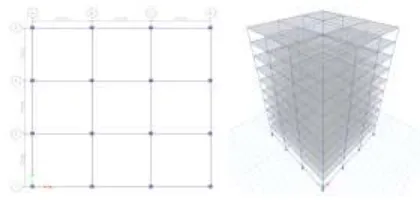
[image:2.612.342.552.91.191.2]The overall dimension of the plan is 22.5 X 22.5 m. Typical plan and elevation of the structure modeled in ETABS software tool is shown in the figures below
Figure 4.1 Plan and Elevation of the structure
PROBLEM STATEMENT
Column section of
RCC structure 0.50 x 0.50 m
Beam section of RCC
structure 0.30 x 0.60 m
Slab thickness 0.100 m
Concrete grade M25 and M30
Storey height 3m
Total height of build
ing 30.6m
Type of soil TYPE II
medium
Zones II and III
Dead load 1.5 kN/m2
Live load 4 kN/m2
4.2 LOAD COMBINATION
Load Combinations should be considered based on what design code and requirements of the area in which the structure is built.The load combinations is taken as per IS 1893 (Part 1): 2002. ETABS automatically generates default load combinations when at least one user defined combination is not specified under both the strength and
the deflection tab. Program design is based on a set of
loading combinations.
4.3 ETABS MODELLING
ETABS stands for Extended 3D (Three-Dimensional)
Analysis of Building Systems. ETABS is an
© 2019, IRJET | Impact Factor value: 7.211 | ISO 9001:2008 Certified Journal
| Page 3685
building analysis and design. Modeling tools andtemplates, code-based load prescriptions, analysis methods and solution techniques, all coordinate with the grid-like geometry unique to this class of structure. ETABS offers a single user interface to perform: Modeling,
Analysis, Design, and Reporting. Basic or advanced
systems under static or dynamic conditions may be evaluated using ETABS. For a sophisticated assessment of seismic performance, modal and direct-integration time-history analyses may couple with P-Delta and Large Displacement effects.
[image:3.612.55.267.288.337.2]Structure is modeled in ETABS as per the specification given by the beginning of this chapter. Typical plan and elevation of the structure modeled in ETABS software tool is shown in the figures below:
Figure 4.3 Plan and elevation of the structure in ETABS software tool
4.3.1 MATERIAL PROPERTIES
BEAMS COLUMNS
Concrete M30 M25
Density 25KN/m3 25KN/m3
Modulus of
Elasticity 25 N/mm2 K
25 K
N/mm2
4.3.2 SECTION PROPERTIES
Beams:0.3 m x 0.6 m
Columns:0.5 m x 0.5 m
Slab:0.100 m
4.3.3 ASSIGNING OF LOADS AND LOAD COMBINATION
Dead load : 1.5 kN/m2
[image:3.612.328.574.390.605.2]Live load : 4 kN/m2
Figure 4.4 Assigning of Loads and Load Combination
Structure is modeled in ETABS 2016 software tool as per the specification given in the beginning of this chapter. The structure is being analyzed in ETABS 2016 software tool after modelling the structure and results are discussed in detail in next chapter.
5. RESULTS AND DISCUSSION
Different parameters are discussed graphically after the complete analysis of the modeled structure. Different parameters discussed are displacement, storey force and moment.
5.1 VARIATION OF DISPLACEMENT
By observing the graph it is clear that displacement obtained by using P-delta analysis is higher than the linear static analysis. Therefore the displacement is significantly influenced by P-delta effect. As the height of structure is increased i.e slenderness increase the displacement also increases. The slenderness increases due to lower bay i.e 3 X 3 therefore the displacement increases. By observing the results it is clear that the displacement increases as the intensity of zone increases. Similarly the P-delta effect also increases as the intensity of zone increases.
No of Storey Disp without p-delta (mm) Disp with p-delta(mm) % Difference of
Zone II Zone III Zone II Zone III Zone II Zone III
Ground
storey 1.12 2.21 1.28 2.43 14.37 10.03
1 2.18 9.33 2.33 10.10 6.76 8.26
2 3.41 12.58 3.94 14.66 15.44 16.94
3 6.87 21.96 7.99 25.75 16.31 17.26
4 11.94 28.24 12.27 30.69 2.72 8.17
5 13.65 34.19 14.57 36.95 6.72 8.32
6 15.55 35.93 17.72 40.73 13.92 13.24
7 17.99 39.62 20.58 46.02 14.40 16.14
8 21.47 40.89 23.04 49.26 7.31 20.46
9 23.92 45.52 24.97 54.32 4.36 19.33
[image:3.612.54.272.624.701.2]10 24.0 49.46 26.22 61.10 9.16 23.53
Figure 5.1 Variation of displacement with and without P-delta effect in zone II
Figure 5.1 Variation of displacement with and without P-delta effect in zone III
5.2 VARIATION OF STOREY FORCE
By observing the graph it is clear that storey force obtained by using P-delta analysis is higher than the linear static analysis. Storey force also increases as there is increase in seismic zone factor it is due to severity of earthquake. The results obtained with P-delta analysis are more than without P-delta analysis. The increase in the value of P-delta analysis becomes significant than without P-delta analysis, it is considered in the design of reinforced concrete frame rectangular plan configuration structure.
No of
Storey SF without p-delta (mm) SF with p-delta(mm) % Difference of
Zone II Zone III Zone II Zone III Zone II Zone III
Ground
storey 230.14 382.30 244.90 476.12 6.41 24.54
1 440.83 705.33 451.82 875.43 2.49 24.11
2 612.21 961.95 693.54 1073.70 13.28 11.61
3 734.87 1159.79 782.94 1271.04 6.54 9.59
4 816.56 1206.49 886.91 1320.51 8.61 9.45
5 898.06 1309.69 933.02 1419.21 3.89 8.36
6 903.13 1477.01 996.14 1496.03 10.28 1.28
7 977.56 1486.09 1091.17 1535.72 11.62 3.33
8 1099.10 1489.57 1238.01 1595.80 12.63 7.13
9 1104.52 1520.04 1386.83 1651.98 25.55 8.68
[image:4.612.339.559.467.615.2]10 1203.54 1540.06 1387.08 1662.14 15.20 7.92
Table 5.1 Variation of Storey Force with and without P-delta effect in zone II and zone III
Figure 5.1 Variation of Storey Froce with and without P-delta effect in zone II
Figure 5.1 Variation of Storey Froce with and without P-delta effect in zone III
5.3 VARIATION OF MOMENT
By observing the graph it is clear that moment obtained by using P-delta analysis is higher than the linear static analysis. The moment of G + 10 storey of reinforced concrete framed structure with different seismic zone are 0
10 20 30 40 50 60
1 2 3 4 5 6 7 8 9 10 11
Di
sp
lace
m
en
t
No of Stories
disp with p-delta disp without p- delta
0 20 40 60 80 100 120
1 2 3 4 5 6 7 8 9 10 11
Di
sp
lace
m
en
t
No of Stories
disp without p- delta disp with p-delta
0 2000 4000
1 2 3 4 5 6 7 8 9 10 11
Store
y Force
No of Stories
Storey force with P-delta
Storey Froce without P-delta
0 1000 2000 3000 4000
1 2 3 4 5 6 7 8 9 10 11
Sto
re
y Fo
rce
No of Stories
Storey Froce with P-delta
© 2019, IRJET | Impact Factor value: 7.211 | ISO 9001:2008 Certified Journal
| Page 3687
obtained. The moment for reinforced concrete framed rectangular plan configuration structure with respect to seismic zone II and III are plotted. The moment increases with P-delta analysis than without P-delta analysis, therefore P-delta analysis becomes necessary.
No of
Storey Mom without p-delta (mm) Mom with p-delta(mm) % Difference of
Zone II Zone III Zone II Zone III Zone II Zone III
Ground
storey 15261.4 17278.9 16815.3 18289.1 10.182 5.84
1 15261.3 17178.7 16815.2 17678.1 10.182 2.90
2 15206.4 16120.1 15214.6 16229.3 0.054 0.67
3 15023.1 15599.6 15120.1 16030.2 0.646 2.76
4 14635.4 14611.1 14943.5 15620.1 2.105 6.90
5 13967.4 14198.6 14002.1 14901.6 0.248 4.95
6 12943.7 13206.4 13216.7 14417.3 2.109 9.16
7 11488.2 12453.8 11786.1 12861.6 2.593 3.27
8 9525.07 11160.0 11427.1 11972.7 19.969 7.28
9 6979.02 7344.26 7023.45 7756.93 0.637 5.61
[image:5.612.344.562.76.238.2]10 3719.25 4225.67 4520.15 4730.21 21.534 11.94
[image:5.612.30.295.161.508.2] [image:5.612.45.277.544.695.2]Table 5.1 Variation of Moment with and without P-delta effect in zone II and zone III
Figure 5.1 Variation of Moment with and without P-delta effect in zone II
Figure 5.1 Variation of Moment with and without P-delta effect in zone III
6. CONCLUSIONS
1. It is clear from results that P-delta analysis is
beneficial.
2. Second order effects increase the deflections,
moments and forces beyond those calculated by first order analysis. So as structural engineer must consider second order analysis.
3. Requirement of P-delta analysis is necessary for
structure higher than 7 storey as wide displacement, moment and storey force varies with increasing slenderness.
4. The moment obtained from the analysis show a
different tendency the moment value decreases as their is increase in storey.
5. Displacement, Storey force and moment increases as
there is increase in seismic zone factor, it is due to severity of earthquake.
REFERENCES
1. Neeraj Kulkarni, S.M.Maheswerappa, Dr.J.K.Dattatraya
(2015): Presented “Study of P-Delta Effect on Tall Steel Structure ”Vol 2, Issue 4.
2. A. N. Pattar, S. M. Muranal (2017): Presented “P-delta
effect on multi-storey buildings ”Vol 6, Issue 3.
3. ManikRao, Rajendrakumar S Harsoor (2016):
Presented “Effect of p-delta in seismic analysis of multistorey buildings ”Vol 5, Issue 11.
4. Rajat Sharma, Raghvendra Singh (2017): Presented
“P-Delta Effects on Tall RC Buildings with and Without Shear Wall ”Vol 4, Issue 11.
0 10000 20000 30000 40000
1 2 3 4 5 6 7 8 9 10 11
Mo
m
en
t
No of Stories
Moment with P-delta
Moment without P-delta
0 10000 20000 30000 40000
1 2 3 4 5 6 7 8 9 10 11
Mp
m
en
t
No of Stories
Moment with P-delta
5. Rafaa M. Abbas and Anas N. Hassony (2018): Presented “Stability analysis of the seismic response of high rise steel buildings including p-delta effects” Vol 2, Issue 8.
6. Deepak.G, Arunkumar B.N (2017): Presented “P-delta