SOFTWARE ERROR
SOFTWARE ERROR
DETECTION THROUGH
TESTING AND ANALYSIS
J. C. Huang
University of HoustonCopyrightC2009 by John Wiley & Sons, Inc. All rights reserved. Published by John Wiley & Sons, Inc., Hoboken, New Jersey. Published simultaneously in Canada.
No part of this publication may be reproduced, stored in a retrieval system, or transmitted in any form or by any means, electronic, mechanical, photocopying, recording, scanning or otherwise, except as permitted under Sections 107 or 108 of the 1976 United States Copyright Act, without either the prior written permission of the Publisher, or authorization through payment of the appropriate per-copy fee to the Copyright Clearance Center, Inc., 222 Rosewood Drive, Danvers, MA 01923, (978) 750-8400, fax (978) 750-4470, or on the web at www.copyright.com. Requests to the Publisher for permission should be addressed to the Permissions Department, John Wiley & Sons, Inc., 111 River Street, Hoboken, NJ 07030, (201) 748-6011, fax (201) 748-6008, or online at http://www.wiley.com/go/permission. Limit of Liability/Disclaimer of Warranty: While the publisher and author have used their best efforts in preparing this book, they make no representations or warranties with respect to the accuracy or completeness of the contents of this book and specifically disclaim any implied warranties of merchantability or fitness for a particular purpose. No warranty may be created or extended by sales representatives or written sales materials. The advice and strategies contained herein may not be suitable for your situation. You should consult with a professional where appropriate. Neither the publisher nor author shall be liable for any loss of profit or any other commercial damages, including but not limited to special, incidental, consequential, or other damages.
For general information on our other products and services or for technical support, please contact our Customer Care Department within the United States at (800) 762-2974, outside the United States at (317) 572-3993 or fax (317) 572-4002.
Wiley also publishes its books in a variety of electronic formats. Some content that appears in print may not be available in electronic formats. For more information about Wiley products, visit our web site at www.wiley.com.
Library of Congress Cataloging-in-Publication Data:
Huang, J. C., 1935–
Software error detection through testing and analysis / J. C. Huang. p. cm.
Includes bibliographical references and index. ISBN 978-0-470-40444-7 (cloth)
1. Computer software–Testing. 2. Computer software–Reliability. 3. Debugging in computer science. I. Title.
QA76.76.T48H72 2009 005.14–dc22
2008045493 Printed in the United States of America
CONTENTS
Preface ix
1 Concepts, Notation, and Principles 1
1.1 Concepts, Terminology, and Notation 4 1.2 Two Principles of Test-Case Selection 8
1.3 Classification of Faults 10
1.4 Classification of Test-Case Selection Methods 11
1.5 The Cost of Program Testing 12
2 Code-Based Test-Case Selection Methods 14
2.1 Path Testing 16
2.2 Statement Testing 17
2.3 Branch Testing 21
2.4 Howden’s and McCabe’s Methods 23
2.5 Data-Flow Testing 26
2.6 Domain-Strategy Testing 36
2.7 Program Mutation and Fault Seeding 39
2.8 Discussion 46
Exercises 51
3 Specification-Based Test-Case Selection Methods 53
3.1 Subfunction Testing 55
3.2 Predicate Testing 68
3.3 Boundary-Value Analysis 70
3.4 Error Guessing 71
3.5 Discussion 72
Exercises 73
4 Software Testing Roundup 76
4.1 Ideal Test Sets 77
4.2 Operational Testing 80
4.3 Integration Testing 82
4.4 Testing Object-Oriented Programs 84
4.6 Criteria for Stopping a Test 88 4.7 Choosing a Test-Case Selection Criterion 90
Exercises 93
5 Analysis of Symbolic Traces 94
5.1 Symbolic Trace and Program Graph 94 5.2 The Concept of a State Constraint 96 5.3 Rules for Moving and Simplifying Constraints 99 5.4 Rules for Moving and Simplifying Statements 110
5.5 Discussion 114
5.6 Supporting Software Tool 126
Exercises 131
6 Static Analysis 132
6.1 Data-Flow Anomaly Detection 134
6.2 Symbolic Evaluation (Execution) 137
6.3 Program Slicing 141
6.4 Code Inspection 146
6.5 Proving Programs Correct 152
Exercises 161
7 Program Instrumentation 163
7.1 Test-Coverage Measurement 164
7.2 Test-Case Effectiveness Assessment 165 7.3 Instrumenting Programs for Assertion Checking 166 7.4 Instrumenting Programs for Data-Flow-Anomaly Detection 169 7.5 Instrumenting Programs for Trace-Subprogram Generation 181
Exercises 192
Appendix A: Logico-Mathematical Background 194
Appendix B: Glossary 213
Appendix C: Questions for Self-Assessment 220
Bibliography 237
PREFACE
The ability to detect latent errors in a program is essential to improving program reliability. This book provides an in-depth review and discussion of the methods of software error detection using three different techniqus: testing, static analysis, and program instrumentation. In the discussion of each method, I describe the basic idea of the method, how it works, its strengths and weaknesses, and how it compares to related methods.
I have writtent this book to serve both as a textbook for students and as a technical handbook for practitioners leading quality assurance efforts. If used as a text, the book is suitable for a one-semester graduate-level course on software testing and analysis or software quality assurance, or as a supplementary text for an advanced graduate course on software engineering. Some familiarity with the process of software quality assurance is assumed. This book provides no recipe for testing and no discussion of how a quality assurance process is to be set up and managed.
In the first part of the book, I discuss test-case selection, which is the crux of problems in debug testing. Chapter 1 introduces the terms and notational conventions used in the book and establishes two principles which together provide a unified conceptual framework for the existing methods of test-case selection. These principles can also be used to guide the selection of test cases when no existing method is deemed applicable. In Chapters 2 and 3 I describe existing methods of test-case selection in two categories: Test cases can be selected based on the information extracted form the source code of the program as described in Chapter 2 or from the program specifications, as described in Chapter 3. In Chapter 4 I tidy up a few loose ends and suggest how to choose a method of test-case selection.
I then proceed to discuss the techniques of static analysis and program instru-mentation in turn. Chapter 5 covers how the symbolic trace of an execution path can be analyzed to extract additional information about a test execution. In Chapter 6 I address static analysis, in which source code is examined systematically, manually or automatically, to find possible symptoms of programming errors. Finally, Chapter 7 covers program instrumentation, in which software instruments (i.e., additional program statements) are inserted into a program to extract information that may be used to detect errors or to facilitate the testing process.
Because precision is necessary, I have made use throughout the book of concepts and notations developed in symbolic logic and mathematics. A review is included as Appendix A for those who may not be conversant with the subject.
these methods cannot be put into practice without proper tool support. The cost of the tools required for complete automation is so high that it often rivals that of a major programming language compiler. Software vendors with products on the mass market can afford to build these tools, but there is no incentive for them to do so because under current law, vendors are not legally liable for the errors in their products. As a result, vendors, in effect, delegate the task of error detection to their customers, who provide that service free of charge (although vendors may incur costs in the form of customer dissatisfaction). Critical software systems being built for the military and industry would benefit from the use of these methods, but the high cost of necessary supporting tools often render them impractical, unless and until the cost of supporting tools somehow becomes justifiable. Neverthless, I believe that knowledge about these existing methods is useful and important to those who specialize in software quality assurance.
I would like to take opportunity to thank anonymous reviewers for their comments; William E. Howden for his inspiration; Raymond T. Yeh, Jos´e Mu˜noz, and Hal Watt for giving me professional opportunities to gain practical experience in this field; and John L. Bear and Marc Garbey for giving me the time needed to complete the first draft of this book. Finally, my heartfelt thanks go to my daughter, Joyce, for her active and affectionate interest in my writing, and to my wife, Shih-wen, for her support and for allowing me to neglect her while getting this work done.
1
Concepts, Notation, and Principles
Given a computer program, how can we determine whether or not it will do exactly what it is intended to do? This question is not only intellectually challenging, but also of primary importance in practice. An ideal solution to this problem would be to develop certain techniques that can be used to construct a formal proof (or disproof) of the correctness of a program systematically. There has been considerable effort to develop such techniques, and many different techniques for proving program correctness have been reported. However, none of them has been developed to the point where it can be used readily in practice.
There are several technical hurdles that prevent formal proof of correctness from becoming practical; chief among them is the need for a mechanical theorem prover. The basic approach taken in the development of these techniques is to translate the problem of proving program correctness into that of proving a certain statement to be a theorem (i.e., always true) in a formal system. The difficulty is that all known automatic theorem-proving techniques require an inordinate amount of computation to construct a proof. Furthermore, theorem proving is a computationally unsolvable problem. Therefore, like any other program written to solve such a problem, a theorem prover may halt if a solution is found. It may also continue to run without giving any clue as to whether it will take one more moment to find the solution, or whether it will take forever. The lack of a definitive upper bound of time required to complete a job severely limits its usefulness in practice.
Until there is a major breakthrough in the field of mechanical theorem proving, which is not foreseen by the experts any time soon, verification of program correctness through formal proof will remain impractical. The technique is too costly to deploy, and the size of programs to which it is applicable is too small (relative to that of programs in common use). At present, a practical and more intuitive solution would be to test-execute the program with a number of test cases (input data) to see if it will do what it is intended to do.
How do we go about testing a computer program for correctness? Perhaps the most direct and intuitive answer to this question is to perform an exhaustive test: that is, to test-execute the program for all possible input data (for which the program is expected to work correctly). If the program produces a correct result for every possible input, it obviously constitutes a direct proof that the program is correct. Unfortunately, it is in general impractical to do the exhaustive test for any nontrivial program simply because the number of possible inputs is prohibitively large.
To illustrate, consider the following C++program. Program 1.1
main () {
int i, j, k, match;
cin >> i >> j >> k; cout << i << j << k;
if (i <= 0 || j <= 0 || k <= 0
|| i+j <= k || j+k <= i || k+i <= j) match = 4;
else if !(i == j || j == k || k == i) match = 3;
else if (i != j || j != k || k != i) match = 2;
else match = 1;
cout << match << endl; }
If, for an assignment of values to the input variablesi,j, andk, the output variable matchwill assume a correct value upon execution of the program, we can assert that the program is correct for this particular test case. And if we can test the program for all possible assignments toi,j, andk, we will be able to determine its correctness. The difficulty here is that even for a small program like this, with only three input variables, the number of possible assignments to the values of those variables is prohibitively large. To see why this is so, recall that an ordinary integer variable in C++can assume a value in the range−32,768 to+32,767 (i.e., 216different values). Hence, there are 216 ×216 ×216 =248 ≈256×1012 possible assignments to the input triple (i,j,k). Now suppose that this program can be test-executed at the rate of one test per microsecond on average, and suppose further that we do testing 24 hours a day, 7 days a week. It will take more than eight years for us to complete an exhaustive test for this program. Spending eight years to test a program like this is an unacceptably high expenditure under any circumstance!
This example clearly indicates that an exhaustive test (i.e., a test using all possible input data) is impractical. It may be technically doable for some small programs, but it would never be economically justifiable for a real-world program. That being the case, we will have to settle for testing a program with a manageably small subset of its input domain.
Engineers (IEEE) terminology, the desired test cases would be those that have a high probability of revealing faults.
Other than software developers, expert users of a software system may also have the need to do testing. For a user, the main purpose is to assess the reliability so that the responsible party can decide, among other things, whether or not to accept the software system and pay the vendor, or whether or not there is enough confidence in the correctness of the software system to start using it for a production run. In that case the test cases have to be selected based on what is available to the user, which often does not include the source code or program specification. Test-case selection therefore has to be done based on something else.
Information available to the user for test-case selection includes the probability distribution of inputs being used in production runs (known as theoperational profile) and the identity of inputs that may incur a high cost or result in a catastrophe if the program fails. Because it provides an important alternative to debug testing, possible use of an operational profile in test-case selection is explained further in Section 4.2. We discuss debug testing in Chapters 2 and 3. Chapter 4 is devoted to other aspects of testing that deserve our attention. Other than testing as discussed in Chapters 2 and 3, software faults can also be detected by means of analysis, as discussed in Chapters 5 through 7.
When we test-execute a program with an input, the test result will be either correct or incorrect. If it is incorrect, we can unequivocally conclude that there is a fault in the program. If the result is correct, however, all that we can say with certainty is that the program will execute correctly for that particular input, which is not especially significant in that the program has so many possible inputs. The significance of a correct test result can be enhanced by analyzing the execution path traversed to determine the condition under which that path will be traversed and the exact nature of computation performed in the process. This is discussed in Chapter 5.
We can also detect faults in a program by examining the source code systematically as discussed in Chapter 6. The analysis methods described therein are said to be static, in that no execution of the program is involved. Analysis can also be done dynamically, while the program is being executed, to facilitate detection of faults that become more obvious during execution time. In Chapter 7 we show how dynamic analysis can be done through the use of software instruments.
For the benefit of those who are not theoretically oriented, some helpful logico-mathematical background material is presented in Appendix A. Like many others used in software engineering, many technical terms used in this book have more than one possible interpretation. To avoid possible misunderstanding, a glossary is included as Appendix B. For those who are serious about the material presented in this book, you may wish to work on the self-assessment questions posed in Appendix C.
1.1 CONCEPTS, TERMINOLOGY, AND NOTATION
Theinput domainof a program is the set of all possible inputs for which the program is expected to work correctly. It is constrained by the hardware on which the program is to be executed, the operating system that controls the hardware, the programming environment in which the program is developed, and the intent of the creator of the program. If none of these constraints are given, the default will be assumed.
For example, consider Program 1.1. The only constraint that we can derive from what is given is the fact that all variables in the program are of the type “short integer” in C++. The prevailing standard is to use 16 bits to represent such data in 2’s-complement notation, resulting in the permissible range−32,768 to 32,767 in decimal. The input domain therefore consists of all triples of 16-bit integers; that is,
D= {<x,y,z>|x,y, andzare 16-bit integers}
Input(data) are elements of the input domain, and atest caseis an input used to perform a test execution. Thus, every test case is an input, but an input is not necessarily a test case in a particular test. The set of all test cases used in testing is called atest set. For example,<3, 5, 2>is a possible input (or test case) in Program 1.1, and in a particular test we might choose{<1, 2, 3>,<4, 5, 6>,<0, 0, 5>,<5, 0, 1>,<3, 3, 3>}as the test set.
This notational convention for representing program inputs remains valid even if the program accepts an input repeatedly when run in an interactive mode (i.e., sequence of inputs instead of a single input). All we need to do is to say that the input domain is a product set instead of a simple set. For example, consider a program that reads the value of input variablex, which can assume a value from set X. If the function performed by the program is not influenced by the previous value of x, we can simply say that X is the input domain of the program. If the function performed by the program is dependent on the immediately preceding input, we can make the product setX·X= {<x1,x2>|x1 ∈X and x2∈ X}the input domain. In general, if the function performed by the program is dependent on nimmediately preceding inputs, we can make the product set Xn+1= {<x1,x2, . . . ,xn,xn+1>
|xi∈ Xfor all 1≤i≤n+1}the input domain. This is the property of a program
with memory, often resulting from implementing the program with a finite-state machine model. The value ofnis usually small and is related to the number of states in the finite-state machine.
Do not confuse a program with memory with an interactive program (i.e., a program that has to be executed interactively). Readers should have no difficulty convincing themselves that an interactive program could be memoryless and that a program with memory does not have to be executed interactively. We shall now proceed to define some terms in program testing that might, at times, have a different meaning for different people.
domain may satisfy the same criterion. Examples of a test-case selection criterion include T = {0,1,2,3},T = {<i,j,k>|i= j=k andk>1 and k<10}, and “T is a set of inputs that cause 60% of the statements in the program to be exercised at least once during the test.”
LetDbe the input domain of a given programP, and let OK(P,d), whered ∈D, be a predicate that assumes the value of TRUE if an execution of program P with inputd terminates and produces a correct result, and FALSE otherwise. Predicate OK(P,d) can be shortened to OK(d) if the omission ofPwould not lead to confusion. After we test-execute the program with inputd, how can we tell if OK(d) is true? Two assumptions can be made in this regard. One is that the program specification is available to the tester. OK(d) is true if the program produced a result that satisfies the specification. Another is the existence of anoracle, a device that can be used to determine if the test result is correct. The target-practice equipment used in testing the software that controls a computerized gunsight is a good example of an oracle. A “hit” indicates that the test is successful, and a “miss” indicates otherwise. The main difference between a specification and an oracle is that a specification can be studied to see how to arrive at a correct result, or the reason why the test failed. An oracle gives no clue whatsoever.
LetT be a test set: a subset ofDused to test-execute a program. A test usingT is said to besuccessfulif the program terminates and produces a correct result for every test case inT. A successful test is to be denoted by the predicate SUCCESSFUL(T). To be more precise,
SUCCESSFUL (T)≡(∀t)T(OK(t))
The reader should not confuse a successful test execution with a successful pro-gram test using test set T. The test using T fails if there exists a test case in T that causes the program to produce an incorrect result [i.e.,¬SUCCESSFUL(T)≡ ¬(∀t)T(OK(t))≡(∃t)T(¬OK(t))]. The test usingT is successful if and only if the
program executes correctly for all test cases inT.
Observe that not every component in a program is involved in program execution. For instance, if Program 1.1 is executed with inputi = j = k = 0, the assign-ment stateassign-mentmatch = 1will not be involved. Therefore, if this statement is faulty, it will not be reflected in the test result. This is one reason that a program can be fortuitously correct, and therefore it is insufficient to test a program with just one test case.
According to the IEEE glossary, a part of a program that causes it to produce an incorrect result is called afaultin that program. A fault causes the program to fail (i.e., to produce incorrect results) for certain inputs. We refer to an aggregate of such inputs as afailure set, usually a small subset of the input domain.
is because for all practical programs, a single test case will not cause all program components to become involved in the test execution, and if there is a fault in a component, it will not be reflected in the test result unless that component is involved in the test execution.
Of course, one may argue that a single test case would suffice if the entire program were considered as a component. How we choose to define a component for test-case selection purposes, however, will affect our effectiveness in revealing faults. If the granularity of component is too coarse, part of a component may not be involved in test execution, and therefore a fault contained therein may not be reflected in the test result even if that component is involved in the test execution. On the other hand, if the granularity of the component is too fine, the number of test cases required and the effort required to find them will become excessive. For all known unit-testing meth-ods, the granularities of the component range from a statement (finest) to an execution path (coarsest) in the source code, with one exception that we discuss in Section 7.2, where the components to be scrutinized are operands and expressions in a statement. For debug testing, we would like to reveal at least one fault in the test. To be more precise, we would like to maximize the probability that at least one test case causes the program to produce an incorrect result. Formally, we would like to maximize
p(¬OK(t1) ∨ ¬OK(t2) ∨ · · · ∨ ¬OK(tn))= p((∃t)T(¬OK(t)))
= p(¬(∀t)T(OK(t)))
=1−p((∀t)T(OK(t)))
The question now is: What information can be used to construct such a test set? It is well known that programmers tend to forget writing code to make sure that the program does not do division by zero, does not delete an element from an empty queue, does not traverse a linked list without checking for the end node, and so on. It may also be known that the author of the program has a tendency to commit certain types of error or the program is designed to perform certain functions that are particularly difficult to implement. Such information can be used to find test cases for which the program is particularly error-prone [i.e., the probability p(¬OK(t1)∨ ¬OK(t2)· · · ∨ ¬OK(tn))
is high]. The common term for making use of such information iserror guessing. The essence of that technique is described in Section 3.4.
Other than the nature or whereabouts of possible latent faults, which are unknown in general, the most important information that we can derive from the program and use to construct a test set is the degree of similarity to which two inputs are processed by the program. It can be exploited to enhance the effectiveness of a test set. To see why that is so, suppose that we choose some test case,t1, to test the program first, and we wish to select another test case,t2, to test the program further. What relationship must hold betweent1andt2so that the joint fault discovery probability is arguably enhanced?
the probability that the program will execute correctly with inputt2 given the fact that the program executed correctly witht1. To be exact,
p(¬OK(t1)∨ ¬OK(t2))= p(¬(OK(t1)∧OK(t2))) =p(¬(OK(t2)∧OK(t1))) =1−p(OK(t2)∧OK(t1))
=1−p(OK(t2)|OK(t1))p(OK(t1))
This equation shows that if we can choose t2 to make the conditional probability p(OK(t2)|OK(t1)) smaller, we will be able to increase p(¬OK(t1)∨ ¬OK(t2)), the probability of fault discovery.
The value of p(OK(t2) | OK(t1)) depends on, among other factors, the degree of similarity of operations performed in execution. If the sequences of operations performed in test-executing the program using t1 andt2 are completely unrelated, it should be intuitively clear that p(OK(t2)|OK(t1))=p(OK(t2)), that is, the fact that the program test-executed correctly with t1 does not influence the probability that the program will test-execute correctly with test caset2. Therefore, p(OK(t2)∧ OK(t1))= p(OK(t2))p(OK(t1)). On the other hand, if the sequences of operations performed are similar, then p(OK(t2)|OK(t1))> p(OK(t2)), that is, the probability that the program will execute correctly will become greater given that the program test-executes correctly with inputt1. The magnitude of the difference in these two probabilities, denoted by
␦(t1,t2)=p(OK(t2)|OK(t1))−p(OK(t2))
depends on, among other factors, the degree of commonality or similarity between the two sequences of operations performed by the program in response to inputst1 andt2.
For convenience we shall refer to␦(t1,t2) henceforth as the (computational) cou-pling coefficient between test casest1 andt2, and simply write␦if the identities of t1andt2are understood. The very basic problem of test-case selection can now be stated in terms of this coefficient simply as follows. Given a test case, find another that is as loosely coupled to the first as possible!
Perhaps a more direct way to explain the significance of the coupling coefficient
␦(t1,t2) is that
p(¬OK(t1)∨ ¬OK(t2))=1−p(OK(t2)|OK(t1))p(OK(t1)) =1−(p(OK(t2)|OK(t1))−p(OK(t2)) +p(OK(t2)))p(OK(t1))
=1−(␦(t1,t2)+p(OK(t2)))p(OK(t1))
=1−␦(t1,t2)p(OK(t1))−p(OK(t2))p(OK(t1))
The values of p(OK(t1)) and p(OK(t2)) are intrinsic to the program to be tested; their values are generally unknown and beyond the control of the tester. The tester, however, can selectt1andt2with a reduced value of the coupling coefficient␦(t1,t2), thereby increasing the fault-discovery probabilityp(¬OK(t1)∨ ¬OK(t2)).
How can we reduce the coupling coefficient␦(t1,t2)? There are a number of ways to achieve that, as discussed in this book. One obvious way is to selectt1andt2from different input subdomains, as explained in more detail later.
1.2 TWO PRINCIPLES OF TEST-CASE SELECTION
Now we are in a position to state two principles. The first principle of test-case selectionis that in choosing a new element for a test set being constructed, preference should be given to those candidates that are computationally as loosely coupled as possible to all the existing elements in the set. A fundamental problem then is: Given a program, how do we construct a test set according to this principle? An obvious answer to this question is to select test cases such that the program will perform a distinctly different sequence of operations for every element in the set.
If the test cases are to be selected based on the source code, the most obvious candidates for the new element are those that will cause a different execution path to be traversed. Since almost all practical programs have a large number of possible execution paths, the next question is when to stop adding test cases to the test set. Since the purpose of using multiple test cases is to cause every component, however that is defined, to be exercised at least once during the test, the obvious answer is to stop when there are enough elements in the test set to cause every component to be exercised at least once during the test.
and therefore become handy under situations when no existing method is applicable. For example, when a new software system is procured, the user organization often needs to test it to see if it is reliable enough to pay the vendor and release the system for production runs. If an operational profile is available, the obvious choice is to perform operational testing as described in Section 4.2. Otherwise, test-case selection becomes a problem, especially if the system is fairly large. Source code is generally not available to the user to make use of the methods presented in Chapter 2, and detailed design documents or specifications are not available to use the methods presented in Chapter 3. Even if they are available, a typical user organization simply does not have the time, resources, and technical capability to deploy the methods. In that event, the two principles can be utilized to select test cases. The components to be exercised could be the constituent subsystems, which can be recognized by reading the system user manual. Two inputs are weakly coupled computationally if they cause different subsystems to be executed in different sequences. Expert users should be able to apply the two principles readily to achieve a high probability of fault detection. In short, if one finds it difficult to use any existing method, use the two principles instead.
Next, in practical application, we would like to be able to compare the cost-effectiveness of test sets. In the literature, the cost-effectiveness of a test set is measured by the probability of discovering at least one fault in the test (see, e.g., [FHLS98]). It is intuitively clear that we can increase the fault-discovery capability of a test set simply by adding elements to it. If we carry this idea to the extreme, the test set eventually would contain all possible inputs. At that point, a successful test constitutes a direct proof of correctness, and the probability of fault discovery is 100%. The cost of performing the test, however, will become unacceptably high. Therefore, the number of elements in a test set must figure prominently when we compare the cost-effectiveness of a test set. We define thecost-effectiveness of a test setto be the probability of revealing a fault during the test, divided by the number of elements in the test set.
1.3 CLASSIFICATION OF FAULTS
In the preceding section we said that a test case should be selected from a subdomain or a subset of inputs that causes a component to be exercised during the test. Is there a better choice if there is more than one? Is there any way to improve the fault-detection probability by using more than one test case from each subdomain? The answer depends on the types of faults the test is designed to reveal. What follows is a fault classification scheme that we use throughout the book.
In the abstract, the intended function of a program can be viewed as a function f of the nature f : X→Y. The definition of f is usually expressed as a set of subfunctions f1,f2, . . . , fm, where fi :Xi →Y (i.e., fiis a function f restricted to
Xi for all 1≤i ≤m),X =X1∪X2∪ · · · ∪Xm, and fi = fjifi = j. We shall use
f(x) to denote the value of f evaluated atx∈ X, and suppose that eachXi can be
described in the standard subset notationXi = {x|x∈ X∧Ci(x)}.
Note that, above, we require the specification of f to becompact(i.e., fi = fj
ifi = j). This requirement makes it easier to construct the definition of a type of programming fault in the following. In practice, the specification of a program may not be compact (i.e., fimay be identical to fjfor someiand j). Such a specification,
however, can be made compact by mergingXi andXj.
Let (P,S) denote a program written to implement the functionfdescribed above, where P is the condition imposed on the input andS is the sequence of statements to be executed. Furthermore, letDbe the set of all possible inputs for the program. Set D is the computer-implemented version of set X mentioned above. No other constraints are imposed. The definition of set D, on the hand, will be constrained by programming language used and by the hardware on which the program will be executed. For example, if it is implemented as the short integers in C++, thenDis a set of all integers representable by using 16 bits in 2’s-complement notation. The valid input domain (i.e., the set of all inputs for which the program is expected to work correctly) is seen to be the set{d |d ∈ D and P(d)}. The program should be composed ofnpaths:
(P,S)=(P1,S1)+(P2,S2)+ · · · +(Pn,Sn)
Here (Pi,Si) is a subprogram designed to compute some subfunction fj.P ≡P1∨ P2∨ · · · ∨Pn, and P is in general equal to T (true) unless the programmer places
additional restrictions on the inputs. We shall use S(x) to denote the computation performed by an execution ofSwithxas the input.
the specification, there is a computational fault. To be more precise, we can restate the definitions as follow.
1. Computational fault. The program has a computational fault if (∃i)(∃j)((Pi ⊃
Cj∧Si(x)= fj(x)).
2. Domain fault. The program has a domain fault if¬(∀i)(∃j)(Pi ⊃Cj).
In words, if the program specification says that the input domain should consist of m subdomains X1,X2, . . . ,Xm, the program should partition the input domain
into n subdomains D1,D2, . . . ,Dn, where n must be greater than or equal to m
if the partition prescribed by the specification is compact. The partition created by the program must satisfy the condition that every Di = {d | d ∈ DandPi(d)}be
contained completely in some Xj,X1∪X2∪. . .∪Xm=X, and D1∪D2∪. . .∪ Dn =D. Otherwise, there is a domain fault.
If there is a subdomainDicreated by the program that is contained completely in
someXj prescribed by the specification, then for every input in Di, the value
com-puted bySimust be equal to that computed by fj. Otherwise, there is a computation
fault.
It is possible that a program contains both domain and computational faults at the same time. Nevertheless, the same element in the input domain cannot be involved in both kinds of fault. If the program is faulty at a particular input, it is either of domain or computational type, but not both.
Previously published methods of program-fault classification include that of Goodenough and Gerhart [GOGE77], Howden [HOWD76], and White and Cohen [WHCO80]. All three include one more type of fault, called a subcase fault or missing-path fault, which occurs when the programmer fails to create a subdomain required by the specification [i.e., if¬(∀i)(∃j)(Ci ⊂Pj)]. Since such a fault also
manifests as a computational fault, we chose, for simplicity, not to identify it as a fault of separate type.
In Chapters 2 and 3 we discuss test-case selection methods that are designed particularly for revealing the domain faults. In such methods, the components to be exercised are the boundaries of subdomains embodied by the predicates found in the source code or program specification.
1.4 CLASSIFICATION OF TEST-CASE SELECTION METHODS
It was observed previously that when a program is being test-executed, not all con-stituent components would be involved. If a faulty component is not involved, the fault will not be reflected in the test result. A necessary condition, therefore, for revealing all faults in a test is to construct the test set in such a way that every contributing component in the program is involved (exercised) in at least one test execution!
control-flow diagram, or a predicate in the program specification. The use of differ-ent compondiffer-ents leads to the developmdiffer-ent of differdiffer-ent test-case selection methods. As shown in Chapters 2 and 3, many test-case selection methods have been developed.
If the component used is to be identified from the source code, the resulting test-case selection method is said to becode-based. The most familiar examples of such a method are the statement test, in which the program is to be tested to the extent that every statement in its source code is exercised at least during the test, and the branch test, in which the program is to be tested to the extent that every branch in its control-flow diagram is traversed at least once during the test. There are several others that cannot be explained as simply. All the methods are discussed in detail in Chapter 2.
If the component used is to be identified from the program specification, the resulting test-case selection method is said to bespecification-based. Examples of the components identifiable from a program specification include predicates, boundaries of input/output variables, and subfunctions. Chapter 3 is devoted to a discussion of such methods.
It is possible that certain components can be identified from either the source code or the program specification. The component defined in the subfunction testing method discussed in Chapter 3 is an example.
Since a component can be also a subdomain consisting of those and only those inputs that cause that component to be exercised during the test, a test-case selection method that implicitly or explicitly requires execution of certain components in the program during the test can also be characterized as being subdomain-based [FHLS98]. The test methods and all of their derivatives, discussed in Chapters 2 and 3, are therefore all subdomain-based.
Are there any test-case selection methods that are not subdomain-based? There are at least two: random testing [DUNT84, CHYU94, BOSC03] and operational testing [MUSA93, FHLS98]. The first, although interesting, is not discussed in this book because its value has yet to be widely recognized. The second is important in that it is frequently used in practice. Because it is neither code- nor specification-based, we choose to discuss it in Section 4.2.
1.5 THE COST OF PROGRAM TESTING
Software testing involves the following tasks: (1) test-case selection; (2) test execu-tion; (3) test-result analysis; and if it is debug testing, (4) fault removal and regression testing.
A commonly used test-case selection criterion is the statement test: testing the pro-gram to the extent that every statement in the source code is exercised at least once during the test. The critics say that this selection criterion is far too simplistic and in-effectual, yet it is still commonly used in practice, partly because the analysis required for test-case selection is relatively simple and can be automated to a great extent.
The process of test-case selection is tedious, time consuming, and error prone. The most obvious way to reduce its cost is through automation. Unfortunately, some parts of that process are difficult to automate. If it is specification based, it requires analysis of text written in a natural language. If test cases satisfying a selection criterion are to be found automatically, it requires computational power close to that of a mechanical theorem prover.
For operational testing, which we discuss in Section 4.2, the cost of test-case selection is minimal if the operational profile (i.e., the probability distribution of inputs to be used in production runs) is known. Even if the operational profile had to be constructed from scratch, the skill needed to do so is much less than that for debug testing. That is one of the reasons that many practitioners prefer operational testing. It should be pointed out, however, that a real operational profile may change in time, and the effort required to validate or to update an existing profile is nontrivial.
Test executionis perhaps the part of the testing process that is most amenable to automation. In addition to the machine time and labor required to run the test, the cost of test execution includes that of writing the test harness (i.e., the additional nondeliverable code needed to produce an executable image of the program).
The cost oftest-result analysisdepends largely on the availability of an oracle. If the correctness of test results has to be deduced from the specification, it may become tedious, time consuming, and error prone. It may also become difficult to describe the correctness of a test result if it consists of a large aggregate of data points, such as a graph of a photographic image. For that reason, the correctness of a program is not always unequivocally definable.
A class of computer programs called real-time programs have hard time con-straints; that is, they not only have to produce results of correct values but have to produce them within prescribed time limits. It often requires an elaborate test harness to feed the test cases at the right time and to determine if correct results are produced in time. For that reason, a thorough test of a real-time software system is usually done under the control of an environment simulator. As the timing aspect of program execution is not addressed in this work, testing of real-time programs is beyond the scope of this book.
2
Code-Based Test-Case
Selection Methods
We start by discussing a family of test methods that can be used to do debug testing, and the test cases are to be selected based on the information that can be extracted from the source code. In debug testing, as explained in Chapter 1, we want to maximize the probability that at least one fault will be revealed by the test. That is, if we use a test set ofnelements, say,T={t1,t2,. . .,tn}, we want to maximize the probability
p(¬OK(t1)∨ ¬OK(t2)∨ · · · ∨ ¬OK(tn))= p((∃t)T(¬OK(t)))
= p(¬(∀t)T(OK(t)))
=1−p((∀t)T(OK(t)))
How do we go about constructing such a test set? We can do it incrementally by lettingT ={t1}first. If there is any information available to find a test case that has a high probability of revealing a fault in the program, make itt1. Otherwise,t1can be chosen arbitrarily from the input domain.
We then proceed to add another test caset2toT so that the probability of fault discovery is maximal. That probability can be expressed as
p(¬OK(t1)∨ ¬OK(t2))= p(¬(OK(t1)∧OK(t2))) = p(¬(OK(t2)∧OK(t1))) =1−p(OK(t2)∧OK(t1))
=1−p(OK(t2)|OK(t1))p(OK(t1))
As explained in Chapter 1, this can be achieved by finding another test case, t2, such thatt1 andt2are as loosely coupled as possible; that is,␦(t1,t2), the coupling coefficient betweent1 andt2, is minimal. The value of␦(t1,t2) is a function of the degree of exclusiveness between the sequences of operations to be performed by the program in response to test casest1andt2.
Now if we proceed to findt3, the third element for the test set, the fault discovery probability to maximize is
p(¬OK(t1)∨ ¬OK(t2)∨ ¬OK(t3)) =p(¬(OK(t1)∧OK(t2)∧OK(t3))) =p(¬(OK(t3)∧OK(t2)∧OK(t1))) =1−p(OK(t3)∧OK(t2)∧OK(t1))
=1−p(OK(t3)|OK(t2)∧OK(t1))p(OK(t2)∧OK(t1))
Again, this probability can be maximized by minimizing the conditional probability p(OK(t3)|OK(t2)∧OK(t1)), that is, the probability that the program will execute correctly witht3given that the program executed correctly witht1andt2. Obviously, this can be accomplished by selectingt3 such that neither OK(t1) nor OK(t2) will have much, if any, impact on the probability p(OK(t3)). That is,t3should be chosen such that both␦(t1,t3) and␦(t2,t3) are minimal.
This process can be repeated to add inputs to the test set. In general, to add a new element to the test setT = {t1,t2, . . . ,ti}, the (i+1)th test caseti+1is to be selected
to maximize the probability
p(¬OK(t1)∨ · · · ∨ ¬OK(ti)∨ ¬OK(ti+1))
=p(¬(OK(t1)∧ · · · ∧OK(ti)∧OK(ti+1)))
=p(¬(OK(ti+1)∧OK(ti)∧ · · · ∧OK(t1))) =1−p(OK(ti+1)∧OK(ti)∧ · · · ∧OK(t1))
=1−p(OK(ti+1)|OK(ti)∧ · · · ∧OK(t1))p(OK(ti)∧ · · · ∧OK(t1))
This probability can be maximized by minimizing the conditional probability p(OK(ti+1)| OK(ti)∧ · · · ∧OK(t1)), that is, by selectingti+1 in such a way that
␦(t1,ti+1),␦(t2,ti+1), . . . ,␦(ti,ti+1) are all minimal. In practice, there are several
dif-ferent ways to do this, each of which led to the development of a difdif-ferent test-case selection method, discussed in this and the following chapters.
is rightly so, because the main purpose of debug testing is to improve the reliability of a software system by detecting and removing latent faults in the system.
To facilitate understanding of the test-case selection methods discussed below, it is useful to think that every method for debug testing is developed as follows. First, a type of programming construct, such as a statement or branch predicate, is identified as the essential component of a program each component of which must be exercised during the test to reveal potential faults. Second, a test-case selection criterion is established to guide the construction of a test set. Third, an analysis method is devised to identify such constructs in a program and to select test cases from the input domain so that the resulting test set is reasonable in size and its elements are loosely coupled computationally. Those are the essential elements of every debug test method.
2.1 PATH TESTING
In path testing, the component to be exercised is the execution path. The test-case selection criterion is defined to select test cases such that every feasible execution path in the program will be traversed at least once during the test. Path testing is interesting in that every feasible execution path defines a subdomain in the input domain, and the resulting set of subdomains constitutes a partition of the input domain. That is, the intersection of any two subdomains is an empty set, and the union of all subdomains is the input domain. In other words, every input belongs to one and only one subdomain, and the subdomains are not overlapping.
If two test cases are selected from the same subdomain, they will be tightly coupled computationally because they will cause the program to test-execute along the same execution path and thus perform the same sequence of operations. On the other hand, if two test cases are selected from different subdomains of this sort, they will cause the program to test-execute along two different execution paths and thus perform different sequences of operations. Therefore, they will have a smaller coupling coefficient, as explained previously. Any subset of the input domain that contains one and only one element from each subdomain defined by the execution paths in the program will satisfy the test-case selection criterion, and the test cases will be loosely coupled.
number of test cases to be used, conceivably at the cost of inevitable reduction in the fault-discovery capabilities.
2.2 STATEMENT TESTING
In a statement test the program is to be tested to the extent that every executable statement in the program is exercised at least once during the test. The merit of a statement test can be explained simply as follows. In general, not every statement in the program is involved in a program execution. If a statement is faulty, and if it is not involved in a test execution, the fault will never be reflected in the test result. To increase the fault-discovery probability, therefore, we should use a test set that causes every statement in the program to be exercised at least once during the test. Consider the C++program that follows.
Program 2.1
Main() {
float a, b, e, w, p, q, u, v;
cin >> a >> b >> e; w = b - a;
while (w > e) { p = a + w / 3; u = f(p); q = b - w / 3; v = f(q); if (u < v)
a = p; else
b = q; w = b - a; }
max = (a + b) / 2; cout << max << endl; }
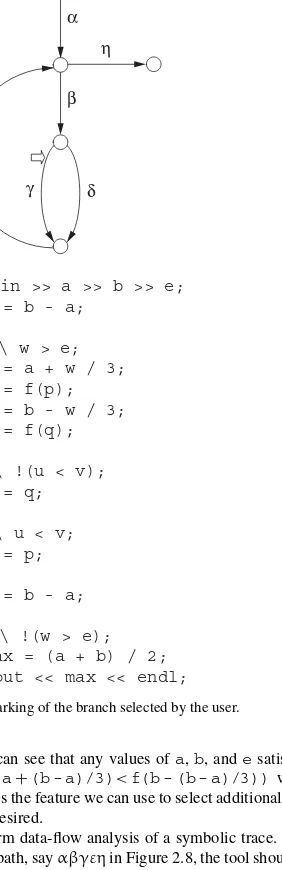
To see the control structure of this program, it is useful to represent it with a directed graph, called a program graph, in which every edge is associated with a pair of the form</ \C,S>, whereCis the condition under which that edge will be traversed andSis the sequence of statements that will be executed in the process.1
1This graphic representation scheme makes it possible to represent a program, or its execution paths, by
α
β
γ
δ
ε
η
α:
cin >> a >> b >> e;
w = b - a;
β:
/\ w > e;
p = a + w / 3;
u = f(p);
q = b - w / 3;
v = f(q);
γ:
/\ !(u < v);
b = q;
δ:
/\ u < v;
a = p;
ε:
w = b - a;
η:
/\ !(w > e);
[image:30.441.146.291.70.510.2]max = (a + b) / 2;
cout << max << endl;
Figure 2.1 Program graph of Program 2.1. (Adapted from [HUAN75].)
2
1 3 4 5 6 7
x f(x)
Figure 2.2 Function plot off(x).
into three equal parts. Then compare the values of the function at the dividing points a+w/3 andb−w/3, wherewis the width of the interval being considered. If the value of the function at a+w/3 is less than that atb −w/3, the leftmost third of the interval is eliminated for further consideration; otherwise, the rightmost third is eliminated. This process is repeated until the width of the interval being considered becomes less than or equal to a predetermined small constante. When that point is reached, the location at which the maximum of the function occurs can be taken as the center of the interval, (a+b)/2, with an error of less thane/2.
Now suppose that we wish to test this program for three different test cases, and assume that the function f(x) can be plotted as shown in Figure 2.2. Let us first arbitrarily choose eto be equal to 0.1, and choose the interval (a,b) to be (3, 4), (5, 6), and (7, 8). Now suppose that the values ofmaxfor all three cases are found to be correct in the test. What can we say about the design of this test?
Observe that if the values of functionf(x) are monotonously decreasing in all three intervals chosen, the value ofuwill always be greater thanv, as we can see from the function plot. Consequently, the statementa=pin the program will never be executed during the test. Thus if this statement is for some reason written erroneously as, say,a=qorb=p, we will never be able to discover the fault in a test using the three test cases mentioned above. This is so simply because this particular statement is not “exercised” during the test. The point to be made here is that our chances of discovering faults through program testing can be improved significantly if we select the test cases in such a way that every statement will be executed at least once.
sequence of operations to be performed, as explained elsewhere). This renders the test set less efficient in the sense that it takes more elements to achieve the same goal. In practice, rarely can we afford to do a full statement test, simply because it requires too many test cases. Software development contracts that require statement testing often reduce the coverage requirement to 60% or less to make the cost of testing more acceptable. The tester is always under pressure to meet the test requirements by using as few test cases as possible. A minimal set of test cases can be constructed by finding a minimal set of execution paths that has the property that every statement is on some path in that set. Then find a test case to traverse each path therein. The test set so constructed will not only have a minimal number of elements but will also have loosely coupled elements (because different elements cause the program to traverse different execution paths), and therefore will be more compact and effective.
Another point to be made in this connection: Although the subdomains defined by the statements in a program are overlapping in nature, the elements of a required test set for statement testing need not be selected from overlapping subdomains, as suggested or implied in some literature (see, e.g., [FHLS98]).
What is described above is a proactive approach to test-case selection, meaning that we look actively for elements in the input domain that satisfy the selection criterion. It requires nontrivial analytical skill to do the analysis, and could be time consuming unless software tools are available to facilitate its applications. If the program to be tested is relatively small, the test-case designer may be able to find the majority of required test cases informally. Also, some test cases may be available from different sources, such as program designers or potential end users and there is no reason not to make good use of them. In that case, the only thing left to be done is to determine to what extent coverage has been achieved, and if the coverage is not complete, what additional test cases are needed to complete the task. The answer can readily be found by instrumenting the program with software counters at a number of strategic points in the program, as explained in Chapter 7. The software instruments not only provide accurate coverage information but also definitive clues about additional test cases needed to complete the task. This is important because in practice the tester has not only the responsibility to achieve the test coverage prescribed by the stakeholders but also to produce verifiable evidence that the coverage required has indeed been achieved. The software instruments do provide such evidence.
There is another way to determine if a particular statement in a program has been exercised during the test. Given a program, create a mutant of that program by altering one of its executable statements in some way. The program and the mutant are then test-executed with test cases. Unless the mutant is logically equivalent to the original program, it should produce a test result different from that of the original program when a test case causes the altered statement to be exercised during the test. Thus, to do the statement test, we can create a mutant with respect to every executable statement in the program, and then test the program together with all mutants until the program differentiates itself from all the mutants in the sense that it produces at least one test result different from that of every mutant.
happens to be fortuitously correct with respect to the test case used. Unfortunately, its cost-effectiveness is dismal because in general it requires a huge number of test executions to complete a job. We discuss this topic in more detail in Section 2.7.
It must be emphasized here, however, that a statement test gives no assurance that the presence of a fault will definitely be reflected in the test result. This fact can be demonstrated using a simple example. For instance, if a statement in the program, say,x=x+yis somehow erroneously written asx=x-y, and if the test case used is such that it setsy =0 prior to the execution of this statement, the test result certainly will not indicate the presence of this fault. This is so because although the statement is exercised during the test, the statementx=x-yis fortuitously correct aty=0.
The inadequacy of testing a program only to the extent that every statement is executed at least once is actually more fundamental than what we described above. There is a class of common programming faults that cannot be discovered in this way. For instance, a C++programmer may mistakenly write
if (B) s1; s2;
instead of
if (B) { s1; s2; }
In this case the program produces correct results as long as the input data causeB to be true when this program segment is entered. The requirement of having every statement executed at least once is satisfied trivially in this case by using a test case that makesBtrue. Obviously, the fault will not be revealed by such a test case.
The problem is that a program may contain paths from the entry to the exit (in its control flow) which need not be traversed in order to have every statement executed at least once. Since the present test requirement can be satisfied without having such paths traversed during the test, it is only natural that we will not be able to discover faults that occur on those paths.
2.3 BRANCH TESTING
Hence, our chances of discovering the fault will be greatly improved, because the program will probably produce an erroneous result for the test case that makesB false.
Observe that this new requirement of having every branch traversed at least once is more stringent than the earlier requirement of having every statement executed at least once. In fact, satisfaction of the new requirement implies satisfaction of the preceding one. This is so because every statement in the program is associated with some edge in the program graph. Thus, every statement has to be executed at least once in order to have every branch traversed at least once (provided that there is no inaccessible code in the program text). Satisfaction of the requirement stated previously, however, does not necessarily entail satisfaction of the new requirement. The question now is: How do we go about branch testing?
The main task is to find a test set that will cause all branches in the program to be traversed at least once during the test. To find such a set of test cases:
1. FindS, a minimal set of paths from the entries to the exits in the program graph such that every branch is on some path inS.
2. Find a path predicate for each path inS.
3. Find a set of assignments to the input variables each of which satisfies a path predicate obtained in step 2.
This set is the desired set of test cases.
In step 1 it is useful to construct the program graph and use the method described in Appendix A to find a regular expression describing all the paths between the entry and the exit of the program. Find a minimal subset of paths from that regular expression such that every edge symbol in the program graph occurs at least once in the regular-expression representation of that subset. A set of inputs that will cause every path in that subset to be traversed at least once is the desired set of test cases. It is entirely possible that some paths so chosen may turn out to be infeasible. In that case it is necessary to seek an alternative solution.
For example, consider Program 2.1. From its program graph shown in Figure 2.1, we can see that the set of all paths between the entry and the exit can be described by the regular expressionα(β(δ+γ)ε)∗η. It contains subsetsαβδεβγεη,αβγεβδεη, (αβγεη+αβδεη), and others that consist of all edge symbols. Any of these can be chosen as the subset of paths to be traversed if it represents a feasible path.
2.4 HOWDEN’S AND McCABE’S METHODS
The branch test described above can be seen as a method for choosing a sample of execution paths to be exercised during the test. There are at least two other methods for selecting a sample of paths to be tested.
Boundary–Interior Method
The Howden method, calledboundary–interior testing[HOWD75], is designed to circumvent the problem presented by a loop construct. A boundary testof a loop construct causes it to be entered but not iterated. An interior test causes a loop construct to be entered and iterated at least once. A boundary–interior test combines these two to reduce the number of paths that need to be traversed during the test. If an execution path is expressed in a regular expression, the path to be exercised in the boundary–interior test is described by replacing every occurrence of the formα∗with
+α, whereis the identity under the operation of concatenation. The examples listed in Table 2.1 should clarify this definition.
In practice, the paths prescribed by this method may be infeasible because certain types of loop construct, such as a “for” loop in C++and other programming lan-guages, has to iterate a fixed number of times every time it is executed. Leave such a loop construct intact because it will not be expanded into many paths.
Semantically speaking, the significance of having a loop iterated zero and one times can be explained as follows. A loop construct is usually employed in the source code of a program to implement something that has to be defined recursively: for example, a setDof data whose membership can be defined recursively in the form
1. d0∈ D. (initialization clause)
2. Ifd ∈ DandP(d), then f(d) is also an element ofD. (inductive clause) 3. Those and only those obtainable by a finite number of applications of clauses
1 and 2 are the elements ofD. (extremal clause)
HerePis some predicate andf is some function. In this typical recursive definition scheme, the initialization clause is used to prescribe what is known or given, and the inductive clause is used to specify how a new element can be generated from those given. (The extremal clause is understood and usually omitted.) Obviously, setDis defined correctly if the initialization and inductive clauses are stated correctly. When
TABLE 2.1 Examples
Paths in the Program Paths to Be Traversed in the Test
ab∗c ac+abc a(b+c)∗d ad+abd+acd
Dis used in a program, it will be implemented as a loop construct of the form d:=d0;
whileP(d)do beginS; d := f(d)end;
whereSis a program segment designed to make use of the elements of the set. Obviously, a test execution without entering the loop will exercise the initialization clause, and a test execution that iterates the loop only once will exercise the inductive clause. Therefore, we may say that boundary–interior testing is an abbreviated form of path testing. Instead of exercising all possible execution paths generated by a loop construct, it is designed to circumvent the problem by exercising only those paths that involve initialization clauses and inductive clauses of inductive definitions implemented in the source code.
McCabe’s Method
The McCabe method is based on his complexity measure [MCCA76], which requires that at least a maximal set of linearly independent paths in the program be traversed during the test.
A graph is said to bestrongly connectedif there is a path from any node in the graph to any other node. It can be shown [BERG62] that in a strongly connected graphG=<E, N>, where E is the set of edges and N is the set of nodes in G, there can be as many asv(G) elements in a set of linearly independent paths, where
v(G)= |E| − |N| +1
The numberv(G), also known as McCabe’s cyclomatic number, is a measure of program complexity [MCCA76].
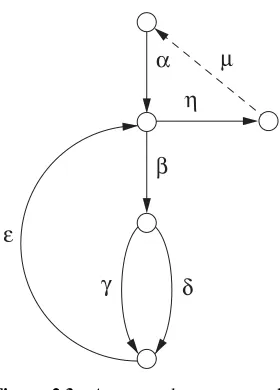
Here we speak of a program graph with one entry and one exit. It has the property that every node can be reached from the entry, and every node can reach the exit. In general, it is not strongly connected but can be made so by adding an edge from the exit to the entry. For example, we can make the program graph in Figure 2.1 strongly connected by adding an edge(dashed line), as depicted in Figure 2.3. Since there are seven edges and five nodes in this graph,v(G)=7−5+1=3 in this example. Note that for an ordinary program graph without that added edge, the formula for computingv(G) should be
v(G)= |E| − |N| +2
α
β
γ
δ
ε
[image:37.441.151.291.63.258.2]η
μ
Figure 2.3 Augmented program graph.
A path is said to be alinear combinationof others if its vector representation is equal to that formed by a linear combination of their vector representations. Thus, pathβγεηis a linear combination ofβγandεηbecause
<βγεη>=<βγ>+<εη>
=<0 1 0 0 1 0 0>+<0 0 0 1 0 0 1> =<0 1 0 1 1 0 1>
and pathαηis a linear combination ofαβδεηandβδεbecause <αη>=<αβδεη>−<βδε>
=<1 1 1 1 0 0 1>−<0 1 1 1 0 0 0> =<1 0 0 0 0 0 1>
A set of paths is said to belinearly independentif no path in the set is a linear combination of any other paths in the set. Thus,{αβδεη,αβγεη,αη}is linearly independent but{αβδεη,αβδεβδεη,αη}is not (because<αβδεη>+<αβδεη> −<αβδεβδεη>=<αη>).
Abasis setof paths is a maximal set of linearly independent paths. In graphG given above, sincev(G)=3,{αβδεη,αβγεη,αη}constitutes a basis set of paths. That is to say, in McCabe’s method, three paths, denoted byαβδεη,αβγεη, andαη, must be exercised during the test.
in common structurally, which means that the operations to be performed along these two paths will have little in common. Now, if t1 andt2 are the inputs that cause these two paths to be traversed, it implies that the distance betweent1 andt2 [i.e.,␦(t1,t2)= p(OK(t2)|OK(t1))−p(OK(t2)) as defined in Section 1.1] would be greater than if the two paths are not linearly independent. The test cases in a basis set are therefore as loosely coupled as possible as far as can be determined by their dependencies. Thus, to test a program with a basis set is to exercise a finite subset of execution paths in the program that yield a maximal probability of fault discovery.
To construct such a test set, we need to construct a set of linearly independent paths first. We can start by putting any path in the set. We then add to this set another path that is linearly independent of the existing paths in the set. According to graph theory, we will have to terminate this process when the number of paths in the set is equal to McCabe’s cyclomatic number because we will not be able to find an additional path that is linearly independent of the existing paths. We then find an input for each path in the set. The result is the test set desired.
Note that althoughv(G) is fixed by the graph structure, the membership of a basis set is not unique. For example,{αβδεη,αβδεβγεη,αη}is also a basis set in G. That is, in McCabe’s method, the set of paths to be traversed is not unique. The set of paths to be traversed can be{αβδεη,αβδεβγεη,αη}instead of{αβδεη,αβγεη, αη}, mentioned previously.
It is interesting to observe thatv(G) has the following properties:
1. v(G)≥1.
2. v(G) is the maximum number of linearly independent paths inG, and it is the number of execution paths to be traversed during the test.
3. Inserting or deleting a node with an outdegree of 1 does not affectv(G). 4. Ghas only one path ifv(G)=1.
5. Inserting a new edge inGincreasesv(G) by 1.
6. v(G) depends only on the branching structure of the program represented byG.
2.5 DATA-FLOW TESTING
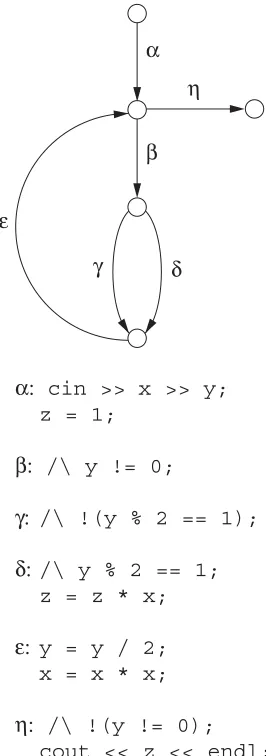
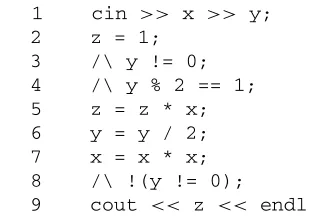
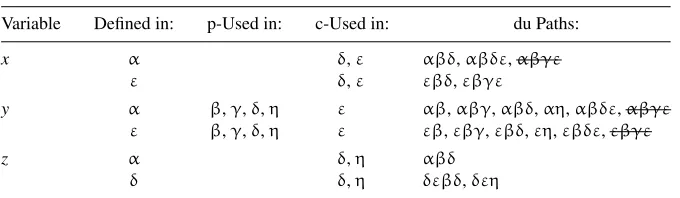
Data-flow testing [LAKO83, GUGU02] is also an approximation of path testing. The componentthat will be exercised during the test is a segment of feasible execution path that starts from the point where a variable is defined and ends at the point where that definition is used. It is imp
![Figure 2.1Program graph of Program 2.1. (Adapted from [HUAN75].)](https://thumb-us.123doks.com/thumbv2/123dok_us/911870.603826/30.441.146.291.70.510/figure-program-graph-program-adapted-huan.webp)