University of Warwick institutional repository: http://go.warwick.ac.uk/wrap
A Thesis Submitted for the Degree of PhD at the University of Warwick
http://go.warwick.ac.uk/wrap/57981
This thesis is made available online and is protected by original copyright. Please scroll down to view the document itself.
managing and testing the lifecycle of consent and
revocation
Ioannis Agrafiotis
(BSc, MSc)
A thesis submitted in partial fulfilment of the requirements for
the degree of
Doctor of Philosophy in Engineering
School of Engineering
University of Warwick
Acknowledgements i
Declaration iv
Abstract v
1 Introduction 1
1.1 The vicious circle . . . 3
1.2 Establishing the importance of privacy . . . 6
1.2.1 Critique of privacy . . . 7
1.2.2 The value of privacy . . . 9
1.3 Management of controls . . . 11
1.4 Research questions and main contributions of the thesis . . . 12
1.5 About EnCoRe . . . 14
1.6 Thesis structure . . . 16
2 The journey from privacy to consent and revocation 19 2.1 Conceptualising privacy . . . 21
2.1.1 Privacy as the right to be let alone . . . 21
2.1.2 Privacy as limited access to the self . . . 22
2.1.3 Privacy as personhood and autonomy . . . 23
2.1.4 Privacy as controls . . . 25
2.2 Privacy in the online environment . . . 27
2.2.1 The notion of controls in online privacy . . . 28
2.3 The literature on consent and revocation . . . 33
2.3.1 History of consent . . . 34
2.3.2 Consent in the literature on information privacy . . . 36
2.3.3 Revocation in the literature on information privacy . . . 40
2.4 Legislating privacy and consent . . . 41
2.5 Formal methods . . . 43
2.5.1 Challenges for formal methods in privacy . . . 46
2.5.2 Formal methods in privacy . . . 47
3.1.1 Focus groups as a qualitative methodology . . . 59
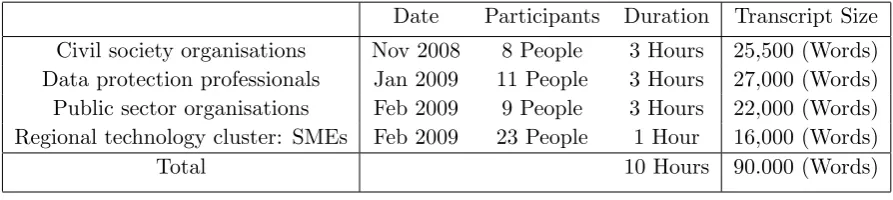
3.1.2 EnCoRe focus groups . . . 60
3.1.3 Content analysis as a methodology to discuss the results from focus-groups . . . 63
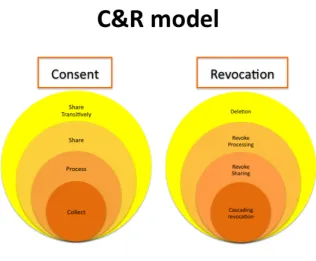
3.2 A novel conceptual model for consent and revocation . . . 67
3.2.1 Building the consent model . . . 68
3.2.2 Building the revocation model . . . 70
3.2.3 Limitations . . . 73
3.3 Verifying the model in different contexts . . . 74
3.3.1 Identifying data subjects’ requirements . . . 76
3.4 The concept of informed revocation . . . 80
3.4.1 Differences from informed consent . . . 82
3.5 Synopsis of the findings presented in the chapter . . . 84
4 The logic for Consent and Revocation 86 4.1 Hoare style consent and revocation logic . . . 88
4.1.1 Rights, variables and actions defined in the logic . . . 92
4.1.2 Semantics of the actions . . . 95
4.2 Concurrency issues and model . . . 110
4.2.1 Problems challenging the concurrency model . . . 110
4.2.2 The rapid changing of mind . . . 111
4.2.3 The special case of deletion . . . 114
4.2.4 Identity of data . . . 114
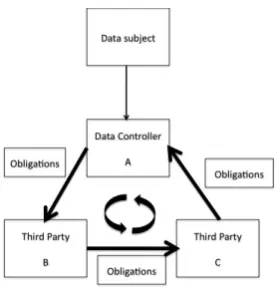
4.2.5 The circular problem . . . 114
4.2.6 Different preferences for different data handlers . . . 115
4.3 Healthiness conditions . . . 117
4.3.1 Healthiness conditions relating to the characteristics of the system . . . 122
4.3.2 Healthiness conditions relating to the actors of the system . 122 4.4 Proofs for healthiness conditions in Maude . . . 123
4.4.1 Right to share implies right to process . . . 123
4.4.2 Deletion of data from every state of the system . . . 124
4.4.3 Third parties cannot revoke rights from data controllers . . . 127
4.4.4 Revoking rights from third parties without influencing the rights of the data controller . . . 127
4.4.5 Revoking rights from a data controller without influencing the rights possessed by third parties . . . 128
4.4.6 Store data without being able to process . . . 128
4.4.7 All the achievable states and the rights that pertain to them 129 4.5 Lessons learnt and implications for EnCoRe . . . 131
4.5.1 Ambiguities . . . 131
4.5.2 Refinement process . . . 133
5 The Employee case study 136
5.1 Eliciting requirements . . . 137
5.2 Formalising the Employee case study . . . 138
5.2.1 Mary is hired . . . 139
5.2.2 Mary is enrolled in other services . . . 142
5.2.3 Data outsourced . . . 143
5.2.4 Mary withdraws from some services . . . 144
5.2.5 Mary is getting married . . . 144
5.2.6 Mary gets promoted . . . 147
5.2.7 Mary moves to a different country . . . 148
5.2.8 Mary gets sick . . . 151
5.2.9 Team is expanding . . . 151
5.2.10 Termination of contracts . . . 153
5.3 Synopsis of the chapter . . . 156
6 The Biobank case study 158 6.1 Requirements elicitation . . . 158
6.2 Formalising the Biobank case study . . . 159
6.2.1 The IT administrator creates consent and revocation options that will be presented to the patient . . . 160
6.2.2 The data subject (patient) or Biobank technician makes con-sent and revocation choices for specific study/studies) . . . . 167
6.2.3 The data subject (patient) or Biobank technician changes con-sent and revocation choices for specific study/studies . . . . 168
6.2.4 Tissue sample collection, data and consent and revocation choices entry . . . 169
6.2.5 The Biobank technician is sharing a sample and/or personal data in a spreadsheet . . . 170
6.3 Synopsis of the chapter . . . 171
7 The Identity Assurance Programme case study 173 7.1 Requirements elicitation . . . 173
7.2 Formalising the Identity Assurance Programme case study . . . 176
7.2.1 Semantics of the use cases . . . 176
7.2.2 Use cases related to consent and revocation . . . 177
7.2.3 Use cases loosely related to consent and revocation . . . 184
7.3 Synopsis of the chapter . . . 187
8 The testing strategy 189 8.1 Why formal methods in testing . . . 190
8.2 Presenting the testing strategy . . . 191
8.2.1 Procedure 1: Eliciting test requirements . . . 193
8.2.2 Procedure 2: Producing test suites . . . 195
8.3.2 Mary leaves the company . . . 200 8.4 Results from the application of the strategy on the EnCoRe prototype
implementation . . . 203 8.4.1 Mapping the “logic-derived tests” to the EnCoRe architecture 204 8.4.2 Limitations to the testing strategy . . . 206 8.5 Synopsis of the chapter . . . 207
9 Conclusions and future work 209
9.1 Contributions to knowledge . . . 211 9.2 Contributions to the EnCoRe Project and Dissemination of Project
Results . . . 215 9.3 Future work . . . 216
References 219
A Code for the implementation of proofs in Maude 220
1.1 Technological developments that favour either society or individuals 5
1.2 The constant development of data collection, aggregation and
pro-cessing technologies results in a vicious circle as society attempts to
seek a balance of protection between the individual’s privacy and
security of society. . . 6
3.1 The novel conceptual model for consent and revocation . . . 74
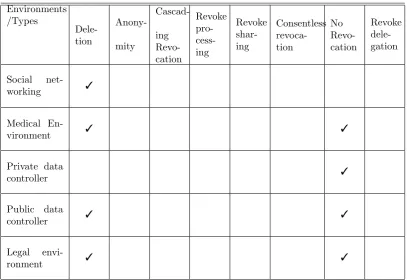
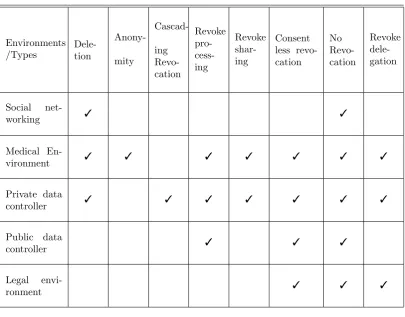
3.2 The environments formed from the data subjects’ interaction with the possible stakeholders of the privacy problem . . . 75
4.1 Syntax of Hoare logic. . . 92
4.2 The circular problem . . . 115
4.3 Actions prohibited by the proposed solution . . . 115
4.4 Actions allowed by the proposed solution . . . 116
4.5 List that contains different constraints for different parties . . . 116
4.6 The state machine model depicting only the “grant and process” actions examined in Maude . . . 119
4.7 The state machine model depicting only the “revoke and delete” ac-tions examined in Maude . . . 120
4.8 The state machine model depicting the “notify, update actions and the Φ conditions” examined in Maude . . . 121
4.10 States where processing implies storing data is not true . . . 124
4.11 The results that Maude produced when the transitions from all states
to the initial were tested . . . 125
4.12 The results that Maude produced when the transitions from all states
to the initial were tested . . . 126
4.13 Requesting to reach a state where the third party would possess rights
but the data controller would not . . . 127
4.14 Revoking rights from third parties without influencing the rights of
the data controller . . . 128
4.15 Revoking rights from data controller without influencing the rights
of third parties . . . 128
4.16 Reaching a state where the data subject can only store data . . . . 129
4.17 Achievable states from the initial state and the rights that pertain to
them . . . 130
4.18 Refinement of the logic . . . 134
7.1 EnCoRe in the Identity Assurance Programme architecture. A
pic-ture created by HP laboratories in Bristol [184] . . . 175
8.1 The state of the system . . . 194
8.2 Transition from the initial state to the final state with the grant action198
8.3 Transition from the initial state to the final state with the delete action201
3.1 Focus-groups . . . 63
3.2 Initial/Default choices . . . 81
3.3 Informed Choices . . . 82
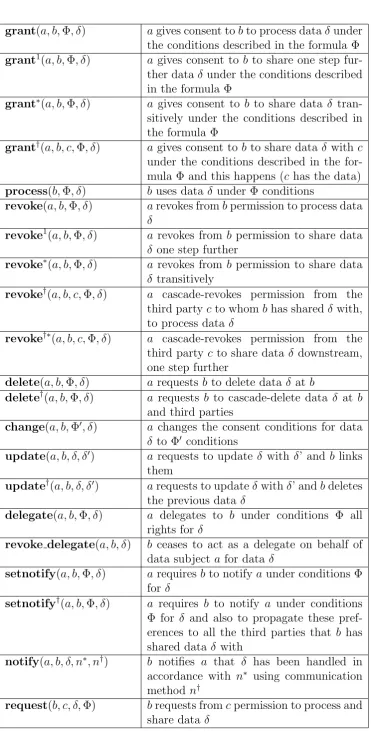
4.1 Meaning of the actions in the consent and revocation logic. . . 93
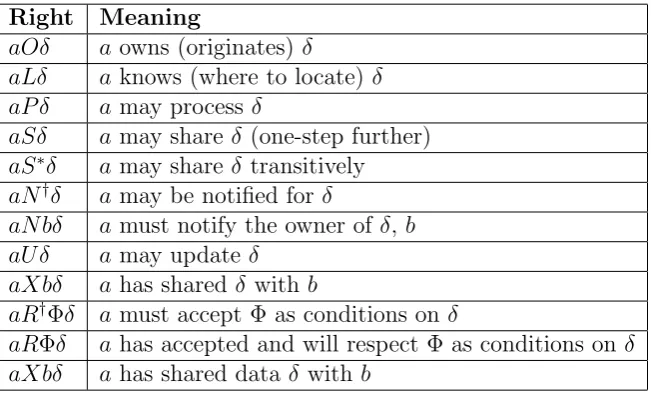
4.2 List of rights and facts in the consent and revocation logic explained in English. . . 94
4.3 Sample of consent variables in the consent and revocation logic. . . 94
4.4 Explanation of the state-machine’s notations . . . 118
8.1 Results from the application of the first procedure . . . 199
8.2 Testing suites generated by the application of the second procedure 199 8.3 Results from the application of the second procedure . . . 202
8.4 Testing suites generated by the application of the second procedure 202
In the last years I was fortunate to have the academic and moral support of several people. Without their help and encouragement this work would not have been completed.
First and foremost, I would like to thank my supervisors, Professor Sadie Creese and Professor Michael Goldsmith, for their invaluable guidance, advice and patience. I am grateful for the opportunities they offered me, the encouragement and support in this journey into the academic world. I hope this journey will continue. They made all PhD comics look so alien to me!
I would also like to thank Professor Michael Huth and Professor Yasmin Merali for agreeing to be my examiners and for their valuable comments that strengthen this thesis.
I am grateful for the financial support provided by the EPSRC. I would also like to thank the EnCoRe team for all the valuable input, discussions and contributions to this thesis. In particular, I would like to thank Dr. Edgar Whitley for giving me access to the transcripts of the focus groups. Without his assistance the qualitative part of the research would have been impossible. I would also like to thank HW Communications Ltd. for implementing the testing code. Dr. David Lund, Dr. Bassem Ammar, George Mourakis and Dr. Noel Catterall thank you all very much for your help.
Special gratitude goes to former and current members of the e-Security Group at the University of Warwick, now transferred to the Cybersecurity Group at Oxford. In particular, I would like to thank Dr. Nick Papanikolaou for helping me when I first joined the group and for his ongoing encouragement, motivation and advice throughout these years. I will never forget the long discussions over coffee. Also, I would like to thank Dr. Nick Moffat, who over the last two years offered me valuable guidance and support. His diligence and patience allowed me to improve my work, and as he usually says, “this is music to my ears!”. Furthermore, I would like to thank Dr. Jason Nurse, Dr. Jassim Happa, Thomas Gibson-Robinson, Adrian Duncan, Dr. Adedayo Adetoye, Dr. Duncan Hodges, Syed Sadiqur Rahman, Dr. Mark Josephs and Paul Hopkins for their advice, help, encouragement and motivation. Special thanks to Elmedin Selmanovic, Dr. Tom Bashford-Rogers,
I would also like to thank Chrysanthi Papoutsi, Alexandros Georgalis, Elena Pasia, Dimitris Valsamidis for the relaxing moments and their support throughout these years. In particular, I would like to thank for all the fun moments, my friends in Greece: Sokratis Vatalis, Marina Geka, Dimitris Antoniadis, George Michailidis, Apostolis Gouziotis, Lena Dramanidou, Ntinos Fasoulas, George Giannikis, Anasta-sios Annoulidis, Prokopis Didilis, AthanaAnasta-sios Dislakis, Germanos Gavrilidis, Stella Pasvalidou, Alexandros Ioakeimidis, Despoina Christodoulou, Anastasia Papageor-giou, Fanis Korlos, Dimitris Samaras and George Gerogiannis. I could not have completed my work without your motivation.
Most importantly I would like to express my deepest gratitude to my family. Dad, Mom, Victoria and Nick without your support and direction I would not have achieved anything. Thank you for believing in me.
full of adventure, full of discovery. Laistrygonians and Cyclops, angry Poseidon-don’t be afraid of them: you’ll never find things like that on your way as long as you keep your thoughts raised high, as long as a rare sensasion touches your spirit and your body. Laistrygonians and Cyclops, wild Poseidon-you won’t encounter them unless you bring them along inside your soul, unless your soul sets them up in front of you.
Hope that your journey is a long one. May there be many summer mornings when, with what pleasure, what joy, you come into harbors you’re seeing for the first time; may you stop at Phoenician trading stations to buy fine things, mother of pearl and coral, amber and ebony, sensual perfume of every kind-as many sensual perfumes kind-as you can; and may you visit many Egyptian cities to learn and learn again from those who know.
Keep Ithaka always in your mind. Arriving there is what you’re destined for. But don’t hurry the journey at all. Better if it lasts for years, so that you’re old by the time you reach the island, wealthy with all you’ve gained on the way, not expecting Ithaca to make you rich. Ithaca gave you the marvelous journey. Without her you would have not set out. She has nothing left to give you now.
And if you find her poor, Ithaca won’t have fooled you. Wise as you will have become, so full of experience, you’ll have understood by then what these Ithacas mean. Ithaka, C. P. Kavafis, 1911
This thesis is written in accordance with the regulations for the degree of Doctor of Philosophy. The work to be presented has been composed by myself and has not been submitted for a degree at another university. The material in this thesis has been undertaken by myself, except where otherwise stated. Parts of this thesis have been published previously in conferences as follows.
The conceptual model in Chapter 3 has been published in a conference paper in [10]. The formalisations in Chapter 5 have been published in a conference paper in [11]. Work presented in Chapter 6 has been published in a conference paper in [8], while the testing strategy methodology, presented in Chapter 8 has been published for a conference paper in [7].
Ioannis Agrafiotis, August 2012
Increasingly, people turn to the Internet for access to services, which often require disclosure of a significant amount of personal data. Networked technologies have enabled an explosive growth in the collection, storage and processing of personal information with notable commercial potential. However, there are asymmetries in relation to how people are able to control their own information when handled by enterprises. This raises significant privacy concerns and increases the risk of privacy breaches, thus creating an imperative need for mechanisms offering information control functionalities.
To address the lack of controls in online environments, this thesis focuses on consent and revocation mechanisms to introduce a novel approach for controlling the collection, usage and dissemination of personal data and managing privacy ex-pectations. Drawing on an extensive multidisciplinary review on privacy and on empirical data from focus groups, this research presents a mathematical logic as the foundation for the management of consent and revocation controls in technological systems.
More specifically, this work proposes a comprehensive conceptual model for con-sent and revocation and introduces the notion of ’informed revocation’. Based on this model, a Hoare-style logic is developed to capture the effects of expressing indi-viduals’ consent and revocation preferences. The logic is designed to support certain desirable properties, defined as healthiness conditions. Proofs that these conditions hold are provided with the use of Maude software. This mathematical logic is then verified in three real-world case study applications with different consent and revocation requirements for the management of employee data in a business envi-ronment, medical data in a biobank and identity assurance in government services. The results confirm the richness and the expressiveness of the logic. In addition, a novel testing strategy underpinned by this logic is presented. This strategy is able to generate testing suites for systems offering consent and revocation controls, such as the EnCoRe system, where testing was carried out successfully and resulted in identifying faults in the EnCoRe implementation.
Keywords: Privacy, Consent, Revocation, Formal Methods, Hoare Logic, Testing Strategy
Introduction
There have been inventions in the history of mankind that changed the way people
communicate, causing such an impact on societal norms that the world became
a different place. For example, the printing press in the 15th century ended the
monopoly of Church to knowledge and its control on the ideas that were published
in the Western world. The printing press expanded the flow of information to new
audiences, giving them the opportunity to be educated and to freely publish their thoughts and ideas. In contemporary times, the Internet has altered our society’s
function since most of the economic, professional and social aspects of our lives now
hugely depend on networked technologies.
Individuals use the Internet to acquire access to products, services and benefits,
to articulate their political or religious beliefs, to form their social relationships or
operate their businesses. Technological innovations offer opportunities to enterprises
for novel and agile business models and ever-growing capabilities to collect, store,
process and share huge quantities of personal data in cyberspace. As Francis Maude
noted in a speech at the Information Commissioner’s Conference on 6 March 2012, “cyberspace has become a vast storehouse for human knowledge” since there is an
abundance of data and sophisticated tools to analyse this data [96].
However, the use of online applications comes with compromise. Data subjects,
a term that in this thesis will be used to describe individuals whose data is
han-dled by others, when disclosing personal data on the Internet they practically lose
any control over how this data is handled. For example, information uploaded by
users on social-networking sites is often analysed and sold to enterprises, and users
are categorized in profiles according to their demographic data and commercial
preferences. Mechanisms to enable users to control these actions are missing and companies are reluctant to implement a system that manages controls and
gates the risk associated with the absence of such controls, for example, allow data
subjects to remove or modify personal data held. This lack of controls may hinder
data subjects from trusting data controllers, a term defined in this thesis to include all the parties handling and processing personal data. When the data controllers
offer their services on cyberspace, the lack of controls raises concerns regarding data
subjects’ privacy protection.
That these concerns are based on solid ground is illustrated by the increasing
number of incidents where data has been lost, mistreated, or shared without
author-ity [1], making the use of privacy-enhancing technologies essential for every Internet user. For example, in 2005 Sony BMG’s anti-piracy measure resulted in
vulnerabil-ities and loss of personal data, forcing the company to pay $150 to its customers in
Texas [1]. Since 2007, Google has been facing privacy complaints due to the Street View application resulting in a fine of $142,000 by the French government [1], while on 2010, Facebook’s most popular applications confessed to sharing users’ personal
data with advertising companies [1].
The absence of a system able to manage mechanisms to control personal data
in online environments does not only raise concerns for data subjects but imposes
consequences for data controllers as well. Enterprises have often been reluctant to
design and implement such mechanisms due to the financial cost and the constraints
that these would impose on enterprise data-handling practices. But with the new
EU Privacy and Communications Directive [80] it is estimated that unless businesses implement a mechanism to obtain and manage explicit consent for websites, they could lose up to ten billion pounds [88].
In the recent years, voices acknowledging the need to consider privacy principles
when personal information is used by data controllers are increasing and privacy
advocates, governments and consumers require companies “to cater for privacy
con-cerns” [124]. Technological developments and the use of the Internet have crafted current business practices to treat personal data as a commodity, without providing
any sense of control to the data subjects. However, the importance of information
privacy is challenging researchers from different disciplines to propose new
infor-mation systems that will shift business norms towards privacy-friendly practices. According to Rule, today, information is indefinitely stored, and there is no
con-trol regarding the future handling of the data or the context in which it is shared
further [223].
There are limited references to control mechanisms in the literature on privacy.
sys-tems, and the use of privacy-impact statements is still a maturing discipline.
Social-networking sites, such as Facebook and Twitter, include embedded mechanisms to
capture users’ preferences regarding their consent, which offers some semblance of control, while governmental directives require from companies to clearly state the
use of cookies in their websites[129].
However, whilst users may consent explicitly to the sharing, storing and
pro-cessing of data on such sites, they cannot as easily revoke (permissions to hold or
process) data they may already have disclosed. This means that, in most cases, it
is not possible for users to change their privacy preferences in a transparent way;
without an explicit revocation capability users cannot have clear and unambiguous
controls to protect data privacy. Unfortunately, there is a general lack of
revo-cation controls in social-networking, e-commerce or indeed almost any cyberspace
applications.
An effective system that manages control of data must provide mechanisms
enabling the data subjects to truly decide and understand in what they give consent
to and allow them to change their mind in the future [96]. The need for such a system is also acknowledged by the White House, in an attempt to protect consumers’
privacy and boost innovation in digital economy [263]. In a report published on February 2012, they define individual control and note that “consumers have a
right to exercise control over what personal data companies collect from them and
how they use it. Companies should provide consumers appropriate control over the
personal data that consumers share with others and over how companies collect, use, or disclose personal data” [263].
1.1
The vicious circle
In order to address individuals’ privacy concerns in the online environment, one has
to understand how the problem occurs. One of the earliest attempts to
concep-tualise privacy took place in England and the rational that underpinned it can be
summarised in the phrase that “every man’s home is his castle”. In 1763, William Pitt noted that “the poorest man may in his cottage bid defiance to all the force
of the Crown. It may be frail; its roof may shake; the wind may blow through it;
the storms may enter; the rain may enter - but the King of England cannot enter;
man, even for the most under-privileged people. Its importance raises from the fact
that not even the King of England, the highest authority of that time, could defy
the right to privacy.
If we subdue the fact that Pitt’s definition remains oblivious to women, the
idea of privacy as invasion seemed to be effective for more than one hundred years.
Until privacy concerns re-appeared as a fundamental factor in the late 1800s in
United States, when Louis Brandeis and Samuel Warren argued that new privacy
concerns have emerged and novel approaches to privacy, such as their proposition
of the “right to be let alone”, must be embraced to address them [45]. However, the circumstances that stimulated their position, reveal the root of the privacy problem.
As Brandeis’ biographer writes [in [40]]:
Warren had married Miss Mabel Bayard, daughter of Senator Thomas
Francis Bayard. They set up housekeeping in Boston’s exclusive Back
Bay section and began to entertain elaborately. The Saturday Evening
Gazzette, which specialised in blue blood items, naturally reported their
activities in lurid detail. This annoyed Warren who took the matter up with Brandeis.
As Warren was a prominent and wealthy member of the “higher society”, it
was natural that the marriage would attract the interest of the tabloids. However, what was unexpected was what Brandeis and Warren describe in their article as
“instantaneous photographs” that when published in the newspapers “invade the
sacred precincts of private and domestic life; and numerous mechanical devices
threaten to make good the prediction that ‘what is whispered in the closet shall be
proclaimed from the house tops’ ” [45]. However, according to the journalists, the claim of invasion could not have been justified in a court as the photographer never
entered the property. Instead he took the photo while standing on a public place.
The authors of the article warned that “recent inventions and business methods, call
attention to the next step which must be taken for the protection of the person” [45]. The same consequences that led Warren and Brandeis to publish their article
still exist today. Consider the war against illegal drugs in the US: It was thought
that using heat sensors to find marijuana growing operations would be acceptable,
but in 2001 [Kyllo v United States (533 U.S. 27)] it was ruled that using thermal
imaging devices that can reveal previously unknown information without a warrant,
does indeed constitute a violation of privacy. With the outburst of technological
new ways of gathering personal information emerged. This affects the ways in which
privacy may be either protected or violated, depending on the purpose for which
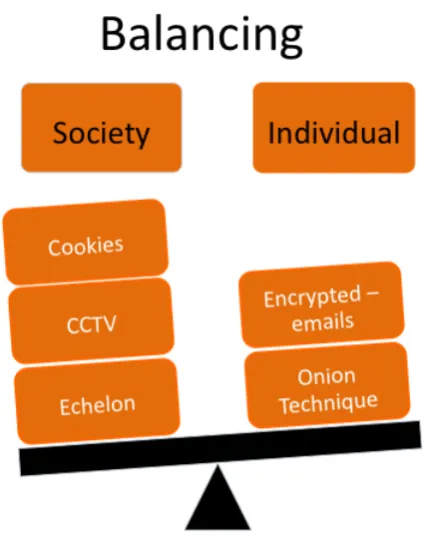
[image:20.595.214.427.209.483.2]these advances are applied. Examples of technological innovations that have either aggravated or mitigated privacy concerns are illustrated in Figure 1.1.
Figure 1.1: Technological developments that favour either society or individuals
The example of Warren and Brandeis demonstrates that legislation and
regu-latory procedures endeavour to establish functions which seek a balance between individuals’ right to privacy and the common good. But every time a balance is
found, the use of new technologies alters old norms either in favour of the individual
or in the interest of the common good, and new norms and functions need to be
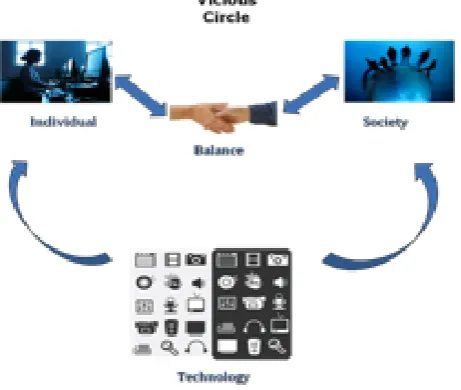
re-established to restore the balance, thus forming a vicious circle.
Technological developments always proceed faster than the establishment of
leg-islation and regulatory policies, thus fuelling the vicious circle presented in Figure 1.2
and leading to new privacy concerns. Society is continuously attempting to achieve
a balance between privacy and security, individualism and the common good,
prevailing societal norms, the technological advances and the seek for balance
[image:21.595.196.427.169.364.2]be-tween the private and public sphere [223]. It is these compromises that question the real value of privacy and whether this right is worth protecting [236].
Figure 1.2: The constant development of data collection, aggregation and processing technologies results in a vicious circle as society attempts to seek a balance of protection between the individual’s privacy and security of society.
1.2
Establishing the importance of privacy
How can we decide if privacy is important? Why is it worth protecting? These
questions have concerned society throughout history. The development of
technolo-gies kept the debate around the value of privacy for centuries, but the proliferation of novel information systems strengthened arguments both for privacy advocates
and privacy critics from various disciplines such as philosophy, law and economics,
rendering the “privacy erupt into a frontline issue around the world” [236].
Privacy advocates argue that privacy is evaporating and soon we will have a sense
of nostalgia if we do not act, whereas, critics are based on the privacy paradox, where
people declaim their privacy concerns but their actions are towards the opposite
directions. Thus, critics claim that there is a general paranoia and people cater for
1.2.1
Critique of privacy
Critiques of privacy as being socially detrimental, arise from several sources that
focus on different aspects of privacy. The most prominent is the communitarian
critique which, to quote Etzioni, perceives privacy as a “societal licence [. . . ] that
tramps all other rights or concerns for the common good” [86]. Communitarian scholars argue that there is not an absolute right to privacy because it exempts
people from obligations of social life [86;119], associating privacy with individualistic benefits which antagonise the public sphere. However, as many scholars argue, this
view is erroneous [236; 124]. The assumption that individual needs and societal interests are always in conflict, results in a fallacious quest for balancing privacy
with community needs. As Solove argues, “individualism becomes not an element
valued for its contributions to the common good, but a counter-value that stands
in opposition to common good”, underestimating the contributions of privacy to
society [236].
Another criticism to privacy stems from the classical feminists, as they contend
that privacy is a right favouring men by concealing the abuse of women at home.
Historically, they argue, societal norms have been dominated by men and as a result
every husband is the master of the house, a private sphere in which authorities cannot intervene if, for example, a woman is subject to domestic violence [166;236]. Thus, privacy is the means to protect men and shift the authoritative relations
between the two sexes in favour of men. MacKinnon, by paraphrasing Warren and
Brandeis view of privacy, claims that “the right of privacy is a right of men ’to
be let alone’ to oppress women” [166]. This view is valid if we consider common practices in precedent centuries; courts in the 19th century “turned a blind eye to
issues of domestic abuse in the name of family privacy” [236]. However, society’s power relations between the two sexes have changed and women have strengthen
their position. Recent legislated laws are not oblivious to domestic violence and privacy can be used to support the prosecution of offenders as it offers anonymity
in cases of rape and violence or forbids any disclosure of data to the public [124]. There is a stream of literature arguing that privacy hinders the disclosure of
information critical to establish trust relations and judge individuals’ reputations,
thus leading to the sharing of discredible information and fraud [211; 85]. Scholars in favour of this argument, emphasise the aspect of self-determination, defined as
the ability of individuals to manage information about themselves, claiming that
dissemination of falsified data. Posner ascribes an economic aspect to this criticism
by arguing that erroneous information can prohibit the commercial profitability of
businesses. The non-disclosure of vital information tampers with the “economic rationality”of the free market which forces enterprises to depend on assessing vast
amounts of information and make rapid decisions [211]. As a result, privacy Cate argues, “may reduce productivity and lead to higher prices” [54]. However, the critic suffers from misconceptions, since privacy can enhance, rather than reduce,
the disclosure of data. Individuals feel more confident and “disclose information with
brevity” [124] when they have the sense of controlling the flow of their information. Regarding the economic aspect of the argument, Acquisti [3] demonstrated the existence of an economically “negative and statistically significant impact” of data
breaches. The impact of the privacy breach is profound in large companies because
their reputation is at risk. Hence, the adoption of a system which is able to support the management of personal data by data subjects, can not only enhance the trust
relation between customers and enterprises, but it can also boost the disclosure
of valid data, offering competitive advantage to those companies that cater for
customers’ privacy needs.
Questions also have been raised from advocates of civil liberties and human rights
who dispute privacy as a right [274]. The rational is similar with the communitar-ian critique and scholars supporting this argument believe that privacy undermines
other primary rights which protect civil liberties. Freedom of speech, liberty and
the right to be free from injury are some of the rights which are deemed antag-onistic to privacy. To quote Postrel, privacy hinders “the freedom to gather and
disseminate truthful information, otherwise known as freedom of speech and the
press” [in [236]].This argument, however, assumes that privacy is in conflict with these rights. In a counterexample, someone could argue that privacy can be
sym-biotic instead. Several authors deem privacy to be synonymous with liberty [101], while focusing on the freedom of speech there have been several journalists who
un-der the umbrella of anonymity or pseudonimity have expressed their opinions freely.
The symbiosis of privacy and freedom of speech or liberty ensures that people will
be able to express themselves freely, while retaining their dignity at the same time. Further objections to privacy occur from scholars contending that social
surveil-lance and national security is hampered by the concealment of malicious activities
under the protection of privacy. As Pulitzer denotes, “there is no crime, there is
not a dodge, there is not a trick, there is not a swindle, there is not a vice which
the events of 9/11 in US, as privacy is deemed to hinder government responses to
threats and conceal emerging dangers from terrorism [243; 212]. Posner declares that nowadays “the government has a compelling need to gather [. . . ] vast quanti-ties of information, much of it personal” [212]. In a similar manner, other scholars wonder that “if you have nothing to hide, then what do you have to fear”, or “if
you aren’t doing anything wrong, then what do you have to hide?” [235]. The key problem with this argument is that “it myopically views privacy as a form of
con-cealment or secrecy” [235]. Privacy may enhance openness and transparency in the community since it has a positive effect on individuals’ trust relations. In addition
, the existence of privacy rights ensure that the governmental surveillance will be
conducted with respect to human autonomy and dignity. The weakness of the
ar-gument emerges from its assumption that governmental authorities always behave
in a benign fashion. However, reasonable reasons to use surveillance may quickly escalate and result in power abuse that causes “intimidation, embarrassment or
distraction” [124] as described in Orwell’s book titled “1984” [198]. Furthermore, the problem that occurs is not only “Orwellian but Kafkaesque” as well [235]. In Kafka’s book “The Trial” [138], the problem raised by the author is the situation where individuals are powerless and vulnerable against the bureaucratic
governmen-tal system. The misuse of personal data with the exclusion of data subjects from
any governmental process results in a lack of transparency, misjudgement, errors,
authoritative abuses [235] and at the end of the book, the condemning of an inno-cent man, Mr K., to death [138]. Thus, the argument of “nothing to hide” collapses because avoiding behaving in an illicit manner is not enough to ensure individuals’
innocence, since, to quote Kafka [138]:
“- ‘One does not have to believe everything is true, one only has to
be-lieve what is necessary.’
- ‘Depressing though, said K.’[. . . ] The simple story had become
per-plexing.”
1.2.2
The value of privacy
The vast majority of literature advocates the importance of privacy as essential to
an open and democratic society [124; 82; 45; 41; 101; 262]. Many scholars perceive privacy as a right that protects solely individuality, while excluding people from
dignity of the individual.[. . . ]The right of privacy[. . . ]is essentially the right not to
participate in the collective life the right to shut out the community” [82]. The value of protecting privacy stems from the self-development and the respect for autonomy. According to Westin “people respite from the whirlpool of social life [. . . ] achieve
goals of self-realisation” [262] and thus, develop a “firmer, better contracted position in the opposition of the dominant” [236].
Although the importance of privacy is significant when emphasising on the
in-dividual, perceiving privacy in nonconformist terms provokes conflicts with other
primary rights and interests and provides solid ground for criticism. When privacy
is excluded from social life, inherently it is balanced against common good, resulting
in privacy being undervalued. Solove contends that privacy has a social value and
its importance also emerges from the benefits it confers upon society [236]. Loss of privacy has a significant impact upon “freedom, creativity, culture and transparency in social life”, effects that are not assessed in the equation if privacy is considered as
a “stand-alone” right [262]. Since we are not isolated from other people and social interaction is part of our daily lives, we cannot afford to consider privacy as
some-thing we abandon when we join social life. Thus, the “value of privacy should be
assessed on the basis of its contribution to society” and the value of individualism
should be integrated to the social benefit [236], since “we cannot separate the idea of ourselves and our own good from the idea of others and their good” [44].
Privacy offers a wide range of protections to a plurality of issues and as a
conse-quence, its value varies depending on which issue is being addressed. The value that stems from the involved activities should be weighed against the value of
contrast-ing interests and privacy should prevail when the result is best for the society. As
Solove argues, “we live in an age of balancing and the prevailing view is that most
rights and interests are not absolute and privacy should be reconciled with other
interests” [236]. Balancing is a useful approach to resolve conflicts but the criti-cal step to maximise the utility in both parts of equation is to adopt a systematic
process that “will be as rigorous and thoughtful as possible” [236].
Privacy is a powerful tool able to shape social norms, alter power relations,
ensure democracy and freedom and establish a transparent and open society. Values of the highest importance, but very difficult to be quantified and calculated in
mathematical equations. A solution to address privacy concerns while respecting the
common good must be sought. Since social trends are shaped by the participation of
individuals and the way they communicate, information systems that enable users
The research that will be presented in this thesis, has been conducted bearing in
mind that privacy cannot be isolated from social good and the balance in the vicious
circle must be researched in a manner that maximises both individual and public good. In alignment with Solove’s view, I believe that offering mechanisms to the
data subjects to control their data is the rigorous process to ensure, even-though the
vicious circle will remain, the means by which the exposure to risk can be mitigated
more effectively and the balance can be achieved more efficiently.
1.3
Management of controls
The research undertaken in this thesis offers to data subjects, for the first time,
the opportunity to express their consent and revocation preferences regarding the collection, usage and further dissemination of their personal data and convey their
own privacy expectations. Offering controls to data subjects can create a positive
effect on their predisposition to disclose data, thus enhancing transparency and
openness in the relationship between the customer and the enterprise. On the other
hand, the controls available to data subjects can be designed with respect to the
common good, ensuring the social control and the resolution of any conflicts with
other interests.
Capturing the process of giving and revoking consent provides solid ground to
express privacy controls. Legislation, and more specifically data protection, already requires from the data controllers the acquisition of data subjects’ consent before
collecting any personal data. In addition, the process of giving consent has been
common practice for many years in several disciplines, such as medicine, where
privacy is of paramount importance.
This thesis seeks to develop methods by which balance can be achieved via
consent and revocation controls over the storage, use and sharing of personal data.
The issues addressed arise as a consequence of the disclosure of personal data.
Enterprises store personal data about their customers, often not only contact details
but various consumer preferences; such information enables an enterprise to tailor its products and services to customer needs. Companies share, buy and sell customer
data with the aims of increasing their customer base and obtaining useful marketing
statistics. There are even firms whose entire business is to manage and market
large databases of personal data about individuals. The central problem is that an
remove) the storage, aggregation and flow of this data.
While it is necessary, by law, to obtain an individual’s consent for the collection
of data regarding her or his person, the possible semantic interpretations of such consent can vary widely, possibly opening the way for data misuse and abuse [1;88;
2]; this can arise when the data controller interprets the given consent in a way that conflicts with the individual’s preferences. Furthermore, it is common practice for
an enterprise to request ‘blanket consent,’ which is consent for data to be collected,
used and disseminated in any way the data controller deems appropriate; by giving
blanket consent, an individual completely relinquishes control over such data. When
more fine-grained consent is required, the request is usually accompanied by lengthy
details of the collector’s privacy policy; research has suggested [65] that individuals rarely study such policies carefully, and this may cause them to give blanket consent
to save time and effort.
1.4
Research questions and main contributions of the thesis
Having described the problem that this thesis seeks to address and having
estab-lished the value of privacy to society that attributes to the importance of the research
to be presented in the following chapters, this thesis contributes to knowledge in
multiple layers and its novelty concerns different aspects.
Adopting a user-centric point of view, the first research question that I seek to
answer is:
What controls could a data subject perform in order to express privacy
preferences and requirements on the management of their personal data?
In order to answer this question, the methodology followed included a
multidisci-plinary literature study on online privacy. The findings informed the first framework
of effective controls and suggested that consent is the appropriate means to offer
these controls to the data subject. However, there is a significant gap in the liter-ature, since the functionality of the online environment raises considerable threats
to privacy and requires the ability to revoke the initial consent and delete data. As
Solove declaims “details about your private life on the Internet can become
per-manent digital baggage” [238]. However, so far literature perceives consent as an one-off event while the possibility of revoking this consent is not considered.
The second research question which complemented the question presented above
What does revoking consent mean?
The approach followed to provide a model for revocation embraced elements from
the social sciences discipline. The methodological framework consisted of focus groups and the generated data was analysed with the content analysis approach.
The result was a novel conceptual model of consent and revocation, which is the
first contribution of the thesis. In addition, different types of revocation have been
defined and the term of “informed revocation” has been introduced, extending the
existing literature on online privacy.
The next step required the formalisation of the novel conceptual model that can
validate a system which offers data subjects the opportunity to express consent and
revocation expectations. The research question to be answered in this quest is:
How can consent and revocation controls be formalised?
I conducted a literature survey on the application of formal methods whose aim
is to resolve privacy issues. The findings of this review concluded that there
ex-ists a gap in the literature, since the dominant approaches consist of languages
which address security issues and embrace extensions for catering privacy needs.
Privacy is not usually the primary concern of these efforts. Any existing
method-ologies addressing solely privacy concerns focus mainly on converting personal data
to non-identifiable forms and not on controlling the flow of personal data through
its lifetime. The difference in the two approaches lays on the sharing of data. In the first approach, the aim is to hamper the disclosure of certain information, whereas
the latter approach surveillances any dissemination of data throughout its life-cycle
by posing controls. In addition, all the formal models remain oblivious to consent
and revocation concepts. A Hoare-style logic was developed, capable to reason and
capture the effects of user’s consent and revocation expectations in a system. This
novel logic is the second and main contribution of this thesis. In order to validate the
logic, the use of Maude, a rewrite tool for logic, was deemed necessary to prove that
the logic is designed in such a manner that certain healthiness conditions hold. In
addition, the logic was applied to formalise the consent and revocation requirements of three different case studies. The pilot Employee case study, revealed ambiguities
that were addressed by enriching the logic. The refined and final version of the logic
is presented in this thesis. The refinement process and the lessons learnt from the
first attempt are described in Section 4.5.
logic, generating tests for systems that handle consent and revocation controls. The
research question answered is:
How might a testing strategy be formed based on formal methods, for
a system that offers consent and revocation controls to ensure correct
behaviour while services and technological infrastructure evolve?
The result of this effort is a novel and rigorous testing strategy based on formal
methods, able to generate testing suites in an automatic way. The approach is
tech-nological agnostic and it is validated by creating tests for the first case study. Further
validation required the development of a pseudo-code that automatically generates
tests. The pseudo-code was adjusted to the needs of the EnCoRe project [83], a project that funded this research for the last three years. The proposed pseudo-code was implemented by HW Communications Ltd ∗, one of the partners participating
in the EnCoRe project who were responsible for the implementation of the system.
The novel approach was used to produce tests and reveal faults in the design of the
system.
Parts of the research presented in this thesis were presented in conferences.
Published papers [10;11;201;7;8] were co-authored with my supervisors, Professor Sadie Creese and Professor Michael Goldsmith, to whom I am most grateful for
their guidance and support throughout this journey. Their guidance ensured that I
would not deviate from the research questions and that the methodologies followed would be the most appropriate to provide valid answers, while giving me the liberty
to freely develop and express my own understanding of the problem and propose
and develop my own solutions. Furthermore, the research presented in this thesis
was used to underpin the design of the EnCoRe system and is included in the final
deliverables of the project [9; 6].
1.5
About EnCoRe
The EnCoRe project ran from June 2008 to April 2012 and was a multi-disciplinary research project which aimed to “develop technology-enabled solutions for
deliver-ing easy-to-use, practical and scalable consent and revocation controls over the use
of personal data in cyberspace; and to render these control mechanisms as simple
to use as a kitchen tap” [83]. The project was partially funded by the Technol-ogy Strategy Board (TP/12/NS/P0501A), the Engineering and Physical Sciences
Research Council and the Economic and Social Research Council (EP/G002541/1). Currently, organisations’ procedures for managing personal data may possibly
exploit the trust that data subjects place in them when giving their initial consent
and disclosing their data. There is not a system in place that can provide controls
to the users to express themselves and capture the giving of consent or the dynamic
notion of this process required to address data subjects privacy concerns.
In the EnCoRe project we perceived “controls” as the means which enable people
to manage the flow of their personal data, by expressing consent and revocation
preferences that can be implemented through non-interference and privacy policies.
The overall vision of the project was “to make giving consent as reliable and easy
as turning on a tap and revoking that consent as reliable and easy as turning it off again” [83]. To this end, EnCoRe project took into account a variety of perspectives, including social, legal, regulatory and technological aspects.
The EnCoRe project endeavoured to provide solutions that would:
• Enable organisations to adopt scalable, cost effective and robust consent and revocation methods for controlling the usage, storage, location and
dissemi-nation of personal data.
• Benefit individuals by providing meaningful, intuitive mechanisms which will allow them to control the use of their personal information held by others.
• Help restore individual confidence in participating in the digital economy and so, in turn, benefit the wider society.
The project partners were:
• Hewlett-Packard Laboratories
• HW Communications Ltd
• London School of Economics and Political Science
• QinetiQ Ltd
• e-Security Group, Warwick Manufacturing Centre, University of Warwick, Coventry (June 2008 - September 2011)
• Centre for Health, Law and Emerging Technologies (Helex), University of Oxford
The project’s website iswww.encore-project.infoand the tweeter account can
be found atwww.twitter.com/encore_project
1.6
Thesis structure
The thesis is divided in nine chapters. Elaborating on each chapter:
Chapter 2 presents literature surveys of the online privacy and the concept of consent, a description of the regulations legislated for the data protection and
a literature review of the formal methods that endeavour to model privacy. The
chapter starts with the main concepts of privacy and illustrates their limitations.
Based on the dominant concept which perceives privacy as controls, I examine the
available controls which researchers believe that can facilitate the management of
personal data by data subjects. The most appropriate mechanism is the concept of
consent and I explore the origins of the concept, the relevant theories of consent,
their application on our daily lives and their limitations. In addition, I present the appropriate legislative efforts that enhance the concepts of consent and revocation
and provide legal ground to their adoption by the data controllers. Since the main
purpose of this thesis is to develop a formal model of consent and revocation, I
study the relevant formal languages that address privacy issues and present their
advantages and limitations.
Chapter 3 presents a novel conceptual model of consent and revocation. I describe the qualitative methodology of focus groups adopted to underpin the design
of the model and I explain the content analysis approach used to code and analyse
the data generated by the focus groups. The analysis of the transcripts resulted in a novel conceptual model of consent and revocation. More specifically, I describe how
the findings extend the theory of informed consent with an additional dimension and
the definition of different types of revocation. Furthermore, the term of informed
revocation is coined to describe a phenomenon observed in the focus groups.
Chapter 4 illustrates the novel logic of consent and revocation, which is de-signed based on the novel conceptual model of consent and revocation. It is a
consent and revocation controls. The expectations of the data subjects are
cap-tured with a set of actions that, when performed in completion, assign rights to the
participants of the system, create obligations and bound the handling of data with constricting choices. The logic has been refined after its application to the pilot
case study and the process of refinement among with the lessons learnt from the
formalisation of the case study and more specifically, how these lessons informed
the implementation of the EnCoRe system are also discussed in this chapter.
Chapter 5 describes the pilot case study, namely the Employee Data Scenario and presents the formalisation of employees expectations regarding consent and
revocation in their working environment. Several use cases depict different
require-ments which are elicited with the Goal Notation Structure. The chapter illustrates
the application of the refined and final version of the logic and provides evidence
that the ambiguities acknowledged in Chapter 4 have been addressed.
Chapter 6 presents the formalisation of requirements for a real case scenario, which due to confidentiality issues it will be called the Biobank. There are multiple
use cases formalised which illustrate different consent and revocation expectations
which patients may have. The requirements are elicited by analysing transcripts
from focus groups, specifically designed to capture privacy concerns of patients and
cater for the needs of Biobank’s researchers.
Chapter 7 presents the formalisation of requirements regarding the consent and revocation controls offered to the data subjects for the Identity Assurance
Pro-gramme, a mock system inspired by a real project whose name will not be revealed due to confidentiality issues. The context in this case study involves different power
relations from the previous case studies, because there are governmental needs to
be addressed. The requirements are elicited by analysing documents and
discus-sions from the research community which was assigned to assist in the design of
the project. Not all sets of actions, constraints and choices expressed in the final
version of the logic are used in each case study, as the business model and the data
subjects’ preferences change according to the context. The successful application of
the logic to three diverse contexts validates its efficacy and richness of expression.
Chapter 8explains the need for a testing strategy based on the logic illustrated in Chapter 4 and presents the novel approach, which is technological agnostic and
able to generate testing suites for a system that manages consent and revocation
controls. The model comprises of two procedures and is validated by being applied
to generate tests on the Employee case study. In addition, I developed a
pseudo-code was implemented in the first EnCoRe prototype, specifically designed
for the Employee case study. The testing strategy is successfully implemented in
the EnCoRe system and the results of any faults in the EnCoRe implementation are reported in the chapter.
Chapter 9 summarises the research presented in the thesis. The chapter illus-trates the contribution to knowledge that this thesis achieves and proposes
direc-tions for future work. These direcdirec-tions could extend the logic further to address
issues that are not considered in this approach, such as anonymity and improve the
The journey from privacy to consent and
revocation
What is privacy? Philosophers, legal theorists and scientists from diverse disciplines
have not provided yet a satisfactory solution to that riddle. Philosopher Julie Inness
declares that the privacy conundrum is in a “state of chaos” [131], privacy advocate Simon Davies contends that “even after decades of academic interest in the subject,
the world’s leading experts have been unable to agree on a single definition” [73] and the legal theorist Robert Post doubts if a definite and widely accepted answer
will ever be given as “privacy is a value so complex, so entangled in competing and
contradictory dimensions, so engorged with various and distinct meanings, that I
sometimes despair whether it can be usefully addressed at all” [213].
What can undoubtedly be answered though, is the importance of the concept
of privacy which has been highlighted from privacy advocates to privacy sceptics,
as it is the catalyst when referring to diverse rights and values that can only be articulated under the umbrella of privacy. As Charles Sykes [245] notes, “privacy is like oxygen; we really only appreciate it when it’s gone”. In the published literature,
privacy is declared as “essential to democratic societies” and recognised as “the heart
of our liberty and beginning of our freedom” [101]. It is considered to be the core element for protecting autonomous life, maintaining human dignity [215] and the remedy to preserving individuality [40]. Many scholars intertwine privacy with our senses of rightness and our moralities [142; 202] and argue that the explanation of the privacy enigma is based on the “feeling”, the “instinct” and the familiarity
with “common usage of language” which is “riddled with paradoxes”[202]. As Lord Philips of Sudbury said, in an abstract and indirect definition of what privacy is,
after opposing the ID-card policy[39] in the United Kingdom, “I instinctively and
quite deeply reject [to vote the policy under consideration]. I can’t quite find the
language to rationalise the depth of my feeling about this” [264].
Privacy is not a “stand-alone” issue but emerges from social interaction. It depends on the context and the environment where these interactions occur and
offers opportunities for social association regarding “political expression and
criti-cism, political choice and freedom from unreasonable police interference; it allows
non-political participations in family and religion”[262]. It is this social interaction that differentiates our understanding of privacy according to our experiences and
the cultural and political environment in which we act, resulting in our privacy
con-cerns to stem from our subjective perceptions [132]. As Simon Davies [73] argues, “privacy means different things to different cultures. In France, it equates most
closely to liberty. In America, it is an inseparable component of individual
free-doms particularly freedom from intrusion by federal government. Many European countries interpret privacy as the protection of personal data. Since the days of
the huge campaign against the government’s proposed ID card in 1987, most
Aus-tralians view privacy as a measure of state power, while the government views it as
a set of strictly defined legal rights”.
Due to the multi-dimensional, subjective and context-depended nature of
pri-vacy, unsurprisingly its prism has been investigated by adopting different lenses
that vary widely. In the next section I present the different conceptions in the vast
literature on privacy that seek to distil its core characteristics by defining privacy,
as Solove [236] argues,“per genus et differentiam”. In essence, researchers search for a“common set of necessary and sufficient elements that single out privacy as
unique from other conceptions” [236]. In Section 2.2.1 I review the research con-ducted regarding privacy concerns in online environments. The researchers draw
elements from the philosophical concepts of privacy in order to mitigate online
pri-vacy concerns and the dominant concept is the perception of pripri-vacy as controls.
These controls can be captured with the notions of consent and revocation and in
Section 2.3 I illustrate how social sciences understand consent and revocation and
the proposed models that lead to the theory of “informed consent”. These models
are depicted on legislative attempts to protect privacy and in Section 2.4 I present the rationale that dictates contemporary privacy regulations. In Section 2.5 I
il-lustrate the formal methods aiming to provide the mechanics for a privacy-friendly
framework able to encompass the research undertaken regarding privacy in social
2.1
Conceptualising privacy
I define the conception of privacy as “an abstract mental picture of what privacy
is and makes it unique” [236]. The conception of privacy differs from the daily usage of the word privacy, defined as the diverse ways that we speak of privacy
when referring to things [236], and I adopt the definition of conception in order to avoid the multi-use of the word that leads to paradoxes [202]. Literature suggests several conceptions in an attempt to describe the common characteristics of privacy.
Every conception encapsulates interesting insights and is criticised for its limitations.
There is not a clear distinction between the different concepts presented below and
many of their characteristics interleave.
2.1.1
Privacy as the right to be let alone
The first attempt to address the privacy conundrum was Aristotle’s [74] distinction between the public “polis” and the domestic or private “oikos” sphere. Centuries
later, legal theorists encapsulated the problems emerging from this distinction by
legislating rights to privacy. Two of the pioneers were Samuel Warren and Louis
Brandeis who argued for “the right to let alone” [45], drawing on an earlier view by Thomas Cooley who suggested “the right of personal immunity” [75].
Brandeis’s and Warren’s seminal article drew attention to the privacy problem
and since then it has been the cornerstone for privacy laws in the United States [236]. The authors distinguish the core characteristic of privacy to be “that of inviolate
personality”and underline that the value is “found not in the right to take the profits arising from publication, but in the piece of mind or the relief afforded by the ability
to prevent any publication at all” [45].
Brandeis’s view flourished when he was given the opportunity to advocate and
establish the conception of being let alone as a right after the US Supreme Court
in Olmstead vs United States decided that telephone wire-tapping does not violate
the Fourth Amendment since there is no physical trespass [in [202]]. Brandeis in his dissent argued that “they conferred, as against the government, the right to
be let alone - the most comprehensive of rights and the right most valued by
The right to be let alone preceded its time and set the foundations for more
robust privacy conceptions. However, it is criticised of being too broad failing to
enlighten the circumstances under which the individuals shall be let alone. Accord-ing to Parent [202] there are “innumerable ways of failing to let a person alone” which are irrelevant to privacy [202]. Allen[14] contends that “if privacy simply meant ‘being let alone’, any form of offensive or harmful conduct directed toward
another person could be characterised as a violation of personal privacy”. Although
highly influential as a conception, it still remains quite vague.
2.1.2
Privacy as limited access to the self
A considerable amount of literature conceptualises privacy as “limited access” to
the self [101; 100]. The core characteristic of this theory is individual’s will to concealment and acting remotely from the others. As Parent denotes “it has the
virtue of separating privacy from liberty”[202]. Thus, it is a refinement of the “right to be let alone” theory as it endeavours to describe under which circumstances people could be let alone.
The first version of this theory was illustrated in Godkin’s seminal article [107]. Godkin defines privacy as “the right of every man to keep his affairs to himself, and
to decide for himself to what extend they shall be the subject of public observation
and discussion” [107]. He argues that every individual should decide to what extend public could obtain “knowledge of his affairs”[108]. This work set the foundation for other scholars to underpin their theories. Gross envisages privacy as “the condition
of human life in which acquaintance with a person or with affairs of his life which are
personal to him is limited” [114] while Den Haag declares that individuals should request exclusive rights to either “watch, utilize or invade someone’s realm” [254]. Bok [42] extends this view and distinguishes physical access from personal informa-tion, while Allen introduces the concept of inaccessibility as the “apt application of
privacy” [14].
There are though subsequent shortcomings in the limited access to self approach.
Parent [202] drawing on Bok’s dichotomy argues that violations of “physical prox-imity” could better be explained by other concepts such as personal property while
violations regarding access on personal knowledge are considered “limitations on
what violations of access constitute privacy breaches, thus rendering the conception
too vague.
Gavison [101] attempts to fill the gap in this theory and as a reply to the criticism she focuses on defining a “neutral” but “coherent concept of privacy” elaborating on
what is considered as limited access. Her model consists of three distinctive elements
namely “secrecy, anonymity and solitude”[101]. Posner focuses on secrecy and ar-gues for the individual’s right to “conceal discreditable facts about himself” [209]. His view is expressed under the prism of economics and by focusing on the profits
that such a concealment may offer, he suggests that people “want more power to
con-ceal information about themselves that others might use to their disadvantage”[209]. Jourard adds that privacy should have a dynamic and continuous effect as the
“out-come of a person’s wish to withhold from others certain knowledge as to his past
and present experience and his intentions for the future” [137]. A more refined version of secrecy is expressed by Etzioni that proposes a selective form of secrecy
and describes privacy as “the realm in which an actor can legitimately act without
disclosure and accountability to others” [86].
Although these refinements of Godkin’s seminal theory endeavoured to address
the criticism and provide a solid and satisfactory conception of privacy, in their
attempt to become more descriptive they ended up in being too narrow. Secrecy
and solitude involve only the concealment of the information and once personal
facts are publicly disclosed or leaked then according to the theory there can exist no
privacy [236]. However people may willingly share their personal facts with a group of people while keeping the same facts private from others [40]. Even in the selective secrecy perception, privacy should not be narrowed in refraining from disclosure but
other issues, such as using personal facts for the desirable purpose, should be taken
into account [236]. Furthermore, there are situations where there is no “reasonable expectation of privacy” [236] when people for example act in public places. As Parent suggests limitations on access, no matter how applicable they could be, are
not privacy themselves but “safeguards” of what privacy stands for [202].
2.1.3
Privacy as personhood and autonomy
Another stream of literature conceives privacy as the means for protecting
auton-omy and personhood. Gavison, although a prominent advocate of the limited access