http://wrap.warwick.ac.uk/
Original citation:Kazim , Azam and Pitt, Mike (2014) Bayesian inference for a semi-parametric copula-based Markov chain. Working Paper. Coventry: University of Warwick. Department of Economics. Warwick economics research papers series (TWERPS), Volume 2014 (Number 1051). (Unpublished)
Permanent WRAP url:
http://wrap.warwick.ac.uk/66199
Copyright and reuse:
The Warwick Research Archive Portal (WRAP) makes this work of researchers of the University of Warwick available open access under the following conditions. Copyright © and all moral rights to the version of the paper presented here belong to the individual author(s) and/or other copyright owners. To the extent reasonable and practicable the material made available in WRAP has been checked for eligibility before being made available.
Copies of full items can be used for personal research or study, educational, or not-for-profit purposes without prior permission or charge. Provided that the authors, title and full bibliographic details are credited, a hyperlink and/or URL is given for the original metadata page and the content is not changed in any way.
A note on versions:
The version presented here is a working paper or pre-print that may be later published elsewhere. If a published version is known of, the above WRAP url will contain details on finding it.
Bayesian Inference for a Semi-Parametric
Copula-based Markov Chain
Mike Pitt & Kazim Azam
No 1051
WARWICK ECONOMIC RESEARCH PAPERS
Bayesian Inference for a Semi-Parametric
Copula-based Markov Chain
∗
Kazim Azam
†Vrije Universiteit, Amsterdam
Michael Pitt
‡University of Warwick
July 9, 2014
Abstract
This paper presents a method to specify a strictly stationary univariate time series model with particular em-phasis on the marginal characteristics (fat tailedness, skewness etc.). It is the first time in time series models with specified marginal distribution, a non-parametric specification is used. Through a Copula distribution, the marginal aspect are separated and the information contained within the order statistics allow to efficiently model a discretely-varied time series. The estimation is done through Bayesian method. The method is invariant to any copula family and for any level of heterogeneity in the random variable. Using count times series of weekly firearm homicides in Cape Town, South Africa, we show our method efficiently estimates the copula parameter representing the first-order Markov chain transition density.
JEL Classification: C11, C14, C20.
Keywords: Bayesian copula, discrete data, order statistics, semi-parametric, time series.
∗We would like to thank Gianna Boero, Robert Kohn and Alessandro Palandri for the invaluable advices. Valuable
com-ments from Charles Bos, Valentina Corradi, Peter Hoff, Lennart Hoogerheide, Siem Jan Koopman and Andre Lucas are much
appreciated. All the participants from “Copulae In Mathematical And Quantitative Finance 2012” are also acknowledged. The
comments from the participants at the Warwick Lunchtime Workshop are acknowledged. Responsibility for the remaining errors
is solely ours.
†Address for correspondence: Department of Finance, VU University Amsterdam, De Boelelaan 1105, NL-1081HV
Amster-dam, The Netherlands. E-mail: [email protected]
‡E-mail: [email protected]
1
Introduction
Limitations and rigidness of time series models is well documented. Their construction has
always depended upon the exact nature of the data, and do not easily accommodate other types
of data (non-normal random variables). By separating the characteristics specific to the data
from the time-varying properties, we are able to specify a general method through copula to
model any strictly stationary time series.
In Finance, copula models have recently gained popularity, as they provide an alternative
to the assumption of normality in data (see Embrechts et al. (1999)). Copula applications
range from Value at Risk (VaR) analysis of Cherubini and Luciano (2001) and Embrechts et al.
(2003), to studies of financial contagion of Rodriguez (2007). Common to all these works is the
emphasis on how copula models provide a solutions when the assumptions of normality and
linear dependency fail. Bouy´e et al. (2007) present a detailed coverage of copula methodology
and other applications in finance. In Economics, instead, the copula based literature remains
limited to few studies. In Economics and Econometrics, analysis involving discrete data is
unavoidable and this represents a complication, as alike other joint analysis techniques, copula
models do not cope well with the limitations posed by discrete data. Nevertheless, the
advan-tage gained through non-normality and non-elliptical joint distribution, has lead researchers to
address problems otherwise not possible. Smith (2003) uses copula framework to study
self-selection problem. Demarta and McNeil (2005) among others, analyze categorical data from
clinical trials. Zimmer and Trivedi (2006) employ a trivariate copula for dependency between
health insurance status for couples and their demand for health care. Trivedi and Zimmer
(2006) cover various aspects of copula estimation for discrete type data. Hoff (2007) proposes
a Bayesian technique which addresses the discreteness of data in a semi-parametric copula
set-ting, and employs it on cross-sectional data (U.S. labour force) of continuous and discrete type.
Patton (2006) introduces copulas in modelling of economic time series (continuous data).
Most of the copula literature in general deals with modelling contemporaneous dependence
among random variables, there has been quite a lot of work in specifying a Markov chain
through a copula. Most of such work has been theoretical dealing with probability and weak
condi-tions for constructing stationary first-order Markov models based on a copula. They show
that the Chapman-Kolmogorov equations are satisfied for such models. Ibragimov (2009)
ex-tend the conditions presented by Darswo and Olsen (1992) for higher-order Markov models.
Chen and Fan (2002), Chen et al. (2009) and Beare (2010a,b) present the persistence
proper-ties of stationary copula-based Markov chains. Chen and Fan (2002) state conditions under
which copula-based Markov models are β-mixing with either exponential or polynomial
de-cay rates, and the conditions are independent of the marginal distribution specification, but
only dependent upon the copula specification, they also show EFGM and Gaussian copula are
indeed geometric β-mixing. Beare (2010a) provides strong sufficient conditions for geometric
β-mixing, which rules out copula families exhibiting asymmetric and tail dependence, for whom
β-mixing with exponential decay rates is established. Lentzas and Ibragimov (2008) show a
Clayton copula-based model behaves like a long memory time series with high persistence,
but Chen et al. (2009) show in terms of the mixing properties, such a model is weakly
de-pendent and short memory and models generated through Clayton, Gumbel and t-copula are
indeed geometric β-mixing. Beare (2010b) shows for Archimedean copulas that the regular
variation of the generator at zero and one implies geometric ergodicity. Joe (1997) shows in a
fully-parametric copula setting that various Maximum likelihood (ML) based estimators to be
consistent and asymptotically normal under some regularity conditions. Chen and Fan (2002)
propose a semi-parametric copula estimation (empirically computed margins) using ML, and
also prove consistency and asymptotic normality. Chen et al. (2009) state an efficient sieve ML
estimation procedure for copula-based Markov chains.
We specify a univariate time series through a copula-based Markov chain, which is not only
specific to discretely varying data (i.e. count data), but also to time series of continuous random
variable type. The novelty of our paper is two fold, first, this is the first time in literature for
time series models with specified marginal distribution (parametric), a non-parametric based
specification is being introduced, which like the other models does acknowledge and identify
marginal behaviour but is non-parametric. The transition density is given through a copula
function. Secondly, this paper also introduces Bayesian methodology for copula-based Markov
copula, the marginal behaviour (like fat tailedness and skewness) of a time series from the
dependence structure (like asymmetric persistence in extreme values or other non-linear
depen-dence structure) of any type of random variable. One such time series could be the number of
patents a firm acquires over time, the outcomes could be of poisson type and having larger
per-sistence over time for high number of patents obtained as compared to low number of patents.
This is generally observed for growing firms.
The modelling is similar to an AR type process, where we specify the current value to
be some function of its own lags. But unlike previous models, where the assumption on the
marginal distribution dictates the conditional distribution (normality etc.), we model these
dis-tributions separately and they are not bounded to each other. Our method is general across
various data types, as we make no assumption regarding the marginal distribution and treat it
completely as unknown. The estimation of the copula parameters (conditional dependency) is
based only on the order statistics of the observed time series which is similar to Hoff (2007), but
he deals with cross-sectional data, and specifies a sampling scheme suitable only to a Gaussian
copula. To keep the intuition clear, we model a first-order Markov chain, which can be adopted
for high order processes. The marginal distribution is completely left unspecified, and we treat
the uniform variables (generally obtained through the marginal distribution for copula
mod-elling) as latent variables which along with the copula parameters are estimated in a Bayesian
framework.
We use a real data application, which is based on the count of weekly firearm homicides
observed in Cape Town, South Africa. Crime in general is quite persistent, and our period of
analysis consists of a time when there was urbanisation in and around Cape Town. Hence we
could model such persistent through copulas. We successfully capture temporal dependence
first through a Gumbel copula, and then to show our method is invariant to different
cop-ula families (also applying a Gaussian copcop-ula separately). In terms of the Bayesian methods
applied, standard diagnostics are used to confirm the Markov Chain Monte Carlo (MCMC)
performs well.
The paper sets out with a brief discussion on copula models, most importantly on
the order statistics. The two-stage Bayesian sampling scheme for the latent copula arguments
and the copula parameters in Section 3. We then in Section 4 apply our technique on to a real
data application and concluding in Section 5.
2
Copula-based Markov chain
2.1
Copula Definition
A copula is multivariate distribution able to separate out the marginal distribution of the
random variables, and the dependence among them. This enables modelling dependency more
rigorously and entails features not available within other commonly employed multivariate
distributions (like a Multivariate Normal distribution). Let us consider a bivariate case for
simplicity, then the theorem of Sklar (1959) states that a bivariate distribution H can be
decomposed into a copula C capturing the dependence and two marginal distributionF and G
of random variables X and Y respectively
H(x, y) =C(F(x), G(y)), (2.1)
which could be reformulated as
C(u, v) =H(F−1(u), G−1(v)).
C : [0,1]×[0,1]7→[0,1] is the joint Cumulative Distribution Function (CDF) with the uniform margins as input arguments. The marginals F and G transform the observed x and y to
uniformly distributed variables, u and v respectively. C is a uniquely defined copula if H
is continuous, otherwise it is defined over the range of both F and G. The attraction of
copula models is, that it allows to disentangle characteristics specific to the marginals from the
dependence strcture, allowing flexibility and their independent selection process. There exists
a wide choice of copulas, differing in the type of dependence they capture (i.e. asymmetric and
tail dependence). Joe (1997) and Nelsen (2007) provide a detailed survey of various copula
2.2
Markov chain through Copula
We can specify a strictly stationary process through a copula, assuming {Yt}T
t=1 is Markov
chain of order one, and let F be its true invariant continuous distribution along with H being
the joint distribution ofYt−1 andYt. Then there exists a unique copula capturing the transition
distribution, given as,
H(yt, yt−1) =C(F(yt), F(yt−1)). (2.2)
The above equation would be true for al the T −1 pairs. Given that F is continuous, then we can take the partial derivatives w.r.t both yt and yt−1 of (2.2) which yields
∂H2(y
t, yt−1)
∂yt∂yt−1
=h(yt, yt−1) =c(F(yt), F(yt−1)).f(yt).f(yt−1), (2.3)
whereh is the joint density and cdenotes the copula density. From (2.3) we can now state the
conditional density of yt given yt−1 as
ht|t−1(yt|yt−1) =c(F(yt−1), F(yt)).f(yt), (2.4)
where ht|t−1 denotes the conditional density. If F was assumed to be a normal distribution
and C a Gaussian copula, then (2.4) would correspond to normal conditional density, hence an
AR(1) process with normally distributed errors.
Suppose now F is discrete distribution, hence Yt takes non-negative integers. Then (2.2)
would be given as,
H(yt, yt−1) =C(F(yt), F(yt−1))−C(F(yt−1), F(yt−1))
−C(F(yt), F(yt−1−1)) +C(F(yt−1), F(yt−1−1)).
(2.5)
Then we can also derive the conditional density equation.
There are quite a few problems associated with employing discrete copula. First, the copula
in the joint distribution H is not identified, which implies there could be several functions A
in (2.2), such that,
We can solve the above equation for A, but it is not necessarily a copula function or even a
distribution function. This is referred to as the identifiability issue, as we require some set of
copulas for which we can replaceAby, such copulas of course require their own lower and upper
bounds. We refer interested reader to Genest and Ne˘slehov´a (2007) for more details.
Within continuous copula setup, the copula dependence parameter is usually converted to
a meaningful measure such as Kendall’s tau or Spearman’s rho. Both of these measures are
defined on [0,1] and are independent upon the marginal specifications. However, in case of
discrete data both measures are not invariant to the choice of the marginal distributions. Also
rank-based estimators are not useful due to the ties observed in the ranks of discrete data, and
dealing with them by either splitting or ignoring creates a bias in the estimate of the copula
parameters.
Trivedi and Zimmer (2006) mention maximization of likelihood with discrete margins poses
computational difficulties and proposes to perform continuation transformation, where each
discrete margin is made continuous by adding some noise (Uniform [0,1] draw), then proceed
with copula estimation, with continuous margins, but such a process of course creates a bias
through misspecification.
Hoff (2007) calls marginal parameters as nuisance parameters, especially for discrete data,
and derives a likelihood which treats the copula arguments as latent variables and relies on the
fact that they have the same order statistics, as the observed data. Other similar Bayesian
methods are specified in Pitt et al. (2006) and Smith and Khaled (2012) to deal with discrete
margins. Generally the interpretation ofθ (copula parameter) does not have the same meaning
in case of discrete margins as it has for continuous margins.
We now provide a method similar to Hoff (2007) for specifying a copula-based Markov chain
for all types of data, which is invariant to the choice of the copula family.
3
Framework
Let Y = (Y1, Y2, . . . , YT) be a strictly stationary time series originating from an unknown
marginal distributionF, andU= (U1, U2, . . . , UT) be the series of uniforms, with each instance
Data Generating Process (DGP) for a first-order Markov chain as
c(ut|ut−1; Θ), fort = 2, . . . , T,
yt=j, if max
n
us; F :j−17→us
o
< ut< min
n
us; F :j+ 1 7→us
o
,
where j ∈J (discrete outcomes).
Where Θ is the parameter vector associated to C, and j is a discrete observation belonging to
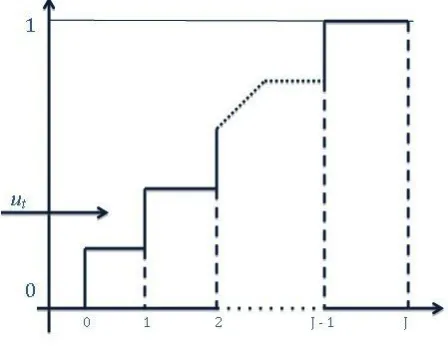
set of possible values inJ. Each ut∈[0,1] is generated through the conditional copula density c, and the corresponding yt determined through the maximum and minimum of the uniforms
corresponding to the neighbouring order statistics ofj, as seen in Figure 1. The DGP described
above is set out for a discretely-varied time series, in case we are dealing with a time series of
[image:10.612.177.401.342.520.2]continuous type random variables, the correspondence of ut to yt is one-to-one.
Figure 1: Mapping of generatedut
If F is known, and belongs to either a parametric family or non-parametric (empirical
dis-tribution), then one of the estimators stated in Section 2.4 could be employed for Θ. For a
continuous margin such estimators would yield constant and asymptotically normal estimates
of Θ, but in case F is a discrete distribution, ML methods can fail with convergence of the
likelihood and results will be biased from using continuous transformation.
We treatF as completely unknown, and henceUis unobtainable and considered as a series
of latent variables. The only available information available related to F is that it is a
case the margin is continuous, F−1 will be a one-to-one mapping function, and for a discrete
margin a many-to-one function. It is the first time a completely non-parametric specification
has been assumed for the marginal distribution using for Markov chain type time series
frame-work, both for continuous and discrete type outcomes. This overcomes any form of marginal
misspecification, and allows to combine any type of marginal behaviour with non-gaussian type
of temporal dependence.
Given that F is non-decreasing, we know the order statistics of the uniforms generated
through the unknown F will be dictated by the order statistics of the observed Y, and this
is the only information known with certainty. But there is still the uncertainty of the actual
value of U, and the degree of uncertainty depends upon the discrete data (low count implying
more uncertainty). In case we have a time series of binary outcomes, there is really only two
ranks, and hence we have more uncertainty. We can provide a formal definition for the order
statistics of the time series.
Definition 3.1 Let the rank of the observation at timet, yt, be denoted as kt. Henceyt=y(kt),
and for each t
y(kt−1) < y
t< y(kt+1), and, u(kt−1) < u
t< u(kt+1).
y(kt) is the order statistic of y
t. ut has the same rank kt, as yt.
Definition 3.1 simply states that given thatF is non-decreasing and monotonic, the unobserved
Uhave to obey the same order statistics as that of Y. We keep the time indexing on the ranks,
as unlike cross-sectional analysis, the time stamp on an observation is important. Note, we
have strict-inequality for the ranks of the observed data, implying any ties are left unresolved.
As we are capturing the temporal dependence of the series U, each instance ut is related
to its neighbor in time and the corresponding order statistic through Y. This is perhaps best
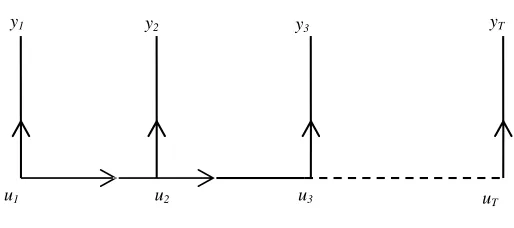
understood by employing a Directed Acyclic Graph (DAG) in Figure 2, where we see that
U is a Markov chain, and the observation yt are independent of each other conditional upon
ut. Starting from u1 the chain moves forward till the last value uT. We see how each ut is
u1 u2 u3 uT
[image:12.612.175.432.102.216.2]y1 y2 y3 yT
Figure 2: DAG of Latent Variable
only information retrieved iskt, the rank.
Using the above framework of the DAG, we can now model the structure of the Markov
chain in a Bayesian setup.
4
Bayesian Sampling Scheme
We specify a general sampling scheme to estimate the copula parameters, which will capture
the temporal dependence within a stationary Markov chain. The estimation technique is general
to any copula family and makes no assumption regarding the marginal distribution, and hence
can accommodate both continuous and discrete type margins. The sampling scheme can be
separated into two different stages, the first stage involves sampling U conditional upon the
copula parameter Θ, and in the second stage we draw Θ conditional upon U. This implies all
the uniforms are considered as auxiliary variables and have to be sampled.
Before proceeding with the sampling scheme, let us define the necessary notation. Through
Bayes theorem, let the posterior of Θ be given as
p(Θ|U)∝p(Θ)×p(U|Y; Θ), (4.1)
whereπdenotes the posterior of Θ. To make our scheme general across various copula families,
we need to re-parametrize the copula parameter vector Θ. Copula families support different
ranges, for a Gaussian and Student-t copula the dependence parameter lies in [−1,1]. Whereas for most Archimedean copulas the upper or lower bounds are defined up to infinity, like the
real line R. Let the mapping be Z(Θ) = Ψ, where Ψ ∈R and Z (See Appendix A for various transformations) represents a vector of functions, which has the same dimension as Θ. This
re-parametrization will change the posterior defined in (4.1). The prior distribution p(θ) has
to be transformed over to prior of Ψ, and we have to consider the Jacobian matrix associated
to such a reformulation. The prior p(Ψ) for Ψ will then be defined as
p(Ψ)∝p(Θ)
∂Θ ∂Ψ
,
where
∂Θ ∂Ψ
is the determinant of the Jacobian matrix. Regardless of which copula is now
chosen, we have a support over the real line for the parameters associated. The posterior
defined in (4.1) now becomes
p(Ψ|U)∝p(Ψ)×p(U|Y; Ψ).
Finally, we can now proceed with specifying the two stage sampling scheme, where first we
sample from p(U|Y; Ψ), followed by sampling from p(Ψ|U).
4.1
Sampling from
p
(
U
|
Y
; Ψ)
We see from Figure 2 how each instance of U is linked by its neighbours in time and the
corresponding order statistic from Y. Assuming a first-order Markov chain, we can write the
conditional probability for each ut, where 1< t < T as
p(ut|U\t,Y; Ψ) =p(ut|ut−1, ut+1, yt; Ψ), (4.2)
where U\t is the complete series U without ut. Given that we have a Markov chain of order
one and using the information from the DAG, the conditioning of U\t can be reduced to ut’s
connected neighbours in time (i.e. ut−1 and ut+1). As we mentioned previously, the only
information available from conditioning ut on yt is, ify(kt) is the order statistic of yt then kt is
also the rank of ut. This implies ut has to lie between u(kt−1) < ut < u(kt+1) to maintain the
order statistics, and the size of the interval depends upon the degree on discreteness. So we
can simplify (4.2) as
We cannot directly sample from (4.3) through a bivariate copula density (a first-order Markov
chain corresponding to bivariate copula), but applying Bayes theorem further, we can write
p(ut|ut−1, ut+1; Ψ) as
p(ut|ut−1, ut+1; Ψ) ∝p(ut|ut−1; Ψ)×p(ut+1|ut; Ψ).
Now we have two conditional distributions and we introduce the conditional copula, let C be
the copula distribution, and let ct|t−1 be the bivariate conditional copula density of ut given
ut−1, corresponding toC(see Appendix A.1 for various copulas density formulation). We model
the conditional probability of ut through the conditional copula density as,
p(ut|ut−1; Ψ) =ct|t−1(ut|ut−1; Ψ).
Hence the copula represents the transition density of the Markov chain. The same holds
for conditioning of ut+1 to ut. Now we can easily sample from the conditional distribution
Ct|t−1(ut|ut−1; Ψ), and evaluate the draw through Metropolis-Hasting (M-H) algorithm using
ct+1|t(ut+1|ut; Ψ). The sampling scheme is given as
for each ut,(t= 1, . . . , T),
compute u(kt−1) and u(kt+1), given (y(kt−1) < y
t < y(kt+1)), sampleu∗tfromCt|t−1(ut|ut−1; Ψ)I(u(kt−1) < ut < u(kt+1)),
compute αu = min
1,ct+1|t(ut+1|u
∗
t; Ψ) ct+1|t(ut+1|ut; Ψ)
.
Sampling from Ct|t−1 is easier than ct|t−1, as most copulas have a closed inverse form for the
conditional distribution. The above scheme is repeated for all ut. The truncated intervals are
updated if the drawnu∗t is accepted. The sampling is performed in the order of theUdictated
by the time order, but the intervals have to be maintained regardless of time. Through this
scheme we obtain an updated sample ofU. For large enoughT (for continuous data) and high
count data (discrete data), the interval (u(kt−1), u(kt+1)) becomes smaller and the acceptance
probability αu gets close to one. In fact anything uniformly sampled through the interval
conditional copula ofut+1. Missing values can also be generated through this scheme. We could
also consider higher-order Markov chain, for example for a second-order Markov chain, we will
require a trivariate copula and proceed with similar sampling procedure.
4.2
Sampling from the Posterior
p
(Ψ
|
U
)
Now we can proceed with sampling from the posterior of Ψ. Unlike the Gaussian copula
(see Hoff (2007)), most copula families do not have the full conditional available to sample
from, and a Markov Chain Monte Carlo (MCMC) based on M-H algorithm has to be adopted.
Within the M-H framework, we have to choose an adequate proposal distribution g(Ψ). A
multivariatet-distribution with the mean equal to the mode of the posterior, and the variance
equal to the negative inverse of the information matrix computed at the mode, can be used as
a proposal distribution. Such a Laplace-type proposal has been used in the literature (see Chib
and Greenberg (1998), Chib and Winkelmann (2001) and Pitt et al. (2006)). A multivariate
t-distribution with ν degrees-of-freedom as opposed to a Normal distribution is preferred, as it
would dominate in the tails of the true density. The advantage of such a proposal density is we
do not need to consider tuning of parameters, to attain some acceptance probability.
We choose a flat prior for Θ, p(Θ) = 1. Hence the re-parametrized Ψ’s prior will be
p(Ψ) ∝
∂Θ ∂Ψ
. To use a Laplace approximation, we need to employ a Maximum a Posterior
Probability (MAP).
b
ΨM AP(U) = arg max
Ψ
p(U|Y; Ψ)p(Ψ),
where Ψ denotes the estimated mode of Ψ. The log of the posterior can then be written asb
logp(Ψ|U)≈logg(Ψ|Ψ;b V).
V =−I−1 and I =
∂2p(U|Y;Ψ)p(Ψ)
∂Ψ∂Ψ0
Ψ=Ψb
is the information matrix evaluated at the mode. We
can finally draw from
Ψ'tν(Ψ, Vb ),
let the drawn value be denoted as Ψ∗ and the current value be Ψ, then Ψ∗ can be evaluated
αΨ = min
1,π(Ψ
∗)t
ν(Ψ|Ψ, Vb )
π(Ψ)tν(Ψ∗|Ψ, Vb )
,
where tν(Ψ|Ψ, Vb ) denotes the density of tν(Ψ, Vb ) evaluated at Ψ. The acceptance ratio is
very high, as the proposal density is close to the true density. We arbitrarily choose ν = 6
to dominate in the tails. A new mode Ψ is found at each iteration, conditional on the newb
updated U sample. To avoid computational burden of finding a new mode at each iteration,
we could update the mode every hundredth time or so, but we cannot not change it as the U
get sampled at each iteration. Numerical techniques such as Newton-Raphson are required to
locate the mode, and they are found within few steps of the algorithm search. Re-estimating
the mode at each iteration could become computationally intensive, and could be avoided by
updating it at regular intervals.
5
Data Example (Firearm Homicides)
We now present a real data application, where there could be persistence within a
discretely-varied time series. To be specific, we are looking at the weekly firearm homicides in Cape Town,
South Africa from the period of 1st January 1986 up to 31st February 1991 (275 observations)1,
as given in Figure 3.
Generally the period of the data sample corresponds to a time when areas in and around
Cape Town experienced rapid urbanization. Through such development local gangs form in
these areas, and clustering of high count of homicides could be associated with it. Cape Town
also attracted people from different regions of South Africa to settle in, and differences in social
norms could be another contributing reason.
We could employ various copula models to capture some specific form of temporal
depen-dence present in such a series. Two copula families will be employed here, first a Gumbel copula
which is a one-parameter copula exhibiting greater dependence in the right tail. Secondly, to
emphasis that our method is general across copula families a standard Gaussian copula with
no tail dependence parameter will be used, for the transition density.
The MCMC scheme is performed for 50,000 iterations. To deal with posterior correlation,
Figure 3: Firearm Homicides South Africa
0 50 100 150 200 250 0
2 4 6 8 10 12
Weeks
Gunfire Homicides
we perform thinning by saving every 30th iterate for posterior analysis, also the first 5000
it-erations are discarded for burn-in. Figure 4 presents the trace plot for both the Gumbel and
the Gaussian copula, where we see the chain mixes well. We also present the autocorrelations
plot of the final posterior sample for both of the used copulas in figure 5. The autocorrelation
is lower than 0.02 after the 4th and 3rd lag for the Gumbel and the Gaussian copula
param-eter respectively. Further to ensure convergence to the stationary distribution, we performed
multiple runs from different initial values. The reason for finding such high correlation, is due
to the sampling of eachut at a time, and then sampling Ψ based on the whole sample of U. In
a time series framework it is difficult to overcome such posterior correlation.
Apart from obtaining the posterior mean of Θ, we also compute the Kendall’s Tau rank
correlation coefficient for the copulas, which provides a meaningful interpretation of the
depen-dence as it is defined over [−1,1]. Computed as
τ = 4
Z Z
[0,1]2
C(u, v)dC(u, v)−1. (5.1)
For most copula families, a simple analytical solution for (5.1) exists, else it has to be
numer-ically computed. From using both of the copulas, we see there is evidently some temporal
0 0.5 1 1.5 2 2.5 3 3.5 4 4.5 5 x 10⁴
1.05 1.1 1.15 1.2 1.25 1.3 1.35 1.4 1.45 1.5 Iterations Θ
0 0.5 1 1.5 2 2.5 3 3.5 4 4.5 5
[image:18.612.73.532.97.258.2]x 104 0.05 0.1 0.15 0.2 0.25 0.3 0.35 0.4 Iterations Θ
Figure 4: Trace Plots: Gumbel & Gaussian Copula
0 10 20 30 40 50
−0.2 0 0.2 0.4 0.6 0.8 Lag Sample Autocorrelation
Sample Autocorrelation Function
0 10 20 30 40 50
−0.2 0 0.2 0.4 0.6 0.8
Sample Autocorrelation Function
Lag
[image:18.612.79.531.313.462.2]Sample Autocorrelation
Figure 5: Autocorrelation Plots: Gumbel & Gaussian Copula
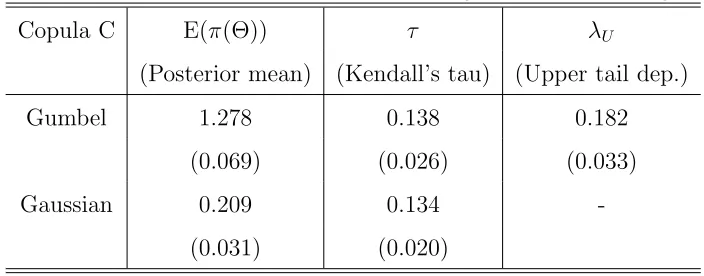
Table 1: Posterior Distribution Inference (Firearm Homicides)
Copula C E(π(Θ)) τ λU
(Posterior mean) (Kendall’s tau) (Upper tail dep.)
Gumbel 1.278 0.138 0.182
(0.069) (0.026) (0.033)
Gaussian 0.209 0.134
-(0.031) (0.020)
through both copulas is the same. For the Gaussian copula the tail dependence (lower and
[image:18.612.125.477.534.672.2]parameter through,
λU = lim1−
1−2u+C(u, u)
u ,
where lim1− is the limit approaching from the left. From Table 1 we can see there is significant
upper tail dependence, which implies, through Gumbel copula there seems to be higher
prob-ability of observing high homicides counts this week if in the previous week there were high
number of homicides.
Apart from the persistence observed within the time series, there could be other explanatory
variables to determine the current period firearm homicides, like number of police deployment
in local boroughs of Cape town over time, policy implementation, number of people moving
to Cape Town from rural areas around and others. Such covariates can be considered either
within copula framework where we could choose separate copula families to present the
contem-poraneous dependence or if our interest is not on these covariates but solely on the temporal
dependence, we can filter out the unexplained variation in homicides through a regression where
the covariates are considered.
6
Conclusion
Time series models fail to be flexible enough to capture complex temporal dependence for
data of different types (binary, count, ordered etc.). The entanglement of the marginal
distri-bution with the conditional (transition) distridistri-bution, confine most models to specific problems.
Models constructed for data of continuous type cannot normally be applied to discrete data
type. Copula models are generally used to capture contemporaneous dependence, but recently
they have been considered to describe a time series process (see ?, Chen and Fan (2002) and
Chen et al. (2009) among others). Lentzas and Ibragimov (2008) show a copula-based Markov
chain can act like long memory process. ? proposes a parametric copula-based Markov chain
for continuous data, where both the marginal distribution and the copula are parametrically
specified. Chen and Fan (2002) present a semi-parametric copula-based Markov chain, where
the marginal distribution is computed through an empirical distribution and employing
However, for discrete data types such methods can create computational problems (algorithm
failing to converge) and induce bias.
Hoff (2007) proposes a technique for cross-sectional data of mixed type (continuous-discrete),
where the marginals are left completely unspecified and based only on the information contained
in the order statistics a multivariate Gaussian copula is estimated. We extended Hoff’s
tech-nique in a time series framework and make it general across various copula families. Such a
technique can accommodate time series of both discretely and continuously varying random
variables. A Bayesian sampling scheme is proposed, where we first sample the latent uniform
variables conditional upon the copula parameters, and then the copula parameter conditional
upon the sampled uniform series. To make the methodology general across copula families, a
Laplace-type proposal for the posterior is presented, where each draw is evaluated through a
Metropolis-Hasting algorithm. The novelty of our work is in the class of time series models
with specified margins, it is the first time a non-parametric specification has been proposed for
the marginal density, avoiding misspecification for discrete data which is quite easy and not
having to estimate nuisance parameters associated to the marginal distribution.
We use a real data application based on the weekly count of firearm homicides in Cape
Town, South Africa. Employing both a Gumbel and a Gaussian copula separately, we capture
the significant persistence present within such a time series. Various quantities of interest, like
tail dependence can also be computed through copulas. The MCMC technique works well.
Appropriate thinning and discarding of the initial posterior draws is performed to ensure no
autocorrelation in the final posterior sample.
A
Copula Families and Conditional Distribution
A.1
Copula Transformations
We can obtain analytical formulas for important copula properties through the general
distribution function C. For the copula density c given the distribution function is twice
c(u, v|Θ) = ∂
2C(u, v|Θ)
∂u∂v .
And the conditional distribution of a copula given as
Cu|v(u|v; Θ) =
∂C(u, v|Θ) ∂v .
The conditional copula density cu|v(u|v; Θ) =c(u, v|Θ).
A.2
Clayton Copula
The Clayton copula is an Archimedean copula exhibiting strong joint left tail dependency.
It is a one-parameter based copula. The various transformations for Clayton copula are given
as
C(u, v|α) = (u−α+v−α−1)−1/α),
c(u, v|α) = (1 +α)[uv]−α−1(u−α+v−α−1)−2−1/α,
cu|v(u|v;α) =v−α−1(u−α+v−α−1)−1−1/α,
Cu−1|v(u|v;θ) =
(uvθ+1)−θ/(1+θ)+ 1−v−θ
−1/θ
,
where u, v ∈[0,1], and the copula parameter α ∈[0,∞].
A.3
Gumbel Copula
Gumbel copula is an Archimedean copula exhibiting strong joint right tail dependency. It
is a one-parameter based copula. The various transformations for Gumbel copula are given as
C(u, v|α) = exp
−(ueα+evα)1/α
c(u, v|α) =C(u, v|α)(uv)−1 (eu.ev)
α−1
(ueα+
e
vα)2−(1/α)
(ueα+evα)1/α+α−1
,
Cu|v(u|v;α) =v−1exp
−(ueα+
e
vα)1/α
1 + (ue e
v)
α−1+(1/α)
,
where eu=−Logu and ev =−Logv, u, v ∈[0,1], and the copula paramater α∈[0,∞].
The inverse of the conditional gumbel distribution can not be solved analytically and hence we
have to rely on a numerical method.
A.4
Gaussian Copula
Gaussian copula is an Elliptical copula, which is completely symmetric and has zero
prob-ability for any left/right extreme dependency. It is a one-parameter based copula. The various
transformations for Gaussian copula are given as
C(u, v|ρ) =C(u, v|ρ) =
Z Φ−1(u)
−∞
Z Φ−1(v)
−∞
1
2π(1−ρ2)12
− x
2−2ρxy+y2
2(1−ρ2)
,
c(u, v|ρ) = 1
(1−ρ2)1/2exp
[ρ2(Φ−1(u))2−2ρΦ−1(u)Φ−1(v) +ρ2(Φ−1(v))2]
2(1−ρ2)
,
Cu|v(u|v;ρ) = Φ
Φ−1(u)−ρΦ−1(v)
p
1−ρ2
,
Cu−1|v(u|v;ρ) = Φ
Φ−1(u)p1−ρ2+ρΦ−1(v)
.
Φ−1(.) is the standard normal quantile function. u, v ∈ (0,1), and the correlation paramater ρ∈(−1,1).
A.5
Student-t Copula
Student-t copula is an Elliptical copula and is symmetric. It has tail dependency dictated
by the degrees of freedom. It is two-parameter based copula. The various transformations for
Student-t copula are given as
C(u, v|Θ) =C(u, v|ρ, ν) =
Z t−ν1(u)
−∞
Z t−ν1(v)
−∞
Γ((ν+2)2 )
Γ(ν2)πν(1−ρ2)12
exp
1 +(x
2 −2ρxy+y2)
ν(1−ρ2)
−(ν+2)/2
c(u, v|ρ, ν) = Γ( ν+2 2 )Γ( ν 2) p
1−ρ2[Γ(ν+1 2 ]2]
,
× ([1 +
(t−ν1(u))2
ν ][1 +
(t−ν1(v))2
ν ])
ν+1
2
[1 + (t−ν1(u))2+(t−ν1(v))2−2ρt−ν1(u)t−ν1(v)
ν(1−ρ2) ]
ν+2
2
,
Cu|v(u|v;ρ, ν) = tν+1 (
t−1ν (u)−ρt−1ν (v)
q
ν+(t−ν1(v))2(1−ρ2)
ν+1
)
,
Cu−1|v(u|v;ρ, ν) = tν
(
t−1ν+1(u)
q
ν+(t−ν1(v))2(1−ρ2)
ν+1 +ρt −1
ν (v)
)
,
where Γ(a) is the gamma function equal to
Γ(a) =R0∞x(a−1)e−xdx.
t−1(.) denotes the standardized student-t quantile function. u, v ∈[0,1] and the correlation paramater ρ∈(−1,1), and the degrees-of-freedom parameter ν > 0.
B
Re-Parametrization
Copula families generally vary across in terms of their respective parameters ranges. We
propose a re-parameterization for a copula. Such a method unifies the range and makes the
proposal’s distribution support over the real lineR.
If the transformation is Z : Θ7→Ψ, then for various copula families,
Clayton Copula
α∈(0,∞), Z(α) = exp(ψ).
Gumbel Copula
Gaussian Copula
ρ∈[−1,1], Z(ρ) = 1−e
−ψ
1 +e−ψ.
Student-t Copula
ρ∈[−1,1], Z1(ρ) =
1−e−ψ1
1 +e−ψ1.
ν ∈[1,∞), Z2(ν) = exp(ψ2) + 1.
C
Sampling from a Truncated Copula
Each ut is sampled from the conditional copula distribution conditional on ut−1 and
trun-cated through the order statistics. As we showed before the neighbouring instances are simply
to ensure truncation.
Letaandbbe the lower and upper limit, for a drawuto lie in. Then as seen, the conditional
copula distribution is given as
Cu|v(u|v; Θ) =
∂C(u, v|Θ) ∂v .
LetCuT r|v(u|v; Θ, a, b) be the truncated conditional copula, such that
CT r
u|v(u|v; Θ, a, b) =
Ru
a ct|v(t|v; Θ)dt Cb|v(b|v; Θ)−Ca|v(a|v; Θ)
,
= Cu|v(u|v; Θ)−Ca|v(a|v; Θ) Cb|v(b|v; Θ)−Ca|v(a|v; Θ) .
LetCuT r|v(u|v; Θ, a, b) = w, then we can re-arrange equation above to
w·[Cb|v(b|v; Θ)−Ca|v(a|v; Θ)] +Ca|v(a|v; Θ) =Cu|v(u|v; Θ).
x=Cu|v(u|v; Θ), where now by simply inverting the conditional distribution we get
u=Cx−1|v(x|v; Θ).
u∈(a, b). Hence we simply need the inverse of the conditional distribution to successfully draw truncated instances.
References
Al-Osh, M. A. and Alzaid, A. A. First-order integer-valued autoregressive (inar(1)) process. Journal of Time
Series Analysis, 8(3):261–275, 1987.
Baillie, Richard T.; Bollerslev, Tim, and Mikkelsen, Hans Ole. Fractionally integrated generalized autoregressive
conditional heteroskedasticity. Journal of Econometrics, 74(1):3–30, September 1996.
Beare, Brendan K. Copulas and temporal dependence. Econometrica, 78(1):395–410, 2010a.
Beare, Brendan K. Archimedean copulas and temporal dependence. University of california at san diego,
economics working paper series, Department of Economics, UC San Diego, Sep 2010b.
Bollerslev, Tim. Generalized autoregressive conditional heteroskedasticity. Journal of Econometrics, 31(3):
307–327, April 1986.
Bouy´e, Eric; Durrleman, Valdo; Nikeghbali, Ashkan; Riboulet, Ga¨el, and Roncalli, Thierry. Copulas for finance
- a reading guide and some applications. Social Science Research Network Working Paper Series, November
2007.
Chen, Xiaohong and Fan, Yanqin. Estimation of copula-based semiparametric time series models. Working
Papers 0226, Department of Economics, Vanderbilt University, October 2002.
Chen, Xiaohong; Wu, Wei Biao, and Yi, Yanping. Efficient estimation of copula-based semiparametric markov
models. Cowles Foundation Discussion Papers 1691, Cowles Foundation for Research in Economics, Yale
University, February 2009.
Cherubini, U. and Luciano, E. Value-at-risk trade-off and capital allocation with copulas. Economic Notes, 30
(2), 2001.
Chib, Siddhartha and Greenberg, Edward. Analysis of multivariate probit models. Biometrika, pages 347–361,
Chib, Siddhartha and Winkelmann, Rainer. Markov chain monte carlo analysis of correlated count data.Journal
of Business & Economic Statistics, 19(4):428–35, 2001.
W.Darswo, B. Nguyen and Olsen, E. Copulas and markov processes. Illinois Journal of Mathematics, 36:
600–642, 1992.
Demarta, Stefano and McNeil, Alexander J. The t copula and related copulas.International Statistical Review,
73:111–129, 2005.
Embrechts, P.; Lindskog, F., and Mcneil, A. Modelling Dependence with Copulas and Applications to Risk
Management. InHandbook of Heavy Tailed Distributions in Finance, chapter 8, pages 329–384. 2003.
Embrechts, Paul; McNeil, Alexander, and Straumann, Daniel. Correlation and dependence in risk
manage-ment: Properties and pitfalls. InRisk Management: Value At Risk And Beyond, pages 176–223. Cambridge
University Press, 1999.
Engle, Robert F. Autoregressive conditional heteroscedasticity with estimates of the variance of united kingdom
inflation. Econometrica, 50(4):987–1007, July 1982.
Freeland, R.K. Statistical analysis of discrete time series with applications to the anaylsis of worker’s
compen-sation claims data. PhD thesis, The University of British Columbia, Canada, 1998.
Freeland, R.K. and McCabe, B.P.M. Forecasting discrete valued low count time series. International Journal
of Forecasting, 20(3):427 – 434, 2004.
Genest, C. and Ne˘slehov´a, J. A primer on copulas for count data. Astin Bulletin, 37(2):475, 2007.
Hoff, Peter D. Extending the rank likelihood for semiparametric copula estimation. Ann. Appl. Stat., 1(1):
265–283, 2007.
Ibragimov, Rustam. Copula-based characterizations for higher order markov processes. Econometric Theory,
25(03):819–846, June 2009.
Joe, H. Multivariate Models and Dependence Concepts. Chapman & Hall/CRC, 1997.
Lentzas, G and Ibragimov, Rustam. Copula and long memory. 2008.
MacDonald, I.L. and Zucchini, W. Hidden Markov and Other Models for Discrete- valued Time Series: A
Practical Introduction using R. Monographs on Statistics and Applied Probability. Taylor & Francis, 1997.
Mikosch, T. and St˘aric˘a, C. Limit Theory for the Sample Autocorrelations and Extremes of a Garch (1,1)
Process. Preprint // Department of Mathematics, Chalmers University of Technology, G¨oteburg University.
Department, Univ, 1998.
Nelsen, R. B. An Introduction to Copulas. Springer, 2007.
Patton, A. J. Modelling Asymmetric Exchange Rate Dependence. International Economic Review, 47(2):
527–556, 2006.
Pitt, Michael; Chan, David, and Kohn, Robert. Efficient bayesian inference for gaussian copula regression
models. Biometrika, 93(3):537–554, September 2006.
Rodriguez, Juan Carlos. Measuring financial contagion: A copula approach. Journal of Empirical Finance, 14
(3):401–423, June 2007.
Sklar, A. Fonctions de r´epartition `a n dimensions et leurs marges. Publications de l Institut Statistique de
l’Univwesit`e de Paris, 8:229–31, 1959.
Smith, Michael S. and Khaled, Mohamad A. Estimation of copula models with discrete margins via Bayesian
data augmentation. 107(497):290–303, 2012.
Smith, Murray D. Modelling sample selection using archimedean copulas. Econometrics Journal, 6(1):99–123,
2003.
Trivedi, Pravin K. and Zimmer, David M. Copula Modeling: An Introduction for Practitioners. Foundations
and Trends in Econometrics, 1(1):1–111, 2006. ISSN 1551-3076.
Zimmer, David M. and Trivedi, Pravin K. Using trivariate copulas to model sample selection and treatment
effects: Application to family health care demand. Journal of Business & Economic Statistics, 24:63–76,