University of Warwick institutional repository: http://go.warwick.ac.uk/wrap
A Thesis Submitted for the Degree of PhD at the University of Warwick
http://go.warwick.ac.uk/wrap/57050
This thesis is made available online and is protected by original copyright.
Please scroll down to view the document itself.
Library Declaration and Deposit Agreement
1.
STUDENT DETAILS
Please complete the following:
Full name: ………. University ID number: ………
2.
THESIS DEPOSIT
2.1 I understand that under my registration at the University, I am required to deposit my thesis with the University in BOTH hard copy and in digital format. The digital version should normally be saved as a single pdf file.
2.2 The hard copy will be housed in the University Library. The digital version will be deposited in the University’s Institutional Repository (WRAP). Unless otherwise indicated (see 2.3 below) this will be made openly accessible on the Internet and will be supplied to the British Library to be made available online via its Electronic Theses Online Service (EThOS) service.
[At present, theses submitted for a Master’s degree by Research (MA, MSc, LLM, MS or MMedSci) are not being deposited in WRAP and not being made available via EthOS. This may change in future.]
2.3 In exceptional circumstances, the Chair of the Board of Graduate Studies may grant permission for an embargo to be placed on public access to the hard copy thesis for a limited period. It is also possible to apply separately for an embargo on the digital version. (Further information is available in the Guide to Examinations for Higher Degrees by Research.)
2.4 If you are depositing a thesis for a Master’s degree by Research, please complete section (a) below. For all other research degrees, please complete both sections (a) and (b) below:
(a) Hard Copy
I hereby deposit a hard copy of my thesis in the University Library to be made publicly available to readers (please delete as appropriate) EITHER immediately OR after an embargo period of ………... months/years as agreed by the Chair of the Board of Graduate Studies.
I agree that my thesis may be photocopied. YES / NO (Please delete as appropriate)
(b) Digital Copy
I hereby deposit a digital copy of my thesis to be held in WRAP and made available via EThOS.
Please choose one of the following options:
EITHER My thesis can be made publicly available online. YES / NO
(Please delete as appropriate)
OR My thesis can be made publicly available only after…..[date] (Please give date)
YES / NO
(Please delete as appropriate)
OR My full thesis cannot be made publicly available online but I am submitting a separately identified additional, abridged version that can be made available online.
YES / NO (Please delete as appropriate)
Whether I deposit my Work personally or through an assistant or other agent, I agree to the following:
Rights granted to the University of Warwick and the British Library and the user of the thesis through this agreement are non-exclusive. I retain all rights in the thesis in its present version or future versions. I agree that the institutional repository administrators and the British Library or their agents may, without changing content, digitise and migrate the thesis to any medium or format for the purpose of future preservation and accessibility.
4.
DECLARATIONS
(a) I DECLARE THAT:
I am the author and owner of the copyright in the thesis and/or I have the authority of the authors and owners of the copyright in the thesis to make this agreement. Reproduction of any part of this thesis for teaching or in academic or other forms of publication is subject to the normal limitations on the use of copyrighted materials and to the proper and full acknowledgement of its source.
The digital version of the thesis I am supplying is the same version as the final, hard-bound copy submitted in completion of my degree, once any minor corrections have been completed.
I have exercised reasonable care to ensure that the thesis is original, and does not to the best of my knowledge break any UK law or other Intellectual Property Right, or contain any confidential material.
I understand that, through the medium of the Internet, files will be available to automated agents, and may be searched and copied by, for example, text mining and plagiarism detection software.
(b) IF I HAVE AGREED (in Section 2 above) TO MAKE MY THESIS PUBLICLY AVAILABLE DIGITALLY, I ALSO DECLARE THAT:
I grant the University of Warwick and the British Library a licence to make available on the Internet the thesis in digitised format through the Institutional Repository and through the British Library via the EThOS service.
If my thesis does include any substantial subsidiary material owned by third-party copyright holders, I have sought and obtained permission to include it in any version of my thesis available in digital format and that this permission encompasses the rights that I have granted to the University of Warwick and to the British Library.
5.
LEGAL INFRINGEMENTS
I understand that neither the University of Warwick nor the British Library have any obligation to take legal action on behalf of myself, or other rights holders, in the event of infringement of intellectual property rights, breach of contract or of any other right, in the thesis.
Please sign this agreement and return it to the Graduate School Office when you submit your thesis.
U N
IV ER
SITAS WARWICEN
SIS
Evaluating the Performance of Legacy
Applications on Emerging Parallel Architectures
by
Simon John Pennycook
A thesis submitted to The University of Warwick
in partial fulfilment of the requirements
for admission to the degree of
Doctor of Philosophy
Department of Computer Science
The University of WarwickThe gap between a supercomputer’s theoretical maximum (“peak”)
floating-point performance and that actually achieved by applications has grown wider
over time. Today, a typical scientific application achieves only 5–20% of any
given machine’s peak processing capability, and this gap leaves room for
signif-icant improvements in execution times.
This problem is most pronounced for modern “accelerator” architectures
– collections of hundreds of simple, low-clocked cores capable of executing the
same instruction on dozens of pieces of data simultaneously. This is a significant
change from the low number of high-clocked cores found in traditional CPUs,
and effective utilisation of accelerators typically requires extensive code and
algorithmic changes. In many cases, the best way in which to map a parallel
workload to these new architectures is unclear.
The principle focus of the work presented in this thesis is the evaluation
of emerging parallel architectures (specifically, modern CPUs, GPUs and Intel
MIC) for two benchmark codes – the LU benchmark from the NAS Parallel
Benchmark Suite and Sandia’s miniMD benchmark – which exhibit complex
parallel behaviours that are representative of many scientific applications. Using
combinations of low-level intrinsic functions, OpenMP, CUDA and MPI, we
demonstrate performance improvements of up to 7x for these workloads.
We also detail a code development methodology that permits application
de-velopers to target multiple architecture types without maintaining completely
separate implementations for each platform. Using OpenCL, we develop
perfor-mance portable implementations of the LU and miniMD benchmarks that are
faster than the original codes, and at most 2x slower than versions highly-tuned
for particular hardware.
Finally, we demonstrate the importance of evaluating architectures at scale
(as opposed to on single nodes) through performance modelling techniques,
highlighting the problems associated with strong-scaling on emerging accelerator
I am indebted to many people for the advice, support and friendship that they
have provided during my studies at the University of Warwick. It gives me great
pleasure to acknowledge them here.
First and foremost I need to thank my supervisor, Prof. Stephen Jarvis, for
guiding my research and professional development over the past three years.
Thank you for your confidence in me, your enthusiasm, and for giving me the
opportunity to undertake a PhD.
Thanks go to my colleagues in the Performance Computing and Visualisation
Group – David Beckingsale, Bob Bird, Dr. Adam Chester, James Davis, Henry
Franks, Dr. Matthew Leeke, Andrew Mallinson, Oliver Perks and others – for
making lunch interesting and a welcome break from work. I reserve special
thanks for my office mates, Dr. Simon Hammond, Dr. Gihan Mudalige and
Steven Wright; thank you for your encouragement, for proof-reading hundreds
of paper drafts, and for your undeniable roles in developing all of the ideas in
this thesis.
I also wish to thank the members of the Intel Parallel Computing Lab in
Santa Clara, in particular Pradeep Dubey, Chris Hughes, Jason Sewall and
Misha Smelyanskiy, for their support and guidance during (and beyond) my
internship. My experiences with Intel have given me a far greater understanding
of micro-architecture and “ninja” programming, and have shaped the latter half
of this thesis – thank you.
Collecting the experimental data for this thesis relied on access to a wide
range of supercomputing hardware, and I thank the staff of the Daresbury
Laboratory; the Centre for Scientific Computing at the University of Warwick;
and the Lawrence Livermore National Laboratory for their maintenance work
and for granting me access to their machines.
Outside of work, I would like to thank all of my friends at Warwick and
at home in Cornwall for reminding me that it’s okay to have fun occasionally;
Charlie, Mum, Dad, Grandma, Aunty and the rest of my family for their
con-tinued love and support; and finally, my girlfriend Louise – I dedicate this thesis
This thesis is submitted to the University of Warwick in support of the author’s
application for the degree of Doctor of Philosophy. It has been composed by the
author and has not been submitted in any previous application for any degree.
The work presented (including data generated and data analysis) was carried
out by the author except in the cases outlined below:
• Analysis of LU’s execution time (Chapter 4) was aided by Gihan Mudalige (Oxford e-Research) and Simon Hammond (Sandia National
Laborato-ries).
• Execution times for miniMD on KNC (Chapter 5) were collected by Chris Hughes (Intel Corporation), who also developed the message-passing level
of the code.
• Analysis of miniMD’s execution time on Intel hardware (Chapters 5 and 6) was aided by Chris Hughes and Misha Smelyanskiy (Intel Corporation).
• Execution times for the GTX 680 (Chapter 6) were collected by Chris Hughes.
• Execution times for the A8-3850 and HD6550D (Chapter 6) were collected by Simon Hammond.
• Execution times for theDawnDev,Hera andSierra supercomputers
(Chapter 7) were collected by Simon Hammond.
Where possible, source code developed by the author is made available online:
• NAS-LU Optimisations:
http://www2.warwick.ac.uk/fac/sci/dcs/research/pcav/areas/hpc/
download/nas-lu-ports/
• miniMD Optimisations:
http://www2.warwick.ac.uk/fac/sci/dcs/research/pcav/areas/hpc/
• S. J. Pennycook, G. R. Mudalige, S. D. Hammond and S. A. Jarvis, Par-allelising Wavefront Applications on General-Purpose GPU Devices, In
Proceedings of the UK Performance Engineering Workshop (UKPEW),
University of Warwick, UK, July, 2010 [130]
• S. J. Pennycook, S. D. Hammond, G. R. Mudalige and S. A. Jarvis, Ex-periences with Modelling Wavefront Algorithms on Many-Core
Architec-tures, InProceedings of the Daresbury GPU Workshop, Daresbury, UK,
September, 2010 [123]
• S. J. Pennycook, S. D. Hammond, G. R. Mudalige and S. A. Jarvis,
Perfor-mance Analysis of a Hybrid MPI/CUDA Implementation of the NAS-LU
Benchmark, InProceedings of the International Workshop on Performance
Modeling, Benchmarking and Simulation of High Performance Computing
Systems (PMBS), New Orleans, LA, November, 2010 [124]
• S. J. Pennycook, S. D. Hammond, S. A. Jarvis and G. R. Mudalige,
Perfor-mance Analysis of a Hybrid MPI/CUDA Implementation of the NAS-LU
Benchmark, ACM SIGMETRICS Performance Evaluation Review, 38 (4),
ISSN 0163-5999 [125]
• S. J. Pennycook, S. D. Hammond, G. R. Mudalige and S. A. Jarvis, On the Acceleration of Wavefront Applications using Distributed Many-Core
Architectures, The Computer Journal, 55 (2), pp. 138–153, ISSN
0010-4620 [126]
• S. J. Pennycook, S. D. Hammond, S. A. Wright, J. A. Herdman, I. Miller and S. A. Jarvis, An Investigation of the Performance Portability of
OpenCL, Journal of Parallel and Distributed Computing (JPDC), 2012
(to appear) [127]
• S. J. Pennycook, C. J. Hughes, M. Smelyanskiy and S. A. Jarvis, Explor-ing SIMD for Molecular Dynamics, UsExplor-ing Intel Xeon Processors and Intel
Xeon Phi Coprocessors, In Proceedings of the IEEE International
Paral-lel and Distributed Processing Symposium (IPDPS), Boston, MA, May,
2013 [128]
• S. J. Pennycook, S. A. Jarvis, Developing Performance-Portable Molecular Dynamics Kernels in OpenCL, InProceedings of the International
Work-shop on Performance Modeling, Benchmarking and Simulation of High
Performance Computing Systems (PMBS), Salt Lake City, UT,
The research presented in this thesis was made possible by the support of the
following benefactors and sources:
• The University of Warwick, United Kingdom:
Warwick Postgraduate Research Scholarship (2009–2012)
• Intel Corporation, Santa Clara:
Summer Internship (2011)
• Royal Society:
Industry Fellowship Scheme (IF090020/AM)
• UK Atomic Weapons Establishment:
“The Production of Predictive Models for Future Computing
Requirements” (CDK0660)
“AWE Technical Outreach Programme” (CDK0724)
AoS Array of Structs
AVX Advanced Vector eXtensions
CPU Central Processing Unit
CUDA Compute Unified Device Architecture
FLOP/s Floating-Point Operations per Second
GFLOP/s 109 FLOP/s
GPU Graphics Processing Unit
HPC High-Performance Computing
MIC Many-Integrated Core
MPI Message Passing Interface
PFLOP/s 1015 FLOP/s
SIMD Single Instruction Multiple Data
SoA Struct of Arrays
SDK Software Development Kit
SSE Streaming SIMD Extensions
Abstract ii
Acknowledgements iii
Declarations iv
Sponsorship and Grants vi
Abbreviations vii
List of Figures xiii
List of Tables xv
1 Introduction 1
1.1 Motivation . . . 3
1.2 Thesis Contributions . . . 5
1.3 Thesis Overview . . . 7
2 Performance Analysis and Engineering 9 2.1 Benchmarking . . . 10
2.2 Profiling . . . 11
2.3 Code Optimisation . . . 12
2.4 Performance Modelling . . . 14
2.4.1 Analytical Modelling . . . 15
2.4.2 Simulation . . . 16
2.5 Summary . . . 18
3.3 Multi-threading . . . 23
3.4 Message Passing . . . 25
3.5 Benchmark Platforms . . . 26
3.5.1 Single Nodes . . . 26
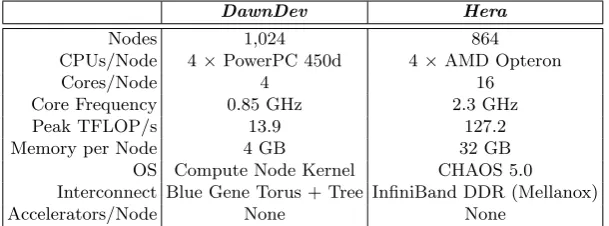
3.5.2 Supercomputers . . . 28
3.6 Summary . . . 29
4 Optimisation of Pipelined Wavefront Applications 30 4.1 Benchmark Description . . . 31
4.2 Related Work . . . 33
4.3 Optimisation Challenges . . . 34
4.4 Experimental Setup . . . 34
4.5 Optimisations . . . 36
4.5.1 SIMD and Multi-threading . . . 36
4.5.2 Message Passing . . . 41
4.6 Performance Results . . . 42
4.6.1 Performance Breakdown . . . 42
4.6.2 Architecture Comparison . . . 44
4.7 Summary . . . 47
5 Optimisation of Molecular Dynamics Applications 48 5.1 Benchmark Description . . . 50
5.2 Related Work . . . 51
5.3 Optimisation Challenges . . . 52
5.4 Experimental Setup . . . 53
5.5 Optimisations . . . 55
5.5.1 SIMD . . . 55
5.5.2 Multi-threading and Message Passing . . . 63
5.6 Performance Results . . . 65
5.6.3 Architecture Comparison . . . 70
5.7 Summary . . . 73
6 Developing “Performance-Portable” Applications 74 6.1 “Single Source” Methodology . . . 75
6.1.1 Work-Item and Work-Group Distribution . . . 76
6.1.2 Memory Layout . . . 78
6.1.3 Implicit vs. Explicit Vectorisation . . . 79
6.1.4 Device Fission . . . 79
6.1.5 Communication . . . 81
6.2 Benchmark Parameterisation . . . 81
6.2.1 Memory Layout . . . 82
6.2.2 Implicit vs Explicit Vectorisation . . . 83
6.2.3 Device Fission . . . 85
6.3 Performance Results . . . 86
6.4 Comparison with “Native” Implementations . . . 87
6.4.1 Pipelined Wavefront . . . 87
6.4.2 Molecular Dynamics . . . 89
6.5 Summary . . . 92
7 Predicting Application Performance on Future Architectures 93 7.1 Adapting Models for Future Architectures . . . 94
7.1.1 Single Node . . . 94
7.1.2 Multiple Node . . . 96
7.2 Communication Breakdown . . . 101
7.3 Machine Comparison . . . 101
7.3.1 Scalability . . . 101
7.3.2 Power Consumption . . . 105
8.1 Limitations . . . 110
8.2 Future Work . . . 112
8.2.1 k-blocking in Wavefront Applications . . . 112
8.2.2 Conflict Resolution in Molecular Dynamics . . . 115
8.2.3 Optimisation of Production Applications . . . 119
Bibliography 120
Appendices 138
1.1 A hybrid supercomputing architecture viewed from the
perspec-tive of (a) hardware and (b) software. . . 2
3.1 Parallel software/hardware stack. . . 19
3.2 Comparison of scalar and intrinsics code for a simple loop. . . 21
3.3 SPMD code for a simple loop. . . 22
3.4 Fork-join model used by OpenMP. . . 23
4.1 Simple loop-nest exhibiting a wavefront dependency (ignoring boundary conditions). . . 31
4.2 First three steps of a wavefront through a three-dimensional data grid. . . 31
4.3 Comparison of three differentk-blocking depths. . . 37
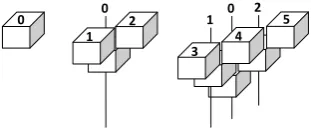
4.4 A mapping from a two-dimensional grid of work-items onto three-dimensional data. . . 40
4.5 Comparison of speed-up for our optimised implementation of LU running on different architectures. . . 45
5.1 An atom’s neighbourhood. . . 49
5.2 Combining a dot-product and AoS-to-SoA transpose in 128-bit SIMD. . . 58
5.3 Using a packed store to append to a neighbour list. . . 61
5.4 The hardware/class hierarchy. . . 63
5.5 A subdomain split into dependent and independent volumes. . . 64
5.6 Weak-scaling results for miniMD with a cut-off of 2.5. . . 69
5.7 Strong-scaling results for miniMD with a cut-off of 2.5. . . 69
nations of work-item and work-group size. . . 77
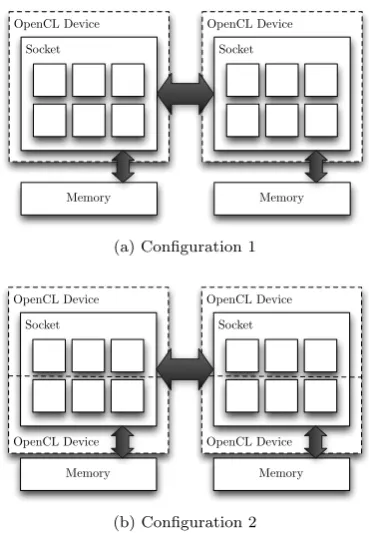
6.2 A dual-socket, hex-core node fissioned into (a) two sub-devices of six compute units; and (b) four sub-devices of three compute units. 80 6.3 Effect of neighbour list transposition on memory access pattern. Each arrow represents a single load instruction. . . 82
6.4 OpenCL code-snippet for a force compute kernel storing atom data infloat4s. . . 83
6.5 Effect of using vector types on memory access pattern. . . 84
6.6 OpenCL code-snippet for a force compute kernel using vector arithmetic. . . 85
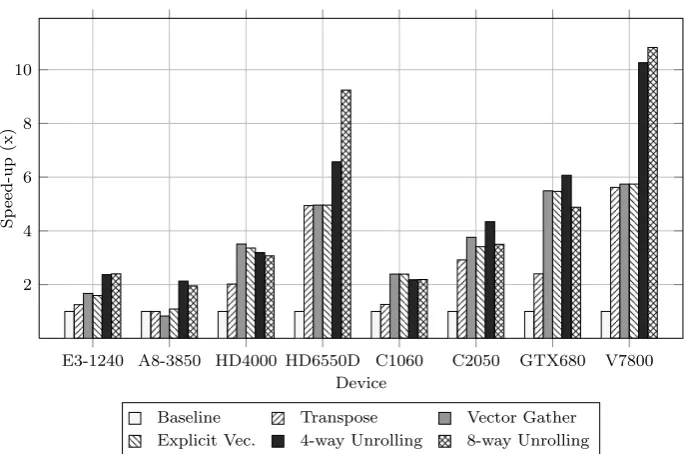
6.7 Comparison of speed-ups for parameterised force calculation ker-nel on various architectures. . . 86
6.8 OpenCL code-snippet for the gather of x, y and z positions in the force compute kernel with 8-way unrolling. . . 90
7.1 Observed and predicted times for a wavefront kernel on a Tesla C1060. . . 95
7.2 Observed times for a wavefront kernel on a Tesla C2050. . . 96
7.3 Breakdown of execution times for LU from the GPU model. . . . 101
7.4 Weak-scaling projections for LU. . . 102
7.5 Strong-scaling projections for LU. . . 104
8.1 First three wavefront steps for the newk-blocking policy. . . 114
8.2 Resolving conflicts using 128-bit SIMD. . . 116
A.1 Assembly from the vector gather kernel. . . 139
3.1 Hardware specifications of the CPUs used in this thesis. . . 27
3.2 Hardware specifications of the accelerators used in this thesis. . . 27
3.3 Hardware specifications of the integrated GPUs used in this thesis. 27 3.4 Hardware specifications of theSierraandMinervaclusters. . . . 28
3.5 Hardware specifications of theDawnDevandHeraclusters. . . . 28
4.1 Compiler configurations for the wavefront optimisation study. . . 35
4.2 Performance breakdown for LU (Class C). . . 43
5.1 System configuration for the molecular dynamics optimisation study. . . 54
5.2 Comparison of theoretical worst-case instruction counts for four different force compute gather-scatter approaches. . . 57
5.3 Clock-cycles per neighbour and speed-up versus scalar for force compute gather-scatter approaches. . . 59
5.4 Static instructions for force compute. . . 59
5.5 Static instructions for neighbour list build. . . 62
5.6 Performance breakdown for miniMD (2.048M atoms). . . 66
6.1 Comparison of execution times (in seconds) for Intel CPU imple-mentations of LU. . . 87
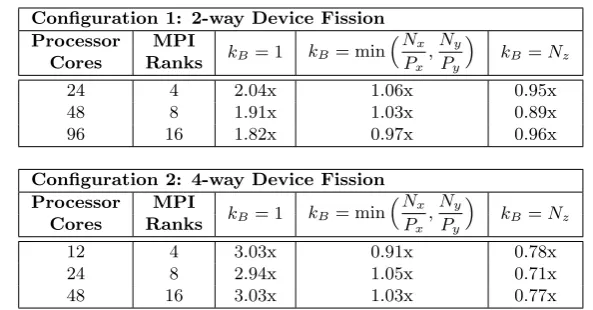
6.2 Speed-up of LU for two device fission configurations, and three kB values. . . 88
6.3 Comparison of execution times (in seconds) for NVIDIA GPU implementations of LU. . . 89
implementations of miniMD. . . 91
7.1 Model and simulation validations for LU. Execution times are
given in seconds. . . 100
7.2 Compiler configurations for the LU model validation. . . 100
7.3 Cluster comparison for executing LU (Class E) within a fixed
execution time. . . 105
8.1 Comparison of execution times (in seconds) for LU (Class C)
using the old and newk-blocking policies. . . 113
8.2 Slow-down of conflict resolution approach. . . 117
Introduction
Computational modelling and simulation form a key part of today’s scientific
and engineering research, permitting the rapid validation of theories in place
of (or in addition to) physical experimentation. Where such experimentation is
costly, impractical or dangerous (e.g.aircraft design, climate research, nuclear
power), computational methods are essential, and there is an understandable
desire for simulations to be run as quickly as possible. To this end, many
researchers employ clusters and/or supercomputers, large machines typically
thousands of times more powerful than a single desktop computer. Computer
scientists in the field of high performance computing (HPC) seek to understand
and maximise the performance of these machines, through the development
of new hardware, better suited to arithmetic-intensive workloads; the design
of more efficient algorithms; and the optimisation of scientific and engineering
applications, to ensure that existing hardware is utilised effectively.
Over the past twenty years, the performance of supercomputers has improved
significantly. Measured in terms of arithmetic throughput, floating-point
oper-ations per second (FLOP/s), the fastest supercomputer today is almost 300,000
times more powerful than the fastest supercomputer in 1993 [103]. Many
mod-ern supercomputers are comprised of several thousand commodity processors
connected by some networking interface, and the key to effective utilisation of
these machines is dividing problems into sub-tasks that can be solved
indepen-dently and in parallel. Communication between sub-tasks (e.g. to satisfy data
dependencies) must be handled explicitly by the programmer, and a generation
of computer scientists has developed considerable expertise in the development
CPU Accelerator
PCIe
(a) A CPU and an accelerator connected via a PCI-Express interface.
Accelerator CPU
"Device" Code "Host" Code
"Host" Code
Data Transfer
(b) Offloading work to an accelerator.
Figure 1.1: A hybrid supercomputing architecture viewed from the perspective of (a) hardware and (b) software.
different programming methodology from that required for the
vector-processor-based supercomputers of the 1970s and 1980s.
In 2008, HPC underwent another significant shift in technology, with the
introduction of a supercomputer named Roadrunner. This machine, built by
IBM for the Los Alamos National Laboratory, was noteworthy not only for
being the first supercomputer ever to achieve a sustained performance of one
petaflop per second (1015 FLOP/s), but also for its hybrid architecture – a coupling of 7,000 traditional processors with 13,000 computationalaccelerators
(i.e.massively parallel co-processors1, to which the CPU can “offload” compu-tation as shown in Figure 1.1). Four years later, the use of such accelerators
has become commonplace, powering some of the world’s fastest
supercomput-ers. These architectures promise high levels of raw performance, and a better
performance-to-power cost ratio (i.e.more FLOP/s per Watt), reflecting some
of the same motivations for the move away from vector machines in the 1990s.
Many believe that the continued use of accelerators is necessary to reach the
next big performance milestone – one exaflop per second (1018FLOP/s) – within an acceptable power budget.
1.1
Motivation
The speed of scientific and engineering applications has not followed the same
trend as the speed of supercomputers. Rather, the gap between a
supercom-puter’s maximum (peak) floating-point performance and that achieved by
ap-plications has grown wider over time – today, a typical scientific application
achieves only 5–20% of any given machine’s peak FLOP/s rate. This gap leaves
room for significant performance improvements, and it is not unheard of for
codes to run an order-of-magnitude faster following optimisation for modern
architectures [12, 29, 78, 117, 145, 150, 162]. Such improvements in execution
time have the potential to impact the cost of science significantly, with direct
and measurable results: codes can be run in less time, or run in the same time
on fewer computational resources. The former accelerates scientific delivery
and reduces power costs, while the latter enables HPC sites to (i) purchase a
smaller machine, decreasing procurement and maintenance costs; or (ii) make
more efficient use of existing machines, by executing several small applications
simultaneously.
The widening of this performance gap is largely the result of the so-called
clock-speed “free lunch” [153] enjoyed by programmers during the early 1990s.
During this time, applications were able to benefit from the steadily increasing
clock-speed of CPUs afforded by Moore’s Law [104] (i.e. the doubling of the
number of transistors on a chip every two years). Due to issues concerning
power consumption and heat dissipation [112], hardware manufacturers
even-tually abandoned increasing clock-speeds in favour of alternative methods of
improving performance, placing multiple CPU cores on one die, and/or
increas-ing the number of operations per cycle usincreas-ing Sincreas-ingle-Instruction-Multiple-Data
(SIMD) execution units. A large number of HPC codes have not yet adapted
to these changes: they often do not make any distinction between cores on the
same die and cores on a separate machine; and many do not make effective
are essentially collections of hundreds of simple, low-clocked cores capable of
executing the same instruction on dozens of pieces of data simultaneously.
Complicating the matter further, the vast majority of supercomputers to
date have supported the same programming model across successive hardware
generations (i.e. a programming language like Fortran or C++, coupled with
a message passing library), providing the ability to run existing codes on new
machines without making any changes. Utilising accelerators, on the other
hand, typically requires the adoption of new development tools and
program-ming languages. Prior to the introduction of the Open Computing Language
(OpenCL) [76] and OpenACC [2] standards, each accelerator required the use of
its own proprietary programming model and, although this is largely no longer
the case, applications are still likely to require significant algorithmic and code
changes in order to make effective use of new architectures.
The HPC community is thus faced with the daunting task of updating two
decades-worth of “legacy” applications, typically hundreds of thousands of lines
of source code each, to utilise accelerators and new parallel programming
mod-els. The principle focus of the work presented in this thesis is the evaluation of
these emerging parallel architectures for representative scientific and engineering
codes, and the demonstration of a code development methodology that offers a
middle-ground between: (i) focusing on a single architecture today, hoping that
the resulting code will execute effectively on the hardware of the future; and
(ii) potentially wasting considerable effort writing efficient code for each new
1.2
Thesis Contributions
The research presented in this thesis makes the following contributions:
• We develop one of the first reported CUDA implementations of a
three-dimensional pipelined wavefront application, specifically the LU
bench-mark from the NAS Parallel Benchbench-mark (NPB) Suite, detailing a
num-ber of general optimisations for this class of algorithm. We demonstrate
the effect ofk-blocking on the amount of exploitable parallelism, and the
importance of choosing a k-blocking depth that is appropriate for the
target architecture. Furthermore, and in contrast to previous work on
two-dimensional wavefronts, we show that satisfying data dependencies
via implicit CPU synchronisation (i.e. launching one CUDA kernel per
hyperplane) can be the best parallelisation approach for some
applica-tions.
• We develop the first reported MIC implementation of a molecular
dy-namics application, specifically the miniMD benchmark from Sandia’s
Mantevo benchmark suite, and propose several novel improvements to
its SIMD and threading behaviour. We examine the impact of instruction
overhead on gather/scatter memory accesses, and show how storing data
as an array-of-structs (AoS) can improve execution times across CPU and
MIC hardware. Our results also highlight that redundant computation,
the conventional approach for avoiding scatter write-conflicts on
accelera-tor hardware, is not necessarily the best approach for molecular dynamics
codes. Gather/scatter accesses are common to other classes of application
(e.g. unstructured mesh) which we believe could benefit from
• We demonstrate a methodology for writing “performance-portable” codes
using OpenCL, highlighting a number of important hardware and software
parameters that should be considered during application development. For
both wavefront and molecular dynamics applications, we show that it is
possible to maintain an application that is optimised for multiple
micro-architecture designs (if source code is sufficiently parameterised) without
a significant performance penalty on any one architecture. Our OpenCL
implementations of the LU and miniMD benchmarks are at most 2x slower
than versions individually optimised for a single platform – and faster than
the original Fortran and C codes.
• Finally, we utilise a combination of analytical performance modelling and
discrete event simulation to examine the performance of accelerator-based
supercomputers at scale. We extend two existing CPU modelling
ap-proaches by adding support for the prediction of PCI-Express transfer
times, and compare the performance of commodity CPU and GPU
clus-ters to that of an IBM Blue Gene/P. Our results highlight issues associated
with the strong-scaling of applications on GPU-based clusters, and
there-fore suggest that accelerators may not be a suitable architectural choice
1.3
Thesis Overview
The remainder of the thesis is structured as follows:
Chapter 2 presents an account of the concepts, principles and terminology related to the field of high-performance computing, and more specifically that
of performance engineering. This account includes a detailed survey of related
literature, and describes many of the techniques at the core of this work.
Chapter 3details the history of, and current state-of-the-art in, parallel hard-ware and softhard-ware technologies. The programming challenges addressed by this
research arise due to the many alternative forms of parallelism available across
a wide variety of different platforms, and the contents of this chapter highlight
the key differences between the micro-architectures compared and contrasted in
this work.
Chapter 4andChapter 5present optimisation studies for the LU and miniMD benchmarks, respectively. The optimisation challenges and performance
bottle-necks of both codes are identified, and we describe a number of novel
optimisa-tions designed to improve: (i) utilisation of SIMD execution units; (ii)
multi-threading behaviour; and (iii) communication between devices (and nodes). For
both benchmarks, we demonstrate that the same set of optimisations can
ben-efit multiple architecture types.
Chapter 6 proposes an incremental programming methodology that allows HPC sites to develop “performance-portable” applications that adapt to
mul-tiple architectures at run- or compile-time. This methodology is evaluated for
both benchmark applications, and the performance of the resulting codes is
compared to that of the optimised implementations developed in previous
Chapter 7demonstrates the application of traditional performance modelling techniques to emerging parallel architectures. We use a combination of
ana-lytical modelling and simulation to facilitate the prediction of execution times
for accelerator-based supercomputers based on benchmark results from a single
node, ultimately permitting a comparison of application performance on future
machines.
Chapter 8concludes the thesis, and discusses the implications of our research for the designers of HPC applications. We identify the limitations of the work
Performance Analysis and Engineering
As micro-architectures continue to evolve, and manufacturers introduce new
hardware features, programming languages must also adapt to support them.
The rapid development of supercomputing hardware thus poses a real challenge
for the developers of scientific and engineering codes – for best performance,
legacy applications representing several decades worth of development should be
updated to reflect current architectural trends. However, due to a combination
of application size (thousands to millions of lines of code) and the costs of
employing domain and computer scientists with sufficient expertise to re-write
code and re-validate results, significant code modification (in the worst case,
starting from scratch) is not an option for many HPC sites.
The result is an iterative development cycle trading off code maintainability
against performance, allowing codes to develop both in terms of functionality
and performance optimality over the course of several hardware generations –
domain scientists add new features to an existing code base as scientific
knowl-edge and code requirements change, while computer scientists (in particular,
performance engineers) work on identifying slow regions of code and
accelerat-ing them through the use of new languages and/or hardware.
The work in this thesis focuses on the latter process (i.e.performance
anal-ysis and engineering), which we consider here as consisting of four steps:
2.1
Benchmarking
The peak FLOP/s rate quoted by hardware manufacturers represents an
archi-tecture’s theoretical maximum arithmetic throughput. It is becoming
increas-ingly difficult for real-world applications to achieve this level of performance
– at a minimum, most current generation hardware requires the evaluation of
a single precision addition and multiplication on each of its SIMD execution
units in every clock cycle; some hardware also requires that these operations
are performed on the same values (i.e.a fused multiply-add), or the evaluation
of transcendental functions (e.g.sine, cosine, reciprocal, square root) in
hard-ware using special function units [92]. Many HPC codes make use of double
precision, typically with some imbalance in the number of addition and
multi-plication operations, and there is thus a clear motivation for the production of
alternative metrics which are more representative of the performance achieved
by real applications. Benchmarks are pieces of code written specifically to
col-lect such performance data, such that architectures can be compared in a more
meaningful way.
So-called “micro” or “kernel” benchmarks are small, simple, pieces of code
designed to extract low-level hardware information. The most famous of these
benchmarks is LINPACK [40], a linear algebra benchmark that is used to
de-termine a machine’ssustained (i.e.achievable) FLOP/s rate and also its
place-ment on the Top500 [103] list of the world’s fastest supercomputers.
Simi-lar benchmarks exist for the evaluation of sustained memory bandwidth (e.g.
STREAM [97]) and network communication performance (e.g. MPPTest [53]
and SKaMPI [142]). Benchmarks of this kind are useful for drawing conclusions
about general trends in hardware [82], and can also help to discover any
dis-crepancies between the hardware specification published by vendors and what is
experienced by users [33]. However, it is difficult to combine the simple metrics
produced by micro-benchmarks to draw conclusions about the performance of
and subsystems is likely to result in lower performance than that measured by
micro-benchmarks, and the behaviour of some components (e.g.data cache) is
too complex to be captured by these micro-benchmarks in a way that is
repre-sentative of all applications.
“Macro” or “application” benchmarks are more complex codes designed to
exhibit analogous computational behaviours to production applications. The
use of such a benchmark may be preferable to the use of the application
it-self: scientific applications may take days or weeks to complete a simulation;
and many applications are of a commercially sensitive (or classified) nature,
thus preventing them from being distributed. Popular examples of
macro-benchmarks are: the ASC benchmark suite [152] developed by the Los Alamos
and Lawrence Livermore National Laboratories; the NAS Parallel Benchmark
Suite developed by NASA Ames Research Centre [15, 16]; and the Mantevo
benchmark suite [61, 62] developed by Sandia National Laboratories. These
benchmarks typically output a breakdown of their execution time, such that
the performance bottlenecks of different application and architecture
combina-tions can be identified.
2.2
Profiling
Not all codes and benchmarks break down their execution time into component
parts and, even where they do, the breakdown may not be at a low enough level
to identify the root cause of poor application performance. In these situations, it
is usual to make use of aprofiler– a tool that monitors an application as it runs,
and generates aprofile of its execution. During performance analysis, the use
of profilers allows programmers to examine both high level performance metrics
(e.g. execution time [52, 116], memory consumption [131, 132, 157], network
communication costs [68] and time spent reading/writing from/to disk [163])
and low-level metrics (e.g.instructions retired, cache hits, cache misses) recorded
One method of profiling (used extensively in this thesis) is to instrument
source code directly, manually inserting calls to profiling functions and libraries
into particular sections of code. The use of such instrumentation is well-suited to
situations where performance engineers are only interested in the performance of
a small section of an application, or want to record only a few high-level metrics
(such as total execution time). For more general analysis, certain compilers
can insert calls to profiling functions at compile time (e.g. gprof [52]); other
profiling tools can be enabled at link time, wrapping system and library function
calls with code that records information about certain events [116, 132, 163],
thus allowing applications to be profiled without source code modification or
re-compilation.
2.3
Code Optimisation
Once the reasons for an application performing poorly have been identified,
performance engineers can begin the process of code optimisation. This can
take many forms: simple code transformations (e.g.loop unrolling, pipelining
and tiling) designed to reduce instruction count, increase throughput or improve
cache behaviour [39, 98]; code re-writes that make use of new hardware features
(e.g.loop vectorisation, SIMD intrinsics) [44]; and completely new algorithms,
with lower computational complexity or better suited to modern architectures
(e.g.being more amenable to parallelisation) [145].
When performing code optimisation studies on a single platform, there is
an obvious baseline against which to measure performance improvements – the
original code, run in the same configuration. Following the introduction of
ac-celerators, many code optimisations took the form of porting (or “offloading”)
arithmetic-intensive portions of an application to an accelerator: some studies
featured comparisons between parallel codes utilising accelerators and
unop-timised CPU codes [23]; some compared codes using different floating-point
data transfer overheads [51]. Taken out of context, the speed-up figures reported
in such studies can be misleading, and many papers have since disputed claims
that accelerators are several orders of magnitude faster than traditional
archi-tectures [21, 22, 92, 158]. In the optimisation studies presented in this thesis, we
strive to keep architectural comparisons as fair as possible – specifically, we: (i)
spend a significant amount of time optimising baseline codes before considering
accelerators; (ii) only draw comparisons between architectures running codes of
the same floating-point precision; and (iii) report full application times, rather
than focusing on sections of codes that may be more amenable to acceleration.
The introduction of hybrid supercomputer architectures has had another
sig-nificant effect on code optimisation – with a wide variety of micro-architectures
available even within a single machine, developers are now keen for their
appli-cations to exhibit good levels of performance across different hardware,
with-out maintaining separate implementations for each. Recent work has proposed
several alternative methodologies for the development of such “performance
portable” applications, aiming to achieve high levels of performance on multiple
architectures using a single source code.
“Directive”-based programming allows developers to mark (using pragmas)
the regions of code that they wish to be cross-compiled for an accelerator, and
is quickly becoming the programming model of choice for legacy application
developers. The HMPP [37] and OpenACC [2] standards are currently
sup-ported by compilers from CAPS, Cray and PGI, and the inclusion of similar
directives within OpenMP has also been proposed [4, 5, 89, 90]. Although this
approach allows applications developed on one architecture to be compiled for
alternative targets with relative ease, it does not necessarily make any
guaran-tees of performance portability – directives do not improve the performance of
the original CPU code, and recent work by Leeet al.[91] suggests that current
generation directives are not expressive enough to facilitate accelerator-specific
Another alternative is the use of domain specific languages (DSLs) and/or
“active libraries”, which permit application developers to express their problem
in a high-level and domain specific manner, leaving the actual code
implementa-tion to a library or smart compiler. For example, the OP2 [46, 47] and Liszt [35]
projects both provide abstractions for codes that operate on unstructured grids;
programmers write applications in terms of operations over constructs such as
nodes or edges, and the compiler transforms this representation into a binary
optimised for the target platform.
Other research (including that presented in this thesis) has investigated the
utility of using the recent OpenCL [76] standard to develop codes in a
platform-agnostic manner [42, 83, 159, 161], parameterising codes in a fashion that
al-lows them to adapt to hardware changes – this is discussed in more detail in
Chapter 6.
2.4
Performance Modelling
The term “performance modelling” describes a collection of techniques that
allow computer scientists to reason about and predict the performance of an
application. Models of sufficient accuracy can be used to augment performance
analysis and engineering activities, and their use has been demonstrated in
identifying performance bottlenecks [34]; evaluating the impact of code
optimi-sations ahead of implementation [109]; predicting the performance of
applica-tions when ported to new architectures [102]; and comparing the communication
behaviour of codes at scale on different machines [63, 72, 74].
This last point in particular forms an important part of this thesis. HPC
codes are rarely run on a single processor, instead running on hundreds or
thou-sands of compute “nodes” in parallel. There is a clear need to reflect this in
both benchmarking and code optimisation; benchmark results must be
repre-sentative of performance when codes are run at scale, and code optimisations
delivery significantly. However, there are several reasons that it is desirable
to benchmark at much smaller scale (at least initially). Firstly, it allows for
new hardware and software to be evaluated without significant investment – an
HPC site can buy one or two small computers built on a new architecture, and
use these to carry out performance analysis before committing to purchasing
a much larger machine [57]. Secondly, and arguably more importantly from a
software development perspective, it allows programmers to avoid the problems
associated with debugging parallel programs running at scale [18].
Performance modelling in this context can be broadly divided into two
al-ternative techniques: (i)analytical modelling, where an application’s execution
time is represented mathematically as a series of equations; and (ii)simulation,
where a code (or a representation thereof) is run on a model of a machine that
is simulated in software. Several works have looked to use analytical models and
simulations together, to lend further credence to their predictions [55, 99, 107].
2.4.1
Analytical Modelling
Generally, an application’s execution time (Ttotal) can be represented by the
following equation [6]:
Ttotal= (Tcomputation+Tcommunication−Toverlap)
+Tsynchronisation+Toverhead
(2.1)
That is, the sum of the time that the application spends performing
computa-tion and communicacomputa-tion, minus the amount of time during which computacomputa-tion
and communication are performed concurrently. Tsynchronisation andToverhead
account for communication costs that cannot be overlapped, such as processor
synchronisation and message overheads.
Each of these components is constructed from a series of sub-models,
repre-senting the contribution of an application’s functions to overall execution time.
per-message communication costs are usually predicted based on a simple set
of network parameters [10, 32, 105]. Analytical models of this form have been
demonstrated to achieve high levels of accuracy on a wide range of applications
from various scientific domains [7, 30, 34, 73].
The main advantage of this technique is that, once constructed and
appro-priately parameterised, an analytical model can be evaluated very quickly –
predicting application performance in a new configuration is as simple as
sub-stituting different parameter values into the model equations. However, the
con-struction and parameterisation of a model is a difficult task, requiring significant
understanding of the code’s behaviour in order to represent it mathematically.
Recent work, by Mudaligeet al.[107, 110, 111], suggests that this process could
be greatly simplified by building upon pre-existing and pre-validated models
that capture the key performance behaviours of whole application classes (as
opposed to individual applications).
The analytical models contained in this thesis use LogGP [10] to model
com-munication behaviour, which characterises a network in terms of: latency (L);
overhead (o); bandwidth for small messages (g); bandwidth for large messages
(G); and the number of processors (P).
2.4.2
Simulation
Simulators aim to address the shortcomings of analytical modelling, shifting
the complexity away from individual application models and into a re-usable
package capable of representing machine and/or application state in software.
The models executed by simulators are much simpler than analytical models,
typically taking the form of either: (i) a trace, recorded from an application run
by some accompanying tool; or (ii) a representation of the application’s source
code.
“Micro” simulators replicate the behaviour of individual hardware
compo-nents at a very low level, tracking system state on a clock-by-clock basis. Such
fabrication of silicon chips (both in research and industry); to evaluate the
performance impact of novel hardware features [8, 85]; or to identify the
perfor-mance bottlenecks of an application [99].
“Macro” simulators instead aim to capture the behaviour of a machine at
a much higher level, with changes to system state occurring in response to
particular events (e.g.network communications). Like analytical models,
macro-simulators typically require that computation times be collected empirically or
from a micro-simulator – however, they are able to couple these times with
additional system state information (e.g. processor/network load from other
users and applications) to produce more accurate results.
The increased accuracy of simulation comes at a cost, however, requiring
sig-nificant computational resources. At the micro-level, each executed instruction
must be simulated in software, while at the macro-level, events from thousands
of simulated processors must be handled. In both cases, a simulation will take
significantly longer to produce performance predictions than an equivalent
an-alytical model.
The research in this thesis makes use of the Warwick Performance Prediction
(WARPP) toolkit [55, 56], a macro-simulator similar to Sandia’s Structural
Simulation Toolkit (SST) [70] and successor to the University of Warwick’s
2.5
Summary
Due to the size and complexity of scientific and engineering applications, it is
becoming common for the performance analysis and engineering process to take
place at the level of macro-benchmarks, with optimisations only later applied
to production codes [62]. We adopt this methodology in this thesis, using two
macro-benchmarks to investigate the utility of alternative parallel hardware and
programming models.
This process allows for drastic changes to be made much more rapidly than
could ever be possible in the context of a legacy application. Although an
ana-lytical (or “paper and pencil”) exploration of the design space can typically label
a potential optimisation as either fruitless or promising, only micro-architectural
simulation or a real implementation (both of which require the algorithm to be
Parallel Hardware and Programming Models
Modern computer architectures are highly parallel, featuring hardware support
for many different types of parallelism. Figure 3.1 represents this parallelism
diagrammatically, mapped to a “stack” of hardware features: superscalar
archi-tectures provide instruction-level parallelism (ILP), executing multiple
indepen-dent instructions in a single clock cycle; SIMD architectures provide data-level
parallelism, with each instruction capable of executing on a vector of data
el-ements; and multi-core and cluster architectures provide task-level parallelism,
supporting severalthreads ornodes running independently of one another. As
suggested by the stack representation, each of these levels of parallelism can
make use of the level beneath it – each node in a supercomputer can run
mul-tiple threads, each thread can make use of SIMD instructions, and each SIMD
instruction can be scheduled alongside others.
Understanding these levels of parallelism, and how best to utilise them,
is key to achieving high levels of performance for scientific and engineering
applications. In the remainder of this section, we detail the programming models
used for the research in this thesis, and how they map to the parallelism available
in current generation hardware.
Instruction-Level Task-Level Data-Level Parallelism Cluster Superscalar SIMD Multi-core Hardware Message Passing Smart Compilers Multi-threading Vectorisation Software Instruction-Level Task-Level Data-Level Cluster Superscalar SIMD Multi-core Message Passing Smart Compilers Multi-threading Vectorisation
3.1
Instruction-Level Parallelism
Modern architectures support ILP in several forms. “Out-of-order” processors
are able to execute instructions as soon as their inputs are available, rather
than in the order in which they appear in a program; this is often coupled with
“speculative” execution, which allows a processor to execute instructions that
may or may not be required (based on the result of some branch condition).
Together, these two features allow a processor to utilise clock-cycles that would
otherwise be wasted if a program’s instructions were to be executed sequentially.
Writing code to maximise ILP is a difficult task, requiring a detailed
under-standing of both the application and the target architecture. Data dependencies
between instructions, instruction throughputs/latencies and the way in which
instructions are mapped to an architecture’s execution units must all be
con-sidered [141]. Furthermore, many of the techniques that a programmer could
employ in code to improve ILP (such as loop unrolling) [71] are now supported
by optimising compilers; we therefore focus on exploiting data and task level
parallelism in this research.
3.2
SIMD / Vectorisation
The SIMD execution units of modern processors are very similar conceptually
to the vector processors of the 1970s and 1980s, providing the capability to
perform the same operation on a number of data items simultaneously. The
number of values manipulated by each instruction (i.e. the SIMD “width”)
differs by architecture, and is typically considerably less than on old vector
processors, but has been following an upward trend: the 128-bit Streaming
SIMD Extensions (SSE) of x86 architectures have been augmented by 256-bit
Advanced Vector Extensions (AVX); the new Intel Many-Integrated Core (MIC)
architecture supports 512-bit SIMD; and GPUs typically support 1024- or
2048-bit SIMD. We list SIMD widths in 2048-bits because a SIMD register can be used to
for (int i = 0; i < 128; i++) {
a[i] = b[i] + c[i];
}
(a) Scalar
for (int i = 0; i < 128; i += 4) {
__m128 _a;
__m128 _b = _mm_load_ps(&b[i]);
__m128 _c = _mm_load_ps(&c[i]);
_a = _mm_add_ps(_b, _c);
_mm_store_ps(&a[i], _a);
}
(b) SSE
Figure 3.2: Comparison of scalar and intrinsics code for a simple loop.
four 32-bit single precision floating-point values, or two 64-bit double precision
floating-point values.
Traditional programming languages used for HPC codes (such as C, C++
or Fortran) are scalar in nature, and thus do not make use of an architecture’s
SIMD execution units when compiled. In order to utilise these SIMD
instruc-tions, programmers must either: (i) use compilers supportingauto-vectorisation,
which transform scalar code into an equivalent vector representation; or (ii)
identify vectorisation opportunities explicitly, through extensions to the
origi-nal language orintrinsicfunctions.
Coding with intrinsic functions is often the best way to achieve maximum
performance, since each intrinsic maps directly to a hardware instruction (or
series of instructions). It also allows programmers to reason about potential
bottlenecks much more readily during development, since operations that do
not make efficient use of SIMD will have been written by hand. However, it is
for exactly these reasons that programmers often prefer not to use intrinsics –
they are less readable than scalar code and require an in-depth understanding
of an architecture’s SIMD execution capabilities. Further, intrinsic functions
differ by instruction set and may not be supported in the same way by all
compilers. Figure 3.2 compares scalar code for a simple loop written in C++
__kernel simple_loop(...) { int i = get_global_id(0); if (i < 128) {
a[i] = b[i] + c[i]; }
}
Figure 3.3: SPMD code for a simple loop.
Many programmers thus prefer to rely on vectorisation. Most
auto-vectorisation compilers (e.g.Cray, Intel, PGI, Sun) will attempt to apply
vec-torisation to a function’s inner-most loop, effectively unrolling the loop a number
of times to match the hardware’s SIMD width. This operation relies on the
com-piler being able to identify that the operations in the loop are independent, and
may require some programmer intervention (such as insertion of pragmas) [81]
to assert that auto-vectorisation is possible. This approach works well for
sim-ple loops, but programmers with sufficient domain and hardware knowledge are
likely to be able to construct a more efficient instruction sequence for complex
loops – the compiler has no knowledge of the problem domain or how the code
will be run, and therefore cannot make certain assumptions (e.g.that all inputs
will be valid and not NaN).
An alternative paradigm that targets SIMD execution units is that of
Single-Program-Multiple-Data (SPMD) programming, where programmers write code
from the perspective of an individual parallel task. The resulting code is much
more readable than when intrinsics are used, and also eases the process of
auto-vectorisation for the compiler, since each task is guaranteed to be independent.
This SPMD model has gained significant traction in HPC for programming
GPU architectures, in the form of NVIDIA’s CUDA [118] (which grew from
Buck’s earlier Brook [25] language), but recent developments have shown that
it is equally applicable to CPUs; the open-source ispc (Intel SPMD Program
Compiler) [135] and the Intel OpenCL compiler both support this form of
auto-vectorisation. Figure 3.3 shows how the loop from Figure 3.2 could be
imple-mented in OpenCL; each iteration of the loop is carried out by a separate task,
Serial Execution
Parallel Execution Parallel Execution Parallel Execution
Serial Execution
[image:41.595.128.468.126.226.2]Fork Join
Figure 3.4: Fork-join model used by OpenMP.
The research in this thesis utilises all three of these vectorisation approaches,
comparing the level of performance achieved for our benchmarks when using
auto-vectorisation, explicit vectorisation with intrinsics and SPMD
program-ming. For SPMD, we use OpenCL, which launches functions known as kernels
across a number of parallelwork-items.
3.3
Multi-threading
The power (and cooling) required by an architecture increases more rapidly
with clock-speed than with number of cores [45]. Modern hardware designs
are thus typified by a high number of cores with low clock-speeds, and efficient
parallel execution relies on running parts of an application on all cores
con-currently. This is accomplished viamulti-threading, which sees threads execute
some sub-problem or task independently using the resources of a separate core.
Many modern architectures also support simultaneous multi-threading (SMT)
or “hyper-threading”, allowing multiple threads to execute on and share the
re-sources of a single core: x86 CPUs typically support 2-way SMT; MIC supports
4-way SMT; and GPUs support a large number of threads per core (the exact
number differs by vendor and architecture revision).
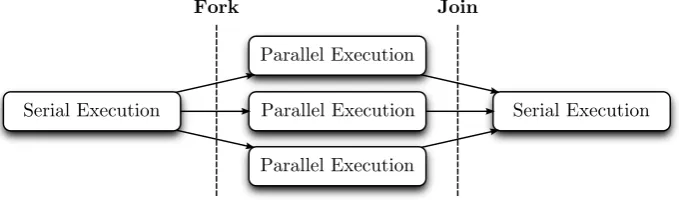
A common model of parallel execution adopted by multi-threaded
applica-tions is called fork-join. As represented in Figure 3.4, a master thread
exe-cuting serially creates (“forks”) a number of additional threads during parallel
with serial execution. This is the approach taken by OpenMP [4], which allows
programmers to mark (via pragmas) the loops in their program that can be
executed in parallel.
An alternative programming model is adopted by Cilk [20] and its successor,
Intel Cilk Plus [67], which allow programmers to identify (via extensions to the
C language) any dependencies that exist between functions. The result is a
dependency graph, which the Cilk scheduler uses to determine which functions
should be run by which threads. This approach is better suited to exposing
“nested parallelism” than the OpenMP approach of using threads to execute
independent loop iterations, since a function and the functions it calls can run
in parallel; it also potentially exposes more parallelism, since computation from
multiple functions (and hence multiple loops) can be performed simultaneously.
Using a low-level library such as POSIX threads (Pthreads) [114] gives a
programmer greater control over the threading behaviour of an application,
but at the expense of significantly more complicated code. OpenMP/Cilk are
therefore typically favoured because of their ease of use.
The SPMD model is also applicable to multi-threading. All tasks are known
to be independent at compile time, and compilers are thus free to distribute
work across threads in addition to (or instead of) SIMD execution units without
affecting correctness. Both CUDA and OpenCL allow for threads/work-items
to be grouped together into blocks/work-groups, providing certain guarantees
regarding synchronisation and memory access behaviours within a work-group,
but do not guarantee that all work-items will be executed by the same thread.
Neither programming model permits synchronisation between work-items in
3.4
Message Passing
Whereas communication between SIMD execution units and threads is
pos-sible through shared memory, separate nodes in a supercomputer have only
one method of communication – the passing of messages back and forth across
some dedicated network interface. In HPC, such communication is most
com-monly performed through the use of communication libraries built upon the
standardised Message Passing Interface (MPI) [3], although recent work has
in-vestigated the use of Partitioned Global Address Space (PGAS) models [147]
and OpenCL [79] for programming clusters of machines.
Due to the ubiquity of MPI programs, and its familiarity to programmers,
many HPC codes use MPI not only for inter-node communication but also for
intra-node communication (i.e.in place of threading). This has been shown to
cause problems, such as increased memory overhead (due to redundant storage
and unnecessary communication buffers) [19, 28, 84] and increased
communi-cation times (due to multiple threads contending for use of a single network
interface) [54]. As such, much research has investigated the utility of so-called
“hybrid” MPI/OpenMP programming approaches [140, 151], providing a better
mapping from software to the underlying hardware.
Where accelerators are employed, message passing appears in two forms:
firstly, any communication between thehost CPU and an attached accelerator
devicemust take place via explicit message passing over the PCI Express (PCIe)
interface that connects them; and secondly, any communication between devices
in separate nodes must travel over both PCIe and the network. Recent advances
in accelerator technology aim to alleviate these problems, by giving CPU and
accelerator cores direct access to the same memory (e.g.AMD Fusion, Intel HD
Graphics, NVIDIA Project Denver), or by giving the accelerator direct access
3.5
Benchmark Platforms
The research in this thesis makes use of a wide variety of different architectures,
from a number of hardware vendors. Not all machines are used in every study,
due to: (i) limited access to many of the large-scale machines, which are shared
resources external to the University of Warwick; (ii) incompatibilities between
programming techniques and hardware; and (iii) the rapid development of
hard-ware during the course of our work – we report results from the most recent
hardware iteration available at the time each study was performed.
3.5.1
Single Nodes
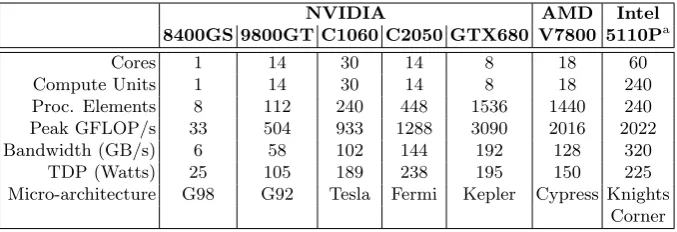
We divide the architectures used into three types: CPUs (Table 3.1);
accelera-tors and co-processors, including both discrete GPUs and Intel MIC (Table 3.2);
and “fused” architectures, featuring some combination of CPU and GPU cores
on the same chip (Table 3.3).
In all cases, performance is reported as peak GFLOP/s in single precision,
and bandwidth as peak transfer rate from main memory in gigabytes per second
(GB/s). As noted previously, these figures are not necessarily representative of
the level of sustained performance that can be achieved by an application. Power
is reported as thermal design power (TDP) in Watts, and for fused architectures
includes the power drawn by both the CPU and GPU cores. We additionally
list the instruction set supported by the CPUs.
As this thesis makes use of OpenCL, we also list the number ofcompute units
andprocessing elements for each device. On CPUs, each core is a compute unit
consisting of one processing element; with SMT, each hyper-thread appears as a
distinct compute unit (e.g.the Intel Xeon E3-1240 has 4 cores with 2-way SMT
and therefore has 8 compute units). GPUs from different vendors are divided
into compute units and processing elements in different ways: on the Intel GPUs
we use, each execution unit is a compute unit of 8 processing elements; on the
or 192 “CUDA cores” (processing elements) on the Tesla, Fermi and Kepler
architectures respectively; and on the discrete and integrated AMD GPUs, both
of which belong to the Evergreen series, a compute unit contains 16 stream cores
(compute units) of 5 simple processing elements each.
Intel AMD
X5550 E3-1240 E5-2660 A8-3850
Cores 4 4 8 4
Compute Units 4 8 16 4
Proc. Elements 4 8 16 4
Peak GFLOP/s 85 211 281 93
Bandwidth (GB/s) 32 21 51 30
TDP (Watts) 95 80 95 100
Instruction Set SSE 4.2 AVX AVX SSE 4a
[image:45.595.155.434.231.346.2]Micro-architecture Nehalem Sandy Bridge Ivy Bridge Llano
Table 3.1: Hardware specifications of the CPUs used in this thesis.
NVIDIA AMD Intel
8400GS 9800GT C1060 C2050 GTX680 V7800 5110Pa
Cores 1 14 30 14 8 18 60
Compute Units 1 14 30 14 8 18 240
Proc. Elements 8 112 240 448 1536 1440 240
Peak GFLOP/s 33 504 933 1288 3090 2016 2022
Bandwidth (GB/s) 6 58 102 144 192 128 320
TDP (Watts) 25 105 189 238 195 150 225
[image:45.595.128.467.389.505.2]Micro-architecture G98 G92 Tesla Fermi Kepler Cypress Knights Corner
Table 3.2: Hardware specifications of the accelerators used in this thesis.
Intel AMD
HD4000 HD6550D
Compute Units 16 5
Proc. Elements 128 400
Peak GFLOP/s 147 480
Bandwidth (GB/s) 26 30
TDP (Watts) 77 100
Micro-architecture HD Graphics 4000 BeaverCreek
Table 3.3: Hardware specifications of the integrated GPUs used in this thesis.
[image:45.595.188.407.546.639.2]