warwick.ac.uk/lib-publications
A Thesis Submitted for the Degree of PhD at the University of Warwick
Permanent WRAP URL:
http://wrap.warwick.ac.uk/106978
Copyright and reuse:
This thesis is made available online and is protected by original copyright.
Please scroll down to view the document itself.
Please refer to the repository record for this item for information to help you to cite it.
Our policy information is available from the repository home page.
THE BRITISH LIBRARY
BRITISH THESIS SERVICE
C O P YR IG H T
Reproduction of this thesis, other than as permitted under
the United Kingdom Copyright Designs and Patents Act
1988, or under specific agreement with the copyright
holder, is prohibited.
This copy has been supplied on the understanding that it
is copyright material and that no quotation from the thesis
may be published without proper acknowledgement,
R EPR O D U C TIO N Q U A L IT Y NO TICE
The quality of this reproduction is dependent upon the
quality of the original thesis. Whilst every effort has been
made to ensure the highest quality of reproduction, some
pages which contain small or poor printing may not
reproduce well.
Previously copyrighted material (journal articles, published
texts etc.) is not reproduced.
Understanding Knowledge Creation:
A Study of the Processes, Interrelationships and
Contributory Factors
within
Multidisciplinary Project Teams
Sik Wah Fong
Industrial Relations and Organisational Behaviour
Warwick Business School
University o f Warwick
Submitted in fulfilment o f the requirements for the degree o f Doctor o f
Philosophy in the Faculty o f Social Studies at the Warwick Business
School, University o f Warwick
Table o f C ontents
List of Tables...5
List of Figures... 6
Acknowledgements...7
Declaration...9
Abstract... 10
Abbreviations...11
Chapter One - Introduction... 12
1.1 Background to the Research...12
1.1.1 Knowledge as an Important Resource...12
1.1.2 Knowledge Creation and New Product Development...13
1.1.3 Knowledge Creation Activities...15
1.1.4 Research Implications o f the Present Study... 16
1.2 Research Scope and Objectives... 17
1.3 Structure o f the Thesis... 19
Chapter Two - Existing Literature and Theory...21
2.1 Introduction...21
2.2 Organisational Knowledge C reation... 24
2.2.1 Knowledge in Organisations... 24
2.2.1.1 Knowledge, Information and Data... 24
2.2.1.2 The Concept o f Knowledge...26
2.2.1.3 Conceptualisations o f Knowledge in Organisations...27
2.2.1.3.1 Experience as a Sub-set o f Tacit Knowledge... 31
2.2.1.3.2 Social Capital as an Enabler for Managing Knowledge... 33
2.2.2 Knowledge Creation in Organisations... 36
2.2.2.1 Organisational Knowledge Creation Theories... 39
2.2.2.2 Enabling Conditions for Organisational Knowledge C reation ... 48
2.3 Knowledge Creation in Multidisciplinary Teams...51
T ' o vs 2.3.1 Knowledge Sharing... 53
2.3.1.1 The Importance o f Knowledge Sharing... 53
2.3.1.2 Communication Media and Knowledge Sharing Effectiveness...56
2.3.1.3 Knowledge Sharing and Team Members’ Diversity...59
2.3.1.4 Tensions in Knowledge Sharing... 62
2.3.1.5 Viewpoint o f Knowledge Sharing in the Present Study... 65
2.3.2 Knowledge Integration... 66
2.3.2.1 The Importance o f Knowledge Integration... 66
2.3.2.2 Knowledge Integration in Team Situations...69
2.3.2.3 Tensions in Knowledge Integration... 71
2.3.2.4 Knowledge Integration Perspective o f the Present Study... 75
2.3.3 Collective Project Learning... 76
2.3.3.1 Projects and Learning... 76
2.3.3.2 Individual Learning... 79
2.3.3.3 Team Learning...82
2.4 Conceptual Framework and Research Questions o f Knowledge Creation within Multidisciplinary Project T eam s...85
Chapter Three - Research Methodology... 101
3.2 Methodological Approach Chosen...102
3.3 Research Design... 108
3.3.1 Selection o f the Research C ases... 109
3.3.2 Negotiating Access...111
3.4 Research Strategy... 113
3.4.1 Data Sources... 113
3.4.1.1 Project Documentation and Organisational R ecords...113
3.4.1.2 Interview s... 115
3.4.1.3 Direct Observation...117
3.4.2 Data Collection...121
3.4.3 Data A nalysis... 124
3.5 Generalisability o f the Research and Limitations of the Fieldw ork...127
Chapter Four - Facilities Development and Project Teams in the Case Organisation... 131
4.1 Introduction... 131
4.2 The Case O rganisation...132
4.2.1 History o f the Case Organisation...132
4.2.2 Structure o f the Case Organisation... 136
4.3 Facilities Development and Multidisciplinary Project Team s... 137
4.3.1 Strategic Design Development Concept...137
4.3.2 The Infrastructure Development Project (IN F )... 138
4.3.2.1 Background o f the INF Project... 138
4.3.2.2 Organisational Aspects o f the INF Project T e a m ...139
4.3.3 The Residential Development Project (RDA )... 145
4.3.3.1 Background o f the RDA project... 145
4.3.3.2 Organisational Aspects o f the RDA Project T e a m ...150
4.3.4 Interrelationships Between the Two Case Projects...155
4.3.5 Organisational and Project Practices... 156
4.3.5.1 Expertise in Construction and Design...156
4.3.5.2 Selection o f Professional Service F irm s... 160
4.3.5.3 Recruitment o f Project Team Members... 161
4.3.5.4 Working on Single or Multiple Projects... 163
4.3.5.5 Project Team M eetings... 164
4.4 Sum m ary...167
Chapter Five - An Analysis of the Knowledge Creation Processes Throughout the Infrastructure Project Team...169
5.1 Introduction... 169
5.2 Interactive Design Process... 169
5.3 Hierarchy o f Client, Consultant and Contractor... 173
5.4 Previous Work with the Client, Other Consultants and on Similar Projects... 174
5.5 The Process o f Knowledge Sharing...177
5.5.1 Socialising with Other Project Team Members... 177
5.5.2 Sharing Positive as well as Negative Experiences...179
5.5.3 Contributory Factors...181
5.5.3.1 Openness... 181
5.5.3.2 Motivation Linked to Sharing o f Knowledge...183
5.5.3.3 Trust... 185
5.5.3.4 Time Pressure...186
5.6 Joint Site Visits as Collective Experiences... 187
5.7 Generating New Know ledge... 188
5.7.1 Contributory Factors... 190
5.7.1.1 Time...190
5.7.1.2 M otivation... 190
5.8 Knowledge Sources... 191
5.9 The Process o f Knowledge Integration... 194
5.9.1 Multiple Stakeholders and Perspectives...194
5.10.1 Individual Learning... 196
5.10.2 Collective Learning... 202
5.10.3 Inter-project Learning... 204
5.11 A Summary o f Knowledge Creation in the Infrastructure Project Team...205
Chapter Six - An Analysis of the Knowledge Creation Processes Throughout the Residential Development Project Team...209
6.1 Introduction... 209
6.2 Interactive Design Process...209
6.3 Hierarchy o f Client, Consultant and C ontractor...212
6.4 Previous Work with the Client, Other Consultants and on Similar Projects...213
6.5 The Process o f Knowledge Sharing...216
6.5.1 Socialising with Other Project Team Members... 216
6.5.2 Sharing Positive as well as Negative Experiences...218
6.5.3 Shielding Knowledge Sharing...220
6.5.4 Contributory Factors...222
6.5.4.1 Openness...222
6.5.4.2 M otivation... 223
6.5.4.3 Time Pressure... 224
6.6 Generating New Knowledge... 225
6.7 Experimenting... 228
6.8 Knowledge Sources...229
6.9 Market Knowledge and Intelligence...232
6.10 The Process o f Knowledge Integration... 236
6.10.1 Multiple Stakeholders and Perspectives... 236
6.11 The Process o f Collective Project Learning... 238
6.11.1 Individual Learning... 238
6.11.2 Inter-project Learning...242
6.12 A Summary o f Knowledge Creation in the Residential Development Project T eam ... 243
Chapter Seven - Knowledge Creation Processes - Their Interrelationship and Contributory Factors in Multidisciplinary Project Teams...247
7.1 Introduction...247
7.2 The Process o f Boundary Crossing...250
7.2.1 Expertise Boundaries within the Project Teams...250
7.2.2 Observed Methods for Crossing Expertise Boundaries... 253
7.2.3 Hierarchical Boundaries within the Project T eam s...258
7.2.4 Observed Methods for Crossing Hierarchical Boundaries...259
7.2.5 Summary o f the Boundary Crossing Process... 260
7.3 The Process o f Knowledge Sharing...261
7.3.1 Competition and Knowledge S h arin g ... 262
7.3.2 Communication Thickness and Knowledge Sharing... 265
7.3.3 Knowledge Sharing from Different Knowledge D om ains...268
7.3.4 Contributory Factors Influencing the Knowledge Sharing Process... 271
7.3.4.1 Openness...271
7.3.4.2 M otivation... 272
7.3.4.3 Trust... 273
7.3.4.4 Time Pressure...274
7.3.5 Summary o f the Knowledge Sharing Process... 275
7.4 The Process of Knowledge G eneration... 276
7.4.1 Social Netw orks... 278
7.4.2 Print as Sources o f Knowledge...282
7.4.3 Knowledge Generated from Customers and Competitors...284
7.4.4 Contributory Factors Influencing the Knowledge Generation Process...285
7.4.4.1 Time... 285
7.4.4.2 M otivation... 286
7.4.5 Summary o f the Knowledge Generation Processes...287
7.5 The Process o f Knowledge Integration... 288
7.5.2 Project Documentation and Design Objects as Integrative T o o ls...295
7.5.3 Summary o f the Knowledge Integration Process...296
7.6 The Process o f Collective Project Learning... 297
7.6.1 Individual Learning...299
7.6.2 Team Learning... 303
7.6.3 Inter-project Learning... 307
7.6.4 Summary o f the Collective Project Learning Process... 310
7.7 Interrelationships between the Five Processes o f Knowledge C reation... 311
Chapter Eight - Conclusion...315
8.1 Introduction... 315
8.2 Contributions o f the Research...316
8.2.1 Knowledge Creation in Multidisciplinary Project T eam s...318
8.2.2 A Model o f Knowledge Creation in Multidisciplinary Project Team Settings... 322
8.3 Implications for the Theory on Knowledge Creation...323
8.4 Implications for the Effective Management o f Multidisciplinary Project Teams... 324
8.4.1 The Support o f Intra- and Inter-organisational Social N etw orks...325
8.4.2 The Enhancement o f Co-operative Teamwork... 326
8.4.3 Mechanisms for Easing Tension among Project Team M em bers...327
8.4.4 Concentration on Project Value M aximisation... 327
8.5 Limitations and Future Directions o f Research...329
List o f Tables
Table 2.1 ‘Articulability’ of knowledge... 30
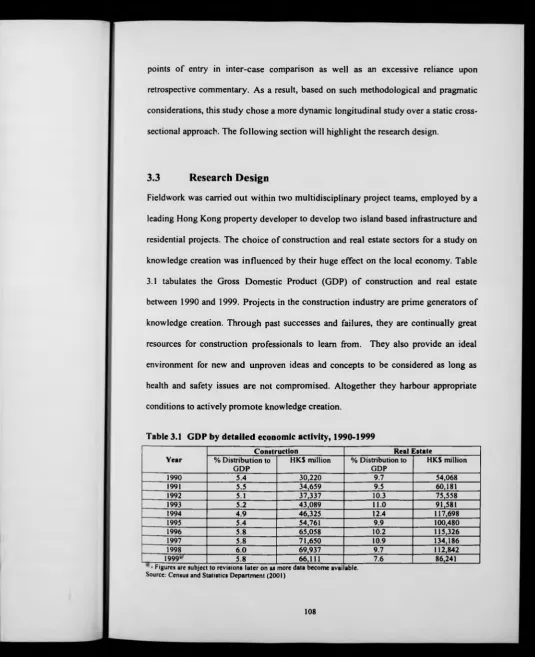
Table 3.1 GDP by detailed economic activity, 1990-1999... 108
Table 3.2 Sources of evidence...112
Table 4.1 INF project team ...143
Table 4.2 RDA project team ...153
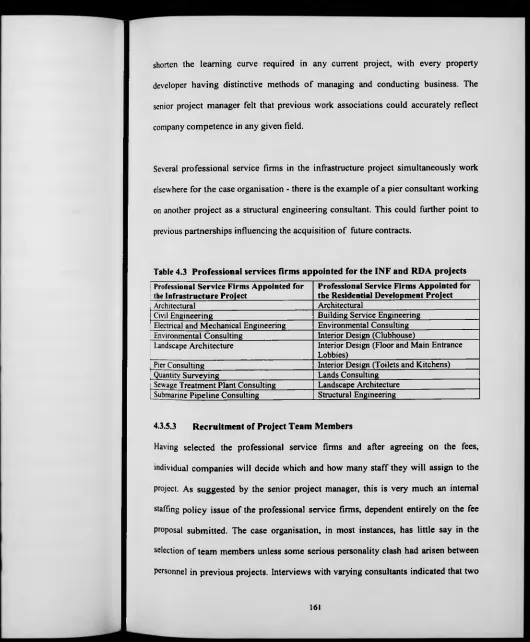
Table 4.3 Professional services firms appointed for the INF and RDA projects... 161
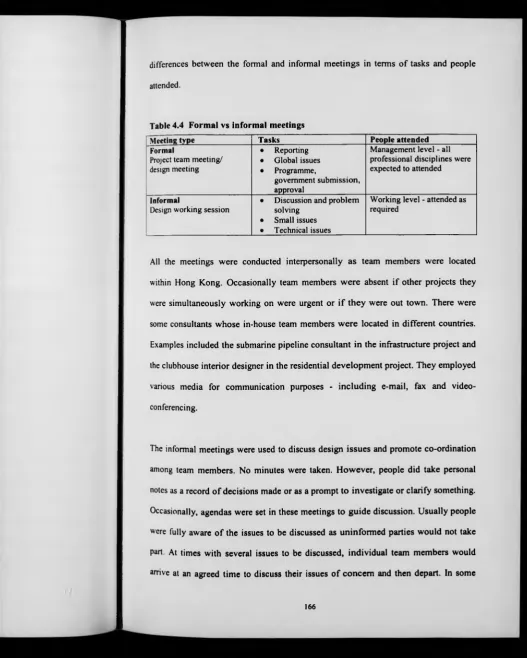
Table 4.4 Formal vs informal meetings...166
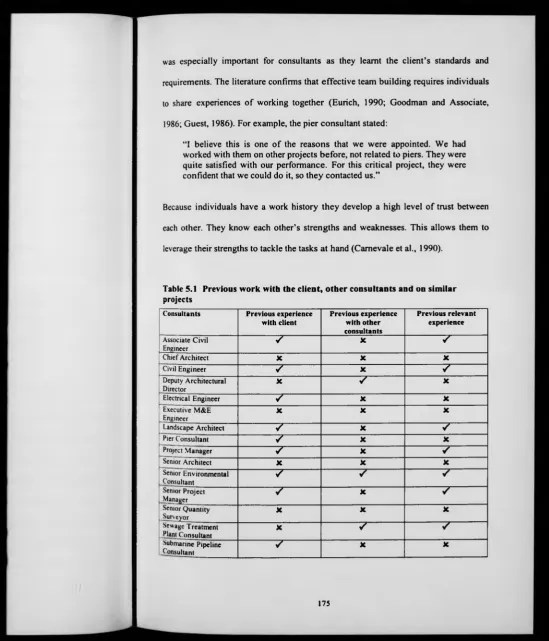
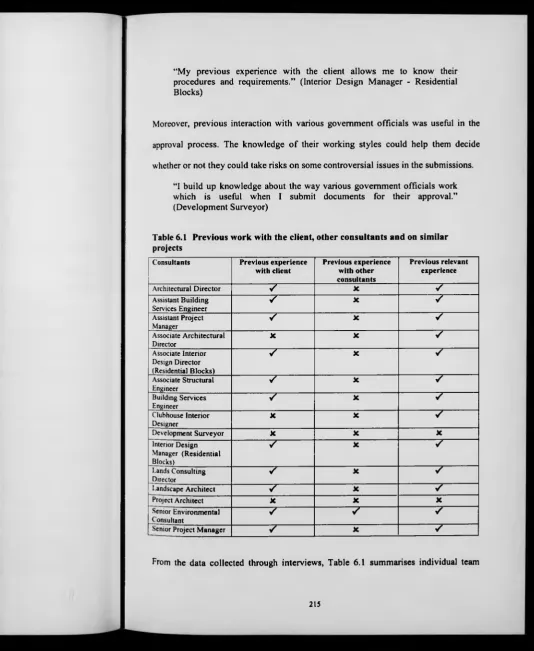
Table 5.1 Previous work with the client, other consultants and on similar projects.175 Table 6.1 Previous work with the client, other consultants and on similar projects.215 Table 7.1 Key comparisons between the infrastructure and residential development project teams...248
List o f Figures
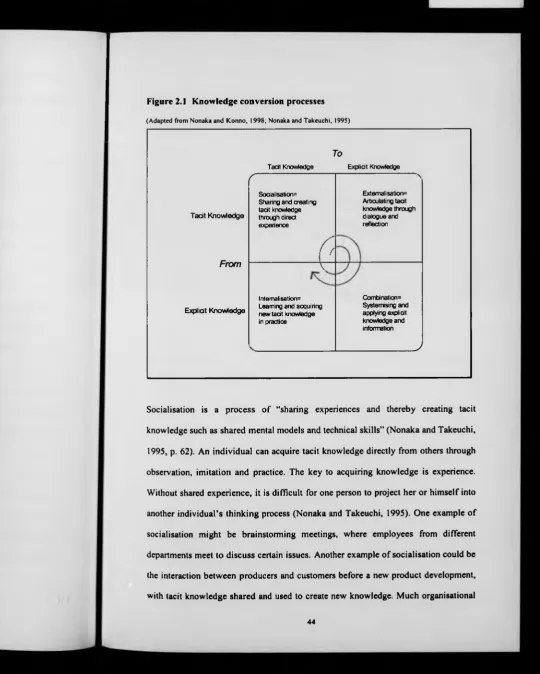
Figure 2.1 Knowledge conversion processes... 44 Figure 3.1 Project durations and periods of fieldwork... 122 Figure 7.1 The interrelationships between multidisciplinary knowledge creation
[image:9.600.24.557.15.662.2]A cknow ledgem ents
During the five-year progression of my PhD, there were not only intellectual challenges, but also those requiring considerable perseverance, with the many demands of work and life presenting themselves along the way. I could not have edged my way towards completion without the assistance, support and inspiration of many professional colleagues, social relations, loved ones and God. I am grateful for all their contributions, although the limitations of space enable only a few to be mentioned explicitly.
My deepest intellectual debt goes to my supervisors, Dr. Mike Bresnen of the Warwick Business School and Professor Sue Newell of the Royal Holloway, University of London. They consistently set aside time in their hectic schedule to provide steady feedback on my ideas and written output. Their constructive comments influenced the design, execution and reporting of the study. They have been a wealth of continual encouragement, inspiration, support, patience and help throughout this research.
I am grateful to professional colleagues from all around the world, who unstintingly responded to specific queries, all the while engaging in lively and fruitful discussion, providing pertinent feedback and generally availing me of their expertise and experience. Their generosity in sending me publications, both published as well as about to be, was of tremendous assistance. There were so many whom I cannot individually name but I would like to extend my heart-felt appreciation to them all. Hopefully I will be able to thank them personally in the near future.
I wish to thank the Executive Director, the Senior Project Manager and his secretary within the Project Management Department of the case organisation. They provided immense help, facilitating access to the two multidisciplinary project teams forming the core of this research. In addition, my sincere gratitude goes to all the team members of both projects for their trust, openness and commitment and for taking time from their frantically paced lives to be interviewed and answer numerous queries. Without them, I could not have successfully completed this study.
I extend enormous thanks to my many colleagues in the library who provided immense and excellent support. They cheerfully responded to my unceasing requests for both local and overseas publications, assisting in other services within the library domain as well. The Faculty Librarian, Ms. Gwendolin Wong, requires particularly warm mention, in constantly meeting any urgent demands. I would also like to thank my departmental colleagues, including the former Head of Department, Professor David Scott and the present Acting Head, Professor Mike Anson. Both provided great support in one way or another to make my journey slightly easier. The Hong Kong Polytechnic University’s generous financial support is gratefully acknowledged.
gratitude to my mother, brothers and sister who helped me through some difficult times. Nobody was as proud of this study as my father, not able to see this thesis in its final form. I hereby dedicate it to his memory, to his boundless love and support. My friends have been more than understanding through the years of my neglect and preoccupation. I cannot express enough appreciation to them for their steadfast encouragement. I would also like to thank the brothers and sisters in my church for their words and prayers of support. Professor Allan Ashworth and Mr. Mike Lee, as Christian brothers and friends, revealed their faith in God, encouraging me tremendously to press on amidst difficulties.
Declaration
This thesis is presented in accordance with the regulations for the degree of Doctor of
Philosophy (PhD) of the University of Warwick. The work described in this thesis is
entirely original and my own, unless otherwise indicated. None of the material
contained hereafter has been submitted for a degree at any other university. The
interpretations in this thesis are the sole responsibility of the author, and do not in any
way represent the views of the case company, the project team members or Warwick
Business School.
The following papers based on the findings in this thesis have already been presented
or will be presented in due course:
Fong, P.S.W., Bresnen, M. and Newell, S. (2001). Knowledge Creation in Two
Multi-Disciplinary Inter-Organisational Project Teams. Managing Knowledge:
Conversations and Critiques. 10-11 April, University of Leicester Management
Centre, UK.
Fong, P.S.W. (2002). Knowledge Creation in Multidisciplinary Project Teams: An
Empirical Study o f the Processes and Dynamic. Fifth International Conference of the
International Research Network on Organising by Projects (IRNOP 51. 29-31 May,
Renesse, Zeeland, The Netherlands.
Fong, P.S.W. (2002). Knowledge Creation Processes and Dynamics: An Empirical
Study o f Two Multidisciplinary Project Teams at the Design Phase. CIB W65
Symposium - Construction Innovation and Global Competitiveness. 9-13 September,
A bstract
The growing importance of introducing unique products to the market has made firms more conscious of organisational knowledge creation. Knowledge creation is recognised to be important in creating and sustaining competitive advantage as well as in meeting organisational goals in modem societies. Multidisciplinary project teams have gained increased popularity owing to their diversity of knowledge resources, drawing upon different organisational functions and professional disciplines. They are viewed as having high potential to innovate due to their heterogeneous nature. Their activities are fundamental to learning within wider organisations, and not just in the form of temporarily disconnected project units. The research empirically investigates the creation of new technical knowledge and develops a conceptual model of the knowledge creation process. It broadens the organisational knowledge creation theory developed by Nonaka and Takeuchi (1995), into the area of multidisciplinary project teams. This research focuses on three major aspects: the key processes that underlie knowledge creation within multidisciplinary project teams, the interrelationships between these key knowledge creation processes and the factors that influence the processes of multidisciplinary knowledge creation. Empirical evidence was collected from a large property development company, using a qualitative case study approach. Two multidisciplinary project teams, working on infra-structural and residential developments, were selected for the in-depth study.
A bb reviation s
GFA Gross Floor Area
HDD Horizontal Directional Drilling
IT Information Technology
M&E Mechanical and Electrical
C h a p te r One - Introduction
1.1
Background to the Research
1.1.1
Knowledge as an Important Resource
The increasing importance of knowledge has been proposed as a central feature of
post-industrial societies (Bell, 1973; Drucker, 1995; Habermas, 1979; Quinn, 1992;
Quinn et al., 1996), with knowledge considered as a primary economic resource.
Knowledge is one of the most important resources to an organisation (Drucker, 1993;
Grant, 1996a; Nonaka and Takeuchi, 1995; Spender, 1996b), and may be “the only
meaningful resource” (Drucker, 1993, p. 42). Intellectual or knowledge-based assets
have been distinguished from the more traditional factors of production, such as land,
labour and machinery. Unlike traditional factors of production, knowledge assets are
intangible, residing within individuals. As a result, they may be more difficult to
locate and harness, and may be easily lost.
In order to compete in knowledge intensive industries, an organisation must
continuously create, utilise and disseminate new knowledge (Brown and Eisenhardt,
1995; D’Aveni, 1994; Dougherty, 1992; Nonaka, 1994). D’Aveni (1994) reasoned
that given the dynamic environments faced by most organisations, those capable of
producing a continuous stream o f new knowledge are best positioned to achieve
competitive advantage. In order to compete, firms must acquire, retain and integrate
knowledge and be able to facilitate the creation o f knowledge (Nonaka and Ichijo,
1997). Nonaka et al. (2000, p. 2) suggest that the reason for a firm’s existence is to
Attempting to develop and sustain competitive advantage so as to survive intensive
competition, organisations are focusing their resources and processes on generating
unique knowledge embodied in new and innovative products or services. Although
many organisations are beginning to seek more sophisticated organisational
structures, or train personnel in many managerial, creative or teamwork skills, many
are still likely to have difficulty in being continuously innovative. They may be highly
effective in exploiting existing knowledge in the short term, but there is likely to be
relatively little long-term learning and knowledge creation, particularly if individuals
and knowledge are isolated and fragmented (Dachler, 1992; Isaacs, 1993; Spender,
1996b). Bringing the collective knowledge of members in teams to bear on serving
customers or clients is practically important because knowledge is a source of
competitive advantage (Barney, 1991; Prahalad and Hamel, 1990; Teece and Pisano,
1994; Teece et al., 1997). Knowledge creating skills in particular are important as
they are required to create new products or processes or enhance existing ones (Kogut
and Zander, 1996; Leonard-Barton, 1995; Nahapiet and Ghoshal, 1998; Nonaka and
Takeuchi, 1995; Prahalad and Hamel, 1990). Learning must be integrated with current
tasks, not only to meet present goals, but also to develop and retain knowledge for
future organisational needs.
1.1.2
Knowledge Creation and New Product Development
Several researchers have described new product development as a knowledge-
intensive activity (Davenport and Prusak, 1998; Iansiti and MacCormack, 1997;
Nonaka and Takeuchi, 1995; Song and Montoya-Weiss, 1998). New product
development often involves cross-functional linkages, where different participants
and synergy resulting from their interaction with other team members (Jassawalla and
Sashittal, 1998). Morrison and Kennedy (1996) suggest that this interaction brings in
the need to organise, integrate, filter, condense and annotate collaborative data and
other relevant information that these team members contribute.
Creating new knowledge and perspectives is fundamental to new product
development. A new product can be considered as “a package of features and
benefits, each of which must be conceived, articulated, designed and
‘operationalised’, or brought into existence” (Dougherty, 1996, p. 425). The
development of a constructed facility can be viewed as a new product development,
with customers or end-users purchasing or using the facility. They would assess their
own needs and affordability before they purchase. The development of a new product
entails the application of knowledge to new problem-oriented situations, thus
requiring uncertainty reduction. The same applies to construction projects, with each
project unique in itself in terms o f design and construction. With the many constraints
the construction industry faces (due to limited space, increasing project complexity,
limited budgets, tight programmes and the constant demand for facility innovation),
project teams are faced with challenges to utilise diverse, and create new, knowledge
in meeting stringent requirements and fulfilling ever changing needs. Project team
members have to incorporate new information into their understanding in order to
solve the technical challenges they face. Thus, learning is inherent in the work they do
(Mohrman, Mohrman and Cohen, 1995). The knowledge gained can be explicit and
formal, as when members learn new analytical procedures to deal with a new
phenomenon or go to a publication to learn the properties of a new material being
1962), occurring as the individual learns from experience and develops a deep but
unarticulated sense of the phenomena at hand. It could also lead to informal learning
as members consult one another, taking advantage of each other’s personal knowledge
stocks (Eraut, 2000). Learning can be personal and remain within the heads of
individual contributors, or become public when it is shared with others and perhaps
systematised.
1.1.3
Knowledge Creation Activities
In this research, technological innovation and shared problem solving1 are viewed as
knowledge creation activities. In the activity of shared problem solving employees
with different specialisations and problem-solving approaches are brought together so
that the diversity of their knowledge and backgrounds can be channelled toward
creative problem solving (Leonard-Barton, 1995). According to Leonard-Barton
(1995), as people become highly skilled, they develop individual ‘signature skills,’
formed from their specialisations, cognitive style preferences and preferences for
particular tools or methods. Bringing people with diverse signature skills together to
work on a problem generates the creative abrasion that, when managed properly, can
be a source of innovative solutions. Viewing technological innovation and problem
solving this way also follows the framework of Nonaka and Takeuchi (1995) in
allowing for the concept o f tacit knowledge. Tacit knowledge is a highly contextual
and barely expressible knowledge that may be communicated and shared only through
socialisation (Nonaka and Takeuchi, 1995). Traditional explanations o f knowledge
emphasise explicit knowledge in the form of patents or books that may be best
considered as the final expression of the knowledge creation process. By
acknowledging the tacit elements, the entire process of knowledge creation is
included and may be more deeply understood. Anand et al. (1993), emphasise the
better understanding of tacit knowledge as a prerequisite for acquiring, distributing
and creating knowledge. Eder (1989) suggests that much knowledge in new product
development, such as knowledge about the strategic design approach, and knowledge
about tactics and methods for designing, is primarily tacit.
1.1.4
Research Implications o f the Present Study
The present research has important implications for those project teams that are
increasingly investing in knowledge-based co-operative ventures. Many
multidisciplinary project teams are involved in collaborative projects, like those
examined here. The implications of the findings have widespread ramifications for
both theoretical development and managerial practice. As is the case with most
construction projects, their raison d’être is creating knowledge to fulfil stakeholder
needs, allowing for any constraints that may be imposed. As such, these projects make
ideal research material for studying the process of knowledge creation. Senior
management also stands to gain substantially from a better understanding of the
processes and management of knowledge creation. Successful knowledge creation in
the form of better design ultimately leads to economic benefits for the customers that
may result in the products meeting increasing demand. Knowledge creation in
projects could also lead to the technological innovation that is so desperately needed
in the construction industry (Gann, 2000).
investigated (Brown and Eisenhardt, 1995; Dougherty, 1992; Kogut and Zander,
1992; Spender, 1996b), research that explores the endogenous knowledge creation
process in multidisciplinary project teams is in its infancy and offers fertile ground for
study. Multidisciplinary teams are different from traditional homogenous teams in
that the diversity of knowledge helps, at least potentially, to maximise the creation of
knowledge. The combination of project team processes and knowledge creation - a
typical challenge to today’s companies whose main thrust is project-based - is still a
relatively unknown and novel subject for management researchers.
As organisations shift towards adopting a team-based structure, theories about what
makes multidisciplinary project teams productive and innovative are lagging behind
(Denison et al., 1996). This research focuses on knowledge creation within
multidisciplinary project teams - to empirically examine its processes, the
interrelationship between the processes and the significant factors involved in
knowledge creation.
For consistency reasons, no distinction has been made between the term ‘team’ or
‘group’. Instead, both words are used interchangeably throughout the thesis.
1.2
Research Scope and Objectives
The main purpose of this research is to improve the understanding, both empirically
and theoretically, of the processes that contribute to knowledge creation within
multidisciplinary project teams, the interrelationship between these processes and the
factors significantly affecting them. Such factors, positively or negatively contributing
emotional or managerial. The role of management is to ensure that these conditions
are available for project teams (Nonaka and Takeuchi, 1995). This research does not
attempt to convey a comprehensive understanding of all the ‘right’ significant factors
for knowledge creation, as we believe these may not be readily prescribed. The
purpose is rather to highlight some central themes that project team members
emphasised as important.
The research questions, identified from gaps in existing literature, seek to create an
understanding of how project teams work and what critical issues they face in their
knowledge-creating activities. Due to the lack of existing theories, the research points
the way towards an understanding of organisational knowledge creation in a broader
sense.
This study focuses on the processes, their interrelationship and the critical issues
through which project teams create products and knowledge, with teamwork as the
main focus and emphasis. Technology infrastructure, or information technology (IT),
has a low priority in this study. This choice does not intend to neglect or undermine
its emerging and important role in managing and creating knowledge. As highlighted
by Tuomi (1999), if information technology is seen as part of the broader socio-
technical systems and includes aspects like tacit knowledge and social capital,
information management can probe more deeply into the whole area of knowledge,
1.3
Structure of the Thesis
The remainder of this thesis is structured as follows. Chapter Two highlights existing
theories and perspectives related to knowledge and organisational knowledge
creation. Other issues essential to the inquiry of knowledge creation within
multidisciplinary project teams are examined. A conceptual framework, utilising as an
initial framework the organisational knowledge creation theory of Nonaka and
Takeuchi (1995), is proposed for knowledge creation within multidisciplinary team
settings, consisting o f knowledge sharing, knowledge integration and collective
project learning. Finally, the literature review demonstrates gaps in the literature and
identifies researchable questions to be explored in this research.
Chapter Three describes the research process and the methodology utilised to explore
the phenomenon of knowledge creation within multidisciplinary project teams. The
attempt is to detail the process and the data collection methods in order to provide
information and justification of how the case study was prepared and how the major
findings emerged and were analysed during the research process. Other issues, such as
the philosophical stance and research orientation, are also given as a means of
answering the proposed research questions.
Chapter Four presents the case organisation, the two facility development projects and
the two multidisciplinary project teams. A detailed look at the case organisation’s
history and structure will be given. Case descriptions for the two projects, as well as
their teams and the organisational and project practices of the case organisation, are
Chapters Five and Six are very similar in nature. With the perspective of knowledge
creation, they describe the research findings from both case studies - the infrastructure
development project and the residential development project respectively. The
emphasis, based on the proposed conceptual framework, has been on how the teams
share knowledge, integrate knowledge and learn collectively. Other issues pertinent to
the processes of knowledge creation are not precluded from the case analyses. These
chapters intend to build up richly detailed analyses of how professionally diverse team
members created their knowledge during the design process.
Chapter Seven discusses the empirical findings based on the analysis of data collected
from the two case studies, as well as drawing comparisons with existing literature and
theories. The processes underlying knowledge creation in multidisciplinary project
teams, their interrelationships and the significant factors influencing these processes,
are identified. A revised model of the knowledge creation processes is proposed.
Chapter Eight concludes the study findings and describes their implications for theory
and practice. The limitations of the research, together with future research directions,
C h a p te r T w o - Existing Literature and Th eo ry
2.1
Introduction
This research attempts to fill a significant gap in the literature on team functioning
and knowledge creation by exploring the processes of knowledge creation in
multidisciplinary project team settings within construction projects. There is a
significant amount of literature and research on team processes and teamwork as well
as knowledge creation in organisational settings, but very little on how
multidisciplinary teams o f professionals engage in knowledge creation in projects.
Research is needed to explore and understand the processes and dynamics of
knowledge creation in multidisciplinary project teams. This gap stems from the dearth
of empirical research into how team knowledge is actually created. Accordingly the
research focuses on a particular type of team setting, that of multidisciplinary project
groups.
The literature review chapter serves three purposes. The first is to demonstrate the gap
mentioned above. The second is to place the phenomenon of knowledge creation in a
multidisciplinary project team setting within the context of the knowledge creation
and team processes literature. This is important to both theoretical development and
managerial practice because knowledge, as an important resource, is now seen as a
driving force behind organisational goal achievement as well as gaining competitive
advantage. The third is to formulate a conceptual framework, research questions and
an appropriate data collection strategy addressing the need for further theoretical
development.
organisational, innovation and economic literatures (Boisot, 1995; Kidd, 1998;
Nonaka and Konno, 1998; Nonaka and Takeuchi, 1995; von Krogh, 1998). In
addition, a number of innovation researchers have emphasised the importance of a
team approach in successful product development (Clark and Fujimoto, 1991;
Eisenhardt et al., 1997; Leonard and Sensiper, 1998). There is extensive literature on
project or work teams, which contribute to an understanding of the ways in which
they operate. For example, Cohen and Bailey (1997) have conducted an extensive
review o f research on four types of teams, namely work, parallel, project and
management, published between 1990 and 1996. However, a focus on the processes
of knowledge creation from a multidisciplinary project team perspective is new and
compelling, as evident in the increased interest in knowledge creation. Furthermore,
research specific to multidisciplinary project teams and the knowledge creation
process appears to be very limited (e.g. Newell and Swan, 2000). Yet
multidisciplinary project teams are such important vehicles for developing new
products and services, with many organisations actively using them to achieve their
organisational goals (Bushe and Johnson, 1989).
Most product development is moving towards team-based structures, since teams are
believed to increase individual commitment and performance. As Galegher et al.
(1990) observe, they seem effective in bringing a new product to the market within a
short time frame. As products and technologies become increasingly complex, new
product development requires the effective collaboration and integrated skills of
several individuals. Many suggest that creating knowledge at the team level is
essential for long-term team effectiveness, innovation and productivity (Nonaka and
because teams are one of the primary natural and structural work units in
organisations, knowledge creation at the team level has the potential to contribute to
performance and knowledge creation at the overall, organisational level. However,
Dougherty (1992) finds that the varying thinking styles and actions of team members,
involved in different aspects of new product developments, can inhibit a team’s
effectiveness primarily by blocking the collaboration required to develop sufficient
knowledge of the technology and market relationships. In addition, Newell et al.
(1998) have demonstrated the difficulties of knowledge creation and retention in
cross-disciplinary project teams. The objective here is to advance our understanding
of the processes that support knowledge creation in multidisciplinary project teams,
leading to better theories and practice of knowledge creation, innovation and
technological development in collaborative team settings.
The following literature review attempts to cover the major areas of the literature that
have fuelled the research. It starts by looking at the origins and meaning of
organisational knowledge creation. An intrinsic feature of organisational knowledge
creation is knowledge itself. Knowledge is defined, with distinctions drawn between
knowledge, information and data. The nature o f explicit and tacit knowledge,
experience and social capital, discussed and proposed by others, are explored.
Organisational knowledge creation from various perspectives is discussed. Finally,
this section reviews various existing frameworks proposed by other researchers
together with their enabling conditions. The chapter then details three interrelated
processes in multidisciplinary knowledge creation - knowledge sharing, knowledge
integration and collective project learning. The chapter concludes by providing the
questions which this study aims to address.
2.2
Organisational Knowledge Creation
2.2.1
Knowledge in Organisations
2.2.1.1 Knowledge, Information and Data
Before considering the concept of knowledge, it is essential to highlight and discuss
some of the distinctions made in the literature between knowledge, information and
data. Davenport and Prusak (1997) find it rather difficult to distinguish between data,
information and knowledge. Nonaka and Takeuchi (1995) differentiate information
and knowledge, with information as a flow o f messages and knowledge as something
created by that very flow of information, anchored in the beliefs and commitment of
its holder. Starbuck (1996) clarifies the distinction by defining knowledge as a stock
of experience rather than a flow of information. Thus he suggests that knowledge
relates to information in the same way that assets relate to income. The distinction
between information and knowledge is thereby understood as the degree to which
information is processed and put into a practicable context.
Davenport and Prusak (1997) stress that data are simple observations of states of the
world. Data are easily structured, captured on machines, often quantified and easily
transferred. They further use Drucker (1988) to define information as data endowed
with relevance and purpose. Information requires units of analysis, needs consensus
on meaning and also human mediation. Davenport and Prusak (1997) say that
knowledge consists of valuable information from the human mind. It includes
reflection, synthesis and context and is said to be hard to structure, difficult to capture
machines (Davenport and Prusak, 1997) as well as in routine or process (De Long and
Fahey, 2000).
Brown and Duguid (2000) note that the terms ‘information’ and ‘knowledge’ are
often used interchangeably in the literature. However, they also note three generally
accepted distinctions between the terms. First, they mention that knowledge usually
entails a ‘knower’. Given this personal attachment, knowledge secondly appears
harder to recognise than information that is generally easy to find, possess, put in a
database, accumulate or compare. Knowledge, in contrast, is less easy to identify.
Their third distinction is that knowledge seems to be something we digest rather than
merely hold. Brown and Duguid (2000) assert that it entails the understanding of the
‘knower’, alongside some kind of commitment. They say that information can be
conflicting but knowledge is usually not. Brown and Duguid (2000, p. 119) further
state that it is reasonable to say: ‘I have got the information, but I do not understand
it’ rather than ‘I know, but I do not understand’. These three distinctions between
knowledge and information, they argue, should initiate a shift in emphasis from
processes and technology towards people and the assimilating, understanding and
sensemaking of information. Unless the social process of shared understanding and
sensemaking o f information is in place, it cannot be converted to knowledge.
It can be concluded that knowledge may be transferred either directly between
individuals through socialisation, or indirectly through delivering information which
people can make meaning of and internalise as their personal knowledge. Information,
After reviewing the various distinctions made in the literature between knowledge,
information and data, the next section will examine and discuss the different
perspectives of knowledge that provide the theoretical underpinnings for the analysis
and the processes of knowledge creation in multidisciplinary teams.
2.2.1.2 The Concept of Knowledge
Polanyi (1962, p. 4) defines knowledge generically as “justified true belief’. This
rationalistic perspective means that there exists a true reality and people are part of the
real truth. The rationalistic and formal perspective is closely connected to the
cognitive approach, which has dominated theories o f learning within organisations.
The cognitive school developed formal models of the brain (or any cognitive system)
as a machine for information processing and logical reasoning. Knowledge is seen as
something that is possible to encode and store, and easy to transmit to others (von
Krogh, 1998). According to this view, organisations can never be perfectly rational
due to the limited information processing ability in bureaucratic organisations. This
means that individuals are only able to explore a limited number of alternatives and
make only adequate decisions (Morgan, 1986).
According to the ‘constructionist’ perspective, knowledge resides between individuals
and is closely tied to earlier experiences. Instead of considering that individuals have
certain characteristics, constructionists argue that people act in ways that are unique to
each person (von Krogh, 1998) because of the different ways in which they interpret
the world around them. From this perspective there is no ‘real’ world, only individual
constructions of that world built through a process of sensemaking during interactions
interpretation of the world depends on a unique viewpoint, personal interpretation and
individual experience, but this interpretation is derived from interactions with others,
hence it is a process o f social construction.
After reviewing the various perspectives on knowledge, the social construction
perspective is adopted in this research to provide a useful philosophical lens, not only
to understand the nature of knowledge but also to investigate the processes of
knowledge creation. The cognitive perspective’s assumption that the accessibility and
value o f organisational knowledge are unconditional and unproblematic appears to be
incomplete. From the social construction perspective, knowledge is a set of shared
beliefs, constructed through social interactions and embedded within the social
contexts in which knowledge is created, whereas the data and information emphases
on processes and technology lack the social process of shared understanding and
sensemaking. For this reason, only by understanding the dynamics of social
interaction and its social context can the underlying meaning o f knowledge be
understood. In the next section, the literature conceptualising knowledge in
organisations is briefly reviewed.
2.2.1.3 Conceptualisations of Knowledge in Organisations
The concept of knowledge has been portrayed by literature as on a continuum of
‘articulability’, i.e. from easy to difficult to articulate or codify. This distinction
emphasises the ease of measurement (articulated or codified knowledge is easier to
measure than knowledge that is tacitly held). Empirical research has focused more on
knowledge that is codified (Mowery et al., 1996; Szulanski, 1996) than on knowledge
studies of innovation (Leonard-Barton, 1995; Senker, 1995) and technical work
(Barley and Bechky, 1994; Collins, 1974). The implication of this literature is that
articulated knowledge is thought to be easier to share and capture. Knowledge that has
not been articulated is thought to be more difficult to share and capture.
Thus, the distinction between explicit and tacit knowledge, perhaps the dominant
typology in the literature, highlights the dimension of articulability. This distinction
was originally drawn by Polanyi (1962, 1966), who captured the essence of tacit
knowledge in the phrase, ‘we know more than we can tell’. Tacit knowledge is
heuristic, subjective and internalised (Nonaka and Takeuchi, 1995) and is learned
through personal examples, experiences and practice (Senker, 1995). Tacit knowledge
is difficult to formalise, making it hard to articulate, communicate or share with
others. Face recognition and bicycle riding are two examples of tacit knowledge. They
illustrate activities that many people perform frequently, but have difficulty
articulating and explaining. Tacit knowledge is distinguishable from explicit
knowledge, which is easily articulated and transmittable in formal, systematic
language (Nelson and Winter, 1982). Examples of explicit knowledge include recipes,
procedures and explanations.
Winter’s (1987) distinction between articulable and observable knowledge follows
this logic as well. Articulable knowledge can be expressed through words.
Observable knowledge can only be acquired through observation or experience. A
swimming instructor can explain to a new swimmer how to float, but that knowledge
The distinction between knowledge that is easier or more difficult to articulate also
underlies efforts to differentiate ‘knowing what’ from ‘knowing how’ (Ryle, 1949).
‘Knowledge what’ includes facts, axiomatic propositions and symbols (Kogut and
Zander, 1992, p. 386). ‘Knowledge how’ is defined by von Hippel (1988) as the
accumulation of expertise or skill that enables one to perform well. In the context of
professional intellect, Quinn et al. (1996) describe ‘know-how’ as the translation of
book learning, or the rules of a discipline, into real-world problems. ‘Knowledge
what’ can be easily articulated and communicated without loss of integrity, while
‘knowledge how’ or ‘know-how’ is more difficult to articulate.
The difference between ‘knowing what’ and ‘knowing how’ maps closely the
distinction between declarative and procedural knowledge, commonly invoked in the
literature on artificial intelligence (Simon, 1996). Declarative knowledge consists of a
statement that provides a state description. Procedural knowledge consists of
statements that describe a process, such as how to determine when a batch of cookies
is ready to take out of the oven. Some procedural knowledge, such as recipes, may be
articulated. Other procedural knowledge, such as how to negotiate a tense situation in
a project team meeting, may be less easily articulated, based more on accumulated
experience or intuition that is difficult to explain. Procedural knowledge of this
variety is not formulaic.
Scholars who have drawn on research by Rogers (1983) and Winter (1987) to
distinguish between codifiable and complex knowledge also differentiate according to
ease or difficulty of articulating knowledge. Codifiability refers to the ease with
easily communicable. Drawing on information theory, Pringle (1951) defined
complexity as the number of parameters required to define a system.
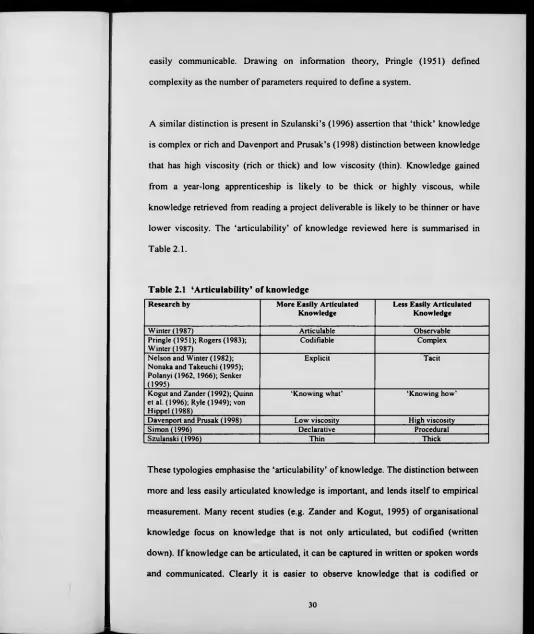
A similar distinction is present in Szulanski’s (1996) assertion that ‘thick’ knowledge
is complex or rich and Davenport and Prusak’s (1998) distinction between knowledge
that has high viscosity (rich or thick) and low viscosity (thin). Knowledge gained
from a year-long apprenticeship is likely to be thick or highly viscous, while
knowledge retrieved from reading a project deliverable is likely to be thinner or have
[image:33.596.20.554.20.654.2]lower viscosity. The ‘articulability’ of knowledge reviewed here is summarised in
Table 2.1.
Table 2.1 ‘Articulability’ of knowledge
R esearch by M ore Easily A rticulated
Knowledge
Less Easily A rticulated Knowledge
Winter (1987) Articulable Observable
Pringle (1951); Rogers (1983); Winter (1987)
Codifiable Complex
Nelson and Winter (1982); Nonaka and Takeuchi (1995); Polanyi (1962, 1966); Senker (1995)
Explicit Tacit
Kogut and Zander (1992); Quinn et al. (1996); Ryle (1949); von Hippel (1988)
‘Knowing what’ ‘Knowing how’
Davenport and Prusak (1998) Low viscosity High viscosity
Simon (1996) Declarative Procedural
Szulanski (1996) Thin Thick
These typologies emphasise the ‘articulability’ of knowledge. The distinction between
more and less easily articulated knowledge is important, and lends itself to empirical
measurement. Many recent studies (e.g. Zander and Kogut, 1995) of organisational
knowledge focus on knowledge that is not only articulated, but codified (written
down). If knowledge can be articulated, it can be captured in written or spoken words
articulated. This has led scholars to assert that tacit knowledge, in particular, is a
source of competitive advantage because it is more difficult for other firms to copy or
replicate (Senker, 1995; Teece and Pisano, 1994; Teece et al., 1997). Strangely
enough, the characteristics of tacit knowledge making it difficult for other firms to
copy also make it difficult to share internally. Although the distinction between tacit
and explicit is important, Tsoukas (1996) suggests that tacit and explicit knowledge
are mutually constituted. While it is useful to differentiate and delineate knowledge
types, it is recognised that their inseparability has to be acknowledged.
In professional work, experience has been seen as an indispensable part of a
professional who offers his professional service to the client. Experience as a kind of
tacit knowledge, not fully explored in the past, will be examined in the following
section.
2.2.1.3.1 Experience as a Sub-set of Tacit Knowledge
Knowledge and experience are gained by continuously engaging in work activities.
From Polanyi’s (1962) work, it is suggested that tacit knowledge is acquired and
maintained through experience. This experience can be either obtained through
repeatedly performing a task in a similar way, or through experimentation with new
approaches to complete a task. New tacit knowledge is acquired when a familiar task
is performed in a new way, or when a new task is performed through experimentation.
Knowledge develops over time, through experience that includes what we absorb
from formal means such as courses, books as well as informal learning. Penrose
‘experience-based’ rather than ‘objective-based’ knowledge created a competitive
advantage. Experience-based knowledge focuses on knowledge difficult to transfer
and imitate. Experience-based knowledge requires time to create (Penrose, 1959). The
value o f experience lies in its historical perspective. Experience is the essential bridge
between what happened in the past and what is happening in the present. Experience
is embedded in every response to a problem or issue encountered on a project. In a
very important way, project team members may ‘re-experience’ that which has
already been experienced. Experience also is valued for the critical understanding it
adds to a new situation. When team members are working on a new project, that
experience becomes invaluable, providing insight and direction. In determining the
importance of previous experience, it is relevant to consider mistakes as well as
success, as Arup (1989, p. 10) states: “mistakes are valuable guides; they should not
be forgotten or concealed. Rocks and reefs are chartered on maps as a warning to
sailors - shouldn’t we do the same with our mistakes and failures?” These
experienced-based insights are what firms pay premiums for - they show why
experience counts. Nonaka and Takeuchi (1995) suggest that knowledge of
experience tends to be tacit, physical and subjective, while knowledge of rationality
tends to be explicit, metaphysical and objective.
A study by Marvin (1985) confirms that architects relied heavily on their experience
rather than published literature to obtain solutions to problems. The research by
Mostow (1985) concludes that experience is the most importance influence on design
decisions. Since knowledge is the primary resource for professionals, learning from
future value creation for clients (Lowendahl, 1997). Experience can be seen as an
important sub-set of tacit knowledge, as experience is usually hard to articulate.
Utilising the knowledge and experience of others has been shown to be a crucial part
of the professional’s knowledge creation process. An element of utilising the
experience of others is the exchange of information in the form of meetings. The
importance of meetings is considered by Svensson (1990) who believes that
knowledge is transferred through conversation. Knowledge that has been gained
through direct experience can be indexed to that experience. Knowledge gained
through others (knowledge by description) cannot be indexed in such a manner. Yet it
is one of the most prominent ways of learning. In deciding how much reliance can be
placed on events that are not directly experienced, Russell (1948, p. 29) states:
“The chief importance of knowledge by description is that it enables us to pass beyond the limits of our private experience. In spite of the fact that we can only know truths which are wholly composed o f terms which we have experienced in acquaintance, we can yet have knowledge by description of things which we have never experienced. In view of the very narrow range of our immediate experience, this result is vital, and until it is understood, much of our knowledge must remain mysterious and therefore doubtful.”
While experience is an important subset of tacit knowledge in professional work,
social capital is defined by Lesser (2000, p. 4) as “the wealth (or benefit) that exists
because of an individual’s social relationship”. It can be seen as an enabler for
managing both explicit and tacit knowledge (Lesser, 2000).
2.2.1.3.2 Social Capital as an Enabler for Managing Knowledge
Social capital is broadly defined as an asset that inheres in social relations and
have used the term in competing and sometimes contradictory ways. Fukuyama
(1995, p. 10) defines social capital as “the ability o f people to work together for
common purpose in groups and organisations”. Fukuyama (2000, p. 3) later defines
social capital as “an instantiated informal norm that promotes cooperation between
two or more individuals”. Putnam (1995, p. 67) sees social capital as “features of
social organisation such as networks, norms and social trust that facilitate
coordination and cooperation for mutual benefit”. Nahapiet and Ghoshal (1998) find
that unlike other forms of capital, social capital increases rather than decreases with
use. Bourdieu (1986) suggests that interaction is a pre-requisite for the development
and maintenance of dense social capital. Adler and Kwon (2000) find that the sources
of social capital are embedded in networks, norms, beliefs, rules and trust.
As suggested by Lesser (2000, p. 9), social capital is necessary “to enable the
effective management of both explicit and tacit knowledge”. Nahapiet and Ghoshal
(1998) highlight the influences of the three dimensions of social capital: structural,
cognitive and relational in the creation of intellectual capital2. They create a social
capital framework to show the effects of social capital on the creation of new
intellectual capital. Lesser (2000, p. 10) further adds that since technology has been
used to capture explicit knowledge by using repositories o f different formats, social
capital “truly impacts the effectiveness of such efforts”. It is found that the role of
social capital is even more important in the sharing of tacit knowledge as it is usually
transferred through direct contact between parties (Lesser, 2000). Tsai and Ghoshal
(1998) find that social capital has significant effects on the way organisations create
and share knowledge. In addition, Szulanski’s (1996) finding suggests that social
capital is an essential element in transferring best practices. These are the reasons that
support why social capital has been increasingly viewed as an important concept in
knowledge creation as well as in managing explicit and tacit knowledge.
Consider the example of applications software and electrical engineering members in
a product development team increasing their likelihood of creativity or innovativeness
by capitalising on novel task information acquired through their separate external
networks. Social capital creates connections between different people, systems and
their environments. Social capital is a quality created between people, whereas human
capital is a quality of individuals (Burt, 1997). Burt (1997) describes social capital as
the contextual complement to human capital. He links human capital with individual
ability and social capital with opportunity. Individuals with high social capital are
able to add value by coordinating other people and using the right people to develop
new opportunities. Individuals with more social capital get higher returns on their
human capital because they are positioned to identify and develop more rewarding
opportunities.
In cross-functional teams, members have training and experience in a number of
specialised areas. Thus cross-functionality increases the likelihood of any team
improving performance should members exchange knowledge externally. The breadth
of perspective in a multi-functional team can improve the reception and transmission
of knowledge within it. Members of cross-functional teams also have more
opportunities than members of functionally homogeneous teams because each has ties
external sources of knowledge alone is not enough to guarantee positive results for
cross-functional teams. Team members need to exchange knowledge with their ties
outside of the team. This is in line with the argument that cross-functional members
can have non-overlapping areas of expertise externally, with members of different
functions capitalising on diverse external networks, accessing diverse sources o f task
information, know-how and feedback.
After examining the various facets of knowledge in organisations, the following
section will look into knowledge creation in organisations.
2.2.2
Knowledge Creation in Organisations
Organisations innovate not by simply processing information, from the outside in, to
solve existing problems and adapt to a changing environment, as described in
classical organisation theory. They rather have to create new knowledge and
information, from the inside out, to redefine both problems and solutions and, in the
process, to create their environment (Daft and Weick, 1984; Weick, 1995).
Traditionally, organisations were conceptualised as entities that converted inputs into
outputs by using essentially well known capital such as land, labour and machinery,
so that the production function was pre-eminent in the nature of the competitive
advantage of the firm (Grant, 1996a; Prahalad and Hamel, 1990). The introduction of
the resource-based view of the firm shifted the attention from the production function
to the resource side (Wemerfelt, 1984). In the resource-based view of the firm,
organisational competitive advantage is thought to be generated from the resources of
substitutability (Barney, 1991). This shift towards the resource-based view o f the
firm, and the realisation of the firm’s primary role as knowledge creator rather than
knowledge applicator, has led to proposals for a knowledge based theory of the firm
(Grant, 1996a). The culmination of this research direction is the discovery of the
importance of organisational knowledge creation in general and, specifically,
knowledge creation in multidisciplinary project teams for sustainable competitive
advantage.
Nonaka and Takeuchi (1995, p. 3) define organisational knowledge creation as “the
capability of a company as a whole to create new knowledge, disseminate it
throughout the organisation and embody it in products, services and systems”. Or,
more succinctly, “the process that organisationally amplifies the knowledge created
by individuals and crystallises it as part of the knowledge system of an organisation”
(Nonaka et al., 1996, p. 833). The role of management is to design the structures and
encourage the processes that are shown to increase the capacity of the organisation’s
members to absorb and create new knowledge giving a competitive advantage. It is
the creation of knowledge that is organisationally relevant.
The process o f knowledge creation has been variously described in the literature as
the production o f new knowledge by means of the exchange and integration of data,
information, knowledge and wisdom within and between individual, team and
organisation levels in a company (Nonaka and Takeuchi, 1995; Watkins and Marsick,
1997). These exchanges are best described using the seminal work of Nonaka and
Takeuchi (1995) who view them as interactive, spiralling, iterative processes that go