Graduate Theses and Dissertations
Dissertations
2017
Driver helper dispatching problems: Three essays
Shih-Hao Lu
Iowa State University
Follow this and additional works at:https://lib.dr.iastate.edu/etd Part of theTransportation Commons
This Dissertation is brought to you for free and open access by the Iowa State University Capstones, Theses and Dissertations at Iowa State University Digital Repository. It has been accepted for inclusion in Graduate Theses and Dissertations by an authorized administrator of Iowa State University Digital Repository. For more information, please [email protected].
Recommended Citation
Driver helper dispatching problems: Three essays
by
Shih-Hao Lu
A dissertation submitted to the graduate faculty
in partial fulfillment of the requirements for the degree of
DOCTOR OF PHILOSOPHY
Major: Business and Technology (Supply Chain Management)
Program of Study Committee: Yoshinori Suzuki, Major Professor
Toyin Clottey Anthony Craig Zhengrui Jiang Lizhi Wang
The student author and the program of study committee are solely responsible for the content of this dissertation. The Graduate College will ensure this dissertation is globally accessible
and will not permit alterations after a degree is conferred.
Iowa State University
Ames, Iowa
2017
TABLE OF CONTENTS
Page
LIST OF FIGURES ... v
LIST OF TABLES ... vi
ACKNOWLEDGEMENTS ... vii
ABASTRACT ... viii
CHAPTER 1 GENERAL INTRODUCTION ... 1
Introduction ... 1
Dissertation Organization ... 3
CHAPTER 2 DEPENDENT DRIVER HELPER DISPATCHING MODEL ... 5
Abstract ... 5
Introduction ... 5
Literature Review ... 6
Driver Helper Dispatching Problem (DHDP) ... 6
Last Mile Logistics Problems and Solutions ... 7
Traveling Salesman Problem (TSP) and Vehicle Routing Problem (VRP)... 8
Model Formulation ... 9
Problem Definition and Illustration ... 9
Current Practice DDH Model ... 13
Proposed Model ... 15
Experimental factors and their ranges ... 18
Design of experiments ... 20
Results ... 21
Conclusion ... 27
CHAPTER 3. HYBRID DRIVER HELPER DISPATCHING MODEL ... 30
Abstract ... 30
Introduction ... 30
Literature Review... 32
Logistics Operations with Multiple Delivery Resources ... 32
Flying Sidekick Traveling Salesman Problem ... 33
Model Formulation ... 35
Problem Definition and Illustration ... 35
Proposed Model ... 37
Computational Experiments... 42
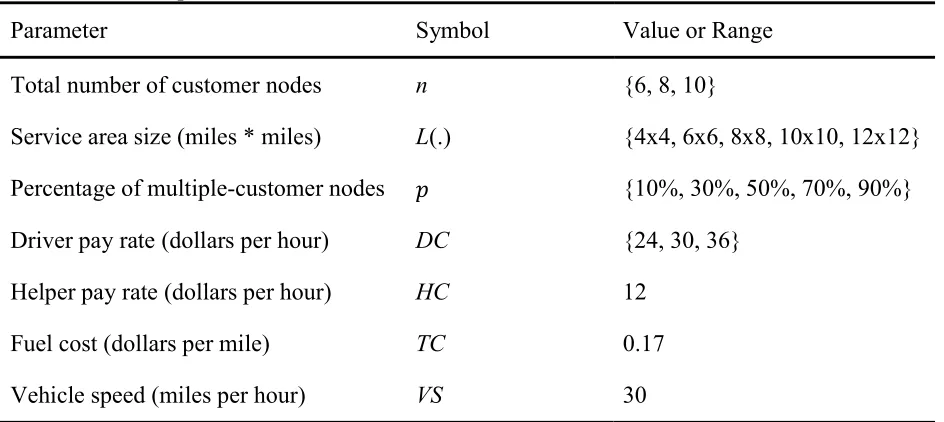
Experimental factors and their ranges ... 42
Design of experiments ... 43
Results ... 44
Conclusion ... 50
CHAPTER 4. INTEGRATE DRIVER HELPERS DISPATCHING PROBLEM AND VEHICLE ROUTING PROBLEM WITH TIME WINDOWS ... 52
Abstract ... 52
Introduction ... 52
Classical heuristics ... 53
Metaheuristics ... 55
Model Formation ... 57
VRPTW with helper dispatching model ... 57
Simulated Annealing ... 62
Penalty Function ... 66
Computational Experiments... 68
Experimental factors and their ranges ... 68
Design of experiments ... 71
Results ... 71
Sensitivity Analysis ... 77
Conclusion ... 79
CHAPTER 5. GENERAL CONCLUSION ... 82
LIST OF FIGURES
Page
Figure 1 Example problem solved by no-helper solution and current-practice
DDH solution ... 11
Figure 2 Example problem solved by Proposed DDH solution ... 11
Figure 3 Example problem solved by proposed HDH model ... 36
Figure 4 Sample solution for homogeneous service methods ... 62
LIST OF TABLES
Page
Table 1 Expected service time of each node in the example problem ... 10
Table 2 Comparison of the no-help, current-practice DDH, and proposed DDH solutions ... 12
Table 3 Selected parameters ... 19
Table 4 Improvement over the no-helper model ... 22
Table 5 Improvement over the current-practice DDH model ... 23
Table 6 Impact of individual factor ... 24
Table 7 Expected service time of each node in the example problem ... 36
Table 8 Comparison of the no-help, current-practice DDH, and proposed HDH solutions ... 37
Table 9 Selected parameters ... 42
Table 10 Improvement over the no-helper model ... 45
Table 11 Improvement over the current-practice DDH model ... 46
Table 12 Impact of individual factor ... 48
Table 13 Selected parameters for SA ... 66
Table 14 Selected parameters ... 69
Table 15 Paired solution comparisons ... 72
Table 16 Impact of individual factor ... 73
Table 17 Selected parameters for sensitivity analysis ... 78
ACKNOWLEDGEMENTS
I owe thanks to many individuals both professionally and personally. First, I would like
to thank my committee chair, Yoshinori Suzuki. Without his support, I would not be where I am
today. Second, I would like to thank my committee members, Toyin Clottey, Anthony Craig,
Zhengrui Jiang, and Lizhi Wang for providing helpful suggestions during the dissertation
process. Finally, on the personal side, I would like to thank my wife Yueh-Chun Kuo for her
ABSTRACT
The driver helper dispatching problems (DHDPs) have received scant research attention
in past literature. In this three essay format dissertation, we proposed two ideas: 1) minimizing of
the total cost as the new objective function to replace minimizing the total distance cost that is
mostly used in past traveling salesman problem (TSP) and vehicle routing problem (VRP)
algorithms and 2) dispatching vehicle either with a helper or not as part of the routing decision.
The first study shows that simply separating a single with-helper route into two different types of
sub-routes can significantly reduce total costs. It also proposes a new dependent driver helper
(DDH) model to boost the utilization rate of the helpers to higher levels. In the second study, a
new hybrid driver helper (HDH) model is proposed to solve DHDPs. The proposed HDH model
provides the flexibility to relax the constraints that a helper can only work at one predetermined
location in current-practice independent driver helper (IDH) model and that a helper always
travels with the vehicle in the current-practice DDH model. We conducted a series of
full-factorial experiments to prove that the proposed HDH model performs better than both two
current solutions in terms of savings in both cost and time. The last study proposes a
mathematical model to solve the VRPTW version of DHDPs and conducts a series of full
factorial computational experiments. The results show that the proposed model can achieve more
cost savings while reducing a similar level of dispatched vehicles as the current-practice DDH
solution. All these three studies also investigate the conditions under which the proposed models
CHAPTER 1. GENERAL INTRODUCTION
Introduction
In the US, the winter holiday shopping season from Black Friday to Christmas holidays
accounts for around 30% of the total US annual retail sales (National Retail Federation, 2014).
However, as more and more people prefer to shop online and take advantage of delivery service
convenience, shipment during holiday shopping seasons becomes a big challenge to parcel
delivery service providers. Last minute shoppers, higher than expected e-commerce volume,
retailers with increasingly later delivery cut-off times, and harsh winter weather are all sources of
logistic service challenges (Soltes, 2014). As a result, shipment delays during shopping seasons
have occurred many times in the past few years. While some domestic companies service only
tens or hundreds of customers every day, international companies such as United Parcel Service
(UPS), Federal Express (FedEx), and Deutsche Post (DHL) are servicing millions of customers
daily all over the world. Those companies always look for methods to find the most cost-efficient
way to distribute parcels across the logistic network.
The volume from one origin to one destination is typically too small to justify direct
transport. The shipments of the same neighborhood area (e.g., city) are typically consolidated
into a facility known as a station. In most of the cases, each station has a predetermined service
area, which covers an appropriate geographic size with a sufficient customer base. The primary
objective of a station is to ensure that all delivery and pickups shipments are accomplished in a
timely and efficient manner. Ideally, the daily delivery capacity of one station should be larger
than the daily customer demand in the service area. Therefore, all the customers can receive their
Typically, a station is equipped with one or more trucks and drivers. Each driver has on
average 8 to 12 hours of daily work. The need for drivers to work overtime is the industry
normal. Working overtime, however, has many drawbacks. First, from companies’ perspectives,
based on the Fair Labor Standards Act (FLSA) in the US, employees must receive overtime
payment for hours worked over 40 in a given workweek at a rate not less than one and a half of
their regular rates. That is, letting drivers work overtime will increase direct labor costs. Second,
from drivers’ perspectives, even with overtime payment, not every driver is willing and able to
work overtime especially if it involves significant time during the entire winter shopping season.
This unpleasant employment condition can not only put pressure on the drivers’ physical or
mental well-being, but also increase driver turnover. This in turn can increase indirect labor cost,
such as hiring and training. Last and most importantly, even though FLSA does not limit the total
working hours in a period, for employees aged 16 years and older can be required to work, there
is still a physical limitation on the drivers’ daily work time. If delivery capacity cannot cover the
delivery demand of the day, some customers would be unable to receive their packages by the
promised time. This potential failure in service turns out to be a more serious problem for the
parcel delivery companies. Moreover, the trend shows that home delivery volumes during peak
seasons keep increasing (National Retail Federation, 2014). Thus, a parcel delivery company that
is unable to implement useful solutions to deal with the increasing demand, is likely to face
increasing operation costs and worsening delay issues from year-to-year.
Hiring seasonal employees is one widely used method by parcel delivery companies. For
example, in the year 2015, UPS and FedEx announced a plan to hire 95,000 and 55,000 seasonal
employees respectively to support the anticipated increase in package volume from November
as driver helpers, whoassist drivers in the delivery of packages. Driver helpers are not required
to drive the delivery vehicle and usually meet the drivers at a mutually agreed upon time and
location.
This dissertation focuses on investigating the enhanced ways of utilizing driver helpers to reduce costs, and the design of mathematical models to support the decision-making of driver helper dispatching problems in various scenarios. Modeling the driver-helper dispatching
problem provides researchers a further understanding of this new type of transportation problem, and may trigger creative ideas to solve related issues. It also provides value to practitioners by seeking methods to avoid drivers working overtime, in addition to providing better customer
service, in terms of on-time delivery, during the peak holiday seasons. In essence, this study proposes a novel framework that shapes the way the increasing package delivery challenges that occur in the e-commerce era are dealt with. Computational experiments show that
simultaneously analyzing driver helper scheduling and vehicle routing can significantly improve the efficiency of a firm's shipping pattern. This study also shows that the utilization performance of driver helpers is enhanced considerably by using the proposed models.
Dissertation Organization
proposal of a new model to realize the saving opportunities. In Chapter 3, the focus is shifted to the second type of helpers called independent driver helpers (IDHs). A new hybrid model to consider a helper, who works as either a DDH or an IDH in each node, is introduced. In Chapter 4, the research topics is extended to a large-scale vehicle routing problem (VRP) which considers routing multiple vehicles and scheduling multiple helpers. This results in the design of a
metaheuristic algorithm to tackle the problem. In each of the main chapters, computational simulation experiments are conducted to evaluate the savings in cost, driver time, and numbers of dispatched vehicles for the proposed ideas. Chapter 5 will summarize all the important
CHAPTER 2. DEPENDENT DRIVER HELPER DISPATCHING MODEL
Abstract
The driver helper-related issues in dispatching problems have received scant research
attention in past literature. This study shows that simply separating a single with-helper route
into two different types of sub-routes can significantly reduce total costs and proposes a new
DDH model to boost the utilization rate of the helpers to higher levels. Three main contributions
are provided by the current research. First, it introduces a new transportation problem, DHDPs,
which had never been studied before. Second, the results of the experiment show that the
proposed DDH model provides a higher cost savings percentage than the current-practice DDH
solutions. Finally, it conducts a series of experiments to investigate the conditions under which
the proposed DDH model would work most and least effectively.
Introduction
Hiring seasonal driver helpers is a widely used method to temporarily boost the service
capacity by parcel delivery companies. To date, parcel delivery companies have primarily
utilized two types of driver helpers (Rhodes et. al., 2007). The first is dependent driver helpers
(DDHs) who travel with delivery trucks (in the passenger seat) but work separately from drivers
to deliver packages. The second type is independent driver helpers (IDH), who do not travel with
delivery trucks but work at a predetermined local distribution point which typically covers a high
customer density area. In this chapter, we focus on driver helper dispatching problem (DHDP)
while considering only the DDH strategy, and will shift the focus to both types of helpers in
DDH strategy is designed to reduce drivers’ workloads at locations with more than one
customer. While a driver delivers packages on one street, the paired helper can deliver packages
on another street. With the assistance from a helper, the driver can share the delivery workload.
However, current vehicle routing tools are designed for finding the shortest routes to reduce the
total travel cost without considering the scheduling helper. We believe that such shortest route
can be a drawback when pursuing DHDP solutions. Therefore, we propose a new DDH model
that relaxes the shortest route assumption and includes both travel and service cost in its
objective function. A mixed integer linear programming algorithm was used to solve the problem
and conduct a series of full-factorial computational experiments to evaluate the savings that can
be achieved with these proposed ideas.
Literature Review
In this section, literature focused on DHDPs and other similar or related topics are
reviewed.
Driver helper dispatching problem (DHDP)
To the best of our knowledge, Rhodes et al. (2007) is the only previous study that has
focused on the DHDP. Rhodes and colleagues proposed an idea about a helper dispatch tool for
UPS’s delivery system to find out the optimal driver-helper dispatch combination based on a
cost-benefit analysis. The drivers’ pay rate is higher than the helpers’ pay rate, with the drivers’
overtime rate being even higher. By replacing drivers’ overtime with helpers’ regular work time,
the decision tool could save on direct labor costs and provide a more efficient delivery solution.
In Rhodes et al. (2007), the authors did not mention any routing decision. Therefore, it is
focuses on answering the strategic level questions of 1) how many helpers should be deployed,
2) which routes need dependent helpers, and 3) which locations need independent helpers. In
contrast to Rhodes et al. (2007), the scope of the decision was extended to include routing which
can further improve cost savings. In other words, the study focuses on the operational level
problem of finding the optimal driver-helper routing and scheduling decisions based on
calculations of work time in each node and travel distance among them.
Last mile logistics problems and solutions
Last mile logistics refers to the last portion of transit in supply chains, where goods are
delivered from the last transit point to the final drop point of the delivery chain, or called
door-to-door (D2D) delivery (Lee and Whang, 2001). This part of logistics often involves routing a
fleet of vehicles for physical distribution, and plays a crucial role in ensuring that consignments
are distributed in correct quantities and within the timing limits promised to the customers. It
also can be regarded as one of the most expensive and least efficient segments in the supply
chain field (Gevaers et al., 2011). The vehicle operational decisions by the logistics providers
can significantly affect costs in various ways including fuel consumption and labor costs (via the
methods used to load, unload, and provide delivery service), and so on.
Another less obvious but also important issue is that of the information and
communication technology used. Parcel delivery companies, such as UPS, Fedex, DHL, US
Postal Service, etc. have long maintained records to be able to verify deliveries. Typically, a
driver leaves the vehicle with one or more parcels and a portable data acquisition device. The
device may be able to collect data for further tracking and forecasting analysis, such as the travel
model is built around the concept of using such historical data to estimate the service time at
each node for making better-combined routing and helper scheduling decisions.
Traveling salesman problem (TSP) and vehicle routing problem (VRP)
We consider DHDP as a new type of last mile logistics problem. Last mile logistics
problems were frequently solved as a traveling salesman problem (TSP) or a vehicle routing
problem (VRP). If a delivery company considers the problem scope as using only one vehicle to
visit all customer nodes in one route (without capacity limitation), the problem can be modeled
as a TSP. TSP is a popular research topic that has received much attention from researchers,
because it is so easy to describe but so difficult to solve (Hoffman et al., 2013). The basics of this
problem can be simply described as finding the shortest travel path that visits each city once and
only once and then back to the origin (Applegate et al., 2011).
The TSP has received considerable attention over the past few decades and various
methods based on deterministic or probabilistic heuristics have been proposed to solve the
problem, such as branch-and-bound, simulated annealing, genetic algorithms, tabu search, and
ant colony optimization. (Lin, 1965; Lawler and Wood, 1966; Held and Karp, 1970; Lin and
Kernighan, 1973; Christofides, 1976; Kirkpatrick et al., 1983; Glover, 1989; Reinelt,1991;
Dorigo and Gambardella, 1997; Dorigo and Gambardella, 2016). Readers interested in
discussions of various TSP studies are referred to Laporte (1992a), and Applegate et al. (2011).
If a parcel delivery company considers using more than one vehicle routes to serve all
customers, then the problem should be modeled as a VRP. VRP aims to select an optimal set of
routes for a fleet of vehicles on a network to serve a set of customers given specified constraints.
minimizing the total travel cost. Dantzig and Ramser (1959) first introduced VRP where they
described a real-world problem considering the delivery of gasoline to service stations and
proposed the first mathematical algorithm to solve the problem. Clarke and Wright (1964)
proposed an effective saving heuristic that made an improvement on the Dantzig and Ramser
(1959) approach.
To date, many variants of VRPs have been investigated in both academia and industry.
Classification schemes are available in Desrochers et al. (1990) and Laporte et al. (2000). Other important VRP surveys studies include Magnati (1981), Raff, (1983), Laporte (1992b), Osman
(1993), Desrosiers et al. (1995), and Fisher (1995). Readers that are interested in recent detailed
reviews of various VRP studies are referred to Golden et al. (2008) and Toth and Vigo (2014).
Model Formulation
Keeping the delivery peak season challenge and the driver helper concept in mind, we
first provide an illustration of our proposed ideas and then construct the mathematical models for
both the current and proposed solutions. The current driver helper solution follows traditional
TSP and VRP approaches, which seek to optimize routes to reduce the overall traveling costs and
meet customer requirements. In order to improve the current solution, a more complete objective
function was incorporated that includes both costs from travel time and service time in our
proposed model.
Problem definition and illustration
The problem of DHDP in a one vehicle scenario may be viewed as a variant of the TSP,
which allows companies considering using a DDH to reduce the drivers’ work time at nodes with
visited by the vehicle once and only once, and the delivery service can be handled by either only
the driver or shared by the driver and the helper. Since the driver’s pay rate is higher than the
helper’s pay rate, it provides cost savings to use the helper’s time to replace the driver’s time.
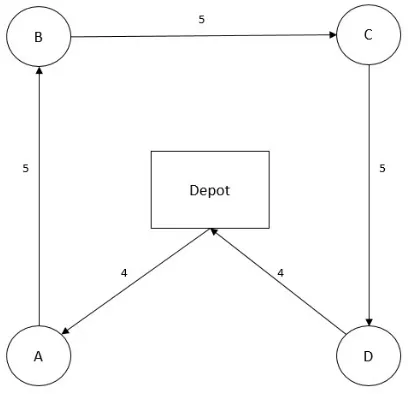
Consider a route where there exist one depot and four customer nodes (denoted A, B, C,
and D). In this example, we assume the visiting sequence “Depot – A – B – C– D – Depot” is the
shortest path calculated by standard routing software. The travel time between customer nodes
are all 5 minutes, and those between the depot and customer nodes are all 4 minutes. We also
assume that the driver’s pay rate is three times that of the helper’s pay rate. Each node may have
one or more customers. To simplify this demonstration problem, we assume that each customer
needs 5 minutes for delivery service. If a node has more than one customer then, the driver and
the helper will equally share the service time. If a node has only one customer, utilization of
DDH will be unable to reduce the service time. Table 1 shows the service time in each node done
by the driver alone or with a helper’s assistance. In both nodes A and B, where there is more than
one customer, the service time in both nodes is reduced by half if using a helper. In nodes C and
D, because each of these nodes has only one customer, using a helper does not reduce the service
[image:19.612.76.538.564.642.2]time.
Table 1: Expected service time of each node in the example problem
A B C D
Expected Service time without a helper (minute) 60 30 5 5
Expected Service time with a helper (minute) 30 15 5 5
Base on the results of interviews with practitioners, in peak seasons, parcel delivery
letting the driver work alone (in most of these cases the driver needs to work overtime, referred
to as no-helper solution) or assigning a helper to the driver (referred to as current-practice DDH
solution).
Here is a demonstration of the proposed solution. The proposed solution has two core
concepts. The first is assigning a helper to assist with delivery in only a part of the driver’s route.
Therefore, the company can separate the original route into two sub-routes, one without a helper
and the other with a helper. The second is to relax the shortest one route assumption, and
therefore re-route for these two sub-routes. Figure 1 below demonstrates the first two solutions,
[image:20.612.86.290.348.545.2]and Figure 2 demonstrates the proposed DDH solution.
Figure 1: Example problem solved by no-helper solution and current-practice DDH solution
(*All figures are in minutes)
Figure 2: Example problem solved by proposed DDH solution
(*All figures are in minutes)
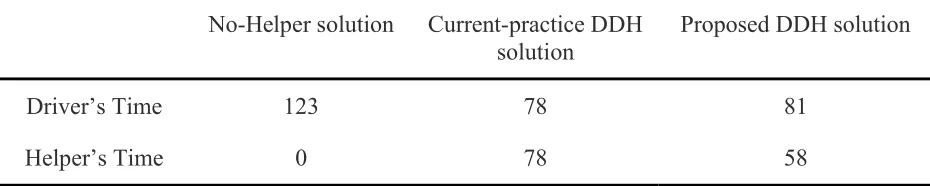
If the driver does not use a helper (Figure 1) then the total time of the entire route will be
[image:20.612.319.534.350.542.2]minutes. By using a helper, it saves 45 minutes of driver’s time with the cost of 78 minutes of the
helper’s time. It is worth noting that, in the current-practice DDH solution, the helper does not
actually provide help in node C and D. Therefore the helper’s time, spent at nodes C and D along
with the time spent traveling to and from both nodes, is unnecessary.
The proposed solution, shown in Figure 2, separates the service schedule into two
sub-routes. The first one is a with-helper route “Depot – A – B – Depot”; the second is a no-helper
route “Depot – C – D – Depot”. Table 2 shows the comparison of the proposed DDH solution to
that of the two current standard solutions. Since it was assumed that the driver’s pay rate is three
times that of the helper’s pay rate, the proposed DDH solution is the most cost-efficient among
[image:21.612.72.537.406.499.2]these three solutions.
Table 2: Comparison of the no-help, current-practice DDH, and proposed DDH solutions
No-Helper solution Current-practice DDH solution
Proposed DDH solution
Driver’s Time 123 78 81
Helper’s Time 0 78 58
The goal of the proposed model is to help parcel delivery companies to make cost
efficient driver helper dispatching decisions. It is worth noting that the helper’s time spent on
visiting nodes with only one customer provides no value to the delivery process. When a helper
travels with a vehicle, a good solution should let the vehicle continuously visit high customer
density nodes and avoid those nodes with only one customer. Therefore, the helper can spend the
bulk of their work time on customer service to a sufficient level and replace a large amount of
Current-practice DDH model
Based on information collected from interviews with practitioners, current drivers usually
have a fixed service route called “routing,” which typically provides a near-shortest (if not
exactly the shortest) route. Therefore, it is reasonable to simulate the current solution by first
finding the shortest route and then assigning to that route.
This is the notation used to describe the mathematical model.
N= {1, 2, …, n}: set of all customer nodes;
V= {0, 1, 2, …, n, n+1}: set of all nodes;
: travel time from node i to node j;
: binary decision variable that equals 1 if the vehicle travels from node i to
node j;
: auxiliary integer variable that specifies the travel sequence of node i on the
vehicle’s path.
M: an arbitrarily large number;
Given the notation, the current solution model is expressed as the following two steps.
Step 1: The following standard TSP algorithm is used to simulate the initial shortest
tijxij
Minimize (1)
Subject to: V i x i V j
ij
1 } { \ (2) V i x i V qqi
1 } \{ (3) } 0 { \ }, 0 { \ ) 1 (1 M x i V j V
u
ui j ij (4)
i j V j V i
xij{0,1} , , (5)
} 0 { \
1ui n iV (6)
The objective function (1) aims to minimize the total travel time. Constraint (2) serves to
make sure each customer node will be visited once and only once. Constraint (3) ensures that for
each node the inflow equals to the outflow. Constraint (4) is the sub-tour elimination constraint.
Constraint (5) and (6) specify the domains for decision variables.
Step 2: Given the visiting sequence with the shortest travel distance from Step 1, the total
work time for the driver and the helper can be collected and the total cost of the current-practice
DDH solution can be calculated. Note that the same procedures were followed to get the
no-helper solution from the same model with the only change that the driver must do all the service
Proposed model
It is worth noting that in the current-practice DDH model the helper may be forced to
visit nodes with only one customer and provide no help there. The shortest route setting, while
minimizing the travel distance, may unnecessarily increase unnecessary helper work time when
pursuing an optimal DDH dispatch solution. Therefore, eliminating the shortest route assumption
and pursuing a minimal total cost objective function in the proposed model to test how much
savings can be achieved with this change.
By relaxing the shortest route assumption, our model separates the customer nodes into
two routes. On the first route, all customer nodes have only one or very few customers, where the
helper can’t provide sufficient help. Therefore, the driver is better of working alone on this route
(referred to as no-helper route). On the second route, the majority of nodes have a large number
of customers, where the helper can efficiently help (referred to as with-helper route). Therefore,
it is better for the driver better to work along with a helper on this route. The notations used to
describe the mathematical model are aligned to those in section 2.3.3. The redefined and
additional notations are presented as follows.
: binary decision variable that equals 1 if the no-helper route includes a travel
from node to node ;
: binary decision variable that equals 1 if the with-helper route includes a
travel from node to node ;
: auxiliary integer variable that specifies the travel sequence of node on the
: auxiliary integer variable that specifies the travel sequence of node on the
with-helper route;
: work time at node i if all the workload is done by the driver;
: work time at node i if all the workload is shared by the driver and the helper;
DT
:
driver’s total work time, which equals to the sum of driver’s service timeand driver’s travel time;
HT
:
helper’s total work time, which equals to the sum of helper’s service timeand helper’s travel time;
DC: driver’s pay rate;
HC : helper’s pay rate;
TD: total traveled distance of the vehicle;
FC : fuel cost per distance unit of the vehicle;
VS : vehicle speed.
Thus, the proposed solution is expressed as follows.
FC TD HC HT DC
DT
Minimize (7)
V i 2 1 V i ) ( ) ( Where Vj ij ij i
i V
j ij ij
s t y s t x DT ) ( 2 V i i V j ij ij t s y HT
VS y x t TD ij V j ijij
1
} \{ 0
V i
j j
x (8)
1 0 } \{
V i j j
y (9)
} 0 { \ 1 ) ( } \{ V i y x ij i V j
ij
(10) V i x x i V j ij i V qqi
0 } { \ } { \ (11) V i y y i V j ij i V qqi
0 } { \ } { \ (12) } 0 { \ }, 0 { \ ) 1 (1 M x i V j V
u
ui j ij (13)
} 0 { \ }, 0 { \ ) 1 (
1 M y i V j V
v
vi j ij (14)
V j i
xij{0,1} , (15)
V j i
yij{0,1} , (16)
} 0 { \
1ui c iV (17)
} 0 { \
1vi c iV (18)
The objective function (7) aims to minimize the total direct labor cost and fuel cost.
Where the first and second term for DT in the objective function represents the sum of travel and
work times on the no-helper route and with-helper route, respectively. The numerator in the TD
Constraints (8) to (10) serve to make sure that each customer node will be visited once
and only once on either route. Constraints (11) and (12) ensure that for each node the inflow
equals to the outflow. Constraints (13) and (14) work as the sub-tour elimination constraints.
Constraints (15) and (16) specify the domains for decision variables. Constraint (17) and (18)
specify the ranges for travel sequence variables.
Computational Experiments
In this section, a series of experiments were conducted to investigate the conditions under
which the proposed DDH solution works most, or least, effectively.
Experimental factors and their ranges
How the cost-saving potential of the solution is affected by the following four
experimental factors was tested: 1) the total number of customer nodes, 2) the size of the service
network, 3) the percentage of multiple-customer nodes, and 4) driver pay rates.
To obtain realistic results and implications, the experiment and specified model
parameters were carefully designed by referring to a variety of reliable data sources. The sources
include the following: 1) inputs from a global retail corporation with online shopping and
delivery service, 2) expert opinions obtained from a global parcel delivery company, and 3) a
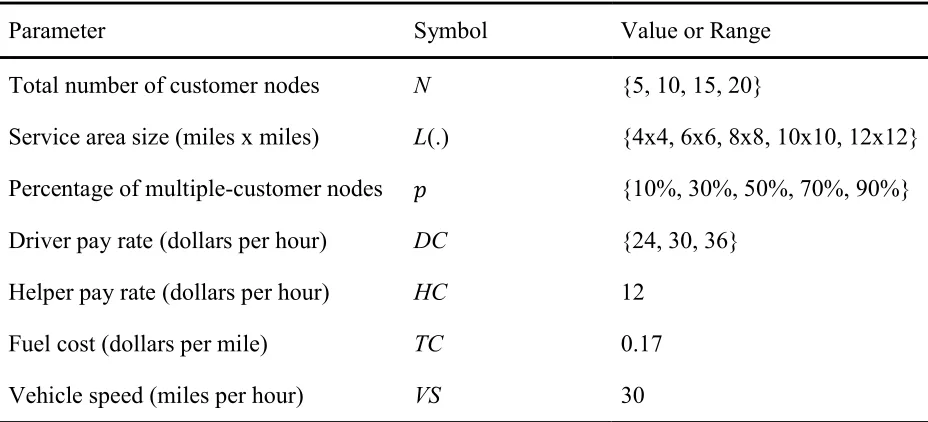
Table 3: Selected parameters
Parameter Symbol Value or Range
Total number of customer nodes N {5, 10, 15, 20}
Service area size (miles x miles) L(.) {4x4, 6x6, 8x8, 10x10, 12x12}
Percentage of multiple-customer nodes {10%, 30%, 50%, 70%, 90%}
Driver pay rate (dollars per hour) DC {24, 30, 36}
Helper pay rate (dollars per hour) HC 12
Fuel cost (dollars per mile) TC 0.17
Vehicle speed (miles per hour) VS 30
The range of total number of customer nodes was set at four levels: 5, 10, 15, and 20. To
set a realistic range for this factor, a pilot test was conducted under the experimental settings and
found that the average total work time of the no-helper route with 10 to 15 customer nodes is the
segment most close to a driver’s regular 8-hour work shift in the US. Therefore, 10 customer
nodes were used as the base level and 50% decrease, 50% increase, and 100% increase as the
other three levels to represent the demands variances.
For the size of the service network, the size of one service area varies from an urban
high-density area to a rural low-density area. The higher the population density in one area, the
smaller the size of a network a driver can serve in one day. Expert opinions were consulted and
the following five levels were set: 16 mile2, 36 mile2, 64 mile2, 100 mile2, and 144 mile2. Note
that service area shape is not considered as a factor (i.e., a square shape was assumed in all
service networks).
For service time in each node, we set the distribution percentage of the multiple-customer
both the service time by a driver alone ( ) and that by a driver and a helper together ( ) are 5
minutes. For each multiple-customer node, follows a uniform distribution between 10 and 120
minutes, and is a half of .
For drivers pay rate, the inputs obtained from industry experts were adopted along with
the publicly available driver wages database and set a three-level range (i.e., 24, 30, and 36
dollars per hour), which are also 2, 2.5, and 3 times that of the helpers pay rate in the experiment
(12 dollars per hour). It is assumed that time saved from the solution can be employed elsewhere,
and can be converted to cost savings via the pay rate structure. Finally, yet importantly,
overtime pay structure is not include in the research to present a more conservative result. The
main reason is that the threshold of overtime may vary by companies and shift schedules. For
example, under a 40 work hours per week regulation, some parcel delivery companies require
that their drivers work only 4 days a week and 10 hours each day instead of 5 days a week and 8
hours each day. However, it should be readily apparent that the inclusion of an overtime pay
structure would result in cost savings that are at minimum as high as those from the proposed
solution are.
Design of experiments
The simulation experiments randomly generate and solve several hypothetical DHDP
instances under a variety of factorial combinations, and compare the costs of proposed solutions
to those of the current-practice DDH solutions of the no-helper solutions (i.e., current practices).
We use Visual Basic .NET (2012) to generate instances, and use CPLEX (12.5) to solve
A full factorial design was employed of the four factors specified earlier. Each simulation
trial was repeated ten times by executing the following steps. First, a depot and n ∈{5, 10, 15,
20}customer nodes in a service area L(.) were randomly generated, where the size of L(.) is
assigned as one of the five levels 16, 36, 64, 100, and 144 in mile2. The distance unit as set at 0.1
miles; for example, a 16 mile2 service area converts to a 40 (distance unit) x 40 (distance unit)
network with 1600 possible locations for each randomly decided location. After randomly
generating the locations, each customer node was assigned a set of service time either without
helper ( ) or with a helper( ). Note that the service times are decided by the distribution of
customers in nodes. There are ∗ of multiple-customer nodes and (1 − )*n of
single-customer nodes, where ∈{10%, 30%, 50%, 70%, 90%}.
Second, each of the problems was solved using the two current solution methods along
with the proposed DDH model to obtain three different solutions. The above simulation trial (i.e.,
generation of 300 problem versions, and 900 solutions) was repeated 10 times. In total, the
experiment generated 4 x 5 x 5 x 3 x 10 =3,000 instances, and 3,000 3 = 9,000 solutions.
Finally, after all the trials are completed, for each instance, the percentage cost saving and time
saving attained by the current-practice DDH solutions over the no-helper solutions were
computed, which is used as the benchmark to evaluate the performance of our proposed DDH
solutions. The same computation for the proposed DDH solutions over current-practice DDH
solutions was then repeated.
Results
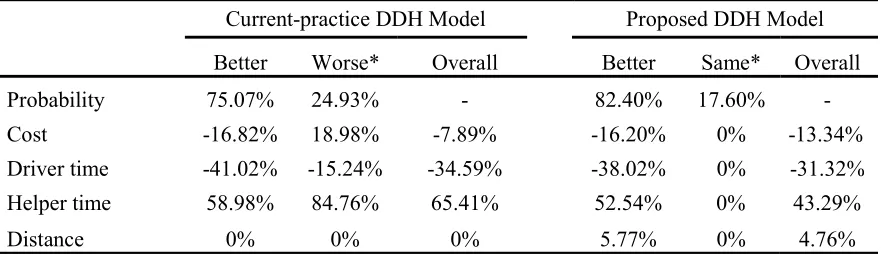
Computational results are summarized in the following tables. Table 4 shows the
using two DDH strategies over the no-helper solutions. Table 5 focuses on the paired
comparisons between the current-practice DDH solutions and that of the proposed DDH
solutions. Table 6 reports the sensitivity of the model’s effectiveness to changes in the
[image:31.612.74.522.225.352.2]experimental factors.
Table 4: Improvement over the no-helper model
Current-practice DDH Model Proposed DDH Model
Better Worse* Overall Better Same* Overall
Probability 75.07% 24.93% - 82.40% 17.60% -
Cost -16.82% 18.98% -7.89% -16.20% 0% -13.34%
Driver time -41.02% -15.24% -34.59% -38.02% 0% -31.32% Helper time 58.98% 84.76% 65.41% 52.54% 0% 43.29%
Distance 0% 0% 0% 5.77% 0% 4.76%
* the current-practice DDH solution has 0% to get the same cost as that from no-helper solution, while the proposed DDH solution has 0% to get a worse result as compare to the no-helper solution.
In Table 4, the analysis focuses on performance improving frequency and the average
improvement in each dimension. First, in all instances, the frequency counts of the
current-practice DDH solution and that of the proposed model were calculated, finding better, the same,
or worse results (based on total cost), respectively. Second, in each instance, the cost saving,
driver time saving, and increased distance were calculated and reported the average percentage
values over all instances among the paired comparisons.
The results show that both the current-practice DDH solution and proposed model can
help parcel service companies archive cost savings by using helpers’ time to replace drivers’
time. On average, the current-practice DDH solution can save 7.89%, while the proposed DDH
model can enhance the figure to 13.34%. Specifically, with respect to the current-practice DDH
cost reductions through replacing 41.02% of the drivers’ time by helpers’ time. However,
24.93% of the results show that using current-practice DDH solutions may not always lead to a
cost saving solution. In those worse results, although the drivers’ time still reduces by 15.24%,
the total cost increases by 18.98%. The lower driver-time replacement rate provides the major
explanation these phenomena.
When switching from the no-helper solution to the proposed DDH solution, companies
have an 82.40% chance of finding a cost saving opportunity with an average total cost reduction
of 16.20% while replacing 38.02% of the drivers’ time with helpers’ time on average. In terms of
time-savings, the proposed DDH solution eliminates the wasted time for helpers’ at
single-customer nodes by separating the route into two, one with a helper, and the other without a
helper. Although this strategy slightly increased the travel distance (4.76% on average) and the
driver time (3.27% on average), it provided the tradeoff opportunity to use less of the helpers’
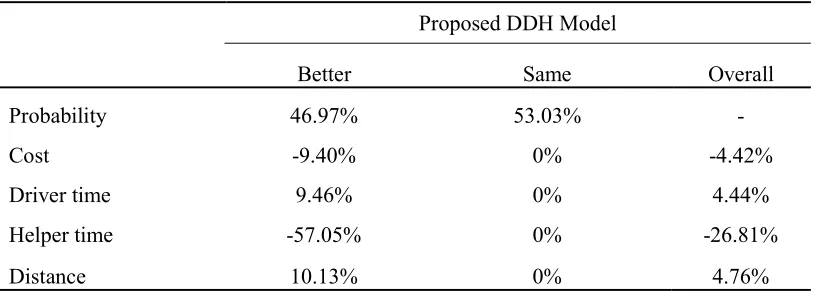
[image:32.612.73.486.486.633.2]time (22.12% on average) while gaining higher total cost savings (5.45% on average).
Table 5: Improvement over the current-practice DDH model
Proposed DDH Model
Better Same Overall
Probability 46.97% 53.03% -
Cost -9.40% 0% -4.42%
Driver time 9.46% 0% 4.44%
Helper time -57.05% 0% -26.81%
Distance 10.13% 0% 4.76%
In Table 5, the current-practice DDH solution was used as the benchmark to evaluate the
proposed DDH solution. The results in Table 5 illustrate that a company who has already adapted
switching to the proposed DDH model. If such a company does so, it can have an average
reduction in total costs of 4.42% by using 26.81% less of helpers’ time. Moreover, the
probability of the company getting a worse result by switching to the proposed DDH solution is
zero. That is because the proposed DDH model provides the flexibility of using either a pure
no-helper route or a pure with-no-helper route to service all customers. In other words, the proposed
DDH model will always find either better or the same quality solutions as the approaches used in
current practice. However, it is also worth noting that the savings come with the following
drawbacks: 1) the average drivers work time is 4.44% longer than that in the current-practice
DDH solutions, and 2) the travel distance is 4.76% longer than that in current-practice DDH
[image:33.612.82.550.393.666.2]solutions.
In Table 6, the average savings in cost and driver time for each combination of
experimental factor levels is reported. First, the cost savings percentage increases as the number
of customer nodes increases in both the current-practice DDH solutions and the proposed DDH
solutions. With large customer nodes values, the improvement of switching from the
current-practice DDH solution to proposed DDH solution incrementally converges to a stable level
around 3.6%. The total cost structure includes two parts: labor cost and fuel cost. When the
number of customer nodes is small, the total service time is also small, and the proportion of fuel
cost becomes a large part of the total cost. Moreover, when switching from the no-helper
solution to the current-practice DDH solution, the visiting sequence is the same. The only cost
saving is from the reduction in labor costs due to the replacement of drivers’ work time by
helpers’ work time. With more customer nodes, the proportion of total costs due to drivers’ work
time becomes larger, which result in large savings percentages.
When switching from the no-helper solution to that of the proposed model, another major
savings is from the reduction of the unnecessary helpers’ time wasted on single-customer nodes.
However, this saving comes with extra drivers’ time and extra travel distance. When the service
network has more customer nodes, the proposed model has more routing options to mitigate
those extra drivers’ time and extra travel distances. In other words, when the solution space
becomes larger, the proposed model has a higher chance to find a cost improved solution without
significantly increasing driver’s time and fuel cost.
Second, in terms of service area size, the helper strategies work better in high customer
density areas. This may be explained by the fact that when the distances between each node are
the vehicle if they are not required to assist in delivery. So helpers’ time can be used in a more
efficient way to replace drivers’ time. The improvement when switching from the
current-practice DDH solution to that of the proposed model is very stable around 4% to 5%, irrespective
of the service area size. These results imply that the use of driver helpers may be a key strategy
to reduce the time and cost spent on urban logistics.
Third, in areas with a large number of multiple-customer nodes, the helper strategy works
more efficiently. It is easily understandable that a higher concentration of multiple-customer
nodes implies more opportunities to save when using the helper strategy. However, in the
scenarios with an extremely low percentage of multiple-customer nodes (i.e., when = 10%),
the current-practice DDH solution is 17.63% worse than no-helper solutions. In other words,
companies that stick with the current-practice DDH strategy while still saving drivers’ time may
spend too much on helpers. In those extreme instances, the proposed model can still find ways to
provide savings instead of paying the unnecessary helper costs. That is because the proposed
model only assigns helpers to visit nodes with positive savings. Over all, if a service area has a
low percentage of multiple-customer nodes or the percentages vary each day, the companies may
consider reducing the risk of dispatching unnecessary driver helpers by applying proposed DDH
solution.
Finally, when the drivers’ pay rate is twice that of the helpers’, the current-practice DDH
solution and proposed DDH solution can save only 2.26% and 9.51%, respectively. However, the
saving increases rapidly as the pay rate grows. When the drivers’ pay rate is three times that of
helpers’, the cost savings are 12.78% and 16.8%, respectively. It may imply that both current and
rates to drivers. Such extra rates can be in the form of overtime during holiday shopping seasons,
or when a service network lacks drivers and needs to ask drivers to work overtime on a regular
basis. Moreover, the cost saving rate using the current-practice DDH solution is relatively
unstable compared to the proposed DDH solution. When the current-practice DDH solution does
not work well and leaves large saving residuals, the benefit from switching to the proposed DDH
solution becomes larger. For example, in the instances where the drivers’ pay rate equals to $24,
switching to the proposed model can provide more than three times the savings compared to that
in the proposed DDH solution.
Conclusion
In this study, we proposed a brand new DDH model to advance the current-practice DDH
solutions. Our approach is based on total cost minimization objective function rather than the
vehicle distance minimization objective functions used in current DHDP practices. In addition,
the entire route was separated into a with-helper route and a no-helper route. A series of
full-factorial simulations were conducted and provided managerial insights based on the experiment
results.
The results from the computational experiment prove that the proposed DDH solution can
consistently help companies to make more cost-efficient helper schedules than current practices
(i.e., either the no-helper solution or the current-practice DDH solution) under all factorial
combinations. On average, our proposed model can save 13.34% in total costs with the use of a
helper in one service route. That is a 69% improvement on the current wildly used DDH
chance to get a worse solution than not using helper, the proposed solution assigns helpers only
at nodes that can provide cost savings.
The current-practice DDH solution was found not to work well in some situations. When
the number of total customer nodes is small, too many single-customer nodes or the pay rate
gaps between drivers and helpers is not large enough, the benefit of using helpers is limited, and
sometimes even cost more than not using helpers. On the other hand, the proposed DDH solution
can eliminate those negative cost saving solutions and provides a more stable savings range in all
circumstances.
The results also show that both the current-practice DDH solution and the proposed DDH
solution work better in certain situations. These situations are, 1) when there is a sufficient
number of customer nodes, 2) in small-sized service areas, 3) when there is a high percentage of
multiple-customer nodes, and 4) when there is a large gap between the drivers pay rate and that
of the helpers. Therefore, it can be concluded that the driver helper strategies are suitable for
urban areas (e.g., New York City, Los Angeles, Miami, Singapore, Hong Kong) and have the
potential to solve some logistics challenges. For example, parking lots are very rare in some
urban areas, and drivers need to service as many customers as possible after each parking
opportunity. Moreover, limited parking time or service time windows presents additional
challenges at some customer nodes. In both cases, helpers can play key roles to reduce service
time thus satisfying those time constraints. Therefore, companies need a more time-oriented
decision tool for making plans when helpers go along with drivers.
In summary, this study has three major contributions. First, the driver helper literature
had never been studied before. Second, the results of the experiment show that the proposed
DDH model provides a higher cost savings percentage than the current-practice DDH solutions.
Finally, a series of experiments were conducted to investigate the conditions under which the
proposed DDH model would work most, or least, effectively.
As previously mentioned in the literature review section, the driver helper related issues
in dispatching problems has received scant research attention. While it has been shown that
simply separating a single with-helper route into two sub-routes can significantly reduce total
costs, there should be better ways to coordinate drivers and helpers to boost the utilization rate of
the helpers to higher levels. Therefore, in Chapter 3, the study is extended via the consideration
of the second type of helper mode (i.e., IDH) to increase the saving potential of helpers. This
research suggest that future research design more advanced DHDP models to expand the saving
potential.
It is worth noting that when solving larger-sized problems with multiple vehicles, the
proposed model may be able to amplify the cost savings by combining several of the same type
routes (either no-helper routes or with-helper routes) into a longer one. Each vehicle can be
dedicated to either a no-helper route or a with-helper route and thereby further reducing
unnecessary vehicle movement. Moreover, the company may hire fewer DDHs or turn those
unused DDHs into other usage, for example IDHs, and further reduce the number of dispatched
vehicles and drivers. Thus, in Chapter 4, multiple vehicles extensions to the proposed model is
CHAPTER 3. HYBRID DRIVER HELPER DISPATCHING MODEL
Abstract
A new hybrid driver helper (HDH) solution to solve DHDP problems is proposed in this
study. The concept of the proposed HDH model provides the flexibility to relax the constraints
that a helper can only work at one predetermined location in current-practice independent driver
helper (IDH) model and that a helper always travels with the vehicle in the current-practice
dependent driver helper (DDH) model. Thus, the proposed HDH model combines both the
saving opportunities from current-practice DDH solution and from current-practice IDH
solution. We conducted a series of full-factorial experiments to prove that the proposed HDH
model performs better than both two current solutions in terms of savings in both cost and time.
When in small sized service areas with a limited number of customer nodes and a low percentage
of multiple-customer nodes, applying the proposed HDH strategy has a higher chance to save
more cost than applying the current-practice DDH strategy.
Introduction
In this chapter, the proposed ideas are expanded by taking the second type of helpers,
independent driver helpers (IDHs), into consideration. An IDH doesn't travel with a delivery
truck but independently deals with all delivery works at a predetermined node. Each day, a
delivery truck will unload the packages to a local distribution point at the node, and the
independent helper will deliver all of the packages to customers by a light vehicle such as a bike
or walk with tools such a hand truck. The independent helper strategy is designed for areas
where a lot of packages need to be delivered or picked up. For example, neighborhoods with a
lot of apartment complexes, shopping malls, and urban area with high-rise buildings. The major
with the vehicle. Therefore, all the IDH’s work time can dedicate to delivery service and fully
used to replace drivers’ work time.
The feature of no wasted time on traveling in IDH model provides an opportunity to
fulfill larger savings than DDH model. However, the current IDH model has significant
drawbacks. Each IDH serves only at one location because IDH does not move with the vehicle.
In addition, IDH locations are predetermined, because the company needs to prepare a local
place as the IDH’s warehouse in advance. Therefore, an IDH’s work time is uncontrollably
decided by the daily demand in the IDH location. When the customers’ demand at the IDH
location is too low to provide enough workload for an IDH regular shift, the investment at the
IDH location will become a waste to the company. It makes the IDH dispatching problem a risky
decision.
To tackle the problem by assigning an appropriate workload to a driver helper every day
to sufficiently reduce the driver’s work time, a new Hybrid Driver Helper (HDH) concept that
eliminates the boundary between DDH and IDH is proposed. An HDH typically works in DDH
mode in most of the visited nodes. However, at high customer density nodes with the opportunity
to save more drivers’ work time, the HDH can switch to IDH mode. While the helper works
independently in a node that needs long service time, the driver can move and provide service to
other nodes where the helper cannot provide sufficient help. After the helper finishes the work in
Literature Review
Driver helpers are considered as a secondary delivery resource to assist the main delivery
resource, a driver with a truck. From this perspective, the literature is reviewed based on logistics
operations with multiple delivery resources.
Logistics operations with multiple delivery resources
One of the most popular research streams of logistics operations with multiple delivery
resources is the truck and trailer routing problem (Chao, 2002). In this problem, customers are
served by either a truck or a complete vehicle (truck plus trailer) and the packages are sent out
with a complete vehicle. However, in some places, the trailer needs be parked first, such that the
truck can visit customer locations that are less easily accessible by a complete vehicle. Semet
(1995) formulated this problem as an integer programming model and solved heuristically by a
two-phase procedure. The first phase assigns trailers to trucks and determines customers to be
served by each truck or complete vehicle, followed by the second phase of routes generation.
Other heuristics for similar problems included construction and improvement heuristics
(Gerdessen, 1996), construction heuristics with tabu search (Chao, 2002; Scheuerer, 2006) and
simulated annealing (Lin et al., 2009).
Kamoun & Hall (1996) introduced a network system for express mail services in which
two types of vehicles operate as a feeder-backbone delivery system. In this system, each feeder
vehicles (small van) are assigned to provide pickup and delivery services in a district/route and
the backbone vehicle is in charge of the transportation between a sorting facility and drop-boxes.
A drop-box works as a transshipment point, where the feeder vehicles put in the collected
take the outbound items (which were put in the box earlier by a backbone vehicle) to deliver in
the next round. Both feeder vehicles and backbone vehicles would periodically visit drop-boxes.
Compared to traditional courier industry practice, such transshipment points design would reduce
transportation cost considerably, while keeping the same delivery speed. This feeder-backbone
system was later adopted in Mitrović-Minić and Laporte (2006) to solve pickup and delivery
problems with time windows (PDPTW) by applying a construction and improvement heuristic.
In terms of using humans as delivery vehicles, a series of studies were made by Lin
(2008a), Lin (2008b), and Lin (2011). In these studies, the author proposed an operational mode
to solve PDPTW that used two types of delivery resources. A van (heavy resource) may carry
both delivery items and one or more foot couriers (lighter resources) on its route assignment.
Foot couriers can travel with a van on its outbound and/or return leg, and pick up and deliver
items independently. In the latest work, the problem is first formulated as a mixed integer
program and then solved by a two-stage heuristic based on the critical chain concept (Lin, 2011).
The schedule of the heavy resource units is planned first since it dominates in the coordination
system, and then the light resource is scheduled to synchronize with the heavy resource.
Flying sidekick traveling salesman problem
Another research stream with multiple delivery resources is the flying sidekick traveling
salesman problem (FSTSP) which was first introduced by Murray and Chu (2015). FSTSP is
defined as the optimization routing and scheduling problem where a truck works in collaboration
with a drone. The objective of the FSTSP is to minimize the total time required to service all
The major differences between driver helpers and drones are the launch and rendezvous
procedures. A drone flight path may begin either at the depot or from the truck at any customer
location. Prior to launch, a setup time is required for the driver to change the drone’s battery and
to load the parcel. Once launched, the drone visits a customer and returns to either the location of
a customer service by the truck or the depot within the drone’s flight endurance limit. If a flight
path ends at the truck, another setup time may be required for the driver to recover the drone. If
the drone is on its last flight path and going to be out of service, the depot can also be considered
as the end node.
Similar to helper dispatching problems, practical-sized FSTSP is hard to be solved by
exact algorithms. Murray and Chu (2015) provided a mixed integer linear programming model
for the FSTSP and a heuristic solution approach to solve problems of practical size. Ponza (2016)
slightly changed the time variables for more consistent and realistic time accounting and used
Simulated Annealing metaheuristic to solve the problem.
Another formulation for a similar problem is the traveling salesman problem with drone
(TSP-D) by Agatz et al., (2015). The authors formulate this problem as a mixed integer
programming (MIP) model and develop route-first-cluster-second heuristics on local search and
dynamic programming for the TSP-D. The main difference between FSTSP and TSP-D is the
latter assumes the truck and the drone travel on the same road network. This assumption makes
the problem solving easier and provides the maximum achievable gains over a tradition
truck-only system. However, these assumptions sacrifice the advantages of drones’ high speed and
drone-first-truck-second and a truck-first-drone-drone-first-truck-second heuristic methods to solve the TSP-D. They also compare
their heuristics with both optimal TSP-D tours and the FSTSP on their instances.
Model Formulation
In this section, the mathematical model is constructed which represents the proposed
HDH strategy.
Problem definition and illustration
The problem of our interest may be viewed as a variant of the traveling salesman
problem, which allows for considering the use of a helper as a DDH to reduce the drivers’ work
time at some nodes with more than one customer and as an IDH to replace all the drivers’ work
time at any other nodes. While a helper is working as an IDH at one node, the driver can visit
and provide service at other nodes, and then pick up the helper at the IDH location later. Assume
that all the customer nodes must be visited by the vehicle once and only once, and the delivery
service can be handled by either one person (a driver or a helper in IDH mode) or shared by the
driver and the helper in DDH mode.
An example problem is provided with 5 customer nodes to demonstrate how the proposed
HDH solution works. The assumed travel time from the depot to any node is 4 minutes and the
travel time between any customer nodes is 5 minutes. The service time in each node either done
by one worker (the driver or the helper) alone or by two workers (the driver with the helper’s
Table 7: Expected service time of each node in the example problem
A B C D E
Expected Service time for 1 worker (minute) 60 40 5 5 5
[image:45.612.188.466.182.429.2]Expected Service time for 2 workers (minute) 30 20 5 5 5
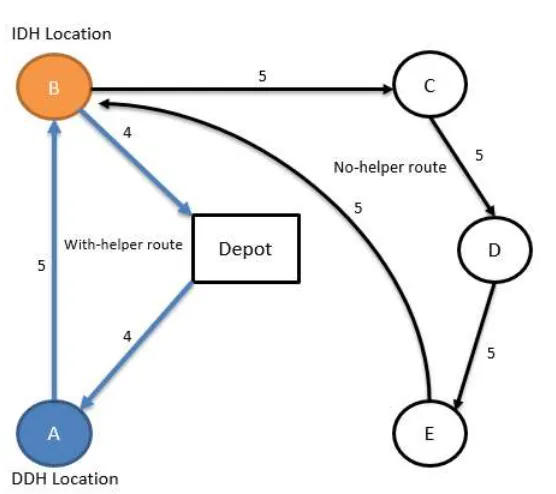
Figure 3: Example problem solved by proposed HDH model
*All figures are in minutes
In Figure 3, the proposed HDH model suggests that, first, the driver and helper go to
node A and work together there. Second, the driver drives the helper to node B and let the helper
works independently there. In the meantime, the driver begins a no-helper route and visits node
C, D, and E by themselves then goes back to pick up the helper at node B. When the driver
returns to node B, the driver needs to wait 5 minutes there, because the no-helper route takes 35
minutes of driver’s time that is 5 minutes less than the time the helper needs to finish all the
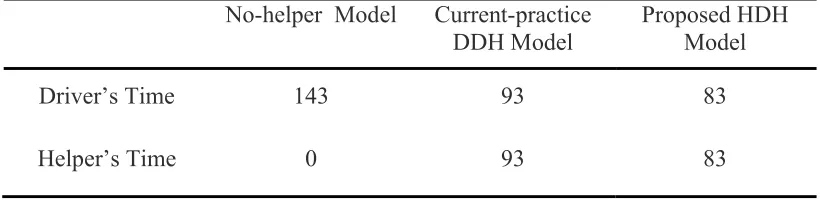
work in node B. Finally, the driver and the helper return to the depot together. In this solution,
current practices (no-helper solution and current-practice DDH solution) are compared in Table
[image:46.612.101.511.170.270.2]8.
Table 8: Comparison of the no-helper, current-practice DDH, and proposed HDH solutions
No-helper Model Current-practice
DDH Model Proposed HDH Model
Driver’s Time 143 93 83
Helper’s Time 0 93 83
Since we assume the drivers pay rate is higher than the helpers pay rate, the HDH
solution improves cost savings than both the current solutions.
Proposed model
Our proposed HDH model uses three types of decision variables. The first is the 0/1
binary variable Xij that indicates the route decisions in arc (i, j), such that Xij = 1 if the route
includes travel through arc (i, j); Xij = 0 otherwise.The second are the 0/1 binary variables and
. These variables jointly indicate whether a node on the route should be served by the helper as
a DDH or an IDH. = 1, = 0 if the helper works as a DDH at node i; = 0, =1 if the helper
works as a IDH at node i; = 0, = 0 if the helper doesn’t visit node i, where customers are
serviced by the driver only while the helper working at another node. The last is the integer
variable that indicates the arive time at each node, which does not include the service time at
node i. Variable also plays an important role in the subtour-elimination constraint. If Xij = 1,
then the arrive time at node j must equal to the summary of arrive time at node i, the work time
subtour becomes infesible in the model. The depot also has its arive time a0 that represents the
total spent time of the whole route.
If a customer node has an independent helper working there, the driver will need to go
back to node to pick up the helper after the helper finishes the work at node . The going back
action, however, confuses the time measurement . A can only has one value, which is not
able to store the second visiting time when the driver comes back for picking up the helper at the
IDH location. To fix the problem, a set of dummy customer nodes were used (node C) to
duplicate all customer nodes. In our model, if a customer node has a independent helper works
there, the driver will be forced to visit the dummy node + (instaed of node ) to pick up the
helper. Therefore, the second visiting time can be stored in ( ).
This is the notation used to describe the mathematical model.
C= {1, 2, …, c}: set of all customer nodes;
C’= {c + 1, c + 2, …, c + c}: set of all dummy customer nodes where the location
of node(c+i) is the same as the node(i);
V= {0, 1, 2, …, c, 2c+1}: set of all real nodes;
V’= {0, 1, 2, …, c, c + 1, c + 2, …, c + c ,2c+1}: set of all real and dummy nodes;
: travel distance from node i to node j;
: binary decision variable that equals 1 if the route includes a travel from node
i to node j;
: auxiliary integer variable that specifies the arrive time at node on the route;
: work time at node i if all the workload is done by either the driver or the
helper; for all dummy nodes =0 ∀ ∈ ′;
:work time at node i if all the workload is shared by the driver and the helper;
for all dummy nodes =0 ∀ ∈ ′;
: binary decision variable that equals 1 if the helper works as a dependent
helper at node ;
: binary decision variable that equals 1 if the helper works as an independent
helper at node ;
LC: combined labor cost of a driver and a helper per time unit;
VS : vehicle travel speed;
TD: total traveled distance of the vehicle;
FC : fuel cost per distance unit.
Given these, the proposed argorithem is expressed as a mixed integer linear programming
model in the following form:
FC x d LC a V j ij ij
V'
i '
0
Minimize (1)
Subject to: C i x i V j
ij
1 } '\{ (2) ' 1 } '\{ C i x i V jij
(3) ' } '\{ } '\{ V i x x i V j ij i V qqi