420
Learning Matching Models with Weak Supervision for Response Selection
in Retrieval-based Chatbots
Yu Wu†, Wei Wu‡, Zhoujun Li†∗, Ming Zhou♦ †
State Key Lab of Software Development Environment, Beihang University, Beijing, China
†Authors are supported by AdeptMind Scholarship ♦Microsoft Research, Beijing, China
‡ Microsoft Corporation, Beijing, China
{wuyu,lizj}@buaa.edu.cn{wuwei,mingzhou}@microsoft.com
Abstract
We propose a method that can leverage un-labeled data to learn a matching model for response selection in retrieval-based chat-bots. The method employs a sequence-to-sequence architecture (Seq2Seq) model as a weak annotator to judge the matching degree of unlabeled pairs, and then per-forms learning with both the weak signals and the unlabeled data. Experimental re-sults on two public data sets indicate that matching models get significant improve-ments when they are learned with the pro-posed method.
1 Introduction
Recently, more and more attention from both academia and industry is paying to building non-task-oriented chatbots that can naturally converse with humans on any open domain topics. Exist-ing approaches can be categorized into generation-based methods (Shang et al., 2015; Vinyals and Le, 2015; Serban et al., 2016; Sordoni et al.,
2015;Xing et al.,2017;Serban et al.,2017;Xing et al.,2018) which synthesize a response with nat-ural language generation techniques, and retrieval-based methods (Hu et al.,2014;Lowe et al.,2015;
Yan et al., 2016; Zhou et al., 2016; Wu et al.,
2017) which select a response from a pre-built
index. In this work, we study response
selec-tion for retrieval-based chatbots, not only because retrieval-based methods can return fluent and in-formative responses, but also because they have been successfully applied to many real products such as the social-bot XiaoIce from Microsoft (Shum et al.,2018) and the E-commerce assistant AliMe Assist from Alibaba Group (Li et al.,2017).
∗
Corresponding Author
A key step to response selection is measuring the matching degree between a response candi-date and an input which is either a single mes-sage (Hu et al.,2014) or a conversational context consisting of multiple utterances (Wu et al.,2017). While existing research focuses on how to define a matching model with neural networks, little at-tention has been paid to how to learn such a model when few labeled data are available. In practice, because human labeling is expensive and exhaust-ing, one cannot have large scale labeled data for model training. Thus, a common practice is to transform the matching problem to a classification problem with human responses as positive exam-ples and randomly sampled ones as negative ex-amples. This strategy, however, oversimplifies the learning problem, as most of the randomly sam-pled responses are either far from the semantics of the messages or the contexts, or they are false negatives which pollute the training data as noise. As a result, there often exists a significant gap be-tween the performance of a model in training and the same model in practice (Wang et al.,2015;Wu et al.,2017).1
We propose a new method that can effec-tively leverage unlabeled data for learning match-ing models. To simulate the real scenario of a retrieval-based chatbot, we construct an unlabeled data set by retrieving response candidates from an index. Then, we employ a weak annotator to provide matching signals for the unlabeled input-response pairs, and leverage the signals to super-vise the learning of matching models. The weak annotator is pre-trained from large scale human-human conversations without any annotations, and thus a Seq2Seq model becomes a natural choice. Our approach is compatible with any matching models, and falls in a teacher-student framework
1The model performs well on randomly sampled data, but
(Hinton et al., 2015) where the Seq2Seq model transfers the knowledge from human-human con-versations to the learning process of the matching models. Broadly speaking, both of (Hinton et al.,
2015) and our work let a neural network supervise the learning of another network. An advantage of our method is that it turns the hard zero-one labels in the existing learning paradigm to soft (weak) matching scores. Hence, the model can learn a large margin between a true response with a true negative example, and the semantic distance be-tween a true response and a false negative exam-ple is short. Furthermore, due to the simulation of real scenario, harder examples can been seen in the training phase that makes the model more ro-bust in the testing.
We conduct experiments on two public data sets, and experimental results on both data sets in-dicate that models learned with our method can significantly outperform their counterparts learned with the random sampling strategy.
Our contributions include: (1) proposal of a new method that can leverage unlabeled data to learn matching models for retrieval-based chatbots; and (2) empirical verification of the effectiveness of the method on public data sets.
2 Approach
2.1 The Existing Learning Approach
Given a data setD={xi,(yi,1, . . . , yi,n)}Ni=1with xia message or a conversational context andyi,ja
response candidate ofxi, we aim to learn a
match-ing modelM(·,·)fromD. Thus, for any new pair (x, y),M(x, y)measures the matching degree be-tweenxandy.
To obtain a matching model, one has to deal with two problems: (1) how to defineM(·,·); and (2) how to perform learning. Existing work fo-cuses on Problem (1) where state-of-the-art meth-ods include dual LSTM (Lowe et al.,2015), Multi-View LSTM (Zhou et al.,2016), CNN (Yan et al.,
2016), and Sequential Matching Network (Wu
et al.,2017), but adopts a simple strategy for Prob-lem (2): ∀xi, a human response is designated as
yi,1 with a label 1, and some randomly sampled responses are treated as(yi,2, . . . , yi,n)with labels
0. M(·,·)is then learned by maximizing the fol-lowing objective:
PN
i=1
Pn
j=1[ri,jlog(M(xi, yi,j)) + (1−ri,j) log(1− M(xi, yi,j))],
(1)
where ri,j ∈ {0,1} is a label. While matching
accuracy can be improved by carefully designing M(·,·)(Wu et al.,2017), the bottleneck becomes the learning approach which suffers obvious prob-lems: most of the randomly sampled yi,j are
se-mantically far fromxi which may cause an
unde-sired decision boundary at the end of optimization; someyi,j are false negatives. As hard zero-one
la-bels are adopted in Equation (1), these false neg-atives may mislead the learning algorithm. The problems remind us that besides good architec-tures of matching models, we also need a good approach to learn such models from data.
2.2 A New Learning Method
As human labeling is infeasible when training complicated neural networks, we propose a new method that can leverage unlabeled data to learn a matching model. Specifically, instead of
ran-dom sampling, we construct D by retrieving
(yi,2, . . . , yi,n) from an index (yi,1 is the human response ofxi). By this means, someyi,jare true
positives, and some are negatives but semantically close toxi. After that, we employ a weak
annota-torG(·,·)to indicate the matching degree of every (xi, yi,j) in D as weak supervision signals. Let
sij = G(xi, yi,j), then the learning approach can
be formulated as:
arg min M(·,·)
N
X
i=1
n
X
j=1
max(0,M(xi, yi,j)− M(xi, yi,1) +s0i,j),
(2) wheres0ij is a normalized weak signal defined as max(0,si,jsi,
1 −1). The normalization here elimi-nates bias from differentxi.
Objective (2) encourages a large margin be-tween the matching of an input and its human re-sponse and the matching of the input and a neg-ative response judged by G(·,·) (as will be seen later, si,jsi,
1 > 1). The learning approach simu-lates how we build a matching model in a retrieval-based chatbot: given {xi}, some response
candi-dates are first retrieved from an index. Then hu-man annotators are hired to judge the matching degree of each pair. Finally, both the data and the human labels are fed to an optimization program for model training. Here, we replace the expensive human labels with cheap judgment fromG(·,·).
conversa-tion data. The Seq2Seq model can capture the semantic correspondence between an input and a response, and then transfer the knowledge to the learning of a matching model in the optimization of (2).sij is then defined as the likelihood of
gen-eratingyi,jfromxi:
sij=
X
k
log[p(wyi,j,k,|xi, wyi,j,l<k)], (3)
wherewyi,j,k is thek-th word ofyi,jandwyi,j,l<k
is the word sequence beforewyi,j,k.
Since negative examples are retrieved by a search engine, the oversimplification problem of the negative sampling approach can be partially mitigated. We leverage a weak annotator to assign a score for each example to distinguish false neg-ative examples and true negneg-ative examples. Equa-tion (2) turns the hard zero-one labels in Equation (1) to soft matching degrees, and thus our method encourages the model to be more confident to clas-sify a response with a high si,j score as a
nega-tive one. In this way, we can avoid false neganega-tive examples and true negative examples are treated equally during training, and update the model to-ward a correct direction.
It is noteworthy that although our approach also involves an interaction between a generator and a discriminator, it is different from the GANs (Goodfellow et al., 2014) in principle. GANs try to learn a better generator via an adversarial process, while our approach aims to improve the discriminator with supervision from the genera-tor, which also differentiates it from the recent work on transferring knowledge from a discrimi-nator to a generative visual dialog model (Lu et al.,
2017). Our approach is also different from those semi-supervised approaches in the teacher-student framework (Dehghani et al.,2017a,b), as there are no labeled data in learning.
3 Experiment
We conduct experiments on two public data sets: STC data set (Wang et al.,2013) for single-turn re-sponse selection and Douban Conversation Corpus (Wu et al.,2017) for multi-turn response selection. Note that we do not test the proposed approach on Ubuntu Corpus (Lowe et al.,2015), because both training and test data in the corpus are constructed by random sampling.
3.1 Implementation Details
We implement our approach with TensorFlow. In both experiments, the same Seq2Seq model is ex-ploited which is trained with 3.3 million input-response pairs extracted from the training set of the Douban data. Each input is a concatenation of consecutive utterances in a context, and the re-sponse is the next turn ({u<i}, ui). We set the
vo-cabulary size as30,000, the hidden vector size as 1024, and the embedding size as620. Optimiza-tion is conducted with stochastic gradient descent (Bottou, 2010), and is terminated when perplex-ity on a validation set (170k pairs) does not de-crease in3consecutive epochs. In optimization of Objective (2), we initialize M(·,·) with a model trained under Objective (1) with the (random) neg-ative sampling strategy, and fix word embeddings throughout training. This can stabilize the learn-ing process. The learnlearn-ing rate is fixed as0.1.
3.2 Single-turn Response Selection
Experiment settings: in the STC (stands for Short Text Conversation) data set, the task is to select a proper response for a post in Weibo2. The train-ing set contains4.8million post-response (true re-sponse) pairs. The test set consists of 422 posts with each one associated with around30responses labeled by human annotators in “good” and “bad”. In total, there are12,402labeled pairs in the test data. Following (Wang et al., 2013, 2015), we combine the score from a matching model with TF-IDF based cosine similarity using RankSVM whose parameters are chosen by5-fold cross vali-dation. Precision at position 1 (P@1) is employed as an evaluation metric. In addition to the models compared on the data in the existing literatures, we also implement dual LSTM (Lowe et al.,2015) as a baseline. As case studies, we learn a dual LSTM and an CNN (Hu et al., 2014) with the proposed approach, and denote them as LSTM+WS (Weak Supervision) and CNN+WS, respectively. When constructingD, we build an index with the train-ing data ustrain-ing Lucene3 and retrieve 9candidates (i.e.,{yi,2, . . . , yi,n}) for each post with the inline
algorithm of the index. We form a validation set
by randomly sampling 10 thousand posts
associ-ated with the responses fromD(human response
is positive and others are treated as negative).
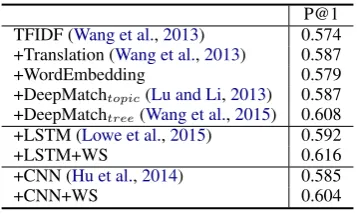
Results: Table1reports the results. We can see
2
http://weibo.sina.com
P@1 TFIDF (Wang et al.,2013) 0.574 +Translation (Wang et al.,2013) 0.587
+WordEmbedding 0.579
+DeepMatchtopic(Lu and Li,2013) 0.587
+DeepMatchtree(Wang et al.,2015) 0.608
+LSTM (Lowe et al.,2015) 0.592
+LSTM+WS 0.616
+CNN (Hu et al.,2014) 0.585
[image:4.595.91.270.61.168.2]+CNN+WS 0.604
Table 1: Results on STC
that CNN and LSTM consistently get improved when learned with the proposed approach, and the improvements over the models learned with random sampling are statistically significant (t-test with p-value < 0.01). LSTM+WS even sur-passes the best performing model, DeepMatchtree,
reported on this data. These results indicate
the usefulness of the proposed approach in prac-tice. One can expect improvements to models like DeepMatchtreewith the new learning method. We
leave the verification as future work.
3.3 Multi-turn Response Selection
Experiment settings: Douban Conversation Cor-pus contains0.5million context-response (true re-sponse) pairs for training and 1000 contexts for test. In the test set, every context has 10 re-sponse candidates, and each of the rere-sponse has a label “good” or “bad” judged by human
anno-tators. Mean average precision (MAP) (
Baeza-Yates et al., 1999), mean reciprocal rank (MRR) (Voorhees, 1999), and precision at position 1 (P@1) are employed as evaluation metrics. We copy the numbers reported in (Wu et al.,2017) for the baseline models, and learn LSTM, Multi-View, and SMN with the proposed approach. We build an index with the training data, and retrieve9 can-didates with the method in (Wu et al., 2017) for
each context when constructing D. 10 thousand
pairs are sampled fromDas a validation set.
Results: Table 2 reports the results. Consis-tent with the results on the STC data, every model (+WS one) gets improved with the new learning approach, and the improvements are statistically significant (t-test withp-value<0.01).
3.4 Discussion
Ablation studies: we first replace the weak su-pervisions0i,jin Equation (2) with a constant se-lected from{0.1,0.2, . . . ,0.9}on validation, and denote the models as model+const. Then, we keep
MAP MRR P@1
TFIDF 0.331 0.359 0.180
RNN 0.390 0.422 0.208
CNN 0.417 0.440 0.226
BiLSTM 0.479 0.514 0.313
DL2R (Yan et al.,2016) 0.488 0.527 0.330 LSTM (Lowe et al.,2015) 0.485 0.527 0.320
LSTM+WS 0.519 0.559 0.359
Multi-View (Zhou et al.,2016) 0.505 0.543 0.342
Multi-View+WS 0.534 0.575 0.378
SMN (Wu et al.,2017) 0.526 0.571 0.393
SMN+WS 0.565 0.609 0.421
Table 2: Results on Douban Conversation Corpus
STC Douban
P@1 MAP MRR P@1
CNN+WSrand 0.590 - -
-CNN+const 0.598 - -
-CNN+WS 0.604 - -
-LSTM+WSrand 0.598 0.501 0.532 0.323
LSTM+const 0.607 0.510 0.545 0.331
LSTM+WS 0.616 0.519 0.559 0.359
Multi-View+WSrand - 0.515 0.549 0.357 Multi-View+const - 0.528 0.564 0.370
Multi-View+WS - 0.534 0.575 0.378
SMN+WSrand - 0.536 0.574 0.377
SMN+const - 0.558 0.603 0.417
[image:4.595.305.531.62.186.2]SMN+WS - 0.565 0.609 0.421
Table 3: Ablation results.
everything the same as our approach but replace Dwith a set constructed by random sampling,
de-noted as model+WSrand. Table3 reports the
re-sults. We can conclude that both the weak su-pervision and the strategy of training data con-struction are important to the success of the pro-posed learning approach. Training data construc-tion plays a more crucial role, because it involves more true positives and negatives with different se-mantic distances to the positives into learning.
Does updating the Seq2Seq model help? It is well known that Seq2Seq models suffer from the “safe response” (Li et al., 2016a) problem, which may bias the weak supervision signals to high-frequency responses. Therefore, we attempt to iteratively optimize the Seq2Seq model and the matching model and check if the matching model can be further improved. Specifically, we update
the Seq2Seq model every 20 mini-batches with
[image:4.595.307.526.224.369.2]im-prove the Seq2Seq model with a policy gradient based method; and (2) eliminating “safe response” for Seq2Seq model cannot help a matching model to learn a better decision boundary.
How the number of response candidates af-fects learning: we vary the number of {yi,j}nj=1 in D in {2,5,10,20} and study how the
hyper-parameter influences learning. We study with
LSTM on the STC data and SMN on the Douban data. Table4reports the results. We can see that as the number of candidates increases, the perfor-mance of the the learned models becomes better.
Even with2candidates (one from human and the
other from retrieval), our approach can still im-prove the peformance of matching models.
LSTM2 LSTM5 LSTM10 LSTM20
P@1 0.603 0.608 0.615 0.616
SMN2 SMN5 SMN10 SMN20
MAP 0.542 0.556 0.565 0.567
MRR 0.588 0.594 0.609 0.609
P@1 0.408 0.412 0.421 0.423
Table 4: The effect of instance number
4 Conclusion and Future Work
Previous studies focus on architecture design for retrieval-based chatbots, but neglect the problems brought by random negative sampling in the learn-ing process. In this paper, we propose leveraglearn-ing a Seq2Seq model as a weak annotator on unlabeled data to learn a matching model for response selec-tion. By this means, we can mine hard instances for matching model and give them scores with a weak annotator. Experimental results on public data sets verify the effectiveness of the new learn-ing approach. In the future, we will investigate how to remove bias from the weak supervisors, and further improve the matching model perfor-mance with a semi-supervised approach.
Acknowledgment
Yu Wu is supported by Microsoft Fellow-ship ScholarFellow-ship and AdeptMind ScholarFellow-ship. This work is supported by the National
Nat-ural Science Foundation of China (Grand
Nos. 61672081,U1636211,61370126),
Bei-jing Advanced Innovation Center for Imaging Technology (No.BAICIT-2016001).
References
Ricardo Baeza-Yates, Berthier Ribeiro-Neto, et al. 1999. Modern information retrieval, volume 463. ACM press New York.
Dzmitry Bahdanau, Kyunghyun Cho, and Yoshua Ben-gio. 2015. Neural machine translation by jointly learning to align and translate. ICLR.
L´eon Bottou. 2010. Large-scale machine learning with stochastic gradient descent. InProceedings of COMPSTAT’2010, Springer, pages 177–186.
Mostafa Dehghani, Arash Mehrjou, Stephan Gouws, Jaap Kamps, and Bernhard Sch¨olkopf. 2017a. Fidelity-weighted learning. arXiv preprint arXiv:1711.02799.
Mostafa Dehghani, Aliaksei Severyn, Sascha Rothe, and Jaap Kamps. 2017b. Avoiding your teacher’s mistakes: Training neural networks with controlled weak supervision.arXiv preprint arXiv:1711.00313 .
Ian Goodfellow, Jean Pouget-Abadie, Mehdi Mirza, Bing Xu, David Warde-Farley, Sherjil Ozair, Aaron Courville, and Yoshua Bengio. 2014. Generative ad-versarial nets. In Advances in neural information processing systems. pages 2672–2680.
Geoffrey Hinton, Oriol Vinyals, and Jeff Dean. 2015. Distilling the knowledge in a neural network. arXiv preprint arXiv:1503.02531.
Baotian Hu, Zhengdong Lu, Hang Li, and Qingcai Chen. 2014. Convolutional neural network archi-tectures for matching natural language sentences. InAdvances in Neural Information Processing Sys-tems. pages 2042–2050.
Feng-Lin Li, Minghui Qiu, Haiqing Chen, Xiong-wei Wang, Xing Gao, Jun Huang, JuXiong-wei Ren, Zhongzhou Zhao, Weipeng Zhao, Lei Wang, et al. 2017. Alime assist: An intelligent assistant for cre-ating an innovative e-commerce experience. In Pro-ceedings of the 2017 ACM on Conference on Infor-mation and Knowledge Management. ACM, pages 2495–2498.
Jiwei Li, Michel Galley, Chris Brockett, Jianfeng Gao, and Bill Dolan. 2016a. A diversity-promoting ob-jective function for neural conversation models. In NAACL HLT 2016, The 2016 Conference of the North American Chapter of the Association for Computational Linguistics: Human Language Tech-nologies, San Diego California, USA, June 12-17, 2016. pages 110–119.
Ryan Lowe, Nissan Pow, Iulian Serban, and Joelle Pineau. 2015. The ubuntu dialogue corpus: A large dataset for research in unstructured multi-turn dia-logue systems. SIGDIAL.
Jiasen Lu, Anitha Kannan, Jianwei Yang, Devi Parikh, and Dhruv Batra. 2017. Best of both worlds: Trans-ferring knowledge from discriminative learning to a generative visual dialog model. InAdvances in Neu-ral Information Processing Systems. pages 313–323.
Zhengdong Lu and Hang Li. 2013. A deep architec-ture for matching short texts. InAdvances in Neural Information Processing Systems. pages 1367–1375.
Iulian Vlad Serban, Alessandro Sordoni, Yoshua Ben-gio, Aaron C. Courville, and Joelle Pineau. 2016. End-to-end dialogue systems using generative hier-archical neural network models. InProceedings of the Thirtieth AAAI Conference on Artificial Intel-ligence, February 12-17, 2016, Phoenix, Arizona, USA.. pages 3776–3784.
Iulian Vlad Serban, Alessandro Sordoni, Ryan Lowe, Laurent Charlin, Joelle Pineau, Aaron C Courville, and Yoshua Bengio. 2017. A hierarchical latent variable encoder-decoder model for generating di-alogues. InAAAI. pages 3295–3301.
Lifeng Shang, Zhengdong Lu, and Hang Li. 2015. Neural responding machine for short-text conversa-tion. InACL 2015, July 26-31, 2015, Beijing, China, Volume 1: Long Papers. pages 1577–1586.
Heung-Yeung Shum, Xiaodong He, and Di Li. 2018. From eliza to xiaoice: Challenges and oppor-tunities with social chatbots. arXiv preprint arXiv:1801.01957.
Alessandro Sordoni, Michel Galley, Michael Auli, Chris Brockett, Yangfeng Ji, Margaret Mitchell, Jian-Yun Nie, Jianfeng Gao, and Bill Dolan. 2015. A neural network approach to context-sensitive gen-eration of conversational responses. InNAACL HLT 2015, The 2015 Conference of the North American Chapter of the Association for Computational Lin-guistics: Human Language Technologies, Denver, Colorado, USA, May 31 - June 5, 2015. pages 196– 205.
Oriol Vinyals and Quoc Le. 2015. A neural conversa-tional model. arXiv preprint arXiv:1506.05869.
Ellen M. Voorhees. 1999. The TREC-8 question an-swering track report. InProceedings of The Eighth Text REtrieval Conference, TREC 1999, Gaithers-burg, Maryland, USA, November 17-19, 1999.
Hao Wang, Zhengdong Lu, Hang Li, and Enhong Chen. 2013. A dataset for research on short-text conversations. InProceedings of the 2013 Confer-ence on Empirical Methods in Natural Language Processing, EMNLP 2013, 18-21 October 2013, Grand Hyatt Seattle, Seattle, Washington, USA, A meeting of SIGDAT, a Special Interest Group of the ACL. pages 935–945.
Mingxuan Wang, Zhengdong Lu, Hang Li, and Qun Liu. 2015. Syntax-based deep matching of short texts. InTwenty-Fourth International Joint Confer-ence on Artificial IntelligConfer-ence.
Yu Wu, Wei Wu, Chen Xing, Ming Zhou, and Zhou-jun Li. 2017. Sequential matching network: A new architecture for multi-turn response selection in retrieval-based chatbots. In Proceedings of the 55th Annual Meeting of the Association for Compu-tational Linguistics (Volume 1: Long Papers). vol-ume 1, pages 496–505.
Chen Xing, Wei Wu, Yu Wu, Jie Liu, Yalou Huang, Ming Zhou, and Wei-Ying Ma. 2017. Topic aware neural response generation. In AAAI 2017. pages 3351–3357.
Chen Xing, Wei Wu, Yu Wu, Ming Zhou, Yalou Huang, and Wei-Ying Ma. 2018. Hierarchical recurrent at-tention network for response generation. AAAI-18 .
Rui Yan, Yiping Song, and Hua Wu. 2016. Learning to respond with deep neural networks for retrieval-based human-computer conversation system. In Proceedings of the 39th International ACM SIGIR conference on Research and Development in Infor-mation Retrieval, SIGIR 2016, Pisa, Italy, July 17-21, 2016. pages 55–64.