Proceedings of the 2019 Conference on Empirical Methods in Natural Language Processing 111
Multi-hop Selector Network for Multi-turn Response Selection in
Retrieval-based Chatbots
Chunyuan Yuan1,2,†, Shangwen Lv1,2,†, Mingming Li1,2, Wei Zhou1,2,*, Fuqing Zhu2, Jizhong Han2 and Songlin Hu1,2
1School of Cyber Security, University of Chinese Academy of Sciences
2Institute of Information Engineering, Chinese Academy of Sciences
{yuanchunyuan, lvshangwen, limingming, zhouwei, zhufuqing, hanjizhong, husonglin}@iie.ac.cn
Abstract
Multi-turn retrieval-based conversation is an important task for building intelligent dialogue systems. Existing works mainly focus on matching candidate responses with every con-text utterance on multiple levels of granularity, which ignore the side effect of using excessive context information. Context utterances pro-vide abundant information for extracting more matching features, but it also brings noise sig-nals and unnecessary information.
In this paper, we will analyze the side effect of using too many context utterances and pro-pose a multi-hop selector network (MSN) to al-leviate the problem. Specifically, MSN firstly utilizes a multi-hop selector to select the rel-evant utterances as context. Then, the model matches the filtered context with the candidate response and obtains a matching score. Ex-perimental results show that MSN outperforms some state-of-the-art methods on three public multi-turn dialogue datasets.
1 Introduction
Building a dialogue system that can naturally and consistently converse with humans has drawn in-creasing research interests in past years. Ex-isting works on building dialogue systems in-clude generation-based and retrieval-based meth-ods. Compared with generation-based methods, retrieval-based methods have advantages in provid-ing fluent and informative responses. Many indus-trial products have applied retrieval-based dialogue system, e.g., the E-commerce assistant AliMe As-sist from Alibaba Group (Li et al.,2017) and the XiaoIce (Shum et al.,2018) from Microsoft.
Early studies (Tan et al.,2015;Yan et al.,2016;
Wan et al.,2016) of retrieval-based dialogue system
†Equally contributed. * Corresponding author.
focus on response selection for single-turn conver-sation. Recently, researchers have begun to pay attention to the multi-turn conversation, aiming at selecting the most related response from a set of candidates given the context utterances of a con-versation. Some effective models, such as Sequen-tial Matching Network (SMN) (Wu et al.,2017), Deep Attention Matching network (DAM) (Zhou et al., 2018c), Multi-Representation Fusion Net-work (MFRN) (Tao et al., 2019), have been pro-posed to capture the matching features on multiple levels of granularity (words, phrases, sentences, etc.) and short-term and long-term dependencies among words.
[image:1.595.309.530.586.689.2]Previous works have shown that utilizing multi-turn utterances can further improve the matching performance than only using single-turn utterance (i.e., last utterance). But context utterance is a “double-edged sword”, it also provides a lot of noise while providing abundant information, which would influence the performance due to the sensi-tivity of these matching-based methods.
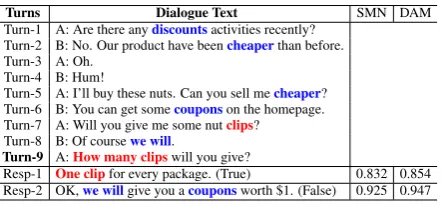
Table 1: An error case of SMN (Wu et al., 2017), DAM (Zhou et al.,2018c) from E-commerce Corpus. The scores in the table are matching scores predicted by the models.
Turns Dialogue Text SMN DAM
Turn-1 A: Are there anydiscountsactivities recently? Turn-2 B: No. Our product have beencheaperthan before. Turn-3 A: Oh.
Turn-4 B: Hum!
Turn-5 A: I’ll buy these nuts. Can you sell mecheaper? Turn-6 B: You can get somecouponson the homepage. Turn-7 A: Will you give me some nutclips? Turn-8 B: Of coursewe will.
Turn-9 A:How many clipswill you give?
Resp-1 One clipfor every package. (True) 0.832 0.854 Resp-2 OK,we willgive you acouponsworth $1. (False) 0.925 0.947
To illustrate the problem, we show an error case of SMN (Wu et al.,2017) and DAM (Zhou et al.,
mod-els still choose “Resp-2”. Because it has more words overlap with context utterances, thus accu-mulating a larger similarity score. We can easily observe that “Resp-2” is relevant to former utter-ances (Turn-1 to Turn-6), but the topic has changed after “Turn-6”. Besides, we can see that “Turn-3” and “Turn-4” do not provide any useful informa-tion for selecting candidate response. From this example, irrelevant context utterances may cause the models making simple mistakes that humans would not make. Furthermore, we conduct several adversarial experiments and the results show that these matching-based models are very sensitive to the adversarial samples.
In this paper, we propose a multi-hop selector network to tackle the above problem. Intuitively, the closer the utterance to the response is, the more it reflects the intention of the last dialogue session. Thus, we firstly use the last utterance as key to select context utterances that are relevant to it on the word and sentence level. However, we find that there are many samples whose last utterance is very short and contains very limited information (such as “good”, “ok”), which will cause the selec-tors to lose too much useful context information. Therefore, we propose multi-hop selectors to select more relevant context utterances, yieldingk differ-ent context. Then, we fuse these selected context utterances and match it with candidate response. During the matching stage, the convolution neural network (CNN) is applied to extract matching fea-tures and the gated recurrent unit (GRU) is applied to learn the temporal relationship of utterances.
The contributions of this paper are summarized as follows:
• We find the noises in context utterances could influence the matching performance and de-sign adversarial experiments to verify it.
• We propose a unified network MSN to select relevant context utterances from word and ut-terance level and fuse the selected context to generate a better context representation.
• Experimental results on three public datasets achieve significant improvement, which shows the effectiveness of MSN.
The outline of the paper is as follows. Section2
introduces related works. Section3describes adver-sarial experiment to check how sensitivity of pre-vious models to the context utterances. Section4
describes every component of MSN model. Sec-tion5discusses the experiments and corresponding results. Section6discusses some experiments to explore the influence of hyparameters on per-formance. We conclude our work in Section7.
2 Related Work
With the development of natural language process-ing, building intelligent chatbots with data-driven approaches has drawn increasing attention in recent years. Existing works can be generally categorized into retrieval-based methods (Wan et al.,2016;Wu et al.,2017;Zhang et al.,2018;Tao et al.,2019) and generation-based methods (Shang et al.,2015;
Serban et al., 2016;Xing et al., 2017;Wu et al.,
2018;Zhou et al.,2018a,b). In this work, we focus on retrieval-based method and study context-based response selection.
Early retrieval-based chatbots are devoted to response selection for single-turn conversa-tion (Wang et al.,2013;Tan et al.,2015;Yan et al.,
2016). Recently, researchers have begun to turn to the multi-turn conversation.Lowe et al.(2015) use RNN to read context and response, use the last hidden states to represent context and response as two semantic vectors to measure their relevance.
Zhou et al.(2016) perform context-response match-ing with a multi-view model on both word and utterance levels. Considering concatenating utter-ances in context may lose relationships among ut-terances or important contextual information,Wu et al.(2017) separately match the response with each utterance based on a convolutional neural net-work. This paradigm is applied in many subsequent works.Zhou et al.(2018c) consider the dependency relation among utterances based on the attention mechanism.Tao et al.(2019) fuse words, n-grams, and sub-sequences of utterances representations and capture both short-term and long-term depen-dencies among words.
Different from previous works, (i) we study the influence of using excessive context utterances, (ii) we explore how to filter out irrelevant context to improve the robustness of matching-based meth-ods.
3 Adversarial experiments
To study how sensitive of the previous models (Wu et al.,2017;Zhang et al.,2018;Zhou et al.,2018c;
1 n
u
n
u
r
Representation Utterance-Response Matching Aggregation
Input 1
u
Attentive Module
Hop1 Selector
Attentive Module
Hop2 Selector
Hopk Selector
Context Fusion
Attentive Module
…
…
…
…
…
key context
key
GRU
L < Word
Embedding
context
[image:3.595.78.520.63.304.2]CNN + Max pooling
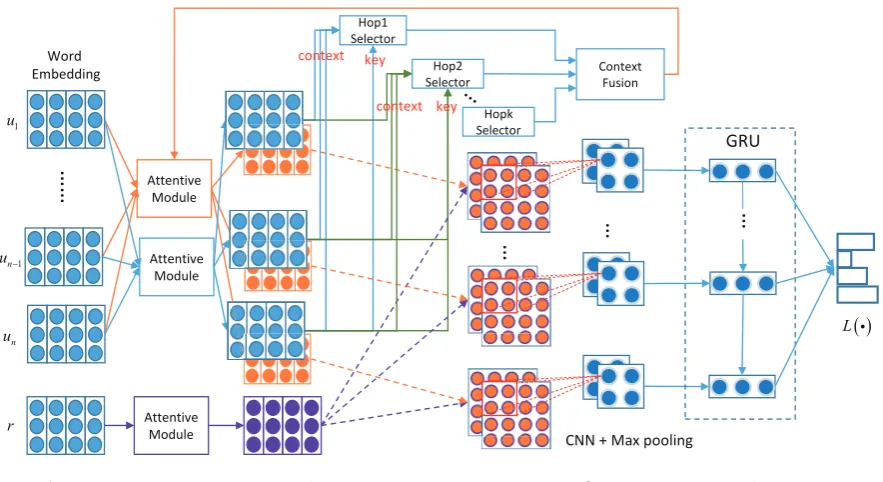
Figure 1: Architecture of multi-hop selector network.
by (Jia and Liang,2017). We keep the training set unchanged and add some noises to the original test set. To be specific, we randomly sample 1∼3 words from context utterances and append them on every candidate response. In this way, we can obtain 3 different adversarial test sets: adversarial set1, adversarial set2, adversarial set3.
Then, we evaluate the models again to see how much will the performance change. To ensure the fairness of the experiments, we use the results from their papers for the original test set. Moreover, we use their open source code for adversarial ex-periments. We employ recall at position k in n candidates (Rn@k) as the evaluation metric, which is the same as previous works.
Table 2: Adversarial experimental results on Ubuntu Dialogue Corpus. The results of SMN (Wu et al., 2017), DUA (Zhang et al.,2018), DAM (Zhou et al., 2018c), MFRN (Tao et al., 2019) on original test set are cited from their papers.
Models
original test set adversarial set1 adversarial set2 adversarial set3
R10@1R10@2R10@1R10@2R10@1R10@2R10@1R10@2 SMN 72.6 84.7 66.2 82.1 63.8 79.4 57.1 75.0 DUA 75.2 86.8 64.0 80.4 58.0 75.6 52.7 70.8 DAM 76.7 87.4 67.5 82.3 61.2 76.8 54.3 71.6 MRFN 78.6 88.6 65.4 81.7 65.1 76.4 58.2 72.3
MSN 80.0 89.9 70.7 84.6 66.2 81.4 64.6 79.9
The experimental results are shown in Table2. From the table, we can observe that the one-word noise will bring about 7% ∼ 13% absolute
de-crease onR10@1and the three-word noise brings
about 20%R10@1decrease. Thus, we can see that
matching-based models (Wu et al.,2017;Zhang et al.,2018;Zhou et al.,2018c;Tao et al.,2019) are very sensitive to small noises of the dataset. More-over, using too many context utterances will greatly increase the probability of introducing noise. The results of MSN also show that filtering irrelevant ut-terances can effectively alleviate this problem and improve the robustness of matching-based models.
4 Model
4.1 Problem Formalization
Suppose that we have a data set D = {Ui, ri, yi}Ni=1, where Ui = {ui1, ui2, . . . , uiL} represents a conversation context withLutterances and every utteranceuij containsT words. riis a response candidate andyi ∈ {0,1} denotes a la-bel. yi = 1meansri is a proper response forUi, otherwiseyi= 0. Our goal is to learn a matching model g(·,·) with D. For any context-response pair(Ui, ri),g(Ui, ri)measures the matching de-gree betweenUiandri.
To this end, we need to address two problems: (1) how to select proper context utterances from
4.2 Model Overview
We propose a multi-hop selector network (MSN) to model g(·,·). Figure 1 gives the architec-ture, which generally follows the representation-matching-aggregation framework (Wu et al.,2017;
Zhang et al.,2018;Zhou et al.,2018c;Tao et al.,
2019) to match response with multi-turn context. Different from previous works, we add a selec-tion process before the above framework. MSN first constructs semantic representations at word level by an Attentive Module. Then, each utterance are packed as context or key and sent to the “Hopk Selector” to calculate relevance scores. The scores ofkdifferent selectors are fused together by a Con-text Fusion module. Finally, the fused scores are performed over original context utterances to filter out irrelevant context. The rest context utterances are applied for response matching.
4.3 Attentive Module
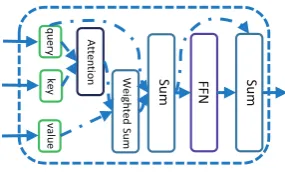
We use the Attentive Module to learn the context in-formation for word representation. Attentive Mod-ule is proposed in DAM (Zhou et al.,2018c) and it is a variant of Multi-head Attention (Vaswani et al.,
2017). Figure2shows its structure.
q
u
e
ry
k
e
y
v
a
lu
e
S
u
m
S
u
m FFN
A
tt
e
n
tio
n W
e
ig
h
te
d
S
u
[image:4.595.109.252.423.510.2]m
Figure 2: Architecture of Attentive Module.
The AttentiveModule(Q, K, V) has three
input sentences: the query sentence, the key sen-tence and the value sensen-tence, namelyQ∈Rnq×d,
K ∈Rnk×d, andV ∈Rnv×drespectively, where
nq,nk, andnvdenote the number of words in each sentence, anddis the dimension of the embedding.
The Attentive Module first takes each word in the query sentence to attend to words in the key sen-tence via Scaled Dot-Product Attention (Vaswani et al., 2017), and then applies those attention weights upon the value sentence:
Vatt=sof tmax
QKT
√
d
V . (1)
Then, a feed-forward network (FFN) with RELU (LeCun et al., 2015) activation is applied
upon the normalization result, to further process the fused embeddings:
FFN(x) = max(0, xW1+b1)W2+b2, (2)
wherexis a 2D matrix in the same shape of query sentenceQandW1,b1,W2,b2are learnt
parame-ters. The resultFFN(x)is a 2D matrix that has the same shape asx,FFN(x) is then residually added tox, and the fusion result is then normalized as the final outputs.
4.4 Context Selector
Given Ui = [ui1, . . . ,uij, . . . ,uiL], the word-level embedding representations for utterance
uij ∈ RT×d, where dis the dimension of word vector, we use the Attentive Module to reconstruct the word representations of each utterance to en-code the context and dependency information into word, which is formulated as:
u0ij =AttentiveModule(uij,uij,uij), (3)
whereu0ij ∈ RT×d. U0
i = [u0i1,u0i2, . . . ,u0iL] ∈
RL×T×d.
We first discuss how to construct “Hop1 Selec-tor”, which consists of word and utterance selector. To capture matching features at multiple levels of granularity, we leverage word and utterance level matching features to select relevant context.
4.4.1 Word Selector
At word level, we utilize cross attention to obtain a matching feature map for each context utterance
u0ij and keyK1 =u0iL, which is formulated as:
A=vTtanh(K1TWU0i+b), (4)
whereW ∈Rd×d×h,b∈Rhandv∈Rh×1. And we get a word alignment matrixA∈RL×T×T.
Then, we extract the most prominent matching features fromAby max pooling over row and col-umn. Then, they are concatenated together:
m1(K1,U0i) = [max
dim=2A;dimmax=3A], (5)
wherem1(K1,Ui0)∈RL×2T, which reflects which words have identical or similar meaning between utterancesuij and keyuiL. The matching features are transformed to the relevance score by a linear layer:
wherec∈R2T×1andb∈
RL×1.
The word selector can only capture word-level relevance between key and utterances. It can not reflect whether key and context are compatible on the overall semantic level. Thus, we continue to evaluate the relevance on the utterance level.
4.4.2 Utterance Selector
Firstly, the word-level representationsU0iare trans-formed to utterance-level representations by mean pooling over word dimension:
e
Ui=mean(U0i), (7)
whereUei ∈RL×d.
We use cosine similarity to measure the rele-vance between keyK2 = UeiL and context
utter-ancesUei, which is formulated as:
s2 =
e
UiKT2
||Uei||2kK2k2
, (8)
wheres2 ∈ RL×1 is the relevance score at utter-ance level.
Both the scores of word selector and utterance selector are important to measure the relevance of last utterance and context. In order to make full use of word and utterance selectors, we design a com-bined strategy to fuse two scores. Specifically, we use the weighted sum of two scores for selection:
s(1)=α∗s1+ (1−α)∗s2, (9)
where α is a hyper-parameter and s(1) is the fi-nal score that hop1 selector produces. The default value ofαis set to 0.5.
4.4.3 Hopk Selector
Although “Hop1 Selector” can choose proper con-text utterances that are related to the last dialogue session, we find that there are many samples whose last utterance contains very little information (such as “good”, “ok”), which will cause the selector lose too much useful context information. Thus, we combine it with eui,L−1, eui,L−2, ..., uei,L−k
by mean pooling. Then, we treat them as key to conduct the same process as “Hop1 Selector” for context selection. In this way, we can get
k different selectors, yielding k different scores
S= [s(1),s(2), . . . ,s(k)]∈RL×k.
4.5 Context Fusion
Then we fuse the similarity scores from different selectors and apply it to select relevant context utterances for matching.
Firstly, we combine the similarity scores S ∈
RL×kto form the final scores for each context ut-terances and filter out irrelevant context, which is formulated as:
s0 =SWT,
es=s
0
(sigmoid(s0)≥γ), (10)
whereW ∈R1×kis a dynamic weight vector and will be tuned by the gradient.γis the threshold and will be tuned according to the dataset. The default value ofγ can be set to 0.5. The utterances whose scores are belowγwill be allocated lower weights or filtered out.
Then, we multiply the mask weightesand context utterances to filter irrelevant context:
ˆ
Ui =esUi, (11)
and generateUˆi ∈RL×T×d, whereUi∈RL×T×d is the original utterances tensor.
4.6 Utterance-Response Matching
Similar to DAM (Zhou et al., 2018c), we utilize the self and cross matching paradigm to construct better matching feature maps.
4.6.1 Origin Matching
Given the filtered utterances Uˆi =
[uˆi1, . . . ,ˆuij, . . . ,uˆiL] and candidate response
ri ∈ RT×d, they are then used to construct a word-word similarity matrixM1 ∈RL×2×T×T by dot product and cosine similarity. Both of them are stacked together as the channel dimension. The process can be formulated as:
M1 = [UˆiA1rTi ;cos(Uˆi,ri)]. (12)
whereA1 ∈ Rd×dis a linear transformation ma-trix.
4.6.2 Self Matching
Then, we use the Attentive Module over word di-mension to construct multi-grained representations, which is formulated as:
ˆ
Uselfi =AttentiveModule(Uˆi,Uˆi,Uˆi),
rselfi =AttentiveModule(ri,ri,ri).
(13)
combine more and more overall characterizations. Different from DAM (Zhou et al.,2018c), we do not stack many Attentive Module layers because it will drastically increase the computational expense.
Then, we use them to construct M2 ∈
RL×2×T×T, whose element is
M2 = [Uˆselfi A2(rselfi )T;cos(Uˆselfi ,rselfi )],
(14)
whereA2 ∈ Rd×dis a linear transformation ma-trix.
4.6.3 Cross Matching
Similarly, we build the semantic association be-tween every utterance and response by the attentive module:
ˆ
Ucrossi =AttentiveModule(Uˆi,ri,ri),
ricross=AttentiveModule(ri,Uˆi,Uˆi).
(15)
In this way, we can make the inter-dependent seg-ment pairs close to each other, and aliseg-ment scores between those latently inter-dependent pairs could get increased, which will better encode the depen-dency relation into representation.
Finally, we use Uˆcrossi andrcrossi to construct
M3 ∈RL×2×T×T, whose element is
M3= [Uˆcrossi A3(rcrossi )T;cos(Uˆcrossi ,rcrossi )], (16)
whereA3∈Rd×dis a linear transformation.
4.7 Aggregation
MSN aggregates all the matching matrices together
M = [M1;M2;M3] ∈ RL×6×T×T and applies 2D CNN and max pooling for matching feature extraction and use GRU to model the temporal relationship of utterances in the context, which is the same as SMN (Wu et al.,2017).
Then we compute matching score g(Ui, ri) based on the matching features. Specifically, we use the final state of GRU outputhLas features and apply a single-layer perceptron to obtain score:
g(Ui, ri) =σ(WhL+b), (17)
whereWandbare learnt parameters,σ(·)is sig-moid activation function.
Finally, the negative log-likelihood is used as a loss function to optimize the training process.
5 Experiment
5.1 Dataset
We test MSN on three widely used multi-turn response selection datasets, the Ubuntu Cor-pus (Lowe et al.,2015), the Douban Corpus (Wu et al.,2017) and the E-commerce Corpus (Zhang et al.,2018). Data statistics are in Table3.
Table 3: Data statistics for Ubuntu, Douban and E-commerce datasets.
Models
Ubuntu Douban E-commerce
Train Val Test Train Val Test Train Val Test #context-response pairs 1M 500K 500K 1M 50K 50K 1M 10K 10K #candidates per context 2 10 10 2 2 10 2 2 10 Avg #turns per context 10.13 10.11 10.11 6.69 6.75 6.45 5.51 5.48 5.64 Avg #words per utterance 11.35 11.34 11.37 18.56 18.50 20.74 7.02 6.99 7.11
Ubuntu Corpusconsists of English multi-turn conversations about technical support collected from chat logs of the Ubuntu forum.
Douban Corpuscontains dyadic dialogs (con-versation between two persons) longer than 2 turns from the Douban group1which is a popular social networking service in China.
E-commerce Corpus is collected from real-world conversations between customers and cus-tomer service staff from Taobao2, the largest e-commerce platform in China. The dataset contains diverse types of conversations (e.g. commodity consultation, logistics express, recommendation, and chitchat) concerning various commodities.
5.2 Evaluation Metric
Following the previous works (Wu et al., 2017;
Zhang et al., 2018;Chaudhuri et al., 2018; Tao et al.,2019), we employ recall at position k in n can-didates (Rn@k) as evaluation metrics. Apart from
Rn@k, we use MAP (Mean Average Precision), MRR (Mean Reciprocal Rank), and Precision-at-one P@1 especially for Douban corpus, which is the same as previous works (Wu et al.,2017;Tao et al.,2019). For some dialogues in Douban corpus have more than one true candidate response.
5.3 Baseline Models
Single-turn matching models: Basic models in (Lowe et al.,2015;Kadlec et al.,2015) includ-ing RNN, CNN are used in early works. Some advanced single-turn matching models, such as DL2R (Yan et al.,2016), Atten-LSTM (Tan et al.,
1
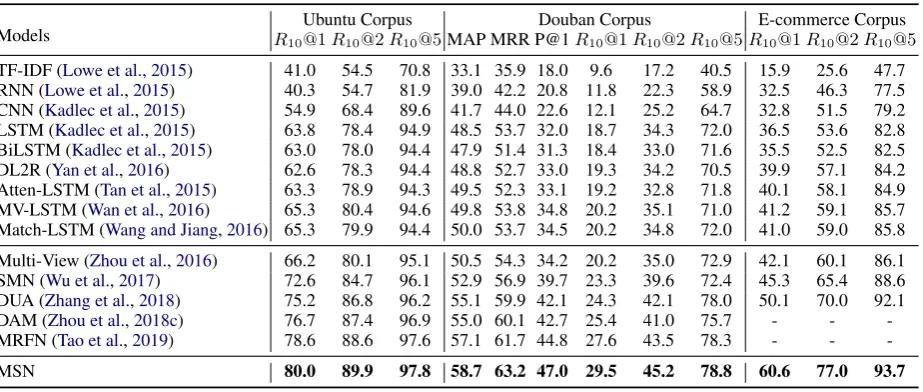
Table 4: Experimental results on Ubuntu, Douban and E-commerce datasets. MRFN is the state-of-the-art model until this submission.
Models R10Ubuntu Corpus@1R10@2R10@5MAP MRR P@1Douban CorpusR10@1R10@2R10@5RE-commerce Corpus10@1R10@2R10@5
TF-IDF (Lowe et al.,2015) 41.0 54.5 70.8 33.1 35.9 18.0 9.6 17.2 40.5 15.9 25.6 47.7 RNN (Lowe et al.,2015) 40.3 54.7 81.9 39.0 42.2 20.8 11.8 22.3 58.9 32.5 46.3 77.5 CNN (Kadlec et al.,2015) 54.9 68.4 89.6 41.7 44.0 22.6 12.1 25.2 64.7 32.8 51.5 79.2 LSTM (Kadlec et al.,2015) 63.8 78.4 94.9 48.5 53.7 32.0 18.7 34.3 72.0 36.5 53.6 82.8 BiLSTM (Kadlec et al.,2015) 63.0 78.0 94.4 47.9 51.4 31.3 18.4 33.0 71.6 35.5 52.5 82.5 DL2R (Yan et al.,2016) 62.6 78.3 94.4 48.8 52.7 33.0 19.3 34.2 70.5 39.9 57.1 84.2 Atten-LSTM (Tan et al.,2015) 63.3 78.9 94.3 49.5 52.3 33.1 19.2 32.8 71.8 40.1 58.1 84.9 MV-LSTM (Wan et al.,2016) 65.3 80.4 94.6 49.8 53.8 34.8 20.2 35.1 71.0 41.2 59.1 85.7 Match-LSTM (Wang and Jiang,2016) 65.3 79.9 94.4 50.0 53.7 34.5 20.2 34.8 72.0 41.0 59.0 85.8
Multi-View (Zhou et al.,2016) 66.2 80.1 95.1 50.5 54.3 34.2 20.2 35.0 72.9 42.1 60.1 86.1 SMN (Wu et al.,2017) 72.6 84.7 96.1 52.9 56.9 39.7 23.3 39.6 72.4 45.3 65.4 88.6 DUA (Zhang et al.,2018) 75.2 86.8 96.2 55.1 59.9 42.1 24.3 42.1 78.0 50.1 70.0 92.1 DAM (Zhou et al.,2018c) 76.7 87.4 96.9 55.0 60.1 42.7 25.4 41.0 75.7 - - -MRFN (Tao et al.,2019) 78.6 88.6 97.6 57.1 61.7 44.8 27.6 43.5 78.3 - -
-MSN 80.0 89.9 97.8 58.7 63.2 47.0 29.5 45.2 78.8 60.6 77.0 93.7
2015), and MV-LSTM (Wan et al.,2016) are also explored in this work. These models concatenate all context utterances together to match a response.
Multi-turn matching models: Multi-view (Zhou et al., 2016) models utterances from word level view and utterance level view; DL2R model (Yan et al.,2016) reformulates the message with other utterances in the context; SMN (Wu et al.,2017) matches a response with each utterance in the con-text; DUA (Zhang et al., 2018) formulates previ-ous utterances into context using a proposed deep utterance aggregation model; DAM (Zhou et al.,
2018c) constructs representations of utterances in the context and the response with stacked self-attention and cross self-attention; MRFN (Tao et al.,
2019) fuses multiple types of representations with a multi-representation fusion network for response matching.
5.4 Model Training
Our model was implemented by PyTorch (Paszke et al.,2017). Word embeddings were initialized by the results of word2vec (Mikolov et al.,2013) which ran on the dataset, and the dimensionality of word vectors is 200. The hyper-parameterkof selectors is set to 3. We use three convolution layers to extract matching features. The 1st convolution layer has 16 [3,3] filters with [1,1] stride, and its max-pooling size is [2,2] with [2,2] stride. The 2nd convolution layer has 32 [3,3] filters with [1,1] stride, and its max pooling size is also [2,2] with [2,2] stride. The 3rd convolution layer has 64 [3,3] filters with [1,1] stride, and its max pooling size is
also [3,3] with [3,3] stride. We set the dimension of the hidden states of GRU as 300. The parameters were updated by Adam algorithm (Kingma and Ba,
2014) and the parameters of Adam,β1 andβ2are
0.9 and 0.999 respectively. The learning rate is initialized as 1e-3 and gradually decreased during training. Same as previous works (Wu et al.,2017;
Zhang et al.,2018), the maximum utterance length is 50 and the maximum context length (i.e., number of utterances) as 10.
5.5 Experiment Result
Table4shows the results of MSN and all baseline models on the datasets. All the experimental results are cited from previous works (Zhang et al.,2018;
Chaudhuri et al.,2018;Tao et al.,2019).
Referring to the table, MSN significantly outper-forms all other models in terms of most of the met-rics on the three datasets, including MRFN, which is the state-of-the-art model until this submission. MSN extends from SMN (Wu et al., 2017) and DAM (Zhou et al., 2018c), and it achieves more than 3% absolute improvement on R10@1
com-pared with SMN and DAM. The improvement also shows the importance of filtering irrelevant context before matching.
6 Further Analysis
6.1 Ablation Study
MSN as the baseline. Then, we gradually remove its modules as follows:
• w/o Word Selector: A model that is trained using the utterance selector but without the word selector.
• w/o Utterance Selector: A model which is trained without the utterance selector.
• Only Hop1 (Hop2, Hop3) Selector: A model which is trained only with hop1 or hop2 or hop3 selector.
[image:8.595.313.521.179.300.2]• w/o Selector: Removing all selector modules and only use the attention module for match-ing.
Table 5: Ablation study on E-commerce corpus.
Model R10@1 R10@2 R10@5
MSNbase 60.6 77.0 93.7
w/o Selector 55.4 74.2 92.5
w/o Word Selector 59.3 76.5 92.4
w/o Utterance Selector 58.6 75.3 92.8
Only Hop1 Selector 58.3 74.9 93.3
Only Hop2 Selector 56.8 76.7 94.6
Only Hop3 Selector 56.6 74.7 94.0
From experimental results in Table 5, we can observe that:
(1) Compared with MSNbase, removing selectors leads to performance degradation, which shows that the multi-hop selectors are indeed help to im-prove the selection performance.
(2) The performances decay a large margin when the word selector and utterance selector are re-moved, which proves that both word selector and utterance selector play an important role in select-ing relevant context utterances.
(3) For E-commerce dataset, the context selected by Hop1 selector is more important than other se-lectors. We think the main reason is that the dialogs in E-commerce corpus happen between buyers and sellers on the Taobao platform. The intent of the dialogue is very clear and the dialogue is mainly in the form of one question and one answer. So the last dialogue session has little dependency on the very far context. However, the fusion of these hop selectors’ results still brings more performance improvement.
6.2 Parameter Sensitivity
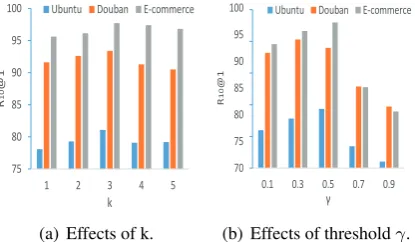
The choices ofkfor selectors and thresholdγ in formula (10) may influence the performance. Thus, we conduct a series of sensitivity analysis exper-iments on the development dataset to study how different choices of parameters influence the per-formance of the model.
ɶ
75 80 85 90 95 100
1 2 3 4 5
R
1
0
@
1
k
Ubuntu Douban E-commerce
(a) Effects of k.
70 75 80 85 90 95 100
0.1 0.3 0.5 0.7 0.9
R
1
0
@
1
ɶ
Ubuntu Douban E-commerce
[image:8.595.74.292.322.453.2](b) Effects of thresholdγ.
Figure 3: Parameter sensitivity analysis on the devel-opment datasets of Ubuntu, Douban, and E-commerce Corpus.
The k decides how many selectors that MSN uses to select relevant context utterances. Referring to Figure 3 (a), only using hop1 selector is not better than using multiple selectors. However, the performance does not increase when k > 3. It is easy to see that when k is too large, the key will contain too many noises and cannot reflect the intention of the last dialogue session.
Figure3(b) shows the performance with differ-ent thresholdγ. Intuitively, whenγ is too large, the selectors will filter out too much context, which may hurt performance. However, when γ is too small, the selectors do not work very well. We can observe that MSN achieves the best performance whenγ = 0.3or 0.5.
7 Conclusion and Future Work
In this paper, we analyze the side effect of using un-necessary context utterances and verify matching-based models are very sensitive to the context. We propose a multi-hop selector network to alleviate this problem. Empirical results on three large-scale datasets demonstrate the effectiveness of the model in multi-turn response selection and yield new state-of-the-art results at the same time.
8 Acknowledgement
We gratefully thank the anonymous reviewers for their insightful comments. This research is supported in part by the Beijing Municipal Science and Technology Project under Grant Z191100007119008 and Z181100002718004, the National Key Research and Development Pro-gram of China under Grant 2018YFC0806900 and 2017YFB1010000.
References
Debanjan Chaudhuri, Agustinus Kristiadi, Jens Lehmann, and Asja Fischer. 2018. Improving response selection in multi-turn dialogue systems by incorporating domain knowledge. In Proceedings of the 22nd Conference on Computational Natural Language Learning, pages 497–507.
Qian Chen, Xiaodan Zhu, Zhen-Hua Ling, Diana Inkpen, and Si Wei. 2018. Neural natural language inference models enhanced with external knowledge. InProceedings of the 56th Annual Meeting of the As-sociation for Computational Linguistics (Volume 1: Long Papers), pages 2406–2417.
Robin Jia and Percy Liang. 2017. Adversarial exam-ples for evaluating reading comprehension systems. In Proceedings of the 2017 Conference on Empiri-cal Methods in Natural Language Processing, pages 2021–2031.
Rudolf Kadlec, Martin Schmid, and Jan Kleindienst. 2015. Improved deep learning baselines for ubuntu corpus dialogs. arXiv preprint arXiv:1510.03753.
Diederik P Kingma and Jimmy Ba. 2014. Adam: A method for stochastic optimization. arXiv preprint arXiv:1412.6980.
Yann LeCun, Yoshua Bengio, and Geoffrey Hinton. 2015. Deep learning. nature, 521(7553):436.
Feng-Lin Li, Minghui Qiu, Haiqing Chen, Xiong-wei Wang, Xing Gao, Jun Huang, JuXiong-wei Ren, Zhongzhou Zhao, Weipeng Zhao, Lei Wang, et al. 2017. Alime assist: an intelligent assistant for cre-ating an innovative e-commerce experience. In Pro-ceedings of the 2017 ACM on Conference on Infor-mation and Knowledge Management, pages 2495– 2498. ACM.
Ryan Lowe, Nissan Pow, Iulian Serban, and Joelle Pineau. 2015. The ubuntu dialogue corpus: A large dataset for research in unstructured multi-turn dia-logue systems. InProceedings of the 16th Annual Meeting of the Special Interest Group on Discourse and Dialogue, pages 285–294.
Tomas Mikolov, Ilya Sutskever, Kai Chen, Greg S Cor-rado, and Jeff Dean. 2013. Distributed representa-tions of words and phrases and their compositional-ity. InAdvances in neural information processing systems, pages 3111–3119.
Lili Mou, Rui Men, Ge Li, Yan Xu, Lu Zhang, Rui Yan, and Zhi Jin. 2016. Natural language inference by tree-based convolution and heuristic matching. In
The 54th Annual Meeting of the Association for Com-putational Linguistics, page 130.
Adam Paszke, Sam Gross, Soumith Chintala, Gregory Chanan, Edward Yang, Zachary DeVito, Zeming Lin, Alban Desmaison, Luca Antiga, and Adam Lerer. 2017. Automatic differentiation in pytorch. InNIPS-W.
Iulian V Serban, Alessandro Sordoni, Yoshua Bengio, Aaron Courville, and Joelle Pineau. 2016. Building end-to-end dialogue systems using generative hier-archical neural network models. InThirtieth AAAI Conference on Artificial Intelligence.
Lifeng Shang, Zhengdong Lu, and Hang Li. 2015. Neu-ral responding machine for short-text conversation. In Proceedings of the 53rd Annual Meeting of the Association for Computational Linguistics and the 7th International Joint Conference on Natural Lan-guage Processing (Volume 1: Long Papers), vol-ume 1, pages 1577–1586.
Heung-Yeung Shum, Xiao-dong He, and Di Li. 2018. From eliza to xiaoice: challenges and opportunities with social chatbots. Frontiers of Information Tech-nology & Electronic Engineering, 19(1):10–26.
Ming Tan, Cicero Dos Santos, Bing Xiang, and Bowen Zhou. 2015. Lstm-based deep learning models for nonfactoid answer selection. InProceedings of the International Conference on Learning Representa-tions.
Chongyang Tao, Wei Wu, Can Xu, Wenpeng Hu, Dongyan Zhao, and Rui Yan. 2019. Multi-representation fusion network for multi-turn re-sponse selection in retrieval-based chatbots. In Pro-ceedings of the Twelfth ACM International Confer-ence on Web Search and Data Mining, pages 267– 275. ACM.
Ashish Vaswani, Noam Shazeer, Niki Parmar, Jakob Uszkoreit, Llion Jones, Aidan N Gomez, Łukasz Kaiser, and Illia Polosukhin. 2017. Attention is all you need. In Advances in neural information pro-cessing systems, pages 5998–6008.
Hao Wang, Zhengdong Lu, Hang Li, and Enhong Chen. 2013. A dataset for research on short-text conver-sations. InProceedings of the 2013 Conference on Empirical Methods in Natural Language Processing, pages 935–945.
Shuohang Wang and Jing Jiang. 2016. Learning natu-ral language inference with lstm. InProceedings of NAACL-HLT, pages 1442–1451.
Yu Wu, Wei Wu, Chen Xing, Ming Zhou, and Zhou-jun Li. 2017. Sequential matching network: A new architecture for multi-turn response selection in retrieval-based chatbots. In Proceedings of the 55th Annual Meeting of the Association for Compu-tational Linguistics (Volume 1: Long Papers), pages 496–505.
Yu Wu, Wei Wu, Dejian Yang, Can Xu, and Zhoujun Li. 2018. Neural response generation with dynamic vocabularies. InThirty-Second AAAI Conference on Artificial Intelligence.
Chen Xing, Wei Wu, Yu Wu, Jie Liu, Yalou Huang, Ming Zhou, and Wei-Ying Ma. 2017. Topic aware neural response generation. In Thirty-First AAAI Conference on Artificial Intelligence.
Rui Yan, Yiping Song, and Hua Wu. 2016. Learning to respond with deep neural networks for retrieval-based human-computer conversation system. In Pro-ceedings of the 39th International ACM SIGIR con-ference on Research and Development in Informa-tion Retrieval, pages 55–64. ACM.
Zhuosheng Zhang, Jiangtong Li, Pengfei Zhu, Hai Zhao, and Gongshen Liu. 2018. Modeling multi-turn conversation with deep utterance aggregation. InProceedings of the 27th International Conference on Computational Linguistics, pages 3740–3752.
Hao Zhou, Minlie Huang, Tianyang Zhang, Xiaoyan Zhu, and Bing Liu. 2018a. Emotional chatting ma-chine: Emotional conversation generation with in-ternal and exin-ternal memory. InThirty-Second AAAI Conference on Artificial Intelligence.
Hao Zhou, Tom Young, Minlie Huang, Haizhou Zhao, Jingfang Xu, and Xiaoyan Zhu. 2018b. Com-monsense knowledge aware conversation generation with graph attention. InIJCAI, pages 4623–4629.
Xiangyang Zhou, Daxiang Dong, Hua Wu, Shiqi Zhao, Dianhai Yu, Hao Tian, Xuan Liu, and Rui Yan. 2016. Multi-view response selection for human-computer conversation. In Proceedings of the 2016 Confer-ence on Empirical Methods in Natural Language Processing, pages 372–381.