2247
Efficient Low-rank Multimodal Fusion with Modality-Specific Factors
Zhun Liu∗, Ying Shen∗, Varun Bharadhwaj Lakshminarasimhan, Paul Pu Liang, Amir Zadeh, Louis-Philippe Morency
School of Computer Science Carnegie Mellon University
{zhunl,yshen2,vbl,pliang,abagherz,morency}@cs.cmu.edu
Abstract
Multimodal research is an emerging field of artificial intelligence, and one of the main research problems in this field is mul-timodal fusion. The fusion of mulmul-timodal data is the process of integrating multiple unimodal representations into one compact multimodal representation. Previous re-search in this field has exploited the ex-pressiveness of tensors for multimodal rep-resentation. However, these methods often suffer from exponential increase in dimen-sions and in computational complexity in-troduced by transformation of input into tensor. In this paper, we propose the Low-rank Multimodal Fusion method, which performs multimodal fusion using low-rank tensors to improve efficiency. We evaluate our model on three different tasks: mul-timodal sentiment analysis, speaker trait analysis, and emotion recognition. Our model achieves competitive results on all these tasks while drastically reducing com-putational complexity. Additional experi-ments also show that our model can per-form robustly for a wide range of low-rank settings, and is indeed much more efficient in both training and inference compared to other methods that utilize tensor represen-tations.
1 Introduction
Multimodal research has shown great progress in a variety of tasks as an emerging research field of arti-ficial intelligence. Tasks such as speech recognition (Yuhas et al.,1989), emotion recognition, (De Silva et al.,1997), (Chen et al.,1998), (W¨ollmer et al.,
2013), sentiment analysis, (Morency et al.,2011)
∗
equal contributions
as well as speaker trait analysis and media descrip-tion (Park et al., 2014a) have seen a great boost in performance with developments in multimodal research.
However, a core research challenge yet to be solved in this domain is multimodal fusion. The goal of fusion is to combine multiple modalities to leverage the complementarity of heterogeneous data and provide more robust predictions. In this regard, an important challenge has been on scaling up fusion to multiple modalities while maintaining reasonable model complexity. Some of the recent attempts (Fukui et al.,2016), (Zadeh et al.,2017) at multimodal fusion investigate the use of tensors for multimodal representation and show significant improvement in performance. Unfortunately, they are often constrained by the exponential increase of cost in computation and memory introduced by using tensor representations. This heavily restricts the applicability of these models, especially when we have more than two views of modalities in the dataset.
!"
#
Low-rank Multimodal
Fusion
ℎ %&
%" #
# %'
!'
!&
("
(&
('
Task output
⋯
*"(,) *"(.) *"(/)
∘
1
# #
%"
+ + + ⋯
*&(,) *&(.) *&(/)
1
%&
+ + + ∘
# ⋯
*'(,) *'(.) *'(/)
1
%'
+ + +
Low-rank factors Low-rank factors Low-rank factors
Visual
Audio
Language
Multimodal Representation
#
[image:2.595.70.525.69.275.2]Prediction
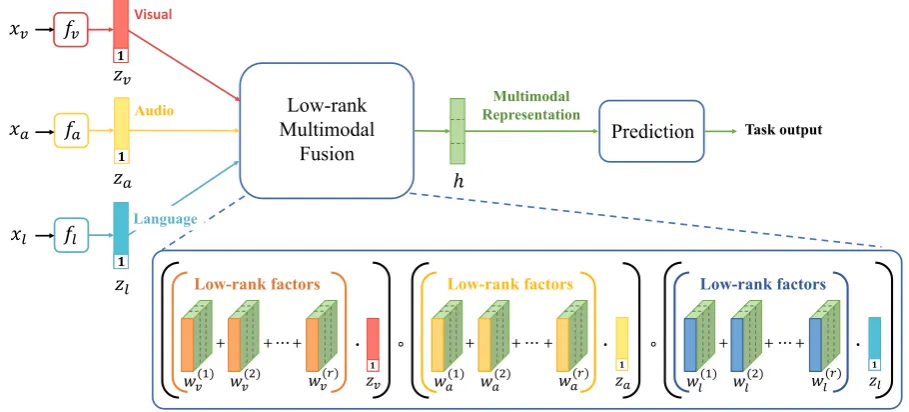
Figure 1: Overview of our Low-rank Multimodal Fusion model structure: LMF first obtains the unimodal representationza, zv, zl by passing the unimodal inputsxa, xv, xlinto three sub-embedding networks fv, fa, fl respectively. LMF produces the multimodal output representation by performing low-rank multimodal fusion with modality-specific factors. The multimodal representation can be then used for generating prediction tasks.
other tensor-based models.
The main contributions of our paper are as fol-lows:
• We propose the Low-rank Multimodal Fusion method for multimodal fusion that can scale linearly in the number of modalities.
• We show that our model compares to state-of-the-art models in performance on three multi-modal tasks evaluated on public datasets.
• We show that our model is computationally efficient and has fewer parameters in compari-son to previous tensor-based methods.
2 Related Work
Multimodal fusion enables us to leverage comple-mentary information present in multimodal data, thus discovering the dependency of information on multiple modalities. Previous studies have shown that more effective fusion methods translate to bet-ter performance in models, and there’s been a wide range of fusion methods.
Early fusion is a technique that uses feature concatenation as the method of fusion of differ-ent views. Several works that use this method of fusion (Poria et al., 2016) , (Wang et al., 2016) use input-level feature concatenation and use the
concatenated features as input, sometimes even re-moving the temporal dependency present in the modalities (Morency et al.,2011). The drawback of this class of method is that although it achieves fusion at an early stage, intra-modal interactions are potentially suppressed, thus losing out on the context and temporal dependencies within each modality.
On the other hand, late fusion builds sepa-rate models for each modality and then integsepa-rates the outputs together using a method such as ma-jority voting or weighted averaging (Wortwein and Scherer,2017), (Nojavanasghari et al.,2016). Since separate models are built for each modality, inter-modal interactions are usually not modeled effectively.
Given these shortcomings, more recent work focuses on intermediate approaches that model both intra- and inter-modal dynamics.Fukui et al.
inter-modality interactions and have shown a great success. However, such methods suffer from expo-nentially increasing computational complexity, as the outer product over multiple modalities results in extremely high dimensional tensor representations.
For unimodal data, the method of low-rank ten-sor approximation has been used in a variety of applications to implement more efficient tensor op-erations.Razenshteyn et al.(2016) proposes a mod-ified weighted version of low-rank approximation, andKoch and Lubich(2010) applies the method towards temporally dependent data to obtain low-rank approximations. As for applications,Lei et al.
(2014) proposes a low-rank tensor technique for dependency parsing whileWang and Ahuja(2008) uses the method of low-rank approximation applied directly on multidimensional image data (Datum-as-is representation) to enhance computer vision applications.Hu et al.(2017) proposes a low-rank tensor-based fusion framework to improve the face recognition performance using the fusion of facial attribute information. However, none of these previ-ous work aims to apply low-rank tensor techniques for multimodal fusion.
Our Low-rank Multimodal Fusion method pro-vides a much more efficient method to com-pute tensor-based multimodal representations with much fewer parameters and computational com-plexity. The efficiency and performance of our ap-proach are evaluated on different downstream tasks, namely sentiment analysis, speaker-trait recogni-tion and emorecogni-tion recognirecogni-tion.
3 Low-rank Multimodal Fusion
In this section, we start by formulating the problem of multimodal fusion and introducing fusion meth-ods based on tensor representations. Tensors are powerful in their expressiveness but do not scale well to a large number of modalities. Our proposed model decomposes the weights into low-rank fac-tors, which reduces the number of parameters in the model. This decomposition can be performed efficiently by exploiting the parallel decomposition of low-rank weight tensor and input tensor to com-pute tensor-based fusion. Our method is able to scale linearly with the number of modalities.
3.1 Multimodal Fusion using Tensor Representations
In this paper, we formulate multimodal fusion as a multilinear function f ∶ V1 ×V2 ×...×VM →
H whereV1, V2, ..., VM are the vector spaces of input modalities andHis the output vector space. Given a set of vector representations, {zm}Mm=1 which are encoding unimodal information of the M different modalities, the goal of multimodal fusion is to integrate the unimodal representations into one compact multimodal representation for downstream tasks.
Tensor representation is one successful approach for multimodal fusion. It first requires a transfor-mation of the input representations into a high-dimensional tensor and then mapping it back to a lower-dimensional output vector space. Previous works have shown that this method is more effec-tive than simple concatenation or pooling in terms of capturing multimodal interactions (Zadeh et al.,
2017), (Fukui et al., 2016). Tensors are usually created by taking the outer product over the input modalities. In addition, in order to be able to model the interactions between any subset of modalities using one tensor, Zadeh et al.(2017) proposed a simple extension to append1s to the unimodal rep-resentations before taking the outer product. The input tensorZformed by the unimodal representa-tion is computed by:
Z =
⊗
Mm=1
zm, zm∈Rdm (1)
where
⊗
Mm=1denotes the tensor outer product over a set of vectors indexed bym, andzmis the input representation with appended1s.The input tensorZ ∈Rd1×d2×...dM is then passed
through a linear layerg(⋅)to to produce a vector representation:
h=g(Z;W, b) = W ⋅ Z +b, h, b∈Rdy (2)
whereW is the weight of this layer and bis the bias. With Z being an order-M tensor (where M is the number of input modalities), the weight W will naturally be a tensor of order-(M+1)in
Rd1×d2×...×dM×dh. The extra(M+1)-th dimension
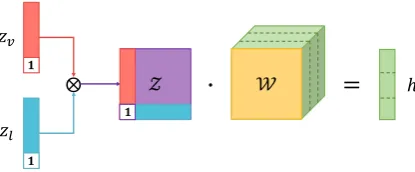
corresponds to the size of the output representation dh. In the tensor dot productW ⋅ Z, the weight ten-sorW can be then viewed asdh order-M tensors. In other words, the weightW can be partitioned intoW̃k∈Rd1×...×dM, k=1, ..., dh. EachW̃k con-tributes to one dimension in the output vectorh, i.e. hk= ̃Wk⋅ Z. This interpretation of tensor fusion is illustrated in Figure2for the bi-modal case.
M
R ?
⨂
E
E
!>
!#
E
ℎ
[image:4.595.77.285.65.151.2]=
Figure 2: Tensor fusion via tensor outer product
will increase exponentially with the number of modalities as∏Mm=1dm. The number of parameters to learn in the weight tensorW will also increase exponentially. This not only introduces a lot of computation but also exposes the model to risks of overfitting.
3.2 Low-rank Multimodal Fusion with Modality-Specific Factors
As a solution to the problems of tensor-based fu-sion, we propose Low-rank Multimodal Fusion (LMF). LMF parameterizes g(⋅) from Equation
2with a set of modality-specific low-rank factors that can be used to recover a low-rank weight ten-sor, in contrast to the full tensorW. Moreover, we show that by decomposing the weight into a set of low-rank factors, we can exploit the fact that the tensorZ actually decomposes into{zm}Mm=1, which allows us to directly compute the outputh without explicitly tensorizing the unimodal repre-sentations. LMF reduces the number of parameters as well as the computation complexity involved in tensorization from being exponential inM to linear.
3.2.1 Low-rank Weight Decomposition The idea of LMF is to decompose the weight tensor W intoM sets of modality-specific factors. How-ever, since W itself is an order-(M +1) tensor, commonly used methods for decomposition will result inM +1parts. Hence, we still adopt the view introduced in Section3.1thatWis formed by dhorder-MtensorsW̃k∈Rd1×...×dM, k=1, ..., dh stacked together. We can then decompose eachW̃k separately.
For an order-M tensorW̃k ∈Rd1×...×dM, there
always exists an exact decomposition into vectors in the form of:
̃ Wk=
R
∑
i=1
M
⊗
m=1wm,k(i) , wm,k(i) ∈Rdm (3)
The minimalRthat makes the decomposition valid is called therankof the tensor. The vector sets
{{w(m,ki) }Mm=1}Ri=1 are called the rankR decomposi-tion factors of the original tensor.
In LMF, we start with a fixed rank r, and pa-rameterize the model withrdecomposition factors {{w(m,ki) }Mm=1}ri=1, k =1, ..., dh that can be used to reconstruct a low-rank version of theseW̃k.
We can regroup and concatenate these vectors into M modality-specific low-rank factors. Let w(mi)= [w(m,i)1, wm,(i)2, ..., wm,d(i)
h], then for modality
m,{w(mi)}ri=1is its corresponding low-rank factors.
And we can recover a low-rank weight tensor by:
W =∑r
i=1
M
⊗
m=1w(mi) (4)
Hence equation2can be computed by
h= ( r
∑
i=1
M
⊗
m=1w(mi)) ⋅ Z (5)
Note that for all m, w(mi) ∈ Rdm×dh shares the
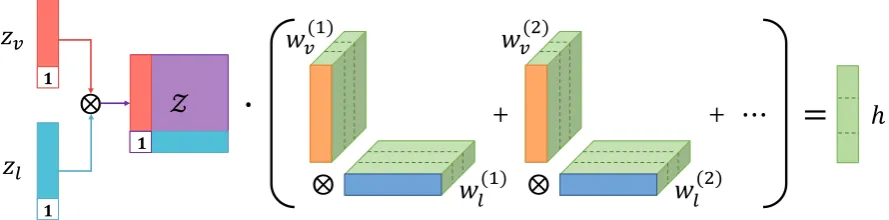
same size for the second dimension. We define their outer product to be over only the dimensions that are not shared: w(mi)⊗wn(i) ∈Rdm×dn×dh. A
bimodal example of this procedure is illustrated in Figure3.
Nevertheless, by introducing the low-rank fac-tors, we now have to compute the reconstruction ofW = ∑ri=1
⊗
M m=1w
(i)
m for the forward computa-tion. Yet this introduces even more computacomputa-tion.
3.2.2 Efficient Low-rank Fusion Exploiting Parallel Decomposition
In this section, we will introduce an efficient pro-cedure for computing h, exploiting the fact that tensorZ naturally decomposes into the original input{zm}Mm=1, which is parallel to the
modality-specific low-rank factors. In fact, that is the main reason why we want to decompose the weight ten-sor intoMmodality-specific factors.
Using the fact thatZ =
⊗
Mm=1zm, we can sim-plify equation5:h= ( r
∑
i=1
M
⊗
m=1w(mi)) ⋅ Z
=∑r
i=1
(
⊗
Mm=1
w(mi)⋅ Z)
=∑r
i=1
(
⊗
Mm=1
w(mi)⋅
M
⊗
m=1zm)
=
Λ
Mm=1
[∑r
i=1
5
>(S)⨂
+ +
⋯
5
#(S)5
> (T)⨂
5
#(T)V
⨂
E
E
!
>!
#g
E
=
[image:5.595.78.523.73.183.2]ℎ
Figure 3: Decomposing weight tensor into low-rank factors (See Section3.2.1for details.)
where
Λ
Mm=1 denotes the element-wise product over a sequence of tensors:Λ
3t=1xt=x1○x2○x3.An illustration of the trimodal case of equation6
is shown in Figure1. We can also derive equation
6for a bimodal case to clarify what it does:
h= ( r
∑
i=1
w(ai)⊗w(vi)) ⋅ Z
= (∑r
i=1
w(ai)⋅za) ○ ( r
∑
i=1
w(vi)⋅zv) (7)
An important aspect of this simplification is that it exploits the parallel decomposition of bothZ andW, so that we can computehwithout actually creating the tensorZ from the input representa-tionszm. In addition, different modalities are de-coupled in the simplified computation ofh, which allows for easy generalization of our approach to an arbitrary number of modalities. Adding a new modality can be simply done by adding another set of modality-specific factors and extend Equa-tion7. Last but not least, Equation6 consists of fully differentiable operations, which enables the parameters{w(mi)}ri=1m = 1, ..., M to be learned
end-to-end via back-propagation.
Using Equation6, we can computeh directly from input unimodal representations and their modal-specific decomposition factors, avoiding the weight-lifting of computing the large input ten-sor Z and W, as well as the r linear transfor-mation. Instead, the input tensor and subsequent linear projection are computed implicitly together in Equation 6, and this is far more efficient than the original method described in Section3.1. In-deed, LMF reduces the computation complexity of tensorization and fusion fromO(dy∏Mm=1dm)to
O(dy×r× ∑Mm=1dm).
In practice, we use a slightly different form of Equation 6, where we concatenate the low-rank
factors into M order-3 tensors and swap the or-der in which we do the element-wise product and summation:
h= r
∑
i=1
[
Λ
Mm=1[
wm(1),w(m2), ...,wm(r)] ⋅zˆm] i,∶
(8)
and now the summation is done along the first di-mension of the bracketed matrix.[⋅]i,∶indicates the i-th slice of a matrix. In this way, we can parame-terize the model withM order-3 tensors, instead of parameterizing with sets of vectors.
4 Experimental Methodology
We compare LMF with previous state-of-the-art baselines, and we use the Tensor Fusion Networks (TFN) (Zadeh et al.,2017) as a baseline for tensor-based approaches, which has the most similar struc-ture with us except that it explicitly forms the large multi-dimensional tensor for fusion across different modalities.
We design our experiments to better understand the characteristics of LMF. Our goal is to answer the following four research questions:
(1) Impact of Multimodal Low-rank Fusion: Di-rect comparison between our proposed LMF model and the previous TFN model.
(2) Comparison with the State-of-the-art: We evaluate the performance of LMF and state-of-the-art baselines on three different tasks and datasets. (3) Complexity Analysis: We study the modal complexity of LMF and compare it with the TFN model.
(4) Rank Settings: We explore performance of LMF with different rank settings.
The results of these experiments are presented in Section5.
4.1 Datasets
Dataset CMU-MOSI IEMOCAP POM
Level Segment Segment Video
# Train 1284 6373 600
# Valid 229 1775 100
[image:6.595.72.289.62.115.2]# Test 686 1807 203
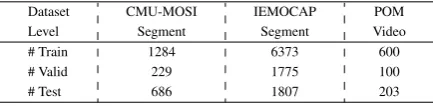
Table 1: The speaker independent data splits for training, validation, and test sets.
POM (Park et al.,2014b), and IEMOCAP (Busso et al.,2008) for sentiment analysis, speaker traits recognition, and emotion recognition task, where the goal is to identify speakers emotions based on the speakers’ verbal and nonverbal behaviors. CMU-MOSIThe CMU-MOSI dataset is a collec-tion of 93 opinion videos from YouTube movie reviews. Each video consists of multiple opinion segments and each segment is annotated with the sentiment in the range [-3,3], where -3 indicates highly negative and 3 indicates highly positive. POMThe POM dataset is composed of 903 movie review videos. Each video is annotated with the fol-lowing speaker traits: confident, passionate, voice pleasant, dominant, credible, vivid, expertise, enter-taining, reserved, trusting, relaxed, outgoing, thor-ough, nervous, persuasive and humorous.
IEMOCAPThe IEMOCAP dataset is a collection of 151 videos of recorded dialogues, with 2 speak-ers per session for a total of 302 videos across the dataset. Each segment is annotated for the presence of 9 emotions (angry, excited, fear, sad, surprised, frustrated, happy, disappointed and neutral).
To evaluate model generalization, all datasets are split into training, validation, and test sets such that the splits are speaker independent, i.e., no identical speakers from the training set are present in the test sets. Table1illustrates the data splits for all datasets in detail.
4.2 Features
Each dataset consists of three modalities, namely language, visual, and acoustic modalities. To reach the same time alignment across modalities, we perform word alignment using P2FA (Yuan and Liberman,2008) which allows us to align the three modalities at the word granularity. We calculate the visual and acoustic features by taking the average of their feature values over the word time interval (Chen et al.,2017).
Language We use pre-trained 300-dimensional Glove word embeddings (Pennington et al.,2014) to encode a sequence of transcribed words into a sequence of word vectors.
VisualThe library Facet1is used to extract a set of visual features for each frame (sampled at 30Hz) in-cluding 20 facial action units, 68 facial landmarks, head pose, gaze tracking and HOG features (Zhu et al.,2006).
Acoustic We use COVAREP acoustic analysis framework (Degottex et al.,2014) to extract a set of low-level acoustic features, including 12 Mel frequency cepstral coefficients (MFCCs), pitch, voiced/unvoiced segmentation, glottal source, peak slope, and maxima dispersion quotient features.
4.3 Model Architecture
In order to compare our fusion method with previ-ous work, we adopt a simple and straightforward model architecture2 for extracting unimodal rep-resentations. Since we have three modalities for each dataset, we simply designed three unimodal sub-embedding networks, denoted asfa, fv, fl, to extract unimodal representationsza, zv, zlfrom uni-modal input featuresxa, xv, xl. For acoustic and visual modality, the sub-embedding network is a simple 2-layer feed-forward neural network, and for language modality, we used an LSTM ( Hochre-iter and Schmidhuber,1997) to extract represen-tations. The model architecture is illustrated in Figure1.
4.4 Baseline Models
We compare the performance of LMF to the follow-ing baselines and state-of-the-art models in multi-modal sentiment analysis, speaker trait recognition, and emotion recognition.
Support Vector Machines Support Vector Ma-chines (SVM) (Cortes and Vapnik, 1995) is a widely used non-neural classifier. This baseline is trained on the concatenated multimodal features for classification or regression task (P´erez-Rosas et al., 2013), (Park et al., 2014a), (Zadeh et al.,
2016b).
Deep FusionThe Deep Fusion model (DF) ( No-javanasghari et al.,2016) trains one deep neural model for each modality and then combine the out-put of each modality network with a joint neural network.
Tensor Fusion NetworkThe Tensor Fusion Net-work (TFN) (Zadeh et al.,2017) explicitly models view-specific and cross-view dynamics by creat-ing a multi-dimensional tensor that captures
uni-1
goo.gl/1rh1JN
2
modal, bimodal and trimodal interactions across three modalities.
Memory Fusion Network The Memory Fusion Network (MFN) (Zadeh et al.,2018a) accounts for view-specific and cross-view interactions and con-tinuously models them through time with a special attention mechanism and summarized through time with a Multi-view Gated Memory.
Bidirectional Contextual LSTM The Bidirec-tional Contextual LSTM (BC-LSTM) (Zadeh et al.,
2017), (Fukui et al., 2016) performs context-dependent fusion of multimodal data.
Multi-View LSTMThe Multi-View LSTM (MV-LSTM) (Rajagopalan et al.,2016) aims to capture both modality-specific and cross-modality interac-tions from multiple modalities by partitioning the memory cell and the gates corresponding to multi-ple modalities.
Multi-attention Recurrent Network The Multi-attention Recurrent Network (MARN) (Zadeh et al.,
2018b) explicitly models interactions between modalities through time using a neural component called the Multi-attention Block (MAB) and storing them in the hybrid memory called the Long-short Term Hybrid Memory (LSTHM).
4.5 Evaluation Metrics
Multiple evaluation tasks are performed during our evaluation: multi-class classification and regres-sion. The multi-class classification task is applied to all three multimodal datasets, and the regres-sion task is applied to the CMU-MOSI and the POM dataset. For binary classification and multi-class multi-classification, we report F1 score and accu-racy Acc−kwhere k denotes the number of classes. Specifically, Acc−2stands for the binary classifica-tion. For regression, we report Mean Absolute Er-ror (MAE) and Pearson correlation (Corr). Higher values denote better performance for all metrics except for MAE.
5 Results and Discussion
In this section, we present and discuss the results from the experiments designed to study the re-search questions introduced in section4.
5.1 Impact of Low-rank Multimodal Fusion In this experiment, we compare our model directly with the TFN model since it has the most similar structure to our model, except that TFN explic-itly forms the multimodal tensor fusion. The
com-parison reported in the last two rows of Table 2
demonstrates that our model significantly outper-forms TFN across all datasets and metrics. This competitive performance of LMF compared to TFN emphasizes the advantage of Low-rank Multimodal Fusion.
5.2 Comparison with the State-of-the-art We compare our model with the baselines and state-of-the-art models for sentiment analysis, speaker traits recognition and emotion recognition. Results are shown in Table2. LMF is able to achieve com-petitive and consistent results across all datasets.
On the multimodal sentiment regression task, LMF outperforms the previous state-of-the-art model on MAE and Corr. Note the multiclass accuracy is calculated by mapping the range of continuous sentiment values into a set of intervals that are used as discrete classes.
On the multimodal speaker traits Recognition task, we report the average evaluation score over 16 speaker traits and shows that our model achieves the state-of-the-art performance over all three eval-uation metrics on the POM dataset.
On the multimodal emotion recognition task, our model achieves better results compared to the state-of-the-art models across all emotions on the F1 score. F1-emotion in the evaluation metrics indi-cates the F1 score for a certain emotion class.
5.3 Complexity Analysis
Theoretically, the model complexity of our fu-sion method is O(dy ×r× ∑Mm=1dm) compared toO(dy∏Mm=1dm) of TFN from Section3.1. In practice, we calculate the total number of parame-ters used in each model, where we chooseM =3, d1 = 32,d2 =32, d3 =64,r =4, dy = 1. Under this hyper-parameter setting, our model contains about 1.1e6 parameters while TFN contains about 12.5e6 parameters, which is nearly 11 times more. Note that, the number of parameters above counts not only the parameters in the multimodal fusion stage but also the parameters in the subnetworks.
Furthermore, we evaluate the computational complexity of LMF by measuring the training and testing speeds between LMF and TFN. Table 3
Dataset CMU-MOSI POM IEMOCAP
[image:8.595.75.523.62.163.2]Metric MAE Corr Acc-2 F1 Acc-7 MAE Corr Acc F1-Happy F1-Sad F1-Angry F1-Neutral SVM 1.864 0.057 50.2 50.1 17.5 0.887 0.104 33.9 81.5 78.8 82.4 64.9 DF 1.143 0.518 72.3 72.1 26.8 0.869 0.144 34.1 81.0 81.2 65.4 44.0 BC-LSTM 1.079 0.581 73.9 73.9 28.7 0.840 0.278 34.8 81.7 81.7 84.2 64.1 MV-LSTM 1.019 0.601 73.9 74.0 33.2 0.891 0.270 34.6 81.3 74.0 84.3 66.7 MARN 0.968 0.625 77.1 77.0 34.7 - - 39.4 83.6 81.2 84.2 65.9 MFN 0.965 0.632 77.4 77.3 34.1 0.805 0.349 41.7 84.0 82.1 83.7 69.2 TFN 0.970 0.633 73.9 73.4 32.1 0.886 0.093 31.6 83.6 82.8 84.2 65.4 LMF 0.912 0.668 76.4 75.7 32.8 0.796 0.396 42.8 85.8 85.9 89.0 71.7
Table 2: Results for sentiment analysis on CMU-MOSI, emotion recognition on IEMOCAP and personality trait recognition on POM. Best results are highlighted in bold.
Model Training Speed (IPS) Testing Speed (IPS)
TFN 340.74 1177.17
LMF 1134.82 2249.90
Table 3: Comparison of the training and testing speeds between TFN and LMF. The second and the third columns indicate the number of data point inferences per second (IPS) during training and testing time respectively. Both models are imple-mented in the same framework with equivalent run-ning environment.
Based on these results, performing a low-rank multimodal fusion with modality-specific low-rank factors significantly reduces the amount of time needed for training and testing the model. On an NVIDIA Quadro K4200 GPU, LMF trains with an average frequency of 1134.82 IPS (data point inferences per second) while the TFN model trains at an average of 340.74 IPS.
5.4 Rank Settings
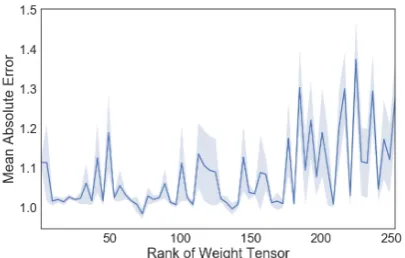
[image:8.595.80.283.579.708.2]To evaluate the impact of different rank settings for our LMF model, we measure the change in perfor-mance on the CMU-MOSI dataset while varying
Figure 4: The Impact of different rank settings on Model Performance: As the rank increases, the results become unstable and low rank is enough in terms of the mean absolute error.
the number of rank. The results are presented in Figure4. We observed that as the rank increases, the training results become more and more unstable and that using a very low rank is enough to achieve fairly competent performance.
6 Conclusion
In this paper, we introduce a Low-rank Multi-modal Fusion method that performs multiMulti-modal fu-sion with modality-specific low-rank factors. LMF scales linearly in the number of modalities. LMF achieves competitive results across different mul-timodal tasks. Furthermore, LMF demonstrates a significant decrease in computational complex-ity from exponential to linear time. In practice, LMF effectively improves the training and testing efficiency compared to TFN which performs multi-modal fusion with tensor representations.
Future work on similar topics could explore the applications of using low-rank tensors for attention models over tensor representations, as they can be even more memory and computationally intensive.
Acknowledgements
This material is based upon work partially sup-ported by the National Science Foundation (Award # 1833355) and Oculus VR. Any opinions, findings, and conclusions or recommendations expressed in this material are those of the author(s) and do not necessarily reflect the views of National Science Foundation or Oculus VR, and no official endorse-ment should be inferred.
References
Lan-guage Resources and Evaluation 42(4):335–359.
https://doi.org/10.1007/s10579-008-9076-6.
Lawrence S Chen, Thomas S Huang, Tsutomu Miyasato, and Ryohei Nakatsu. 1998. Multimodal human emotion/expression recognition. In Auto-matic Face and Gesture Recognition, 1998. Proceed-ings. Third IEEE International Conference on. IEEE, pages 366–371.
Minghai Chen, Sen Wang, Paul Pu Liang, Tadas Bal-truˇsaitis, Amir Zadeh, and Louis-Philippe Morency. 2017. Multimodal sentiment analysis with word-level fusion and reinforcement learning. In Pro-ceedings of the 19th ACM International Con-ference on Multimodal Interaction. ACM, New York, NY, USA, ICMI 2017, pages 163–171.
https://doi.org/10.1145/3136755.3136801.
Corinna Cortes and Vladimir Vapnik. 1995. Support-vector networks. Machine learning20(3):273–297.
Liyanage C De Silva, Tsutomu Miyasato, and Ryohei Nakatsu. 1997. Facial emotion recognition using multi-modal information. In Information, Commu-nications and Signal Processing, 1997. ICICS., Pro-ceedings of 1997 International Conference on. IEEE, volume 1, pages 397–401.
Gilles Degottex, John Kane, Thomas Drugman, Tuomo Raitio, and Stefan Scherer. 2014. Covarepa collabo-rative voice analysis repository for speech technolo-gies. In Acoustics, Speech and Signal Processing (ICASSP), 2014 IEEE International Conference on. IEEE, pages 960–964.
Akira Fukui, Dong Huk Park, Daylen Yang, Anna Rohrbach, Trevor Darrell, and Marcus Rohrbach. 2016. Multimodal compact bilinear pooling for visual question answering and visual grounding. arXiv preprint arXiv:1606.01847.
Sepp Hochreiter and J¨urgen Schmidhuber. 1997. Long short-term memory. Neural Comput. 9(8):1735– 1780.https://doi.org/10.1162/neco.1997.9.8.1735.
Guosheng Hu, Yang Hua, Yang Yuan, Zhihong Zhang, Zheng Lu, Sankha S Mukherjee, Timothy M Hospedales, Neil M Robertson, and Yongxin Yang. 2017. Attribute-enhanced face recognition with neu-ral tensor fusion networks.
Othmar Koch and Christian Lubich. 2010. Dynami-cal tensor approximation. SIAM Journal on Matrix Analysis and Applications31(5):2360–2375.
Tao Lei, Yu Xin, Yuan Zhang, Regina Barzilay, and Tommi Jaakkola. 2014. Low-rank tensors for scor-ing dependency structures. In Proceedings of the 52nd Annual Meeting of the Association for Com-putational Linguistics (Volume 1: Long Papers). vol-ume 1, pages 1381–1391.
Louis-Philippe Morency, Rada Mihalcea, and Payal Doshi. 2011. Towards multimodal sentiment anal-ysis: Harvesting opinions from the web. In Proceed-ings of the 13th International Conference on Multi-modal Interactions. ACM, pages 169–176.
Behnaz Nojavanasghari, Deepak Gopinath, Jayanth Koushik, Tadas Baltruˇsaitis, and Louis-Philippe Morency. 2016. Deep multimodal fusion for persua-siveness prediction. InProceedings of the 18th ACM International Conference on Multimodal Interaction. ACM, pages 284–288.
Sunghyun Park, Han Suk Shim, Moitreya Chatterjee, Kenji Sagae, and Louis-Philippe Morency. 2014a. Computational analysis of persuasiveness in social multimedia: A novel dataset and multimodal predic-tion approach. InProceedings of the 16th Interna-tional Conference on Multimodal Interaction. ACM, pages 50–57.
Sunghyun Park, Han Suk Shim, Moitreya Chatterjee, Kenji Sagae, and Louis-Philippe Morency. 2014b.
Computational analysis of persuasiveness in social multimedia: A novel dataset and multimodal pre-diction approach. In Proceedings of the 16th In-ternational Conference on Multimodal Interaction. ACM, New York, NY, USA, ICMI ’14, pages 50–57.
https://doi.org/10.1145/2663204.2663260.
Jeffrey Pennington, Richard Socher, and Christopher D Manning. 2014. Glove: Global vectors for word rep-resentation.
Ver´onica P´erez-Rosas, Rada Mihalcea, and Louis-Philippe Morency. 2013. Utterance-level multi-modal sentiment analysis. In Proceedings of the 51st Annual Meeting of the Association for Compu-tational Linguistics (Volume 1: Long Papers). vol-ume 1, pages 973–982.
Soujanya Poria, Iti Chaturvedi, Erik Cambria, and Amir Hussain. 2016. Convolutional mkl based mul-timodal emotion recognition and sentiment analysis. In Data Mining (ICDM), 2016 IEEE 16th Interna-tional Conference on. IEEE, pages 439–448.
Shyam Sundar Rajagopalan, Louis-Philippe Morency, Tadas Baltruˇsaitis, and Roland Goecke. 2016. Ex-tending long short-term memory for multi-view structured learning. In European Conference on Computer Vision.
Ilya Razenshteyn, Zhao Song, and David P Woodruff. 2016. Weighted low rank approximations with prov-able guarantees. InProceedings of the forty-eighth annual ACM symposium on Theory of Computing. ACM, pages 250–263.
Hongcheng Wang and Narendra Ahuja. 2008. A ten-sor approximation approach to dimensionality re-duction. International Journal of Computer Vision 76(3):217–229.
Martin W¨ollmer, Felix Weninger, Tobias Knaup, Bj¨orn Schuller, Congkai Sun, Kenji Sagae, and Louis-Philippe Morency. 2013. Youtube movie reviews: Sentiment analysis in an audio-visual context. IEEE Intelligent Systems28(3):46–53.
Torsten Wortwein and Stefan Scherer. 2017. What really mattersan information gain analysis of ques-tions and reacques-tions in automated ptsd screenings. In 2017 Seventh International Conference on Affective Computing and Intelligent Interaction (ACII). IEEE, pages 15–20.
Jiahong Yuan and Mark Liberman. 2008. Speaker iden-tification on the scotus corpus.Journal of the Acous-tical Society of America123(5):3878.
Ben P Yuhas, Moise H Goldstein, and Terrence J Se-jnowski. 1989. Integration of acoustic and visual speech signals using neural networks. IEEE Com-munications Magazine27(11):65–71.
Amir Zadeh, Minghai Chen, Soujanya Poria, Erik Cam-bria, and Louis-Philippe Morency. 2017. Tensor fu-sion network for multimodal sentiment analysis. In Empirical Methods in Natural Language Processing, EMNLP.
Amir Zadeh, Paul Pu Liang, Navonil Mazumder, Soujanya Poria, Erik Cambria, and Louis-Philippe Morency. 2018a. Memory fusion network for multi-view sequential learning. arXiv preprint arXiv:1802.00927.
Amir Zadeh, Paul Pu Liang, Soujanya Poria, Pra-teek Vij, Erik Cambria, and Louis-Philippe Morency. 2018b. Multi-attention recurrent network for hu-man communication comprehension.arXiv preprint arXiv:1802.00923.
Amir Zadeh, Rowan Zellers, Eli Pincus, and Louis-Philippe Morency. 2016a. Mosi: multimodal cor-pus of sentiment intensity and subjectivity anal-ysis in online opinion videos. arXiv preprint arXiv:1606.06259.
Amir Zadeh, Rowan Zellers, Eli Pincus, and Louis-Philippe Morency. 2016b. Multimodal sentiment in-tensity analysis in videos: Facial gestures and verbal messages. IEEE Intelligent Systems31(6):82–88.