ISSN Online: 2327-5901 ISSN Print: 2327-588X
DOI: 10.4236/jpee.2019.75001 May 21, 2019 1 Journal of Power and Energy Engineering
Overview of Analysis on State Evaluation of
Relaying Protection System
Wanqing Li
1, Pinduan Hu
21Department of Electrical Engineering and Automation, College of Electrical Engineering & New Energy, China Three Gorges University, Yichang, China
2Department of Smart Grid, College of Electrical Engineering & New Energy, China Three Gorges University, Yichang, China
Abstract
With the rapid development of the smart grid, it is necessary to do good cor-responding work in relaying protection so as to meet the overall requirements of the smart grid better. So we must focus on the state division, risk analysis and fault diagnosis methods in the relaying protection system, in the basis of fully understanding the advantages and disadvantages of relaying protection system, and then improve the problems existing of relaying protection system at this stage according to the actual situation. This paper aims at the overview of analysis on state evaluation of relaying protection systems.
Keywords
Relaying Protection System, State Evaluation, Research Overview
1. Introduction
At this stage, the construction and development of smart grid are relatively fast. But in the actual development process, the protection of the system is more complicated due to the increase of new electronic devices, which causes a greater burden on the relaying protection system. According to relevant data research, the main reason for the operation error of relaying protection device is not the principle error, but the internal setting and external circuit problems. In the past, the evaluation of relaying protection system only stayed in the action judgment, and rarely started from the online diagnosis and quantitative safety performance indicators.
2. State of Relaying Protection System
2.1. Device State
Generally, the state of relaying protection device mainly includes hardware and How to cite this paper: Li, W.Q. and Hu,
P.D. (2019) Overview of Analysis on State Evaluation of Relaying Protection System. Journal of Power and Energy Engineering, 7, 1-7.
https://doi.org/10.4236/jpee.2019.75001
Received: April 17, 2019 Accepted: May 18, 2019 Published: May 21, 2019
Copyright © 2019 by author(s) and Scientific Research Publishing Inc. This work is licensed under the Creative Commons Attribution International License (CC BY 4.0).
http://creativecommons.org/licenses/by/4.0/
DOI: 10.4236/jpee.2019.75001 2 Journal of Power and Energy Engineering software states. The work of these two devices is affected by several factors such as design level, manufacturing technology, software version and electronic components, and it is also affected by factors such as operating environment and maintenance level in the process of practical application [1]. For different stages of device state, the two states of commissioning and decommissioning are usually used to distinguish. The main reason is that the structure of relaying protection device is complicated, and it is often difficult to determine the oper-ating state of relaying protection device after entering different working modes. Therefore, when judging the operating state of relaying protection device, it is necessary to first judge its working mode and then analyze its operating state. As most of relaying protection devices are in the preparation stage for a long time, their internal structure will be extremely vulnerable to the influence of external factors, resulting in the aging of the device. Therefore, it is particularly impor-tant to judge whether the device is in the normal operation and working state. According to relevant research [2], the relevant research on circuit breakers can distinguish the six working states of relaying protection system. These six ing states include judging whether relaying protection device is in normal work-ing state, and the specific probability of the occurrence of events can be deter-mined after calculation. According to the literature [3], there are three main sit-uations in which relaying devices are faulty due to hardware problems: 1) when the fault occurs, the relaying protection device itself does not have any problems, and other related protection actions cannot operate normally due to the fault, 2) the hardware fault will cause the device to fail to complete the normal protec-tion, 3) when there is no fault, the environmental protection will invalidate the protection measures of the relaying protection. As for the software fault at that time, it was mainly caused by the software configuration management problem, but the main reason of the relaying protection error was probably caused by the protection software version problem.
2.2. Circuit State
opera-DOI: 10.4236/jpee.2019.75001 3 Journal of Power and Energy Engineering tion, but this will cause the secondary circuit to malfunction, thus leading to the failure of the normal action protection work.
2.3. Function State of Relaying Protection System
The composition of the relaying protection system mainly includes four aspects, namely relaying operation box, secondary circuit, protector and transmitter-receiver. The digital relaying protection device is mainly composed of eight parts, includ-ing the circuit breaker, the protection part, the transmission part, the synchro-nization timer, the terminal part, the merged component, the switching device and the sensor. The coordination among these systems can promote the stable operation of relaying protection system. The overall operating states of these links together constitute the overall functional state of the system. According to the literature [4], in the process of judging the hidden fault, the influence be-tween each component is analyzed, and the misoperation caused by the original is classified, and a more practical state model can be obtained.
3. Diagnostic Mode of Relaying Protection System State
subs-DOI: 10.4236/jpee.2019.75001 4 Journal of Power and Energy Engineering tation, thus effectively improving the reliability of the monitoring system.
At this stage, with the rapid development of relaying protection system and diagnostic system, the working characteristics of relaying protection system are gradually divided into static and dynamic modes. The static mode mainly refers to the working characteristics that the protection device is not able to start, and is often used to detect the cable connection condition, the pre-processing of the circuit and the system circuit test in the relaying protection system; and the dy-namic mode mainly means that the measured signal meets the protection start-ing condition, and it is mostly used in the detection of the settstart-ing value and the correctness of the action principle [7]. The specific steps of the online setting of the relaying device mainly include the following items: Firstly, construct the fixed value space; secondly, match the topology information in real time; finally, perform the tuning in real time. Although this method has good effects, its dis-advantages are also obvious, Topology change belong to the frequent failure pe-riod, while the system can only use the traditional offline setting value during the period of incomplete real-time setting. Therefore, it is necessary to improve the real-time setting efficiency and formulate online setting strategy for im-provement.
4. State Analysis and Application Overview of Relaying
Protection System
4.1. Relaying Protection Risk Assessment Based on State
Statistical Analysis on Relaying Protection System
With the wide use of Markov state model and fault tree model, most researchers have constructed risk assessment methods for relaying protection device; they mainly reflect the reliability of the entire relaying protection system by factors such as protection system misoperation rate, normal operation rate, availability, refusal rate, failure frequency and load loss risk. It is mainly used to analyze the basic data, including the test and operation between different modules and the constituent systems; its main sources include two types: one is to collect objec-tive historical statistics; the other is based on the subjecobjec-tive and prior improve-ment, the historical data is used as a reference basis, and according to the actual operation at the current stage, a certain range is given for the possible value of the current data [8]. In the study of different problems, it is often necessary to solve the curve of data incompleteness; in terms of simulation, the method of neural network usually has certain problems, and Monte Carlo can effectively solve this problem.
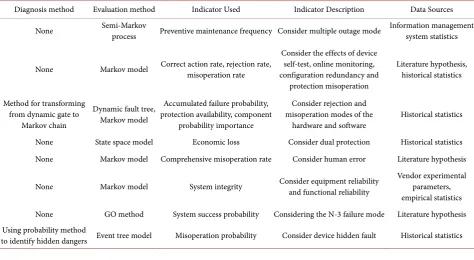
DOI: 10.4236/jpee.2019.75001 5 Journal of Power and Energy Engineering The judgment is made; finally, according to the historical protection failure data of the relevant scene, the order and scale of the device can be analyzed. Accord-ing to relevant foreign research, it constructs the model of relayAccord-ing protection system, which mainly adopts the idea of primary device reliability analysis. It mainly analyzes the reliability of the primary device, distinguishes the mode of the hidden fault, by extending the concept of hidden fault risk parts in each unit to the transmission line measured by length, the results obtained are more intui-tive. However, the main shortcoming is the process of data processing, the mal-function rate of circuit breakers caused by hidden faults is taken as a constant. Because of the difference between line protection systems, the occurrence rate of hidden faults is actually a variable. In the related literature research [9], the tra-ditional sampling method is used to obtain the simulation structure with higher confidence, which usually requires more samples and long time calculation. The importance sampling method can facilitate the occurrence of faults with low oc-currence rate in the sample. In addition to the fault action due to hidden faults in line protection, the DC power flow algorithm can also effectively make up for the non-convergence of the Niu Lafa after three iterations. Finally, the error rate obtained by sampling method is used to evaluate the weak link of the line. As shown in the model in Table 1, due to different modeling methods, indicators contain different directions, but there is still a lack of perfect state evaluation model research. At the same time, a large amount of historical data also plays a very important role in the construction of the state assessment model. The in-completeness of historical data leads to the fact that most cases need to be car-ried out in a hypothetical way, which also makes the assessment model lack of standards for the status quo of information interface.
Table 1. Comparison of models.
Diagnosis method Evaluation method Indicator Used Indicator Description Data Sources
None Semi-Markov process Preventive maintenance frequency Consider multiple outage mode Information management system statistics
None Markov model Correct action rate, rejection rate, misoperation rate
Consider the effects of device self-test, online monitoring, configuration redundancy and
protection misoperation
Literature hypothesis, historical statistics
Method for transforming from dynamic gate to
Markov chain
Dynamic fault tree, Markov model
Accumulated failure probability, protection availability, component
probability importance
Consider rejection and misoperation modes of the
hardware and software Historical statistics None State space model Economic loss Consider dual protection Historical statistics None Markov model Comprehensive misoperation rate Consider human error Literature hypothesis
None Markov model System integrity Consider equipment reliability and functional reliability Vendor experimental parameters, empirical statistics None GO method System success probability Considering the N-3 failure mode Literature hypothesis Using probability method
DOI: 10.4236/jpee.2019.75001 6 Journal of Power and Energy Engineering
4.2. Safety Measures Based on State Evaluation of Protective
Device
In the process of evaluating the state of the relaying protection device, if the hidden fault is diagnosed, the exit separation or function reorganization can be appropriately selected to solve the corresponding fault problem after knowing the actual fault causing device [10]. It is worth noting that for a substation like IEC61850, it not only has certain data platform functions, but also has a wide range of protection devices. If such a device system is used in actual work, it can effectively improve the device protection function. Combined with digital in-formation sharing in the current digital substation, relevant researchers have studied the stability of digital substation relaying protection system, and pro-posed two ways to solve the problem of transformer failure and protection unit failure.
5. Conclusion
To sum up, with the rapid development of information technology, in order to promote the relaying protection work to obtain the good condition, the relaying protection also carries out the transformation gradually from the theory to the structure hardware, so as to adapt the present stage power system development demand unceasingly. However, according to practical experience, there are still many problems in the operation of the relaying protection system, such as the malfunction of protection actions and the emergence of refusal problems, lead-ing to widespread power outages. Therefore, it is necessary to effectively evaluate the operating state and risks of the relaying protection system, and constantly optimize the research on the theory and technology, so as to improve the safety and stability of the relay protection system.
Conflicts of Interest
The authors declare no conflicts of interest regarding the publication of this pa-per.
References
[1] Song, Y.K. (2017) Overview and Research on the State Evaluation of Relaying Pro-tection System. Electric Power System Equipment, 17, 235-236.
[2] Yang, L., Ying, L.M. and Wang, Y.L. (2017) Research on State Evaluation of Relay-ing Protection Device Based on Fuzzy DEA Theory. Power System Protection and Control, 9, 25-26.
[3] Wang, X. (2018) Practical Research on Condition Assessment of Relaying Protec-tion Devices in Intelligent SubstaProtec-tion. Electro Techniques, 482, 16-18.
[4] Duan, J.J., Ying, L.M. and Luo, X.C. (2018) Health Condition Assessment for Re-laying Protection System Based on Induced Ordered Weighted Evidential Reason-ing Method under Incomplete Information. Power System Protection and Control, 8, 69-70.
DOI: 10.4236/jpee.2019.75001 7 Journal of Power and Energy Engineering Condition-Based Maintenance of Relaying Protection Devices. Power System Pro-tection and Control, 10, 137-143.
[6] Zhao, X.M., Wu, J. and Wang, S. (2018) Fuzzy Comprehensive Evaluation of Varia-ble Relaying Protection System Based on the Membership. Power System Protection and Control, 13, 76-77.
[7] Pan, Q.Y. (2017) Online State Evaluation Method for Relaying Protection Based on Multi-Level Framework. Wireless Interconnect Technology, 11, 16-17.
[8] Xu, C.B., Wang, Y.L. and Zhao, L.J. (2018) Fuzzy Comprehensive Evaluation of In-telligent Substation Relaying Protection System Based on Information Trend Pre-diction and Combination Weighting. Electric Power Automation Equipment, 21, 142-143.
[9] Shi, Y.K., Gao, Q. and Jiang, Z.C. (2017) Analysis and Condition Assessment Re-search on Secondary Circuit of Relay Protection in Smart Substation. North China Electric Power, 7, 27-28.