Information geometry and local asymptotic normality for multi-parameter estimation of quantum Markov dynamics
Madalin Guta1,a) and Jukka Kiukas2,b)
1)School of Mathematical Sciences, University of Nottingham, University Park,
Nottingham, NG7 2RD, UK
2)Department of Mathematics, Aberystwyth University, Penglais, Aberystwyth,
Ceredigion, SY23 3BZ, UK
(Dated: 20 March 2017)
This paper deals with the problem of identifying and estimating dynamical parameters of continuous-time Markovian quantum open systems, in the input-output formalism. First, we characterise the space of identifiable parameters for ergodic dynamics, assuming full access to the output state for arbitrarily long times, and show that the equivalence classes of undistinguishable parameters are orbits of a Lie group acting on the space of dynamical parameters. Second, we define an information geometric structure on this space, including a principal bundle given by the action of the group, as well as a com-patible connection, and a Riemannian metric based on the quantum Fisher information of the output. We compute the metric explicitly in terms of the Markov covariance of certain ”fluctuation operators”, and relate it to the horizontal bundle of the connec-tion. Third, we show that the system-output and reduced output state satisfy local asymptotic normality, i.e. they can be approximated by a Gaussian model consisting of coherent states of a multimode continuos variables system constructed from the Markov covariance “data”. We illustrate the result by working out the details of the information geometry of a physically relevant two-level system.
I. INTRODUCTION
The input-output formalism12,23 is fundamental to key areas of quantum open systems
the-ory such as Markov dynamics, continuous-time measurements and filtering thethe-ory7,10, quantum networks25 and feedback control8,39. The formalism serves as a platform which integrates in
a common language methods from control engineering, classical and quantum stochastic pro-cesses, non-equilibrium statistical mechanics, and quantum information. In this paper we aim to further expand this platform by adopting a system identification42 perspective. Concretely,
we investigate which dynamical parameters of an open system can be estimated from the out-put state (identifiability problem), how the associated quantum Fisher information arises from the structure of the parameter manifold (information geometry), and how the multi-parameter statistical model defined by the output state can be approximated by a quantum Gaussian model (local asymptotic normality).
System
Input Output
A1(t) Aout
1 (t)
Aout
k (t)
Ak(t) N(t)
[image:2.595.161.446.327.382.2]B(t) H, L1, . . . , Lk
FIG. 1. Continuous-time Markovian dynamics of an open quantum system in the input-output for-malism. Input fields Ai(t) interact with the system, so that the joint unitary transformation UD(t)
depends on the dynamical parameter D:= (H, L1, . . . , Lk) where H is the system Hamiltonian and
Li are the coupling (jump) operators with the input fields. The output state carry information about
D, which can be estimated by measuring the output fields.
In a typical quantum input-output set-up, an open system (e.g. an atom, or a cavity mode) is driven by an input consisting of the vacuum or coherent state of the electromagnetic field, the latter being modelled by a continuum of Bosonic modes representing the incoming “quantum noise”, see Figure 1. The input interacts with the system in a Markovian fashion, with joint unitary evolutionUD(t) determined by the “dynamical parameters”D:= (H, L1, . . . , Lk), where H is the system Hamiltonian and Li is the coupling operator to thei-th input mode.
The output fields carry information about the dynamical parameterD, and can be monitored by means of continuous-time measurements, or may be “post-processed”, e.g. by using feed-forward or feedback schemes53. However, since such schemes often rely on the knowledge of the
dynamics, it is important to develop efficient methods for estimating the unknown parameters entering the dynamics. Our goal here is not to propose or analyse specific measurement and estimation schemes (see e.g.14,20,21,43 for related results), but rather investigate the statistical
We envisage that the structure of the output state uncovered here will be relevant not only for designing efficient measurement schemes (cf.28 for optimal estimation of qubit states) but also
for applications in quantum metrology44 and quantum control, including feedback.
In our analysis we assume that the system is finite dimensional, and the input is stationary (time independent). We also assume that the dynamics is ergodic, i.e. the system has a unique strictly positive stationary state ρDss, in which case any initial state converges to ρDss and the output becomes stationary in time. From a quantum information perspective, the system-output state |Ψs+oD (t)i associated to the time interval [0, t] is a continuous matrix product state52, and the output state ρoutD (t) is a continuous version of a purely generated finitely correlated state18. Our results are therefore relevant for the problem of estimating such states,
whose discrete version was considered in6 from the perspective of quantum tomography of spin
chains.
Since we deal with a multi-parameter statistical problem, we adopt a differential geometry viewpoint in the spirit of the theory of information geometry2. This allows us to characterise the manifold of identifiable parameters as the quotient of the parameter space with respect to a group of transformations leaving the output state invariant (see Theorem 1), thus extending our previous results for discrete time quantum Markov chains31. An analogous differential geometric construction has been presented in33,34 for parametrisations of discrete matrix product states,
and a related approach has been used in studying the manifold of correlation matrices for stationary states of certain specific open quantum systems4.
Furthermore, we show that the quantum Fisher information (QFI)11,36of the output is closely
related to the covariance of certain “fluctuation operators”, which we study in detail in section V. The covariance defines a Riemannian metric on the space of identifiable parameters, and provides a complex structure and a positive inner product on the tangent space of identifiable parameters. An alternative approach to computing the quantum Fisher information is described in22, see also44 and16.
With the help of this differential geometric structure we construct an associated algebra of canonical commutation relations (CCR), and a family of coherent states whose QFI is equal to the QFI per time unit of the output state. The latter will play the role of limit Gaussian model below.
Local asymptotic normality (LAN) is a key concept in asymptotic statistics, that describes how certain statistical models can be approximated by simpler Gaussian models, with vanishing error in the limit of large “sample size”. This phenomenon occurs for instance in the case of models consisting of independent, identically distributed samples41, but also for multiple
the general theory of convergence of models was discussed in24,29, and LAN for ensembles of independent finite dimensional systems was established in40. For quantum Markov dynamics,
LAN for one-dimensional parameter models was discussed in27,31 for discrete time, and in13 for
continuous-time. Here we extend the latter to the multi-dimensional model where all identi-fiable parameters are assumed to be unknown; this brings forward the information-geometric aspects, which do not play a significant role in a one-parameter setting. Theorem 2 shows that the system-output state and (reduced) output state models converge to the Gaussian model consisting of a family of coherent states of the above mentioned CCR algebra, in the limit of large times.
The present investigation suggests several interesting future lines of research. One direction is to understand the physical significance of the geodesic distance of the Fisher metric and the relation to quantum speed limit51 and thermodynamic metrics50. Another direction is to show that fluctuation operators satisfy the Central Limit Theorem, and identify the measurement which achieves the optimal estimation precision. Building on32, one can develop a similar theory for the identification of quantum linear input-output systems in the stationary regime, i.e. from the “power spectrum”. Moreover, the extension of the current theory to non-ergodic dynamics and the analysis of “metastable”45 or “near phase transition”44systems is important due to its relevance for quantum metrology. Finally, our framework has a number of interesting generali-sations connected with other ongoing mathematical work on quantum stochastic evolutions. In particular, when the stationary state manifold is nontrivial (non-ergodic case), one can discuss conserved quantities and adiabatic transport1,3,26. From the more technical point of view, our
manifold of dynamical parameters actually has a natural Lie group structure17; reformulation of our results in this more structured framework could be useful especially for applications to control theory.
In order to increase the accessibility of the paper, we collect the main constructions and results in the next section.
II. OVERVIEW OF RESULTS
stochastic differential equation
dUD(t) =
k X
i=1
(iH⊗1Fdt+Li⊗dA∗i(t)−Li∗⊗dAi(t))−
1 2
k X
i=1
Li∗Li⊗1Fdt
!
UD(t).
Above, dAi(t) anddA∗i(t) are the time increments of input annihilation and creation operators
of k Bosonic input channels, acting on the Fock space F over L2(
R+)⊗Ck. The reduced
system evolution is governed by an ergodic Markov semigroup with Lindblad generator WD, and unique stationary state ρDss. The output state after time t is obtained by tracing out the system, ρoutD (t) = trs(|ΨDs+o(t)ihΨs+oD (t)|). For long times the system converges to the stationary
state, and the output becomes stationary in time.
D
gD P Derg
Identifiable parameters Equivalence classes
Tnonid
D
Tid
D
˙ Da
˙ Db
[image:5.595.103.500.263.384.2]D
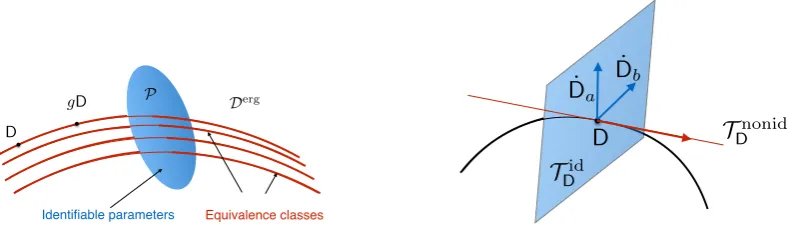
FIG. 2. Left panel: the space of ergodic dynamical parameters Derg as principle G-bundle over the base manifold P of identifiable parameters. Equivalence classes (red lines) of dynamical parameters
with identical outputs. Right panel: the tangent space at the pointDdecomposes as direct sum of the tangent space Tnonid
D to the orbit of the group action, and the space TDid of “identifiable directions”
defined by the identity E0
D( ˙D) = 0. The Markov covariance defines a complex structure and an inner
product onTid
D , such that the QFI rate isfa,b= 4Re( ˙Da,D˙a)D.
Section IV discusses the identifiability problem in the stationary setting, see Figure 2. We define an equivalence relation between dynamical parameters for which the stationary output states are identical for all timest. In Theorem 1 we show that two dynamical parametersDand D0 are equivalentif and only if they are related by the “gauge transformation”H0 =W∗HW+ r1 andL0i =W∗LiW, whereW is unitary andris a real constant. From a differential geometry
viewpoint, the space of identifiable parameters is the quotient P :=Derg/G, whereDerg is the
manifold of dynamical parametersDwith ergodic dynamics, andG=P U(d)×Ris the group of “gauge transformations” whose orbits are the equivalence classes of parameters. In particular, we show that Derg is a principalG-bundle over the base manifold P. The vertical bundle over
Derg consists of subspacesTnonid
“non-indentifiable” components (i.e. TD =TDnonid⊕ TDid), such a decomposition can be obtained from a principal connection, in a covariant way. A natural choice of connection is provided by the information geometry, as discussed below. This approach to system identification often appears in the classical setting, and the advantage is that one gains insight in the geometric structure of the parameter manifold, beyond the direct computation of the Fisher information. For instance, the connection can be useful for developing recursive estimation algorithms based on geodesics of the manifold35. For the standard theory of connections on principal bundles, see e.g.38.
In Section V we derive the information geometric structure of the statistical estimation problem at hand. Before discussing the statistical aspects, we describe the basic elements of a theory of “output fluctuations” which is essential for information geometry, but has an interest in its own and deserves to be further investigated. For each (k+ 1)-tuple of system operators
X= (X0, X1, . . . , Xk)∈M(Cd)k+1 we define the associated fluctuation operator FD,t(X) given
by the quantum stochastic integral
FD,t(X) =
1 √ t
Z t
0
i
k X
i=1
jD,s(Xi)dA∗i(s) +jD,s ◦ CD(X0)ds
!
, CD(X) := X−tr[ρDssX]1,
where jD,s(X) := UD∗(s)XUD(s) is the time-evolved operator X. The covariance of FD,t(X)
converges in the limit of large times, and defines a positive (but degenerate) inner product on M(Cd)k+1 (cf. Proposition 1 for the explicit formula)
(X,Y)D = lim
t→∞hFD,t(X) ∗
FD,t(Y)i.
Furthermore, in Propositions 1 and 2 we construct a linear map RD :M(Cd)k+1 →M(Cd)k+1
such that RD is a projection onto the subspace of operators of the form (0, Y1, . . . , Yk) ∈ M(Cd)k+1, and the kernel of R
D is the subspace of degenerate vectors of the inner product. With this definition, the inner product take the following simple form
(X,Y)D =
k X
i=1
trρDssRD(X)i∗RD(Y)i
.
We denote by ˙D= ( ˙H,L˙1, . . . ,L˙k) an element of the tangent spaceTD. Thereal linear mapXD defined below plays an important role in connecting fluctuation operators with the information geometry:
XD :TD →M(Cd)k+1
˙
D7→(ED( ˙D),L˙1, . . . ,L˙k) where ED is the map
ED :TD →M(Cd)
ED : ˙D7→H˙ + Im
k X
i=1
Here the second term in ED is due to quantum Ito calculus, hence in some sense represents the effects of the stochastic output on the information geometry. Using the map XD we define a real inner product on the tangent space TD
( ˙D,D˙0)7−→Re(XD( ˙D),XD( ˙D0))D.
Moreover, sinceXD is injective, we can use it to define a projection PD =XD−1◦RD◦XD acting on TD. Its kernel is the vertical space TDnonid whose vectors correspond to infinitesimal “gauge transformations”, and are the degenerate vectors of the inner product. The range ofPD consists of tangent vectors satisfying the condition ED( ˙D) = 0. In particular, since PD is a projection, the tangent space can be decomposed into “identifiable” and “non-identifiable” directions (see right panel of Figure 2)
TD = ranPD⊕kerPD =TDid⊕ TDnonid
whose statistical interpretation is discussed below. This split has also an interesting differen-tial geometric interpretation: the above tangent space decomposition, and inner product are covariant with respect to the action of the group G and define a connection on the resulting principal G-bundle, with the associated Lie algebra valued one-form
ωD :TD →g, ωD( ˙D) = (−iWD−1◦ CD◦ ED( ˙D),tr[ρDssED( ˙D)])
explicitly depending on the mapED( ˙D) containing the essential quantum Ito correction. More-over, the strictly positive inner product onTDid induces a strictly positive inner product on the tangent spaceT[D]to the point [D] in the base spaceP =Derg/Gof identifiable parameters. As
we will see below, this Riemannian metric is closely connected to the quantum Fisher infor-mation rate of the output state, so we will refer to it as the information geometry of the open quantum system, in analogy to the classical case2.
Let us consider now the problem of estimating the dynamical parameter D. Although the key constructions could be introduced in a “coordinate free” way, in order to emphasise the statistical aspects we choose to work with a given (but arbitrary) parametrisation θ 7→ Dθ
of Derg, where θ is an unknown parameter belonging to an open subset of Rm, with m := dim(Derg). At a given point D = D
θ ∈ Derg, we define the tangent vectors ˙Da := ∂D/∂θa =
( ˙Ha,L˙1a, . . . ,L˙ka) describing infinitesimal changes of the coordinate θa, for a = 1, . . . , m; these
vectors form a basis of the tangent space TD.
We consider now the m×m quantum Fisher information (QFI) matrix Fθ(t) associated to
the system-output state |Ψs+oD
θ (t)i. The QFI is proportional to the real part of the covariance matrix of (centred) “generators” G0
θ,a(t) of infinitesimal changes with respect to parameter
componentθa11. We show that the generatorG0θ,a(t) (normalised byt
afluctuation operator Ft(XD( ˙Da)), using the mapXD defined above. As consequence, the QFI grows linearly in time, and the QFI rate per time unit fθ = limt→∞Fθ(t)/t can be expressed
in terms of the Markov covariance as
fa,bθ = 4Re(XD( ˙Da),XD( ˙Db))D = 4Re(RDXD( ˙Da), RDXD( ˙Db))D = 4
k X
i=1
Re trhρDssL˙ia−i[Li,W−D1◦ ED0( ˙Da)]
∗
˙
Lbi −i[Li,WD−1◦ ED0( ˙Db)] i
.
whereWD is the Lindblad operator atDandED0 =CD◦ED. In particular, the Fisher information rate associated to directions in vertical bundle Tnonid
D (gauge transformations) is equal to zero as expected from the invariance of the output state. This follows from the fact that XD maps Tnonid
D into kerRD.
Above we saw that the real part of the Markov covariance (·,·)D defines a positive defi-nite inner product on the real space TDid. In fact, TDid can be made into a complex space by introducing the complex structure
JD :TDid → TDid
JD : ( ˙H,L˙1, . . . ,L˙k)7→
k X
i=1
Re ˙Li∗Li, iL˙1, . . . , iL˙k
!
. (1)
With this definition the mapXD becomes an isomorphism of complex spaces and (·,·)D defines a complex inner product on (Tid
D ,JD). Using the imaginary part σD of the inner product, we
define the canonical commutation relations (CCR) algebra CCR(TDid, σD) generated by Weyl operators with commutation relations
W( ˙D)W( ˙D0) = eiσD( ˙D,D˙0)W( ˙D+ ˙D0), W(−D˙) =W( ˙D)∗, D,˙ D˙0 ∈ TDid.
Following a standard construction we define the Fock representation and the coherent states |D˙i:=W( ˙D)|0i, where |0iis the vacuum stateh0|W( ˙D)|0i= exp(−( ˙D,D˙)D/2) This model will be interpreted below as limit of the output state model for large times.
Section VI details the above constructions in the case of special one dimensional models, and for a general multidimensional model for a two dimensional system.
In section VII we study the asymptotic statistical structure of the output state. The main result is the local asymptotic normality (LAN) Theorem 2 which shows that both the system-output state, and the stationary system-output state can be approximated by coherent states of the CCR algebraCCR(Tid
D , σD). Below we give a brief description of the result and its interpreta-tion.
Let us consider a parametrisation u7→ [D]u of (an open subset of) the space of identifiable
u v
s+o v/pt(t)
E
s+o u/pt(t)
E
System-output states at time t Limit Gaussian shift model
[image:9.595.167.465.61.150.2]t! 1
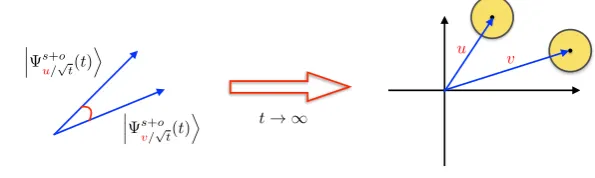
FIG. 3. Local asymptotic normality as weak convergence to the Gaussian limit. The inner products
of system-output states with local parameter u, v converge (uniformly) to the inner products of the corresponding coherent state|ui and |vi, in the limit of large times.
[D0] = [D]u=0. We define the time-indexed family of “local” statistical models
˜ Qt:=
n
ρoutu/√
t(t) :u∈ O ⊂R
dim(P)o
which consist of the output state for unknown parameter valuesu/√t in a shrinking ball of size scaling as the statistical uncertainty. The local model ˜Qt captures the asymptotic properties
of the quantum output state for parameters in a neighbourhood of [D0], and it can be justified
operationally by means of adaptive procedures whereby a “small part” of the output can be used to localise the parameter, while the “remaining part” can be used for estimating the local parameter u (cf.30 for a similar argument in the state estimation setup).
To define the system-output statistical model let us consider a horisontal section s : P → Derg of the principal bundle, i.e. the tangent space to s(P) at D is the horisontal space Tid
D . Let
Qt:=nΨs+ou/√t(t) E
:u∈ O ⊂Rdim(P)o,
be the quantum statistical model where
Ψs+o
u/√t(t) E
is the joint system-output state at time t at the dynamical parameter Du = s([D]u). The reasons for using a horisontal section in
defining the model are as follows. While the stationary output state depends only on the identifiable parameters in P, the system-output state is also sensitive to the location of the parameter within an orbit. It turns out that the asymptotic properties can be captured most transparently by choosing a horisontal section which sets certain unphysical phase factors to zero and allows us to understand the model directly in terms of the geometric properties of the vector state, as explained below.
Finally, we define the Gaussian model
G :=ρu :=|uihu|:u∈ O ⊂Rdim(P)
where |ui = W(PauaD˙a)|0i is the coherent state of the CCR algebra CCR(TDid0, σ
D0). By
which also is the QFI of the output state with respect to the local parameter u, rather than the “true” parameter u/√t.
The first version of LAN states that Qt converges (weakly) to G for large times in the sense
of convergence of the inner products (uniformly in u, v ∈ O), as illustrated in Figure 3
lim
n→∞
D
Ψs+ou/√
t(t) Ψs+ov/√
t(t) E
=hu|vi.
Since pure state models are fully characterised by the inner products, the convergence simply means that for large times the geometry of the system-output states is very similar to that of the coherent states. Although intuitive, this notion of convergence is not suitable for mixed states such as that of the output, and does not have a direct operational meaning. In the second version of LAN we show that the output models ˜Qt converge strongly toG in the sense
that there exist channels Tt and St such that
lim
t→∞supu∈O
Tt
ρoutu/√
t(t)
−ρu
1
= 0
lim
t→∞supu∈O
St(ρu)−ρoutu/√t(t)
1
= 0.
A concrete consequence of this “convergence to Gaussianity” is that the QFI computed above is asymptotically “achievable” in the sense that the estimation of dynamical parameters reduces to that of estimating a Gaussian displacement family with QFI equal tofa,b. Similarly to LAN
for ensembles of identical states30, the result implies that the optimal measurement is a linear
one (i.e. of homodyne and heterodyne type) and the errors are normally distributed. However, since this paper concentrates on the structure of the quantum states, the measurement and estimation procedures are not discussed here.
III. PRELIMINARIES ON QUANTUM MARKOV PROCESSES
We begin by introducing notations and necessary background about the input-output for-malism of continuous-time quantum Markov processes23. The formalism describes the joint
unitary evolution of an open quantum system interacting with a Bosonic environment in the Markov regime, cf. Figure 1. From this, one can derive the reduced (master) dynamics of the system, as well as the stochastic Schr¨odinger equations for quantum trajectories, describing the stochastic evolution of the system conditional on observations produced by a continuous-time measurement on the environment. However, in this paper we will be mainly interested in the output quantum state, i.e. the state of the environment after the interaction with the system.
Throughout the paper we assume the system to be finite-dimensional, with Hilbert space H = Cd, and associated algebra of observables A = M(
dynamics is specified by thesystem Hamiltonian H, together with thequantum jump operators L1, . . . , Lk. We denote these collectively by
D= (H, L1, . . . , Lk) = (H,L)∈ D:=Msa(Cd)×M(Cd)k,
and refer to each D∈ D as adynamical parameter, and to D as manifold (space) of dynamical parameters.
A. Environment as quantum noise.
In the Markov approximation, the interaction can be described as the unitary scattering of incoming vacuum Bosonic fields, caused by the continuous interaction with the system. The environment is modelled by k Bosonic channels whose Hilbert space is the Fock space
F :=F(hk) = C|Ωi ⊕
∞
M
l=1 h⊗sl
k
where hk := L2(R+)⊗Ck is the one particle space of the k channels, and |Ωi is the vacuum
vector. Similarly, we denote by F(a,b) the Fock space over L2((a, b)) ⊗Ck. For each time
t, the symmetric Fock space decomposes as tensor product F = F(0,t)⊗ F(t,∞) between the
space of excitations up to time t (the past) and after time t (the future). The fundamental environment degrees of freedom are the annihilation and creation operators of the ith channel Ai(f) :=A(|fi ⊗ |ii) and respectively A∗i(g) := Ai(g)∗, which are defined in a standard way46
for all |fi,|gi ∈L2(
R+), and satisfy the commutation relations
[A∗i(g), Aj(f)] = Imhf|giδi,j1.
In particular, we will deal with the annihilation and creation processes Ai(t) := Ai(χ[0,t]) and
A∗i(t), where t ∈ R+ represents time23,46. These processes are the quantum analogue of the
“classical” Wiener process and can be used to define quantum stochastic integrals of the form
I(t) =
Z t
0
k X
i=1
Mi(s)dAi(s) +Ni(s)dA∗i(s)
+P(s)ds
whereMi(s), Ni(s), P(s) aretime-adapted operator valued integrands, i.e. they are of the form
X(s)⊗1[s,∞) with respect to the decompositionF =F(0,s)⊗ F(s,∞). Quantum stochastic
inte-grals can be formally multiplied, and the productI1(t)I2(t) of two such integrals is a stochastic
integral whose increment is given by
d(I1(t)I2(t)) = dI1(t)·I2(t) +I1(t)·dI2(t) +dI1(t)·dI2(t) (2)
where the third terms is theIto correction which can computed by using the quantum Ito rule
dAi(t)dA∗j(t) = δi,jdt (3)
B. Interaction as input-output scattering.
We now introduce the coupling between system and the Bosonic environment, and the corresponding unitary evolution. Each dynamical parameter D = (H,L) determines a unique continuous family UD(t) of unitary operators (cocycles) describing evolution of the system and environment in the interaction picture with respect to the free evolution of the fields, the latter being given by the second quantisation of the right shift on L2(R). The unitaries are defined as the solution of the quantum stochastic differential equation (QSDE)
dUD(t) =
k X
i=1
(Li⊗dA∗i(t)−Li∗⊗dAi(t))−iHeff ⊗1Fdt
!
UD(t), (4)
with initial condition UD(0) = 1. Here, Heff is the effective Hamiltonian Heff := H −
i
2
Pk i=1Li
∗Li which generates a semigroup S
D(t) = e−itHeff of contractions on the system’s space, and describes the evolution of the system between consecutive quantum jumps. The imaginary part 2i Pki=1Li∗Li is the Ito correction which insures that UD(t) is unitary. For sim-plicity of notation, from now on we will omit the tensor product and simply write Li⊗dA∗
i(t)
as LidA∗i(t), an similarly for other integrands.
If the system is initialised in state |ϕi and the input fields are in the vacuum state|Ωi, then the state of the system together with the output after time t is given by
|Ψs+oD (t)i=UD(t)|ϕ⊗Ωi=VD(t)|ϕi, (5)
where VD(t) :H → H ⊗ F is a family of isometries defined by the second equality. Theoutput state is the state of the scattered field modes after the interaction with the system, and is obtained by tracing out the system
ρoutD (t) = trH[|Ψs+oD (t)ihΨs+o(t)|].
Let us denote by jD,t(X) :=UD(t)∗(X⊗1F)UD(t) the Heisenberg evolved system operator X. Using equation (4), we find that the operators satisfy the quantum Langevin equation
djD,t(X) = X
i
jD,t([X, Li])dA∗i(t) +jD,t([Li∗, X])dAi(t)
+jD,t(WD(X))dt. (6)
where
WD(·) =−i(·)Heff +iHeff∗ (·) +
k X
i=1
Li∗(·)Li
is called the Lindblad generator. Its significance can understood by considering the reduced Heisenberg evolution of the system TD,t : A → A defined by taking the expectation over the
environment
From (6) we find dTD,t(X) = dhΩ|jD,t(X)|Ωi= WD(TD,t(X)) which means that TD,t is a trace
preserving completely positive semigroup with generator WD. The generator is said to be ergodic, if it has a unique stationary state ρDss (i.e. [WD]∗(ρDss) = 0) which has full rank. In this
case19
lim
t→∞TD,t = limt→∞
1 t
Z t
0
TD,sds= tr[ρDss(·)]1. (8)
Since we are interested in the long-time asymptotic properties of the output state, we assume that the dynamics has reached stationarity, or equivalently that the initial state of the system is ρDss. In this case the output state is time-stationary and is given by
ρoutD (t) = trH[UD(t)(ρDss⊗ |ΩihΩ|)UD(t)
∗
]. (9)
Since ρDss is a stationary state, the range of WD is included in
BD
0 ={X |tr[ρDssX] = 0}.
By ergodicity,1 is the only fixed point ofetWD, and hence ker(
WD) is spanned by 1∈ B/ D0. This
implies that the range has dimension d2−1 = dimBD
0, i.e. WD is surjective onto BD0, and the
restriction ofWDontoB0Dis injective. HenceWDis invertible onBD0, and we letW −1
D :B0D → B0D
denote the inverse. Furthermore, the following limit exists:
−W−D1 = limt→∞
Z t
0
TD,sds. (10)
IV. IDENTIFIABILITY OF CONTINUOUS QUANTUM MARKOV
PROCESSES
This section deals with the problem of characterising the equivalence classes of Markov dynamics with identical stationary output states. We restrict ourselves to ergodic Markov processes, although similar results are expected to hold more generally. Similar results have been obtained in31 fordiscrete time quantum Markov processes.
Let Derg denote the open submanifold of D consisting of dynamical parameters for which the associated Markov process is ergodic; this will be the relevant parameter set for subsequent considerations. Note that Derg is indeed an open subset of D since ergodicity (i.e. non-zero
spectral gap and full rank stationary state) is preserved under small perturbations.
Of course, the same equivalence can be formulated for arbitrary parameters in D. However, it turns out that when restricted toDerg, the equivalence classes have a simple characterisation
in terms of the following transformations:
(PM) Phase conjugation on the Hamiltonian:
(H, L1, . . . , Lk)7→(H+r1, L1, . . . , Lk), (r∈R).
(UC) Conjugation by system unitary W:
(H, L1, . . . , Lk)7→(W∗HW, W∗L1W, . . . , W∗LkW).
Indeed, it is easy to verify that (PM) and (UC) do not change the output of the associated continuous Markov process. The following Theorem shows that the converse is also true. The details of the proof can be found in Appendix VIII.
Theorem 1. Let D,D0 ∈ Derg. Then Dand D0 are output-equivalent if and only if they can be
obtained from each other via the transformations (UC) and (PM).
The interpretation of the result is that parameters along the equivalence classes described by the transformations (UC) and (PM) are not identifiable, while the identifiable parameters are “transversal” to these classes, as illustrated in Figure 2. It is now convenient to formulate the equivalence classes in terms of an action of the appropriate Lie group G:=P U(d)×R. On Derg we use transformations (PM) and (UC) to set up the action:
G× Derg → Derg
(g,D)7→gD:= (W∗HW, W∗L1W, . . . , W∗LkW) +a(1,0, . . . ,0), (11) g = (W, a)∈P U(d)×R, D= (H, L1, . . . , Lk)∈ Derg.
Here P U(d) = U(d)/U(1) is the projective unitary group, equipped with its unique Lie group structure, and the above action is defined as the natural lift of the corresponding one forU(d). The reason to useP U(d) instead of U(d) will become clear from the proof of the Lemma below. The above theorem implies that the equivalence class [D]∈ P is the orbit of D∈ Derg under the action ofG, such that P can be identified with the quotient Derg/G. The following lemma
which relies on the ergodicity assumption, is essential for understanding the structure of the quotient, as we will see below. In order to avoid confusion with the output equivalence, we identify W ∈P U(d) with a representative unitary operator without explicit indication.
Proof. The action defined via (11) is clearly smooth with respect to W, and a, hence its lift to the quotient Lie group P U(d)×R is smooth as well. Since the group P U(d) is compact, and the rest is just a translation, it follows from elementary arguments that the smooth map G× Derg → Derg× Derg given by (g,D) 7→ (gD,D) is proper, i.e. preimage of every compact set is compact. This means that the action is proper. In order to show that the action is free, we need to use ergodicity as follows: suppose that gD=g0D for some D, and g = (W, a), g0 = (W0, a0); then a direct computation similar to the one in the proof of Lemma 2 in Appendix shows that WD(W∗W0) =i(a−a0)W∗W0. Since ergodicity requires
lim
τ→∞e
iτ(a−a0)W∗
W0 = tr[W∗W0ρss]I,
we must have a = a0 and W∗W0 a multiple of the identity. But this exactly means that W equals W0 as an element of the projective unitary group; hence g = g0. This proves that the action is free.
The fact that the group action preserves the equivalence classes, that is gD ∈ [D] for all D ∈ Derg, can now be formulated in differential geometric terms. Indeed, using the standard
theory of Lie group actions on manifolds, we conclude from the above Lemma that the space of output equivalence classes
P ={[D] : D∈ Derg}=Derg/G
admits a unique smooth structure such that the quotient map π:Derg→ P
π(D) = [D], for all D∈ Derg,
is a submersion, and Derg is a principalG-bundle over P38. Here the equivalence classes [D] are
considered as fibres of the fiber bundle over the base manifold P, that is, the map π has the local triviality property: each [D]∈ P has an open neighbourhood U such that there exists a diffeomorphism
φ :π−1(U)→U ×G,
which is G-equivariant, i.e. φ(gD) = gφ(D) where Gacts onU ×G asg([D], g0) := ([D], g0g−1). The term principal G-bundle refers to the fact that the group action preserves the fibres.
We can now use this differential geometric framework to describe local changes of identifiable parameters, via the tangent bundle T of the manifold Derg. In particular, the non-identifiable parameter changes along the equivalence classes correspond to the vertical bundle over Derg
with the fibres
Tnonid
where π∗|D is the push-forward tangent map of the canonical projection π at point D, and TD is the full tangent space at that point.
The group action is reflected in two ways at the level of tangent spaces. On the one hand, given any fixedg ∈G, the push-forwardg∗ of the map D7→gDmaps the fibres into each other
as
g∗TDnonid =TgnonidD .
This push-forward is simply obtained by differentiating the parameters in the standard chart
g∗( ˙H,L˙1, . . . ,L˙k) = (W∗HW, W˙ ∗L˙1W, . . . , W∗L˙kW), g = (W, a).
On the other hand, for any fixed D, the push-forward of g 7→gD defines a Lie algebra isomor-phism
D∗ :g→ TDnonid, (12)
so that different fibres all have the same dimension, which is that of the Lie algebra g. We can now explicitly compute this action. First of all, the Lie algebra of G can be conveniently written as
g={(−iK, r)|K ∈Msa(Cd)/R1, r ∈R}={(−iK, r)|K ∈Msa(Cd), tr[ρssK] = 0, r∈R},
(13) where the choice of the sign as well as the last identification is for later convenience. In particular, the subspace of non-identifiable directions is in one-to-one correspondence with this linear space. From this we already find the number of non-identifiable directions:
dimTDnonid =d2−1 + 1 =d2.
We stress that this result is crucially based on ergodicity, which ensures that the action is free; this is required for the push-forward D∗ to be an isomorphism. Now D∗ acts on an element
X = (−iK, r)∈g as
D∗(X) =
d
dt(exp(t(−iK, r))D)|t=0 = d
dt (e
itKHe−itK, eitKL1e−itK, . . . , eitKLke−itK) +t r(1,0, . . . ,0)| t=0
= (i[H, K], i[L1, K], . . . , i[Lk, K]) +r(1,0, . . . ,0). (14)
Having now characterised the vertical bundleTnonidof non-identifiable directions, an obvious
question arises: is there a natural way to choose complementary subspaces for identifiable directions in each fibre? This means choosing subspacesTDid such that
If the subspaces are chosen smoothly, i.e. so as to define a fibre bundle TidoverDerg, the result is called a horizontal bundle Tid, and in case it respects the group action, that is
g∗TDid =TgidD, (15)
it defines an principal connection on the manifold Derg.
There is a natural way of defining a principal connection via its associated connection one-form; since this approach turns out to be relevant in our situation, we briefly explain the idea in the general level. As we have shown above, any ˙D∈ Tnonid
D can be generated by the action of the Lie algebra; ˙D = D∗(X) for some X ∈ g. Now suppose that we can associate to every
tangent vector ˙D ∈ TD an element ωD( ˙D) ∈ g which somehow describes the “part” of the parameter that results from the non-identifiable group action. Such a map should define a one-form ωD :T → gsatisfying the compatibility condition (sometimes called nondegeneracy)
˙
D=D∗(ωD( ˙D)), D˙ ∈ TDnonid, (16)
and theG-covariance condition
g∗ω= Adg−1 ◦ω, (17)
where g∗ is the pull-back of the action by g on the cotangent bundle, which simply acts as g∗ω( ˙D) = ωgD(g∗D˙) = ωgD(W∗DW˙ ) for g = (W, a), and the adjoint action is given by Adg−1(X) = (W∗XW, r+a).
Given such a map, we can then define the ”back-action”D∗◦ωD on the tangent space; due to the above compatibility condition, the back-action is a special projection of the tangent space onto the subspace Tnonid
D . Hence, we can use its complementary projection
PD := Id−D∗◦ωD
to define the above horizontal bundle and the associated principal connection via
Tid
D := ranPD.
Indeed, the condition (15) holds because of (17). The mapω is called theconnection one-form, and P is the horizontal projection.
V. INFORMATION GEOMETRY FOR DYNAMICAL PARAMETER
ESTIMATION FROM THE OUTPUT STATE
Our goal is to describe quantitatively the precision with which unknown dynamical param-eters can be estimated by making measurements on the output state. As noted above, we will restrict our attention to dynamical parameters Dwhich belong to the open subset Derg of D of
ergodic Markov dynamics. As we will consider this problem in the limit of large times, the rel-evant dynamical regime is the stationary one; moreover, the statistical properties of the output state can be understood locally, by focusing on a shrinking neighbourhood of the parameter manifold Derg whose size is of the order of the statistical uncertainty13,31. This will lead to the concept of local asymptotic normality discussed in section VII. In this section however, we focus on the information geometry of the system identification problem, more precisely on the quantum Fisher information matrix of the output state and its asymptotic behaviour, and its relationship with the covariance of certain quanta stochastic integrals called “fluctuation operators”. We will start by introducing the latter in a general set-up and then show how the former fits in this theory.
Section V A derives the quantum Fisher information of the system-output state as covari-ance of certain “generators”; section V B analyses more general “fluctuation operators” and looks at their Markov covariance; section V C deals with the information geometry structure, and connects the previous constructions, in particular it provides an explicit expression of the quantum Fisher information; section V D constructs an algebra of canonical commutation re-lations (multimode continuous variables system) and a family of coherent states which will be relevant later on for the local asymptotic result.
A. Quantum Fisher information of a parametric model
We pass now to a statistical setting where the dynamical parameter D is considered to be unknown. The changes in Dare encoded in its (partial) derivatives ˙D= ( ˙H,L˙1, . . . ,L˙k), which
will be seen as vectors in the tangent space TD to Derg at the point D. Since the dynamics is ergodic, the system converges to a unique stationary state ρDss for large times, and we will denote by h·iss the expectation with respect to the state ρDss⊗ |ΩihΩ|. In this subsection we
consider a generic statistical model and analyse the quantum Fisher information (QFI) of the output state; we will show that the QFI grows linearly with time and the rate can be expressed in terms of the Markov covariance inner product introduced below. Let
be a smooth family of dynamics parametrised by an unknown parameterθ ∈Rm which may be thought to encode our prior knowledge about the dynamics. In this subsection we work with this parametrisation, and hence identify Dθ with θ for simplicity. Note that this could be a
complete parametrisation of Derg. The directional derivatives of Dθ are defined as
˙ Dθ,a:=
∂H ∂θa ,∂L 1 ∂θa
, . . . ,∂L
k
∂θa
= ( ˙Hθ,a,L˙1θ,a, . . . ,L˙kθ,a)∈ TDθ.
Recall that the QFI of an arbitrary multiparameter (smooth) family of pure states |ψθi with
θ ∈Rm, is them×m positive real matrix with elements11
Fa,bθ = 4Re
∂ψθ ∂θa ∂ψθ ∂θb − ψθ ∂ψθ ∂θb ∂ψθ ∂θa ψθ
, 1≤a, b≤m.
We apply this formula to the output state |Ψs+oθ (t)i := Uθ(t)|ϕ ⊗Ωi generated with a θ
-dependent dynamical parameter Dθ, cf. equation (9). By differentiating with respect to θa we
get
Uθ∗(t) ∂ ∂θa
Ψoutθ (t) =Uθ∗(t) ˙Uθ,a(t)|ϕ⊗Ωi, U˙θ,a(t) :=
∂Uθ(t)
∂θa
. (18)
We will now show that the generator −iGθ,a(t) := Uθ∗(t) ˙Uθ,a(t) can be written as a quantum
stochastic integral. From (4) we have
dUθ∗(t) =Uθ∗(t) X
i
(−LiθdA∗i(t) +Lθi∗dAi(t))−(−iHθ+
1 2
X
i
Liθ∗Liθ)dt
!
,
dU˙θ(t) = X
i
( ˙Liθ,adA∗i(t)−L˙θ,ai∗ dAi(t))−(iH˙θ,a+
1 2
X
i
( ˙Liθ,a∗ Liθ+Liθ∗L˙iθ))dt
!
Uθ(t)
+ X
i
(LiθdA∗i(t)−Lθi∗dAi(t))−(iHθ+
1 2
X
i
Liθ∗Liθ)dt
!
˙ Uθ(t).
Therefore, by applying the Ito rule (3) we get
dUθ∗(t)·dU˙θ,a(t) = Uθ(t)∗ X
i
Liθ∗L˙iθ,aU(t) +LiθU˙θ(t)
dt.
and using (2) we obtain an explicit differential expression for the generator
dGθ,a(t) = id(Uθ∗(t) ˙Uθ,a(t))
=iX
i
jθ,t( ˙Liθ,a)dA
∗
i(t)−jθ,t( ˙Lθ,ai∗ )dAi(t)
+jθ,t H˙θ,a+ Im X
i
˙ Liθ,a∗ Liθ
!
dt
=iX
i
jθ,t( ˙Liθ,a)dA
∗
i(t)−jθ,t( ˙Lθ,ai∗ )dAi(t)
+jθ,t
Eθ( ˙Dθ,a)
dt (19)
where Eθ =EDθ is the real linear map ED :TD →Msa(C
d) given by
ED( ˙D) := ˙H+ Im
k X
i=1
˙
Later on we will see that this map turns out to play a crucial role in the construction of the horizontal bundle for the identifiable parameters, and in the definition of the CCR algebra in section V D.
The QFI can be written in terms of the covariance matrix of the generators Gθ,b(t)
Fa,bθ (t) = 4Re hϕ⊗Ω|G∗θ,a(t)Gθ,b(t)|ϕ⊗Ωi − hϕ⊗Ω|G∗θ,a(t)|ϕ⊗Ωihϕ⊗Ω|Gθ,a(t)|ϕ⊗Ωi
.
where the second term stems from the fact thatGθ,b(t) have non-zero mean. The generators are
in fact not uniquely defined: since dAi(t) annihilates the vacuum state, arbitrary annihilation
integrals can be added, while terms proportional to the identity produce only unphysical com-plex phases which do not change the state. We will therefore define a modified (non-selfadjoint) generator which “centres”Gθ,b(t) for large times, and lacks annihilations terms so that it is
con-sistent with the definition of “fluctuation operators” introduced in the next subsection. The modified generator is given by the quantum stochastic integral with differential form
dG0θ,a(t) = i
k X
i=1
jt( ˙Liθ,a)dA
∗
i(t) +
jθ,t(EDθ( ˙Dθ,a))−Tr
ρDssEDθ( ˙Dθ,a)
dt. (21)
By ergodicity, its rescaled mean converges to zero
lim
t→∞
1
thϕ⊗Ω|G
0
θ,a(t)|ϕ⊗Ωi= 0
For large times, the QFI matrix elements scale linearly with t and the leading contribution is given by the quantum Fisher information rate
fa,bθ := lim
t→∞
Fa,bθ (t)
t = limt→∞
1
t4Rehϕ⊗Ω|G
0∗
θ,a(t)G0θ,b(t)|ϕ⊗Ωi. (22)
In the next section we prove the linear scaling and find an explicit expression of the QFI rate.
B. Fluctuation operators and the Markov covariance form
Our goal is now to formulate the QFI rate (22) in terms of certain quantum fluctuation operators, and subsequently compute it using quantum stochastic calculus. These fluctuation operators can be formulated in a slightly more general setting, which is naturally complex linear instead of real linear, and is also independent on the mapED special to our setting. The dynamical parameter D will remain fixed throughout the section.
Recall that for any X ∈ M(Cd) we let jD,t(X) denote the Heisenberg evolved system
observable defined by the Langevin equation (6). For an arbitrary (k + 1)-tuple X := (X0, X1, . . . , Xk) ∈ M(
quantum stochastic integral
FD,t(X) =
1 √ t
Z t
0
i
k X
i=1
jD,s(Xi)dA∗i(s) +jD,s◦ CD(X0)ds
!
, (23)
where the map
CD(X) := X−tr[ρDssX]1
“centers” the stationary mean of FD,t(X) to zero:
hFD,t(X)iss =
1 √ t
Z t
0
tr[ρDssTD,s(X0−tr[ρDssX
0]1)]ds = √1
t
Z t
0
tr[ρDss(X0−tr[ρDssX0]1)]dt= 0.
The proof of the following crucial result is based on quantum Ito calculus, and can be found in the Appendix.
Proposition 1(Markov covariance for fluctuation operators). The following limit exists, is independent of the unit vector|ϕi ∈ H, and defines a positive sesquilinear form (·,·)D on the complex linear space M(Cd)1+k via
(X,Y)D := lim
t→∞hϕ⊗Ω|FD,t(X) ∗
FD,t(Y)|ϕ⊗Ωi= k X
i=1
trρDssRD(X)i∗RD(Y)i
,
where
RD(X) = (CD(X0), X1, . . . , Xk)− LD◦W−D1◦ CD(X
0), and
LD(X) = WD(X), i[L1, X], . . . , i[Lk, X]
.
We call (·,·)D the Markov covariance inner product.
From this proposition it is clear that the map RD plays a central role; in particular, since ρDss has full rank, the kernel of the Markov covariance coincides with kerRD. Also the range of RD turns out to be relevant. These subspaces can be characterised explicitly as follows.
Proposition 2. The operator RD is a projection, i.e. R2D =RD, with range and kernel
kerRD =
(WD(K) +r1, i[L1, K], . . . , i[Lk, K])
K ∈M(Cd), r∈C ,
ranRD =
n
0, Y1, . . . , Yk Y1, . . . , Yk ∈M(Cd)
o
.
Proof. First of all,X∈kerRDif and only ifXi =i[Li,W−1(X0−tr[ρDssX0]1)] for alli= 1, . . . , k.
Since tr[ρDssWD(K)] = 0 for any K, the given form of the kernel follows. The range is clear from the definition, and the property R2
C. Markov covariance from a principal connection
We now proceed to show how the Markov covariance is naturally associated with a specific horizontal bundle for the principal G-bundle Derg, and we also define a Riemannian metric on the manifold Derg. In order to motivate this, we continue the the discussion from subsection
V A. Indeed, the modified generator (21) can be expressed as a fluctuation operator
G0θ,a(t) = √tFt(XD( ˙Dθ,a)),
where we have used the suggestive notation XD for the real linear isomorphism
XD :TD →Msa(Cd)×M(Cd)k (24)
˙
D= ( ˙H,L˙1, . . . ,L˙k)7→(ED( ˙D),L˙1, . . . ,L˙k), (25) where M(Cd)k is now considered as a real linear space with dimension 2kd2, while Msa(Cd) is
naturally a real linear space. Therefore, using the explicit expression provided in Proposition 1, we obtain the following expression of the QFI rate (22) in the coordinates D =Dθ used in
subsection V A:
fa,bθ = 4ReXD[ ˙Dθ,a], XD[ ˙Dθ,b]
D
= 4
k X
i=1
Re trhρDssL˙iθ,a−i[Liθ,W−D1◦ ED0( ˙Dθa)]
∗
˙
Lθ,bi −i[Liθ,WD−1◦ ED0( ˙Dθb)]
i
, (26)
where E0
D =CD ◦ ED. The QFI rate inherits the positivity property of the Markov covariance, but also the fact that it may not be positive definite. In conclusion, the real part of the form
( ˙D,D˙0)D := (XD[ ˙D],XD[ ˙D0])D (27) has a natural interpretation in terms of the output Fisher information. Its explicit form (see Proposition 1) suggests the definition of the following projection on the tangent bundle over Derg:
P :T → T, PD =XD−1◦RD◦XD. (28)
Indeed, the bilinear form essentially depends on this projection:
( ˙D,D˙0)D =
k X
i=1
tr
h
ρDss[PD( ˙D)i]∗PD( ˙D0)i
i
.
In order to understand the intuitive meaning of PD, we now proceed to make a fundamental observation concerning the relation between the push-forward map D∗ defined in (12), and the
map ED defined in (20):
This relation has appeared before in a different context3. In order to verify it, we recall that D∗(−iK, r) = (i[H, K] +r1, i[L1, K], . . . , i[Lk, K]), so that
ED(D∗(−iK, r)) =i[H, K] +r1+
1 2i
k X
i=1
(i[Li, K])∗Li−Li∗(i[Li, K])
=r1+i[H, K]− 1 2
k X
i=1
[K, Li∗]Li+Li∗[Li, K]
=r1+iHK−iKH−1 2
k X
i=1
(KLi∗Li−Li∗KLi+Li∗LiK−Li∗KLi)
=r1−iK H− i 2
X
i
Li∗Li
!
+i H+ i 2
X
i
Li∗Li
!
K+X
i
Li∗KLi
=r1+WD(K).
Equation (29) is the key to defining the horizontal bundle for the identifiable parameters. Indeed, we get the following crucial result:
Proposition 3 (Principal connection). The map ω :TD →g, defined by
ωD( ˙D) = (−iW−D1◦ CD◦ ED( ˙D),tr[ρDssED( ˙D)]),
is the one-form of a unique principal connection onDerg, having PD as its horizontal projection. In particular, PD = Id−D∗◦ωD, with the vertical subspaces kerPD = ranD∗ =TDnonid, so this
connection is compatible with the vertical bundle defining the ”non-identifiable directions”.
Proof. We first verify the important relation PD = Id−D∗◦ωD. DenoteK =W−D1◦ CD◦ ED( ˙D) and r = tr[ρDssED( ˙D)], so that CD(ED( ˙D)) = WD(K). On the one hand, using the formulas of RD and LD in Proposition 1, we get
RD(XD( ˙D)) =RD(ED( ˙D),L˙1, . . . ,L˙k) =
CD(ED( ˙D)),L˙1, . . . ,L˙k
− LD
W−D1(CD(ED( ˙D))
= (WD(K),L˙1, . . . ,L˙k)− LD(K) = (0,L˙1 −i[L1, K], . . . ,L˙k−i[Lk, K]).
On the other hand, ωD( ˙D) = (−iK, r) by definition, so using the formula (14) of the push-forwardD∗, we get
(Id−D∗◦ωD)( ˙D) = ( ˙H−i[H, K]−r1,L˙1−i[L1, K], . . . , Lk−i[Lk, K]). The crucial equation (29) givesED(D∗(ωD( ˙D))) =WD(K) +r1, and hence
ED
˙
D−D∗(ωD( ˙D))
=ED( ˙D)−r1−WD(K) = CD(ED( ˙D))−WD(K) = 0. Consequently,
XD
˙
D−D∗(ωD( ˙D))
showing that XD◦(Id−D∗◦ωD) = RD◦XD. By the definition ofPD in (28), this implies that PD = Id−D∗◦ωD.
For a given X = (−iK, r) ∈ g we can clearly find ˙D such that r = tr[ρDssED( ˙D)] and CD(ED( ˙D)) =WD(K), and hence the range of the one-formωD fills the whole Lie algebra. Fur-thermore, we can easily verify the compatibility condition (16), and G-covariance (17) follows from the fact that
EgD(g∗( ˙D)) =W∗ED( ˙D)W, ρgssD =W
∗
ρDssW, g = (W, a)∈G, (30)
which is straightforward to check. This completes the proof.
With this result we therefore achieve the aim described at the end of section IV by defining the subspace of the identifiable directions to be the horizontal subspace:
Tid
D := ranPD={D˙ | E( ˙D) = 0}.
The associated split TD = TDnonid ⊕ TDid now follows immediately from the general theory; in particular, the number of identifiable parameters is
dimTDid = 2kd2.
As a consequence of the G-invariance of the horizontal projection, the form (·,·)D on TD is G-invariant in the sense that
( ˙D,D˙0)D = (g∗D, g˙ ∗D˙0)gD, D,˙ D˙0 ∈ TDid, g ∈G. (31) Hence, this form only depends on the equivalence class, so its real part determines a unique bilinear form on the base manifold P. Moreover, it also only depends on the horizontal projec-tion PD( ˙D) of the tangent vectors; hence it becomes nondegenerate on the horizontal bundle, thereby defining a Riemannian metric on the base manifold P.
We emphasise that the principal connection (together with the stationary state), completely determines the metric and the associated Fisher information. In this way the connection pro-vides geometric insight on how the (in practice rather complicated) expression of the Fisher information arises; for a discussion on a classical analogy, see e.g.35. We demonstrate this in a
concrete example in section VI below.
D. Symplectic structure and CCR-algebra for identification
In Proposition 1 we defined the Markov covariance on the complex linear space M(Cd)k+1, and used the real linear maps
to induce an associated real inner product (·,·)D on the identifiable part of the tangent space, cf. equation (27); up to a constant factor, this inner product is the QFI rate. It is then natural to ask if the imaginary part of the Markov covariance has any physical interpretation. We will show that the latter can be used to define an algebra of the canonical commutation relations (CCR) over the real space of identifiable parameters Tid
D , which will play the role of limit Gaussian model in the next section.
On the real linear space TDid={D˙ | ED( ˙D) = 0}= ranPD we now define a complex structure via
JD :TDid → TDid
JD : ( ˙H,L˙1, . . . ,L˙k)7→
k X
i=1
Re ˙Li∗Li, iL˙1, . . . , iL˙k
!
. (32)
Using the property thatED( ˙D) = 0 for all vectors ˙D∈ TDid, it is easy to check thatJD satisfies the defining property of a complex structure on Tid
D , i.e. JD2 = −Id. Furthermore, since PD =X−D1◦RD◦XD, we immediately see from Proposition 2 that
XD[JD( ˙D)] =iXD[ ˙D] = (0, iL˙1, . . . , iL˙k), D˙ ∈ TDid,
that is, the map XD is compatible with the natural complex structure of M(Cd)k+1. In fact,
this is the only way of defining a complex structure on Tid
D in such a way that the restriction of XD to TDid is a complex linear map.
When endowed with the complex structureJD, the spaceTDidbecomes a complex linear space; this is Hilbert space with respect to the inner product induced by the Markov covariance:
( ˙D,D˙0)D:=
XD( ˙D), XD( ˙D0)
D, ˙
D,D˙0 ∈ TDid. (33) The real part of this form gives the Riemannian metric and QFI rate on the real linear tangent spaceTid
D as discussed above. In addition, the imaginary part can be used to construct a repre-sentation of the canonical commutation relations (CCR) overTid
D , together with a distinguished Fock state whose statistical interpretation is discussed in section VII.
Definition 2 (CCR algebra for identifiable parameters). Let (TDid,JD) and ( ˙D,D˙0)D be the complex linear space, and respectively inner product defined above. On Tid
D we define the symplectic form
σD( ˙D,D˙0) := Im( ˙D,D˙0)D =
k X
i=1
Im tr[ρDssL˙∗iL˙0i]
We define the CCR algebra CCR(Tid
D , σD) generated by unitary Weyl operators W( ˙D) with ˙
D∈ Tid
D satisfying the relations
On CCR(TDid, σD) we define the Gaussian stateϕdetermined by the characteristic function
ϕ(W( ˙D)) =e−81fD( ˙D,D˙)
where
fD( ˙D,D˙0) := 4Re( ˙D,D˙0)D = 4Re
X
i
tr[ρDssL˙∗iL˙0i]. (34)
By a standard construction47, the CCR algebra can be represented on the Fock space F
D over the Hilbert space (TDid,JD,( ˙D,D˙0)D), in such a way that that ϕ(W( ˙D)) = h0|W( ˙D)|0i, where |0i ∈ FDis the vacuum state, and the Weyl operatorsW( ˙D) can be written in terms of canonical quadrature operators Qj, Pj satisfying the Heisenberg form of the CCR [Qk, Pk0] =iδkk01.
In order to explicitly find such a representation, we need to choose a symplectic basis {D˙1, . . . ,D˙2m} of TDid (recall that m = dimTDid = 2kd2) which is also compatible with the complex structure. This means that fD( ˙Dj,D˙j0) = δjj0 for all j, and JD( ˙D2j+1) = ˙D2j+2,
σD( ˙D2j+1,D˙2j0+1) = σD( ˙D2j+2,D˙2j0+2) = 0, σD( ˙D2j+1,D˙2j0+2) = δjj0 for j = 0, . . . , m −1.
We then define the canonical operators Qj, Pj as generators of the one-parameter groups
W(uD˙2j+1) = e−iuPj and W(uD˙2j+2) = eiuQj. In the generic case, the basis will depend
smoothly on the coordinates.
A fairly canonical choice for the basis is obtained by first defining the rank-1 matrices
Ej;l =
1
p
pD
l
|jihϕDl |,
wherepDl andϕDl ,l = 1, . . . , d are eigenvalues and eigenvectors of the stationary state, counted according to their multiplicities. We then define
˙
Di;j;l:= (−ImEj,l∗ L
i,0, . . . ,0, E
j;l,0, . . . ,0)∈ TDid
for each i = 1, . . . , k and j, l = 1, . . . , d, where the nonzero element in the middle is at the ith place. Then JD( ˙Di;j;l) = (ReEj,l∗ Li,0, . . . ,0, iEj;l,0, . . . ,0), and it is easy to check that
{D˙i;j;l,JD( ˙Di;j;l)} is a symplectic basis compatible with the complex structure, and depends
smoothly on the coordinates (since the stationary state does), except possibly at some special points. However, the explicit expressions of these vectors are often rather lengthy and compli-cated. In the two-parameter example below we will demonstrate the geometry using a more tractable basis.
VI. EXAMPLES OF PARAMETRIC MODELS
To illustrate the general theory we analyse several examples of one-parameter and multi-parameter models.
A. One parameter models
LetDθ := (H, e−iθL) be a one-parameter family, where we have chosenm= 1 for simplicity.
The corresponding one-dimensional tangent vector atDθ=0is ˙D= (0, iL).By applying equation
(18) we find that the corresponding generator has differential equation
dGθ(t) = k X
i=1
[jt(L)dA∗(t) +jt(L∗)dA(t) +jt(L∗L)dt] (35)
Then E0
D( ˙D) = (−L∗L+hL∗Liss1), and XD( ˙D) = (ED0( ˙D), iL). The QFI rate is fθ = 4tr
h
ρDss L+ [L,W−1(L∗L− hL∗Liss1)] 2i
.
Physically, this transformation can be implemented by placing a phase-shifter in each output channel, which gives each photon a phase shift eiθ44. This phase parameter is identifiable, and
it is easy to see that
|Ψs+oθ (t)i= exp(−iθN(t))|Ψs+o(t)i
where N(t) is the counting process associated to the number of photons up to time t in the Bosonic environment. Equivalently, this can be written asU∗(t)|Ψs+oθ (t)i= exp(−iθNout(t))|φ⊗
ΩiwhereNout(t) :=U(t)∗N(t)U(t), is the output number of photons operator, whose
differen-tial form is
Nout(t) =dN(t) +jt(L)dA∗(t) +jt(L∗)dA(t) +jt(L∗L)dt. (36)
By comparing (35) and (36) we see that the two generators are not identical. However, the difference is the term dN(t) which annihilates the vacuum state, so the resulting action of the generators is identical. This illustrates that in general the generator is not unique but one can add terms which annihilate the vacuum, such as annihilation or number operator terms.
The second example we consider is that of the coupling constant, where Lθ = θL, with
unknown parameter θ ∈ R. The tangent vector is ˙D := (0, L), and E0
D(T) = 0. Therefore,
XD( ˙D) = (0, L) and the QFI rate is
f = 4trρDssL∗L.
In the third example we consider the model where the hamiltonian is known up to a mul-tiplicative constant Hθ = θH. The tangent vector is ˙D := (H,0), and ED0(T) = H − hHiss.
Therefore,XD( ˙D) = (H− hHiss,0) and the QFI rate is
4tr ρDss[L,W−1(H− hHiss)]∗[L,W−1(H− hHiss)]
.
B. Simplest multiparameter setting
The geometric aspects are naturally trivial in a one-parameter model. In order to illustrate the full use of the theory developed above, we now consider the simplest nontrivial setting with d = 2 and k = 1, that is, Derg is the open subset of {(H, L) | H ∈ M
s(C2), L ∈ M(C2)}
consisting of ergodic dynamical parameters. The dimension of this manifold is 12, and the number of identifiable parameters is 8. Hence, full treatment of this simplest setting is still rather tedious, and we settle for looking at points on a physically relevant submanifold, extended suitably so as to allow for the full description of the relevant geometry. The model is the following 7-dimensional submanifold:
H∆,Ω,v =
1 2
∆ Ω +v1−iv2
Ω +v1+iv2 −∆ +v0
, Lα,θ,v=αeiθ
(iv1−v2)/α2 1 +iv0/α2
0 (−iv1+v2)/α2
.
Here the three parameters v are auxiliary, and the rest have physical meaning at v = 0. In fact, we are looking at the off-resonant laser-driven two-level system with Rabi frequency Ω and detuning ∆, in contact with a zero-temperature heat bath, with emission rateα2, and emitted
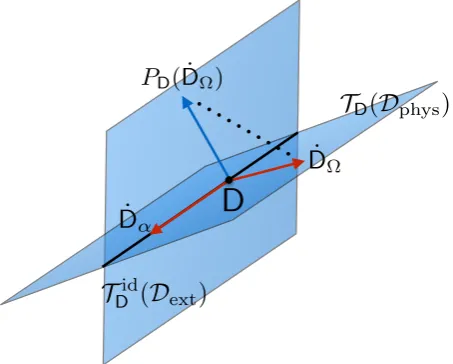
photons monitored on the environment. In addition, we include the above discussed phase shift θ to the emitted photons. The auxiliary parameters are chosen such that their tangent vectors lie in the identifiable subspace at v= 0; their span is needed in order to describe the horizontal projections of the physical tangent vectors, as we will see below.
The quantum Fisher information associated with the three parameters (∆,Ω, α) of this model has been compared with particular measurement strategies22; we emphasise geometric
aspects not discussed there, and have also included the phase parameter θ. The main idea is to demonstrate how the rather complicated expressions of the Fisher information arise from considerably simpler geometric ingredients as a result of straightforward linear algebra. This provides insight on the structure of the physical system from the operational identification point of of view, and may eventually be useful in developing global estimation strategies in analogy to classical cases (see e.g.35).
Accordingly, we let Dext denote the whole (extended) 7-dimensional manifold, and Dphys =