W
estern
Europe
a
nd
Computers
September, 1963
____
.
E
~.'.
....
.
...--~~
:
:
:.:
:. :
..
:
:
:
.U3.4800 7300 ORIG -'" • 5/62
~ ..
YOU DON'T HAVE TO SAY A WORD
to send great masses
of business data to any location by telephone. New Bell System
DATA-PHONE
service is the reason why.
Machines do the talking - 16 times faster than people can talk.
Almost any kind of word or figure data in any amount can be
transmitted immediately any time you want-at regular telephone rates.
There's no faster, safer and more economical way to
ship data than by
DATA-PHONEservice. Have a talk with
one of our 'Communications Consultants about it. Just
call your Bell Telephone Business Office and ask for him.
,)
The front cover shows number
0/
computers installed per million0/
the working population (adjusted)on January 1, 1962.
Arti~les and features relating to computers in Western Europe appear ill this isme
all pages 5, 6, JO, 16, and 20.
©@CFLFUCQJl10f0~~~
mU-U@
m(1~\0@u-liLlC!J\0D
@U-U
SEPTEMBER, 1963 Vol. XII, No.9
editor and publisher
EDMUND C. BERKELEY
assistant editors
MOSES M. BERLIN NEIL D. MACDONALD LINDA LADD LOVETT
contributing editors
ANDREW D. BOOTH NED CHAPIN JOHN W. CARR, III ALSTON S. HOUSEHOLDER PETER KUGEL
advisory committee
T. E. CHEATHAM, JR. GEORGE E. FORSYTHE RICHARD W. HAMMING ALSTON S. HOUSEHOLDER HERBERT F. MITCHELL, JR.
associate publisher
PATRICK J. MCGOVERN
production manager
ANN B. BAKER
art director
N. DORF
circulation manager
VIRGINIA A. NELSON, 815 Washington St. Newtonville 60, Mass., DEcatur 2-5453
advertising representatives
New York 18, BERNARD LANE 37 West 39 St., BRyant 9-7281 Chicago II, COLE, MASON AND DEMING 737 N. Michigan Ave., SU 7-6558 Los Angeles 5, WENTWORTH F. GREEN 300 S. Kenmore Ave., DUnkirk 7-8135 San Francisco 5, A. S. BABCOCK 605 Market St., YUkon 2-3954 Elsewhere, THE PUBLISHER 815 Washington St., DEcatur 2-5453 Newtonville 60, Mass.
computers and data processors: the design, applications, and implications
0/
in/ormation processing systems.
liz This Isstle
10 THE DEVELOPMENT OF THE COMPUTER MARKET IN EUROPE (Part 1) by W. K. de Bruijn, A. B. Frelink, and B. Scheepmaker
16 THE CURRENT STATE OF THE COMPUTER FIELD IN BRITAIN
by R. H. Williams
20 A SURVEY OF NEW WEST·EUROPEAN DIGITAL COMPUTERS (Part 1) by Joseph L. F. De Kerf
26 DESIGN OF A REAL·TIME PROGRAMMING SYSTEM
by R. J. Coyle and J. K. Stewart
35 ELECTRONIC COMPUTERS AND SCIENTIFIC RESEARCH (Part 2)
by Stanislaw M. Ulam
In Every Issue
across the editor's desk
41 COMPUTING AND DATA PROCESSING NEWSLETTER
5
6 6
7 7 7 7 7
51
52 57
58
54
58
editorial
Number of Computers Per Million Persons
readers' and editor's
/OI'IIJ1iMagnetic Ink Character Recognition in Europe
"Information Processing in the Nation's Capital" - One-Day Sympo-sium, October 17, 1963, College Park, Md.
Call for Papers Correction
Changing from Eleven to Twelve Issues Per Year Communication to the subscription Department Basic Programming Language
Calendar of Coming Events
reference information
Monthly Computer Census
Books and Other Publications, by Moses M. Berlin New Patents, by Raymond S. Skolnick
index of notices
Who's Who in the Computer Field Advertising Index
COMPUTERS AND AUTOMATION IS PUBLISHED MONTHLY AT 815 WASHINGTON ST., NEWTONVILLE 60, MASS., IIY BERKELEY ENTERPRISES, INC. PRINTED IN U.S.A. SUBSCRIPTION RATES: UNITED STATES, $15.00 FOR 1 YEAR, $29.00 FOR 2 YEARS, INCLUDING THE JUNE DIRECTORY ISSUE; CANADA, ADD SOc A YEAR FOR POSTAGE; FOREIGN, ADD $1.50 A YEAR FOR POSTAGE. ADDRESS ALL EDITORIAL AND SUBSCRIPTION MAIL TO BERKELEY ENTERPRISES, INC., 815 WASHINGTON ST., NEWTONVILLE 60, MASS. SECOND CLASS POSTAGE PAID AT BOSTON, MASS.
POSTMASTER: PLEASE SEND ALL FORMS 3579 TO BERKELEY ENTERPRISES, INC., 815 WASHINGTON ST., NEWTONVILLE 60, MASS. © COPYRIGHT, 1963, BY BERKelEY ENTERPRISES, INC. CHANGE OF AD-DRESS: IF YOUR ADDRESS CHANGES, PLEASE SEND US BOTH YOUR NEW ADDRESS AND YOUR OLD ADDRESS (AS IT APPEARS ON THE MAGAZINE ADDRESS IMPRINT), AND ALLOW THREE WEEKS FOR THE CHANGE TO BE MADE.
"We've found
Extra Length Computer
Audiotape
definitely superior"
says Kenneth Sassaman, Data Processing Manager for Blue Shield Medical Service Association of Pennsylvania
With 41/2 million subscriberswe process thousands of claims everyweek. Beforewe
used Extra Length Computer Audiotape we frequently had to interrupt our claims
payment runs to change reels because our program requirements exceeded 2400-ft. tape lengths.
These frequent reel changes often caused print-out errors. But now we process all our claims on
Extra Length Computer Audiotape and save time with less reel mounting and dismounting.
With 50% more tape on the same size reels we require fewer tapes to store ,the same amount of
information. As a result, we have less dollar value tied up in tape. We put the new tapes into
operation in an existing program without making any modifications. In over six months of heavy
use we haven't had a single permanent
read-w~itefailure. We've had no problems
with the tape. We've found Extra Length Computer Audiotape definitely superior.
Extra Length Computer AUdiotape uses a l-mil "Tempered Mylar"* base instead of conventionall.5-mil polyester film. As a result you get 1800 ft. on 8Yz-inchreels, 3600 ft. on 1 OYz-inch reels. Although thinner, the new tape is slightly stronger than 1.5-mil tapes. Like all Computer Audiotape, the new tape is 100% certified against defects and is offered with certification of 556 and 800 bits per track-inch. For addi-tional information on Extra Length Computer Audiotape and regular Computer Audiotape, in Standard and Heavy Duty types, contact your local representative or write to Audio Devices,Dept.
·OUPONT TRADEMARK FOR ITS POLYESTER FILM.
c&a
EDITORIAL
Number of Computers Per Millioll Persolls
Elsewhere in this issue is an interesting report to the European Economic Community by three Netherlanders, W. K. de Bruijn, A. B. Frelink, and B. Scheepmaker, on behalf of the Netherlands Automatic Information Pro-cessing Research Centre in Amsterdam. In this report, among other ideas, is the statistic or index: number of computers per million persons of the working population (with or without agricultural and fishery workers). The index at the end of 1961 varies from about 18 in Austria, to about 36 in Germany, Belgium, and France, to about 68 in SWitzerland, and 118 in the United states.
Of course this index suffers from the lack of an agreed and comparable definition of "computer." But even so, the figure is interesting, and gives rise to sev-eral questions.
How high is this index now in the United States?
The Monthly Computer Census published in "Compu-ters and Automation" shows total installations of compu-ters for the manufacturers there reported; but it is not subdivided according to the country where the computer is installed. Suppose we estimate that 80% of the 15, 000 installations reported there are in the United States. Sup-pose the applicable working population of the United States is taken as about 67 million. Then this index for the Uni-ted States currently is about 180 computers per million persons.
How high will this index go in the future?
The future is a long time. Perhaps we had better talk about the next 30 years.
In the next 30 years (a period 50 percent longer than the 20 years that have seen the existing development of computers) a great many important new developments can be confidently expected.
The power of computers is increasing. The cost of them is decreasing. The size of them is decreasing. The number of kinds of applications -- over 600 now (see the list in the June Computer Directory issue of "Computers and Automation") -- is steadily increasing. rIlle ways in which they can be used are becoming more and more un-derstood and more and more convenient. The size of the computer field in factories, workers, etc., is bounding upward. Packaged programs are multiplying.
COMPUTERS and AUTOMATION for September, 1963
All these factors will greatly increase the number of computers, certainly by a factor of 10, probably by a fac-tor of 100, and perhaps by a facfac-tor of 1000.
Even in our own small business which publishes "Computers and Automation," in which we employ twenty people full-time and part-time, we have two applications for computers: about 50 hours of clerical work per month dealing with figures, and about 300 hours of clerical work per month dealing wi th subscriptions. These small quanti-ties of work to be done by a computer do not at present justify paying to get the problems into machine language and the results back out of machine language. But it is clear that these are temporary obstacles, and they may well disappear in the next 10 years; almost certainly,
they will disappear in the next 30 years.
The cheaper that computing power becomes, including the costs of going into a computer and coming back out of a computer, the more sensible it will be for one to use a computer. The computer will be either in one's own prem-ises or at a neighboring service bureau.
Just as electrical power permeates all advanced civi-lizations today, so will computing power.
In fact, I would estimate that the index of number of computers per million persons will change to an index of number of computers per thousand persons, and in the United States by the end of the next 30 years, will be on the order of 100 to 200 computers per thousand persons. In other words, by the end of the next 30 years, I would estimate that the index should multiply by 1000.
If we think over. similar technological developments in the last 100 years, there come to mind telephones, auto-mobiles, radios, and TV. Probably something like 40 million cars are on the roads in the United States, cor-related with a working population of some 70 million. Or one car for every two persons working. Individual com-puters, it seems to me, are not likely to become quite as frequent as this, but computing power will become acces-sible to almost everyone. And in a great many cases a small, cheap, easily instructed, powerful computer at one's elbow will be more comfortable and convenient than dialing into a central computer.
We have only seen the beginning of the computer revolution.
MAGNETIC INK CHARkCTER RECOGNITION
IN EUROPE
D. Hekimi
Secretary-General
European Computer Manufacturers Association Geneva, Switz.
In the July, 1963 issue of Computers and Automation, Dick Utman g:lve a complete and extremely interesting re-view of the state of affairs of standardization in the com-puter field.
However I should like to add some remarks on the
.M ICR situation in Europe.
There is in Europe no European Bankers Association (e.g., comparable to ABA). The Reunion Europeenne d'Automa:tisme (REA) is a body grouping only a number of private bank associations. This group has proposed to its members to adopt the CMC-7 system, originally by the Comp:lgnie des Machines BULL, but not at all based on BULL equipment. Numerous other manufacturers have developed suitable CMC-7 readers. This system has so far
b~(n adopted by French, Italian and Danish bankers only.
It is by no means a Common Market Standard, the more so since such a class of standards does not exist.
The ECMA working Committee TC7 is now preparing-a se,t of specifications which will allow a rapid introduction of CMC-7 in the banking industry. It is hoped that by the end of this year the full specification for the printed image of a complete alphanumeric set will be achieved.
It is expected that this proposal will be supported by all
memben of our
auoci.ation."INFORMATION PROCESSING IN THE
NATION'S CAPITAL"-ONE-DAY SYMPOSIUM,
OCTOBER 17, 1963, COLLEGE PARK.; MD.
J.
H. NicholsBethesda, Md.
The Washington, D. C., Chapter of the Association for Computing Machinery and the University of Maryland, co-sponsors of the 4th Annual One-Day Technical Sym-posium, have announced that the Symposium w.ill convene in the Ballroom of. the. Student Union Building on the College Park campus (near Baltimore) of the University of Maryland at 9:00 A.M. on Thursday, October 17, 1963.
The program includes significant reports on recent
de-c&a
READERS'
&
EDITOR'S ,FORUM
vclopments by leading members of the information-process-ing community. Topics include time sharinformation-process-ing, programminformation-process-ing languages, list processing, information retrieval, automatic indexing and classification of documents, satellite data processing, character recognition, and a panel discussion "Our Resources in Information Processing-Where Are the Gaps?"
Dr. Alan J. Perl is, President of the ACM, will deliver an address "An Experimental Time-Sharing System." The Honorable Roman C. Pucinski, Representative from Illi-nois, will deliver the luncheon address. He is Chairman of the House of Representatives Ad Hoc S.ub~Committee on a Research Data Processing and Information Retrieval Center. "The Thinking Machine," a movie featuring Dr. Jerome B. Wiesner and many other authorities in the computer fi.eld, will be shown.
Other papers being given include:
-List Processing on the IBM 1401, by A. Opler, Com-puter Usage Co.
-A Discussion of Chemical Information Searching Problems, by E. C. Marden, National Bureau of Standards
-A\ltomatic Indexing and the Association Factor, by H. E. Stiles, Dept. of Defense
-'-Experimental Results of a Discrimination Method for Automatically Classifying Documents, by J. H.
Williams, IBM
-Programming Languages: a Classification of Fea-tures, by W. Orchard-Hays, Systems Programming, Inc.
-Data Processing for the Orbiting Geophysical Ob-servatory Satellite, by E. Habib and M. Mahoney, Goddard Space Flight Center
-Character Recognition in Context, by R. B. Thomas and M. Kassler, RCA
Because of the extensive interest in Congressman Pu-cinski's luncheon . address, pre-registration will be RE-QUIRED for the luncheon. Luncheon registration will not be available at the door. The following schedule of fees has been established:
Pre-Registration
Symposium and Luncheon $5.00 Symposium only $2.50
Late Registration (at the door) Symposium only $3.00
1
-For additional information, write to
J.
H. Nichols, Dun· lap and Associates, Inc., 7220 Wisconsin Avenue, Bethesda 14, Maryland.CALL FOR PAPERS
The fifth Joint Automatic Control Conference will be held at Stanford Univ., Stanford, Calif., Ju.ne 24·26, 196,1. The deadline for receipt of 100-word abstracts is Septem· ber 30, 1963. The deadline for receipt of full abstracts is November 15, 1963. Prospective.authors who are not memo bers of the sponsoring societies are also invited to submit abstracts. They should be marked "For 1964 lACC" and sent to: IEEE, 345 East 42 St., New York 17, N. Y.
CORRECTION
I. From Paul W. Howerton Information for Industry, Inc.
Washington 6, D. C.
Thank you for the reprints of Dr. Leon E. Dostert's paper which appeared in the May issue of Computers and
Automation.
I was surprised to find that you failed to indicate that the article had been reproduced by permission of th~ copy-right owner, Information for Industry, Inc., and had ap-peared originally in "Vistas in Information Handling, Vol. I-The Augmentation of Man's Intellect by Machine." The reprints imply that you hold the. copyright to Dr. Dostert's work.
Your original request for permission to reprint the article dated March 20, 1963 and addressed to Dr. Dostert sug· gested that the reprinting of the pape,r would draw atten-tion to the book.. In my letter of March 26, 1963 I ap-proved your request and took note of the possible benefit to the book sale. I fail to se,e how such attention can be gained when the source of the original is uncredited.
Please rectify this omission by including this letter in your "Letters to the Editor" column.
II. From the Editor
Through a most unfortunate error, the May issue of Computers and Automation on page 24 omitted the ac-knowledgment that Dr. Dostert's article "Machine Transla-tion and Automatic Language Data Processing" was re-printed with permission from the book "Vistas in Informa-tion Handling, Volume I-the Augme.ntaInforma-tion of Man's In-tellect by Machine," edi[e(l by Paul W. Howerton and David C. Weeks, and published by Spartan Books, 6411 Chillum Place, N.W., Washington 6, D. C. That page of the May issue should have borne a note beginning "Re-printed with permission from" the foregoing reference. We greatly regret this error.
Distressing errors like these remind us once more of Murphy's Laws quoted in the "Scientific American," April, 1956, as applying not only to laboratories but also to editors;
I. If something can go wrong, it will.
II. When left to themselves, things always go from bad to worse.
III. Nature always sides with the hidden flaw. The whole book "Vistas in Information Handling" is interesting. It contains nine papers by··nine authors, on such subjects as conceptual frameworks, associative infor-nutian retrieval, structural models of linguistic automation, the classification and identification of homographs, and the prod uction of. cri tical scien tific da tao
COMPUTERS and AUTOMATION for September, 1963
CHANGING FROM ELEVEN TO TWELV'E
ISSUES .. PER YEAR
I. From Stephen E. Laurens Cincinnati, Ohio
lllve be,en a subscriber of yours for a little less than a year, and I would like you to know that I consider your publication an excellent and highly informative one. I would like to make two requests of you:
First, at the time I entered my subscription, I chose. not to receive your June Computer Directory and Buyers' Guide. I now sec the error of my ways, and would very much like to have a copy of your latest one. Could you sdl me one? I f so, please send it and bill me.
Secondly, could you send me information on your ad-vertising rates? I am particularly interested in the "per column inch" rate for those pages divided into three col-umns.
II. From the Editor
To change a subscription from eleven issues per year of Computers and Automation leaving out June, to all twelve issues per year including the regular June, Computer Di-rectory and Buyers' Guide costs theoretically the price of the Directory by itself, $12.00. But during July in each year we invite. our non-directory subscribers to include the Di-rectory issue into their subscription at no surcharge, simply the difference ($7.50) between the $7.50 and the $15.00 an-nual subscription rates. In practice, during the rest of the year, if any subscriber sees a copy of the Directory and promptly writes us and says please may he change, we would be much inclined to make the change at no sur-charge.
COMMUNICATION TO THE SUBSCRIPTION
DEPAItTMENT
1\1. W. BliSS
Uni\'ll(~ DiviMiull uf Sperry Itlllul
'VIIMhill~l()n, D. C~
Apparently there arc two listings for me ill your record file. Under CA 7877, "Remington Rand" was changed to "UNIVAC, Division of Sperry Rand" on 2-year renewal in March, 1963. Current file, number is CA 14343 and previ-ous is obsolete. Please update accordingly and don't worry about my dropping your informative magazine.
BASIC PROGRAMMING LANGUAGE
ON
,
Ol:s:-"We've done our best to keop 010 programming within tho avorago stenographor's capabilities. "
When
~s
•
ONE better than FIVE?
Oftentimes we're asked about the best procedure to be followed when a person
contemplates changing his position. We feel it is very important that a person select
ONE professional agency to represent him; ONE agency interested in his abilities
and his needs.
,:~*Naturally , we think McGovern Senter & Associates is the ONE.
Director -
Digital Data Systems
-40k
Direct activities including comF'{land and control,
collec-tion, processing and transmitting of data for space
vehicles, data collection systems for military and
non-military applications.
Computer Design
-18k
Digital logic, counter circuits, transistorized circuits
-BSEE required, 5-10 years experience.
Computer Systems Analyst
-16k
Analysis concerned with large scale digital computer
operational design for military application.
Space Systems Analyst
-15k
Analytical studies relating to space systems or missiles
projects. Apply mathematical techniques to probability
and statistics to system trade-off studies.
Intelligence Processing Programmer
-14k
Problem analysis, block diagramming, flow charting,
instruction writing and coding in machine language for
problems on 705 or 1401 computers.
Operational Programmer
-16k
Responsible for design of real-time information retrieval
computer programs for command control systems computer
systems.
The staff of the McGovern Senter Professional Placement Center, a
company-sponsored service, is comprised of professional people, most of whom have graduate
degrees and many years experience. (Their business is to serve the professional
man in a professional manner).
• David W. Currier
• Edward
L
Benedict, Jr.
Director Executive Search
Engineering-Administration
• Russell D. Brown
Specia I Sea rch
• William T. Lawson
Engineering
Roger C. Senter
.. William O. Uraneck
Engineering-Administration
• Paul F. Copp
Field Recruiting
• Charles S. Langenfeld
Scientists
Joseph A. McGovern
For further information on the above positions, please contact Dept. 103.
McGOVERN SENTER
&
ASSOCIATES, INC.
134 Main Street, Stoneham, Mass.
The McGovern Senter Professional Placement Center is located
just off Boston's famed Electronics Highway -
Route 128 at
Exit #36S.
AFFILIATED OFFICES NEW YORK, SAN FRANCISCO, LOS ANGELES
REQUEST INVENTORY Sf AT US ITEM 121,684
LOCATION CODE 128 ON HAND 62 ON ORDER 48 AVERAGE t10Nl'HLY USAGE 50
ECONOMlC ORDER QUAlll'lTY 125
VENDOO CODE 16
ANSWERS ...
with CRAM and Remote Inquiry
provided
by
the
NCR 315
Computer
System
The NCR 315 CRAM (Card
Ran-dom Access Memory) Computer
System is more than just another
back-office electronic accounting
machine.
In industry, for example, Inquiry
Units can be located at dozens of
remote locations, enabling people
to communicate with the computer
files ... even from hundreds of miles
away. With the NCR 315 you will
be able to keep a "current finger"
on the pulse of your business ... to
get immediate answers to questions
about inventories, production, sales
... and a host of other timely facts
people must have to effectively
manage .... and to act while the
"iron is hot."
.
For more information, call your
nearby NCR representative or write
to The National Cash Register
Company, Data Processing Systems
. and Sales, Dayton 9, Ohio.
NCR PROVIDES TOTAL SYSTEMS - FROM ORIGINAL ENTRY TO FINAL
REPORT-THROUGH ACCOUNTING MACHINES, CASH REGISTERS OR ADDING MACHINES, AND DATA PROCESSING
Number of computers on order per one million of the working population exclusive of agricultural and fishery workel's as of January 1, 1962.
CJ
..
6 TO[JJ
129
180
...
Z4
•
30 " 36W. K. de Bruijn,
A. B. Frelink, and
B. Scheepmaker
Nethe1'lands Automatic Information Processing
Research Centre
Amsterdam, Netherlands
Though the first computers in Europe came into use sometime about 1951-the EDSAC at Cambridge and the FERRANTI MARK I at Manche.ster-and the first on the continent round 1954" in a discussion of the development of computer application the year 1957 can be considered
th~ st:lrting point. The development in Great Britain was about two yc.ars ahead of that on the continent due to the colllilluous strain during and after the second world war alld the establishmcnt of a-native computer industry. The first colllputers werc inherently built for scientific calcu-lations. Th~ first 'so,called business computer-the LEO
cOlllput~r devclop2d by Lyons-was not operational before
1953. At the end of 1956 and in the beginning of 1957 the first administrative machines were i.nstalled on the
con-10
THE
DEVELOPMENT
OF THE
COMPUTER
MARKET
IN
EUROPE
(Part 1)
tinent. These were machines of the IBM-650 type. From that moment the development was such that the number of compute.rs installed at the end of each year was 160 to 220 per cent of the number at the beginning of that year. The dates of instalment of the machines are often not exactly known and very difficult to retrace, if only through the fact that the date of instalment given by the rrianufacturer often lies many months ahead of the date mentioned by the user. In extreme cases the difference is as much as six months.
(Based on a report "Development of the European Computer Market," prepared by the Centre at the request of the European Economic Communi~y, and reproduced with permission)
The trend in the use of computers is approximately as shown in Table I. Though these figures suggest a certain gradual development, in practice this was not so. During the first years this might indeed have been the case. In those years there were only a few types of machines avail-able and of those, already so sball in number, some were offered in only one single country, or, at any rate, not in all European countries. Most 9f tile British types w.ere hardly sold outside the Commonwealth, just as nearly all the originally European types were not available outside, the countries where they were manufactured. Examples are: ZUSE, SIEMENS, STANDARD ELECTRIC (Germany), SEPSEA (France), OLIVETTI (Italy) and FACIT and WEGEMATIC (Sweden. Besides the most important USA types (IBM and RE'MINGTON), till then BULL (France) and ICT (Great Britain) were the only manufacturers who were able to gain a part of any importance of the market. In the last two years a clear change has been taking place: many manufacturers are now trying to conquer a market outside their own countries as well. The difficulty, however, in obtaining experts and trained staff proves a serious obstacle when trying to set up branches in other countries. Besides the efforts of European manufacturers, USA producers have recently increased competition in the European markets. NCR and RCA, like IBM and SPERRY RAND, are very active, RCA mainly through agreements with European manufacturers. For some time also HON-EYWELL (in Great Britain) and GENERAL ELECTRIC (in France) have established outposts in Europe.
Rapid progress has been made in the last two years, in the first place due. to the introduction of the IBM 1401.
This machine, which came on the market in 1959, was at once enormously successful and caused a peak in orders. Deliveries began in the second half of 1960 and got weJI under way in 1961. In 1962 also a large number of ma-chines of this type were installed, but the climax is now over, causing a considerable change in the ratio of com-puters installed and on order. It may be assumed that by the end of 1962, at least 40% of all computers installed in Europe were of this type, of which a total in Europe of more. than 1000 were ordered; some of these have still to be delivered in 1963.
Factors that have played a more or less important part in this development, include these:
-the existence of a computer industry in the country concerned. This factor was mainly of importance in Great Britain, but in Germany also the presence of a manufacturer as ZUSE appeared to be significant, especially when certain applications (in this case cadastral work) proved successful;
-the existence of heavy industry and precision indus-try. They are in fact an important group of buyers who need both business data processing and scien-tific calculations by computers. More,over, those companies are often sufficiently large and have enough financial capacity to be able to acquire these expensive machines;
Table I
-the existence of organizations which stimulate this development, either by supplying information or by providing opportunities for the exchange of experi-ences and ideas. Examples are: The British Com-putex Society (Great Britain), The Netherlands
Au-Computers installed in Europe at the end of:
1955
1956
1957
1958
1959
1960
1961
European Economic
5
15
55
135
250
470
985
Community
Great Britain
20
35
75
130
170
240
340
Rest of Western
Europe
_ _
5
--1Q
~
---2§.
100
220
Europe
25
55
140
300
485
810
1545
The development in the separate European Economic Community countries during the
last 5 years has been approximately as follows:
Computers installed at the end of:
1957
1958
1959
1960
1961
Belgium/Luxemburg
5
10
20.
35
65
Germany
20
45
85
170
390
France
15
35
60
125
260
Italy
10
25
55
100
200
Netherlands
_ _
5
--.£Q
~
40
--1Q
European Economic Community
55
135
250
470
985
tomatic Information Processing Research Centre (Holland), and the Comite d'Action pour la Produc-tivite dans I'Assurance (CAPA) (France). The latter organization is only interestl.!d in the insurance field: -labor shortage and the level of wages can also have a considerable influence on the development. These factors had considerable influence in Switzerland and Sweden especially;
-the fear of a recurrence of the crisis of the 1930's and coupled with it the need to put companies in as strong a position as possible, was an important factor in Germany especially.
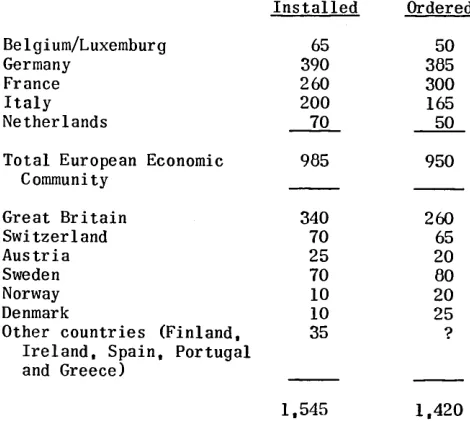
The situ:ltion at the end of 1961, which will be the starting point of the forecast for the coming years, is shown in Table· II. This starting point is not so definite as one might wish, since the data used are not altogether reliable, nor in every respect comparable. Unlike other types of machines, there is no common measure by which the ca-pacity of computers can be expressed. The borderline be-tween computers and conventional information processing equipment (calculating machines, etc.) is not drawn alike by all concerned. The figures about the number of com-puters installed and on order have be.en given as accurately and as completely as possible, all available sources having been considered. To indicate that, nevertheless, the.y have no absolutely reliable value, the numbers have been rounded off to muhiples of 5.
Table II
Computers Installed and Ordered -- End of 1961
Belgium/Luxemburg
Germany
France
Italy
Netherlands
Total European Economic
Community
Great Britain
Switzerland
Austria
Sweden
Norway
Denmark
Other countries (Finland.
Ireland. Spain. Portugal
and Greece)
Installed
65
390
260
200
---1SL
985
340
70
25
70
10
10
35
1.545
Ordered
50
385
300
165
~950
260
65
20
80
20
25
?1.420
In order to get an insight into the meaning of the data on computers installed and on order in the several coun-tries, see Table III showing the computer situation at the e,nd of 1961 as compared with the population data for 1960. (The population data are taken from several sources, such as the "Statistisches J ahrbuch fur die Bundesrepublik Dtutschland 1960," the "Demographic Yearbook 1959 U. N." and data from the Netherlands Central Bureau of Statistics.)
This table clearly shows that the situation differs widely from country to country. Especially when one looks at
th~ Jlumher of computers per 1,000,000 of the working population, marked differences are to be seen. The leading coun tries arc Switzerland and Sweden. The explanation
s~cms to be tint in these countries especially the situation
on the labor market is most critical, so that automation is as it we.re enforced by lack of personnel. Also remarkable
12
are the arrears of Great Britain as compared with most of the EEC countries. The cause of this can be found partly in the intermittent development which is almost traditional in this country, and partly in the fact that automation starte.d earlier here, and so many companies are now in a stage of transition to bigger and more modern machines. This, however, can at the moment not yet be seen in the numbers of computers ordered. The late arrival of Ameri-can manufacturers on the British market may also be a cause of the arrears in Great Britain. Although there is an important native computer industry, the production capacity is not as great as it may appe.ar.
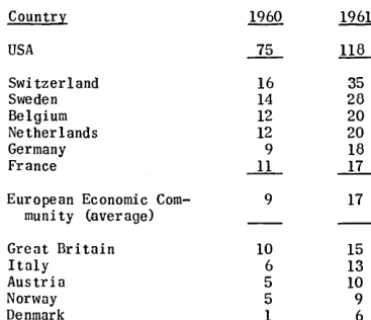
For the change from 1960 to 1961 in computers installed per 1,000,000 of the working population, see Table IV. Switzerland and Sweden show the greatest progress, while Sw.itzerland is clearly the leading country. The increase in the Swedish figure is even surpassed by the increase in the Danish one, this country rapidly making up its arrears. The situation in the USA, based upon the census of John Diebold Associates shows the following figures:
Installed' at the end of 1960: 4718 machines Installed at the end of 1961: 7445 machines Converted into a comparison between the number of ma-chines and the working population exclusive, of agricul-tural and fishery workers in 1959 (63.2 million), it shows per 1,000,000 of this population in 1960, 75 computers and in 1961, 118 computers. When the USA figures are com-pared to those of Europe, it is clear that the le.ad of the USA is still very considerable. It may be estimated at five years.
The contrast between USA and EEC is remarkable, tak-ing into account the only slight difference in population figures between the two entities. When comparing these figures for 1960 and 1961, it is indeed striking that the percentage progress in the. European countries is much higher than in the USA. In several European countries it is more than 100 per cent, whereas in the USA there has been a progress of not even 60 per cent. It has, however, to be taken in to accoun t tha t a progress' of 60 per cent in the USA in absolute figures means a much larger number of machines (2727) than in Europe (1510 - 848
+
662).It will certainly be a long time before Europe has made up its arrears in this respect. It is indeed a question whether this will even be possible as long as the discrepancy be-tween the rate of exch:mge and the buying power of the dollar on the one h:md and the rate of exchange of the European currencies on the other is still as large as it is now. This discrepancy is of importance here, because most of the computer. prices in Europe are still based upon dol-lars and so, relatively, the same machine is considerably more expensiv~ ,ill ~urope t~an in the USA.
THE' EXTENT TO WHICH THE SEVERAL BRANCHES OF INDUSTRY ARE USING COMPUTERS AND THE EXPECTATIONS
REGARDING FUTURE USE
When one tries to get an insight into the extent to which the several sectors of society have progressed in the field of automation, we can reasonably classify as follows:
A. Universities, scientific institutions, technical high schools;
B. Insurance companies (private as well as social insur-ance);
C. Transport; D. Service centers; E. Industrial companies; F. Trading concerns;
G. Banks and Clearing agencies; H. Public utilities;
I. Governmental institutions; J. Local governmen t;
[image:12.612.51.286.350.562.2]SECTORS THAT ARE OR WILL BE ENGAGED IN A UTOMA TION
A. Universities
This was one of the first tgroups to use computers. Many universities are now in possession of a small scientific rna· chine. Within the EEC 67 universities are known to have togdher 109 machines. W'hen we add to this the scientific institutions of which some are directly or indirectly con· nected with universities, the figures mentioned risc to 123 institutes and universities with a total of 182 machines. Of these 182 machines 97-more than half-may be called
smaller scientific machines (for instance ZEBRA, CAB 500, ZUSE 22, LGP 30, IBM 1620). The great variety of rna· chines is striking; the 182 consist of 34 differe.nt types, the nine self·built machines not included, so that the total is actually 43 different types. The types most common are ZUSE 22 (24), CAB 500 (20), IBM 650 (19) and IBM 1620 (18). Of each of fifteen types only one, institute is using them, and the number of none of the types not mentioned exceeds nine.
The number of large, computers used by universities is still very limited, but there is a marked tendency to begin t}sing machines w.ith a greater capacity and more
possibili-Table III
The Computer Situation at the End of
1961
Survey of the relationship between the computers installed (A) and on order (B)
in Europe at the end of
1961, and the total population (I), the working
population (II), and the working population exclusive of agricultural and
fishery workers (III).
Computers
Population x 1,000,000
Country
A
B
Total
I
II
III
Belgium
65
50
115
<J,1
3,6
3,2
Germany
390
385
775
53,4
25,6
21,7
France
260
300
560
45,5
20,5
15,2
Italy
200
165
365
50,8
21,3
14,9
Netherlands
70
50
120
11,5
4,3
3,5
European Economic
985
950
1935
170,3
75,3
58,5
Community
Great Britain
340
260
600
52,4
24,1
22,9
Norway
10
20
30
3,6
1,5
1.1
Sweden
70
80
150
7,5
3,7
2,5
Denmark
10
25
35
4.4
2,1
1.6
Swi tz er
1 and
70
65
135
5,3
2,4
2,0
Austria
25
20
45
7,1
3,7
2,5
Computers per
Computers per
Compu ter s per
1,000,000 I
1,000,000 II
1,000,000 III
Country
-L
-1L
Total
-L
B
Total
A
.JL
Total
Belgium
7
5
12
18
14
32
20
16
36
Germany
7
7
14
15
15
30
18
18
36
France
6
7
13
13
15
28
17
20
37
Italy
4
3
7
9
8
17
13
11
24
Netherlands
--2....
...L
10
~
lL
28
20
lL
34
European Economic
6
6
11
13
13
26
17
16
33
Community
Great Britain
6
5
11
14
11
25
15
11
26
Norway
3
6
9
6
13
19
9
18
27
Sweden
9
11
20
19
22
41
28
32
60
Denmark
2
6
8
5
12
17
6
16
22
Switzerland
13
12
25
29
27
56
35
33
68
Austria
4
3
7
7
5
12
10
8
18
Table IV
Machines Installed per 1,000,000 of the Working Population Exclusive of Agricultural and Fishery Workers
as educational aids. The development in Great Britain points in that direction. In that country more than 15 such colleges already use machines such as FERRAN TO SIRIUS, NATIONAL 803, IBM 1620 and STANTEC ZEBRA. The 67 universi-ties in the, EEC mentioned above also include some technical schools such as the Bergakademie in Claus-thaI, Germany (ZUSE 22), the Ecole Nationale Su-perieure d'Aeronautique in' Paris, France (CAB 500) and the Ecole Superieure d'Electricite in Paris, France (CAB 500).
USA
Swi tzerland Sweden Belgium Netherlands Germany France
European Economic Com-muni ty (average)
Great Britain Italy Austria Norway Denmark
16
14
12 12
9
...lL
9
10 6
5 5
1
35 28
20 20 18
JL
1715 13 10
9
6
B. Insurance companies
This is the second group which had an early start in the field of automation. This early start is probably partly the result of the successes of automation with some big Ameri-can insurance firms. The purely administrative character of this type of organization is doubtless an important rea-son for this early development. Also important is the large amount of mathematical and statistical work which is ties. A considerable increase. in the number of computers mostly dou'e by highly qualified personnel. A third reason in this group may be expected on the following grounds: is the fact that nearly all the accounting tasks are based on
A.
B. C.
D.
E. F.
G.
H.
I.
J.K.
-Many universities or comparable organizations have a set of data already known from the start (the policy not yet ordered or installed computers. _ data). The result is that there are but few types of busi-- The,re is a growing need for this type of education nesses so well suited for a really integrated application of
which will tause an increase in the number of uni- automation as the insurance companies.
versities. The development of automation in this branch is, more--In many of the universities with computers the over, highly supported and stimulated by an international
situation is still such that the machine is only used organization called CAP A (Comite d'Action pour la Pro-by one faculty or special institute of the, university, ductivite dans l'Assurance) which is seated in Paris. This whereas a growing number of faculties will need to organization has already twice organized a spe.cial congress have a computer available. on automation in the insurance branch (June, 1960 and -According to an American statement 138 universi- October, 1962). Another incentive has without doubt been ties or comparable institutes had their own machines given by the international actuarial congresses which are in use at the end of 1961. 20 per cent of these were held regularly and where more than once the subject of using smaller scientific computers and another 20 automation has been on the agenda.
per cent large-scale systems. The number of private insurance companies having com--There is an ever growing field of application pos- puters installed or on order is, as far as is known, 60 with
sibilities where it is discovered that computers can a total of 85 machines. If we include the social insurance help to solve questions which have given trouble for organizations which are often wholly or partly govern-many years. So far most computers have been used mental institutes, this figure rises to 80 and 109, or 13 per in the mathematical and physical sectors. Recently cent of the t.otal of 689 known companies and 10 per cent other sectors have also been showing great interest. of the total of 1,080 known machines (see table V and The medical, legal and linguistic faculties for ex- chart F). In reality these percentages are probably lower ample are becoming more and more interested. The because the information available concerning this branch development of information retrieval techniques too is better and more complete than that on most other is an important reason in this connection. branches. Nevertheless the. figures clearly demonstrate that
- I t is probable that certain other educational insti- the insurance branch is far ahead of any other. Another tution such as technical, nautical and electro tech- proof of this is the cooperative use of computers which in nical colleges will also start usinK small c0I1!puters Europe started first in this branch. Examples of such co ..
Table V
Computers in the European Economic Community Countries (Installed and on Order) - as Far as Known. as of the Middle of 1962
The first figure indicates the number of users. the second the number of computers. The classification per type of user is the same as that used in the article.
Be1g.LLux. Germany France Italy Netherlands Universities, etc. 8 - 13 49 - 14 32 - 43 15 - 22 19 - 30 Insurance companies 1 - 9 32 - 46 25 - 32 5
-
8 11 - 14 Transport 3 - 5 5 - 10 2 - 3 1-
2 3 - 6 Service centers 4 - 6 21 - 38 10 - 22 5-
11 13 - 22 Industrial companies 15 - 11 19 -132 46 - 66 41-
58 25 - 42 Trading concerns 1 - 9 24 - 44 6 - 10 5-
5 8 - 11 Banks. etc. 2 - 4 9 - 15 14 - 30 24-
31 13 - 21 Public utilities 5 - 5 2 - 28 1-
9 4 - 4 Governmental inst. 5 - 6 11 - 14 16 - 32 10-
16 2 - 4 Local government 29 - 33 1 - 1 1-
2Miscellaneous 2 - 3
Total 123 - 182
80 - 109 14 - 26 53 - 105 212 - 315 50 - 19 62 - 101
18 - 46 44 - 12 31 - 36 2 - 3 Total European Economic 51 - 69 264 -411 154 -261 120 -116 100 -151 689 -1080
Community
[image:14.620.74.260.68.228.2]Table VI
Computers in the Remaining European Countries (Installed and on Order) - as Far as Known, as of the Middle of 1962
Other
Great Britain Scandinavia Swi tzerl nnd Austria Countries Total A. Universities, etc. 59 - 77 19 - 25 9 - It! 1 - 3 t! - t! 92 - 123 B. Insurance companies 19 - 22 23 - 34 15 - 16 9 - 11 66 - 83 C. Transport 9 - 15 6 - 10 2 - 5 2 - 3 1 - 1 20
-
34 D. Service centers 31 - 71 15 - 22 6 - 11 2 - 2 1 - 1 55-
107 E. Industrial companies 192 - 257 28 - 36 45 - 60 10- 13 5 - 5 280-
371 F. Trading concerns 15 - 21 9 - 9 12 - 12 1 - 1 37 43 G. Banks, etc. 24 - 29 9 - 13 13 - 22 3 - 3 6 - 6 55-
73 H. Public utili ties 14 - 24 4 - 4 1 - 1 3 - 3 3 - 5 25 37 I. Governmental inst. 32 - 60 10 - 20 3 - 6 1 - 1 3 3 49 90 J. Local government 30 - 37 7 - 7 2 - 2 6 - 8 45 54 K. Miscellaneous 2 - 2 1 - 1 1 - 1 1 5 5 Total Non-EEC European 427 - 615 131 - 181 109 - 150 38 - 48 24 - 26 729 1020Countries
The "Other Countries" in this table include Ireland, Spain and Portugal. The Scandinavian figures include Denmark. Finland. Norway and Sweden.
operative use by insurance companies are known in Great Britain, Norway and the Netherlands. This concerns com-panies which are wholly independent of each other and do not even belong to the same ownership.
It may be stated that in spite of this lead the number of computer users in this branch will increase collSiderabiy. Not only by reason of the fact that a large numbcr of
COIll-panies still do not have a computer, but also bccause many firms have just made a start with automation. Thcre, arc known cases where a rather high dcgree of integration has been reached already. But. these are still a small majority. It may be of interest that the types of machines used in this area differ considerably from those in the. group men-tioned before. Only two of the 109 machines may be classi-fied as small scientific ones and nine as big ones. The large majority consists of middle class machines. There are also fewer different types, not more than 24 among the 109 machines. Of 14 of these 24 there is only one machine per firm. The machines mostly used are IBM 1401 (31), IBM 650 (17) and UNIVAC SOLID STATE (14). The number of the other types does not exceed five.
The more advanced companies show a marked tendency towards expansion of the installation. In several cases old machines have been replaced by bigger ones; sometimes, however, a second machine of the same type as the first is taken.
C. Transport companies
This group should really be divided into three sub· groups, viz., air, railway and other transport. The former two belong with the insurance companies as early starters. All big airlines in the EEC have computers installed. Air France, Alitalia, Royal Dutch Airlines (KLM), Lufthansa and Sabena have installed or on order J <1 machines
to-gether. In addition to these therc is the machinc of the Deutsche Flugversicherung at Frankfurt, which hrings the known number of machines to IG, thc Illachillc.~ for scat reservation not included. Four of these fifLccll can be classified as large ones. A considerable increasc ill the number of machines in this group cannot, therefore, be expected.
COMPUTERS and AUTOMATION for September, 1963
The same goe.s but to a lesser extent for the railway :;-, ,Ip. Here I <1 machines are known to be installed or on
()I, ter. Users are the national railways of Belgium, France,
Ccrmany and the Netherlands, and in addition to these 14, a reservation system for the ferries from Germany to Scan-dinavia should be mentioned.
Of the fifteen machines only two may be, classified as large ones. The European railway companies keep in close .:ontact with each other and there is a lively exchange. of
r~ata. This naturally furnishes a stimulus for automation.
increase in the total number of machines may be expected because of the. big projects to which automation has not yet been applied and the development in countries outside the EEC. British Railways now have 10 machines installed or on order. It is to be expe,cted that the Italian Railways too will start using computers.
The third group of transport companies has not got so far yet. The only known llser is the Hamburger Hochbahn. Outside the EEC a private transport company in Austria also using a computer, is known. In exceptional cases the work of a municipal tramway- or bus-organization is done on the computer of the municipality concerned. It may however be expected that this group will start using com-puters in the future" either having their own machines or in combination w.ith other municipal services. Consider-ing the little headway niade so far, it will certainly take several years before automation is of any importance in the group of tramway-, bus- and forwarding companies.
Among the 31 computers mentioned (15 air, 15 railway and I other) therc are 11 different ~ypes, of which 10 ma-,chines arc IBM 1·101; none of lhc others OCCUlTillg more
than threc timcs.
.\ fourth cat~g(}ry of transport (olllpanil's has not yet h:'l'n 11ll'lIliOl~ed in this s~~ctiOll. Thc rcason why the ship. plllg companlcs, howt'vcr important thl~y are, have not be,en
di~(llSSl'd, liC's ill the fact that automation has lurdly started
here. There are hardly any shipping companies that have (ven ordered a computer. This does not alter the fact that without doubt shipping compani~s will start studying com-puter possibilities in the coming 10 years.
(Tobe Continued in the Next Issue)
THE CURRENT STATE
OF THE
COMPUTER FIELD IN
BRITAIN
Wishful Thinking and Reporting
A report on the state of any industry is usually colored by a certain amount of wishful thinking and the particular position of the individual who is preparing the report.
Too often in the past, usually intelligent individuals from American universities and other places have visited Europe and in particular Great Britain, and have then returned to the United States with very distorted views on the state of the British computer industry. There is more activity in the development and production of computers in Britain than anywhere else in the world apart from the United States, and how these individuals can ever hope to produce a true report after collecting opinions from a small number of people in a very short space of time has always puzzled us in Britain.
Nevertheless, very important decisions are taken and de-velopments are planned on the basis of these reports, often with disastrous results.
Hardening American Computer Market
Now that the American computer market is getting into an advanced state of competition and is hardening, more and more American companies are turning their attention
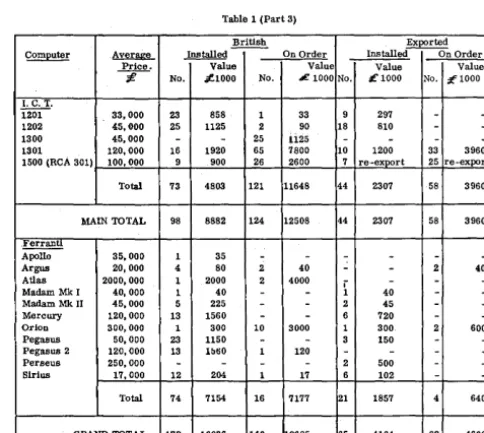
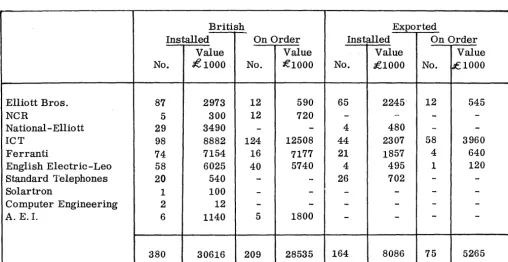
Table 1. Details of Numbers and Values of British-Built Computers, and Company Family Trees - - (Part 1)
'J'
National-Elliott
British Exported Computer Average Installed On Order Installed On Order
Price --v;;Iue ~e -value - v a i u e
-r-
No. .;£1000 No. £1000 • No. L1000 No. .;£1000 E!gottBros.Arch 25,000 50 25 401 15,000 15
402 22,000 132 22 402E 25,000 25
402F 25,000 25 25 403 100,000 100 502 135,000 135 135
503 80,000 160 240 802 17,000 51 68
803 35 000 74 2590 245 58 2030 280 Total 87 2973 12 590 65 2245 12 545 NCR
315 Total 300 12 720
Nat.~~
405 120,000 28 3360 480 405M 130,000 130
Total 29 3490 480
16'
R.
H.
Williams
Computer Consultants Limited
Enfield) Middlesex) England
Table 1 (Part 2)
Hollerith Limited Powers-Sarnas Limited Ferranti Limited
• I •
International Computers & Tabulators Ltd.
MI Now part 0
BMCSpecial 100,000 1100 180,000 1101 180,000 2400 500,000 Total
H~ith
HEC (1200) Total Powers-Sarnas Ltd.
PCC - calculator
British Installed On Order
-v.;iiie
--varue
No. £:1000 No. L1000 1 100
14 2520
2 360 360 1000 500 19 3980 860
99
Exported Installed On Order -r---viilue --Y-alue No. £1000 No. ~1000
to Europe where the number of computers installed is very much fewer than in the United States. It is obvious that many more computers will be installed in Britain and Europe, and at first sight the market seems to be an at-tractive and easy one.
~
Price.
---r-I. C. T.
l201 33,000 1202 45,000 1300 45,000 1301 120,000 1500 (RCA 301) 100,000 Total MAIN TOTAL Ferranti
Apollo 35,000 Argus 20,000 Atlas 2000,000 Madam Mkl 40,000 Madarn MkIl 45,000 Mercury 120,000 Orion 300,000 Pegasus 50,000 Pegasus 2 120,000
Perseus 250,000
Sirius 17,000 Total GRAND TOTAL
Table 1 (Part 3) British Installed----v.;!ue No. ot1000 No. 23 858 25 1125
25 16 1920 65 9 900 26 73 4803 121 98 8882 124
35 80 2000 40 225 13 1560
1 300 10 23 1150 13 1btiO 12 204 74 7154 16 172 16036 140
Exported On Order lnstalled--O-n Order
Value ~ ~
L 1000 No. £ 1000 No. ~ 1000 33 297
90 18 810 1125
7800 10 1200 33 3960 2600 7 re-export 25 re-export 11648 44 2307 58 3960 12508 44 2307 58 3960 40 40 4000
40 45 720
3000 300 600 150
120
500 17 102
7177 21 1857 640
[image:16.621.300.544.279.461.2] [image:16.621.302.544.525.741.2] [image:16.621.41.285.526.752.2]Table 1 (Part 4)
I.e<. Computers Limited English Electric Limited
I
Computer Leo Leo I Leo II
Leo III
English Electri Deuce I
Deuce II
Deuce lIA
KDF 6 KDF 9 KDN 2
KDP 10 (RCA 501)
I
~
English Elec tric -Leo Ltd. British Average Installed On Order
Price - - - v . : i u e ---y;j;;.,
~
95,000 95,000 200,000 Total 45,000 50,000 55,000 60,000 120,000 20,000 400,000 Total
No. 11
6 18 21
40 Summary 58
JI!' 1000 No. .i£ 1000 95
1045
1200 16 3200 2340 16 3200
945 250 330
120 120 16 1920 40 100 2000 400 3685 24 2540 6025 40 5740
Exported Installed On Order
Valu< ---vaiue
No. L 1000 No. Jil1000 400
400 45 50
95 495
120 120 120
We say advisedly at first sight, because the behavior in both Britain and Europe of the people who decide to buy computers or sometimes decide not to buy computers, can to our American friends appear totally irrational and contrary to what any reasonable American might expect. Again, this has led to many mistakes being made and wrong decisions of principle being taken.
Conservatism
By nature the Britisher is far more conservative than his American cousin, and also the pattern of the usage of of-fice equipment is totally different. For example, whereas in America there is a tendency to rent rather than pur-chase, in Britain the accent is very much on purchase rather than on rent. The Britisher is far less likely to buy this year's model for the sake of prestige or what have you, if his existing equipment is giving satisfactory service how-ever antique this may ap'pear on the face of it. Let's face
Standard Telephones Limited Computer Enj:ineering Limited
Computer Average Price
Table 1 (Part 5)
Solartron Electronics Group Limited Metropolitan Vickers Limited
~ .
Associated Electxlcallndustrles LImited British
Installed-- On order
-vaiue ----va:Iue
Exported Installed On Order
---v&iue ---v&iue
£ No. .It 1000 No. £'1000 No. ,(1000 No. t,l000
S~~
Zebra 27,000 20 540 26 702 Solartron El. G!:p.
Solartron
Special 100,000 100 Digital
Computer Coml1uter E~.
CE 55 2,000
CE 102 10,000 10 Met. Vickers
Metrovick 950 20,000 60 Assoc. El. Ind.
AEI1010 360,000 1080 5 1800
it also, that if one can do a job fast enough and 'accurately enough, then fast enough is fast enough, and there is no purpose whatever in doing it in one tenth of the time.
PaHerns of Industries
The pattern of certain industries and organizations is also different in Europe. For example, there are very few banks in Britain, but they do have very many branches. The same thing applies to insurance companies. The, pat-tern of Government behavior is also traditionally different from that in America and certainly the educational pattern as it relates to the use of computers in universities is vastly different.
In an article of this type, therefore, it would be as well at the outset to get our facts right and with this in mind, the article contains four tables.