http://wrap.warwick.ac.uk
Original citation:Holtom, Brooks, Goldberg, Caren B., Allen, David G. and Clark, Mark A.. (2016) How today’s shocks predict tomorrow’s leaving. Journal of Business and Psychology. http://dx.doi.org/10.1007/s10869-016-9438-9
Permanent WRAP url:
http://wrap.warwick.ac.uk/77792 Copyright and reuse:
The Warwick Research Archive Portal (WRAP) makes this work by researchers of the University of Warwick available open access under the following conditions. Copyright © and all moral rights to the version of the paper presented here belong to the individual author(s) and/or other copyright owners. To the extent reasonable and practicable the material made available in WRAP has been checked for eligibility before being made available.
Copies of full items can be used for personal research or study, educational, or not-for profit purposes without prior permission or charge. Provided that the authors, title and full bibliographic details are credited, a hyperlink and/or URL is given for the original metadata page and the content is not changed in any way.
Publisher’s statement:
“The final publication is available at Springer via http://dx.doi.org/10.1007/s10869-016-9438-9
A note on versions:
The version presented here may differ from the published version or, version of record, if you wish to cite this item you are advised to consult the publisher’s version. Please see the ‘permanent WRAP url’ above for details on accessing the published version and note that access may require a subscription.
How Today’s Shocks Predict Tomorrow’s Leaving
Abstract
Purpose: This research explores “shocking events” as part of the unfolding model of turnover,
extending our understanding of the influence of various types of shocks on future voluntary
employee separations.
Design/Methodology/Approach: 1,536 new hires at a large financial institution reported shocks
monthly during their first eight months at work as well as their job satisfaction and perceptions
of marketability. We used event history to estimate the basic distributional properties of the
shocks and Cox proportional hazards models to examine the effects of shocks on job satisfaction
and turnover over the subsequent year as reported by the organization.
Findings: Organizational shocks generally occur earlier than personal shocks. Further,
unexpected shocks have a stronger impact than expected shocks on subsequent turnover. Finally,
the effects of organizational shocks on turnover are mediated by job satisfaction, whereas
personal shocks have direct effects on turnover.
Implications: Our findings offer evidence for the utility of the shock construct in the unfolding
model of turnover and speak to the importance of encouraging managers to monitor shocks on an
on-going basis in order to predict when different types of shocks will occur and their likely
influence on turnover.
Originality/Value: Ours is the first study to examine shocks as they occur. In so doing, we are
able to better test the predictions of the unfolding model of turnover.
How Today’s Shocks Predict Tomorrow’s Leaving
Question
Have you experienced a specific event that has led you to consider leaving your job? If yes, please describe.
Responses
Employee 1: I was specifically promised a raise and promotion on a specific date by my manager that was never received.
Employee 2: Professional level employees are indignant when asked to put in additional hours or tasks. I feel that the ship has gone to the other extreme.
Employee 3: A misunderstanding with a coworker.
Employee 4: Time cut. I was told I would work 25 hours at hiring and was cut to 20 hours.
Employee 5: Our family is leaving due to my husband receiving military orders. Employee 6: The death of my son.
Employee 7: I was recruited by another company.
The respondents above, employees in our sample of a large financial institution, are
reflecting on experiences–positive or negative, work-related or personal–that may affect their
future decisions of whether to remain with their employer. In this paper, we demonstrate how
such experiences, referred to as “shocks” (cf. Lee & Mitchell, 1994), shed light on voluntary
employee turnover, a topic that has captivated both organizational scientists and managers for
nearly a century (Hom, 2010). Specifically, we explore the distributional properties of different
types of shocks and examine the effects of different types of shocks on subsequent employee
turnover and the mediating role of job satisfaction, thus improving understanding of how and
why employee turnover may occur.
Despite strong managerial interest in this topic and extensive academic attention, there
remains much to be known about the causes and consequences of voluntary exit. The complex
process has long been studied as a motivational issue, reflecting March and Simon’s (1958) early
pronouncement that both the motivation to participate and motivation to produce are essential for
movement (i.e., job dissatisfaction) and ease of movement (i.e., availability of acceptable job
alternatives) are the primary reasons why employees leave jobs (Hom, 2010). However, Lee and
Mitchell (1994) argued that this dominant paradigm for studying turnover possessed a number of
shortcomings. For example, they posited that external non-attitudinal “shocks” or “jarring
events” initiate the psychological analyses involved in quitting a job (Lee & Mitchell, 1994: 51),
such as those given in the above quotes. For some, feelings about the job or prospects for
employment elsewhere have little to do with their decisions to leave. Instead, as Lee and
Mitchell argued, many employees quit without first seeking or evaluating alternative jobs, due to
their reliance on scripts for leaving or because they experience image violations of their own role
or of the organization’s role. These researchers summarized the diverse exit processes people
tend to follow via five decision paths. The first three of these paths are initiated by shocks of
some kind. Subsequent work suggests that 50 percent or more of all voluntary turnover is
prompted by shocks (Holtom, Mitchell, Lee & Inderrieden, 2005; Morrell, Loan-Clarke &
Wilkinson, 2004).
Despite the important role they appear to play in the turnover process, relatively little
research has focused explicitly on shocks and none to our knowledge has measured these shocks
before individuals leave. The purpose of this paper is to look specifically at the nature, timing
and consequences of such shocks. In the following pages, we will first review the unfolding
model and then develop hypotheses about when and how shocks influence turnover. One
important contribution of our study lies in the collection of the shock data: In contrast to prior
unfolding model research, which has relied on retrospective accounts, we measure shocks before
employees depart. While retrospective accounts have merit, they are also subject to a number of
exaggeration or justification to preserve self-esteem or reputation, and post-decision
rationalization that can bias qualitative data (Griffeth & Hom, 2001; Steers & Mowday, 1981;
Westaby, 2005). To overcome these limitations, in this study we assess shocks before people
leave, reported by employees monthly, over the course of their first eight months of employment.
We then look at the impact of these shocks on subsequent staying or leaving over the next year.
Not only does this avoid the potential problems of retrospective accounts noted above, but it also
allows us to open the “black box” of mechanisms through which shocks may operate (e.g.,
mediated versus direct effects), to ultimately improve our understanding of how and why
employee turnover may occur. To achieve this greater theoretical and empirical depth, we have
limited to the focus of our study to shocks, rather than a full test of the unfolding model.
Theory and Hypotheses
Unfolding Model of Turnover
Lee and Mitchell’s (1994) model is comprised of five general paths that may culminate in
an individual leaving. As outlined in their model, in Path 1, a shock triggers the enactment of a
script or pre-existing plan for action. A person leaves without considering his or her attachment
to the current organization and without considering the benefits of other alternatives. Further, job
satisfaction is essentially irrelevant. In Path 2, a shock prompts a person to reconsider his or her
attachment to the organization because of an image violation. That is, the shock event altered the
employee’s perception of the organization and his/her role in the organization. After this
experience, the individual typically engages in relatively brief internal deliberations, but leaves
without searching for alternatives. In Path 3, a shock also produces image violations; however, in
this case, the image violations initiate a comparison of the current job with known alternatives.
Paths 4a and 4b are more consistent with March and Simon’s (1958) perspective, whereby lower
levels of satisfaction (rather than shocks) initiate leaving. The person realizes he or she is
dissatisfied and leaves with (in the case of Path 4b) or without (in the case of Path 4a) searching
for alternatives.
Lee, Mitchell, and colleagues (Lee, Mitchell, Wise & Fireman, 1996; Lee, Mitchell,
Holtom, McDaniel & Hill, 1999) have demonstrated that people tend to follow one of these paths
when quitting. Their model described up to 91 percent of the exits by people in their samples. In
their study of public accountants, Donnelly and Quinn (2006) classified 86 percent of the leavers
in their sample into one of the five paths. Interestingly, they noted that women experience shocks
more than men do, and consequently are more likely to exit via Paths 1, 2, or 3. Morrell,
Loan-Clarke, Arnold and Wilkinson (2008) reported classifying 77 percent of people in their sample of
nurses in Great Britain into one of the five paths. In sum, evidence from multiple samples across
different Western societies is accumulating that supports the key elements of the unfolding
model.
Shocks
A shock is an event that provides meaning or generates information about a person’s job.
This event is then interpreted and integrated into the person’s beliefs and images about their
employment. By definition, it is sufficiently jarring that it cannot be ignored. Thus, not all events
are shocks. To be deemed a shock, the event must produce job-related considerations that
involve the possibility of leaving. As detailed by Lee and Mitchell (1994), shocks and their
surrounding circumstances are compared to an individual’s images (i.e., values, goals and plans
for goal attainment; see Beach, 1997); if incompatible, thoughts of leaving occur. The social and
interpretation of the event. The initial interpretation of the event is likely to be shaped by the
general context of the employee’s knowledge of the organizational culture (Schein, 1990). The
employee may then evaluate the event along a number of dimensions (e.g., novelty, favorability,
threat). A re-interpretation may follow, whereby the individual assesses the degree to which she
can or should respond to the event.
Shocks may be categorized along several dimensions (Holtom et al., 2005). First, a shock
may be a surprise or it may be expected. Any change in the ongoing social system that
challenges the status quo or that causes an employee to reconsider his or her continuing
employment is a shock—whether planned or not. An unsolicited job offer is a common
unexpected shock (Lee, Gerhart, Weller & Trevor, 2008), whereas the planned birth of a child
may be a common expected shock (Holtom et al., 2005). Second, the jarring event captures the
person’s attention, but it may do so in either a positive or negative way. A positive shock might
be winning a $10 million lottery and a negative shock might be a having an argument with a
boss. Third, shocks can be personal events that are external to the job or they can be events that
are linked to the organization. Examples of personal shocks include getting married, having a
spouse be transferred, or losing a loved one. Examples of organizational shocks include being
passed over for promotion, experiencing a merger/acquisition, or earning a large bonus. In
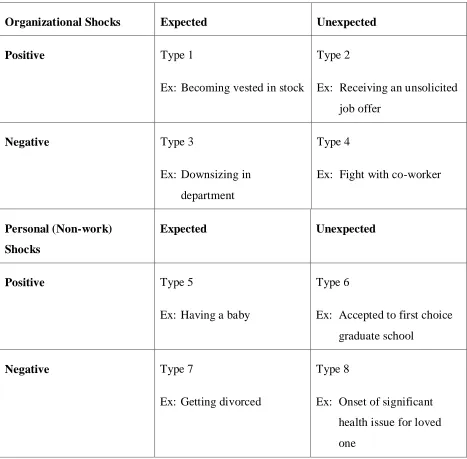
summary, as displayed in Table 1, we believe shocks can be sorted into eight distinct types
according to these characteristics (2x2x2).
--- Insert Table 1 about here
Research on turnover shocks has suggested that while there are age-related differences in
the probability of experiencing personal shocks (for example, parenthood is more common
among younger employees, whereas the death of a loved one is more common among older
employees), these lifespan events are related to age; not tenure. Thus, given a workforce with a
sufficient range of age with regard to typical lifespan events (cf. Schroots & Assink, 2005),
personal shocks will be relatively randomly distributed across an employee’s tenure, (Holtom et
al, 2005; Weller, Holtom, Matiaske, & Mellewigt, 2009). We believe that organizational shocks,
on the other hand, are apt to exhibit predictable patterns, with a higher concentration early in the
period immediately following an individual’s entry into the organizational for two reasons. First,
the entry point defines a new opportunity for unfamiliar events and is often coupled with feelings
of insecurity for many newcomers. As Miller and Jablin (1991) noted, “new hires… are likely to
experience considerably higher levels of role-related and career uncertainty when entering a new
environment than at any other time during their organizational tenure.” Thus, we believe that
they will confront more shocks early in their tenure than when they are more experienced and
familiar with organizational processes, norms and rhythms. Second, because they may lack
context for interpreting events early on, newcomers may perceive more shocks than experienced
employees. This is based on the consistency principle, which explains how people use their own
behavior to inform them about what they prefer (Bem, 1972). Cialdini (2001) elaborates noting,
“the more effort that goes into a commitment, the greater is its ability to influence the attitudes of
the person who made it.” In the present context, we would argue that a longer tenured employee
who has experienced previous shocks but who has remained with the organization, may conclude
that s/he must be committed to the organization. Thus, s/he may experience or interpret
experienced before are less likely to register as sufficiently shocking to cause the individual to
reconsider his/her employment with the organization. To summarize, we believe that
organizational shocks are more likely to be noticed and interpreted as shocks early in one’s
tenure, as individuals experience events that cause them to question their roles in the
organization, reevaluate the culture and job to determine their fit, and assess the utility of
remaining. In contrast, in a sample varying in age, personal shocks will be distributed randomly
across a person’s tenure. In sum,
Hypothesis 1. On average, organizational shocks will occur earlier in an individual’s
tenure than personal shocks.
Hypothesis 2a. The probability of organizational shocks decreases with tenure.
Hypothesis 2b. The probability of personal shocks is randomly distributed across tenure.
Whereas shocks that cause people to reconsider their attachment to an organization may
be expected or unexpected, several related bodies of research point to the potency of unexpected
shocks. For example, the effects of unmet expectations on newcomers’ attitudes and behaviors
are relatively well established. As defined by Porter and Steers (1973, p. 152), “The concept of
met expectations may be viewed as the discrepancy between what a person encounters on the job
in the way of positive and negative experiences and what he expected to encounter…(and) when
an individual’s expectations—whatever they are—are not substantially met, his propensity to
withdraw would increase.” Unmet expectations are seen as leading to dissatisfaction, which in
turn, leads to quitting an organization (Wanous, Poland, Premack & Davis, 1992). The effects of
unmet expectations are generally studied in the context of new employees because the
rates among new hires are typically much higher than those of employees with greater tenure
(Hom, Roberson, & Ellis, 2008). In short, unmet expectations appear to lead to subsequent
turnover. Moreover, a careful reading of Porter and Steers’ (1973) work reveals that they
considered only the disconfirmation of important expectations to be dissatisfying. Put differently,
consistent with Porter and Steers’ logic, we believe that unexpected shocks will have a greater
impact on turnover probability than expected shocks will. In addition, in line with our prior
discussion on organizational entry processes, we contend that the effects of shocks on turnover
will be most pronounced early in one’s tenure.
Hypothesis 3. Unexpected shocks will have a stronger influence than expected shocks on
subsequent leaving.
Hypothesis 4. The influence of shocks on subsequent leaving will be stronger earlier in
one’s tenure than later in one’s tenure.
In their initial formulation of the unfolding model, Lee and Mitchell (1994) presumed
that job dissatisfaction only plays a role in withdrawal via Path 4. That is, they saw
dissatisfaction and shocks as being as mutually exclusive explanations of turnover. Lee et al.
(1999) later relaxed this assumption to acknowledge that job dissatisfaction could exist also in
Path 3 leavers, but that it was not a required condition for classification. Subsequent studies have
supported this perspective. For example, Maertz and Campion (2004) found that the negative
workplace shocks that trigger withdrawal through Path 2 also elicit anger and dissatisfaction. In
addition, Kammeyer-Mueller et al.’s (2005) results indicate that leavers who had experienced
critical events prior to leaving, differed in terms of satisfaction from individuals who had gone
explained that shocks or image violations may reduce job satisfaction. Finally, Weller et al.
(2009) found that the influence of recruitment sources on turnover was partially mediated by job
satisfaction, and they attributed their finding to the functioning of shock - vs. satisfaction-driven
turnover processes.
In an independent test of the unfolding model, Morrell et al. (2004) reported that 44
percent of the nurses in their sample experienced shocks that had a substantial influence on the
decision to leave, with most of them calling the shocks a main or “overwhelming” influence on
leaving. Their key findings show: 1) shocks that are expected are more likely to be positive,
personal and lead to unavoidable leaving, 2) shocks that are negative are more likely to be
organizational in nature, associated with dissatisfaction, and lead to avoidable leaving, and 3)
shocks tend to cluster into work and non-work domains. In another study, Morrell (2005)
reported three clusters of leavers. Cluster 1 leavers (n=103) had an organizational shock that was
unexpected, negative and affected other workers. Cluster 2 leavers (n=50) had a personal shock
that was expected, positive and private. Cluster 3 leavers (n=196) had no shock and followed a
more traditional Path 4 process. This research suggests that the mediating effect of job
satisfaction on the shock-turnover relationship is limited to unexpected organizational shocks.
Because the literature on the unfolding model suggests that job satisfaction plays a role in the
decision to leave following organizational shocks, but offers little conceptual basis regarding
personal shocks, our focus here is limited to the former. In particular, we believe the effects of
organizational shocks on turnover will be mediated by job satisfaction. We further contend that
mediation does not undermine the essence of the unfolding model. Rather, we believe evidence
of mediation supports a key unfolding model premise: some turnover is initiated through
Hypothesis 5. The effects of organizational shocks on turnover will be mediated by job
satisfaction.
Method
Sample and Procedures
Data were collected from a financial services institution headquartered in the Eastern
United States with offices around the world. All individuals who began employment at the
organization between September 2007 and April 2009 were asked to participate in a nine-wave
longitudinal study of new hire attitudes and experiences. During their orientation, all new hires
either attended a presentation by the second author in which their participation was requested or
viewed a videotape of this presentation. To encourage participation, the second author conducted
monthly random drawings for $25 Visa gift cards. To encourage retention in the study, the
second author also held random drawings for leave passes. Those who completed each of the
first four surveys were eligible for one of four four-hour leave passes; those who completed all
nine surveys were eligible for one of four eight-hour leave passes.1 New hires’ supervisors were
also asked to complete two surveys about each new hire.
Within three days of reporting to their supervisors, new hires received an e-mail from the
second author with a link to the first on-line survey. New hires who did not respond within a
week were sent a follow-up e-mail with a link to this survey. This process was repeated at
monthly intervals for each of the remaining surveys. On the same date as each new hire’s Time 1
e-mail was sent, the new hire’s supervisor also received an e-mail with a link to the first survey
on that new hire. Four months later, the supervisors received an e-mail with a link to the second
1Although the organization provided the gift cards and leave passes, to maintain anonymity, they
survey. As with the new hire surveys, supervisors who did not respond within a week after
receiving a request were sent a reminder message with a link to the survey.
Of the 2,497 new hires who were asked to participate in this study, 1,536 (61.5 percent)
completed the surveys used in this study. The majority (70.6 percent) of respondents were
women. Their mean age was 33.1 (minimum = 18, maximum = 71). The racial breakdown was
as follows: 59.6 percent were Caucasian; 17.3 percent were African American; 9.2 percent were
Asian; 8.4 percent were Hispanic; .6 percent were Native American; and 4.9 percent were
multi-racial or “other.” The new hires worked in a variety of jobs from entry level to executive and
had prior work experience ranging from 0 to 40 years (mean = 6 years). The new hires ranged in
age from 18 to 68 (mean = 33.8, SD = 11.2). The great majority of new hires had at least some
college education (86.1 percent). A total of 1,120 supervisors (54.6 percent) completed the first
and second surveys.
Measures
Voluntary Turnover. Turnover was coded as 0 for stayers and 1 for leavers. Consistent
with other turnover researchers (Holtom, Mitchell, Lee, & Eberly, 2008), we collected voluntary
turnover data for a period of one year after subjects’ date of hire. Every two weeks, the
organization provided the second author with a list of individuals who had separated from the
organization over the prior two-week period.
Shocks. We assessed shocks on surveys two through eight, by asking respondents if they
had experienced a shock by way of the following survey instructions, based on Holtom and his
colleagues (2005): “Specific events that are either work-related or non-work/personal-related
sometimes lead people to consider leaving their jobs. These events can be positive (e.g., winning
at work or a divorce). Finally, this event could be an unexpected shock or it could be a planned
event such as finishing school.” We then asked them to provide a dichotomous response (0 = no;
1 = yes) to the following item: “Have you experienced a specific event that has led you to
consider leaving your job?” For new hires who responded affirmatively, we then asked them to
dichotomously respond to the following items:
Would you characterize the event as work-related or nonwork-related?
Would you characterize the event as positive or negative?
Would you characterize the event as planned or unexpected?
The categorization of shocks into the eight types was done based on participants
responses to these questions. We also asked respondents to describe their shock in an open-ended
format. Participants provided 1,120 open-ended responses. These responses occurred across all
waves of data collection, so it is possible that a single respondent provided more than one
response (e.g. described a shock at time 2 and time 7). In such cases, we relied upon the first
shock experienced, in keeping with the tenets of the unfolding model, which suggests that a
shock is the trigger that starts deliberations about turnover. Examples of each of the eight categories are provided in the Appendix.
Job Satisfaction. We used Hackman and Oldham’s (1975) three-item measure of job
satisfaction. On their third, sixth, and eighth surveys, new hires indicated their agreement (1 =
strongly disagree; 7 = strongly agree) with the following items: 1) “Generally speaking, I am
very satisfied with this job,” 2) “I am generally satisfied with the kind of work I do in this job,”
and 3) “In general, I like working here.” The alphas for this measure were .91 at Time 3, .92 at
Time 6, and .92 at Time 8.
Because demographics, perceptions of marketability, person-organization fit and
leader-member exchange are strong potential alternative explanations for our results (Griffeth et al.,
2008), we included these variables, as controls. Each of these is described below.
New Hire Demographics. On their initial survey, new hires were asked to provide their
sex (0 = female; 1 = male), race (1 = Caucasian; 2 = African American; 3 = Asian; 4 = Hispanic;
5 = Native American; 6 = Multiracial or “Other”), age (open-ended), years of work experience
(open-ended), and education (1 = some high school; 6 = completed graduate degree).
Perceived Marketability. We used Griffeth, Steel, Allen and Bryan’s (2005) measure of
perceived employment marketability. The items were, 1) “There aren’t very many jobs for
people like me in today’s job market,” [reverse scored] 2) “Given my qualifications and
experience, getting a new job would not be very hard at all,” and 3) “I can think of a number of
organizations that would probably offer me a job if I were looking.” Response options ranged
from 1 (strongly disagree) to 7 (strongly agree). The coefficient alpha for this measure was .63.
New hires provided their responses to these items on their initial survey.
Leader-Member Exchange. On both the initial and four-month surveys, supervisors
provided their perceptions of new hires’ LMX. The nine items were based on Bauer and Green’s
(1996) scale. However, we modified the wording slightly to reflect the fact that the supervisor
was completing the items. For example, the item, “I usually feel like I know where I stand,” was
changed to “The new hire usually knows where she/he stands.” Responses ranged from 1
(strongly disagree) to 7 (strongly agree). The alphas for this scale were .91 for one-month
supervisor assessments and .95 for four-month supervisor assessments.
Person-Organization Fit. We used Kristof-Brown’s (2000) four-item measure of
responded to the following items: 1) “To what degree does the new hire fit with (organization’s)
culture?” 2) “To what extent is this new hire similar to other (organization) employees?” 3) “To
what extent will other employees think this new hire fits well with (organization’s) culture?” 4)
“How confident are you that this new hire would be compatible with (organization’s) culture?”
Supervisors provided their responses on both the initial (alpha = .84) and four-month surveys
(alpha = .91).
Analytical Strategy and Exploratory Results
Because of the complex data structure (panel information with time varying predictor
variables and event data criterion variables) we rearranged the data according to the hypotheses
generated in the literature review section. For all turnover analyses, the data were arranged as
event history panel data (survival data), and different kinds of event history (survival) models
were used.
To estimate the occurrence of shocks, we arranged the data in a cross-sectional format
and used descriptive statistics and t-tests to compare the average timing of first shock
occurrences. For exploratory reasons, we also used the cross-sectional design to predict whether
an individual experienced a shock (logistic regressions), and how many shocks she experienced
(OLS regressions). We used the available demographic information as predictor variables (age,
gender, race, education, work experience), but found that the explained variance in shocks was
almost zero.
We further used event history models (with the corresponding data structure) to estimate
the basic distributional properties of the shock processes. All descriptive analyses were
performed by the statistical package SPSS18. The event history models were estimated with the
Hypothesis 1 was tested by comparing the mean occurrence (timing) of the first
organizational vs. personal shock of an individual. Hypotheses 2a and 2b were tested with a
Gompertz specification. The Gompertz model is a standard parametric survival model that is
often used if one assumes either monotonically decreasing or increasing hazard functions. The
model reduces to the standard exponential model (constant hazard rate) if there is no significant
slope of the hazard function over time. The model is given by the formula r(t) = b exp(ct), where
r(t) is the time dependent turnover hazard, and b and c are regression functions. TDA software
uses an exponential link function for b, and a linear link function for the c-term. If a null-model
is estimated, the c-intercept indicates whether the hazard function is monotonically increasing,
decreasing, or time-constant; the b-intercept indicates the level of the hazard (see, e.g., Blossfeld
& Rohwer, 2002).
The remaining hypotheses were tested with Cox proportional hazards models. The Cox
model (Cox, 1972; Morita, Lee, & Mowday, 1993) is a standard model in turnover research. The
formula is r(t) = h(t) exp(βx), where r(t) is again the time-dependent turnover hazard, h(t) is the
baseline hazard function (not parameterized), and β and x are vectors of the population
parameters to be estimated and the exogenous variables, respectively. The model is semi
-parametric because the baseline hazard remains unspecified; it is called a proportional hazards
model because covariate influences are multipliers to the baseline hazard function but do not
change the distributional properties of the function per se. As such, the model is very flexible but
requires the hazard functions for different groups of respondents to be proportional.
Because we observed some missing values in the full model specifications (i.e., when all
covariates were included), we decided to report analyses based on two data sets, the full and the
case, the period between survey responses). The full data set consisted of 13,456 time periods for
1,536 individuals. Out of the 1,536 respondents, 414 left voluntarily (414/1,536 = 27%). We
would note that this level of turnover is somewhat below the industry average for the major job
families represented. The reduced data set had 7,197 time periods from 777 individuals. 178
people voluntarily left (178/777 = 23%). In the reduced data set, the turnover share is slightly
lower because the very early leavers have missing values on some variables by definition (i.e., if
the variables were first sampled in later surveys). Because the data loss due to missing values is
non-trivial, we decided to employ a control strategy by estimating the general functional
properties of the turnover process as proposed by Lee et al. (2008) and Weller et al. (2009). We
estimated generalized log-logistic null models to check whether the turnover processes varied
substantially between the two data sets. The generalized log-logistic model (Brüderl, 1991;
Brüderl & Diekmann, 1995) is given by the formula
𝑟(𝑡) = 𝑏 𝑝(𝜆𝑡)
𝑝−1
1 + (𝜆𝑡)𝑝; 𝑏, 𝑝, 𝜆 > 0
where b, p, and λ are regression functions (each with exponentiated link functions in TDA). As
can be seen from the formula, the model is also a proportional hazards model (b multiplies the
hazard function), and can thus be used as a parametric counterpart to the Cox model (Weller et
al., 2009). In the null model, the p-intercept indicates whether the turnover hazard has an
inverted U-shape, or is monotonically decreasing. With both data sets, the general properties of
the turnover processes were the same. In each case, the turnover hazard function had an inverted
U-shape with similar parameter estimates (estimates not reported but available upon request).
Based on our knowledge of the data and these analyses, we are confident that the loss of
statistical power due to missing values does not substantially alter the properties of the analysis
Results
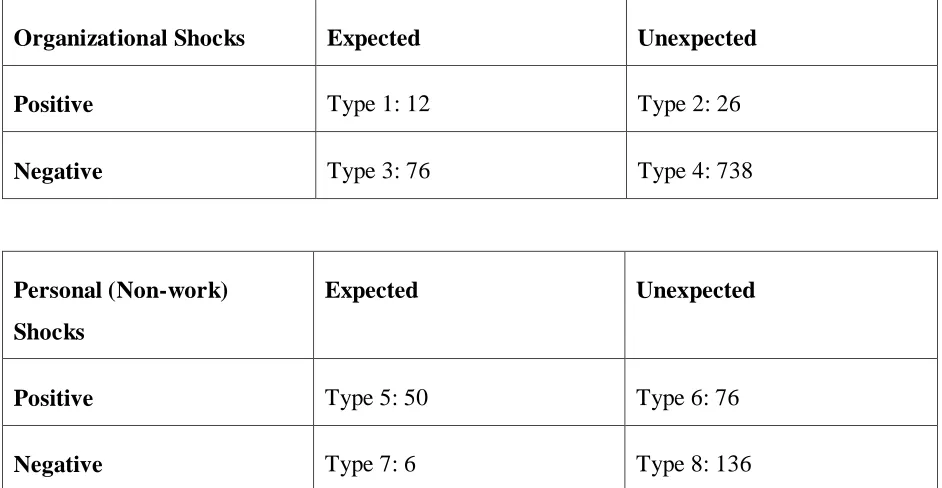
The individuals surveyed reported 1,120 shocks. On the basis of their classification, we
noted the following frequencies for the different types of shocks (Table 2).
--- Insert Table 2
---
As predicted by Hypothesis 1, we observed that organizational shocks occur earlier in
tenure than personal shocks. On average, the first occurrence of an organizational shock was at
3.20 months (SD = 2.05), whereas the mean time until the first occurrence of a personal shock
was 3.68 months (SD = 2.23). This difference is statistically significant (t = 2.35, p < .05), and
we consider practical significance in the discussion.
Contrary to our second set of hypotheses (2a and 2b), we found that organizational
shocks have a constant hazard rate across tenure, whereas personal shocks have an increasing
risk function over time. Although this supports our contention that organizational shocks are
more likely earlier in a career (as compared to personal shocks, which are more likely later in a
career), the distributional assumptions we expected were not supported: The Gompertz models
revealed a non-significant c-intercept for organizational shocks (c0 = 0.02; p > .05), and a
significant c-intercept for personal shocks (c0 = 0.07; p < .05). The b-intercepts indicated a higher
risk for organizational shocks (b0 = -3.43; p < .001) as compared to personal shocks (b0 = -4.63; p
< .001). In sum, whereas the first incident of organizational shocks tends to occur slightly earlier
in a person’s tenure, personal shocks are not randomly distributed. They tend to occur later in a
Our next set of analyses demonstrated that, consistent with Hypothesis 3, unexpected
shocks have a stronger influence on subsequent leaving than expected shocks do. As can be seen
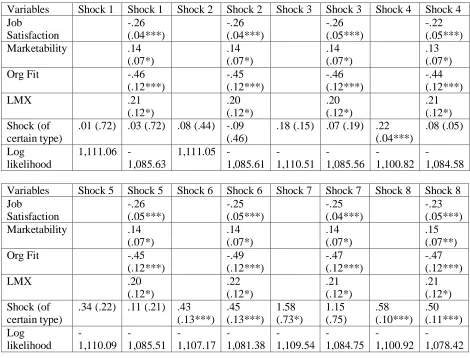
in Table 4, three out of four unexpected shock types (Types 4, 6 and 8) were statistically
significant predictors of turnover, whereas none of the categories of expected shocks (Types 1, 3,
5 and 7) significantly predicted turnover. Additionally, our results show that shocks have a
stronger influence on leaving early in one’s tenure than later (Hypothesis 4), as evidenced in
Model 4 in Table 3. Models 1-3 in Table 2 also illuminate the statistical significance of selected
control variables (including work experience, organizational fit, and LMX).
--- Insert Tables 3 and 4 about here
---
Finally, we found that the effects of organizational shocks on turnover were mediated by
job satisfaction, as predicted by Hypothesis 5. Of the four types of organizational shocks, only
one (Type 4, the most common type of a shock [organizational, negative, unexpected]) was
related to turnover, and the effect was indirect through job satisfaction. Mediation analysis has
long relied on Baron and Kenny’s (1986) logic, which does not specify a formal test of
significance (i.e., it does not propose a method for estimating the confidence interval of the
indirect effect). Thus, we followed MacKinnon and his colleagues (2002) recommendation and
used a “difference in coefficients” test to estimate the significance level of the indirect effects
(c.f., Weller et al., 2009). This test (Freedman & Schatzkin, 1992) uses the difference in
coefficients (shock effects with and without job satisfaction as a mediator) as the effect size and
defines the standard error of the indirect effect as follows:
𝑠𝑒(𝑐 − 𝑐′) = √𝜎
where c and c’ are the effect sizes of shocks in the two models (with and without the mediator), σ
is the standard error of the effects, and ρ is the correlation between shocks and the mediator, job
satisfaction. The test follows a t distribution, with df = N- 2.
As shown in Table 3, for Type 4 shocks, the total shock effect was .22; the direct effect
was .08, and the indirect effect was .14 (t = 6.07; p < .05). For Type 6 shocks, the total shock
effect was .43; the direct effect was .45, and the indirect effect was -.02 (t = -2.26; p < .05). For
Type 7 shocks, the total shock effect was 1.58; the direct effect was 1.15, and the indirect effect
was .43 (t = 10.12; p < .05). For Type 8 shocks, the total shock effect was .58; the direct effect
was .50, and the indirect effect was .08 (t = 5.59; p < .05). In sum, organizational shocks were
either unrelated to turnover or indirectly related through job satisfaction. In contrast, most
personal shocks were related to turnover, and the direct effects remained significant, after the
potential mediator was entered into the models. Nevertheless, personal shocks, too, were partly
mediated by job satisfaction. In sum, Hypothesis 5 received partial support.
Discussion
Theoretical and Empirical Contributions
Prior studies of the unfolding model have relied on retrospective accounts that allow
researchers to identify the decision paths leavers followed. While this innovative research has
stretched thinking in the field and identified new constructs that are relevant to turnover (e.g.,
scripts, image violations), it has not been particularly actionable for practitioners. Put differently,
we believe managers would benefit from the development of tools based on strong theoretical
and empirical approaches. In this research we have sought to exploit one of the key insights from
anticipate generally when different types of shocks will occur and how they are most likely to
influence turnover.
In addition to expanding theory about the nature, timing, and mental processes associated
with shocks, we have used a large-scale, longitudinal dataset to demonstrate the empirical
implications of the different characteristics of shocks. As pointed out previously, this is
important because, to date, verification of the unfolding model largely rests on qualitative
findings based on retrospective accounts from leavers (Holtom et al., 2008), which are subject to
potential biases and errors. Another concern with retrospective research is the possibility a leaver
would exaggerate or invent justifications for their actions to preserve their self-esteem or
reputation (Westaby, 2005). Finally, qualitative tests cannot generate estimates of a model’s
predictive power. The design employed in this study was created to overcome these limitations.
In sum, this research contributes three primary insights to the turnover literature. First,
collecting shock data from stayers and leavers allows for predictive modeling. Second,
unexpected shocks appear to be more influential in prompting leaving than expected shocks.
Third, organizational shocks may be mediated by job satisfaction whereas personal shocks may
have more direct effects. These insights extend our understanding of the unfolding model by
going beyond the mere existence of a shock, to begin specifying how different types of
experienced shocks operate differently in initiating the withdrawal process.
Practical Implications
Prior scholarly work has advocated that managers monitor for shocks (Lee & Mitchell,
1994). The present research shows that; a) shocks cannot be predicted adequately, and b) that the
type of shock matters. Managers should thus analyze the nature of the shocks generally, because
through ongoing survey efforts can help guide managers to move quickly to address unexpected,
negative work shocks or to alter recruitment and selection plans for the future, based on his/her
observation of a recurring pattern of expected, positive non-work shocks.
Analysis of shocks also helps to better identify turnover that is “unavoidable” such as the
relocation of a spouse (Hom & Griffeth, 1995). This might allow firms to more accurately
reward managers who minimize “avoidable” turnover. It might also prompt analysis of systemic
factors that might be contributing to unavoidable turnover. This differs from the undifferentiated
investment involved in a job satisfaction or organizational commitment approach to minimizing
turnover, which might focus on raising morale generally. Time, attention, and resources can be
allocated to addressing the major prompts of much turnover: shocks. A specific example is the
case of an expected, positive, non-work shock such as pregnancy. If a manager learns that such
shocks cause him/her to systematically lose productive workers, the manager can analyze the
costs and benefits of revising policies to reduce work-family conflicts, by implementing
arrangements such as telecommuting or flexible work schedules (Johnson, Lowe & Reckers,
2008).
Timely monitoring will also help organizations connect the effects of predictable shocks
such as performance appraisals, salary decisions and promotion activities to organizational exit.
This will provide leaders insight into how these vital HR processes impact functional and
dysfunctional turnover. Based on these insights, they may be able to avoid future dysfunctional
turnover. Finally, we believe that this research points to the importance of systematic collection
of data by managers about the events occurring in employee’s lives. As managers maintain open
lines of communication with employees, these managers will be able to better anticipate potential
that although the average time between the first occurrence of organizational shocks and
personal shocks observed in this sample is only two weeks, the organizational socialization
literature provides rich examples of processes that can be materially affected (e.g., organizational
commitment, perceived organizational support) in relatively short time periods—especially early
in a person’s tenure as was the case with these respondents (c.f., Allen & Shanock, 2013; Perrot,
Bauer, Abonneau, Campoy, Erdogan & Liden, 2014).
Limitations and Future Research
While this study provides a richer understanding of the role of shocks in the turnover
process, we acknowledge that we do not test all elements of the unfolding model (scripts, image
violations, job search). Collecting data about the existence of scripts might be considered
invasive, particularly if collected before enacted. Image violations almost by definition, have to
be collected post-experience. However, we did collect from respondents (job satisfaction,
perceived marketability), as well as data from supervisors (person-organization fit,
leader-member exchange), to provide a more robust test.
Further, while we present strong evidence, our results come from a single organization.
Thus, future research is necessary to demonstrate the generalizability of the effects we observed,
as is research including other predictors. Additionally, we believe there is significant value in
integrating Maertz and Campion’s (2004) turnover motives approach with the unfolding model.
The diverse motives people have for leaving clearly tie to certain types of shocks. How shocks or
events influence motives and subsequent decisions is important. Moreover, it is possible that
certain shocks are reliably linked to the Maertz and Campion (2004) decision types (e.g.,
impulsive, preplanned comparison). In short, building on their work, which integrates how
forward. A comprehensive study looking both at pre-leaving data as well as retrospective
accounts would clarify the role of sense-making in the post-turnover reasons research (c.f., Shipp
& Jansen, 2011). Plus, analysis of how an individual’s experiencing multiple shocks impacts
turnover may provide additional insights that allow researchers to increase the variance
explained with their models.
How dynamic processes unfold present another research opportunity. For example, in this
study we found a relatively small difference between the occurrences of first organizational and
personal shocks. Diary studies might allow us to better understand the timing between the
shocking event and serious deliberations about leaving. It is possible that the process would
unfold very quickly making timely management intervention critical. Further, examining
alternative mechanisms operating for different types of shocks may have some merit. For
example, it is possible that the impact of positive personal shocks (e.g., winning the lottery) is
moderated by job satisfaction rather than mediated through satisfaction as you would expect in
References
Allen, D. G., & Shanock, L. R. (2013). Perceived organizational support and embeddedness as
key mechanisms connecting socialization tactics to commitment and turnover among new
employees. Journal of Organizational Behavior, 34, 350-369.
Aquino, K., Griffeth, R. W., Allen, D. G., Hom, P. W. (1997). Integrating justice constructs into
the turnover process: A test of a referent cognitions model. Academy of Management
Journal, 5, 1208-1227.
Baron, R. M., & Kenny, D. A. (1986). The moderator–mediator variable distinction in social
psychological research: Conceptual, strategic, and statistical considerations. Journal of
Personality and Social Psychology, 51, 1173–1182.
Bauer, T. N., & Green, S. G. (1996.) Development of Leader-Member Exchange: A Longitudinal
Test, Academy of Management Journal, 39, 1538-1567
Beach, L.R. (1997). The psychology of decision-making: People in organizations. Beverly Hills,
CA: Sage Publications.
Bem, D. J. (1972). Self-perception theory. In L. Berkowitz (Ed.), Advances in experimental
social psychology, (Vol. 6. pp. 1-62), New York: Academic Press.
Blossfeld, H.P., & Rohwer, G. (2002). Techniques of event history modeling: New approaches to
causal analysis (2nd ed.). Mahwah, NJ: Erlbaum.
Brüderl, J. (1991). Mobilitätsprozesse in Betrieben: Dynamische Modelle und empirische
Befunde [Mobility processes in firms: Dynamic modelsand empirical results]. Frankfurt
am Main, Germany: Campus.
Brüderl, J., & Diekmann, A. (1995). The log-logistic rate model. Two generalizations with an
Cialdini, R. B. (2001). Influence: Science and practice (4th ed.). Boston: Allyn& Bacon.
Cox, D. R. (1972). Regression models and life tables. Journal of the Royal Statistics Society
(Series B), 34, 187-202.
Donnelly, D. P., & Quinn, J. J. (2006). An extension of Lee and Mitchell's unfolding model of
voluntary turnover. Journal of Organizational Behavior, 27: 59-77.
Freedman, L. S., & Schatzkin, A. (1992). Sample size for studying intermediate endpoints within
intervention trials of observational studies. American Journal of Epidemiology, 136,
1148–1159.
Griffeth, R. & Hom, P. (2001). Retaining valued employees. Thousand Oaks, CA: Sage.
Griffeth, R.W., Steel, R. P., Allen, D. G., & Bryan, N. 2005. The development of a
multidimensional measure of job market cognitions: The Employment Opportunity
Index. Journal of Applied Psychology, 90, 335-349.
Hackman, J. R., & Oldham, G. R. (1975). Development of the Job Diagnostic Survey. Journal of
Applied Psychology, 60,159-170.
Holtom, B. C., Mitchell, T., Lee, T., & Inderrieden, E. (2005). Shocks as causes of turnover:
What they are and how organizations can manage them. Human Resource Management,
44, 337-352.
Holtom, B., Mitchell, T., Lee, T., & Eberly, M. (2008). Turnover & retention research: A glance
at the past, a closer review of the present, and a venture into the future. Academy of
Management Annals, 2, 231-274.
Hom, P. W. (2010). Organizational exit. In S. Zedeck, H. Aguinis, W. Cascio, M. Gelfand, K.
Leung, S. Parker, & J. Zhou (Eds.), Handbook of Industrial/Organizational Psychology,
Hom, P. W., Griffeth, R. W. (1995). Employee turnover. Cincinnati, OH: South-Western College
Publishing.
Hom, P., Roberson, L., & Ellis, A. (2008). Challenging conventional wisdom about who quits:
Revelations about employee turnover from corporate America. Journal of Applied
Psychology, 93, 1-34.
Johnson, E., Lowe, D., & Reckers, P. (2008). Alternative work arrangements and perceived
career success: Current evidence from the big four firms in the U.S. Accounting,
Organizations and Society, 33, 48-72.
Kammeyer-Mueller, J. D., Wanberg, C. Glomb, T. Ahlburg, D. (2005). The role of temporal
shifts in turnover processes: It’s about time. Journal of Applied Psychology, 90, 644-658.
Kristof-Brown, A. L. (2000). Perceived applicant fit: Distinguishing between recruiters’
perceptions of person–job and person–organization fit. Personnel Psychology, 53, 643–
671.
Lee, T. H., Gerhart, B., Weller, I., & Trevor, C. O. (2008). Understanding voluntary turnover:
Path-specific job satisfaction effects and the importance of unsolicited job offers,
Academy of Management Journal, 51, 651-671.
Lee, T. W., & Mitchell, T. R. (1994). An alternative approach: The unfolding model of voluntary
employee turnover. Academy of Management Review, 19, 51-89.
Lee, T. W., Mitchell, T. R., Holtom, B. C., McDaniel, L. S., & Hill, J. W. (1999). The unfolding
model of voluntary turnover: A replication and extension. Academy of Management
Journal, 42, 450-462.
Lee, T. W., Mitchell, T. R., Wise, L., & Fireman, S. (1996). An unfolding model of voluntary
MacKinnon, D. P., Lockwood, C. M., Hoffman, J. M., West, S. G., &Sheets, V. (2002). A
comparison of methods to test mediation and other intervening variable effects.
Psychological Methods, 7, 83–104.
Maertz, C. P., & Campion, M. A. (2004). Profiles in quitting: Integrating process and content
turnover theory. Academy of Management Journal, 47, 566-582.
Maertz, C. P., & Griffeth, R. W. (2004). Eight motivational forces and voluntary turnover: A
theoretical synthesis with implications for research. Journal of Management, 30,
667-683.
March, J. G. & Simon, H. A. (1958). Organizations. New York: John Wiley.
Miller, V., Jablin, F.. (1991). Information seeking during organizational entry: Influences,
tactics, and a model of the process. Academy of Management Review, 16, 92-120.
Morita, J. G., Lee, T. W., & Mowday, R. T. (1993). The regression-analog to survival analysis:
A selected application to turnover research. Academy of Management Journal, 36, 1430–
1464.
Morrell, K. (2005). Towards a typology of nursing turnover: the role of shocks in nurses’
decision to leave. Journal of Advanced Nursing, 49, 315-322.
Morrell, K. Loan-Clarke J., & Wilkinson, A. (2004). The Role of Shocks in Employee Turnover,
British Journal of Management, 15, 335-349.
Morrell, K., Loan-Clarke, J., Arnold, J., & Wilkinson, A. (2008). Mapping the decision to quit: a
refinement and test of the unfolding model of voluntary turnover. Applied Psychology:
Perrot, S., Bauer, T. N., Abonneau, D., Campoy, E., Erdogan, B., & Liden, R. C. (2014).
Organizational Socialization Tactics and Newcomer Adjustment: The Moderating Role
of Perceived Organizational Support. Group & Organization Management, 39: 247-273.
Porter, L. W., & Steers, R. M. (1973). Organizational, work, and personal factors in employee
turnover and absenteeism. Psychological Bulletin, 80, 151-176.
Rohwer, G., & Pötter, U. (2002). TDA user’s manual. Bochum/Germany: Ruhr Universität.
Schein, E. H. (1990). Organizational culture. American Psychologist, 45, 109-119.
Schroots, J. J. F., & Assink, M. H. J. (2005). Portraits of life: Patterns of events over the lifespan.
Journal of Adult Development, 12(4): 183-198.
Shipp, A. J., & Jansen, K. J. (2011). Reinterpreting time in fit theory: Crafting and recrafting
narratives of fit in media research. Academy of Management Review, 36, 76–101.
Wanous, J. (1992). Organizational entry: Recruitment, selection, orientation, and socialization.
Reading, MA: Addison-Wesley.
Wanous, J., Poland, T. Premack, S., & Davis, S. (1992). The effects of met expectations on
newcomer attitudes and behaviors: A review and meta-analysis. Journal of Applied
Psychology, 77, 288-297.
Weller, I., Holtom, B., Matiaske, W., & Mellewigt, T. (2009). Level and time effects of job
search sources on early voluntary turnover, Journal of Applied Psychology, 94,
1146-1162.
Westaby, J. (2005). Behavioral reasoning theory: Identifying new linkages underlying intentions
Table 1
Eight Categories of Shocks with Examples
Organizational Shocks Expected Unexpected
Positive Type 1
Ex: Becoming vested in stock
Type 2
Ex: Receiving an unsolicited
job offer
Negative Type 3
Ex: Downsizing in
department
Type 4
Ex: Fight with co-worker
Personal (Non-work)
Shocks
Expected Unexpected
Positive Type 5
Ex: Having a baby
Type 6
Ex: Accepted to first choice
graduate school
Negative Type 7
Ex: Getting divorced
Type 8
Ex: Onset of significant
health issue for loved
one
Table 2
Frequency of Occurrence: Eight Shock Categories
Organizational Shocks Expected Unexpected
Positive Type 1: 12 Type 2: 26
Negative Type 3: 76 Type 4: 738
Personal (Non-work)
Shocks
Expected Unexpected
Positive Type 5: 50 Type 6: 76
Table 3
Cox Regression Models for Voluntary Turnover (All Shocks)
Variables Model 1 Model 2 Model 3 Model 4 Age -.01 (.01) -.01 (.01) -.01 (.01) -.01 (.01) Men (R: Women) -.63 (.20***) -.72 (.20***) -.69 (.20***) -.69 (.20***) Race (R: Caucasian)
African American .03 (.21) -.01 (.21) -.06 (.21) -.09 (.21) Asian -.80 (.35*) -.78 (.35*) -.69 (.35*) -.69 (.35*) Hispanic .31 (.26) .22 (.27) .18 (.27) .15 (.27) Native American .46 (1.01) .23 (1.02) .19 (1.02) .16 (1.02) Other -1.25 (.59*) -1.41 (.59**) -1.39 (.59**) -1.35 (.59*) Education (R: some college)
some HS -9.73 (145.96) -9.58 (166.84) -9.60 (175.62) -9.57 (174.36) HS grad -.23 (.25) -.09 (.26) -.08 (.26) -.06 (.26) college grad .09 (.17) .06 (.17) .02 (.17) .02 (.17) some grad school .05 (.36) .11 (.36) .08 (.36) .08 (.36) complete grad
degree
-.32 (.36) -.45 (.36) -.58 (.36) -.57 (.36)
Work experience -.04 (.02**) -.03 (.02*) -.04 (.02**) -.04 (.02**) Job satisfaction -.26 (.04***) -.14 (.06**) -.10 (.14) Marketability .14 (.07*) .12 (.07*) .10 (.07) Organizational fit -.45 (.12***) -.45 (.12***) -.44 (.12***) LMX .20 (.12*) .22 (.12*) .21 (.12*)
Shocks .18 (.05***) .91 (.21***)
Job satisfaction * time -.00 (.02)
Shocks * time -.09 (.0.3***)
Log likelihood -1,111.06 -1,085.63 -1,078.85 -1,071.70
Table 4
Cox Regression Models for Voluntary Turnover (by Shock Type)
Variables Shock 1 Shock 1 Shock 2 Shock 2 Shock 3 Shock 3 Shock 4 Shock 4 Job Satisfaction -.26 (.04***) -.26 (.04***) -.26 (.05***) -.22 (.05***) Marketability .14
(.07*) .14 (.07*) .14 (.07*) .13 (.07*) Org Fit -.46
(.12***) -.45 (.12***) -.46 (.12***) -.44 (.12***)
LMX .21
(.12*) .20 (.12*) .20 (.12*) .21 (.12*) Shock (of certain type)
.01 (.72) .03 (.72) .08 (.44) -.09 (.46)
.18 (.15) .07 (.19) .22 (.04***)
.08 (.05)
Log likelihood
1,111.06
-1,085.63
1,111.05
-1,085.61 -1,110.51 -1,085.56 -1,100.82 -1,084.58
Variables Shock 5 Shock 5 Shock 6 Shock 6 Shock 7 Shock 7 Shock 8 Shock 8 Job Satisfaction -.26 (.05***) -.25 (.05***) -.25 (.04***) -.23 (.05***) Marketability .14
(.07*) .14 (.07*) .14 (.07*) .15 (.07**) Org Fit -.45
(.12***) -.49 (.12***) -.47 (.12***) -.47 (.12***)
LMX .20
(.12*) .22 (.12*) .21 (.12*) .21 (.12*) Shock (of certain type)
.34 (.22) .11 (.21) .43 (.13***) .45 (.13***) 1.58 (.73*) 1.15 (.75) .58 (.10***) .50 (.11***) Log likelihood -1,110.09 -1,085.51 -1,107.17 -1,081.38 -1,109.54 -1,084.75 -1,100.92 -1,078.42
Appendix 1
Examples of Shocks Experienced by Respondents
Organizational Expected Unexpected
Positive
Became eligible for retirement.
Conflict with a subordinate. Please note that my
VP's response and support made me want to stay
with this organization even more. My VP provided
good feedback and guidance through the entire
process.
I was recruited by another company.
Better position/pay/hours with another company.
I was offered a job that I applied for over two
years ago with a federal organization.
Negative Realized I’m in a cube doing the same thing every
day! I think I'm going to start talking to the
copier!!!
The move to risk-based collections had made this
an incredibly stressful job.
My regular duties were not presented accurately to
me at my interview.
Feeling like a failure because I did not receive the
Being told I would have chances to advance and
receive further training. I have not received
anything.
I was specifically promised a raise and promotion
on a specific date by my manager that was never
received.
Malicious gossip by co-workers.
Poor direction from supervisor, Critical corrections
in unacceptable tones and in from of others.
Fellow employee altercation.
Misbehavior from a coworker and constantly
ignored by the management. I feel like double
standard approach towards a new hire.
Being told that my attire is not appropriate for
work, when it is.
A supervisor who cannot control his anger.
Personal Expected Unexpected
Positive
Got married.
Graduating from college.
I just found out that I am pregnant.
I miss my son, and I would like to be a stay at home
mom for him so that he doesn’t have to go to
daycare.
I scored very well on the GMAT and considered
leaving my position to attend graduate school full
time. Decided a part-time program is better suited
for me at this time.
Negative
Separation/divorce.
Issues with my son's childcare caused us to have to
re-evaluate the care for our son. My staying home
is the best situation for us and no longer working
part time.
The death of my son.
Illness of spouse.
Health issues.
Mother's health.
Rising gas prices have caused me to consider
miles from my worksite and rising gas prices have