Developing and Evaluating the
Multiple Mini Interview in
Student Midwife Selection
by
Alison Callwood
Submitted for the
Degree of Doctor of Philosophy
Faculty of Health and Medical Sciences
University of Surrey
May 2015
© Alison Callwood2
Abstract
The multiple mini interview (MMI) is an admissions instrument designed to replace the personal interview in health care student selection. Its effectiveness has been evaluated in medical student recruitment processes (Eva et al., 2004a, Roberts et al., 2014). At the commencement of this research no reliability, validity, or acceptability studies had been published specifically in relation to student midwife selection.
Study objectives: to develop, pilot and evaluate the reliability, validity and acceptability of MMIs in student midwife selection in a Higher Education Institution (HEI) in the United Kingdom (UK).
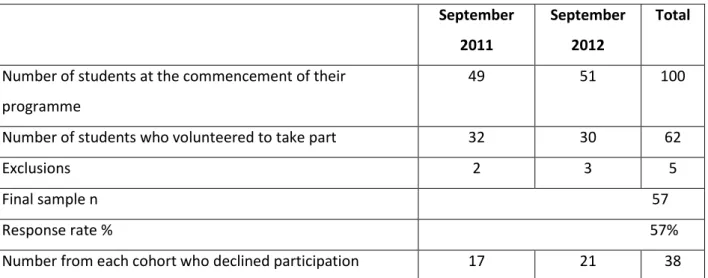
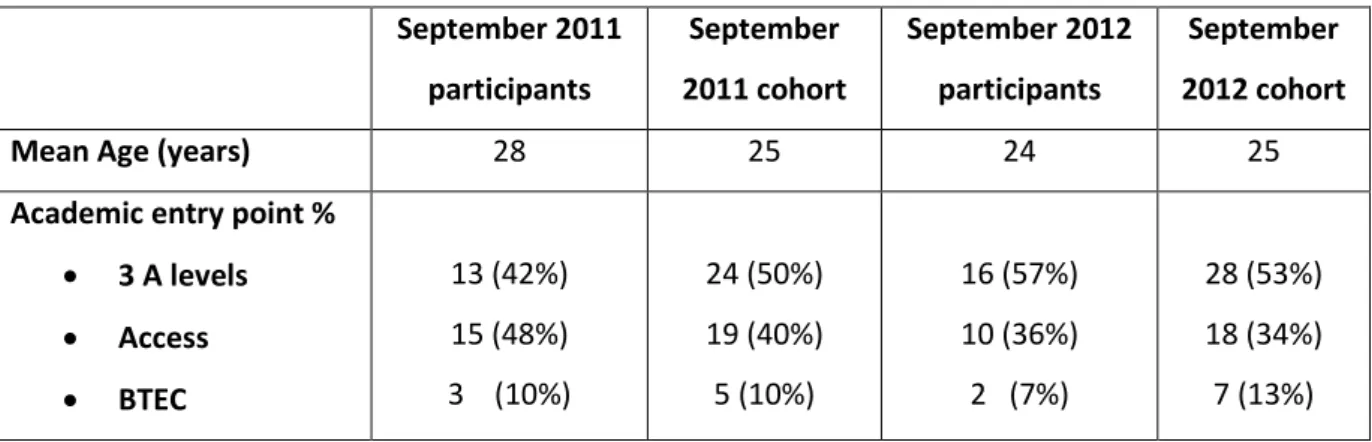
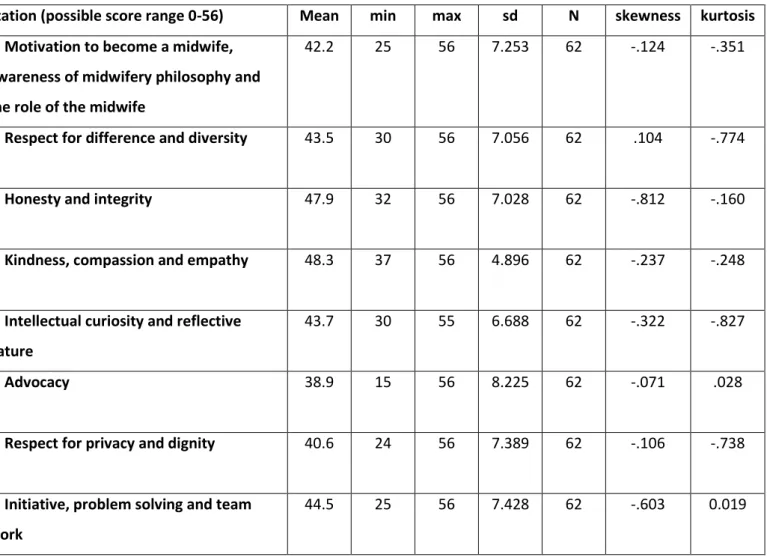
A dual paradigmatic dialectical enquiry was used in a multi-method case study. A literature review and qualitative work were conducted to identify the desirable personal qualities of a student midwife. This was followed by the systematic development of a customised eight station, five-minute MMI model. Sixty-two students from the BSc Midwifery Studies, September 2011 and 2012 cohorts, at the University of Surrey, volunteered to undertake ‘mock’ MMIs in the first week of their programme. Fifty-seven participants were followed up having completed their first year. Predictive validity was assessed using students’ end of year OSCE and mentor grading; station reliability, including inter-station and internal consistency, were also examined. Interviewers’ (n=9) and candidates’ (n=62) views of MMIs were obtained from a focus group and semi-structured questionnaires respectively.
The literature review revealed that acknowledgement of the importance of ‘emotionality’ or an emotional dimension in the relationship between a woman and her midwife was missing from key professional, regulatory (Nursing and Midwifery Council, 2009, 2010, International Confederation of Midwives, 2011) and government documentation (Department of Health, DH,2012). According to the Department of Health (DH, 2013), selection to all National Health Service (NHS) funded training posts should incorporate recruitment for the NHS Constitution values (DH, 2012). In the absence of any mention of ‘emotionality’ it is suggested that this requires more specific recognition in considerations of what is important to appraise at selection.
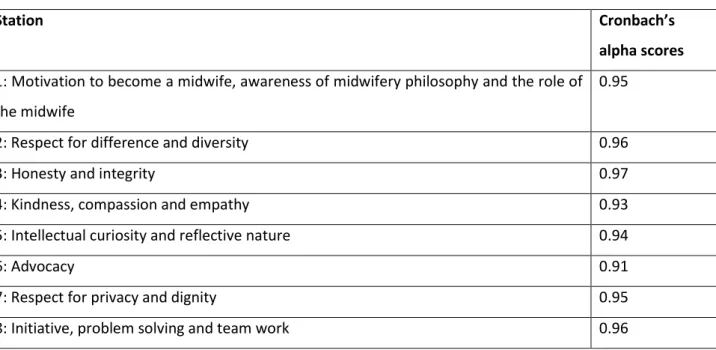
No statistically significant associations were found between students’ MMI score and their subsequent performance in clinical practice. The University Registrar would not consent to ‘live’ selection using MMIs in the absence of midwifery-specific evidence; participants were therefore students who had already been accepted onto an undergraduate midwifery programme. This has been addressed in an on-going longitudinal follow up-study. Reliability (internal consistency) was ‘excellent’ with Cronbach’s alpha scores between 0.91-0.97 across eight stations. Inter-station reliability findings suggested that each station measured different independent constructs with only a moderate positive correlation between two stations, kindness, compassion and respect for privacy and dignity (p<0.01). All other stations indicated little or no relationship offering additional support to the reliability of the scales.
Candidates stated that undertaking MMIs would not discourage them from applying to the University as they felt they were a fair assessment instrument. They suggested that the multi- interview format was a positive feature which allowed them to recover from a poor performance at any one station. Overall, 23 participants (37%) reported a preference for MMIs compared to 22 (35%) who preferred a one-to-one personal interview format; 44 participants (71%) found the personal interview more daunting than MMIs. Interviewers appreciated the parity of opportunity afforded to candidates through the standardisation of the interview process. They were willing to adopt MMIs in future selection processes provided any anticipated complications were resolved.
MMIs were shown to be reliable in the context and model defined. The insightful information obtained has informed a ‘roll out’ to MMIs across all health care student selection at the University of Surrey as well as being used by Health Education England as a case study example (HEE, 2014)
3
Statement of Originality
This thesis and the work to which it refers are the results of my own efforts. Any idea, data, image or text resulting from the work of others are fully identified as such within the work and attributed to their originator in the references or footnotes.
This thesis has not yet been submitted in whole or part for any other academic degree or professional qualification.
Name: Alison Callwood
Signature:
4
Acknowledgements
To Professor Helen Allan and Dr Debbie Cooke,
Thank you for your support, patience and guidance. You have been instrumental in enabling me to fulfil a long held aspiration. You have truly made a difference and I am extremely grateful.
To the students and staff in The School of Health Sciences,
Thank you for willingly taking part and contributing to this research. I could not have managed without you; you have taught me so much about friendship and collegiality.
To my friends ... especially Mary,
Thank you for coffees, for being there and for your faith in me.
To Mum and Dad,
Thank you for your love and encouragement. Dad, our deal is on for spring 2016; I hope we make it ... my graduation and first draft of your book.
To Madeline Rose, Josephine Poppy and Francesca May,
Thank you, your patience, love, laughter and hugs have kept me going. I promise there are going to be fewer times in the future when you will need to ask “mummy when will your work be finished”?
To Andy,
Without you I would not have had the courage to start, or the endurance to finish this thesis. You always seem to believe in me; I don’t know why but you do, and that is all that matters. Thank you.
5
Contents
Glossary of terms 10
Chapter One Introduction: current context
1.0 Introduction 12
1.1 Statement of intent: aim, research question and objectives 19
1.2 Importance of this research 19
1.3 Organisation of the thesis 20
Chapter Two The desirable personal qualities of a student midwife
2.0 Introduction 22
2.1 Search strategy 22
2.2 What are ‘values’, ‘traits’, ‘attributes’ and ‘personality’? 24
2.3 What are the desirable personal qualities of a student midwife? 27
2.4 Midwives’ views of a ‘good’ midwife 28
2.5 Women’s views of a ‘good’ midwife 30
2.6 Emotions, Emotionality and Emotional Intelligence 31
2.6.1 Emotional intelligence assessment 37
2.7 Conceptualising values, attributes, traits and emotionality in the context of student midwife selection
39
2.8 Summary 41
Chapter Three Multiple Mini Interviews
3.0 Introduction 43
3.1 Search strategy 43
3.2 The Multiple Mini Interview 46
3.3 What is the effectiveness of multiple mini interviews? 47
3.3.1 Validity 47 3.3.2 Reliability 55 3.3.3 Acceptability 64 3.3.3.1 Interviewer perspectives 64 3.3.3.2 Applicant perspectives 66 3.3.4 Feasibility 70
3.4 Strengths and weaknesses of MMIs in the context of alternative interview techniques
72
6
Chapter Four Methodology and Methods
4.0 Introduction 79
4.1 Philosophical foundations 79
4.2 Epistemology 80
4.3 Theoretical perspective: Dialecticism 84
4.4 Multi-methodology 85
4.4.1 Design 85
4.4.1.1 Phase One: Instrument development 87
4.4.1.2 Phase Two: concurrent embedded design 95
4.5 Methods: The Case Study 96
4.5.1 Correlation Survey 97
4.5.2 Reliability measures 98
4.5.3 Acceptability Questionnaire 99
4.5.4 Interviewer Focus Group 99
4.6 Ensuring study rigour 100
4.6.1 Content validity 100 4.6.2 Construct validity 101 4.6.3 Internal validity 102 4.6.4 External validity 106 4.6.5 Research reliability 106 4.7 Reflexivity 107 4.8 Sampling 108 4.9 Data analysis 109
4.9.1 Quantitative data analysis 109
4.9.2 Qualitative data analysis 111
4.9.2.1 Content analysis 111
4.9.2.2 Thematic analysis 112
4.10 Ethical considerations 115
Chapter Five Findings from MMI Development and pre-testing
5.0 Introduction 116
5.1 Desirable personal profile 116
7
5.3 MMI scenario development 118
5.3.1 Pre-test findings 118
5.4 Final scenarios 128
5.5 Scoring pro-forma 132
5.5.1 Standard descriptors 132
Chapter Six Pilot Study Findings
6.0 Introduction 135 6.1 Study population 135 6.2 Quantitative results 137 6.2.1 Reliability 140 6.2.1.1 Inter-station reliability 140 6.2.1.2 Internal consistency 140 6.2.1.3 Item-total correlations 141 6.2.2 Predictive validity 144
6.2.3 Participant evaluation: Descriptive statistics 146
6.3 Qualitative results 149
6.3.1 Participant evaluation: Content analysis 149
6.3.1.1 Multiple nature of MMI format 155
6.3.1.2 Cognitive theme 155
6.3.1.3 Experiential theme 155
6.3.1.4 Overall view of MMI format 155
6.3.2 Interviewer feedback. 156 6.3.2.1 Experience perspectives 160 6.3.2.2 Pragmatic considerations 164 6.3.2.3 Emotions 169 6.3.2.4 Looking ahead 172 6.3.2.5 Summary 174 6.3.3 Conclusion 174
Chapter Seven Discussion
7.0 Introduction and summary of findings 175
7.1 Theoretical perspectives and instrument development 176
8
7.3 Summary 187
7.3.1 Methodological considerations 187
7.3.2 Conceptualisation of ‘what’ is being assessed: values based recruitment
188
7.3.3 Practical applications 190
7.3.3.1 Implementation: MMI ‘roll out’ at the University of Surrey 190
7.4 Summary 197
Chapter Eight Conclusion
8.0 Introduction 198
8.1 Study strengths and limitations 199
8.2 Future research 200
8.3 Research reflections 200
References Boxes
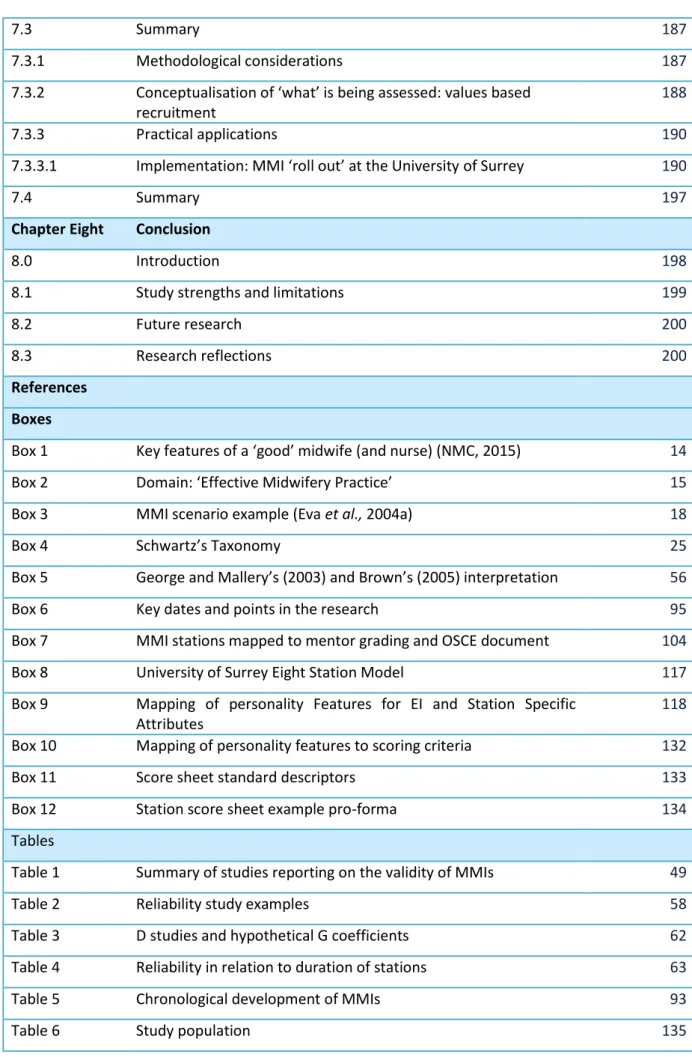
Box 1 Key features of a ‘good’ midwife (and nurse) (NMC, 2015) 14
Box 2 Domain: ‘Effective Midwifery Practice’ 15
Box 3 MMI scenario example (Eva et al., 2004a) 18
Box 4 Schwartz’s Taxonomy 25
Box 5 George and Mallery’s (2003) and Brown’s (2005) interpretation 56
Box 6 Key dates and points in the research 95
Box 7 MMI stations mapped to mentor grading and OSCE document 104
Box 8 University of Surrey Eight Station Model 117
Box 9 Mapping of personality Features for EI and Station Specific Attributes
118
Box 10 Mapping of personality features to scoring criteria 132
Box 11 Score sheet standard descriptors 133
Box 12 Station score sheet example pro-forma 134
Tables
Table 1 Summary of studies reporting on the validity of MMIs 49
Table 2 Reliability study examples 58
Table 3 D studies and hypothetical G coefficients 62
Table 4 Reliability in relation to duration of stations 63
Table 5 Chronological development of MMIs 93
9
Table 7 Cohort demographics 136
Table 8 Correlations between age and academic entry point, mentor grading and OSCE score
137
Table 9 Station data distribution 138
Table 10 Pearson’s correlation and station MMI scores 139
Table 11 Station specific Cronbach’s alpha scores 141
Table 12 Station item-total correlations 143
Table 13 Mean station item-total correlations 144
Table 14 Pearson’s correlation of total MMI score and practice outcomes 145
Table 15 Participants previous experience of MMIs 146
Table 16 Descriptive analysis from participant evaluation 147
Table 17 Respondents preference for interview technique 149
Table 18 Free text responses to participant questionnaire 150
Table 19 Participant responses: frequency and themes 153
Table 20 Interviewer focus group questions, codes and themes 157
Figures
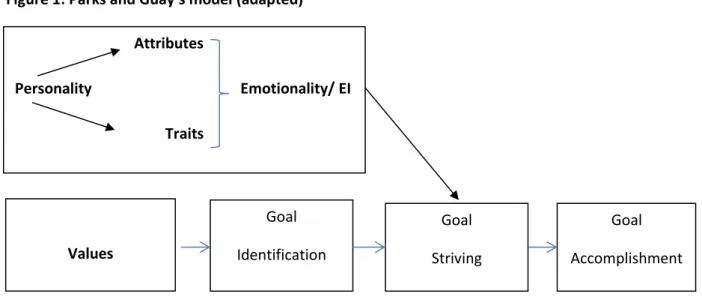
Figure 1 Parks and Guay’s model 40
Figure 2 Flow chart of the selection of papers for review 45
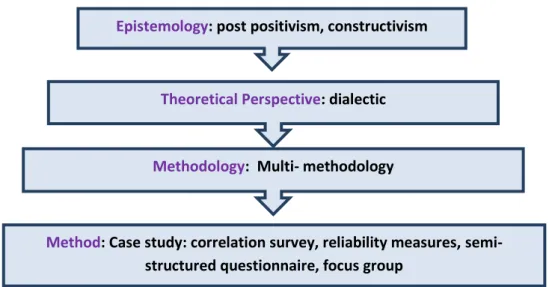
Figure 3 Research Development (Crotty. 1998) 80
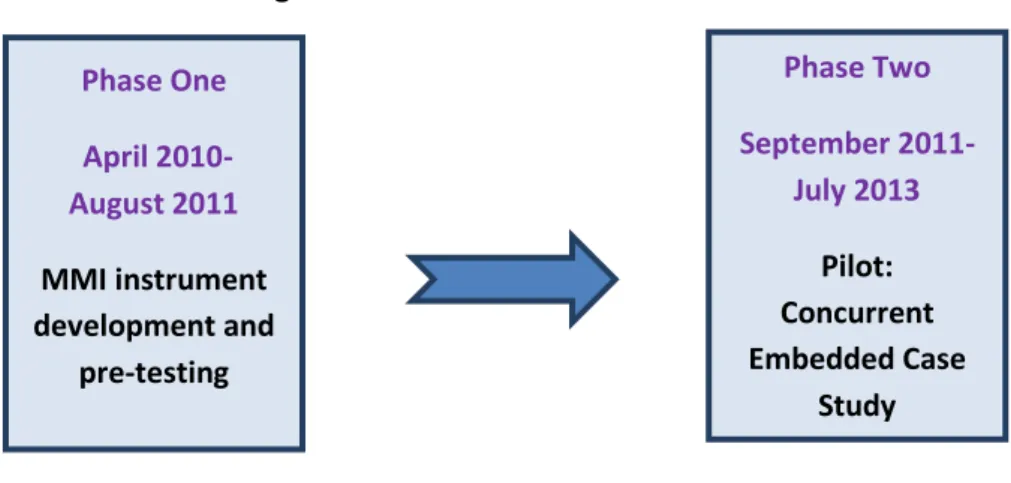
Figure 4 Overall Research Design 86
Figure 5 Study Design (big diagram) 86
Appendices
1 Evidence tables 266
2 NMC Domains of competencies 236
3 Schwartz’s Schwartz Values Survey (SVS) and Portrait Values Questionnaire (PVQ
238
4 Pre-test questionnaire (S2008 cohort) 240
5 Focus group questions 242
6 Focus Group transcription 243
7 Candidate questionnaire 274
8 Postnatal OSCE documentation 277
9 Mentor grading rubrics 287
10 Station score sheets 289
10
Glossary of terms
Graduate Australian Medical School Admissions Test (GAMSAT) is a test used to select candidates applying to study medicine, dentistry, podiatry, pharmacy and veterinary science at Australian, British, and Irish Universities for admission to their Graduate Entry Programmes (candidates must have a recognised Bachelor degree, or equivalent, completed prior to commencement of the degree).
Grade Point Average (GPA)is used by countries outside the UK. It is the average of all grades from all current classes for the marking period. The GPA is calculated by taking the number of grade points a student earned in a given period of time of middle school through high school.The GPA can be used by potential employers or educational institutions to assess and compare applicants.
Medical College Admissions Test (MCAT) is a computer-based standardized examination for prospective medical students in the United States, Australia and Canada. It is designed to assess problem solving, critical thinking, written analysis and knowledge of scientific concepts and principles.
Medical College of Canada Evaluating Examination Year 1 (Total score) (MCCQE 1, total) MCCQE 1 and 11 are part one and part two respectively of the Medical Council of Canada Qualifying Exams. ‘Total score’ represents an overall score; sub-scores are generated, for example, for problem solving and patient interaction.
Medical College of Canada Evaluating Examination Year 2 (Total score) MCCQE 11 (Total) see MCCQE 1 above.
Multiple mini interview (MMI) is an interview format that uses a number of short independent assessments, typically in a timed circuit, to obtain an aggregate score of each candidate’s ‘soft skills’.
Objective Structured Clinical Examination (OSCE) comprises a circuit of short (5–15 minute) stations in which each candidate is examined on a one-to-one basis with one or two examiners and either real or simulated patients (actors or electronic patient simulators) are used.
Pharmacy College Admissions Test (PCAT) is a computer-based standardized test administered to prospective pharmacy school students. The test is divided into six sections including verbal ability, quantitative ability, biology, chemistry, reading comprehension and writing sections.
11
Situational Judgement Tests (SJT) are a type of psychological test which present candidates with realistic, hypothetical scenarios and ask the individual to identify the most appropriate response or to rank the responses in the order they feel is most effective.
UK Clinical Aptitude Test (UKCAT) is a test used in the selection process by UK Medical and Dental Schools. It is designed to give information on candidates' cognitive abilities through four reasoning tests, with a fifth test, the situational judgement test testing attitudes and professional behaviour.
Undergraduate Medicine and Health Sciences Admissions Test (UMAT) is administered by the Australian Council for Educational Research (ACER) in Australia and New Zealand to assist in the selection of students into medical and dentistry courses. It is designed to assess the qualities deemed by ACER to be important to the study and practice of medicine and the health sciences including: critical thinking and problem solving, ability to understand people, and abstract non-verbal reasoning.
12
Chapter One: Current Context 1.0 Introduction
Multiple mini interviews (MMIs) are an admissions instrument designed to inform final decisions in health care student selection. At the commencement of this study in 2010, they were an unknown and unevaluated admissions instrument in student midwife selection. Findings from this research have added important contextual data to the developing evidence base evaluating the effectiveness of MMIs. They also feature as a case study in the National Values – Based Recruitment Framework published by Health Education England (HEE) in 2014 (http://hee.nhs.uk/work-programmes/values-based-recruitment/national-vbr-framework).
Women accessing maternity services are entitled to receive care which reflects the six values embedded within the National Health Service Constitution (NHS) (Department of Health, DH, 2012). These include: “respect and dignity”; “commitment to quality of care”; “compassion”; “working together for patients”; “improving lives” and “everyone counts” (DH, 2012, p.14). The significance of these values in terms of service users’ experience was highlighted in the mid-Staffordshire Enquiry (Francis, 2013) where widespread inadequacies in the provision of compassionate care were identified.
Being with a woman at one of the most vulnerable moments in her life is the immense privilege afforded to midwives (Edwards, 2014). Student midwives embarking on their journey towards achieving professional registration face the challenge of being able to meet women’s complex and changing needs. Higher Education Institutions (HEIs) have the responsibility for educating this future midwifery workforce. They are required to decide which applicants to accept for training: decisions which will directly impact on the experiences of women who use maternity services. The difficulty facing HEIs is that they are tasked with making empirical judgements about applicants’ personal qualities during recruitment processes.
Selecting student midwives who are able to offer safe, compassionate care to women and their families presents challenges and identifying the desirable personal qualities of a student midwife is complex. Students applying to undertake Midwifery Education Programmes in the United Kingdom (UK) are required to meet the statutory admissions criteria of the Nursing and Midwifery Council (NMC, 2009). Minimum age is a generic pre-condition and academic entry levels vary between HEIs with specific criteria commensurate with graduate level of study. Evidence suggests a positive correlation between high academic ability and subsequent theoretical programme performance (Ferguson, James and Madeley 2002). Therefore, selection processes that discriminate between
13 candidates on the basis of their academic credentials would result in a student who is more likely to pass the theory component of their programme. The relationship between academic performance and clinical practice performance is less clear (Salvatori, 2001, Schmitt, 2011, Pitt, 2014). Being a midwife is about more than being able to articulate a theoretical underpinning to practice; the NMC admission criteria also specifies that all applicants must demonstrate that they have “good character
sufficient for safe and effective practice” (NMC, 2009, p.10). . In order to take this discussion
forward, it is important to determine what the NMC mean by this phrasing and to establish whether there is congruence between the NMC’s ‘good character’ and the NHS Constitution values (DH, 2012). Questions can then be asked regarding whether these personal features represent a comprehensive view of the desirable personal qualities of a student midwife and are they being rigorously appraised by admissions processes during selection.
The NMC (2010) state that ‘good character’ is based on an individual’s conduct, behaviour and attitude taking into consideration any convictions, cautions or pending charges. The importance of disclosure of any previous offences is emphasised as it relates to honesty and trustworthiness. Key values are listed including: being accountable, fair, professional, progressive and inclusive. No further explanation of how the NMC defines ‘behaviour’, ‘attitude’ or associated desirable personal attributes is evident in this document (NMC, 2010). It also states that “all midwifery students are expected to work towards being able to apply the Code (NMC, 2015) at the point of registration” (NMC, 2010, p. 6). This is important as the Code (NMC, 2015) represents the professional standards required of midwives once they have achieved their registration. A revised Code (NMC, 2015) has recently been published. The superseded version (NMC, 2008) referred to the provision of care centred on trustworthiness, respect for others, privacy and dignity, advocacy, working with others, provision of the highest standards of care at all times, honesty and integrity, it did not mention ‘good character’. The updated Code (NMC, 2015) repositions itself in a series of statements which together signify what ‘good’ midwifery (and nursing) looks like. The frames of reference centre around four headings, see Box 1.
14
Box 1: Key features of ‘good’ midwifery (and nursing), (NMC, 2015)
‘Prioritising people’ by: Treating them as individuals, listening, ensuring their social, physical and psychological needs are assessed, acting in their best interests and respecting confidentiality
‘Practising effectively’ by Always using best available evidence, ensuring good communication, co-operative working, knowledge and skills sharing, accurate record keeping and being accountable
‘Preserving safety’ by: Recognising the limits of one’s own competence, being honest with service users; assist in an emergency, act promptly if there is a patient safety concern, raise concerns for any vulnerable individual and reduce the risk of harm associated with practice
‘Promoting
professionalism and trust’ by:
Upholding the reputation of the profession, engaging in all registration requirements, investigations and audits, responding professionally to any complaints and providing leadership to ensure the protection of people’s well being
It can be seen that, embedded within the NMC values (2010) and the four statements of the NMC Code (2015) are personal qualities, for example compassion, respect for others, good communication skills and honesty. However, the phrasing ‘good character’ is not mentioned.
The NMC Standards for Pre-Registration Midwifery Education (2009) allude to ‘personal attributes’ in their framework of competencies which students are required to achieve for entry in the professional register. ‘Competent’ is defined as the “combination of skills, knowledge, attitudes, values and technical abilities that underpin safe effective practice” (NMC, 2010, p. 11). Competencies are divided into four domains: ‘effective midwifery practice’; ‘professional and ethical practice’; ‘developing the individual midwife and others’ and ‘achieving quality of care through evaluation and research’. The requirements of each domain are specified, see example in Box 2 (see also Appendix 2.
15
Box 2: Domain: ‘Effective Midwifery Practice’
“Care for, monitor and support women during labour and monitor the condition of the fetus, supporting spontaneous births. This will include:
Communicating with women throughout and supporting them through the experience
Ensuring that the care is sensitive to individual women’s culture and preferences
Using appropriate clinical and technical means to monitor the condition of mother and fetus
Provide appropriate pain management
Provide appropriate care to women once they have given birth” (NMC, 2009, p. 3)
At the core of these competencies are personal skills including ‘effective communication’, ‘empathy’, ‘respect’ and ‘sensitivity’; however, a definitive list of desirable personal features is not present.
The International Confederation of Midwives (ICM) also refers to ‘competencies’ rather than specific attributes or values in their key documentation (ICM, 2011) They describe competencies as “the knowledge, skills and behaviours required of the midwife for safe practice in any setting” (ICM, 2011, p. 1). They are summed up in specific ‘key midwifery concepts’ which further define the unique role of the midwife including: working in partnership, respect for human dignity, advocacy and cultural sensitivity (ICM, 2011). The ICM do not refer to ‘good character’; ‘values’ are mentioned in just one section titled ‘basic professional behaviours’ where it states that the midwife should “act consistently in accordance with professional ethics, values and human rights” (ICM, 2011, p. 4). No further clarification is offered.
While the meaning of the terms ‘good character’, ‘values’ and ‘attributes’ are implicit in the key documentation which explains the role and responsibilities of a midwife, they are not consistently used or defined. What can be identified within the competency frameworks of the NMC (2009), the ICM (2011), the Code (NMC, 2008, 2015) and central to the NHS Constitution values (DH, 2012) is an intrinsic thread centred around the ‘relationship building’ between carer and health care professional. The etymology of the word ‘midwife’ encapsulates this relationship. Found in ancient English, it was first formed in the 1300s when ‘wife’ meant ‘woman’, rather than the more contemporary definition of a ‘married’ woman (Oxford English Dictionary, 2014). ‘Mid’ is a preposition meaning ‘together with’ and therefore midwife literally means ‘together with woman’ (American Heritage Dictionary of the English Language 2009). Bharj and Chesney (2010) suggest that to be ‘with woman’ is more than giving physical and technical care; it involves providing emotional and psychological support to women and their families. The simple definition of the word ‘midwife’
16 belies the complexity of the unique physical, emotional and psychological aspects of care embedded in the relationship which develops when a midwife is ‘with’ a woman during childbearing.
“The relationship that develops between the women and the midwife is at the core of human caring and may provide the basis of the professional body of knowledge that encapsulates
midwifery” Saddiqui (1999, p. 111)
In order for an individual to be able to foster this relationship it is important to understand what it is about the connection between a mother and midwife which is enhanced through the ‘good character’ specified by the NMC (2009). Alluding to a distinctive set of skills and attributes, Nicky Leap (2010) offers some insight,
“Our expertise as midwives rests in our ability to watch, to listen and to respond to any given situation with all of our senses ... the skill lies in knowing when to inform, suggest, act ...
when to be still and when to withdraw and remove ourselves ... ” (Leap, 2010, p. 22).
Kirkham (2009) suggests that the relationship between mother and midwife is founded on principles of respect, trust, reciprocity and emotional integrity. Without these a midwife will risk ‘doing to’ and ‘checking women’ rather than truly listening and being ‘with them’. Kirkham (2009) refers to an emotional dimension but only begins to allude to how this might specifically relate to ‘good character’, ‘attributes’ and ‘values’. The significance of this emotional dimension to both women and midwives should not be understated (Hunter, 2009) and it is explored in greater depth in section 2.6. It is important to consider the subtle nuances of ‘attributes and values’ and how they link to personal qualities, emotions and behaviour before any attempt can be made to identify which ones are desirable in a student midwife. In chapter two a review of relevant literature begins by contextualising these terms with working definitions which then form the foundation for exploring if and how they can be assessed at selection. Of particular significance is the apparent omission of ‘emotions’ or ‘emotionality’ in caring relationships in regulatory and government guidelines and publications. This is revisited in sections 2.6, 2.7 and 7.3.2.
The ‘good character’ or personality features required of a midwife to enable her/him to provide care that reflect the NHS constitution values (DH, 2012) are difficult to define. HEIs however, have responsibility to select students on to their education programmes whom they believe to be best suited to the profession. To add pressure to this decision-making, the Government’s mandate (DH, 2013) to HEE following the Francis Report (2013) states that recruitment into all newly-funded training posts, including midwifery, should incorporate selecting for ‘values’ during selection by 31st March, 2015. This is discussed in greater depth in section 7.3.2. The Government clearly emphasise
17 personal ‘values’ citing ‘caring’, ‘compassion’ and ‘empathy’ as well as technical and academic skills (DH, 2013). This aligns with the NHS Constitution (2012) but a lack of clarity is evident between the phrasing of these key documents and those of the NMC (2009, 2010), the ICM (2011) and DH, (2013) where terms like ‘values’, ‘attributes’ and ‘character’ are used interchangeably. Selecting midwives of the future is intensely competitive; for example in 2014-2015 the University of Surrey received over 1000 applications for the 56 available places on their pre-registration midwifery degree programme. In this competitive milieu, HEIs have a duty to adopt recruitment strategies that are as reliable, defensible and valid as possible (Rodgers et al., 2013). This involves being clear about what a desirable profile of a student midwife is and ensuring that selection measures are robust enough to assess whether applicants possess ‘it’ during selection.
HEIs admissions procedures in the UK are staged. Applicants are initially shortlisted according to their academic ability which is measured by previous examination success. To meet the NMC Standards for Midwifery Education (NMC, 2009) a face-to-face meeting with an interviewer is then required before a candidate can be accepted onto programmes following short listing. The personal interview is widely used to inform these final decisions. However, the predisposition of the personal interview to examiner bias, chance and ‘context specificity’, where an individual’s performance in one situation is weakly predictive of their performance in another (Eva, 2003), have been identified (Patterson et al., 2014). Also called into question is the ability of the interview to assess an individual’s personal profile in order to identify those most likely to be able to meet women’s complex and changing needs (Wilson et al., 2012, Perkins et al., 2013, Rodgers et al., 2013). This is discussed further in section 3.4.
The multiple mini interview (MMI) is an admissions tool designed to replace the personal interview at selection. Initially developed with medical school applicants at McMaster University, Ontario (Eva
et al., 2004a) it has been adopted in health care student training institutions internationally (Roberts
et al., 2008; McBurney and Carty, 2009; O’Brien et al., 2011; Husbands and Dowell, 2013; Perkins et
al., 2013, Hopson et al., 2014; Campagna-Vaillancourt et al., 2014). MMIs are short focused interactions with a series of interviewers where candidates are required to respond scenarios (see Box 3) designed to assess specific skills and attributes (see section 3.2). Proponents argue that the aggregate of multiple encounters generates a more accurate and generalisable representation of an individual’s attributes and values than any one encounter (Eva 2004a). The reliability and validity of MMIs have been evidenced in, for example, medical, dental and veterinary student selection (Eva et al., 2004a and 2009, Roberts et al., 2008, O’Brien et al. 2011, McAndrew et al, 2012, Oliver et al, 2014) but not in nursing or midwifery selection to date.
18
Box 3. Example MMI scenario (Eva et al., 2004a, pp.325)
Ethical decision making
“Dr Cheung recommends homeopathic medicines to his patients. There is no scientific evidence or widely accepted theory to suggest that homeopathic medicines work and Dr Cheng doesn’t believe them to. He recommends homeopathic medicines to people with mild and non-specific symptoms such as fatigue, headaches and muscle aches because he believes that it will do no harm, but will give them reassurance.
Consider the ethical problems that Dr Cheng’s behaviour might pose ... ”
At the commencement of this study I questioned whether the personal interview, which was being used to inform final decisions in student midwife selection at the University of Surrey, was fit for purpose. Having searched the literature, I proposed an alternative, the MMI, citing the published evidence base in medical student selection. The Registrar at the University of Surrey was unable to grant approval to replace the personal interview with MMIs in the absence of supportive empirical data specifically in the context of student midwife selection; this was despite the questionable evidence base relating to the reliability of the personal interview (see section 3.4). It therefore became clear that robust research was required involving the development of a bespoke model and tools.
Noteworthy at this point, is the important distinction between ‘selection’ and ‘recruitment’. Recruitment can be defined as “the process of generating a pool of capable people to apply for a role within an organisation” and selection as “the process by which managers or others use specific instruments to choose from a pool of applicants a person or persons most likely to succeed in a job or role” (Bratton and Gold, 2007, p. 239). For the purposes of clarity in this document, I conceptualise recruitment and selection according to Bratton and Gold’s definitions (2007).
Validated scenarios and MMI models used in medical student selection were not considered directly transferable to student midwife selection as many featured clinically orientated content as well as a different attributes profile (see section 3.2). In my experience of midwifery selection at the University of Surrey, applicants present with a wide range of previous clinical practice exposure, some with significant experience as Maternity Care Assistants and others with very little. This disparity potentially rendered the medical student’s scenarios unfair as parity of opportunity could not be ensured between candidates. Non-clinically based scenarios and scoring pro-forma were
19 required, aimed at assessing the attributes embedded within the NMC (2009, 2010) and ICM (2011) documentation as well as capturing women’s and midwives’ views regarding makes a ‘good’ midwife (see sections 2.3, 2.4, 2.5).
1.1 Statement of intent
Research Aim: to develop, pilot and evaluate multiple mini interviews in pre-registration student midwife selection in a Higher Education Institution (HEI) in the UK
Research Question: How effective are multiple mini interviews in pre-registration student midwife selection?
Objectives
1. Development
a. To define the desirable personal qualities of a student midwife
b. To develop MMI scenarios designed to assess these personal qualities c. To develop an MMI model to pilot the scenarios
2. Pilot MMIs on pre-registration student midwives examining their effectiveness: Validity (content, face, construct and predictive)
Reliability (inter-station, internal consistency)
Acceptability perspectives
o Interviewer
o Applicant
3. Evaluation
To evaluate MMIs as a selection tool for pre-registration midwifery education programmes
1.2 Importance of this research
In 2010 research exploring the effectiveness of MMIs had taken place primarily in medical student selection. MMIs have been used in student midwife selection at the University of British Colombia, Canada (personal correspondence, 2010: http://midwifery.ubc.ca/person/saraswathi-vedam). However there was no published midwifery specific reliability and validity data available in the literature at the time of this research.
20 This study contributes a unique perspective to current theory relating to the assessment of student midwives’ values and attributes at selection including: the identification of desirable personal qualities of a student midwife; a detailed conceptual framework for MMI development; pilot data specifically relating to midwifery selection; and generic practical considerations. The findings of this research have added significance since the publication of the Francis Report (2013). While core values including care and compassion were written into the NHS Constitution (2012) individuals using the Health Service were clearly not experiencing the standard of care they had the right to receive. The ensuing work by HEE has included developing a comprehensive National Values-Based Recruitment’ Framework (HEE, 2014) designed to guide NHS employers and HEIs with their recruitment processes (see section 7.3.2). The use of MMIs as a selection measure is endorsed within this framework.
With current Government policy (DH, 2013) emphasising assessing ‘values’ at selection (Section 7.3.2) this thesis concludes by offering new perspectives in section 7.3. I suggest that selecting for ‘good character’ (NMC, 2009) is about more than the current drive for values-based recruitment (DH, 2013). The importance of a multi-dimensional ‘emotionality’ embedded in caring relationships is emphasised and its explicit inclusion in government, professional and regulatory publications is proposed. Finally, the contribution that MMIs can make to enhancing selection processes is evaluated. I suggest that generic conclusions can be drawn which have the potential to be extrapolated across health care professional student selection.
1.3 Organisation of the thesis
At the commencement of the literature review in 2010 there was relatively limited published literature evaluating interview techniques in relation to assessing caring attributes and values in healthcare professional student selection. Since the Mid-Staffordshire Enquiry (Francis, 2013) there has been an unprecedented interest and drive to engender greater compassionate care in the NHS. Primary research and ‘contemporary issue’ discussion papers exploring ‘values-based’ recruitment strategies, including MMIs, are now pervasive throughout midwifery, nursing and medical journals (Patterson et al., 2014). In addition MMIs were a relatively new innovation in 2010. Data to examine their predictive validity has taken time to evolve. Students needed to progress through their programmes before any associations could be explored between their admissions MMI score and subsequent performance in practice. By 2014 a significant volume of new evidence was available (Appendix 1); data which had been published during the course of my study time frame. Accordingly, literature published up to December 2014 has been included.
21 The review of the literature has been divided into two chapters: Chapter Two is concerned with clarifying what is a desirable personal profile of a student midwife. This begins with a broad context presenting working definitions of words like ‘attributes’, ‘values’ and ‘personality’. A more detailed exploration of the personal features that stakeholders feel are commensurate with being a ’good’ midwife follows, including an emotional dimension to the caring relationship.
Chapter Three presents the MMI as an alternative to the personal interview. Embedded in this discussion is a critique of different face-to-face interview techniques including the personal interview, group interview and assessment centres.
In Chapter Four the research methodology and methods are described and critically justified. A dual paradigmatic approach incorporating multiple methods was used in a concurrent embedded case study (Creswell and Clark, 2011). Greene and Caracelli’s (1997) philosophical position underpinned this research which rejects a single paradigm perspective in favour of a pluralistic standpoint. Each paradigm and associated methods offers a legitimate and meaningful perspective, generating in-depth multi-dimensional knowledge and understanding (Creswell and Clark, 2011). By adopting this philosophical stance it was possible to examine reliability and validity as well as exploring more in depth acceptability perspectives which would not have been possible with adherence to any one, single theoretical position.
The study findings are presented in chapters five and six. Chapter Five reports development and pre-study findings including the final scenarios and scoring pro-forma. Chapter Six presents qualitative and quantitative results from the study.
The Discussion follows in Chapter Seven. Reflecting on the theoretical assumptions made at the commencement of this study, their influence on the final research design is considered. The findings are discussed in the light of the conclusions drawn from the literature review. New insights generated are appraised in the context of current policy surrounding values based recruitment. Finally, details of how the pilot data and experience gained informed a “roll out” to live selection at the University of Surrey are presented. This chapter concludes with three principle themes: ‘methodological considerations’, ‘conceptualisation of what is being assessed’ and ‘practical applications’ as well as study strengths and limitations and areas for future research.
Chapter eight concludes the thesis with specific reference to study strengths and limitations, suggestions for further research and reflections.
22
Chapter Two: The desirable personal qualities of a student midwife 2.0 Introduction
This chapter aims to elucidate the desirable personal qualities of a student midwife, once pre-conditions, namely academic achievement and work experience, have been met. At the commencement of this review, preliminary searches revealed the complexity of defining desirable qualities because terms like attributes, traits, values and personality are used interchangeably in the literature.
Section 2.1 begins by detailing the search strategy undertaken. Section 2.2 contextualises ‘what’ is being assessed at selection by setting out working definitions for attributes, traits, values and personality. In section 2.3 the desirable personal qualities considered important by the NMC (2009, 2010) and the ICM (2010) are explored in greater depth, having been introduced in section 1.0. Midwives’ and women’s views of a ’good’ midwife are examined in sections 2.4 and 2.5 respectively. A recurring theme embedded within these perspectives is the significance to both women and midwives of the presence of an emotional dimension to the caring relationship. Section 2.6 goes on to explore the complex, nuanced features of this ‘emotionality’ in the context of the mother-midwife relationship. Section 2.7 follows summarising how working definitions of ‘values’, ‘attributes’, ‘traits’, personality and ‘emotionality’ relate to student midwife selection.
A definitive list of personal qualities is presented later in section 5.1. The systematic development of this profile is critically explained in section 4.4.1.1.
2.1 Search strategy
Searching for literature was an iterative process. This was in response to new information revealed in the course of the search, as well as influential developments outside the search, for example, The Francis Report (2013) which had a significant impact on contemporary literature.
The following databases were searched: British Education Index; CINAHL; Educational Administration Abstracts; ERIC; MEDLINE; PsycARTICLES; Psychology and Behavioural Sciences; PsycINFO; ASSIA; British Nursing Index and Sociological Abstracts.
In addition, Google searches were undertaken to find any relevant literature including information about which HEIs were using MMIs and how they were administering them. Key professional organisation websites were also searched, for example, the NMC and ICM.
23
Searches of the grey literature included: https://www.opengrey.eu and
http://www.gov.uk/government/publications.
Each search was restricted to only those written in English, with no date limiters to ensure the inclusion of seminal concepts. Searches were entered into Endnote to remove duplicates.
Search A
Search Term
S1 values AND attribute*
S2 personality
S3 “good character”
S4 virtue
S5 midwi OR “student midwi*”
S6 mother S7 “good midwi*” S8 “virtue ethics” String 1 S1+S2+S3+S4 String 2 S1+S5 String 3 S2+S5 String 4 S3+S5 String 5 S4+S5 String 6 S8+S5 String 7 S5+S7 String 8 S6+S7 S9 emotion* S10 “emotional intelligence” String 9 S5+S9 String10 S5+S10
During the course of the search different stakeholder views emerged regarding the desirable personal qualities of a student midwife. These include professional organisation, women’s and midwives’ perspectives. These themes inform sections 2.3, 2.4 and 2.5.
24
2.2 What are: ‘values’, ‘traits’, ‘attributes’ and ‘personality’?
In accordance with the NMC (2009) and ICM (2011) documentation and the NHS Constitution (DH, 2012) I have alluded to the ‘soft skills’ (McIntosh et al., 2013) like respect, trust, relationship building and communication required of a midwife in order to be able to meet women’s needs. These ‘soft skills’ are presented in the literature as ‘attributes’, ‘values’, ‘traits’ and ‘personality’ and many are subsumed by an emotional dimension (Kirkham, 2009). The subtle nuances of ‘attributes and traits’ and how they link to personal qualities, values and emotions are important to consider before any attempt can be made to assess, at selection, whether an individual possesses them.
It was outside the scope of this review to systematically appraise, in-depth, current literature on values, attributes, traits and personality. However, for the purposes of clarity, the following working definitions are proposed. Values are principles or standards of behaviour and, ones judgement of what is important in life (Oxford English Dictionary, 2014). Values are cognitive representations of enduring goals, reflecting personal choice to act in a certain way (Roccas et al., 2002). They impact on behaviour and are influenced by motivation (Parks and Guay, 2009). Values hold different degrees of importance from individual to individual. A particular value may be important to one person but unimportant to another (Schwartz, 2012). As learned beliefs, values can change or adapt over time (Parks and Guay, 2009). Personal values can be predictive of behaviour as they relate to how individuals feel they ought to behave (Schwartz, 1994). Values can transcend different situations, for example, honesty values may be important to an individual in the workplace as well as with friends or strangers (Schwartz, 2012). They can be prioritised by importance when two or more values are in conflict (Parks and Guay, 2009), for example, individuals may act less benevolently if their achievement values are threatened. In 1992, Schwartz published a taxonomy of values which groups values into ten domains that are reportedly recognised across cultures (Schwartz, 2012) see Box 4. To test his taxonomy, Schwartz developed dedicated instruments; the Schwartz Value Survey (SVS, Schwartz, 1992) and the Portrait Values Questionnaire (PVQ, Schwartz, 2006) (see Appendix 3) and conducted extensive international studies (Schwartz, 1992). Following the comprehensive and widespread validation of his values theory, it was included in the European Social Survey (www.europeansocialsurvey.org) which aimed to monitor changing values and attitudes across Europe (Jowell et al., 2007). Interestingly, there is no mention of emotions or emotionality or how learning from emotions and experience can inform human behaviour. In addition, Knoppen and Saris (2009) question the ability of the Schwartz tools to discriminate between different values; their criticisms remain unconfirmed. Therefore, while acknowledging this potential critique the
25 widespread acceptance of Schwartz value theory over the past two decades is the justification for its inclusion in this work.
Box 4: Schwartz’s Taxonomy Schwartz Values (1992)
‘Self-direction’ meaning independence of thought, creativity and exploration
‘Stimulation’ meaning responding to challenges in life
‘Hedonism’ or the pursuit of pleasure and self-enjoyment
‘Power’ or social status and control
‘Achievement’ or personal success through demonstrating competence according to social standards
‘Security’ referring to safety and harmony in society, within relationships and the self
‘Conformity’ or restraint of actions and inclinations likely to upset or harm others, or violate social expectations and norms
‘Tradition’ demonstrating respect, commitment and acceptance of customs dictated by culture or religion
‘Benevolence’ or preserving and enhancing the welfare of others with whom one comes in personal contact
‘Universalism’ representing an appreciation, tolerance and protection for the welfare of all people
Intrinsic to Schwartz’s taxonomy are many of the NHS Constitution values for example: ‘compassion’, ‘everyone counts, ‘commitment to quality of care’ and ‘working together’ relate to the ‘tradition’, ‘benevolence’ and ‘universalism’ values. Also embedded within Schwartz’s ‘tradition’, ‘benevolence’ and ‘universalism’ values are some of the ‘attributes’ and values featured in the NMC (2009, 2010) and ICM (2011) documentation including ‘respect for difference and diversity’, fairness and ‘caring’. However, there is no explicit mention of ‘emotions’ or ‘emotionality’ in relationships in either the NMC (2009, 2010), ICM (2011) attributes, Schwartz’s taxonomy or the NHS Constitution values (DH, 2012). This raises important questions about the personal qualities considered desirable in a student midwife. If this profile were restricted to ‘values’ or attributes as defined by Schwartz (2012), the NMC (2009) and ICM (2011) then the emotional dimension to the caring relationship, so valued by women (Kirkham, 2010), may be lost.
To take this discussion forward it is pertinent to clarify key terms: an attribute is ‘a quality or characteristic that someone has’. It is considered ‘a feature regarded as a characteristic or inherent
26 part of someone’ (Oxford English Dictionary, 2014). This is conceptually distinct from a ‘trait’ which is ‘a distinguishing quality or characteristic’ (Oxford English Dictionary, 2014).
The terms traits, attributes and personality are used interchangeably in the literature and the relationship between them is complex. Working definitions of traits and attributes have been established. A substantive amount of academic writing has been devoted to exploring ‘personality’ or, more specifically, ‘personality traits’. In the 1980s the Five-Factor or the Big 5 Personality Factor model was developed which is considered to be the most widely accepted representation of human trait structure today (McCrae and Costa, 1987). The five factors including examples of associated traits are: conscientiousness (responsible, organised, efficient), emotional stability (self-confident, resilient, well-adjusted), extroversion (talkative, ambitious, assertive), agreeableness (friendly, loyal, co-operative) and openness to experience (curious, imaginative, open minded). Mount and Barrick (1995) suggest that these five personality constructs are sufficient to describe the basic dimensions of normal personality and it can be seen that ‘emotions’ feature but care and compassion do not. I searched the literature using the databases listed in section 2.1 and could find no published research which specifically explored associations between the Big 5 personality factors in health care professionals and their performance in clinical practice. This suggests an important area for future research. Roccas et al., (2002) however, explored the relationship between the Big 5 and the value taxonomy espoused by Schwartz (2012). She concluded that values and traits are conceptually distinct; the influence of values on how an individual may act is more cognitively controlled than is the impact of personality traits over which an individual may have less cognitive control. It is implied that the ‘emotionality’ factor in the Big 5 did not feature in Schwartz’s taxonomy (2012). This is an important observation because, if values, traits and attributes are considered to be distinct constructs, they may all potentially contribute to what constitutes a desirable personal profile of a student midwife but together they may not still encompass ‘emotion’ factors. It is therefore suggested that selection for ‘values’ (DH, 2013) is potentially self-limiting. This position is discussed in greater depth in section 7.3.2.
What constitutes the ‘good character’ stipulated by the NMC (2009) is difficult to define. It is only implicit in the desirable personal attributes and values. Interestingly it is explicit in ‘virtue ethics’ theory which emphasises the role of ‘character’ or the virtues that one’s character embodies in determining behaviour. ‘Ethics’ has its roots in the Greek term ‘ethos’ which means habit. Aristotle believed that virtues are ‘dispositions’ which may be developed by ‘habit’ (Barnes, 2000). Aristotle suggested that dispositions such as courage, generosity, fair-mindedness are virtues which are characterised as good judgement and practical wisdom. ‘Care’ or ‘caring’ is not cited by Aristotle as a
27 virtue but Barnes (2000) suggests it could be implicit in his virtue of ‘courage’. Aristotle also emphasised the importance of aspiring to be ‘good’ and to live the life of a good and virtuous person (Banks and Gallagher, 2009). More recently writers have reconsidered virtue ethics in contemporary considerations of what makes for ‘caring practice’. Notable is MacIntyre in his book After Virtue
(2012). MacIntyre (2012) broadly conceptualises ‘practice’ as human activity which has its own goals and inherent virtues. He talks about ‘internal and external goods’ which enable the achievement of ‘practices’. ‘External goods’ refer to an individual’s property or possessions and are less relevant to this discussion. ‘Internal goods’ are characteristics which enable achievement. He states that a virtue is a human quality that enables the achievement of ‘internal goods’ relevant to practice including justice, courage and honesty. These important considerations contribute to our understanding of how ‘good character’ can be conceptualised in terms of ‘virtues’. Despite the association with ‘character’, which is featured in the NMC documentation (2009, 2010), the terms ‘virtue’ or ‘virtue ethics’ are not specifically mentioned in either the NMC (2009, 2010), ICM (2011) documentation or the NHS values (DH, 2012) and are therefore not taken forward in this discussion.
There is no mention of the term ‘personality’ in the NMC (2009), ICM (2011) documentation or the NHS Constitution values (D0H, 2012) and features of the Big 5 factors are implicit but not explicit. Therefore,I have taken forward my emerging profile for the desirable qualities of a student midwife using the terms ‘values’, ‘attributes’ and ‘traits’ plus an ‘emotional dimension’ which together comprise the “good character” espoused by the NMC (2009). Before a definitive list of desirable qualities could be developed further, it was necessary to explore different stake holder perspectives.
2.3. What are the desirable personal qualities of a student midwife?
Student midwives require the necessary skills and qualities to enable them to navigate the complex journey to professional competence from theoretical and practice perspectives. In section 1.0 I suggested that the relationship a midwife builds with a woman is fundamental to their caring practice (Kirkham, 2009). The ICM (2011) endorses this view, stating that the midwife is a “responsible and accountable professional who works in partnership with women” (ICM, 2011, p. 2). Working in partnership involves the ability to communicate in a mutually reciprocal and beneficial way. Effective communication is not just about the spoken or written word (Gaudian and Homeyard, 2010), it requires emotional sensitivity and emotional engagement (Deery, 2009); knowing when to speak, when to be quiet, as well as empathy and intuition. Midwives communicate with women non-verbally and non-verbally in the form of conversation. The German philosopher Hans-Georg Gadamer (1989) described conversation as ‘the process of two people understanding each other whereby knowledge arises out of that interaction’. Gadamer (2006, p. 301) believed that “horizons of
28 understanding” or knowledge is not a fixed commodity but is something that arises out of the interaction between two people. This conceptualisation of knowledge acquisition can be applied to midwifery. Midwives should be open to what women are expressing, seeking to understand, accept and empathise with a woman’s point of view from both factual and emotional perspectives.
Gaudian and Homeyard (2010) assert that a pre-requisite for providing care in partnership with a woman is to avoid stereotyping and to listen, in order to gain understanding of her individual needs. As a unique person, a woman will relate to a midwife in her own way but the midwife’s ‘cluefulness’ or ability to listen openly, to inform, suggest, act, be still and know when to withdraw will enhance the relationship between mother and midwife emotionally and psychologically (Leap, 2010). Midwives are ‘with women’ at arguably some of the most vulnerable times in their lives (Raynor and England 2010). During these challenging and intimate events, high levels of emotional expression are common (Hunter, 2010). Within the evolving relationship, the requirement for midwives to establish a level of understanding and to be ‘emotionally’ sensitive to women’s needs is paramount (Hunter and Deery 2009).
The next two sections explore different stakeholder perspectives of a ‘good’ midwife beginning with midwives’ views.
2.4 Midwives’ views of a ‘good midwife’
There is limited primary research exploring midwives’ views of a ‘good’ midwife. Bryom (2008) conducted a phenomenological study exploring ten midwives’ accounts of the characteristics of ‘good’ leadership and a ‘good’ midwife. Analysis revealed two dominant themes: skilled competence relating to knowledge and skills personality characteristics cited as ‘emotional intelligence’ (see section 2.6). These findings reflect others (Hunter, 2004, Nicholls and Webb, 2006). Nicky Leap explored the midwife-mother relationship focusing on the innate skill of ‘being with women’. Her conceptualisation of the role of the midwife from a psychological perspective is about ‘enabling women’:
“our expertise as midwives rests on our ability to watch, to listen and to respond to any given
situation with all of our senses” ... the less we do the more we give ...” (Leap, 2010, p.22).
Tensions could manifest between this philosophy and the medicalised culture of maternity care embedded in today’s NHS. Midwives themselves may face a dissonance between their personal aspirations and the constraints of day-to-day practice rendering them disillusioned and stressed (Dykes, 2009).
29 A structured literature review of published research over 30 years conducted by Borelli (2013) was designed to report on what is considered to be a ‘good midwife’. She concluded that a ‘good midwife’ relates to the complementary combination of theoretical knowledge, clinical and professional competencies, communication skills, personal qualities and moral and ethical attitude. However, she cautions against assuming clarity and congruence between the views of women and those of midwives. Midwives’ perception of themselves as ‘good’ professional could be affected by the potential tensions they might experience between their personal ideology and the institutional constraints within which they work (Hochschild, 1983, Dykes, 2009). These findings build on those of Nicholls and Webb (2006) who carried out an integrated review of methodologically diverse research to answer their question ‘what makes a good midwife’? Their premise was that, while the NMC (2010) defines what constitutes ‘competence’, some midwives possess enhanced skills and attributes elevating their performance from ‘competent’ to ‘good’. Research from a range of perspectives including midwives’ and mothers’ views was evaluated systematically. The most commonly cited theme that made midwives ‘good’ was their ‘attributes’. Having good communication skills made the greatest contribution while being compassionate, kind and supportive, knowledgeable and skilful were other major factors. Nicholls and Webb (2006) concluded by stating that pre-registration midwifery educators may need to consider these attributes when selecting students for entry on to their education programmes. Waugh et al., (2014) provided evidence to support a values-based personal specification for recruitment of compassionate midwifery candidates. Registered and student midwives’ views of desirable attributes and key skills were elucidated in this online survey. Findings included seven top ranked attributes: honesty and trustworthiness, communication skills, being a good listener, patience and tactfulness, sensitivity and compassion, the ability to seek and act on guidance and being a good team worker. These findings corroborate Carolan (2010, 2013) who also explored student midwives’ views of a ‘good midwife’ in qualitative study in Australia. Of note, is the interchangeable use of the terms ‘values and attributes’ making the findings hard to interpret accurately.
Most recently Bray et al.’s (2014) findings complement the growing evidence base where: acting with warmth and empathy; providing individualised patient care and acting in a way that you would like others to act towards you were considered by health care professionals and students alike to be the most important features of care provision. Bray et al.’s (2014) findings are interesting to note in a multicultural society where people’s perceptions of how they might prefer to be treated could be culturally influenced. However, in her literature review, Borelli (2014) came to similar conclusions adding, to the personal qualities, communication skills and moral and ethical values.
30
2.5 Women‘s views of a ‘good’ midwife
The significance that women place on the midwife-mother relationship cannot be understated. Women rate midwives’ ‘presence’ more highly than ‘actions’ (Pembrooke, et al., 2008); the ‘being there’ is more important than what is said and done (Dahlen et al., 2010, Sjoblom et al., 2014). The Association for Improvements in Maternity Services (AIMS, online 2012), citing McCourt and Stevens (2009), presented the ‘top ten’ skills women would like from their midwife: to listen, be an advocate for women, understand informed decision making, respect women, value professional skills in normal birth, be a courageous professional, a collaborative worker, use positive language, know when to be silent while engaged and to be human(e). Endorsing this, Beake et al., (2010) concluded that staff interaction had a direct impact on how women perceived their care. The views of 20 women were explored through in-depth interviews, generating a micro-level perspective. Transferability of the findings are limited by the sample size in addition to the differing interventions that these women received, for example, the majority underwent caesarean sections with a minority having normal vaginal births. Most women were primiparous and over 30 years of age hence their needs and expectations may have varied significantly from a younger, multiparous population. The most recent national Surveys of Women’s experiences of Maternity Care conducted in England (Care Quality Commission, 2013) and Scotland (The Scottish Government, 2014) revealed that women rate ‘good communication’ highly at all stages of their care.
Sjoblom et al., (2014) evaluated the views of 939 women in relation to positive aspects of midwifery care provided in homebirth settings. Content analysis revealed that women valued the midwife’s ‘safe hand’ where the midwife’s overview of the birth process and grasp of the situation made women feel safe; ‘having control over the course’ or the midwife having a watchful eye by checking the wellbeing of the mother and baby; ‘the midwife having a sense of when and how action is needed’; the ‘midwife’s caring approach’; ‘the midwife providing support and encouragement’, ‘guidance’ and ‘showing respect by staying in the background’. These features are congruent with others who have demonstrated that women appreciate midwives who are honest, respectful, prepared to listen, who are sensitive to their needs, who treat them as individuals (Green, 1990 et al., Walsh, 1999, Fraser, 1999, Fenwick, 2005) and who possess good communication skills (Nicholls
et al., 2011). The absence of these features renders the woman insecure, lacking in trust and less
satisfied with her birth experience (Berg et al., 1996, Beake et al., 2010). The relationship built between women and midwives is also strengthened by reciprocity or a mutual sharing. Where there is reciprocity, evidence indicates that the relationship will be meaningful and satisfying to both mother and midwife (Hunter, 2006, McCourt and Stevens, 2009,). Women suggest that they value a
31 midwife who is able to engage with them at different levels offering “caring encounters” rather than “being absently present” (Kirkham, 1010, p. 38). The importance of an emotional dimension to care provision was highlighted by Tumblin and Simkin (2001) in their qualitative study exploring the expectations of a sample of primigravida women during labour. Fifty - seven women were asked what they expected from their nurse during labour and birth. One hundred and seventy four items were listed with 29% of the task priorities related to emotional and informational support.
Summary
Women appear to value safe, competent care enhanced through effective communication and an emotional dimension. Congruence is evident between research exploring women’s views of what they perceive as being a ‘good’ midwife, and the values and attributes intrinsic to the NMC (2009, 2010) and ICM (2010) documentation as well as the NHS Constitution apart from specific reference to this emotional dimension.
In section 2.3 I considered the features implicitly present in the relationship midwives foster with women, namely a midwife’s ability to be emotionally engaged and emotionally sensitive with women. Emotional engagement and emotional sensitivity are central to meeting women’s needs but, in addition, midwives’ self-awareness and the ability to recognise and regulate their responses are essential to avoid burn out (Hochschild, 1983, Deery and Kirkham 2007). The next section explores this ‘emotionality’ beginning with emotions themselves.
2.6 Emotions, Emotionality and Emotional intelligence
Emotions mark meaningful moments in peoples’ lives. They are complex and involve the entire body, mind, action and thought. Having a baby is a physical experience coupled with a potent mix of emotions, hormones, and psychological and spiritual elements. Many emotions associated with childbearing, including love, joy, anger, fear, happiness, guilt, sadness, hope can be inhibitive or transformative.
Questions have been raised over whether emotions can be conceptualised or quantified in a scientific way (Cornelius, 1996). This is important in relation to this study which involves the assessment of personal qualities in which ‘emotionality’ is embedded. Frijda (1988) believes that emotions exhibit ‘empirical regularities’ and it is possible to show that they display recurring features which are caused by sets of circumstances that can be precisely described. Hochschild (1983), Hunter and Deery (2009), citing Goffman (1969) and more recently Kirkham (2010) question the authenticity of emotional responses in professional relationships. They allude to the influence of