Institut de Recerca en Economia Aplicada Regional i Pública Document de Treball 2015/18 1/26
Research Institute of Applied Economics Working Paper 2015/18 1/26
“Strong versus Weak Vertical Integration:
Contractual Choice and PPPs in the United States”
4
WEBSITE: www.ub.edu/irea/ • CONTACT: [email protected]
The Research Institute of Applied Economics (IREA) in Barcelona was founded in 2005, as a research institute in applied economics. Three consolidated research groups make up the institute: AQR, RISK and GiM, and a large number of members are involved in the Institute. IREA focuses on four priority lines of investigation: (i) the quantitative study of regional and urban economic activity and analysis of regional and local economic policies, (ii) study of public economic activity in markets, particularly in the fields of empirical evaluation of privatization, the regulation and competition in the markets of public services using state of industrial economy, (iii) risk analysis in finance and insurance, and (iv) the development of micro and macro econometrics applied for the analysis of economic activity, particularly for quantitative evaluation of public policies.
IREA Working Papers often represent preliminary work and are circulated to encourage discussion. Citation of such a paper should account for its provisional character. For that reason, IREA Working Papers may not be reproduced or distributed without the written consent of the author. A revised version may be available directly from the author.
Any opinions expressed here are those of the author(s) and not those of IREA. Research published in this series may include views on policy, but the institute itself takes no institutional policy positions.
Abstract
Public-Private-Partnerships are long-term, relational contracts between a public-sector sponsor and a private partner to deliver infrastructure projects across a range of economic sectors. Efficiency gains may derive from risk transfer and bundling different tasks within a single contract. We study the factors explaining the scope of bundling. We focus on the choice between weak vertical integration, which includes operational tasks alone or construction tasks alone, versus strong vertical integration, which involves the combination of operational and construction tasks. We utilize a new data set that includes 553 PPPs concluded in the U.S. between 1985 and 2013.
JEL classification: L14; L33; L51; L88
Keywords: Privatization, Public–Private Partnerships, Contracting, Vertical Integration
Daniel Albalate: Department of Economic Policy & GiM-IREA, Universitat de Barcelona (Barcelona, Spain) ([email protected]).
Germà Bel: Department of Economic Policy & GiM-IREA, Universitat de Barcelona (Barcelona, Spain) ([email protected]).
Richard R. Geddes: Department of Policy Analysis and Management College of Human Ecology, Cornell University (Ithaca, New York) ([email protected])
Acknowledgements
This work was supported by the Spanish Government (ECO2012-38004); the Catalan Government (SGR2014-325), and the ICREA-Academia program of the Catalan Government. We are grateful to Bill Reinhardt, the editor of Public Works Financing Newsletter, for providing us with access to his database, and also for his detailed information on how the data base is built.
Strong versus Weak Vertical Integration:
Contractual Choice and PPPs in the United States
I. Introduction
The term public-private partnership, or PPP, is often used to describe long-term, relational
contracts between a public-sector sponsor and a private partner that are created to deliver large infrastructure projects in a range of economic sectors. PPPs have been used for decades in many countries. Popular sectors include water, transport, energy, etc.1 Their use in the U.S. is
rising rapidly, with many U.S. states passing laws encouraging such a contractual approach. We here focus on the structure of PPPs and the bundling of various aspects of project delivery. We do so because bundling is –together with risk transfer- the critical characteristic distinguishing PPPs from traditional procurement (Albalate, 2014).2 We consider bundling
construction and operational elements of project delivery. In particular, we examine the determinants of what we term strong vertical integration, or the combining of construction and operational tasks together, versus weak vertical integration, under which different project phases are combined, either within construction or within operations only.
The distinction between strong and weak vertical integration is important because many anticipated benefits from PPPs rely on synergies between construction and operation. Understanding why governments engaging in PPPs choose to bundle construction and operations (i.e. strong vertical integration), or to leave them separate is thus essential.
We assembled a large data set on PPP projects using the International Major Projects Survey collected by Public Works Financing (PWF). The PWF Survey includes the universe of PPP projects in North America. PWF requests detailed project information from all project
1 See Chong et al. (2009) and Cruz et al. (2014) for recent papers on PPPs experiences in different sectors. 2
Traditional procurement refers to a design-bid-build (DBB) contract. Project design is placed out for bid, and construction of that design is bid out separately.The public sector finances the project, while operating and
developers. Developers have strong incentives to comply with that request because their annual ranking (highly valued in the industry) is based on reported information. PWF then cross checks that information with the Transportation Infrastructure Financing and Innovation Act (TIFIA) loan database, as well as several other data sources.
We use data on 553 U.S. PPP projects signed between 1985 and 2013. We model determinants of the weak versus strong vertical integration decision using multinomial logistic regression. We include financial, economic and political variables. We find that some financial variables are important drivers of that choice, while political variables have little influence. Sector-specific economic variables are strongly predictive of the strong-versus-weak bundling choice and may account as proxies for transaction costs, externalities and commercial risk.
II. Related literature
The PPP concept is broad (Hodge, Greve and Boardman, 2010). For example, the European Commission (2003:96) defines PPPs as “the transfer to the private sector of investment projects that traditionally have been executed or financed by the public sector”. The Asian Development Bank (2008: 28) distinguishes five basic types of PPPs (Service contracts,
management contracts, lease contracts, concessions, and build-operate- transfer -or BOT-), on the basis of differences in commercial risk and overall risk level assumed by the private sector.3
Viewed broadly, PPPs are contractual frameworks that enhance the role of private infrastructure participants and include shifting risks to the private partner. Risk sharing between taxpayers and the private partner is a key PPP issue (Engel, Fischer and Galetovic, 2014), that requires that the public sponsor pay a risk premium. PPPs range from simple
3 In a BOT contract, a private entity receives a concession from the public sector to finance, design, construct, and operate a facility for an agreed-upon period. Operation is transferred back to the public sector at the end of the concession period. Close relatives of BOT contract are the Build-Own-Operate (BOO), in which the private partner owns the facility for a time, and the Build-Transfer-Operate (BTO), in which the private partner owns the facility for the construction phase only, transfers ownership to the public sponsor, and commences operation.
management contracts to complex design-build-finance-operate (DFBO) contracts. The PPP contract typically bundles different tasks while transferring significant risk to the private sector.
The industrial organization literature has adopted a more restrictive view of bundling in PPPs. It requires a PPP to combine construction and operations within one contract. Only what we term strong vertical integration is here considered to be a PPP. An identifying feature of PPPs is then that the same private sector firm (or consortium of firms) building the asset also operates it (Martimort and Pouyet, 2008: 394; Engels Fischer and Galetovic, 2014: 11). To summarize, bundling exists if only one or two firms are organized as a consortium and operate as a single unit, rather than operating independently under different contracts with the government (Bennett and Iossa, 2006). Together with risk sharing, and B&O bundling, such bundling emerges as the third distinctive feature of PPPs (Iossa and Martimort, 2015:6-7).
Theoretical contributions have examined the conditions under which contracts are likely to take the form of a strong vertical integration. Bentz, Grout and Halonen (2004, 6&21) link the government’s choice of PPP to service provision costs. They conclude that strong vertical integration is chosen when those costs are low and the required investment is small. Alternatively, conventional procurement is chosen when service provision costs are high and the investment required is large. However, when such costs are small, the transaction costs associated with PPPs can dominate and make conventional procurement or public production more likely, as stressed by Iossa and Martimort (2015).
With PPPs, tendering periods can be long and the contracting process costly;
procurement costs may be between 5 and 10 percent of total capital costs (Yescombe, 2007). Moreover, the relative impact of procurement cost rises as the project’s capital value declines. High transaction costs can thus be a significant barrier to strong vertical integration for low capital value projects. Overall, the relationship between capital value and the probability of choosing a PPP is likely to be parabolic.
Going beyond overall costs of investment and service delivery, Bennett and Iossa (2006) analyze synergies between different project phases. They distinguish between positive externalities (i.e. when quality-enhancing investment in building reduces operational costs), and negative externalities (i.e. when quality-enhancing investment increases operational costs).4
They predict that bundling construction and operation will be more frequent with positive externalities because the builder will be able to internalize the benefits of quality-enhancing investment on operational costs. This occurs in prison provision, where a better infrastructure design may reduce operational costs for a given safety level (Martimort and Pouyet, 2008).
Alternatively, strong vertical integration generates underinvestment in the case of negative externalities because greater investment increases operational costs. That discourages the private partner from undertaking those investments if it is also in charge of operations. Airports offer an example. The complexity created by innovation requires that new procedures and sophisticated management tools be learned and adopted (Martimort and Pouyet, 2008).
The theory of incomplete contracts provides a useful analytical framework for studying situations where contracting is complex as in a PPP. Using that framework, Hart (2003) and Hart, Shleifer and Vishny (1997) show that private production creates incentives to reduce costs by means of reducing quality. The contracted firm may thus sacrifice quality to reduce total costs (e.g. Bennet and Iossa, 2006a) unless quality is well defined and highly specified. Building on those insights, theory implies that strong vertical integration is preferable when quality is contractible (i.e. Martimort and Pouyet, 2008; Iossa and Martimort, 2015).
Regarding risk-related characteristics, Iossa and Martimort (2012) show that PPP benefits are higher when demand and operational risks are low. PPPs on existing motorways or toll roads therefore benefit from well-documented traffic information, vastly improving
4 A more general term for positive externalities would be that of 'complementarities', which imply that the marginal profitability of one action increases with the level of another (Lafontaine and Slade, 2012, p. 1001).
revenue forecasts. Traditional procurement may thus be preferable for new toll roads, where traffic and demand risk is considerably more difficult to predict.
Bennett and Iossa (2006) study the relationship between strong vertical integration and intrinsic asset characteristics, and show that reduced specificity for public use at the contract’s end generates higher PPP benefits. Investments with strong network characteristics and the attendant high sunk costs are less appropriate for PPP than facilities with multifunctional traits.
Potential competition is an important driver of PPP-created benefits. The number of potential bidders is positively related to the decision to use PPP (Iossa and Martimort, 2015). Auriol and Picard (2013) show that private water delivery is more frequent in large cities; the number of potential vendors is positively related to the service potential market size. The PPP-choice literature also emphasizes the role of financial incentives. Auriol and Picard (2013) stress limiting government spending as a motivation for PPP use, arguing that strong vertical integration is more frequent during financial crises.
Most prior empirical work on contract design has focused on the compensation scheme, financial terms, or control rights (see e.g. Lafontaine and Slade, 2012). We are the first to empirically analyze the extent of vertical integration in contract design. We next describe the data used to study the strong-versus-weak vertical integration choice.
III. Empirical Strategy III.1 Data
Our main data on PPP projects were gleaned from the International Major Projects Survey collected by the Public Works Financing newsletter, which contains information on PPP projects since 1985. We use information on 553 U.S. PPP projects signed between 1985 and 2013., which cover several economic sectors, including Water, Roads, Rail, Airports, Ports, Prisons and other Facilities (i.e. sport stadiums, schools, street lights, and parking, among others).
Those PPPs are governed by different contract types, including Management Contracts, Design and Build, Leases (with or without improvements), Joint Development
Agreements,5 Concessions, and other relatively complex arrangements. Those contracts include
different tasks, such as Design, Build, Finance, Maintain or Operate. We omit military housing projects (sponsored by the Federal government) and those implying full privatization (asset sales). Such projects do not fit within our characterization of PPPs. This leaves 475 projects in the database signed by local and State authorities in the U.S. between 1985 and 2013.
Table 1 displays information on major economic sectors included in our sample, as well as contract type. Most PPPs in the sample involve water/wastewater and road projects, followed by fewer rail, airports, prisons, bridges and tunnels, ports and other facility projects.
(Insert table 1 around here)
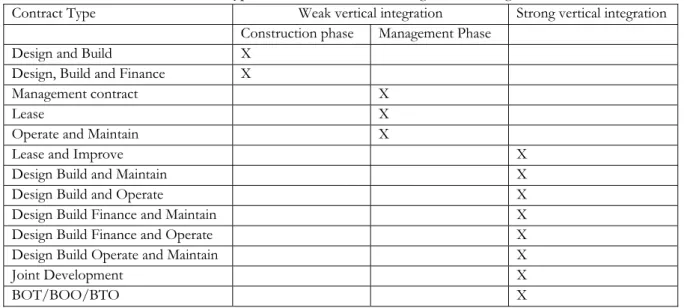
We distinguish between strong-versus-weak vertical integration PPP contracts. As noted, strong vertical integration refers to the combination of construction and operational tasks, while weak vertical integration combines specific tasks on either the construction or operational side only. The last column in Table 1 offers information on the percentage of strong bundling PPPs in each economic sector in the sample. Our sample includes 232 (49 percent) weak vertical integration PPPs and 242 (51 percent) strong-vertical-integration PPPs.
Table 2 shows distinctions made between PPP contracts in order to divide the sample into weak vertical integration versus strong vertical integration.
(Insert table 2 around here) III.2 Variables
We focus on the choice between alternative contract types. Our dependent variable is
categorical, and takes different (but not ordered) values to identify different contract types. If PPP contracts have strong vertical integration features (bundling construction and operational tasks) we group them into category 1, which is our reference category. We group contracts
5 Lease contracts with improvements imply that the lease included a commitment to undertake new investments in the existing facility. Joint development agreements refer to PPPs undertaken by joint venture companies with equity contributed by the private and public sectors (see Moszoro and Gasiorowski, 2008).
including only design-build tasks into category 2. Management-related contracts are in category 3. We thus compare weak vertically integrated alternatives to strong vertical integration.
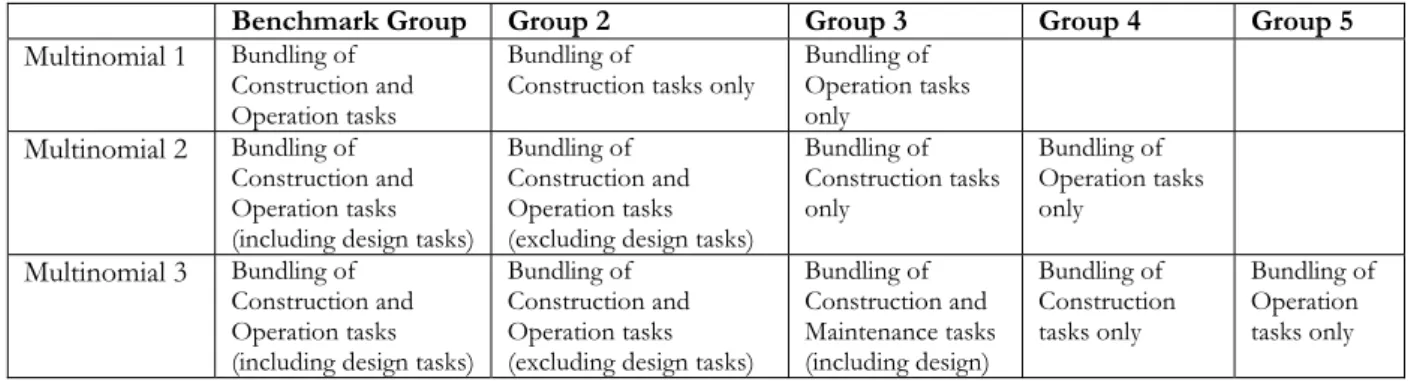
We considered alternative groupings to obtain a better fit for our empirical model. Specifically, categories 2 and 3 were retained, but we split the reference category by including in category 4 those PPPs with strong vertical integration that exclude design tasks. We defined category 5 as vertically integrated PPPs that exclude operational activities. That allows us to examine how externalities and synergies associated with the design task can affect contract decisions and how demand risk may influence the same.
Independent variables can be grouped into: (i) financial variables to account for the pragmatic decision of policy makers; (ii) binary variables identifying different economic sectors, which capture intrinsic characteristics of various infrastructure types; (iii) variables that proxy for political preferences; and (iv) other control variables. We estimate the likelihood of strong versus weak vertical integration in PPPs as impacted by financial, economic and political factors. To some extent, bundling is present by construction in all PPPs in our sample. Thus, we do not address the determinants of PPP use per se, as have other authors.
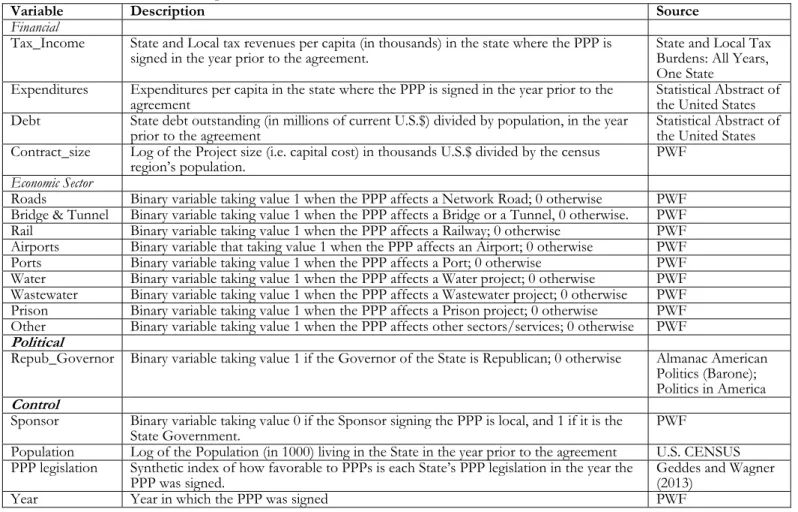
Table 3 lists our variables and data sources. We lag financial variables to the year prior to the PPP agreement to avoid endogeneity. Including all economic sectors in our estimation would generate perfect collinearity. We dropped one economic sector from our model and use Facilities as the reference category. Facilities are delivered through strong vertical integration PPPs in 71 percent of the cases (see table 1), one of the highest percentages in our sample.
(Insert table 3 around here) III.2.A. Financial Predictors
Tax Income: State and local tax revenues per capita (in thousands) in the State where the project was signed, in the year prior to the agreement. We view this as a proxy for fiscal pressure and the ability of governments to raise money from the state’s taxpayers. We expect this variable to
be negatively correlated with strong vertical integration, since states with larger per capita revenues may rely less on private investment in infrastructure.
Expenditures: Local and state government expenditures per capita in the state where the project was signed, year prior to the agreement. This variable reflects the government’s fiscal burden and its need to seek private financing. We expect a positive correlation between this variable and strong vertical integration because states with greater per-capita spending are likely to rely more on private investment and to bundle construction and operations in PPP projects.
Debt: State debt outstanding (in millions of current dollars) per capita, year prior to the project agreement. This captures states with fiscal stress resulting from relatively high debt levels. We predict a positive relationship between this variable and strong vertical integration since a larger debt burden will encourage greater reliance on private partnerships.
Contract Size: Project size, as measured by capital cost, in thousands of U.S. dollars divided by the relevant census region’s population. Consistent with extant literature, we expect a parabolic relationship between capital value and strong vertical integration. We used a logarithmic transformation of this variable.
III.2.B. Economic Sector Predictors
We include 10 sector-specific binary variables to indicate which sector each project most closely represents. Each is relative to facilities, which is the reference sector. Our literature review revealed that facilities are prone to strong vertical integration because their quality is contractible, easy to measure, and transaction costs are likely to be smaller. In contrast, road and rail projects typically bear large commercial risks, which may frustrate strong vertical integration. This leads to less frequent use of strong-vertical-integration PPPs and greater weak vertical integration during the project’s management or construction phases.
Network infrastructure generates greater asset specificity relative to facilities. This suggests that roads, rail and water PPPs will be negatively correlated with strong vertical integration, except in the case of Bridges and Tunnels, which have more common traits with facilities;
Ports, Airports and Prisons despite their asset specificity, bear less commercial risk. Their economic cost – limiting the hold-up problem – is much lower than that of network infrastructure. We do not expect large differences between stand-alone infrastructure and facilities, but do expect large differences between network infrastructure and facilities.
Our economic sectors can reflect the extent of asset specificity and ease of measurement, which are drivers of transaction costs. It is useful to account directly for those factors using specific indicators of asset specificity and ease of measurement. We use the average specificity and ease of measurement ratings in Brown, Potosky and Van Slyke (2005) for services
contracted out by U.S. municipalities. We can thus examine the role of transaction costs in explaining strong-versus-weak vertical integration in alternative models.
III.2.C. Political Predictors
Republican Governor: A dummy variable set to one if the governor (when the project is signed) is Republican, zero otherwise. To the extent that Republican governors are more business friendly and more market oriented than their Democratic counterparts, they are more likely to utilize strong-vertical-integration PPPs.
III.2.D. Control Predictors
Population: State population. This is a proxy for the size of the market where the project is signed. Private investors are likely to find facilities in populated markets more attractive. Based on our literature review, we expect a non-linear relationship between population and strong vertical integration. We apply a logarithmic transformation to this variable.
Sponsor: Categorical variable set to zero if the project sponsor is a local government; one if a state government. Because higher levels of government typically receive more public resources, we expect that variable to reduce strong vertical integration.
Year: Variable indicating the year in which the PPP was signed. This captures a time trend and thus long-run changes in PPP policy. Economic crisis may have impacted PPP
design, so it is important controlling for time. We expect Year to positively impact strong vertical integration.
PPP Legislation: Variable indicating the degree of PPP favorability of a State’s legislation in the year and State in which the PPP is consummated. This variable was developed and described in Geddes and Wagner (2013) and used in Albalate, Bel and Geddes (2015) to evaluate the impact of PPP legislation on private infrastructure investment. It is a synthetic indicator of how experts value the degree of PPP favorability of different provisions included in the State’s legislation. Higher values of this variable indicate a better institutional framework stemming from reduced uncertainty and regulatory risks, which are essential to engaging in long-term relationships and large sunk investments as those usually involved in PPPs bundling construction and operation tasks. Table 4 offers some descriptive statistics.
(Insert table 4 around here) III.3 Methods
We use multinomial logistic regression to model the contract-type decision, particularly regarding the strong vs. weak vertical integration. Our empirical analysis relies on estimating the determinants of strong-versus-weak vertical integration in U.S. PPPs. Equation (1) below contains the above-mentioned four variable groups:6
_ _ _ _ _ _
In equation (1) Yitakes the value 1 for strong vertical integration, 2 for if some type of
weak vertical integration was chosen among those within the construction phase and 3 for
6 Model (1) includes a time-trend variable (Year). We also considered models with year dummies. These show consistent results for financial, economic sector and control regressors. Those models however return negative values in the McFadden Pseudo-R2, which suggests a poor fit. We thus report models with time trends.
those within the operational phase. The economic sector Facilities is not included in the equation because they are the omitted (or benchmark) category in interpreting the economic sector coefficients. We are careful to avoid perfect collinearity. The reference category for the dependent variable is strong-vertical-integration contracts.
We estimate (1) using a multinomial logistic regression because having discrete (unordered) values does not allow using OLS. We have a dependent variable with different values (categories of PPP contracts), so we cannot apply binary response models such probit or logit. Our model is analogous to a logistic regression model, but the response variable’s probability distribution is multinomial instead of binomial. Also, the J-1 multinomial logit equations compare each categories 1, 2…J-1 to category J (in our case strong vertical
integration), whereas the single logistic regression equation is a contrast between successes and failures. Finally, standard errors are robust to arbitrary forms of heteroscedasticity and w standard errors are clustered by State or by economic sector.7
We compared multinomial logistic regressions according to different groupings of contracts, starting with a 3-categoriy model. Table 5 displays the type of multinomial models we compared, and Table 6 shows their joint-significance tests. Comparisons of model fit are possible through the log likelihood values and the use of McFadden pseudo-R2. In all cases we find that according to the likelihood ratio chi-square our models are jointly significant. Results on the log-likelihood and pseudo-R2 values suggest that the most restricted model (multinomial 1) is the best model in terms of fit and explanatory power. We used strong vertical integration contracts as the reference category in that model. The two remaining categories are those that only bundle construction or operational tasks.8
(Insert table 5 around here) (Insert table 6 around here)
7 We considered State fixed effects (separately) but the maximum likelihood method did not converge.
We also compared the multinomial model to the logistic regression model -which is just a special case of the multinomial model in which the dependent variable is dichotomous- considering strong versus weak vertical integration. We find support for the former, rejecting the use of the logistic regression method. The next section discusses estimates for the selected model (multinomial 1) only.
IV. Estimates
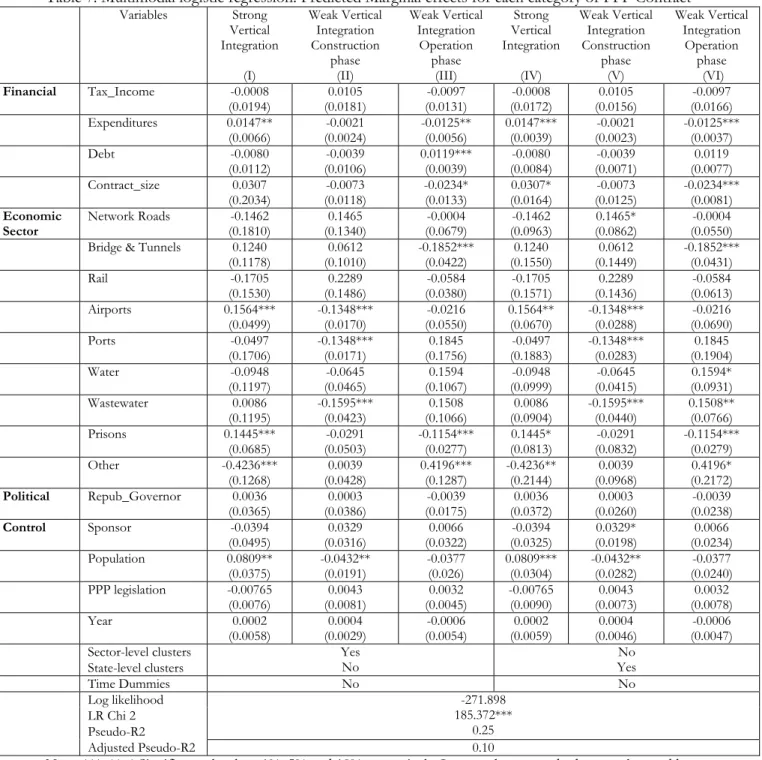
Table 7 reports estimates for our main model (multinomial 1). This model utilizes our full sample, in which all observations are included and standard errors are clustered by economic sector (I, II, III), and by State (IV, V, VI). Predicted marginal effects for each category of PPP contract are reported (instead of coefficients), which would be difficult to interpret in
multinomial logistic models and operationally irrelevant.
In column (I), we report the predicted marginal effects associated with the choice of PPP contracts with strong vertical integration (bundling of construction and operation), while columns (II) and (III) report predicted marginal effects for weak vertical integration contracts within the construction and the operational phases, respectively.
(Insert table 7 around here) IV.1 Financial variables
Marginal effects in Columns (I), (II) and (III) indicate that the level of (lagged) expenditures per capita is positively related to strong vertical integration, negatively related to weak vertical integration within operational tasks and statistically irrelevant for PPP contracts with
construction-tasks bundling. This result is consistent with predictions from Auriol and Picard (2013), as States with larger spending are oriented to bigger participation of private partners in the development and provision of services and infrastructure. This result is also consistent in models where standard errors are clustered at State level, as columns (IV), (V) and (VI) show.
Log of contract size reveals a similar pattern, with a positive relationship to strong vertical integration in column (IV) and a negative and statistically significant correlation in
column (VI). If we view contract size as a proxy of provision costs, we find some evidence of the relationship between the bundling decision (vertical integration) and service provision costs, as inferred from Bentz, Grout and Halonen (2004). Indeed, these two financial variables indicate that financial constraints are important for the bundling decision. Nonetheless, tax income per capita is statistically insignificant for all contract types, while State indebtedness is only significant (and negative) in the case of weak vertical integration within the operational phase and only when we account for economic sector clusters (column III).
IV.2 Economic sectors
Road projects are not associated with any particular type of PPP vertical integration when compared to this project reference group (i.e. facilities). When State clustering is included, we find a positive, statistically significant impact on PPPs that bundle construction tasks only. Rail projects follow a similar pattern, but marginal effects are not statistically significant. This suggests that rail is not associated with a particular PPP contract type.
Bridges and tunnels provision, however, consistently relies less on weak-vertical- integration PPPs that include the operational phase. Airports and prison provision relies more heavily on strong vertical integration regardless of the clustering type used. The former is also related to less contracts that bundle construction tasks – exactly as ports do - and the latter to less contracts that bundle operation tasks.
We find no significant association between water distribution projects and any type of contracts except in column (VI). We there find a positive correlation with contracts that bundle operational tasks only. Wastewater projects show a positive relationship with that contract type, but only when we cluster standard errors at the State level. We also find that wastewater projects are less likely to use construction-task bundling contracts. Finally, activities in the Others group are less likely to rely on strong-vertical-integration PPP project delivery. IV.3 Political and control variables.
Marginal effects indicate that the governor’s political party is not associated with any particular type of PPP contract vertical integration. This conclusion remains regardless of the clustering type used. We obtain a similar conclusion for public sponsor type, except for column (V), which suggests, at the 10 percent significance level, that State governments are more likely to rely on weak vertical integration within the construction phase. Neither PPP legislation nor the time trend impacts the PPP bundling decision.
Population, however, has an important effect on contract choice. More populated States are associated with more projects relying on strong vertical integration. That may be due to higher expected demand and use of infrastructure services provided, which reduces
commercial risk. Populated States are less likely to rely on weak vertical integration that only involves tasks within the construction phase. Population is irrelevant for contracts that only bundle operation tasks.
IV.4. The role of transaction costs
Sector variable estimates show the relevance of transaction costs as a key aspect of the PPP bundling decision. Economic sector variables are likely to capture differing project traits linked to transaction costs. Those include asset specificity and ease of measurement. We next account directly for asset specificity and ease of measurement although it reduces our sample size.
We rely on asset specificity indicators and ease of measurement obtained in Brown, Potosky and Van Slyke (2005) for services contracted out by U.S. cities. We identified those sectors that appear in our sample. Although most of the Brown, Potosky and Van Slyke (2005) service list does not appear in our sample, we were able to utilize values for 163 projects. We applied the multinomial 1 model, but replaced economic sectors with their asset specificity and ease of measurement variables. Table 8 reports estimates.
(Insert table 8 around here)
Our results indicate that both variables are relevant for the strong vs. weak vertical integration choice. Strong integration is highly correlated with asset specificity, but unaffected
by measurement ease. Both transaction cost variables impact weak integration contracts, but in opposite directions: asset specificity reduces the likelihood of reliance on weak vertical
integration in the construction phase, while ease of measurement increases it.
Although a similar conclusion is obtained for the asset specificity impact on weak vertical integration in the operational phase, measurement ease now reduces the likelihood of choosing that contract form. However, the marginal effect is very small in the construction phase even if it is statistically significant at the 10 percent level. In this regard, our estimates are consistent with theoretical predictions in Bennett and Iossa (2006) and Iossa and Martimort (2012, 2015).
V. Conclusions
To our knowledge, this is the first detailed empirical study of the strong-versus-weak vertical integration PPP contract choice. That choice is important in assessing the expected efficiency gains that could be realized due to bundling-derived synergies. Those depend to a large extent to whether bundling involves operational and construction tasks (which provides the largest scope for such efficiencies) versus tasks that remain within the operational or construction aspects, respectively. We refer to the bundling of operational and construction tasks as strong vertical integration, and tasks on the operation or construction sides only as weak vertical integration.
We find that government expenditures per capita increase the likelihood of strong vertical integration and reduce it in case of weak vertical integration within the operational phase. However, other financial variables such as debt per capita and taxes per capita do not play an important role. When tasks bundled belong to the operational phase, contract size is positively correlated with strong integration and negatively correlated with weak integration.
We also conclude that the economic sector under consideration strongly influences bundling choice, which may be due to transaction costs, commercial risk, and initial
investments. Indeed, sector dummies may act as proxies for transaction costs. We explored that possibility using a reduced project sample that included asset specificity and ease of
measurement variables. That exploration suggests that both are relevant factors in the choice between strong versus weak vertical integration.
Our results suggest that PPP design may be a pragmatic decision rather than a political instrument. The decision to undertake a PPP or not (which implies inclusion of the private sector in the delivery) may include political considerations while choice between strong versus weak vertical integration does not. Regarding controls, population is positively correlated with strong vertical integration. Other variables considered are generally unrelated to the type of vertical integration chosen.
Because ours is the first empirical examination of the strong versus weak vertical integration decision, we view our conclusions as preliminary. Further empirical research is needed. While we focus on the U.S. case, it is reasonable to expect that different national regulations, contracting practices, legal origins, and legal traditions will produce different PPP designs. They may also impact factors leading to decisions about the combining operational and construction tasks, as with decisions regarding risk transfer via PPPs. Our results indicate that bundling decisions are neither random nor arbitrary. We instead identify an initial set of statistically significant factors that help explain policy makers’ PPP contract bundling choices.
References
Albalate, D. (2014). Privatisation and Nationalisation of European Roads. Success and Failure of Public-Private Partnerships. Cheltenham: Edward Elgar.
Albalate, D., Bel, G. & Geddes, R.R. (2015). Do Public-Private Partnership Enabling Laws Increase Private Investment in Infrastructure? Working Paper U. Barcelona.
Asian Development Bank (2008). Public-private Partnerships Handbook. Manila: ADB. Auriol, E. & Picard, P.M. (2013). A theory of BOT concession contracts. Journal of Economic
Behavior & Organization, 89, 187–209.
Bennett, J. & Iossa, E. (2006). Building and managing facilities for public services. Journal of Public Economics, 90(10-11), 2143-2160
Bentz, A., Grout, P.A., & Halonen, M.L. (2004). What should governments buy from the private sector–Assets or services? Mimeo.
Brown, T., Potosky, M. & Van Slyke, D. (2005)Transaction costs and contracting: The practitioner perspective. Public Performance & Management Review, 28(3), 326-351. Chong, E., Huet, F., Saussier, S. & Steiner, F (2006). Public-Private Partnerships and Prices:
Evidence from Water Distribution in France. Review of Industrial Organization, 29(1-2), 149-169.
Cruz, C., Marques, R.C. & Cardoso, P. (2014). Empirical evidence for renegotiation of PPP contracts in the road sector. Journal of Legal Affairs and Dispute Resolution in Engineering and Construction,7(2), 05014003
Engel, E., Fischer, R. & Galetovic, A. (2014). The economics of public-private partnerships. A basic guide. Cambridge: Cambridge University Press.
European Commission (2003). Public Finances in EMU 2003. Brussels: European Commission.
Geddes, R.R. & Wagner, B.L (2013). Why Do States Adopt Public-Private Partnership Enabling Legislation? Journal of Urban Economics, 78, 30-41.
Hart, O. (2003). Incomplete Contracts and Public Ownership: Remarks, and an Application to Public-Private Partnerships. Economic Journal, 113(486), C69-76.
Hart, O., Shleifer, A. & Vishny, R.W. (1997). The Proper Scope of Government: Theory and an Application to Prisons. Quarterly Journal of Economics, 112(4), 1127-1161
Hodge, G.A., Greve, C. & Boardman, A.E. (2010). Introduction: the PPP phenomenon and its evaluation. In G.A Hodge, C.Greve & A.E. Boardman (Eds.) International Handbook of Public-Private Partnerships (pp. 3-16). Cheltenham: Edward Elgar.
Iossa, E. & Martimort, D. (2012). Risk allocation and the costs and benefits of public–private partnerships. RAND Journal of Economics, 43(3), 442–474
Iossa, E., & Martimort, D. (2015). The simple microeconomics of public-private partnerships. Journal of Public Economic Theory, 17(1), 4-48
Lafontaine, F. & Slade, M.E. (2012). Interfirm contracts: Evidence. In R. Gibbons & J. Roberts (Eds.), Handbook of Organizational Economics (pp. 958-1013). Princeton: Princeton University Press.
Martimort, D. & Pouyet, J. (2008). To build or not to build: Normative and positive theories of public–private partnerships. International Journal of Industrial Organization, 26(2), 393– 411
Moszoro, M.& Gasiorowski, P. (2008). Optimal Capital Structure of Public-Private Partnerships. IMF Working Paper 1/2008.
Yescombe, E. (2007). Public-private partnerships. Principles of policy and finance. Burlington, MA: Butterworth-Heinemann, Elsevier.
TABLES
Table 1. International Major Projects Survey for the U.S.. Sectors and Services included. 2013
Id Economic Sector Number of PPPs
in Sample Percentage in Sample Percentage of Strong vertical integration in Sample
1 Roads 115 24 39
2 Bridge & Tunnels 23 5 70
3 Rail 32 7 47 4 Airports 29 6 38 5 Ports 8 2 63 6 Water 92 19 44 7 Wastewater 103 22 44 8 Prisons 28 6 89 9 Facilities 31 7 71 10 Other 14 3 36 475 100 49
Source:Public Works Financing (PWF) newsletter.
Table 2. Classification of contract types between weak and strong vertical integration features.
Contract Type Weak vertical integration Strong vertical integration Construction phase Management Phase
Design and Build X
Design, Build and Finance X
Management contract X
Lease X
Operate and Maintain X
Lease and Improve X
Design Build and Maintain X
Design Build and Operate X
Design Build Finance and Maintain X
Design Build Finance and Operate X
Design Build Operate and Maintain X
Joint Development X
BOT/BOO/BTO X
Table 3. Variable description and source for the full U.S. PPP database.
Variable Description Source Financial
Tax_Income State and Local tax revenues per capita (in thousands) in the state where the PPP is
signed in the year prior to the agreement. State and Local Tax Burdens: All Years, One State
Expenditures Expenditures per capita in the state where the PPP is signed in the year prior to the
agreement Statistical Abstract of the United States
Debt State debt outstanding (in millions of current U.S.$) divided by population, in the year
prior to the agreement Statistical Abstract of the United States Contract_size Log of the Project size (i.e. capital cost) in thousands U.S.$ divided by the census
region’s population. PWF
Economic Sector
Roads Binary variable taking value 1 when the PPP affects a Network Road; 0 otherwise PWF Bridge & Tunnel Binary variable taking value 1 when the PPP affects a Bridge or a Tunnel, 0 otherwise. PWF Rail Binary variable taking value 1 when the PPP affects a Railway; 0 otherwise PWF Airports Binary variable that taking value 1 when the PPP affects an Airport; 0 otherwise PWF Ports Binary variable taking value 1 when the PPP affects a Port; 0 otherwise PWF Water Binary variable taking value 1 when the PPP affects a Water project; 0 otherwise PWF Wastewater Binary variable taking value 1 when the PPP affects a Wastewater project; 0 otherwise PWF Prison Binary variable taking value 1 when the PPP affects a Prison project; 0 otherwise PWF Other Binary variable taking value 1 when the PPP affects other sectors/services; 0 otherwise PWF
Political
Repub_Governor Binary variable taking value 1 if the Governor of the State is Republican; 0 otherwise Almanac American Politics (Barone); Politics in America
Control
Sponsor Binary variable taking value 0 if the Sponsor signing the PPP is local, and 1 if it is the
State Government. PWF
Population Log of the Population (in 1000) living in the State in the year prior to the agreement U.S. CENSUS PPP legislation Synthetic index of how favorable to PPPs is each State’s PPP legislation in the year the
PPP was signed. Geddes and Wagner (2013)
Year Year in which the PPP was signed PWF
Table 4. Descriptive statistics.
Variable Mean Std.Dev. Min Max
Financial Tax_Income 3.94 1.85 1.41 13.51
Expenditures 9.27 22.02 0.30 432.64
Debt 3.52 3.08 0.50 17.15
Contract_size 440.59 792.77 0 7000
Economic Sector Network Roads 0.21 0.41 0 1
Bridge & Tunnels 0.04 0.20 0 1
Rail 0.06 0.23 0 1 Airports 0.05 0.22 0 1 Ports 0.01 0.12 0 1 Water 0.17 0.37 0 1 Wastewater 0.19 0.39 0 1 Prisons 0.05 0.22 0 1 Other 0.02 0.16 0 1 Political Repub_Governor 0.40 0.49 0 1 Control Sponsor 0.26 0.44 0 1 Population 13.24 10.77 0.57 38.04 PPP legislation 2.50 2.31 0 7 Year 2003 5.50 1985 2013
Table. 5. Multinomial categories: Different groupings of contracts.
Benchmark Group Group 2 Group 3 Group 4 Group 5
Multinomial 1 Bundling of Construction and Operation tasks
Bundling of
Construction tasks only Bundling of Operation tasks only
Multinomial 2 Bundling of Construction and Operation tasks (including design tasks)
Bundling of Construction and Operation tasks (excluding design tasks)
Bundling of Construction tasks only Bundling of Operation tasks only Multinomial 3 Bundling of Construction and Operation tasks (including design tasks)
Bundling of Construction and Operation tasks (excluding design tasks)
Bundling of Construction and Maintenance tasks (including design) Bundling of Construction tasks only Bundling of Operation tasks only
Note: We cannot provide models with more or other categories because the Maximum Likelihood procedure did not converge with the necessary further splitting.
Table 6. Model fit of different multinomial models
Multinomial 1 Multinomial 2 Multinomial 3 Logistic
LR Chi2 test 185.372 *** 238.288 *** 263.41 *** 41.54***
Log-Lik Full Model -271.898 -353.022 -363.516 -218.689
McFadden Adj. R2 0.098 0.091 0.074 0.01
Table 7. Multimodal logistic regression. Predicted Marginal effects for each category of PPP Contract Variables Strong Vertical Integration (I) Weak Vertical Integration Construction phase (II) Weak Vertical Integration Operation phase (III) Strong Vertical Integration (IV) Weak Vertical Integration Construction phase (V) Weak Vertical Integration Operation phase (VI) Financial Tax_Income -0.0008 (0.0194) 0.0105 (0.0181) -0.0097 (0.0131) -0.0008 (0.0172) 0.0105 (0.0156) -0.0097 (0.0166) Expenditures 0.0147** (0.0066) -0.0021 (0.0024) -0.0125** (0.0056) 0.0147*** (0.0039) -0.0021 (0.0023) -0.0125*** (0.0037) Debt -0.0080 (0.0112) (0.0106) -0.0039 0.0119*** (0.0039) (0.0084) -0.0080 (0.0071) -0.0039 (0.0077) 0.0119 Contract_size 0.0307 (0.2034) (0.0118) -0.0073 -0.0234* (0.0133) (0.0164) 0.0307* (0.0125) -0.0073 -0.0234*** (0.0081) Economic
Sector Network Roads (0.1810) -0.1462 (0.1340) 0.1465 (0.0679) -0.0004 (0.0963) -0.1462 (0.0862) 0.1465* (0.0550) -0.0004
Bridge & Tunnels 0.1240
(0.1178) (0.1010) 0.0612 -0.1852*** (0.0422) (0.1550) 0.1240 (0.1449) 0.0612 -0.1852*** (0.0431) Rail -0.1705 (0.1530) (0.1486) 0.2289 (0.0380) -0.0584 (0.1571) -0.1705 (0.1436) 0.2289 (0.0613) -0.0584 Airports 0.1564*** (0.0499) -0.1348*** (0.0170) (0.0550) -0.0216 0.1564** (0.0670) -0.1348*** (0.0288) (0.0690) -0.0216 Ports -0.0497 (0.1706) -0.1348*** (0.0171) 0.1845 (0.1756) -0.0497 (0.1883) -0.1348*** (0.0283) 0.1845 (0.1904) Water -0.0948 (0.1197) -0.0645 (0.0465) 0.1594 (0.1067) -0.0948 (0.0999) -0.0645 (0.0415) 0.1594* (0.0931) Wastewater 0.0086 (0.1195) -0.1595*** (0.0423) (0.1066) 0.1508 (0.0904) 0.0086 -0.1595*** (0.0440) 0.1508** (0.0766) Prisons 0.1445*** (0.0685) (0.0503) -0.0291 -0.1154*** (0.0277) (0.0813) 0.1445* (0.0832) -0.0291 -0.1154*** (0.0279) Other -0.4236*** (0.1268) (0.0428) 0.0039 0.4196*** (0.1287) -0.4236** (0.2144) (0.0968) 0.0039 (0.2172) 0.4196* Political Repub_Governor 0.0036 (0.0365) (0.0386) 0.0003 (0.0175) -0.0039 (0.0372) 0.0036 (0.0260) 0.0003 (0.0238) -0.0039 Control Sponsor -0.0394 (0.0495) (0.0316) 0.0329 (0.0322) 0.0066 (0.0325) -0.0394 (0.0198) 0.0329* (0.0234) 0.0066 Population 0.0809** (0.0375) -0.0432** (0.0191) -0.0377 (0.026) 0.0809*** (0.0304) -0.0432** (0.0282) (0.0240) -0.0377 PPP legislation -0.00765 (0.0076) (0.0081) 0.0043 (0.0045) 0.0032 -0.00765 (0.0090) (0.0073) 0.0043 (0.0078) 0.0032 Year 0.0002 (0.0058) 0.0004 (0.0029) -0.0006 (0.0054) 0.0002 (0.0059) 0.0004 (0.0046) -0.0006 (0.0047)
Sector-level clusters Yes
No Yes No State-level clusters Time Dummies No No Log likelihood -271.898 185.372*** 0.25 LR Chi 2 Pseudo-R2 Adjusted Pseudo-R2 0.10
Note: ***, **, * Significance levels at 1%, 5% and 10% respectively. In parentheses standard errors clustered by economic sector (I, II, III) or by State (IV, V, VI).
Table 8. Multimodal logistic regression estimates. Predicted Marginal effects for each category of PPP Contract. Estimates for Transaction costs as drivers of Contract choice.
Variables Strong Vertical
Integration (VII) Weak Vertical Integration Construction phase (VIII) Weak Vertical Integration on Operation phase (IX) Asset specificity 0.4955*** (0.1004) -0.1506*(0.0817) -0.3448** (0.1671) Ease of measurement 0.5501 (0.3685) 0.0381*(0.0212) -0.5882* (0.3578) Log likelihood -136.808 43.204*** 0.158 LR Chi 2 Pseudo-R2
Note: ***, **, * Significance levels at 1%, 5% and 10% respectively. In parentheses, standard errors clustered by economic sector. We control for the same variables used in previous models.
Institut de Recerca en Economia Aplicada Regional i Pública Document de Treball 2014/17, pàg. 5