Procedia Technology 18 ( 2014 ) 42 – 46
Available online at www.sciencedirect.com
ScienceDirect
2212-0173 © 2014 The Authors. Published by Elsevier Ltd. This is an open access article under the CC BY-NC-ND license (http://creativecommons.org/licenses/by-nc-nd/3.0/).
Peer-review under responsibility of the Scientific Committee of IICST 2014 doi: 10.1016/j.protcy.2014.11.010
International workshop on Innovations in Information and Communication Science and
Technology, IICST 2014, 3-5 September 2014, Warsaw, Poland
Human Activity Recognition System
Including Smartphone Position
Shinki Miyamoto and Hitoshi Ogawa*
Ritsumeikan University, Kusatsu, Shiga, 525-8577 JapanAbstract
The data gathered by acceleration sensors in smartphones gives different results depending on the location of the smartphone. In this paper, a human activity recognition system was proposed, including the smartphone’s position. This system can recognize not only the activity of a person, but also the location of the smartphone. HOG (Histograms of Oriented Gradients) were used to extract features of the acceleration data, because the waveform of the acceleration data is very complex. Then, a strong classifier was obtained using a learning algorithm of Real AdaBoost based on the position of possession smartphone and acceleration sensor data. It also improves the recognition rate by analyzing the acceleration data. The effectiveness of the activity recognition system was shown by the experiment. © 2014 The Authors. Published by Elsevier Ltd.
Peer-review under responsibility of the Scientific Committee of IICST 2014.
Keywords: Acceleration sensor; Histograms of Oriented Gradients; Real AdaBoost
1.Introduction
In recent years, products with various functions such as information home appliances and smartphones have become widespread with the advance of information communication technology. It is thought to bring a richer quality of life for humans with the spread of these products. A smartphone can be used by anyone at any time. Also, time and location data of the smartphone is easily obtained.
* Corresponding author. Tel.: +81-77-561-2697
E-mail address: [email protected]
© 2014 The Authors. Published by Elsevier Ltd. This is an open access article under the CC BY-NC-ND license (http://creativecommons.org/licenses/by-nc-nd/3.0/).
43 Shinki Miyamoto and Hitoshi Ogawa / Procedia Technology 18 ( 2014 ) 42 – 46
In this study, we focused on the acceleration sensors of smartphones. If one would be able to analyze complex acceleration data, it would be possible to develop an Activity Recognition System, using a smartphone. The reason for using an acceleration sensor for activity recognition is to obtain information without depending on the environment, such as being indoors. If the situation and activity of a user is obtained from acceleration data of the smartphone, an ambient network service is made possible.
In the field of activity recognition, many works have been published. The main means of acquiring data, however, were by camera [1] and tracking wearable sensors [2]. Such equipment is expensive, time consuming to set up, and limited in its use. Considering activity recognition in different environments and real life conditions, smartphones were deemed useful.
Using Android smartphones, Google Play Services carried out differentiations between standing still, walking, cycling, and driving by car [3]. However, the system was very susceptible to the device tilt, limiting practical applications [4].
In the previous studies, data of the acceleration was often obtained at a fixed position, for example, the smartphone is attached to a waist belt, kept in a pocket [5], etc.. However, the position of possessing is various when the user is actually using a smartphone, such as in a hand, in a bag, etc. In this paper, the recognition system for human activity and location of the smartphone is proposed using the acceleration sensor mounted on the smartphone. This system used HOG (Histograms of Oriented Gradients) and Real AdaBoost as learning algorithm. HOG (Histograms of Oriented Gradients) were used to express the features of the acceleration data, Real AdaBoost was used for feature selection.
In the following section, a data acquisition system is described. In Section 3, a feature of acceleration data is described. Then, a learning system based on Real AdaBoost is described in Section 4. Section 5 shows the results of experiment, and Section 6 concludes the paper.
2.Data acquisition system
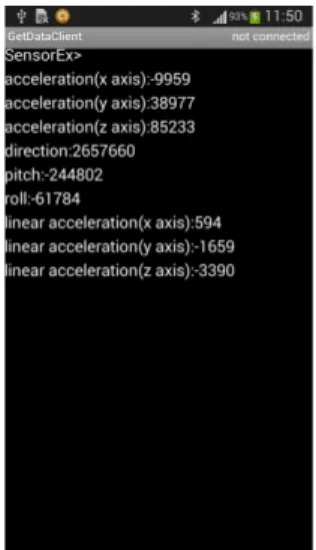
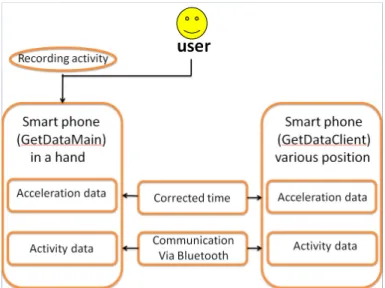
The data acquisition system uses two smartphones, which communicate via Bluetooth to record the activity data of both smartphones. The reason this system uses two smartphones is because the phone kept in a pocket cannot record the activity data and the acceleration data at the same time. The smartphone kept in the pocket it cannot be operated. The GetDataMain records the activity data and the acceleration data while the device is handheld and the other system named GetDataClient records the acceleration data in a pocket, in a bag, etc. Then, two smartphones communicate via Bluetooth to record the activity data of both smartphones. GetDataMain has a human interface in which the situation of the activity is selected as shown in Fig. 1. GetDataClient displays linear acceleration data, direction, pitch and roll as shown in Fig. 2. Structure of Data Acquisition System is shown in Fig. 3.
Fig 3. Structure of data acquisition. 3.Acceleration data
The characteristics of data are different by a mobile place even if the same movement is played. The acceleration data are acquired in the three dimensions, are displayed with a complicated shape. HOG (Histograms of Oriented Gradients) is used to express the feature of complex acceleration data
3.1. Analysis of the acceleration data
It was found that by analyzing the acceleration sensor data, the recognition of activity could be performed by size of the acceleration data and the difference in shape of the waveform. The acceleration data changed in a constant cycle in the case of walking and running. On the other hand, the acceleration sensor data varies unique in the case of riding elevator and train. The waveform of the riding elevator changed the Y-axis direction, because the elevator moves up and down. The waveform of the riding train changed the X-axis and Z-axis directions, because the train runs parallel to the ground. Then, we focused on the size of the acceleration data. The acceleration data differs greatly by varying actions. Acceleration data in the case of running is larger than acceleration data in case of walking, which can be used to distinguish running and walking.
3.2. Feature of acceleration data
HOG (Histograms of Oriented Gradients) are feature descriptors usually used in computer vision and image processing for the purpose of object detection [6]. Also, HOG are useful to express complex shapes.
The data of the acceleration exists in three-dimensional space and the data of the acceleration is very complex. So, it is necessary that HOG features express the acceleration data. Then, it is necessary to calculate the strength of the acceleration and direction of the acceleration itself.
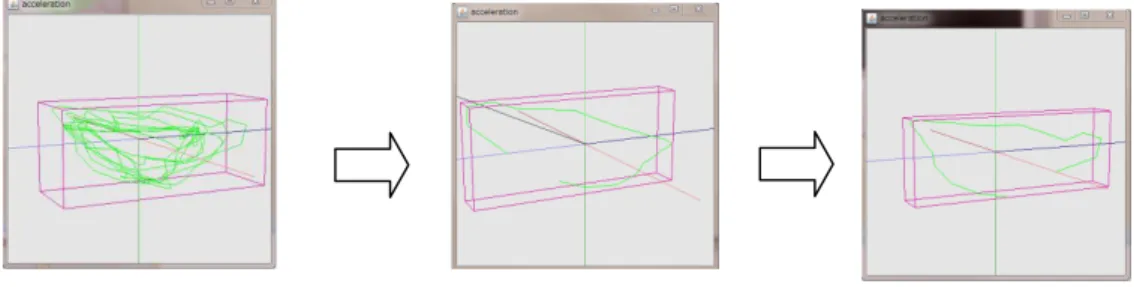
Acceleration data is continuous, so it is necessary to divide the acceleration data for use with machine learning. In the case of walking, one cycle means the data line in which the coordinate of the wave approaches the starting point. Dividing each cycle of acceleration data creates a cube. This cube is named T-cube. At this time, we displayed a black line in the gravity direction to consider the gravity direction of the T-cube. Then, T-cube is rotated to fit in the Z-axis direction. These steps were taken into account to account for the gravity direction of the acceleration data. After that, the T-cube is divided into 5h5h5 cells (125 cells). The direction of the wave is
45 Shinki Miyamoto and Hitoshi Ogawa / Procedia Technology 18 ( 2014 ) 42 – 46
Fig 4. taking out a vector for 1 cycle from the three-dimensional vector.
Fig 5. 27 directions.
expressed in 27 directions (26 directions + the centre). The procedure of normalization of the acceleration data is shown in Fig. 4, and definition of the 27 directions is shown in Fig. 5.
4.Learning system based on Real AdaBoost
The AdaBoosting algorithm was proposed by Freund and Schapire [7]. AdaBoost is a classifier system. Real AdaBoost is a variation of the AdaBoost. This application estimates the probability that a given input pattern belongs to a class, considering the current weight distribution for the training set. Real AdaBoost can be used for feature selection.
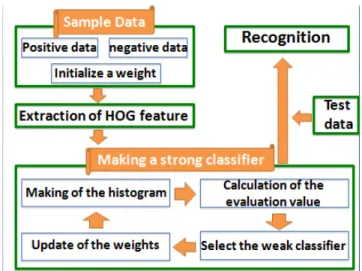
Fig.7 shows a structure of the learning system. At first, the learning system based on Real AdaBoost provides a negative data and positive data in each action, which is a learning data. Next, we extract the HOG features from the learning data. Then, We create a strong classifier by repeating the four strokes, creation of the histogram, calculating the evaluation value, the selection of weak classifiers and update of the weights. Finally, this system performs activity recognition using test data.
5.Experimental results
Seven types of data were learned as sample data; three activities (walk, running and train) and three positions (pocket of trousers, handheld, and in a bag). 3000 samples were acquired for seven types each and were used for learning. Table1 shows the results of the recognition rate for 100 data each.
Fig 7. Structure of the learning system.
6.Conclusions
Human activity recognition system was proposed, including carried position of a smartphone, and we obtained the acceleration data by developing a data acquisition system. Difference in waveform and size were confirmed to differentiate actions by analyzing the acceleration data. HOG were used to express characteristics of acceleration data. Real AdaBoost was used to automatically select a set of discriminative HOG with orientation information in order to achieve robust detection results.
References
[1] PROJECT: Automatic Detection of Activities of Daily Living, http://activityrecognition.com, last accessed August 2014
[2] Murao K. Terada T. A Motion Recognition Method by Constancy Decision, Journal of Information Processing, 2011;52(6):1968-1979 (in Japanese)
[3] Google Play Services, http://developer.android.com/google/play-services/index.html, last accessed August 2014 [4] Android Activity Recognition, http://java.dzone.com/articles/android-activity-recognition, last accessed August 2014
[5] Ouchi K. Doi M. Living Activity Recognition using an Accelerometer and a Microphone, Interaction. Tech. Rep. Corporate Research & Development Center, Toshiba Corporation, 2011.
[6] Yamaushi Y., Fujiyoshi H., Yamashita T. Human Detectin by Boosting-based Co-occurrence Feature Representation, Meeting on Image Recoginition and Understanding; 2008.
[7] Freund Y., & Schapire R. Experiments with a new boosting algorithm, proceeding osThirteenth Intemetional Conference on Machine Learning; 1996. pp.148-156.