Formalization and Detection of Host-Based
Code Injection Attacks in the Context of
Malware
Dissertation
zur
Erlangung des Doktorgrades (Dr. rer. nat.) der
Mathematisch-Naturwissenschaftlichen Fakult¨at der
Rheinischen Friedrich-Wilhelms-Universit¨at Bonn
vorgelegt von
Thomas Felix Barabosch
aus Andernach
Angefertigt mit Genehmigung der Mathematisch-Naturwissenschaftlichen Fakult¨at der Rheinischen Friedrich-Wilhelms-Universit¨at Bonn
1. Gutachter: Prof. Dr. Peter Martini, Rheinische Friedrich-Wilhelms-Universit¨at Bonn 2. Gutachter: Prof. Dr. Wim Mees, K¨onigliche Milit¨arakademie Br¨ussel
Tag der Promotion: 04.09.2018 Erscheinungsjahr: 2018
Summary
The Internet faces an ever increasing flood of malicious software (malware). Threat actors distribute millions of new malware variants every year. They do so for a variety of reasons such as financial gain or political power. The sophistication of malware as well as their target platforms steadily increase. Since a couple of years malware has often utilizes a platform-independent technique calledHost-Based Code Injection Attack
(HBCIA). This attack denotes the local injection of code from an attacker entity into a victim entity. Both entities are usually operating system processes. The malicious code runs within the context of another process, which is contrary to the common belief that each program possesses its own process space. HBCIAs allow the attacker the intercep-tion of critical informaintercep-tion, escalaintercep-tion of privileges, and covert operaintercep-tion. This trend of conducting local code injections creates a challenge in detecting malware since it blends into the behavior of benign processes. Therefore, this thesis addresses this challenge and elaborates on new ways to detect code injections.
So far, no basic research on HBCIAs in the context of malware has been carried out. There is a lack of understanding in terms of problem definition and problem size. There-fore, we built a model and formally defined HBCIAs. Based on this model, we introduced a taxonomy that allowed us to classify malware according to their algorithms. Then, we showed that almost two thirds of malicious samples of our representative corpus lever-aged HBCIAs. This finding implies that local code injections are a relevant problem for security researchers since the detection of HBCIAs implies the detection of a huge share of today’s malware. Especially due to the fact that leading operating systems, such as Microsoft Windows, Linux, macOS and Android, are all prone to this attack.
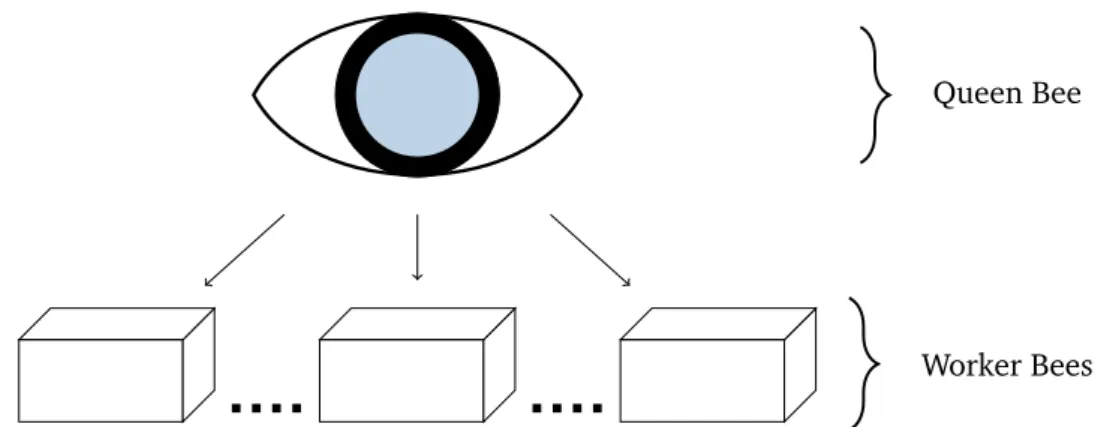
After the problem formalization and problem size estimation, we present two approaches: one static and one dynamic method to detect HBCIAs. Since HBCIAs are a behavior exhibited during execution, it is important to detect its occurrence to prevent further damages. Therefore, our first system Bee Master dynamically detects HBCIAs at run-time. It transfers the honeypot paradigm to processes. Its main component theQueen Bee observes several child processes calledWorker Bees. EachWorker Bee mocks a pos-sible victim process likeExplorer.exe. The behavior of eachWorker Beeis a priori known so that new threads or new memory regions imply an HBCIA. Our approach differs from related work due to its platform-independence, high abstraction level and focus on mal-ware. We implemented and evaluatedBee Masterfor several Windows and Ubuntu Linux versions. The evaluation with several prevalent representatives of HBCIA-employing
malware families as well as many benign programs shows that Bee Masterreliably de-tects HBCIAs without false positives.
One major source of information is the memory of victim machines. It reflects the ma-chine’s state and in case of an attack it allows us to derive valuable insights about the attacker as well as their hacking tools. However, it is difficult to pinpoint an attack in memory. If malware conducts HBCIAs, it is well hidden in benign processes. Hence, our second system Quincy addresses the challenge to statically detect HBCIAs in memory dumps. Its detection heuristic is based on machine learning. We constructed 36 fea-tures based on domain knowledge and selected the most appropriate ones. At its core, the detection heuristic leverages a tree-based machine learning algorithm. We eval-uated Quincy with seven algorithms of which Extremely Randomized Trees performed best. Subsequently, we evaluated it on three Windows version with an high quality cor-pus comprising more than a thousand benign and malicious programs. The results show thatQuincyimproves upon the current state of the art by more than eight percent, when comparing both systems using the ROC AUC score.
Publications
This thesis is mainly based on the following three peer-reviewed publications:
• Thomas Barabosch and Elmar Gerhards-Padilla,Host-Based Code Injection Attacks: A Popular Technique Used by Malware, 9th International Conference on Malicious and Unwanted Software: The Americas (MALWARE), IEEE, 2014
• Thomas Barabosch, Sebastian Eschweiler and Elmar Gerhards-Padilla,Bee Master: Detecting Host-Based Code Injection Attacks, Detection of Intrusions and Malware, and Vulnerability Assessment (DIMVA), Springer International Publishing, 2014
• Thomas Barabosch, Niklas Bergmann, Adrian Dombeck and Elmar Padilla,Quincy: Detecting Host-Based Code Injection Attacks in Memory Dumps, Detection of Intru-sions and Malware, and Vulnerability Assessment (DIMVA), Springer International Publishing, 2017
The following peer-reviewed publications evolved (directly or indirectly) from our re-search for this thesis:
• Thomas Barabosch, Andre Wichmann, Felix Leder and Elmar Gerhards-Padilla, Au-tomatic Extraction of Domain Name Generation Algorithms from Current Malware, NATO Symposium on Information Assurance and Cyber Defense (IST-111), 2012
• Thomas Barabosch, Adrian Dombeck and Elmar Gerhards-Padilla,ParasiteEx: Dis-infecting Parasitic Malware Platform-Independently, Future Security (FuSec), Fraun-hofer Verlag, 2015
• Thomas Barabosch, Adrian Dombeck, Khaled Yakdan and Elmar Gerhards-Padilla,
BotWatcher: Transparent and Generic Botnet Tracking, Research in Attacks, Intru-sions, and Defenses (RAID), Springer International Publishing, 2015
• Thomas Barabosch and Elmar Gerhards-Padilla, Behavior-Driven Development in Malware Analysis, The Journal on Cybercrime & Digital Investigations, Volume 1, Number 1, CECyF, 2016
Contents
1 Introduction 1
1.1 Problem Statement . . . 1
1.2 Research Questions . . . 3
1.3 Main Contributions . . . 4
1.3.1 Basic Research on HBCIAs . . . 5
1.3.2 Detection of HBCIAs at Runtime . . . 5
1.3.3 Detection of HBCIAs in Memory Dumps . . . 5
1.4 Roadmap . . . 6 2 Basics 9 2.1 Malware . . . 9 2.2 Malware Analysis . . . 10 2.2.1 Dynamic Analysis. . . 10 2.2.2 Static Analysis . . . 12
2.2.3 Memory Forensic Analysis . . . 13
2.3 Honeypots. . . 15
2.4 Machine Learning. . . 15
2.4.1 Samples and Features . . . 16
2.4.2 The Classification Problem and Supervised Learning . . . 16
2.4.3 Decision Trees . . . 17
2.4.4 Ensemble Learning . . . 18
2.4.5 Forests of Randomized Trees . . . 19
2.5 Conclusion . . . 19
3 Related Work 21 3.1 Formalization and Study of Code Injection Attacks . . . 22
3.2 Prevention of Code Injection Attacks . . . 22
3.2.1 Complication and Prevention of Code Execution. . . 22
3.2.2 Randomization . . . 23
3.2.3 Integrity . . . 27
3.3 Detection of Code Injection Attacks . . . 29
3.3.1 Host-based Approaches . . . 29
3.3.2 Network-based Approaches . . . 33
3.4 Non-Scientific Work . . . 34
3.4.1 Patents Related to Code Injections . . . 34
3.4.2 Security Products Related to Code Injections . . . 35
3.5 Conclusion . . . 36
4.1 Defining Code Injections . . . 38
4.1.1 Attacker Model . . . 39
4.1.2 Code Injections . . . 39
4.1.3 Host-Based and Remote Code Injections . . . 40
4.1.4 HBCI/RCI vs. HBCIA/RCIA . . . 40
4.2 Advantages and Disadvantages of HBCIAs . . . 41
4.2.1 Advantages of Employing HBCIAs. . . 42
4.2.2 Disadvantages of Employing HBCIAs . . . 44
4.3 HBCIA Algorithms . . . 46
4.3.1 Victim Process Selection Strategy . . . 46
4.3.2 Code Copying . . . 49
4.3.3 Code Execution Strategy . . . 49
4.3.4 An HBCIA Algorithm Taxonomy . . . 53
4.4 The Future of HBCIA-employing Malware . . . 54
4.5 Conclusion . . . 55
5 Measuring Host-Based Code Injection Attacks 57 5.1 Prevalence of HBCIAs in Malware . . . 58
5.1.1 Data Set . . . 59
5.1.2 Methodology . . . 65
5.1.3 Results. . . 66
5.2 Preferred Victim Processes . . . 66
5.2.1 Data Set & Methodology . . . 67
5.2.2 Results. . . 67
5.3 Family Feature HBCIAs . . . 68
5.3.1 Data Set . . . 68
5.3.2 Methodology . . . 71
5.3.3 Results. . . 72
5.4 Prevalence of HBCIA Algorithms . . . 72
5.4.1 Data Set . . . 73
5.4.2 Methodology . . . 74
5.4.3 Results. . . 74
5.5 Conclusion . . . 75
6 Bee Master: Detecting Host-Based Code Injection Attacks at Runtime 77 6.1 Methodology . . . 78 6.1.1 Requirements . . . 78 6.1.2 Overview . . . 80 6.1.3 Queen Bee . . . 81 6.1.3.1 Decision Heuristic . . . 82 6.1.4 Worker Bees. . . 85 6.1.5 Implementation. . . 87
6.1.6 Limitations and Evasions. . . 87
6.2 Evaluation. . . 88
6.2.1 Evaluation Methodology . . . 88
6.2.2 Configuration of the Prototype . . . 89
6.2.4 Results. . . 94
6.3 Conclusion . . . 96
7 Quincy: Detecting Host-Based Code Injection Attacks in Memory Dumps 99 7.1 Requirements . . . 101
7.2 Methodology . . . 103
7.2.1 Overview . . . 103
7.2.2 Feature Extraction . . . 104
7.2.3 Feature Selection . . . 112
7.2.4 Training and Classification . . . 112
7.2.5 Implementation. . . 114 7.2.6 Discussion of Evasion . . . 115 7.3 Evaluation. . . 115 7.3.1 Data Set . . . 115 7.3.2 Methodology . . . 121 7.3.3 Results. . . 124 7.4 Conclusion . . . 134
8 Applications, Future Work, and Conclusion 137 8.1 Applications . . . 137 8.1.1 Malware Detection . . . 137 8.1.2 Malware Analysis . . . 138 8.1.3 Forensic Analysis . . . 138 8.2 Future Work. . . 139 8.2.1 HBCIAs in General . . . 139 8.2.2 Bee Master . . . 139 8.2.3 Quincy. . . 140 8.3 Conclusion . . . 143
A Sample List of Class Prevalence Estimation 145
B Sample List of Bee Master Evaluation 147
C Sample List of Quincy Evaluation 149
Abbreviations 154
List of Figures 157
List of Tables 159
Faber est quisque fortunae suae.
Appius Claudius Caecus
1
Introduction
1.1
Problem Statement
When the Internet became accessible to the public in the 1990s, only some daydreamers imagined how the world would look just ten years later. Digitalization of society was science fiction. Today, just a couple of years later, many aspects of our daily life are digitalized. From our annual tax declaration to video communication with relatives re-siding in countries far away, the Internet and enabling technologies such as laptops and smartphones are essential to our society, which continues on its way to full digitaliza-tion. Indeed, the Western world is on a digitalization highway. We are witnessing how the first generation of real digital natives grow up. This new generation naturally in-teracts with the enabling technologies such as tablet computers and smart phones. The rapid development of theInternet of Things(IoT) results in further digitalized aspects of our life. Ubiquitous objects such as refrigerators, coffee makers or watches start to com-municate and interact with each other. Leading manufactures estimate that 50 billion devices will be interconnected in 2020 [1]. This leads to many new opportunities. Not only will entrepreneurs benefit from this trend, but also users will benefit, for example, due to better life quality.
It is utterly important that future devices will be developed with security in mind. Fifty billion devices offer a huge attack surface. However, in the past we witnessed more than once that security is treated as a second-class citizen. When enterprises rush products to the market, just to have the first-mover advantage, security aspects are neglected. In general, devices are only supported for a couple of months. The industry counts on a consume-oriented society that replaces functional devices in short cycles. For instance, Google counts with a 18 month lifetime of Android devices and provides patches only within this period of time [2]. However, this led and still leads to the problem of billions of vulnerable devices.
Such vulnerabilities are the gateway for adversaries. Once they exploited a vulnerability and gained access to a system, they wish, for example, to extract information from the hacked system. This is where malicious software – also known asmalware– comes into play. This kind of software executes unsolicited on a system and carries out malicious activities such as banking fraud or identity theft. Society faces an ever increasing flood of malware. According toPandaLabs, they detected 75 million novel malware samples in 2014 [3] and 84 million in 2015 [4]. This has led to severe economical damages. The antivirus company Intel Security estimated that cybercrime has an annual worldwide cost of $400 billion [5]. Industrial countries are heavily affected. For example, Germany has an estimated cost of cybercrime of 1.6% of its gross domestic product (GDP) [5]. Cyber criminals are not the only ones that utilize malware. Whereas cyber criminals mostly tend to enrichment, secret services and armies utilize sophisticated malware for complex operations in the field. This includes, for instance, gathering intelligence [6] and attacking crucial infrastructures like nuclear power plants [7]. It is likely that the problem of malware will not diminish in the near future but rather will receive another boost with the increasing digitalization of our society.
Not only does the flood of malware, its caused financial damage, and its sophistication continue to grow, but also the number of target operating systems increases. Microsoft
was the undisputed market leader for consumer-oriented operating systems just ten years ago. As of November 2017, Microsoft is still the market leader [8]. However, the tide has turned and old and new competitors are attacking the market position of Microsoft. Other major desktop-oriented (macOS, Linux) or mobile-oriented (Android, iOS) OSes have a significant market share [8]. This also motivates malware authors to write malicious code for these operating systems [9–11].
Nonetheless, malware authors do not reinvent the wheel when writing malware for an-other operating system. Instead, they rather quickly adapt to an-other platforms by porting well-known techniques. One of these techniques is theHost-Based Code Injection Attack
(HBCIA). In a nutshell, an HBCIA is a local attack from one local entity such as a pro-cess or kernel module on another local propro-cess. The attacking entity injects code into the victim process. Then, it triggers the code execution within the context of the victim. We will give a precise definition of HBCIAs later (see Chapter 4). This kind of attack comes with a lot of benefits from the attacker’s point of view. They include, amongst others, covert operation within a benign process and interception of unencrypted, criti-cal information. We estimate that almost two thirds (see Chapter5) of malware samples targeting Windows employ HBCIAs. A wide range of malware families such as banking Trojans, ransomware, or computer worms uses them. Moreover, many malware families that participate in sophisticated targeted attacks also employ HBCIAs (e.g. [6,12,13]). We believe that a thorough investigation of this phenomenon and the proposal of de-tection approaches leads to a higher dede-tection rate of malware and increased Internet security in general. Therefore, this thesis focuses on the topic ofHost-Based Code Injec-tion Attacksin the context of malware. It lays a solid foundation with its basic research and analysis as well as proposes two approaches to – dynamically and statically – detect HBCIAs on various operating systems.
1.2
Research Questions
We have touched on the problem of malware andHost-Based Code Injection Attacksin our initial problem statement. Malware and closely related to it Host-Based Code Injection Attacks are ubiquitous problems. Take for example the number of Internet users in 2015. More than 80% in the developed world and already millions of the undeveloped world had daily access to the Internet and computing devices in general. Nevertheless, there were still four billion people in developing countries that remained offline [14]. Therefore, many of us face or will face malware and HBCIAs, whether be it knowingly or unknowingly.
During our work as malware analysts, we faced HBCIAs in a plethora of malware fami-lies. Moreover, most malware analysis reports discuss the utilized code injection scheme, be it an injection by the malware packer or by the unpacked malware. Our goal is to investigate this phenomenon in depth and to develop detection mechanisms. In this sec-tion, we pose the two main questions – analysis and detection of HBCIAs – that drove our research throughout the last years. These two questions lead us to the main contri-butions of this thesis (see Section1.3).
How does modern malware employ Host-Based Code Injection Attacks, what are the consequences, and what is the problem size?
The first research question covers the basics of HBCIAs. While related research mostly focused on code injection attacks in general, we are the first to discuss HBCIAs in the context of malware in detail (see Chapter 3). In contrast to classical code injection attacks, malware often employs techniques that the operating system provides. We pub-lished a seminal paper on this research question [15] and we will address this topic with great detail in the first part of our thesis (see Chapters4and5).
How can we detect this malicious behavior using dynamic and static analysis techniques?
The second research question focuses on the detection of this particular behavior. While dynamic detection protects users at runtime, static detection is of great value to malware and forensic analysts. We published two seminal papers on this research question ([16] and [17]) and we will address this topic in detail in the second part of our thesis (see Chapters6and7).
1.3
Main Contributions
In this section, we summarize the main contributions of this thesis. First, we conducted basic research onHost-Based Code Injection Attacksthat defines and classifies this kind of attack in the context of malware. Second, we proposed a system to detect HBCIAs at runtime. Its main objective is live user protection. Third, we proposed a system that statically detects HBCIAs in memory dumps utilizing machine learning techniques. Its main goal is to improve upon current systems to aid forensic and malware analysts. We will examine in detail these three main contributions in the following sections. The main contributions of this thesis were published in several peer-reviewed seminal papers:
• Host-Based Code Injection Attacks: A popular technique used by malware[15]
• Bee Master: Detecting Host-Based Code Injection Attacks[16]
• Quincy: Detecting Host-Based Code Injection Attacks in Memory Dumps[17]
Please note that this thesis goes further than these individual publications. It contextual-izes our work by discussing HBCIAs in the context of malware, the need to dynamically and statically detect them, and their future implications. Furthermore, we improved the proposed systems and evaluated them again to increase the insights on the topic of HBCIAs.
1.3.1 Basic Research on HBCIAs
Even though the malware analysis community faces HBCIAs every day, no basic research on this phenomenon in the context of malware has been carried out so far. We are the first to investigate this in detail.
Our basic research defined this kind of attack and allows further systematic research on this topic. Since HBCIAs are based on a platform agnostic concept, cross-platform detection of malware can be achieved by focusing on this technique rather than on the individual operating system-dependent malware families. Furthermore, we showed in several measurements with current malware that, for example, HBCIAs are very preva-lent (almost two thirds of current malware employs this technique) or that these attacks are a family feature, i.e. it can be found in all members of a malware family (vari-ants and versions). These measurements emphasize the need to investigate HBCIAs in particular.
1.3.2 Detection of HBCIAs at Runtime
There are approaches that focus on detecting HBCIAs at runtime. However, they are impractical and slow (e.g. [18,19]), they are too tightly coupled to operating system-specific knowledge (e.g. [20–22]), or they require new hardware (e.g. [23,24]). Also, given the fact that HBCIAs are a platform- and operating system-agnostic problem, most solutions focus on one platform and operating system.
We are the first to present a platform and operating system agnostic approach called
Bee Masterthat detects HBCIAs at runtime. Our approach is neither based on domain-specific knowledge nor does it require additional hardware. Rather it employs the hon-eypot paradigm to operating system processes and offers a set of victim processes to the malware. We evaluated Bee Master with 38 malware families and several hundred be-nign programs on Windows and Linux. The evaluation shows that it detected all HBCIAs without having any false positive.
1.3.3 Detection of HBCIAs in Memory Dumps
The detection of HBCIAs in memory dumps is an everyday task of forensic and malware analysts. Current approaches (e.g. [25–27]) come with high false positive rates and are not scientifically grounded or have a too coarse detection granularity (e.g. [28]). We present a scientifically based approach for statically detecting HBCIAs in memory dumps. Our approachQuincydetects them by leveraging supervised machine learning
techniques. We employ up to 36 unique features that are common to HBCIAs. The result is a method working with modern Windows operating systems from Windows XP to Windows 10, which we released as a Volatility plugin on github [29]. During our investigation on HBCIAs in memory dumps, we gathered the most comprehensive data set of representatives of HBCIA-employing malware families that is available today. We createdYARAsignatures for each family to verify a successful infection and to ensure a precise ground truth. We published this data set on github as well [30]. A comparison to the current state of the artMalfind[25] showed thatQuincyhad more true positives (of up to 27% on Windows 7) and less false positives (of up to 63% on Windows XP). This statistically significant improvement yielded an increase of the area under the receiver operating characteristic (ROC) curve of up to 8% (on Windows 7).
1.4
Roadmap
This thesis is divided into eight chapters that cover the topic Host-Based Code Injection Attacksand their detection in-depth.
In Chapter 2, we present the preliminaries that are fundamental to understand this thesis. Since this thesis focuses on HBCIAs in the context of malware, we provide an overview of malicious software and its analysis. To understand our static and dynamic detection approaches, the reader requires basic knowledge of honeypots and machine learning, which we discuss also in this chapter.
Chapter 3reviews related work and arranges our work in the scientific landscape. Major fields that are related to our thesis are the prevention and the detection of code injection attacks.
Chapter 4discusses the fundamentals of HBCIAs in detail. At first, we present a model that allows us to define them. This model assumes general concepts of theVon Neumann
architecture and general concepts of multi-tasking operating systems like Windows and Linux. Then, we take a close look at the fundamentals of HBCIA algorithms that current malware employs. This leads to a taxonomy that allows us to classify current malware families according to their HBCIA algorithm. Finally, we discuss future implications of HBCIAs.
Chapter 5measures the impact of HBCIAs in practice. At first, we estimate the preva-lence of HBCIAs in current malware and the preferred victim processes. Then, we show that an HBCIA is a malware family feature that does not change either between differ-ent versions or differdiffer-ent variants of a malware family. Finally, we scrutinize the differdiffer-ent HBCIA algorithms that we have defined in the previous chapter.
InChapter 6, we present a system for detecting HBCIAs at runtime. The system called
Bee Masterapplies the honeypot paradigm to operating system processes. It relies only on concepts that are common to all current multi-tasking operating systems such as Windows and Linux. Bee Masterdetects HBCIAs platform-independently as proven in an evaluation on several versions of Windows and Ubuntu Linux with prevalent malware families, artificial samples and goodware.
Chapter 7proposes a system to detect HBCIAs in memory dumps. Our approachQuincy
is based on similar concepts asBee Master. It employs machine learning techniques in order to detect HBCIAs in memory dumps. We evaluated Quincy on several versions of Windows and compared it to the current state of the art Malfind [25] as well as
Hollowfind[27].
In Chapter 8, we discuss direct applications of our thesis, future work, and conclude this thesis.
If I have seen further, it is by standing on the shoulders of giants.
Sir Isaac Newton
2
Basics
This chapter discusses the basics that are required to follow this thesis. At first, we discuss malware in general and how its analysis is conducted. Since our thesis focuses on malware, it is important to have a basic idea of malware and to understand how malware is analyzed today. We then shift our focus in the next section and present hon-eypots. A basic understanding of honeypots is required since our systemBee Master(see Chapter6) transfers the honeypot paradigm to operating system processes to dynami-cally detect HBCIAs. Next, we present the fundamentals of machine learning that are relevant to our thesis. Our second detection approach Quincy(see Chapter7) utilizes machine learning techniques. Finally, we recapitulate the main ideas of this chapter in a concluding section.
2.1
Malware
The termmalware is a blend of the two termsmalicious and software. There are sev-eral definitions, for example, the English dictionaryMeriam-Websterdefinesmalwareas “software designed to interfere with a computer’s normal functioning” [31]. A more for-mal definition is given by Kramer et al.. They define for-malware as “A software system s is malware by definition if and only if s damages non-damaging software systems (the civil
population so to say) or software systems that damage malware (the anti-terror force so to say).” [32]. The utilization schemes of malware are manifold. Cyber criminals may utilize malware for confidential information theft [6], banking credential theft [33], attacking third-parties [34], cyberwarfare [7], or resource theft [35].
Today, on one side there are criminal gangs that target the general public due to mone-tary gains, e.g. with banking Trojans likeTinba[36],Rovnix[37] andZeus[38]. Several actors offer their services – commonly known asMalware as a Service(MaaS) – in order to help others to commit cyber crimes [39]. Moore et al. estimated that these criminal gangs cause damages worth several billions of dollars each year [40].
On the other side, there are secret services that supposedly target nations, dissidents, or non-governmental organizations due to intelligence. Two prominent cases recently gained media attention. First, the case of Regin, where the secret services NSA and
GCHQallegedly employed this sophisticated espionage kit to spy on, amongst others, the European Union [41,42]. Second, the Syrian civil war, where the belligerents allegedly spied on each other with mostly simple Trojans [43,44].
2.2
Malware Analysis
Malware analysis denotes analyzing a malicious program with the objective to gain un-derstanding of its internals. Classically, malware analysis is divided into dynamic anal-ysis and static analanal-ysis. Whereas malware executes during dynamic analanal-ysis, this is not the case during static analysis. Our first detection system Bee Master that we present in Chapter 6 is a dynamic one. Lately, a special form of static analysis has emerged: memory forensics. As a consequence of the rapid development of memory forensic frameworks, malware analysts conduct more and more memory forensic analyses. Our second detection system Quincy, which we introduce in Chapter 7 conducts memory forensic in an automated fashion.
2.2.1 Dynamic Analysis
During dynamic analysis of malware, malware analysts execute the malware in a con-trolled environment. This permits them to observe the malware’s behavior and its in-teractions with the environment at runtime, yielding valuable information about the malware and its internal states.
However, there are two major drawbacks of dynamic analysis. The first one is that not every possible program path is executed [45]. There might be dormant behaviors
that the malware only exhibits when certain conditions are met. An example for a dormant behavior was the time-based update mechanism ofConficker.C[46]. For ana-lyzing dormant behaviors, analysts have to statically analyze the malware to explore all its program paths. Another drawback that becomes increasingly more severe isevasive malware[47]. Malware authors utilize dynamic analysis evasion to complicate the anal-ysis of their software. They employ several techniques to evade dynamic analanal-ysis: i.) some of them (e.g. virtual machine detection [48]) target automatic analysis systems like sandboxes, ii.) some of them (e.g. debugger detection [49]) target the manual analysis carried out by human malware analysts.
Dynamic Analysis Techniques
The simplest form of dynamic analysis is called Black Boxing [50]. This technique de-scribes the process of executing a malicious program and observing its interactions with its environment without peeking into the program’s code or its internal states. Black boxing can be applied at host-level, at network-level, or in a combination of both. For instance, at host-level, a malware analyst may be interested in new processes or files that the malware creates as well as the modifications of system configurations. At network-level, a malware analyst may be interested in the hosts that the malware connects to and the data that it exfiltrates.
Typically, Virtual Machines (VMs) are utilized when analyzing malware. VMs emulate computer systems [51]. From a malware analyst’s point of view, they offer a broad range of advantages like revertable system states.
There are also special systems for dynamic analysis automation calledsandboxes[52]. They conduct behavioral analysis of malware samples in an automated fashion. A sand-box executes a malware sample for a couple of minutes, observes the behavior of the sample, and finally outputs a report. To the best of our knowledge, there is no evalu-ation of the optimal runtime. In practice sandboxes grant malware typically between two and five minutes to run. Most of these systems are based on VMs but there are also systems based on bare-metal machines [53].
Developers utilizes debuggersto find and fix errors in their programs [54]. Debuggers allow them, for instance, to step through the code instruction-wise, to execute the code until it reaches a certain point or it fulfills a certain condition, as well as to inspect the registers or the memory of a program. They are a valuable tool for malware analysts, since they permit them to inspect the malicious code while it is interacting with its environment.
2.2.2 Static Analysis
During static analysis the malware does not execute. Although, no execution context is available during static analysis, the whole program can be inspected including all possible program paths [45].
However, there are two major drawbacks associated with static analysis. First, the ma-jority of today’s malware samples is packed, i.e. the original code is compressed or encrypted. It is then decompressed or decrypted at runtime [55]. This renders a sole static analysis of malware impracticable. Malware analysts must unpack the malware sample before they can conduct a proper static analysis. Second, the code of malicious binaries is often obfuscated (e.g. [56–58]), which further impedes an analysis and often demands the time-consuming implementation of custom deobfuscation scripts.
Static Analysis Techniques
Basic static analysis deals with a malware sample without taking its code into account. For example, the inspection of a malware sample’s header is a static analysis technique.
Cryptographic hash functions such as MD5 or SHA256 are employed to fingerprint
malware samples [59]. If the hash value of the sample is known because it had al-ready been analyzed, then no further analysis is required. Unfortunately, cryptographic hash functions are prone to minimal modifications, which result in completely differ-ent hash sums. Therefore, other static similarity measures were proposed including
Fuzzy Hashes [60], Pehash [61] and Import Hashing [62]. Further basic static anal-ysis techniques determine if a malware sample is packed. Several publications focus on executable packer detection (e.g. [55, 63]) and consequently on static unpacking (e.g. [64]).
Disassembling
We assume in the following that the malware analyst has no access to the malware’s source code and that the malware at hand comes in binary form. This is a reasonable assumption for the great majority of malware samples since distributing malware in binary form increases its analysis complexity. A primitive analysis approach would be analyzing the malware’s machine code, for example, as hexadecimal dump in a hexedi-tor. Listing2.1shows the machine code of aRovnixfunction as hexadecimal dump.
55 8 B EC 51 C7 45 FC 00 00 00 00 83 7 D 0 C 00 74 08 8 B 45 0 C 3 B 45 10 76
07 C7 45 FC 57 00 07 80 8 B 45 FC 8 B E5 5 D C2 0 C
LISTING2.1: Hexadecimal representation of x86 machine code of Rovnix (MD5:284c8188657cabad50c3192200ea445a)
Only very skilled and experienced analysts understand such a hexadecimal representa-tion. For instance, 0x55 is the encoding of the instructionpush ebp and 0xEC8B (due to the endianness of Intel x86) is the encoding of the instruction mov ebp, esp. Disas-semblers decode the binary to assembly code. Machine code is the code that a micro processor understands. A disassembler decodes – or more formally speaking disassem-bles – the machine code of Listing2.1to the human-understandable assembly code in Listing2.2. . t e x t : 7 6 0 0 1 1 A0 s u b _ 7 6 0 0 1 1 A 0 p r o c n e a r . t e x t : 7 6 0 0 1 1 A0 v a r _ 4 = d w o r d ptr -4 . t e x t : 7 6 0 0 1 1 A0 a r g _ 4 = d w o r d ptr 0 Ch . t e x t : 7 6 0 0 1 1 A0 a r g _ 8 = d w o r d ptr 10 h . t e x t : 7 6 0 0 1 1 A0 . t e x t : 7 6 0 0 1 1 A0 p u s h ebp . t e x t : 7 6 0 0 1 1 A1 mov ebp , esp . t e x t : 7 6 0 0 1 1 A3 p u s h ecx
. t e x t : 7 6 0 0 1 1 A4 mov [ ebp + v a r _ 4 ] , 0 . t e x t : 7 6 0 0 1 1 AB cmp [ ebp + a r g _ 4 ] , 0 . t e x t : 7 6 0 0 1 1 AF jz s h o r t l o c _ 7 6 0 0 1 1 B 9 . t e x t : 7 6 0 0 1 1 B1 mov eax , [ ebp + a r g _ 4 ] . t e x t : 7 6 0 0 1 1 B4 cmp eax , [ ebp + a r g _ 8 ] . t e x t : 7 6 0 0 1 1 B7 jbe s h o r t l o c _ 7 6 0 0 1 1 C 0 . t e x t : 7 6 0 0 1 1 B9 . t e x t : 7 6 0 0 1 1 B9 l o c _ 7 6 0 0 1 1 B 9 : . t e x t : 7 6 0 0 1 1 B9 mov [ ebp + v a r _ 4 ] , 8 0 0 7 0 0 5 7 h . t e x t : 7 6 0 0 1 1 C0 . t e x t : 7 6 0 0 1 1 C0 l o c _ 7 6 0 0 1 1 C 0 :
. t e x t : 7 6 0 0 1 1 C0 mov eax , [ ebp + v a r _ 4 ] . t e x t : 7 6 0 0 1 1 C3 mov esp , ebp
. t e x t : 7 6 0 0 1 1 C5 pop ebp . t e x t : 7 6 0 0 1 1 C6 r e t n 0 Ch . t e x t : 7 6 0 0 1 1 C6 s u b _ 7 6 0 0 1 1 A 0 e n d p
LISTING2.2: Disassembled function of Rovnix using IDA Pro [65]
The disassembled code exhibits increased readability compared to the hexadecimal code. Typically, malware analysts analyze malicious code at this level of abstraction.
2.2.3 Memory Forensic Analysis
So far, we have discussed the two traditional branches of malware analysis. Now, we shift our focus to a recent branch. Our second approachQuincythat we will present in
Chapter7solves a problem that malware analysts but also forensic analysts face daily: Detecting a malicious binary that has injected itself into another process space. Once they have detected this binary, they can continue with its detailed analysis. To solve this problem, we utilizememory forensic analysis, which has become popular in the context of malware throughout the last years, owing to the rapid development of memory forensic frameworks.
Memory forensic analysis is a subcategory of Computer Forensics, which is the science of identifying, preserving, and examining evidence on computer systems, all done in a forensic-sound fashion [66]. Computer forensics is a broad field that includes areas like storage media forensics and memory forensics. However, memory forensic analysis in the context of malware analysis gained its momentum only a couple of years ago. This is a consequence of the easy and free access to frameworks such as Volatility[25] and
Rekall[67].
We consider memory forensic analysis in the context of malware as a combined approach of dynamic and static analysis. The malware is not executed during the analysis (static analysis) because the forensic analyst analyzes a memory dump that shows the state of a system at point in time t. However, the malware was executed in the environment at hand before the memory dump was taken. Therefore, its interactions are observable (dynamic analysis). This definition may differ from the literature. Where the literature is written from the point of view of forensic analysts, this thesis is written from the point of view of malware analysts.
A memory dump is an image of a computer’s volatile main memory at point in timet. It comprises a wealth of data. For example, it contains the list of running processes of the operating system or private keys of hard disk encryption tools. A plain image of a computer’s volatile main memory is just a huge binary string. In this form it is of no use to analysts. First, they have to overcome thesemantic gapto conduct an analysis of the system’s state at point in timet[68]. The semantic gap denominates the fact that there is a gap between how the lower layers interpret the memory dump data (low semantic value) and how the operating system interprets it (high semantic value) [69]. Several seminal papers have investigated this problem (e.g. [70,71]). In practice, analysts have access to mature frameworks likeVolatility[25] to overcome the semantic gap.
They are popular, especially in the malware analysis community. Malware analysts ex-ecute a sample in a VM and after a couple of minutes they create a memory dump of this VM. The hypervisor usually offers the functionality to take a consistent memory dump, e.g. with dumpvmcore in VirtualBox [72]. Then, they analyze the behavior of the malware by analyzing the forensic artifacts with the help of such frameworks. The advantage of this approach is that analysts are not restricted to neither kernel space nor
user space and that they have access to all information that was available at point in timet. Executing a sample and observing the results of its interactions with the environ-ment in a memory dump is similar to blackboxing, which is a dynamic analysis method (see Section2.2.1).
2.3
Honeypots
Spitzner defines ahoneypot as ”a security resource whose value lies in being probed, at-tacked or compromised” [73]. These resources allow the collection of data on attack patterns, the detection of previously unknown attack vectors, or the employment to dis-tract attackers. Possible application areas of honeypots in the security domain are man-ifold. We therefore introduce honeypots only in the context of malware. Please note that there are other applications such as detecting password cracking [74] or profiling attacker behavior [75] that are not directly related to malware.
Depending on their application, honeypots can be either host-based (e.g. Ghost[76]) or network-based (e.g Nepenthes [59]). They can be either a client (e.g. Thug [77]), i.e. searching to be attacked, or they can be a server (e.g. honeyd [78]), i.e. wait-ing for an attack. Furthermore, the interaction level between the honeypot and the attacker is an important success factor. Interaction levels stretch from low interaction to high interaction. Whereas low interaction honeypots simulate attackable entities (e.g.
dionaea [79]), high interaction honeypots offer real entities (e.g. CaptureHPC [80]). The higher the interaction, the more attack information can be extracted. However, the higher the interaction, the higher the probability of misuse since services are not simulated.
2.4
Machine Learning
Machine learning evolved from the field of artificial intelligence. In a nutshell, machine learning is the science of learning from data and making predictions based on it [81]. In the following sections, we introduce the basics of machine learning relevant to this thesis. At first, we define samples and features. Then, we introduce the classification problem and supervised machine learning. Our systemQuincy(see Chapter7) solves a problem of this class since it classifies memory artifacts as benign or malicious. It solves it by utilizing supervised machine learning. Finally, we present the machine learning algorithm of Quincy’s final model. We derive Extremely Randomized Treesfrom simple
algorithms in Section 7.3, we describe only the best performing algorithm Extremely Randomized Treesin the following. The reader should consult introductory literature on machine learning such as Russel et al. [81] or Flach [82] for explanations of the other machine learning algorithms utilized in Section7.3.
2.4.1 Samples and Features
We define a sample s as single entity of a specific class. For instance, samples of the vehicle class areFreightliner M2 dump truckandBMW X3 G01. Features describe mea-surable aspects of samples [82]. For instance, a vehicle has, amongst others, a top speed and a tank capacity. A feature f assigns to each samplesa real numberf(s). Given a fixed set of featuresF ={f1, ..., fn}, n∈N, we can see a samplesas ann-dimensional
vector of features(f1(s), ..., fn(s))∈Rn. This identifies samples with points in a vector
space, calledfeature space. The identification naturally defines a notion of distance and similarity between samples. For instance, sports cars should be clustered closer to each other than to trucks and golf cars because their top speed is much higher. Many classifi-cation algorithms are based on geometric properties of samples in the feature space, e.g. SVM [83] uses a hyperplane to split the feature space in two half-spaces and KNN [84] uses distance in the feature space to assign samples to a cluster.
2.4.2 The Classification Problem and Supervised Learning
Given a set of predefined classes C0, C1, . . . , Cn, the problem of assigning a sample s
to one of the classesCi is calledclassification problem[85]. The simplest classification
problem is binary classification. Either a sample belongs to classC0or it belongs to class C1. For instance, the detection of malware can be modeled by two classesCgoodwareand
Cmalwarethat need to be distinguished.
One approach to solve classification problems isSupervised Machine Learning. This term describes learning witha teacher. More formally, it describes the problem of inferring a function from a set of labeled training data [81]. The labeled training data is a set of pairs, consisting of known samples together with their correct classification. A su-pervised learning algorithm induces a function based on this data with the objective to correctly classify unseen data.
Masochist 1. FC K¨oln yes German European Boca Juniors no Paris Saint-Germain yes no FC Bayern Munich yes no
FIGURE2.1: Decision tree for choosing the right football club. Brown nodes represent tests and green leafs represent decisions.
2.4.3 Decision Trees
Quincy’s model selection showed that the algorithm Extremely Randomized Trees per-forms best on our problem (see Section7.3). In the following three sections, we derive this algorithm using a bottom-up approach. First, we introduce Decision Trees in this section. They are the smallest constituent unit ofExtremely Randomized Trees. This al-gorithm assembles many of these units to one greater structure by utilizing Ensemble Learning, which we explain in the next section. Finally, we assemble the concepts of this and the next section toExtremely Randomized Treesin the section after next.
Decision Treeis a supervised machine learning algorithm that partitions the feature space into a set of rectangles [86]. It is based on a tree data structure to make decisions. A sample traverses this tree starting at its root and a series of tests is performed. Each non-leaf node represents a test and each non-leaf a decision to classify this sample. Figure 2.1 illustrates aDecision Treefor choosing the right football club. Each brown node tests a feature, e.g. if the future fan is interested in European football. The green leaves suggest a football club, e.g. the Argentinian club Boca Juniors.
The de-facto standard algorithm forDecision Treegeneration isCART(Classification And Regression Trees) proposed by Breiman et al. in 1984 [87]. CARTis a greedy algorithm. It chooses at each node of the tree how to split the current set of samples into subsets based on their features.
Decision Treestend to reflect anomalies and outliers of the training data [88]. A method to address this shortcoming isTree Pruning. Pruned trees lose a lot of their complexity. In a nutshell, tree pruning algorithms reduce the impact of noise by removing the least reliable branches of the tree and by combining leaves.
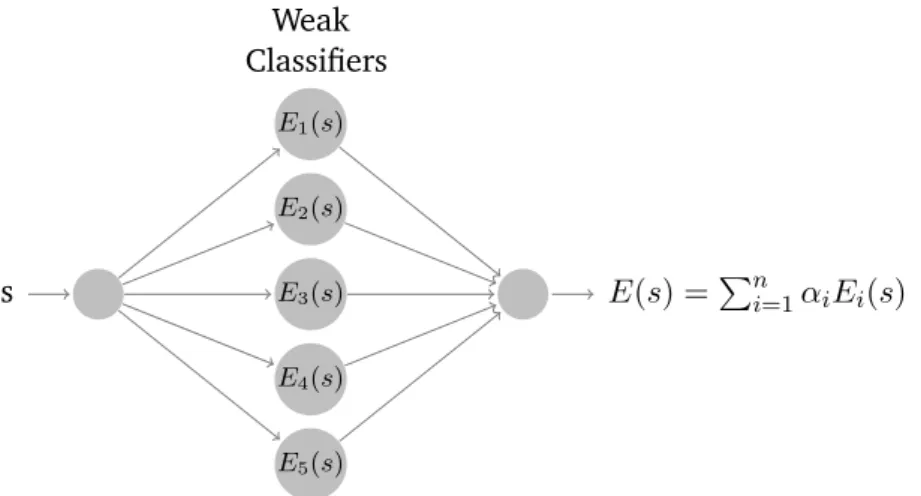
s E1(s) E2(s) E3(s) E4(s) E5(s) E(s) =Pni=1αiEi(s) Weak Classifiers
FIGURE2.2: Predicting a class using an ensemble classifierEwith five weak classifiers Ei, wherei∈ {1, ..,5}.
2.4.4 Ensemble Learning
The preceding section has stated that simple Decision Trees tend to reflect anomalies and outliers of the training data. The bias-variance trade-off expresses this dilemma. It denotes the problem of minimizing two main roots of errors in supervised machine learning algorithms that prevent an algorithm from generalizing [82]. The bias de-scribes the difference between the expected predictions and the true predictions. It is responsible for underfitting. The variance describes the variability of predictions. It is responsible for overfitting. One way to counter this problem inDecision Treesis to prune them. Another way to tackle this problem isEnsemble Learning. Ensemble learning com-bines multiple (weak) classifiers to one ensemble classifier. The predictive performance of such an ensemble is often better than the performance of each weak classifier [85]. This is based on statistical intuition: Conducting several measurements and then aver-aging them leads to more stable and reliable estimates [82]. However, the algorithmic complexity and model complexity increase as well. Ensembles types are, for instance,
Bagging,Tree Forests, andBoosting[88].
Figure 2.2 illustrates how a learning ensemble E predicts a class for sample s. Each weak classifier predictsEi(s), wherei∈ {1, ..., n}andn∈Nis the number of classifiers.
The prediction is given by averaging the weighted predictions of the weak classifiers. Even though the following ensemble learning algorithms work with different types of weak classifiers, they are typically utilized in conjunction with Decision Trees in prac-tice [82,88]. Therefore, we assume the weak classifiers to be standard(CART) Decision Treesin the following.
2.4.5 Forests of Randomized Trees
Forests of Randomized Trees is an ensemble method that consists of several random-ized Decision Trees. The introduction of randomization to the ensemble learning pro-cess yields a decrease of the model’s variance with a typical increase of the model’s bias [82]. The two most popular members areRandom Forest [89] andExtremely Ran-domized Trees[90].
Extremely Randomized Trees proposed by Geurts et al. [90] heavily rely on randomiza-tion. They are based on the idea ofBootstrap Aggregation, also known as Bagging. The main idea of Bagging is drawing several subsamples of the original set and train one weak classifier of the learning ensemble on each subsample [82]. The sampling method is done by uniformly drawing samples with replacement from the original sample set. Since samples are drawn with replacement, a bagged set may contain duplicates. Train-ing the weak classifiers on different bootstrapped sets creates diversity, which in turn increases the robustness of the ensemble.
Another technique calledSubspace Sampling is utilized to further increase variation. It induces eachDecision Treefrom a different random subset of the feature set, i.e. the split that is chosen is not the best split among all features but rather the best split among a random subset of them [82]. In case ofExtremely Randomized Trees, a random cutpoint for a feature f ∈ F is uniformly drawn to further increase randomization. At each node, it creates K splits with K being a parameter of the algorithm (a typical default choice K = p|F|). Therefore, it examines K features at each node. For each feature
fk,06k6K, it uniformly draws a cutpoint from[fmin, fmax], wherefmin denotes the
minimal value of f regarding the current set and fmax denotes the maximal value of
f regarding the current set. Then, it takes the split that yields the highest score with respect to a scoring metric, e.g. the precision, the recall, or the ROC AUC score.
2.5
Conclusion
This chapter has discussed the fundamentals of this thesis. Since this thesis focuses on
Host-Based Code Injection Attacks in the context of malware, we have given an intro-duction to malware and its analysis first. Our two systems to detect HBCIAs employ dynamic analysis (Bee Masterin Chapter6) and forensic analysis (Quincyin Chapter7).
Bee Master incorporates the honeypot paradigm. Therefore, we have discussed honey-pots including high-interaction and host-based systems. Quincyrelies on machine learn-ing techniques. We have presented supervised machine learning and in particular the
algorithm Extremely Randomized Treesthat achieved the best performance in Quincy’s evaluation in Section7.3.
Plus c¸a change, plus c’est la mˆeme chose
Jean-Baptiste Alphonse Karr
3
Related Work
This chapter plants our research in the research landscape by discussing related work, which covers three areas: The first area is the formalization and study of code injection attacks in general. The second area is the prevention of Host-Based Code Injection At-tacks(HBCIAs). There have been numerous publications in this area that mostly aimed at the prevention of exploitation due to software bugs, e.g. stack-based buffer over-flows. This topic was intensively researched in the early 2000s concomitant with the massive outbreaks of computer worms. The third area is the detection of code injection attacks. In this field, many publications have focused on the network-based detection of code injection attacks. However, there have been few publications that have dealt with the continuously increasing threat of HBCIAs. In addition to related scientific work, we surveyed related software patents and products. Our field is a practical one and the computer security industry significantly invests into the development of mitigation techniques.
Since our thesis focuses on binary code injections carried out by malware, we did not survey other forms of injection techniques likeSQL injections[91] orcross-site scripting
3.1
Formalization and Study of Code Injection Attacks
The formalization and study of code injection attacks is a prerequisite for further studies in this field. Younan et al. [93] surveyed common techniques for injecting code into C and C++ programs. They distinguished between indirect attacks (indirect pointer overwriting and exploiting of heap-based overflows, dangling pointer references, as well as integer errors), exploiting data-based overflows, as well as attacks on format string vulnerabilities. The origin of code injection attacks can be either host-based or network-based. Ma et al. [94] as well as Polychronakis et al. [95] studied network-based code injection attacks in detail.
Whereas the presented publications focused on code injections that only exploit pro-grammatic errors (e.g. dangling pointers), we focus on HBCIAs in the context of mal-ware, which also injects its code with the help of interfaces offered by the operating system. Malware may also use programmatic errors for injection, e.g. the espionage malware Stuxnet [7]. We are the first to introduce a formalization of HBCIAs in the context of malware and to classify the various modus operandi. Since our formalization is more abstract, it is agnostic to the underlying technical injection method. This allows us to discuss HBCIAs on different operating systems (e.g. Windows, Linux, macOS) and architectures (e.g. x86, x64, ARM).
3.2
Prevention of Code Injection Attacks
This section discusses related work concerning the prevention of code injection attacks. Even though these approaches focus on the prevention, they may also allow the detec-tion of code injecdetec-tion attacks – Be it explicit, like preventing the execudetec-tion of a payload at a certain address or be it implicit, like an access violation due to a process crash.
3.2.1 Complication and Prevention of Code Execution
From a defender’s point of view, the main objective is blocking the execution of injected code to prevent it from doing any harm. If this is neither possible nor feasible then the defender should at least raise the bar for attackers and complicate the execution of injected code.
The beginning of the 2000s was the time of major computer worm outbreaks. These worms spread mainly via buffer overflows. Back then, buffer overflows were consid-ered as “the vulnerability of the decade” [96] and constituted a major topic in computer
security research. A popular area of research focused on the prevention of buffer over-flows (e.g. [97–101]). One notable defense was the introduction of the non-executable stack [102]. Salamat et al. ([103,104]) proposed multi-variant program execution to detect and prevent buffer overflows. They executed several slightly different instances of the same program in parallel, which performed equivalent computations. Their model assumed that buffer overflows may occur and it detected them by deviations in one or more instances. Another line of research focused on the prevention of unexpected system calls (e.g. [105,106]). Such system calls might emerge from injected code. In order to thwart techniques like code-signing and non-executable memory, return-oriented programming(ROP) was invented ([107–110]). ROP allows an attacker to hi-jack the control flow of a program by only controlling its call stack. Several defenses againstROPhave been proposed (e.g. [111–114]).
HBCIAs carried out by malware are different. Whereas the discussed seminal papers detect the execution of exploits, they may not detect HBCIAs. This is due to the fact that HBCIAs are mostly carried out with the help of regular system calls. Our approach
Bee Master is independent of the techniques utilized. It detects, on the one hand, HB-CIAs that employ regular system calls. On the other hand, it detects HBHB-CIAs using the above-mentioned attack methods. This is owed to the fact that after such an attack the malware, for example, loads detectable modules, which diverges form the expected behavior.
3.2.2 Randomization
Randomization of several computer system components have been the foundation of many ideas such as Data Layout Randomization andSystem Call Randomization. Ran-domization of several aspects of a computer system may lead to execution failures of injected code. This is due to assumptions the injected code may take (e.g. the API call
VirtualAllocresides at address0x00767689) or the fact that it may not encounter what it is looking for (e.g. the API callVirtualAllocin general).
Whereas many different approaches were proposed for preventing code injection at-tacks, only a few of them, likeAddress Space Layout Randomization(ASLR) [115], found their way into major operating systems such as Microsoft Windows and Linux. The reason for this may be the demand of major changes to the kernel. Therefore, many vendors shunned promising approaches likeInstruction Set Randomization (ISR) [116] because of their impracticality.
In the following sections, we survey proposals that randomize the data layout, the in-structions, the system calls, or the operating system itself.
Data Layout
One successful class of countermeasures are Data Layout Randomizations. They were introduced between the late 1990s and the early 2000s. For example, injected code assumed back then that certain system libraries would always be mapped to certain addresses. Randomization of data layouts, however, did not lead to the end of code injections. It just raised the bar by reducing the reliability of exploits.
The PAX project [117] introduced several countermeasures against code injection at-tacks. These includedNon-Executable Pages, i.e. pages can be marked as non-executable resulting in an exception if executed, andAddress Space Layout Randomization(ASLR), i.e. randomly relocating code and data pages. Many of the leading operating systems like iOS and Microsoft Windows (DEP [118]) incorporated theNX-bitas an implementa-tion of non-executable pages. Xu et al. [119] proposed a system forTransparent Runtime Randomization. It randomly relocated the heap, the stack, and shared libraries at run-time. Bhatkar et al. ([120,121]) presented Address Obfuscation, which was based on address randomization. They also added features like the permutation of the variable order. This even further decreased the probability of a successful exploitation. Kil et al. [122] presentedAddress Space Layout Permutation(ASLP). They criticized that ASLR introduced insufficient randomization and that similar approaches (e.g. [120,121]) re-quired access to the application’s source code. ALSP was a binary rewriting system that modified the locations of static code and data to a random location. In addition, it per-formed fine-grained permutations of the functions and the data in the binary. Bhatkar et al. [123] introducedData Space Randomization. Their proposal randomized the rep-resentation of data objects in programs. Thus, their approach protected against cor-ruption of non-control flow data. However, it was limited to source code. Giuffrida et al. [124] proposed Fine-Grained Address Space Randomization, which allowed ASLR on a finer-grained level in user space as well as in kernel space. The key concept was the re-randomization of code during runtime. Snow et al. ([125, 126]) stated that fine-grained ASLR could be circumvented by finding possibleROP-gadgets at runtime. Shioji et al. [127] presented code shredding, a technique to improve the randomization granularity (when compared to ASLR) to one byte. However, code shredding resulted in a tremendous overhead in both runtime and memory. Due to the cats and mouse game that defenders and attackers are playing, several new attack techniques against poorly implemented ASLR systems were presented throughout the last years: Brute-Forcing[128],Partial Pointer Overwrites[129], andReturn-Oriented Programming[125].
Chen et al. [130] presentedCodeArmorto harden code diversification against advanced
ROPexploits. Their system improved on ASLR randomization and also introduced honey gadgets, which triggered an alarm in the case they were utilized.
The presented systems are different fromBee Master. They only focus on the exploitation stage. Modern malware does not need to exploit the system once it resides on it to inject code (see Chapter4). This is due to the fact that many operating systems offer such capabilities via system calls or special APIs (e.g. Windows [54]). Therefore,Bee Mastermonitors its child processes for modifications to detect HBCIAs independently of the injection method and the underlying OS.
Instructions
Another branch of research focused on the randomization of the processor’s instruction set. This branch of research has been actively followed at least since 2003. Even though the results have been promising and the performance of the approaches has increased throughout the years, the application to productive operating systems is still missing. Cohen [131] argued that different obfuscated variants of a program raise the bar for new attacks significantly. His idea focused on the obfuscation and also implied randomization of the program code. He applied techniques like instruction reordering, random garbage insertion, and exchanging equivalent instruction sequences.
Barrantes et al. [116,132] presented aRandomized Instruction Set Emulatorcalled RISE, scrambling each byte of the legitimate program code. The foundation of this obfuscation was a pseudo random number generator (PRNG) that was seeded with a random key. When the key was known, the descrambling of the bytes was trivial. However, it was infeasible to produce even a short sequence of code with a meaningful behavior without knowledge of the correct key. Incorrectly scrambled code produced invalid instructions that crashed the program on execution. Similar to Barrantes et al., Kc et al. [24] pro-posed a system for thwarting code injection attacks by randomizing the instruction set of each process. It required special support by the processor. Several publications followed these two publications of Barrantes et al. and Kc et al. on instruction set randomization (e.g. [23,101,133–135]). They focused on alternate implementations, enhancements, or improvement of the performance.
Whereas all of the presented seminal papers prevent and potentially detect the execution of injected code, they require profound modifications of current operating systems to work. Such modifications are not realistic in the most popular closed source operating systems in the short term. Bee Master is different from these publications. First, it
does not rely on modifying current operating systems. It can be easily ported to other platforms without any modification of them. Second, it does not focus on prevention but rather on detection. The above mentioned papers focused mainly on prevention and detection may only be a side effect.
System Calls
Programs receive inputs and output results. This is achieved via the interaction with the OS kernel through system calls.
Chew et al. [136] presented the randomization of system call mappings. They changed these mappings in the kernel and dynamically rewrote system calls in programs be-fore loading the program. Injected code did not know the correct mappings and hence crashed the victim process. Oyama et al. [137] proposed the encryption of system call IDs and arguments. Hence, an attacker without knowledge of the encryption algorithm and key was not able to use system calls. Building upon former approaches, Jiang et al. [138] introducedRandSys, an approach that combined ASLR with a weakened form of ISR (see previous section). They only randomized system calls. Similar to Jiang, Nguyen et al. [139] implemented a native API randomization for Microsoft Windows. The presented publications can protect against code injections, especially in the classical case of remote exploits. However, they fail to protect against code injections carried out by an attacker that already resides on the system and utilizes legitimate system calls for foreign process space manipulation, e.g. due to access to the compiler tool chain. This is often the case with today’s malware. Our approach Bee Master does not suffer from this limitation. It is able to detect such HBCIAs that are carried out by legitimate system calls, since they result in measurable changes in its child processes.
Operating System
Another set of proposals built diverse operating systems, which may increase the robust-ness against replicated attacks.
Pu et al. [140] discussed ideas for countering malware and exploits, which relied on implementation details of the OS. They counted on variation of the OS code. Even though the authors might be the first to apply biological ideas (e.g. the human im-mune system) to OSes to counteract malware and exploits, their publication contained vague statements and suggestions for future work. Forrest et al. [141] were the first to formally introduce the idea of building diverse operating systems. They argued that
diversity implies robustness in biology. Current computer systems were not very diverse and therefore very susceptible to mass exploitation attacks. They did not present a con-crete solution to this problem but they proposed possible implementations like memory layout randomization and code permutation. Please note that these ideas were subject to research several times in the last two decades (see the previous sections). Chew et al. [136] proposed OS randomization to mitigate buffer overflow attacks. Since their proposal aimed at the mitigation of buffer overflow attacks, it randomized parts of the OS that played an important role in buffer overflow attacks: system call mappings, li-brary entry points and stack placements. We have already discussed these techniques in the previous sections. Larsen et al. surveyed automated system diversity [142].
Our work is different from the presented publications. We aim for practical and applica-ble solutions such asBee MasterandQuincythat can be employed with current operating system implementations. Diverse operating systems pose many drawbacks. They may be problematic for system administrators and programmers when bugs occur. Also, they demand the reimplementation of current operating systems from the ground up.
3.2.3 Integrity
Next to randomization, integrity-based systems are popular in the literature. They en-sure the integrity of the code and the code execution environment. First, we review work that focuses on the integrity of control and data flows. Second, we discuss further approaches that, for example, aimed at the integrity of the execution environment.
Control and Data Flows
Code injections violate the integrity of the control and data flows of the victim process. For instance, the hijacking of a thread violates the control flow of the corresponding victim process.
Kiriansky et al. [143] presented Program Shepherding, which verified every branch in-struction and enforced certain security policies. For example, they detected code injec-tions due to a code origin policy. Their system was based on the interpretation of binary code. Suh et al. [144] introducedDynamic Information Flow Tracking. Their approach marked data coming from Input/Output (I/O) sources as spurious. Then, it tracked this marked data and detected dangerous uses of it. Abadi et al. [145, 146] defined the concept ofControl Flow Integrity(CFI). Their idea ensured that the program execution followed a path in the precomputed program’s control flow graph. Valid paths were determined beforehand. Younan et al. [93] proposed separating pointer and control
flow information of programs to mitigate a wide range of attacks including buffer over-flows. They extended a C compiler to generate code with these characteristics. Castro et al. [147] proposedData Flow Integrity. They statically computed a data flow graph and enforced valid data flows by instrumenting the program. Their system raised an excep-tion when it detected an invalid data flow. Akritidis et al. [148] introduced a system that statically computed the control flow graph and determined memory access locations for each instruction. Then, code was generated that prevented the manipulation of objects by instructions that were not allowed to write to these objects. Bletsch et al. [149] presented Control Flow Locking. They lazily validated control flow changes after they occurred. Therefore, they inserted code before each indirect control flow transfer such as returns and indirect jumps. This code checked a memory value to verify if the current control flow had already been transfered. They aborted the execution in this case. Zhang et al. [150] improved CFI by introducing a springboard section, where they stored all legal targets of indirect control flow instructions. The order of the targets was random-ized and access was restricted. The authors claimed that this technique worked directly on the binary code and significantly increased the performance ofCFI.CFIcontinues to be an open field for research (e.g. [151–154]). Even thoughCFI raised the bar for at-tackers significantly, there are still ways to circumvent it, albeit certain conditions have to be met (e.g. [155–160]).
In contrast to the presented publications,Bee Masterfocuses on the detection of malware instead of exploit detection and prevention. We detect changes in theWorker Beessuch as new threads and new libraries that are a result of executing malicious code. We assume that there are some attacks like simple ROP exploits that might be missed by
Bee Masterbut there are other cases in which it should perform better than aCFI-based system. Therefore, a combination of it andCFI-based systems would be a way to boost detection rates even further and also beyond malware.
Other Approaches
Feng et al. [161] utilized call stack analysis to detect several attacks. They extracted call addresses from the call stack and tried to find a path with abstract execution between two program points. If shellcode was executed then a valid path did not exist. Linn et al. [162] ensured that only legitimate system calls were executed by adding information about the allowed system calls of a binary to a special section of the binary. Further-more, they obfuscated system call traps using exceptions. Ratanaworabhan et al. [163] presented a system againstHeap-Spraying Attacksthat also targeted type-safe languages like Java. They monitored the entire heap and detected large-scale modifications to the heap’s objects that are required in such an attack. Salamat et al. [164] proposed
multi-variant execution. They executed multiple variants of a program and compared their states at certain execution points. If there were discrepancies then an exception was raised. Philippaerts et al. [165,166] presentedCode Pointer Masking. They masked code pointers and therefore restricted the range of addresses that these pointers could point to. This should have ensured that an attacker could not make a pointer point to injected code. Baiardi et al. [18] introduced the separation of code execution and con-trol flow in two virtual machines. With this clean separation, they were able to detect injected code. Chen et al. [167] implemented Shreds that allowed in-process private memory. They offered programmers a set of primitives that they had to include in their program. A modified compiler compiled the source code and a kernel drive