Pingyu Zhang
A DISSERTATION
Presented to the Faculty of
The Graduate College at the University of Nebraska In Partial Fulfillment of Requirements
For the Degree of Doctor of Philosophy
Major: Computer Science
Under the Supervision of Professor Sebastian Elbaum
Lincoln, Nebraska
NON-FUNCTIONAL SOFTWARE REQUIREMENTS
Pingyu Zhang, Ph.D. University of Nebraska, 2013 Advisor: Sebastian Elbaum
A software system is bounded by a set of requirements. Functional requirements describe what the system must do, in terms of inputs, behavior, and outputs. We define non-functional requirements to be how well these functional requirements are satisfied, in terms of qualities or constraints on the design or on the implementation of a system. In practice, the validation of these kinds of requirements, does not receive equal emphasis. Techniques for validating functional requirements target all levels of software testing phases, and explore both black-box and white-box approaches. Techniques for validating non-functional requirements, on the other hand, largely operate in a black-box manner, and focus mostly on system testing level. As a result, in practice more efforts are focused on validating functional requirements, and only assess non-functional requirements after functional validation is complete.
In this dissertation, we propose a set of automated bounded exhaustive white-box testing techniques that enable cost-effective validation of non-functional requirements from two perspectives. For non-functional requirements defined as qualities of a sys-tem, we target load testing for the purpose of performance validation. We present Symbolic Load Generation (SLG), a load test suite generation approach that uses symbolic execution to exhaustively traverse program execution paths, and produce test cases for the ones that may expose worst-case or near worst-case resource con-sumption scenarios. An assessment of SLG on a set of Java applications shows that it
ware that follows the pipeline architecture, and is evaluated on a group of Unix and XML pipelines. The results show that it generates load tests in situations where SLG fails to scale, and achieves comparable load with a fraction of the cost. We also ex-tend CompSLG to enable the handling of more complex software structures in terms of Java programs, and show the viability of the extended technique through a series of examples.
For non-functional requirements defined as constraints on a system, we target val-idation of contextual constraints that are imposed by external resources with which the software interacts. We first assessed the magnitude of the problem by conducting a study on fault repositories of several popular Android applications. We then present an approach that amplifies existing tests in an exhaustive manner to validate excep-tion handling constructs that are used to handle such constraints. Our assessment of the approach on a set of Android mobile applications indicates that it can be fully automated, is powerful enough to detect 67% of the faults reported in the bug reports of this kind, and is precise enough that 78% of the detected anomalies correspond to faults fixed by the developers.
Combined, the two proposed techniques advance the field of automated software testing by providing white-box support for non-functional validation.
First and foremost I would like to express my sincere gratitude and appreciation to my advisor, Dr. Sebastian Elbaum, for the guidance, inspiration, suggestions, criticism, and financial support that he has provided throughout the course of my research and studies. He not only shaped my problem solving capabilities in academics, but also carried me through difficult times during this six-year journey. This dissertation would not be a reality without the countless support from him.
Special thanks are also extended to Dr. Berthe Choueiry, Dr. Michael Dodd, and Dr. Matthew Dwyer, for taking the time to review this dissertation and serving on my doctoral advisory committee. In particular, I would like to acknowledge and thank Matthew Dwyer, with whom I had the honor to co-author several papers that eventually made their way to this dissertation. Working with him is an enjoyable experience, and I benefited a lot from his impressive depth and breadth of knowledge. I am also grateful to the research institutes, for which I had the honor to work through several internships during the course of my studies. Among those are NASA Ames Research Center in California, and ABB Corporate Research in Raleigh, North Carolina.
To the people in the ESQuaRed Laboratory at the University of Nebraska-Lincoln, you have provided a superb working atmosphere. Special thanks to my officemates Wayne Motycka and Zhihong Xu, for making this six-year journey a little bit more enjoyable.
My parents have been a continuous source of support for me through out the years. To each of them, I am deeply grateful.
And finally, I would like to thank my wife, Wei Liu. Her love, support and encouragement have made it possible for me to achieve this dream. Thank you for believing in me.
Contents
1 Introduction 1
1.1 Motivation . . . 1
1.2 Non-functional Requirement Validation: Load Testing . . . 5
1.3 Non-functional Requirement Validation: Exception Handling . . . 8
1.4 Dissertation Statement . . . 10
1.5 Contributions of this Research . . . 11
1.6 Outline of Dissertation . . . 13
2 Background & Related Work 14 2.1 Symbolic Execution . . . 14
2.1.1 Generalized Symbolic Execution . . . 17
2.1.2 Dynamic Symbolic Execution . . . 19
2.1.3 Using Symbolic Execution for Automatic Test Generation . . 20
2.1.4 Search Heuristics in Symbolic Execution . . . 24
2.1.5 Memoization in Symbolic Execution . . . 25
2.2 Automated Techniques for Load Testing . . . 27
2.2.1 Generating Load Tests . . . 28
2.2.2 Identifying Performance Problems . . . 30
2.3 Techniques for Detecting Faults in Exception Handling Code . . . 34
2.3.1 Mining Specifications of Exceptional Behavior . . . 34
2.3.2 Exceptional Control Flow Representation . . . 35
2.3.3 Fault Injection . . . 36
2.3.4 Mocking . . . 37
3 Automatic Generation of Load Tests 39 3.1 Challenges . . . 39
3.2 Approach Overview . . . 41
3.3 The SLG Algorithm . . . 44
3.3.1 Parameterizing SLG . . . 47
3.3.2 Clustering the Frontier and Diversity Checks . . . 51
3.3.3 Dealing with Solver Limitations . . . 52
3.4 Implementation . . . 54
4.2 Overview of a Compositional Approach . . . 70
4.3 The CompSLG Algorithm . . . 73
4.3.1 Selecting Compatible Path Conditions . . . 76
4.3.2 Generating Channeling Constraints . . . 78
4.3.3 Weighing and Relaxing Constraints . . . 79
4.3.4 Handling Split Pipelines . . . 82
4.4 Implementation . . . 82
4.5 Evaluation . . . 83
4.5.1 Artifacts . . . 84
4.5.2 Metrics and Treatments . . . 86
4.5.3 Experiment Setup . . . 87
4.5.4 Results and Analysis . . . 88
4.6 Exploring CompSLG Extensions to Richer Structures . . . 91
4.6.1 Richer Channeling Constraints . . . 94
4.6.1.1 Approach to Capture CCr and CCw . . . 94
4.6.1.2 Putting It All Together . . . 99
4.6.1.3 Proof-of-Concept Examples . . . 101
4.6.2 Richer Performance Summaries . . . 114
4.6.2.1 Revisiting the Approach to Generating Performance Summaries . . . 117
4.6.3 A New Strategy for Summary Composition . . . 121
4.6.3.1 Revisiting the Approach to Composition . . . 121
4.7 Summary . . . 124
5 Amplifying Tests to Validate Exception Handling Code 126 5.1 Magnitude of the Problem . . . 127
5.2 Difficulties in Exposing Faulty Exceptional Behavior . . . 131
5.3 Test Amplification . . . 135
5.3.1 Overview with Example . . . 135
5.3.2 Problem Definition . . . 138
5.3.3 Approach Architecture . . . 140
5.3.4 Implementation . . . 143
5.4 Evaluation . . . 145
5.4.1 Study Design and Implementation . . . 146 vii
5.4.2 RQ1: Cost Effectiveness in Detecting Anomalies . . . 148
5.4.2.1 Results with Mocking Length=10 . . . 148
5.4.2.2 Controlling the Mocking Length Parameter for Cost Effectiveness . . . 150
5.4.2.3 A Closer Look at the Mocking Patterns . . . 153
5.4.3 RQ2: Anomalies & Failures . . . 155
5.4.3.1 Precision and Recall . . . 155
5.4.3.2 Feedback From Application Developers . . . 159
5.4.4 Threats to Validity . . . 161
5.4.5 Extended Domain and Alternative Approach . . . 161
5.4.6 Preliminary Case Study . . . 163
5.5 Summary . . . 164
6 Conclusions and Future Work 166 6.1 Summary and Impact . . . 166
6.2 Limitations . . . 170
6.3 Future Work . . . 174
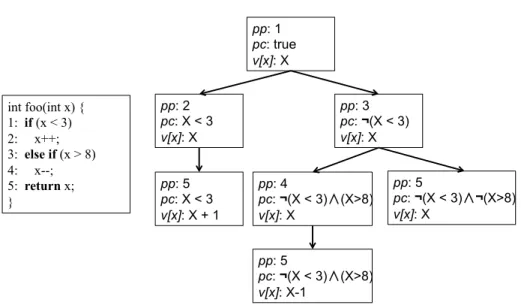
2.1 Code fragment for foo() and its corresponding symbolic execution tree. . . 15
3.1 SQL query template. . . 40
3.2 Histogram of response time for TinySQL. . . 41
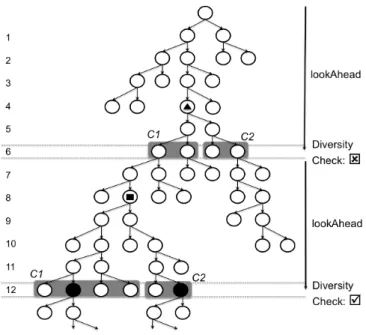
3.3 Iterative-deepening beam symbolic execution. . . 43
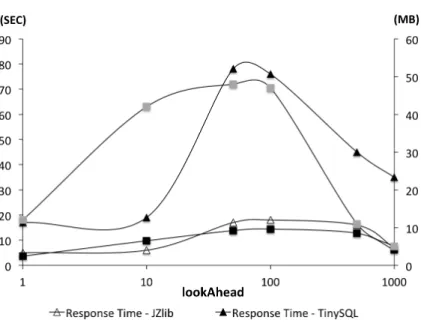
3.4 Quality of load tests as a function oflookAhead. . . 49
3.5 Illustration of the SLG implementation. . . 54
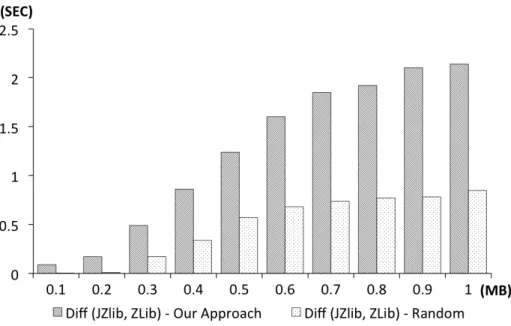
3.6 Revealing performance issues: response time differences of JZlib vs Zlib when using testing suites generated by CLLG vs Random. . . 58
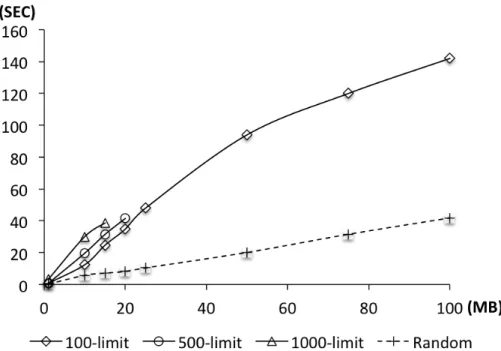
3.7 Scaling: response times of JZlib with test suites generated by CLLG and Random. . . 60
4.1 Pipeline structures. . . 66
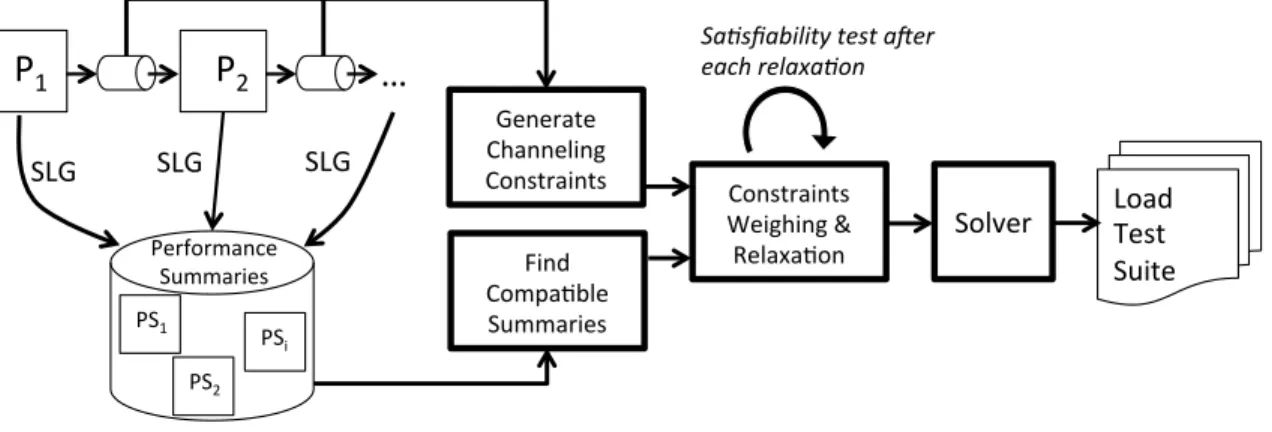
4.2 Illustration of a compositional approach. . . 70
4.3 Path constraints computed for grep [pattern] file | sort, with the pattern being a 10-digit phone number. Three sets of constraints are shown, one for grep, one for sort, one for the channeling constraints connecting them. Crossed out constraints have been removed in order to find a solution. 72 4.4 Symbolic file modeling. . . 75
4.5 Cost-effectiveness of treatments applied to Unix pipelines. Triangles repre-sent CompSLG (blank for No-reuse, shaded for Incremental-reuse, solid for Full-reuse), diamonds represent SLG, and the circles represent Random. . 89
4.6 Cost-effectiveness of treatments applied to XML pipeline. Triangles repre-sent CompSLG (blank for No-reuse, solid for Full-reuse), diamonds reprerepre-sent SLG, and the circles represent Random. . . 90
4.7 Custom-SE Applied to Example Code. . . 98
4.8 Illustration of a compositional approach for Java programs. . . 99
4.9 Code example 1: single function call, no side effects. . . 103
4.10 Code example 2: single function call, with side effects. . . 105
4.11 Code example 3: multiple function calls, with side effects. . . 106
4.12 Code example 4: multiple function calls, with side effects and a predicate. 108 4.13 Code example 5: multiple nested function calls, with side effects. . . 111
4.14 Code snippet for the AVL tree: five inserts. . . 115
5.1 Code excerpt (with comments added for readability) from XBMC Remote
Revision 220 with a faulty exception handling mechanism. . . 132
5.2 Submitted fix to the previous code in Revision 317. . . 134
5.3 Illustration of test amplification up to length 5. Each path from the root to a leaf corresponds to a mocking pattern. 32 patterns are explored and 4 failing patterns (marked as FP1-FP4) are found. . . 136
5.4 Failure report corresponding to FP1. . . 137
5.5 Amplification architecture. . . 141
5.6 Excerpts of aspect for online mocking and error injection. . . 144
5.7 Anomalies detected byTamp under various mocking lengths for application-resource combinations. Each observation corresponds to a mocking length (from left to right: 1, 3, 5, 7, and 10). X-axis represents cost in terms of execution time in hours, and Y-axis represents the number of anomalies detected. . . 152
5.8 Categorization of mocking patterns. . . 154
5.9 Mapping detected anomalies to bug reports. . . 157
3.1 Load test generation for memory consumption. . . 62
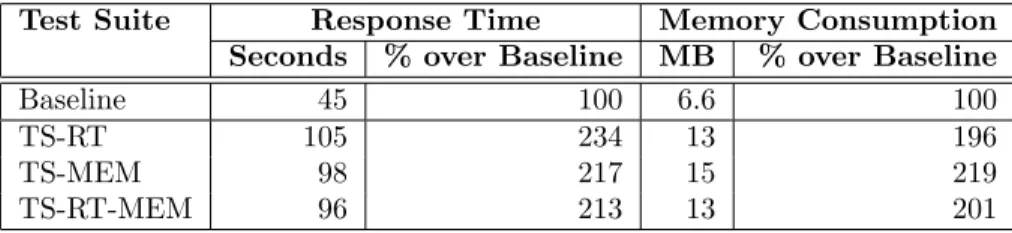
3.2 Response time and memory consumption for test suites designed to increase those performance measures in isolation (TS-RT and TS-MEM) and jointly (TS-RT-MEM).. . . 62
3.3 Queries illustrating test suite diversity. . . 64
4.1 SLG on the pipeline grep [pattern] file | sort with increasing input sizes. . . 69
4.2 SLG on pipelines of increasing complexity. . . 69
4.3 Compositional approach on the pipelinegrep [pattern] file | sortwith increasing input size. % in Gen. and Load shows comparison to Table 4.1. 73 4.4 Compositional approach on pipelines with increasing complexity Previously computed summaries are reused. % in Gen. and Load shows comparison to Table 4.2. . . 73
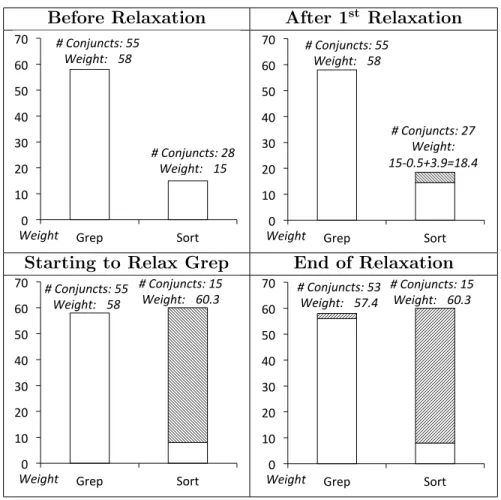
4.5 Illustration of weighing and relaxing constraints. White areas correspond to the original weight, shaded areas correspond to the adjusted weights. . 81
4.6 Unix and XML programs. . . 84
4.7 Summary of pipeline artifacts. . . 85
4.8 Handling pipelines vs. Java programs. . . 92
4.9 Summary of the proof–of-concept examples. . . 102
4.10 Constraint composition for code example 1. . . 104
4.11 Constraint composition for code example 2. . . 106
4.12 Constraint composition for code example 3. . . 107
4.13 Constraint composition for code example 4 (Path 1). . . 109
4.14 Constraint composition for code example 4 (Path 2). . . 110
4.15 Constraint composition for code example 5 (Path 1). . . 112
4.16 Constraint composition for code example 5 (Path 2). . . 113
4.17 Handling AVL tree with five inserts (size match). . . 116
4.18 Handling AVL tree with five inserts (shape match). . . 117
4.19 Evaluation: AVL tree with five inserts. . . 117
4.20 Handling AVL tree with eight calls. . . 120
4.21 Evaluation of the AVL tree example continued. . . 120
5.2 Classification of confirmed and fixed bug reports. . . 129
5.3 Characterization of the original test suites. . . 149
5.4 Characterization of the amplified test suites. . . 150
5.5 Anomalies detected. . . 151
5.6 Summary of feedbacks from developers. . . 160
Chapter 1
Introduction
In this chapter, we first present the motivation for the research efforts that lead to this dissertation, then summaries the contributions of this research.
1.1
Motivation
A software system, from its inception, is bounded by a set of requirements. A require-ment can be either functional or non-functional. Functional requirerequire-ments describe the behaviors (functions or services) of the system that support user goals, tasks or activities. In other words, it captures what the system must do. Non-functional re-quirements, on the other hand, describe how well these functional requirements are satisfied – where “how well” is judged by some externally measurable property of the system behavior.
Hence, non-functional requirements are often defined as qualities or constraints of a system [13]. Qualities are properties or characteristics of the system that its stakeholders care about and hence will affect their degree of satisfaction with the system. For example, performance (e.g., throughput, response time, transit delay, or latency) serves as an important measure of the quality of the system. Constraints, in
this context as defined by Bass et al. [13], are not subject to negotiation and, unlike qualities, are off-limits during design trade-offs. One such example is a contextual constraint, which accounts for elements of an environment into which the system must fit, such as host OS platforms, hardware infrastructures, or other services provided by external resources.
In practice, the validation of the functional and non-functional requirements is not given the same importance. For example, in the popular open source project Eclipse, we observe that validating the core of the Eclipse Editor (release 3.4.1) in-volves executing a total of 48,693 distinct unit and subsystem tests1. Among those
tests, more than 80% are functional, and a significant number of tests, 7,761, explic-itly target the user interface. As an open source project, functionality and usability are key acceptance criteria for the Eclipse user base, and it makes sense that those requirements were the focus of more than 99% of the test development effort. In comparison, however, the same Eclipse module only includes 21 security tests and a single performance test. From another perspective, there is a huge discrepancy be-tween how functional and non-functional bugs are addressed by the developers in the Eclipse community. According to the Eclipse bug repository [37], there are 4200 bugs associated with the editor module, and 45% of those are labeled as closed and fixed. Among those bugs, over 600 are labeled as performance related, but only 3% are fixed and closed, and only three developers participated in submitting fixes. In light of this situation, it is not surprising that Eclipse has severe non-functional issues. A recent study [36] shows that Eclipse 4.2 is up to 6000 times slower than a previous version (3.8) in some UI operations. Clearly, validation of non-functional requirements seems to matter yet it is not getting proper attention.
In terms of how testing activities are conducted, non-functional requirements are 1The number of tests are computed by counting the number of test-java files in each directory
tion on the system testing level alone [79]. However, this could lead to disastrous results if it is revealed at this stage that these quality requirements could not be met by the current architecture without significant rework. An experience from Oracle Corporation suggests that performance validation accounts for an average of 2.5% of the total cost of development [88]. However, the cost of fixing poorly performing applications at the end of development cycle is estimated to be 25% of the total cost of development.
We conjecture several reasons for the negligence of non-functional requirements validation. The first reason is the lack of precise and actionable non-functional re-quirements. Mannion and Keepence outline the characteristics of a high quality non-functional requirement [82]. In reality, many non-functional requirements are specified in loose, fuzzy terms that are open to subjective interpretation [48], which makes testing challenging. The second reason is the lack of cost-effective techniques for validating non-functional requirements. Compared to numerous techniques and tools available for functional testing and validation, tools specifically designed for non-functional purposes are scarce, imprecise, and focus on system testing level. For example, although performance validation plays an important role in the development life cycle, there are only a few tools that support load testing at subsystem testing level [68, 80, 89]. For the tools that do support such activities, most of them focus on profiling and bookkeeping performance trends. They induce load by increasing the input size or the rate at which input is provided [79], which is a rather expensive way of inducing load (e.g., requires additional disk space, bandwidth to execute tests),
and may lead to negligence of real performance faults.
In this dissertation we focus on investigating strategies for improving the cost ef-fectiveness of non-functional validation techniques. We reduce the cost of conducting non-functional validation by developing techniques that automatically generate test suites for specific non-functional requirements, and by transforming existing tests into new tests that add non-functional capabilities to the validation process. We improve the effectiveness of the techniques by using program analysis to exhaustively tra-verse program execution paths, searching for instances of violations of non-functional requirements and producing counter examples (test cases) that allow developers to easily recreate the failing scenarios.
These techniques can be viewed as complementary to the efforts that aim at improving the quality of non-functional requirements. If such requirements are avail-able, our techniques facilitate their validation. If non-functional requirements are not available, the proposed techniques can still be used to expose worst or near worst case scenarios of non-functional properties, which could in turn help to develop more accurate set of non-functional requirements [48, 133].
More specifically, we have targeted two aspects of non-functional testing. For non-functional requirements defined as qualities of a system, we targeted validation of performance properties. We improve cost-effectiveness of performance validation by
automatically generating load tests that focus on smart input value selection to expose worst or near worst case performance scenarios. For non-functional requirements defined as constraints on a system, we targeted contextual constraints on noisy and unreliable external resources with which a software system must interact. One way to improve the robustness of software that interacts with those external resources is to use exception handling constructs. In practice, however, the code handling exceptions is not only difficult to implement [95] but also challenging to validate [45, 109, 117].
1.2
Non-functional Requirement Validation: Load
Testing
Load tests aim to validate whether a system’s performance (e.g., response time, re-source utilization) is acceptable under production, projected, or extreme loads. Con-sider, for example, an SQL server that accepts queries specified in the standard query language to create, delete, or update tables in a database. Functional tests would validate whether a query results in appropriate database changes. Load tests, how-ever, would be required to assess whether, for example, for a given set of queries the server responds within an expected time.
Existing approaches to generate load tests induce load by increasing the input size (e.g., a larger query or number of queries) or the rate at which input is provided (e.g., more query requests per unit of time)[79]. Consider again the SQL server. Given a set of tester supplied queries, a load testing tool might replicate the queries, send them to the SQL server at certain intervals, and measure the response time. When the measured response times differ from the user’s expectation, which might be expressed as some upper bound determined by the size or complexity of the queries or underlying database, a performance fault is said to be detected.
Current approaches to load testing suffer from four limitations. First, their cost effectiveness is highly dependent on the particular values that are used yet there is no support for choosing those values. For example, in the context of an SQL server
we studied, a simple selection query operating on a predefined database can have response times that vary by an order of magnitude depending on the specific values in the select statements. Clearly, a poor choice of values could lead to underestimating system response time thereby missing an opportunity to detect a performance fault. Second, increasing the input size may be a costly means to load a system. For example, in the context of a compression application that we studied, we found that to increase the response time of the application by 30 seconds one could use a 75MB input file filled with random values or a 10MB input file if the inputs are chosen care-fully. This is particularly problematic if increasing the input size requires additional expensive resources in order execute the test (e.g., additional disk space, bandwidth). Third, increasing the input size may just force the system to perform more of the samecomputation. In the worst case, this would fail to reveal performance faults and, if a fault is detected, then further scaling is likely to repeatedly reveal the same fault. In functional testing, diversity in the test suite is desirable to achieve greater coverage of the system behavior. Load suites that cover behaviors with different performance characteristics are not a focus of current tools and techniques.
Finally, while most load testing focuses on response time or system throughput, there are many other resource consumption measures that are of interest to develop-ers. For example, mobile device platforms place a limit on the maximum amount of memory or energy that an application can use.
We introduced an approach (Chapter 3) for the automated generation of load test suites that starts addressing these limitations. It generates load test suites that (a) induce load by using carefully selected input values instead of just increasing input size, (b) expose diversity of resource consuming program behavior, and (c) target a range of consumption measures.
pro-sume more resources. Our approach is directed and incremental in exploring possible program paths. The approach is directed by a specified resource consumption mea-sure to search for inputs of a given size or structure that maximize consumption of that resource (e.g., memory, execution time). The approach is incremental in that it considers program paths in phases. Within each phase it performs an exhaustive exploration of program paths. At the end of each phase, the paths are grouped based on similarity, and the most promising path from each group, relative to the consump-tion measure, is selected to explore in the next phase. We implemented the approach in the Symbolic Path Finder framework [65] and assessed its effectiveness on three artifacts. The results indicate that the proposed approach can produce suites that induce response times several times greater than random input selection and can scale to millions of inputs, increase memory consumption between 20% and 400% when compared with standard benchmarks, and expose different ways to induce high consumption of resources.
If improving on symbolic execution alone would not lead to desirable scalabil-ity suitable for load testing, we reconstruct the analysis compositionally, following a ‘divide-and-conquer’ strategy. We have proposed a compositional approach to gener-ate load tests (Chapter 4). The approach builds on the aforementioned technique to collect the program paths that would lead to an effective load test suite for each system component. The collected paths constitute a performance summary for each compo-nent. The approach is compositional in that it analyzes the components’ summaries and their connections to identify compatible paths, as defined by their constraints,
which can be solved to generate load tests for the whole system. Key to this process is how path constraints across components must be weighted and relaxed in order to derive test inputs for the whole system while ensuring that the most significant constraints, in terms of inducing load, are enforced. We have implemented the ap-proach by using our previous load generation apap-proach as a subroutine for collecting performance summaries. An evaluation on a group of Unix pipeline artifacts and one XML pipeline shows that the compositional approach achieves scalability beyond that of the previous technique, and has an effectiveness gain of 288% over Random when given the same time to generate tests. In its current form, the compositional approach is fully automated to handle software that follows the pipeline architecture. We have also presented an extension of the approach that enables handling of Java programs, in which each component is a Java method. We have presented a set of new algorithms to handle the added challenges, such as more complex program structures and more sophisticated summary composition strategies. We showed the viability of the extended approach through a series of examples.
1.3
Non-functional Requirement Validation:
Ex-ception Handling
Modern software does not execute in isolation. It interacts with external resources that can be noisy and unreliable, and exhibit transient and unpredictable failures [98]. One way to improve software robustness in such a context is to use exception handling constructs. In practice, however, the code handling exceptions is not only difficult to implement [95] but also challenging to validate (e.g., [45, 109, 117]).
We conjecture that the validation challenge is particularly relevant when deal-ing with systems that must interact with external resources that can be noisy and
contrast, an exception handling construct interacting with noisy and often unreliable localization, communication, and sensor services, cannot make such simplifying as-sumptions, requiring more complex and hence harder to validate implementations. A standard testing framework, which only supports simple ways of mocking the API calls that invoke those services, cannot accurately model the noisy nature of the ex-ternal resources, and misses the faults that can only be triggered by specific patterns of exceptions.
To assess the severity of the problem, we conducted a study on fault repositories of eight popular Android applications. The study provides quantifiable evidence of the commonality of faults associated with exception handling code constructs, and more specifically with those related to handling external resources with unpredictable performance that cannot be controlled through standard input manipulation. The re-sults show that 22% of the confirmed and fixed bugs have to do with poor exceptional handling code, and that 12% correspond to interactions with four external resources we deem most relevant to the problem (Section 5.1).
We then presented an exhaustive white box approach to support the detection of such faults (Section 5.3). Our approach is simple, scalable, and effective in practice when combined with a test suite that invokes the resources of interest. The approach is white box in that it first instruments the target program so that the results of calls to external resources of interest can be mocked at will to return exceptions. Then, existing test cases are systematically amplified by re-executing them on the instru-mented program under various mocked patterns to explore the space of exceptional
behavior. The approach exhaustively tests all patterns, looking for the ones that are effective in exposing faults. When a fault is revealed, the mocking pattern applied with the test serves as an explanation of the failure induced by the external resource. To control the number of amplified tests the approach prunes tests with duplicate calls and call-outcomes to the external resources, and bounds the number of calls that define the space of exceptional behavior explored.
The approach is built on two assumptions. First, it builds on the small scope hypothesis [64], often used by techniques that systematically explore a state space, which advocates for exhaustively exploring the program space up to a certain bound. The underlying premise is that many faults can be exposed by performing a bounded number of program operations, and that by doing so exhaustively no corner cases (test cases that expose faults in extreme situations, such as extreme values for the input parameters) are missed. Several studies and techniques have shown this approach to be effective (e.g., [18, 29, 32]) and we build on those in this work. In our approach, the bound corresponds to the length of the mocked patterns. Second, we assume that the program under test has enough tests cases to provide coverage of the invocations to the resources of interest. The increasing number and maturity of automated test case generation techniques and tools support this assumption. If this assumption holds, then the approach can automatically and effectively amplify the exposure of code handling exceptional behavior.
1.4
Dissertation Statement
In the dissertation we explore the following research statement:
non-of performance validation. We present a load test suite generation approach by using symbolic execution to exhaustively traverse program execution paths and produce test cases for the ones that expose worst case resource consumption scenarios. For non-functional requirements defined as constraints on a system, we present an approach for validating contextual constraints that are imposed by external resources with which a software interacts. The approach amplifies existing tests in an exhaustive manner to validate exception handling constructs that are used to handle such constraints. Combined, the two proposed techniques complement the field of automated software testing by providing exhaustive support for non-functional validation.
1.5
Contributions of this Research
In this dissertation, we have developed a set of exhaustive white box testing techniques to support automatic validation of non-functional requirements. The contributions of this work are three-fold:
1. Symbolic Load Generation. For performance validation we have developed a technique for automated generation of load test suites with support for pre-cise input value selection that is built on state-of-the-art symbolic execution techniques, and equipped with a directed incremental search strategy to tai-lor the special needs of load generation. An assessment of the approach shows it generates test suites that induce program response times and memory con-sumption several times worse than the compared alternatives, it scales to large
and complex inputs, and it exposes a diversity of resource consuming program behavior [137] (see Chapter 3 for details).
2. Compositional Load Generation. To further improve on the scalability of the symbolic load generation technique, we developed a compositional tech-nique for automated generation of load tests for more complex software systems. The technique is compositional in that it analyzes each software components’ performance in isolation, then generates load tests for the whole system by accumulating and stitching each performance summary. An evaluation of the technique on software pipelines shows that it achieves scalability beyond that of the symbolic load generation technique, and has an effectiveness gain of 288% over random when given the same time to generate tests [138]. We further generalize the technique to load test generation for Java programs, provide a conceptual implementation sketch, and illustrate its application through a series of examples (see Chapter 4 for details).
3. Exception Handling Validation. For exception handling validation, we first assessed the magnitude of the problem by conducting a study on fault reposito-ries of eight popular Android applications. We then developed a technique that systematically amplifies existing tests to validate exception handling code in an exhaustive manner. Our assessment of the technique indicates that it can be fully automated, is powerful enough to detect 67% of the faults reported in the bug reports of this kind, and is precise enough that 78% of the detected anoma-lies correspond to faults fixed by the developers. The technique outperforms a state of the art approach [117] in precision and recall. In addition, the feed-back from developers and the preliminary case study illustrate the techniques potential to assist developers [136] (see Chapter 5 for details).
for testing of exception handling code. Chapter 3 presents the load test generation technique for standalone programs. In Chapter 4, we introduce the technique for compositional load generation for software pipelines as well as Java programs. In Chapter 5, we present the technique for amplifying tests to validate exception han-dling code. Finally, in Chapter 6, we provide the overall conclusions for this work, summarize the merit and impact, and present ideas for improvements and future research directions.
Chapter 2
Background & Related Work
In this chapter, we identify key pieces of work that are related to our approaches in the two proposed areas. For our work on load testing, we begin with background information on symbolic execution, a fundamental technique used by our technique. We then discuss recent improvements to symbolic execution and how we benefited from those improvements. We also identify other techniques that aim at load test gen-eration or performance characterization in general, and discuss how they are related to ours. For our work on validating exception handling code, we identify two areas of related work: mining exception handling specifications and exception handling code coverage representations, and discuss how they are related to our technique.
2.1
Symbolic Execution
Symbolic execution [73] simulates the execution of a program usingsymbolic values in-stead of actual values as inputs. During symbolic execution, when a program variable is read, its corresponding symbolic value is loaded. Memory locations are updated with symbolic values when they are written during symbolic execution.
sym-4: x--; 5: return x; } pp: 5 pc: X < 3 v[x]: X + 1 pp: 4 pc: ¬(X < 3)∧(X>8) v[x]: X pp: 5 pc: ¬(X < 3)∧¬(X>8) v[x]: X pp: 5 pc: ¬(X < 3)∧(X>8) v[x]: X-1
Figure 2.1: Code fragment for foo() and its corresponding symbolic execution tree. bolic execution. Each node in the tree represents a symbolic program state and the edges represent transitions between states. A symbolic state is a “snapshot” of the current execution after the most recent transition. Branching in the symbolic execu-tion tree corresponds to a choice that cannot be precisely determined based on the symbolic state, during symbolic execution. A path in the tree is uniquely defined by a conjunction of constraints. Each constraint encodes a branch decision made along the path and is defined as a boolean expression over concrete and symbolic values. The conjunction is called the path condition. A path is feasible only when the path condition is satisfiable, i.e., there is an assignment of values to variables that makes the formula true; otherwise, the path is considered infeasible. Each time the path condition is updated, an automated decision procedure is used to check its satisfiabil-ity. When a path condition becomes unsatisfiable, symbolic execution along that path halts and backtracks to the previous decision point, and continues on an unexplored path.
Figure 2.1 shows an example code snippet and its corresponding symbolic execu-tion tree. In the code, method foo() takes a single integer argument, x, and returns
an integer value. It has two branching points (Line 1 and Line 3) and three feasible paths (shown on the right).
Each symbolic state is defined as a triple, (pp, pc, v). The program position, pp, denotes the next statement to be executed. The path condition, pc, is a conjunction of the constraints on the symbolic variables along the current execution path. The
symbolic value map, v, is a map from memory locations of the program variables to symbolic expressions representing their current values. For example, in Figure 2.1, the last state of the middle path on the symbolic execution tree (the bottom box) includesppat Line 5, a pc: ¬(X <3)∧(X >8), and one symbolic expression X−1 for the variable x.
To illustrate how symbolic execution works, again consider the example in Fig-ure 2.1. When foo() is invoked, the path condition is initialized to true, and the symbolic value map for variable x contains the symbolic valueX (we use capital let-ters to indicate symbolic values). At Line 1, symbolic execution branches: (1) when
X < 3, the value of x is incremented at Line 2, and the value X + 1 is returned
at Line 5; (2) when ¬(X < 3), the execution moves to Line 3 and branches again: (1) when X > 8, the value of x is decremented at Line 4, and the value X −1 is returned at Line 5; (2) when¬(X >8) the execution moves to Line 5 and returns the original value X. Symbolic execution on this code generates a total of three paths, as illustrated on the right in Figure 2.1.
The simplicity of this example belies the true complexity of performing symbolic execution on real programs. In the next sections, we will describe some of the more challenging aspects of performing symbolic execution in a realistic environment, such as handling complex inputs, scaling up to complex programs, and its application to automatic test generation.
Symbolic execution was first introduced as a technique for generating test inputs on scalar inputs. In 1976, King presented an interactive system that provides symbolic execution for programs written in a PL/I style language for testing and debugging [73]. In recent years, thanks to the substantial advances in raw computation power and constraint solving technology, symbolic execution has regained its popularity as a promising technology for test generation research [91].
The rise of object-oriented programing languages in the 90s makes symbolic ex-ecution of software written in such languages more challenging: 1) OO programs frequently use dynamically allocated data, such as trees, linked lists, or arrays of un-specified lengths, as inputs. Declaring these types of inputs as symbolic variables is challenging because it would require modeling them in the symbolic heap and updat-ing their structures as the analysis continues. 2) For symbolic execution techniques that correctly model the symbolic heap, the number of possible outcomes for updat-ing a symbolic data structure (such as an symbolic tree) in the heap is prohibitively large, making the technique non-scalable even for tiny examples. 3) A program may use complex library calls in it computation, resulting in non-linear constraints (e.g., strings and high-order mathematical constraints) that can not be solved by tradi-tional decision procedures; or it may make references to native libraries, for which code may not be available to analyze at source code level.
For programs whose inputs are heap-allocated data structures, Khurshid et al. proposed lazy initialization [72]. It starts execution of the program on inputs with uninitialized fields and assigns values to these fields lazily, i.e., when they are first
accessed during symbolic execution of the code. It nondeterministically initializes the field to null, to a reference of a new object with uninitialized fields, or to a reference of an object created during a prior field initialization. The technique branches on these choices, which effectively systematically treats all aliasing possibilities. This approach eliminates the need to specify an a priori bound on the number of input objects, which is generally unknown.
To solve the problem of poor scalability caused by the introduction of sym-bolic heap data, Visser et al. proposed state abstraction and subsumption tech-niques [4, 122]. In this line of work, the authors first described abstraction mapping, an approach that maps heap objects in the symbolic state to a simplified version (e.g., representing a chain of nodes in a linked list with one summarizing node). The authors then present subsumption, a method for examining whether a symbolic state is subsumed by another symbolic state. Subsumption is used to determine when a symbolic state is revisited, in which case the model checker backtracks, thus prun-ing the state space. In this process, abstraction is used to increase chances of state matching. This effectively explores an under-approximation of program behaviors, but has proved to be effective in generating tests for programs that take container objects as inputs, e.g., binary search trees, arrays.
For symbolic execution involving strings, several approaches have proposed using string solvers [47, 104]. String constraints are collected in conjunction with con-straints on scalar variables, and both scalar / string decision procedures are used in satisfiability checks. For other types of complex constraints and native library calls, Pasareanu et al. proposed to solve the problem with uninterpreted functions and mixed concrete-symbolic solving [90]. This technique splits the generated path conditions into two parts: 1) constraints that can be solved by a decision procedure, and 2) complex non-linear constraints with uninterpreted functions to represent
ex-technique support arrays of unspecific length through lazy initialization, and string operations through the use of string decision procedures. Furthermore, we extended the support of external library calls to file system operations through modeling of a symbolic file system, details of which are discussed in Chapter 4.
2.1.2
Dynamic Symbolic Execution
Dynamic symbolic execution aims to improve performance of symbolic execution by combining concrete and symbolic execution, essentially bounding the scope of what is treated as symbolic. First introduced by Godefroid et al. in DART (Directed Automated Random Testing) [51], the idea is to perform a concrete execution on random inputs and at the same time to collect the path constraints along the executed path. These path constraints are then used to compute new inputs that drive the program along alternative paths. More specifically, one can negate one constraint at a branch point to guide the test generation process towards executing the other branch. A constraint solver is called to solve the path constraints and to obtain the test inputs. The program is executed on these new inputs, constraints are collected along the new program path and the process is repeated until all the execution paths are covered or until the desired test coverage is achieved. For example, for the code fragment in Figure 2.1, after exploring the path: ¬(X <3)∧(X >8), dynamic symbolic execution can negate the branch at Line 3 to explore a new path: ¬(X <3)∧ ¬(X >8).
Whenever symbolic execution gets stuck, dynamic symbolic execution uses con-crete values to simplify the constraints, which leads to improved scalability, but loses
completeness. Note that both dynamic symbolic execution and generalized sym-bolic execution aim to help traditional symsym-bolic execution in certain situations, e.g., when there are no available decision procedures or in the presence of native calls, however they use different approaches to achieve this goal. Dynamic symbolic exe-cution uses values from concrete runs to handle situations that decision procedures can not handle, while generalized symbolic execution uses concrete solutions of the solvable constraints in the current path condition to simplify the overall complexity. Implementation-wise, dynamic symbolic execution explores new paths by negating constraints on the current path, which is mostly implemented by code instrumen-tation, while generalized symbolic execution uses state-space search to explore new paths, which is mostly implemented on top of a state-space exploration framework (usually a model checker). Both techniques are implemented through several tools, which explore different tradeoffs between scalability and completeness. We will dis-cuss those tools in the next section.
2.1.3
Using Symbolic Execution for Automatic Test
Gener-ation
One direct application of symbolic execution is the automated generation of test cases that reach certain statements, achieve high degree of coverage, or expose certain bugs. Symbolic execution is well suited for the task, because the path condition to reach a statement in the code when solved, gives exactly the input to reach the statement. There is a large body of work in this research direction, we review some of the most representative ones below.
Symbolic Path Finder. Pasareanu et al. proposed Symbolic Path Finder (SPF) [92], a symbolic execution engine built on the model checking tool called Java Path Finder
with the JPF program states. The underlying model checker core provides many benefits to the symbolic execution engine, such as built-in state space exploration capabilities, a variety of heuristic search strategies, as well as partial order and sym-metry reductions. In addition, it handles complex input data structures and arrays via lazy initialization, and implements state abstraction and subsumption checks. In addition, SPF addresses the issue of scalability with mixed concrete/symbolic exe-cution [92]. The idea is to use concrete system-level simulation runs to determine constraints on the inputs to the units within the system. The constraints are then used to specify pre-conditions for symbolic execution of the units. SPF is used to analyze prototype NASA flight software components and helps to discover several bugs [92, 90].
DART. Proposed by Godefroid et al., DART [51] is the first among the line of work that use dynamic symbolic execution to generate tests (Section 2.1.2). This approach is alternatively named “concolic testing” - aiming to blend concrete and symbolic executions to improve the scalability of traditional symbolic execution approaches. DART, which generates tests for C programs, starts to execute a program with ran-dom concrete inputs, gathers symbolic constraints on inputs along the execution, and then systematically or heuristically negates each constraint in order to steer the next execution towards an alternative path. DART is used to generate tests for applica-tions ranging from 300 to 30,000 lines of code, and detected several bugs. Note that SPF also improves scalability by mixing concrete and symbolic executions, but with
a different methodology. DART performs concrete execution on whole paths and uses the results to steer towards alternative paths, while SPF interleaves concrete and sym-bolic executions and uses concrete execution to setup the environment for symsym-bolic execution [92]. In addition, as discussed in Section 2.1.2, both techniques use concrete execution results to handle native library calls, but with different methodologies as well.
CUTE. CUTE [102] is another concolic execution technique for C programs that improves on DART by providing support for heap-allocated dynamic data structures as inputs. The key idea is to represent all inputs with a logical input map, and then collect two separate kinds of constraints, scalar constraints and pointer constraints, as symbolic execution proceeds. The pointer constraints are collected approximately — the only types of pointer constraints allowed are aliasing and null pointers. All other properties of pointers, such as boundary checks and offsets, are ignored. With this improvement, CUTE enables test generation for dynamic data structures such as trees and linked lists.
EXE and KLEE. EXE [24] is a symbolic execution technique designed for systems code in C language, such as device drivers OS kernels. The unique feature in EXE is that it models memory with bit-level accuracy, which is necessary for handling systems code, which often treats memory as raw bytes and casts them in a variety of ways. EXE also uses a custom decision procedure, STP [46], to speedup the solving process. KLEE [23] is a redesign of EXE built on top of the LLVM [74] compiler infrastructure. This design, along with several improvements in storing and retrieving program states, provides further scalability gains to the technique. Another improvement of KLEE is the ability to handle file systems and network operations. It provides symbolic models of these external libraries and supports symbolic execution
It is shown to successfully generate inputs that detect bugs in these applications. On the other hand, KLEE pushes scalability to a higher level by detecting bugs on applications of 2K-8K lines of code.
Pex. Pex [119], developed by Microsoft Research, is another concolic execution tool to generate test inputs for the .NET platform. It has been released as a plugin for Microsoft Visual Studio and used daily by several groups within Microsoft. Pex uses the Z3 solver [33] as the underlying decision procedure, and uses approximations to handle types of constraints for which Z3 has not supported, such as strings and floating point arithmetic. There have been a number of extensions to Pex, such as support for heap-allocated data [118], which allows test generation for data structures such as trees and linked lists, and new search strategies [127], which use the fitness function in genetic algorithms to guide search.
SAGE. Godefroid et al. proposed a technique called “SAGE: white-box fuzzing” [50], which targets programs whose inputs are determined by some context free grammars, such as compilers and interpreters. The technique abstracts the concrete input syntax with symbolic grammars, where some original tokens are replaced with symbolic con-stants. This operation reduces the set of input strings that must be enumerated. As a result, the inputs generated by this technique can easily pass the front-end (lexers and parsers) of the software under test, and reach deeper stages of execution, increas-ing its chance of catchincreas-ing bugs. The technique has been used to validate applications such as a JavaScript interpreter of Internet Explorer 7. In essence, this technique
can be viewed as another attempt to combine symbolic and concrete executions. It is unique in that it uses symbolic grammars to reduce the set of input strings for software systems. Since then, similar ideas have been adopted by other researchers to enable validation of applications such as logical formula solvers [81], server-side application architectures [63], web pages [10, 132], and database applications [39].
Our load generation technique, SLG (Chapter 3), is built on top of SPF, and takes advantages of its built-in features, such as support for heap-allocated data, support for string solvers, and mixed concrete / symbolic execution. Furthermore, we have extended SPF to support symbolic file systems, a design that was inspired by the KLEE tool [23].
2.1.4
Search Heuristics in Symbolic Execution
A typical symbolic execution framework often provides a rich set of search heuristics. A search heuristic essentially determines the priority of target branches to explore next. In the extreme, full program behaviors can be explored via an exhaustive strategy. Within this category, there are many well-known search strategies such as breadth-first (BFS) and depth-first search (DFS) strategies. However, each such strategy is biased towards particular branches. While breadth-first search favors initial branches in the program paths, the depth-first search favors final branches.
Most symbolic execution techniques support a mixture of the above heuristics. DART and CUTE use DFS. EXE also uses DFS as its default strategy, but provides an alternative strategy, which is a mixture of best-first (Best-FS) and DFS [23]. The strategy works as follows: the search starts with DFS, after four branches, it uses heuristics to evaluate all forked paths, picks the one with the best progress (in terms of coverage) to continue first, then does another four steps of DFS. The goal of this strategy is to provide some global perspective occasionally, in order to prevent DFS
genetic algorithms to the area of concolic execution [127]. The proposed technique, which is termed “fitness function guided search”, assigns fitness values to each ex-plored path. A fitness function measures how close an exex-plored path is in achieving a test target coverage. A fitness gain is also measured for each explored branch: a higher fitness gain is given to a branch if flipping it in the past helped achieve better fitness values. Then during path exploration, the technique would prefer to flip a branch with a higher fitness gain in a previously explored path with a better fitness value. The goal of this technique is to identify high coverage paths quickly, without getting stuck in a large space of less valuable paths.
For our load test generation technique SLG, we developed unique search strategies specifically tailored to our needs. Rather than performing a complete symbolic exe-cution, it performs an incremental symbolic execution to more quickly discard paths that do not seem promising, and directs the search towards paths that are distinct yet likely to induce high load as defined by a performance measure. We will explain the details of this strategy in Chapter 3.
2.1.5
Memoization in Symbolic Execution
Memoization is a technique for giving functions a memory of previously computed values [83]. Memoization allows a function to cache values that have already been calculated, and when invoked under the same preconditions, to return the same value from a cache rather than recomputing each time. Memoization explores the time-space tradeoff, and can provide significant performance gains for programs that
con-tain many computation-intensive calls.
The concept of memoization has also been applied to program analysis techniques, such as software model checking and symbolic execution. Analogous to classical memoization, the results of previous analysis on functions are cached, and then reused accordingly to save time. For example, Lauterburg et al. proposed ISSE (Incremental State-Space Exploration) [75], a model checking technique that stores the state space graph during a full model checking of a program, and then reduces the time necessary for model checking of an evolved version of the program by avoiding the execution of some transitions and related computations that are not necessary. We now discuss the application of memoization in symbolic execution.
Memoization at the functional level. Recent work [3, 49] proposes composi-tional reasoning as a means of scaling up symbolic execution. Godefroid et al. pro-posed the SMART technique [49], which is intended to improve the scalability of DART. The idea is to reuse summaries of individual functions computed from pre-vious analysis. A summary consists of pre-conditions on the functions inputs and post-conditions on the functions output; they are computed “top down”, to take into account the proper calling context of the function under analysis. If f() calls g(), one can summarize g() the first time it is explored, and reuse g()’s summary when analyzing f() later on. Thus, each method is analyzed separately and the overall number of analyzed paths is smaller than in the case where the system is analyzed as a whole. Anand et al. extend the compositional analysis with a demand-driven approach [3], which avoids computing summaries unnecessarily, i.e., summaries that will never be used. Instead, summaries are computed as-needed on the fly.
Memoization on full paths. Application of symbolic execution often requires several successive runs on largely similar programs, e.g., running it once to check a
data structure to store the key elements of a run of symbolic execution, and it reuses this data to speedup successive runs of symbolic execution on a new version of the program. The savings are achieved in a regression analysis setting, in which multiple program versions are available. However, the exact savings are hard to predict, as they depend on the location of the change, and may vary quite a lot between different changes.
Our technique of compositional load generation is inspired by previous work on compositional symbolic execution, but with different goals and mechanisms. For example, in resolving inconsistencies through constraint relaxation, our technique resorts to the performance tags associated with the path constraints in order to max-imize the load that the generated test will induce. To the best of our knowledge, our work is the first one to utilize compositional symbolic execution to generate non-functional tests.
2.2
Automated Techniques for Load Testing
In this section we first present an extensive review of related work on automated techniques for load test generation. Techniques in this area can be roughly catego-rized into two categories: black-box techniques, which treat the system under test as a black box; and white-box techniques, which have access to the source code of the system under test. We will review techniques in both categories, identify their potential and drawbacks, and discuss how our techniques are related to those. In
addition, there is a large body of work on automatic / semi-automatic identification of bottlenecks (or performance bugs) in the source code. Although our current work focuses on generation of load tests, our future goal on load testing includes identifying bottlenecks as well. Therefore, we will present a review on this line of work as well.
2.2.1
Generating Load Tests
Black-box Techniques. There is a large number of tools for supporting load test-ing activities [79], some of which offer capabilities to define an input specification (e.g., input ranges, recorded input session values) and to use those specifications to generate load tests [108]. For example, a popular tool like Silk [108] provides a user interface and wizards to define a typical user profile and scenario, manipulate the number of virtual users to load a system, and monitor a vast set of resources to mea-sure the impact of different configurations. Clearly, more accurate and richer user and scenario specifications could yield more powerful load tests. Support for identi-fying the input values corresponding to the most load-effective profiles and scenarios, however, is very limited.
A common trait among these tools is that they provide limited support for select-ing load inducselect-ing inputs as they all treat the program as a black box. The program is not analyzed to determine what inputs would lead to higher loads, so the effective-ness of the test suite depends exclusively on the ability of the tester to select values. Similar trends appear in load testing techniques and processes in general as they use other sources of information (e.g., user profiles [11], adaptive resource models [14]) to decide how to induce a given load, but still operating from a black box perspective.
One recent advance in this area is the FORPOST technique proposed by Grechanik et al. [55]. The technique is novel in that it uses an adaptive, feedback-directed learning algorithm to learn rules from execution traces of applications, and then uses
is applied to these applications, it automatically learns rules on the bad inputs (high loads) such as: a customer should have home/auto discount, or a customer has viewed more than 16 items, etc. It then uses these rules to derive test inputs, such as customer profiles that have home/auto discounts, that lead to high workloads. Bottlenecks are identified by comparing good with bad test cases: a prominent resource consuming method that occurs in good test cases (high load), but is not invoked or has little significance in bad test cases (low load), is likely to be a bottleneck. This approach works well if there exists a large pool of candidate inputs, the variety among candidate inputs is high, and the properties of the inputs can be expressed by simple rules.
Unlike these black-box techniques, our load test generation technique uses a white-box approach to generate tests. We view black-white-box approaches as complementary, where a hybrid approach may combine the benefits of both approach in a gray-box performance testing, in which a white-box approach is used to select precise input values, and a black-box approach is used to learn input rules, which in turn would help improving scalability of the white-box approach.
White-box Techniques. Until recently, techniques and tools for performance val-idation or characterization have treated the target program as a black box. One interesting exception is an approach proposed by Yang et al. [129]. Conceptually, the approach aims to assign load sensitivity indexes to software modules based on their potential to allocate memory, and use that information to drive load testing. Our approach also considers program structure, but a key difference in that, instead of
having to come up with static indices, our approach explores the program system-atically with the support of symbolic execution to identify promising paths that we later instantiate as tests.
The WISE technique proposed by Burnim et al. proposes to uses symbolic ex-ecution to identify a worst-case scenario [20]. The technique utilizes full symbolic execution on small data sizes, and then attempts to generalize the worst case com-plexity from those small scenarios. This works well when the user can provide a branch policy indicating which branches or branch sequences should be taken or not in order to generalize the worst-case from small examples, which requires an extremely good understanding of the program behavior. The study shows that an ill-defined branch policy fails to scale even for tiny programs like Mergesort.
Our approach is different in two significant respects. First, our work is designed to targets scalability specifically. We characterize the components of a system by performing an incremental symbolic execution favoring the deeper exploration of a subset of the paths associated with code structures. This removes the requirement for a user-provided branch policy. For the entire system, we use a compositional approach to avoid exploring whole program paths and facing path explosion problem. Second, our goal is to develop a suite of diverse tests, not just identifying the worst-case. This requires the incorporation of additional mechanisms and criteria to capture distinct paths that contribute to a diverse test suite, and of a family of performance estimators that can be associated with program paths.
2.2.2
Identifying Performance Problems
Profiling-based Techniques. The most common way of identifying performance problems is through profiling of the system under test. Over the years, profiling tools such as gprof [54] has been used to find bottlenecks related to excessive CPU usage.
framework. It maintains a shadow value for every register and memory location, and uses these shadow values to store additional information, which enables tracking of all types of memory operations, such as value initialization, allocation/deallocation, copying, etc. Although programs instrumented with Memcheck typically run 20-30 times slower than normal, it is claimed to be fast enough to use with large programs that reach 2 million lines of code.
However, profiling tools often rely on one specific run of the program under test. Selecting the ‘right’ input that will expose the resource consumption problems be-comes critical, and in practice often leads to missed performance bugs. In recent years, several works have been done to alleviate this problem, either by aggregating information from multiple runs (possibly with order of magnitude difference in input data sizes), in the hope of providing “cost functions” for the key methods in the system, or by mining from millions of traces collected on deployed software systems. Goldsmidth et al. propose an approach that, given a set of loads, executes the program under those loads, groups code blocks of similar performance, and applies various fit functions to the resulting data to summarize the complexity [52]. This approach is applied to various applications such as a data compression program, a C language parser, and a string matching algorithm, and is able to confirm the expected performance of the implementation of those classic algorithms. Although the approach improves dramatically from single run profiling, the user provided workloads still proves to be critical to the performance of this approach.
with counters, uses an invariant generator to compute bounds on these counters, and composes individual bounds together to estimate the upper bound of loop iterations. This approach relies on the power of the invariant generator and the user input of quantitative functions to bound any type of data structures. As a result, this approach is demonstrated to scale only to small examples up to a hundred lines of code.
Coppa et al. propose a new profiling tool, aprof [28], that further alleviates the problem of relying user provided workloads. aprof also generates performance curves of individual methods in terms of their input sizes. However, instead of allowing users to provide work loads that range orders of magnitude in size, aprof only needs a few runs under a typical usage scenario. The key insight is thataprof automatically identifies different sizes of inputs to a specific method by monitoring its read memory size in each invocation. The approach is evaluated on a few components in the SPEC CPU2006 benchmarks, and is shown to provide informative plots from single runs on typical workloads. However, aprof does not consider alternative types of inputs that are received during runtime, such as data received on-line (e.g., reads from external devices such as the network, keyboard, or timer). The accuracy of the approach would be undermined in those situations.
Zaparanuks et al. propose another profiling tool, AlgoProf [133], that attempts to achieve a similar goal as aprof, but uses different types of metrics. Instead of using cost metrics such as invocation counts, response times, or instruction counts,
AlgoProf uses a set of metrics that focus on repetitions, i.e., loop counts, recursions, and data structure access counts. As a result, AlgoProf produces cost functions that are more focused on the algorithmic complexity. AlgoProf is shown to provide accurate performance plots for classical data structure algorithms such as trees and graphs, and is proved useful in uncovering algorithmic inefficiencies. However, it is not clear whether this type of metrics is as useful in broader types of applications.
to mine suspicious traces out of those traces: a sequence of calls appearing a long time across multiple stacks can be a CPU consumption bug; a sequence of calls wait-ing long time across multiple stacks can be a wait bug. This technique provides an alternative approach to performance debugging in the large, if the user can afford to collect a large amount of stack trace data on deployed products, which is generally expensive and fragmented.
Our work complements these techniques, because we focus on selecting input values that lead to worst case performances. We conjecture that the generated input values can in turn be used to enable a more accurate profiling of the program under test.
Search-based Techniques. Another thread of related works aim to predict overall performance of a system at a stage where only performance evaluation of the con-stituent components are available [1, 12, 107]. This type of information is valuable, because it can predict performance of systems that are yet to be built, therefore avoid-ing system architectures that are doomed to lead to bad performance. For example, Siegmund et al. proposed a technique that can predict program performance based on selected features in a software product line environment [107]. The proposed tech-nique models the problem as a search problem, and uses heuristic search to reduce the number of measurements required to detect the feature interactions that actually contribute to performance out of an exponential number of potential interactions.
perfor-mance information of individual components, in order to evaluate perforperfor-mance of the whole system. However, the information we gather are input constraints corre-sponding to the worst performing program paths, which can enable more accurate compositional analysis, and produce more accurate results.
2.3
Techniques for Detecting Faults in Exception
Handling Code
Our work in this field is mainly related to two areas: mining specifications and cov-erage representations. Additionally, we will review areas of related work on fault injection and mocking, which are techniques used by our work.
2.3.1
Mining Specifications of Exceptional Behavior
Techniques to mine specifications of exceptional behavior (e.g., [2, 117, 124]) operate by mining rules from a pool of source code and then checking a target program for vi-olations of the mined rules. The existing techniques vary in the type of rule structure they target, the scope of the analysis, how the pool is built, and the challenges intro-duced by the target programming language. So, for example, while Thummalapenta et al. [117] use conditional rules, intraprocedural analysis, a pool of code enriched with code from a public repository, and Java code, Acharya et al. [2] use association rules in C code, which does not support explicit try-catch structures.
The performance of these approaches depends on the quality of the pool of source code, the precision and completeness of the analysis, and the training parameters that define what constitutes an anomaly. It is not evident from the reported studies whether or not exception handling constructs that can take so many different forms and occur in such large scopes can be effectively mined as rules. Our approach is

![Figure 4.3: Path constraints computed for grep [pattern] file | sort, with the pat- pat-tern being a 10-digit phone number](https://thumb-us.123doks.com/thumbv2/123dok_us/1667719.2729027/84.918.168.808.144.317/figure-path-constraints-computed-pattern-digit-phone-number.webp)