CAHIER D'ÉTUDES
WORKING PAPER
N° 7
THE ANALYSIS OF RISK AND RISK MITIGATION TECHNIQUES
IN PAYMENT AND SECURITIES SETTLEMENT SYSTEMS
AND THE IMPACT ON CENTRAL BANK'S OVERSIGHT
by Simona AMATI February 2003
© Banque Centrale du Luxembourg, 2003
Address : 2, Boulevard Royal - L-2983 Luxembourg Telephone : (+352) 4774 - 1
Fax : (+352) 4774 - 4901 Internet : http://www.bcl.lu
E-mail : [email protected]
Télex : 2766 IML LU
The analysis of risk and risk mitigation techniques
in payment and securities settlement systems
and the impact on central bank oversight
by Simona AMATIAbstract
This paper investigates the risks and risk mitigation techniques which are in use within the Luxembourg-based payment and securities settlement systems and evaluates what could be the impact of risk analysis on central bank oversight. It indicates how overseers can make use of different tools to assess the availability and appropriateness of risk mitigation techniques implemented by market practitioners and to further promptly react in case of contingency.
Executive summary
The risks, which arise within payment and securities settlement systems, can be of different nature and different can be their probability of materialisation. Overseers are particularly concerned about the occurrence of systemic risk and all other risks which might, directly or indirectly constitute a threat to financial stability. Hence overseers attach importance to assessing how systems' operators and technical agents currently mitigate the exposures which arise within the systems1 they operate.
Due to the fact that risks can be different within payment or securities settlement systems, the mitigation techniques implemented by risk-takers, such as operators and technical agents, can be varied. Risk-takers can be confronted with the need to find a balance between their business needs, the market demand and the risk-adverse attitude adopted by overseers. Hence their capability to fully mitigate risks might need to be seen in the light of what would theoretically represent a first best solution under a risk-adverse attitude, on one hand, and what currently represents best practice on the market on the other hand. The first chapter of the study provides a description of the different systems' exposures followed by an explanation of the scope of the respective mitigation techniques and the way they are currently implemented within the Luxembourg environment. In this context, Clearstream Banking Luxembourg operates the Luxembourg-based securities settlement system, while LIPS-Gross and LIPS-Net represent the Luxembourg payment systems.
The evaluation of exposures and of the availability and appropriateness of risk mitigation techniques is an exercise which overseers, for their part, might undertake continuously. Hence, the second chapter describes an oversight framework which can be applied indifferently to payment and to securities settlement systems. The tools, which are described in the text, have been shaped in such a way as to assess both exposures and mitigation mechanisms. Their aim is to:
(a) enable an understanding of existing risks in the context of payment and securities settlement systems and to foresee possible future exposures which might arise from systems' developments or external threats. Tools which satisfy this aim can be defined as research tools;
(b) enable the assessment of the availability and appropriateness of risk mitigation mechanisms currently in use on the market. Tools which satisfy this aim can be defined as assessment tools;
(c) enable overseers to react promptly in case of contingency and to contribute, when possible, to a timely reduction of the costs incurred by counterparts after an exposure has materialised. Tools which satisfy this aim can be defined as intervention tools and/or procedures.
.
The use of the different instruments is interconnected. Research tools permit systematically the gaining of a wide understanding of the threats arising from the financial market and the achievement of knowledge about the vulnerabilities within a system. The result of such research enables the dynamic identification of the roots of exposures, the assessment, in turn, of whether the risk mitigation techniques adopted by overseen systems might be adequate and if current mitigation mechanisms could cover new threats which are in the process of development. This evaluation permits to shape at best the procedures and the intervention mechanisms to be used by overseers in case of crisis and contingency.
Hence, the aim of assessing risks and risk mitigation techniques in the context of central bank oversight of payment and securities settlement systems can be defined as an ongoing process which finds its major root in the developments overseen systems are subject to and finds one of its major ”raisons d’être” in the developments overseers might achieve in terms of safety and efficiency within the systems they oversee.
Index
1 Introduction
10
2 Risks and risk mitigation techniques
11
2
2..11 SSeeccuurriittiieess sseettttlleemmeenntt ssyysstteemmss -- SSSSSSss -- 1111
2.1.1 Legal risk 11
2.1.1.1 Definition 11
2.1.1.2 Possible risk mitigation techniques 12
2.1.1.3 Situation in Luxembourg 12
2.1.2 Credit risk 14
2.1.2.1 Definition 14
2.1.2.2 Possible risk mitigation techniques 14
Unsecured credit lines 15 Inter-bank placements 16
2.1.2.3 Situation in Luxembourg 17
Credit evaluation process 18 Provision and collateral checks 18
2.1.3 Liquidity risk 19
2.1.3.1 Definition 19
2.1.3.2 Possible risk mitigation techniques 20
2.1.3.3 Situation in Luxembourg 20
Securities lending facilities 21
Credit facilities 21
Additional resources 22 The night-time link CBL/BCL 23
2.1.4 Risk of settlement bank failure 23
2.1.4.1 Definition 23
2.1.4.2 Possible risk mitigation techniques 24
2.1.4.3 Situation in Luxembourg 24
2.1.5 Operational risk 25
2.1.5.1 Definition 25
2.1.5.2 Possible risk mitigation techniques 25
2.1.5.3 Situation in Luxembourg 25
2.1.6 Custody risk 26
2.1.6.1 Definition 26
2.1.6.2 Possible risk mitigation techniques 26
2.1.7 Inefficiency risk 28
2.1.7.1 Definition 28
2.1.7.2 Possible risk mitigation techniques 28
2.1.7.3 Situation in Luxembourg 29
2.1.8 Cross-border risk 29
2.1.8.1 Definition 29
2.1.8.2 Possible risk mitigation techniques 30
2.1.8.3 Situation in Luxembourg 32
2
2..22 PPaayymmeenntt ssyysstteemmss -- PPSS -- 3333
2.2.1 Legal risk 33
2.2.1.1 Definition and possible risk mitigation techniques 33
2.2.1.2 Situation in Luxembourg 33
Finality 33
Dispute resolution 33
2.2.2 Credit risk 34
2.2.2.1 Definition 34
2.2.2.2 Possible risk mitigation techniques 34
2.2.2.3 Situation in Luxembourg 34
2.2.3 Liquidity risk 35
2.2.3.1 Definition 35
2.2.3.2 Possible risk mitigation techniques 35
2.2.3.3 Situation in Luxembourg 36
Queuing facility 36
Gridlock facility 36
Monitoring facility 37
Rules of good conduct and obligations 37
2.2.4 Risk of settlement bank failure 37
2.2.4.1 Definition and possible risk mitigation techniques 37
2.2.4.2 Situation in Luxembourg 38
2.2.5 Operational risk 38
2.2.5.1 Definition and possible risk mitigation techniques 38
2.2.5.2 Situation in Luxembourg 38
Contingency procedures for LIPS-Gross (TARGET) 39 Back-up procedures for LIPS-Net 39 Place an organisation in default 39
2.2.6 Inefficiency risk 39
2.2.6.1 Definition 39
2.2.6.2 Possible risk mitigation techniques 40
3 Oversight responsibility and risk mitigation
42
33..11 RRiisskk mmiittiiggaattiioonn aanndd oovveerrssiigghhtt 4422
3.1.1 Research tools 44
3.1.1.1 Identification of risks 45
3.1.1.2 Analysis of risks 46
Measuring the scale of exposures 46 Measuring the duration of exposures 47 Measuring the frequency at which exposures arise and at which they materialise 48
3.1.1.3 Mapping of risks 49
3.1.1.4 Prioritisation of risks 49
3.1.1.5 Market expectations 51
3.1.2 Assessment tools 51
3.1.2.1 Effectiveness of mitigation mechanisms 52
3.1.2.2 Nature of mitigation mechanisms 53
3.1.2.3 Availability of contingency mechanisms 53
3.1.3 Intervention tools 54
3.1.3.1 Preventing intervention tools 54
Improving market discipline 54 Building a risk conscious culture 55
3.1.3.2 Corrective intervention tools 55
Implementing a procedure for crisis situations 55
3
3..22 RRiisskk mmaannaaggeemmeenntt aanndd oovveerrssiigghhtt 5577
3.2.1 Risk management action plan 59
3.2.2 Reiteration process 60
4 Conclusions
60
5 Glossary
62
6 Glossary of abbreviations
63
7 Bibliography
64
8 First annex: Payment and securities settlement
66
9 Second annex: EOC-CBL bridge agreement
69
10 Third annex: An example of the assessment of principal
Index of tables
Graph 1: Mapping of risks 49
Template 1: Analysis of risks 48
Template 2: Risk weights and prioritisation in terms of oversight 50
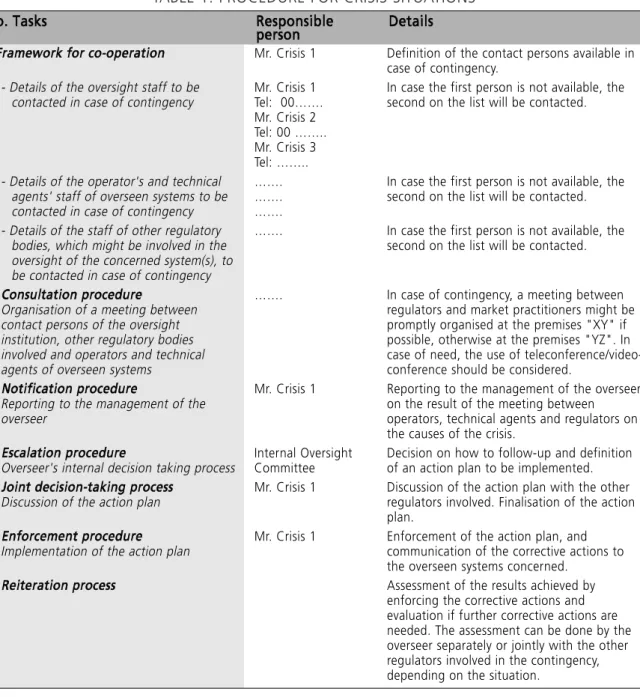
Table 1: Procedure for crisis situations 56
1 Introduction
The risks which arise in payment and securities settlement systems - SSS2 - can be of different
nature and different also can be the mitigation techniques which are implemented by operators3 and technical agents4 to mitigate them. Due to the fact that the link between
payment and securities settlement systems is increasing, overseers might need to develop a general framework which could easily help them to assess exposures and mitigation mechanisms in both, payment and securities settlement systems.
Furthermore, the philosophy behind risk assessment has been slightly changing recently; the emphasis is, among other factors, less on risk measurement but increasingly on the communication with the risk-takers. Hence, operators and technical agents might be overseen according to their awareness of risks, their capability to mitigate exposures5 and their ability to
adapt quickly to changing environments.
The purpose of overseers in assessing risks and risk management is, among other factors, to contribute to the identification and prevention of those risks which could arise in payment and securities settlement systems and of those risks the operator and/or technical agent is exposed to by virtue of its activities, followed by the evaluation of the availability and adequacy of the risk mitigation techniques used by overseen entities. One of overseers' priorities in this context is, among others, to enforce the reduction of systemic risk6. As a direct effect of risk mitigation,
confidence of the counterparts in the payment and securities market can be promoted. The process has its major focus not only on the operator or the technical agent themselves, but might include also the parent company as the subsidiaries, branches and representative offices, where they have a bearing on risk and potentially an impact on payment, payment-related systems or SSSs and financial stability.
.
2 In the paper the term SSS is broadly used and defines systems which settle securities transactions and which can be embedded with payment system to settle the cash leg of securities transactions.
3 An operator has been defined in BCL's Policy and Procedures for the Oversight of payments and securities settlement systems as the "central system organisation providing products and services and the owner of the system".
4 A technical agent has been defined in BCL's Policy and Procedures as "a supplier of service where an operator has located a significant portion of its operational or IT infrastructure or where several payment- or securities settlement-related operational or IT infrastructures are centralised".
5 The term "exposure" is used as synonym for "risk".
6 Systemic risk has been defined in BCL's Policy and Procedures as "the inability of one institution to meet its obligations when due will cause other institutions to fail to meet their obligations when due. The possibility that the liquidity and credit problems precipitated by these failures to perform will disrupt financial markets and impair the functioning of payment and settlement operators is of particular concern".
2 Risks and risk mitigation techniques
The possibility that a transaction might not be settled as expected or not settled is usually defined as settlement risk and comprises the occurrence of several other types of exposures. Overseers are particularly concerned about the occurrence of systemic risk and all other risks, which may constitute, directly or indirectly, a threat to financial stability7.
Within payment and securities settlement systems, the risks and the mitigation techniques involved are of different nature. The exposures treated in this chapter represent only a limited group of risks which have been mostly treated in literature8 and which are, to a large degree,
highly interrelated one to the other. Other risks do nevertheless exist.
The chapter sets out a short description of risks9and mitigation techniques in securities settlement
and payment systems respectively, followed by a short explanation of the scope and use of the mitigation mechanism and its main implementation within the Luxembourg environment. The settlement of securities transactions involves the processing of two legs of the same operation; the securities and the cash leg. Hence, the risks which arise in this context, partly relate to the processing of securities and partly to the processing of the funds, while the risks which arise within payment systems mostly relate to fund transfers. For this reason, securities settlement systems have been treated in the text as the first issue. Clearstream Banking Luxembourg - CBL - operates the Luxembourg-based securities settlement system, while LIPS-Gross and LIPS-Net are the Luxembourg payment systems which have been analysed in the context.
2
2..11 SSeeccuurriittiieess sseettttlleemmeenntt ssyysstteemmss SSSSSSss --2.1.1 Legal risk
2.1.1.1 Definition Legal risk occurs when:
- a counterpart might suffer a loss because relevant laws or regulations do not support the rules of the system in which it participates;
.
7 The vast interrelationships between payments' and SSSs' participants raised concerns after the first counterpart failure, which triggered systemic risk. A major example has been the failure of Bankhaus Herstatt on the 26th June 1974. On that day the Bundesaufsichtsamt fuer das Kreditwesen withdrew the banking license of Herstatt, a small bank in Cologne, which was active in the foreign exchange market, and ordered the liquidation of the institution during the banking day at the close of the interbank system in Germany. Prior to the announcement of the failure, several counterparts of Herstatt had irrevocably paid DEM to Herstatt through the German payment system against receipts of US$ later during the day in New York in respect of maturing transactions. When Herstatt business was terminated during the day, Herstatt's New York correspondents suspended outgoing US$ payments from Herstatt's account. This left Herstatt's counterpart banks exposed for the full value of DEM payments made (credit exposure). Those counterparts, which had entered into forward trades with Hestatt not yet due for settlement, incurred in the loss of replacing the contracts on the market (replacement risk).
8 General literature in this filed usually involves the "Core Principles for Systemically Important Payments Systems" (BIS; January 2001), "Recommendations for securities settlement systems" (BIS; November 2001) and the "Report of the Committee on Interbank Netting Schemes of the central banks of the Group of Ten countries" (BIS; November 1990).
9 The definitions of the different risks which are given in this chapter are taken from the BCL's Policy and Procedures for the Oversight of payments and securities settlement systems, 5 December 2001.
- the application of the relevant laws and regulations is uncertain; or
- the system is not adequately protected against crime, terrorism and money laundering activities.
The exposure itself arises with the finalisation of the trade and lasts until the counterparts have discharged their bilateral obligations.
2.1.1.2 Possible risk mitigation techniques
One of the basic principles in order to ensure a reduction of legal risk is to achieve clarity on a number of issues which might have, directly or indirectly, a significant impact on the functioning, safety and efficiency of the system. As a general rule, the major issues are: - timing of finality of the transaction and of irrevocability of the transfer order10;
- relevance of national and foreign laws which may be applicable to the overseen system and relevance of participants' home jurisdictions;
- nature of the entitlement to securities held in the system; - level of enforceability of risk management measures11;
- bilateral/multilateral obligations of systems' operator, technical agent and participants; - to ensure the traceability of transaction orders12etc..
2.1.1.3 Situation in Luxembourg
The legal and regulatory framework of CBL, the Luxembourg-based SSS, is defined by European legislation13, by national laws14and by CBL's General Terms and Conditions (which are governed
by Luxembourg law). The legal competence of the Banque centrale du Luxembourg - BCL - in the field of the oversight of payment and securities settlement systems is laid down in the national law of 12 January 200115 implementing the Directive 98/26/EC of the European
Parliament and of the Council of 19 May 1998 on settlement finality in payment and securities settlement systems, into the Law of 5 April 1993 relating to the financial sector, as amended. In addition BCL's competence in the field of payment systems results from the European Community's legislation16. BCL's responsibilities as concern the promotion of the smooth
operation of payments and securities settlement systems and hence the stability and integrity
.
10 According to the transposition of the Settlement Finality Directive into Luxembourg law of 12 January 2001, the point of irrevocability corresponds to the point of entry of a transaction order into the system.
11 As general rule, risk management measures are enforceable to the extent they are covered through sound contractual agreements. 12 Important in the context is the circular BCL 2002/172 of 28 June 2002 ("Protection des systèmes de paiement et de règlement des
opérations sur titres contre le crime et le terrorisme").
13 European legislation involves the Treaty establishing the European Community and the Protocol on the Statute of the ESCB and of the ECB. Furthermore a Memorandum of Understanding on cooperation between payment systems overseers and banking supervisors in Stage Three of Economic and Monetary Union has been endorsed by the Governing Council on 18 January 2001.
14 The major national laws relevant in this context are: (i) the law of 12 January 2001, implementing the EU's settlement finality directive, which gives the BCL formal responsibilities for payment and securities settlement systems and (ii) the law of 1 August 2001, pertaining to the circulation of securities and other fungible instruments. The competence of the Banque centrale du Luxembourg in this field is furthermore laid down in the circular BCL 2001/163 of 23 February 2001 ("La surveillance par la Banque centrale des systèmes de paiement et de règlement des opérations sur titres au Luxembourg") and the circular BCL 2001/168 of 5 December 2001 ("Politique et procédures en matière de surveillance des systèmes de paiement et de règlement des opérations sur titres au Luxembourg"). The circulars can be found at www.bcl.lu.
15 Published in Mémorial A-n°16 of 6 February 2001.
of the financial infrastructure, are set out in BCL's Policy and Procedures. Its institutional and legal responsibilities are furthermore extensively laid down in BCL's circular 2000/163 of 23 February 2001 "La surveillance par la Banque centrale des systèmes de paiement et de règlement des opérations sur titres au Luxembourg" as in the Bulletin 2002/2 "Stabilité financière"17.
In the event of participants' insolvency, Luxembourg bankruptcy law protects the holder of securities. His property rights, in fact, remain unaffected in case of default of the operator of the securities settlement system. The book-entry procedure18 confers to the holder of the
securities account at CBL the ownership right over the securities booked on it. This right consists:
- of a claim on a given number of non-individually identified securities of the same type held by the central securities depository on behalf of the community of all owners of the same type of securities; and
- of a right to reclaim them in the event of insolvency of the SSS.
The potential for cross-jurisdictional conflicts is partly covered by the "lex rei sitae principle", which stipulates that the applicable jurisdiction as regards bearer notes is the one of the place where the securities are located (i.e. for notes deposited in CBL it corresponds to Luxembourg law). Due to the mobile nature of bearer notes and of dematerialised securities in general, this principle often becomes contestable. On these grounds a preliminary convention on "The law applicable to certain rights in respect of securities held with an intermediary" is under preparation19. Under this convention, the law applicable to proprietary rights in securities is the
law of the State where the account holder maintains a securities account and where the relevant intermediary in a system (e.g. CBL) has an office engaged in a business or activity of maintaining securities accounts20. This principle is known under the name of PRIMA (PPlace of
the RRelevant IIntermmediary AApproach).
Further within this framework, a specific working group, the ESCB - CESR21Working Group, has
been created as forum of discussion between central banks and securities regulators to define oversight standards and recommendations for the European Union in the context of securities settlement systems.
.
17 Publications relating to the institutional competences of the BCL can be found on www.bcl.lu.
18 The Grand-Ducal Règlement of 17 February 1971 provided the statutory basis for book-entry custody, clearing and settlement of securities and defined the interest of an investor in securities held through accounts with a financial intermediary in Luxembourg as a right of ownership. The law of 1 August 2001 on mobilisation of securities (article 6) replaced the Decree of 1971 and defines the proprietary rights as "real and incorporeal rights" of ownership on behalf of the investor over the pool of assets. Clearstream Services (CS) currently operates the book-entry system on behalf of CBL.
19 The draft convention is under preparation by the Hague Conference on Private International Law. 20 Article 4(1)-(2).
2.1.2 Credit risk 2.1.2.1 Definition
Credit risk represents the possibility that a counterpart does not fulfil its obligations for the full value, either on the due date or at any time thereafter and can be sub-divided in replacement cost risk and principal risk.
Replacement cost risk, i.e. the risk of unrealised gains on unsettled contracts with a defaulting participant, relates to the possibility that the counterpart defaults before any transfer of securities has been carried out. The exposure arises when the original transaction becomes legally binding and lasts until the respective counterpart has discharged its obligations. Principal risk relates to the possibility that the counterpart defaults once the transfer of funds or securities has begun but has not been completed yet. The exposure arises when one party in the transaction has fulfilled its obligations (payment or transfer of securities) and lasts until the counterpart has fulfilled its respective obligations.
2.1.2.2 Possible risk mitigation techniques
The creation of a central counterparty - CCP - reduces counterpart credit risk. This institution provides for the novation of the original contracts by substituting itself as respective counterpart. From a market participant point of view, counterpart credit risk is substituted by the risk of default of the CCP. Due to the fact that CCPs implement strong risk mitigation techniques, their probability of default is usually less than the one of market participants. Countries, which do not have a CCP, implement other mitigation techniques to cover credit risk, such as the reduction of the settlement cycle (the period ranging from the trade execution to the settlement). The longer the settlement cycle, the greater will be the risk that one counterpart will become insolvent or default on its obligations. This, in turn, will increase the replacement cost risk if the price of the security transacted might diverge from the original price. Usually22, the maximum acceptable timeframe is represented by a delay of three business
days after the trade date to settle the cash transaction. Different markets may have different practices in use. Depending on the costs of reducing settlement cycles and on the benefits in terms of risk reduction, different instruments can have different settlement cycles.
Delivery versus payment mechanisms - DvP - furthermore mitigates credit risk by linking a payment system and an SSS to ensure the irrevocable and simultaneous exchange of securities against cash. However this mechanism can either eliminate replacement cost risk nor liquidity risk. Three models of DvP have been defined23:
.
22 The Group of Thirty's 1989 recommendations regarding securities clearance and settlement require that final settlement of cash transactions should occur on t+3, which means three business days after the trade date (recommendation 7).
23 BIS, Committee on Payments and Settlement Systems of the central banks of the Group of Ten countries, Cross-border securities settlement, March 1995.
- model 1 DvP24 settles transfer instructions for both securities and funds on a trade-by-trade
basis (transfer of securities is final simultaneously to the transfer of funds);
- model 2 DvP25settles securities instructions on a gross basis (the transfer of securities is final
immediately), while funds instructions are settled on a net basis (the transfer of funds is final at the end of the processing cycle);
- model 3 DvP26 settles transfer instructions for both securities and funds on a net basis with
final transfer of both at the end of the last settlement cycle. During the processing day, the securities transfers are marked as provisional until the cash settlement is completed later during the day.
Risks in this context can arise from the link between SSSs using different models of DvP. If a model 1 DvP is receiving securities from a model 3 DvP, transfers in the books of the former are final immediately when processed, while transfers in the books of model 3 DvP may remain provisional for many hours after they have been processed. The exposure increases when the transfer to a participant in model 1 DvP is considered as final and the system is granting credit on the basis of the collateral received. Due to the fact that in a model 3 DvP unwind can be permitted in case of a participant's default to settle cash obligations, the corresponding securities transfer might be unwound with possible effects on the participants in model 1 DvP. Further mitigation techniques are:
- the implementation of a loss-sharing arrangement between participants; - the existence of a guarantor syndicate composed by a group of banks; - the possibility of realising collateral when a participant becomes insolvent; - insurance coverage, etc..
SSSs which, in order to enable a smooth settlement of securities transactions, might grant credit to their customers on the basis of internal credit ratings assigned to customer institutions rather than on their available collateral, might raise additional risk concerns. The belief that the creditworthiness of a customer institution can transform an unacceptable risk into an acceptable one, a result which no amount of collateral could in principle achieve, and an eventual granting of unsecured credit lines on a short-term basis for creditworthy customers, could however be considered as non-consistent with the general philosophy expressed by international standards according to which clean credit risk should be eliminated through the use of full collateralisation.
Unsecured credit lines
Potential reasons which could lead SSSs to grant unsecured credit lines might be: - The existence of SSSs' night-time processing;
SSSs might give customers the possibility to settle transactions during day-time as night-time .
24 SSSs settling via model 1 DvP: CBL (Luxemburg), EOC (Belgium), CREST (UK), etc..
25 SSSs settling via model 2 DvP: APK (Finland), Clearstream Banking Frankfurt (Germany) operates model 2 DvP, but has nevertheless a procedure available for participants who want to use model 1 DvP, etc..
26 SSSs settling via model 3 DvP: Bank of Greece Securities Settlement System (Greece), Interbolsa (Portugal), Vaerdipapircentralen (Denmark) gives the possibility to settle via model 1 and model 3 DvP, etc..
processing cycles. Participants might need to use heavily unsecured credit lines during the night-time processing (intra-day). As result of this need the end-of-day figures on the use of those lines might result as relatively low, even if their use intra-day might have been relatively high.
- The way credit lines are granted;
A further reason why unsecured credit lines might be inflated could depend on the way those lines are granted. Indeed, credit lines can be granted for each customer or for each settlement account. In the latter case if customers have more than one account, those lines could be in excess of the real needs.
- The cross-border settlement activities of SSSs;
For SSSs with significant cross-border settlement activities, the differences between the operating hours of SSSs/Central Securities Depositories (CSDs) and the differences between settlement practices (e.g. finality rules, cut-off times, etc.) of national payment systems and local CSDs, might require SSSs to grant credit extensions of large amounts and for a certain duration to participants, in order to reduce the opportunity cost of maintaining cash and securities balances to meet settlement obligations. This opportunity cost is usually represented by a loss of days in value.
Inter-bank placements
SSSs might have in place a network of cash correspondents through which the settlement of the cash leg of securities transactions is performed. Participants need usually to provision their cash accounts in order to settle their operations and at the end of the business day, depending on the treasury management of the different participants in a system, more or less significant amounts of funds might be left on the participants' cash accounts at the operators' cash correspondent network. In this context, the operator has the possibility, through an active treasury management, to invest this liquidity overnight on the inter-bank market. Cash left by single participants on their respective accounts might be of negligible amounts, nevertheless the sum of all funds left overnight by the totality of the participants in a system might represent a significant amount, which invested, might represent an additional income for the operator of the system.
Concerns within this context arise if it is considered that inter-bank placements might entail a credit risk which is proportionate to the creditworthiness of the banks chosen by the operator to place its participants' overnight funds it has at disposal. The operator has therefore a credit risk towards its placement banks and an exposure towards its participants because it is liable towards them for returning their funds at the start at the next business day. The analysis of inter-bank placement risk achieves therefore importance as concerns credit exposures within SSSs.
2.1.2.3 Situation in Luxembourg
At the time the characteristics of the national financial market does not seem to justify the implementation of a CCP:
- transactions' volumes and values are low;
- volumes and turnover of derivatives traded on the stock exchange are currently limited, which does not justify the implementation of a CCP to minimise the use of collateral;
- as a general rule the settlement facility is provided by CBL which supplies pre-settlement matching of trade transactions;
- the stock exchange has operated an automatic trading system since 1996 (Système Automatisé de Marché). Orders are matched electronically and participants do not have the possibility to choose their counterpart in the deal, which might reduce their capability to mitigate credit risk. Nevertheless, stock exchange members operate under the common rules of the exchange27, which foresee sanctions in case of members' non-compliance.
Concerning the settlement cycle, CBL operates a multiple batch processing procedure (free of payment - FOP -) for Eurosystems' credit operations purposes, while it uses DvP settlement in commercial bank money for other settlement procedures. The multi-batch process allows a shortening of the settlement cycle and as result, the system receives and processes trade confirmations from the different markets several times during the day. The date on which the settlement instruction will be processed depends on the type of transaction28.
Due to the fact that CBL operates a model 1 DvP system, which implies that the transfers of securities and funds become final29 simultaneously in the books of CBL (on the buyer's and
seller's account), participants are not exposed to credit risk. In the event of a counterpart's default, CBL would block all the accounts of the concerned participant, so that no further settlement of transactions will be possible. Customers would nevertheless remain exposed to a change in value of the securities that should have been delivered against the agreed transaction price, which is in turn mitigated by the application of haircuts. Furthermore, in order to cover credit risk, the following controls are undertaken internally by CBL:
- CBL never acts as principal to securities transactions;
- access criteria are based on the creditworthiness of the participant; - customer ratings are reviewed yearly by an Internal Credit Group; - collateral valuation is performed daily;
.
27 Règlement d'ordre intérieur de la Bourse de Luxembourg, Chapter VIII, IX, X.
28 Bridge transactions are processed in the overnight cycle for the required settlement date and internal transactions are processed in the day-time settlement cycle for the required settlement date. For settling receipt of securities from a foreign counterpart, the crediting of the security and the debiting of cash in CBL is done upon confirmation of settlement in the domestic market.
29 Irrevocability is achieved when the parties can no longer revoke their instruction and unconditionality when there are no longer any circumstances that could cause the SSS to unwind the transfer. If transfers are provisional at the time of processing, even if DvP is achieved, the risk remains that transfers may have to be unwound later if finality cannot be achieved. In a transaction between two accounts of CBL's system, the finality occurs during the next settlement cycle, while for a bridge transaction, the transfer becomes final at the time the SSS, which is delivering securities, receives the other SSS's feedback transmission accepting the proposed delivery. For links with other SSSs the transfers of funds and securities become final in accordance with the local rules of the foreign domestic markets.
- a loss-sharing arrangement is present. CBL reserves the right to reverse any erroneous debit or credit entries to any account at any time. Such errors shall include a debit or credit made in connection with a transaction which becomes subject to a reversed order. Losses in a collective holding of a particular class of securities are to be borne jointly and pro-rata by the co-owners of the collective holding on the basis of the credit balance existing at the time where the loss occurred;
- in the event that the customer has a debit balance in a security, which can only occur in the case of an unwind, and he does not credit the account within seven business days, CBL may purchase collateral on the market at the expense of the defaulting customer.
Credit evaluation process
The Internal Credit Group (ICG) is a sub-committee of the Group Executive Management30. Its
approval is required for all credit proposals, admission of new customers, setting of credit lines and changes to them, setting or changing limits to exposures on any counterpart as for the appointment of depositories and cash correspondents. The ICG is also responsible for periodic reviews of credit lines and limits to exposures as further for the review of products and operational issues which might trigger credit implications. The Credit Advisory Group, whose members are representatives of international banks having expertise in credit analysis and monitoring particular geographical areas, advises the ICG. Only the Credit Unit can define or alter the credit parameters which are defined for customer's accounts within Clearstream Banking.
As concerns admission of participants to the system, access is granted for a number of institutional types which are listed in the credit policy guidelines of CBL, while ineligibility is evaluated on a case-by-case basis.
Provision and collateral checks
The provision of collateral is required for:
- all settlements in which CBL extends credit to customers, except for non-collateralised credit facilities;
- securities borrowing and lending facilities (see section "securities lending facilities" 2.1.3.3 for details);
- transactions settled through repurchase agreements (see section "securities lending facilities" 2.1.3.3 for details).
.
30 Clearstream Banking, Disclosure Framework Report, BIS-IOSCO Disclosure Framework for Securities Settlement Systems, The Clearstream Banking S.A. Luxembourg Response, 3.2002.
The Securities Lending and Borrowing Syndicate - SLBGS31- ultimately evaluates and bears the
underlying country, currency and issuer risks of collateral eligible in CBL's system according to eligibility criteria, such as the size of the issue, its currency of denomination, its liquidity or its volatility. At the beginning of the settlement process, the system re-evaluates the outstanding exposures and collateral available based on which securities are deposited in the account and on the market price of the security. CBL agrees with the syndicate, which securities are eligible and which haircut32to apply.
Provision and collateral checks are performed by the system during the processing. The former ensures that securities and cash are available on the participants' account or through securities borrowing and credit facilities, while collateral checks ensure that sufficient collateral is available to cover outstanding obligations. Indeed when evaluating the collateral available in an account to secure a certain exposure, CBL takes into account:
- which securities are available in the customer's account and eligible to secure transactions for settlement;
- the market price of the security; - the exchange rate, where relevant; and - the haircut to be applied to the security.
If the exposure resulting from the instructed transactions were in excess of the exposure which can be secured by the collateral available in the account, the transaction would not settle. 2.1.3 Liquidity risk
2.1.3.1 Definition
Liquidity risk arises virtually in every settlement distress scenario. Both parties in a trade might be exposed to it on the settlement date, but in different ways. This risk includes the possibility that the seller/buyer of a security who does not receive payment/delivery in due time (for the full or the partial value) may have to borrow or liquidate assets to fulfil its obligation. The costs associated with it, depend on the liquidity of the markets in which the security is needed and are inversely proportioned to it. The exposure arises at the start of the transaction settlement date and lasts until the settlement has taken place during the day.
In the absence of a direct link between SSSs and payment systems or embedded payment systems, the occurrence of liquidity risk is more likely. As the execution of a transaction may be dependent from settlement of other trades, this, in turn, may prevent other participants from meeting their obligations (gridlock).
.
31 Citibank, UBS, Dexia, BGL, BBL, Kredietbank SA and NV, HSBC-CCF currently compose the SLBGS.
32 Cash is accepted with a 0% haircut; commercial papers with 5-10% haircut; zero coupon bonds with 20% haircut; equities with 34% haircut.
2.1.3.2 Possible risk mitigation techniques
Securities lending or borrowing permit the reduction of liquidity as credit risk. Borrowing securities might in fact be more cost-effective than bearing the cost associated with a settlement failure. On the other hand borrower and lender face the risk that securities lent might not be returned when due33. Those facilities partly shift credit risk from the counterpart
in the original transaction to the lender/borrower (outside the original transaction), who, in case of default, might need to acquire the securities on the market at higher costs.
Intra-day credit, from its part, is often extended to participants in order to ensure timely settlement and avoid gridlock. It is usually provided by the Central Securities Depository as principal and takes the form of intra-day loans or repurchase agreements.
Beside the supply of lending or borrowing facilities and of intra-day credit, in order to provide for additional liquidity for settlement purposes to participants, the operator of an SSS might consider the possibility to enable customers to pre-advise the entry of funds from cash correspondents for credit to a customer's account held at the operator itself. This methodology involves the risk that the pre-advised funds might not be paid as advised, which in turn might have an impact on the treasury management of the system's operator. Indeed, the procedure enables customer to be credited with good value, nevertheless a non-receipt of funds would impact the operator's funds position towards its cash correspondents.
Especially in contingency situations, a system's operator might be faced with the need to mitigate liquidity risk and would therefore rely on a liquidity contingency plan. The latter could include for example, revolving credit facilities or, the possibility to issue commercial papers to raise additional liquidity on the market. Due to the fact that raising liquidity on the market is interlinked with the rating a company has, a downgrade in the rating of a system's operator would imply not only a reputational damage but also a reduction in its capability to raise additional liquidity in contingency situations.
2.1.3.3 Situation in Luxembourg
Final funds transfers are made in CBL's system as debits and credits to customer's cash accounts which CBL holds via a network of correspondent banks on behalf of its customers. In order to minimise settlement failures, CBL provides automatic securities lending programmes and credit facilities:
- for settling purposes;
- within the limits of the customer's credit facilities; and
- fully collateralised (with the exception of unsecured credit lines).
.
A syndicate of guarantors establishes limits on securities lending and CBL itself sets placement limits for major banks.
Securities lending facilities
A securities loan is an agreement in which securities are lent to a counterpart against cash or other collateral, to avoid participants' settlement failure. CBL merely acts as an intermediary between lenders and borrowers and manages three major different types of securities lending programmes:
- Automated Securities Lending (ASL);
- Disclosed Automated Securities Lending (DASL); and - Strategic Securities Lending (SSL).
Under the DASL and the ASL programmes, borrowers have access to a large pool of lenders; whereas under the SSL, securities loans are transacted bilaterally between lenders and borrowers. Within the ASL programme, the collateral provided by the borrowers is pledged to a syndicate of guarantors, which in turn guarantees all securities loans, while CBL does not bear any underlying risk. Within the DASL and SSL arrangement, collateral is directly pledged to the lenders and the risk is borne by the customers. Lenders can specify to which borrowers they are willing to lend and up to which limit.
CBL administers the repurchase transaction through the use of a Tripartite Repurchase Service, which implies the transfer of the securities from the seller to the buyer against cash and the agreement of the seller to repurchase the securities at a specified time in the future or on demand at a pre-defined price34. CBL:
- performs eligibility checks to review if the securities correspond to the agreement; - calculates the cash countervalue of securities;
- performs the matching and the settlement of the transaction;
- makes margin calls if needed and checks that each party fulfils its obligations. Credit facilities
Credit facilities supplied by CBL to its customer base are made available to participants at CBL's discretion and can therefore be cancelled without prior notice. The facilities might also be unavailable or restricted in less liquid currencies. There is a limit for the use of each facility. Two major type of facilities can be supplied, such as;
- Unconfirmed Funds Facility; and - Technical Overdraft Facility.
.
Unconfirmed funds can be used for settlement purposes in addition to an overdraft facility. The facility is discretionary and the limit imposed represents the maximum amount of secured intra-day credit available for each customer which is very much dependent on the financial standing of the institution in whose name the account is opened. It covers intra-day exposures35 where
CBL allows customers to use incoming cash for settlement purposes only, prior to confirmation that CBL has received the cash. Unconfirmed funds are constituted on the basis of outstanding pre-adviced instructions, i.e. a time-lag exists between the value date and the time when the receipt of funds is confirmed by CBL's cash correspondent, and on the basis of instructions for deliveries of securities against payment, i.e. a time-lag exists between the expected value date of the funds to be received and the time when confirmation of settlement is received from the depository. In case of a customer's default, his account will be blocked and he will be charged a penalty interest.
The Technical Overdraft Facility on the other hand permits highly rated customers to borrow cash short-term36. The goal is to finance customers' purchases in the event of unexpected
transaction failures which prevent them meeting their obligations. The credit line is usually fixed in US$ but can eventually cover other currencies if agreed with the customer.
In this context, CBL constantly supervises credit exposures and credit lines granted to its customers.
Additional resources
The objective of liquidity management is to ensure CBL's ability to meet all legitimate demand for funds from depositories, all facilities committed to borrowers and to enable a smooth settlement activity of participants' obligations. The liquidity management of CBL takes into account, inter alia, pre-advised funds which are sent by customers on the basis of funds to be received by CBL's cash correspondent banks -CCB -. Within this context, the CCB's network37
manages the intra-day incoming and outgoing funds timing and performs the regular services such as the execution of payments, receipts of funds, reporting through cash statements and transaction reports, handling of claims and investigations and interest calculation. The CCBs maintain intra-day and overnight credit lines to guarantee timely execution of CBL's payment obligations to customers and other business partners (called uncommitted short inter-bank lines).
In contingency situations, Clearstream might need to raise additional funds. It disposes therefore, inter alia, of the following major resources:
- uncommitted short inter-bank lines; - Euro Commercial Programme -ECP- ; - multi-currency revolving credit facility38.
. 35 The exposure lasts for 24 hours maximum. 36 The exposure lasts for 48 hours maximum.
37 The network involves currently around 70 cash correspondents and depositories. Only in the euro area CBL has 25 CCBs and depositories.
38 The revolving credit facility is established for a stated period of time, but does not have a fixed repayment schedule. The borrower pays a commitment fee to use the facility and may draw down the line at any time, or repay in full without penalty.
Both the revolving credit facility and the ECP, a facility in which CBL issues commercial papers to raise liquidity on the market, are considered as "last resort" measures. They are regularly tested in order to ensure that the market reacts promptly to liquidity constraints; their use has nevertheless to be approved internally.
CBL has currently a short-term rating of A1+ and a long-term rating of AA+ from S&P and Fitch IBCA. The night-time link CBL/BCL
The development of the night-time link between CBL and BCL enables participants to request that liquidity held at BCL be made available as collateral for credit granting during CBL's night-time processing with Euroclear - EOC-. The goal is to increase the participants' liquidity management possibilities39.
The results of the link processing are the following:
- collateral for the processing is provided in central bank money;
- participants have a better liquidity management because they have the possibility to use their liquidity held at the central bank even overnight;
- participants potentially reduce on average their need to provision their cash accounts at CBL. 2.1.4 Risk of settlement bank failure
2.1.4.1 Definition
The settlement bank is the institution across whose books transactions are settled. It supplies the settlement asset, which transferred among counterparts, provides respective obligations to be discharged. This asset can take the form of an account balance at the central bank, which represents a claim on the central bank (settlement in central bank money), or can take the form of an account balance at a commercial bank, which represents a claim on the commercial bank (settlement in commercial bank money). The safety of the system depends on the possibility of the asset issuer’s failure, leading to systemic risk.
The exposure arises when the claim of a participant towards its settlement bank is transformed into a transferable asset used to discharge an obligation and lasts until the asset is re-transformed into a claim of the counterpart towards its settlement bank.
.
39 On the day previous to the settlement date (t-1), the customers estimate the collateral needed in EUR for the night-time settlement process (date t) and transmit to CBL a collateral proposal. CBL submits the customers' proposal to BCL which checks whether the customer's credit balances and a potential intra-day credit cover the request. BCL confirms to CBL the extent to which the requests are covered by available funds hold at BCL. Upon receipt of confirmation, CBL records the credit line in the customers' CBL account for the duration of the night-time processing. After the night-time processing CBL calculates for each customer the amount used during the night for the net settlement of securities and cash transactions and sends a withdrawal of funds request to BCL to pay the used amounts to its account at BCL. BCL then transfers the amount used from the account of the participant to the account of CBL and BCL will release the unused amounts of the credit line into the account of the customer.
2.1.4.2 Possible risk mitigation techniques
Access to central bank money can be desirable under the risk profile. In terms of safety, the provision of central bank money has the following advantages:
- it reduces settlement risk, because central banks "de facto" do not fail;
- it reduces liquidity constraints on the market, because the settlement asset is liquid; and - central banks have objectives targeted on the safety of the financial markets and therefore
behave risk-adversely.
In terms of efficiency, the use of central bank money:
- suffers currently from a lack of economy of scale. The costs for supplying the settlement account for central banks include the costs of opening and maintaining an account, making funds transfers and providing credit. Because generally central banks have a limited customer-base compared to commercial banks, they might be not able to fully realise economies of scale. A wider use of central bank money could increase the possibility of achieving economies of scale. On the other hand, increased efficiency can be achieved if the management of the participants' accounts at the NCB would be outsourced to an SSS. - is concentrated at a common settlement institution. The use of commercial bank money on
the other hand would encourage a competition between commercial banks for the provision of the settlement asset.
- remote participants do, as a general rule, suffer certain limitations when participating in a securities settlement system settling in central bank money, such as:
Gno access to intra-day liquidity provided by the host national central bank -NCB-;
G cash liquidity held on an account with a host NCB does not count in terms of minimum
reserves and is not remunerated; and
Gno access to the deposit facility for the end-of-day liquidity on accounts at the host NCB.
2.1.4.3 Situation in Luxembourg
As of today, CBL does not settle operations in central bank money. The securities leg of ESCB credit operations is settled via free of payments transactions into the securities pool of the BCL. No payment leg exists for collateral movement. For non-ESCB transactions, funds transfers achieve finality under the form of a debit or credit on customers' accounts. When customers give instructions to deliver or receive securities against funds, each securities transfer is linked to the specific payment. CBL holds its customer's cash via a network of cash correspondent banks.
The SSS undertakes a selection of its cash correspondents based, among other factors, on the creditworthiness of the institution. The Internal Credit Group with the support of the Credit Advisory Group performs the credit analysis of the potential suppliers. Clearstream uses more than one cash correspondent for funds transfers in euro40, but as concerns non-euro currencies
accepted for settlement, CBL concentrates the cash service supply on one cash correspondent for each non-euro currency.
2.1.5 Operational risk 2.1.5.1 Definition
Due to the fact that clearing and settlement become increasingly dependent on information systems, the reliability of these arrangements is a key factor which influences operational risk, together with inadequate control mechanisms, errors and delays in processing or failures to follow instructions.
The exposure arises when a transaction order has to be inputted into a system for processing and lasts until the settlement of the instruction enables the settlement of the respective counterparts' obligations.
2.1.5.2 Possible risk mitigation techniques
All key areas and functions of systems should be secured in terms of access controls, be reliable, scalable and able to handle crisis and distress. Contingency, backup, recovery and capacity-stress plans are generally the major mitigation techniques used. In the ideal scenario, all those facilities should be immediately available and fully operational in case of emergency in order to recover operations and data processing without interrupting further the settlement process. Cryptographic techniques are generally used to ensure the reliability of communication networks and the prompt transmission of data.
2.1.5.3 Situation in Luxembourg
CBL's business continuity plan includes both organisatorial and technical elements. It relies "in primis" on a corporate business continuity policy which outlines Clearstream's objective to continue operations in contingency situations and defines further responsibilities in case of disaster scenarios. It further comprises formal crisis management and emergency response procedures, business unit, IT41 and facilities recovery plans. The plan ensures the restart of
mission critical functions within 1-2 hours and full recovery within 4 hours and is tested regularly42.
.
40 CBL currently uses ten euro cash correspondents such as: Erste Bank (Austria), KBC Bank (Belgium), Deutsche Bank (Germany), Banco Bilbao (Spain), Nordea Bank Finland (Finland), Crédit Commercial de France (France), Citibank (Greece), AIB Bank (Irland), IntesaBci (Italy), Kredietbank (Luxembourg).
41 IInformation TTechnology.
The contingency mechanisms of Clearstream's Group have proved to be reliable and efficient. When a terrorist attack made Clearstream's office in New York unavailable on the 11th of September 2002, Clearstream International core business operations were running as normal and customer service support was provided to the North American market from CBL's offices in London, Luxembourg and Mexico City.
2.1.6 Custody risk 2.1.6.1 Definition
Custody risk arises when intermediaries become insolvent, act negligently or commit fraud. The degree of custody risk is influenced, among other factors, by:
- the accounting practices and safekeeping procedures employed by the custodian; - the custodian's choice of the sub-custodians and of other intermediaries;
- the contractual allocation of the risk of securities loss; and - the law governing the custodian relationship.
The exposure arises with the signature of the depository agreement between the depository bank and the SSS and lasts until one of the parties extinguishes the legal arrangement. 2.1.6.2 Possible risk mitigation techniques
The mitigation mechanisms used by custodians can be based on:
a. insurance and ad hoc internal controls to protect customers against misappropriation and risk of theft;
b. segregation between the custodian's own securities and the customer's securities administered by the depository;
c. regular reconciliation of their records to ensure that the total volume of securities maintained in the accounts of participants equals the volume of securities deposited by the issuer; d. direct relationship between the issuer and the SSS43.
Furthermore immobilising44 or dematerialising physical securities may reduce significantly the
cost of owing, trading, custody and settlement of securities and may decrease the occurrence of errors and delays in manual processing. Major issuances are currently done under the form of global notes, which represent the whole issue, while all rights and obligations are registered through book-entry procedures in the respective SSS. This mechanism:
- is a precondition for shortening settlement cycles and therefore reduces replacement cost risk; - facilitates the implementation of DvP arrangements and therefore reduces principal risk.
.
43 Standard three of the "Standards for the use of EU securities settlement systems in ESCB credit operations" ("no undue custody risk"), requires SSSs to have a direct and unique relationship with the issuer as to have in place procedures to check that the total amount of securities in the participants' accounts is equal to the total amount of securities deposited by the issuer in common depositories and safe-kept on behalf of the SSS.
2.1.6.3 Situation in Luxembourg
a. Insurance reduces the cost of mitigation techniques up to the limit of liability of the contract. Contracts signed off by the parent company CI cover risks arising in CBL as in Clearstream Banking Frankfurt - CBF -. Major insurances are:
- a crime and depository indemnity for customer claims for which Clearstream Banking would be liable according to its General Terms and Conditions45(this insurance is aimed at covering
custody and fraud risk); and
- an insurance of all risks of physical loss or damage for losses or damage of instruments held by Clearstream Banking on behalf of its customers or in transit in Clearstream Banking's system (this insurance is aimed at covering custody risk).
b. A network of depository banks46 around the world undertakes the safekeeping of securities
accepted by CBL. CBL allocates each issue to a single depository, which executes customers' instructions for physical or book-entry transfer of securities into or out of CBL's system. All depositories have to comply with standards of performance required by CBL. The Internal Credit Group of CBL performs a risk assessment of potential suppliers of depository services while an external council provides for a legal opinion on the ability of the depository to fulfil its obligations under the depository agreement47 signed with CBL.
Beside the links towards other SSSs, which have been assessed as eligible for ESCB credit operations, CBL uses three types of depository banks for national and/or international securities: common, Euro- and domestic depositories. EOC and CBL jointly appoint common depositories, whereas Euro- and domestic depositories are appointed by CBL only.
Common depositories are generally used to facilitate the launch of new issues of Eurobonds48
and international securities. Both CBL and EOC enter into an agreement with the common depository, according to which the latter acts as an agent for both ICSDs, supplies them custody services and, on their behalf, receives global notes. Following the night-time processing, both EOC and CBL notify on a daily basis to common depositories the changes that have occurred in the volume of the securities represented by a global note. Common depositories verify the correspondence of the notifications and record the transfer of interests in the global notes.
.
45 CBL is liable for direct damages to its customers, in the event it acts with negligence or willful misconduct (negligence can be defined as "the violation of a pre-existent obligation", while willful misconduct can be defined as "the non-execution of an essential obligation defined in a contract") and indirect damages as a result of CBL's depositories, sub-depositories, custodians, sub-custodians acts, etc., in the event it acts with gross negligence or willful misconduct (gross negligence can be defined as "the intentional violation of an obligation").
46 Functions of a depository bank are (i) the safekeeping of securities in its vaults, (ii) the receipt of securities for entry into CBL's system and confirmation of receipt and (iii) the execution of instructions of CBL and collection of interests and dividends on the holdings. Sub-depositories are not allowed to sub-deposit the holdings without written approval of CBL.
47 The depository agreement defines the parties, the settlement, depository and safekeeping procedures, insurance coverage and further bilateral obligations of CBL and the depository.
48 Bonds issued by a borrower outside the domestic market, denominated in a Eurocurrency, underwritten and sold by an international syndicate of financial institutions.
As concerns Euro depositories, they provide safe custody and other administrative services for Eurobonds and Euro-instruments in general on the basis of a depository agreement between the entities, but their services are also accessible to other financial institutions. Domestic depositories on the other hand are mainly, but not exclusively, used to provide CBL's customers with a facility to settle cross-border transactions in domestic markets.
c/d.Common depository banks are appointed by CBL and EOC in order to simplify the procedures for distributing new issues. The responsibility for the reconciliation procedures and the safekeeping function for global notes is undertaken by the fiscal agent, which usually corresponds to the common depository.
2.1.7 Inefficiency risk 2.1.7.1 Definition
Inefficiency risk arises at the time a system does not adequately meet its obligation to its counterparts (members and suppliers)49 and when the system is unable to meet customers'
requests without leveraging on prices. It lasts until these conditions are fulfilled. 2.1.7.2 Possible risk mitigation techniques
Operators and technical agents need to have in place mechanisms to periodically review: - the service level supplied;
- the possible improvements that need to be undertaken; - the pricing strategy; and
- the operational reliability of the system operated.
Those considerations have to be implemented in the light of current volumes and values transacted by the system and of possible future developments. The relative size of the participants in the system also has some importance for the profitability of the operator due to the fact that small or medium sized clients do not have a strong negotiating position and might be charged higher fees compared to the one charged to larger clients.
Due to the fact that inefficient systems can concentrate risks on a limited group of users and lead to other type of exposures, unnecessarily restricted access criteria might also be important in assessing the efficiency level of a system.
.
49 The ability of a system to meet its obligations can be judged according to its financial resources and considering how other systems meet their obligations.
2.1.7.3 Situation in Luxembourg
Admission and termination criteria within CBL are based on the risk profile and creditworthiness of participants. The latter are furthermore subject to a money laundering review. Access to CBL is, as general rule, not restricted on the basis of participants' geographical origin but rather on the assessment of what impact a new participation could have on the system's safety and efficiency. Hence, the customer base in CBL is broad, highly diversified and internationally oriented.
Fees charged to customers are split between custody fees, which are charged on the basis of the account's average daily balance in securities during the month; processing fees, reporting fees and securities lending and borrowing fees. CBL supplies specialised services for its small and medium-sized customer base, while EOC, for example, provides standardised services for high-volume clients. The revision of the competitiveness of the pricing policy is done regularly by CBL.
2.1.8 Cross-border risk 2.1.8.1 Definition
Various types of risks may affect cross-border securities transactions (details of the settlement process are described in first annex). Within a cross-border environment, the settlement processing might involve the use of different intermediaries, such as local agents, global custodians or the use of links between CSDs or ICSDs.
Non-residents normally settle through local agents, which have accounts at the local CSD. Whether principal risk exists, depends on the fact that the local CSD implements DvP settlement.
As a general rule, the settlement can be completed under the condition that the system has checked if the seller and the buyer have sufficient securities and funds respectively or have access to securities and fund loans. Determining that both conditions are satisfied in a cross-border environment, supposes an exchange of information which might last some days in the worst case. The seller might therefore need to pre-position securities or borrow them some days before the settlement day. The same can be true for the buyer.
The custody risk and cash deposit risk incurred by non-resident participants are furthermore increased by other factors. Usually, CSDs extend intra-day, credit to their participants to enable them to economise on liquidity holdings. Non-residents firms hold their securities through a local agent and have to look upon the local agent to receive intra-day cash loans. If this possibility is not available, a non-resident might need to hold larger cash and securities balances compared to the balances a direct participant would need to hold to settle the same set of transactions, and incurs therefore higher opportunity costs.
As regards replacement cost risk in a cross-border environment, the risk pattern depends on the volatility of the security's price and on the time lag between trade and settlement. If the settlement is undertaken according to the local market settlement practices and timing, the replacement cost exposure is the same for resident and for non-resident counterparts.
Global custodians, as opposed to local agents, settle trades and safe-keep securities in many countries through their network of sub-custodians, which in turn settle through their account at the local CSD. The sub-custodians have no direct relationship with the customers of the global custodians and have therefore no knowledge of the interest in securities the customers held. The custody risk borne by the customer is covered by the contractual relationship between the global custodian and the sub-custodian.
When cross-border settlement is done through the use of links between CSDs, the number of intermediaries involved in the transaction chain remains limited. As a consequence, operational, legal and custody risk is reduced. On the other hand links might increase legal and operational exposure because the participants in a cross-border transaction operate under different legal and operational frameworks. The use of links might furthermore increase liquidity constraints and spill them over to different markets.
As concerns the settlement through ICSDs, settlement trades with other participants of the same ICSD50does not suffer from principal risk if DvP is implemented. Furthermore ICSDs which
provide for multiple settlement cycles during the day achieve same-day receipt and delivery of securities. Hence the cash deposit and opportunity risk are limited.
2.1.8.2 Possible risk mitigation techniques
In case of cross-border linkages between SSSs or the use of intermediaries such as commercial intermediaries as sub-custodians, the structure and conditions under which the link is operational becomes crucial for the mitigation of the risks involved. Due to the fact that it is the SSS which usually concludes the agreement with third parties/intermediaries, importance is achieved by the functions the intermediary performs, its risk management procedures, under which conditions the SSS advances funds or securities on behalf of third parties and which are the standards used to select intermediaries by the SSS.
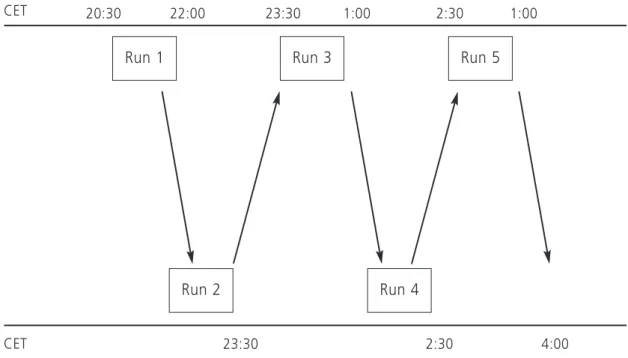
The cross-border costs and risks are heavily influenced by the practices in the local markets in which intermediaries are located and have their activities. In case of bridges, i.e. links between ICSDs, cash deposit and liquidity risk can be mitigated by the introduction of multiple settlement cycles. Bridges can further involve other risks as result of their processing especially if considering automated bridges operating a series of night-time settlement runs. The
.
50 Settlement trades with other participants of the same ICSD are named "internal settlement trades" because they are effected on the ICSD's own books without any intervention of intermediaries.