European Research Studies Journal Volume XXI, Special Issue 1, 2018
pp. 303-314
Export Potential and Measures to Support Small and
Medium-Sized Enterprises
S.S. Morkovina
1, V.V. Malitskaya
2, E.A. Panyavina
3, I.V. Sibiryatkina
4Abstract:
The article presents the results of the study and the comparative analysis of the development of SMEs in the EU and RF countries. The estimation of SMEs' entrepreneurial confidence in the sphere of industrial production is given. Existing incentive mechanisms for export-oriented SMEs in the EU are considered.
It is determined that support for export-oriented SMEs in Russia is aimed at overcoming export barriers, increasing the activity and the competitiveness of the exporting enterprises. It has been established that the mechanism of financial support for export-oriented SMEs and the shift from direct export support to support export-oriented production, including the development of system of concessional loans for the development of export production, similar to the EU need to be changed.
This allows producers to reasonably approach their financial capabilities and effectively build export planning. Priority is targeted support for specific industrial enterprises from among SMEs having experience of export and differing in a significant level of entrepreneurial confidence.
Keywords: Small and Medium Enterprises (SMEs), export, entrepreneurial potential, support of entrepreneurship.
1D.Sc., in Economics, Professor, Department of Management and Economics of
Entrepreneurship, Voronezh State University of Forestry and Technologies named after G.F. Morozov, Voronezh, E-mail: [email protected]
2D.Sc., in Economics, Professor, department of Accounting and Taxation, Plekhanov Russian University of Economics, Moscow.
3Ph.D., in Economics, Associate Professor, Department of Management and Economics of Entrepreneurship, Voronezh State University of Forestry and Technologies named after G.F. Morozov, Voronezh.
4Ph.D., in Economics, Associate Professor, Department of Economics and Finance Voronezh State University of Forestry and Technologies named after G.F. Morozov, Voronezh.
1. Introduction
Globalization of the world economy leads to an increase in the role of small and medium-sized enterprises in international cooperation, both from the point of deriving benefits from the international division of labor, and from the point of view of industrial cooperation with large-scale entrepreneurship. The orientation of small and medium-sized enterprises (SMEs) to active participation in international cooperation contributes to attracting investments, increasing the country's innovative, scientific and technical potential, as well as addressing many social and economic problems. That is why the stimulation of foreign economic activity of small and medium-sized business sector has turned into one of the main priorities of economic policy in all the countries of the world (Breckova and Havlicek, 2013; Lacatus and Vaidean, 2015; Rupeika-Apoga and Solovjova, 2016; 2017).
Interest in export activities for small and medium-sized industrial enterprises lays in the possibility of increasing growth rates of production capacities due to expansion of the market and diversification of products. However, small and medium-sized enterprises do not occupy a significant place in the export potential of the country, although they have a significant specific weight in the structure of industrial production. The peculiarities of small and medium-sized industrial enterprises, such as riskiness, innovation, small-scale nature of production, high production costs, coupled with limited resources and immobilized asset structure, lack of specialized knowledge and skills, trained personnel largely determine their increased vulnerability and limit their export opportunities (Epifanova, 2015; Breckova, 2016). In 2014, the share of exports of small and medium-sized enterprises in the total exports of the Russian Federation, according to the Federal Customs Service, was about 6%. At the same time, the contribution of small and medium-sized enterprises to the exports of developed countries is quite significant - their share in total exports, according to the Organization for Economic Cooperation and Development, ranges from 25 to 35%. In some developing countries, the contribution of small and medium-sized enterprises in the export of products is even higher - about 40% in South Korea, more than 50% in China.
Today, international legislation in the field of business support is concentrated in such areas as international investment law, international tax law, international labor law, as well as regulations that protect the right of intellectual property at the international level (Parahina, 2014; Havlicek et al., 2013; Helisek, 2016; Rupeika-Apoga and Nedovis, 2016). Support of entrepreneurial activity is realized mainly in two directions:
1) a departure from the policy of restrictive measures towards the policy of creating a favorable mode for entrepreneurial activity and commercialization of knowledge, innovations;
2) transferring most of the powers of SMEs regulating from the federal to the local level. Note that this trend is observed in Russia (Morkovina, 2015).
Over the past years, support implemented at all levels of government in Russia is aimed at helping to overcome barriers, consolidating industrial enterprises in the external market and forming a wide range of competitive, active exporting enterprises, which positively affects the state of competition and business climate in general (Vertakova, 2013; Chernysheva and Shepelenko, 2017; Cipovová and Dlaskova, 2016; Japparova and Rupeika-Apoga, 2017). At the same time, a significant number of small and medium-sized enterprises in Russia, due to weak technical equipment and low profitability, are not completely ready for serious changes and competitive challenges from international trade. At the same time, according to experts, export potential has up to 15 thousand small and medium enterprises (Report, 2013).
Small and medium-sized industrial enterprises enter the external markets in conditions of severe competition, due to the significant concentration of business in all market niches. According to the forecasts outlined in the SMEs Development Strategy until 2030, the share of exports of small and medium-sized enterprises in the total export volume of the Russian Federation should increase almost two times - up to 12% in 2030 from 6.5% in 2015 (Strategy, 2016). According to the forecasts, the share of small business exports in 2018 should grow to 7%, in 2020 to 7.5%, in 2025 to 9%. Under the current conditions, the issue of tools for effective support of SMEs, which have been carrying out foreign trade activities for several years, is one of the key ones for the business community and authorities of countries.
2. Methods
During the research, a comprehensive approach to the study of potential in small and medium-sized businesses has been implemented. The sources of information on small and medium-sized enterprises have been federal and regional information resources, monitoring data of printed and electronic business and specialized publications, analytical reviews, materials of marketing and consulting companies for the period from 2011 to 2016.
Respondents have given a comparative assessment of the state of entrepreneurial activity using the scale: "above normal," "normal," "below normal state." Balances of assessments have been a quantitative expression of respondents' opinions on the level and dynamics of indicators of entrepreneurial activity. The balance is the difference in the proportion of respondents who noted an "increase" and "decrease" in the indicator compared to the previous period. On the basis of the balances of assessments of indicators, an indicator of entrepreneurial confidence has been calculated that characterizes the generalized state of the entrepreneurial climate in this or that sector of the economy. In the industrial sector, the indicator of entrepreneurial confidence (the index of business activity) has been calculated as the
arithmetic average of the balances of estimates of the expected output of the main product:
Bout = Bd - Bst (1)
Bout - balance of estimates of the expected output of the main product; Bd- actually developed levels of demand (portfolio of orders);
Bst – balance of finished goods stocks.
When receiving consolidated results, the individual responses of respondents have been weighed against the number of employees in the relevant organizations. The SMEs' export potential has been evaluated on the basis of a survey of business representatives, as well as experts from representatives of government bodies and local governments, infrastructure organizations, development institutions and banking sector.
3. Results and discussion
SMEs form the backbone of the European Union (EU) economy: Micro, small and medium enterprises (SMEs) include up to 99.8% of all EU enterprises. In 2015, just fewer than 23 million SMEs created 3.9 trillion Euros in value added and provided jobs for more than 90 million people (66.8% of those employed in the EU). The predominant form of SMEs in all countries, including Russia, is microenterprises (Figure 1):
Figure 1. Structure of entrepreneurship in the Russian Federation and EU countries
0% 50% 100%
RU AT BG HU DH ES IT LI N PL PG
microenterprises small enterprises medium-sized enterprises large enterprises
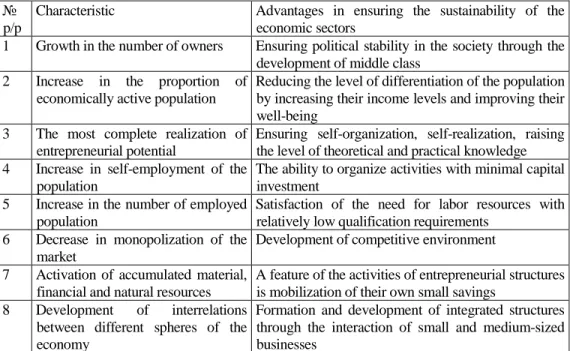
Ensuring the effective development of the business sector of the economy is an indispensable condition for economically sustainable development of the national economies of countries. The modern development of the Russian economy is inextricably linked with small business, thanks to which the level of unemployment in the sectors of the economy is reduced, incomes are growing, tax revenues in the budget of the country and regions are increasing, and innovations are emerging. Comparing the level of development of SMES in Russia and in other countries shows a significant gap from the developed economies of the world. At the same time, the activities of SMEs in Russia's industry radically differ from the conditions in which entrepreneurs of economically developed countries.
This is due to the fact that business of SMEs in European countries has long traditions and culture and legal framework adequate to the requirements of social and economic development business.
Table 1. Advantages of small business development in ensuring the sustainability of the economic sectors
№ p/p
Characteristic Advantages in ensuring the sustainability of the economic sectors
1 Growth in the number of owners Ensuring political stability in the society through the development of middle class
2 Increase in the proportion of economically active population
Reducing the level of differentiation of the population by increasing their income levels and improving their well-being
3 The most complete realization of entrepreneurial potential
Ensuring self-organization, self-realization, raising the level of theoretical and practical knowledge 4 Increase in self-employment of the
population
The ability to organize activities with minimal capital investment
5 Increase in the number of employed population
Satisfaction of the need for labor resources with relatively low qualification requirements
6 Decrease in monopolization of the market
Development of competitive environment 7 Activation of accumulated material,
financial and natural resources
A feature of the activities of entrepreneurial structures is mobilization of their own small savings
8 Development of interrelations between different spheres of the economy
Formation and development of integrated structures through the interaction of small and medium-sized businesses
The process of establishing market relations in Russia was difficult, and the transition to new forms of management has brought to the economy many factors that create conditions for the formation of a modern shadow economy (Bezrukova, 2013).
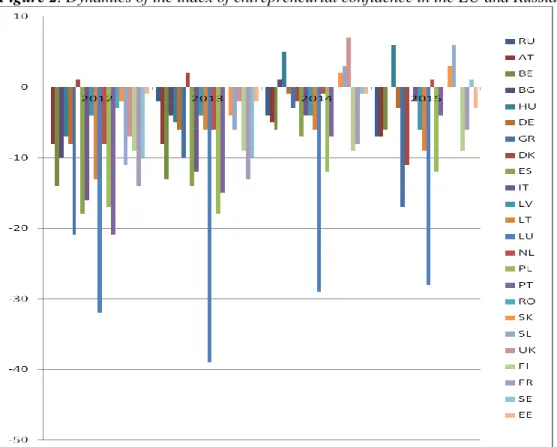
A certain impact on the decline in entrepreneurial potential and business activity of SMEs is being exerted by the economic crisis that has overwhelmed most of the countries today. As the results of the analysis of the dynamics of the index of entrepreneurial confidence have shown, in recent years there has been a steady imbalance between supply and demand, which determines in the industry of the countries of Europe and Russia.
The greatest imbalance and negative balance since 2008 are demonstrated by indices of entrepreneurial confidence of such countries as Greece, Portugal, Poland and Luxembourg. The index of entrepreneurial confidence in these countries is in the range of -10 and below. Countries with index of entrepreneurial confidence from -5 to -10 are Austria, Belgium, Spain, Italy and France.
At the same time, the greatest importance of the index of entrepreneurial confidence, and hence high entrepreneurial potential distinguishes small and medium-sized enterprises in Eastern and Northern Europe (Annual Report, 2016). The indices of entrepreneurial confidence in Russia range from 0 to -7, which allow considering high entrepreneurial potential in the industrial sector of the country (Figure 2): Figure 2. Dynamics of the index of entrepreneurial confidence in the EU and Russia
It is necessary to consider the experience of leading foreign countries in supporting entrepreneurship to understand the role and directions of SMEs development. There is a strong state support for SMEs in all EU countries with developed market economies. Entrepreneurs of different countries unite in various legal and public structures to support their own positions and stimulate further work. For example, there is the CAUX Round Table since 1986, which emphasizes the development of good-neighborliness, mutual understanding and cooperation, corporate responsibility for economic and social stability. It developed and adopted the Declaration "Principles of International Business" for the development of world standard in the conduct of business organizations.
Since 1997, the European Business Congress has been working to promote economic cooperation in the OSCE region to protect the rights and interests of its members and help firms to improve their performance. There is a large number of
unions of entrepreneurs, whose goal is the issues of product standardization, organization of advisory services, training of personnel, maintenance of industry statistics, and others. Unions of entrepreneurs submit their proposals to the government on carrying out tax policies beneficial to firms, providing export and other subsidies to exporting firms, protecting the market from foreign products through high fees, granting guarantees for export credits, etc. Specific international programs to support entrepreneurial activities in the EU countries are based on national experience and the specific nature of the activity. International structure for supporting entrepreneurship brings together the following supranational and national organizations:
1) organizations aimed at general regulation: the UNO, WTO, OECD and others; 2) financial structures: IBRD, IFC, EBRD, Eurasia Foundation and others; 3) foreign unions and business associations: OECEC Business Network, Switzerland, General Confederation of Small and Medium-sized Enterprises, Paris, France; Union of Industrial and Enterprise Confederations of Europe; Federation of Finnish Entrepreneurs and others.
In general, it should be noted once again that in developed countries it is small and medium-sized businesses that are paid attention on a national scale. State supports small and medium business as well as with money, and various benefits, in the field of tax policy. An effective system of stimulating the formation of SMEs in the Russian Federation is just being formed, as well as the economic mechanisms for their support. In practice, this leads to a small share of SMEs in the country's GDP. This is confirmed by the results of our studies.
The graph below shows the relationship between growth in the share of SMEs in GDP and the index of entrepreneurial confidence in the EU and RF in 2015. Each point on the graph is a member state. Figure 3 also shows functional relationship between the index of entrepreneurial confidence (X) and the share of the added value of SMEs in the country's GDP (Y). RF has minimum share of SMEs in GDP - at the level of 21%.
Figure 3. The relationship between the share of SMEs in GDP and the index of entrepreneurial confidence in the EU and RF
The main forms of SMEs support in Russia are: financial, information, consulting, property support and support in the field of training, retraining and advanced training of employees.
In recent years, the growth rate of support for SMEs has increased significantly, but the number of supported enterprises continues to be weak: in 2015, no more than 2% of the total number of SMEs received support. The most popular among SMEs is financial support; it was used by 24.5 thousand units of SMEs (Figure 4):
Most SMEs development financing programs are financed from the federal budget (the Ministry of Economic Development, self-employment programs, various federal agencies), but SMEs receive the main support at the regional level, which necessitates a qualified redistribution of support powers between state and regional government bodies, supported by appropriate financing (Vovchenko, 2016). It was established that 8,500 SMEs used non-financial support measures in the Russian Federation.
Figure 4. Support structure for SMEs (colors and numbers are 1 - financial support, 2 information support, 3 - consulting support, 4 - property support and 5 - support for training, retraining and advanced training of employees, units
As a drawback of the existing support system in the Russian Federation, we note that when determining the directions and volumes of its provision, the potential for the development of SMEs and increasing its contribution to the economy is not taken into account. Areas are identified that require further development, including insufficient coverage of support for medium-sized enterprises, insufficient attention to the development of the services market, including business services. In the system of measures to support small and medium-sized enterprises, a significant place is given to supporting foreign economic activity and exporting products.
Stimulating the export of small businesses has its own characteristics, including additional support measures and targeted incentives, intended only for small businesses. In the budgets of England, France, Italy and other countries, funds are
annually provided for export credit. Along with state loans, the system of state insurance of export credits provides serious support to small businesses. Since private insurers regard small businesses as sources of increased risk, insurance funds are created at the state and regional levels. Abroad priority is given to export credit, and significant financial resources are allocated to small and medium-sized businesses, which in Russia is realized to a lesser extent and as a result makes the mechanism of state support ineffective one. Moreover, in Europe, export promotion measures are beginning to be applied already at the design stage and the creation of export goods and services and continue up to the stage of after-sales service guarantee, in other words, cover the entire life cycle of products. The stimulation of the export-oriented SMEs is carried out using the following mechanisms:
−tax and financial benefits for organizations sending products for export;
− information structure and the very information about the situation on the markets, the sale of goods and services;
− guarantees to small enterprises conducting foreign economic activity; − advising on export operations;
−export crediting to small organizations;
− stimulating innovation in the creation of products for export; − insurance of export operations;
−training in the field of foreign economic activity.
To implement measures and programs to support small and medium-sized businesses, the Ministry of Economic Development of Russia has chosen a direction based on the active involvement of regional authorities in the development of the infrastructure for supporting small and medium-sized businesses (Vovchenko, 2013). Infrastructural support of entrepreneurial activity is a system of organizations of various kinds, functional for values and forms of ownership, united by the goal of creating favorable conditions for normal management of small and medium-sized entrepreneurial structures at various stages of their development. At present, the main efforts in support of export activities of small and medium-sized enterprises in Russia are implemented through a single institute for export support and centers for coordinating the support of export-oriented enterprises (Palagina, 2014). In Russia, there is export-oriented SMEs infrastructure presented by:
- Business support agencies; - Business incubators;
- Special economic zones (SEZ), technological parks; - Electronic trading platforms (ETP);
- Educational centers and organizations; - Leasing centers;
- Banking and non-banking financial institutions; - Innovation and technology centers;
- Public organizations and associations.
However, the share of exporters in the total number of SMEs, both by sales volume and by the number of enterprises of participants in foreign economic activity, remains small, and issues of targeted support for entrepreneurship are the most urgent ones (Morkovina, 2013). The share of SMEs which are engaged in export activities is about 0.7% of all SMEs, and revenue is about 0.8%. Of course, such a small number of small and medium-sized exporters can not contribute to the growth of the competitiveness of the Russian economy as a whole. At the same time, a significant difference in the rates for loans issued in Russia and the EU countries is an essential factor restraining Russian exports. During the survey of the heads of small and medium-sized export-oriented industrial enterprises, we found that their export opportunities are not realized in full (Busarina, 2014).
Thus, most of small and medium-sized export-oriented industrial enterprises (78% of respondents) with an annual turnover of 30 million rubles have the share of exports in turnover which does not exceed 50%. At the same time, half of small and medium-sized export-oriented industrial enterprises are trying to increase the volume of exports in the share of manufactured products by 50% or more, while a third of small and medium-sized enterprises orient exports to the near abroad and CIS countries.
The overwhelming number of respondents has agreed that the management structure of support for small and medium-sized industrial enterprises engaged in foreign trade activities is imperfect one, and the system of encouraging state bodies to support exports and monitor their activities in this area is not effective enough.
4. Conclusions and recommendations
The task of diversifying exports and increasing the number of exporters can be achieved through the export potential of the SME segment. At the same time, it should be taken into account that the support of existing exporting enterprises, although it will have a positive result, is nevertheless limited by objective constraining factors - size of the enterprise, demand for products (usually SMEs-exporters have narrow specialized niches). The main growth potential lies in the search and targeted support of export-oriented SMEs, whose products can potentially compete in foreign markets. It is necessary to use the best world practices while improving the current export support mechanism.
In order to determine the most effective areas of support, first of all, it will be necessary to identify the most promising products that have competitive advantages in the world market. At the same time, it is necessary to support not industries, but industrial enterprises with export experience and differing in a significant level of entrepreneurial confidence.
We believe that it is necessary to change the mechanism of financial support for export-oriented SMEs, namely the transition from direct export support to support of export-oriented industries, including the development of a system of concessional loans for the development of export production, similar to the EU. This will allow producers to really represent their financial capabilities and, accordingly, to build further export plans in more realistic way.
Acknowledgement:
The article was supported by the Ministry of Education and Science of the Russian Federation №11.3960.2717/4.6.
References:
Bezrukova, T.L., Morkovina, S.S., Bezrukov, B.A., Popkova, E.G. 2013. Methodological approach to the identification of predictive models of socio-economic processes for investment and innovative development of enterprises. World Applied Sciences Journal, 26(1), 20-27.
Břečková, P. and Havlíček, K. 2013. Leaders Management and Personnel Controlling in SMEs. European Research Studies Journal, 16(4), Special Issue on SMEs.
Breckova, P. 2016. SMEs Export Activities in the Czech Republic and Export Risk Insuring.
European Research Studies Journal, 19(1), 84-92. ON
Busarina, U.V., Morkovina, S.S., Budkova, S.V., Kolesnichenko, E.A. 2014. Mechanisms of support of export-oriented small enterprises: the regional aspect. Asian Social Science, 10(23), 95-101.
Chernysheva, G.Yu. and Shepelenko, I.G. 2017. Analysis of Development Strategies of Small Enterprises. International Journal of Economics & Business Administration, (5)1, 63-69.
Cipovová, E. and Dlaskova, G. 2016. Comparison of Different Methods of Credit Risk Management of the Commercial Bank to Accelerate Lending Activities for SME Segment. European Research Studies Journal,19(4), 17-26.
Epifanova, T., Romanenko, N., Mosienko, T., Kupchinskiy, A., Skvortsova, T. 2015. Modernization of institutional environment of entrepreneurship in Russia for development of innovation initiative in small business structures. European Research Studies Journal, 18(3), 137-148.
Ermakov, V.P. 2013. Export Potential of Small and Medium-sized Enterprises in Russia and the System of State Support. Russian Agency for Support of Small and Medium-Sized Businesses. http://www.liaa.gov.lv/files/liaa/attachments/ermakov_-_eud_-_rus.pdf
Havlíček, K., Thalassinos, I.E. and Berezkinova, L. 2013. Innovation Management and Controlling in SMEs. European Research Studies Journal, 16(4), 57-70, Special Issue on SMEs.
Helisek, M. 2016. Supporting Small and Medium-sized Enterprises in Preparing for the Euro Adoption in the Czech Republic. European Research Studies Journal, 19(4), 27-41. Japparova, I. and Rupeika-Apoga, R. 2017. Banking Business Models of the Digital Future:
The Case of Latvia. European Research Studies Journal, 20(3), 864-878.
Lacatus, V.D. and Vaidean, V.L. 2015. Opportunities and Constraints in Financing SMEs. International Journal of Economics & Business Administration, 3(2), 66-72.
Morkovina, S.S., Denisova, Yu.G., Drapalyuk, O.I., Shanyan, B. 2013. Forms of supporting entrepreneurship development in the forest sector of the TSCHR Forestry Engineering Journal, 4(12), 210-216.
Morkovina, S.S., Kolesnichenko, E.A., Spesivtsev, V.A., Ivanova, A.V. 2015. Principles of innovational startup selection for e-platforms placement. Mediterranean Journal of Social Sciences, 6(6), 201-211.
Muller, P., Devnani, S., Julius, J., Gagliardi, D., Marzocchi, C. 2016. Annual report on European SMEs 2015/2016. European Union. November.
Palagina, A.N. 2014. Adaptability as a system characteristic of the infrastructure for support of small and medium-sized enterprises . The engineer's messenger of the Don, 28(1). Parahina, V.N., Boris, O.A., Bezrukova, T.L., Shanin, I.I. 2014. State support for creation
and development of socially-oriented innovative enterprises. Asian Social Science, 10(23), 215-222.
Rupeika-Apoga, R. and Nedovis, R. 2016. The Foreign Exchange Exposure of Domestic Companies in Eurozone: Case of the Baltic States. European Research Studies Journal, 19(1), 165-178.
Rupeika-Apoga, R. and Solovjova, I. 2016. Profiles of SMEs as Borrowers: Case of Latvia. 10.1108/S1569-375920160000098005.
Rupeika-Apoga, R. and Solovjova, I. 2017. Access to Finance for Latvian SMEs. European Research Studies Journal, 20(3), 57-68.
Strategy. 2016. For the development of small and medium-sized business in the Russian Federation for the period until 2030, Approved by the decree of the Government of the Russian Federation of June 2, 2016. No1083-р. http://government.ru/docs/23354/ Vertakova, Yu.V., Plotnikov, V.A. 2013. Theoretical aspects of considering the dynamic
characteristics of socioeconomic systems in the management of regional development. Regional Research of Russia, 3(1), 89-95.
Vovchenko, N.G., Epifanova, Т.V. 2016. Impact of financial globalization processes on transformation of Russian financial system. Bulletin of the Rostov State University of Economics, 2(54), 162-169.
Vovchenko, N.G., Panasenkova, T.V. 2013. Trends of formation the Russia's innovation potential. World Applied Sciences Journal, 27(10), 1362-1366.