Problem solving in physics:
Undergraduates’ framing, procedures, and decision making
by
Bahar Modir
B.S., Arak University, 2006
M.S., University of Tehran, 2011
AN ABSTRACT OF A DISSERTATION
submitted in partial fulfillment of the
requirements for the degree
DOCTOR OF PHILOSOPHY
Department of Physics
College of Arts and Sciences
KANSAS STATE UNIVERSITY
Manhattan, Kansas
Abstract
In this dissertation I will start with the broad research question of what does problem solving in upper division physics look like? My focus in this study is on students’ problem solving in physics theory courses. Some mathematical formalisms are common across all physics core courses such as using the process of separation of variables, doing Taylor series, or using the orthogonality properties of mathematical functions to set terms equal to zero. However, there are slight differences in their use of these mathematical formalisms across different courses, possibly because of how students map different physical systems to these processes. Thus, my first main research question aims to answer how students perform these recurring processes across upper division physics courses.
I break this broad question into three particular research questions: What knowledge pieces do students use to make connections between physics and procedural math? How do students use their knowledge pieces coherently to provide reasoning strategies in estimation problems? How do students look ahead into the problem to read the information out of the physical scenario to align their use of math in physics?
Building on the previous body of the literature, I will use the theory family of Knowl-edge in Pieces and provide evidence to expand this theoretical foundation. I will compare my study with previous studies and provide suggestions on how to generalize these theory expansions for future use. My experimental data mostly come from video-based classroom data. Students in groups of 2-4 students solve in-class problems in quantum mechanics and electromagnetic fields 1 courses collaboratively. In addition, I will analyze clinical interviews to demonstrate how a single case study student plays an epistemic game to estimate the total energy in a hurricane.
My second research question is more focused on a particular instructional context. How do students frame problem solving in quantum mechanics? I will lay out a new theoretical
framework based in epistemic framing that separates the problem solving space into four frames divided along two axes. The first axis models students’ framing in math and physics, expanded through the second axis of conceptual problem solving and algorithmic problem solving. I use this framework to show how students navigate problem solving. Lastly, I will use this developed framework to interpret existing difficulties in quantum mechanics.
Problem solving in physics:
Undergraduates’ framing, procedures, and decision making
by
Bahar Modir
B.S., ARAK University, 2006
M.S., University of Tehran, 2011
A DISSERTATION
submitted in partial fulfillment of the
requirements for the degree
DOCTOR OF PHILOSOPHY
Department of Physics
College of Arts and Sciences
KANSAS STATE UNIVERSITY
Manhattan, Kansas
2017
Approved by: Major Professor Eleanor C. Sayre
Copyright
c
Abstract
In this dissertation I will start with the broad research question of what does problem solving in upper division physics look like? My focus in this study is on students’ problem solving in physics theory courses. Some mathematical formalisms are common across all physics core courses such as using the process of separation of variables, doing Taylor series, or using the orthogonality properties of mathematical functions to set terms equal to zero. However, there are slight differences in their use of these mathematical formalisms across different courses, possibly because of how students map different physical systems to these processes. Thus, my first main research question aims to answer how students perform these recurring processes across upper division physics courses.
I break this broad question into three particular research questions: What knowledge pieces do students use to make connections between physics and procedural math? How do students use their knowledge pieces coherently to provide reasoning strategies in estimation problems? How do students look ahead into the problem to read the information out of the physical scenario to align their use of math in physics?
Building on the previous body of the literature, I will use the theory family of Knowl-edge in Pieces and provide evidence to expand this theoretical foundation. I will compare my study with previous studies and provide suggestions on how to generalize these theory expansions for future use. My experimental data mostly come from video-based classroom data. Students in groups of 2-4 students solve in-class problems in quantum mechanics and electromagnetic fields 1 courses collaboratively. In addition, I will analyze clinical interviews to demonstrate how a single case study student plays an epistemic game to estimate the total energy in a hurricane.
My second research question is more focused on a particular instructional context. How do students frame problem solving in quantum mechanics? I will lay out a new theoretical
framework based in epistemic framing that separates the problem solving space into four frames divided along two axes. The first axis models students’ framing in math and physics, expanded through the second axis of conceptual problem solving and algorithmic problem solving. I use this framework to show how students navigate problem solving. Lastly, I will use this developed framework to interpret existing difficulties in quantum mechanics.
Table of Contents
List of Figures . . . xiii
List of Tables . . . xvi
Acknowledgements . . . xvii
Dedication . . . xix
1 Introduction . . . 1
2 Literature Review Overview . . . 8
2.1 Unitary view . . . 9
2.2 Manifold view . . . 11
2.2.1 Phenomenological primitives (p-prims) . . . 11
2.2.2 Manifold vs Unitary view in one example . . . 13
2.2.3 Symbolic forms . . . 14 2.2.4 Resources . . . 14 2.2.5 Epistemic games . . . 17 2.2.6 Coordination class . . . 20 2.2.7 Epistemological framing . . . 24 2.3 Summary . . . 25
3 Unpacking separation of variables in partial differential equations in quantum me-chanics . . . 27
3.2 Context . . . 28
3.3 First interaction . . . 30
3.3.1 Grouping and dividing . . . 30
3.3.2 Functions and separation constants . . . 31
3.3.3 Bringing out functions as constants . . . 32
3.4 Second interaction . . . 34
3.5 Discussion . . . 35
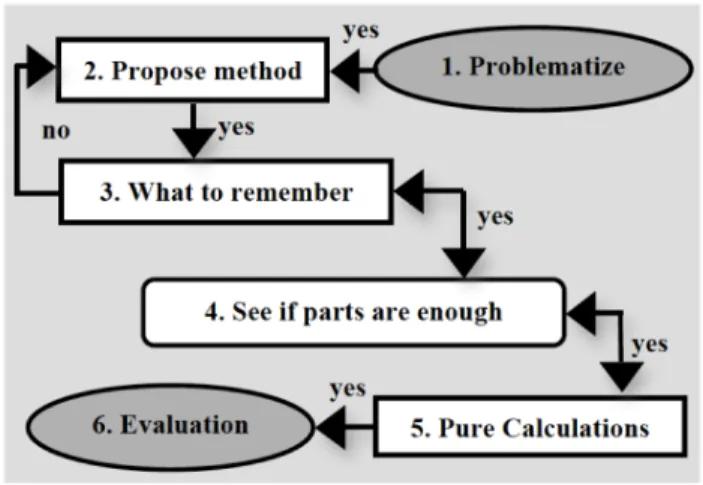
4 Learning about the Energy of a Hurricane System through an Estimation Epistemic Game . . . 39 4.1 Methodology . . . 40 4.2 Game Structure . . . 40 4.2.1 Problematize . . . 41 4.2.2 Propose Method . . . 42 4.2.3 What To Remember . . . 42
4.2.4 See If Parts Are Enough . . . 43
4.2.5 Pure Calculations . . . 43
4.2.6 Evaluations . . . 44
4.3 Patterns of Moves . . . 44
4.4 Discussion and Implications . . . 45
4.5 Conclusion . . . 47
5 “Looking ahead” as an extended readout strategy in EM . . . 49
5.1 Context . . . 50
5.2 Methodology for video data . . . 52
5.3 Generalized knowledge used by the students . . . 54
5.3.1 Physics of Separation of variables . . . 56
5.3.3 Clip 1: Looking ahead in separation of variables . . . 58
5.3.4 Clip 2: Looking ahead to determine sines . . . 59
5.3.5 Clip 3: Looking ahead and decision making . . . 60
5.3.6 Instructor encourages looking ahead . . . 61
5.4 Physics of Taylor series expansion . . . 64
5.4.1 How do students looking ahead when doing Taylor series expansion for a uniform charge line . . . 64
5.4.2 How do students looking ahead when doing Taylor series expansion for a uniform charge ring . . . 65
5.5 Conclusion and Implications . . . 67
5.6 Summary . . . 69
6 Students’ Understanding in Quantum Mechanics . . . 71
6.1 Difficulties framework . . . 71
6.2 Quantum mechanics research-based conceptual assessments . . . 72
6.3 Epistemological framing theory . . . 74
7 Students’ epistemological framing in quantum mechanics problem solving . . . 78
7.1 Introduction . . . 78
7.2 Context . . . 81
7.3 Methodology for video data . . . 82
7.4 Theoretical framework . . . 85
7.4.1 Algorithmic and conceptual math . . . 86
7.4.2 Algorithmic and conceptual physics . . . 87
7.4.3 Continua vs. categories . . . 88
7.5 Illustrative episodes . . . 89
7.5.1 Physics of free particles . . . 90
7.5.3 Episode: Algorithmic math . . . 91
7.5.4 Episode: Conceptual math . . . 93
7.5.5 Episode: Conceptual physics . . . 95
7.5.6 Episode: Algorithmic physics . . . 96
7.6 Accounting for frame transitions . . . 96
7.6.1 Example: Conceptual math to algorithmic math . . . 97
7.6.2 Example: Algorithmic physics to algorithmic math . . . 98
7.6.3 Example: Algorithmic math to algorithmic physics . . . 101
7.7 Discussion . . . 104
7.8 Conclusion . . . 105
8 Framing difficulties in quantum mechanics . . . 107
8.1 Introduction . . . 107
8.2 Theoretical framework . . . 108
8.2.1 Difficulties . . . 108
8.2.2 Manifold views . . . 109
8.2.3 Epistemological framing . . . 109
8.2.4 Interactions between problem statements and responses . . . 111
8.3 Methodology . . . 111
8.3.1 Difficulty identification . . . 111
8.3.2 Mapping students’ difficulties to framing . . . 112
8.3.3 Methodology for secondary analysis . . . 113
8.4 Transition error . . . 115
8.4.1 Transition error example . . . 116
8.4.2 Difficulties which exhibit transition errors . . . 118
8.5 Displacement error . . . 120
8.5.1 Displacement error example . . . 120
8.6 Content error . . . 123
8.6.1 Content error example . . . 124
8.6.2 Difficulties which exhibit content error . . . 126
8.7 Difficulties where more than one error type is possible . . . 130
8.8 Not enough information . . . 134
8.9 Error rates . . . 135
8.10 Conclusion and Implications . . . 137
9 Conclusion . . . 140
10 Future work . . . 146
Bibliography . . . 150
A TRANSCRIPTS . . . 171
A.1 Chapter 3 . . . 171
A.1.1 First interaction . . . 171
A.1.2 Second interaction . . . 173
A.2 Chapter 4 . . . 174
A.3 Chapter 5 . . . 180
A.3.1 Clips 1-2 . . . 180
A.3.2 Clip 3 . . . 186
A.3.3 Instructor encourages Looking ahead . . . 189
A.3.4 Taylor series for a line of charge . . . 191
A.3.5 Taylor series expansion for a uniform charge ring . . . 191
A.4 Chapter 7 . . . 195
A.4.1 Adam, Emma, and Eric’ group . . . 195
A.4.2 Alex and Robert’s Group . . . 204
List of Figures
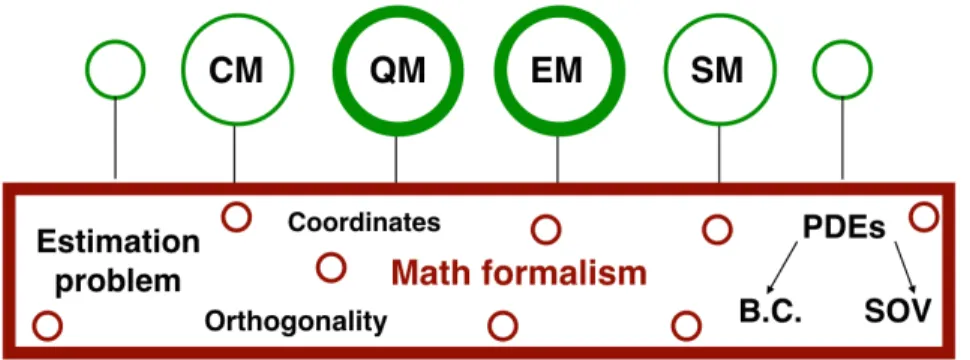
1.1 Schematic graph of physics courses in upper division that are connected via a substrate indicating common mathematical formalisms. This dissertation investigates students use of partial differential equations (PDEs) across two core courses of quantum mechanics (QM), and electromagnetism fields I (EM) course. Separately in an interview setting this dissertation models one case study student solving a fermi problem. . . 2
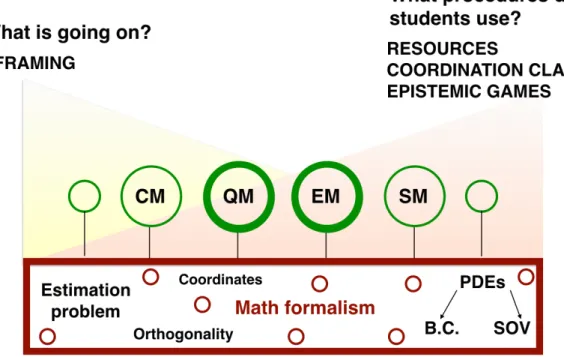
1.2 Schematic graph of my project overview. This dissertation models student’s problem solving. The theory of knowledge in pieces is used to answer two main research questions of how students frame problem solving situations and how students conduct processes while solving a problem. . . 7
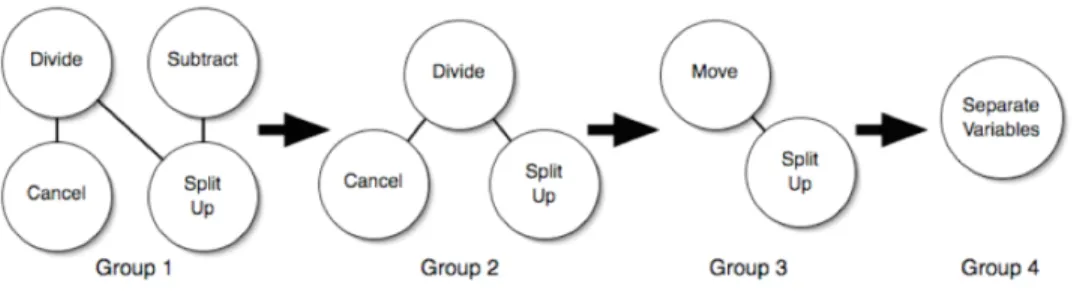
2.1 A model of the formation of the procedural mathematical resource Separate Variables. Figure originally from1 link. This graph shows the procedural resources that each group activated while separating variables as they solve an air resistance problem in an intermediate mechanics class. . . 16
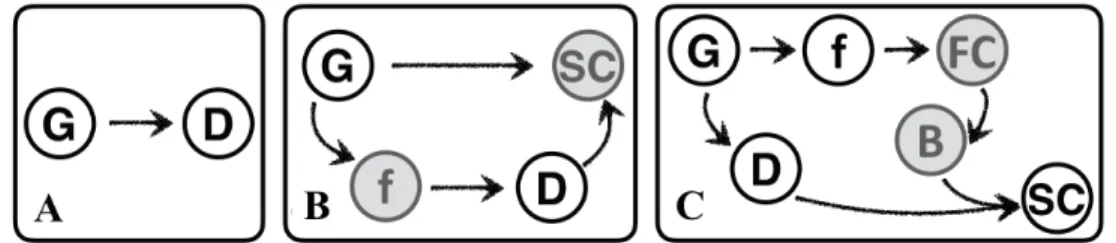
3.1 Phases of unpacking separation of variables. A: initial unpacking with two procedural resources activated. B: intermediate unpacking with two concep-tual resources activated. C: final unpacking with one procedural resource and one conceptual resource activated. The gray circles show the added resources in steps B and C. Key in Table4.1 . . . 29
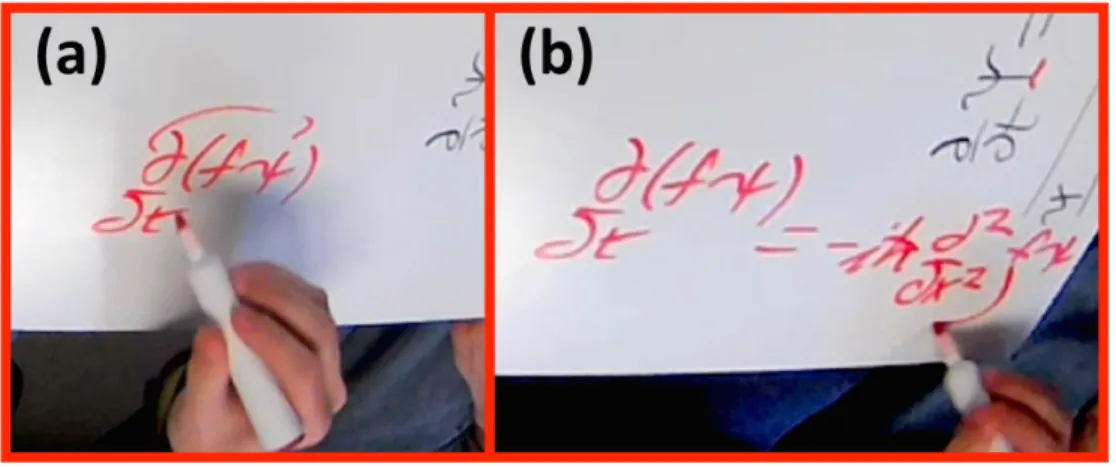
3.2 Showing the bringing out hand gesture. (a) Bringing out the space function ψ from the time partial derivative. (b) Bringing out the time function f from the space partial derivative . . . 32
4.1 Schematic graph of the estimation epistemic game (e-e-game) that Ava plays. The elliptical shapes indicate entry conditions of the games which are in grey color. Ava uses her estimation-based reasonings in move number 4. . . 41
4.2 Ava plays the e-e-game. Notice that initially she spends more time in each move, in the first 8 minutes she shifts mostly between move 3 and move 4, but around minute 10, she starts to change rapidly between three moves of 3, 4, and 5. . . 45
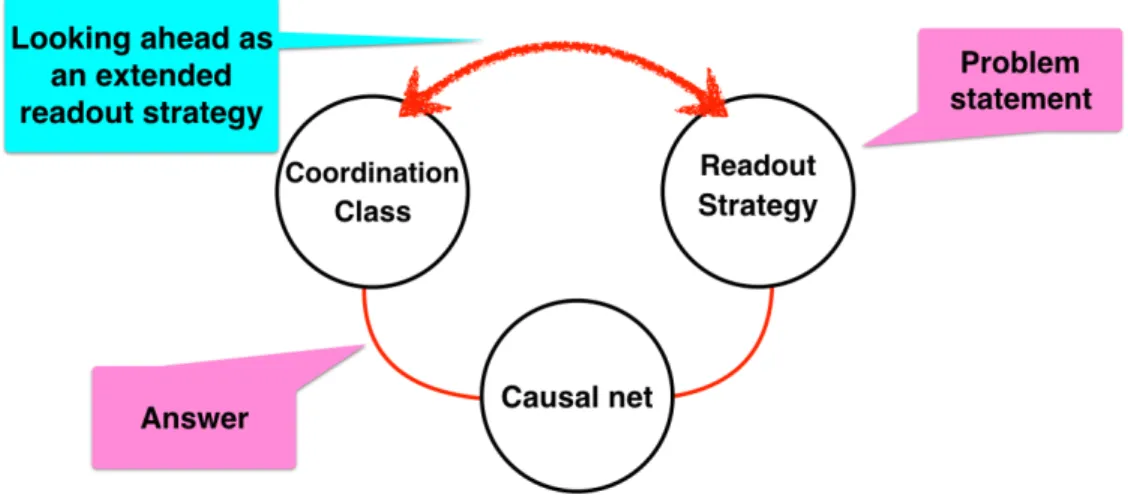
5.1 Expanded coordination class theory with the emphasis on the role of an ex-tended readout strategy. The mechanism of the looking ahead explains the interaction effect between the problem statement and the coordination class, which are the generalized knowledge that students possess. . . 55
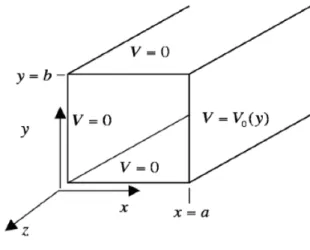
5.2 Tutorial 5: Separation of variables, given to the students during the group problem solving activity in the Electromagnetism field 1 course The problem asks to find the potential inside and outside of the infinite square hollow pipe. 57
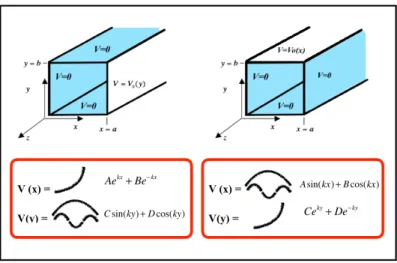
5.3 Two physical systems with different boundary conditions and swapped mathe-matical solutions. For the physical system on the left, the exponential function belongs to x and the sinusoid function belongs to y. For the physical system on the right, the sinusoid function belongs to x and the exponential function belongs to y. . . 59
7.1 Math-physics-algorithmic-conceptual theoretical framework. The horizontal axis indicates algorithmic and conceptual directions. The vertical axis repre-sents the math versus physics directions. This framework gives four frames as labeled in the figure. . . 85
7.2 Group problem solving in algorithmic math frame, as trying to find the wave function for the one dimensional free particle. . . 89
8.1 Does the probability of finding a particle in the marked region depend on time? On this problem, student difficulties display transition error. Figure originally from2. . . . 116
8.2 Calculate the expectation value of the energy in the state ψ(x, t). On this problem, student difficulties display content error. Figure originally from3. . 124
8.3 The number of difficulties mapped to error categories, a) for questions that require transition, b) for questions that do not require transition, and c) un-specified due not having enough information . . . 137
8.4 Displacement, transition and content error categories of difficulty topics for questions that require transition, with the displacement as the most common type of error. . . 137
8.5 Displacement and content error categories of difficulty topics for questions that do not require transition with the content as the most common type of error. . . 138
List of Tables
3.1 Resources in unpackedseparation of variables . . . 29
4.1 Times and recall numbers allocated to different moves of the e-e-game. . . . 45
8.1 Difficulties that exhibit transition error only. These difficulties are labeled “T” for transition errors; the ordering of the difficulties in the table is for labeling purposes only and does not represent a hierarchy. . . 118
8.2 Difficulties which exhibit displacement error in problems that require frame shifting. These difficulties are labeled “D” for displacement errors and “s” because their problems require shifting; the ordering of the difficulties in the table is for labeling purposes only and does not represent a hierarchy. . . 123
8.3 Difficulties that exhibit only displacement error in simpler problems which do not require frame shifting; and “n” because their problems require no shifting. These difficulties are labeled “D” for displacement errors; the ordering of the difficulties in the table is for labeling purposes only and does not represent a hierarchy. . . 123
8.4 Difficulties that exhibit only content error in problems which require shifting frames. These difficulties are labeled “C” for content errors; and “s” because their problems require shifting; the ordering of the difficulties in the table is for labeling purposes only and does not represent a hierarchy. . . 126
8.5 Difficulties that exhibit content error in simpler problems. These difficulties are labeled “C” for content errors; and “n” because their problems require no shifting. The ordering of the difficulties in the table is for labeling purposes only and does not represent a hierarchy. . . 131
8.6 Difficulties that exhibit both displacement and content error in problems which require transitions. These difficulties are labeled “DC” for displace-ment and content errors; and “s” because their problems require shifting. The ordering of the difficulties in the table is for labeling purposes only and does not represent a hierarchy. . . 131
8.7 Difficulties that exhibit both displacement and transition errors in problems which require frame shifting. These difficulties are labeled “DT” for displace-ment and transition errors; and “s” because their problems require shifting. The ordering of the difficulties in the table is for labeling purposes only and does not represent a hierarchy. . . 132
8.8 Difficulty that exhibits both content and transition errors in a problem which requires frame shifting. This difficulty is labeled “CT” for content and tran-sition errors, and “s” because its problem requires shifting. . . 133
8.9 Difficulties that exhibit all types of error in problems which require frame shifting. This difficulties is labeled “DCT” because it may involve all three types of error, and “s” because the problem require shifting. . . 133
8.10 Difficulties that exhibit both displacement and content errors in simpler prob-lems. This difficulty is labeled “DC” for displacement and content errors and “n” because the problem does not require shifting. . . 134
8.11 Difficulty topics for problems without enough information. These difficulties are with any letter because we don’t know which kind(s) of error they may represent; the ordering of the difficulties in the table is for labeling purposes only and does not represent a hierarchy. . . 136
Acknowledgments
From the first day of attending K-State I felt love and support which I am extremely thankful for. I would like to thank all the people, without their help this work was not possible.
I would like to thank my dear advisor, Dr. Eleanor Sayre, for teaching me the alphabet of the Physics Education Research field and her enormous guidance, support, and advise. I could not have chosen a better advisor. My advisor for me is a role model of a successful professional woman in the STEM field which I enjoyed working with.
I would like to thank Dr. Brett DePaola for all his guidance and support in providing me an open opportunity to develop an online course as a teaching assistant. I would like to thank the rest of my committee members: my outside chair Dr. Michael Herman, Dr. James Laverty, and Dr. Bruce Babin for all their support and feedback towards completion of my dissertation.
It was an honor for me to become part of the Physics Education Research Group at K-State and conduct my PhD study. I would like to thank Dr. Dean Zollman for his encouraging advise and feedback on my work.
I would like to thank Erfan Saydanzad, Javad Robatjazi, and Neda Dadashzadeh for all their help, support, and kindness over the last four years. I would like to thank Dr. Sanjay Rebello and Dr. Paul Irving for their support and kind guidance during the initial years of my PhD.
I would like to thank my current and past colleagues on the fourth floor for always being there for me and ready for productive discussions: Nandana Weliweriya, Dina Zohrabi-Alaee, Tra Huynh, John D. Thompson, Ben Archibeque, Deepa Chari, Hai Dong Nguyen and Elise Agra. I would also like to thank the wonderful staff of the physics department. My special thanks to Kim Coy for always being kind and helpful to me.
Finally, I would like to thank my husband for giving me love over the past four years and encouraging me to complete my PhD and pursue my future career.
Dedication
Chapter 1
Introduction
Problem solving as an essential part of physics employs different kinds of knowledge and skills. Mathematics as the language of physics has an important role in understanding the causal physical relation in form of mathematical symbols. The process of converting a physical representation to a mathematical representation to do math on it is called math-ematization4. Doing math is different from mathematization procedure.
Researchers have broadly investigated how students create and understand equations to describe a physical behavior5, and what are the expectation of students in using equations
in physics problem solving that cause them to play particular epistemic games, which may result in a mathematical error6.
In this study my broad research question is how students do problem solving in upper division physics. For this purpose, I am not interested in just the final correctness of students’ answers, but I am interested in the detail of students processes in problem solving in the domain knowledge of math-in-physics. My ultimate goal in this dissertation is to build better theoretical lenses to explain how students perform processes in physics problem solving.
My focus in this study is on students’ problem solving in physics theory courses. There are certain mathematical formalisms that are in common across all physics core courses such as using the process of separation of variables, doing Taylor series, or using the orthogonality properties of mathematical functions to set terms equal to zero. The slight difference among
the use of these mathematical formalisms in different courses such as quantum mechanics vs electromagnetic fields course is due to how students map the physical system to these processes; make judgements, make decisions; and do several readouts in the moment of the problem solving to describe the features of the physical system. These common formalism can be interpreted as a substrate that connects the courses to each other (see figure1.1). Thus it is important to investigate how students do procedures while manipulating these mathematical formalisms in physics courses, which forms my first research question. Among the physics theory courses my focus is on quantum mechanics and electromagnetism fields 1 course. Separately, in an interview setting I investigate how a student solve a fermi problem, which is an estimation problem.
Figure 1.1: Schematic graph of physics courses in upper division that are connected via a substrate indicating common mathematical formalisms. This dissertation investigates stu-dents use of partial differential equations (PDEs) across two core courses of quantum me-chanics (QM), and electromagnetism fields I (EM) course. Separately in an interview setting this dissertation models one case study student solving a fermi problem.
I break my first main research question into three leading research questions. What are the knowledge pieces that students use to make connection between physics and procedural math? How do students use their knowledge pieces coherently to provide reasoning strategies in estimation problems? Lastly, how students look ahead into the problem to read the information out of the physical scenario to align their use of math in physics? I respond to
these three questions in the domain knowledge of math-in-physics.
Previous researchers have examined theoretical constructs to understand how students provide intuitive reasoning7, understand equations5, make mathematical errors6, and acti-vate procedural resources to show mathematical actions8.
I select the family of Knowledge-in-Pieces (KiP) theories to describe student’s problem solving behavior. Phenomenological primitives7 (p-prims) from the pieces theory are atom-istic units of students’ reasoning used to provide an intuitive sense of how physical mech-anisms work. Under the same family of theories, symbolic forms5 describe how students use their p-prims along with mathematical equations to conceptualize a physical situation. Epistemic game (e-game) is another cognitive structure9 that describes how students use mathematical tools6. Students based on their expectation on how to solve a problem can enter an epistemic game. The structure of an epistemic game is determined by its entry conditions and the moves played in the game. The knowledge base used in association with the moves could be p-prims, symbolic forms, or interpretative devices6.
Researchers use different theories to allow them to interpret student’s thinking process. I am interested to see how students use their knowledge of math and physics to solve a problem. I use the knowledge in pieces (KiP) theory to model student’s problem solving activities. This theory allows to view students different ways of thinking and context dependent aspects of problem solving.
The resources theory10 under the umbrella of KiP, models students thinking in terms of the fine grain pieces of knowledge that are called resources. The KiP theory accounts for context dependent ways of student’s thinking. Context can be internal or external. Students as a result of their expectation which is an internal factor can activate particular ideas in a problem solving situation. On the other hand, students can activate different ideas as the result of reading information out of an external context such as the problem statement. In addition, both of these contexts can be present in student’s problem solving activity. Activation of one piece of idea may cue the activation of other ideas. The resources theory at a fine grain level focuses on how students link these small bits of their ideas to form an argument or a reasoning. Over time students can provide different reasonings that can be
very different in nature. Thus investigating student’s dynamic of problem solving may reveal more information about how they are thinking over time.
One of the theories under the umbrella of KiP theory is called epistemic game6(e-game). Epistemic game has an ontological part and a structural part. Activated resources during problem solving form the knowledge base of an e-game. By reading the problem statement students set a goal to enter a particular e-game, follow several moves to find an answer and exit the e-game. Using the e-game theory lens, we can find information about how students shift among the moves, what is the frequency of shifts between two moves, or how interplay of another move can increase the frequency of the shifts. Thus e-games provide a representation that makes it possible to observe the dynamic of students problem solving. Different students can play the variation of the same game. However, there are instances in problem solving situations that student may get “stuck” and in order to get “un-stuck” they may undergo a sharp change in the nature of their activity that can not be captured through an e-game with strict structure of moves. Thus the e-game construct with a particular goal that guides to enter a specific game does not capture the variations in students goals during a problem solving. In order to see the variation of students thinking in a more broader sense I use the epistemological framing theory11, which is a more flexible construct that allows me to view changes in students epistemological views in the use of their knowledge of math and physics and the way they choose to conduct algorithmic or conceptual problem solving.
In Chapter3, I provide evidence on how students within one group unpack the procedural resource of separation of variables to its constituents. I identify a new procedural resource called “bringing out”, which has an important role in this unpacking process. My data is drawn from classroom videos of upper-division quantum mechanics problem solving. I analyze an example of students’ use of separation of variables to solve a partial differential equation for a free particle problem. The “bringing out” resource helps students separate the time part from the space part of the wave function in the course of solving the time-dependent Schr¨odinger equation. I also discuss the conceptual resources that students activate and how they relate to the procedural resources.
upper-division physics student to solve an estimation problem in a clinical interview. I use the theory lens of resources framework and epistemic games to describe students’ problem solving moves. I present a new epistemic game, which is called estimation epistemic game (e-e-game). In the estimation epistemic game students break the larger problem into a series of smaller, tractable problems. Within each sub-problem, they try to remember a method for solving the problem, and use estimation and reasoning abilities to justify their answers. I demonstrate how a single case study student plays the game to estimate the total energy in a hurricane.
In Chapter 5, I use coordination class theory to describe how students connect physical scenarios with mathematical insight. Within coordination class theory, students read infor-mation out of problem statements, connecting the specifics of the problem with generalized conceptual schemata (the “coordination class”) in a causal net. While previous research us-ing coordination classes has focused on identifyus-ing particular coordination classes or details of the causal net, my research focuses on an extended readout strategy, which we call “look-ing ahead”. To characterize the mechanism of look“look-ing ahead, we study students’ problem solving with separation of variables and Taylor series expansions. When students look ahead in a problem, their mathematical and physical insight can help them avoid time consum-ing calculations. I discuss the structure of lookconsum-ing ahead and illustrate it with video-based classroom data.
After discussing students procedures in problem solving I ask my second main research question which is more comprehensive. How students frame problem solving in a senior level quantum mechanics course. Students at this stage of their education are at the “journeyman-level”12, that have access to many ideas and toolboxes to create different paths and ways of thinking to solve a problem. Thus, it is important to investigate what is the mechanism for students to control over which part of their knowledge to activate and how navigate their knowledge use to work in a situation. In Chapter 7, I layout a new theoretical framework called “two coordinate axis framework” that separates the problem solving space into four frames. The first axis models students’ framing in math and physics, expanded through the second axis of conceptual problem solving and algorithmic problem solving.
Students difficulties in quantum mechanics may be the result of unproductive framing and not fundamental inability to solve the problems or misconceptions about physics content. I observed groups of students solving quantum mechanics problems in an upper-division physics course. Using the lens of the epistemological framing, I investigated four frames in my observational data: algorithmic math, conceptual math, algorithmic physics, and conceptual physics. I discuss the characteristics of each frame as well as causes for transitions between different frames, arguing that productive problem solving may occur in any frame as long as students transition appropriately between frames. My work extends framing theory on how students frame discussions in upper-division physics courses.
In Chapter 8, using the theoretical lens of epistemological framing, I apply the “two coordinate axis framework” to seek an underlying structure to the long lists of published difficulties that span many topics in quantum mechanics. Mapping descriptions of published difficulties into errors in epistemological framing and resource use, we analyzed descriptions of students’ problem solving to find their frames, and compared students’ framing to the framing (and frame shifting) required by problem statements. I found three categories of error: mismatches between students’ framing and problem statement framing; inappropriate or absent shifting between frames; and insufficient resource activation within an appropriate frame. Given this framework, I can predict the kinds of difficulties that will emerge for a given problem in quantum mechanics, yielding a possible deeper structure to student difficulties. Lastly, I use this developed framework to frame difficulties in quantum mechanics.
Finally, in Chapters 9 and 10, I discuss the conclusion and suggestions for future works. The schematic overview of my dissertation is sketched in figure1.2. I use a methaphori-cal representation to show that students across physics courses use common mathematimethaphori-cal tools. The mathematical formalisms are like a substrate that ties different upper division physics course. However, students might need to apply different strategies or conduct differ-ent processes in order to map the features of differdiffer-ent physical systems to their mathematical representation in each course. In order to investigate different ways of mapping the knowl-edge of physics to mathematical formalisms I use theory family of “knowlknowl-edge in pieces”, which metaphorically can be interpreted as a light that shines on my observational data and
allows me to interpret students different problem solving activities. We collected data from two upper division physics core courses of quantum mechanics (QM) and electromagnetism fields I (EM) course. My two main research questions are “how students do procedures in problem solving?” and “how students frame problem solving?” For the first research question I analyze data from both physics theory courses of quantum mechanics course and electromagnetic fields 1 course.
Figure 1.2: Schematic graph of my project overview. This dissertation models student’s problem solving. The theory of knowledge in pieces is used to answer two main research questions of how students frame problem solving situations and how students conduct pro-cesses while solving a problem.
Chapter 2
Literature Review Overview
Over the last 50 years13Physics education researchers have conducted research to support
student learning and teaching strategies. Application of these results into K-12 education and on up to upper division and graduate physics consequently open avenues for further research. Researchers have developed different theories in physics education research to investigate how students learn physics, how students provide reasoning, and how students do physics problem solving. In order to answer these broad questions, researchers identify what knowledge students have, what are the constituents of their knowledge7, how students employ
their knowledge4 and how that knowledge develops under physics instructions14. Different
cognitive theories have accounted for understanding the structure of students’ knowledge. In this chapter, I review two big families of theories that have tried to model students’ thinking in physics. The first theory is based on a misconception view which investigates students’ conceptual understanding in physics. The second big family of theory is a manifold view that aims to understand in a more structural sense what are the elements of knowledge that come together in a situation to provide a reasoning.
Starting in the late 1970s until the 1990s, researchers mostly focused on students diffi-culties with conceptual understanding in physics. In this view these diffidiffi-culties form stable units of thinking which have to be confronted and replaced by new conceptions. In the 1990s the role of context was investigated more which led to the idea that students reasoning were
small atomistic pieces, which were called phenomenological primitives7 (p-prims). In the late
1990s and the early 2000s, researchers developed the resources theory that student’s reason-ing are formed from larger pieces of thoughts which could be reusable and link together in different ways. Here I reference a resource letter which was published in 1999 by McDer-mott and Redish15 that aggregates the work and theory on researched-based guidelines of many of the research articles published between the 1980s and late 1990s. This is a good reference that includes the studies done on student conceptual understanding across differ-ent topics and early research on epistemological beliefs of studdiffer-ents about learning physics. Researchers have used resources theory to explain conceptual change16, mechanistic reason-ing17, and along with other theories to serve as the knowledge base of epistemic games6, which is a structure of moves that students play to solve a problem. Many of these resources studies have become published and updated in 2013 by Redish and Sayre18 as the resource framework bibliography that covers research from the early 1990s and on up to 2013.
2.1
Unitary view
I use two terms of “unitary” and “manifold” views19, to explain students reasoning from
the view of two theoretical constructs of “misconceptions” and “pieces”.
In a misconceptions view, students apply an incorrect model of a concept across a wide range of situations independent of the context20;21. The core of conceptual understanding
occurs by confronting the incorrect conception, and replacing it with a new concept. Several studies using the unitary view have investigated student difficulty in understanding various topics such as the concept of velocity in one dimension22, difficulties in connecting graphs
and physics23, work-energy and impulse-momentum theorems24, understanding of light as
an EM wave25, single-slit diffraction and double-slit interference26, difficulties with torque27,
and the first law of thermodynamics28.
Studies that aim to explore students conceptual understanding use certain methods29.
The first step is to identify students misconceptions across certain topics, then surveys30 and
admin-istered to a large population of students to find the prevalence pattern of those difficulties. Many studies have used these results to improve teaching strategies31–34, and design research-based tutorials35–38 to fix students’ understanding in a certain topic. The improvement in student conceptual understanding are measured39through assessment tools such as the Force Concept inventory40 (FCI) and the Force and Motion Conceptual Evaluation41 (FMCE) in introductory mechanics, and the Brief Electricity and Magnetism Assessment42 (BEMA) in introductory electricity and magnetism.
This unitary view of students’ reasoning guides our attention as researchers toward the identification of topics with which students have difficulties. However, focusing on identifica-tion of large scale difficulty concepts can be at the cost of missing students’ epistemological changes43, because a difficulties view predicts a stable model of thinking that is repeatable, and does not account for sudden or contextual changes in the nature of student reasoning.
A study by McCloskey21 shows how students use their knowledge to explain the motion of the ball. Consider the following example of one person throws a ball upward into the air, what forces act on the ball? Student’s incorrect notion involves an internal force that acts on the ball from the hand. This force fights against gravity to keep the ball in motion. As the ball goes up the force or the impetus gradually dies away and the ball slows down. The ball stops at the peak of the trajectory due to the impetus force and the gravity being in equilibrium. Then the gravity overcomes the internal force and causes the ball to fall down. However, a physicist, in the absence of air resistance force, only identifies the force of gravity as acting on the ball. As the ball is tossed into the air, the ball is not in contact with the hand, thus there could not be any force from the hand acting on the ball. However, the hand at the beginning of the motion gives the ball momentum which decreases and gets zero at the peak of the trajectory.
McCloskey considers that these incorrect answer patterns, which are consistent among students, form a naive “Impetus theory”. The impetus theory asserts that an object set into the motion has an internal impetus to keep the object into the motion and the impetus gradually dissipates as the result of external influences. The misconception of the motion implies force is not consistent with the first law of Newton that asserts an object in a
constant speed under the absence of an external forces maintains the constant speed forever. The impetus theory is a naive theory of motion which is different from the experts view in physics. diSessa in contrast, does not think that the “impetus theory” has the systematicity which a theory should possess. diSessa thinks that the misconception view cannot explain students intuitive physics knowledge. He proposes that students intuitive ideas cannot lead to developed misconceptions and instead, students’ reasonings are fragmented and even contradictory to each other. In the rest of this chapter I explain the knowledge in pieces approach and reanalyze the ball in motion example from the phenomenological primitives7 (p-prims) approach by diSessa.
2.2
Manifold view
An alternative view to a unitary difficulties view is a manifold “knowledge in pieces” view. In this view of student reasoning, student thinking is conceptualized as being highly context dependent and composed of small, reusable elements of knowledge and reasoning called “pieces”. These pieces are not themselves correct or incorrect, but the ways in which students put them together to solve problems may be either. By focusing on the pieces of student reasoning and how they fit together, this view of student reasoning foregrounds the seeds of productive reasoning and not just incorrect answers. Theories in this family include phenomenological primitives7 (p-prims), resources10, and symbolic forms44. In contrast to a
unitary view where students’ misconceptions are in contradiction to expert view in physics, a manifold view explains how students can develop their use of p-prims to finally get in alignment with the way experts use their physical intuitions.
2.2.1
Phenomenological primitives (p-prims)
Previous research has modeled students’ ideas as small chunk of resources called phe-nomenological primitives (p-prims)7 that are used in their intuitive reasoning. diSessa7
of the theories, instead these are primitive reasonings that are context dependent and do not have the systematicities that scientific theories own. diSessa under the knowledge in pieces (KiP) view introduced the idea of p-prims, which are atomistic pieces of reasoning that are abstracted from experience. People by living in this world from the early age of childhood experience the physical world to throw objects, pull objects, etc, which lead to primitive sense of mechanisms for how things work. The word phenomenological reflects this abstraction and the word primitive shows that people simply use p-prims without fur-ther justification because they think this is the way how things are and that’s it. P-prims are neither inherently right or wrong, and their correctness is determined by the context. For example, the p-prim of “closer means stronger” is correctly activated in the context of proximity to a fire. As we get closer to the fire the effect is stronger and we feel warmer.
If we ask the question of why the earth is warmer in the summer than it is in the winter, students might say because the earth is naturally closer to the sun in the summer thus it is warmer. Still the same p-prim of closer means stronger is activated, however the activation here does not lead to the correct conclusion as the earth’s axis or rotation angle is responsible for this seasonal weather change. Hammer10 argues that students do not possess robust wrong notions called misconceptions, but these types of reasoning could become activated right in the spot within the context. This context of sun-earth by considering the source and the proximity to the source have a higher cueing priority for the p-prim of “closer is stronger” over other p-prims.
P-prims7 can be refined to be used in an expert way. For example, in constraint phenom-ena such as when a ball in motion hits a wall, the motion gets blocked and the ball can come to rest. One can simply explain this situation by activating the blocking p-prim and simply explains that the ball stops because the wall blocked the motion. After physics instruction as students learn to explain the same phenomena in terms of force, they might think of this situation as an interaction between the ball and the wall, and think of the wall as an agent that can apply a force on the ball. This way of thinking is more likely to activate the force agency p-prim. Thus the probability of the blocking p-prim decreases in favor of increase in the activation of the force agency p-prim. P-prims with high level of priority gradually
become the central ideas in students thoughts. The high frequency of activation of a p-prim over other p-prims indicates the higher cueing priority for that central p-prim. If a p-prim stays activated after becoming activated then the reliability priority for that p-prim is high. If a p-prim stay activated after leading to activation of other collection of p-prims, then that p-prim has a high reliability priority with respect to that particular context of activation7;44.
2.2.2
Manifold vs Unitary view in one example
Hammer19, from the language of diSessa7 explains how the knowledge in pieces approach can account for the contradictory explanations in students responses to the ball problem, which is not understandable through the impetus theory approach. Students based on the misconception of the motion requires force reason that an impetus force which acts in the direction of the motion, fights against the downward gravitational force and keeps the ball in an upward motion. Based on the impetus theory, the internal force gradually dissipates and comes to zero at the peak, since the ball stops and is not in motion at its peak. However, at the peak of the motion students use another line of reasoning that the impetus force and the gravitational force are in equilibrium. This notion is not consistent with the impetus theory which states motion requires force and the impetus gradually dissipates as the object slows down. Hammer argues that under the robust misconception view it is difficult to think why students suddenly change their notion and even use them in contradictions. diSessa’s7
account of context dependent p-prims explains that students break this problem into different contexts and each context cue a different p-prim.
In the first mini context, from where the ball is tossed before it gets to its peak students have activated the p-prim of maintaining agency. In order to maintain an effect, which in this case is the motion of the ball, an agent must keep acting on the ball (object). In the mini context of the ball in its peak, students have activated the balancing p-prim, which implies an upward influence is in balance with a downward influence.
2.2.3
Symbolic forms
The use of p-prims are not limited only in providing conceptual reasonings. Students can activate p-prims along with their mathematical reasonings to explain how a physical system work both in a qualitative and a quantitative manner. Sherin44 uses the idea of
p-prim as a sense of mechanism to investigate how students in the context of problem solving conceptually understand equations in algebra-physics. He then argues that not only p-prims are active in students intuitive reasonings, but also forms can be considered as part of this intuitive understanding. He develops the theoretical construct of symbolic forms consist of a conceptual schema and a mathematical form. Sherin argues that physical understanding can be tuned with mathematical understanding, such that activation of a p-prim could cue the activation of a mathematical form.
2.2.4
Resources
Under the KiP theory family, resources are other elements of thoughts that can come together to make a reasoning. Resources are not atomistic such as p-prims7. Resources are
reusable thoughts that can be broad and even have an internal structure. Resources different than p-prims do not only encompass the content knowledge and conceptual understanding. Resources can have different types: epistemological45, mathematical6, conceptual46, or pro-cedural1. P-prims are intuitive sense of reasoning that become activate to explain how things work. Epistemological resources form the beliefs as to how to activate knowledge. For ex-ample, knowledge can be accessed from an authority source such as textbooks. Conceptual resources deal with understanding concepts, such as coordinate systems14. Mathematical reasonings such as symbolic templates similar to p-prims can be abstracted from experi-ence with mathematical forms. Symbolic templates and p-prims can become reinforced in activation and form symbolic forms44.
Researchers using the resources framework try to answer questions such as what are the ways that students put their knowledge together, how students link their ideas, how can students change part of their reasoning, how can students unpack their reasoning1;47, how
resources develop over time14 or more particularly, what are the resources associated with
thinking algorithmically, conceptually or computationally.
Resources theory has been used broadly with other theories such as framing48;49, epistemic games6, or conceptual change theory50. Resources are small, reusable elements of student reasoning, that may or may not have an internal structure. Resources are neither wrong nor right, and are context dependent14;19.
Resources also can vary in size. Some resources such as primitives do not have an in-ternal structure. Other resources such as coordinate systems can have an internal structure accessible by the user. Although we can keep track of the frequency and the length of p-prim activation (Section2.2.1), but the nature of p-prims can not change. The internal structure of p-prims may not be explorable by the user14. Whereas, larger resources such as episte-mological, conceptual50;51, and procedural47 could have an internal structure by connecting to other ideas.
There are two technical terms that are used to categorize if a resource has an internal structure or not14. Solid resources that are durable can be used as individual resources. These resources have become solid as the result of frequent use in several contexts of ac-tivation. Thus the internal structure of the resources become less accessible, and the user can use that resource on its own. On the other hand, resources that are being created for students for the first time by the instructor or a group mate are less solid and more plastic, thus students need to activate several resources in close association to each other to learn the meaning of a new conceptual resource to describe a physical system, or learn how a mathematical procedure such as separation47 works to separate variables.
I am interested in a particular kind of mathematical reasoning used by students that are procedural resources and could be larger in size. In Chapter 3, using the resource framework I investigate how students by activating several procedural resources can perform the processes of separation of variable to separate the time dependent Schr¨odinger equation. Students based on their expertise can use one resource without using the details, or they can unpack a resource as the collection of other resources.
Figure 2.1: A model of the formation of the procedural mathematical resource Separate Variables. Figure originally from1 link. This graph shows the procedural resources that each group activated while separating variables as they solve an air resistance problem in an intermediate mechanics class.
mathematics and physics becomes more clear. Researchers have identified mathematical actions that met the resources criteria, which are procedural resources. Students use proce-dural resources47 to perform actions such as separating variables to solve partial differential equations (PDEs). Students for showing a procedural resource, instead of using an alge-braic representation, use hand gestures to metaphorically show the mathematical action52.
Wittmann et al.,47investigated procedural resources such asseparation, finding that their
in-ternal structure includes several resources: grouping, division ormultiplication, moving and
subtraction, explorable by students. The level of structure can vary among students with different level of expertise. Students can use separation as a single resource, or they can activate additional resources to successfully separate variables on both sides of an equation. In an earlier study, the same group of researchers1 investigate different ways of separating
variables within four groups. Interestingly, each group uses the separation resource differ-ently. The authors imposed an order on these patterns of activations to say perhaps there is a developmental trend, from the fourth group that usesseparation as an individual resource, to the first group that uses the separation resource as the most unpacked, and accesses to its constituents (see Fig. 2.1). In Chapter 3, using the resources theory I provide evidence that this developmental trend can happen within one group as students activate and link resources to fully unpack the separation of variables resource.
and it is in the connection to other ideas and resources that leads to the right or wrong conclusion.
2.2.5
Epistemic games
By zooming out our view of resource use we can investigate what are the patterns of resource activation in students problem solving in physics, which I discuss in Chapter4, as a case study student plays an epistemic game (e-game) to solve an estimation-based problem. Students by using different resources can play epistemic games. An e-game consists of rules, strategies, and actions that can be taken at different points in the game (“moves”). Epistemic games have a knowledge base and a structural part. The knowledge base of e-games can be formed by p-prims7, symbolic forms44, and interpretive devices53. The structural part is the entering of the game and the moves taken in the game. The nature of activities done in different moves are different. If two moves happen to always follow each other it is likely that they both belong to the same epistemic game6.
The “list making” game is one of the simplest e-games9. In the list-making game, the
goal is to make a list. The basic moves are remove, split, or add an item to the list9.
Tu-minaro and Redish6 identified six different descriptive e-games specific to physics. Chen et
al.,54 identified an answer-making epistemic game (AMEG) in students solutions to
concep-tual problems. Epistemological frames reveal students ways of thinking and expectations. Students’ expectation about problem solving in physics can play an important role in what e-game select to play. In addition, other environmental factors such as interaction with the problem statement or certain keywords in the problem statement might cue students to ac-tivate particular part of their knowledge or skills, and enter a specific game that uses those resources as its knowledge base. Students’ judgement as when to exit an e-game is based on their expectation whether the answer is sufficient or not.
In Chapter4, I use the Resources Framework10to present an analysis of a single student’s
thinking at the micro-level. I am particularly interested in her problem solving moves and how she activates p-prims7, mathematical55, and procedural resources47. Students’
epis-temic stances are manifold and context-sensitive19. By applying e-games to estimation-type
problems, we can describe students ways of thinking and their knowledge and developmental strategies for finding a solution in context-dependent and manifold ways. We choose this student’s work as an exemplary for solving this kind of problem, and analyze it in detail6. Through e-games and the Resources Framework, we can describe students’ tacit expecta-tions6 about how to solve physics problems. Students can take different pathways towards completion of a problem solving situation. The collection of qualitative and quantitative resources and reasoning abilities that emerges during the problem solving process forms the knowledge base component of an e-game55. A single student can take different paths depend-ing on the relative difficulty of the problem and which resources they activate54. Different games may share some moves; however, the set of moves and structure of an individual game is unique.
Tuminaro identifies six games and categorizes these e-games based on two main episte-mological framing, that introductory-level students may posses to solve a physics problem6. Students can frame problem solving as rote manipulation of equations as an input output tool, or in contrast, students may frame problem solving as a sense making activity. Tu-minaro et al., then split the sense making frame into two other frames of quantitative and qualitative sense making frames. In the rote memorization frame Tuminaro6 identifies two games: Recursive Plug-and-Chug and Transliteration to Mathematics. In both of these games students do not provide any conceptual understanding of the equations that they use. Mostly they recall an equation that contains the target in it and insert the known quantities to find the unknown target quantity. If more than one unknown is in the problem they play the e-game to recall an equation that contains the sub-target and then plug it back to the main equation. If students could not find the sub-target then they might get stuck.
In contrast, two e-games of Mapping Meaning to Mathematics and Mapping Mathematics to Meaning both have the element of conceptual understanding that may constituent one or two of the moves in the whole game. The resources activated in these games are intuitive mathematical reasoning, interpretive devices53or symbolic forms44. The most difficult game
to map the physical representation into a mathematical representation that indicates the physical causal relation in the mathematical entities. The next move which is mathematical manipulation is easy for students. The knowledge base of both Mapping games are the same, but the structure of moves are different. In Mapping Mathematics to Meaning students start with identifying equations including the target and the relation of the target with other physics quantities. Up to this point the structure of the Mapping Mathematics to Meaning e-game is exactly the same to the Recursive Plug and Chug game. What makes these two games different is the expectation of the students in problem solving. In Mapping Mathematics to Meaning after setting up the mathematical basis, students in the next move check to see if the relation between physical quantities make sense or not. Whereas, in Recursive Plug and Chug game students plug the physical quantities into the equations without understanding the equation or thinking conceptually about the physical situation.
In e-games of Physical Mechanism Game and Pictorial Analysis, students frame the problem solving as qualitative sense making. These games rely on intuitive and conceptual reasoning of students to generate a sufficient answer and do not include any mathematical manipulations. Students in Pictorial Analysis game choose an external representation such as drawing a free body diagram to expand their conceptual understanding of the situation.
The AMEG54was developed based on students response to multiple choice survey, testing students’ conceptual understanding of Archimedes’ principle. AMEG has two main paths which are called justification path (AJ) and reasoning path (RA). In the AJ path students reach to an early answer in the problem solving process drawn from their existing physics knowledge, followed by justification. In contrast, in the RA path students reach to an answer after providing a conceptual reasoning, which may lead to some mathematical calculations to finally find an answer.
Students playing the AJ path enter the game by remembering an answer or provide an intuitive answer followed by a brief justification. Students exit the game quickly through the AJ path, since they are in an answer making frame and think that their answer is sufficient. If students do not remember an answer, they enter the RA path to provide a conceptual reasoning that helps them to get to an answer. If the conceptual reasoning does not lead
to a sufficient solution, students can do math to find an answer. In contrast to AJ path, students in the RA path of the AMEG, frame problem solving as a sense making activity.
The AMEG with two flexible paths encompasses the four e-games by Tuminaro with the sense making frames. Playing the RA path followed by doing math to give a sufficient answer is comparable to the Mapping Meaning to Mathematics e-game, as both of them start with a conceptual story and map to a fruitful mathematical manipulation. If students play the RA path and use multiple representations such a drawing a free body diagram to get to the sufficient answer, then this is comparable to playing the Pictorial Analysis game. The Mapping Mathematics to Meaning is comparable to students doing math in an iterative cycle to finally get to a justified answer or a reasoning path. If students through the AJ path provide an intuitive answer followed by justification, this is similar to playing the Physical Mechanism Game.
2.2.6
Coordination class
The Coordination class is a particular kind of knowledge that allows to identify a type of information in the world. Not all the information is relevant. A coordination class is a specific concept that is usually hard to understand and even mediated by other coordination classes. For example, to explain the concept of force, one might read the information of mass and acceleration of a moving object and then uses the Newton’s second law equation to make an inference that the force is mass times acceleration. The tools that allow to identify specific information, for example about the coordination classes of force or velocity, from the world is called readout strategies. Reading the hidden information out of the many situations available in the world specifies the function of the coordination class56;57.Causal net is where
the readouts and primed knowledge come together. I review research done on coordination class and their contribution to this theory. Research has broadly used coordination classes in physics education58–60, mathematical education61 and computer science education62, since
physics and mathematical constructs are good candidates to be specified as coordination classes. This is evident from students’ possession of generalized knowledge structure about
some of the mathematical and physics constructs.
This theory has been previously used to explain students’ understanding of concepts across fifth graders, high school class rooms60 and introductory level physics students58. The coordination class theory58 has a perceptual part that is to read the information out of this world that shows the characteristics of the concept. The post perceptual part includes the reasoning strategies that turn the readouts to function as the concept.
The strategy that is used to turn the readouts to coordination classes is called concept projection. Not every projection of ideas determine a coordination class. A concept is a coor-dination class if the projection of information in different contexts leads to the same aligned information. In addition, the range of the contexts that one can apply the coordination class is called the span of that concept. Both span and alignment of a concept determines the power of the coordination class theory.61
Many researchers have determined students difficulties with these two constructs in their learning process. Students have lack of span if they can apply a concept projection in one context, but are not able to use a similar projection in a new context to determine the same information. Students have lack of alignment if they are unable to use their strategies to find the similar information in different contexts. In Chapter 5, I investigate the role of a particular kind of readout, which we call “looking ahead”, which is an extended readout strategy. “Looking ahead” accounts for how to read out relevant information that cue the activation of generalized knowledge in our mind, make decisions and narrow down our knowledge use to describe a particular physical system.
diSessa et al58 use the coordination class lenses and interviewed a student, called J, that is asked about the coordination class of force. J reveals several difficulties while coordinating different ideas. J does not seem to appreciate force as a coordination characteristic of this concept. The authors discuss that J’s difficulty was mostly in her causal net. Instead of making correct inferences with the F = ma equation, J rejected and substituted the equation with her naive ideas. J did not have difficulty with her readout strategy as she was able to read the information of a moving car or perceive the weight of an object. The causal net was considered as the core of learning a coordination class.
Wagner61, investigates a student’s understanding of the expected value concept. Wagner
used the knowledge in pieces view to explain how a student, called Maria, in a new context, activated fine-grained elements of her knowledge to make a new concept projection and increased the span of her understanding of the expectation value. Wagner’s study explains how incremental knowledge elements account for context variations. Variation in context helped Maria to read out other aspects of a problem as being relevant information and developed her rule of “the larger your sample the closer you get to the expectation value”. Wagner mentioned that Maria did not have problem with alignment and her systematic growth of resources in a new context increased the span of application of her rule. Wagner considered this incremental growth in the systematization of Maria’s concept projection as “transfer in pieces”. In Chapter5, within one context of a particular physical scenario, I show how students might use multiple readout strategies to refine their generalized knowledge in the problem.
Thaden-Koch et al63, interviewed students to ask about the realism of motion in three different animations, among different trajectories with one ball and two ball. the features of each track was affecting the observations and thus students’ judgements. Students did not show characteristics of a coordination class related to velocity, change in velocity, or energy conservation law in a systematic way as experts do. But, students coordinated these ideas into their readouts and causal nets. The causal nets were defined as students expectations about the realism of the motion. This study shows that a motion was realistic to the students if the readouts and their expectations based on those readouts were consistent. The readouts were context dependent, and adding one ball changed the readouts and thus the expectation of students about the realistic motion. The selected readouts in the context of two balls was the relative velocity. Whereas, the selected readouts in the context of one ball was the absolute velocity. Since there is no defined coordination classes, thus this study is limited to how giving feedback to students can help them to revise their readouts and causal nets, or how their causal net can lead to a contrary expectation.
Wittmann64 interviewed introductory level students about the wave motion and used a
in this study was related to picking the peak of the wave pulse to represent the motion. Consistent with this readout, students provided several reasoning resources to describe the object-like motion of the wave.
Parnafes60 Interviewed middle and high school students to examine their understand-ing of the harmonic oscillation motion via the lens of coordination class theory. Student initially explored the physical oscillators and then engaged in computer-based simulation. The computer-based simulation provided a new context that students can learn the scientific coordination classes of velocity and period of the oscillatory system via refined perceptual readouts guided by the causal net. This study shows the dynamic of how an intuitive notion of “fastness” can evolve to a more structural scientific concept of velocity as it is used by experts.
Levrini et al65 examined students ideas about the coordination class of proper time. The mathematics involved was at the algebra based level. Initially students, undergo a misalignment as their definition regarding that the frame of reference is uncertain. The instructor then provides more definition about proper time which increases the span of students understanding of the proper time, but does not help with the misalignment problem. Finally, in the third situation students can get into alignment. This study contributed to the coordination class theory by introducing the articulated alignment. This is a stronger form of alignment as students seek for reasons that how the different concept projections in different situations are aligned with each other.
Barth-Cohen et al57have discussed the role of different contexts in aligning the coordina-tion classes for ninth grade students participating in an earth science class. Students use the energy theater (ET)66 activity to develop an embodied model to understand the mechanism that keeps the energy of the earth in a steady state. The authors argue that in a classroom setting there can be different contexts such as scientific context,classroom context, and stu-dent context. The first notion of context is similar to what the last two studies have used to examine the span or alignment of a scientific concept. Furthermore, the authors also identify the context of classroom, which is the interpretation of the whole class from the conceptual model. For the third context the authors break the classroom context into each individual
student’s context to further account for the lack of span or alignment of each student. Most of the studies discussed have contributed to the theory of coordination classes by focusing on the causal net as the core of learning, or discussing the increased span and alignment of a concept. In Chapter 5, I introduce how students “looking ahead” into the problem, which emphasizes on the role of an extended readout strategy. In addition, all of the studies have been conducted in the context of middle, high school, and introductory-based level physics. My study in Chapter5, extends the use of coordination class theory to upper-level problem solving.
2.2.7
Epistemological framing
In section2.2.5, I briefly discussed that students play different e-games based on their ex-pectations in problem solving. This expectation can be conscious or unconscious6. Students can proceed to solve a problem based upon a preconceived expectation about the nature of problem solving in physics6, or more particularly as an interaction effect between the problem statement and students’ thinking. For example, certain keywords in the problem statement can cue students to frame the problem in a particular way such as algorithmically or conceptually. Students’ framing of a problem can also changes by other external factors such as instructors. Framing is the expectation of “what’s going on here?”11. Framing has
different aspects67. For example, in a classroom setting students can frame the situation
socially as (“Who will I interact with and how?”),