Solving Dynamic Economic Dispatch Problem
using Krill Herd Algorithm
D.Vigneswaran1, A.Elavarasan 2
, C.Bharathiraja3, S.Vijayaraj4
Assistant Professor, Dept. of EEE, Maha Bharathi Engineering College, Salem, Tamilnadu, India1 Assistant Professor, Dept. of EEE, Maha Bharathi Engineering College, Salem, Tamilnadu, India2
PG Student, Dept. of EEE, Maha Bharathi Engineering College, Salem, Tamilnadu, India3 Assistant Professor, Dept. of EEE, KCET, Cuddalore, Tamilnadu, India4
ABSTRACT:-This paper yields Krill Herd Algorithm(KHA) technique to solve the dynamic economic load dispatch (DELD) problem for minimizing the operation cost in most economical manner. The effectiveness of the proposed method is demonstrated through five unit test systems. The results are compared with the other optimization technique reported in the literature. The fuel cost and other performance of the given approach has been quite impressive. It is shown that the KHA approach can provide the global or near global optimum solutions with a lesser computational time along with higher efficiency and robustness.
KEYWORDS:Dynamic economic load dispatch (DELD), Krill Herd Algorithm, Valve - point loading effect, Ramp Rate Limits.
I. INTRODUCTION
Dynamic economic load dispatch (DELD) plays a significant role in power system operation and control. It is a dynamic problem due to dynamic nature of power system and the large variation of load demand. This absolute problem is normally solved by discretization of the entire dispatch period into a no of small time intervals. The load is assumed to be constant and the system is considered to be in accurate steady state dynamic model which finds the best generation schedule for the generating units in real power system framework. The main objective of the dynamic economic dispatch is to minimizing the generation cost, subject to satisfy the physical and operational constraints. In traditional economic dispatch, the cost function is quadratic in nature. In practice, a generating unit cannot exhibit a convex fuel cost function, so a non-convex characteristics will observe owing to valve point effect. Mathematically, DED problem with valve point effect can be recognized as a non linear, non convex and large scale optimization problem with various complicated constraints, which finds the optimal result dispatch a new challenge. DED has been recognized as a more accurate problem than the traditional economic dispatch problem. Many classical optimization techniques have been put on to solve the DED problems. The classical mathematical approaches include linear programming [1], nonlinear programming (NLP) [2], quadratic programming (QP) [3] , Lagrange relaxation(LR) [4,5],and Dynamic Programming (DP) [6]. However, most of these techniques are not able to find global optimal solution due to their non linear and non convex characteristics of generator input. Many stochastic search algorithm such as genetic algorithm(GA)[7,8], simulated annealing (SA) [9],evolutionary programming (EP) [10-13],particle swarm optimization(PSO) [14-16], differential algorithm DE [17-18] and clonal selection technique (CSA) [19] have been used in an effective manner to solve dynamic economic load dispatch problems. Recent researches have been directed towards the application of KHA technique to solve DELD problem. The KHA is an efficient global search technique and may be used to find optimal or near optimal solutions to numerical and qualitative problems. It is easy to implement in most programming languages and has been proved to be quite effective and reasonably quick when applied to a diverse set of optimization problems.
incorporated. It has been shown that the algorithm is capable of finding the global or near global optimum solutions for large optimization problems.
II. PROBLEM FORMULATION
The main objective of the dynamic economic dispatch is to determine the outputs of all generating units to minimize the operating cost over a certain period of time under various physical and operational constraints. The formulation of DED problem has expressed as given below.
Min F = F (P ) (1)
F : Total operating cost of all generating units over all dispatch periods. T : Numbers of hour in the time horizon;
N : Number of generating units;
Fit(Pit): The fuel cost in terms of its real power output P at a time t
The fuel cost function with valve point effect of the thermal generating unit is expressed as the sum of a quadratics and sinusoidal-functions.
F (P ) = a P + b P + c + e sin f (P ) (2)
a, b, c, e and, f are constants of fuel cost function of th i unit.
Real power balance constraints
P − P − P = 0, t = 1,2, … T (3)
Where P is the total power demand during tth dispatch period. P Total transmission loss during tth dispatch period.
B. Real power operating limits
P ≤ P ≤ P , i = 1,2, … T; t = 1,2, … T (4)
WhereP and P are the minimum and maximum real power outputs of ith generator respectively.
Generator unit ramp rate limit
P( )− P ≤DR ; i = 1, … n (5)
P − P( ) ≤ UR ; i = 1, … n (6)
UR and DR are ramp up and ramp down rate limits of generator respectively and these are expressed in MW/h. The main objective of DELD problem is to determine the optimal schedule of output powers of online generating units with predicted power demands over a certain period of time to meet the power demand at minimum operating cost.
III. LAGRANGIAN MODEL OF THE KRILL HERDING
Predation removes individuals, leads to reduction of the average krill density, and distances the krill swarm from the food location. This process is assumed to be the initialization phase in the KH algorithm. In the natural system, the fitness of each individual is supposed to be a combination of the distance from the food and from the highest density of the krill swarm. Therefore, the fitness (imaginary distances) is the value of the objective function. The time-dependent position of an individual krill in 2D surface is governed by the following three main actions:
i. Movement induced by other krill individuals; ii. Foraging activity; and
iii. Random diffusion
It is known that an optimization algorithm should be capable of searching spaces of arbitrary dimensionality. Therefore, the following Lagrangian model is generalized to an n dimensional decision space:
dX
where Ni is the motion induced by other krill individuals; Fi is the foraging motion, and Di is the physical diffusion of
the ith krill individuals.
Motion induced by other krill individuals
According to theoretical arguments, the krill individuals try to maintain a high density and move due to their mutual effects . The direction of motion induced is estimated from the local swarm density (local effect), a target swarm density (target effect), and a repulsive swarm density (repulsive effect) . For a krill individual, this movement can be defined as:
N = N α + ω N (8)
where,
α = α + α (9)
and Nmax is the maximum induced speed, xn is the inertia weight of the motion induced in the range [0, 1], N is the last motion induced, a local i is the local effect provided by the neighbors and a target i is the target direction effect provided by the best krill individual. According to the measured values of the maximum induced speed , it is taken 0.01 (ms). The effect of the neighbors can be assumed as an attractive/repulsive tendency between the individuals for a local search. In this study, the effect of the neighbors in a krill movement individual is determined as follows:
α = K, X, (10)
X, =
X −X
X −X + ξ (11)
K, =
K −K
K −K (12)
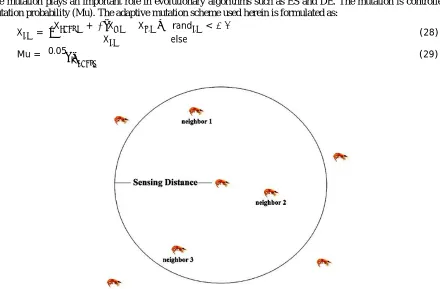
where K and K are the best and the worst fitness values of the krill individuals so far; Ki represents the fitness or the objective function value of the ith krill individual; Kj is the fitness of jth (j = 1,2,. . .,NN) neighbor; X represents the related positions; and NN is the number of the neighbors. For avoiding the singularities, a small positive number, e, is added to the denominator. The right sides of Eqs. contain some unit vectors and some normalized fitness values. The vectors show the induced directions by different neighbors and each value presents the effect of a neighbor. The neighbors’ vector can be attractive or repulsive since the normalized value can be negative or positive. For choosing the neighbor, different strategies can be used. For instance, a neighborhood ratio can be simply defined to find the number of the closest krill individuals. Using the actual behavior of the krill individuals, a sensing distance (ds) should be determined around a krill individual (as shown in Fig. 1) and the neighbors should be found. The sensing distance for each krill individual can be determined using different heuristic methods. Here, it is determined using the following formula for each iteration:
d, =
1
5N X −X (13)
where ds,i is the sensing distance for the ith krill individual and N is the number of the krill individuals. The factor 5 in the denominator is empirically obtained. Using Eq. (17), if the distance of two krill individuals is less than the defined sensing distance, they are neighbors.
The known target vector of each krill individual is the lowest fitness of an individual krill. The effect of the individual krill with the best fitness on the ith individual krill is taken into account using Eq. (14). This level leads it to the global
optima and is formulated as:
α = C K, X, (14)
where, C is the effective coefficient of the krill individual with the best fitness to the ith krill individual. This
coefficient is defined since a target i leads the solution to the global optima and it should be more effective than other krill individuals such as neighbors. Here in, the value of C is defined as:
C = 2 rand + I
I (15)
Foraging motion
The foraging motion is formulated in terms of two main effective parameters. The first one is the food location and the second one is the previous experience about the food location. This motion can be expressed for the ith krill individual
as follows:
F = Vβ + ωF (16)
where
β = β + β (17)
and V is the foraging speed, ω is the inertia weight of the foraging motion in the range [0, 1], is the last foraging motion, β is the food attractive and β is the effect of the best fitness of the ith krill so far. According to the measured values of the foraging speed , it is taken 0.02 (ms-1). The food effect is defined in terms of its location. The center of food should be found at first and then try to formulate food attraction. This cannot be determined but can be estimated. In this study, the virtual center of food concentration is estimated according to the fitness distribution of the krill individuals, which is inspired from ‘‘center of mass’’. The center of food for each iteration is formulated as:
X =
∑ 1
K X
∑ K1
(18)
Therefore, the food attraction for the ith krill individual can be determined as follows:
β = C K, X, (19)
where C is the food coefficient. Because the effect of food in the krill herding decreases during the time, the food coefficient is determined as:
C = 2 1− I
I (20)
The food attraction is defined to possibly attract the krill swarm to the global optima. Based on this definition, the krill individuals normally herd around the global optima after some iteration. This can be considered as an efficient global optimization strategy which helps improving the globality of the KH algorithm. The effect of the best fitness of the ith
krill individual is also handled using the following equation:
β = C K, X, (21)
where Kibest is the best previously visited position of the ith krill individual.
Physical diffusion
The physical diffusion of the krill individuals is considered to be a random process. This motion can be express in terms of a maximum diffusion speed and a random directional vector. It can be formulated as follows:
D = D δ (22)
D = D 1− I
I δ (23) Motion Process of the KH Algorithm
The physical diffusion performs a random search in the proposed method. Using different effective parameters of the motion during the time, the position vector of a krill individual during the interval t to t + ∆t is given by the following equation:
X (t +∆t) = X (t) +∆tdX
dt (24)
It should be noted that ∆t is one of the most important constants and should be carefully set according to the optimization problem. This is because this parameter works as a scale factor of the speed vector. ∆t t completely depends on the search space and it seems it can be simply obtained from the following formula:
∆t = C UB −LB (25)
where NV is the total number of variables, and LBj and UBj are lower and upper bounds of the jth variables (j = 1,2,. .
.,NV), respectively. Therefore, the absolute of their subtraction shows the search space. It is empirically found that Ct is
a constant number between [0, 2]. It is also obvious that low values of Ct let the krill individuals to search the space
Genetic operators
To improve the performance of the algorithm, genetic reproduction mechanisms are incorporated into the algorithm. The introduced adaptive genetic reproduction mechanisms are crossover and mutation which are inspired from the classical DE algorithm.
Crossover
The crossover operator is first used in GA as an effective strategy for global optimization. A vectorized version of the crossover is also used in DE which can be considered as a further development to GA. In this study, an adaptive vectorized crossover scheme is employed. The crossover is controlled by a crossover probability, Cr, and actual crossover can be performed in two ways: (1) binomial and (2) exponential. The binomial scheme performs crossover on each of the d components or variables/parameters. By generating a uniformly distributed random number between 0 and 1, the mth component of Xi ,Xi,m, is manipulated as:
X, =
X , rand, < C
X, else (26)
C = 0.2K, (27)
Mutation
The mutation plays an important role in evolutionary algorithms such as ES and DE. The mutation is controlled by a mutation probability (Mu). The adaptive mutation scheme used herein is formulated as:
X, =
X , + μ X , −X , rand, <
X, else
(28)
Mu = 0.05
K,
(29)
Figure 1: Schematic representation of Sensing Distance around a krill individual
Methodology of the KH algorithm
Various krill-inspired algorithms can be developed by idealizing the motion characteristics of the krill individuals. Generally,
the KH algorithm can be introduced by the following steps:
I. Data Structures: Define the simple bounds, determination of algorithm parameter(s) and etc. II. Initialization: Randomly create the initial population in the search space.
III. Fitness evaluation: Evaluation of each krill individual according to its position. IV. Motion calculation:
Foraging motion
Physical diffusion V. Implement the genetic operators
VI. Updating: updating the krill individual position in the search space. VII. Repeating: go to step III until the stop criteria is reached.
VIII. End
IV. SIMULATION RESULTS AND DISCUSSION
The proposed KHA algorithm has been applied to DELD problems by considering five- generating unit systems to investigate the effectiveness and robustness. The result obtained from proposed approach has been compared with other previously developed techniques. For implementing the KHA technique in ELD problems, the maximum number of generation (iteration) of 500 is taken for simulation study of the five unit test systems.
Table.1 Simulation result for five unit system
Hour Unit 1 (MW)
Unit 1 (MW)
Unit 1 (MW)
Unit 1 (MW)
Unit 1 (MW)
Load (MW)
Figure.2 power generation of five unit system
Table.2 Comparison of result with other techniques Methods Minimum
Cost($/h) MSL[26] 49216.81 SA[26] 47356.00 APSO[26] 44678 EAPSO[26] 43784 GSO [26] 43414.12 KHA 43402.165
Figure.3 Comparison of result with other algorithms.
V. CONCLUSION
A simple and an efficient optimization technique based on KHA is addressed for solving DELD problems, taking account of the valve point effect. By considering a five-unit test system, it is observed that the proposed algorithm has better convergence characteristics, robustness and computational efficiency as compared to other heuristic methods. It is also clear from the result obtained that by different trials, the proposed KHA technique can avoid the shorting of premature convergence of other optimization to obtain good quality results. When more complex fuel cost characteristics is considered, the solution quality and computational efficiency are significantly better than other methods.
R
EFERENCES[2] S.Takriti &B.Krasenbrink “A decomposition approach for the fuel constrained economic power-dispatch problem,” European journal of operational research .Vol. 112, issue 2, pp.460-466, 199
[3] L.Papageorgiou and E. Fraga. “A mixed integer quadratic programming formulation for the economic dispatch of generators with prohibited operating zones, ”Electric Power System Research, vol. 77, issue 10, pp.1292-1296, 2007
[4] A.Keib, H. Ma, and J. Hart, “Environmentally constrained economic dispatch using the Lagrangian relaxation method,” IEEE Transaction son Power System.vol.9, issue 4, pp. 1723-1727, 1994
[5] K. Hindi and M. Ghani, “Dynamic economic dispatch for large-scale power systems: A Lagrangian relaxation approach,” Electric Power system research, vol.13, issue1pp.51-
[6] D.Travers, and R Kaye, “Dynamic dispatch by constructive dynamic programming,” IEEE Transactions on Power System. vol.3, issue 1, pp.72-78, 1998
[7] S.Basker, P. Subbaraj, and M Rao, “Hybrid real coded genetic algorithm solution to economic dispatch problem,” Computers and Electrical Engineering. vol.29, issue 3,pp. 407-419, 2003
[8] C. Chiang, “Improved genetic algorithm for power economic dispatch of units with value-point effects and multiple fuels,” IEEE Transactions on Power System. vol. 20, issue 4, pp. 1690-1699, 2005.
[9] K. Wong, C. Fong, “Simulated annealing based economic dispatch algorithm,” IEEE proceedings on Generation, Transmission and Distribution. vol.140, issue 6, pp. 509-515, 1993
[10] T.Jayabarathi, K.Jayaprakash, and D.Jeyakumar, “Evolutionary programming techniques for different kinds of economic dispatch problems,” Electric Power System Research. vol.73, issue 2, pp. 169- 176, 2005
[11] T. Victoire, and A. Jeyakumar, “A modified hybrid EP-SQP for dynamic economic dispatch with valve-point effect,” International journal of Electrical Power and Energy Systems. vol. 27, issue 8, pp. 594-601, 2005
[12] T. Victoire, and A. Jeyakumar, “Hybrid EP-SQP for dynamic economic dispatch with valve-point effect,” Electric Power System Research,vol.71, issue 1, pp. 51-59, 2004
[13] P. Attaviriyanupap, H. Kita, E. Tanaka, J. Hasegawa, “A hybrid EP and SQP for dynamic economic dispatch with non smooth fuel cost function,” IEEE Trans. Power Syst.2002; vol.17, issue 2, pp.411-416, 2002.
[14] T.A.A. Victoire, and A.E. Jeyakumar, “Deterministically guided PSO for dynamic dispatch considering valve-point effect,” Electric Power Syst. Res. vol. 73, issue 3, pp. 313-322, 2005
[15] Victoire, T.A.A., and Jeyakumar,A.E.Reserved constrained dynamic dispatch of units with valve point effects. IEEE. Trans. Power Syst.2005; 20(3): 1273-1282
[16] Su A Yuan, Y Yuan. et al., “An improved PSO for dynamic load dispatch of generators with valve-point effects. Energy. vol. 34, issue 1, pp. 67-74, 2009
[17] X Yuan, L Wang, and Y Yuan. et al, “ A modified differential evolution approach for dynamic economic dispatch with valve-point effects, “Energy Conversion and Management, vol. 49, issue 12, pp. 3447-3453, 2008
[18] X Yuan, L Wang, and Y Yuan. et al, “A hybrid differential evolution method for dynamic economic dispatch with valve-point effects, “Expert system with Applications. vol. 36, issue 2, pp. 4042-4048, 2009
[19] R.K.Swain, A.K.Barisal, P.KHota and R.Chakrabarti, “Short Term Hydrothermal Scheduling Using Clonal Selection Algorithm, “International Journal in Electrical Power and Energy System. Vol. 33, issue 3, pp. 647-657, March. 2011
[20] T.Niknam, F.Golestaneh, Enhanced adaptive particle swarm optimization algorithm for dynamic economic dispatch of units considering valvepoint effects and ramp rates, IET Gener.Transm.Distrib, 2012, Vol6, issue5,pp424-435.
[21] Panigrahi.C.K,Chattopadhyay.P.K,.Chakrabarty.R.N,,Basu.M simulated annealing technique for dynamic economic dispatch ” Elect power compt.syst,2006,34pp577-586
[22] Panigrahi, B,. Ravikumar, P.V,. Das,S,. “Adaptive particle swarm optimization approach for static and dynamic for static and dynamic economic load dispatch. Energy conversion Mang., 2008,49,pp1407- 1422
[23] Sivasubramani, S. Swarup, K.S.: 'Hybrid SOA-SQP algorithm for dynamic economic dispatch with valve point effects’ Energy, 2010, 35.(12),pp5031-5036
[24] Hemamalini,S,.Simon,S.P “.Dynamic economic dispatch using artificial using Maclaurin series based Lagrangian method” Energy cover, Manage,2010,5,pp2212-2219.
[25] Krishnanand,K.N.D.Ghose,D.Glowworm swarm optimization: a new model for optimizing multimodal functions, Computational Intelligence Studies,1(1):93-119,2009 International Journal of Engineering Research & Technology (IJERT) ISSN: 2278-0181.
[26] K.C. Meher,R. K. Swain and C. K. Chanda," Solving Dynamic Economic Dispatch Problems Facilitating Meta-Heuristic Technique"International Journal of Engineering Research & Technology, Vol. 4 Issue 09, September-2015
[27] S. Vijayaraj and Dr. R. K. Santhi ,'Multi-Area Economic Dispatch with Multi Fuel Option Using Improved Bat Algorithm', International Journal of Innovative Research in Science, Engineering and Technology ,Vol. 5, Issue 10, October 2016.
[28] S. Vijayaraj and Dr. R. K.S anthi ,Multi-Area Economic Dispatch with Valve Point Effect Using Improved Bat Algorithm, International Journal for Research in Applied Science & Engineering Technology, Volume 4 Issue 10, October 2016.
[29] S. Vijayaraj and Dr. R. K. Santhi ,Multi-Area Economic Dispatch with Prohibited Operating Zones Using Improved Bat Algorithm, International Journal of Multidisciplinary Research and Modern Education, Volume II, Issue II, 2016.
[30] Nagendra Singh and Yogendra Kumar," Multiobjective Economic Load Dispatch Problem Solved by New PSO" Advances in Electrical Engineering ,Volume 2015, http://dx.doi.org/10.1155/2015/536040.
[31] S. Vijayaraj, and Dr. R. K.S anthi," Economic Dispatch With Multi-Fuel Option Using Improved Bat Algorithm" International Journal of Multidisciplinary Research and Modern Education, Volume II, Issue II, 2016.
[32] S. Vijayaraj, and Dr. R. K. Santhi, "Economic Dispatch with Prohibited Zones Using Improved Bat Algorithm”, International Journal of Advanced Research in Electrical, Electronics and Instrumentation Engineering, Vol. 5, Issue 11, November 2016.