Navigation Manual
(Unlinked)
This document does not contain hyperlinks and may be formatted for printing instead of web us. This is
due to changes in content and specifications of the vehicle that happen throughout the model year. This
manual will be replaced with a hyperlinked version at the end of the model year.
2007 Ridgeline
Introduction ...4
Manual Overview ...4
System Overview ...4
Accessories Precautions ...5
Important Safety Information ...5
Map Overview ...6
Current Street ... 6
Verified/Unverified Street... 6
User Agreement ...8
Getting Started ...10
System Controls ...10
Voice Control Basics...11
Using the Voice Control System ... 12
Improving Voice Recognition ... 13
Selecting an Item (Button) on the Screen ...14
Selecting an Item in a List ...14
Using the On-screen Keyboard ...14
System Start-up ...16
Map Screen Legend...18
Map Screen Description ...19
Displaying Current Location ...19
System Function Diagram ...20
Entering a Destination ...21
By Address ...22
Selecting the State or Province... 22
Selecting the City ... 22
Selecting the Street ... 24
Entering the Street Number ... 25
By Intersection...26
Selecting the State or Province... 26
Selecting the City ... 26
Selecting the Street ... 28
By Places ...29
Finding the Place by Category ... 30
Finding the Place by Name... 33
Finding the Place by Phone Number ... 34
By Map Input...34
Showing the Map of Current Position ... 34
Showing the Map of City... 35
Showing the Map of State ... 35
Showing the Map of Continental USA ... 36
By Previous Destinations...37
By Today’s Destinations ...38
Editing Today’s Destination List ... 38
Adding Destinations to the List... 38
By Address Book...39
Adding Addresses to the Personal Address Book ... 40
By Go Home ...40
Driving to Your Destination ... 42
Driving to Your Destination ...42
Calculate Route to Screen...42
Changing the Routing Method... 43
Viewing the Routes... 43
Viewing the Destination Map ... 44
Map Screen ...44
Route Line ... 44
Guidance Prompts ... 45
Map Screen Legend ... 46
Guidance Screen ...47
Guidance Screen Legend ... 47
Distance and Time to Destination...48
Direction List ...48
Exit Info (Freeway Exit Information) ... 49
Split Screen Guidance...49
Map Scale ...50
Map Orientation...51
Destination Icon...52
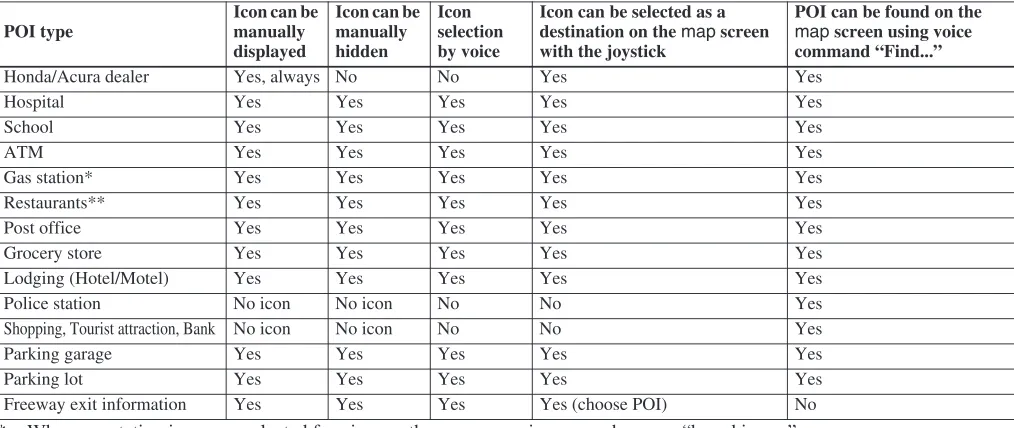
Landmark Icons ...52
Showing Icons on the Map... 54
Icon Options... 54
Guidance Mode... 54
Going Off the Route ...55
Viewing/Saving the Current
Location...56
Pop-ups and Disclaimers ...56
Changing the Route ...57
Waypoints ... 58
Reroute: Avoid Streets ... 59
Reroute: Detour ... 60
Reroute: Change Routing Method ... 60
Changing Your Destination...60
Changing Your Destination (other methods) ...61
Find Nearest (Voice command) ... 61
Go Home (Voice command) ... 61
Entering a Destination from the Menu Screen (while on route) ... 61
Continue Trip Screen...62
Information Features ...63
Information Screen ...63
Set Up ...63
Voice Command Help ...63
Map Legend...64
Calendar...65
Entering Your Schedule ... 65
Calculator ...66
Unit Conversion... 67
Key to Zagat Ratings ...67
System Set-up... 69
Set up Mode...69
Set up Screen (first) ...69
Brightness ... 69
Volume ... 69
Display... 70
Guidance Prompts ... 71
Contrast ... 71
Set up Screen (second) ...71
Personal Information ...72
Address Book ... 72
Home Address... 75
PIN Number ... 75
User Name ... 76
Previous Destinations ... 77
Routing & Guidance...77
Rerouting ... 77
Unverified Area Routing... 79
Edit Avoid Area... 83
Edit Waypoint Search Area ... 85
Guidance Mode... 86
Vehicle...86
Off-road Tracking... 86
Correct Vehicle Position... 87
System Information ...87
Basic Settings ...88
Keyboard Layout ... 88
Units (mile or km) ... 88
Voice Recognition Feedback ... 88
Voice ... 88
Clock Adjustment ...88
Auto Daylight Saving Time ... 88
Auto Time Zone by GPS... 89
Menu Color ... 90
System Initialization ... 91
Entering the Security Code...91
Map Matching...92
System Limitations ... 93
Database Limitations... 95
Customer Assistance... 96
Reporting Errors ...96
Honda Automobile Customer Service ...96
Visiting Your Dealer...97
Obtaining a Navigation Update DVD...97
Changing the DVD ...98
Time Adjustment ...90
System Initialization ...91
Color ...90
GPS Initialization...92
PC Card ...98
Coverage Areas...99
Map Coverage ...99
U.S. Detailed Coverage Areas... 99
Canada Detailed Coverage Areas ... 103
Frequently Asked Questions....108
Troubleshooting...114
Glossary ...115
Glossary...115
Voice Command Index...118
Global Commands ...118
Navigation General Commands ..118
Navigation Display Commands...119
Find Place Commands...120
Climate Control Commands ...121
Temperature Voice Commands...122
Radio Voice Commands...122
CD Voice Commands...123
Information Screen Voice Commands...123
Set up Screen (first) Commands...123
On-Screen Commands ...124
On-Screen Commands Assist... 124
Manual Overview
The manual is divided into the following sections:
• Getting started - A basic introduction that discusses the controls and how to communicate with the system. • Entering a Destination - How to enter
an address or locate a point of interest (POI).
• Driving to your Destination – An explanation of the map features, guidance, and cautions.
• Information Features - Voice Command Help, Map Legend, Calendar, Calculator, and Key to Zagat Ratings.
• System Set-up - How to set up and tailor the system for your personal use and use the Address Book.
The back of this manual contains: • Frequently Asked Questions (FAQs) • Troubleshooting Guide
• Glossary of Terms • Voice Command List
System Overview
Your navigation system is a highly sophisticated location system with voice control that uses satellites and a map database to show you where you are and to help guide you to a desired
destination.
The navigation system receives signals from the global positioning system (GPS), a network of 24 satellites in orbit around the earth. By receiving signals from several of these satellites, the navigation system can determine the latitude, longitude, and elevation of your vehicle. In addition, a gyroscopic yaw sensor and a vehicle speed sensor in your vehicle keep track of the direction and speed of travel at all times.
The navigation system applies this location, direction, and speed
information to the maps and calculates a route to the destination you enter. As you drive to that destination, the system provides map and voice guidance.
Accessories Precautions
If you have front window tinting installed, be aware that if the tint has metallic properties, it can seriously degrade or prevent GPS reception. This is because the GPS antenna is located under the dash board.
If you plan to install electronic components such as radar detectors, vehicle location devices, remote starters, additional amplifiers, or other audio components, ensure that they are not located near the navigation control unit under the driver’s seat, near the navigation screen in the dash, or near the GPS antenna under the dash board. Signal noise emanating from these devices can cause intermittent disruption of the navigation system.
Important Safety Information
The navigation system can distract your attention from the road if you focus on the screen or operate the system’s controls while driving.
Enter as much information as possible into the system before you begin driving, or when the vehicle is stopped. Then, as you drive, listen to the audio instructions and use voice commands when possible.
While driving, do not look at the screen or operate the system controls for more than a second or so at a time, and only after deciding you can do so safely. Pull to the side of the road if you need more time to look at the screen or operate the controls.
Using the navigation system while driving can take your attention away from the road, causing a crash in which you could be seriously injured or killed.
Follow all operating instructions and safety information in this manual.
The navigation system is designed to provide route information to help you reach your destination. However, this route guidance may sometimes conflict with current road conditions such as street closures, road construction, detours, and out-of-date map data.
Additionally, the system itself has certain limitations (see page 93). Therefore, you must verify the audio and visual route information provided by the system by carefully observing the roadway, signs and signals, etc. If you are unsure, proceed with caution. Always use your own good judgment, and obey traffic laws while driving.
Map Overview
Current Street
The current street on which your vehicle is appears at the bottom of the map screen (see page 18). A message saying
“Not on a digitized road” may appear instead when you drive half a mile away from a mapped road. For more details, see Off-road Tracking on page 55.
Verified/Unverified Street
Your navigation system has two kinds of streets: verified (dark colored) and unverified (light colored). The differences between the two types of streets are contrasted in the chart on page 7.
“Unverified” Road
Verified streets (dark colored) Unverified streets (light colored)
When displayed
These roads are found within metropolitan areas, and include interstate freeways and major roads
connecting cities.
These roads are found in rural areas, and typically include residential streets away from the center of a town.
Street color Shown on daytime map screen as black or red, such as interstate freeways.
Shown on the daytime map screen as light brown.
Map Quality
The database vendor has verified these streets. Information like turn restrictions, average speed, and whether it is a one way street have been gathered and used when creating your route to a destination.
These streets have not been verified by the database vendor. The system does not contain information about one-way streets, turn restrictions, or the road’s average speed. They are shown on the map for reference and can have errors in map location, naming, and address range.
Routing differences
While driving to your destination, the displayed route line is solid blue. The system provides voice and map guidance to your destination.
Your route line is either a blue dotted “vector line,” or a dashed pink/blue line. For information on selecting this option, and the routing differences, see Unverified Area Routing on page 79.
Cautions
There are no pop-up boxes urging extra caution during a route. However, because roads constantly change, you are urged to use common sense, and always obey posted traffic restrictions.
Regardless of whether the user chooses route guidance, there are cautionary screens before and during the route urging the user to be extra cautious, and obey all traffic restrictions. See Unverified Area Routing on page 79.
Guidance voice
Voice guidance issues maneuvers such as “In a half mile make a right turn.”
The suffix “if possible” is added to each guidance maneuver. For example: “In a half mile make a right turn, if possible.”
Time and distance “to go”
The time and distance “to go,” displayed while on route to a destination, is based on the average speed and distance for the roads used for your route.
In using this DVD “Satellite Linked Navigation System” (the “DVD”), which includes HONDA MOTOR CO., LTD. software, ALPINE
ELECTRONICS, INC. software, NAVTEQ database contents, INFO USA CORPORATION database, ZAGAT SURVEY database contents, and ZENRIN CO. database contents (hereinafter referred to as “Licensors”), you are bound by the terms and conditions set forth below.
By using your copy of the DVD, you have expressed your Agreement to the terms and conditions of this Agreement. You should, therefore, make sure that you read and understand the following provisions. If for any reason you do not wish to be bound by the terms of this Agreement, please return the DVD to your dealer.
• The DVD may not be copied, duplicated, or otherwise modified, in whole or in part, without the express written permission of the Licensors. • The DVD may not be transferred or
sublicensed to any third party for profit, rent or loan, or licensed for reuse in any manner.
• The DVD may not be decompiled, reverse engineered or otherwise disassembled, in whole or in part. • The DVD may not be used in a
network or by any other manner of simultaneous use in multiple systems. • The DVD is intended solely for
personal use (or internal use where the end-user is a business) by the consumer. The DVD is not to be used for commercial purposes.
• The Licensors do not guarantee to the customer that the functions included in the DVD meet the specific objectives of the user.
• Licensor shall not be responsible for any damages caused by the use of the DVD to the actual user or to any third party.
• The warranty on the DVD shall not extend to an exchange or refund due to misspelling, omission of letters, or any other cosmetic discrepancy in the contents of the DVD.
• The right to use the DVD shall expire either when the user destroys the DVD or software, or when any of the terms of this Agreement are violated and the Licensors exercise the option to revoke the license to use the DVD or software.
• The terms and conditions hereof apply to all subsequent users and owners as well as to the original purchaser.
The user shall indemnify and save harmless the Licensors, and their officers, employees and agents, from and against any claim, demand or action, irrespective of the nature of the cause of the claim, demand or action, alleging loss, costs, expense, damages or injuries (including injuries resulting in death) arising out of the use or possession of the DVD or software.
Use, duplication, or disclosure of this DVD by or on behalf of the United States government is subject to “Restricted Rights” as set forth at FAR 52.227-14, -19 or DFARS 252.227- 7013, as applicable. Manufacturers are the Licensors, including HONDA MOTOR CO., LTD., 2-1-1 Minami Aoyama Minato-Ku Tokyo 107-8556 JAPAN., Alpine Electronics, Inc., 20-1 Yoshima Kogyodanchi, Iwaki, Fukushima 970-1192 JAPAN., NAVTEQ Corporation, 222
Merchandise Mart, Suite 900, Chicago, IL, 60654, INFO USA
CORPORATION, 5711 South 86th Circle, Omaha, NE 68127.,
System Controls
Joystick/ENT button MAP/GUIDE button
CANCEL button Screen
MENU button
INFO button
AUDIO button
OPEN/CLOSE button
ZOOM (IN)/ (OUT)buttons
MENUbutton
Displays the Enter destination by
screen. When on a route, displays the
Change route by screen.
INFObutton
Displays the screen for selecting Set up, Voice Command Help, Map Legend, Calendar, Calculator, and
Key to Zagat Ratings.
AUDIObutton
Press to display the audio screen. For information on audio system features, see the Audio section of the Owner’s manual.
MAP/GUIDEbutton
Displays the map. When on a route, switches between the map and
guidance screens.
CANCELbutton
ZOOM (IN)/ (OUT)buttons
Press ZOOM to zoom in (to show more detail), or ZOOM to zoom out (to show more area and less detail) while a map screen is displayed. ZOOM IN reduces the scale (showing less area with greater detail). ZOOM OUT increases the scale (showing more area with less detail).
Joystick/ENTbutton
Moves left, right, up and down, to move the highlighting around the display, to scroll through lists, or to look around a displayed map. After making a selection in a menu or list, push in on the joystick to enter the selection into the system. In almost all cases, you can enter a selection into the system by using the voice control system, highlighting the item and pushing in on the joystick, or by touching the appropriate item you wish to select.
OPEN/CLOSEbutton
Tilts the screen down to access the CD changer.
Screen
All selections and instructions are displayed on the screen. In addition, the display is a “touch screen” – you can enter information into the system by touching the images (icons) on the screen with your finger.
For example, if you need to enter a street name, a keyboard will be displayed. You can type in the street name by saying or selecting the individual characters on the screen. Clean the screen with a soft damp cloth. You may use a mild cleanser intended for use on liquid crystal displays (LCDs). Harsher chemicals may damage the screen.
NOTE:
Voice Control Basics
Your vehicle has a voice control system that allows hands-free operation of most of the navigation system functions. You can also control the audio system and the climate control system. The voice control system uses the Talk and
BACK buttons on the steering wheel and a microphone near the map light on the ceiling.
NOTE:
While using the voice control system, all of the speakers are muted.
Talk button
BACK button
•
•
• If your vehicle is equipped with a rear view camera option, whenever
For the best image, always keep the rear view camera lens clean, and be sure it is not covered.
you shift to R (reverse), the rear view
area is limited, you should always is shown on the navigation system screen.
back up slowly and carefully, and Since the rear view camera display
Talk button
This button activates the voice control system. Press it when you want to give a voice command. See Voice Command Index on page 118 for a list of voice commands.
BACK button
This button has the same function as the
CANCEL button. When you press it, the display returns to the previous screen. When the previous screen appears, the system replays the last prompt. This button is enabled for the navigation system commands only. However, it can be used to cancel an audio or climate control voice command up to one second after the command confirmation.
Using the Voice Control System
Most of the system’s functions can be controlled by voice commands. The voice control system is activated with the Talk button. To control your navigation system by voice, press and release the Talk button, wait for the beep, then give a voice command. Once the microphone picks up your
command, the system changes the display in response to the command and prompts you for the next command. Using the Talk button, answer the prompts as required.
If you hear a prompt such as “Please use the touch screen to...” or “Please choose an area with the joystick,” the system is asking for input that cannot be
performed using the voice control system.
If the system does not understand a command or you wait too long to give a command, it responds with “Pardon,” “Please repeat,” or “Would you say again.” If the system cannot perform a command or the command is not appropriate for the screen you are on, it sounds a beep.
Anytime you are not sure of what voice commands are available on a screen, you can always say “Help” at any screen. The system can then read the list of commands to you.
When you speak a command, the system generally either repeats the command as a confirmation or asks you for further information. If you do not wish to hear this feedback, you can turn it off. See
the Voice Recognition Feedback
setting in Set up.
Improving Voice Recognition
To achieve optimum voice recognition, the following guidelines should be followed:
NOTE:
Make sure the correct screen is displayed for the voice command that you are using. See Voice Command
Index on page 118.
•
• After pressing the Talk button, wait for the beep, then give a voice command.
• Give a voice command in a clear,
pausing between words.
• If the system cannot recognize your command, speak louder.
• If the microphone picks up voices other than yours, the system may not interpret your voice commands correctly.
• If you are still having trouble with the voice control system, refer to Voice
Command Help on the
Information screen.
natural speaking voice without
not blow against the microphone on
Close the windows and the sunroof. the ceiling. Place your hand over the Adjust the airflow from both the
microphone; if you feel any airflow, dashboard and side vents so they do
adjust the vents.
•
Selecting an Item (Button)
on the Screen
On most screens, there are items that can be selected (like buttons with titles such as OK or Return). To select an item on any screen, do one of the following:
• Use the voice control system and say the name of the desired item. Every selectable item on the screen, including some listed items, is recognized by the voice control system.
• Touch the desired item on the screen. • Move the highlighting to the desired
item with the joystick, then push in on the joystick.
Tip:
If buttons are very dark colored, this means that they cannot be selected.
Selecting an Item in a List
To scroll through a list, do one of the following:
• Use the joystick to scroll through the list item by item.
• Use the voice control system and say “Next” or “Previous” or use the “on screen” scroll up or down buttons, or the ZOOM buttons to scroll through the list page by page.
If you cannot find the desired name, or have made an error, return to the previous screen by pressing the
CANCEL or the BACK button.
To select the desired item in the list, do one of the following:
• Use the voice control system, and say the item number of the desired item. • Touch the item on the screen. • Use the joystick to move the
highlighting to the item, then push in on the joystick.
Using the On-screen
Keyboard
When the system needs input from you, the display changes to a keyboard. Use the displayed letters to enter the information. Enter each letter by one of the following methods:
• Using the voice control system, say the desired letter on the screen. • Move the highlighting to the desired
letter using the joystick, then push in on the joystick.
• Touch the desired letter on the screen.
When speaking the letters or using “spell mode,” you can substitute the name that represents each letter or symbol. This improves recognition. The system will only respond to the names shown in the following graphic. For example:
• To select the letter “A”: Say, “A”; “Alpha”; or “Apple.”
The names that can be used for each letter are shown below. For additional keyboard symbols, see page 124.
Alpha
Apple BravoBoy Charlie DeltaDog EdwardEcho FoxtrotFrank GeorgeGolf HenryHotel JulietJohn Apostrophe
Kilo King
Lima Larry
Mike Mary
November
Nancy Oscar
Papa Paul
Quebec Queen
Romeo Robert
Sierra Sam
Tango
Tom Ampersand
Uniform
Uncle Victor WhiskeyWilliam X-Ray YankeeYellow ZebraZulu Slash
India Igloo
Each entered letter will appear at the top of the display. Say or select Space to enter a space between words. Say or select Delete to erase a letter entered incorrectly.
When entering an address, the system searches the database for words that match the letters you are entering. As a result, you will notice that some letters are no longer available.
When the system finds only one entry that matches, it completes the entry of the name for you. If the system finds more than one entry that matches your input, the system displays a list.
Tip:
You can choose to have your keyboard
displayed in alphabetized format as show below:
System Start-up
When you turn the ignition to ON (II), it takes several seconds for the navigation system to boot up.
The first screen to appear is the navigation system globe screen. The screen then changes to the Disclaimer
screen:
NOTE:
The OK button does not appear immediately. It appears after the software is loaded.
Read this disclaimer carefully so you understand it before continuing. Push in on the joystick, or touch OK, and the
map screen will appear on the display. The “OK” cannot be activated by voice.
If you do not press the joystick or touch
OK, the screen will go dark after 30 seconds. To return to the Disclaimer
screen, press any navigation or voice control button.
NOTE:
If you do not select OK, and then enter the Set up or Information screens, some items are not available, and will show up as darkened buttons. See System Function Diagram on page 20.
If you have entered any Calendar reminders, they are displayed after you select OK.
Or in a regular keyboard (QWERTY) format as shown below:
See Keyboard Layout in the Set up
The Calendar reminder screen remains displayed until you select OK,
Remind Later or press the CANCEL
button.
If you select OK, the reminder will not show up again. If you wish to have the reminder show up again later in the day, touch the Remind Later button.
If you press the CANCEL button, the message will be displayed the next time you start the vehicle.
NOTE:
Map Screen Legend
Map Orientation
(see page 51)
GPS Signal Strength
Green: Best Reception White: Good Reception None: No Reception
Map Scale
(see page 50)
ICON Button (see page 54)
Vehicle Position (see page 56)
(Use voice command “Display the current location.” or touch the icon to show current location.)
Streets
(see Map Overview on page 6)
Red: Interstates or Freeways Black: Verified Streets Light Brown: Unverified Streets
Map Features
Dark Green: Park Violet: Hospital Brown: Shopping Mall
Light Brown: Indian Reservation Green: Golf Course
Gray: Airport/Stadium/Business Blue: Body of Water
Blue/Green: Cemetery Matte Blue: University
NOTE:
If you move the joystick over an area (map features shown above), the name is displayed on the screen. Current Street
(see page 6) “North Up”
NOTE:
See Map Legend on the Information screen for further explanation.
“Heading Up”
“Breadcrumbs”
(see Off-road Tracking
on page 55)
Landmark Icon (see page 52)
Acura Dealer
School
Restaurant
ATM
Parking Lot
Post Office Honda Dealer
Hospital
Grocery Store
Gas Station
Hotel/Lodging
Parking Garage
Map Screen Description
Use the ZOOM buttons to change the scale of the map. Zooming in increases the detail, while zooming out gives you a view of a wide area. After changing the scale, give the system a few moments to update the display.
The map can be oriented with north pointing up (North-up), or with a front window view (Heading-up). The red arrow in both heading symbols always points north. The map can display “North-up” in any scale. However, “Heading-up” can be viewed only in the five most detailed map scales (1/20, 1/8, 1/4, 1/2 and 1 mile, or 80, 200, 400, 800 meter and 1 kilometer).
You can switch between the two by saying “Display North up.” or “Display Heading up.” or by touching the Map Orientation icon in the upper corner of the screen.
To view other areas on the map, move the joystick left, right, up, or down. The map will shift in that direction. To return the map to your current location, press either the MAP/GUIDE, the
CANCEL, or the BACK button.
The display automatically changes to the map screen when you reach your destination. Press the MENU button to return to the Enter destination by
screen.
Displaying Current Location
You can say “Display current location.” or touch the vehicle position icon at any time to see the current address, latitude, longitude and elevation. The screen will change to:
NOTE:
The elevation will not appear when the system is temporarily lacking proper GPS information. The system elevation may not agree with elevations shown on roadside elevation signs, and may fluctuate plus or minus 100 feet or more.
You can say “Save current location.” or select Save on the screen to save the current location in the Address Book.
System Function Diagram
This diagram shows the navigation system features, starting at the center and working outward in layers. The navigation program starts at “Key ON,” and then displays the globe screen (blue). If OK is selected, the functions in the yellow segments of the diagram become available in the Set up and
Information screens.The white segments of the diagram are available anytime, even if you do not select OK.
The items above the map screen show various methods, to begin driving to your destination (orange). You are provided with map/voice guidance, routing cautions, and a direction list. While driving to your destination, use the voice control system as much as possible to interact with the navigation, audio, and climate control systems (green).
GL
OBE SCREE N
REMIND
ERS(pg. 17)
CALENDAR T H E DIS CLA IMER SCREEN(pg . 1 6)
- T
HE
MAP SCREEN (pg. 1
8)
-(MA
P/V
OIC
E GU
IDAN
CE, ROUTING CAUTIONS, D
IRE CTIO NS L IST )
-
D
RI
VI
NG
TO
YOUR DESTIN
ATIO
N
-VOICE: "FIND NEAREST..." ATM, ETC. (pg. 120) SELE CT A DEST INATION WITH JOYSTICK
(pg. 60)
VOICE: "GO HOME"(pg.40) VOICE
:
"HELP"(AL L) (pg. 118) VOICE: "IN FORMA TION SCR EE N" (pg. 63) VOIC E: "MENU" (to
change route)(pg. 57) VOICE:
"HOW F
AR TO
THE
DESTINA TION?"
(pg. 46)
VOICE: "DISPLAY (OR SET) CURRENT LOCATION"
(pg. 56)
VOICE: "WH
AT TIME IS IT ?" (pg. 118) VOICE: "AUD IO /CD " (pg. 1 22, 123) V O IC E : C L IMA T E FAN , T E MP (pg.121, 122) "SET W AYPOINT" (pg. 58) VOICE:
"ZOOM IN/ZOOM
OUT"
(pg. 18, 46)
VOICE: "HIDE/DISPLAY ICONS"
(pg. 54, 119)
AVOID AREA (pg. 83) ROUTE GUIDE BASIC CLOCK COLOR VEHICLE ADJ. DISP. PERSONAL
UNVERIFIED (pg. 79)
UNITS MI KM (pg. 88)
ADJUST CLOCK (pg. 88)
OFFROAD TRACKING
PINS (pg. 75)
ADDRESS BOOK (pg.72) VOICE VOLUME (pg. 69) BRIGHT.(pg. 69) NUMERIC RATING
(pg. 67) KEY TO ZAGAT RATINGS
COST (pg. 67)
ENTER (pg. 65)
LIST (pg.
65)
MATH (pg. 66)
CON VERT
(pg. 67)
LIST (pg. 64) CALEND AR FUNCTION CALCULA TOR MAP LE GEN D VOICE: "MEN U" FOR ENTER DESTINA TION SCRE EN (pg.
21) CONTI
NUE TO THE DE STI NA TI ON (RESUME) AFTER RES TAR T (pg . 6 2) KEY ON PRESS OK F orm ore inform ation, see the ve hicle ow ne r's m an ual. V OIC E C OM MA ND S NOT PR ESS ED OK NOT PRESSED OK INFORMA TIO N SCREEN
(pg. 63) AUDIO (pg. 122)
CLIMATE CONTROL (pg. 121) C ONTRAS T (pg. 71) VOICE HELP (pg. 63)
(pg. 55, 86)
DAY /NITE
(p g. 70
) INF OB UT TO N (pg .6 3 ) SE TU P(p g. 69 ) IN F O B U TT O N (p g.
When you press the MENU button, the display changes to:
Address (see page 22)
This selection requires you to enter the city (and possibly the state), and the address that you want to go to.
Intersection (see page 26)
This selection allows you to enter the names of two intersecting streets in a city. This is useful if you know the general location of your destination, but not the exact address.
Places (see page 29)
The system contains the locations of many businesses, parks, hospitals, etc. This selection lets you search these by category, name, or phone number.
Map Input (see page 34)
This selection allows you to point to a destination on the map using the joystick. This allows you to enter a destination or address that may not be listed in the database.
Previous Destinations (see page 37) When you enter a destination with any of the available selections (except
Address Book and Go Home), the last 50 destinations are saved by the system. Use this selection to choose a destination again.
NOTE:
If Previous Destinations is grayed out, there are no Previous Destinations entered.
Today’s Destinations (see page 38) You can enter and sort up to five destinations and store them in the Today’s Destinations list. You can then use the Today’s Destination selection.
NOTE:
If Today’s Destinations is grayed out, there are no Today’s Destinations entered.
Address Book (see page 39)
This selection allows you to select a stored address. The system can store up to a combined total of 200 User 1 and 2 addresses.
Go Home (see page 40)
This selection allows you to select your home or a common place as a
destination.
NOTE:
By Address
After you select Address from the
Enter destination by screen, the display changes to:
Tip:
• When entering an address by voice, it is more efficient to say the city name first, then the street name.
• When entering an address by touch, it is usually easier to enter the street first and then let the system display the city or cities that the street appears in. This avoids having to enter both the city and the street.
NOTE:
If you find that your city is not listed, it may be part of a larger metropolitan area. Try entering the street first.
Selecting the State or Province
The state you are in is displayed at the top of the screen. If your desired destination is in another state, select
Change State.
The display then changes to the Enter state name screen. Use the voice control system and say the name of the state or use the on-screen keyboard to enter the name of the state.
Selecting the City
The city you are in is displayed on the screen. If the city you want is displayed on the screen, say “Select current city.” If your desired destination is in another city, say or enter that city.
By Voice Control:
Say “City” on the Find address by
screen, and the display changes to the
Say city name screen. Say the city name and the searching will begin.
To enter the city name by voice spelling, say or select CHANGE TO Spell Mode on the Say city name screen, and the display will change to the Enter city name screen.
The system has a talkback function. If your spoken letter is not recognized, the system will talk back to you. For example, if you say “E” but the system does not recognize the command, it will ask you such as “E as in Edward?” You should answer “Yes.”
Alternately, to improve voice recognition, you can say “Echo” or “Edward” instead of “E.”
See page 14 for a list of available words for each letter.
By Touch Control:
This is helpful if the street runs through several cities, and you know what city the street is in. Select City, and the display then changes to the Enter city name screen. Use the on-screen keyboard to enter the name of the city.
The system will display a list of city names, with the closest match to the name you entered at the top of the list. Select the number (1-6) of the desired city from the list.
If the system does not find an exact match, select List when you finish entering the name of the city. Most of the cities and towns for that state are listed.
Listings of cities and towns in the non-detailed coverage area may have an asterisk “*” next to their names. If you select one, no detailed street data is available, and an address cannot be entered. Try entering the street first, and then select the city if available.
Select View Dest. Map and use the joystick to select an icon, approximate area, or street you wish to choose as your destination. Otherwise, a central location of the city will be selected. If you select a point of interest (POI) or road in an unverified area, you may or may not have routing in these areas. See
Selecting the Street
By Voice Control:
After you have selected the city, or if you say “Street” on the Find address by screen, the display changes to the
Say street name screen. Say the street name and the searching will begin.
To enter the street name by voice spelling, say or select CHANGE TO Spell Mode on the Say street name
screen, and the display will change to the Enter street name screen.
Say the street name by saying individual letters or numbers, one at a time.
The system has a talkback function. If your spoken letter is not recognized, the system will talk back to you. For example, if you say “E” but the system does not recognize the command, it will ask you such as “E as in Edward?” You should answer “Yes.”
Alternately, to improve voice recognition, you can say “Echo” or “Edward” instead of “E.”
See page 14 for a list of available words for each letter.
By Touch Control:
After you have selected the city, or if you selected Street in the beginning, the display changes to the Enter street name screen. Use the on-screen keyboard to enter the name of the street (like ELM or 42ND) that is your destination.
To enter the name of a major highway, you must use the full name, including a hyphen. For interstates, use an “I” (I-10). For U.S. highways, use US (US-18). For state highways, use the two character state designation (CA-101). For county roads, use the appropriate designation (G-2, for example).
Tip:
The system will display a list of street names, with the closest match to the name you entered at the top of the list. Select the number (1-6) of the desired street from the list.
Entering the Street Number
After you have completed the street name, the display changes to the Enter street number screen. Use the voice control system and say the address number as a continuous string of numbers. For example, the address 1527 should be spoken as “One, five, two, seven.” You can also use the on-screen keyboard to enter the street number. If you try to enter a number outside that range, you will be shown an error message. The system displays the acceptable address range.
If you did not select a city in the beginning, the street name you selected might appear in more than one city. The system will give you a list of cities that the street appears in. Select the desired city from the list. The system then displays the Calculate route to screen (see Driving to Your Destination on page 42).
Tip:
If the particular address you want cannot be found, select Map Input and use the joystick to select the appropriate location on the map (see By Map Input on page 34).
Select View Dest. Map and use the joystick to select an icon, approximate area, or street you wish to choose as your destination. Otherwise, a central location of the street will be selected. If you select a point of interest (POI) or road in an unverified area, you may or may not have routing in these areas. See
By Intersection
After you select Intersection from the
Enter destination by screen, the display changes to:
Tip:
When entering an address, it is usually easier to enter the street first and then let the system display the city or cities that the street appears in. This avoids having to enter the city and the street.
NOTE:
• If you find that your city is not listed, it may be part of a larger
metropolitan area. Try entering the street first.
• Prior to departure, you can set areas to avoid. The system then includes them in its calculations for the destination you have entered. See Edit Avoid Area on page 83.
Selecting the State or Province
The state you are in is displayed at the top of the screen. If your desired destination is in another state, select
Change State.
The display then changes to the Enter state name screen. Use the voice control system and say the name of the state or use the on-screen keyboard to enter the name of the state.
Selecting the City
The city you are in is displayed on the screen. If the city you want is displayed on the screen, say “Select current city.” If your desired destination is in another city, say or enter another city.
By Voice Control:
Say “City” on the Find intersection by
screen, and the display changes to the
Say city name screen. Say the city name and the searching will begin.
To enter the city name by voice spelling, say or select CHANGE TO Spell Mode on the Say city name screen, and the display will change to the Enter city name screen.
The system has a talkback function. If your spoken letter is not recognized, the system will talk back to you. For example, if you say “E” but the system does not recognize the command, it will ask you such as “E as in Edward?” You should answer “Yes.”
Alternately, to improve voice recognition, you can say “Echo” or “Edward” instead of “E.”
See page 14 for a list of available words for each letter.
By Touch Control:
This is helpful if the street runs through several cities, and you know what city the street is in. Select City, and the display then changes to the Enter city name screen. Use the on-screen keyboard to enter the name of the city.
The system will display a list of city names, with the closest match to the name you entered at the top of the list. Select the number (1-6) of the desired city from the list.
If the system does not find an exact match, select List when you finish entering the name of the city. Most of the cities and towns for that state are listed.
Listings of cities and towns in the non-detailed coverage area may have an asterisk “*” next to their names. If you select one, no detailed street data is available, and an address cannot be entered. See Map Coverage on page 99.
Select View Dest. Map and use the joystick to select an icon, approximate area, or street you wish to choose as your destination. Otherwise, a central location of the city will be selected. If you select a point of interest (POI) or road in an unverified area, you may or may not have routing in these areas. See
Selecting the Street
By Voice Control:
After you have selected the city, or if you say “Street” on the Find intersection by screen, the display changes to the Say street name screen. Say the street name and the searching will begin.
To enter the street name by voice spelling, say or select CHANGE TO Spell Mode on the Say street name
screen, and the display will change to the Enter street name screen.
Say the street name by saying individual letters or numbers, one at a time.
the system will talk back to you. For example, if you say “E” but the system does not recognize the command, it will ask you such as “E as in Edward?”
Alternately, to improve voice recognition, you can say “Echo” or “Edward” instead of “E.”
See page 14 for a list of available words for each letter.
By Touch Control:
After you have selected the city, or if you select Street in the beginning, the display changes to the Enter street name screen. Use the on-screen keyboard to enter one of the names (like ELM or 42ND) of the intersecting streets.
To enter the name of a major highway, you must use the full name, including a hyphen. For interstates, use an “I” (I-10). For U.S. highways, use US (US-18). For state highways, use the two character state designation (CA-101). For county roads, use the appropriate designation (G-2, for example).
Tip:
When entering a street, you do not need to enter the direction (N, S, E, W) or the type (St, Ave, etc.). The system will automatically determine that for you.
The system will display a list of street names, with the closest match to the name you entered at the top of the list. Select the number (1-6) of the desired street from the list.
The system has a talk back function. If After you have completed the first name,
You should answer “Yes.”
name of the other intersecting street.
the display changes to the Say
your voice spelling is not recognized,
After you have completed the first street name, the display changes to the Enter intersecting street screen.
Enter the name of the other intersecting street using the on-screen keyboard.
If you did not select a city in the beginning, and the intersection appears in more than one city, you will see the
Select a city screen. The system will give you a list of cities that the intersection appears in. Select the desired city from the list. If more than one intersection appears in a city, select the desired intersection from the Select an intersection screen. The system then displays the Calculate route to
screen (see Driving to Your Destination
on page 42).
Tip:
If the particular intersection you want cannot be found, select Map Input and use the joystick to select the appropriate location on the map (see By Map Input on page 34).
Select View Dest. Map and use the joystick to select an icon, approximate area, or street you wish to choose as your destination. Otherwise, a central location of the street will be selected. If you select a point of interest (POI) or road in an unverified area, you may or may not have routing in these areas. See
Map Overview on page 6.
By Places
After you select Places from the Enter destination by screen, the display changes to:
There are three ways to find a place or point of interest (POI), by Category,
Name, or Phone Number.
Let’s assume you want to find a coffee shop (restaurant) called “Bucks.” • If you know the phone number of the
coffee shop, select Phone Number, then enter the 10-digit number with area code. This is the quickest way to find it.
• The second best method is to select
• You can try to enter “Bucks” using
Name, but you may have to search through a list that might include Bucks Welding, Bucks Surplus, etc.
NOTE:
• Prior to departure, you can set areas to avoid. The system then includes them in its calculations for the destination you have entered. See Edit Avoid Area on page 83.
• You can enter the desired destination using the voice control system. For information of the available voice commands, see Voice Command Index on page 118.
Finding the Place by Category
The Category option gives you a list of categories or types of businesses to select from with the following screen:
Tip:
If you are not sure of the spelling of a place, the best way to find it is to use the keyword search. Select Category, choose a category and subcategory from the menus, then select Place Name by Keyword, and type in the partial name.
Auto Service
The subcategories are: Acura Dealers; Honda Dealers, gas stations, etc.
Banking
The subcategories are: ATM; Bank, etc.
Community
The subcategories are: City Hall; Civic/ Community Center; Convention/ Exhibition Center; Court House; Higher Education; Library; Post Office; School, etc.
Emergency
The subcategories are: Hospital; Police Station; Roadside Assistance, etc.
Lodging
The subcategories are: Bed & Breakfast; Hotel/Motel, etc.
Leisure
Restaurant
This category is broken down into types of food, giving you a selection by each type: All Types, American, French, Japanese, etc.
The ZAGAT SURVEY for some restaurants is available in the system. See the Information screen “Key to Zagat Ratings” for an explanation of these ratings.
On the Select a place screen, restaurants with a Zagat Rating have a “Z” icon at the end of the line. To list only restaurants with Zagat reviews, say or select ZAGAT 2006 only. You can view the complete Zagat Review for a selected restaurant by selecting the “Z” icon.
By voice, select the “Z” icon by saying, “Zagat list number X” (where X is the line number 1-3). Alternately, use the joystick or touch screen to select the “Z” icon.
Say or select Read List and the review will be read out. Say or select OK to display the Calculate route to screen. See Key to Zagat Ratings on page 67 for details on the key to ratings.
Tip:
When trying to find a specific restaurant, select the category All Types. Some restaurants may be miscategorized.
Shopping
The subcategories are: All Types; Accessories/Jewelry; Auto Parts & Electronics; Books/Music/Video; Clothing; Groceries; Home
Improvement; Mall/Department Store; Office Supplies/Electronics; Pharmacy/ Drug Store; Pet Food/Supplies; Sewing/ Linen; Shoes/Bags; Sporting Goods; Toys/Arts/Crafts, etc.
Tip:
When trying to find a specific shopping store, select the category All Types. Some stores may not be in the right category.
Travel
Advanced
If you do not find the category or subcategory you need in the other options, you can find the categories with a keyword. When you select this option, the display changes to the Enter keyword for category screen. Enter the keyword using the on-screen keyboard.
When it finds the categories with the keyword you entered, the display changes to the Select a category
screen. Select the desired category.
After selecting a category, the system will give you the options of Place
Name by Keyword, Sort by
Distance to Travel, City Vicinity, or
Place Name.
With the following screen:
Place Name by Keyword
If you do not know the exact name of the destination, you can find the place with a keyword. When you select this option, the display changes to:
You can find your destination with keyword using the Sort by Distance to Travel option or City Vicinity
option.
If you select the Sort by Distance to Travel option, the Enter keyword for place screen appears. Enter the keyword using the on-screen keyboard. If the system does not find an exact match, select List when you finish entering the keyword. The system starts searching for places that match the entered keyword. If you see your desired place, select it from the list.
If not, scroll through the list to find the desired place.
If you select the City Vicinity option, the Enter city name screen appears. Enter the name of the city using the on-screen keyboard. The system will display a list of city names, with the closest match to the name you entered at the top of the list. Select your desired city name from the list. Once you have selected your desired city name, the
Enter keyword for place screen appears. Enter the keyword using the on-screen keyboard to specify the desired place.
Sort by Distance to Travel
When you select this option, the system gives you a list of all the places in the subcategory. This list is arranged by distance from your current location, with the closest at the top of the list.
The distance and direction to the destination at the top of the list are shown in the screen. The distance shown is straight line distance (as the crow flies), not driving distance. Select the number (1-4) of the desired destination from the list.
Once you select a place, the system then displays the Calculate route to screen (see Driving to Your Destination on page 42).
City Vicinity
The system allows you to find points of interest in the vicinity of the city you entered. When you select this option, the display changes to Enter city name
screen. Enter the name of the city using the on-screen keyboard. If the system does not find an exact match, select List
when you finish entering the name of the city. Select a desired city from the list.
Once you have selected the city, the display changes to Enter a place name
screen. Enter the name of the place using the on-screen keyboard.
Once you select a place, the system then displays the Calculate route to screen (see Driving to Your Destination on page 42).
Place Name
When you select this option, the display changes to Enter a place name screen. Enter your selection, using the on-screen keyboard.
Once you select a place, the system then displays the Calculate route to screen (see Driving to Your Destination on page 42).
Finding the Place by Name
The Name option allows you to enter the name of a business, and then shows you a list of businesses with the same or similar names to select from. Use the name option only if you know the exact spelling of the place. If unsure, use the
Finding the Place by Phone Number
The Phone Number option allows you to select a destination by its telephone number. Only telephone numbers stored in the system under the
Places (of business) option are recognized. The system does not contain residential telephone numbers, or numbers you may have entered in your personal Address Book.
Tip:
If you know the phone number of a point of interest (POI), its uniqueness makes it the fastest entry method. When using the voice control system, the entry should be spoken as a continuous string of numbers. For example, the telephone number (310) 555-4000 should be spoken as “Three, one, zero, five, five, five, four, zero, zero, zero.”
By Map Input
After you select Map Input from the
Enter destination by screen, the display changes to:
NOTE:
• Prior to departure, you can set areas to avoid. The system then includes them in its calculations for the destination you have entered. See Edit Avoid Area on page 83. • For information of the available
voice commands, see Voice Command Index on page 118.
Showing the Map of Current Position
The Current Position selection assumes that you are looking for a destination in the immediate area. The display changes to:
The red arrow indicates your vehicle position. Find your desired destination by pushing the joystick left, right, up, or down. The map and cross hairs will move in the same direction.
Use the joystick to position the cross hairs on the desired icon, map feature, or road. If desired, use the ZOOM
The yellow box indicates the area you will see when you click on the current map with the joystick.
NOTE:
The address of the road segment will be displayed on the 1/20, 1/8, 1/4, or 1/2 mile (80, 200, 400, or 800 meter) scale map.
If this is the desired destination, push in on the joystick again. If not, use the joystick to reposition the cross hairs, then push in on the joystick again to display the new address.
Once you select an address, the system then displays the Calculate route to
screen (see Driving to Your Destination
on page 42).
Showing the Map of City
With the City selection, the display changes to the Enter city name screen. When you have entered the desired city, the display changes to a map. The starting location will be the central position in the selected city.
See Showing the Map of Current Position on page 34 for instructions on finding and entering your desired destination.
Showing the Map of State
With the State selection, the display changes to the Enter state name
screen.
After you select the desired state, the display changes to a map of the state, with the cross hairs located near the middle.
Use the joystick to move the cross hairs to the area of the state close to your intended destination. If desired, use the
Move the cross hairs to the desired destination, then push in on the joystick. The address of the location you have selected will appear at the top of the screen.
The yellow box indicates the area you will see when you click on the current map with the joystick.
NOTE:
The address of the road segment will be displayed on the 1/20, 1/8, 1/4, or 1/2 mile (80, 200, 400, or 800 meter) scale map.
If this is the desired address, push in on the joystick again. If not, use the joystick to reposition the cross hairs, then push in on the joystick again to display the new address.
Once you select an address, the system then displays the Calculate route to
screen (see Driving to Your Destination
on page 42).
Showing the Map of Continental USA
With the Continental USA selection, the display changes to:
Use the joystick to move the cross hairs to the area of the country for your intended destination. Then push in on the joystick.
The map scale changes to display a closer view of the area you selected. Use the joystick to move the cross hairs on the desired icon, map feature, or road. If desired, use the ZOOM buttons to change the map scale. The address of the location you have selected will appear at the top of the screen.
The yellow box indicates the area you will see when you click on the current map with the joystick.
NOTE:
The address of the road segment will be displayed on the 1/20, 1/8, 1/4, or 1/2 mile (80, 200, 400, or 800 meter) scale map.
If this is the desired destination, push in on the joystick again. If not, use the joystick to reposition the cross hairs, then push in on the joystick again to display the new address.
Once you select an address, the system then displays the Calculate route to
screen (see Driving to Your Destination
By Previous Destinations
Every time you route to a destination, that destination is saved by the system. Up to 50 destinations can be stored. Select Previous Destinations from the Enter destination by screen to choose one of those destinations.
After you select Previous
Destinations, the display lists the last 50 destinations entered, with the most recent appearing first.
NOTE:
When finishing a “Today’s Destinations” trip, the Today’s
Destination list entries are stored to this list, beginning with the date (e.g., item 1 shown above).
NOTE:
• If Previous Destinations is grayed out, there are no Previous Destinations entered.
• Because both the Home and personal Address Book list can be protected by a PIN, they do not show up in the previous destination list.
Scroll through the list and say the line number (1-6) of the destination, or touch the desired destination you want.
Once you select the desired destination, the system then displays the Calculate route to screen (see Driving to Your Destination on page 42).
NOTE:
• Prior to departure, you can set areas to avoid. The system then includes them in its calculations for the destination you have entered. See Edit Avoid Area on page 83. • For information of the available
By Today’s Destinations
You can create a “trip” by combining multiple destinations previously selected on the Calculate route to
screen.
Select Today’s Destinations from the Enter destination by screen and the display changes to:
NOTE:
If Today’s Destinations is grayed out, there are no Today’s Destinations entered.
Editing Today’s Destination List
If you change your plans, you can modify the Today’s Destination list order by distance, or by order of entry.
Say or select Input to sort the list by the entry order, and say or select Distance
to sort the list by the distance order. To delete a destination, say or select
Delete and the display changes to
Select a destination to delete screen. Select the destination to delete and say or select Done. The display returns to the previous screen.
NOTE:
For information of the available voice commands, see Voice Command Index on page 118.
Adding Destinations to the List
After you have used any of the other selections from the Enter destination by screen to select a destination, the display changes to:
To add this to the Today’s Destination list, select ADD TO Today’s Dest.
NOTE:
The display then changes to show you all the current entries on the Today’s Destination list. Press the MENU button to return to the Enter destination by
screen.
The system automatically sorts the destinations stored in the Today’s Destination list for the best path.
If the displayed list shows your plans, select the first destination. The system will guide you to the destination according to the order of the list. When you reach the destination, it will be automatically removed from the list.
NOTE:
When finishing a “Today’s Destinations” trip, the Today’s
Destination list entries are stored to the Previous Destination list, beginning with the date (e.g., item 1 shown below).
By Address Book
This selection allows you to choose a personal address entry for a destination. After you select Address Book from the Enter destination by screen, the display changes to:
If an Address Book PIN has been set in Set up, the system prompts you to enter your PIN after you select User 1
or User 2. Say or enter your PIN, and say or select Done.
If the PIN has not been entered, the system displays the list after you select
NOTE:
PINs are optional. If you choose to use a PIN, make sure you remember it. If you forget your PIN, your dealer will have to reset it for you.
The system then displays a list of the places entered in your personal Address Book. You can sort the displayed addresses by Category: ALL,
BUSINESS, PERSONAL or by other
categories you may create.
Scroll through the list to find your desired destination. After you select it, the system then displays the Calculate route to screen (see Driving to Your Destination on page 42).
Adding Addresses to the Personal Address Book
There are two ways to enter addresses to the personal Address Book:
• Entering them in the personal Address Book feature in Set up (see page 72).
• Adding them in the Address Book directly from the Calculate route to
screen (see page 42).
The personal Address Book can be edited (see Address Book on page 72).
NOTE:
• Destinations chosen from the Address Book do not show up in Previous Destinations.
• Prior to departure, you can set areas to avoid. The system then includes them in its calculations for the destination you have entered. See Edit Avoid Area on page 83. • For information of the available
voice commands, see Voice Command Index on page 118.
By Go Home
Selecting Go Home from the Enter destination by screen takes you home or to a frequently used address you have chosen.
If a Go Home PIN has been set in Set up, the system prompts you to enter your PIN. Say or enter your PIN, and say or select Done. The system will then display the Calculate route to
screen (see Driving to Your Destination
on page 42).
If a Go Home PIN has not been set, the system displays the Calculate route to
screen after you select Go Home (see
NOTE:
• To edit Home Address, see Home Address in Home Address on page 75.
• Prior to departure, you can set areas to avoid. The system then includes them in its calculations for the destination you have entered. See Edit Avoid Area on page 83. • PINs are optional. If you choose to
use a PIN, make sure you remember it. If you forget your PIN, your dealer will have to reset it for you.
• If a PIN is desired, enter it using the Personal preference PIN number feature in Set up.
See page 76 for information on entering your Go Home PIN. • For information of the available