SEISMIC RESPONSE ANALYSIS OF ISOLATION SYSTEM
CONSIDERING COUPLING EFFECT BETWEEN HORIZONTAL AND
VERTICAL DEFORMATION OF RUBBER BEARINGS
Keisuke Minagawa1, Satoshi Fujita2, Akira Yamaguchi3, Takashi Takata4 and Kenichi Kurisaka5
1 Researcher, Dept. of Mechanical Eng., School of Eng., Tokyo Denki Univ., Tokyo, Japan
(Present: Lecturer, Dept. of Mechanical Eng., Saitama Institute of Tech., Saitama, Japan [email protected]) 2 Professor, Dept. of Mechanical Eng., School of Eng., Tokyo Denki Univ., Tokyo, Japan
3 Professor, Dept. of Sustainable Energy and Environment Eng., Osaka Univ., Osaka, Japan
4 Associate Professor, Dept. of Sustainable Energy and Environment Eng., Osaka Univ., Osaka, Japan 5 Principal Researcher, Advanced Nuclear System R&D Directorate, Japan Atomic Energy Agency, Ibaraki, Japan
ABSTRACT
Application of seismic isolation system using rubber bearings into nuclear power plants has been expected. Generally, rubber bearings have nonlinear characteristics in case of large deformation. In addition, the horizontal nonlinear characteristics depend on vertical load. Therefore it is important to consider these nonlinearity and coupling effect. Authors have already reported results of seismic response analysis of an isolated reactor building considering the nonlinearity of rubber bearings. In this paper, seismic response analysis considering the coupling effect of horizontal and vertical deformation of rubber bearings is investigated by numerical simulations. The summaries of the simulations are as follows. The vertical motion affected the start displacement of hardening, so that the coupling effect decreased isolation performance of horizontal direction. However the isolation system is still effective to reduce seismic force even if the nonlinearity and the coupling effect were considered.
INTRODUCTION
In Japan, applications of seismic isolation systems to new generation nuclear power plants and fast breeder reactors (FBRs) have been expected in order to enhance seismic safety. The seismic isolation is a system that extends the natural period of the superstructure and prevents superstructure from resonating with ground motion. In general, rubber bearings that consist of rubber and steel plates are used as the isolation device.
For example, FBRs utilize sodium having high thermal conductivity as coolant and are operated at higher core temperature than a conventional light water reactor. Therefore, thin-wall structure is adapted for the FBRs for the relaxation of the thermal stress. However the thin-wall structure is weak to the seismic load. Therefore, it is very important to reduce seismic force by applying seismic isolation systems.
Authors deal with development of the seismic response simulation technique considering the nonlinearity and the coupling effect. Results of seismic response analysis of an isolated reactor building considering the nonlinearity of rubber bearings were reported in the previous SMiRT [2]. In this paper, seismic response analysis considering the coupling effect of horizontal and vertical deformation of rubber bearings is investigated by numerical simulations.
ANALYTICAL MODEL
In this section, the analytical models of an isolated reactor building and a rubber bearing are described. The isolated reactor building was modeled by mass points. The restoring force characteristics were explained by multi-linear models.
Modeling of building
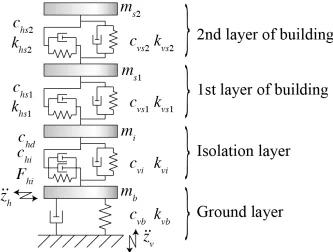
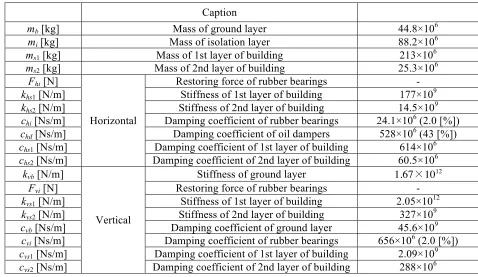
In this study, the isolated reactor building was modeled by a four mass points model as shown in Fig. 1 [3]. Table 1 indicates parameters of the analytical model. These parameters are based on an actual design of a nuclear power plant.
Deformation of isolation device is predominant compared with it of the upper structure in isolated building, so the modeling to mass points is permissible for this fundamental investigation. The model consists of the ground layer, the isolation layer, the 1st and 2nd layer of the building. The mass ms1 corresponds to floor where a reactor and important equipment are installed. As shown in Fig. 1, horizontal ground motion
!!
zh
is input to the upper part of the ground layer, and vertical ground motion!!
zv
is input to the lower part of the ground layer. The reason is that horizontal stiffness of rubber bearings is so small compared with ground that dynamic behavior of ground is negligible. Horizontal and vertical motion of the ground layer, 1st and 2nd layer of the building do not interact each other. On the other hand, horizontal motion of the isolation layer depends on vertical motion as described later.
The horizontal isolation period is 3.4 seconds and the vertical is 1/8 seconds, respectively.
Table 1: Parameters of analytical model of isolated building.
Caption
mb [kg] Mass of ground layer 44.8!106
mi [kg] Mass of isolation layer 88.2!106
ms1 [kg] Mass of 1st layer of building 213!106
ms2 [kg] Mass of 2nd layer of building 25.3!106
Fhi [N]
Horizontal
Restoring force of rubber bearings -
khs1 [N/m] Stiffness of 1st layer of building 177!109
khs2 [N/m] Stiffness of 2nd layer of building 14.5!109
chi [Ns/m] Damping coefficient of rubber bearings 24.1!106 (2.0 [%]) chd [Ns/m] Damping coefficient of oil dampers 528!106 (43 [%]) chs1 [Ns/m] Damping coefficient of 1st layer of building 614!106
chs2 [Ns/m] Damping coefficient of 2nd layer of building 60.5!106
kvb [N/m]
Vertical
Stiffness of ground layer 1.671012
Fvi [N] Restoring force of rubber bearings -
kvs1 [N/m] Stiffness of 1st layer of building 2.05!1012
kvs2 [N/m] Stiffness of 2nd layer of building 327!109
cvb [Ns/m] Damping coefficient of ground layer 45.6!109 cvi [Ns/m] Damping coefficient of rubber bearings 656!106 (2.0 [%]) cvs1 [Ns/m] Damping coefficient of 1st layer of building 2.09!109
cvs2 [Ns/m] Damping coefficient of 2nd layer of building 288!106
Modeling of Rubber Bearings
Rubber bearings have linear stiffness in the normal deformation range. However they have nonlinear stiffness in case of large deformation.
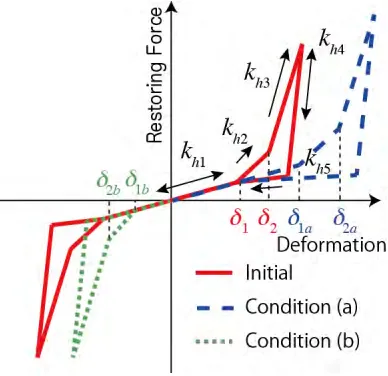
Figure 2 and table 2 show horizontal restoring force model and its parameter, respectively. In horizontal direction, nonlinear behavior that is caused by the strain hardening occurs. The hardening behavior is expressed by multi-linear model as shown in Fig. 2 [4]. When deformation of the rubber bearing exceeds !1, 1st hardening occurs. In addition, when deformation of the rubber bearing exceeds !2, further hardening occurs. The 1st hardening displacement !1 shifts by the following condition.
Condition (a) : !1 increases depending on the maximum displacement that the rubber bearing experienced. Condition (b) : !1 decreases depending on the vertical load for the rubber bearing.
In condition (a), once the hardening occurs, the hardening displacement increases in accordance with the following equations.
!
1a=!
1+" !
(
max!!
1)
(1)!
2a =!
2+" !
(
max!!
1)
(2)Where !1a and !2a are the new hardening displacement by condition (a),!max is the maximum displacement that the rubber bearing has experienced, and " is a influence coefficient of repetition. In
Figure 2. Restoring force model of rubber bearings (Horizontal).
Table 2: Parameters of analytical model of rubber bearing (Horizontal).
Caption
kh1 [N/m] 1st stiffness 1.12!109
kh2 [N/m] 2nd stiffness 3.92!109 (3.5kh1)
kh3 [N/m] 3rd stiffness 13.4!109 (12kh1)
kh4 [N/m] 4th stiffness 33.0!109 (29.5kh1)
kh5 [N/m] 5th stiffness 224!106 (0.2kh1)
!1 [m] 1st hardening displacement 0.830 (#1=250[%])
!2 [m] 2nd hardening displacement 1.20 (#1=360[%])
In condition (b), the hardening displacement decreases, when vertical load increases. This paper calls condition (b) the coupling effect. As shown in Fig. 3, rubber bearings retain initial performance, when the vertical load is in between $tty and $ccy. On the other hand, the hardening displacement
decreases from !1 to !1b, when vertical load exceeds $tty or is less than $ccy. The parameters $ty, $tty, $ccy
and $cy that provide the linear limit of the rubber bearings have not been verified by experiments yet.
Thus the parameters were determined by interpolation from fracture characteristics [5, 6].
Figure 3. Coupling effect between horizontal restoring force and vertical load.
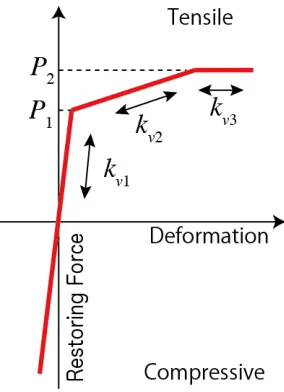
Figure 4. Restoring force model of rubber bearings (Vertical).
Table 3: Parameters of analytical model of rubber bearing (Vertical).
Caption
kv1 [N/m] 1st stiffness 825!109
kv2 [N/m] 2nd stiffness 27.5!109 (kv1/30)
kv3 [N/m] 3rd stiffness 0
P1 [N] 1st softening load 3.20!109
ANALYTICAL PROCEDURE
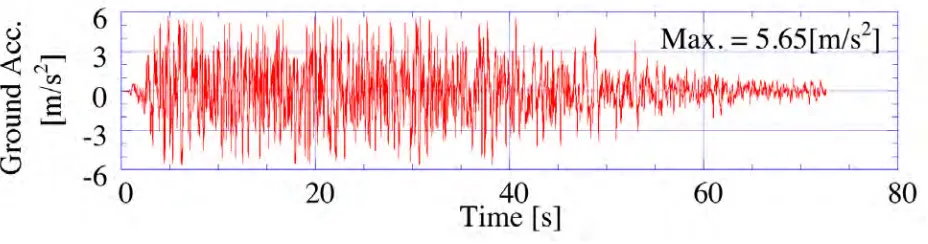
In this paper, an artificial wave shown in Fig. 5 was used as an input wave. The input wave was made in consideration of a target spectrum of design basis earthquake ground motion. A wave of which amplitude is 2/3 of the wave for horizontal direction is used for vertical direction. These waves are called Ss wave in this paper. Amplitude of the wave is varied in analyses in order to investigate relationships between response and earthquake level.
Figure 5. Input wave (Horizontal).
ANALYTICAL RESULTS
In this paper, analytical results are reported from the viewpoint of the coupling effect mainly. The coupling effect does not affect response of vertical direction, and the influence of nonlinearity on vertical direction has been reported by the authors in the previous SMiRT [2]. Therefore this section describes analytical results of horizontal direction.
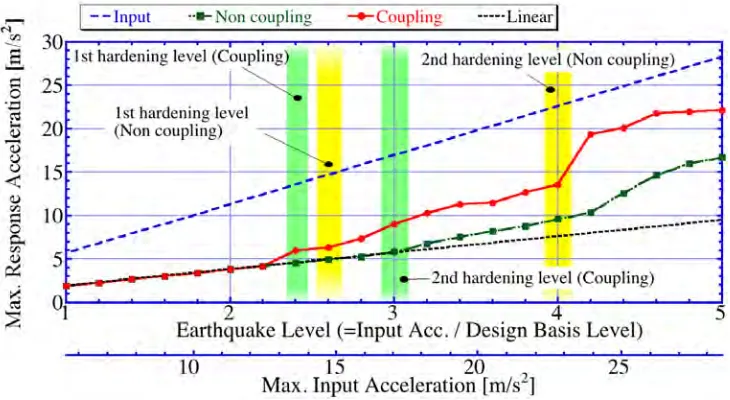
Figure 6 shows relationship between earthquake level and the maximum horizontal response acceleration at ms1. It is confirmed that response acceleration increases and the linear limit decreases by the consideration of coupling effect. In the case of analyses considering the coupling effect, the earthquake levels that lead the rubber bearing to hardening were small compared with the results that didn’t consider the coupling effect. In fact, the 1st hardening and the 2nd hardening occur from the design basis level ! 2.4 and 3.0 when the coupling effect was considered, and they occur from the design basis level ! 2.6 and 4.0 when the coupling was not considered. The maximum response acceleration increases nonlinearly with the hardening of the rubber bearings, because the horizontal isolation period came close to the natural period of superstructure by hardening of rubber bearings. In the case of analyses considering the coupling effect, this tendency is remarkable and thus the acceleration was larger compared with the results that didn’t consider the coupling effect. Meanwhile, the isolation system retained performance of isolation even if the coupling effect was considered, since response acceleration of the isolated structure is smaller than the input wave.
Figure 7 shows relationship between earthquake level and horizontal response displacement at mi,
namely deformation of the rubber bearings. As shown in Fig. 7, the maximum response displacement is comparable with linear analysis, because the condition (a) extends !1 and !2, once hardening occurs. In addition, deformation of the rubber bearing is suppressed by the considering of the coupling effect, because response acceleration increased instead of displacement.
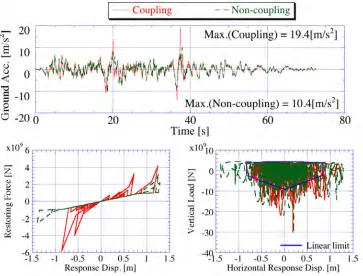
is Fig. 8, is a result that 1st hardening occurred, and the result of the design basis level !4.2, that is Fig. 9, is a result that 2nd hardening occurred.
From Fig. 8, time history of acceleration considering the coupling effect resembles it that didn’t considers the effect. The difference was confirmed only at around 20 seconds. In addition, the relationship between horizontal displacement and the vertical load exceeded the linear limit, and the hardening starting displacement decreased as shown in the hysteresis loop.
From Fig. 9, time history of acceleration considering the coupling effect differed from it that didn’t considers the effect. Especially the large difference was confirmed at around 20 and 40 seconds, and the maximum response acceleration was twice as large as results not considering the coupling effect. The relationship between horizontal displacement and the vertical load exceeded the linear limit very much. As shown in the hysteresis loop, the hardening occurred from small displacement, as a result the response displacement was suppressed.
Figure 6. Relationship between earthquake level and response acceleration (Horizontal).
Figure 8. Analytical results (Design Basis Level ! 2.6).
CONCLUSION
This paper described results of seismic response analysis considering the coupling effect of horizontal and vertical motion of rubber bearings. Influence of the coupling effect is summarized as follows.
In the case of analysis considering the coupling effect, the nonlinear behavior occurs from smaller input earthquake compared with analysis not considering the coupling effect.
In the case of analysis considering the coupling effect, the deformation of the rubber bearings is suppressed compared with analysis not considering the coupling effect.
Although the nonlinear behavior decreases the isolation performance, the isolation system is still effective.
As a result of this study, importance of consideration of the coupling effect was confirmed. However the investigation regarding nonlinear characteristics by experiment, especially combination of the horizontal and vertical motion, is not enough. Therefore further investigations regarding this problem by experiment and analysis are required in the future.
ACKNOWLEDGEMENT
Present study is the result of “Development of level-1 PSA method for sodium-cooled fast breeder reactors” entrusted to Japan Atomic Energy Agency by the Ministry of Education, Culture, Sports, Science and Technology of Japan (MEXT). The authors would like to express his appreciations to Mr. M. Oguro of graduate school of Tokyo Denki University for his devoted assistance.
REFERENCES
[1] Nuclear Safety Commission of Japan (2006). “Regulatory Guide for Reviewing Seismic Design of Nuclear Power Reactor Facilities”, Nuclear Safety Commission of Japan Decision No. 2006-D59, http://www.nsr.go.jp/archive/nsc/NSCenglish/documents/decisions/2006/2006_59_1.pdf
[2] Minagawa, K., Fujita, S., Yamaguchi, A., Takata, T., Kurisaka, K. (2011). “Development of Level-1 PSA Method Applicable to Japan Sodium-cooled Fast Reactor: (2) Seismic Response Analysis Considering Characteristics of the Advanced Seismic”, Transactions of SMiRT 21, 2011, p263.pdf. [3] Japan Electric Association (2000). “Japan Electric Association Guide 4614-2000”, Japan Electric
Association, 5-18, [in Japanese].
[4] Katoh, A., Nagura, S., Nojima, O., Yoneda, G. (1993). “Study on concept of seismic isolation type plant for FBR: Part 28 Ultimate Behavior of Base-Isolated Reactor Building (Sensitivity Analysis on Hysteresis Curve Modeling Method)”, Proceedings of Architectural Institute of Japan, 1595-1596, [in Japanese].
[5] Nishikawa, I., Isono, M., Shimada, J., Ozawa, Y., Sakaguchi, T. and Takayama, M. (2004). “Performance of Natural Rubber Bearings by Compression-shear Test : Part 3 Ultimate Compression-shear Properties”, Proceedings of Architectural Institute of Japan, 441-442, [in Japanese].