Improve the Data Security based on Cluster Method
for the Mobile Sink in WSN
B. Lasyasri [1], Dr. L. Nirmala Devi [2]
[1] [2]
Deputy Manager, HAL, Hyderabad, INDIA
Associate Professor, Department of ECE, OU College of ENGG, OU University, Hyderabad, INDIA
Abstract-In wireless sensor systems (WSNs), the advantages of abusing the sink mobility to drag out system lifetime have been very much perceived. In physical situations, a wide range of obstacles could exit in the detecting field. Consequently, an examination challenge is the means by which to proficiently dispatch the mobile sink to discover a find staying away from briefest route. This paper shows an energy efficient directing component in light of the cluster based technique for the portable sink in WSNs with obstacles. As per the cluster based strategy, the nodes chose as cluster heads gather information from their group individuals and exchange the information gathered to the mobile sink. In this paper, the mobile sink begins the information gathering route intermittently from the beginning site, at that point specifically gathers information from these cluster heads in a single hop extend, lastly comes back to the beginning site. Here we take a network system as heuristic tour arranging calculation for the mobile sink to discover the obstacle-avoidance shortest route. In any case, because of the intricacy of the scheduling issue in WSNs with obstacles and visit time more, the ordinary calculations are hard to determine. Here proposed method reduces the time in network process. Simulation results through NS2 software to verify the effectiveness of our method.
I. INTRODUCTION
Wireless Sensor Networks (WSNs) have been connected in many regards including health monitoring, environmental monitoring, military surveillance, and many others as Internet of Thing (IoT) [2]-[5]. Energy efficiency has become the most key issue for WSNs. However, power supplies for sensor nodes are limited and hard to replace. What's more, contrasted and different nodes, nodes close to the base station (likewise called the sink) expend more energy, since the nodes transfer the information gathered by sensor nodes far from the sink. Henceforth, once these sensors close to the sink fail, the information gathered by different sensors can't be exchanged to the sink. At that point, the whole system ends up early, although a large portion of the nodes can even now have a considerable measure of energy. Subsequently, to expand the system lifetime, limiting the energy utilization of sensor nodes is the key difficulties for WSNs.
A sensor organize is characterized as a creation of a substantial number of minimal effort, low power multi utilitarian sensor nodes which are exceptionally conveyed either inside the framework or near it. These nodes which are little in measure comprise of detecting, information preparing and communicating parts. The position of these small nodes require not be supreme; this gives irregular situation as well as implies
that conventions of sensor systems and its calculations must have self sorting out capacities in out of reach zones. However nodes are compelled in energy supply and data transfer capacity, a standout amongst the most essential limitations on sensor nodes are the low power consumption requirements. These limitations joined with a particular arrangement of substantial number of nodes have postured different difficulties to the outline and management of systems. These difficulties require energy mindfulness at all layers of systems administration protocol stack. The issues identified with physical and connect layers are by and large normal for all sort of sensor applications, consequently the exploration on these territories has been centered around framework level power mindfulness, for example, dynamic voltage scaling, radio correspondence equipment, low cycle issues, system portioning, and energy aware MAC protocols. At the system layer, the main point is to discover ways for energy efficient route setup and solid transferring of information from the sensor nodes to the sink with the goal that the lifetime of the system is boosted.
Since the execution of a directing protocol is firmly identified with the building model, in this area we endeavor to catch engineering issues and feature their suggestions.
A. Network flow
There is three principle segments in a sensor arrange. These are the sensor nodes, sink and checked events. Beside the not very many setups that use portable sensors, the vast majority of the system design expects that sensor nodes are stationary. Then again supporting the mobility of sink or cluster heads (entryways) is some of the time regarded vital.
B. Node Deployment
Another thought is the topological arrangement of the nodes which is application dependent and influences the execution of the routing protocol. The arrangement is either deterministic or self sorting out. In deterministic circumstances, the sensors are physically put and information is directed through pre determined ways. However in self sorting out framework the sensor nodes are scattered arbitrarily makes a foundation in a specially appointed way.
During the formation of a framework, the procedures of setting up the routes are significantly impacted by energy considerations. Since the transmission energy of a remote radio is corresponding to the distance squared or considerably higher request within the sight of obstacles, multi hop routing will consume less energy than coordinate correspondence. Be that as it may, multi hop routing presents huge overhead topology administration and medium access control. Coordinate directing would perform well advice if every one of the nodes is near the sink. More often than not sensors are scattered arbitrarily finished a zone of intrigue and multi hop directing winds up plainly unavoidable.
D. Data Delivery Models
Depending on the utilization of the sensor arrange, the information conveyance model to the sink can be persistent, event driven, inquiry driven and half breed. In constant conveyance show, every sensor sends information intermittently. In event driven and question driven models, the transmission of information is activated when an occasion happens or an inquiry is produced by the sink. Some system applies a crossover arrange utilizing a mix of nonstop, event driven and question driven information delivery. The routing protocol is very impacted by information delivery model, particularly concerning the minimization of energy utilization and route security [6].
In this paper, the mobile sink will travel through the system with obstacles to discover an impediment keeping away from most brief route. In the meantime, the mobile sink must consider the vitality utilization adjust among nodes while moving over the detecting field. To dispatch the portable sink proficiently, we use the cluster based technique that is exhibited in [7] and [8]. As indicated by the cluster based technique, all sensor nodes in the detecting field are partitioned into two classes: cluster heads and cluster individuals. Cluster heads gather information from relating group individuals which gather condition data, and after that pass information to the mobile sink. We expect that WSNs can endure some degree of delay with the goal that the mobile sink gathers all detecting information from cluster heads. The portable sink starts its periodical development from beginning site lastly returns. Amid its development, the portable sink gathers the detecting information from cluster heads. When its moving way is arranged, the mobile sink can move close to the group heads and devour less energy. Henceforth, the system lifetime can be drawn out fundamentally.
In this paper, the system lifetime is characterized as the time interim from sensor nodes begin working until the passing of every static sensor. However, in physical situations, the detecting field may contain different obstacles which make the planning for the portable sink more mind boggling. Here, the portable sink can move to any site aside from the site of obstacles. Subsequently, an exploration challenge is the manner by which to effectively dispatch the mobile sink to discover an obstacle maintaining a strategic distance from most brief route within the sight of obstructions.
II. RELATED WORK
Recent work demonstrates that the advantage utilizing the mobility of nodes has been well recognized. By using the mobility of nodes in WSNs, we can ease the traffic burden and enhance energy efficiency. Henceforth, the system lifetime is extended significantly. Many papers have proposed several different approaches. We then study the related works of the mobility of nodes in the literature.
In [9], the authors show a VGDRA scheme for the mobile sink to minimize the communication cost. The sensor field is isolated into a virtual grid containing the same size cells and the nodes near the center are chosen as the cell-header nodes. In addition, a virtual backbone structure consisting of the cell header nodes is constructed. The mobile sink moves across the sensor field and gathers the detecting information by communicating with the border cell header nodes. To decrease the general correspondence cost, the routes remaking process incorporates just a subset of cell-header nodes. In [10], the authors propose a blended number programming system for base station to relieve the problematic energy scattering. To invert the problematic energy scattering patterns, the base station portability is acquainted with WSNs. The network lifetime is finally stretched out by utilizing portability designs for base station The paper [11] utilizes the support vector regression technique to construct a raised advancement show, by which the ideal direction of the mobile sink can be resolved. The system lifetime is influenced by the direction (called COT). To amplify the system lifetime, the mobile sink in the event driven is utilized to gather the caught information of events. In [12], the authors propose a mobile information gathering visit for various sensor systems.
calculation to dispatch versatile sensor for hot areas. In the first stage, the creators dispatch MAM sensors to hot areas in a coordinated approach.
III. CLUSTER-BASED APPROACH
To prolong the lifetime of the WSNs, the cluster-based method has been proven to be effective [8], [9]. According to the cluster-based algorithm, all sensor nodes in the network are divided into two categories: cluster heads and cluster members. Cluster heads collect data from their cluster members who collect environment information, and then forward the data to the sink either directly or via relaying across other cluster heads. Due to movement of the sink, the mobile sink can move nearest the cluster heads and consume less energy. We can balance energy consumption of sensor nodes by using the cluster-based algorithm. Therefore, the network lifetime will be prolonged significantly.
To solve the scheduling for the mobile sink, we use the LEACH (low-energy adaptive clustering hierarchy) protocol developed by Heinzelman et al. [8]. Once cluster heads are determined by the LEACH, the mobile sink can move closest to the cluster heads for gathering data. Hence, sensor nodes consume less communication energy which is the most critical energy consumption of sensor nodes. Here, the mobile sink mounted on a mobile vehicle is equipped with enough energy. Owe to balanced energy consumption of sensor nodes, it is obvious that the lifetime of the WSNs will be extended.
A. Cluster formation
We expect that every node is outfitted with Global Positioning System (GPS). Every single node in the system intermittently communicates a hello packet which comprises of the two dimensional positional coordinates, speed vector, Energy, number of neighbors, its hierarchical level and the ID of the group head.
B. Cluster head election
Initially, every one of the nodes begins as cluster heads and begin broadcasting Hello Packets. Presently, each of the nodes gets Hello Packets of its neighboring nodes. At the point when a node gets a Hello Packet from another neighbor, it adds a passage to the neighbor table .Once you have Hello Packets from every one of your neighbors, it doles out need given by condition [1] to each neighbor in light of its vitality level and the quantity of neighbors. At that point node chooses the neighbor with the most noteworthy need and contrasts and its need. On the off chance that most priority need among the neighbors need is more prominent than the hubs need then node chooses it as its cluster head, else node accept itself as the cluster head.
C. Cluster maintenance
Re organization of the Cluster can be observed in three instances.
Energy of the Cluster Head drops down.
Arrival of a new node in to the cluster.
Decrease in number of neighbors of the cluster head.
IV. PROPOSED SYSTEM
In this segment, we exhibit a heuristic algorithm to discover an obstruction maintaining a strategic distance from most limited route for the mobile sink. Keeping in mind the end goal to better take care of the dispatch issue of the mobile sink, we utilize the algorithm to develop the spanning chart of the system model. As per the spanning diagram, we get all obstruction staying away from ways. Furthermore, the obstacle- maintaining limited route for the mobile sink can be acquired from these obstacle-avoiding paths. We present particular steps of the heuristic snag maintaining a strategic distance from calculation below.
A. Spanning graph algorithm
Fundamentally, the obstacle keeping away from most limited route issue is like the Traveling Salesman Problem (TSP) which is a classical problem. We can utilize the base spanning tree to solve the TSP. Hence, according to the minimum spanning tree, we can also discover an obstacle maintaining a strategic distance from most limited course for the mobile sink. In this paper, a spanning graph is an undirected chart which contains all base spanning trees.
In this area, we will talk about how to build the spanning diagram. A few examinations have tended to the spreading over chart development. We can utilize the sweep line calculation to develop the spanning diagram. The obstacle avoiding spanning graph is the arrangement of edges that can be framed by making associations amongst terminals and deterrent corners. Once a spreading over chart is developed, the vast conceivable locales for the mobile sink development will be diminished to a limited arrangement of destinations. Therefore, the algorithm in view of the spreading over diagram makes it more proficient to plan for the mobile sink.
B. Obstacle avoiding spanning graph construction
problem of the mobile sink. The detecting region is isolated into a similar size grid cells by using the grid-based techniques. Obviously, edges of obstacles intersect grid cells and obstacles may possess some portion of some grid cells. When obstacles possess some portion of one lattice cell, we accept that the matrix cell is viewed as obstacles.
V. EXPERIMENTAL RESULTS
In this paper, we assume that 25 sensor nodes are randomly distributed over a 1000x500m2 field where four obstacles exist. In this paper, we accept that no gap exists in the detecting field and static sensors are the same in their abilities. In the meantime, we accept that the mobile sink is located in the top-left corner of the two-dimensional territory and its coordinates are (50 m, 50 m). The mobile sink begins its periodical obstacle-avoiding movement from starting site and finally returns. Table1 shows the system parameters used in our simulations. In this paper, in order to simplify scheduling for the mobile sink, we accept that the information gathered by sensor nodes is the deferral tolerant information, i.e., they can wait for the mobile sink to come and lift them up.
PARAMETER VALUE
Application Traffic CBR
Transmission rate 10 packets/sec Radio range 250m Packet size 512 bytes Maximum speed 25m/s Simulation time 8000ms Number of nodes 21 Area 1000x500 Grid size 10m
Table1: System parameters
Evaluation results
In this section, we utilize the heuristic obstacle-avoiding algorithm to conduct numerous experiments in the sensing field with obstacles. According to the network lifetime and the movement path of mobile sink, we present experimental results of the algorithm which are introduced below.
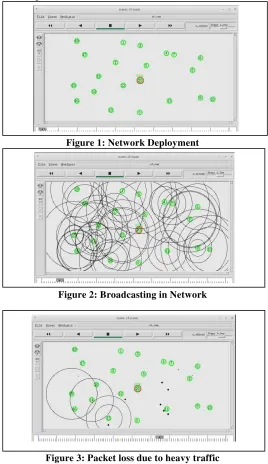
Figure 1: Network Deployment
Figure 2: Broadcasting in Network
Figure 3: Packet loss due to heavy traffic Algorithm: –CHS
Input:
Deployment Area WSN = s*s,
Set of sensor nodes where represents (xi , yi ), the
coordinate of ith Sensor
Transmission range
Output:
CLH–set of cluster heads
Start:
1. // Determine centre C and radius R of
Welzl’s circle that covers all SNS
2.
3. Partition WSN Area into square grids of side , with C as the
Centre, to the extent possible.
4. Determine the grid centre points for each from a set of grid
centre points
5.
6. where m is number of grids
7. //Identify CHs in welz_circle
8. Identify closest to each in welzl_circle
9. //append to list of CHs
10. //remove from SNS
11.
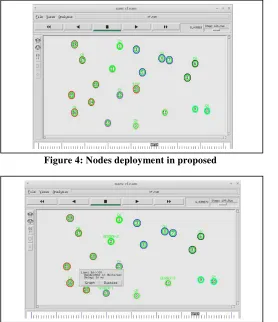
Figure 4: Nodes deployment in proposed
Figure 5: CH to Mobile sink data moving
Figure 6: Performance on Delay
Figure 7: Energy level routing
Figure 8: Network performance
In above screenshots, Fig 1 shows all nodes placed in network and deployment of nodes is in network properly. Here all nodes displayed based on topology values and all properties of NAM window it should be mentioned. Fig 2 shows the broadcasting occur throughout the network. Here broadcasting occurs for communication purpose. All nodes should be involved in this process. Fig 3 shows that more packet loss due to the traffic during communication process. In above mentioned screens, first three are indicating as cluster-based process.
Fig 4 shows that, all nodes participate and which node consider as which type of node mentioned above screenshot of NAM. All cluster head nodes are displayed which are considering as cluster heads. Here 20th node consider as mobile sink. Fig5 shows that, data delivery form CH to mobile sink. In this, data delivering protocol and time interval then how much data should be delivered these all are shows.
In Fig 6, graph shows and represents end2end delay and it shows a simulation time versus delay. The performance of Tour planning algorithm improves delay time it means decrease the delay between communication nodes compare to cluster-method. Fig 7 shows and represents energy consumption and it shows a simulation time versus energy. The performance of Tour planning algorithm improves energy values compare to cluster-based method. Fig 8 shows and represents throughput and it shows a simulation time versus throughput. The performance of Tour planning algorithm improves the throughput compare to cluster method.
0 0.2 0.4 0.6 0.8 1 1.2 1.4 1.6
2000 4000 6000 8000
T
h
r
o
u
g
h
p
u
t
(M
b
/s)
Throughput
LEACH
H-TOUR-P
Time (msec)
0 0.2 0.4 0.6 0.8 1 1.2
2000 4000 6000 8000
E
n
e
r
g
y
(
j)
Energy Consumption
LEACH
H-TOUR-P
Time (msec)
0 0.2 0.4 0.6 0.8 1 1.2 1.4
2000 4000 6000 8000
De
lay
(m
/s
)
DELAY TIME
LEACH
H-TOUR-P
V.CONCLUSION
In this paper, we used the mobile sink to prolong the network lifetime. In physical conditions, the detecting field could contain different obstacles. To rearrange the planning for the mobile sink, we introduced the grid-based technique to the WSN with obstacles. In the meantime, we developed the spanning graph for the mobile sink to discover an obstacle-avoiding shortest route. Here we propose a Tour planning algorithm for limit the quantity of got visits and more data based on cluster head we have to collect and increase the lifetime of network. We also conducted simulation by using NS2 and exploratory outcomes demonstrate that our cluster-based approach is practical for the dispatch of the mobile sink. We finally found an obstacle-avoiding shortest route for the mobile sink and the network lifetime was prolonged.
REFERENCES
1) Y.T. Mingliang Jiang, Jinyang Li, “Cluster based routing
protocol,” IETF Internet Draft, draft -ietf-manet-cbrpspec-01.txt, July 1999.
2) J. C. Cuevas-Martinez, J. Canada-Bago, J. A. Fernandez-Prieto, and M. A. Gadeo-Martos, ``Knowledge-based duty cycle estimation in wireless sensor networks: Application for sound pressure monitoring,'' Appl. Soft Comput., vol. 13, no. 2, pp. 967_980, 2013.
3) H.-L. Fu, H.-C. Chen, and P. Lin, ``Aps: Distributed air pollution sensing system on wireless sensor and robot networks,'' Comput. Commun., vol. 35, no. 9, pp. 1141_1150, 2012.
4) Z. Shen et al., ``Energy consumption monitoring for sensor nodes in snap,'' Int. J. Sensor Netw., vol. 13, no. 2, pp. 112_120, 2013.
5) B. Zhou, S. Yang, T. H. Nguyen, T. Sun, and K. T. V. Grattan, ``Wireless sensor network platform for intrinsic optical _ber pH sensors,'' IEEE Sensors J., vol. 14, no. 4, pp. 1313_1320, Apr. 2014.
6) M. Dong, X. Liu, Z. Qian, A. Liu, and T. Wang, ``QoE-ensured price competition model for emerging mobile networks,'' IEEE Wireless Commun., vol. 22, no. 4, pp. 50_57, Aug. 2015.
7) Gowrishankar. S, T.G.Basavaraju, Manjaiah D.H, Subir Kumar Sarkar, Issues In Wireless Sensor Networks, WCE 2008.
8) W. B. Heinzelman, A. P. Chandrakasan, and H. Balakrishnan, ``An application-speci_c protocol architecture for wireless microsensor networks,'' IEEE Trans. Wireless Commun., vol. 1, no. 4, pp. 660_670, Oct. 2002.
9) G. Smaragdakis, I. Matta, and A. Bestavros, ``SEP: A stable election protocol for clustered heterogeneous wireless sensor networks,'' in Proc. SANPA, 2004, pp. 1_11.
10) A. W. Khan, A. H. Abdullah, M. A. Razzaque, and J. I. Bangash, ``VGDRA: A virtual grid-based dynamic routes
adjustment scheme for mobile sink-based wireless sensor networks,'' IEEE Sensors J., vol. 15, no. 1, pp. 526_534, Jan. 2015.
11) O. Cayirpunar, E. Kadioglu-Urtis, and B. Tavli, ``Optimal base station mobility patterns for wireless sensor network lifetime maximization,'' IEEE Sensors J., vol. 15, no. 11, pp. 6592_6603, Nov. 2015.
12) F. Tashtarian, M. H. Y. Moghaddam, K. Sohraby, and S. Effati, ``On maximizing the lifetime of wireless sensor networks in event-driven applications with mobile sinks,''
IEEE Trans. Veh. Technol., vol. 64, no. 7, pp. 3177_3189,
Jul. 2015.
13) M. Ma, Y. Yang, and M. Zhao, ``Tour planning for mobile data-gathering mechanisms in wireless sensor networks,''
IEEE Trans. Veh. Technol., vol. 62, no. 4, pp. 1472_1482,
May 2013.
14) L. Xie, Y. Shi, Y. T. Hou, W. Lou, H. D. Sherali, and S. F. Midkiff, ``Multi-node wireless energy charging in sensor networks,'' IEEE/ACM Trans. Netw., vol. 23, no. 2, pp. 437_450, Apr. 2015.