Available online: https://edupediapublications.org/journals/index.php/IJR/ P a g e | 1938
Experimental Study on Structural Lightweight Concrete Utilizing
Cinder and Pumice as Replacement of Coarse Aggregate
Majji Neelima& Dr N. Victor Babu
1PG Student, Baba institute of technology and sciences, Visakhapatnam (INDIA)
2PHD, Associate Professor, Civil Engineering Department,
Baba institute of technology and sciences, Visakhapatnam (INDIA)
ABSTRACT
Concrete material is been widely used with basalt coarse aggregate throughout the world were the properties and behavior of concrete changes with the materials used, admixtures, water content and w/c ratio. Conventional concrete weight ranges from 2300kg/m3 to 2450kg/m3 and reinforced concrete ranges from 2500 kg/m3 to 2600kg/m3. The self weight of the structure is an important criterion in design point of view and also for economy of construction. Light weight concrete is been popular due to advantages over the conventional concrete, used widely in precast concrete structures. In this project work M30 grade concrete with three mix proportions are considered with granite, pumice and cinder aggregates with proportions of 50%, 75% and 100%.
INTRODUCTION
Concrete is composite material manufactured using fine aggregate, coarse aggregate, water and cement the properties of concrete will change with the percentages of coarse and fine aggregate mix proportions of materials, water content and temperature. The cement reacts with the water and other ingredients to form hard rock like material. Concrete generally required vibration to reach every part of the corners of shuttering to avoid leakages and honey combs etc. Most concretes used are Portland cement concrete, when aggregate is mixed together with dry Portland cement and water, the mixture forms fluid slurry that is easily poured and molded into shape.
Available online: https://edupediapublications.org/journals/index.php/IJR/ P a g e | 1939 Types of aggregates
Aggregates are classified according to shape into the following types
Rounded aggregates
Irregular or partly rounded aggregates
Angular aggregates
Flaky aggregates
Elongated aggregates
Flaky and elongated aggregates
Aggregates are classified into two types according to size
Fine aggregate
Coarse aggregate
Fine Aggregate
When the aggregate is sieved through 4.75mm sieve, the aggregate passed through it called as fine aggregate. Natural sand is generally used as fine aggregate, silt and clay are also come under this category. The soft deposit consisting of sand, silt and clay is termed as loam. The purpose of the fine aggregate is to fill the voids in the coarse aggregate and to act as a workability agent.
Table: gradation of fine aggregates
Fine aggregate Size variation
Coarse Sand 2.0mm – 0.5mm
Medium sand 0.5mm – 0.25mm
Fine sand 0.25mm – 0.06mm
Silt 0.06mm – 0.002mm
Clay <0.002
Coarse Aggregate
When the aggregate is sieved through 4.75mm sieve, the aggregate retained is called coarse aggregate. Gravel, cobble and boulders come under this category. The maximum size
aggregate used may be dependent upon some conditions. In general, 40mm size aggregate used for normal strengths and 20mm size is used for high strength concrete. the size range of various coarse aggregates given below. Table: gradation of coarse aggregates
Coarse aggregate Size
Fine gravel 4mm – 8mm
Medium gravel 8mm – 16mm
Coarse gravel 16mm – 64mm
Cobbles 64mm – 256mm
Available online: https://edupediapublications.org/journals/index.php/IJR/ P a g e | 1940 Pumice aggregate
These are rocks formed in volcanic eruptions and found in many places around world. They are light weight and also strong enough and have high crushing value. Pumice aggregate is
light weight is due to gas escaping from molten lava. Pumice is mostly light or weight colored and it is mostly used light weight aggregate in construction industry. Pumice is mined and washed thoroughly and then used in concrete.
Cinder aggregate
Cinder, clinker and breeze are used for particles arrived from combustion of coal. Cinder type aggregates undergo high drying shrinkage and moisture movement, cinder
aggregates are widely used in building blocks for partition walls and flooring etc. The cinder aggregates have less unsoundness value because having excessive unburnt coal particles upto 15-25%.
Advantages of light weight concrete
self weight of the structural members is
reduced results in lighter sections
ease in lifting and placing of precast
members
reduction in construction cost by
25-30%
light weight concrete have less
tendency to spall
coefficient of thermal expansion is
Available online: https://edupediapublications.org/journals/index.php/IJR/ P a g e | 1941 Disadvantages of light weight concrete
more brittle than conventional concrete
special care to be taken in pumping
concrete
mixing time is more than conventional
concrete
Difficult to place and finish because of
the porosity and angularity of the aggregate.
Applications of light weight concrete
precast constructions
in bridge decks and long span girders
heat insulators on roof and terrace
soling
construction of partition walls in
framed structures
used widely in low cost housing
shotcrete of damaged areas
LITERATURE SURVEY
Saritha .B1,J.Chamundeeswari2 “
Experimental Study Of Light Weight Concrete By The Partial Replacement Of Coarse Aggregate By Thermo Plastics” We had replaced the coarse aggregate partially by the plastic aggregates (in the light weight concrete) which are having the properties of the thermoplastics.” beams in both the conventional concrete and also in the light weight concrete (using plastic aggregates). We are going to cast 18 cubes, 18 cylinders and 18 beams. On these 18 cubes, 9 cubes for the conventional concrete and 9 cubes for the light weight concrete, on the 18 cylinders, 9 cylinders for the conventional concrete and 9
cylinders for the light weight concrete, on the 18 beams, 9 beams for the conventional concrete and 9 beams for the light weight concrete. The compressive strength of the partially light weight concrete is lower than the ordinary conventional concrete. Therefore this light weight concrete will be used in the places where the structure is not belonging to any external force. This light weight concrete is only capable to carry its self weight only. The partially light weight concrete may also be used as structural concrete on some cases because it is having the compressive strength value which is suitable for structural (greater than 17.44N/mm2).
Lakshmi Kumar Minapu1, M K M V
Ratnam2, Dr. U Rangaraju3,
Available online: https://edupediapublications.org/journals/index.php/IJR/ P a g e | 1942 admixtures, the compressive, split-tensile
and flexural strengths of concrete are increased. Light weight aggregate is no way inferior to natural coarse aggregate and it can be used for construction purpose.
N. Sivalinga rao1, V. Bhaskar Desai2 and B.L.P.Swamy3 “Structural Properties of Silica Fume Modified Light Weight
Aggregate (Cinder) Concrete” The
conventional mix has been designed for M20 grade concrete and is adopted with a water cement ratio 0.50. With 100% cinder aggregate in the normal course aggregate and cement replaced with silica fume in weight percentages of 0%, 5%, 8%, 10%, 15% and 20%, compressive strength, split tensile strength, flexural strength , moment carrying ,modulus of elasticity and strain energy stored capacity of concrete specimens increase up to 10% of silicafume
and then decrease. The optimum
recommended combination for this strength is 40% cinder and 60% natural aggregate along with 10% silica fume. The moment carrying capacity of slabs is found to vary from 14.23KN-m to 9.82KN-m with the replacement of natural aggregate by cinder from 0 to 100 percent. Between 8 to 10 percent replacement of cement with silicafume gives the optimum values of moment carrying capacity. The optimum recommended combination for this strength
is 40% cinder and 60% natural aggregate along with 10% silica fume.
Anju Ramesan1, Shemy S. Babu2,
Aswathy Lal3 “Performance of Light-Weight Concrete with Plastic Aggregate”
Effect of replacement of coarse aggregate with various percentages (0% to 40%) of plastic aggregate on behaviour of concrete was experimentally investigated and the optimum replacement of coarse aggregate was found out. The results showed that the addition of plastic aggregate to the concrete mixture improved the properties of the resultant mix. Plastic aggregate is a lightweight material with specific gravity 0.94. Compressive strength and splitting tensile strength of concrete increased till 30% replacement of natural aggregate with plastic aggregate and on further replacement they tend to decrease but not below the target mean strength. Compressive strength increased by 9.4% and splitting tensile strength by 39% for a mix with 30 % replacement of natural aggregate by plastic aggregate when compared to control mix. Flexural strength of PCC beam and breaking load of RCC beam increased till 40% replacement. There was an improvement of 20% and 31% strength respectively. The optimum percentage replacement of natural coarse aggregate using plastic aggregate was obtained as 30%
Table: proportion of M30 concrete mixes
Grade Designation Normal aggregate % Light weight aggregate %
M30 NWAC-100 100 0
M30 LWCAC-50 50 50
M30 LWCAC-75 25 75
M30 LWCAC-100 0 100
M30 LWPAC-50 50 50
M30 LWPAC-75 25 75
Available online: https://edupediapublications.org/journals/index.php/IJR/ P a g e | 1943 NWAC-100: Normal Weight Aggregate Concrete
(100% normal aggregate)
LWCAC-50: Light Weight Cinder Aggregate Concrete (50% Cinder + 50% normal aggregate) LWCAC-75: Light Weight Cinder Aggregate Concrete (75% Cinder + 25% normal aggregate) LWCAC-100: Light Weight Cinder Aggregate Concrete (100% Cinder Aggregate)
LWPAC-50: Light Weight Pumice Aggregate Concrete (50% Pumice + 50% normal aggregate) LWPAC-75: Light Weight Pumice Aggregate Concrete (75% Pumice + 25% normal aggregate) LWPAC-100: Light Weight Pumice Aggregate Concrete (100% Pumice Aggregate)
Tests on concrete
Compressive strength of concrete
Compressive strength of concrete is found by testing cube in compressive testing machine and the stress at which the cube will fail is noted.
Cube are taken out from the curing tank after 28days and dried to remove moisture from the cube surface.
Cubes are placed in between the upper and lower plates in compressive testing machine.
Load is applied on the cube at an increasing rate.
Load at which the cube fails and cracks is noted as the compressive strength of the cube and the grade of concrete is decided.
Series of cubes of around three
specimens are tested and the
compressive strength is taken as average value.
Fig: testing of cubes and cylinders
Available online: https://edupediapublications.org/journals/index.php/IJR/ P a g e | 1944 Splitting Tensile Strength Test On Concrete
Cylinder Is A Method To Determine The Tensile Strength Of Concrete.
Cylinder Of Size 150mm Diameter And 300mm Long Is Casted In A Cylindrical Mould.
Cylinder Is De-Molded And Curing For 28days.
Were After The Cylinder Is Placed In Compressive Testing Machine In Between The Plywood Sheets.
The Cylinder Is Placed Such That The Longitudinal Axis Horizontal.
Load Is Applied On The Cylinder.
Stress At Which The Cylinder Cracks Is Noted Split Tensile Strength Of The Concrete.
Standard Consistency Test:
In This Test Used To Find Out The Percentage Of Water Required To Produce A Cement Paste Of Standard Consistency. This Is Also Called Normal Consistency.
The Consistency Is Measured By The Vicat Apparatus Using A 10mm Diameter Plunger.
A Trial Paste Of Cement And Water Is Mixed And Placed In The Mould Having An Inside Diameter Of 70mm At The Base And 60mm At The Top, And A Height Of 40mm.
The Plunger Is Then Brought Into Contact With The Top Surface Of The Paste And Released. Under The Action Of Its Weight The Plunger Will Penetrate The Paste. The Depth Depending On The Consistency.
When The Plunger Penetrates The Paste To A Point 5 To 7mm From The Bottom Of The Mould. The Paste Is Considered To Be At “Normal Consistency.
Available online: https://edupediapublications.org/journals/index.php/IJR/ P a g e | 1945 Fig: vicat’s apparatus
Table: physical characteristics of 53 grade ordinary Portland cement (OPC)
S.NO PROPERTY TEST RESULTS
1 Normal consistency 29%
2 Initial setting time 32 min
3 Final setting time 495 min
4 Fineness of cement(m2/kg) 231
5 Specific gravity of cement 3.20
6 Soundness 9mm
Table: slump and unit weights of concrete
Mix Slump(mm) Unit weight(kg/m3)
NWAC-100 90 2360
LWCAC-50 70 1980
LWCAC-75 60 1870
LWCAC-100 50 1650
LWPAC-50 80 1850
LWPAC-75 50 1680
LWPAC-100 40 1540
Table: Test results of concrete with normal aggregate
Mix
7 days compressive strength(N/mm2)
14 days compressive strength(N/mm2)
28days compressive strength(N/mm2)
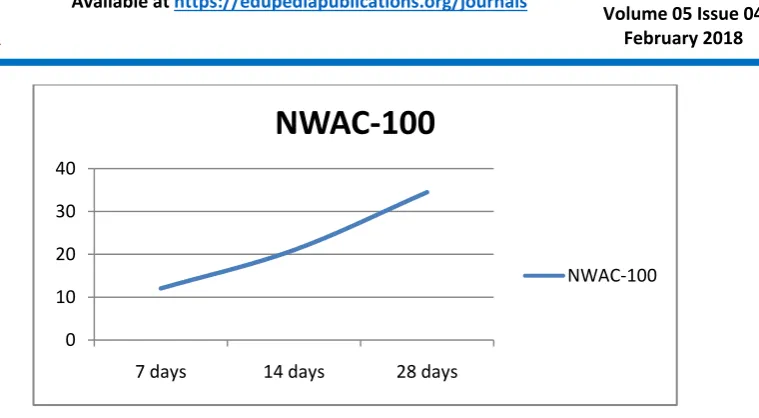
Available online: https://edupediapublications.org/journals/index.php/IJR/ P a g e | 1946 Fig : Test results of concrete with normal aggregate
Table : Test results of concrete with cinder aggregate
Mix
7 days compressive strength(N/mm2)
14 days compressive strength(N/mm2)
28days compressive strength(N/mm2)
LWCAC-50 11 19.5 33
LWCAC-75 10.5 18 32.5
LWCAC-100 9 19 30.5
Fig : Test results of concrete with cinder aggregate 0
10 20 30 40
7 days 14 days 28 days
NWAC-100
NWAC-100
0 5 10 15 20 25 30 35
LWCAC-50 LWCAC-75 LWCAC-100
Available online: https://edupediapublications.org/journals/index.php/IJR/ P a g e | 1947 Table: Test results of concrete with pumice aggregate
Mix compressive 7 days strength(N/mm2)
14 days compressive strength(N/mm2)
28days compressive strength(N/mm2)
LWPAC-50 13 23.5 34.5
LWPAC-75 12 22 32
LWPAC-100 10.5 20 31
Fig: Test results of concrete with pumice aggregate
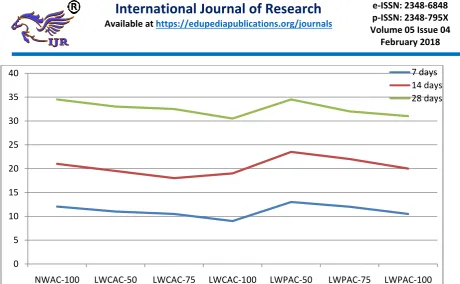
Table: Test results of concrete with different types of aggregates
Mix
7 days compressive strength(N/mm2)
14 days compressive strength(N/mm2)
28days compressive strength(N/mm2)
NWAC-100 12.05 21 34.5
LWCAC-50 11 19.5 33
LWCAC-75 10.5 18 32.5
LWCAC-100 9 19 30.5
LWPAC-50 13 23.5 34.5
LWPAC-75 12 22 32
LWPAC-100 10.5 20 31
0 5 10 15 20 25 30 35 40
LWPAC-50 LWPAC-75 LWPAC-100
Available online: https://edupediapublications.org/journals/index.php/IJR/ P a g e | 1948 Fig : Test results of concrete with different types of aggregates
CONCLUSIONS
The following are the conclusions from project work of M30 grade concrete with three mix proportions are considered with granite, pumice and cinder aggregates with proportions of 50%, 75% and 100%.
NWAC-100: Normal Weight Aggregate Concrete (100% normal aggregate)
LWCAC-50: Light Weight Cinder Aggregate Concrete (50% Cinder + 50% normal
aggregate)
LWCAC-75: Light Weight Cinder Aggregate Concrete (75% Cinder + 25% normal
aggregate)
LWCAC-100: Light Weight Cinder Aggregate Concrete (100% Cinder Aggregate)
LWPAC-50: Light Weight Pumice Aggregate Concrete (50% Pumice + 50% normal
aggregate)
LWPAC-75: Light Weight Pumice Aggregate Concrete (75% Pumice + 25% normal
aggregate)
LWPAC-100: Light Weight Pumice Aggregate Concrete (100% Pumice Aggregate)
1. The fine modulus of the aggregates is observed to be 7.13, 7.01 and 7.86 for granite, pumice and cinder coarse aggregates.
2. unit weights of concrete using granite coarse aggregate is 2360kg/m3, unit weight using cinder aggregate is 1650kg/m3 and unit weight using pumice aggregate is 1540kg/m3
0 5 10 15 20 25 30 35 40
Available online: https://edupediapublications.org/journals/index.php/IJR/ P a g e | 1949 3. The unit weight of concrete is reduced by
30% using cinder aggregate and by 34.75% using pumice aggregate.
4. the compressive strength of the concrete is found to be increasing with age of concrete 5. The 28 days compressive strengths for the
mix NWAC is 34.5N/mm2
6. The 28 days compressive strengths for the
mix LWCAC-50 is 33N/mm2, LWCAC-75
is 32.5N/mm2 and , LWCAC-100 is 30.5N/mm2
7. The 28 days compressive strengths for the mix LWPAC-50 is 34.5N/mm2, LWPAC-75 is 32N/mm2 and , LWPAC-100 is 31N/mm2
8. The compressive strength of cinder aggregate concrete is reduced when compared with natural aggregate concrete by 4.34%, 5.8% and 11.6%
9. The compressive strength of pumice aggregate concrete is reduced when compared with natural aggregate concrete by 0%, 7.25% and 10.14%
10. Pumice aggregate concrete has shown higher strength results when compared with cinder aggregates.
11. Higher percentages of light weight aggregates had given lesser compression strength.
REFERENCES
[1] Saritha .B1,J.Chamundeeswari2 “ Experimental Study Of Light Weight Concrete By The Partial Replacement Of Coarse Aggregate By Thermo Plastics”
[2] Lakshmi Kumar Minapu1, M K M V Ratnam2, Dr. U Rangaraju3, “Experimental Study on Light Weight Aggregate Concrete with Pumice Stone, Silica Fume and Fly Ash as a Partial Replacement of Coarse Aggregate”
[3] N. Sivalinga rao1, V. Bhaskar Desai2 and B.L.P.Swamy3 “Structural Properties of Silica Fume Modified Light Weight Aggregate (Cinder) Concrete”
[4] Anju Ramesan1, Shemy S. Babu2, Aswathy Lal3 “Performance of Light-Weight Concrete with Plastic Aggregate”
[5] IS 456: 2000,"Plain reinforced concrete-code of practice", Bureau of Indian Standards, New Delhi, India.
Available online: https://edupediapublications.org/journals/index.php/IJR/ P a g e | 1950 [7] N. Sivalinga Rao, Y.Radha Ratna Kumari,
V. Bhaskar Desai, B.L.P. Swami, “Fibre Reinforced Light Weight Aggregate (Natural Pumice Stone) Concrete”, International Journal of Scientific & Engineering Research Volume 4, Issue 5, May-2013 ISSN 2229-5518.
[8] Banthia, N. and Trottier, J., „Concrete reinforced deformed steel fibbers, part 1: Bond-slip mechanisms‟, ACI MaterialJournal 91 (5) (1994) 435-446.