How to Construct Cryptosystems and Hash Functions in
Weakened Random Oracle Models
Yusuke Naito1, Lei Wang2, and Kazuo Ohta2
1
Mitsubishi Electric Corporation 2 The University of Electro-Communications
Abstract. In this paper, we discuss how to construct secure cryptosystems and secure hash func-tions in weakened random oracle models.
The weakened random oracle model (WROM), which was introduced by Numayama et al. at PKC 2008, is a random oracle with several weaknesses. Though the security of cryptosystems in the random oracle model, ROM, has been discussed sufficiently, the same is not true for WROM. A few cryptosystems have been proven secure in WROM. In this paper, we will propose a new conversion that can convertanycryptosystem secure inROMto a new cryptosystem that is secure in the first preimage tractable random oracle modelFPT-ROMwithout re-proof.FPT-ROMisROM without preimage resistance and so is the weakest of the WROM models. Since there are many secure cryptosystems inROM, our conversion can yield many cryptosystems secure inFPT-ROM.
The fixed input length weakened random oracle model,FIL-WROM, introduced by Liskov at SAC 2006, reflects the known weakness of compression functions. We will propose new hash functions that are indifferentiable fromROwhen the underlying compression function is modeled by a two-way partially-specified preimage-tractable fixed input length random oracle model (TFILROM). TFILROMisFIL-ROMwithout two types of preimage resistance and is the weakest of theFIL-WROM models. The proposed hash functions are more efficient than the existing hash functions which are indifferentiable fromROwhen the underlying compression function is modeled byTFILROM. Keywords: Random oracle model, variable input length weakened random oracle model, fixed input length weakened random oracle model, hash functions, indifferentiability.
1
Introduction
Most cryptographic schemes are designed by using ideal primitives such as a random oracleROand an ideal cipher. For example, OAEP [3], PSS [4] and so on are secure in theROmodel and PGV compression functions [16] are provably collision resistant compression functions in the ideal cipher model [5].
Recently, several weakened ideal models were considered [10, 15] and several cryptographic schemes were proposed that are secure in a weakened model. Liskov [10] first proposed weakened random oracle models for compression functions: fixed input length weakened random oracle model (FIL-WROM). In the models, adversaries are given sub-oracles in addition toRO. The sub-oracles return collisions, preimages and so on. He proposed the Zipper hash function which behaves like RO (indifferentiable from RO) even when an underlying compression function is modeled by FIL-WROM. Note that Hoch and Shamir [9] revised this model and proved that the Double pipe hash function and the parallel hash function are indifferentiable fromRO even when an underlying compression function is modeled byFIL-WROM. Numayama et al. [15] extended this model from compression functions to hash functions creating the concept weakened random oracle model (WROM). They proposed several signature schemes secure in the
WROMthat are variants of FDH [2].
In this paper, we reconsider two models. ForWROM, though the previous results [15] only considered variants of FDH, we propose a conversion that yields secure cryptosystems even if the underlying hash function is weakened. ForFIL-WROM, we propose two hash functions that are indifferentiable from RO
1.1 Tools
Weakened Random Oracle Models: LetFIL-RO:{0,1}n×{0,1}m→ {0,1}n be a fixed input length random oracle. Oracles inFIL-WROMare as follows:
– Fixed input length collision tractable oracle (FILCTO): On invoking the oracle with no input, the or-acle returns values (x, x0, y, y0, z) uniformly chosen from a set of values{(x, x0, y, y0, z)|FIL-RO(x, y) =
z=FIL-RO(x0, y0)∧(x, y)6= (x0, y0)}.
– Fixed input length second preimage tractable oracle (FILSPTO): On query (x, y), it returns pair (x0, y0) uniformly chosen from a set{(x0, y0)|FIL-RO(x, y) =FIL-RO(x0, y0)∧(x, y)6= (x0, y0)}.
– Fixed input length preimage tractable oracle (FILPTO): On queryz, it returns pair (x, y) uniformly chosen from a set{(x, y)|FIL-RO(x, y) =z}. If no such pair exists, it returns ⊥.
– Bridge oracle (BrO): On query (x, z), it returnsy chosen uniformly from a set{y|FIL-RO(x, y) =z}. If no such pair exists, it returns⊥.
– Backward oracle (BO): On query (y, z), it returnsxchosen uniformly from a set{x|FIL-RO(x, y) =z}. If no such pair exists, it returns⊥.
The weakest model amongWROMs is so-called two-way partially-specified preimage-tractable fixed input length random oracle model (TFILROM), which is that an attacker is givenFIL-RO,BrOandBO. Because FILCTO, FILSPTO and FILPTO can be constructed from either BrO or BO and the relation among
BrOandBOis independent.
Oracles inWROMare as follows:
– Collision tractable oracle (CO): On invoking the oracle with no input, it returns pair (M, M0) chosen uniformly from a set{(M, M0)|RO(M) =RO(M0)∧M 6=M0}.
– Second-preimage tractable oracle (SPO): On query (M, z), it returnsM0chosen uniformly from a set
{M0|RO(M) =z=RO(M0)∧M 6=M0}. If no such value exists, it returns⊥.
– First-preimage tractable oracle (FPO): On query z, it returnsM from a set{M|RO(M) =z}. If no such value exists, it returns ⊥.
Note that the model wherein an attacker is given bothROandFPOis the weakest model among above models (first-preimage tractable random oracle model (FPT-ROM)).
Indifferentiability: The indifferentiability framework generalizes the fundamental concept of the indis-tinguishability of two cryptosystemsC(U) and C(V) where C(U) is the cryptosystemC that invokes the underlying primitiveU andC(V) is the cryptosystemC that invokes the underlying primitiveV.U andV have two interfaces: public and private interfaces. Adversaries can access only the public interfaces and honest parties (e.g. the cryptosystemC) can access only the private interface.
We denote the private interface of systemWbyWprivand the public interface of systemW byWpub.
The definition of indifferentiability is as follows.
Definition 1. V is (tD, tS, q, ²)indifferentiable from U, denote V @U, if for any distinguisher D with
binary output (0 or 1) there is a simulatorS such that |P r[DVpriv,Vpub ⇒1]−P r[DUpriv,S(Upub)⇒1]|< ². SimulatorS has oracle access toUpub and runs in time at mosttS. DistinguisherD runs in time at most
tD and makes at most qqueries. ²is negligible in the security parameterk.
This definition will allow us to use constructionV instead ofU inany cryptosystem while retaining the same level of provable security (taken from the indifferentiability theory of Maurer et al. [12]). We denote the same level of provable security byC(V)Â C(U). Namely, we denoteC(V)Â C(U) for the case that if
C(U) is secure, thenC(V) is secure. More strictly,V@U ⇔ C(V)Â C(U) holds.
At Crypto 2005, Coron et al. applied this framework to hash functions [6]. Hoch and Shamir extended the framework of [6] toFIL-WROM. Generalization of these frameworks are as follows.
Definition 2. Let X be a model wherein any party is given FIL-RO and sub-oracles O1, ..., Oi. Hf is (tD, tS, q, ²) indifferentiable from RO when underlying compression function f is modeled by X, denote
Hf @
X
RO, if for any distinguisher D with binary output (0 or 1) there is a simulator S such that
|P r[DHf,f,O1,...,Oi ⇒1]−P r[DRO,S(RO)⇒1]|< ². Simulator Shas oracle access toROand runs in time
at most tS. DistinguisherD runs in time at most tD and makes at mostq queries. ²is negligible in the
“f is modeled byX” means thatf isFIL-ROand all parties are given oraclesf, O1, ..., andOi.Ssimulates
f, O1, ..., Oi by using RO. When X is TFILRO, i = 2, O1 is BO and O2 is BrO. If Hf @
X RO, then any
cryptosystem secure in RO is also secure under Hf. Namely, hash functions that satisfy this property behave likeRO. This property considers the structures of hash functions. Therefore, this property bridges
RO and hash functions. Coron et al. showed that the Merkle-Damg˚ard (MD) construction [7, 13] does not satisfy this property when the underlying primitive is a fixed input length random oracle (FIL-RO). Several constructions that in FIL-ROM is indifferentiable from RO have been proposed. For example, Prefix-free Merkle-Damg˚ard (PMD) [6], Enveloped MD (EMD) [1], MD with permutation (MDP) [8] and so on are indifferentiable fromROwhen the underlying compression function isFIL-RO.
1.2 Our Goal
Again, this paper proposes both a conversion of cryptosystems and constructions of hash functions from the most-weakened random oracle models as follows.
1. We propose new conversionconvthat convertsanycryptosystem secure inROMto a new cryptosystem that is secure inFPT-ROM.
2. We propose two hash constructions that are indifferentiable fromROwhen the underlying compression function is modeled byTFILROM.
1.3 First Goal: Constructing Secure Cryptosystems in FPT-ROM
Previous Results and Problem: Numayama et al. succeeded in constructing secure signature schemes in WROMby modifying RSA-FDH. First, they considered the attack on RSA-FDH in the model where RO and CO are available; they recognized RSA-PFDH as the patch against this attack. RSA-FDH is existentially forgeable against adaptive chosen message attack in this model as follows. (1) The forger obtains collision messages m andm0 from CO. (2) He poses query m to the signing oracle and get the signatureσ=RSA−1(RO(m)). Since the signatures of collision messages mandm0 are same, signature
σis also the signature ofm0. Therefore, they considered a variant of RSA-FDH that resists this attack. They picked up RSA-PFDH. Signatureσof messagemfor RSA-PFDH isRSA−1(RO(m||r)) whereris a random value chosen by the signer. When the above attack is applied to RSA-PFDH, CO seems to be not helpful for attacking RSA-PFDH. The reason is that the probability thatr=r1holds is negligible, since collision messagesm||r1 and m0||r01 given by CO are chosen before making the signature. They proved that RSA-PFDH is secure in this model. They also considered variants of RSA-FDH that are secure in other models ofWROMs by similar discussions. However their modificationsdepend on RSA-FDH. It is not known if their modification techniques can be applied to other cryptosystems generally.
Our Conversion:In this paper, we propose the new conversionconv; it can convertany cryptosystem secure inROMto a new cryptosystem that is secure inFPT-ROM. The advantage of the new conversion is that it is unnecessary to reprove the security of the converted cryptosystem. LetC(RO(·)) be a cryptosys-tem. Modified cryptosystemconv(C) isC(RO(·||c)) such thatcis ansbit constant value such that 21s is negligible. Roughly speaking, since the outputs ofFPOare randomly chosen, the probability that the last
sbits of some output ofFPOare equal tocis 21s. Since 1
2s is negligible, the outputs ofFPOare useless for attacking the converted cryptosystem. We propose conversionconvby using the indifferentiability with condition that was proposed by Naito et al [14].
Indifferentiability with Condition [14]: Since cryptosystems accessROwhile adversaries accessRO,
ROhas public and private interfaces. Since adversaries access FPO, FPOhas only the public interface. The indifferentiability with condition [14] is the extended indifferentiability framework wherein restricting the queries ofD on the private interfaceROpriv by the following condition.
Definition 3 (Indifferentiability with Condition).FPT-ROis(tD, tS, q, ²)indifferentiable fromRO
with conditionα, denoteFPT-RO@αRO, if for any distinguisherD with binary output (0 or 1) such that
1]−P r[DROpriv,S(ROpub) ⇒1]| < ². Simulator S has oracle access toROpub and runs in time at most tS.
Distinguisher D runs in time at most tD and makes at most q queries. ² is negligible in the security
parameterk.
Note thatS simulates public interfacesROpub andFPOpub such that noD can distinguish (RO,S) from
FPT-RO. This definition will allow us to use construction FPT-ROinstead of RO in any cryptosystem
Cα such that the interface between Cα andROpriv is restricted by conditionα while retaining the same level of provable security. More exactly,FPT-RO@αRO⇔ Cα(FPT-ROpriv)Â Cα(ROpriv) holds. Note that procedures ofROpriv andROpub are the same asROitself and the procedures ofFPOpub are the same as
FPOitself.
How to Use Indifferentiability with Condition: Our proposal, conversion conv, is defined by the following procedure.
1. Select conditionαsuch thatFPT-RO@αROholds.
2. Check that, for any cryptosystemC,Cα(ROpriv)Â C(ROpriv) holds whereCαis such thatCis restricted by condition αwith regard to accessing the private interface.
The above procedure yields condition α such that no D can distinguish (RO,S) from FPT-RO. If we can find conditionαthat passes procedure 1, for any system Cα, Cα(FPT-ROpriv)Â Cα(ROpriv) holds. If condition α passes procedure 2, we can automatically get the result that Cα(FPT-ROpriv) Â C(ROpriv) holds. We regard the approach of adding a condition to a cryptosystem as conversion.
How to Select Condition α: Since noS can see the input-output list ofRO, the probability that S
returns a response on the list is negligible. Therefore,D can distinguish (RO,S) from FPT-RO by the following procedure: (1) D poses queryz to FPOpub/S and receivesM. (2) D poses query M to ROpriv
and receives z0. (3) If z = z0, D outputs 1, otherwise 0. When D interacts with FPT-RO, D outputs 1 with probability of 1. On the other hand, when D interacts with (ROpriv,S), D explicitly outputs 0 with overwhelming probability. Therefore, distinguisherD can distinguish ROfrom FPT-RO. We select conditionαsuch that the above attack does not work. Namely, conditionαis such that in procedure 2 noD can poses queryM obtained from procedure 1. Since the outputs ofFPOare randomly chosen, the probability that the lastsbits of some output are equal tosbit constant valuecis21s. Therefore, we select conditionαwherein the lastsbits of the inputs toROprivare constant valuecsuch that 1
2s is negligible. We will proveFPT-RO@αROas well asCα(ROpriv)Â C(ROpriv). Therefore,conv(C)(FPT-ROpriv)Â C(ROpriv) holds.
1.4 Second Goal: Constructing Secure Hash Functions from TFILRO
Previous Results and Problems: Liskov proposed the Zipper hash function ZHFg,hthat is indiffer-entiable fromRO, when the underlying compression function is modeled byTFILRO. However, there is a problem in theFIL-WROMdefined in [10]. The probability that BOreturns⊥is 1e. However, the author of [10] ignored the case that BO returns ⊥. Accordingly, we revisit the indifferentiable security of the Zipper hash function inTFILROM. We show thatZHFg,h 6@
TFILROM
ROholds. This distinguishing attack
uses the fact thatBOreturns⊥with probability of 1e.
The double pipe hash function DPHFf was proposed by Lucks [11] and Hoch and Shamir [9] proved thatDPHFf @
TFILROMROholds. A compression function is called two times per message block in Double
pipe hash function. Usually a compression function is called just one time (e.g. MD,EMD, and so on) which means thatDPHFis not efficient3. In [9], parallel hash functionPHFg,his proposed wherePHFg,h @
TFILROM
ROholds. Since two types of compression functions are called for one block message, this compression function is not efficient.
3
f IV1
m1||const1
f mi||const1
f 0m-n
IV2
||
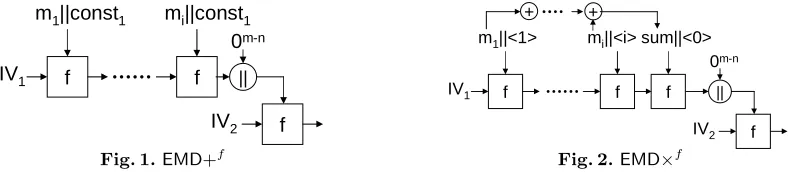
Fig. 1.EMD+f
f IV1
m1||<1>
f mi||<i>
f 0m-n
IV2 || f sum||<0> +
+
Fig. 2.EMD×f
Our Goal: We propose two new constructions that are more efficient thanDPHFf andPHFg,h, and that are indifferentiable fromROwhen the underlying compression function is modeled byTFILRO. Namely, we propose constructions such that a compression function is called one time per block message and only one type of compression function is used.
Toward Our Goal: In order to realize our constructions, we need to overcome following three obstacles: the distinguishing attack usingFIL-RO(length extension attack), the distinguishing attack usingBO, and the distinguishing attack usingBrO.
First, we search for candidates that resist the distinguishing attack usingFIL-RO. Existing construc-tions such asPMD,EMD and so on resist the distinguishing attack usingFIL-RO. We select these con-structions as the first candidates.
Second, we choose a second round candidate from these constructions such that the distinguishing attack usingBO is resisted. Before selecting a candidate, we analyze the reason whyDPHFf resists the distinguishing attack usingBO. The reason for this is that this hash function has a HMAC-like structure (enveloped structure). The structure that has a HMAC-like structure among the first round candidates is theEMDconstruction. Therefore, we choose theEMDconstruction.
As a remaining work, we modify theEMDconstruction to resist the distinguishing attack usingBrO.
First Scheme (Fig.1): In order to resist the distinguishing attack usingBrO, we use the idea of the above conversionconvfor the first schemeEMD+f. We defineEMD+f wherein thedbit constant value is input in each block ofEMDf. Since outputs of BrOare randomly chosen, the probability that a random value is equal to thedbit constant value is O(21d). We select the constant value such thatO(
1
2d) is negligible, soEMD+ resists the distinguishing attack that usesBrO. We will prove thatEMD+f @
TFILROMROholds.
Second Scheme (Fig.2): In the second scheme, we use two techniques: the check sum operation and the block index input operation. The check sum operation is the input of valuesum =m1⊕ · · · ⊕mi to a compression function wherem1, ..., mi are input messages to the compression functions. The block index input operation inputs an index of a compression function to each compression function. Since the outputs ofBrOare randomly chosen, the probability that messages satisfyingsum=m1⊕ · · · ⊕mi are found by usingBrOis negligible and the probability that an output ofBrOincludes required index value is negligible. Therefore, the new constructionEMD×f, the result of combiningEMD, the check sum operation and the block index input operation, resists the three attacks. We will prove thatEMD×f @
TFILROM RO
holds.
2
Preliminaries
2.1 Notation
Let r ←−$ R represent that elementr is selected from set R with uniform distribution. Let a||b be the concatenated value of a and b. ⊕ is the bitwise exclusive-or operation, lsba(b): the least significant a
2.2 Realization of FPT-RO
By using the technique of [9], we can realizeFPT-ROas follows. Let L be a list of ROthat is initially empty. LetMbe a finite set andZ={0,1}n. Let RObe a random oracle that maps fromM toZ. In this paper, we assume that|M| À |Z|, namely the probability thatFPOreturns⊥is negligible.
– RO(M) : If∃(M, z)∈L, returnz. Otherwise,z←− Z$ ,L←(M, z), and returnz.
– FPO(z) :M ←− M$ ,L←(M, z), and returnM.
Since cryptosystems (honest parties) access RO and any adversary can accessRO, RO has public and private interfaces. Since any adversary can accessFPO,FPO has the public interface. Note that we can also realize FPT-RO by using the technique of [15]. However, since the technique of [9] is simpler than that of [15], we use the former.
2.3 Realization of TFILRO[9]
TFILROcan be realized by using the technique of Hoch and Shamir [9]. In the following discussions, we assumem≥2nsuch that the probability thatBrOreturns⊥is less thanO(21n). This means that a query to BrOtriggers an overwhelming number of responses. However, there are far fewer responses to query (y, z) due to the description ofFIL-RO. Therefore, we realize TFILROby considering this fact. Hoch and Shamir solve this problem by using a Poisson distribution. The number of responses of BO is defined by using a Poisson distribution and a response of BOis selected from candidates whose the number is defined by a Poison distribution. Please see Section 3.1 of [9] for more details.TFILROcan be realized as follows. LetLf andTf be initially empty lists.
– FIL-RO: On query (x, y), 1. If∃(x, y, z)∈Lf, return z.
2. Generate an integer j with Poisson distribution conditioned on being non-zero, z ←− {$ 0,1}n,
Tf ←(j, y, z),Lf ←(x, y, z), and Returnz.
– BrO: On query (x, z),
1. y←− {$ 0,1}m.
2. Generate an integerj with Poisson distribution conditioned on being non-zero, Tf ← (j, y, z),
Lf ←(x, y, z), and Returny.
– BO: On query (y, z),
1. If∃(a, y, z)∈Tf,j←a. Else, generate an integerj with Poisson distribution andTf ←(j, y, z). 2. Ifj = 0,x←⊥. Else choose xuniformly from thej possible answers (some may not be defined
yet).
3. Ifxis not defined,x←− {$ 0,1}n andL
f ←(x, y, z). 4. Returnx.
2.4 Zipper Hash Function [10]
The description of Zipper hash function ZHFg,h is as follows [10]. Let g : {0,1}n × {0,1}m → {0,1}n and h:{0,1}n× {0,1}m → {0,1}n be compression functions. On inputM, the following procedure is executed.
1. Letx1, ..., xibe m-bit strings such thatx1||...||xi =M.
2. H1is computed as g(x1, IV), andH2, ..., Hi are computed iteratively asHj=g(xj, Hj−1). 3. H10 is computed as h(xi, Hi), andH20, ..., Hi0 are computed iteratively asHj=h(xi−j+1, Hj0−1). 4. OutputHi0.
2.5 Double Pipe Hash Function [11]
Double pipe hash function DPHFf was proposed by Lucks [11]. Hoch and Shamir [9] proved that
DPHFf @
TFILROMRO. The description of Double pipe hash function is as follows.
1. For input messageM, split M intoiblocks each of size m−nbits,x1, ..., xi. 2. Setr0=IV1, s0=IV2 whereIV1andIV2are the initialization vectors.
3. For each message block xj compute rj = f(rj−1, sj−1||xj) and sj = f(sj−1, rj−1||xj) where f :
{0,1}n× {0,1}m→ {0,1}n is a compression function.
4. Outputf(IV3, ri||si||0m−2n) whereIV3 is the initialization vector.
Note that the above description omits the message padding operation.
2.6 The Parallel Hash Function [9]
The indifferentiability of parallel hash function PHFg,h was discussed by Hoch and Shamir [9]. They proved thatPHFg,h @
TFILROM
RO. The description ofPHFg,h is as follows.
1. For input messageM, split messageM into iblocks each of sizembits, x1, ..., xi. 2. Setr0=IV1, s0=IV2 whereIV1andIV2are the initialization vectors.
3. For each message blockxjcomputerj=g(rj−1, xj) andsj =h(sj−1, xj) whereg:{0,1}n×{0,1}m→
{0,1}n andh:{0,1}n× {0,1}m→ {0,1}n are compression functions. 4. Outputri⊕si.
Note that the above description omits the message padding operation.
2.7 EMD Construction [1]
TheEMDf construction was proposed by Bellare and Ristenpart [1]. They showed thatEMDf @
FIL-ROM
RO
holds. TheEMDf construction is as follows.
1. For input messageM, splitM intoi−1 blocks each of sizembitsx1, ..., xi−1and am−nbit block,
xi.
2. Setc0=IV1 whereIV1 is the initialization vector.
3. For each message block xj compute cj = f(cj−1, xj) where f : {0,1}n × {0,1}m → {0,1}n is a compression function.
4. Outputf(IV2, ci−1||xi).
Note that the above description omits the message padding operation.
3
New Conversion for First Pre-image Tractable Random Oracle Model
In this section, by using indifferentiability with condition, we propose conversionconv that can convert any cryptosystem secure inROMto one that is secure inFPT-ROM.
3.1 Conversion
New Conversion: We define conditionαwherein lastsbits of the input toROprivis the constant value. Therefore, new conversionconvis as follows. LetC be any cryptosystem.
– For any valuexthat is sent from cryptosystemCto a hash function, in modified cryptosystemconv(C)
x||c is sent to a hash function instead ofxwherec is thesbit constant value.
The following theorem holds.
Theorem 1. FPT-RO @α RO where α is such that query m to ROpriv is equal to x||c where x is any
value, for anytD, withtS =O(q)and²=O(2qs).
Note thatsmust be selected such that if we want to select the constant value to ensure that the advantage ofD is less thanO(2qa),s≥amust hold, and if we want to select the constant value to ensure that the probability thatBrOreturns⊥is less thanO(21b),l+s−n≥bmust hold wherelis the maximum input length of the hash functions except forc (namelyl+sis maximum input length).
Proof (Theorem 1). In the following proof, first we introduce a simulator that simulates the public interfaces of FPO. LetSROpub be the simulator that simulates the public interface of RO andSFPOpub be
the simulator that simulatesFPOpub. Second, we show that noD can distinguish FPT-ROfromROand the simulator.
S has initially empty listLS.
– SROpub: On queryM,
1. If∃(M, z)∈LS, returnz.
2. Else poses queryM toRO, receivesz,LS←(M, z), and returnsz.
– SFPOpub: On queryz,
1. M ←− M$ , LS ←(M, z) and returnsM.
WhenD poses all queries to the simulator, running time of the above simulator is maximum. Therefore,
tS=O(q).
First we show that noD can distinguish FPOfrom (ROpriv,S) as follows. For queryM to SROpub, the
simulator simply returns the output ofRO(M). Therefore,SROpub can simulateROpub.
Second we show that SFPOpub simulates the public interface of FPO. Procedures of SFPOpub are the
same as those ofFPO. Therefore,SROpub can simulateROpubin the case that consistency between several
interfaces.
Finally, we show consistency betweenROpriv andSFPOpub and consistency betweenSROpub andSFPOpub.
Consistency betweenROpriv and SFPOpub: Above simulatorSROpub has the same construction asFPO.
Therefore, when D poses queryz to SROpub where z is a response of ROpriv, no D can distinguishSROpub
fromFPO.
Since all responses of SFPOpub are randomly chosen from M, the probability that the last s bits of
some response ofSFPOpub are equal toc isO(21s). Therefore, noD can make a query that is the response ofSFPOpub toROpriv without incurring the probability ofO(2qs).
From above discussions, sinceDcan make queries at mostqtimes,Dcan distinguishROfromFPT-RO
with probability less thanO(2qs). Therefore, the probability thatD can distinguishROfromFPT-ROby using the relation betweenROpriv andSFPOpub is at mostO(2qs).
Consistency betweenSROpub andSFPOpub: SinceSROpub andSFPOpub has same listLS,SROpub is explicitly
consistent withSFPOpub.
From the above discussions, ²=O(2qs). ut
From Theorem 1, the following corollary is obtained.
Corollary 1. For any cryptosystemC,conv(C)(FPT-ROpriv)Âconv(C)(ROpriv) holds.
Theorem 2. ROc @ RO where ROc is an entity such that for any query x to ROc, it responds with
RO(x||c).
Proof. Since for new queryxtoROcthe response is randomly chosen and for repeated queries the response
is selected fromL, the above theorem explicitly holds. ut
Therefore, for any cryptosystem C, C(ROprivc ) Â C(ROpriv) holds from the indifferentiability framework. SinceC(ROprivc ) is the same asconv(C)(ROpriv), the following corollary holds.
Corollary 2. For any cryptosystemC,conv(C)(ROpriv)Â C(ROpriv).
From corollary 1 and 2, the following corollary is obtained
Corollary 3. For any cryptosystemC,conv(C)(FPT-ROpriv)Â C(ROpriv).
Remark 1. There are conditions other than the above conditions. For example, an interface of an input of a hash function satisfies one of the following conditionsc||x,x||msbs(x),x||lsbs(x),msbs(x)||x,lsbs(x)||x
and so on.
4
Several Constructions from Fixed Input Length Weakened Random
Oracle
We show that ZHFg,h 6@
TFILROM
RO holds. We propose two constructions, EMD+ and EMD×, such that
EMD+f @
TFILROM
ROandEMD×f @
TFILROM
ROhold. Our constructions are based on theEMDconstruction.
These constructions are more efficient than the existing constructions (double pipe hash function and parallel hash function).
4.1 Distinguishing Attack for Zipper Hash Function
We showZHFg,h 6@
TFILROM
RO. The attack procedure of the Zipper hash function inTFILROMis as follows.
Letqbe the maximum number of queries made byD. LetSBObe the simulator ofBOofhandBOh be
BOofh. LetH be the Zipper hash function.
1. a←0.
2. While the number of queries is less thanq, execute the following procedure.
(a) b←− {$ 0,1}.
(b) m1 $
←− {0,1}m
(c) If b = 0, pose query m1 to ZHFg,h/RO, receive z, pose query z to BOh/SBO, and receive x. If
x=⊥, output 1 and stop.
(d) Else (b= 1),z←− {$ 0,1}n, pose queryz toBOh/SBO, and receivex. Ifx=⊥,a←a+ 1.
3. Ifa= 0, output 1. Else, output 0.
WhenDinteracts with (ZHFg,h,TFILRO), in step 2-cx6=⊥holds with probability of 1 due to the Zipper hash function. Therefore, the above distinguisher does not output 1 in step 2-d. On random query to
BOh,BOhreturns⊥with probability e1 whereeis Napier’s constant. SoDreceives⊥with probability 1e in step 2-c. The probability thata6= 0 holds in step 3 is 1−(1e)qd≈0 whereq
dis the number of invoking steps 2-d. Therefore,D outputs 0 with probability of almost 1.
WhenD interacts with (RO,S), since z is randomly chosen in both step 2-c and step 2-d, no S can know the step in whichzis defined. ThusScannot correctly decide valuex. Therefore,Doutputs 1 with non-negligible probability whenDinteracts with (RO,S). Therefore,ZHFg,h 6@
TFILROM
4.2 New Construction EMD+
From the above attack,ZHFg,h 6@
TFILROM
ROholds. So the hash function withTFILROthat is indifferentiable
fromROis only the Double pipe hash function and the Parallel hash function. However, the Double pipe hash function and the Parallel hash function are not efficient. In this section, we propose new construction
EMD+ based onEMD. In order to proposeEMD+ such thatEMD+ @
TFILROMROholds, we must overcome
three obstacles: the distinguishing attack usingFIL-WRO, the distinguishing attack usingBO(the attack in subsection 4.1), and the distinguishing attack usingBrO.EMDresists the distinguishing attack using
FIL-WROdue to [1]. Since theEMDconstruction has a HMAC-like structure and the Double pipe hash function resists the distinguishing attack usingBO (the attack in subsection 4.1) due to its HMAC-like structure ,EMDresists the distinguishing attack usingBO. Therefore, we modifyEMDsuch that modified constructionEMD+ resists the distinguishing attack usingBrO. Letf :{0,1}n× {0,1}m→ {0,1}n be a compression function.
The distinguishing attack using BrO: First we confirm the distinguishing attack using BrO for
EMD. The following distinguisher can distinguishEMDf fromROwhen underlying compression function
f is modeled byFIL-WRO. LetSBrO be a simulator ofBrO.
1. c←− {$ 0,1}n.
2. Make query (IV2,0m−n||c) toBrO/SBrO and receivez.
3. Make query (IV1, c) toBrO/SBrO and receivey.
4. Make queryy toEMDf/ROand receivez0. 5. Ifz=z0, output 0. Else output 1.
In the above procedure,Dexplicitly outputs 0 whenDinteracts with (EMDf,TFILRO). WhenDinteracts with (RO,S), Doutputs 1 with non-negligible probability because no Scan predict z0 in the above step 2. Therefore, the probability thatz6=z0 is non-negligible andEMDf 6@
TFILROM
RO.
EMD+: We apply the conversion of section 3.1 to all compression functions in order to avoid the above attack. We defineEMD+f as follows.
1. For input messageM, computeM0 =pad(M) wherepadis a padding function that returns a string whose length is an integer multiple ofm−n.
2. For messageM0, splitM0 intoiblocks each of sizem−nbits,y1, ..., yi. 3. Setc0=IV1 whereIV1 is the initialization vector.
4. For each message block yj such that j ∈ {1, ..., i} computecj =f(cj−1, yj||const1) where const1 is thenbit constant value.
5. Outputf(IV2,0m−n||ci) whereIV2(6=IV1) is thenbit constant value.
Usually a padding function that returns a string appended with the 64-bit encoding of the input length is used. Since in the above attacky is randomly chosen and the probability that lsbn(y) =const1 holds is negligible, the above attack cannot be applied toEMD+. More detail is as follows.
Theorem 3. EMD+f @
TFILROM
RO, for anytD withtS=O(lq)and²=O(l
2q2
2n )wherelis maximum block
length of the query made byD.
For more detail, please see proof of Theorem 3 in the Appendix A.
4.3 Efficient Construction EMD×
EMD+ is more efficient than the double-pipe hash function. However, EMD+ needs to input a n-bit constant value to each compression function. This additional input degrades the efficiency of the hash function compared toEMD. Our solution isEMD×which is a more efficient construction than EMD+.
1. For input messageM, computeM0 =pad(M) wherepadis a padding function that returns a string whose length is an integer multiple ofm−s.
2. For messageM0, splitM0 intoiblocks each of sizem−sbits,y1, ..., yi. 3. Setc0=IV1 whereIV1 is the initialization vector.
4. For each message blockyj computecj =f(cj−1, yj||hji) wherehjiis thes-bit binary representation of the index of the compression function.
5. Computec=f(ci, sum||h0i) wheresum=y1⊕ · · · ⊕yi. 6. Outputf(IV2,0m−n||c).
Usually we use a padding function that returns a string appended with the 64-bit encoding of the length. Note that s ≥ log2l should hold where l is the maximum number of compression function calls in
EMD×, and s≥log2q should hold when the maximum total number of query ofD isq. The security of indifferentiability is as follows.
Theorem 4. EMD×f @
TFILROM
RO, for any tD withtS=O(lq) and²=O(l
2q2
2n )wherel is the maximum
block length of a query made byD.
EMD×can resist the third attack thanks to the check sum operation and the block index input operation. Roughly speaking, the reason for this is as follows. Since a block index is input in each compression function and the output of BrO is randomly chosen, the probability that the right most s bits of an output ofBrOequal the target value is negligible. Moreover, since the output ofBrOis randomly chosen, the probability that some message satisfying sum= y1⊕ · · · ⊕yi is found by using BrO is negligible. Therefore, the probability that chain messages y1||h1i, ..., yi||hii, sum||h0i are obtained by using BrO is negligible. Therefore, EMD×can resist the third attack due to the check sum operation and the block index input operation. This proof is similar to the proof of theorem 3.
4.4 Comparison
We compare our schemes to the Double pipe hash function. In the following discussions, we consider the case thatn= 256 andm= 512.
[EMD+v.s.DPHF]: Length of one block message ofDPHFandEMD+ is 256 bits. However, a compression function is called two times per one block message inDPHF. On the other hand, a compression function is called one time inEMD+. Therefore,EMD+ is more efficient than the Double pipe hash function.
[EMD+v.s.PHF]: Two types of compression functions are called per one block message inPHF.EMD+ uses only one type of compression function. Therefore,EMD+ is more efficient thanPHF.
[EMD× v.s. DPHF]: Usually, since the maximum input length of a hash function is less than 264, the maximum number of compression function calls inEMD×is less than 264. Therefore, lengthsof a block index is less than 64 bits. Whens= 64, length of one block message ofEMD×is 448 bits. A compression function is called two times per one block message in DPHF while a compression function is called one time inEMD×. Therefore,EMD×is more efficient than the Double pipe hash function.
[EMD× v.s. PHF]: Two types of compression functions are called per one block message inPHFwhile
EMD×uses only one type of compression function. Therefore,EMD×is more efficient thanPHF.
[EMD× v.s. EMD+]: One block length of EMD× is more than 448 bits. On the other hand, that of
EMD+ is 256 bits. However, inEMD×,sumis input in the second last compression function. Therefore, when the input length is less than 512 bits, EMD+ is more efficient than EMD×. On the other hand, when the input length is more than 512 bits,EMD×is more efficient thanEMD+.
4.5 Remarks
We propose hash constructions EMD+ and EMD× based on the EMD construction. When we apply the technique of either EMD+ or EMD× to other constructions such as PMD and MDP, the resulting constructions are indifferentiable from RO when the underlying compression function is modeled by
References
1. Mihir Bellare and Thomas Ristenpart. Multi-Property-Preserving Hash Domain Extension and the EMD Transform. InASIACRYPT, pages 299–314, 2006.
2. Mihir Bellare and Phillip Rogaway. Random Oracles are Practical: A Paradigm for Designing Efficient Protocols. InACM Conference on Computer and Communications Security, pages 62–73, 1993.
3. Mihir Bellare and Phillip Rogaway. Optimal Asymmetric Encryption. In EUROCRYPT, volume 950 of Lecture Notes in Computer Science, pages 92–111. Springer, 1994.
4. Mihir Bellare and Phillip Rogaway. The Exact Security of Digital Signatures - How to Sign with RSA and Rabin. InEUROCRYPT, volume 1070 ofLecture Notes in Computer Science, pages 399–416. Springer, 1996. 5. John Black, Phillip Rogaway, and Thomas Shrimpton. Black-Box Analysis of the Block-Cipher-Based Hash-Functions Constructions from PGV. InCRYPTO, volume 2442 ofLecture Notes in Computer Science, pages 103–118. Springer, 2002.
6. Jean-S´ebastien Coron, Yevgeniy Dodis, C´ecile Malinaud, and Prashant Puniya. Merkle-Damg˚ard Revisited: How to Construct a Hash Function. InCRYPTO, volume 3621 ofLecture Notes in Computer Science, pages 430–448. Springer, 2005.
7. Ivan Damg˚ard. A Design Principle for Hash Functions. InCRYPTO, volume 435 ofLecture Notes in Computer Science, pages 416–427. Springer, 1989.
8. Shoichi Hirose, Je Hong Park, and Aaram Yun. A Simple Variant of the Merkle-Damg˚ard Scheme with a Permutation. InASIACRYPT, volume 4833 ofLecture Notes in Computer Science, pages 113–129. Springer, 2007.
9. Jonathan J. Hoch and Adi Shamir. On the Strength of the Concatenated Hash Combiner When All the Hash Functions Are Weak. InICALP, Lecture Notes in Computer Science, pages 616–630. Springer, 2008. 10. Moses Liskov. Constructing an Ideal Hash Function from Weak Ideal Compression Functions. InSelected
Areas in Cryptography, Lecture Notes in Computer Science, pages 358–375. Springer, 2006.
11. Stefan Lucks. A Failure-Friendly Design Principle for Hash Functions. In ASIACRYPT, volume 3788 of Lecture Notes in Computer Science, pages 474–494. Springer, 2005.
12. Ueli M. Maurer, Renato Renner, and Clemens Holenstein. Indifferentiability, Impossibility Results on Re-ductions, and Applications to the Random Oracle Methodology. InTCC, volume 2951 of Lecture Notes in Computer Science, pages 21–39. Springer, 2004.
13. Ralph C. Merkle. One Way Hash Functions and DES. InCRYPTO, volume 435 ofLecture Notes in Computer Science, pages 428–446. Springer, 1989.
14. Yusuke Naito, Kazuki Yoneyama, Lei Wang, and Kazuo Ohta. How to Confirm Cryptosystems Security: the Original Merkle-Damg˚ard is Still Alive! InASIACRYPT, volume 5912 ofLecture Notes in Computer Science. Springer, 2009.
15. Akira Numayama, Toshiyuki Isshiki, and Keisuke Tanaka. Security of Digital Signature Schemes in Weakened Random Oracle Models. InPublic Key Cryptography, Lecture Notes in Computer Science, pages 268–287. Springer, 2008.
16. Bart Preneel, Ren´e Govaerts, and Joos Vandewalle. Hash Functions Based on Block Ciphers: A Synthetic Approach. InCRYPTO, volume 773 ofLecture Notes in Computer Science, pages 368–378. Springer, 1993.
A
Proof of Theorem 3
In the following proof, we ignore the message padding operation so the length of any input to a hash function is a integer multiple ofm−n, sinceEMD+ with the message padding operation is just a special case of EMD+ without the message padding operation. First ,we define simulator S as follows. S has initially empty listsLS andT. Letf beFIL-RO. LetSf be a simulator that simulatesf,SBOa simulator
that simulatesBO, andSBrO a simulator that simulatesBrO. We define terms “chain triples” and
“semi-chain triples” as follows.
Definition 4 (Chain Triples ofEMD+). (x1, y1, z1), ...,(xi, yi, zi) are chain triples ofEMD+if these
pairs satisfy the following: x1 = IV1, xt = zt−1 (t = 2, ..., i−1), lsbn(yt) = const1 (t = 1, ..., i−1),
lsbn(yi) =zi−1,msbm−n(yi) = 0m−n andxi=IV2.
Chain triples ofEMD+ are input-output triples of the compression function inEMD+.
Definition 5 (Semi-chain Triples ofEMD+).(x1, y1, z1), ...,(xi, yi, zi)are semi-chain triples ofEMD+
RO S
D RO
S
D R1
RO
S0
D R1
RO
S0
D
R2 S1
D
R2 TFILRO
D EMD+
Game1 Game2 Game3 Game4 Game5 Game6
Fig. 3.Games
Semi-chain triples ofEMD+ are input-output triples of a compression function in EMD+ except for the last compression function.
Simulator S.
– Sf: On query (x, y)
1. If∃(x, y, z)∈LS, returnz.
2. Generate integersawith Poisson distribution conditioned on being non-zero. 3. z←− {$ 0,1}n.
4. T ←(a, y, z). 5. LS ←(x, y, z).
6. If∃(x1, y1, z1), ...,(xi, yi, zi)∈LSsuch that (x1, y1, z1), ...,(xi, yi, zi),(x, y, z) are semi-chain triples, (a) z0←RO(msbm−n(y1)||...||msbm−n(yi))||msbm−n(y)).
(b) Generate integersb with Poisson distribution conditioned on being non-zero. (c) T ←(b,0m−n||z, z0),
(d) LS ←(IV2,0m n
||z, z0). 7. Returnz.
– SBO: On query (y, z)
1. If∃(j, y, z)∈T, a←j. Else generate an integerawith Poisson distribution andT ←(a, y, z). 2. Choosexuniformly from theapossible answers (some may not be defined yet).
3. If the chosen answerxis not defined,x←− {$ 0,1}n andL
S ←(x, y, z). 4. Ifa= 0,x←⊥.
5. Returnx.
– SBrO: On query (x, z)
1. y←− {$ 0,1}m.
2. Generate an integerawith Poisson distribution conditioned on being non-zero. 3. T ←(a, y, z).
4. Returny.
In above simulator, though we omit the description of how to store pairs in LS, we can construct an efficient simulator by using the technique of [9] for storing pairs inLS.
In the worst case of the simulator’s running time,Sf executes step 4 for every query and this requires at mostO(ql) time whereqis the maximum number of queries ofDandlis maximum number of message blocks in the hash queries.
We call a query to f /Sf “forward query”, a query to BO/SBO “backward query”, and a query to
BrO/SBrO “bridge query”.
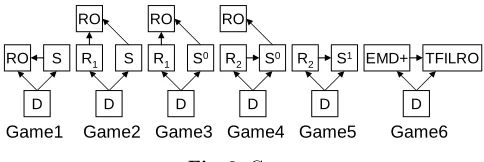
The proof involves a hybrid argument starting in theROscenario, and ending in theTFILROscenario through a sequence of mutually indistinguishable hybrid games. Fig. 3 is the figure of each game.
Game 1: This is the random oracle model, whereD has oracle access toROandS. LetG1 denote the event thatDoutputs 1 after interacting withROandS. ThusP r[G1] =P r[DRO,S(RO)⇒1].
Game 3: In this game, we modify the simulator S. In particular, we restrict the responses of the simulator. If a response of the simulator satisfies one of following conditions, it fails explicitly instead of sending this response.
LetS0be the new simulator that avoids following conditions. In response to forward query (x, y), new simulatorS0
f chooses responsez∈ {0,1}
n similar to Sand it checks for the following conditions:
– FC1: the case thatz=IV1.
– FC2: triple (x0, y0, z0) exists in LS, with (x0, y0)6= (x, y), such thatz0=z.
– FC3: triple (x0, y0, z0) exists in LS, with (x0, y0)6= (x, y), such thatx0=z.
– FC4: triple (x0, y0, z0) exists in LS, such thatlsbn(y0) =z.
If responsezis chosen byS0 thenS0checks for these conditions and explicitly fails if any of them holds. In step 6 of S0
f, if value z0 is defined in step 6 thenS
0 checks for conditions FC1−4 and explicitly fails if any of them holds.
If backward query (y, z) is made to simulatorS0, then it chooses response x∈ {0,1}n to this query similar to the original simulatorSand checks for the following failure conditions:
– BaC1: the case thatx=IV1.
– BaC2: the case thatx=IV2.
– BaC3: triple (x0, y0, z0) exists inLS, with (y0, z0)6= (y, z), such thatz0=x.
In the case of backward queries, if responsexis chosen by simulatorS0thenS0checks for these conditions and explicitly fails if any of them holds.
If bridge query (x, z) is made to simulatorS0
BO, it chooses a responsey∈ {0,1}
mto this query similar
to the original simulatorSBO and checks for the following failure conditions:
– BrC1: the case thatlsbn(y) =const1.
– BrC2: triple (x0, y0, z0) exists inLS such thatz0=lsbn(y).
– BrC3: triple (x0, y0, z0) exists inLS, with (x0, z0)6= (x, z), such thaty0=y.
In the case of bridge queries, if responseyis chosen by simulatorS0
BrOthenS
0checks for these conditions
and explicitly fails if any of them holds.
IfS0does not fail, Game 3 is identical to Game 2. We examine the probability thatS0fails as follows.
Lemma 1. The probability that simulator S0 fails is at most O(q21
2n) where q1 is maximum number of
times the simulator is invoked.
Proof. We will examine each of the twelve conditions and bound their probability.
– FC1: These conditions are that a random value is equal to some fixed value. Therefore, the probability that S0 fails due toFC1 is at mostO(q1
2n).
– FC2: This condition is that a collision occurs between two random outputs of S0
f. Therefore, the probability thatFC2 occurs is at mostO(q21
2n).
– FC3: Sincez is randomly chosen, the probability thatz collides with some valuex0 in LS is at most
1−(1−21n)(1− 2
2n)...(1− q1−1
2n ) = q2
1 2n =O(
q2 1
2n). Therefore, the probability thatS0 fails due toFC3 is at mostO(q21
2n).
– FC4: Since the output of S0
f is randomly chosen, the probability thatS
0 fails due to FC4is at most
O(q21 2n).
– BaC1 andBaC2: Since output ofS0
BOfor a backward query is randomly chosen, the probability that
S0
BOfails due toBaC1 orBaC2 is at mostO(
q1 2n).
– BaC3: Since responsexof a backward query is randomly chosen, the probability thatxcollides some value z0 in LS is at most O(
q21
2n). Therefore, the probability that S 0
BO fails due to BaC3 is at most
O(q21 2n).
– BrC1: Since the output of S0
BO for a bridge query is randomly chosen, the probability thatS0 fails
– BrC2: Since the output of S0BrO for a bridge query is randomly chosen, the probability thatS0 fails due toBrC2 is at most O(q12
2n).
– BrC3: since the output ofS0
BrOfor a bridge query is randomly chosen, the probability that two random
values collide is at mostO(q21
2m). Therefore, the probability thatS0fails due toBrC3 is at mostO( q2
1 2m).
Therefore, the probability thatS0fails is bounded byO(q21
2n). ut
Letqh be the total number of queries to S0 made by D. Let G3 denote the event that distinguisherD outputs 1 in Game 3. From Lemma 1,|P r[G3]−P r[G2]|=O(q2h
2n).
Game 4: In this game, we modify the relay algorithm as follows. The underlying idea is to make the responses of the relay algorithm directly dependent on the simulator. Thus,R2is essentially the same as
EMD+S0f.
We will show that Game 4 is identical to Game 3 unlessS0fails. The same simulatorS
0is used in Game 3 and Game 4. However, the relay algorithm in Game 4 is different from that in Game 3. Accordingly, we demonstrate the following three facts:
1. UnlessS0fails when interacting with (R
1,S0), the answers given byS0are consistent with those given byR1.
2. UnlessS0fails when interacting with (R
2,S0), the answers given byS0are consistent with those given byR2.
3. Unless S0 fails when interacting with either with (R
1,S0) or with (R2,S0), the answers given byR1 are exactly the same as those given byR2.
Before demonstrating these facts, we present two useful properties as follows.
Lemma 2. Any chain triples ofEMD+ (x1, y1, z1), ...,(xi, yi, zi)inLS are stored by the ordered sequences
of forward queries(x1, y1), ...,(xi−1, yi−1)unless S0 fails.
Proof. To check the contrary, assume that there is some chain triples ofEMD+ (x1, y1, z1), ...,(xi, yi, zi) inLS such that
1. (xt, yt, zt) (t∈ {1, ..., i−1}) is stored inLS by a forward query when there is (xt+1, yt+1, zt+1) inLS, 2. (xt, yt, zt) (t∈ {1, ..., i}) is stored by a backward query or a bridge query, or
3. (xi, yi, zi) is stored inLS by forward query (xi, yi).
Given the first assumption, whent6=i−1 is stored by a forward query, sincezt=xt+1,S0 fails due to
FC3. When (xt, yt, zt) such thatt=i−1 is stored by a forward query, sincezi−1=lsbn(yi),S0 fails due toFC4.
Given the second assumption, let j be a minimum value such that j ∈ {1, ..., i} and (xj, yj, zj) is stored by a bridge query or a backward query. Whenj= 1,
– in the case that (xj, yj, zj) is stored by a backward query, sincexj=IV1,S0 fails due toBaC1, or
– in the case that (xj, yj, zj) is stored by a bridge query, since msbm−n(yj) = const1, S0 fails due to
BrC1.
Whenj 6= 1 andj6=i,
– in the case that (xj, yj, zj) is stored by a backward query when (xj−1, yj−1, zj−1) is in LS, since
zj−1=xj holds, S0 fails due toBaC3,
– in the case that (xj, yj, zj) is stored by a backward query when (xj−1, yj−1, zj−1) is not in LS, since (xj−1, yj−1, zj−1) is stored by a forward query,S0fails due toFC3, or
– in the case of (xt, yt, zt) stored by a bridge query, sincemsbm−n(yj) =const1,S0 fails due toBrC1.
Whenj =i,
– in the case that (xi, yi, zi) is stored by a bridge query when (xi−1, yi−1, zi−1) is inLS,S0 fails due to
BrC2, or
– in the case that (xi, yi, zi) is stored by a bridge query when (xi−1, yi−1, zi−1) is not inLS, S0 fails due toFC4.
Given the third assumption, since (xi, yi, zi) is stored inLS by forward query (xi, yi)), the following case should occur from the definition ofS0f (step 6): (xi, yi, zi) is stored inLS before storing (xt, yt, zt) for sometsuch thatt≤i−1. Whent6=i−1, this case is the same as that of the first or second assumption. Therefore, in this case S0 fails. When t = i−1 and (xt, yt, zt) is stored by a forward query, namely (xi−1, yi−1, zi−1) is stored after storing (xi, yi, zi),S0 fails due to FC4. Whent=i−1 and (xt, yt, zt) is stored by a bridge query or a backward query, this case is the same as the case of assumption 2. Therefore,
S0 fails.
Therefore, this lemma is valid. ut
Lemma 3. For any chain triples ofEMD+ (x1, y1, z1), ...,(xi, yi, zi)inLS,
zi=RO(msbm−n(y1)||...||msbm−n(yi−1))holds unlessS0 fails.
Proof. From Lemma 2, (x1, y1, z1), ...,(xi, yi, zi) were stored by the ordered sequences of forward queries (x1, y1), ...,(xi−1, yi−1) unless S0 fails. Therefore,zi is defined by step 6 of S0 from the definition ofS0f.
zi=RO(msbm−n(y1)||...||msbm−n(yi−1)) holds unless one of following cases occurs.
– t exists in{1, ..., i−2}such thatzt=IV1, or
– (xt, yt, zt) (t exists in {1, ..., i−1}) and (x01, y01, z01), ...,(x0j, y0j, z0j) ∈ LS such that x01 = IV, zk0 =
x0k+1 (k= 1, ..., i−1), andzj0 =zt.
The first case is identical toFC1. The second case is identical to conditionFC2.
Therefore,zi=RO(msbm−n(y1)||...||msbm−n(yi−1)) unlessS0 fails. ut
We prove the first point by Lemma 4: we demonstrate that, when interacting with (R1,S0), any chain triples ofEMD+ obtained byS0 are consistent with an output ofR1unless S0 fails.
Lemma 4. For any chain triples ofEMD+ (x1, y1, z1), ...,(xi, yi, zi)inLS,
zi=R1(msbm−n(y1)||...||msbm−n(yi−1))holds unlessS0 fails.
Proof. Since for anyM R1(M) =RO(M) holds, this lemma is explicitly valid due to Lemma 3. ut
Second, we prove the first point by Lemma 5: we demonstrate that, when interacting with (R1,S0), any chain triples ofEMD+ obtained byS0 are consistent with an output ofR1 unlessS0fails.
Lemma 5. For any chain triples ofEMD+ (x1, y1, z1), ...,(xi, yi, zi)inLS,
zi=R2(msbm−n(y1)||...||msbm−n(yi−1))holds unlessS0 fails.
Proof. Since R2 is the same asEMD+S
0
f and (x1, y1, z1), ...,(xi, yi, zi) are explicitly inner input-output
triples ofEMD+S0f(msbm−n(y1)||...||msbm−n(yi−1)),zi=R2(msbm−n(y1)||...||msbm−n(yi−1)) explicitly holds
unlessS0 fails. ut
Third, we prove the first point by Lemma 6: we demonstrate that the answers given byR1are exactly the same as those given byR2unlessS0fails.
Lemma 6. For any inputM,R2(M) =RO(M) holds unlessS0 fails.
Proof. This lemma is explicitly valid due to Lemma 3. ut
SinceR1(M) =RO(M) holds for anyM, answers given byR1are exactly the same as those given byR2. From Lemma 4, 5, and 6, noDcan distinguish Game 3 from Game 4 unlessS0fails. Let q
F be total number of queries to the relay algorithm made byD. From 1, the probability thatS0fails is bounded by
O((lqF+qh)2 2n ) =O(
(lq)2
2n ). LetG4 denote the event that distinguisher Doutputs 1 in Game 4. Therefore,
Game 5: In this game, we modify simulator S0f. In new simulatorS1ROis removed as follows.
– S1 f(x, y):
1. If∃(x, y, z)∈LS, returnz.
2. Generate integersawith Poisson distribution conditioned on being non-zero.
3. z←− {$ 0,1}n. 4. T ←(a, y, z), 5. LS ←(x, y, z). 6. returnz.
Step 6 ofS0
f is removed inS 1
f. Note thatS 1
BOandS
1
BrOare same asS
0
BOandS
0
BrO. Since noD can see the
values defined in step 6 ofS0
f,ROoutputs a random value andROis called by justS0f, the view ofDfor
S1
f is the same as that forS0f. Therefore, Game 5 is identical to Game 4 unlessS0fails. LetG5 denote the event that distinguisherD outputs 1 in Game 5. Since the probability thatS0 fails is at most O(
(lq)2 2n ),
|P r[G5]−P r[G4]|=O((lq2n)2).
Game 6. This is the final game of our argument. Here we finally replace S1 with TFILRO. Since S1 is the same as TFILRO, this game is identical to Game 5. LetG6 denote the event that distinguisherD
outputs 1 in Game 6. Obviously we can deduce thatP r[G6] =P r[G5].
Now we can complete the proof of the theorem by combining Games 1 to 6, and observing that game 1 is the same as the ROmodel while Game 6 is the same as the TFILROmodel. Hence we can deduce