Scholarship@Western
Scholarship@Western
Electronic Thesis and Dissertation Repository
8-22-2019 10:00 AM
Understanding the Development of a Logic Model in a
Understanding the Development of a Logic Model in a
Multi-Agency Resource Centre
Agency Resource Centre
Alexandra M. Boston
The University of Western Ontario
Supervisor Oudshoorn, Abe
The University of Western Ontario Co-Supervisor Broad, Gayle
Algoma University
Graduate Program in Health Information Science
A thesis submitted in partial fulfillment of the requirements for the degree in Master of Health Information Science
© Alexandra M. Boston 2019
Follow this and additional works at: https://ir.lib.uwo.ca/etd
Part of the Community-Based Research Commons
Recommended Citation Recommended Citation
Boston, Alexandra M., "Understanding the Development of a Logic Model in a Multi-Agency Resource Centre" (2019). Electronic Thesis and Dissertation Repository. 6545.
https://ir.lib.uwo.ca/etd/6545
This Dissertation/Thesis is brought to you for free and open access by Scholarship@Western. It has been accepted for inclusion in Electronic Thesis and Dissertation Repository by an authorized administrator of
ii
In response to social and economic decline in the downtown area of Sault Ste. Marie,
Ontario, over thirty diverse community organizations collaborate to deliver programs and
services out of a shared space, the Neighbourhood Resource Centre (NRC). This study seeks
to uncover how the objectives of the NRC are being interpreted and enacted by community
partners, as well as, how the partners navigate diverse desired outcomes to create a common
logic model. Through participatory action research, the study sought to answer the research
questions through field observation, semi-structured interviews, and focus groups. An
analysis of the data yields that, 1) collaboration and engagement has strengthened
neighbourhood development, 2) the NRC promotes belonging, 3) community partners must
overcome barriers, 4) the NRC enacts continuous evaluation and 5) evaluation has instigated
participants getting on the same page. This study is a part of a growing body of literature that
seeks to understand how logic models are developed across diverse collaborations. It is our
hope that this project will contribute to future research on collaborative planning and
evaluation processes.
Keywords
Community, collaboration, engagement, evaluation, multi-agency, neighborhood resource
iii
Summary for Lay Audience
Neighbourhood resource centres, community centres or neighbourbood hubs have the ability
to connect neighbours and provide opportunities for personal interactions. The presence of
these centres in neighbourhoods that are facing higher rates of poverty have the ability to
contribute more than just opportunities for mixing with one another. In the case of the
Neighbourhood Resource Centre (NRC) located in Sault Ste. Marie, Ontario, the NRC is
comprised of over 30 different organizations that offer a range of health and human services
to neighbours in the city’s downtown. This research is attempting to understand how the
goals of the NRC are being understood and acted upon by different members, as well as how
NRC members plan how things should turn out to create a common logic model. A logic
model is a visual representation of how a complex program or system works by looking at
activities, inputs, outputs and outcomes. In order to better understand the NRC, researchers
invited members of the NRC to participate in interviews, focus groups and be observed
during their meetings. After looking at the results of the study, the following findings are
suggested: 1) individuals delivering services and programs must work together to strengthen
neighbourhood development, 2) the NRC promotes belonging within the neighbourhood, 3)
members must work to overcome barriers, 4) the NRC provides many opportunities for
reflection and evaluation, and 5) the development of this logic model has allowed NRC
members to get on the same page. This study is a part of a growing body of research that
seeks to understand how logic models are developed across different collaborations. It is our
iv
Co-Authorship Statement
Alexandra Boston completed this work under the supervision of Dr. Abe Oudshoorn and Dr.
v
Acknowledgments
Firstly, I would like to thank my thesis supervisor, Dr. Abe Oudshoorn, for your guidance
and commitment to my work. Thank-you for your constant support and flexibility even while
completing my research at such a distance. I would also like to thank Dr. Gayle Broad for
your support and expertise on our community. I am incredibly thankful for the support that
both of you provided to me as I completed this degree.
I also want to acknowledge and thank my close friends for their support and encouragement,
Kayla Palombaro, Leah Henderson-Harrington and Jennifer Black.
Finally, I thank all my family members, especially my parents, Andy Boston and Laurie
Zeppa, and my brother, Sam Boston. Dad, Mum and Sam, I can’t even attempt to thank you
for all that you have done for me but please know I am forever grateful for being a part of a
family that supports my success. I’d also like to acknowledge my Mum, who has been a
Registered Nurse for 35 years. Thank you for your dedication to public health and health
equity in our community. Mum, you inspired me to take this path in my academic career.
vi
Dedication
I would like to dedicate this work to my family and friends for their support throughout my
academic years. I would especially like to thank my parents, Laurie Zeppa and Andy Boston,
who have been my ‘rocks’ and instilled in me the importance of hard work. Without them, I
would not be the person I am today and for that I am eternally grateful. I also dedicate this
work to the Neighbourhood Resource Centre. It was a honour to learn about the important
vii
Table of Contents
Abstract ... ii
Summary for Lay Audience ... iii
Co-Authorship Statement... iv
Acknowledgments... v
Dedication ... vi
Table of Contents ... vii
List of Tables ... ix
List of Figures ... x
List of Appendices ... xi
Chapter 1 ... 1
1 Introduction ... 1
1.1 Background and Significance ... 2
1.2 Statement of the Problem and Research Questions ... 5
1.3 Purpose of the Study ... 6
1.4 Participatory Action Approach ... 6
1.5 References ... 8
Chapter 2 ... 10
2 Introduction ... 10
2.1 Background and Significance ... 10
2.2 Literature Review... 15
2.3 Ethical Approval ... 20
2.4 Methodology ... 21
2.5 Study Design ... 21
viii
2.7 Data Collection ... 24
2.8 Data Analysis ... 24
2.9 Rigor ... 27
2.10Findings... 28
2.11Discussion and Implications ... 42
2.12Limitations ... 50
2.13Conclusion ... 51
2.14References ... 52
Chapter 3 ... 57
3 Implications ... 57
3.1 Implications for Policy ... 57
3.2 Implications for Health Information Science ... 59
3.3 Implications for Program Evaluation ... 60
3.4 References ... 62
Appendix A: Letter of Information and Consent ... 63
Appendix B: Invitation to Participate ... 70
Appendix C: Semi-Structured Interview Guide ... 73
Appendix D: Focus Group Guide ... 75
Appendix E: Observation Guide ... 77
ix
List of Tables
x
List of Figures
xi
List of Appendices
Appendix A: Letter of Information and Consent ... 63
Appendix B: Invitation to Participate ... 70
Appendix C: Semi-Structured Interview Guide ... 73
Appendix D: Focus Group Guide ... 75
Chapter 1
1
Introduction
Neighbourhood resource centres act as a community hub to offer neighbourhood-based
social, recreational and educational services and programming to a specific geographic
area within a town or city. Neighbourhood resource centres often include a collaboration
of diverse agencies and organizations who deliver a wide range of services and
programming, and are usually funded by federal, provincial and/or municipal
governments. Neighbourhood resource centres offer an ideal location to study
collaboration at the organizational level due to the diversity of their service delivery.
Collaborations within Neighbourhood Resource Centres have the ability to positively
contribute to the areas they serve, however, there are also potential challenges inherent in
collaboration. Health and social service collaborations can struggle with clarity, be
problematic in terms of conflict, or ultimately fail. Some of the root causes may be due to
a lack of understanding, differing agendas, intentions, and a disconnect in communication
between agencies involved. Inter-agency conflict can be caused by issues of power and
control, poor planning, such as poor identification of goals, differing levels of
commitment and a lack of attention to sustainability. This thesis explores the
collaborations that occur between health and social service providers within a
Neighbourhood Resource Centre, including participatory development of a logic model
defining the work of the NRC.
This thesis follows an integrative article format. Chapter 1 introduces the issue, purpose,
and study design. Chapter 2 is a stand-alone paper re-iterating these elements plus
containing the findings and recommendations. The third chapter consists of the
implications section that focuses on policy, health information science, and program
evaluation. Within an integrative article format there is some repetition across the three
1.1
Background and Significance
The city of Sault Ste. Marie is located in Northeastern Ontario with a population of 73
368 (Statistics Canada, 2018). Members of the community, spearheaded by the Sault Ste.
Marie Police Services’ (SSMPS) community mobilization model of policing, identified a decline in social and economic growth in the city’s downtown core accompanied by an
increase in the number of social needs within this area. This was accompanied by an
unexpectedly high murder rate in the downtown area between 2010-2011. From
2012-2014, members of the community participated in a “Downtown Dialogue in Action” research project that assessed the downtown area’s social and economic issues. Their
findings indicated that there was an out-migration of essential services that moved to the
north end of the city. The out-migration of these services also caused a decrease in
knowledge regarding where to go for services. In addition, another finding was that a
large amount of 911 calls were directed to a specific intersection, Albert and Gore Street,
in the downtown area. These calls were considered “social disorder” calls, “which
required a different approach to resolution” (Broad, Meades, Green, Chalifoux, &
Bolduc, 2014, p. 4). Essentially, these calls were non-reportable by the police and instead
required a response by human services.
In 2014, the Sault Ste. Marie Police Services’ (SSMPS) community mobilization model
of policing project opened its doors to the Neighbourhood Resource Centre, which was
located in the Albert and Gore Street area, with the goal to deter and prevent crime
(Broad, Meades, Green, Chalifoux, & Bolduc, 2014). Originally, the NRC worked
collaboratively to build relationships with over 14 diverse community agencies and
organizations in an effort to share resources and develop core partnerships. (Doxtater,
Broad, Ortiz, Storozuk, & Dupuis, 2015). Since the opening of the NRC there has been a
growth in services and programming, as well as involvement from other community
members and stakeholders, from 14 agencies to over 30. One of the discussed objectives
of the NRC is to work towards altering negative perceptions of the area, ultimately, to
create a feeling of safety and instill pride and purpose for residents of this area (Doxtater,
Broad, Ortiz, Storozuk, & Dupuis, 2015). In addition, the NRC’s efforts within the
provincially, in the Chief Medical Officer of Health of Ontario to the Legislative
Assembly of Ontario 2018 report “Improving the Odds: Championing Health Equity in Ontario.” In these reports, the NRC is described as a positive contribution to the
community, which is described as a place where residents feel safe and are able to access
person-centred services.
The NRC studied has over 30 organizations and agencies actively delivering
programming and services out of its location. Staff who offer programming come from
these partnered agencies and operate at the NRC utilizing their own agency or
organization’s mandates, policies, and objectives. This can affect the operations at the
NRC, as frontline staff do not necessarily share common goals under the umbrella of the
NRC. There is significant interdisciplinary variety across staff placed at the NRC, which
adds a further degree of complication to service delivery. Therefore, this research
engages with the complexity of collaboration in an NRC model, involving an effort to
collaboratively develop a logic model for the organization as a whole.
Collaboration in human services is often referred to as service integration or interagency
service coordination (Longoria, 2005). Collaborative efforts between health and human
services is a rational and effective means to achieving outcomes set by organizations and
agencies (Page, 2003). While it is hoped that collaboration, service integration or
interagency service coordination will be of benefit, there are chances for potential issues
to arise. These problems may include, a lack of communication and understanding,
differing agendas, motives, and intentions (Byles, 1985). These challenges can lead to
power struggles that can be further complicated through various leadership designs.
Power and control imbalances may be due in part to the organization or agency that
instigated the collaboration, invited other organizations and agencies to participate, or is
the recipient of the funding that will be utilized by the collaboration (Shortell, Gillies,
Anderson, Mitchell & Morgan, 1993). Lastly, Dorsey et al., (2014) explain that confusion
around collaboration can limit the ability to engage in proper program evaluation, which
requires clear definition of goals, outputs, and outcomes. Failures of collaboration may be
caused when those involved in the collaboration do not understand one another’s purpose
differing agendas, motives or intentions that are aligned to meeting their own needs or
reaching differently mandated statistics.
The NRC in Sault Ste. Marie is designed following a backbone agency model. Backbone
agencies within a collaboration are an agency or organization that takes a role within the
partnership to organize, lead, and support the group in working towards their intended
goal (Turner, Merchant, Kania and Martin, 2012). Backbone agencies may also be the
direct source of the funding for the collaboration. In this case, the Sault Ste. Marie Police
Service is the backbone agency as the initial concern precipitating development of the
NRC was community safety and crime.
Planning is a key concept interconnected with the idea of collaboration. Ideally, a
thorough needs-assessment is conducted prior to designing and implementing a
collaborative service model (Janosky et al., 2013). This allows for a deeper understanding
to identify the specific need and resources around which services can be provided.
Effective planning also allows for considering sustainability of the collaboration with
consideration of staffing and funding. As noted above, adequate planning supports proper
evaluation through the clear definition of program outcomes. This can ultimately impact
service recipients by ensuring alignment between the services provided and community
needs. Therefore, evaluation is optimized if designed at the project outset (Helitzer, et al.,
2010).
Part of the impetus for this project was the noted lack of common goals and objectives
that were utilized by the frontline staff at the NRC to guide their service delivery and
planning. This was important to the success of the NRC as they rely on collaborative
efforts to achieve their outcomes. Therefore, to best understand the collaboration, it was
of benefit to learn if frontline staff have an understanding of why they are at the NRC
delivering their specific programs and services. A suggested way to assess the
collaboration was through analyzing the various processes and common goals understood
by frontline staff at the NRC. From the outset, co-designing a logic model was considered
a way to almost take a step back and consider the NRC from a high level in terms of
what the NRC as a collaboration expects to happen and a figurative ‘road map’ on how
exactly will they get there. Through engaging frontline staff in the logic model
development process, individuals are not only participating in the co-creation but also
enhancing their relationships and collaborations with one another. Using a logic model
also helps in the evaluation and monitoring of the NRC, as well as for managing what is
going on, and informing those who are not directly involved, such as senior management
of the frontline staff’s organizations and agencies. Through using a logic model,
participants are able to collectively align their common goals and objectives and enhance
collaborative efforts at the NRC.
The significance of this topic is that the community of Sault Ste. Marie identified a need
for a collaboration amongst organizations to re-instate growth and development in a
neighbourhood facing disparities. To challenge these disparities, the Neighbourhood
Resource Centre was opened with the support of numerous organizations. Since its initial
opening, there has been an increase in services, programs and involvement of community
members. Due to the vast amount of services, programming and outreach the
Neighbourhood Resource Centre offers, it was of benefit to evaluate the ongoing
collaboration. This research study will provide further insight into understanding how the
use of a logic model can be used to guide outcomes in a multi-agency resource centre
where diverse needs and interests of diverse organizations may align in some cases, and
differ in others.
1.2
Statement of the Problem and Research
Questions
Since the opening of the NRC there has been a tremendous growth in services and
programming, as well as involvement from other community members. Originally, the
NRC was opened with a narrow goal to deter and prevent crime, however, after the
growth of the diversity of programs and services offered at the NRC the main objective
was altered to promoting community health and well-being. In understanding the main
objective, the promotion of community health and well-being, there is reason to believe
that the path in achieving these outcomes may be interpreted differently amongst various
understand how numerous agencies and organizations understand the NRC’s objectives
and to understand how a logic model to guide collaboration is developed across diverse
organizations. The following research questions are addressed:
1. How are the objectives of the NRC being interpreted and enacted by different members?
2. How do NRC members navigate diverse desired outcomes to create a common logic model?
1.3
Purpose of the Study
The purpose of this participatory action research study is to work collaboratively with a
neighbourhood resource centre to understand the co-development of a logic model that
graphically illustrates a relationship between resources, programs and activities and
intended outcomes. Through this participatory action process, collaborative processes or
challenges to collaboration will be uncovered. Ultimately, this study will contribute
knowledge regarding collaborative program evaluation and planning processes.
1.4
Participatory Action Approach
This project is situated within the interpretive paradigm with a focus on understanding
the meaning of everyday collaboration. The concept of everyday collaboration is a norm
for participants and therefore the study has been able to uncover the subjective
experiences of working with numerous organizations for a common purpose. The
subjective approach was a valuable theoretical approach as it led to a deeper
understanding of each participant’s unique perspectives and interpretations. In addition, it
led to a rich co-construction of knowledge amongst participants, who have varying
degrees of experiences. This has been done through exploring the stories of research
participants while they engage in developing a logic model.
Working through the interpretive paradigm, the methodology of participatory action
research (PAR) was deemed the most appropriate for the research. This is due in part to
the emphasis on participation and action. Reason and Bradbury (2001, Pg 1) define PAR
understanding of power as he sees power as something that results from between people
and from different forms of knowledge (Baum & MacDougall, 2006). Another
connection to PAR is directly traced to Paulo Freire, who thought that critical reflection
was essential for social and personal change (Ozanne & Saatcioglu, 2008). This
methodology fully integrates both researcher and participants, in order to create a
working environment where they can improve practices that they participate in and the
various situations they find themselves in (Baum & MacDougall, 2006). The literature
also suggests that researchers work closely with health policy makers and practitioners to
overcome professional dominance and improve strategies. At times, researchers often
struggle with this methodology due to the ongoing and competing relationship between
academic theories and everyday knowledge (Ozanne & Saatcioglu, 2008). However, in
my experience, the reflective component of PAR allowed myself as a researcher to digest
what I was seeing and hearing from participants in order to develop new understandings.
PAR is an engaging research method that drives social change, empowers participants
and encourages collaboration.
The use of participatory action research enabled the participants and I to become fully
immersed in the collection of new data and co-development of knowledge products.
Participants were invited to take part in semi-structured interviews, focus groups and to
be observed at bi-weekly meetings. Those who decided to engage in the research were
able to control which parts of the data collection they wanted to be involved with at
varying capacities. The dissemination of the results concluded in co-creating a logic
model that participants and their organizations will be able to utilize for planning and
evaluation.
Following an integrative thesis format, the next chapter is an in-depth piece that includes:
an introduction, background and significance, literature review, ethical approval,
methodology, study design, sample/sampling method, data collection, data analysis,
rigor, findings, discussion and implications, limitations, and conclusion. The third and
final chapter includes a deeper examination of potential implications in policy, health
information science, and program evaluation. This chapter is followed by appendices and
1.5
References
Abdi, S., & Mensah, G. (2016, December). Focus On: Logic model - a tool for planning and evaluation. Retrieved October 15, 2018, from Public Health Ontario website:
https://www.publichealthontario.ca/-/media/documents/focus-on-logic-model.pdf?la=en
Baum, F., MacDougall, C., & Smith, D. (2006). Participatory action research. J
Epidemiol Community Health,60(10), 854-857. doi:10.1136/jech.2004.028662
Broad, G., Meades, S., Green, T., Chalifoux, D., & Bolduc, J. (2104, December 31).
Downtown Dialogue in Action: Crime Prevention through Social Development
(Rep.). Retrieved August 13, 2018 from Northern Ontario Research,
Development, Ideas and Knowledge website: http://www.nordikinstitute.com/wp-content/uploads/2013/12/Downtown-Dialogue-in-Action-Final-Report.pdf
Byles, J. A. (1985). Problems in interagency collaboration: Lessons from a project that failed. Child Abuse & Neglect, 9(4), 549-554. doi:10.1016/0145-2134(85)90065-1
Dorsey, S. G., Schiffman, R., Redeker, N. S., Heitkemper, M., McCloskey, D. J., Weglicki, L. S., & Grady, P. A. (2014). National Institute of Nursing Research Centers of Excellence: A logic model for sustainability, leveraging resources, and collaboration to accelerate cross-disciplinary science. Nursing outlook, 62(6), 384-393.
Doxtater, L., Broad, G., Ortiz, J., Storozuk, M., & Dupuis, P. (2016, January).
Neighbourhood Resource Centre: A Collective Impact Assessment (Rep.).
Retrieved August 13, 2018, from Northern Ontario Research, Development, Ideas and Knowledge website:
http://www.nordikinstitute.com/wp- content/uploads/2011/12/Collective-Impact-of-the-Neighbourhood-Resource-Centre_-2016.pdf
Helitzer, D., Hollis, C., Hernandez, B. U., Sanders, M., Roybal, S., & Deusen, I. V. (2010). Evaluation for community-based programs: The integration of logic models and factor analysis. Evaluation and Program Planning,33(3), 223-233. doi:10.1016/j.evalprogplan.2009.08.005
Janosky, J. E., Armoutliev, E. M., Benipal, A., Kingsbury, D., Teller, J. L., Snyder, K. L., & Riley, P. (2013). Coalitions for impacting the health of a community: the Summit County, Ohio, experience. Population health management, 16(4), 246– 254. doi:10.1089/pop.2012.0083
Ozanne, J., & Saatcioglu, B. (2008). Participatory Action Research. Journal of Consumer Research,35(3), 423-439. doi:https://doi.org/10.1086/586911
Page, S. (2003). Entrepreneurial strategies for managing interagency collaboration. Journal of Public Administration Research and Theory, 13(3), 311-340.
Shortell, S. M., Gillies, R.R., Anderson, D.A., Mitchell, J.B., & Morgan, K. L.(1993, Winter). Creating organized delivery systems: the barriers and facilitators.
Hospital & Health Services Administration, 38(4), 447+.
Statistics Canada. 2017. Sault Ste. Marie [Population centre], Ontario and Ontario [Province] (table). Census Profile. 2016 Census. Statistics Canada Catalogue no. 98-316-X2016001. Ottawa. Released November 29, 2017.
https://www12.statcan.gc.ca/censusrecensement/2016/dp-pd/prof/index.cfm?Lang=E (accessed October 15, 2018).
Chapter 2
2
Introduction
Neighbourhood resource centres act as a community hub to offer neighbourhood-based
social, recreational and educational services and programming to a specific geographic
area within a town or city. Neighbourhood resource centres often include a collaboration
of diverse agencies and organizations who deliver a wide range of services and
programming, and are usually funded by federal, provincial and/or municipal
governments. Neighbourhood resource centres offer an ideal location to study
collaboration at the organizational level due to the diversity of their service delivery.
Collaborations within Neighbourhood Resource Centres have the ability to positively
contribute to the areas they serve, however, there are also potential challenges inherent in
collaboration. Health and social service collaborations can struggle with clarity, be
problematic in terms of conflict, or ultimately fail. Some of the root causes may be due to
a lack of understanding, differing agendas, intentions, and a disconnect in communication
between agencies involved. Inter-agency conflict can be caused by issues of power and
control, poor planning, such as poor identification of goals, differing levels of
commitment and a lack of attention to sustainability. This thesis explores the
collaborations that occur between health and social service providers within a
Neighbourhood Resource Centre, including participatory development of a logic model
defining the work of the NRC.
2.1
Background and Significance
There was a time in Sault Ste. Marie, Ontario’s history where Gore Street, an area located
in the city’s downtown core, was a bustling area occupied by locally owned businesses,
restaurants and entertainment. It was a regular destination for community members from
across the city. However, more recently, the area experienced a gradual social and
economic decline as well as a decrease in the residential population. Schools, churches,
businesses, restaurants, and existing community centres in the area have closed. To
the community participated in a “Downtown Dialogue in Action” research project that assessed the downtown area’s social and economic issues. Two of their findings
included: 1) Essential social, health and human services uprooted their locations to the
north end of the city. Due to this, members of the community faced numerous barriers in
accessing these services. 2) While the out-migration of services was ongoing, the Sault
Ste. Marie Police Services (SSMPS) noticed that a bulk of 911 calls received were from
the Gore St area. These calls were deemed “social disorder” calls, “which required a
different approach to resolution” (Broad, Meades, Green, Chalifoux, & Bolduc, 2014, p.
4). Essentially, these calls did not require a police response and instead required a
response by human services.
To better address the needs of downtown residents, in 2014, the SSMPS community
mobilization model of policing project opened its doors to the Neighbourhood Resource
Centre (NRC), located on Gore Street, with the narrow initial goal to deter and prevent
crime (Broad, Meades, Green, Chalifoux, & Bolduc, 2014). Originally, the NRC worked
collaboratively to build relationships with over 14 diverse community agencies and
organizations in an effort to share resources and develop core partnerships. (Doxtater,
Broad, Ortiz, Storozuk, & Dupuis, 2015). Since the opening of the NRC there has been a
growth in human, health and social services and programming, as well as involvement
from other community members and stakeholders, from 14 agencies to over 30. This has
also precipitated a shift in focus of the NRC, although this shift has not been formalized
in Centre documents.
The NRC studied has over 30 organizations and agencies actively delivering
programming and services out of its location. Staff who offer programming come from
these partnered agencies and operate at the NRC utilizing their own agency or
organization’s mandates, policies, and objectives. This can affect the operations at the
NRC, as frontline staff do not necessarily share common goals under the umbrella of the
NRC. There is significant interdisciplinary variety across staff placed at the NRC, which
adds a further degree of complication to service delivery. Therefore, this research
engages with the complexity of collaboration in an NRC model, involving an effort to
Collaboration in human services is often referred to as service integration or interagency
service coordination (Longoria, 2005). Collaborative efforts between health and human
services is a rational and effective means to achieving outcomes set by organizations and
agencies (Page, 2003). While it is hoped that collaboration, service integration or
interagency service coordination will be of benefit, there are chances for potential issues
to arise. These problems may include, a lack of communication and understanding,
differing agendas, motives, and intentions (Byles, 1985). These challenges can lead to
power struggles that can be further complicated through various leadership designs.
Power and control imbalances may be due in part to the organization or agency that
instigated the collaboration, invited other organizations and agencies to participate, or is
the recipient of the funding that will be utilized by the collaboration (Shortell, Gillies,
Anderson, Mitchell & Morgan, 1993). Lastly, Dorsey et al., (2014) explain that confusion
around collaboration can limit the ability to engage in proper program evaluation, which
requires clear definition of goals, outputs, and outcomes. Failures of collaboration may be
caused when those involved in the collaboration do not understand one another’s purpose
or objectives (Byles, 1985). In addition to this, agencies and organizations may have
differing agendas, motives or intentions that are aligned to meeting their own needs or
reaching differently mandated statistics.
The NRC in Sault Ste. Marie is designed following a backbone agency model. Backbone
agencies within a collaboration are an agency or organization that takes a role within the
partnership to organize, lead, and support the group in working towards their intended
goal (Turner, Merchant, Kania and Martin, 2012). Backbone agencies may also be the
direct source of the funding for the collaboration. In this case, the Sault Ste. Marie Police
Service is the backbone agency as the initial concern precipitating development of the
NRC was community safety and crime.
Planning is a key concept interconnected with the idea of collaboration. Ideally, a
thorough needs-assessment is conducted prior to designing and implementing a
collaborative service model (Janosky et al., 2013). This allows for a deeper understanding
to identify the specific need and resources around which services can be provided.
consideration of staffing and funding. As noted above, adequate planning supports proper
evaluation through the clear definition of program outcomes. This can ultimately impact
service recipients by ensuring alignment between the services provided and community
needs. Therefore, evaluation is optimized if designed at the project outset (Helitzer, et al.,
2010).
Neighbourhood centres, hubs and institutions are integral for building community. They
provide opportunities for socialization, can instill a sense of belonging and potentially
enhance civic pride. In addition, they may offer neighbourhood-based social, recreational
and educational services. While some centres are run by religious or educational entities,
others may be operated by social enterprise groups. Additionally, many are constituted of
a diverse network of organizations (Small, 2006). These networks can include a valuable
collaboration of diverse organizations to deliver a wide range of services and
programming. However, these networks can also include competing interests or
priorities. This is significant to this study as, the Neighbourhood Resource Centre (NRC)
located on Gore Street in Sault Ste. Marie, Ontario is operated by an extensive network of
local agencies and organizations. Since its initial opening, there has been continual
growth in services, programs and involvement from the community members. Due to the
fact that the NRC is primarily ran by frontline staff who offer vast amount of services,
programming and outreach, it was important to understand how they have collectively
operated over the past 5 years.
Part of the impetus for this project was the noted lack of common goals and objectives
that were utilized by the frontline staff at the NRC to guide their service delivery and
planning. This was important to the success of the NRC as they rely on collaborative
efforts to achieve their outcomes. Therefore, to best understand the collaboration, it was
of benefit to learn if frontline staff have an understanding of why they are at the NRC
delivering their specific programs and services. A suggested way to assess the
collaboration was through analyzing the various processes and common goals understood
by frontline staff at the NRC. From the outset, co-designing a logic model was considered
a way to almost take a step back and consider the NRC from a high level in terms of
what the NRC as a collaboration expects to happen and a figurative ‘road map’ on how
exactly will they get there. Through engaging frontline staff in the logic model
development process, individuals are not only participating in the co-creation but also
enhancing their relationships and collaborations with one another. Using a logic model
also helps in the evaluation and monitoring of the NRC, as well as for managing what is
going on, and informing those who are not directly involved, such as senior management
of the frontline staff’s organizations and agencies. Through using a logic model,
participants are able to collectively align their common goals and objectives and enhance
collaborative efforts at the NRC.
The significance of this topic is that the community of Sault Ste. Marie identified a need
for a collaboration amongst organizations to re-instate growth and development in a
neighbourhood facing disparities. To challenge these disparities, the Neighbourhood
Resource Centre was opened with the support of numerous organizations. Since its initial
opening, there has been an increase in services, programs and involvement of community
members. Due to the vast amount of services, programming and outreach the
Neighbourhood Resource Centre offers, it was of benefit to evaluate the ongoing
collaboration. This research study will provide further insight into understanding how the
use of a logic model can be used to guide outcomes in a multi-agency resource centre
where diverse needs and interests of diverse organizations may align in some cases, and
differ in others.
For this research study, we sought to uncover how the existing objectives of the NRC are
interpreted and enacted by various frontline staff. In addition, we sought to understand
how NRC members navigate diverse desired outcomes. The dissemination of these
results involved co-creating a logic model. Past research studies address how
organizations have utilized logic models within their organizations to address diverse
intended outcomes. This research study will provide further insight into understanding
how the development and creation of a logic model can be used to guide outcomes in a
multi-agency resource centre where there are diverse needs and complex interests of
2.2
Literature Review
To examine how logic models have been developed and utilized by neighbourhood
resource centres, or similar collaborations in communities, and to understand methods to
support further research in this field, a comprehensive review of the literature was
conducted. The databases that were searched within included PubMed, PsychInfo,
MEDLINE (Ovid) and CINAHL. I began by conducting a brief Google search to
determine what community collaborations are called that function similar to a
“neighbourhood resource centre”. Through developing a list of synonyms to a
“neighbourhood resource centre” I was able to develop terms that would be used within
my search strategy. The terms that were utilized within my search strategy were: logic
model, evaluation, activities approach, backbone agency, backbone organization,
collaboration, community, community collaboration, community health center,
community hub, community centre, community center, health services, human services,
neighbourhood centre, neighbourhood center, outcomes approach, recreation centre,
recreation center, planning, system, theory approach, triangulation, research methods, and
qualitative.
Collectively, the search results totaled to just under 300 peer-reviewed scholarly works
across all four databases. The search results were filtered and examined to locate key
research findings that spoke to collaborative planning processes and identify gaps in the
current knowledge surrounding the use of logic models to plan and evaluate
collaborations amongst community organizations. Most of the research found was of
qualitative nature with some utilizing mixed-method strategies. The date range of the
pieces was between 1998 and 2014. The scholarly works utilized a range of methods:
survey distribution and collection, semi-instructed interviews, and focus groups.
Integrating health and human services to address an arising problem or issue is a strategy
commonly utilized by publicly-funded agencies and organizations. This is especially true
when resources and funding is limited, or to address a crisis. In fact, the literature
indicated that there are higher opportunities for collaboration between interdisciplinary
services in the health field when there is a potential crisis (Gorder, 2015). During these
in high-level leadership positions (Gorder, 2015). Therefore, these leaders must be
responsible for also nurturing collaboration amongst direct service staff to enhance the
success of the collaboration (Gorder, 2015). If collaborations are successful, the literature
argues that they can add to positively changing community infrastructure, increasing
financial and material resources, improving health outcomes, and contributing to a higher
quality of life (Janosky et al., 2013). The success of these collaborations is often
attributed to effective leadership, communication, and trust. Organizational politics also
play a key role in ensuring that interagency collaborations work, meaning that agencies
should work towards sharing responsibilities (Byles, 1985). Collaboration means
organizations removing themselves from figurative ‘silos,’ which includes stepping out
of their discipline and be willing to work collectively with other disciplines in order to
develop a variety of viewpoints (Janosky et al., 2013). Inter-organization collaborations
have the opportunity to address complex problems while developing relationships that
could encourage future collaborations (Provan et al., 2003).
On the other hand, the literature identified that there are potential problems that can arise
during collaborations between health and human service organizations. Longoria (2005)
expresses concerns about the effectiveness of human services working together,
questioning if this process is potentially fragmented, inefficient and wasteful. Shortell,
Gillies, Anderson, Mitchell and Morgan (1993) outlined many barriers that lead to failure
in collaboration, such as misunderstanding why the collaboration is occurring and whom
the collaboration will be serving. Another contributing factor to failure is struggles of
power and control. Byles (1985) argued that if agencies are not sharing responsibilities or
working together, roles can become blurred and objectives may be misinterpreted. The
presence of power can also be affected if individuals working together do not understand
how to manage and strategize the objectives that have been set out, this could potentially
lead to a lack of strategic alignment between staff (Shortell, Gillies, Anderson, Mitchell
& Morgan, 1993). This is especially true if the collaboration has not adequately assessed
the need for the collaborative service model. Collaborations could also fail if the
service(s) being offered overlap with others, or if there are too many people working
towards achieving the same objective (Janosky et al., 2013). Adequately assessing the
Looking at the components of collaboration and the potential designs, Longoria (2005)
states that collaborations should be mutually beneficial for all involved. A type of
collaboration that resonates with this particular study is when it is supported by a
“backbone” agency. Outlined by Turner, Merchant, Kania and Martin, (2012), backbone
agencies are responsible for guiding a vision and strategy for cross-sectoral groups of
partners, they support activities of the group of partners, conduct evaluation, take
measures to increase policy, and look for ways to increase funding. Backbone agencies
have the opportunity to take on a role in a collaboration and to address issues of
communication, trust and leadership. In some collaborative instances, the backbone is an
agency or organization with funding or interest in addressing a certain issue (Turner,
Merchant, Kania & Martin, 2012), however, the literature suggests that collaborations
can now hire private firms or groups to take on the role of a backbone within a
collaboration (Varda, 2017). Regardless of who plays the role, backbone agencies have
the ability to provide strength and direction within a collaboration (Turner, Merchant,
Kania, & Martin, 2012).
Within the literature, it was identified that logic models are utilized to bring clarity to
complex processes and programs. Dorsey et al., (2014), explain that logic models have
the ability to act as a road map in order to better identify components, processes, and
outcomes in a collaboration. The literature located in this review indicated that logic
models contribute to effective collaborative programming, as their main goal is to display
the “big picture” of the program, in an effort to simplify the complexities (Lando,
Marshall Williams, Sturgis, & Williams, 2006). Within Dorsey et al., (2014), they
specifically developed a logic model to “leverage resources, increase cross-disciplinary
and cross-centre collaboration to achieve sustainability” in their collaborative work (p.
386-387). Logic models have the ability to lay a foundation for collaborations to occur
between various agencies and organizations. Anderson-Butcher et al., (2010) claim that
in their collaborative work on integrating more publicly funded resources into education,
their logic model worked as a common facilitator between the various partners. In
addition, they claim that the logic model assisted with the operation of the various
programs and to ensure the collaboration was staying on task (Anderson-Butcher et al.,
model. Renger and Titcomb (2002), explain that the development of a logic model can be
time consuming and costly, therefore, participants may choose to forego this evaluation
option. They further claim that all involved members must understand what the rationale
is and why the logic model is being developed (Renger & Titcomb, 2002), which points
to the importance of communication and understanding. Similarly, in the design process
of the logic model, problems should be defined in order for complex relationships and
factors to be assessed at the start, rather than after it has been developed and to avoid
confusion for its users (McLaughlin & Jordan, 2004). Another potential issue with using
a logic model for a collaboration is that they are very linear and are not necessarily
responsive to new information (McLaughlin & Jordan, 2004). McLaughlin and Jordan
(2004) claim that they are not dynamic enough to capture constant or quick change in
programs, which is something that should be planned for in collaborations with multiple
agencies and organizations.
Speaking to the utilization of logic models, the literature review uncovered various
approaches to logic models and reasoning behind selecting one approach of a logic model
over another. The W.K. Kellogg Foundation outlines three approaches to logic models:
theory of change, outcomes approach and activities approach (2004). Hill and Thies
(2010) explain that the theory of change approach has the ability to influence the design
and planning portion of the program. It encompasses rich explanations as to why the area
of the program should be explored (W.K. Kellogg Foundation, 2004). The theory of
change approach provides visualization of the how and why the program will be
successful (Hamilton & Bronte-Tinkew, 2007). The positive components of utilizing a
theory of change approach in a logic model is that it is useful in the planning and design
portion of the program (Hill & Thies, 2010). Nonetheless, prior to this approach being
utilized, the planners must understand what is exactly to be expected and how the
program plans to get there (W.K. Kellogg Foundation, 2004). The outcomes approach in
designing a logic model encompasses the early aspects of program planning. This
approach provides opportunities for the program to connect their planned resources and
activities with their desired outcomes (W.K. Kellogg Foundation, 2004). The outcomes
approach attempts to help planners become more outcome-based in their program design
logic model is that it is useful in effective evaluation and reporting (W.K. Kellogg
Foundation, 2004). On the other hand, this approach must have individuals who are
committed to understanding the routine of the evaluation process (Reed & Brown, 2001).
The last approach is referred to as activities-based. This approach focuses on the
implementation stage (W.K. Kellogg Foundation, 2004), specifically, how it examines
and explains the steps that are required in order for the program to operate effectively and
efficiently (Das, Petruzzello & Ryan, 2014). This approach is able to link the various
activities into a visual map that helps with the process of implementation (Hamilton &
Bronte-Tinkew, 2007). One of its purposes is to describe and address various levels of
action and explain to stakeholders how the activities lead to producing the original goals
of the program (Das, Petruzzello & Ryan, 2014). The benefit of utilizing an activities
approach is that it is useful for the monitoring and management of a program, as well as
informing other key members about the program (W.K. Kellogg Foundation, 2004). The
challenging aspect of the activities approach is that it is usually applied to a complex
program or initiative, which is multi-layered and often involves the personal,
institutional, community and policy factors (Das, Petruzzello & Ryan, 2014).
Lando, Marshall Williams et al., (2006) examined a single organization that successfully
utilized a logic model to focus its programming amongst various departments within an
organization with one single mission. Through the use of a logic model the members of
this organization were able to re-focus their goals and inputs to understand the main
objectives (Lando, Marshall Williams, Sturgis, & Williams, 2006). The literature also
suggested that the process of developing a logic model assisted in clarifying certain
objectives and goals, as well as addressing issues concerning efficiencies (Fielden, et al.,
2007). This was a common theme, both with small and large collaborations. Kaplan and
Garrett (2006) indicated that within smaller collaborations there was a discussion of a
lack of resources, however, during the logic model development process, individuals
were able to identify gaps to improve planning and address the shortage. While
examining large-scale collaborations, Kaplan and Garrett (2006) noted that there were
reports of a large contingency of skills and roles that crossed over. This, in turn, made
The literature indicated that the steps and process in developing a logic model must also
address the diverse collaboration amongst professionals that will occur. The findings
indicated that through the development of a logic model, individuals became better
informed of how each role contributed to the same overarching-goal (Helitzer, et al.,
2010). Through encouraging individuals to participate in the logic model planning
process, a collective and shared understanding around desired outcomes occurred
(Fielden, et al., 2007). Armstrong and Barsion (2006) explain that participation in the
logic model development contributed to participants actively planning within their own
programs, as well as utilizing self-assessment strategies that were discussed in the logic
model planning process. Fielden, et al., (2007) stressed that with multi-disciplinary and
multi-sectoral individuals involved in the planning, diverging priorities and interests will
arise, however, the collaboration process should allow for a positive change in
perceptions. The steps taken to design logic models for community collaborations had
positive indications that a visual representation of joint program planning, the reiteration
of goals and objectives, as well as the joint initiatives made by a wide range of
practitioners (Helitzer, et al., 2010).
A knowledge gap identified in the literature was the development of a logic model
through the collaboration of diverse organizations. The literature I found focused most
often on staff collaboration, perhaps interdisciplinary collaboration, within a single
organization. For example, there might be multiple departments within one singular
organization that used a logic model to re-align their desired outcomes. An NRC is an
example of a complex collaboration that is attempting to align their programs and
services under one logic model. Ultimately, developing a logic model in the context of an
NRC in this study is a research-in-action process that will highlight the challenges and
opportunities of a diverse multi-organization based models.
2.3
Ethical Approval
The Western University Non-Medical Research Ethics Board and Algoma University’s
Research Ethic Board granted approval for the study. Participants were invited through
email and in-person to participate in the study. Those who expressed interest in the
of the study and their rights as research participants. Electronic data and information were
stored on a password-protected computer that was only accessible by the primary
researcher and research support. Hard copies of data and information were stored in a
locking file folder. To maintain confidentiality, participants were assigned an
identification code.
2.4
Methodology
A participatory action research methodology with qualitative methods was utilized to
gather data and information from frontline staff at the Neighbourhood Resource Centre.
Swantz (2008) indicates that the combination of participation and action has made
research contextual, meaning there are opportunities for a mutual development of
knowledge while the researcher and researched interchange. Participation included
having the researcher embedded in NRC bi-weekly team meetings as well as facilitating
focus groups, where co-creation of the resulting logic model was enacted. This study
used methodological triangulation to solidify the data collection methods and results,
which included semi-structured interviews, focus groups and observation. Denzin (1970)
suggests that by utilizing methodological triangulation in data collection, researchers
have the ability to both confirm and expand upon data collected in each differing form.
Initial results from the study identified priorities from frontline staff at the
Neighbourhood Resource Centre. Through this study, these priorities, as well as inputs,
participants, activities and outcomes were identified to reveal how multiple agencies
collaborate to develop one common logic model.
2.5
Study Design
This qualitative study was designed to engage participants in the research process through
semi-structured interviews, focus groups and observation, with the researcher embedded
for 5 months with the NRC at bi-weekly planning meetings. Initially, participants were
invited via email or in person (Appendix B) to take part in semi-structured interviews,
utilizing an interview guide (Appendix C). This interview guide was designed utilizing
the W.K. Kellogg Foundation’s Logic Model Development Guide(2004). The purpose of
experiences at the NRC through their activities, collaborative efforts and what outcomes
they desired to see. This allowed for identifying key elements to be structured into the
logic model. This iterative process allowed for both answering the research questions as
well as advancing the work of creating a logic model. During the time frame in which the
semi-structured interviews and focus groups were taking place field observation of the
NRC’s bi-weekly meetings was also ongoing, utilizing an observation guide (Appendix
E). The purpose of the field observation was to gather a deeper understanding of
collaboration and engagement of organizations. The results of the semi-structured
interviews and embedded observations were proposed into a logic model. This was
followed by three separate focus groups, which utilized a focus group guide (Appendix
D) and were held within the community to collaboratively evolve this logic model. These
focus groups were used to understand the participants experience’s during the creation of
the logic model, understand how they may or may not use the logic model in future
planning and to gather further recommendations. The focus groups were the most
participatory element of the research, as they involved reviewing, revising and discussing
the preliminary logic model. Through specifically structuring the study design in this
manner, the researcher was able to answer the research questions and engage participants
in the research through the co-creation of a logic model.
2.6
Sample/Sampling Method
The NRC is a storefront located on Gore Street in Sault Ste. Marie. The NRC is managed
by the Sault Ste. Marie Police Services (SSMPS) which can be acknowledged as the
backbone agency, subsequently one police officer is usually at the NRC at all times. As
outlined in the literature review, utilizing a backbone agency is one particular type of
collaboration. The SSMPS also control the physical infrastructure of the building, which
means they collect money from agencies who assist with rent, utilities, and other means
to keep the NRC operating. The NRC offers programs and services from staff at the
organizations with whom they have developed partnerships. There are over 30
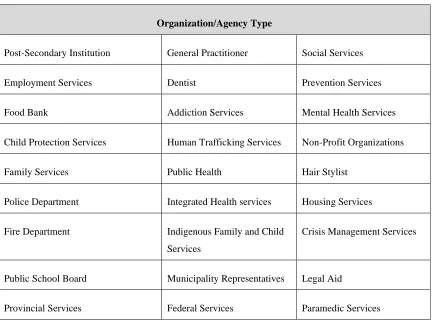
organizations that constitute the NRC along with 3 local businesses. An overview of the
varying types of organizations and agencies can be found Table 1. The number of
This variability is due to vacation and sick time, as well as workers at times being
required to meet needs within their home organizations. The NRC does not have a board
of directors or steering committee but rather, associated staff meet on a bi-weekly basis
for collaborative planning.
Table 1
Organization/Agency Type
Post-Secondary Institution General Practitioner Social Services
Employment Services Dentist Prevention Services
Food Bank Addiction Services Mental Health Services
Child Protection Services Human Trafficking Services Non-Profit Organizations
Family Services Public Health Hair Stylist
Police Department Integrated Health services Housing Services
Fire Department Indigenous Family and Child
Services
Crisis Management Services
Public School Board Municipality Representatives Legal Aid
Provincial Services Federal Services Paramedic Services
The research sample was limited to frontline staff who delivered programs and services at
the NRC. Those individuals who were interested in participating were invited to take part
in a semi-structured interview followed by the focus group at a later date, and the team
consented to my presence for field observation. The participants varied to some degree
between the semi-structured interviews, focus groups and field observation. There was
significant overlap between participants, however, participants were given the option as
to choose the research activities in which they participated. The focus groups were held
six weeks after the last semi-structured interview, which allowed for design of the
preliminary logic model. There was a noted transient membership and attendance at
organizations who have staff participating at the NRC, however, during semi-structured
interviews with frontline staff it became clear that their directors and CEOs may not
possess a comprehensive understanding of what occurs at the NRC. I also did not include
neighbourhood patrons of the NRC in the sample. This is due to the fact that the focus
was on gathering data from the service providers, as this research is inquiring about what
be learned when a logic model is collaboratively developed amongst diverse professions
from a range of organizations.
2.7
Data Collection
Qualitative data was collected for this study through semi-structured interviews, focus
groups and field observation. All participants were required to read and sign a consent
form. The semi-structured interviews lasted up to 30 minutes and were audio recorded.
The focus groups lasted up to 60 minutes and were audio recorded. The field observation
took place at bi-weekly meetings which lasted no longer than 120 minutes and notes were
hand recorded. The recordings were then transcribed verbatim by the researcher. Data
from 11 semi-structured interviews, three focus groups and 8 bi-weekly meeting
observations were included in the analysis. The concept of data saturation was used in
determining the completion of data collection. Bowen (2008) explains that saturation has
been reached when there is no new data being produced in terms of themes or topics.
Thematic data saturation was determined in this study when no new themes were being
explored (Hancock, Amankwaa, Revell & Mueller, 2016).
2.8
Data Analysis
A step-by-step method developed by Braun and Clarke (2008) was used to analyze the
data from the semi-structured interviews and focus groups. For the field observation, I
utilized “Themes and codes for stakeholder collaboration theory” highlighted by Bowen
(2008) to analyze data from the notes. Initially, audio recordings from the semi-structured
interviews were listened to in order to gather a better understanding of the recorded data.
In this first stage, specific experiences and feelings from the data were very apparent.
Following this, verbatim transcripts were developed based on the audio recordings of the
interest as related to the research question. Following this, the initial codes and quotes
were presented to my thesis supervisor. Once initial codes were then refined, the codes
were distributed into larger themes with supporting quotes. These themes were again
presented to and refined in collaboration with the thesis supervisor.
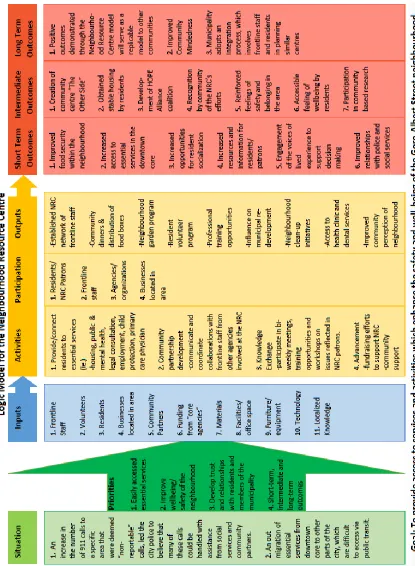
The findings of the semi-structured interview data, were formatted into a preliminary
logic model (Figure 1). This was designed based on a format developed by the University
of Wisconsin-Madison’s Program Development and Evaluation division. The two
approaches considered for the logic model were activities-based or outcomes-based. The
approach chosen for this logic model was an outcomes-based logic model. This form of
logic model allowed for two components that were relevant to planning at the NRC. The
first being that, even though outcomes-based logic models are utilized in the beginning
stages of planning and the NRC was entering its fifth year of being opened, it allowed for
the connection of their broad array of resources and activities with desired outcomes. The
second reason that the outcomes-based approach worked well for the NRC is that in the
data collection, it was clearly identified that there were already short-term outcomes that
had been accomplished, intermediate outcomes that were ongoing and lastly, long-term
outcomes that participants clearly identified in their semi-structured interviews. The
outcomes portion of this approach to logic modeling involves a focus on the varying
levels of outcomes; short-term, intermediate and long-term. Stories from participants
helped to understand the ‘Situation(s)’ that led to the creation of the NRC. This
connected in turn with ‘Priorities’ highlighted by participants. The ‘Inputs’ column was
derived more from data through field observation, which involved attending bi-weekly
meetings to visualize the space and observe member interactions. The ‘Activities’ column
highlights daily activities of the NRC, including providing and connecting residents to
essential services, community partnership development, knowledge exchange and
advancement. Similar to the ‘Inputs’ column, the ‘Participation’ column was also derived primarily from field observation. The ‘Outputs’ column was generated both from
The draft model (Figure 1) was presented to three focus groups, all of which were audio
recorded. The focus groups took place six weeks following the conclusion of the last
semi-structured interview. The purpose of presenting the logic model in its draft stage to
focus groups was to support creation of the logic model, participation and
co-engagement of participants. During the focus groups, participants had the opportunity to
reform the draft model. In the analysis of the focus group recordings, the method
proposed by Braun and Clarke (2008) was utilized. Initially, the audio recordings from
the focus group were listened to prior to being transcribed, to note emotion or tone from
the discussion. After the transcripts were developed, the data was coded with supporting
quotes and then given themes with supporting quotes. The themes that were proposed
through the semi-structured interviews were referenced and confirmed, as well as one
new theme that emerged from the focus group data. The audio recordings of the focus
group were also used to review and revise the draft logic model. The findings were noted
and adjustments to the logic model were made. The analysis of the focus group data also
incorporated member-checking, as the researcher was checking to ensure that their ideas
and thoughts were adequately represented in the logic model. The incorporation of
member checking in this research sought out to ensure the accuracy, credibility and
validity (Harper & Cole, 2012) of what was proposed as findings from the
semi-structured interviews. Lincoln and Guba (1985), shared that when member checking
occurs near the end of the research, similar to this research study, participants have the
opportunity to check if what was said during their interview is an authentic representation
of what they were attempting to say. Out of the 11 participants in the semi-structured
interviews, 10 of the participants were present for the focus groups. Analysis of the field
observations, observing the NRC’s bi-weekly meetings, revealed key language and
existing group dynamics. These were examined and unpacked for their significance in the
collaboration efforts that are ongoing at the NRC.
2.9
Rigor
While conducting this research, I was able to establish rigor through continual attention
to how my own subjectivity might interact with subjectivities presented by participants