Privacy-Preserving RFID Systems: Model and Constructions
⋆S´ebastien Canard1
, Iwen Coisel2
, Jonathan Etrog3
, and Marc Girault4 1 Orange Labs - 42 rue des Coutures - BP6234 - F-14066 Caen Cedex - France
2 UCL - Place du Levant, 3 - B-1348 Louvain-la-Neuve - Belgium
3 Orange Labs - 38-40 rue du G´en´eral Leclerc - F-92794 Issy les Moulineaux - France
4 GREYC Universit´e de Caen, Campus 2, Boulevard du Mar´echal Juin, BP 5186, 14032 Caen Cedex, France
Abstract. In this paper, we study systems where a reader wants to authenticate and identify legitimate RFID tags. Such system needs thus to be correct (legitimate tags are accepted) and sound (fake tags are rejected). Moreover, an RFID tag in a privacy-preserving system should be anonymous and untraceable, except for the legitimate reader. We here present the first security model for RFID authentication/identification privacy-preserving systems which is at the same time complete and easy to use. Our correctness property permits to take into account active adversaries. Our soundness property incorporates the case of adversaries realizing relay attacks. Finally, our privacy model includes adversaries with no restrictions on their interactions with the system and moreover takes into account the case of “future correlations”. We next propose several constructions, based on the work from Vaudenay, proving that (i) our strongest property is at least as strong as those of Vaudenay and (ii) this property is reachable by efficient schemes.
⋆This work has been partially financially supported by the European Commission through the ICT program under contract
Table of Contents
1 Introduction . . . 3
2 Model for RFID Systems . . . 4
2.1 Definition of the Procedures . . . 4
2.2 Definition of the Oracles . . . 4
2.3 Definition of the Adversary . . . 5
3 The Correctness Property . . . 6
4 The Soundness Property . . . 6
5 Related Work on the Privacy Property . . . 7
5.1 Existing Privacy Models . . . 7
5.2 The Vaudenay’s Model for Privacy . . . 7
5.3 Some Recent Related Models . . . 8
6 Our New Privacy Property . . . 8
6.1 Non-Obvious Link . . . 9
6.2 Description of Our Untraceability Experiment . . . 9
7 From Encryption to Privacy . . . 10
7.1 Public Key Cryptosystem . . . 10
7.2 Some Examples . . . 11
7.3 Generic Construction from Vaudenay . . . 11
8 Future Untraceability ≥Narrow-Strong Privacy . . . 12
8.1 A Toy Scheme . . . 12
8.2 Security Considerations . . . 12
8.3 Vaudenay’s Privacy vs. Our Untraceability . . . 13
9 IND-CCA ⇒ Future Untraceability . . . 13
9.1 Instance Description . . . 14
9.2 The Future Untraceability is Reachable . . . 15
9.3 A Very Practical Instantiation: the DHAES Case . . . 19
10 Constant Fixed Non Malleability⇒ Untraceability . . . 19
10.1 Insecure Scheme: the Hash El Gamal Case . . . 19
10.2 Secure Scheme: the Rabin Case . . . 20
10.3 Secure Scheme: the El Gamal Case . . . 21
10.4 The Constant Fixed Non Malleability Property . . . 21
11 IND-CPA Cryptosystem + MAC ⇒ (Future) Untraceability . . . 22
11.1 MAC function . . . 22
11.2 Our New Generic Construction . . . 22
11.3 The Hash El Gamal Case . . . 23
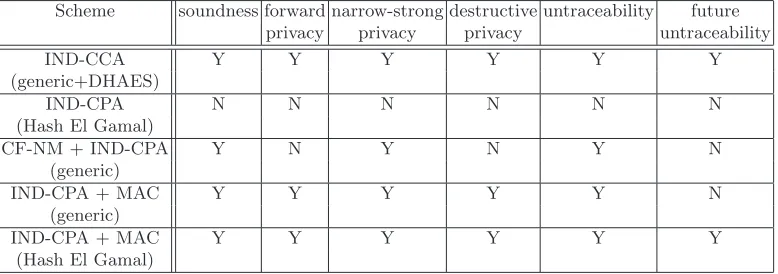
12 Efficiency and Security Comparison . . . 29
12.1 Security Comparison . . . 29
12.2 Efficiency Comparison . . . 29
1 Introduction
Due to the increasing number of interconnections between networks and communications between devices, it is commonly believed that preserving privacy is the main challenge that information society is faced to. Particularly concerning is the claimed irruption of RFID technology in our daily life. An RFID system is a vast bi-partite network made of readers, generally connected to back-end databases, and tags, small chips able to communicate through radio-frequency channels. Such tags are integrated into various objects, animals and even humans, in (premier) order to remotely identify them. Vast majority of presently used tags only provide an identity number (or Electronic Product Code if they comply with the EPC Global standard), and neither authentication nor any kind of privacy is achieved in such a case.
Nonetheless, many use cases for tags require authentication, identification and privacy properties. For instance, if the tag is embedded into a passport, it is highly desirable that the latter be authenticated and identified (correctness property) by immigration officials, and that cloned or counterfeited passports can be detected (soundness property). In addition, the holder may legitimately demand that authentications remain anonymous (and even untraceable) for other entities, so that indiscreet eavesdroppers cannot trace her. This leads to the notion of “privacy-preserving” authentication.
Several models for privacy preserving RFID authentication systems have already been proposed. Some of them focus on the correctness property [15, 11], some others on soundness [15, 32] but most of them on the privacy property [2, 21, 22, 32, 28, 11]. However, it seems that none of them are at the same time complete and easy to use. In fact, no soundness model takes into account “relay attacks” [3]. Moreover, none of existing privacy models permit the adversary against privacy to make future correlations (that is the target tags cannot have been previously corrupted by the adversary), except in the Vaudenay’s model [32], which one is very elegant and complete. However, this latter model is very hard to handle and only few papers have use it, privileging the less complete Juels-Weis model [21], with the consequence that some schemes, considered as secure in the Juels-Weis model, may be in fact insecure. Moreover, the case of the strong adversary with no limitations is not completely handled in the case of future correlations, since it has been proven [32] to be impossible.
In this paper, based on our work in [13], we introduce the first security model for RFID authentica-tion/identification privacy-preserving systems which is at the same time complete and easy to use. Our correctness property permits to take into account active adversaries, such as in [15, 11]. Our soundness property incorporates the case of adversaries using relay attacks. Finally, our privacy model includes ad-versaries with no restrictions on their interactions with the system and moreover takes into account the case of future correlations.
Next, we provide several constructions to prove that our strongest security definition is reachable and that our new untraceability property is at least as strong as the properties defined by Vaudenay in [32]. For this purpose, we focus on the generic construction from Vaudenay [32] based on the use of a public key cryptosystem. Based on our work in [12], we go further by giving the first concrete instantiation of the Vaudenay’s result by using the CCA secure cryptosystem DHAES. We next notice that the IND-CCA property is only reached by a few public key cryptosystems that can be embedded into an RFID tag and consequently, we argue that a weaker cryptosystem can also be used. More precisely, we introduce the “constant fixed non malleability”. Next, we give a new generic construction based on the use of an IND-CPA secure public key cryptosystem (indistinguishability against chosen plaintext attack) together with a MAC scheme. We next give an example of a concrete implementation of this construction, using the so-called Hash El Gamal encryption scheme.
construction and we give the practical DHAES instantiation. Next, Section 10 introduced our new notion of constant fixed non malleability, give some examples, and prove that this property permits us to reach our untraeacbility property. In Section 11, we give our main scheme, based on the use of both the IND-CPA Hash El Gamal encryption scheme and a MAC scheme, and we finally make a global comparison, regarding security and efficiency, in Section 12.
2 Model for RFID Systems
In this section, we model an authentication/identification scheme for RFID systems. Then we describe all the possible interactions of an adversary with this system.
A tag T is a transponder, identified by a unique identifierID, with limited memory and computational abilities, that can communicate with a reader R up to a limited distance. A reader is composed of (i) a transreceiver which communicates with possibly several tags and (ii) a back-end database containing all identifiers of valid tags and additional data such as secret keys. As for most of existing papers in the subject, we assume that communications between the transreceiver and the database are secure. In terms of security, the difference between a tag and a reader is that a tag cannot be considered as a tamper-resistant device (and thus an RFID tag can be corrupted by an adversary against the system) whereas the reader is more secure and more powerful.
2.1 Definition of the Procedures
A privacy-preserving RFID authentication scheme, denoted S, is composed of the following procedures, whereλis a security parameter.
– Setup(1λ) is a probabilistic algorithm which on input λ outputs the parameters param of the system and generates a private/public key pair (rsk,rpk) for the reader. It also creates an empty databaseDBR which will later contain the identifiers and keys of all tags.
– TKeyGen(1λ,param,ID,rpk) is a probabilistic algorithm which returns a tag-dependent key settkID. (ID,tkID) is added in the reader’s databaseDBR.
– Ident is an interactive protocol between the readerR taking on inputs 1λ,param,rsk,rpk and DBR, and a tag T with identifier ID taking on inputs 1λ,param,tkID,rpk and eventually ID. At the end of
the protocol, the reader either accepts the tag and outputs its identifierID or rejects it and outputs⊥.
2.2 Definition of the Oracles
We have now to define the adversaryAagainst such system. We consider that there is only one valid reader
R in the system and we assume that this reader is sufficiently protected, such that the adversary is not able to corrupt it. However, as we will see below, the adversary may play the role of dishonest readers to interact with a tag and we assume that the latter does not knowa priori if it is interacting with the valid readerRor the adversary A.
At the beginning of each experiments (see Sections 3 to 6), we assume that the Setup procedure has already been executed by the challenger denotedC and thus that the values 1λ,param,rpk andrskalready exist. We next assume thatA is always given 1λ,param and rpk, while the secret rskis never given to A (since the valid reader cannot be corrupted). At the beginning of one experiment, we consider that there is no tag in the system. We thus give toA the following oracle to introduce new ones.
– OCreateTag
(): this oracle creates a legitimate tag with a unique identifierID. This oracle usesTKeyGen algorithm on input ID to set up the tag with tkID and updatesDBR by adding this new one.
Next, as in the Vaudenay’s model [32], we consider that the adversary can only interact with tags that are sufficiently close to her without having access to other existing ones. We thus use the concept of free
so that she can communicate while being able to link communications. Free tags are the other tags with which the adversary can not interact. At the creation of a new tag, that is after the call to OCreateTag
(), the new tag has the statusfreeand the adversary cannot interact with this tag. The adversary can modify these statuses by using the following oracles.
– ODraw
(k): this oracle randomly and uniformly selects ktags between all existing (not already drawn) ones. For each chosen tag, the oracle gives it a new pseudonym denoted ti and changes its status from
free to drawn. Finally, the oracle outputs all generated pseudonymst1,· · ·,tk in any order. If there is not enough free tags (i.e.less than k), then the oracle outputs ⊥. All relations (ti,ID) are kept in a a
priori secret table denotedTab. – OFree
(t): this oracle moves the tag with pseudonym t from the status drawn to the status free. This makes tunavailable from now on (in particular,A can not interact with tagtanymore).
Next, the adversary is only able to interact with tags by using the pseudonyms, and only if the tag has the statusdrawn. To simplify notation, we denote by tkt the secret key of the tag with pseudonymt, which is equal to the secret keytkID of the underlying identifierID of this tag. Using a pseudonym, the adversary
has now several ways to interact with tags.
First, Ais able to corrupt tags by using the following oracle. – OCorrupt
(t): returns the tag-dependent keytkID of the related tagID. The pseudonymtis now marked
as “corrupted”5 .
Next, the adversary can passively witness in the whole protocol Identbetween a legitimate tag and the valid reader Rby using the following oracle.
– OExecute
(t,step): executes an Identprotocol between the reader and the tag with pseudonym t. The valuesteppermits the adversary to stop the execution at the stepstep. This oracle outputs the transcript of the protocol (partial or complete). Moreover, if step=f inal(the protocol is completely executed), it outputs 0 if the output of the reader during the Ident protocol is⊥ and 1 otherwise (but not the identifier of the legitimate tag, for privacy reasons).
A can also actively participate in the Identprotocol by playing the role of either a fake/corrupted tag, or an invalid reader. For this purpose, we introduce the following oracles which also permit A to stop at any step a “standard” identification protocol, delete or modify some messages.
– OLaunch
(): makes the legitimate readerRlaunch a newIdentprotocol instance, that is the first request to an unknown tag so as to authenticate and identify it. It outputs the sent message r from the reader to the tag and the identifierπ for this protocol instance.
– OSendReader
(m, π): sends a message m to the reader in the protocolπ. It outputs the responser from the reader.
– OSendTag
(m,t): sends a message m to the tag with pseudonymt. It outputs the response r from the tag.
– OReturn
(π): outputs 0 if the output of the reader during the Identprotocol is ⊥and 1 otherwise.
2.3 Definition of the Adversary
We now define the different classes of adversaries who will play security experiments (see Sections 5 and 6). We here adapt the classification introduced by Vaudenay in [32].
Definition 1 (Adversary Class). An adversary A against the RFID system is said to be
– passive if A has access to no oracles;
5Note that the underlying tag with identifier ID is also corrupted. However, a new pseudonym of this tag can also be
– weak if A has no access to the OCorrupt
oracle;
– forward if A is committed to only use theOCorrupt
oracle after her first call to the OCorrupt
oracle;
– destructive ifA can not use anymore a corrupted tag;
– strong if A has no limit on the oracles.
A is moreover said narrow if she has no access to OReturn .
In the following, we denote by AP the adversary with power P ∈ P ⊂ {∅,narrow} ∪ {passive, weak, forward, destructive, strong}
. We now give our security definitions, regarding correctness, soundness and privacy/untraceability.
3 The Correctness Property
As we consider (RFID) authentication schemes, we first need to ensure that a legitimate RFID tag is (almost) always accepted by the reader. In some cases (as those detailed in [22, 11]), it is necessary to introduce a strong correctness property, where the adversary is able to interact with uncorrupted tags so as to prevent them from being accepted. This is in fact useful for e.g. schemes [33, 25, 4, 17, 22, 11] which modify the internal shared secret key after each successful authentication.
In the following, we define both standard (called passive below) and strong correctness properties by using the following correctness experiment, where P ∈ {passive,strong}.
Experiment Expcorrect
S,AP :
1. The challenger C initializes the system and sends 1λ,param and rpktoA P. 2. AP interacts with the system through the oracles.
3. A chooses an uncorrupted tagID.
4. Alaunches a request OExecute(ID). The experiment returns the bitboutputted by
this oracle.
For a schemeS, we define the success of an adversary AP for the correctness experiment as follows:
SucccorrectS,AP (1λ) = Pr
ExpcorrectS,AP = 0
.
Definition 2 (Correctness). An RFID authentication scheme S is P-correct if for any adversary AP
running in polynomial time,Succcorrect
S,AP (1λ) is negligible.
Remark 1. The Strong-correctness is sometimes called the availability property [22].
4 The Soundness Property
The soundness property below formalizes the fact that a fake tag cannot be accepted by the system. We here define two different levels for this property, depending on the possibility for the adversary to interact (full soundness) or not (soundness) with the tag she tries to impersonate during theIdentprotocol itself. To formalize the soundness property, we use the following experiment where the adversary Ais strong.
Experiment Expsound
S,A :
1. The challenger C initializes the system and sends 1λ,param and rpktoA. 2. A interacts with the whole system through oracles.
3. At any time of the experiment, the adversary outputs a protocol instance identifier
π outputted by theOLaunch
oracle.
4. A can again interact with the whole system.
5. The experiment finally returns the bitb outputted byOReturn
(π). We denote ID
For a schemeS, we define the success of an adversary A for the soundness experiment as follows:
SuccsoundS,A (1λ) = Pr h
ExpsoundS,A = 1 i
.
In the following, we say that the soundness experimentExpsound
S,A isnot relevantif at least one pseudonym
tof the tagIDhas been corrupted duringExpsound
S,A . Using this characterization, we can define the soundness.
Definition 3 (Soundness). An RFID authentication scheme S is soundif for any adversary Arunning in polynomial time, Expsound
S,A is relevant, Succ sound
S,A (1λ) is negligible andA did not interact with the tag ID
after Step 3 of Expsound S,A .
Definition 4 (Full Soundness). n RFID authentication scheme S is full-soundif for any adversary A running in polynomial time,ExpsoundS,A is relevant and Succ
sound
S,A (1λ) is negligible.
Remark 2. Thefull-soundness permits to model “relay attacks” whereAjust transmits messages from the reader to the tag and vice versa. For example, such attack permits an adversary Ato open a car with the RFID car keys of the real owner of the car, without the permission of the latter. For this purpose, Ais in the neighborhood of a RFID car keys and her accomplice is near the car. The relay attack permits to open the car even if the key is far away. Although these attacks seem very hard to stop, they can be avoided by using distance bounding techniques as described in many papers (e.g.[3, 24, 23, 20]).
5 Related Work on the Privacy Property
As stated in the introduction, privacy of RFID tags should be protected in authentication/identification systems. More precisely, a tag should be at least anonymous and untraceable for everyone except the valid reader. Moreover, the scheme has to preserve the anonymity and the untraceability of tags even if an adversary obtains its internal data: this is what is called forward privacy (a.k.a. forward untraceability).
5.1 Existing Privacy Models
Several attempts have been done to model the privacy of tags. Leet al.adopt in [22] a specific approach to the formalization of protocol security based on the Universal Composability (UC) framework. Some other proposals are based on a different concept, introduced by Avoine [2] in the RFID setting, where privacy is formalized by the ability for the adversary to distinguish two known tags. This model was refined by Juels and Weis [21] and later in [28, 11]. However, none of these models permit the adversary to make future correlations (that is the target tags cannot have been corrupted by the adversary). This case is taken into account in Vaudenay’s model [32], which one is very elegant and complete, but quite hard to use. In the rest of this section, we give some words on this model in particular.
5.2 The Vaudenay’s Model for Privacy
Vaudenay has introduced a new privacy model in [32]. Informally, a scheme ensures the privacy property, in the sense of Vaudenay, if for a given experiment (see below), the success probability of an adversary, which interacts with the system through oracles (as defined in section 2.2), is indistinguishable of a “blinded” adversary, which interacts with a simulated system, controlled by a simulator who does not know any-thing about secret values. More formally, Vaudenay defines the following experiment where P belongs to
{∅,narrow} ∪ {strong,destructive,forward,weak}: Experiment ExpVaud-privS,AP
1. The challenger C initializes the system and sends 1λ,param and rpktoA. 2. AP interacts with the whole system through the oracles, limited by her classP. 3. AP submits a hypothesis about the system and receives the hidden table Tab of
theODraw
oracle.
The adversary wins if she returns 1.
Definition 5 (Trivial Adversary). An adversary Ais said trivial if it is possible to define a simulator Sim who perfectly simulates the system, without knowing any secrets, for a “blinded” adversary denoted
ASim
, such that |P r[A wins]−P r[ASim
wins]|is negligible.
If those success probabilities are indistinguishable, it means that there is no privacy loss through the communication channel. In other words, the adversary makes no effective use of the messages as their simulation (without using the secret values) leads to the same probability of success. Thus the scheme can be considered private.
Definition 6 (Privacy). For P ∈ {∅,narrow} ∪ {strong,destructive,forward,weak}, a scheme is said P-private if all P-adversaries are trivial.
Vaudenay proves moreover in [32] that a protocol cannot ensure at the same time destructive-privacy
and narrow-strong-privacy. Thus, as a result, strong-privacy cannot be reached in the Vaudenay’s model. As a consequence, the best privacy property in this model implies that the adversaries’ abilities have to be restrained: either the adversary is destructive or the adversary is narrow. Thus, this is not possible with such model to study its security against a strong adversary.
Relations between privacy properties [32]
The following implications between privacy properties are obvious.
Destructive ⇒ Forward ⇒ Weak
⇓ ⇓ ⇓
Narrow-Strong⇒Narrow-Destructive⇒Narrow-Forward⇒Narrow-Weak
5.3 Some Recent Related Models
As it is impossible to reach the strongest property of Vaudenay’s model, many adaptations of this model have been done in order to define a weakest, but reachable, strong property. For example, Ng et al. have introduced in [36] the notion of wise adversary. These adversaries are restrained (compared to those of Vaudenay) such that they are not able to access twice the same oracle with the same input, and they are also not able to access oracles where the results can be precisely predicted. Thus, they prove that it is indeed possible that a scheme ensures the strong privacy property against wise adversary. Furthermore, they prove equivalence between the eight privacy properties of Vaudenay and thus reduce them to three different properties as follows:
Note that the authors of [36] use the same denominations for their privacy properties as those defined by Vaudenay. This is a misuse of language as the modification of the adversary necessarily (unless if the equivalence is proven) modifies the relied property.
Deng et al. have introduced in [16] the notion of zero-knowledge privacy. There exists lots of similarity between their model and Vaudenay’s model. Although they define a new experiment, the adversary’s abilities are again restrained compared to those of Vaudenay’s adversary. The related privacy property is again not shown against the strongest possible adversary.
In the following section, we define a new privacy model where, instead of restrain the adversaries’ abilities, we reduce the success conditions of this adversary. As this will be detailed in Section 8, this permits to define a stronger privacy property than those (achievable) of Vaudenay.
6 Our New Privacy Property
6.1 Non-Obvious Link
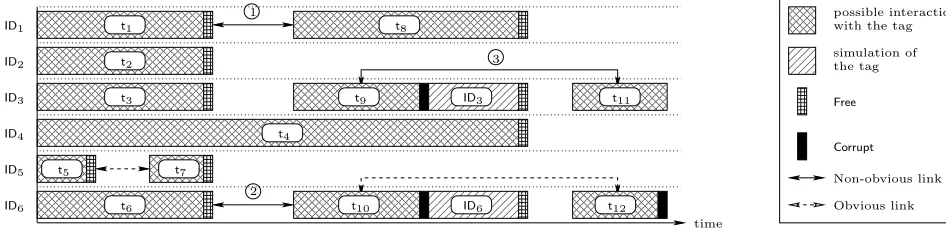
A link is a couple of pseudonyms associated to the same identifier in Tab. As some links are obvious (e.g.
if both pseudonyms have been corrupted), we define below the notion of non-obvious link, illustrated by Figure 1. Links are chronologically ordered,i.e.(ti,tj) means thatti has been freed before thattj has been drawn. Informally, anon-obvious link (n.o.l.) is a link between two pseudonyms which cannot be defined without using some hidden (or not) information in the sent messages.
Definition 7 (Non-Obvious Link). (ti,tj)is a non-obvious linkif ti andtj refer to the sameIDin Tab and if a “dummy” adversary, who only have access to OCreateTag
,ODraw
,OFree
,OCorrupt
, is not able to output this link with a probability better than1/2. Moreover, a non-obvious link is said:
– standard if A has not corruptedti or tj (see link 1 in Figure 1);
– past if A has corrupted tj (see link 2 in Figure 1);
– future if A has corrupted ti (see link 3 in Figure 1).
00 00 00 11 11 11 00 00 00 11 11 11 00000000000000000000000000000000000 00000000000000000000000000000000000 00000000000000000000000000000000000 11111111111111111111111111111111111 11111111111111111111111111111111111 11111111111111111111111111111111111 0000000000000 0000000000000 0000000000000 1111111111111 1111111111111 1111111111111 0000000000000 0000000000000 0000000000000 1111111111111 1111111111111 1111111111111 0000000000000 0000000000000 0000000000000 1111111111111 1111111111111 1111111111111 00 00 00 11 11 11 00 00 00 11 11 11 00 00 00 11 11 11 0000000000000 0000000000000 0000000000000 1111111111111 1111111111111 1111111111111 00 00 00 11 11 11 00000 00000 00000 11111 11111 11111 00 00 00 11 11 11 00000 00000 00000 11111 11111 11111 00 00 00 11 11 11 0000000 0000000 0000000 1111111 1111111 1111111 00000000 00000000 00000000 11111111 11111111 11111111 0000 1111 0000 1111 000 000 000 111 111 111 00 00 00 11 11 11 00000000 00000000 00000000 11111111 11111111 11111111 00000000 00000000 00000000 11111111 11111111 11111111 00000000000000000 00000000000000000 00000000000000000 11111111111111111 11111111111111111 11111111111111111 0000000000 0000000000 0000000000 1111111111 1111111111 1111111111 0000000000 0000000000 0000000000 1111111111 1111111111 1111111111 00 00 00 11 11 11 00 00 00 11 11 11 000 000 000 111 111 111 ID1 ID2 ID3 ID4 ID5 ID6 2 3 1 time Non-obvious link Obvious link simulation of the tag Free Corrupt with the tag
t7
t6
t8
t9 ID3
ID6 t4 t10 t11 t12 t1 t2 t3 t5 possible interactions
Fig. 1.Privacy Model
Note that this “dummy” adversary is equivalent to the blinded adversary of Vaudenay. Although this latter has access to the remaining oracles ( OExecute
,OLaunch
,OSendReader
,OSendTag
,OReturn
), all the answers of these oracles are simulated by a “Blinder” which don’t know any secret values of the system. Consequently, the blinded adversary has no advantage compared to our dummy adversary.
It is straightforward that a weak adversary is only able to output standard non-obvious link as she cannot request the OCorrupt
. A forward or a destructive adversary is not able to output a future link as the corruption of a tag either stops the system or destroys the tag (and thus prevent it to be drawn again). However, both of these adversaries can output standard and past link. Finally, a strong adversary is able to output each possible link. As a conclusion, we highlight the fact that the goal of the forward and the destructive adversaries are the same, thus in the following, we will never consider a forward adversary (as this one is weaker than the destructive one).
6.2 Description of Our Untraceability Experiment
It is obvious that the untraceability of a scheme is equivalent to the impossibility for an adversary to find some non-obvious links. Our new untraceability experiment is defined as follows, where the adversary class
P belongs to {strong,destructive,weak}. Experiment ExpUntS,A
1. The challenger C initializes the system and sends 1λ,param and rpktoA.
For a schemeS, we define the success of an adversary A for the untraceability experiment as follows:
SuccUntS,A(1λ) = Pr [(ti,tj) is a non-obvious link].
Thus, considering the three classes of adversary, we can define the following three levels of untraceability. Definition 8 (Untraceability).An RFID authentication schemeS isuntraceable(resp.past-untraceable
/ future-untraceable) if for any weak (resp. destructive / strong) adversaryArunning in polynomial time, it is possible to define a “dummy” adversaryAd, who only have access to oraclesOCreateTag,ODraw,OFree
and OCorrupt
such that:
Succ
Unt
S,A(1λ)−Succ Unt S,Ad(1λ)
≤ǫ(λ)
where ǫ(λ) is negligible.
In other words, a scheme is considered untraceable, if an adversary cannot output a non-obvious link with a probability better than 1/2 (the maximal success probability of the dummy adversary).
It is relatively straightforward that:
Relations between untraceability properties (this paper)
The following implications between untraceability properties are obvious. Future-Untraceability ⇒Past-Untraceability ⇒ Untraceability.
In the next sections, we study our new model and prove that our strongest untraceability property (i.e. future-untraceability) is achievable. We also describe an attack that is neither taken into account in the destructive-privacy nor the narrow-strong-privacy properties of Vaudenay’s model. With those two arguments, it is obvious to understand why our model improves Vaudenay’s one. Before that, we need to introduce a generic construction due to Vaudenay [32].
7 From Encryption to Privacy
We first recall the notion of public key cryptosystems and what does IND-CCA and IND-CPA say. We next give a generic RFID identification and authentication scheme, due to Vaudenay [32], based on the use of such public key cryptosystem.
7.1 Public Key Cryptosystem
Let a public-key encryption schemeE = (KeyGen,Enc,Dec) such that:
– KeyGenis a probabilistic key generation algorithm which on input the security parameter 1λ outputs the encryption public key rpkand the corresponding decryption secret key rsk,
– Encis a probabilistic encryption algorithm which on input a messagemand the public keyrpkoutputs the corresponding ciphertext c,
– Dec is a deterministic decryption algorithm which on input a ciphertext c and the decryption secret key rskoutputs a plaintext m.
The correctness of the scheme is defined asDec(Enc(m,rpk),rsk) =m.
Classes of Adversary. We then consider three different attacks for the adversary.
– Under non-adaptive chosen-cipher attack (CCA1), the adversary gets, in addition to the public key, access to an oracle for the decryption function. The adversary may use this decryption function only for a period of time before receiving the challenge ciphertext c.
– Under adaptive chosen-cipher attack (CCA2) the adversary again gets, in addition to the public key, access to an oracle for the decryption function, but this time she may use this decryption function even on ciphertexts chosen after obtaining the challenge ciphertext c, the only restriction being that the adversary may not ask for the decryption of c itself.
One-wayness. Regarding security, the weakest property one encryption scheme should verify is the One-Wayness (OW), which says that this is infeasible to retrieve the plaintext from the ciphertext.
indistinguishability. Moreover, an encryption scheme should also be secure in the sense that it should not be possible for an adversary to learn any information about the plaintext m underlying a challenge ciphertext c. Such scheme is said to have the indistinguishability (IND) property.
Note that the notion of IND-CCA usually refers to the IND-CCA2 property while the IND-CCA1 is rarely used in practice. We utilize this notation in the following.
Non-malleability. The Non-Malleability (NM) property formalizes an adversary’s inability, given a chal-lenge ciphertext y, to output a different ciphertext y′
such that the plaintexts x, x′
underlying these two ciphertexts are “meaningfully related” (for example, x′ =x+ 1).
7.2 Some Examples
In this paper, we will use several different encryption schemes. The Rabin encryptions scheme [29] is OW-CPA. We will also use the El Gamal encryption scheme [19] (which is IND-CPA) and the hash variant [14], named Hash El Gamal in the following, which is also IND-CPA. Finally, the DHAES [1] has been proved to be IND-CCA.
7.3 Generic Construction from Vaudenay
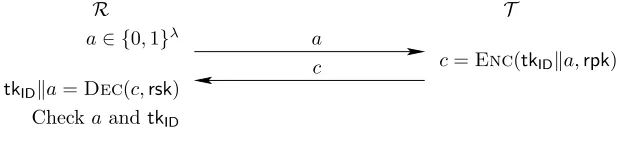
Using a public key cryptosystem E such as defined above, Vaudenay introduces the following RFID iden-tification scheme. In this scheme and in all the following ones in this paper, the reader key pair (rsk,rpk) corresponds to the public key cryptosystem key pair, that is, rskis a secret decryption key and rpk is the corresponding encryption public key. Moreover, lettkID be theλ-bit key of a tag, which is known by both
the tag and the reader. The identification protocol is next described in Figure 2.
a∈ {0,1}λ
T R
a
c=Enc(tkIDka,rpk)
c tkIDka=Dec(c,rsk)
CheckaandtkID
Fig. 2.Vaudenay’s protocol
In [32], Vaudenay proves that if the cryptosystem is IND-CPA, then the identification scheme is narrow-strong private and, if the cryptosystem is IND-CCA2, the scheme is further secure and forward private. We do not recall the security proof in this paper. We will however prove that this construction provides untraceability, regarding our model, in the next section.
Remark 4. Note that, as a consequence of the IND-CPA property, the encryption scheme needs to be probabilistic. This implies some randomness coming from the RFID tag, which is quite natural in order to achieve the forward privacy.
8 Future Untraceability ≥ Narrow-Strong Privacy
In this section, we define an attack which is only possible for a strong adversary. We first remember that a strong adversary can corrupt tags without destructing them. This means that after a corruption, a tag can be freed and affected again. Our strong adversary is also authorized to request the OResult
oracle, which is never possible in the Vaudenay’s model, since strong-privacy is not achievable. Next, our “strong” attack uses these two characteristics of a strong adversary since the essence of this attack is to use the
OResult
oracle in order to produce a future non-obvious link. Thus, a narrow-strong adversary is not able to make such attack, and thus cannot break the narrow-strong privacy, in the Vaudenay’s sense. In fact, if the adversary makes no effect use of OResult
, the narrow-strong adversary in Vaudenay’s model is able to produce the same attack.
8.1 A Toy Scheme
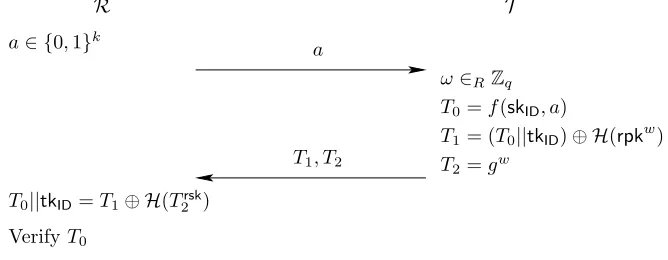
In the following, we describe a protocol which does not resist to the above attack. This scheme is an instantiation of Vaudenay’s generic protocol (see Figure 2) using the Hash ElGamal encryption scheme [6] (which is not IND-CCA secure). In this scheme, each tags knows the public key rpk of the encryption scheme and a couple of secrets tkID= (kID,skID), where kID is a secret key of a tag for thef function and skID is a secret which is known by both the tag and the reader. The reader knows the secret decryption key rsk ∈ Z∗q associated to rpk such that rpk = grsk, where g is a generator of a cyclic group G of prime
order q. Moreover,f is an unforgeable function which takes as input a secret value and a message, and H
is a cryptographically secure hash function. The resulting identification scheme is depicted in Figure 3.
ω∈RZq T0=f(skID, a)
T1= (T0||tkID)⊕ H(rpkw)
T1, T2
a a∈ {0,1}k
T0||tkID=T1⊕ H(T2rsk)
VerifyT0
T R
T2=gw
Fig. 3.Hash ElGamal based protocol
8.2 Security Considerations
Lemma 1. The above toy scheme is not future untraceable.
Proof. To break the privacy of this scheme, an adversaryAhas first to create two tags and corrupt one of them, denoted ˜t, in order to obtain the corresponding tkID = (kID,skID). Then,A frees this tag and then draws the two tags t0 and t1. To identify the tag ˜t, A initiates a protocol execution with the reader and received a challenge a. Then, Achooses one of the two affected tag, e.g. t0, and sends him a nonce a′.A
receives (T1, T2), computes T1′ =T1⊕f(a,kID)||0. . .0⊕f(a′,kID)||0. . .0 and sends (T1′, T2) to the reader. If t0 and ˜t correspond to the same tag, the reader will accept A asT1′ =f(a
′
,kID)||skID⊕ H(rpkw) which
is a valid answer. As a conclusion, the adversary is able to recognize ˜t, and so to produce a future link,
which concludes the proof. ⊓⊔
Lemma 2. The above toy scheme is narrow strong.
Proof (sketch). In fact, a narrow-strong adversary cannot perform this attack as the OResult
request is
indispensable to distinguish the tag. ⊓⊔
Remark 5. As described here, the scheme is neither past-untraceable as this attack can be adapted to produce a past link. However, and contrary to the “future-link attack”, it can be avoided by using a key update mechanism ase.g.in [25, 17, 22, 11]. We do not detail this here as we only want to sketch an attack which can not be realized in Vaudenay’s model.
8.3 Vaudenay’s Privacy vs. Our Untraceability
As a conclusion of this section, neither the destructive nor the narrow-strong privacy implies the future-untraceability.
Relations between privacy and untraceability properties ( [32] and this paper)
We now have the following implications:
Future-Unt6⇐ Destructive
6⇑ ⇓
N-Strong ⇒N-Destructive
Consequently, our untraceability property is at least as strong as those of Vaudenay.
Remark 6. It seems possible to prove that Future-Untraceability implies Narrow-Strong privacy. However, this result is hard to obtain as it requires proving that all the narrow-adversaries taken in account in Vaudenay’s model are useless, except the one who is able to produce a non-obvious link and it is impossible to model all of them.
9 IND-CCA ⇒ Future Untraceability
In this section, we prove that our strongest privacy property (future-untraceability) is achievable. For this purpose, we use the above generic RFID authentication protocol from Vaudenay, with an IND-CCA secure encryption scheme (e.g.the DHAES scheme [1]). It is quite obvious that the security of this scheme relies to the security of the underlying encryption scheme. However, the security goal of these two schemes is not the same. Thus, we have to prove that the security of the encryption scheme implies the security of the authentication scheme.
9.1 Instance Description
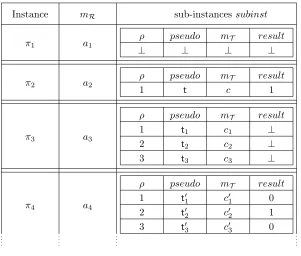
As our model is made up of a large number of oracles (which have to be formally described in the proof), we first introduce a table, denotedInst, which contains all the information concerning all the instances of the identification protocols. The different oracles have a read/write access to this table.
Each line of Inst are referenced by an instance identifier and contains all the messages exchanged by both entity (reader and tag), and the result of the protocol. As described here, this table can be seen as an historic of all instances of the protocol when it works normally. However, we have to consider in this model the intervention of an adversary. For example, after a call to theOLaunch
oracle, an adversary initiates an instance protocolπbut can transmit the obtained nonceNRto several tags. This can be modeled by several sub-instances of the protocol. This instance is only “closed” when the adversary transmits a message such that the reader accept or reject a tag. As a consequence, all responses obtained from tags are not invalid until the final result for π. Then, when the responses of these tags are written inInst, the result cannot be instantiated and is, for the moment, defined as ⊥. An example of Inst table is presented in Figure 4 for the generic protocol described in Figure 2.
t′ 3
Instance mR sub-instancessubinst
mT
1 2 3
c′ 1
c′ 2
c′ 3
0 1 0 π4
ρ pseudo result π2
mT
1 c 1
ρ pseudo result mT
⊥
⊥ ⊥ ⊥
π1
ρ pseudo result
π3
ρ pseudo mT result
1 2 3
c1
c2
c3
⊥ ⊥ ⊥
a1
a2
a3
a4
t
t1
t2 t3
t′ 1
t′2
Fig. 4.Example de tableInst
The four presented cases of this example can be described as follows.
– Instance π1 is the result of a request to OLaunch oracle. The reader has generated a nonce NR1 which have not be transmitted to a tag (justifying why there is no sub-instance).
– Instanceπ2 can be the result of a request to OExecute oracle with input t.
– Instanceπ3 is the result of several requests toOSendTagwith the nonceNR3. In this example, the nonce has been obtained by a OLaunch
request. If the adversary had choose this value, the result of all the sub-instances should be 0 as the reader has a negligible probability to start a new instance with this nonce, and will obviously rejects all these tags..
9.2 The Future Untraceability is Reachable
In [32], Vaudenay proves that the generic scheme in Figure 2 is narrow-strong private and forward private when the encryption scheme is IND-CCA secure. In our model, we prove the following result.
Theorem 1. The encryption-based authentication protocol ensures the future-untraceability property if the encryption scheme is IND-CCA secure.
Proof. In this proof, we use the game proof technique introduced by Shoup in [31] to base the success of an adversary against the untraceability of the scheme to the advantage of an adversary against the IND-CCA property of the encryption scheme. In this proof, our goal is to define a final game where all messages sent by a tag are completely dissociated and thus does not permit an adversary to rely some of them. In other words, we replace each message by the encryption of a nonce. To conclude, we show that the success of an adversary cannot be significantly different of the success of the adversary in the final game, which corresponds to the dummy adversary.
In the initial game, we model the normal behavior of the whole system (i.e.of all oracles).
Game 0:
• Setup(1λ):
∗ nbt:= 0;req:= 0;Free:=∅;
∗ generates (rsk,rpk); param:= (Enc,Dec,λ,rpk).
∗ returnparam.
nbtandreqare counter which respectively give the total number of pseudonym which have been attributed, and the total number of started instances. reqdoes not take in account the number of sub-instances.
In order to simplify notations, we use in this proof a valueρnew which attribute a new unique value of sub-instance for a given instance. The set Free contains all thefreetags of the system.
• OCreateTag
:
∗ ID∈RID;tkID:=PRF(ID,rk); Free←+ID;DB←+(ID,tkID).
The setID here corresponds to the set of all possible identifiers which can be created by the system.
• ODraw
(i) :
∗ ifi≤#(Free), then repeatitimes:
ID∈RFree;Free←−ID;nbt+ +;tnbt∈RZ;
tktnbt :=DB(ID).tkID;Tab←+ (tnbt,ID,Actual); returntnbt;
∗ else return⊥.
A unique pseudonymtnbt is attributed to each new selected tag. We here introduce the keytktnbt initially equal totkID, whereID is the identifier associated to the pseudonym.
• OFree
(t) :
∗ Tab(t).status:=Old;Free←+ Tab(t).ID.
• OCorrupt
(t) :
∗ ID←Tab(t).ID;
∗ Corrupt←+ (t,ID); return A(ID,tkID).
• OExecute
(t) :
∗ ID←Tab(t).ID;
∗ Inst←+(req, a,(1,t, c,1));
∗ return (req,(a, c),1).
This oracle realizes a complete execution of the protocol between the reader and the tag represented by the pseudonymt. The adversary obtain the whole transcript of this protocol, the identifier of the instance
req and the bit 1 corresponding to the success of the authentication. This instance is added in the table
Inst.
• OLaunch
:
∗ req+ +;a∈R{0,1}λ;Inst←+(req, a,⊥);
∗ return (a, req).
This oracle generate a new instance which initially contain the instance identifierreq and a random value
a, transmitted to the adversary.
• OSendTag
(a,t) :
∗ ID←Tab(t).ID;
∗ c:=Enc(rpk,tkID||a); returnc;
∗ if∃π such that (Inst(π).mR=a), then:
if∃ ρ such that (Inst(π).ssinst(ρ).result6=⊥), thenInst(π).ssinst←+(ρnew,t, c,0); elseInst(π).ssinst←+(ρnew,t, c,⊥);
∗ elsereq+ +;Inst←+(req, a,(1,t, c,0));
When a tag’s message is created, a new sub-instance is added in Inst. Depending of the state of the corresponding instance inInst, the sub-instance will not be created identically.
– If there is an instance π associated to the valuea, two cases are possible:
• if there is a sub-instance π such that result6=⊥, then the tag given in input to the oracle will be rejected by the reader. Thus, the added sub-instance has to be (ρnew,t, c,0).
• ifresult=⊥for all existing sub-instances, then the corresponding instance is not yet closed. Thus, the added sub-instance has to be (ρnew,t, c,⊥).
– Else, the input value ahas been generated by the adversary. As we consider that a reader will create a new instance with this nonce with a negligible probability, (req, a,(1,t, c,0)) is added inInst.
• OSendReader
(c, π) :
∗ iff orall ρ(Inst(π).ssinst(ρ).result=⊥) then:
- if∃ ρ such that (Inst(π).ssinst(ρ).mT =c), then (Inst(π).ssinst(ρ).result= 1); - else:
tkt||a′
:=Dec(rsk, c); ifa′
=Inst(π).mR, then:
iftkID=PRF(ID,rk), then Inst(π).ssinst←+(ρnew,ID, c,1); elseInst(π).ssinst←+(ρnew,⊥, c,0);
If the instanceπ is complete or if it has been initialized by the adversary, then it exists a sub-instance where the result is 1 or 0. In this case, the oracle cannot answer to this request and stops.
Else the two following cases are possible.
– It does not exist any sub-instance containing c. Then this value as been generated by the adversary. The oracle decrypts the message in order to verify its validity. Whatever the result of the identification is, the oracle generates the appropriate sub-instances with the corresponding result.
• OReturn
(π) :
∗ if∃ ρ such that (Inst(π).ssinst(ρ).result= 1) then return 1;
∗ else
if∃ρ such that (Inst(π).ssinst(ρ).result= 0) then return 0; else return⊥.
• Adversary’s response: (ti,tj)
In the untraceability experiment, the goal of an adversary is to output a non-obvious link (ti,tj). We define the eventS0 as: “(ti,tj) is a non-obvious link”. We thus obviously have:
SuccUntS,A(1λ) =P r[S0]
We now define the final game where all tag’s message are replaced by encryption of nonce. As all messages are now simulated, the adversary in the final game is a dummy adversary. Then to prove that the scheme is untraceable, we will have to demonstrate that the success probability of an adversary and the one of the dummy adversary are equal.
For clarity reasons, we only redefine oracles which are different of those in the initial game, and modi-fications are written in bold.
Final Game
• Setup(1λ) (unchanged).
• OCreateTag
(unchanged).
• OAffect
(i) (unchanged).
• OFree
(t) (unchanged).
• OLaunch
(unchanged).
• OSendReader
(c, π) (unchanged).
• OExecute
(t) :
∗ req+ +;a∈R{0,1}λ;nT∈R{0,1}λ
′
;c:=Enc(epk,nT||a);
∗ Inst←+(req, a,(1,t, c,1));
∗ return (req,(a, c),1).
k′ is defined by k′:=|tkID|+|ID|.
• OSendTag
(a,t) :
∗ nT ∈R{0,1}λ
′
;c:=Enc(rpk,nT||a);
∗ if∃π such that (Inst(π).mR=a) then:
if∃ ρ such that (Inst(π).ssinst(ρ).result6=⊥) thenInst(π).ssinst←+(ρnew,t, c,0); elseInst(π).ssinst←+(ρnew,t, c,⊥).
∗ elsereq+ +;Inst←+(req, a,(1,t, c,0));
∗ returnc.
The only things changed in this final game are the messages send by tags. The recording in Inst is unchanged as legitimate tags must still be accepted. The eventSf inal is also defined by “(ti,tj) is a non-obvious link”. As all transcripts are simulated in the final game, the outputted link by the adversary in the final game is non-obvious only if she correctly guess it. It is thus obvious that this adversary is a dummy adversary and consequently, we have:
In order to conclude, we have now to exhibit all the transitions games which will permit us to rely the success of an adversary to the success of the dummy adversary, and thus to conclude. We have to introduce as much intermediate games (including the final game) as there are request to oracles OExecute
andOSendTag
. Letq be this number. Each of these games will replace one more “correct” encryption made by one of these two oracles by the encryption of a nonce. Each event Si are still defined by “(ti,tj) is a non-obvious link”. We consider that we have ordered all the “encryption” requests (done during requests toOExecute
andOSendTag
). Thei-th game is defined as follows:
– the i first requests return an encryption of (rpk, nT||a) where nT is randomly chooses in {0,1}λ ′
for each request.
– the q−inext requests return an encryption of (rpk,tkID||a), where t is the pseudonym given in input of the oracle and ID=Tab(t).ID.
Note that only one encrypted message is modified between two games (even between game 0 and 1, or q−1 and the final game). If |P r[Si]−P r[Si−1]| is not negligible, it is possible to trivially define a distinguisher for the IND-CCA2 property of the encryption scheme.
Remark 7. It is important to notice that during the requests toOSendReader
, the simulator has to decrypt the value c if it has been transmitted by an adversary (i.e. which is not in Inst). As the adversary can transmit this kind of message at any moment of the experiment (before or after thei-th encryption request), the simulator must have access to a decryption oracle during the whole game. Thus it is necessary, in this proof, that the encryption scheme is IND-CCA2 secure.
The distinguisher D can be defined as follows. He first computes the i-th cipher correctly using the keys tkID. When the adversary makes the (i+ 1)-th requests, D defines two messages m0 = tkID||a and
m1 = nT||a, and sends these messages to the challenger of ExpIN D−CCA2. The distinguisher sends the received encryption c=Enc(rpk, mb) to the adversary. Depending of b, the adversary will play the gamei, ifb= 0, and the gamei+ 1 otherwise. More formally we have:
P r[D →1|b= 0] =P r[Si] and P r[D →1|b= 1] =P r[Si+1]. Thus:
|P r[Si]−P r[Si+1]|=|P r[D →1|b= 1]−P r[D →1|b= 1]| =AdvExpIN D−CCA2
D,SE
In conclusion,
Succ
Unt
S,A(1λ)−SuccUntS,Ad(1λ)
=|P r[S0]−P r[Sf inal]|
=|P r[S0]−P r[S1] +P r[S1]−. . .+P r[Sq−1]−P r[Sf inal]|
≤
q−1 X
i=0
|P r[Si]−P r[Si+1]|
≤q.AdvExpIN D−CCA2 D,SE
As q is polynomial, the adversary’s advantage in the untraceability experiment is negligible in λ which
prove the theorem. ⊓⊔
9.3 A Very Practical Instantiation: the DHAES Case
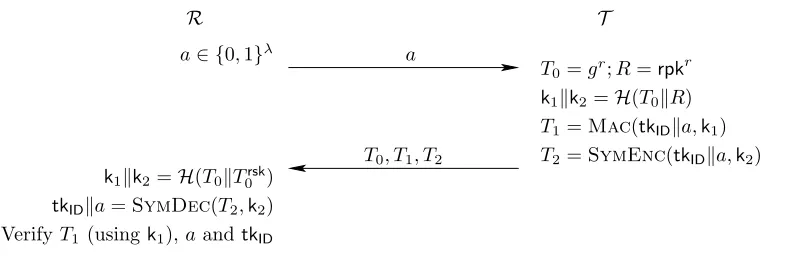
The DHAES has been introduced in [1] by Abdalla, Bellare and Rogaway and has been submitted to the IEEE P1363a standard. Its aim is to propose a method to encrypt strings using the Diffie-Hellman assumption, since the standard El Gamal encryption scheme has some flaws when regarding the message as a string. It is as efficient as the standard El Gamal encryption but has more and better security properties since it has been proved to have the indistinguishability property against adaptive chosen ciphertext attacks with unlimited access to the decryption oracle (IND-CCA2). It is thus possible to directly use it in the above generic construction to obtain the security of the underlying privacy-preserving RFID identification scheme (see 7 and [32]).
LetGbe a cyclic group of prime orderq. The reader’s private key to decrypt a message isrsk∈Z∗
q and the corresponding encryption public key isrpk=grsk wheregis a generator ofG. Moreover, lettkID be the
λ-bit key of a tagID, which is known by both the tag and the reader. The DHAES encryption scheme can be used to obtain and RFID identification scheme as described in Figure 5, whereHis a cryptographically secure hash function.
VerifyT1 (usingk1),aandtkID
T R
a
T0=gr;R=rpkr k1kk2=H(T0kR)
T1=Mac(tkIDka,k1)
T2=SymEnc(tkIDka,k2)
T0, T1, T2
a∈ {0,1}λ
k1kk2=H(T0kT0rsk)
tkIDka=SymDec(T2,k2)
Fig. 5.DHAES based protocol
The IND-CCA property of an encryption scheme is a strong property which need adapted schemes. In the following, we try to use weaker encryption scheme, while trying to keep the same security level for the resulting RFID identification and authentication scheme.
10 Constant Fixed Non Malleability ⇒ Untraceability
In this section, we study the case of encryption schemes which are not IND-CCA. In fact, we can consider IND-CPA schemes (with various results), or something between IND-CCA and IND-CPA.
10.1 Insecure Scheme: the Hash El Gamal Case
The Hash El Gamal encryption scheme [14] consists in computingT0 =m⊕ H(epkr) and T1 =gr for the encryption of the messagem, and is known to be IND-CPA, but not IND-CCA.
Using the hash El Gamal encryption scheme in the Vaudenay’s construction, it is trivially possible to break the soundness of the resulting scheme. Concretely, from one successful authenticationT0 = (tkIDka)⊕
H(epkr) and T1 = gr, one can fake the valid tag by simply computing, on reception of the new random ˜
10.2 Secure Scheme: the Rabin Case
The Rabin cryptosystem [29] is a public key cryptosystem introduced by Rabin whose security is related to the factorization problem. The main disadvantage of this system is that each ciphertext can be generated by any of four possible inputs so that some extra computation is needed during the decryption phase to output the correct corresponding plaintext.
Rabin in RFID Systems. The Rabin encryption scheme can be described as follows.
– KeyGen: letpandqbe two large prime numbers and letn=pq. The private keyrskis the factorization (p, q) of nand the corresponding public key rpkis n.
– Enc: when someone wants to encrypt a messagemin the range [1, n[, he has to compute the ciphertext
c = m2
(modn). To overcome the problem of selecting the correct plaintext from among four possi-bilities, one solution is to add prespecified redundancy to the original plaintext m prior to encryption. Then, with high probability, exactly one of the four square roots will possess the right redundancy. Note that if this randomness is always modified, this transform the cryptosystem to a probabilistic one but it is however not possible to prove that it is IND-CCA secure.
– Dec: the owner of the decryption key sk = (p, q) retrieves m by computing c1/2 (modn) (which is possible only when knowing the factorization of n) and uses the prespecified redundancy to find the correct plaintext.
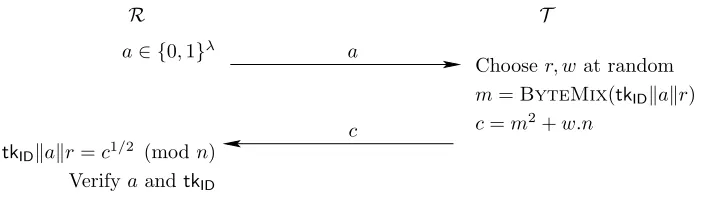
In the RFID setting, this cryptosystem has been used by Shamir to describe a MAC scheme [30]. In [27], Oren and Feldhofer also use this cryptosystem in the design of their privacy-preserving RFID identification scheme named WIPR. As the Rabin cryptosystem is deterministic (and thus not IND-CPA), the protocol needs to be modified so as to include some randomness coming from the tag, as it is described in [27].
The WIPR System. Let p and q be two large prime numbers and let n = pq. The reader’s private key rskis the factorization (p, q) of nand the corresponding public key rpk is n. The scheme is described in Figure 6, where ByteMixis a publicly known byte-interleaving operation used to ensure that neither the tag nor the reader fully dominates a large element of the plaintext. Moreover, reduction modulo n is replaced by an addition of a multiple of the divisorn. Moreover,ByteMixalgorithm is a publicly known byte-interleaving operation used to ensure that neither the tag nor the reader fully dominates a large element of the plaintext. It takes as input a message and outputs another message. Finally, tkIDis again a λ-bit key of a tagID, which is known by both the tag and the reader.
VerifyaandtkID
T R
a∈ {0,1}λ a
Chooser, wat random m=ByteMix(tkIDkakr) c=m2
+w.n c
tkIDkakr=c1/2 (mod n)
Fig. 6.The WIPR protocol
In [34], the authors show that without a good preprocessing step (e.g.a weak ByteMix), the scheme is insecure. They use the preprocessing step SAEP (Simple OAEP) so as to prove the security in a simple model where, unfortunately, strong privacy is not taken into account.
This should be impossible, even if the adversary can obtain several encryptions of this kind where the challengeais known. But what we need is that an adversary, taken on input the public key and being able to send somea and obtain in response the Rabin encryption of tkIDkakr where tkID is unknown and fixed and r is random, is not able to output the encryption of tkIDkak˜ r˜for a given ˜a. As Oren and Feldhofer, we are not able to prove the “partial non-malleability” of this scheme. However, as no such attack already exists, it seems that this system and the WIPR one are secure.
10.3 Secure Scheme: the El Gamal Case
The El Gamal encryption scheme has been introduced in [19] and is now largely used in many cryptographic papers. The El Gamal encryption scheme can be used either in groups of prime order or in groups of unknown order. In the following, we use a group of prime order. It has been shown that this scheme is IND-CPA but not IND-CCA (as malleable).
Description of the System. Let G be a cyclic group of prime order q. The reader’s private key to
decrypt a message is rsk∈Z∗q and the corresponding public key is rpk=grsk whereg is a generator of G.
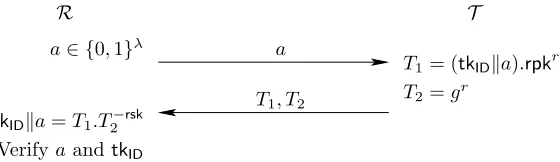
Finally, tkID is again a λ-bit key of a tag ID, which is known by both the tag and the reader. We next
obtain the RFID identification scheme described in Figure 7.
VerifyaandtkID
T R
a∈ {0,1}λ a
T1= (tkIDka).rpkr
T2=gr
T1, T2 tkIDka=T1.T
−rsk 2
Fig. 7.El Gamal based protocol
Security Considerations. As for the Rabin case, we are unable to provide a proof that the construction based on El Gamal is secure but again, it would seem that this is the case.
In addition to what has been said for the Rabin case, the El Gamal opens a new problem. In fact, we should be careful here that the message tkIDkatruly belongs to the right working group. This should be done by using a good preprocessing step. Note however that this may imply some additional computations for the RFID tag. This is for example the case if the implementation is done using elliptic curves [10].
10.4 The Constant Fixed Non Malleability Property
In [7], Bellareet al.have shown that the IND-CCA property is equivalent to the NM-CCA one. Moreover, the soundness property of the Vaudenay’s generic scheme intuitively comes from the non-malleability of the public key cryptosystem while the privacy property comes from the indistinguishability property. But the non-malleability property may be too strong for our purpose and, as we need lightweight computation, this may be not a good choice. In fact, most of existing IND-CCA secure cryptosystems are not relevant in the RFID setting and thus, cannot be used in practice.
together with some randomness a that are “publicly” known, since they are sent in clear by the reader. We thus introduce the following security definition for encryption schemes.
Definition 9 (Constant Fixed Non Malleability). A public key encryption scheme verifies the con-stant fixed non malleability if given the encryption public key and having access to an oracle which on input a value a, outputs the encryption of tkIDka, wheretkID is secret, an adversary is unable to output the encryption of tkIDk˜a on input ˜awith non-negligible probability.
As a conclusion, if we are able to find a public key cryptosystem not necessarily IND-CCA but having the constant fixed non malleability property, then we have the following result on privacy-preserving RFID systems.
Theorem 2. The Vaudenay’s generic construction given in Figure 2 using a constant fixed non malleable and IND-CPA encryption scheme is secure and forward private.
11 IND-CPA Cryptosystem + MAC ⇒ (Future) Untraceability
In this section, we first provide a generic construction of a privacy-preserving RFID identification system which make use of any IND-CPA public key cryptosystem and a MAC function. Next, we provide a practical implementation using the Hash El Gamal encryption scheme.
11.1 MAC function
A cryptographic message authentication code (MAC) is a cryptographic tool used to authenticate a message and belongs to the family of symmetric cryptography. A MAC scheme denoted M is composed of the following procedures: KeyGen is the key generation algorithm which permits to generate the MAC key denoted k;Mac is the code generation algorithm which accepts as input an arbitrary-length message m and the secret keyk and outputs the MACσ for message m, under the secret key k;VerMacis the code verification algorithm which takes as input a message m, the secret key k and a message authentication code σ and outputs 1 if σ=Mac(m,k) and 0 otherwise.
To be considered as secure, a MAC scheme should resist to existential forgery under chosen-plaintext attacks (EF-CPA). This means that even if an adversary A has access to an oracle which possesses the secret key and generates MACs for messages chosen by the adversary,Ais unable to guess the MAC for a message it did not query to the oracle.
11.2 Our New Generic Construction
Our generic construction needs a public key cryptosystem and a MAC scheme as defined above.
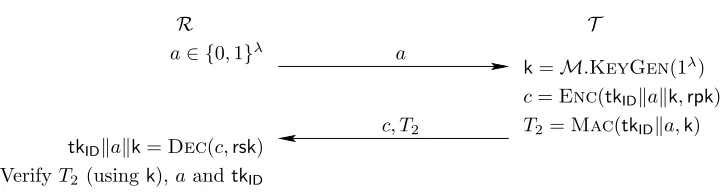
Proposed construction. Let E be a public-key encryption scheme with the IND-CPA property and a MAC schemeMsuch as defined above, we next introduce our new RFID identification scheme in Figure 8, where each tagIDshares with the reader a unique key denotedtkID, and where the reader key pair (rsk,rpk)
corresponds to the public key cryptosystem key pair, that is, rskis a secret decryption key and rpk is the corresponding encryption public key.
Security Considerations. Assume an adversary able to impersonate an uncorrupted tag. As she has no control over the nonce achosen by the reader, the returned values will correspond, with a significant probability, to a new message tkID||a, which contradict the EF-CPA property of the MAC. Consequently, under the EF-CPA property, our new generic construction is sound.
Regarding the untraceability property, we have to prove that for every adversary A of this protocol, there exists a blinded adversaryAB
such that whateverAdo,AB
a∈ {0,1}λ
T R
a
k=M.KeyGen(1λ)
c=Enc(tkIDkakk,rpk)
T2=Mac(tkIDka,k)
c, T2 tkIDkakk=Dec(c,rsk)
VerifyT2 (usingk),aandtkID
Fig. 8.A generic scheme based on an IND-CPA encryption scheme and a MAC
with the simulator. The game technique, presented by Shoup is perfectly adapted to obtain this result. The purpose is to replace every interactions with oracles of A by an answer of the simulator. The success of each game is the experiment that perform the adversary, for example : find a non-trivial link between two pseudonyms. If the difference between the success probabilities of two successive games is negligible, then it follows that the difference between the success probability of the adversary and the one of the blinded adversary is negligible.
We give here some details about this proof. It is possible to replace one by one every plaintexts of the public key cryptography by random messages. As detailed in [31], these operations cannot influenced the success probability of the adversary, otherwise it is possible to exhibit a distinguisher for the IND-CPA experiment. In order to obtain a perfect simulation of all messages exchanged during the experiment, it is also necessary to modify inputs of the MAC function. For this purpose, the MAC scheme must be a pseudo random function, which is also required to avoid attacks as those presented in [8]. This is not restrictive in practice as most of MAC schemes verifies this property. In conclusion, as we use the game technique, the difference between the success probabilities ofAandAB
is increased by the advantage of an adversary against the IND-CPA property of the encryption scheme plus the advantage of an adversary against the pseudo-random property. As both of these advantages are negligible by definition, the success probability of Amust be negligible which demonstrates the untreacability property of our scheme.
11.3 The Hash El Gamal Case
The Hash El Gamal encryption scheme [14] is a variant of the classical El Gamal encryption scheme which uses a hash function. It allows a compact ciphertext and avoids problems with messages whose orders are not the ones of the group. We have shown in Section˜refss:insecurehasheg that using this scheme alone is not enough to obtain a secure scheme. However, we can use it with the above generic proposal to obtain a secure and efficient scheme. But, even if this is easily possible, we describe in this section a slightly different scheme which permits us to obtain a more efficient scheme than the “simple” applying of the Hash El Gamal encryption scheme in the above generic construction.
Description of the System. Let G be a cyclic group of prime order q. The reader’s private key to
decrypt a message is rsk ∈ Z∗q and the corresponding encryption public key is rpk = grsk, where g is a
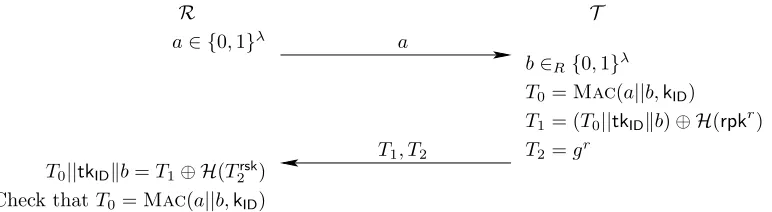
generator of G. We thus obtain the RFID identification scheme described in Figure 9, where tkID and kID
are secret λ-bits values shared by the tagID and the reader.
In a nutshell, we have described an efficient authentication scheme based on an IND-CPA public-key cryptosystem and a MAC scheme. It is sound and untraceable as the DHAES scheme (see section 9.3) and seems to be efficient. In the next section we give some implementation estimation for all presented schemes. We will then be able to conclude about the relevancy of an authentication scheme based on an IND-CPA public-key cryptosystem. First of all, we formally prove that this scheme is secure, i.e. sound and untraceable.