University of South Carolina
Scholar Commons
Theses and Dissertations
12-14-2015
Confluence of Density Currents Over an Erodible
Bed
Hassan Ismail
University of South Carolina - Columbia
Follow this and additional works at:https://scholarcommons.sc.edu/etd Part of theCivil Engineering Commons
This Open Access Thesis is brought to you by Scholar Commons. It has been accepted for inclusion in Theses and Dissertations by an authorized administrator of Scholar Commons. For more information, please [email protected].
Recommended Citation
Ismail, H.(2015).Confluence of Density Currents Over an Erodible Bed.(Master's thesis). Retrieved from
Confluence of Density Currents Over an Erodible Bed
by
Hassan Ismail
Bachelor of Science
University of South Carolina 2011
Submitted in Partial Fulfillment of the Requirements
for the Degree of Master of Science in
Civil Engineering
College of Engineering and Computing
University of South Carolina
2015
Accepted by:
Jasim Imran, Director of Thesis
Enrica Viparelli, Reader
M. Hanif Chaudhry, Reader
c
Dedication
Abstract
Results from laboratory experiments on conservative density current confluence
are reported. Hydraulic characteristics and morphodynamic consequences of the
con-fluence of two continuous release density currents in a horizontal, 45◦ asymmetrical
junction are examined and compared to those of terrestrial river junctions. It was
observed that density current confluence is markedly different than those in river
junctions primarily due to the ease of the dense fluid to convect into the ambient
fluid in the junction zone. Upward convection in the junction resulted in low
horizon-tal velocity and shear stresses on the bed of the junction zone, followed by re-plunging
to the layer of neutral buoyancy downstream of the junction where acceleration
oc-curs. In the downstream reach was a distinctive erosional pattern similar to central
scouring seen in river junctions but starting at the downstream junction point rather
than at the upstream junction point. It was found that terrestrial river models match
well with the density current case in terms of maximum velocity downstream of the
junction, backwater effect, avalanche face protrusion into the downstream reach, and
maximum scour orientation. Poor matching was found in terms of separation zone
dimensions and shape, streamline deviation angle on the junction line, and maximum
Table of Contents
Dedication . . . iii
Abstract . . . iv
List of Figures . . . vi
Chapter 1 Introduction . . . 1
Chapter 2 Background Information on River Confluences . . . 5
Chapter 3 Laboratory Experiments . . . 10
3.1 Experimental Setup and Procedure . . . 10
3.2 Flow Field . . . 13
3.3 Bed Evolution . . . 15
Chapter 4 Comparison to River Confluences . . . 24
4.1 Comparison to River Hydraulics . . . 24
4.2 Comparison to River Morphodynamics . . . 28
Chapter 5 Conclusions. . . 36
List of Figures
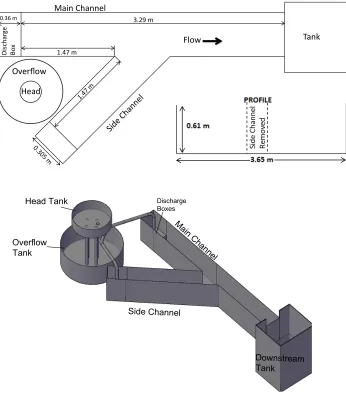
Figure 3.1 Physical model dimensions in plan view, profile view, and rendering. 17
Figure 3.2 Comparison of main channel and side channel primary velocity
at the channel centerlines. . . 18
Figure 3.3 Initial head confluence of the density currents in time as seen
from the main channel. . . 18
Figure 3.4 Primary velocity profiles along the main channel centerline. Solid vertical lines indicate the points of measurement, and dashed vertical lines indicate the location at which the side
channel connects. . . 18
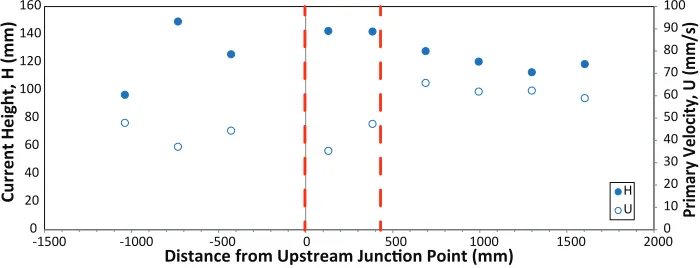
Figure 3.5 Layer averaged current height and velocity based on 1D profiles. . 19
Figure 3.6 Horizontal isovelocity map near the junction zone at 114.3 mm, 88.9 mm, 63.5 mm, 38.1 mm, and 25.4 mm from the bed. The
origin of the plot is the upstream junction point. . . 20
Figure 3.7 Horizontal velocity vectors with streamlines near the junction zone at 114.3 mm, 88.9 mm, 63.5 mm, 38.1 mm, and 25.4 mm
from the bed. The origin of the plot is the upstream junction point. 21
Figure 3.8 Evolution of the bed of main channel after 540 s, 1028 s, 3630 s, 4140 s, 5618 s, and 9329 s total run time. Flow is from left to right, and the vertical dash lines indicate the locations of the
junction points. . . 22
Figure 3.9 Qualitatively observed erosional pattern downstream of the junction. 22
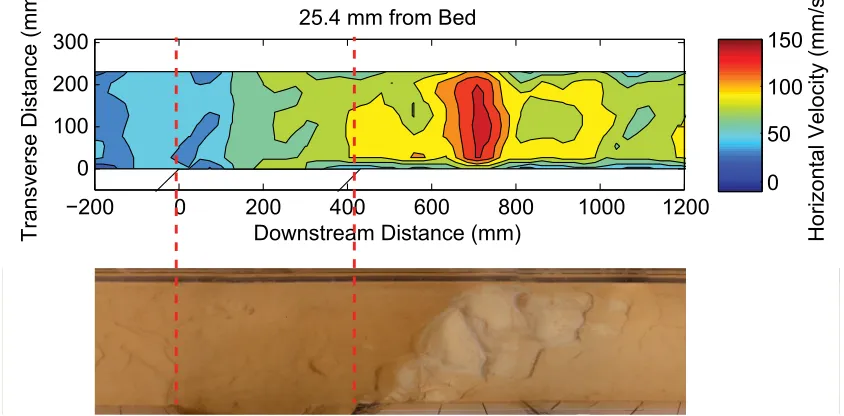
Figure 3.10 Near-bed velocity isoline plot with associated scouring down-stream of the junction. The dashed vertical lines indicate the
Figure 4.1 Typical characteristics of river channel confluences (left panel) and observed characteristics of density current confluences (right
panel). . . 31
Figure 4.2 Zoomed streamlines near flow separation zone. The dash line indicates the extent of the flow separation zone, and the coordi-nates X and Y indicate the downstream and lateral coordicoordi-nates,
respectively, of the points of interest. . . 32
Figure 4.3 Variation of streamline deviation angle from the upstream to
downstream junction points. . . 33
Figure 4.4 Variation of streamline deviation angle with depth. Included is
the fit curve to the density current case. . . 33
Figure 4.5 Visual method for measuring current height downstream and
upstream of the junction. . . 34
Figure 4.6 Location and extent of avalanche face protrusion into the
down-stream reach. . . 34
Chapter 1
Introduction
Density currents are flows driven by the density difference between a current and
ambient fluid (Benjamin 1968). This density difference may be caused by a
conser-vative substance such as dissolved salt, or by a non-conserconser-vative substance such as
suspended sediment. In particular, turbidity currents are sediment-laden underflows
that may travel for very long distances on the ocean floor. They can create
self-forming canyons and channels passing over the continental slope and into the abyssal
plane (Peakall, McCaffrey, and Kneller 2000). After the slope break at the toe of
the continental slope, turbidity currents can deposit their suspended sediments in
submarine fans.
Natural turbidity currents are episodic events that, depending on the triggering
mechanism and conditions, can be either sustained, quasi-steady flows or surge-type
events (Hay 1987). The episodic nature of turbidity currents has left only a few notable
instances of direct field observation of turbidity current flows (e.g., Prior et al. 1987;
Normark 1989; Khripounoff et al. 2003; Paull et al. 2002; Xu, Noble, and Rosenfeld
2004; Vangriesheim, Khripounoff, and Crassous 2009).
Although a great deal of attention has been placed on the study of submarine
channel systems, previous studies have focused heavily on the hydraulics and
mor-phodynamics of individual channels and sinuous submarine channels (e.g., Keeulegan
1949; Simpson and Britter 1979; Parker, Fukushima, and Pantin 1986; Parker et al.
1987; Garcia and Parker 1993; Kneller, Bennett, and McCaffrey 1999; Peakall,
Imran, and Pirmez 2008; Islam and Imran 2008; Sequeiros et al. 2010; Huang, Imran,
and Pirmez 2012; Ezz, Cantelli, and Imran 2013; Janocko et al. 2013; Tokyay and
Garcia 2013). Although submarine channel networks and confluences are well
doc-umented through field observation (Canals, Urgeles, and Calafat 2000; Dalla Valle
and Gamberi 2011; Greene, Maher, and Paull 2002; Hesse 1989; L’Heureux, Hansen,
and Longva 2009; Mitchell 2004; Paquet et al. 2010; Straub et al. 2011, e.g.,), little
attention has been placed on understanding the characteristics and physical processes
of these settings.
Hesse (1989) and Klaucke, Hesse, and Ryan (1998) acquired imagery data of the
Labrador sea floor including an extensive network of converging drainage channels.
Based on seismic and sonar data, distinct differences between submarine and
sub-aerial drainage systems were identified. Mitchell (2004) and Vachtman, Mitchell, and
Gawthorpe (2013) described erosion rates and submarine canyon hydrology on the
Atlantic continental slope and recommended a simple relationship to describe erosion
rates as a function of channel gradient and contributing area. To do so, the authors
employed principles of terrestrial hydrology to the submarine environment. An
impor-tant assumption in developing their model is that long-term erosion rates of branches
of fluvial (and thus extended to submarine) channels must be identical. Straub et
al. (2007) used high resolution data from the Monterey, CA and Brunei Darussalam
continental slopes to assess submarine channel profiles and drainage area statistics.
Although substantial differences in physical processes exist, the data yielded
subma-rine scaling exponents within the range of terrestrial observations.
Gamboa, Alves, and Cartwright (2012) provides the most detailed survey of
sub-marine confluences on confined slopes (i.e., subsub-marine canyon confluences). Based
on the interpretation and analysis of 3D seismic data, these researchers proposed a
classification scheme based on the geometry of the confluence. The classification
which case the downstream reach is in line with one of the contributing channels, or
symmetrical, in which case the downstream reach approximately bisects the junction
angle between the contributing channels. Confluence densities and width ratios in the
study area of Gamboa, Alves, and Cartwright (2012) also indicate similarities to those
found in fluvial river systems furthering the notion by Mitchell (2004) and Straub
et al. (2007) that submarine channel confluences, from the drainage and hydrological
perspective, are similar to those found in terrestrial river systems.
Despite the similarities noted in geometry and erosion rates, hydraulic differences
in the confluences of submarine channels inevitably exists due to the nature of density
currents. The most significant difference hydraulically is that the density contrast
be-tween turbidity currents and the ambient fluid is on the order of only a few percent,
whereas fluvial rivers experience a density difference of about 800 times that of the
ambient fluid (i.e., air) (Parker, Fukushima, and Pantin 1986; Imran, Parker, and
Katopodes 1998). Some aspects of turbidity or density currents have been well
doc-umented as analogous to rivers and others have shown distinct differences. Several
researchers (e.g., Clark and Pickering 1996; Peakall, McCaffrey, and Kneller 2000;
Pirmez and Imran 2003) document the similarities in sinuosity, wavelengths, and
avulsions of submarine channels and river channels. Others document the differences
in terms of hydraulic and morphodynamic character (e.g., Parker, Fukushima, and
Pantin 1986; Wynn, Cronin, and Peakall 2007; Kolla, Posamentier, and Wood 2007;
Deptuck et al. 2007; Islam and Imran 2008; Sequeiros et al. 2010; Straub et al. 2011;
Ezz and Imran 2014). Parker et al. (1987) noted that since relative density is the
driving mechanism of turbidity currents, erosive and flow power are subject to direct
feedback from entraining and depositing bed sediment adding complexity to sediment
transport potential in submarine flows. Sequeiros et al. (2010) proposed a sediment
transport relation which is strikingly similar to that of river systems with
channels can be a result of aggradation rather than incision as is the case with river
channels. To the authors’ knowledge, no study has been reported regarding hydraulics
and sediment response in submarine channel confluences despite the fact that channel
networks are important elements of continental margin strata.
This paper presents the results and the analysis of laboratory experiments
specif-ically designed to study simultaneously active, conservative density current
conflu-ences over an erodible bed. Using the classification system of Gamboa, Alves, and
Cartwright (2012), tests were performed in a neutrally asymmetric confluence
(neu-trally indicating that both upstream reaches contribute equally to the downstream
reach). A total of 21 subsequent density currents were released to characterize the
velocity field in the junction and in the contributing channels. In particular,
one-dimensional primary (i.e., streamwise) velocity and two-one-dimensional horizontal
ve-locity in the near junction zone were measured. Further, qualitative assessment of
bed evolution was performed after each test. Well-established models for terrestrial
river confluences were then tested with the submarine data to identify similarities
and differences between subaerial and submarine confluences. This study focused on
gaining insight on the hydraulics and mechanics of density current confluences and
their morphological impacts, and on observing how the submarine velocity field and
Chapter 2
Background Information on River Confluences
The characteristics and properties of river channel confluences have been examined by
field observations (e.g., Best 1988), physical experiments (e.g., Lin and Soong 1979;
Best 1988; Gurram, Karki, and Hager 1997; Hsu, Wu, and Lee 1998; Webber and
Greated 1966; Qing-Yuan et al. 2009), and theoretical and numerical models (e.g.,
Lin and Soong 1979; Hsu, Wu, and Lee 1998; Hsu, Lee, and Chang 1998; Shabayek,
Steffler, and Hicks 2002; Kesserwani et al. 2008).
Hydraulic characteristics in terrestrial river confluences include a separation zone
downstream of the junction, streamline deviation angle from the side channel, and a
backwater effect into each contributing reach.
In the confluence of terrestrial rivers, flow separation occurs at the downstream
junction point and continues into the downstream reach; the extent of flow separation
has been studied by Best and Reid (1984) and Gurram, Karki, and Hager (1997) who
both focused on maximum separation zone dimensions, and Qing-Yuan et al. (2009)
who studied the variation in separation zone geometry with depth.
Best and Reid (1984) quantified the geometry and extent of the flow separation
zone downstream of an experimental, equal-width junction. They varied both relative
discharge and junction angle and tracked the extent of the separation zone visually
using an overhead camera. The authors found that the length and width of the
flow separation zone increase with both relative tributary contribution and junction
angle. Best and Reid (1984) fit logarithmic trend lines to their data set for maximum
bs
b3
= 0.264 + 0.117 ln(Qs Qm
) (2.1)
Ls
b3
= 1.348 + 0.538 ln(Qs Qm
) (2.2)
where bs and Ls are the width and length of the separation zone, respectively, b3
is the width of the downstream reach,Qs is the discharge from the side channel, and
Qm is the discharge from the side channel. Gurram, Karki, and Hager (1997) also
developed an analytical solution for separation zone geometry in subcritical
open-channel flows as:
bs
b3 = 1
2(Fd/s− 2 3)
2+ 0 .45Q
1 2 r(
θ
90◦) (2.3)
Ls
b3
= 3.8 sin3θ(1− 1
2Fd/s)Q
1 2
r (2.4)
where Fd/s is the downstream Froude number, Qr is the discharge ratio, and θ is
the junction angle.
Qing-Yuan et al. (2009) furthered the investigation into separation zone geometry
by describing the variation of separation zone extent with depth in a 90◦ open channel
junction. In particular, they developed a new method for defining the extent of
the separation zone called the velocity isoline method which is based on tracing
the zero-downstream-velocity contour to define the separation zone boundary. The
careful comparison of the new isoline method with the classical streamline method
to determine the extent of the separation zone revealed that the isoline method is
simpler to implement if velocity data is available. The main results of the Qing-Yuan
et al. (2009) work are, 1) the separation zone at open channel junctions increases
both in width and in length away from the bed, and 2) the separation zone becomes
Due to flow separation in the downstream reach of river confluences, effective flow
area decreases opposite to the separation zone creating a high velocity region alongside
the separation. Best and Reid (1984) defined a velocity index for the maximum near
bed velocity as Ux =Umax/U1 where Ux is the velocity index, Umax is the maximum
observed velocity in the downstream reach at the separation zone section, and U1 is
the velocity in the main upstream reach. A line was fit to the data as:
Ux= 4.52 + 2.36
b3−bs
b3
(2.5)
Early models of river confluences (e.g., Lin and Soong 1979), termed linear models,
assumed equal upstream water depths in each contributing branch. Later models of
Hsu, Lee, and Chang (1998) and Gurram, Karki, and Hager (1997), are nonlinear
models based on momentum balance in the junction.
Hsu, Lee, and Chang (1998) proposed an analytical approach for solving the
up-stream depth ratio of subcritical open channel junction flows for equal width,
hori-zontal channels and they found that the upstream depth ratio is directly correlated
to the Froude number in the downstream reach, Fd/s, and to junction angle. The
re-searchers also examined trends of streamline deviation angle across the junction line
as a function of discharge ratio and junction angle. The deviation angle is defined as
the angle of the streamlines entering the junction from the side channel. The
devia-tion angle is measured relative to the juncdevia-tion line, and the side channel streamlines
are skewed from the junction angle due to forcing from the main channel inflow.
The pioneering work of Best (1988), which included both laboratory experiments
and field observation, utilized knowledge of junction hydraulics to identify three
dis-tinct morphological elements common among open channel junctions: 1) avalanche
faces at the upstream edges of the junction zone where the two contributing channels
combine, 2) a deep central scour beginning at the upstream junction point and
of the separation zone. The dominant factors effecting the geometry of these three
elements are relative discharge and junction angle. Best (1988) concluded that
in-creasing either of these factors, i.e., the relative discharge and/or the junction angle,
results in a more pronounced segregation of sediment and flow contributions causing
1) the retreat of the main channel avalanche face, 2) rotation of the central scour
about the upstream junction point, and 3) increase in the extent of the separation
zone bar. Gamboa, Alves, and Cartwright (2012) identified morphological elements of
submarine junctions that are similar to those defined by Best (1988), i.e., the presence
of plunging faces in the contributing channels and a well defined scour int he
junc-tion zone. These observajunc-tions suggest that by using the well-established knowledge
on fluvial channel confluences, analogies between the subaerial and the submarine
settings can be established.
By relating protrusion into the junction with relative discharge and junction angle,
Best (1988) fit a line to his data for the case of equal contribution from each channel
as:
= 1.9525−0.0186θ (2.6)
whereis the normalized distance from the upstream junction point to the farthest
point of the avalanche face into the junction and is normalized by the downstream
channel width as=a/b3whereais the dimensional maximum extent of the avalanche
face into the junction from the upstream junction point.
Best (1988) also developed logarithmic trend lines for the maximum depth of
scouring past the avalanche face starting at the upstream junction point. The depth
of scouring was normalized by the upstream reaches’ water depth and takes the form:
ds =−4.944 + 1.830 lnθ (2.7)
dimensional scour depth and Yavg is the average water depth of the main and side
channels at the junction entrance.
Best (1988) has described the orientation of the line of maximum scour as
approx-imately bisecting the junction angle which was computed from the curve for equal
upstream discharge taking the form:
β = 6.98 + 0.297θ (2.8)
where β is the angle of the maximum scour line relative to the main channel
Chapter 3
Laboratory Experiments
3.1 Experimental Setup and Procedure
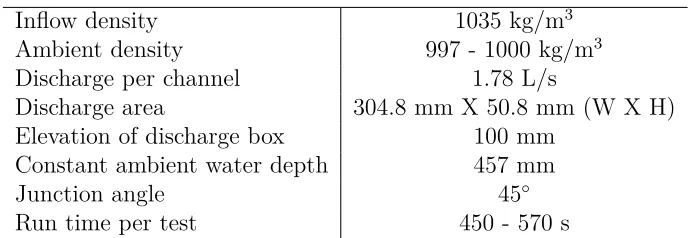
The laboratory experiments were conducted in an asymmetric y-shaped flume in the
Hydraulics Laboratory at the University of South Carolina (Figure 3.1). Experimental
conditions are summarized in Table 3.1.
Experimental Conditions
The rigid sub-bed of the flume was constructed with painted wood. The walls were
painted wood on one side of the flume and transparent acrylic glass on the other side
for flow visualization and tracking of the density current’s propagation.
The near-junction zones, to a distance of 0.91 m in the upstream direction and
the entire length of the downstream reach, was covered to a depth of 40 mm with
sand-sized plastic particles with a specific gravity of 1.5 and D50 of 0.2 mm. The
extreme upstream reaches of each inflow channel was a painted wood board to allow
the current to develop fully before reaching the erodible bed material. The board was
also 40 mm deep to avoid any bed discordance.
A premixed salt water solution was stored in a continuously stirred overflow tank
from which it was lifted to a constant-elevation head tank. The head tank split in a
manifold to feed each upstream reach. Each limb of the manifold was equipped with
differential piezometers and valves to monitor and ensure constant inflow throughout
box and grate to ensure the inflow was quiescent and the density current could form
in a relatively short downstream distance. The discharge boxes were elevated to 100
mm above the flume bed to allow the inflow mixture to plunge to produce a coherent
density current. The flume’s downstream reach terminated in a large tank where the
density current was allowed to plunge below the flume’s bed elevation. The ambient
water level was maintained with an overflow drain pipe in the downstream tank.
Test Procedure
In preparation for each test, 1.28 m3of a salt water mixture was prepared to a density
of 1035 kg/m3. To this end, a bench test was performed to determine the precise mass
of salt required for each incremental change in fluid density. Using the results of the
bench test, a formula was developed based on the initial density of the fluid and
target density as:
msalt
∀ = 1.366×(ρtarget−ρinitial) (3.1)
where msalt is the required mass of salt in kg,∀ is the volume of the container in
m3,ρ
target is the desired final density of the solution in kg/m3, and ρinitial is the initial
density of the water in kg/m3. Since, depending on the run time off each test, the
entire pre-mixed volume was not fully used, before the subsequent test the mixing
tank was refilled with fresh water, mixed, and the initial density was measured in
preparation for the new mixture. This procedure resulted in reliably constant inflow
density for all tests.
Before the test runs begin, the flume was filled with fresh water, and a continuously
operating submersible pump was used to elevate the salt water mixture to a head tank.
Once the head tank begins to overflow back to the storage tank for a suitable amount
of time, testing can begin. For the duration of the test, a calibrated discharge pump
of the flume. In tandem, a constant, low-velocity inflow of fresh water was added
to the top of the downstream discharge tank to reduce upward convection of dense
water in the downstream tank and to prevent reflection. Each test was initiated by
simultaneously opening valves releasing the salt water mixture to each flume. Using
the differential piezometers, all tests showed a constant inflow of 1.78 L/s (±2%) to
each channel. The discharge started in the momentum-reducing boxes, passed the
flow-straightening grates, and formed two developed density currents. The currents’
heads propagated downstream, collided at the junction, and continued downstream.
Once the head of the combined current exited the domain and the current height
stabilized, measurement procedures began.
Once the pre-mixed volume of salt water was nearly depleted, the test was halted
by closing the inflow valves to each discharge box. The current tail was then allowed
to move downstream where the discharge pump and drain were still active until the
current exited the domain completely. The flume was then drained to approximately
one-third of the initial depth, and photographs of the bed were taken. To avoid any
bed disturbance, the flume was never completely drained below this point between
tests; rather, the flume was slowly refilled with fresh water and drained repeatedly
until the water density was measured to be 1000 kg/m3, as desired, for subsequent
testing.
Measurement Techniques
Measurements were taken to capture the current depth in space, 1D velocity profiles,
2D horizontal velocity, and bed evolution after each test. A high-definition camcorder
was mounted along the flume’s main channel to capture the current development in
space and time. In preliminary testing, these cameras were also used to ensure the side
and main channels were behaving similarly in terms of density current development
45◦ pointing downward into the current for 1D primary velocity measurement as a
function of depth. These probes were placed at the centerline of the main and side
channels and downstream reach. UVPs were also used in a grid pattern to obtain
2D horizontal velocity at 114.3, 88.9, 63.5, 38.1, and 25.4 mm from the bed. The
near-bed 2D velocity was used to correlate to observations on bed development. A
still overhead camera was used to photograph the bed of the main channel after each
run. For better quality of the photos, several photos were taken at a short distance
from the bed and merged to one image. The photos were overlapped approximately
30% on each side to avoid distortion in the final image.
3.2 Flow Field
Given equal inflow discharges to each flume, behavior of each upstream reach was
established to be equal by obtaining primary, or downstream, velocity profiles in
the channel centerlines at 1.092 m from each discharge boxes. Figure 3.2 shows
the normalized velocity profile from each channel and good agreement is observable.
The peak velocity is within 8% in each channel with similar shape and inflection
(near z/H = 1). In the figure, z is the upward coordinate from the bed, u is the
measured primary velocity, andU and H are the depth averaged velocity and current
height, respectively, by using the moment method (Parker et al. 1987). Since matching
between the side and main channel is good, henceforth measurements and discussion
will focus on the main upstream channel, junction zone, and the downstream reach.
In the laboratory tests it was observed that the current rose into the ambient
water layer in the junction as seen in Figure 3.3 taken during the initial collision of
the current fronts. After the two inflows combined, they re-plunged in the downstream
reach. This large plume subsided to a quasi-equilibrium height which is represented
in the velocity profiles of Figure 3.4 and the depth-averaged H in Figure 3.5. The
Primary Velocity
Figure 3.4 shows one-dimensional primary velocity along the main channel centerline.
The dashed vertical lines in the figure indicate the upstream and downstream
junc-tion points, and the solid vertical lines indicate the measurement point downstream
coordinate. The maximum velocity near the junction shifted away from the bed near
the downstream junction point and then returned to a more typical velocity profile
in the downstream reach.
Figure 3.5 shows the layer-averaged current thickness, H, and velocity, U based
on the profiles seen in Figure 3.4. As expected for the majority of the domain,H and
U were inversely correlated, but both increased near the downstream junction point.
This suggests that in the junction zone, there was significant upward convection of
momentum causing the maximum velocity to be further from the bed and flow area
to increase.
Horizontal Velocity
Two-dimensional horizontal velocity measurements were taken near the junction at
five different elevations above the bed. Isovelocity maps are shown in Figure 3.6; the
entire width of the main channel is not included in these measurements due to the
need for physical clearance of the velocity probes. In general, velocity in the junction
zone and downstream of the junction was higher closer to the bed as expected based
on the one-dimensional velocity profiles in Figure 3.4. At all of the five elevations near
the upstream junction point, horizontal velocity was low with acceleration through
the junction zone and in particular downstream of the junction. Some flow separation
can be noted just beyond the downstream junction point which is more evident away
from the bed.
Horizontal velocity vectors with streamlines are shown in Figure 3.7. A clear
Near the bed, the main channel contribution was restricted to the outer wall of the
downstream reach as the side channel inflow entered the junction. Conversely, the
main channel contribution was more dominant away from the bed. This implies that
the main channel flow rode atop the side channel flow in the junction before mixing in
the downstream reach where velocity was once again unidirectional. The stagnation
of flow near the upstream junction point seen in the horizontal velocity contour plots
(Figure 3.6) can also be seen in the streamlines plots (Figure 3.7) where streamlines
near the upstream junction point in the main channel terminate against the shear
plane of contributing inflows. Flow separation in the downstream reach is also evident
in termination of streamlines against the wall of the flume at elevations far from the
bed. It can be inferred that the main channel inflow rode atop the side channel inflow
and entrained ambient water, thus becoming more diffuse and weaker. Its ability to
counteract the momentum from the side channel lessened allowing for the formation
of a downstream separation zone. Near the bed, the orientation of the downstream
reach and strength of the main channel inflow forced the side channel contribution
to deviate to the downstream direction and stick to the wall of the flume.
3.3 Bed Evolution
Figure 3.8 shows the evolution of the erosional pattern observed on the bed. The
inflow condition was such that sufficient shear stress was acting on the bed to create
distinctive bedforms upstream and downstream of the junction zone, but very little
sediment transport was noted in the junction zone itself. This corroborates the notion
that horizontal momentum was converted to vertical momentum in the confluence
zone as the main channel inflow rose above the side channel inflow. Thus horizontal
shear stresses acting on the bed were reduced inhibiting transport of bed material.
The most distinctive bathymetric pattern was the scouring beginning at the
Table 3.1 Experimental conditions.
Inflow density 1035 kg/m3
Ambient density 997 - 1000 kg/m3
Discharge per channel 1.78 L/s
Discharge area 304.8 mm X 50.8 mm (W X H)
Elevation of discharge box 100 mm
Constant ambient water depth 457 mm
Junction angle 45◦
Run time per test 450 - 570 s
the flume. The avalanche face (i.e., beginning of the scoured section) was
approxi-mately in line with the side channel’s wall and developed a series of relatively deep
erosional waves from successive runs until reaching the opposite wall (Figure 3.9).
By comparing the scouring to the near-bed velocity contours (Figure 3.6), it is clear
that this zone downstream of the junction experiences the highest horizontal velocity,
thus scouring here is expected.
Figure 3.10 shows the near-bed velocity and associated scouring downstream of
the junction. From this plot it is clear that in the junction there was relatively low
horizontal velocity thus sediment transport capacity was limited. However,
down-stream of the junction, high horizontal velocity indicates high bed shear stress which
Head Tank
Main Channel
Side Channel
Overflow Tank
Discharge Boxes
Downstream Tank 1.47 m
Di
sc
ha
rg
e
Bo
x
Main Channel
Flow Tank
0.36 m 3.29 m
Overflow
Head
0.305 m
0.0 0.2 0.4 0.6 0.8 1.0 1.2
-0.5 0.0 0.5 1.0 1.5
N or m al iz ed D is ta nc e fr om B ed (z /H )
Normalized Downstream Velocity (u/U)
Main Channel Side Channel
Figure 3.2 Comparison of main channel and side channel primary velocity at the channel centerlines.
FLOW FLOW
FLOW FLOW
Figure 3.3 Initial head confluence of the density currents in time as seen from the main channel. 50 mm/s 0 50 100 150 200 250
-1500 -1000 -500 0 500 1000 1500 2000
Di st an ce fr om B ed (m m )
Distance from Upstream Junction Point (mm)
0 10 20 30 40 50 60 70 80 90 100 0 20 40 60 80 100 120 140 160
-1500 -1000 -500 0 500 1000 1500 2000
Pr im ar y Ve lo cit y, U (m m /s ) Cu rr en t H ei gh t, H (m m )
Distance from Upstream Junction Point (mm)
H U
Downstream Distance (mm)
Transverse Distance (mm)
114.3 mm from Bed
−200 0 200 400 600 800 1000 1200
0 100 200 300
Horizontal Velocity (mm/s)
0 50 100 150
Downstream Distance (mm)
Transverse Distance (mm)
88.9 mm from Bed
−200 0 200 400 600 800 1000 1200
0 100 200 300
Horizontal Velocity (mm/s)
0 50 100 150
Downstream Distance (mm)
Transverse Distance (mm)
63.5 mm from Bed
−200 0 200 400 600 800 1000 1200
0 100 200 300
Horizontal Velocity (mm/s)
0 50 100 150
Downstream Distance (mm)
Transverse Distance (mm)
38.1 mm from Bed
−200 0 200 400 600 800 1000 1200
0 100 200 300
Horizontal Velocity (mm/s)
0 50 100 150
Downstream Distance (mm)
Transverse Distance (mm)
25.4 mm from Bed
−200 0 200 400 600 800 1000 1200
0 100 200 300
Horizontal Velocity (mm/s)
0 50 100 150
−200 0 200 400 600 800 1000 1200 0
100 200 300
Downstream Distance (mm)
Transverse Distance (mm)
114.3 mm from Bed
−200 0 200 400 600 800 1000 1200 0
100 200 300
Downstream Distance (mm)
Transverse Distance (mm)
88.9 mm from Bed
−200 0 200 400 600 800 1000 1200 0
100 200 300
Downstream Distance (mm)
Transverse Distance (mm)
63.5 mm from Bed
−200 0 200 400 600 800 1000 1200 0
100 200 300
Downstream Distance (mm)
Transverse Distance (mm)
38.1 mm from Bed
−200 0 200 400 600 800 1000 1200 0
100 200 300
Downstream Distance (mm)
Transverse Distance (mm)
25.4 mm from Bed
Junction Line 100 mm/s
Junction Line 100 mm/s
Junction Line 100 mm/s
Junction Line 100 mm/s
Junction Line 100 mm/s
540 s
1028 s
3630 s
4140 s
5618 s
9329 s
Figure 3.8 Evolution of the bed of main channel after 540 s, 1028 s, 3630 s, 4140 s, 5618 s, and 9329 s total run time. Flow is from left to right, and the vertical dash lines indicate the locations of the junction points.
Junction Line
Downstream Distance (mm)
Transverse Distance (mm)
25.4 mm from Bed
−200 0 200 400 600 800 1000 1200
0 100 200 300
Horizontal Velocity (mm/s)
0 50 100 150
Chapter 4
Comparison to River Confluences
4.1 Comparison to River Hydraulics
With the previously discussed observations and measurements, comparisons can be
directly made to well-established observations of subaerial river confluences. This
comparison will focus on comparing hydraulic response to the confluence as described
by Best and Reid (1984), Gurram, Karki, and Hager (1997), Hsu, Lee, and Chang
(1998), and Qing-Yuan et al. (2009). Morphological characteristics of river confluences
are extracted from the work of Best (1988). Hydraulic characteristics to be assessed
include 1) flow separation downstream of the junction; 2) maximum velocity due to
the effective flow contraction adjacent to the separation zone; 3) deviation angle of
streamlines entering from the side channel; and 4) backwater effect of the junction into
the upstream reaches. Morphological features that are assessed include 1) avalanche
faces at the edge of scouring in the junction zone; 2) maximum scouring depth; and 3)
maximum scouring orientation. Figure 4.1 shows these characteristics as expected in
river confluences with a summary of the characteristics found in the density current
case.
Separation Zone
The zero-velocity contour at most elevations are hardly visible in the contour plots
of Figure 3.6. Furthermore a closer view and finer contouring revealed only minimal
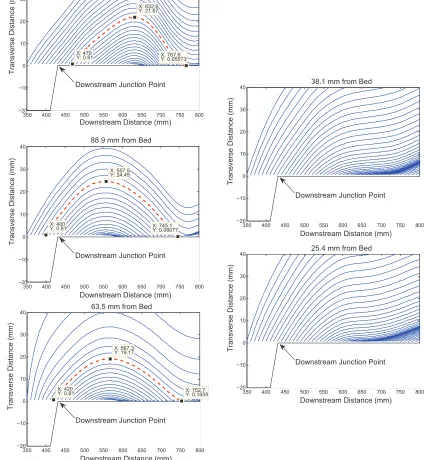
Figure 4.2 shows closer views of the streamlines presented in Figure 3.7. Very distinct
separation can be seen for the upper three elevations at which horizontal velocities
were measured. It is also clear from this figure that near the bed, flow does not
sep-arate from the downstream wall. To define coordinates of the streamline delineating
the separation zone, the farthest streamline downstream to reattach to the wall was
traced upstream to its point of origin. This data is summarized in Table 4.1 in which
x1 and x2 are the downstream coordinates of the streamline beginning and end,
re-spectively, and Ls and bs are the separation zone length and width, respectively. By
comparing the ability to define the separation zone by either the streamline or isoline
method, it was found that the streamline method performs better than the isoline
method when velocity data is available.
By applying Equations 2.1-2.4 to the current work, the predicted maximum width
and length of the separation zone are presented in Table 4.1. In both models,
sepa-ration zone width is over predicted and length is under predicted. The model of Best
and Reid (1984) matched modestly better than the analytical solution of Gurram,
Karki, and Hager (1997) indicating that although separation can occur in the case
of density currents, application of an analytical solution solved for subaerial flows is
inappropriate for application for submarine flows.
To apply the Gurram, Karki, and Hager (1997) solution, Fd/s was computed as:
Fd/s=
Qt
(g0b2 3H33)
1 2
(4.1)
where Qt is the total discharge, and H3 is the height of the density-ambient fluid
downstream of the junction, thus Fd/s = 0.428 for the present work.
Best and Reid (1984) also discussed separation zone shape index defined asbs/Ls
which linearly trends with discharge ratio. The shape index in the present work is
0.07 which is far from the expected value of 0.19 using the Best and Reid (1984)
water column where the main channel contribution rode atop the side channel inflow.
If discharge ratio decreases less rising is expected in the junction. This would lead to
lesser upward diffusion in the junction zone and a smaller separation zone. The result
would be that the size of the separation zone, like in river cases, directly correlates
to discharge ratio.
With limited data points, similar assessment to that of Qing-Yuan et al. (2009) on
the present work was made with results shown in Table 4.1. As in the work of
Qing-Yuan et al. (2009), separation zone length and width increased away from the bed,
and it is expected that the maximum separation zone dimensions occurred between
z = 88.9 and 63.5 mm., very near the depth averaged current height downstream of
the junction. Flow separation did not exist in the lower part of the current where
concentration and velocity were relatively high. In the upper more diffuse part of the
current, flow separation with depth trends similar to river confluences, although with
significantly smaller dimensions. As is the case with rivers, the largest flow separation
occurred away from frictional boundaries, which includes both the channel bed and
dense-ambient interface for density currents.
Maximum Velocity
By applying Equation 2.5 to the data of the present work, predicted velocity index
is 2.59, and predicted Umax = 152.6 mm/s. The observed maximum velocity from
measurement was found to be 157.1 mm/s, less than 3% relative error. To apply this
model, the layer averaged velocity in the main channel upstream of the junction was
used. This close match indicates that based on upstream velocity, relative discharge,
and junction angle, maximum velocity is predictable. However, in the case of rivers,
maximum velocity at this location occurs due to constriction of the effective area by
the presence of a flow separation zone. In the case of a density current, maximum
was observed near the bed where the maximum velocity occurs. It is postulated that
the high velocity measured near the bed in the physical experiments herein were due
to convection of vertical to horizontal momentum just downstream of the junction. As
discussed previously, in the junction zone, the main channel contribution rode atop
the side channel contribution converting horizontal momentum to vertical momentum.
After the confluence, dense fluid returned to its layer of natural buoyancy by plunging
towards the bed. To confirm this notion, vertical velocity data should be obtained
and analyzed for trends downstream of the junction zone.
Deviation Angle
Figure 4.3 shows the variation of deviation angle from the upstream to downstream
junction points normalized by the length of the junction line. The values presented
are averaged in depth over the five elevations measured as analyzed by Hsu, Lee, and
Chang (1998). In general, this is unlike the trend seen by Hsu, Lee, and Chang (1998)
who observed that deviation angle decreases for 90% of the distance from upstream
to downstream junction points before again increasing near the downstream junction
point. The cross-sectionally averaged deviation angle was computed as 35.5◦ which
also is far from the expected 24.5◦ as predicted by Hsu, Lee, and Chang (1998).
There is a clear trend in the variation of deviation angle with depth in the case
presented herein. Figure 4.4 shows average deviation angle with depth normalized
by the elevation of the ambient interface upstream of the junction. The
dense-ambient interface was determined visually by dying the inflow and measuring the
elevation of the dye near the junction (Figure 4.5). The trend shows that the deviation
angle near the bed will tend to the junction angle and will approach zero near the
elevation of the dense-ambient interface upstream of the junction. The fitted equation
δ=−θzˆ2+ ˆz+θ (4.2)
where ˆz is the elevation from the bed normalized by dense-ambient interface
ele-vation, and δ is the deviation angle relative to the downstream direction.
Backwater Effect
Two approaches were taken in this work to measure upstream and downstream depths
of density current flow. These included layer averaged current height as computed
using the moment method, and the other was done visually through photographic
capture of the current in the vicinity of the junction (Figure 4.5). Table 4.2 shows the
measured values of density current height upstream of the junction and the predicted
values by using the Gurram, Karki, and Hager (1997) and Hsu, Lee, and Chang (1998)
models. Note that both models perform well for either method of measurement.
However, the visual method outperforms the moment method by resulting in less
than 1% error for both models and does not require velocity profile measurement.
The advantage of the Hsu, Lee, and Chang (1998) model is the independence of
streamline deviation angle but only offers a family of curves for predicting backwater
effects. Gurram, Karki, and Hager (1997) however, offers a closed form equation
for computing backwater depths but requires trial and error or other convergence
methods.
4.2 Comparison to River Morphodynamics
The work of Best (1988) is used to evaluate the morphological character of river
junctions. The characteristics of avalanche faces, scouring depth, and scouring
orien-tation are assessed and compared to what has been observed in the density current
Avalanche Faces
As observed in the bed evolution photos, there was no scouring near the upstream
junction point, thus no avalanche faces as defined by Best (1988). However, if the
avalanche face is defined as the edge of scouring from the downstream junction point,
where scouring begins in the density current case, the extent of the avalanche face
into the downstream reach can be measured. Figure 4.6 shows how the location of the
avalanche face was measured to 307 mm. Note that the avalanche face was oriented
at approximately the same angle as the junction angle. By applying Equation 2.6
for the density current case, = 1.12, and the predicted avalanche face protrusion
is a = 341 mm. This shows that, with only 11% relative error from the observed to
predicted protrusion length, avalanche faces in density currents behave similarly to
that seen in rivers but with the origin of scouring being shifted from the upstream
junction point in the case of rivers to the downstream junction point in the case of
density currents.
Maximum Scour Depth
By applying Equation 2.7 to the conditions in the current work, ds = 2.02 and d =
267 mm. To compute ds, Yavg was taken to be the depth using the visual method
discussed previously. The observed scouring depth had an approximate maximum of
only 30 mm.
It is clear that the scouring in the density current case is significantly smaller than
that observed in river cases. The model of Best (1988) does not directly account for
physical parameters such as sediment characteristics and near-bed velocity. In the
case presented herein, synthetic particles were used with low specific gravity and grin
sizes in the fine sand range which cannot be accounted for in the Best (1988) model.
High shear stress acting on the bed is the mechanism that causes scouring and is
model. Best (1988) indirectly accounts for relative velocity in the junction zone
and upstream channels through the upstream depth of water. For river junctions,
relatively high acceleration is expected as twice the discharge, for Qr = 0.5, passes
through a smaller combined channel section. In the case of density currents, twice
the discharge passes the junction but is easily diffused to the ambient layer due to
very low effective gravity, effectively increasing the flow area of dense fluid. Thus,
the relative velocity in the junction zone and upstream channels behave differently in
the submarine and subareal cases.
Maximum Scour Orientation
Figure 4.7 shows the orientation of the line of maximum scour for the density
cur-rent case as 25◦ and the predicted value using Best’s model (Equation 2.8) as 20◦.
Note again that the origin of the line of maximum scour in the present case is the
downstream junction point rather than the upstream junction point.
In the density current case presented herein, β is slightly larger than one-half
of the junction angle, and the predicted orientation of maximum scour is slightly
smaller than one-half of the junction angle. This is an indication that the simple
linear model presented by Best (1988) fits reasonably well with the density current
case for maximum scour orientation. Coupled with the good performance of the Best
(1988) model for avalanche face (i.e., beginning of scouring) protrusion downstream,
the geometry of the scouring can be well predicted by Best (1988) although depths
Shear Plane
Separation Zone
Line of M aximum S
cour
Avalanche Face Avalanche F
ace
Shear Plane
Separation Zone
Line of M aximum S
cour
Avalanche F ace
RIVER CONFLUENCES DENSITY CURRENT CONFLUENCES
Figure 4.1 Typical characteristics of river channel confluences (left panel) and observed characteristics of density current confluences (right panel).
Table 4.1 Length and width of separation zone by elevation and predicted maximum dimensions.
Elevation (mm) x1 (mm) x2 (mm) Ls (mm) bs (mm)
114.3 470 767.6 297.6 21.67
88.9 400 745.1 345.1 24.45
63.5 420 752.7 332.7 19.17
38.1 - - -
-25.4 - - -
-Best & Reid - - 297.2 55.8
350 400 450 500 550 600 650 700 750 800 −20 −10 0 10 20 30 40 X: 470 Y: 0.81
Downstream Distance (mm)
Transverse Distance (mm)
114.3 mm from Bed
X: 767.6 Y: 0.05573
X: 632.6 Y: 21.67
Downstream Junction Point
350 400 450 500 550 600 650 700 750 800
−20 −10 0 10 20 30 40 X: 400 Y: 0.81
Downstream Distance (mm)
Transverse Distance (mm)
88.9 mm from Bed
X: 745.1
Y: 0.08077 X: 557.5
Y: 24.45
Downstream Junction Point
350 400 450 500 550 600 650 700 750 800
−20 −10 0 10 20 30 40 X: 420 Y: 0.81
Downstream Distance (mm)
Transverse Distance (mm)
63.5 mm from Bed
X: 752.7 Y: 0.1859
X: 567.3
Y: 19.17
Downstream Junction Point
350 400 450 500 550 600 650 700 750 800
−20 −10 0 10 20 30 40
Downstream Distance (mm)
Transverse Distance (mm)
38.1 mm from Bed
Downstream Junction Point
350 400 450 500 550 600 650 700 750 800
−20 −10 0 10 20 30 40
Downstream Distance (mm)
Transverse Distance (mm)
25.4 mm from Bed
Downstream Junction Point
0 10 20 30 40 50 60
0.0 0.2 0.4 0.6 0.8 1.0
St re am lin e An gl e De vi a ti on (D eg re es )
Normalized Distance Across Junction Line
Figure 4.3 Variation of streamline deviation angle from the upstream to downstream junction points.
0 5 10 15 20 25 30 35 40 45 50
0.0 0.1 0.2 0.3 0.4 0.5 0.6 0.7 0.8
De vi a ti on A ng le (d eg re es )
Normalized Distance From Bed
R2 = 0.987
Junction Line
Figure 4.5 Visual method for measuring current height downstream and upstream of the junction.
Table 4.2 Measured and predicted upstream depth due to backwater effect. Each method of current height measurement was separately analyzed, and the measured downstream depths were used to compute the predicted upstream depths. All dimensions are in mm,
Moment Method Height
Downstream Upstream
Measured 128.0 142.5
Gurram 128.0 151.0
Hsu 128.0 151.7
Visual Method Height
Downstream Upstream
Measured 132 157
Gurram 132 155.8
Hsu 132 156.4
a = 307 mm
Junction Line
θ= 45
β= 25
βB= 20o
o o
Junction Line
Chapter 5
Conclusions
The presented work includes results from physical experiments on the confluence of
two sustained density currents. Also assessed is the applicability of models proposed
for subaerial river confluences in terms of hydraulic and morphological characteristics.
This work offers a first look at the dynamics and bathymetric implications of such
flows. Major observations from the experiments include:
1. Primary velocity showed upward convection in the junction zone.
2. Upward convection of momentum in the junction resulted in reduction of
trans-port capacity at this location.
3. Moving away from the bed, the shear plane between contributing flows rotated
towards the main channel direction.
4. Flow separation near the downstream junction point was only observed in the
upper, diffuse part of the flow.
5. Maximum horizontal velocity coincided with deep scouring beginning at the
downstream junction point.
6. Maximum velocity was caused by re-plunging of the main channel inflow.
7. The streamline method for defining flow separation performed better than the
Assessment of characteristics of the case tested herein revealed similarities to
ter-restrial river junctions in terms of predicting maximum velocity, backwater effect,
avalanche face protrusion, and maximum scour orientation. However, poor
correla-tion between density current and river confluences exists in terms of separacorrela-tion zone
dimensions, streamline deviation angle, and maximum scour depths. Notable details
of this assessment include:
1. The models of Best and Reid (1984) and Gurram, Karki, and Hager (1997) both
over predict separation zone width and under predict separation zone length.
2. Away from frictional boundaries, the separation zone is largest, similar to river
confluences.
3. Maximum velocity adjacent to the separation zone is predictable by the model
of Best and Reid (1984) but the mechanism of acceleration is conversion of
vertical to horizontal momentum rather than flow constriction.
4. Streamline deviation angle across the junction line does not behave similar to
river confluences.
5. A simple polynomial function is presented describing the variation of deviation
angle with depth based only on junction angle.
6. The backwater effect of density current confluences is predictable by both
Gur-ram, Karki, and Hager (1997) and Hsu, Lee, and Chang (1998) analytical
solu-tions.
7. The visual method for determining current thickness performed better than the
moment method for ease of application and good matching with river backwater
8. Avalanche face protrusion in rivers and density currents match well with the
important distinction that the protrusion in the present case begins at the
downstream junction point.
9. Maximum depth of scouring is an order of magnitude smaller in the present
case versus that predicted by Best (1988).
10. The orientation of the maximum scour approximately bisects the junction angle
Bibliography
Benjamin, T. B. (1968). “Gravity currents and related phenomena”. In: Journal of
Fluid Mechanics31.02, p. 209.issn: 1469-7645.doi:10.1017/s0022112068000133.
url: http://dx.doi.org/10.1017/S0022112068000133.
Best, J. L. (1988). “Sediment transport and bed morphology at river channel con-fluences”. In: Sedimentology 35.3, pp. 481–498. issn: 1365-3091. doi: 10.1111/
j.1365- 3091.1988.tb00999.x. url:
http://dx.doi.org/10.1111/j.1365-3091.1988.tb00999.x.
Best, J. L. and I. Reid (1984). “Separation Zone at Open Channel Junctions”. In:
J. Hydraul. Eng. 110.11, pp. 1588–1594. issn: 1943-7900. doi: 10.1061/(asce)
0733- 9429(1984)110:11(1588). url: http://dx.doi.org/10.1061/(ASCE)
0733-9429(1984)110:11(1588).
Canals, M., R. Urgeles, and A. M. Calafat (2000). “Deep sea-floor evidence of past ice streams off the Antarctic Peninsula”. In: Geology 28.1, p. 31. issn: 0091-7613.
doi: 10 . 1130 / 0091 - 7613(2000 ) 028<0031 : dseopi > 2 . 0 . co ; 2. url: http :
//dx.doi.org/10.1130/0091-7613(2000)028<0031:DSEOPI>2.0.CO;2.
Clark, J. and K. Pickering (1996). “Architectural elements and growth patterns of submarine channels: applications to hydrocarbon exploration”. In:AAPG Bulletin
80, pp. 194–221.
Dalla Valle, G. and F. Gamberi (2011). “Slope channel formation, evolution and back-filling in a wide shelf, passive continental margin (Northeastern Sardinia slope, Central Tyrrhenian Sea)”. In: Marine Geology 286.1-4, pp. 95–105. issn: 0025-3227. doi: 10.1016/j.margeo.2011.06.005. url: http://dx.doi.org/10.
1016/j.margeo.2011.06.005.
Deptuck, M. E. et al. (2007). “Migration-aggradation history and 3-D seismic geomor-phology of submarine channels in the Pleistocene Benin-major Canyon, western Niger Delta slope”. In: Marine and Petroleum Geology 24.6-9, pp. 406–433. issn: 0264-8172. doi: 10.1016/j.marpetgeo.2007.01.005. url: http://dx.doi.
Ezz, H., A. Cantelli, and J. Imran (2013). “Experimental modeling of depositional turbidity currents in a sinuous submarine channel”. In:Sedimentary Geology 290, pp. 175–187. issn: 0037-0738. doi: 10 . 1016 / j . sedgeo . 2013 . 03 . 017. url:
http://dx.doi.org/10.1016/j.sedgeo.2013.03.017.
Ezz, H. and J. Imran (2014). “Curvature-induced secondary flow in submarine chan-nels”. In: Environ Fluid Mech 14.2, pp. 343–370. issn: 1573-1510. doi:10.1007/
s10652-014-9345-4. url: http://dx.doi.org/10.1007/s10652-014-9345-4.
Gamboa, D., T. M. Alves, and J. Cartwright (2012). “A submarine channel conflu-ence classification for topographically confined slopes”. In:Marine and Petroleum
Geology 35.1, pp. 176–189. issn: 0264-8172. doi: 10.1016/j.marpetgeo.2012.
02.011.url: http://dx.doi.org/10.1016/j.marpetgeo.2012.02.011.
Garcia, M. and G. Parker (1993). “Experiments on the entrainment of sediment into suspension by a dense bottom current”. In:Journal of Geophysical Research98.C3, p. 4793. issn: 0148-0227. doi: 10.1029/92jc02404. url: http://dx.doi.org/
10.1029/92JC02404.
Greene, H., N. Maher, and C. Paull (2002). “Physiography of the Monterey Bay Na-tional Marine Sanctuary and implications about continental margin development”.
In: Marine Geology 181.1-3, pp. 55–82. issn: 0025-3227. doi:
10.1016/s0025-3227(01)00261-4. url:
http://dx.doi.org/10.1016/S0025-3227(01)00261-4.
Gurram, S. K., K. S. Karki, and W. H. Hager (1997). “Subcritical Junction Flow”. In:
J. Hydraul. Eng.123.5, pp. 447–455.issn: 1943-7900.doi:
10.1061/(asce)0733-9429(1997 ) 123 : 5(447). url: http : / / dx . doi . org / 10 . 1061 / (ASCE ) 0733
-9429(1997)123:5(447).
Hay, A. E. (1987). “Turbidity currents and submarine channel formation in Rupert Inlet, British Columbia: 1. Surge observations”. In: Journal of Geophysical
Re-search 92.C3, p. 2875. issn: 0148-0227. doi: 10 . 1029 / jc092ic03p02875. url:
http://dx.doi.org/10.1029/JC092iC03p02875.
Hesse, R. (1989). “Drainage systems associated with mid-ocean channels and sub-marine yazoos: Alternative to subsub-marine fan depositional systems”. In: Geology
17.12, p. 1148. issn: 0091-7613. doi: 10 . 1130 / 0091 - 7613(1989 ) 017<1148 :
dsawmo > 2 . 3 . co ; 2. url: http : / / dx . doi . org / 10 . 1130 / 0091 - 7613(1989 )
017<1148:DSAWMO>2.3.CO;2.
Hsu, C.-C., W.-J. Lee, and C.-H. Chang (1998). “Subcritical Open-Channel Junction Flow”. In: J. Hydraul. Eng. 124.8, pp. 847–855. issn: 1943-7900. doi: 10.1061/
(asce ) 0733 - 9429(1998 ) 124 : 8(847). url: http : / / dx . doi . org / 10 . 1061 /
Hsu, C.-C., F.-S. Wu, and W.-J. Lee (1998). “Flow at 90 Equal-Width Open-Channel Junction”. In: J. Hydraul. Eng. 124.2, pp. 186–191. issn: 1943-7900. doi: 10 .
1061 / (asce ) 0733 - 9429(1998 ) 124 : 2(186). url: http : / / dx . doi . org / 10 .
1061/(ASCE)0733-9429(1998)124:2(186).
Huang, H., J. Imran, and C. Pirmez (2008). “Numerical Study of Turbidity Currents with Sudden-Release and Sustained-Inflow Mechanisms”. In: J. Hydraul. Eng.
134.9, pp. 1199–1209. issn: 1943-7900. doi: 10.1061/(asce)0733- 9429(2008)
134:9(1199). url: http://dx.doi.org/10.1061/(ASCE)0733- 9429(2008)
134:9(1199).
— (2012). “The depositional characteristics of turbidity currents in submarine sin-uous channels”. In: Marine Geology 329-331, pp. 93–102. issn: 0025-3227. doi:
10 . 1016 / j . margeo . 2012 . 08 . 003. url: http : / / dx . doi . org / 10 . 1016 / j .
margeo.2012.08.003.
Imran, J., G. Parker, and N. Katopodes (1998). “A numerical model of channel in-ception on submarine fans”. In:Journal of Geophysical Research 103.C1, p. 1219. issn: 0148-0227. doi: 10.1029/97jc01721. url: http://dx.doi.org/10.1029/
97JC01721.
Islam, M. A. and J. Imran (2008). “Experimental modeling of gravity underflow in a sinuous submerged channel”. In: Journal of Geophysical Research 113.C7.issn: 0148-0227. doi: 10.1029/2007jc004292. url: http://dx.doi.org/10.1029/
2007JC004292.
Janocko, M. et al. (2013). “Turbidity current hydraulics and sediment deposition in erodible sinuous channels: Laboratory experiments and numerical simulations”.
In: Marine and Petroleum Geology 41, pp. 222–249. issn: 0264-8172. doi: 10 .
1016 / j . marpetgeo . 2012 . 08 . 012. url: http : / / dx . doi . org / 10 . 1016 / j .
marpetgeo.2012.08.012.
Keeulegan, G. (1949). “Interfacial instability and mixing in stratified flows”. In: J.
Res US Bur Stand 43, pp. 487–500.
Kesserwani, G. et al. (2008). “Simulation of subcritical flow at open-channel junction”.
In: Advances in Water Resources 31.2, pp. 287–297. issn: 0309-1708. doi: 10 .
1016 / j . advwatres . 2007 . 08 . 007. url: http : / / dx . doi . org / 10 . 1016 / j .
advwatres.2007.08.007.
Khripounoff, A. et al. (2003). “Direct observation of intense turbidity current activity in the Zaire submarine valley at 4000 m water depth”. In: Marine Geology 194.3-4, pp. 151–158. issn: 0025-3227. doi: 10.1016/s0025- 3227(02)00677- 1. url:
Klaucke, I., R. Hesse, and W. B. F. Ryan (1998). “Morphology and structure of a distal submarine trunk channel: The northwest Atlantic Mid-Ocean Channel between lat 53 degrees N and 44 degrees 30 ’ N”. In: Geological Society of America Bulletin
110, pp. 22–34.
Kneller, B. and C. Buckee (2000). “The structure and fluid mechanics of turbidity currents: a review of some recent studies and their geological implications”. In:
Sedimentology 47, pp. 62–94. issn: 0037-0746. doi: 10 . 1046 / j . 1365 - 3091 .
2000.047s1062.x. url: http://dx.doi.org/10.1046/j.1365- 3091.2000.
047s1062.x.
Kneller, B. C., S. J. Bennett, and W. D. McCaffrey (1999). “Velocity structure, tur-bulence and fluid stresses in experimental gravity currents”. In: Journal of
Geo-physical Research 104.C3, p. 5381.issn: 0148-0227.doi:10.1029/1998jc900077.
url: http://dx.doi.org/10.1029/1998JC900077.
Kolla, V., H. Posamentier, and L. Wood (2007). “Deep-water and fluvial sinuous channels–Characteristics, similarities and dissimilarities, and modes of formation”.
In: Marine and Petroleum Geology 24.6-9, pp. 388–405. issn: 0264-8172. doi:
10.1016/j.marpetgeo.2007.01.007. url: http://dx.doi.org/10.1016/j.
marpetgeo.2007.01.007.
L’Heureux, J.-S., L. Hansen, and O. Longva (2009). “Development of the submarine channel in front of the Nidelva River, Trondheimsfjorden, Norway”. In: Marine
Geology 260.1-4, pp. 30–44. issn: 0025-3227. doi: 10.1016/j.margeo.2009.01.
005. url:http://dx.doi.org/10.1016/j.margeo.2009.01.005.
Lin, J. D. and H. K. Soong (1979). “Junction losses in open channel flows”. In:Water
Resour. Res.15.2, pp. 414–418.issn: 0043-1397.doi:10.1029/wr015i002p00414.
url: http://dx.doi.org/10.1029/WR015i002p00414.
Mitchell, N. C. (2004). “Form of submarine erosion from confluences in Atlantic USA continental slope Canyons”. In: American Journal of Science 304.7, pp. 590–611. issn: 0002-9599. doi: 10.2475/ajs.304.7.590. url: http://dx.doi.org/10.
2475/ajs.304.7.590.
Normark, W. R. (1989). “Observed Parameters for Turbidity-Current Flow in Chan-nels, Reserve Fan, Lake Superior”. In: SEPM JSR Vol. 59.issn: 1527-1404. doi:
10.1306/212f8fb2-2b24-11d7-8648000102c1865d. url: http://dx.doi.org/
10.1306/212F8FB2-2B24-11D7-8648000102C1865D.
Paquet, F. et al. (2010). “Buried fluvial incisions as a record of Middle-Late Miocene eustasy fall on the Armorican Shelf (Bay of Biscay, France)”. In: Marine Geology
268.1-4, pp. 137–151. issn: 0025-3227. doi: 10.1016/j.margeo.2009.11.002.