Entropy Contribution to the Line Tension: Insights from
Polymer Physics, Water String Theory and the Three-Phase
Tension
Edward BormashenkoAriel University, Engineering Faculty, Chemical Engineering, Biotechnology
and Materials Department, P.O.B. 3, 407000, Ariel, Israel
Abstract
The notion of the three-phase (line) tension remains one of the most disputable notions in the surface science. A very broad range of its values has been reported. Experts even do not agree on the sign of the line tension. The polymer-chain-like model of the three-phase (triple) line enables the rough estimation of the entropic
input into the value of the line tension, estimated as , where
is the diameter of the liquid molecule. The introducing of the polymer-chain-like model of the triple line is justified by the “water string” model of the liquid state,
predicting strong orientation effects for liquid molecules located in the vicinity of hydrophobic moieties. The estimated value of the entropic input into the line tension is close to experimental findings, reported by various groups.
Keywords: line tension; entropic contribution; entropic force; orientation
effect; hydrophobic substrate.
1. Introduction
Surface tension is due to the special energy state of the molecules at a solid or liquid surface [1-4]. Molecules located at the triple (three-phase) line where solid, liquid, and gaseous phases meet are also in an unusual energy state [1-4]. The notion of line (three-phase) tension has been introduced by Gibbs. Gibbs stated: "These (triple) lines might be treated in a manner entirely analogous to that in which we have treated surfaces of discontinuity. We might recognize linear densities of energy, of entropy, and of several substances which occur about the line, also a certain linear tension" [5]. Consider, that Gibbs emphasized the role of the entropy density, which will play the main role in our approach to the problem of line tension.
In spite of the fact that the concept of line tension is intuitively clear, it remains one of the most obscure and disputable notions of the surface science [6-8]. Researchers disagree not only on the value of the line tension but even on its sign.
Experimental values of a line tension in the range of N were reported [6-11]. Very few methods allowing experimental measurement of line tension were developed [9-14]. A. Marmur estimated a line tension as
Y SA
m
d cot
4
, where dm is the molecular dimension, SA, are surface
energies of solid and liquid correspondingly, and θY is the Young angle. Marmur concluded that the magnitude of the line tension is less than 5·10-9 N, and that it is positive for acute and negative for obtuse Young angles [15-16]. However, researchers reported negative values of the line tension for hydrophilic surfaces [14].
As to the magnitude of the line tension the values in the range 109 1012N look
realistic. Large values of reported in the literature are most likely due to contaminations of the solid surfaces [3].
Let us estimate the characteristic length scale l at which the effect of line tension becomes important by equating surface and "line" energies:
. nm 100 1 /
l It is clear that the effects related to line tension can be
important for nano-scaled droplets or for nano-scaled rough surfaces. However, these effects also may be important for design of microfluidics circuits [6] and stabilization of the Cassie air-trapping wetting regime, enabling manufacturing of superhydrophobic and superoleophobic surfaces [17]. The notion of the line tension remains highly controversial at least due to the conceptual difficulties, which arise because the interfaces between two phases are always diffuse and never sharp [18]. In the present article we try to estimate the role of the entropy contributions in constituting the line (three-phase) tension.
2. “Water String Theory”, Insights from Polymer Physics and Entropy
Contribution into the Line Tension.
It should be mentioned that calculation of the line tension from the first principles by MD and DFT simulations is not a trivial task [19-20]. Nosonovsky in his
three-phase tension at the solid/liquid/vapor boundary appears. The line tension is also inherent for so-called liquid lens, but it seems to be more studied and less controversial [12, 18].
Let us start from the unobvious assumption that the line tension may be split into “interactional” (denoted ) and entropy-inspired (denoted ) contributions:
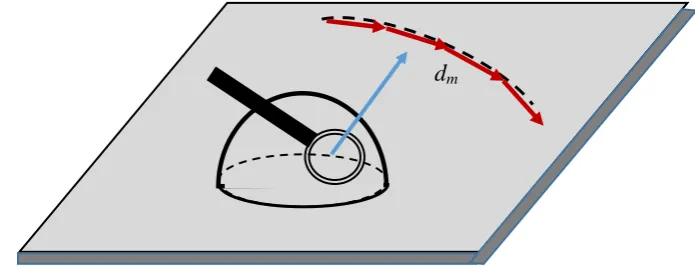
, (1) where is due to the interaction of molecules located at the triple line with surrounding ones, and is the entropy input into the three-phase tension. In order to estimate , assume that molecules constituting the triple line form the quasi-polymer chain, as depicted in Figure 1. This idea is inspired by the “water-string theory” presented and discussed in Refs. 22-24. X-ray absorption spectroscopy and x-ray Raman scattering demonstrated that water, consists of structures with two strong H-bonds, one donating and one accepting, thus promoting formation of chain-like
structures [22-24]. There is much theoretical and experimental evidence that water molecules are strongly oriented in the vicinity of hydrophobic moieties [25-27], and this is the case in our treatment (recall, that we restricted our consideration by sessile
droplets, placed on hydrophobic surfaces). The authors of ref. 27 exploited the intensity vibrational sum-frequency generation (VSFG) technique pointing to an enhanced ordering of the water molecules surrounding the hydrophobic groups; in particular, the orientation was demonstrated for water molecules at the water/polydimethylsiloxane interfaces, thus justifying the chain-like model of the triple line, shown in Figure 1.
The use of polymer-chain model for the approximation of the triple enables the immediate estimation of the entropy contribution into the line tension, according to Eq. 2.
, (2)
where is the entropy force necessary for stretching the pseudo-polymer-chain built of liquid molecules, coinciding with the entropy input to the line tension,
experimentally reported values reported in Refs. [6-7, 9-11, 19]. Thus, the input of entropy factors may be at least not negligible in constituting the value of three-phase tension.
The value of given by Eq. 2 supplies the upper estimation for the entropic contribution to the line tension, due to the fact that it is based on the “ideal chain approximation”, where the monomers do not interact [28]. For real chains, the
interaction between monomers is not negligible and the estimation of the stretching force is supplied by Eq. 3:
, (3)
where is the correlation length [28]. It is noteworthy, that the impact of the entropic term into the line tension is necessarily positive (the sign of the line tension remains debatable [6, 7, 11, 5]). It is also recognized that the value of remains considerable for (values of have been reported [9]. This means that the entropic input into the line tension may be important even when the interaction between molecules forming the three-phase line is considered. Equation 2 also predicts the decrease of the line tension with growth of a size of a liquid molecule dm. Regrettably, the experimental data in the field are scarce, and do not enable clear conclusion on this item.
The rough estimation of the three-phase tension, given be Eqs. 2-3 is obvious from the dimensional considerations and it appears explicitly already in Ref. 29. The new aspect strengthened in the presented paper is identification of Eq. 2 with the entropic contribution to the entire line tension seen as a sum of “interaction-” and “entropy”-inspired inputs. As any other “entropic force”, the value of increases with temperature [21, 28]. The experimental observations evidence the opposite temperature trend: both surface and line tensions are decreased with temperature [4,
21, 10]. This means that the “interaction” part of the line tension in the studied systems prevails on the “entropic” one. However, the input of entropy-inspired factors
into the three-phase tension may be not negligible.
Conclusions
phase tension. For the estimation of the entropic input into the line tension the three-phase line is approximated by a polymer chain. This approximation is approximated by novel experimental data indicating strong orientation effects for liquid molecules located in the vicinity of hydrophobic moieties [22-27]. Thus, the polymer-chain model may be successful for sessile droplets placed on hydrophobic (say polymer) solid substrates. If the polymer-chain-model is adopted for the triple (three-phase) line
the entropic contribution to the line tension is crudely estimated as , where
is the correlation length [28]. If the triple line is seen as an ideal polymer chain, the
entropic input is estimated as , where is the diameter of the liquid molecule, representing the characteristic dimension of the “monomer” of the “polymer chain”. Simple estimations supply for the entropic input into the line tension
the value of , which is comparable with the reported experimental data [6,7, 9, 10]. We conclude that the entropic contribution into the line tension is not negligible.
References
1. Adamson, A. W., Gast, A. P. Physical Chemistry of Surfaces, 6th edn., Wiley
Interscience Publishers, New York, 1990.
2. Erbil, H. Y. Surface Chemistry of Solid and Liquid Interfaces, Blackwell,
Oxford, 2006.
3. De Gennes, P.G.; Brochard-Wyart, F.; Quéré, D. Capillarity and Wetting Phenomena: Drops Bubbles, Pearls, Waves; Springer: New York, NY, USA, 2004. 4. Bormashenko, Ed. Wetting of Real Surfaces, de Gruyter, Berlin, Germany, 2011.
5. Gibbs, J. W. The Scientific Papers of J. W. Gibbs, vol. 1; p. 288. Dover, New York, US, 1961.
6. Amirfazli, A. Neumann, A. W. Status of the Three-Phase Line Tension. Adv. Colloid & Interface Sci. 2004, 110, 121–141.
7. Drelich, J. The Significance and Magnitude of the Line Tension in Three-Phase (Solid-Liquid-Fluid) Systems. Colloids & Surfaces A1996, 116, 43-54.
9. Zhelev, D. V., Needham, D. Tension-stabilized Pores in Giant Vesicles: Determination of Pore Size and Pore Line Tension. Biochimica et Biophysica Acta 1993, 1147, 89-104.
10. De Feijter, J. A., Vrij, I. Transition Regions, Line tensions and Contact Angles in Soap Films. J. Electroanalytical Chem. & Interfacial Electrochem. 1972, 37 (1), 9-22.
11. Law, B. M., McBride S. P., Wang, J. Y. et al. Line Tension and its Influence on Droplets and Particles at Surfaces. Progress Surface Sci. 2017, 92 (1), 1-39.
12. Alexandrov, A. D., Toshev, B, V., Scheludko, A. D. Nucleation from Supersaturated Water Vapors on n-Hexadecane: Temperature Dependence of Critical Supersaturation and Line Tension. Langmuir1991, 7, 3211-3215.
13. Checco, A., Guenoun, P. Nonlinear Dependence of the Contact Angle of Nanodroplets on Contact Line Curvature. Phys. Rev. Lett. 2003, 91(18), 186101. 14. Pompe, T., Fery, A., Herminghaus, S. Measurement of Contact Line Tension by Analysis of the Three-Phase Boundary with Nanometer Resolution, in: J. Drelich, J. S. Laskowski, and K. L. Mittal (eds.) Apparent and Microscopic Contact Angles, pp. 3–12, VSP, Utrecht, 2000.
15. Marmur, A. Line Tension and the Intrinsic Contact Angle in Solid-Liquid-Fluid Systems. J. Colloid & Interface Sci. 1997, 186, 462–466.
16. Marmur, A. Line Tension Effect on Contact Angles: Axisymmetric and Cylindrical Systems with Rough or Heterogeneous Solid surfaces. Colloids & Surf. A 1998, 136, 81–88.
17. Bormashenko, Ed, Whyman, G. On the Role of the Line Tension in the Stability of Cassie Wetting. Langmuir, 2013, 29 (18), 5515–5519.
18. Schimmele, L., Napiórkowski, M., Dietrich, S. Conceptual Aspects of Line Tensions. J. Chem. Physics2007, 127, 164715.
19. Weijs, J. H., Marchand, A., Andreotti, B., Lohse, D., Snoeije, J. H. Origin of Line Tension for a Lennard-Jones Nanodroplet. Phys. Fluids2011, 23, 022001.
20. Khalkhali, M., Kazemi, N., Zhang, H., Liu, Q. Wetting at the Nanoscale: A Molecular Dynamics Study. J. Chem. Physics2017, 146, 114704.
23. Head-Gordon, T. Johnson, M. E. Tetrahedral Structure or Chains for Liquid Water. PNAS2006, 103 (21) 7973-7977.
24. Ball, Ph. Water: Water - an Enduring Mystery. Nature2008, 452, 291–292. 25. Scatena, L. F., Brown, M. G., Richmond, G. L. Water at Hydrophobic Surfaces: Weak Hydrogen Bonding and Strong Orientation Effects. Science 2001, 292
(5518) 908-912.
26. Strazdaite, S., Versluis, J., Backus, E. H. G. Bakker, H. J. Enhanced Ordering of Water at Hydrophobic Surfaces. J. Chem. Physics 2014, 140, 054711.
27. Strazdaite, S. Versluis, J., Bakker, H. J. Water Orientation at Hydrophobic Interfaces. J. Chem. Physics2015, 143, 084708.
28. Rubinstein, M., Colby, R. H. Polymer Physics, Oxford University Press, Oxford, UK, 2003.
29. Rowlinson, J. S., Widom, B. Molecular Theory of Capillarity, Clarendon, Oxford (1982).
30. Wang, J. Y., Betelu, S., Law, B. M. Line Tension Approaching a First-Order Wetting Transition: Experimental Results from Contact Angle Measurements, Phys. Rev. E2001, 63, 031601.
31. Tadmor, R. Line Energy and the Relation between Advancing, Receding, and Young Contact Angles. Langmuir2004, 20 (18), 7659-7664.
32. Tadmor, R. Line Energy, Line Tension and Drop Size. Surf. Sci. 2008, 602
Figure 1. Three-phase line of the sessile droplet is approximated by the polymer chain with a diameter of the monomer dm, where dmis the diameter of the liquid
molecule.