ISSN: 2319-8753
I
nternational
J
ournal of
I
nnovative
R
esearch in
S
cience,
E
ngineering and
T
echnology
(An ISO 3297: 2007 Certified Organization)
Vol. 2, Issue 10, October 2013
Determination of Optimum Influential
Parameters in Turning of Al6061 Using Fuzzy
Logic
P. Venkata Ramaiah
1, N. Rajesh
2, K. Dharma Reddy
3Assoc. Professor, Dept. of Mechanical Engineering, S. V. U. College of Engineering, Tirupati, India1 Asst. Professor, Dept. of Mechanical Engineering, S. V. College of Engineering, Tirupati, India2. Asst. Professor, Dept. of Mechanical Engineering, S. V. U. College of Engineering, Tirupati, India3
Abstract: In this paper an attempt is made to obtain optimum turning parameters for minimum cutting forces and cutting temperature by using Fuzzy Logic. In this work, turning is performed on Al 6061 work material under dry conditions with CNMG cutting tool according to Taguchi experimental design. The Experimental responses like cutting temperature and cutting force are measured for different influential parameter combinations. The Experimental data is analyzed using Fuzzy Logic and optimum parameters combination is determined. The optimum parameters combination is tested by confirmation experiment and the result is satisfactory.
Keywords: Turning operation, Al6061, Taguchi technique, Fuzzy Logic
I. INTRODUCTION
The challenge of modern machining industries is mainly focused on the achievement of high quality in terms of work piece dimensional accuracy, surface finish, high production rate, less wear on the cutting tools, economy in machining.
Cutting forces and cutting temperatures play major role in evaluate the cutting performance in turning operation. Cutting forces are necessary for evaluation of power machining. They are also used for design of machine tool components and the tool body. Cutting forces in Fig:1 influences the deformation of the work piece machined, its dimensional accuracy, machine stability and chip formation.
ISSN: 2319-8753
I
nternational
J
ournal of
I
nnovative
R
esearch in
S
cience,
E
ngineering and
T
echnology
(An ISO 3297: 2007 Certified Organization)
Vol. 2, Issue 10, October 2013
Copyright to IJIRSET www.ijirset.com 5556 Fig. 1 Cutting forces in orthogonal cutting
II. LITERATURE REVIEW
Kamble P.D., et. al [1] made an attempt to review the literature on optimizing the machining parameters in turning processes. Abhang L.B, et.al [2] studied about the temperature generated on the cutting tool and experimental methods for the measurement of teperatures and are reviewed. Hari Singh and Pradeep Kumar [3] obtained an optimal setting of turning process parameters (cutting speed, feed rate and depth of cut) for optimal value of the feed force when machining EN24 steel with TiC-coated tungsten-carbide inserts. The effects of the selected turning process parameters on feed force and the subsequent optimal settings of the parameters have been accomplished
using Taguchi’s parameter design approach. Miroslav and Radovanovic [4] had studied the measured values of cutting force components, signal-to-noise ratios, and analysis of variance are employed in order to study the cutting force. Based on the analysis, the optimal cutting parameter settings were determined. Vijaya Kumar G., et. al [5] had focused on the development of an Aluminium Metal Matrix composite (AMMC) which posses good mechanical properties to meet the functional requirements as the materials of machine elements. The properties (responses) like density, tensile strength, impact strength, and hardness are determined for the samples. These responses are studied and analyzed using fuzzy logic and the optimum combination of influential factors are identified. Vijaya Kumar G., et. al [6] had developed and an Hybrid approach by combining Taguchi Method, Grey Relational Analysis method and Fuzzy Logic, to reap their advantages in the drilling process. Abburi N. R., et.al [7] had developed a knowledge based system for the prediction of surface roughness for given process variables as well as for the prediction of process variables for a given surface roughness in turning. N. Rajesh, et. al [9] used Taguchi Method to identify the optimal combination of influential factors in the milling process Venkata Ramaiah P.,et. al [10] had used Taguchi method for designing the experiment and fuzzy logic for identifying the optimal combination of influential factors in the milling process. Yih-fong Tzeng., et.al. [11] had described the application of the fuzzy logic analysis coupled with Taguchi methods to optimize the precision and accuracy of the high-speed Electrical Discharge Machining (EDM) process. Rajasekaran T., et.al [12] had examined the influence of machining parameters combination
so as to obtain a good surface finish in turning of CFRP composite by Cubic Boron Nitride (CBN) cutting tool and to predict the surface roughness values using fuzzy modeling.
The aim of this experimental investigation is to study the effects of cutting parameters on Al6061 work piece and to find the optimal cutting parameters by employing Taguchi method and Fuzzy Logic.
Fig. 2(a) Turning operation (b) Lathe tool dynamometer (c) Temp. Measurement gun
III. EXPERIMENTAL DESIGN AND TURNING OPERATION
In this experiment three influential parameters are chosen which have more influence on cutting force and cutting temperature and each parameter is set at four levels. The parameters and its levels are shown in Table 1. For
Fx - Radial force
Fy - Feed force
ISSN: 2319-8753
I
nternational
J
ournal of
I
nnovative
R
esearch in
S
cience,
E
ngineering and
T
echnology
(An ISO 3297: 2007 Certified Organization)
Vol. 2, Issue 10, October 2013
full factorial design, the experimental runs required are (levels)(factors) equal to 43 = 64. Hence, fractional factorial design is considered, ie.43-1 = 16 runs by keeping in mind the experimental cost. Therefore Taguchi experimental design L16 is chosen for conducting experiments (Table - 2).
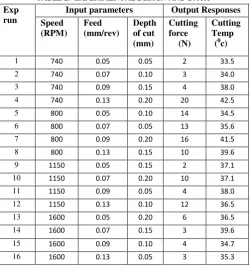
Turning tests have been performed on Al6061 work material by using Engine lathe with CNMG insert for different values of speed, feed and depth of cut combinations. In this paper, cutting temperature and cutting forces are selected as indices to evaluate turning performance, hence these are considered as response characteristics. The responses cutting temperature and cutting forces should be low in any cutting process for better cutting performance (lower the better). Experiments are done according to this design and the cutting temperature and cutting forces are measured using temperature gun and Lathe Tool dynamometer respectively (Table - 2) for each experimental run.
TABLE 1: PROCESS PARAMETERS AND THEIR LEVELS
TABLE 2: EXPERIMENTAL DESIGN AND DATA Exp
run
Input parameters Output Responses
Speed (RPM)
Feed (mm/rev)
Depth of cut (mm)
Cutting force
(N)
Cutting Temp
(0c)
1 740 0.05 0.05 2 33.5
2 740 0.07 0.10 3 34.0
3 740 0.09 0.15 4 38.0
4 740 0.13 0.20 20 42.5
5 800 0.05 0.10 14 34.5
6 800 0.07 0.05 13 35.6
7 800 0.09 0.20 16 41.5
8 800 0.13 0.15 10 39.6
9 1150 0.05 0.15 2 37.1
10 1150 0.07 0.20 10 37.1
11 1150 0.09 0.05 4 38.0
12 1150 0.13 0.10 12 36.5
13 1600 0.05 0.20 6 36.5
14 1600 0.07 0.15 3 39.6
15 1600 0.09 0.10 4 34.7
16 1600 0.13 0.05 3 35.3
V. ANALYSIS OF DATA USING FUZZY LOGIC
Fuzzy Logic involves a fuzzy interference engine and a fuzzification -defuzzification module. Fuzzification expresses the input variables in the form of fuzzy membership values based on various membership functions. Governing rules in linguistic form, for example if cutting force is high and depth of cut is high, then temperature is high, are formulated on the basis of experimental observations. Based on each rule, inference can be drawn on output grade and membership value. Inferences obtained from various rules are combined to arrive at a final decision. The membership values thus obtained are defuzzified using various techniques to obtain true value as discussed in the following.
4.1 Determination of overall fuzzy grade Parameters Design
Process Parameters
Level-1 Level -2 Level-3 Level -4
Speed (RPM) 740 800 1150 1600
Feed (mm / rev) 0.05 0.07 0.09 0.13
ISSN: 2319-8753
I
nternational
J
ournal of
I
nnovative
R
esearch in
S
cience,
E
ngineering and
T
echnology
(An ISO 3297: 2007 Certified Organization)
Vol. 2, Issue 10, October 2013
Copyright to IJIRSET www.ijirset.com 5558
A fuzzy logic unit comprises a fuzzifier, membership functions, a fuzzy rule base, an inference engine and a defuzzifier. In the fuzzy logic analysis, the fuzzifier uses membership functions to fuzzify the given input parameters first. Next, the inference engine performs a fuzzy reasoning on fuzzy rules to generate a fuzzy value. Finally, the defuzzifier converts the fuzzy value into a fuzzy grade. The structure built for this study is a two input- one-output fuzzy logic unit as shown in Fig. 3. The function of the fuzzifier is to convert outside crisp sets of input data into proper linguistic fuzzy sets of information.
Fig. 3 Two input and one out output fuzzy logic unit
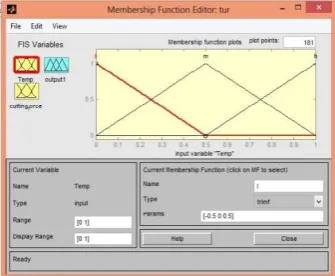
The input variables of the fuzzy logic system in this study are tool tip temperature and cutting forces . They are converted into linguistic fuzzy subsets using membership functions of a triangle form, as shown in Fig. 4, and are uniformly assigned into three fuzzy subsets—small (S), medium (M), and large (L) grade. The fuzzy rule base consists of a group of if-then control rules to express the inference relationship between input and output. A typical linguistic fuzzy rule called Mamdani is described as
Fig. 4 Input parameters for fuzzy
Rule 1: if x1 is A1, x2 is B1 then y is E1 else
Rule 2: if x1 is A2 , x2 is B2 ,then y is E2 else
……… ……….
Rule n: if x1 is An , x2 is Bn ,then y is En else
In above Ai, Bi are fuzzy subsets defined by the Corresponding membership functions i.e., α/4Ai, α /4Bi. The
ISSN: 2319-8753
I
nternational
J
ournal of
I
nnovative
R
esearch in
S
cience,
E
ngineering and
T
echnology
(An ISO 3297: 2007 Certified Organization)
Vol. 2, Issue 10, October 2013
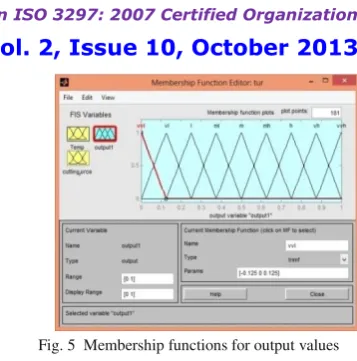
Fig. 5 Membership functions for output values
Unlike the input variables, the output variable is assigned into relatively nine subsets i.e., very very low (VVL), very low (VL), small(S)medium low(ML),medium (M), medium high(MH) high(H), very high (VH), very very high(VVH) Then, considering the conformity of four performance characteristics for input variables, 9 fuzzy rules are defined and listed in Table - 3. The fuzzy inference engine is the kernel of a fuzzy system. It can solve a problem by simulating the thinking and decision pattern of human being using approximate or fuzzy reasoning. In this paper, the max-min compositional operation of Mamdani is adopted to perform calculation of fuzzy reasoning.
TABLE 3 : FUZZY RULES Rule
no
Input variables Output
values Rule
no
Input variables Output
values Cutting
temperature
Cutting force
Cutting temperature
Cutting force
1 Low Low VVL 6 Medium High MH
2 Low Medium VL 7 High Low H
3 Low High L 8 High Meduim VH
4 Medium low ML 9 High High VVH
5 Medium Medium M
*Here: VVL-Very Very Low, VL -Very Low, L-Low, ML-Medium Low, M-Medium, MH- Medium High, H- High, VH-Very High, VVH- Very Very High.
4.2 Optimal levels of Influential Parameters
After determining the overall fuzzy grade values (Table-4), the effect of each Machining parameter is separated based on overall Fuzzy grade at different levels.
TABLE 4: OVERALL FUZZY GRADE Exp
run
Over all Fuzzy Grades
Exp run over all Fuzzy Grades
1 0.9615 9 0.6777
2 0.8113 10 0.6111
3 0.5920 11 0.5920
4 0.0385 12 0.6260
5 0.6980 13 0.6745
6 0.6542 14 0.4459
7 0.2425 15 0.7470
8 0.3685 16 0.7385
ISSN: 2319-8753
I
nternational
J
ournal of
I
nnovative
R
esearch in
S
cience,
E
ngineering and
T
echnology
(An ISO 3297: 2007 Certified Organization)
Vol. 2, Issue 10, October 2013
Copyright to IJIRSET www.ijirset.com 5560 TABLE 5: FUZZY GRADE FOR EACH LEVEL OF INFLUENTIAL PARAMETERS
Cutting parameter
Level -1
Level -2
Level -3
Level -4
Rank
Speed 0.6008 0.4908 0.6267 0.6515 3
feed 0.7529 0.6306 0.5434 0.4429 2
doc 0.7366 0.7206 0.5210 0.3916 1
The optimal levels for the controllable parameters obtained from this methodology are verified by the conformation test results shown in Table-6.
TABLE 6: CONFORMATION TEST RESULTS Speed
(rpm)
Feed (mm/
rev)
Depth of Cut (mm)
Cutting Force
(N)
Cutting Temp
( 0C )
1600 0.05 0.05 1 34.7
VI. CONCLUSIONS
The turning experiment have been conducted on Al 6061 and obtained data has been analyzed using Fuzzy logic. The influence of spindle speed, feed and depth of cut on cutting temperature and cutting forces in turning operation is studied. Optimum machining parameter combination has been found using fuzzy logic technique which yields good results in turning of Al 6061 with minimum cutting force and temperature. This method can also be used for other process while turning different materials.
ACKNOWLEDGEMENTS
The Authors would like to acknowledge Mr. A. Nagarjuna, P.G. Student and Mr. Eswar Reddy, Technician of Mechanical Engineering department, SVUCE for their help in conducting experiments.
REFERENCES
[1] Kamble P. D., Waghmare A.C., Askhedhar R. D., Sahare S. B. and Khedkar S. S. “Optimization of Turning Operation – A Review”, VSRD-MAP, Vol. 1 (3,: 2011, 110-119.
[2] Abhang L. B. and Hameedullah M. “The Measurement of chip-tool interface Temperature in the Turning of steel”, IJCCIS: Vol2. (1): ISSN: 0976–1349, July – Dec 2010;
[3] Hari Singh and Pradeep Kumar, “Optimizing feed force for turned parts through the Taguchi technique”, Sadhana, Vol. 31 (6), December 2006, pp: 671–681.
[4] Miroslav and Radovanovic, “Optimizing Cutting Parameters Based On Cutting Force In Tube Turning Using Taguchi Method” , Nonconventional Technologies Review Romania, December 2012;
[5] Vijaya Kumar G. and Venkataramaiah P., “Development of Aluminium metal matrix composite through selection of influential factors by using Fuzzy Logic”, Elixir Mech. Engg. (53), 2012,PP. 11905-11909.
[6] Vijaya Kumar G. and Venkataramaiah P. “Optimization study on drilling of al-6061 with coated tools under MQL condition using hybrid approach” , Elixir Mech. Engg. (45), 2012; 7831-7839.
[7] Abburi N.R. and Dixit U. S., “A knowledge-based system for the prediction of surface roughness in turning process”, Elsevier Ltd., Robotics and Computer-Integrated Manufacturing (22), 2006; 363–372.
[8] Gokkaya H., Seker U. and Izeiler, M. “The Review of Experimental Methods to Measure the Generated Heat at the Tool-Work piece Interface and the Evaluation of the Experimental Results Using Different Methods”, MATIT, Konya- Turkey, 2001; 91- 105.
[9] Rajesh N., Ramaiah P. V. and Nagarjuna A., “Identification of optimal influencing factors in milling of Al-6065 using Taguchi Method” proceedings of national conferences for researchers on latest innovations in Mechanical Engineering (LIME-2013):Andhra University: Vishakhapatnam: India, (2013); 91- 105.
[10] Venkata Ramaiah P. and Rajesh N., “Optimization of machining parameters in face milling of Al6065 using Fuzzy Logic”, Proceedings of the International Conference on Advanced Engineering Optimization Through Intelligent Techniques (AEOTIT), July 01-03, 2013; S.V. National Institute of Technology, Surat – 395 007, Gujarat, India, Pg. 228-232.
[11] Yih-fong Tzeng and Fu-chen Chen., “Multi-objective optimisation of high-speed Electrical Discharge Machining process using a Taguchi Fuzzy-based approach”, Materials and Design 28 (2007) 1159–1168, 2006; Elsevier Ltd.
[12] Rajasekaran T., Palanikumar K., Vinayagam B. K., “Application of Fuzzy Logic for modeling surface roughnessin turning CFRP composites