Novel Implementation of Indoor detection Using
Zig-bee and LQI
T.Mahender Raju
1; Madhavilatha.K
2& Dr. Murali Malijeddi
3 1Associate Professor in ECE Department, Medha Institute of Science and Technology for Women 2
M-Tech ECE Department, Medha Institute of Science and Technology for Women 3
Principal and Professor in the Department of ECE in Medha Institute of Science and Technology for
Abstract
In this paper, it discusses and performs lab experiment of detecting LQI value from ZigBee wireless sensor network and from the variation of LQI values to determine is there any intrusion. In closed and no one existence indoor area it has a steady LQI value while it changes when someone intrudes into the area. An intrusion detection system is developed by using the variation in LQI values. After the system is validated we further develop an in house intrusion monitor system that when someone intrudes into the house the system will alarm or send a message to the house owner’s cell phone to alarm the house has been intruded so as to attain the in house security protection effect.
Keywords:
Zigbee; LQI; Indoor detection.1.
Introduction
ZigBee is the most popular industry wireless mesh networking standard for connecting sensors, instrumentation and control systems. ZigBee, a specification for communication in a wireless personal area network (WPAN), has
been called the "Internet of things."
Theoretically, your ZigBee-enabled coffee maker can communicate with your ZigBee-enabled toaster. ZigBee is an open, global, packet-based protocol designed to provide an easy-to-use architecture for secure, reliable, low power wireless networks. ZigBee and IEEE 802.15.4 are low data rate wireless networking standards that can eliminate the costly and damage prone wiring in industrial control applications. Flow or process control equipment can be place anywhere and still communicate with the rest of the system. It can also be moved, since the network doesn't care about the physical location of a sensor, pump or valve. The ZigBee RF4CE
standard enhances the IEEE 802.15.4 standard by providing a simple networking layer and standard application profiles that can be used to create interoperable multi-vendor consumer electronic solutions.
the End-Devices and monitor the LQI variations to determine is there any intrusion.
The benefits of this technology go far
beyond, ZigBee applications include:
Home and office automation
Industrial automation
Medical monitoring
Low-power sensors
HVAC control
Plus many other control and
monitoring uses
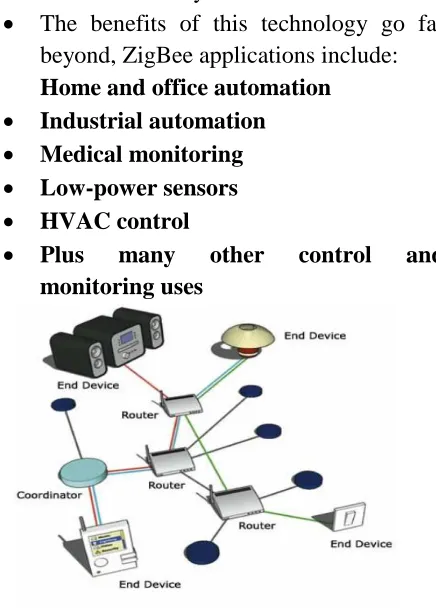
Fig 1: ZigBee Network
2.
Related Work
There are numbers of ranging techniques in wireless sensr networks including time of arrival (TOA), received signal strength indication (RSSI), time difference of arrival (TDOA), angle of arrival (AOA), etc. Some of these technologies may need special hardware, e.g. TDOA uses ultrasonic devices (3), AOA (4) requires antenna arrays. TOF does not need additional hardware and can calculate the distance between a sensor and an anchor node based on round-trip time (RTT) of packets. However, to obtain a higher ranging accuracy, lots of computing resources are needed to process huge amount of RTT samples (5; 6). Moreover, due to the low signal-to-noise ratio(SNR), multi-path fading and hardware
noise, huge errors are expected in RTT measurements (7).
2.1 Received Signal Strength Indication (RSSI):
RSSI has been widely used in wireless link quality assessments, distance measurements, and localization algorithms. An early system called RADAR (8) uses RSSI fingerprints to estimate a node’s location. In (9), an approximated ranging technique by eliminating the mean error in RSSI was presented. There are several works trying to enhance ranging accuracy based on RSSI data, e.g. Gauss model is used in (10), and (11) proposed a recursive filtering algorithm using weighted average with smooth factor map RSSI signal. Split range technique (12) is used to estimate approximate distance and able to predict the path of a moving target. There are other studies on CC2420 (13), which use standard deviation of RSSI and packet loss to estimate distance.
Previous studies have shown that reflection, scattering and other physical properties have severe impacts on RSSI measurements (14). Although (15) introduced an adequately adjusted RSSI measurements, the instability of RSSI measurement is always a problem. There are also approaches using artificial neural network (16) and RSSI fingerprint (17) to address the issues of environmental impact on RSSI.
2.2 Link Quality Indicator (LQI)
:
link quality information to network and above layers after every data frame is received. LQI is relevant to the successful reception of data frames, i.e. higher LQI indicates better link quality and lower data loss rate.
3. Implementation
A.Hardware Development:
The laboratory development board is the ZigBee Sensor Development Board as shown in Fig. 1. It has two boards one is the Base Development Board (BDB) with model number FT-6250 while the other is FT-6251, the Sensor Development Board (SDB) . The main difference between BDB and SDB is that it includes a digital temperature/humidity sensor in SDB and therefore it can monitor temperature/humidity in SDB.
B.Development Program:
It uses Jennic Code:: Blocks and Jennic Flash Programmer as the development program; Code::Blocks provides IDE development tool in editing, assembling and error detection while the Jennic Flash Programmer will burn the assembled files onto the tool programs of the hardware platform .
C. System Demonstration
ZigBee End-Device is setup at the door and across from it is the the ZigBee Coordinator their distance is limited within 75 meters. When someone enters into the room the power between the terminal transceivers will induce some variations and from this power variation to determine is there any intrusion (Fig.2)
D. System Structure:
The system structure is shown in Fig. 3. When the network is setup at ZigBee Coordinator (Terminal C) and after the ZigBee End-Device joins the network (Terminal E), terminal E starts sending data packets and after the terminal E
Coordinator receives the transmitted packets that will be automatically converted into LQI values and displayed at the computer terminal [1].
4.
Experimental Work
When no one is walking and no any activities the LQI will maintain at a constant level. But if it has
any environment changes, it will have
disturbance in the LQI value. The test results for the above three environments considered are as follows:
Environment I: When it has no any activities the LQI will keep at a constant level. When the classroom door is open or close and when it has persons entering or walking out of the room the LQI value will change. More specifically when it has some one enters into the classroom the LQI value will be lower on the other hand the LQI will go higher when someone walks out of the classroom. When the door is open the LQImay be higher or lower and therefore the LQI will have some effects if there is any person in the classroom.
environment. If it has people walking in the room the LQI value will have quite change. When a person walks out of the room the LQI value becomes stable and this phenomena is quite obvious and therefore it can use the LQI variation to determine is there any intrusion into
the room.
Environment III: The person is standstill and he only opens or closes the door the LQI does not have any specific variation; it has significant variation at the instant the door is open or close the LQI value will have variation and it is affected by the door is open or close and the angle in the open of the door and therefore if it has only door open or close the LQI value will not have obvious effect.
5.
Conclusion
In this paper we studied the LQI variations in three environments. From the test results of these three environments it concluded that the LQI value would not have obvious variation and only if it had door open or close the LQI would have significant varied. It then could be concluded that if it has no any person in the room and the room is not affected by the outside environment the LAI value will have a constant level and when it has someone enters and intrudes the room the LQI value varies and from the extent of the LQI variation we can determine is the room has been intruded.
6. References
[1]. Zhang, Jun, et al. "An indoor security system with a jumping robot as the surveillance
terminal." Consumer Electronics, IEEE
Transactions on 57.4 (2011): 1774-1781.
[2]. Kaltiokallio, Ossi, and Maurizio Bocca. "Real-time intrusion detection and tracking in indoor environment through distributed RSSI
processing." Embedded and Real-Time
Computing Systems and Applications (RTCSA), 2011 IEEE 17th International Conference on. Vol. 1. IEEE, 2011.
[3]. Oksar, Irfan. "A Bluetooth signal strength based indoor localization method."Systems, Signals and Image Processing (IWSSIP), 2014 International Conference on. IEEE, 2014.
[4]. Benkic, Karl, et al. "Using RSSI value for distance estimation in wireless sensor networks based on ZigBee." Systems, Signals and Image
Processing, 2008. IWSSIP 2008. 15th
Authors Profile’s
Mr.T.MAHENDER RAJU
T.MAHENDER RAJU received the M.Tech in Communication Systems Engineering from Andhra University, Vishakhapatnam in 2012, is a faculty member in the department of Electronics and Communication Engineering, Medha Institute of Science and Technology for Women, Khammam and presently working as Assistant Professor. His research interests include Embedded systems, Image processing and communications.
Madhavilatha.K
M-Tech ECE Department, Medha Institute of Science and Technology for Women
Dr. Murali Malijeddi
Mr.mr.muralimalijeddi has completed his PhD from Andhra University Under Guidance of Prof. Dr.
G.S.N Raju, Vice-Chancellor, Andhra University inAntennas and Signal Processing . As a Principal and