International Journal of Research (IJR)
e-ISSN: 2348-6848, p- ISSN: 2348-795X Volume 2, Issue 05, May 2015Available at http://internationaljournalofresearch.org
Load Balancing and Resource Allocation Technique in
Cloud Computing for Data Encryption/Decryption using
Ad-Hoc Network
Monika R. Astonkar & Prof. Amar Buchade
Department of Computer Engineering, Pune Institute of Computer Technology, Pune EMAIL: [email protected]; [email protected]
Abstract
Mobile cloud computing is envisioned as a promising approach to augment computation capabilities of mobile devices for emerging resource-hungry mobile applications.[14] Nowadays people depends upon cloud services for various aspects and enjoy various benefits of cloud computing in the form by deploying IaaS, PaaS, and SaaS
services and using it’s versatile
functionalities. Due to advancement in technology, people are using mobile phones more for different purposes as it is providing them same and some advanced features like desktops and mainframes. With this mobile computing have opened new frontiers for Mobile Cloud Computing with Offloading perspective later it provides privacy and security. [13]
In this paper, we are discussing Compare and Balance- Load Balancing and resource allocation technique for mobile cloud offloading that uses cost and time of request processing for processors as key parameters. Also output analysis is done successfully by providing screenshots and implementation details.
Key Words: Mobile cloud computing; Computation offloading; Load balancing; Encryption; Resource allocation
Introduction
Today “Cloud computing” is not only a buzz word but also it is providing various practical applications in desktops as well as in mobile
computing. Advancements in computing technology have expanded the usage of computers from desktops and mainframes to a wide range of mobile and embedded applications, including surveillance, environmental sensing, GPS navigation, mobile phones, and autonomous robots, etc. [3] Many of these applications run on systems with limited resources. For example, mobile phones are battery-powered. Environmental sensors have small physical sizes, slow processors, and small amounts of storage. Most of these applications use wireless networks and their bandwidths are order-of-magnitude lower than wired networks. Meanwhile, increasingly complex programs are running on these systems- for example, video processing on mobile phones and object recognition on mobile robots. Thus, there is an increasing gap between the demand for complex programs and the availability of limited resources. [3]
International Journal of Research (IJR)
e-ISSN: 2348-6848, p- ISSN: 2348-795X Volume 2, Issue 05, May 2015Available at http://internationaljournalofresearch.org
natural solution remains with us is Computation Offloading, which adds to battery lifetime and energy consumption of mobile phones. Offloading uses principle to migrate intensive parts of computation to cloud server and let it process and produce output. [1] This reduces the work of mobile phones of loading and responding to particular application.
Literature Survey
Mobile cloud offloading has been considered in the literature [4]–[6]. MAUI [4] is an offloading system designed for Windows phones. It uses Microsoft .NET to identify the methods that can be offloaded and the states that needed to be transferred during offloading. MAUI continuously collects essential data, e.g., energy consumption, CPU utilization, and network conditions, at runtime. It uses the collected data to make the decision on whether to offload for saving energy of mobile devices. In particular, MAUI builds a call graph and solves it as a 0-1 integer linear programming problem. THINKAIR [5] enables method-level
offloading system on Android phones. CloneCloud [6] is an offloading system for Android. Different from MAUI [4] and ThinkAir [5], it directly works with application binaries. The difference between MAUI and CloneCloud by considering their architectures and other factors as migration granularities, source availability,
optimization target, migration constraints, execution prerequisite are clearly explained in [7]. The factors affecting the technology evolution and the technique of dynamically offloading computation from native applications running on mobile devices to outside surrogates is explained in [8]. The load balancing algorithm as dynamic compare and balance for cloud server optimization is given in [9]. It considers server optimization techniques which helps to
minimize the number of host machines to be powered on, for reducing the cost of cloud servers. Different issues in development of a dynamic load balancing algorithm for multicomputer distributed systems is explained in [10]
Proposed Work
We proposed a system which describes how Computation offloading can be performed providing privacy and security to user data. As we know that mobile devices are having limited resources such as CPU power, memory size, storage, and battery lifetime compared to laptops and desktops. Battery lifetime is considered to be most desirable factor for everyone using Mobile phones and specially smartphones. As there are various high computational intensive applications such as GPS navigation, voice recognition, video processing, gaming, image retrieval and many more which requires more amount of energy. This signifies that we are having limited resources and demand is more from application. There is a need to build a bridge between demand and supply paradigm of mobile devices. [13]
International Journal of Research (IJR)
e-ISSN: 2348-6848, p- ISSN: 2348-795X Volume 2, Issue 05, May 2015Available at http://internationaljournalofresearch.org
Figure 1. Block Diagram for Cloud basedload balancing in ad-hoc network using dynamic compare and balance algorithm [13]
The Algorithmic steps for model of Load Balancing in Ad-Hoc Network as Compare & Balance-Load Balancing and Resource Allocation Algorithm is as follows:
Algorithm: Compare and Balance-Load
Balancing and Resource Allocation
Algorithm
1. Start
2. Initially all processors are in ideal stage
3. Submit task by Mobile/Web Client for Encryption or Decryption of file
4. Initialize processors and start volunteering to search for jobs
5. If job = NULL then
Return to step 3
Else job = AVAILABLE then
Go to Step 5
6. Evaluate and Compare cost of available processors and Last Job Completion time.
If cost<3 && LJCT>= 5ms then
Allocate job to that processor
Apply AES cryptography algorithm for encryption/decryption
Calculate Result
Return Result (encrypted/decrypted file) to Mobile/Web Job Submitter
Else
Wait for LJCT>=5ms
Repeat Step 6
7. End
System Flow diagram (Flow Chart) for above algorithm can be shown as follows in fig 2.
Implementation Details
We have successfully implemented our proposed system with following hardware and software details. The hardware requirement are as follows: Processor as Intel dual core and above with frequency as 1.73 and above, RAM as 1 GB & above, Hard Disk capacity as 80 GB and above. For Software Specifications, we have used Operating System as Windows 8, Java Development Kit 1.7.0, Eclipse Framework 4.3.2, MySQL 5_2.1.40, and Net Beans Platform as NetBeans IDE 8.0.2, Glassfish Web Server, Java-ADT V22.0.5.
International Journal of Research (IJR)
e-ISSN: 2348-6848, p- ISSN: 2348-795X Volume 2, Issue 05, May 2015Available at http://internationaljournalofresearch.org
Figure 3. Cost of processors can be set manually as well volunteering client starts volunteering to process job
Figure 2. System Flow Diagram (Flow Chart) for Compare-Balance: Load Balancing and
resource allocation Algorithm
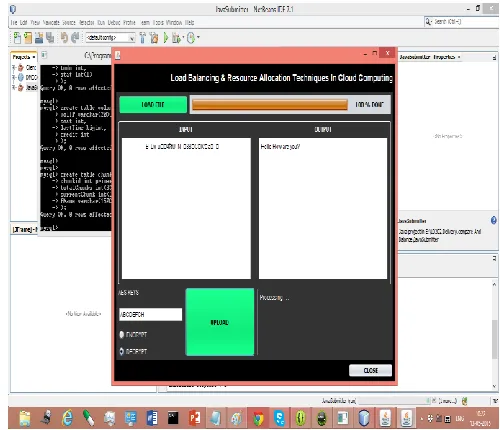
Figure 4. The encryption of file submitted by Mobile/Web Job submitter successful
Above screenshot shows that Mobile/Web Job submitter loads file and uploads for encryption. It gets uploaded successfully and then converted to encrypted file. The contents of file uploaded and encrypted can be seen on screen. WE are using here AES cryptography for encryption and decryption.
International Journal of Research (IJR)
e-ISSN: 2348-6848, p- ISSN: 2348-795X Volume 2, Issue 05, May 2015Available at http://internationaljournalofresearch.org
UML Diagrams for Specified Model
Our proposed system is now developed completely. We have built some UML Diagrams for proposed system as Package diagram and Deployment diagram as follows.
Package Diagram
Package Diagram shows the arrangement and organization of model elements in middle to large scale project. It shows both structure and dependencies between sub-systems or modules. [11] Package diagrams are used to provide a visualisation of namespaces. The package diagram for our application is as shown in fig 6 which consists of different packages for implementation as NetBeans IDE, GUI (AWT/Swing), Web services, Algorithm as load balancing and resource allocation, and hash table to maintain log.
Figure 6. Package Diagram
Deployment Diagram
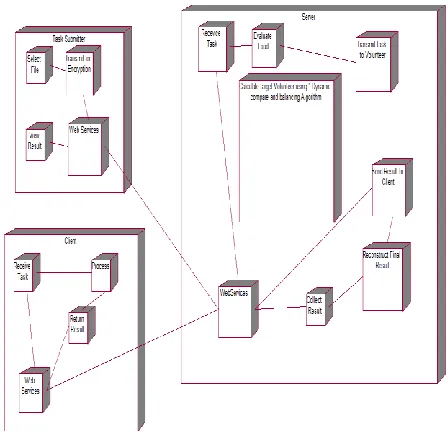
Deployment diagrams are used to visualize the topology of the physical components of a system where the software components are deployed. So deployment diagrams are used to describe the static deployment view of a system as well describes the hardware components where software components are deployed. [12]
The deployment diagram for our system is as follows in fig 7 which shows various hardware and software components.
Figure7.DeploymentDiagram
Conclusion
International Journal of Research (IJR)
e-ISSN: 2348-6848, p- ISSN: 2348-795X Volume 2, Issue 05, May 2015Available at http://internationaljournalofresearch.org
References:
[1.]Karthik Kumar and Yung-Hsiang Lu,
"Cloud Computing for mobile users: Can Offloading computation save energy?” IEEE Computer Society, April 2010.
[2] CNN.com, “Battery Life Concerns Mobile Users,” 23 Sept.2005; [Online]
Available:www.cnn.com/2005/TECH/pte
ch/09/22/phone.study
[3] Karthik Kumar, Jibang Liu, Yung-Hsiang Lu, Bharat Bhargava, "A Survey of
Computation Offloading for Mobile
Systems", Springer Science+Business
Media, LLC 2012
[4] E.Cuervo, A.Balasubramanian, D.Cho, A.Wolman, S.Saroiu, R.Chandra, and P. Bahl, “Maui: Making s martphones last longer with code offload, ” in Proc. of International Conference on Mobile Systems ,Applications , and Services (MobiSys ’10) , San Francis co, CA, USA, June 2010, pp. 49.
[5] S.Kosta, A.Aucinas P.Hui, R.Mortier and X.Zhang, “ThinkAir: Dynamic resource allocation and parallel execution in the cloud for mobile code offloading.” In Proc.of IEEE INFOCOM, Orlando, FL, USA, March 2012, pp. 945k.
[6] B.Chun, M. Naik, S. Ihm, A. Patti, and P. Maniatis, “Clonecloud: Elastic execution between mobile device and cloud,” in Proc.of European Conference on Computer Systems (EuroSys ’11), Salzb ur g, Austrial, April 2011, pp. 181Œ
[7] Lei JIAO, Roy Friedman, Xiaoming FU, Stefano SCCCI, Zbigniew SMOREDA, and
Hannes Tschofenig, "Cloud-based
Computation Offloading for Mobile
Devices: State of the Art, Challenges and Opportunities", Future Network and Mobile Summit 2013 Conference Proceedings, 2013
[8] Juntunen Antero, Kemppainen, Matti, Luukkainen,Sakari, "Mobile Computation offloading- Factors affecting Technology Evolution", Proceedings 11th ICMB 2012
[9] Yatendra Sahu, R.K Pateriya, Rajeev Kumar Gupta, "Cloud Server optimization with load balancing and Green computing techniques Using Dynamic Compare and Balance Algorithm", 2013 5th International Conference on Computational Intelligence and Communication Networks.
[10] Ali M. Alakeel, “A Guide to Dynamic Load Balancing in Distributed Computer Systems”, IJCSNS International Journal of Computer Science and Network Security, VOL.10 No. 6, June 2010
[11] Visual Paradigm Website [Online]
Available:
http://www.visual-paradigm.com/VPGallery/diagrams/Package .html
[12] Tutorials Point Website [Online] Available:
http://tutorialspoint.com/uml/uml_deployme nt_diagram.html
[13] Monika Astonkar, Amar Buchade, “Exploring Cloud based Load Balancing Model for Data Encryption in Ad-Hoc Network ” 5th International Conference on Advanced Computing & Communication Technologies, February 2015
[14] Xu Chen, Member IEEE,
![Figure 1. Block Diagram for Cloud basedload balancing in ad-hoc network using dynamic compare and balance algorithm [13]](https://thumb-us.123doks.com/thumbv2/123dok_us/7799808.1293970/3.612.78.288.86.257/figure-diagram-basedload-balancing-network-dynamic-compare-algorithm.webp)