University of South Carolina
Scholar Commons
Theses and Dissertations
2017
Arvo Part, Sieben Magnificat-Antiphonen: A
Transcription for Wind Ensemble
Julian Hartridge Sconyers III University of South Carolina
Follow this and additional works at:https://scholarcommons.sc.edu/etd
Part of theMusic Commons
This Open Access Dissertation is brought to you by Scholar Commons. It has been accepted for inclusion in Theses and Dissertations by an authorized administrator of Scholar Commons. For more information, please [email protected].
Recommended Citation
A
RVOP
ÄRT,
S
IEBENM
AGNIFICAT-A
NTIPHONEN:
A
T
RANSCRIPTION FORW
INDE
NSEMBLEby
Julian Hartridge Sconyers III
Bachelor of Music University of Georgia, 2009
Master of Music Education University of Georgia, 2011
Submitted in Partial Fulfillment of the Requirements
For the Degree of Doctor of Musical Arts in
Conducting
School of Music
University of South Carolina
2017
Accepted by:
Scott Weiss, Major Professor Chairman, Examining Committee
Cormac Cannon, Committee Member
Gregory Springer, Committee Member
Alicia Walker, Committee Member
DEDICATION
To my parents, Julian and Norma, for their constant support of my goals and for
their endless encouragement throughout this process. Without them, none of this would
ACKNOWLEDGEMENTS
The pursuit of a terminal degree and the dissertation process is not a singular
effort, and I would like to acknowledge some of the many people whose efforts have
made this project possible. First, I would like to thank the members of the University of
South Carolina Wind Ensemble for their performance, preparation, and collaboration on
this work. Additionally, I would like to thank my graduate colleagues here at the
University of South Carolina for their encouragement and friendship: Michelle Smith
Beck, Paul DeCinque, Tremon Kiser, Michael King, Brett Landry, Bailey Seabury, Will
Talley, and Nathan Tucker.
I would like to thank the members of my committee for their guidance and
support during this process: Dr. Scott Weiss, Chairman and Major Professor; Dr. Cormac
Cannon, Associate Director of Bands; Dr. Gregory Springer, Assistant Professor of
Music Education; and Dr. Alicia Walker, Associate Director of Choral Studies.
I would like to extend a special thank you to Arvo Pärt for his music and his
generous willingness to allow me to transcribe his music, and to Eric Marinitsch and the
staff at Universal Edition for their continued assistance and generosity in this process.
Finally I would like to thank a special group of people who have served as my
support group throughout this process: Alison Loyd for her endless hours of
proofreading, counseling, and encouragement, and my parents for their continued love
ABSTRACT
Amongst late twentieth and early twenty-first century music, Arvo Pärt’s
compositional style is a unique musical voice and has led to the composer becoming the
most performed living classical composer for multiple years. His unmistakable
tintinnabuli style is often labeled as part of the post-modernist movement, the minimalist
genre, sacred minimalism, or even as neo-medieval. Despite any label, his music is as
distinctive as it is revolutionary, and many of his works are considered cornerstone works
of the late-twentieth and early-twenty-first centuries. However, despite the popularity of
his works, most of his music is written for choir, orchestra, small chamber ensembles, or
soloists. Written for brass octet, Arbos remains the only original work written for winds,
and only two additional transcriptions of Fratres complete his catalogue of works
accessible to the wind ensemble. Furthermore, these works are all fairly short and
represent only his initial tintinnabuli phase. The intent of this document is to provide a
transcription of a large scale tintinnabuli work for wind ensemble. It is my hope that this
transcription of Sieben Magnificat-Antiphonen will not only provide wind ensembles with
increased access to the music of Arvo Pärt but also bring increased recognition of Pärt’s
music within the wind ensemble community.
The purpose of this document is to produce a score and performance parts of
Sieben Magnificat-Antiphonen for wind ensemble, including relevant information on
a historical background leading up to the composition of Sieben Magnificat-Antiphonen
and an analysis of the work. The transcription process is discussed in detail, and a copy
of the score of the transcription is included in the appendices. A score and performance
parts may be available through Universal Edition (Pärt’s publisher) in the future. A
recording of the premier performance of the transcription is held in the University of
TABLE OF CONTENTS
DEDICATION ... iii
ACKNOWLEDGEMENTS ... iv
ABSTRACT ...v
LIST OF TABLES ... ix
LIST OF MUSICAL EXAMPLES ...x
FOREWORD ...1
CHAPTER 1INTRODUCTION ...2
1.1JUSTIFICATION AND NEED FOR THE STUDY ...3
1.2LITERATURE REVIEW ...5
1.3METHODOLOGY ...12
1.4DESIGN AND ORGANIZATION OF THE STUDY ...14
CHAPTER 2HISTORICAL AND THEORETICAL CONTEXT ...16
2.1EARLY YEARS ...16
2.2SERIALISM AND COLLAGE TECHNIQUE ...19
2.3CREDO ...21
2.4SILENT PERIOD AND MEDIEVAL INFLUENCES ...22
2.5THE GENESIS OF TINTINNABULI ...25
2.6SPIRITUAL ELEMENTS IN TINTINNABULI ...26
CHAPTER 3SIEBEN MAGNIFICAT-ANTIPHONEN ...34
3.1INTRODUCTION TO SIEBEN MAGNIFICAT-ANTIPHONEN ...34
3.2MOVEMENT I:OWEISHEIT ...37
3.3MOVEMENT II:OADONAI ...39
3.4MOVEMENT III:OSPROß AUS ISAIS WURZEL ...40
3.5MOVEMENT IV:OSCHLÜSSEL DAVIDS ...42
3.6MOVEMENT V:OMORGENSTERN ...44
3.7MOVEMENT VI:OKÖNIG ALLER VÖLKER ...47
3.8MOVEMENT VII:OIMMANUEL ...49
CHAPTER 4TRANSCRIPTION PREPARATION ...52
4.1INTRODUCTION ...52
4.2INSTRUMENTATION ...54
4.3GENERAL PRINCIPLES AND ISSUES ...55
4.4DEPARTURES FROM THE ORIGINAL ...58
4.5ISSUES INVOLVING THE TRANSLATION OF CHORAL MUSIC TO WINDS ...62
CHAPTER 5CONCLUSIONS AND RECOMMENDATIONS FOR FURTHER STUDY ...77
BIBLIOGRAPHY ...79
APPENDIX A–SIEBEN MAGNIFICAT-ANTIPHONEN:WIND ENSEMBLE TRANSCRIPTION ...85
APPENDIX B–TRANSCRIPTION COMPARISON CHART...125
APPENDIX C–PERMISSION TO ARRANGE ...133
LIST OF TABLES
Table 3.1 Liturgical date, translations, and biblical origins of the O Antiphons ...35
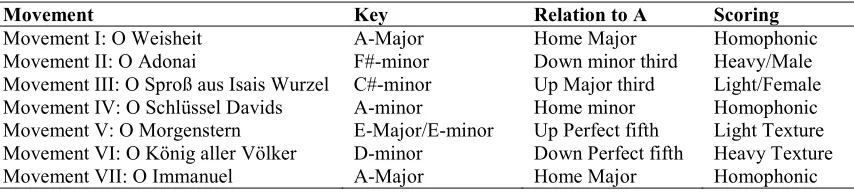
Table 3.2 Tonal and scoring organization of Sieben Magnificat-Antiphonen ...37
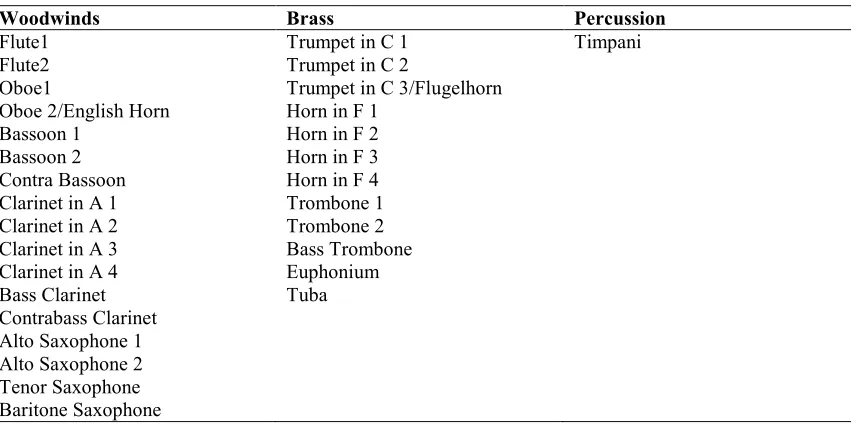
Table 4.1 Instrumentation of Sieben Magnificat-Antiphonen for wind ensemble ...55
Table 4.2 Comparison of stylistic and tempo markings in Sieben Magnificat-Antiphonen
for wind ensemble, Sieben Magnificat-Antiphonen for choir, and Greater Antiphons ...59
LIST OF MUSICAL EXAMPLES
Example 2.1 T-voice positions in relation to the M-voice ...32
Example 2.2 M-voice linear patterns in relation to the central pitch ...32
Example 3.1 Arvo Pärt, Sieben Magnificat-Antiphonen, mvt. I, mm1-3 ...38
Example 3.2 Arvo Pärt, Sieben Magnificat-Antiphonen, mvt. II, mm1-6 ...40
Example 3.3 Arvo Pärt, Sieben Magnificat-Antiphonen, mvt. III, mm33-38 ...42
Example 3.4 Arvo Pärt, Sieben Magnificat-Antiphonen, mvt. IV, mm54-68 ...43
Example 3.5 Arvo Pärt, Sieben Magnificat-Antiphonen, mvt. V, mm1-7 ...45
Example 3.6 Arvo Pärt, Sieben Magnificat-Antiphonen, mvt. VI, mm1-7 or 1-4 ...48
Example 3.7 Arvo Pärt, Sieben Magnificat-Antiphonen, mvt. VII, mm11-14 ...50
Example 3.8 Arvo Pärt, Sieben Magnificat-Antiphonen, mvt. VII, mm15-22 ...50
Example 3.9 Arvo Pärt, Sieben Magnificat-Antiphonen, mvt. VII, mm70-76 ...51
Example 4.1 Arvo Pärt, Sieben Magnificat-Antiphonen, mvt. III, mm18-19 ...56
Example 4.2 Arvo Pärt, Greater Antiphons, mvt. III, m12 ...57
Example 4.3 Arvo Pärt, trans. J. Sconyers, Sieben Magnificat-Antiphonen, mvt. III, m12 ...57
Example 4.4 Arvo Pärt, Sieben Magnificat-Antiphonen, mvt. I, mm1-2 ...61
Example 4.5 Arvo Pärt, Greater Antiphons, mvt. I, mm1-2 ...61
Example 4.6 Arvo Pärt, Sieben Magnificat-Antiphonen, mvt. V, mm1-7 ...62
Example 4.7 Arvo Pärt, trans. J. Sconyers, Sieben Magnificat-Antiphonen, mvt. V, mm1-8 ...63
Example 4.9 Arvo Pärt, trans. J. Sconyers, Sieben Magnificat-Antiphonen, mvt. II, mm3-7 ...67
Example 4.10 Arvo Pärt, trans. J. Sconyers, Sieben Magnificat-Antiphonen, mvt. III,
mm5-10 ...72
Example 4.11 Arvo Pärt, trans. J. Sconyers, Sieben Magnificat-Antiphonen, mvt. IV,
FOREWORD
This document is part of the dissertation requirement for the Doctor of Musical
Arts degree in Conducting. This document is presented in conjunction with four public
recitals. Copies of these recital programs are included in the appendices, and recordings
CHAPTER 1
INTRODUCTION
Considered one of the foremost composers of the late 20th and early 21st century,
Arvo Pärt’s works have challenged our perception of music in the post-modern world.
Spanning the compositional spectrum from his early modernist works to his current
minimalist output, Pärt has become known as one of the world’s leading living
composers; and, followed by fellow minimalist composers John Adams and Phillip Glass,
he has become the most performed living composer in the world for multiple years.1
Principally composing works for choral, orchestral, and chamber ensembles, Pärt
has introduced a unique compositional voice that synthesizes the precepts of both
minimalism and medieval chant with a simple and pure structure reflective of Pärt’s deep
spirituality. This unique style, known as tintinnabuli, has become Pärt’s signature
compositional voice since its inception in 1976. Though this style has evolved over the
past four decades, the basic simplicity and compositional approach remain. Instrumental
works such as Für Alina (1976), Fratres (1977), Tabula Rasa (1977), and Cantus in
Memory of Benjamin Britten (1977/1980) mark his initial tintinnabuli period. However,
his choral works, and specifically his a cappella choral works, make up much of his
oeuvre since the mid-1970s. Works such as Summa (1977), Magnificat (1989), and Nunc
dimittis (2001) have become staples of the choral literature and represent the evolution of
Pärt’s tintinnabuli style to its current form. Pärt’s 1988 work Sieben
Magnificat-Antiphonen presents a variety of styles and colors in each of its distinctive seven
movements while demonstrating his tintinnabuli style. This work was transcribed for
eight cellos under the title O-Antiphonen in 2008. In 2015, Pärt transcribed this a
cappella choral work for strings, and it was premiered on May 28, 2016 under the title
Greater Antiphons by Gustavo Dudamel and the Los Angeles Philharmonic.
Pärt’s inclination towards composing for consorts of like instruments, single
instrument families, and voice creates a unique homogenous texture that has become a
defining characteristic of his music. As a result, much of his output is accessible to only
choir, orchestra, small ensembles, or soloists, and it is rarely performed by wind
ensembles. Therefore, the purpose of this document is to present an analysis and
transcription of Pärt’s Sieben Magnificat-Antiphonen for wind ensemble.
1.1 JUSTIFICATION AND NEED FOR THE STUDY
Despite Pärt’s large repertoire and frequent performances by orchestras, choirs,
and chamber ensembles, few of his works fall within the scope of the wind band
medium.2 Arbos (1977) for four trumpets, four trombones, and percussion is the only
work for wind ensemble transcribed by Arvo Pärt and was originally scored for early
music ensemble without a fixed instrumentation. Additionally, Fratres (1977) has been
transcribed for wind octet and percussion by Beat Briner and wind orchestra by Johannes
Stert. Stert’s transcription for wind orchestra stands apart as the only work accessible to
large wind band. However, this transcription requires a special printing and is rarely
performed.3 Of particular note is both the lack of original compositions for winds by Pärt
and transcriptions of larger scale or a cappella choral works. This transcription of Sieben
Magnificat-Antiphonen is intended to provide wind ensembles with access to a large scale
a cappella choral work by Arvo Pärt, and it is my hope that this transcription will provide
not only increased access to but also recognition of Pärt’s works in the wind band
community.
The modern wind band repertoire includes many transcriptions of a cappella
choral works that have become widely performed and have established a place in the
repertoire.4 However, most of these works are brief, single movement compositions.5
This transcription will provide the wind band medium, and specifically wind ensembles,
access to a large scale choral composition. However, the unique sonic pallets that Pärt
presents within Sieben Magnificat-Antiphonen set the work apart from other
transcriptions of a cappella choral works for wind band. The variety of textures and use
3. All performances of Pärts’s music are listed on the Universal Edition website. This database can be accessed online at http://www.universaledition.com/performances-and-calendar.
4. Clifford N. Towner, “An evaluation of compositions for wind band according to specific criteria of serious artistic merit: a second update,” (DMA Thesis, University of Nebraska-Lincoln, 2011), 77-172.
5. Shaun R. Popp, “An Examination of Orchestration Techniques Used in Wind Band
of smaller vocal ensembles from within the choir afford the possibility of featuring
consorts and utilizing the full range of sonic capabilities present in the wind ensemble.
1.2 LITERATURE REVIEW
Regarded by many musicians and scholars as an important composer in the
minimalist movement of the late twentieth century, there has been extensive research on
Pärt’s life and music. Much of the research falls within the five distinct categories of
biographical writings, interviews with the composer, discussions of specific works or
collections of works, discussions on his compositional periods and the development of
tintinnabuli, and theoretical studies of tintinnabuli.
Paul Hilliard’s book Arvo Pärt is the leading comprehensive biography of Pärt’s
life and includes a detailed analysis of his works prior to 1996. Published in 1997, the
book chronicles Pärt’s life from his childhood and student years, to his immigration from
Soviet Estonia to Vienna and eventually Berlin. In his book, Hilliard details each of
Pärt’s compositional periods including chapters on his early serialism and collage works,
his break from this style, the early tintinnabuli works, and the development of
tintinnabuli. Additionally, this book includes a chapter on performance practice,
appendices that include a listing of the entire collected canon recognized by the composer
prior to 1997, and a discography. The book connects the details of Pärt’s life with the
development of his compositional voice while providing musical analyses and examples
of his compositional traits in many of his key works.6
Pärt has been described as an intensely private person and, in recent years, has
declined many interviews.7 However, many conversations from the late 1980s and 1990s
have been documented and greatly inform the musicological community. These
conversations offer a wealth of information on his compositional techniques and
processes, his musical inspirations, his views on music, his deep spirituality, and his life.
The most substantial interview is included in the book Arvo Pärt in Conversation and is a
2003 conversation between Enzo Restagno, Arvo Pärt, and his wife, Nora Pärt. This
interview was conducted over a period of days during a summer trip to Italy and covers a
range of topics that reveal Pärt as both composer and person.8 Other interviews are
smaller in scope and typically focus on a more specific range of topics. In a 1989 article
in The Musical Times, James McCarthy recounts an interview with Pärt from 1986.
Here, Pärt discusses musical influences, serialism, and his compositional language in the
context of the world of modern music.9 A 1998 discussion between Geoff Smith, Arvo
Pärt, and Nora Pärt is published in a 1999 article from The Musical Times. Although they
discuss both his compositional process and details surrounding many of his major
compositions in this interview, it delves into deeper subjects from spirituality to the
direction of modern music.10
7. Eric Marinitsch, e-mail message to author, March 9, 2016.
8. Leopold Brauneiss, Saale Kareda, Arvo Pärt, and Enzo Restagno, Arvo Pärt in Conversation, trans. Robert Crow (Champaign, IL: Dalkey Archive Press, 2012).
9. Jamie McCarthy and Arvo Pärt, “An Interview with Arvo Pärt,” The Musical Times 130, no. 1753 (March 1989): 130.
A significant area of scholarship surrounding the music of Pärt is research and
analyses of specific works or collections of related works. Of particular interest is Allan
Ballinger’s 2013 dissertation “In Quest of the Sacred: Arvo Pärt and Sieben
Magnificat-Antiphonen.” In his dissertation, Ballinger provides a discussion of Tintinnabuli
technique, an in-depth analysis of each movement of the work, and a historical context of
the work. Most significantly, Ballinger presents a systematic approach for analyzing this
work, while also discussing in detail how Pärt uses tintinnabuli technique in Sieben
Magnificat-Antiphonen.11 Additionally, Kimberly Anne Cargile’s 2008 dissertation “An
Analytical Conductor’s Guide to the SATB A Capella Works of Arvo Pärt,” covers a
broader range of choral works by Pärt, while providing a detailed description of each
work, a brief analysis, and a discussion of the performance and conducting challenges
presented. Included in this is a discussion of Sieben Magnificat-Antiphonen. Though the
dissertation is not intended to be a historical or theoretical account of the development of
Pärt’s a cappella choral music, the wide cross section of music from 1964 through 2004
outlines the evolution of Pärt’s style and particularly the use of tintinnabuli in choral
works.12
In his 1997 thesis “The Tintinnabuli Compositional Style of Arvo Pärt,” Graeme
Langager uses Pärt’s Passio as a case study of tintinnabuli technique and investigates
how this system affects all aspects of the work including text, form, rhythm, harmony,
11. Allan J. Ballinger, “In Quest of the Sacred: Arvo Pärt and Sieben Magnificat-Antiphonen,” (DMA Dissertation, University of Connecticut, 2013).
and scoring.13 Similarly, Thomas Robert Holm provides a detailed analysis of Passio,
along with Miserere and Litany. Holm highlights both the similarities and the
development of tintinnabuli in these works.14 Whereas Passio demonstrates a stricter
construction of both form and harmonic language, Miserere and Litany show an
increased variety in harmonies and expansion of form over the twelve year span of these
works. Furthermore, the differences in orchestration illustrate the evolution of
instrumental and choral writing as well as instrumental interplay during the 1980s and
early 1990s.15
Like Holm’s study investigating the development of tintinnabuli in three different
works, several studies have documented and theorised about the development of Pärt’s
compositional style and specifically tintinnabuli. Grace Muzzo’s 2008 article in the
Musical Times entitled “Systems, Symbols, and Silence” traces the development of
tintinnabuli through several choral works, including Te Deum (1984-85), Triodion
(1998), Nunc Dimittis (2001), and Da Pacem Domine (2004-06).16 Similarly, Oranit
Kongwattananon traces the development of tintinnabuli in its early phases from 1976 to
1985. Kongwattananon focuses on several instrumental and choral works, including Für
Alina, Cantus in Memory of Benjamin Britten, Cantate Domino canticum novum, Missa
Sillabica, Stabat Mater, and Es sang vor langen Jahren. Most significantly, three
13. Graeme Langager, “The Tintinnabuli Compositional Style of Arvo Pärt,” (Masters Thesis, California State University, Long Beach, 1997).
14. Thomas Robert Holm, “Analysis and Comparison of Three Major Vocal/Instrumental Works of Arvo Pärt: Passio, Miserere, and Litany,” (DMA Dissertation, University of Urbana-Champaign, 1998).
15. Ibid, 68.
separate strains of tintinnabuli are identified and described through examples in each
work.17 Combined with the works of Langager and Holm, Kongwattananon and Muzzo’s
scholarship effectively trace the development of tintinnabuli from its beginnings through
the early 2000s, while showing increasing complexities in compositional technique and a
mature willingness to break from the rules of Pärt’s self-defined technique.18
Though discussions on tintinnabuli make up much of the scholarship concerning
Pärt’s stylistic development, research on Pärt’s early period, his serial and collage period,
and his “silent period” (1968-1976) are important in understanding the development of
Pärt as a composer. Lyn Henderson’s 2008 article in The Musical Times, entitled “A
solitary genius: the establishment of Pärt’s technique (1958-68)” discusses the period of
time leading up to the composition of Pärt’s Credo. This work is regarded by many as
the culmination of the first compositional period and serves as a benchmark in his oeuvre
delineating the very end of the serial period before the beginning of the “silent period.”19
Peter Quinn focuses on the end of this early period in his 2000 article, “Out with the Old,
and in with the New: Arvo Pärt’s Credo.” Quinn presents a case that Credo is a point of
departure from his previous compositions in both subject and compositional technique,
and this work is indicative of Pärt’s reconceiving of tonality and signals a move towards
a simpler style.20
17. Oranit Kongwattananon, “Arvo Pärt and Three Types of His Tintinnabuli Technique,” (Masters Thesis, University of North Texas, 2013).
18. Muzzo, “System, Symbols and Silence,” 35.
19. Lyn Henderson, “A Solitary Genius: The Establishment of Pärt’s Technique (1958–68)” The Musical Times 149, no. 1904 (2008): 88.
Even though Pärt’s stylistic periods and compositional language are well
documented and researched, the question of defining and classifying Pärt’s music, and
specifically tintinnabuli style, is a point of much discussion among scholars. Although
David Clarke presents Pärt’s music as part of the “holy minimalism” movement in his
1993 article “Parting Glances: Aesthetic solace or act of complicity?,” he also argues that
Pärt’s music stands as an anomalous reaction to modernism and poses questions about
whether this is a truly new direction for music or simply a reactionary trend.21 Others
present arguments that Pärt’s style should not be classified as minimalism. Graeme
Langager, in his dissertation, and Benjamin Skipp, in his 2009 article “Out of Place in the
20th Century: Thoughts on Arvo Pärt’s Tintinnabuli style,” discuss arguments against
classifying Pärt’s music as minimalism.22
In addition to discussions on tintinnabuli’s application in compositions, its
development, and its classification in modern music, several theoretical works analyze
and define the theory behind tintinnabuli. Hilliard, Holmes, Langager, Cargile, Muzzo,
and Kongwattananon all give substantial definitions of the technique in their writings.23
In Arvo Pärt in Conversation, Leopold Brauneiss gives a lengthy discussion on
tintinnabuli that details defining characteristics of the technique and their implementation
21. David Clarke, “Parting Glances: David Clarke Reappraises the Music of Arvo Pärt,” The Musical Times 134, no. 1810 (1993): 684.
22. Graeme Langager, “The Tintinnabuli Compositional Style of Arvo Pärt,” 76; Benjamin Skipp, “Out of Place in the 20th Century: Thoughts on Arvo Pärt’s Tintinnabuli Style,” Tempo: A Quarterly Review of Modern Music 63, no. 249 (2009): 2.
at all levels of musical composition from a single note to overall form.24 Other articles
approach the analysis of tintinnabuli from a mathematical prospective. They define the
technique through mathematical principles and ascribe algorithmic functions to the
music. Two notable examples of this approach are John Roeder’s 2011 article in the
Journal of Music Theory, entitled “Transformational Aspects of Arvo Pärt’s Tintinnabuli
Music,” and Anna Shvets’ article in Lietuvos muzikologija, entitled “Mathematical Bases
of the Form Construction in Arvo Pärt’s Music.”25
In addition to literature on Pärt and his music, a discussion on scholarship
concerning choral transcriptions for wind band is applicable to the scope of this study.
Several dissertations and theses concerning a cappella choral transcriptions for wind
band exist. Both Daniel Grassi’s 2010 thesis “An Analysis of Three Choral
Transcriptions for Winds by Eric Whitacre,” and John Hairel’s 2009 dissertation “The
Wind Band Music of Eric Whitacre with an Analysis and Discussion of Three Choral
Works Adapted for Wind Band” focus on Whitacre’s transcriptions of Cloudburst, Sleep,
and Lux Aurumque for band.26 Shaun Popp’s 2013 dissertation “An Examination of
Orchestrational Techniques Used in Wind Band Transcriptions of A Cappella Choral
24. Brauneiss et al., Arvo Pärt in Conversation, 107-162.
25. John Roeder, “Transformational Aspects of Arvo Pärt’s Tintinnabuli Music,” Journal of Music Theory 55, (2011): 1-41; Anna Shvets, “Mathematical Bases of the Form Construction in Arvo Pärt’s Music.” Lietuvos muzikologija 15, (January 1, 2014): 88–101.
Works” discusses several important transcriptions as well as techniques associated with
choral transcriptions for wind band.27
1.3 METHODOLOGY
This document synthesizes information about Pärt’s compositional principles,
techniques, style, and relevant historical context surrounding and influencing the
composition of Sieben Magnificat-Antiphonen. This information is intended to both
provide a better understanding of Pärt as a composer and to inform decisions during the
transcription process. The principle aim of this transcription is to translate Pärt’s choral
work Sieben Magnificat-Antiphonen to wind ensemble while preserving the original
musical intent and Pärt’s unique style and sonority. However, the intent is not merely to
recreate the work as Pärt would have orchestrated it. Because of the limited number of
applicable examples of wind orchestration by the composer, this approach is impractical.
Rather, the approach of this transcription is to preserve the style and texture of the
original work. Therefore, orchestration decisions are informed by an understanding of
Pärt’s compositional techniques and language. Furthermore, the original music is
preserved, and notes, rhythms, and harmonies are not altered from the composer’s intent.
However, it is important to note that there are certain carefully considered departures
from the original choral score including occasional octave displacement and dynamics in
specific instrumental voices. These decisions were made using established orchestration
techniques from other wind ensemble transcriptions of choral works. Furthermore, these
decisions were made in consultation with both the original choral score of Sieben
Magnificat-Antiphonen and Pärt’s own string transcription Greater Antiphons in order to
better discern both the intent of and the allowable departures from the original work.
These decisions are discussed in detail in Chapter Four and enumerated in the
transcription comparison chart located in Appendices.
Two principle musical sources are used as a guide in this process. Examples of
transcriptions of Pärt’s works from choral to other instrumental mediums, such as strings
or chamber ensembles, served to inform decisions during the transcription process.
Examples of these include metric translations, adaptation of text to instrumental
articulation and phrasing, and general textural decisions. Many of the transcriptions are
by the composer himself or have been approved by the composer and his publisher.
Principally, Pärt’s string transcription Greater Antiphons is used to inform decisions
involving articulation and meter. Additionally, several examples of successful
transcriptions of a cappella choral works for wind band are utilized to inform decisions
generally concerning the translation of choral music to winds and specific tone colors
desired. These works include, but are not limited to: Ave Maria (Biebl/Cameron), O
Magnum Mysterium (Lauridsen/Reynolds), Contre Qui Rose (Lauridsen/Reynolds), Rest
(Ticheli), Lux Arumque (Whitacre), and Sleep (Whitacre). It is important to note that this
transcription is intended for wind ensemble and will feature smaller choirs and consorts
from within the ensemble during certain movements. The above wind band
transcriptions are generally intended for wind ensemble or larger symphonic band, and
typically represent scoring intended for a larger ensemble than will be utilized in this
1.4 DESIGN AND ORGANIZATION OF THE STUDY
This document includes two primary sections. First, this document addresses
relevant information concerning Pärt’s compositional techniques, the historical context of
Sieben Magnificat-Antiphonen, and an analysis of the work. Second, the document
provides a detailed account of the transcription process including general orchestration
principles and specific orchestrational decisions and their justifications.
Chapter One is an overview of the study, including an introduction to the music of
Arvo Pärt, justification and need for the study, literature review, methodology, and design
and organization of the study. Chapter Two provides a biography of Arvo Pärt, describes
his compositional output, and outlines Pärt’s compositional language and its spiritual
influences. Although a detailed biography, an account of his entire compositional output,
and an analysis of his tintinnabuli technique are important to the understanding of Pärt, I
have chosen to limit the discussion in this chapter to a general outline of Pärt’s
biography, works, and compositional language, thereby setting up a discussion of the
specific context and musical language of Sieben Magnificat-Antiphonen to be discussed
later in the paper. This choice is due to the availability of literature concerning his life,
works, and compositional language. Chapter Three provides a specific historical context
of Sieben Magnificat-Antiphonen and a detailed analysis of Sieben
Magnificat-Antiphonen, highlighting the use of Pärt’s signature tintinnabuli technique in this work.
Chapter Four discusses the preparation of the transcription, including large scale issues of
instrumentation, harmonic considerations, timbral considerations, text and articulation,
and rhythm and meter as well as detailed account of certain decisions made during the
types of decisions made and is not intended to be a measure by measure analysis of the
transcription. Chapter Five consists of conclusions and recommendations for further
research. Appendix A is the transcription of Sieben Magnificat-Antiphonen for wind
ensemble. Appendix B is a transcription comparison chart that provides a measure by
measure comparison of the original choral work and the string transcription Greater
Antiphons with the transcription for wind ensemble. Appendix C is the official
permission to arrange from Pärt’s publisher Universal Edition. Appendix D includes
CHAPTER 2
HISTORICAL AND THEORETICAL CONTEXT
2.1 EARLY YEARS
Born on September 11, 1935 in Paide, Estonia and raised from age 3 in Rakvere,
Estonia, Arvo Pärt began his musical studies at an early age through both a children’s
music school and private piano lessons from his teacher Ille Martin.28,29 It was during his
formative years that Pärt began to experiment with composition on his parents’ Russian
grand piano. Interestingly, he used only the extreme registers of the instrument, because
the middle register did not work. As a teenager, Pärt sought out any music available to
him through radio programs, broadcasts of symphony concerts over local loudspeakers,
and his own performances on piano, percussion, oboe, and voice in the school orchestra,
dance band, and choir. He began to write more formal compositions as a young teenager
and had his first public performance as a composer at age 17. This work, entitled
Meloodia, along with his other early compositions, did not reflect the compositional style
that would come to define Pärt’s early period; rather, they showed heavy influence from
composers of the classical and romantic European canon.30
28. “Timeline,” Arvo Pärt Centre, accessed January 12, 2017, http://www.arvopart.ee/en/arvo-part-2/biography/bio-timeline/.
29. Hillier, Arvo Pärt, 26.
In 1954, Pärt entered the Music Middle School in the Estonian capital of Tallinn.
However, his time there was quickly interrupted by a two year compulsory service in the
Soviet Army.31 During this time, he played percussion and oboe in a military orchestra
and was stricken with serious health problems that would plague him for the next decade.
In 1956, Pärt returned to the Music Middle School and advanced to study at the Tallinn
Conservatory in 1957.32 As a student at the conservatory, Pärt studied composition with
Heino Eller, and was widely recognized by both his teachers and peers as incredibly
talented and able to understand and utilize new techniques very quickly.33
In 1958, Pärt began work as a sound engineer with the Estonian Radio and would
continue in this job until 1967.34 Though this early job is rarely discussed in detail by
Pärt or his biographers, it did provide several important opportunities for the young
composer. Access to music from outside of the Soviet bloc was severely restricted and
often works by Soviet composers were banned. However, the Estonian Radio maintained
a library of every recording that came through the station. As a result, Pärt had access to
music that was unavailable to the general public and even to other Estonian and Soviet
musicians. Furthermore, because the Estonian Radio employed the most important
symphony orchestra in the local region, a professional choir, and a light-music orchestra,
Pärt had access to Estonia’s best musicians and developed a relationship with these
performers. During his time at the radio, Pärt regularly recorded music and edited these
recordings. Though he often did not like the music he was recording, it did give Pärt a
31. “Timeline.”
32. Hillier, Arvo Pärt, 27.
33. Ibid., 28.
unique insight into orchestration and instrumental timbre.35 In a 2005 radio interview,
Pärt spoke of this influence saying:
I hear that music only through loudspeakers, and when I did not like something in its orchestration or timbre, all I had to do was to work the mixer and filters until I did like it. Sometimes when I entered the studio and heard how the music sounded unmediated, I was extremely disappointed. I realized that I needed to make changes in the score. This strange situation accompanied me almost the whole time I worked in the radio. There was no correlation between the music sounding in the concert hall and on the record. My impressions of music had always been influenced by the fact that I was recording it. For that reason, I later needed to learn much more about the orchestra and orchestration.”36
While serving as a sound engineer, Pärt continued his studies at the Tallinn
Conservatory and graduated in 1963. During his time at the conservatory and in the years
following, Pärt composed a diverse range of works, including two cantatas, a string
quartet, works for solo piano, music for children’s choir, and even music for children’s
puppet theatre.37 Additionally, Pärt was a very prolific film composer and composed
more than fifty scores for short animated films, documentaries, plays, and a few
full-length feature works.38 However, serial works, like that of his orchestral piece Nekrolog
(1960-61), are more representative of Pärt’s early style and establish him as the first
Estonian serial composer and amongst the first serial composers in the Soviet bloc.39
This work, along with the earlier Partita (1958) and the later Credo (1968), would draw
scorn from the Composers Union of the Soviet Union for their modern influences and
lack of nationalist and Russian or Estonian folk elements. However, as the Soviet
35. Andrew Shenton, ed., The Cambridge Companion to Arvo Pärt, (Cambridge: Cambridge University Press, 2012), 13-15.
36. Shenton, The Cambridge Companion to Arvo Pärt, 14.
37. Hillier, Arvo Pärt, 29.
38. Shenton, The Cambridge Companion to Arvo Pärt, 21.
garde became more established and the community of young soviet composers grew in
communication and support, Pärtwould become more established in the Eastern bloc and
would eventually become a member of the Estonian Composers Union (a regional branch
of the Composers Union of the Soviet Union). This relationship with the Composers
Union would allow for both financial support and performances of his works.40
2.2 SERIALISM AND COLLAGE TECHNIQUE
Pärt’s first mature compositional period is defined by Pärt and his biographers as
beginning in 1958 during his time at the Tallinn Conservatory and continuing through the
composition of Credo in 1968. During this period, his works embraced the techniques of
serialism, aleatoricism, sonorism, and collage, and these works are markedly different in
aesthetic from the later Tintinnabuli works that have come to define Pärt.41,42 The idea of
using a systematic approach as the concept underlying the inception of a composition and
the concept of juxtaposed dualities forming a greater whole is at the very core of both his
early and later period works. One notable example of this juxtaposition of disparate ideas
is found in Pärt’s use of collage technique, such as that of Collage sur B-A-C-H (1964).
In this work, Pärt juxtaposes contrasting sections of tonality reminiscent of Bach with
stark 12 tone passages.43 In works such as Perpetuum Mobile and the First Symphony,
Pärt utilizes a systematic compositional approach that is centered on the same 12-tone
row to form each work. Combined with the use of metrical canons and modifications of
40. Shenton, The Cambridge Companion to Arvo Pärt, 17.
41. Pärt even wrote the score to the film Evald Okas using a style reminiscent of Edgard Varèse by manipulated tapes, playing tapes backwards, and at different tempi.
42. “Timeline.”
12-tone rows, the relatively strict compositional scheme would seem to draw some
parallels with that of Witold Lutosławski. Pärt’s adherence to strict harmonic and
rhythmic systems in the early serial and collage works present an archetype for how
different compositional techniques would be used to structure later works.44
Many of the works of the early period utilize formal and stylistic ideas from the
baroque period in a pseudo-neoclassical manner. This is seen in the naming of the
movements in Collage sur B-A-C-H (Toccata, Sarabande, and Ricercar) and in the First
Symphony (Canons and Prelude and Fugue). Of particular interest is the veneration of the
music of J.S. Bach and the use of the B-A-C-H motif as a structural idea.45 These
references to Bach are present in many early compositions and continue through Credo
(1968) and its use of Bach’s Prelude in C Major from book 1 of the Well-Tempered
Clavier.46 The use of references to earlier music in both form and content become
commonplace in his later period. However, Pärt shifts from referencing the Baroque in
his early period to drawing influences from Medieval and early church music in his later
tintinnabuli works. Though Pärt’s early period works are often not as well known or as
frequently performed, these early works demonstrate many defining characteristics of
Pärt’s music that are present in much of his oeuvre, while presenting themselves in very
different aesthetic realizations.
44. Hillier, Arvo Pärt, 38-46.
45. Ibid., 43-51.
2.3 CREDO
Arguably the single most pivotal work of Pärt’s career is his 1968 work Credo.
Prior to this composition, Pärt had not openly delved into an overtly religious subject
matter. However, the opening measures of the work proudly proclaim in fortissimo
“Credo in Jesum Christum,” (I believe in Jesus Christ) and continued to show what Pärt
describes as a juxtaposition of love and hate. In speaking of his compositional inspiration
Pärt states, “I wanted to put together the two worlds of love and hate...I knew what kind
of music I would write for hate, and I did it. But for love, I was not able to do it.”47 The
work flows from Bach’s Prelude in C Major accompaning the litergical Credo text until
it reaches a diminished triad. This chord is broken apart and a profound sense of noise
appears. This is the central collage that represents hate. It is a glimpse into something
completely different through the spinning out of this one moment.48 In a thoughtful
manner, the work returns to the music of Bach as hate is overcome by love. Pärt states,
“…this was a theological musical form. Love destroyed the hate. Not destroyed: the hate
collapsed itself when it met the love. A convulsion.”49
Though genius in its construction and profound in its theology, the work met
serious derision from the devoutly atheist Soviet authorities. The work was never
proofed or approved by the composers union, as was the law. Out of a justified fear of its
rejection, Neeme Jarvi and the Estonian Radio Orchestra did not seek approval for
performance of the work and premiered the work on November 16, 1968. This premiere
47. Arthur Lubow, “The Sound of Spirit,” New Your Times, October 15, 2010, accessed January 12, 2017, http://www.nytimes.com/2010/10/17/magazine/17part-t.html?_r=1&pagewanted=all&.
48. Arvo Part & Robert Wilson. The Lost Paradise, DVD (Germany: Accentus Music, 2015).
ignited a firestorm of political controversy that resulted in the removal of people from the
orchestra and a quick downturn for Pärt’s career.50 This marked the beginning of a split
with the Estonian Union of Composers, which started with the loss of commissions and
climaxed in 1979 with a harsh and parodic speech by Pärt to the composers union.51
With Credo, Pärt set a point of departure from his previous works. Pärt had not only
compositionally handled two disparate styles and effectively suspended a sense of time,
he had wrestled with deep spiritual and musical questions. He did this through Bach and
now was charged with doing it in his own manner, through his own music.
2.4 SILENT PERIOD AND MEDIEVAL INFLUENCES
Following the composition of Credo in 1968, Pärt entered a period of transition
and compositional reorientation that has been referred to by many as his “silent period.”
However, this label is misleading. In fact, Pärt wrote numerous stylistic and technical
studies, maintained writing film music to support himself and his family, and composed
both a symphony and symphonic cantata during this time.52 However, Symphony No. 3
(1971) remains as the only authorized work from this period.53
It is important to emphasize the significant personal and professional changes that
occurred during these years. Pärt met and married his wife Nora, and he converted from
the Lutheran church to the Russian Orthodox Church.54 Whereas previously, Pärt had
been influenced by the external stimuli of other musical and artistic styles, the rules and
50. Lubow, “The Sound of Spirit.”
51. Shenton, The Cambridge Companion to Arvo Pärt, 37.
52. Hillier, Arvo Pärt, 66.
53. “Timeline.”
reactions of the Soviet regime, and influences of his teachers and colleagues, he now
began to search inwardly for direction both personally and musically.
In a 1968 interview Pärt stated, “I am not sure there could be progress in art.
Progress as such is present in science. Everyone understands what progress means in the
technique of military warfare. Art presents a more complex situation.” He continues
later by stating, “Art has to deal with eternal questions, not just sorting out the issues of
today.”55 This quote indicates the beginning of Pärt’s shift away from the aesthetic of
objectivity and Modernism and indicates that Pärt is looking for something deeper,
abiding, and timeless from which to draw. Indeed, this is the crisis that Pärt faced. Pärt’s
dilemma was not just that of a compositional writer’s block, but a serious question of
what the next step in centuries of musical evolution should be. This would lead to his
discovery of early music as both a model and a source of inspiration.
In the Soviet bloc, the political and cultural stance of the communist government
made access to pre-Baroque music difficult for the musical community. The music
conservatories in the Soviet Union gave only cursory attention to early music and often
perpetuated an opinion that it is inferior to later music, and especially to the orchestral
tradition of the classical and romantic eras. Furthermore, the prevalence of religious
subject matter in medieval and renaissance music presented a serious threat to the
Communist rhetoric of the Soviet era. 56,57 Russian music theorist Yuri Kholopov
summarized the issue with religious music in stating, “God and Jesus Christ were bigger
55. Hillier, Arvo Pärt, 65.
56. Ibid., 66.
enemies to the Soviet regime than Boulez and Webern.”58 Even during Pärt’s time at the
Tallinn Conservatory he was required to take a course entitled “the science of atheism”
alongside other party required material such as “the history of the Communist Party,” and
“Political Economy.”59 In fact, the overtly religious nature of Pärt’s Credo, received
harsh criticism from Soviet officials and lead to a performance ban and its removal from
the official list of Estonian compositions.
Though music of the medieval and renaissance periods were rarely performed in
the Soviet bloc due to the lack of manuscripts and strict restrictions, Western early music
ensembles provided Soviet composers access to this music as they began to tour in
Eastern Europe. As the prevalence of these performances increased, interest in early
music increased amongst Soviet scholars and composers. In particular, the first Russian
serial composer Andrei Volkonsky, had shifted away from composition and turned his
interest toward his early music ensemble Madrigal. This ensemble performed in the
Estonian capital Tallinn in 1968, and drew large audiences. Interestingly, Volkonsky
would later claim that he sparked Pärt’s interest in early music. Just a few years later,
Andres Mustonen entered the Tallinn Conservatory and, in 1976, founded an early music
ensemble named Hortus Musicus. Pärt and Mustonen shared an interest in early music
and both collected early music scores and recordings.60 Hortus Musicus grew in
popularity, and once Pärt began to compose in his Tintinnabuli style, this group was an
important promoter and performer of Pärt’s early Tintinnabuli works.61 Additionally,
58. Shenton, The Cambridge Companion to Arvo Pärt, 26.
59. Hillier, Arvo Pärt, 27.
60. Upon emigrating, Andrei Volkonsky left his collection of early music scores to Mustonen.
Pärt was able to obtain scores to a large number of ars nova ballades, Italian madrigals,
and early sacred works from libraries in Moscow, and he meticulously copied these
works by hand.62 This undoubtedly helped Pärt understand and absorb the compositional
techniques inherent to early music and later apply it to his own compositions.
2.5 THE GENESIS OF TINTINNABULI
After eight years of wrestling with his compositional impasse, which was
accompanied by an intense preoccupation with medieval music and significant personal
and religious changes, Pärt emerged from his silence with a veritable plethora of new
music. Composed in 1976-77, works such as Für Alina, Arbos, Fratres, and Cantus in
Memory of Benjamin Britten have come to define his early tintinnabuli period and remain
some of his most popular works. Though these pieces once again placed him at the
forefront of Soviet composers, the religious nature of his subject matter remained a point
of contention. As a result, Pärt’s output during this period is heavily instrumental, and
the titles of the works often hint at their religious inspiration but are not overt. Though
his disputes with the Soviet government and increasing hardships for him and his family
would lead to their immigration to the West, the late 1970’s were incredibly fruitful for
Pärt.63 In tintinnabuli, he had found his unique compositional voice that ingeniously
joined elements of the medieval with modern techniques and, most importantly, infused
his works with deep spirituality.
62. Hillier, Arvo Pärt, 67.
2.6 SPIRITUAL ELEMENTS IN TINTINNABULI
Before a discussion of the theoretical and technical components of tintinnabuli is
possible, the spiritual and metaphysical basis of Pärt’s music and its development must
first be addressed. It is easy to assume that tintinnabuli came into existence as the result
of an epiphany from Pärt’s many years of compositional silence. However, more
accurately, tintinnabuli is an evolution of a language that is uniquely Pärt and permeates
his entire recognized oeuvre. This language is not simply one consisting of a system of
notes or rhythms; rather, it is a quest for a sense of truth in life, the world, and spirituality
through music. Like many religions and philosophies, Pärt’s music is permeated with
questions about ideas that are in seemingly diametric opposition to one another.
Tintinnabuli famously consists of sounds and silence, while also consisting of lines that
both oppose and work together in mutually exclusive linear motions. However, his early
period is marked by the same sense of opposition. Collage technique pairs the sublime
beauty of Bach and Baroque stylings with the striking dissonances characteristic of
modernism. Pärt’s early period can be seen as a search for a system that can deal with
the problem of dualities by organizing rhythm and pitch in a manner that utilizes them in
a meaningful way. Russian composer and colleague of Pärt Sofia Gubaidulina quotes
Pärt as saying, “You know, we really have to find out what modern music must do.” She
states, “It is clear from this question how much of what happens to the note itself and to
the musical material affects the composer.”64 Clearly, Pärt was effected in a profound
way by his musical journey. However, his personal struggles most certainly impacted his
shift both as a musician and as a person.
Derived from tintinnabulum, the Latin word for bell, tintinnabuli relies heavily on
the interaction of two voices. While one voice moves diatonically up or down, the other
voice moves in leaps outlining a harmonizing arpeggio, thereby joining each note of the
melody with a harmony derived from the overtone series. The resultant sound is a purity
and resonance similar to a bell. This sound quality lends the technique its metaphorical
name and does not imply a blatant replication of a bell’s sound.65
Like the sound of a bell, tintinnabuli is based on the idea of harmonics
interrupting silence and returning to silence, and at the very core of tintinnabuli technique
are questions concerning silence and time. As a bell’s sound dissipates, we cannot hear
the vibrations at the end of the sound, but they are still there. We hear only a glimpse of
the music, but the music disappears into silence and is still there, imperceptibly and
continuing.66 This concept does not imply performance practice of approaching or
leaving silence, but rather demonstrates the overwhelming sense of weight and
importance Pärt ascribes to each note and silence.67
Pärt’s music is a quest for something eternal, and perspective on time and the
music’s place in it is important. Much of Pärt’s music is slow; however, Robert Wilson68
argues that slow is a purely intellectual idea. If one moves slowly and doesn’t focus on
moving slowly, then every energy of the world around them is relatively fast, and a new
perspective is revealed. In speaking of his music’s message Pärt states:
65. Lubow, “The Sound of Spirit.”
66. Arvo Part & Robert Wilson. The Lost Paradise, DVD (Germany: Accentus Music, 2015).
67. Hillier, Arvo Pärt, 205.
I have set my message to music, let’s call it a search for light, and now it is [the conductor’s] task to convey this message. Through the orchestra, through the interpretation. With the musicians. But Robert Wilson, he sees the music. And his particular specialty is light, and that is probably the most important thing of all. How does the light change when the composer and his interpreters are added to the equation? This is really interesting. What is so interesting about it is that light is almost certainly eternal. For us it is something that seems to stand still and at the same time it is life, it is movement. The link between stillness and movement.69
When asked, “What are you trying to discover, find or achieve there [in tintinnabuli]?,
Pärt simply answered “Eternity and purity.”70 It is this perspective on the music that
revels that Pärt views music as coming from something preexisting and timeless and
returns to the silence that it came from. Our prospective is a glimpse of a larger truth,
and like light it appears to stand still but in reality is constantly in motion.
Whether dealing with questions of sound and silence, stillness and movement, or
the nature of the two lines interacting to form harmonics, Pärt’s tintinnabuli style deals in
the union of seeming opposites and the idea that 1+1=1.71 In speaking specifically of
how the different lines in tintinnabuli interact, Pärt likens them to the relationship
between humankind and God in saying, “This is the whole secret of tintinnabuli ...One
line is who we are, and the other line is who is holding and takes care of us... the melodic
line is our reality, our sins. But the other line is forgiving the sins.”72 Most importantly,
these two lines unite to form a singular harmony, and musically realize the union of two
parts, in this case, diatonic with arpeggiated triad and human with God.
Pärt’s music could be likened to the Eastern Orthodox practice of hesychasm.
Based on Christ’s statement in Matthew 6.6, “When thou prayest, enter into thy closet,
69. Arvo Part & Robert Wilson. The Lost Paradise, DVD (Germany: Accentus Music, 2015).
70. Shenton, The Cambridge Companion to Arvo Pärt, 36.
71. Ibid., 36.
and when thou hast shut thy door, pray,”73 the practice of hesychasm seeks, in simplest
terms, to achieve an enlightened union between human and God that transcends human or
worldly images, concepts, language, or desires, through the practice of mysticism,
contemplation, and prayer. The term hesychasm derives its meaning from the Greek
word for stillness, silence, tranquility, and stability. Beyond its obvious parallels in
Pärt’s use of silence, hesychasm draws upon the concept of a mystical secret that is
timeless and is rooted in the idea of the continuity of the past. Similarly, Pärt’s music
draws upon the timeless nature of chant and seeks to reveal a deeper spiritual truth. 74
Nora Pärt recalls a statement by Arvo in saying, “I know a great secret, but I know it only
through music and I can only express it through music. But how much I would like to
possess it!”75 Whatever this great secret is, it relates to something eternal and Pärt’s
personal relationship with his faith.
2.7 TINTINNABULI TECHNIQUE
Like many notable twentieth-century composers, Arvo Pärt has become
inseparably linked with his compositional techniques. This technique could be described
as formulaic or mathematical, and with a simple understanding of a few principles, the
rules of tintinnabuli can reveal the inner workings of a composition. However, as with
any great master, Pärt has full control of the rules of his process and is able to freely
manipulate and even deviate in order to achieve the desired result. In fact, it is the
intentionality he places in each note that gives the work its character. Not a single note
73. Matthew 6.6 King James Version
74. Hillier, Arvo Pärt, 8.
written by Pärt is random. Even though the formula may be easily explained, the effect is
not lost through analysis, and the musical impact remains.
The basic qualities of tintinnabuli include:76
• Linear and vertical construction are based on scales and triads. This gives
a sense of tonality and key; however, this is a result of the manner in which the system functions and not a result of functional tonality.
• A two part texture consisting of the motion of the exclusively scaler voice
(M-voice) and its interaction with the exclusively triadic voice (T-voice). The harmonic and melodic shapes are determined by this interaction.
• Each voice follows a series of rules determining how they interact with
other voices.
• Each note has significance, weight, and gravitas.
• Melodic shape and rhythm may serve as functionaries of text.
The texture of tintinnabuli is principally a two part texture consisting of an
exclusively scalar voice placed in opposition to an exclusively triadic voice. The scaler
voice is referred to as the M-voice or melodic voice. This voice is sung or played and
can exist in isolation as a solitary melodic voice, or can be coupled with another M-voice.
The tintinnabuli voice, or T-voice, operates purely on the tonic triad, and its movement is
controlled through strict adherence to a compositional principle. 77
The function of the T-voice is tightly controlled through one of several principles,
and its relationship with the M-voice remains constant. These rules determine the
contour of the T-voice’s line. Further, multiple T-voices can exist simultaneously, and all
are subject to the movement of the M-voice and their assigned principle.78 The
relationship of the T-voice to the M-voice could be compared to the orbit of a planet
76. Brauneiss, 109.
77. Hillier, Arvo Pärt, 93.
voice) around a star (M-voice). Though the star may seem motionless, it does slowly
move and its planets continue their motion in a tightly prescribed orbit.
The T-voice can exist in one of six basic positions. The T-voice can be located in
the note of the tonic triad directly above or below the M-voice, and its position is referred
to as 1st superior (T+1) or 1st inferior (T-1) respectively. The T-voice may also be located
on the second note of the tonic triad above or below the M-voice and is referred to as 2nd
superior (T+2) or 2nd inferior (T-2) respectively. The T-voice may also alternate between
1st superior and 1st inferior positions and is labeled T+1/-1. Lastly, the T-voice may
alternate in opposition to another alternating T-voice and is labeled T+1/-1 and -1/+1.
Any version of the T-voice may be transposed to different octaves. Example 2.1
illustrates these positions. Since the T-voice is a function of the M-voice’s motion and a
particular tonic triad is present in both voices, the composite line of example 2.1 could be
labeled as A-minor MT+1. Occasionally, the M-voices and T-voices function in different
tonic keys. A labeling such as A-minor MC Major T+1 would be used in this case.79,80,81
The M-voice’s shape can be determined through textural characteristics, a musical
procedure, or freely composed. However, the latter is rare. Its shape may vary widely
between compositions and may feature unique shapes including repeated notes,
alternating above and below a central pitch, small leaps, and patterns. However, the line
will always operate diatonically and around a central note. This central note is often the
tonic of the tintinnabuli triad, but may be another note from the tintinnabuli triad. In rare
79. Ballinger, “In Quest of the Sacred,” 32.
80. Brauneiss et al. Arvo Pärt in Conversation, 126.
instances, the central pitch may be from outside of the tintinnabuli triad. The scaler
direction of the line is always moving to or from the central pitch in either an ascending
or descending motion.82 This is illustrated in example 2.2. Furthermore, the presence of
text anchors the M-voice to its central pitch. On each word, the central pitch occurs on
either the first or last syllable of each word and is approached or left as described above.
Example 2.1 T-voice positions in relation to the M-voice.83
Example 2.2 M-voice linear patterns in relation to the central pitch.84
83. Hillier, Arvo Pärt, 95.
82. Hillier, Arvo Pärt, 95; Brauneiss et al. Arvo Pärt in Conversation, 126.
Symbolically, the M-voice represents the worldly, mankind, or even pain and sin,
whereas the T-voice represents a divine presence. The M-voice is dynamic and
seemingly has free will. It moves freely around tonic, and the addition of notes from
beyond the tonic triad allows it to add dissonances and create tension. The M-voice
functions as the composition’s guiding line, and like the Schenkerian Urlinie, it
determines the harmonic direction of the entire work. Conversely, the T-voice operates
in an objective and unchanging manner, but through rules governing how text and the
central pitch influence the M-voice, the T-voice seems to ground the M-voice. However,
it is their relationship and the rules that govern them that provide unlikely unity through a
single gesture and is a realization of the concept of 1+1=1.85
CHAPTER 3
SIEBEN MAGNIFICAT-ANTIPHONEN
3.1 INTRODUCTION TO SIEBEN MAGNIFICAT-ANTIPHONEN
Composed in 1988, Sieben Magnificat-Antiphonen is a model of the versatility of
Pärt’s tintinnabuli style, while also having an interesting theological and historical
context. After immigrating to the west in 1980, Pärt quickly established a relationship
with the publisher Universal Edition. The increased artistic and religious freedom
allowed in his new home of Austria enabled Pärt to delve into overtly religious subject
matters and texts. During the early 1980’s, Pärt ceased his practice of disguising or
shortening the titles of religious works, as he had done in Estonia during his early
tintinnabuli period. Instead, he began to delve into hymns, prayers, and psalms. Works
such as De profundis (1980), Passio Domini nostri Jesu Christi secundum Joannem
(1982), Stabat Mater (1985), and Te Deum (1985) mark this change in his output. In
1981, Pärt was awarded a grant from the Deutscher Akademischer Austauschdienst
(German Academic Exchange Service), and moved to Berlin, where he would live until
his return to Estonia in 2010.86,87 Though Pärt had principally composed his religious
works in Latin prior to his settling in Germany, Pärt now began to compose works in
German, beginning with a setting of the poem Es sang vor langen Jahren in 1984. This
86. “Timeline.”
move demonstrated an increased willingness to compose in the vernacular, and liturgical
settings such as Sieben Magnificat-Antiphonen and Berliner Messe (1990) were soon to
follow.88
When commissioned by the Radio Chamber Choir of Berlin to write Sieben
Magnificat-Antiphonen, Pärt’s increased familiarity and comfort with the German
language allowed the composer to effectively set the original Latin text in the vernacular.
Furthermore, this move represented a willingness to expand the expressive and
compositional possibilities of tintinnabuli.89 Because many rhythmic and melodic
elements of tintinnabuli rely heavily on the structure of the text, a change in the language
of the text can result in a pronounced compositional shift.
Sieben Magnificat-Antiphonen is a setting of the “O Antiphons” or “Great O
Antiphons” that are used at vespers in the last seven days of advent leading into
Christmas Eve. Consisting of seven different verses, each antiphon is a name of Christ
used in Old Testament prophesy. The dates of liturgical use, Latin titles, translations, and
corresponding biblical verses are illustrated in Table 3.1.
Table 3.1 Liturgical date, translations, and biblical origins of the O Antiphons.90
Date of use Latin German English
Corresponding Biblical Verse
December 17 O Sapientia O Weisheit O Wisdom Isaiah 11:2-3
December 18 O Adonai O Adonai O Lord Isaiah 33:22
December 19 O Radix Jesse O Sproß aus Isais Wurzel O Root of Jesse Micah 5:1 December 20 O Clavis David O Schlüssel Davids O Key of David Isaiah 9:6
December 21 O Oriens O Morgenstern O Dayspring Isaiah 9:1
December 22 O Rex Gentium O König aller Völker O King of the nations Isaiah 2:4
December 23 O Emmanuel O Immanuel O God is with us Isaiah 7:14
88. “Chronological Works.”
89. Hillier, Arvo Pärt, 165-166.