University of South Carolina
Scholar Commons
Theses and Dissertations
2016
The Repeated Name Penalty and the Overt
Pronoun Penalty in Japanese
Shinichi Shoji
University of South Carolina
Follow this and additional works at:https://scholarcommons.sc.edu/etd Part of theLinguistics Commons
This Open Access Dissertation is brought to you by Scholar Commons. It has been accepted for inclusion in Theses and Dissertations by an authorized Recommended Citation
The Repeated Name Penalty and the Overt Pronoun Penalty in Japanese
by
Shinichi Shoji
Bachelor of Arts Mie University, 1999
Master of Arts Winthrop University, 2003
Master of Arts
University of South Carolina, 2014
Submitted in Partial Fulfillment of the Requirements
For the Degree of Doctor of Philosophy in
Linguistics
College of Arts and Sciences
University of South Carolina
2016
Accepted by:
Amit Almor, Major Professor
Stanley Dubinsky, Major Professor
Anne Bezuidenhout, Committee Member
Mineharu Nakayama, Committee Member
Acknowledgements
I thank the many people who have helped me complete my graduate work.
Regarding my dissertation, I am especially grateful to my advisors, Amit Almor for his
psycholinguistic input and statistical analyses, Stanley Dubinsky for his knowledge of
Japanese syntax and semantics, and both of them for their instructions, encouragements
and patience. I also thank my dissertation committee members, Anne Bezuidenhout and
Mineharu Nakayama for their close reading and advice. In addition, I appreciate the help
from Yuki Hirose, Koichi Sawasaki, Atsushi Fujimori, Katsuo Tamaoka and Etsuko
Yoshida for me to collect data during my research trip in Japan. I also deeply thank all
the professors from the linguistics program, including Mila Tasseva-Kurktchieva and
Eric Holt for their constant and kind support and Paul Malovrh and Nina Moreno for
being the committee members for my Master’s degree. I would also like to thank my
friends in the program, especially Wei Cheng, Peter Nelson and Burcu Gökgöz Kurt. I
could not have survived this program without their support. My colleagues from the
English Programs for Internationals and from the Japanese program have also been
integral part of my life at this school. I thank my wife, Kazuko, for her support and my
daughter, Karin, who was born when I was working on this dissertation. I appreciate the
Abstract
This research investigated the Repeated Name Penalty (RNP) and the Overt
Pronoun Penalty (OPP) in Japanese. The RNP was first reported by Gordon, Grosz and
Gilliom (1993), who observed that English sentences with repeated-name subject
anaphors were read slower than sentences with overt-pronoun subjects when the
antecedents were either the grammatical subject or the first-mentioned surface-initial
noun phrase of the previous sentence. The OPP has been reported in studies of Spanish
(Gelormini-Lezama & Almor, 2011) in which sentences with overt-pronoun subject
anaphors were read slower than sentences with null-pronoun subject anaphors for subject
antecedents.
A concern with the RNP and OPP is that, in most previously tested languages, the
grammatical subject of a sentence is typically also its discourse topic. Thus, it remains
unclear whether these effects are attributable to the anaphors’ subject-hood or to their
topic-hood. To address this question, the present study examined the RNP and the OPP in
Japanese, a language that distinctly utilizes the topic-subject and non-topic-subject. In
addition, while the existing studies controlled saliences of antecedents by grammatical
status (i.e., subject vs. object), the present study utilized the information-structurally
different antecedents, namely topic vs. non-topic (both were grammatical subjects in this
dissertation study), and the non-linguistic aspects, empathy locus vs. non-empathy locus
The present study consisted of six self-paced sentence-by-sentence reading
experiments with native Japanese speakers. The results showed that when antecedents
were subjects or objects, the RNP and the OPP were detected only when anaphors were
non-topic with the nominative-postposition, ga, but not topic anaphors with the
topic-postposition, wa. The outcomes indicate that the topic-hood of anaphors activated
immediate anaphoric interpretation. In contrast, when the antecedents were the topic or
non-topic, the processing of anaphors with wa showed a marginal RNP, and anaphors
with ga elicited no RNP. The results are attributed to the differences in salience between
the antecedents and the function of the postpositions. Finally, although the different
empathy statuses of antecedents elicited neither the RNP nor OPP, a closer examination
of the results found a marginal OPP, likely reflecting the anti-logophoricity of overt
pronouns in Japanese.
Overall, these results indicate that the topic-hood of anaphors should be
considered in studies of the RNP and OPP and that the saliences of antecedents may be
dependent on non-grammatical aspects such as discourse topic or empathy status in
Table of Contents
Acknowledgements ... ii
Abstract ... iii
List of Tables ... vi
List of Figures ... ix
Chapter 1. Introduction ... 1
Chapter 2. Anaphors ...7
Chapter 3. Adnominal Postpositions, Wa and Ga ... 41
Chapter 4. Antecedents ... 52
Chapter 5. Current Study ... 72
Chapter 6. Experiments 1 and 2 ... 75
Chapter 7. Experiments 3 and 4 ... 96
Chapter 8. Experiments 5 and 6 ... 115
Chapter 9. General Discussion ... 143
Chapter 10. Conclusion ... 151
References ... 153
Appendix A. Readings and Meanings of Words Excluded from Corpus Search of kare ‘he’ and kanojo ‘she’... 174
List of Tables
Table 2.1 The Repeated Name Penalty (Gordon et al., 1993) ... 8
Table 2.2 The Overt Pronoun Penalty (Gelormini-Lezama & Almor, 2011) ... 11
Table 2.3 The Givenness Hierarchy: Equivalent Anaphor Forms in English, Spanish and Japanese (Gundel et al., 1993, p. 284) ... 16
Table 2.4 Distinction in Pronouns (Shibatani, 1990, p. 371) ... 19
Table 2.5 Appearances of Kare ‘he’ and Kanojo ‘she’ in Books Published in 1971-2005 ... 29
Table 2.6 Referents of kare in ‘Yamamoto is saying that kare will meet the division manager tomorrow.’ (Kanno, 1997; Pimentel, 2014) ... 35
Table 5.1 Antecedents and Anaphors in Experiments 1-6 ... 73
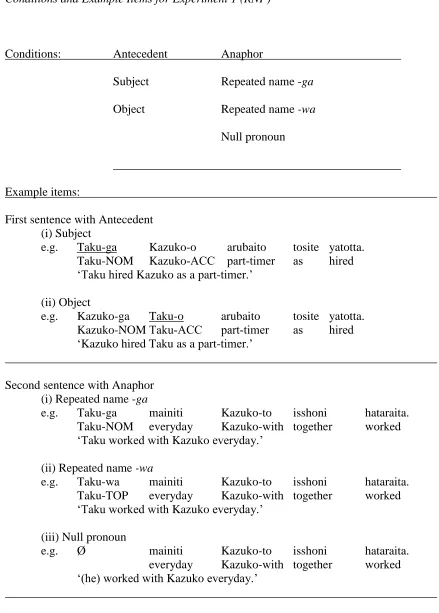
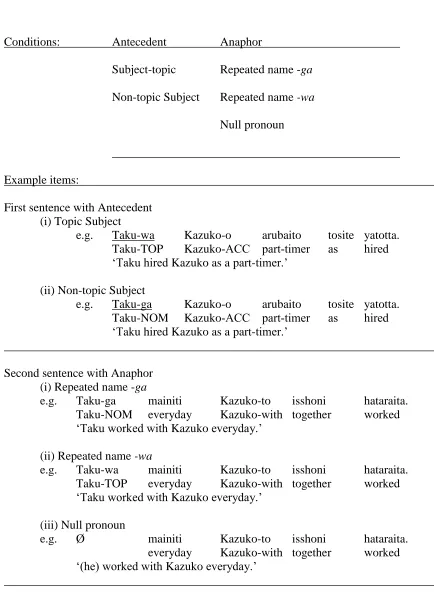
Table 6.1 Conditions and Example Items for Experiment 1 (RNP) ... 77
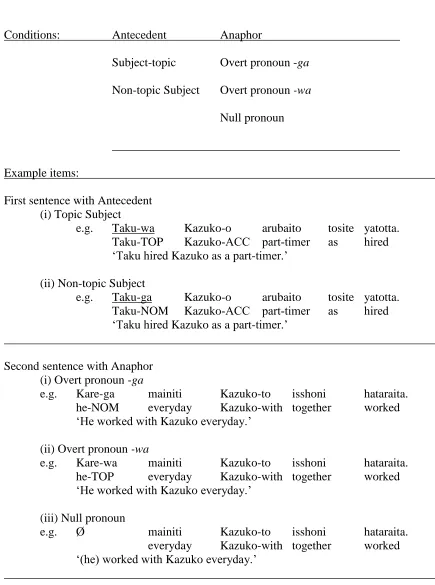
Table 6.2 Conditions and Example Items for Experiment 2 (OPP) ... 78
Table 6.3 Omnibus RNP Analyses for Experiment 1 ... 83
Table 6.4 Separate RNP Analysis for Experiment 1: Null Pronoun vs. Repeated-name Non-topic-ga ... 84
Table 6.5 Separate RNP Analysis for Experiment 1: Null Pronoun vs. Repeated-name Topic-wa ... 85
Table 6.6 Simple Subject vs. Object Antecedent Effects for Anaphor Form in Experiment 1 ... 86
Table 6.9 Separate OPP Analysis for Experiment 2:
Null Pronoun vs. Overt-pronoun Topic-wa ... 90
Table 6.10 Simple Subject vs. Object Antecedent Effects for Anaphor Form in Experiment 2 ... 91
Table 7.1 Conditions and Example Items for Experiment 3 (RNP) ... 98
Table 7.2 Conditions and Example Items for Experiment 4 (OPP) ... 99
Table 7.3 Omnibus RNP Analyses for Experiment 3 ... 101
Table 7.4 Separate RNP Analysis for Experiment 3: Null Pronoun vs. Repeated-name Non-topic-ga ... 102
Table 7.5 Separate RNP Analysis for Experiment 3: Null Pronoun vs. Repeated-name Topic-wa ... 103
Table 7.6 Simple Topic vs. Non-topic Antecedent Effects for Each Anaphor Form in Experiment 3 ... 104
Table 7.7 Omnibus OPP Analyses for Experiment 4 ... 106
Table 7.8 Separate OPP Analysis for Experiment 4: Null Pronoun vs. Overt-pronoun Non-topic-ga ... 107
Table 7.9 Separate OPP Analysis for Experiment 4: Null Pronoun vs. Overt-pronoun Topic-wa ... 108
Table 7.10 Simple Topic vs. Non-topic Antecedent Effects for Each Anaphor Form in Experiment 4 ... 109
Table 8.1 Verbs in Items of Experiment 5 and 6 ... 117
Table 8.2 Conditions and Example Items for Experiment 5 (RNP) ... 119
Table 8.3 Conditions and Example Items for Experiment 6 (OPP) ... 120
Table 8.4 Omnibus RNP Analyses for Experiment 5 ... 123
Table 8.5 Separate RNP Analysis for Experiment 5: Null Pronoun vs. Repeated-name Non-topic-ga ... 124
Table 8.7 Simple Empathy-locus vs. Non-empathy-locus Antecedent
Effects for Each Anaphor Form in Experiment 5 ... 126
Table 8.8 Omnibus OPP Analyses for Experiment 6 ... 128
Table 8.9 Separate OPP Analysis for Experiment 6:
Null Pronoun vs. Overt-pronoun Non-topic-ga ... 129
Table 8.10 Separate OPP Analysis for Experiment 6:
Null Pronoun vs. Overt-Pronoun Topic-wa ... 130
Table 8.11 Simple Empathy-locus vs. Non-empathy-locus Antecedent
Effects for Each Anaphor Form in Experiment 6 ... 131
Table 8.12 Omnibus OPP Analyses for Experiment 6
with Ageru/Kureru ‘give’ & ‘do a favor of –ing’ ... 134
Table 8.13 Separate OPP Analysis for Experiment 6: Null Pronoun vs. Overt-pronoun Non-topic-ga
with Ageru/Kureru ‘give’ & ‘do a favor of –ing’ ... 135
Table 8.14 Separate OPP Analysis for Experiment 6: Null Pronoun vs. Overt-pronoun Non-topic-wa
with Ageru/Kureru ‘give’ & ‘do a favor of –ing’ ... 136
Table 8.15 Simple Empathy-locus vs. Non-empathy-locus Antecedent Effects for Each Anaphor Form in Experiment 6
List of Figures
Figure 2.1. Referents allowed to be referred to with kare ‘he’ and
kanojo ‘she’ ...27
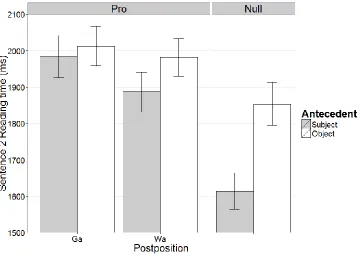
Figure 6.1. Reading times of the second sentences with anaphors in
Experiment 1 ...82
Figure 6.2. Reading times of the second sentences with anaphors in
Experiment 2 ...87
Figure 7.1. Reading times of the second sentences with anaphors in
Experiment 3 ...100
Figure 7.2. Reading times of the second sentences with anaphors in
Experiment 4 ...105
Figure 8.1. Reading times of the second sentences with anaphors in
Experiment 5 ...122
Figure 8.2. Reading times of the second sentences with anaphors in
Experiment 6 ...127
Figure 8.3. Reading times of the second sentences with anaphors in
Experiment 6 with items ageru/yaru & kureru...133
Chapter 1. Introduction
The primary objective of this study is to investigate the effects of the Repeated
Name Penalty (RNP) and the Overt Pronoun Penalty (OPP) in Japanese. The RNP was
first reported by Gordon, Grosz and Gilliom (1993), who investigated the processing of
personal pronouns and repeated names when these anaphors refer to person referents.
They observed that when anaphoric reference appears in the subject position of a
sentence, sentences with repetitive full referential noun-phrase (NP) anaphors (i.e.,
repeated names of the referent person) were read slower than pronouns. This slowed
reading time is not attributed to the shorter length of pronouns relative to repeated names
because it was only observed with subject anaphors referring to antecedents that were
either the grammatical subject (e.g., John gave Mary a pet hamster. John/He didn’t have
a cage to put it in.) or the first-mentioned surface-initial NP (e.g., In John’s opinion,
Mary should not have given him a pet. John/He didn’t have a cage to put it in.). In
contrast, when their antecedents were the grammatical object, the form of an anaphor (i.e.,
pronoun, repeated name) did not affect the speed with which the sentence was read. This
interaction between anaphors and antecedents is the indication of the RNP. On the other
hand, studies of a number of null subject languages such as Spanish (Gelormini-Lezama
& Almor, 2011), Italian, and Brazilian Portuguese (Almor, de Carvalho Maia, Cunha
John/He/Ø didn’t have a cage to put it in.). Gelormini-Lezama and Almor (2011) named
this slowed reading of overt pronouns relative to null pronouns the Overt Pronoun
Penalty (OPP). The current study investigated if we detect these processing penalties with
different anaphors referring to different antecedents in Japanese.1
In addition to the anaphor forms investigated in the previous studies above (i.e.,
repeated names, overt pronouns and null pronouns), the present study also examined a
discourse-based NP category, the topic, as an anaphor. Previous studies examining the
RNP and OPP observed slower readings of repeated-name subjects relative to
overt-pronoun subjects and slower readings of overt-overt-pronoun subjects relative to null-overt-pronoun
subjects. However, it still remains unclear whether these effects reflect a grammatical
constraint associated with anaphors’ grammatical subject-hood or an information
structure constraint associated with anaphors’ topic-hood. This lack of clarity likely
reflects the fact that the subject and topic were not overtly differentiated in the languages
examined in the previous studies. In Japanese, the topic is expressed either in the form of
a null pronoun or as an NP with the topic postposition, wa.2 Both forms are distinct from
non-topic NPs, which are not null or not marked by wa. By overtly differentiating the
topic NP and non-topic NP, the present study measured the reading times of sentences
with the topic or non-topic anaphors that were repeated names, overt pronouns and null
pronouns. In sum, five variations of anaphors were used in this study: repeated-name
1 This dissertation uses the terms, anaphor as an element that refers to an entity that was
introduced before, and antecedent as an element that was introduced before.
2 In some linguistic studies, postposition is differentiated from marker. This dissertation
topic, repeated-name non-topic, overt-pronoun topic, overt-pronoun non-topic, and
null-pronoun topic.3 Following Gelormini-Lezama and Almor (2011), for the examination of
RNP, reading times of repeated-name-topic/repeated-name-non-topic sentences and
null-pronoun sentences were compared; for the examination of OPP, reading times of
overt-pronoun-topic/overt-pronoun-non-topic sentences and null-pronoun sentences were
compared. I looked for the interactions of these anaphors above and different types of
antecedents as the indications of RNP and OPP (baseline: null pronouns for anaphors,
salient antecedents for antecedents).
The reading times of anaphors are also affected by the salience of antecedents. In
the previous studies, slower reading occurred when the antecedents were the grammatical
subjects or first-mentioned NP in the sentence. In other words, the relative slower reading
of certain types of anaphors (e.g., English repeated-name anaphors, Spanish overt
pronouns) is observed when the antecedents are highly salient. Salience refers to the
3 In some syntactic perspectives, the structure of null topic sentences involve an empty
operator in the complementizer phrase (CP) spec position. For example, the sentence
Moo tabeta ‘already ate’ with an understood topic is, [CP Op[TOP]i [IP proi moo [VP tabe]ta].
However, this dissertation does not concern the syntactic position of the topic as
Newmeyer (1999) and Lambrecht (1994) state that it is impossible for grammars to
directly mirror any discourse function. Therefore, this dissertation treats null-pronoun
topic subjects and overt NP-wa topic subjects only as the discourse topic and
grammatical subject (i.e., [IP NP-wa/pro [VP V]]). Also, non-topic-subject anaphors with
degree of activation in readers’ memory; an entity being salient means that the entity is
highly activated in readers’ working memory. The salience of an antecedent is
determined by its syntactic category and by the sentence’s word order (e.g., subjects are
more salient than non-subjects; first-mentioned NPs are more salient than the other NPs).
The change in reading speeds based on the salience of the antecedent reflects the different
levels of ease of retrieval for the antecedent. Ariel (1990) calls the level of the ease of
antecedents’ retrieval accessibility. Grosz, Joshi and Weinstein’s (1995) Centering
Theory suggests an accessibility-ranking of antecedents based on the antecedents’
grammatical categories: Subject > Object > Others, from the most accessible to the least
accessible. For example, in the sentence shown below, the subject John is more
accessible than the object, Chris, i.e., John is easier to retrieve than Chris.
(1) John slapped Chris. He…
While Grosz, et al.’s ranking is based on the grammatical categories of
antecedent-NPs, Ariel (1990) and Gundel, Hedberg and Zacharski (1993) maintain that
antecedents’ accessibilities and salientces are enhanced by the topic-hood of the
antecedents (i.e., Topic > Non-Topic). For example, in the following discourses, both the
topic antecedent and non-topic antecedent are grammatical subjects below. However for
the anaphor He, the topic antecedent he in (2a) might be more accessible than the
non-topic antecedent Peter in (2b).
(2) a. As for Peter, he slapped Mary. He….
b. Peter slapped Mary. He….
In addition, Walker, Iida and Cote (1994) suggest that the accessibility is also
entity that the speaker is empathizing with is more accessible than the other entities. For
instance, in (3a) below, the speaker uses the term [Taro’s] daughter to describe Hanako,
so the speaker is empathizing more with Taro than Hanako (i.e., Taro is the speaker’s
empathy locus). In contrast, in (3b), the speaker states Hanako’s father to describe Taro,
so the speaker is empathizing more with Hanako than Taro (Hanako is the speaker’s
empathy locus).
(3) a. Taro hugged his daughter Hanako. He….
b. Hanako’s father Taro hugged her. He….
Taro is the grammatical subject in the first sentence of both discourses, so for the anaphor
He, Taro should be equally accessible in (3a) and (3b). However, the accessibility of
Taro could be lower in (3b) relative to (3a).
The current study tested the saliences and accessibilities of these different
antecedents: subject vs. object, topic vs. non-topic, and empathy locus vs. non-empathy
locus. These antecedents’ accessibilities are examined along with the five different
anaphors listed earlier (i.e. repeated-name topic, repeated-name non-topic, overt-pronoun
topic, overt-pronoun non-topic, and null-pronoun topic).
The present study investigates processing of anaphors that refer to a person
referent, using the different types of anaphors and antecedents listed above in order to
investigate the RNP and OPP in Japanese.4 This study conducted a series of self-paced
4 Following Gordon et al. (1993) and Gelormini-Lezama and Almor (2011), this study
focuses on the processing of anaphors that are either repeated names, overt pronouns or
reading experiments, following Gordon, Grosz and Gilliom (1993) and
Gelormini-Lezama and Almor (2011). To my knowledge, there are relatively few experimental
studies on the online processing of different anaphors and antecedents in Japanese or on
the influence of topic and empathy. This study aims to fill this gap in the literature,
contributing to a cross-language understanding of reference.
This dissertation is organized as follows. Chapter 2 discusses anaphor forms,
particularly repeated names, overt pronouns and null pronouns, and reviews earlier
studies that tested different processing patterns with these anaphors. The chapter also
includes a detailed review of pronouns in Japanese. Chapter 3 describes postpositions in
Japanese. Because postpositions mark anaphors, they could affect anaphor processing.
Chapter 4 discusses antecedents. The chapter focuses on three different contrasts of
antecedent types, which are mentioned above: grammatical subjects vs. non-subjects,
discourse-topic vs. non-topic, and empathy locus vs. non-empathy locus. Chapter 5
describes a broad overview of the six experiments for the current study. Chapter 6
describes Experiments 1 and 2, which tested the RNP (Experiment 1) and the OPP
(Experiment 2) with subject antecedents vs. non-subject antecedents. Chapter 7 describes
Experiments 3 and 4, which tested the RNP (Experiment 3) and the OPP (Experiment 4)
with topic antecedents vs. non-topic-antecedents. Chapter 8 describes Experiments 5 and
6, which tested the RNP (Experiment 5) and the OPP (Experiment 6) with empathy-locus
antecedents vs. non-empathy-locus antecedents. Chapter 9 provides the general
discussion on all the experiments and their outcomes, and Chapter 10 concludes this
dissertation.
Chapter 2. Anaphors
Anaphors, the Repeated Name Penalty, and the Overt Pronoun Penalty
It has been widely argued that different anaphor forms such as repeated names,
overt pronouns and null pronouns differently affect reference production and resolution.
A number of early studies on English found the preference for using pronouns in
substitution for repetitive full NPs when referring to antecedents. For example, Sanford,
Moar and Garrod (1988) suggested that, while pronouns refer to antecedents, full NPs
generally introduce new entities into discourse. In addition, Cloitre and Bever’s (1988)
study found that readers process the reference faster when an anaphor is a pronoun rather
than when it is a full NP.
On the other hand, Gernsbacher’s (1990) research on repeated names and personal
pronouns claimed that the more that the information denoted by an anaphor overlaps with
the information of its antecedent, the easier it is to realize their referential relationship.
Thus, she suggested that informative anaphors such as repeated names have an advantage
over less informative ones such as pronouns because a repeated-name anaphor includes
information that fully matches the information of its antecedent. According to this view,
repeated-name anaphors activate the antecedents most effectively and should be
processed faster than the anaphors in less informative forms (e.g. pronouns).
repeated-name anaphors are read slower than comparable sentences with pronoun
anaphors (e.g., John gave Mary a pet hamster. John/He didn’t have a cage to put it in.).
Gordon et al. named this slower reading of repeated-name anaphors the Repeated Name
Penalty (RNP). They found that slowed reading of repeated names only occurs for subject
anaphors that refer to antecedents which are either positioned high in the syntactic tree,
namely as the subject (e.g., John gave Mary a pet hamster. John/He didn’t have a cage to
put it in.) or as the first-mentioned surface-initial NP (e.g., In John’s opinion, Mary
should not have given him a pet. John/He didn’t have a cage to put it in.). A summary of
Gordon et al.’s findings is shown in Table 2.1 below.
Table 2.1
The Repeated Name Penalty (Gordon et al., 1993)
Experiments Antecedent Anaphor Results
Experiment 1 Subject Repeated name (Subject) Slower reading
Pronoun (Subject)
Object Repeated name (Object)
Pronoun (Object)
Experiment 2 Subject Repeated name (Surface-initial Non-subject)
Pronoun (Surface-initial Non-subject)
Experiment 3 Subject Repeated name (Non-surface-initial Subject) Slower reading
Pronoun (Non-surface-initial Subject)
Object Repeated name (Surface-initial Non-subject)
Experiment 4 Subject Repeated name (Subject) Slower reading
Pronoun (Subject)
Object Repeated name (Subject)
Pronoun (Subject)
Experiment 5 Non-surface-initial Subject Repeated name (Subject) Slower reading
Pronoun (Subject)
Surface-initial Non-subject Repeated name (Subject) Slower reading
Pronoun (Subject)
Gordon et al. (1993) used two-sentence discourses in this study above, but Gordon,
Hendrick, Ledoux and Yang (1999) found that the same processing penalty in a single
sentence that includes two clauses (e.g., John went to the store so that John/he could buy
candy.); an antecedent in the first clause and an anaphor in the second clause.5
Although the studies described above investigated the differential processing of
repeated names and pronoun anaphors, anaphors’ forms are not limited to repeated names
and overt pronouns in many other languages. For example, Spanish and Italian utilize
null pronouns for the subject in addition to overt pronouns. Several studies on the null
and overt pronouns in Romance languages seem to show equivalences between English
overt pronouns and Spanish/Italian null pronouns and between English repeated names
and Spanish/Italian overt pronouns. In other words, English overt-pronoun subjects and
Spanish/Italian null-pronoun subjects are preferred to English repeated-name subjects and
For example, Alonso-Ovalle, Fernández-Solera, Frazier and Clinton (2002) examined
differences in the use of null pronouns and overt pronouns in Spanish. Based upon the
findings of their written questionnaire study, native Spanish speakers used null pronouns
to refer to subject antecedents 73.2% of the time but used overt pronouns only 50.2% of
the time to refer to subject antecedents. Also, in the acceptability judgment tests from the
same study, sentences using null-pronoun anaphors to refer to subject antecedents were
seen as significantly more acceptable than those using overt pronouns. In addition, Sorace
and Filiaci’s (2006) sentence-interpretation experiment in Italian used null and overt
pronouns referring to ambiguous antecedents. The results showed that native
Italian-speaking participants tended to interpret the null-pronoun subjects referring to the subject
antecedents, and tended to interpret the overt-pronoun subjects referring to the object
antecedents. Belletii, Bennati and Sorace (2007) state that, “typically, an overt
pronominal subject of an embedded clause does not refer to the preverbal lexical subject
of a superordinate clause…, whereas a null subject does” (p. 660).
Gelormini-Lezama and Almor (2011) conducted a self-paced reading study in
Spanish, following Gordon, Grosz and Gilliom (1993). They found that sentences with
repeated-name or overt-pronoun subject anaphors were read slower than sentences with
null-pronoun subject anaphors when the antecedents were in the subject position of the
previous sentence (e.g., Juan se encontró con María. Juan/El/ Ø la vio triste. ‘Juan met
with Maria. Juan/He/Ø found her sad.’). They argued that the slower reading of the
repeated names reflects an RNP in Spanish whereas the slower reading of overt pronouns,
which they called the Overt Pronoun Penalty (OPP), is specific to null subject languages.
effect was reversed when the antecedents were the object; sentences with null-pronoun
anaphors were read slower than sentences with overt pronouns and repeated names. Their
findings are summarized below.
Table 2.2
The Overt Pronoun Penalty (Gelormini-Lezama & Almor, 2011)
Experiment Antecedent Anaphor Results
Experiment 1 Subject Repeated Name (Subject) Slower reading
Overt Pronoun (Subject) Slower reading
Null Pronoun (Subject)
Object Repeated Name (Subject)
Overt Pronoun (Subject)
Null Pronoun (Subject) Slower reading
Gordon, Grosz and Gilliom (1993) originally explained the RNP in the framework
of Centering Theory (Grosz, Joshi & Weinstein, 1995), arguing that this effect violates a
principle mandating the use of pronouns to refer to the most prominent entity in the
discourse. Gordon and Hendrick (1998) later modified this explanation into Discourse
Prominence Theory (DPT).6 They argued that repeated names are initially interpreted
non-anaphorically such that the reader of a repeated-name anaphor first establishes a new
representation of the entity referred to by the repeated name and only then searches for a
possible matching antecedent, starting with the least prominent antecedent and
proceeding in increasing order of antecedent prominence. In contrast, pronouns are
immediately interpreted as anaphors that need antecedents, which are searched for in
decreasing order of antecedent prominence, starting with the most prominent antecedent.7
Thus, for prominent antecedents, pronouns are processed faster than repeated-name
anaphors. However, the DPT cannot explain the different distributions of null and overt
pronouns in Spanish and Italian, which are detected by Frazier and Clinton (2002),
Sorace and Filiaci (2006) and Gelormini-Lezama and Almor (2011). Specifically, when
antecedents are prominent ones such as grammatical subjects, the use of overt pronouns
is inappropriate. This does not agree with the DPT because overt pronouns should be
immediately interpreted as anaphors as long as they are pronouns, and thus null and overt
pronouns should behave similarly.
Almor (1999) offered an alternative explanation for the advantage of using
pronouns over repeated names when referring to prominent (or salient) antecedents.
Almor’s explanation is based on the Grice’s (1975) Maxim of Quantity, which insists on
the pragmatic functionality of an utterance: “Make your contribution as informative as
required” (Grice, 1975, p. 45). According to Almor’s Informational Load Hypothesis
subjects are more prominent than objects since subjects c-command objects, and objects
do not c-command subjects.
7 This dissertation considers that the words salience and prominence roughly mean the
(ILH), the amount of semantic information that an anaphor carries must be just enough to
identify the referent and, in some cases, add new information to the discourse. When the
subject is the intended antecedent, because the subject is the default antecedent, an
anaphor referring to the subject does not have to carry much semantic information that
repeated-name anaphors carry. Therefore, using repeated-name anaphors for subject
antecedents provides too much semantic information that serves no discourse function,
slowing reading. On the other hand, the RNP does not occur when the antecedent is not
the subject, because the semantic information carried by a repeated-name anaphor then
serves a discourse function in helping readers avoid the default antecedent (i.e., subject)
and identify a non-subject NP as the antecedent.
The same explanation can be applied to Gelormini-Lezama and Almor’s (2011)
findings of both the RNP and OPP in Spanish. Gelormini-Lezama and Almor found that
Spanish overt pronouns and repeated names lead to equally slower readings than null
pronouns. These results suggest that both overt pronouns and repeated names in Spanish
carry more semantic information than is necessary in order to identify subject antecedents.
The information that Spanish overt pronouns carry is redundant because their gender and
number features overlap with the information that Spanish verbal morphology provides.
The information carried by rich verbal morphology and by overt pronouns
accumulatively could reach a level where they penalize readers’ processing. This
argument is supported by the fact that the OPP is not observed in Chinese, which does
not employ verbal morphology (Yang, Gordon, Hendrick & Wu, 1999). On the other
indicates that readers needed informative anaphors to avoid the default antecedent (i.e.,
subject) and identify the object antecedent; overt pronouns and repeated names were
satisfactory informative but null pronouns were not.
Using overt-pronoun anaphors in Spanish referring to salient subject antecedents
will be accepted in a given context where the anaphor is focused (Larson & Lujàn, 1989).
(4) a. Cuando Juan trabaja, *él/Ø no bebe.
when John work, he/Ø not drink.
‘When John works, he doesn’t drink.’
b. (John allows other people to drink when they work. However,)
Cuando Juan trabaja, él/Ø no bebe.
when John work, he/Ø not drink.
‘when John works, he doesn’t drink.’
(Larson & Lujàn, 1989, p. 13)
In (4a) above, the use of an overt pronoun is avoided and a null pronoun is preferred
instead, as Gelormini-Lezama and Almor’s (2011) OPP experiments empirically revealed.
However, in (4b) above, the overt pronoun is read natural in the context that John is
focused in the contrast with the other workers. This usage of Spanish overt pronouns is
accepted because it contributes to the identification of the antecedents among competing
entities. In this regard, Spanish overt pronouns parallel English stressed pronouns, as
shown below (Larson & Lujàn, 1989). In (5a) below, the overt pronoun he cannot be
stressed, but it can be in (5b) where John is focused among multiple people.
(5) a. When John works, *HE/he doesn’t drink.
b. (John allows other people to drink when they work, but)
when John works, HE/he doesn’t drink.
Likewise, both English and Spanish should allow the use of repeated-name anaphors
when they focus one of multiple antecedents. Studies regarding the RNP in English
(Gordon, Hendrick, Ledoux & Yang, 1999; Swaab, Camblin & Gordon, 2004; Nair &
Almor, 2009) illustrate that reading speed does not slow when a repeated-name anaphor
focuses one of the equally salient antecedents in a conjoined phrase (e.g., John and Mary
went to the store. John wished to buy some candy.). Also, the original OPP study by
Gelormini-Lezama and Almor (2011) shows that neither the RNP nor OPP occurs when
Spanish repeated-name and overt-pronoun anaphors are the discourse focus. In their
Experiment 2, they explicitly gave a focus-hood on anaphors by utilizing the it-cleft
structure (e.g., John met with Maria. It was John/he/Ø who found her sad.). The results
showed that the sentences with repeated names were read the fastest, sentences with overt
pronouns were read the second fastest, and those with null pronouns were read the
slowest. These outcomes demonstrate that, when an anaphor is a focused entity, the
anaphor is preferred to be in an overt form (i.e., English and Spanish repeated names and
Spanish overt pronouns), contrary to the RNP and OPP.
Overt Pronoun in Japanese
Japanese utilizes both overt pronouns and null pronouns. Gundel, Hedberg and
Zacharski’s (1993) Givenness Hierarchy shows the equivalent anaphors’ forms across
five languages including English, Spanish and Japanese, as shown below. According to
the Givenness Hierarchy, English stressed pronouns, Spanish overt pronouns and
Japanese overt pronouns are equivalent, which refer to antecedents activated in working
tend to use null pronouns and full NPs including referents’ names, their titles (e.g.,
“teacher”) and kinship terms (e.g., “mother”) (Shibatani, 1990).
Table 2.3
The Givenness Hierarchy: Equivalent Anaphor Forms in English, Spanish and Japanese (Gundel et al., 1993, p. 284)
Anaphor
Language for more salient antecedent < --- > for less salient antecedents
English (unstressed) he/she (stressed) HE/SHE the NP
Spanish Ø él/ella el NP
Japanese Ø kare/kanojo NP
Clancy’s (1980) corpus study finds that, when referring to a 3rd person, Japanese speakers’
narratives employed null pronouns (73.2%) and full NPs (26.8%) but never used overt
pronouns. Nagano’s (2012) corpus study shows that, when referring to a 3rd person, only
0.5% of predicates used an overt pronoun in her oral interview with native Japanese
speakers. Miyaji’s (1964) corpus study with Japanese magazines finds that 90.15% of
references to the 1st person were made with overt pronouns, but 28.47% of references to
the 2nd person and only 0.15% of references to the 3rd person were made by overt
pronouns. Almost all of the other references without overt pronouns were made by
tendency to avoid [the overt-pronoun] use as often as possible and to carry on
conversation using some other words to designate speaker and address” (p. 92).
It is of importance to note that the class of expressions referred to as “Japanese
overt pronouns” is syntactically, semantically, and pragmatically different from overt
pronouns in many other languages including English and Spanish, as Clancy (1980) and
Hirose (2000) maintain that Japanese does not have a system of overt pronouns
corresponding directly to those of English. Further, in observing the distribution of
Japanese overt pronouns, they might not be “pronouns” in the traditional sense. One of
the unique properties of Japanese overt pronouns that are distinct from other languages’
pronouns is that they can be modified by a clause or an adjective, just like regular nouns.
In other words, it is grammatical in Japanese to say, “he, whom I saw yesterday” or
“beautiful she”. Also, Japanese overt pronouns can be modified by demonstratives; it is
grammatical in Japanese to say, “this I” or “that he”. Another example of uniqueness of
Japanese overt pronouns is their length. In general, pronouns should be shorter than full
NPs for the purpose of communicative efficacy, but most Japanese overt pronouns such
as anata ‘you’ and kanojo ‘she’ are neither orthographically nor phonologically shorter
than a typical regular noun. Considering that “there is strong evidence that […] word
forms contribute to processing difficulty” (Jaeger & Tily, 2010, p. 326), Japanese overt
pronouns would not contribute to efficient communication. In addition, it is known that
Japanese 1st and 2nd person overt pronouns have a large number of forms, and most of the
forms of Japanese overt pronouns derive from regular nouns (e.g., watakusi ‘I’ originally
(Miyaji, 1964; Shibatani, 1990). Moreover, the use of each form is subject to
socio-cultural factors to a greater extent compared with other languages (Hinds, 1975; Kanaya,
2002; Obana, 2003a, b; Ono & Thompson, 2004; Palmroos, 2010).
1st person Overt Pronoun
Japanese 1st person pronouns (i.e., ‘I’ in English) include watasi, atasi, watakusi,
atakusi, watai, atai, wate, ate, boku, ore, ora, oira, wai, wasi, assi, oidon, uchi, zibun,
ware, soregasi, sessha, temae, onore and shosei. These variations are correlated with
socio-cultural factors such as the gender, age, and relative social standing of the speaker
and the addressee, as well as with other discourse-related and language-related variables
such as speech level (i.e. formality-familiarity), and dialectal differences. For example,
watasi and watakusi, which are perhaps the most general 1st person pronouns, are the
only forms normally used in formal situations such as business meetings, ceremonial
speeches, or employment interviews.8 If one does not call himself/herself watasi or
watakusi in an interview, and instead uses a cruder, more vernacular form of the 1st
person pronoun, such as ore, he/she would most likely not be hired, at least in the
white-collar job market. The 1st person forms atasi, atakusi, atai and ate are all variants of
watasi, watakusi, watai and wate with the deletion of the word-initial “w” (i.e., syncope).
Those forms without “w” are used in more informal situations than those with “w”.
Further, while the forms with “w” are used by both male and female speakers, those
without “w” are used only by females. If a male speaker calls himself atasi, he will sound
8 Although watasi and watakusi are formal versions of the 1st person pronoun, there is a
difference of the degree of formality between these two, i.e., watakusi is more formal
to some extent as though he was presenting himself as a female (e.g., he might be
transsexual). On the other hand, boku, ore, ora, oira, wai, wasi, assi and shosei are used
only by males. Among these words, boku and ore are the most common, but ore sounds
rougher, more masculine and more informal than boku. Shibatani (1990) shows the
differentiation of the uses of the 1st person pronouns based on gender and formality in the
table below.
Table 2.4
Distinction in Pronouns (Shibatani, 1990, p. 371)
Formal < --- > Informal
1st person
Male speaker watakusi watasi boku ore
Female speaker watakusi watasi atasi
However, gender and formality are not the only factors that determine the use of Japanese
overt pronouns. Age is another factor that comes to bear in determining the use of the 1st
person overt pronoun forms. For example, as wasi is typically used by older males at or
around retirement age, and boku is mainly used by younger males. The 1st person form
then, boku has come to express a speaker’s deference to his addressee, communicating
the sense that he is young, and less experienced than his addressee. If a highly
experienced or knowledgeable person with a high social status calls himself boku, that
means that he is bringing himself to a lower status in order to be humble or to fill the gap
of social statuses between himself and the addressee (i.e., the speaker is attempting to
speak in a frank and friendly manner). The forms ora and oira ordinarily communicate
that the speaker is a rustic individual (e.g., is from rural or countryside regions and likely
from Northern Japan).9 The forms uchi (which is also used as a regular noun that means
‘house/home’) and wai are dialectic terms of Western Japan, with uchi typically used by
females, and wai by males. The form oidon is also a dialect-specific 1st person pronoun
used by males in the southernmost region of Japan (i.e., Kyushu region). It is also a form
that is felt to be out of fashion, and its use has fallen off drastically in recent years.
Finally, the term zibun is often categorized by Japanese linguists as a reflexive pronoun
and is most commonly used as a 1st person pronoun by the people who have participated
in physically strict training regimens, such as in the Self-Defense Forces or a traditional
athletic team.10 Zibun as a 1st person pronoun became popular among military men before
9 A well-known example is found in a popular cartoon, Dragon Ball. Goku, the
protagonist, who grew up in a mountain, calls himself ora. In contrast, his son, Gohan,
calls himself boku, which reflects the influence from his mother who is obsessed with his
education.
10 The Self-Defense Forces are the military forces of Japan. Its activity is limited to
reactive defenses against attacks from outsiders and is prohibited from the participation in
Japan’s defeat in World War II. The use of zibun as the 1st person pronoun allows a
speaker to present himself as being traditional, and possessing a strong masculine
character. The terms soregasi, temae and onore were used a few hundred years ago, by
the people in high social classes (e.g. such as members of the samurai class), but very few
people now use these terms. The term shosei is extremely formal and exclusively used in
formal writing.
A Japanese speaker uses these different 1st person pronouns depending on
different situations. A boy who was born in countryside might call himself ora. If he
moves to a big city, he could change ora to boku and/or ore in an attempt to fix or hide
his rural background. He might use ore when talking with his classmates and boku when
talking with his school principal. If he becomes a businessman, he would have to use
watasi/watakusi (but he could still keep using ore when talking to his close friends or
family members). When he gets old and is retired, he might start calling himself wasi. If
he writes his autobiography before he dies, he might refer to himself in it using the
pronoun shosei. Summarizing, Japanese “1st person overt pronouns” are much more than
mere pronouns. They express a speaker’s gender, age, background, his relationship and
standing respective of the addressee, the level of formality and politeness particular to the
discourse context, and sometimes the mode of expression (i.e., written vs. spoken).
2nd person Overt Pronoun
Japanese 2nd person pronouns (i.e. ‘you’ in English) also have a large number of
forms. They include anata, anta, kimi, omae, omee, temee, kisama, onore, ondore, odore,
person pronouns are much more circumscribed in their use. That is, although these forms
can express different degrees of formality and politeness toward the addressee, none of
the 2nd person pronouns are simply not to be used when the addressee is older or of a
higher status than the speaker (Shibatani, 1990). For example, Tanaka (1993) recounts a
situation wherein a Chinese worker, an employee at a Japanese company founded in
China, called his Japanese boss anata, and the worker was fired on account of it. This is
because it is considered highly disrespectful to address a social superior with the use of
an overt pronoun. Also, the 2nd person overt pronoun is not be used in referring to an
addressee who is older than the speaker. For instance, Hasumi (1986) describes a
situation in which he was shocked by his Japanese-French bilingual child addressing him
as anata in Japanese. When addressing a social superior or someone who is older,
Japanese politeness conventions dictate that one should use their actual names (e.g., an
individual named Honda Jiro would be addressed as Honda-san ‘Mr. Honda’ by
someone who was not a close friend or acquaintance, and as Jiro-san by someone who
was so). Alternatively, one may address a person using their title (plus the respect ending
–san). Thus, one’s otoo ‘father’ would be otoo-san and one’s sensei ‘teacher’ might be
Sensei, Honda-sensei, or Jiro-sensei.
The most common 2nd person pronouns are anata, anta, kimi and omae.11 Among
these, anata and kimi are used in formal situations, and anta and omae are informal. For
instance, as an example of a formal situation, a professor can call his/her student anata or
11 As mentioned earlier, anata was originally a deictic term. Anata meant ‘a person in
distance/a distant place’; konata meant ‘the speaker/a place near the speaker’; sonata
kimi; if a professor calls a student anta or omae, the professor might appear to be either
overly friendly with or perhaps even rude to the student. As an example of an
appropriately informal situation, a parent is entitled to call his/her child anta or omae; if a
parent calls his/her child anata or kimi, their relationship would seem overly formal.
Japanese also has a number of 2nd person pronoun forms that have clearly negative
connotations and are used as insults or terms of disrespect. Included among these are
kisama, temee, onore, ondore, odore and ware. These forms are typically used when a
speaker is angrily yelling at or arrogantly insulting an addressee. They can be thought of
as equivalent to ‘you, bastard!’ in English. Note that these forms are derived from two
older 1st person pronoun forms, temae and onore. When used as 1st person pronouns,
they would communicate a reserved and humble disposition on the part of the speaker.
Thus, when used as 2nd person pronoun, their effect is the opposite. In this case they
communicate that the speaker deems the addressee as needing to be humble – which is an
insult, from a politeness perspective. In other words, by lowering the addressee’s status
rather than his own the speaker is seen to be looking down upon the addressee.
Interestingly, the meaning of kisama has changed over time; it originally expressed a
measure politeness toward an addressee, but is now used to insult. While zibun is used (as
we have seen) as a 1st person pronoun, it is also used as the 2nd person pronoun by
speakers of the Kansai regional dialect. Similarly, boku is a 1st person pronoun for young
males, but can be used as a 2nd person pronoun when talking to a small male child. Onusi,
nanji and unu are classical terms from pre-modern era, and are rarely used now. Kikei
Japanese 2nd person pronouns’ referents have to be persons, the referent of otaku can be
also an organization or institute (similar to English ‘you’). For example, one can say
otaku in referring to a company when talking with the telephone operator of the company,
as “I thought you (otaku) accept the payment by a credit card”.
3rd person Overt Pronoun
Unlike the 1st and 2nd person pronouns, Japanese 3rd person pronouns have only
two basic forms, namely kare ‘he’ and kanojo ‘she’. In this regard, Japanese 3rd person
overt pronouns are more comparable to those of English than are their 1st and the 2nd
person pronouns (Ishiguro, 2013). The reason that there are so few variant of the 3rd
person pronominal form is that Japanese did not traditionally ever have anything that
might be considered an overt 3rd person pronoun, and that they (these pronouns) were
originally coined for the purpose of translating texts written in Western languages
(Shibatani, 1991; Martin, 1975). In the mid-19th century, Japan was forced to abandon its
isolationist policy and began thenceforth to develop itself as an industrial and military
power. In this context, Japan began importing ideas (and texts) from the West, and
translators found the need to coin gendered pronouns that are equivalent to ‘he’ and ‘she’
in Western languages.
The 3rd person overt pronouns kare ‘he’ and kanojo ‘she’ are derived from a noun,
kare/ka, which meant ‘a distant location from a speaker’. When kare/ka was used to refer
to a person-entity, it indicated a person who was physically or psychologically distant
from the speaker, as a sign of politeness to the person. The word, kare ‘distant
location/person in distance’, was adapted as the counterpart of English ‘he’, and kanojo
genitive-postposition no and onna/jo ‘woman’, as shown below (Obana, 2003b; Ishiguro,
2013).12
(6) kare/ka
distant location/person in distance
kare
distant location/person in distance ‘he’
ka no onna/jo
distant location/person in distance GEN woman
‘she’
The construction ka-no NP is still found in contemporary Japanese. Two examples, ka-no
chi ‘that place’ and ka-no yumei-na NP ‘that famous NP’ are shown below.
(7) a. ka no chi
distant location GEN place
‘that place (which is very far and hard to reach)’
b. Taro-wa ka no yumei-na koneru daigaku-ni itta. Taro-TOP distant location GEN famous Cornell University-DIR went ‘Taro went to that famous Cornell University (that is prestigious and psychologically distant).’
Like the 1st and 2nd person pronouns, the uses of the 3rd person pronouns are also
socio-culturally constrained. They are not used when referents are older than, or socially
superior to, speakers, similar to the restrictions on 2nd person pronoun use. For instance, a
professor could say kare ‘he’ or kanojo ‘she’ when referring to his/her student, but a
12 ‘Woman’ in Japanese is onna (女). ‘She’ in Japanese was initially ka no onna. Around
1910, the pronunciation onna was replaced by jo, and ka no onna turned to ka no jo
student would not say kare ‘he’ or kanojo ‘she’ when referring to his/her professor. The
avoidance of kare ‘he’ and kanojo ‘she’ in reference to social superiors and elders reflects
a language change of the original word ka/kare. Where the words were formerly used as a
sign of politeness toward referents, they are now used in referring to socially lower or
younger people. Hinds’ (1975) questionnaire research confirmed that native Japanese
speakers accepted the uses of kare ‘he’ and kanojo ‘she’ when referring to someone
younger than oneself and socially inferior to the speaker. However, it is not simply the
case that kare ‘he’ and kanojo ‘she’ are avoided when referents are older than or socially
superior to speakers. The personal relationship between speakers and referents also
affects the usage of kare ‘he’ and kanojo ‘she’. Hinds (1975) found that they are avoided
when referents are personally close to speakers (e.g., family members, close friends) as
well as when referents have little personal relationship to speakers and listeners (e.g.,
strangers, celebrities), even if the referents are younger than and socially inferior to the
speaker. In sum, kare ‘he’ or kanojo ‘she’ are only used to refer to those who are younger
than the speaker, socially inferior to the speaker, personally acquainted with the
speaker/listener but not socially close to them. The interaction of these factors (i.e., age,
social status, and personal relationship) is roughly depicted in the graphic below. The
x-axis and y-x-axis express the status of referents relative to that of the speakers. Referents
Older/Socially superior
Closer relationship Less relationship
(e.g., family member) (e.g., stranger)
Younger/Socially inferior
Figure 2.1. Status and familiarity of individuals who can be referred to using kare ‘he’ or kanojo ‘she’
In addition to factors listed above, Hinds (1975) also reports that Japanese speakers feel
that the use of kare ‘he’ and kanojo ‘she’ is sophisticated and that they therefore tend to
use kare ‘he’ and kanojo ‘she’ in referring to a foreigner. In addition, these overt
pronouns are not used when the referent person is present at the time of utterance.13
Note that the socio-cultural constraints depicted above often do not apply in
written Japanese, especially in novels (Obana, 2003b). In novels, a writer has total
control over the characters, so he/she is socially neither superior nor inferior to them.
Also, he/she knows the characters, but not personally. Thus, novelists often use kare ‘he’
and kanojo ‘she’ to refer to the characters (except in conversations between characters)
13 Kare ‘he’ and kanojo ‘she’ were also developed to form regular nouns that mean
‘boyfriend’ and ‘girlfriend’, which Hinds calls the lover effect (Hinds, 1975, p. 133). A
famous example is a pop song from 1973, Watasi-no kare-wa hidari-kiki ‘my boyfriend
without being constrained by socio-cultural factors.
As mentioned earlier in this section, Clancy (1980), Nagano (2014) and Miyaji
(1964) revealed that 3rd person pronouns usage is much less prevalent than that of 1st and
2nd person pronouns. However, in written Japanese, as Obana (2003b), Ueno and Kehler
(2010) point out that “[3rd person pronouns] are used more frequently than before in
[Japanese people’s] daily life” (Obana, 2003b, p. 139), and that “they appear to be
becoming incorporated into daily Japanese at an increasing rate” (Ueno & Kehler, 2010,
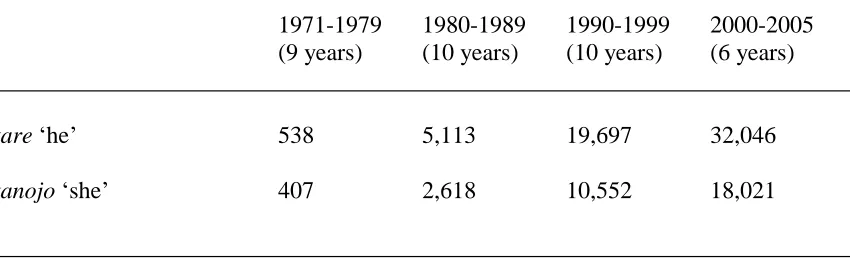
p. 2057). An observation with the Kotonoha Shonagon corpus
(http://www.kotonoha.gr.jp/shonagon) supports their view, as shown in the table below.14
14 In this corpus study, the search for kare ‘he’ was conducted by looking up this word’s
kanji character, 彼. The numbers shown in the table exclude the following words that
include this character:何彼, 誰彼, 彼我, 彼岸, 彼此, 彼氏, 彼ら, 彼等, 彼女ら, 彼女等,
彼処, 彼程, 彼奴, 彼方, 彼某, 元彼, 今彼, 前彼, 彼所, and 海彼 (see Apendix A for a
table showing readings and meanings of these words). In addition, the corpus also finds
the increasing uses of kare-ra ‘they’, which is the plural form of kare ‘he’: 172
(1971-1979), 1472 (1980-1989), 5516 (1990-1999), and 9934 (2000-2005). Likewise, the
corpus finds the increasing uses of kanojo-ra ‘they’, which is the plural form of kanojo
‘she’, as 2 (1971-1979), 48 (1980-1989), 127 (1990-1999), and 181 (2000-2005). A
limitation of this corpus research is that it could not exclude kare and kanojo used as
Table 2.5
Appearances of Kare ‘he’ and Kanojo ‘she’ in Books Published in 1971-2005
1971-1979 1980-1989 1990-1999 2000-2005
(9 years) (10 years) (10 years) (6 years)
kare ‘he’ 538 5,113 19,697 32,046
kanojo ‘she’ 407 2,618 10,552 18,021
Simultaneously, socio-cultural constraints on the use of the 3rd person overt pronouns
appear to be loosening among younger generations. Obana (2003b) replicated Hinds’
(1975) questionnaire research with participants in different generations (15 to 75 years
old). She finds that, compared to the participants older than 45 years old, those younger
than 45 tend to accept kare ‘he’ and kanojo ‘she’ used in reference to family members
and to both strangers and celebrities. They also tend to freely use kare ‘he’ and kanojo
‘she’ in a formal speech or writing, irrespective of the social relationship between the
speaker and the referent. These findings indicate that 3rd person overt pronouns usage
may be in a process of diachronic change. They might be becoming less constrained by
the socio-cultural factors, and on their way to becoming more pronoun-like in the sense
of Western languages.
more than simply pronouns, contrasting with Western languages. This begs the question
of whether they should be categorized as overt pronouns if their use extends beyond that
of overt pronouns in other languages. Based on the distributions of Japanese overt
pronouns, linguists such as Hashimoto (1948), Kuroda (1965), Wetzel (1994) and Kanaya
(2002) argue that there are no differences in morphosyntactic features between overt
pronouns and regular nouns in Japanese, and they suggest that what is called overt
pronouns should be classified as regular nouns. On the other hand, Hoji (1991),
Hasegawa (1995), Kinsui (1989), Okamura (1972) and Takubo and Kimura (1992)
categories kare ‘he’ and kanojo ‘she’ as demonstratives because they take kare ‘he’ and
kanojo ‘she’ to be used as indexing someone from the speaker’s viewpoint. Japanese has
a rich three-position system of deictic expressions, sometimes referred to as the so-called
ko-so-a-do paradigm. Expressions starting with ko indicate ‘something or someone close
to the speaker’; those with so indicate ‘far from the speaker and close to the hearer’; those
with a indicate ‘far from both the speaker and hearer’; and those with do are
interrogatives. Examples are shown below.
(8)
kore ‘this’ / koko ‘here’
sore ‘that (close to the hearer)’ / soko ‘there (close to the hearer)’
are ‘that (far from speaker and hearer)’ / are ‘over there (far from speaker and hearer)’
dore ‘which’ / doko ‘where’
Hoji (1991) discusses the similar distribution of those with a and kare ‘he / kanojo ‘she’,
i.e., the words with ka, suggesting that they are demonstratives.
pronouns should be classified as epithets, a category that Jackendoff (1972) calls
specialized pronouns (p. 110). Epithets, exemplified in English by expressions such as
the bastard, the idiot or the fool, carry semantic connotations that are often negative.
According to Dubinsky and Hamilton (1998), English epithets have nearly the same
distribution as pronouns from a syntactic perspective, being subject to Condition B of the
Binding Theory (Chomsky, 1981). This distribution is distinct from that of pronouns by
virtue of their having the added property of being anti-logophoric. Based on the sense of
the term logophoricity as introduced by Hagege (1974), logophoric pronouns are
pronominal expressions that exclusively refer to antecedents “whose speech, thoughts,
feelings, or general state of consciousness are reported” (Clements, 1975, p. 141).
Logophoricity thus entails a speaker’s situating himself in the place of (i.e., empathizing
with) the referent. Anti-logophoricity plays the opposite role; anti-logophoric pronouns
tend not to refer to antecedents when the sentence reports the antecedents’ speech or
thought (i.e., when the antecedent is the perspective-bearer). Dubinsky and Hamilton
claim that the pronominal quality of epithets is supported by the fact that they are subject
to Condition B of the Binding Theory. According to Condition B, pronouns may not be
bound in their governing category. Accordingly, the sentence Johni embarrassed the
idioti (in which John coreferential with the idiot) is ungrammatical for the same reason
that Johni embarrassed himi is, namely the subject John binds (i.e. c-commands and is
co-indexed with) the object expression the idiot/him in its governing category (Dubinsky
& Hamilton, 1998, p. 688). Further, in addition to being constrained in their distribution
anti-(9) a. *It was said by Johni that the idioti lost a thousand dollars on the slots.
b. It was said of Johni that the idioti lost a thousand dollars on the slots.
(10) a. *According to Johni, the idioti is married to a genius.
b. Speaking of Johni, the idioti is married to a genius.
(Dubinsky & Hamilton, 1998, p. 688)
The sentences (9a) and (10a) are ruled out because the above sentences report John’s (i.e.
antecedent) statements, and the epithets anti-logophorically avoid referring to it. Notice
that in neither (9a) nor (10a) can it be said that John binds the epithet, since it does not
c-command it. Thus, the acceptability of the sentences in (9) and (10) can be seen to vary
solely on account of the sentence taking (or not taking) John’s perspective. If the
sentence is logophoric relative to John (e.g., (10a)), then an epithet referring to John is
unacceptable, the epithet being anti-logophoric. Yashima (2014) presents a paradigm
similar to this one, claiming that Japanese 3rd person overt pronouns are also pronouns
subject to Condition B of the Binding Theory, and further constrained by
anti-logophoricity.
(11) a. *Dono gakuseii-mo karei-o semeta.
every student-PART he-ACC blamed
‘Every student blamed himself’
b. *Dono gakuseii-mo [karei-ga isya-ni naru] to sinziteiru.
every student-PART he-NOM doctor-as become that believe
‘Every student believes that he will become a doctor.’
(Yashima, 2014, p. 1430)
The sentence (11a) is ungrammatical because it violates Condition B, and (11b) is
gakusei ‘student’ that is the agent of believing.15 We can observe that (11b) is not ruled
out by Condition B, since kare is bound by an expression dono gakusei that is outside its
governing category. The following data from Kuno (1986) also demonstrates the
anti-logophoric property of Japanese overt pronouns.
(12) a. *[Hanakoi-ga tensai da] to kanozyoi-ga omotte iru.
Hanako-NOM genius is that she-NOM thinking
‘Hanako thinks that she is a genius.’
b. [Hanakoi-ga tensai da] to kanozyoi-no ryoosin-ga omotte iru. Hanako-NOM genius is that she-GEN parents-NOM thinking
‘Hanako’s parents think that she is a genius.’
(Kuno, 1986, p. 42)
The sentence (12a) is not acceptable because the sentence reports Hanako’s thought, and
the overt pronoun kanozyo (or kanojo) ‘she’ is referring to Hanako (i.e., Hanako is the
perspective-bearer). On the other hand, (12b) is acceptable because the sentence reports
the thought of Hanako’s parents’, not Hanako’s (i.e., Hanako’s parents are the
15 The unacceptability of (11b) could be accounted for by a widely accepted view that
Japanese overt pronouns cannot be interpreted as bound variables (Saito & Hoji, 1983).
However, according to Yashima, this account is not enough because there are sentences
in which an overt pronoun can become a bound variable, as shown in the one below.
perspective-bearer). Again, neither occurrence of kanozyo violates Condition B, since
Hanako does not c-command kanozyo.16
On the other hand, Kanno (1997) and Pimentel’s (2014) questionnaire-based
experiments present data in which kare ‘he’ and kanojo ‘she’ might be taken to not be
anti-logophoric. They used items similar to (12a) above, such as Yamamoto-san-ga [asita
kare-ga butyooo-ni au to] itteimasu yo ‘Mr. Yamamoto is saying that he (kare) will meet
the division manager tomorrow’ (Kanno, 1997, p. 283; Pimentel, 2014, p. 174).17 For this
type of sentence, Kanno and Pimentel asked native Japanese speakers whether kare’s
antecedent was (i) Yamamoto (logophoric antecedent), (ii) another person
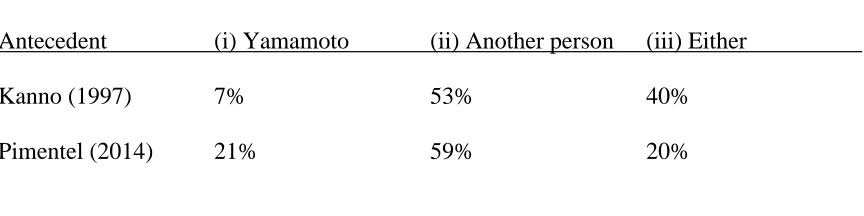
(anti-logophoric antecedent) or (iii) either Yamamoto or another person. Their results are
shown below.
16 Yashima (2014) maintains that a sentence such as (12a) is acceptable because in his
view, Japanese 3rd person overt pronouns’ anti-logophoricity appears only when the
antecedents are quantified (e.g., Dono gakusei-mo ‘every student’ in (11a)). However,
Kanno and Pmentel’s data implies that the anti-logophoricity constraint extends to
non-quantified antecedents.
17 A difference between (12a) and Kanno and Pimentel’s sentence is that (12a) is a
scrambled sentence (OSV), while Kanno and Pimentel’s sentence is in the default word
Table 2.6
Antecedents of kare in ‘Yamamoto is saying that kare will meet the division manager tomorrow.’ (Kanno, 1997; Pimentel, 2014)
Antecedent (i) Yamamoto (ii) Another person (iii) Either
Kanno (1997) 7% 53% 40%
Pimentel (2014) 21% 59% 20%
Based on the results of participants’ acceptances for (i) Yamamoto plus (iii) either
Yamamoto or another person (7% plus 40% in Kanno; 21% plus 20% in Pimentel),
Kanno and Pimentel conclude that Japanese 3rd person pronouns can refer to logophoric
antecedents (e.g., Yamamoto), suggesting that they are not anti-logophoric. However, a
closer examination of these studies actually suggests that the anti-logophoric property of
kare/kanojo is real. One possible reason for coming to this conclusion from their studies
might lie in their presentation of experimental items. In the sentences that they provided
to participants, only logophoric antecedents were explicitly presented, without any
competing antecedent. The absence of anti-logophoric antecedents might well have
biased participants to accept an interpretation that they might not generate independently
(i.e., kare/kanojo’s reference to logophoric antecedents). Furthermore, even with the
possible bias, their results show that the participants dis-preferred the reference to (i)