Optimizing pain control through the use
of implantable pumps
Wilfried Ilias1
Boris Todoroff2
1Dept Anesthesiology, Intensive
Care Medicine and Pain Therapy, Academic Teaching Hospital St. John of God, Vienna, Austria; 2Dept. Plastic
and Reconstructive Surgery, Hospital of St. Vincent, Vienna, Austria
Correspondence: Wilfried Ilias Dept Anesthesiology, Intensive Care Medicine and Pain Therapy, Academic Teaching Hospital St. John of God, Grosse Mohrengasse 9, A-1020 Vienna, Austria Email [email protected]
Abstract: Intrathecal therapy represents an effective and well established treatment of nonmalignant as well as malignant pain. Devices available include mechanical constant fl ow pumps as well as electronic variable fl ow pumps with patient-controlled bolus release. The latter provide faster dose fi nding, individual pain control, and good acceptance by patients. New technologies such as membrane pumps and rechargeable devices are expected to be developed to clinical perfection. The available drugs for intrathecal therapy are listed according to the polyanalgesic consensus on intrathecal therapy. The integration of remote patient-controlled analgesia into electronic implantable devices, and the peptide analgesic ziconotide, have signifi cantly improved intrathecal therapy. Complications include infections, catheter ruptures or disconnections, catheter granulomas, and technical dysfunctions. Further possibilities for optimizing intrathecal therapy include development of new drugs, drug side effects, catheter and pump technologies, and surgical techniques.
Keywords: intrathecal therapy, implantable pumps, morphine pumps, intrathecal drugs, intrathecal catheters, intrathecal pain control
Introduction
Pain control is not only a question of an individual’s need, but also an increasing socio-economic issue. It may be presumed that not only pain specialists but also physicians in general are aware that pain meets the defi nition of illness if it dominates the life of an individual, and interferes with that individual’s undisturbed participation in normal life. There are many reports on epidemiology and socio-economic consequences (Elliott et al 1999). According to these data, adequate pain treatment demands both a therapeutic infra-structure (equipment, facilities and staff) as well as the availability of therapeutics.
MN, USA), which works on the basis of a gas-driven, capillary-controlled constant fl ow with a deformable reservoir, releasing a bolus when compressed (McMullen et al 1997). A more recent version of this invention is still in use and proved to be very cost effective (Erdine et al 2007). Based on a programmable battery-driven pump for the control of insulin release, the roller-pump-driven devices of the SynchroMed® (Medtronic Inc.) series seem to be the most advanced technology now in clinical use. This system, containing many electronic and mechanical parts, needs valuable space for the pump controller which limits the remaining space available for the drug reservoir. Further innovative designs, with space-sparing membrane pump tech-nology driven by piezoelectric devices, have been invented and successfully tested under clinical conditions (Kan et al 2004) and seem to a promising and space-saving alternative to the roller-pump technology.
The technical demands of implantable systems and also the drugs used for intrathecal or epidural application are being constantly studied. The relative merits of epidural and intra-thecal approaches are also under debate. Because of frequent reports of epidural masses after prolonged drug application (Rodan et al 1985), clinicians have favored intrathecal appli-cation, but there have been increasing numbers of reports of infl ammatory masses surrounding the catheter tips with this approach (Bennett et al 2000; Coffey and Burchiel 2002; Hassenbusch et al 2004). It became clear from these reports that the incidence of catheter granulomas increased when the concentration of morphine exceeded 1.5% or 15 mg/mL of the solution. However, owing to differences in underlying pain mechanisms and individual sensitivity to morphine and/or other analgesics, and the limited volume of the implanted device, fl ow rates will be refl ected in decreasing refi ll intervals. It should be pointed out that the only way to increase the refi ll interval of the implanted device is to increase the concentration of the solution. It is well known that there is an increasing risk of neurotoxicity related to drug concentration, osmolarity, and local distribution in the spinal fl uid (Malinovsky and Pinaud 1996; Auroy et al 1997; Gerancher 1997; Holman et al 1997; Chan et al 1998; Holst et al 1998; Loo and Irestedt 1999). In order to overcome these incompatibilities or risks, several drugs, combinations, and concentrations have been experimentally tested.
Medical procedures or regimens need to be optimized or improved when the available options show insuffi cient effec-tiveness, a need of extraordinary skills, or are of considerable risk. In the following sections the main requirements for optimizing intrathecal therapy are defi ned by breaking down intrathecal therapy in to its component parts. The available
drugs still show defi ciencies in effectiveness, stability in surrounding body temperature, compatibility of certain concentrations, lack of neural toxicity, as well as adverse side effects. Thus there is an ongoing effort to develop new drugs that will better meet these demands, either in single use or in combinations.
Optimizing drug regimes
approaches to pain management” (Deer et al 2007). Another important point in choosing a certain drug or combination may be the fact that exposure of a drug in a device made of metal and biologically compatible tubes under a surrounding temperature of more than 37°C may infl uence the stability of a certain drug or mixtures, as mentioned above. The usual tests, however, refer only to the possible degradation of a certain molecule but not to the biological activity of a drug. In larger molecules, such as ziconotide, which in chemical testing showed degradation when exposed to 37°C and when mixed with morphine (Shields and Montenegro 2007), it is yet clear whether this degradation affects its biological activityt. No reports are available on decreasing analgesia in ziconotide-treated patients during usual pump-refi ll intervals of 4 to 6 weeks. Hence it would be worthwhile to check whether drugs and solutions, which in chemical set ups show degradation of the original molecules such as ziconotide, also have different activity when tested in biological receptors.
The implantable pumps available for clinical use, although of very advanced technology, certainly need further adaptations in order to meet the demands of therapeutic fl exibility and overall acceptance.
Optimizing pain control by pump
technology innovations
The control of unpredictable pain fl uctuations has been a challenge to intrathecal therapy because, as mentioned above, the fi rst generations of implantable pumps were designed only to provide a constant fl ow of drugs. Although attempts to integrate bolus functions into gas-driven constant fl ow devices were successful (McMullen et al 1997), program-mable infusion pumps are superior not only for individualized infusion programs in spasticity and pain (Penn and Kroin 1987), but also for individual adaptation of intraperitoneal insulin application in diabetic patients (Saudek and Selam 1989). Compared with constant-fl ow devices, programmable pumps offer many advantages:
If pain levels or the sensitivity to the drug in use changes, increasing or decreasing demands can be easily met by changing the speed of infusion with a remote control device whenever necessary. To achieve this change in constant-fl ow devices the concentration of the drug solution needs to be changed. This presumes repeated emptying and refi lling of the pump reservoir through a puncture hole. Good experience in estimating individual demands are necessary in order to avoid short-interval repetitions of this procedure.
Predictive changes in pain levels owing to physical and emotional stress or resting periods as well as other individual
circadian rhythms can now be controlled by adapting personal infusion schemes to individual demands via remote program-ming. The same is possible with fl uctuating spasticity after reprogramming baclofen treatment, or with fl uctuating blood glucose levels after food intake and insulin infusion.
intervals according to the sum of volumes of the constant infusion and the maximum of possible boluses. And, of course, by sounding an alarm, the implanted device will remind the patient when the container volume falls below a predefi ned alarm value. If the patient needs more time to reach the refi lling institution, it may be worthwhile to take this into consideration when predefi ning the volume alarm limit. Finally, if not all possible boluses are used, the PTM will recalculate the refi ll time according to the remaining volume and display the time on the screen, thereby allowing patients to increase and control refi ll interval according to their individual demands. Of course, these many technical refi nements are expensive and raise the question of whether they are cost effective. A multi-center study, which included 168 patients with chronic cancer and non-cancer pain treated by intrathecal drug application by means of programmable pumps and the above-mentioned PTMs, showed a very good acceptance of the device after a 12-month period. The patients were able to manage unpredictable pain fl uctuations very actively, easily, and safely, and also learned to use the device to control expected pain fl uctuations by prophylactic recall of boluses. Repeated bolus and VAS readouts after device implantation devices shortened the time needed for physicians to optimize basal rates of drug delivery according to individual demands. On the other hand, optimal dose range was refl ected by a decrease in average daily bolus recalls. Overall satisfaction and acceptance of the PTM by patients was greater than 80%. The doctors reported better analgesia, individualized treatment, and patient independence. Doctors and patients preferred a smaller PTM for easier handling, and both found that the time needed to understand how to use and handle the device was too long (Ilias et al 2008).
Programmable pumps, because of their electronic and mechanical technology, are very bulky and currently offer far less volume capacity than constant-fl ow devices of similar external diameter. Depending on infusion speed necessary to deliver the demanded dose, batteries may be exhausted long before their expected lifetime, which happens when the drug solutions reach their maximum recommended concentrations (Deer et al 2007) and the daily doses necessary to provide analgesia exceed a volume of more than 1 to 2 mL. Hence there is also a need for new pump technologies needing less space and energy. Membrane pumps driven by piezo-electric mini crystals seem to meet both demands compared with other electronic pumps currently in clinical use (Kan et al 2004). Rechargeable devices for spinal cord stimulation are now being developed by Advanced Neuromodulation Systems (ANS), Boston Scientifi c, and Medtronic. This technology
could also be applied to intrathecal pumps, but no information is available on whether or how this technology is being adopted in medicine. Remote magnetic control could be used to open and close electronic capillaries, which could be used in gas-driven pumps, thereby combining electronic advantages with space-saving technology. Patents are pending on various designs. Again, no studies are available to prove the feasibility of these technologies. Ideas to split the drug reservoirs from the steering (or control) part are not new and have been incor-porated in an elastomer and capillary fl ow directed device with a patient control panel (AlgoMed®; Medtronic Inc.), which is still in clinical use and apparently is highly cost effective (Erdine and Talu 2007). The advantage of such devices is that the steering part and the refi ll port can be integrated in a protective and robust shell, with a fl at design in a very small set up. The reservoir can be designed as a robust but fl exible vessel, made of a biologically compatible and stress-resistant material, which therefore adapts to movements and pressure but does not directly compress or irritate the surrounding tissue, thereby forcing transdermal movement of the implant. Of course if such a vessel containing extraordinarily high doses of certain analgesics or mixtures of analgesics bursts due to extraordinary physical stress, or is accidentally injured by needles or other sharp instruments, the whole contents will be distributed into the tissue pocket and eventually transported through the bloodstream. The result will be a dramatic and harmful systemic reaction, the extent of which will depend on the reservoir content and the type of drug or mixture. Whereas most of the line 1 to 4 drugs mentioned in the polyanalgesic consensus (Deer et al 2007) may be of high risk in such a situation, ziconotide administered intrathecally in humans has not been reported to induce severe adverse reactions. Our own experience with accidental overfl ow of paravasates of ziconotide during refi ll procedures had no detectable clinical side effects.
Optimizing catheter technology
(0.7 and 0.6 mm). Usually, when catheters are implanted, they are cut to individual optimal length of distal and proximal segments depending on the height of the spinal segment and the distance from the spinal puncture site to the connector of the pump. In the Medtronic 8731SC model, the volume of the catheter can be calculated by simply adding the lengths of both catheter pieces. The Tricumed Spinal-Katheterset 4000 has different length/volume ratios, requiring an additional calcu-lation. Although this would be easy for academically trained staff, clinical practice proves the truth of the “make it simple” principle. Especially when changing doses or concentrations, or the drug itself, knowledge of the exact catheter volume is of great importance. To enable continuation of therapy, in electronic pumps bridging boluses may be programmed to adapt pump fl ow rate from the old to the new drug regimen. In constant fl ow pumps, the catheter contents need to be removed by aspirating the catheter content through the side port and refi lling the catheter with the new drug mixture. Because drug concentrations are adapted to very low fl ows, overestimating catheter length will result in a sudden overdose, and underes-timating catheter length in a discontinuation of drug fl ow, until the solution reaches the end of the catheter.
Complications and how to avoid
them
Although catheter connections are designed to remain connected, disconnections can occur, particularly as a result of the common tissue stresses associated with bodily movements of daily life (Figure 1). In this case (Figure 1), no extraordinary stresses through sports activity, trauma, or other extreme movements were reported. Therefore the patient, although well instructed on all possibilities of (known) complications, including catheter ruptures and pump failures, had no reason to contact the responsible institution. Several days elapsed before the patient realized something was wrong with the implanted device and contacted the responsible physician. Because of this delay, the patient presented not only with severe pain, but also with intense withdrawal symptoms, demanding immediate hospitalization. In order to avoid further risk of disconnection, during the repair surgery the interlocking was not only protected by ligatures but also by medical silicone glue. As a rationale, in order to optimize invasive pain treatment, devices should be designed to decrease further the risk of possible disconnections by incorporating connection designs that provide stress resistance to the catheters themselves.
As mentioned above, hard-cover pumps with metal shells exert a certain stress to the surrounding tissue. Of course,
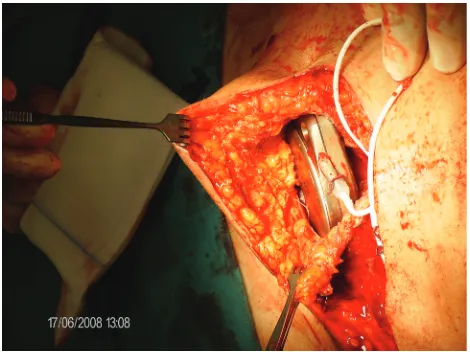
design of soft-cover reservoir pumps with hard-cover electronic steering parts, thereby dividing the total volume of the device between soft and hard components, would be an advantage. However, a reservoir made of soft materials is less shock resistant than one made of hard materials, at least with current technology. Hard-shell metal pumps, because of the total volume and hardness of the device, may induce tissue necroses, with the risk of infection and loss of the (expensive) device. Our own experience suggests that anatomical factors, such as thin subcutaneous fatty tissue, small abdominal area (in small people), or atrophic skin (cortisone skin), increase the risk of pump bed necrosis. A typical situation is shown in Figure 2. A diabetic, lean patient with a short trunk and resulting small abdominal area developed skin necrosis at the lower edge of the implanted pump. A more median placement did not improve the situ-ation. Therefore, with the assistance of a plastic surgeon the electronic, 40-mL device was explanted and replaced in the fascial sheath of the rectus abdominis muscle (see also Figure 3). When discussing possibilities for optimizing intrathecal therapy, it is worth noting the complete lack of controlled studies on implantation techniques. There is only a recommendation for electronic devices that tissue layers between the device and the skin surface should not exceed 20 mm in order to provide undisturbed remote control of the device.
Discussion
Despite innovations such as electronic, programmable pumps with the potential for patient-controlled bolus application, as well as new drugs, the shortcomings in available therapy remain considerable. These shortcomings are refl ected in complications related to intrathecal therapy such as catheter disconnections, spinal fl uid leakage, tissue necrosis, battery exhaustion, misses of refi ll ports with resulting paravasates, drug incompatibilities, catheter granulomas, and seromas around the implants. These complications suggest many possibilities to further optimize intrathecal pain therapy: improving catheter connections to withstand average physical stress; designing catheters that avoid spinal fl uid leakage
along the puncture site, and that resist degradation under exposure to body temperature and non-biological surfaces; to standardize catheter sizes and connectors; to improve implan-tation techniques; and to fi nd drugs compatible in mixtures. Pesentations on implantation techniques at workshops and expert meetings suggest that catheters may be inserted with or without prior skin cut and subcutaneous preparation of the optimal interlaminar approach. The latter certainly offers the advantage of better anatomical overview and catheter fi xation in deeper levels of the tissue, even below muscle. This technique may prevent pain arising from compression of the fi xation site and constant tissue stress, which result in transcutaneous migration of the catheter especially in frail individuals. Clear preparation of fascia and ligaments allow catheter fi xation to this sort of tissue, thereby providing better protection against dislocation by mechanical stress. No data compare advantages or disadvantages of one or the other tech-nique, but it may be suggested that experienced implantation centers with standardized surgical implantation procedures will have lower complication rates (Koulousakis et al 2007) and provide expertize such as neurosurgical backup. In case of complications such as spinal fl uid leakages, meticulous surgical skills are demanded (Singh et al 2008).
Disclosures
The authors have no confl icts of interest to disclose.
References
Auroy Y, Narchi P, et al. 1997. Serious complications related to regional anesthesia: results of a prospective survey in France. Anesthesiology, 87:479–86.
Bennett G, Burchiel K, et al. 2000. Clinical guidelines for intraspinal infusion: report of an expert panel. PolyAnalgesic Consensus
Conference 2000. J Pain Symptom Manage, 20:S37–43.
Chan VW, Garcia J, et al. 1998. A comparative study of low-dose hyperbaric spinal lidocaine 0.5% versus 5% for continuous spinal anesthesia.
Reg Anesth Pain Med, 23:164–9.
Coffey RJ, Burchiel K. 2002. Inflammatory mass lesions associated with intrathecal drug infusion catheters: report and observations on
41 patients. Neurosurgery, 50:78–86; discussion 86–7.
Dahm PO, Nitescu PV, et al. 1998. Six years of continuous intrathecal infusion of opioid and bupivacaine in the treatment of refractory pain due to intrapelvic extrusion of bone cement after total hip arthroplasty.
Reg Anesth Pain Med, 23:315–9.
Dahm PO, Nitescu PV, et al. 1999. Intrathecal infusion of bupivacaine with or without buprenorphine relieved intractable pain in three patients with
vertebral compression fractures caused by osteoporosis. Reg Anesth
Pain Med, 24:352–7.
Deer T, Krames ES, et al. Hassenbusch S, et al. 2007. Polyanalgesic Consen-sus Conference 2007: Recommendations for the Management of Pain by Intrathecal (Intraspinal) Drug Delivery: Report of an Interdisciplinary
Expert Panel. Neuromodulation, 10:300–28.
Elliott A, Smith BH, et al. 1999. The epidemiology of chronic pain in the
community. Lancet, 354:1248–52.
Erdine ST, Talu GK. 2007. Cost effectiveness of implantable devices versus
tunneled catheters. Current Pain Headache Rep, 2:157–62.
Figure 2 Subcutaneous tissue necrosis at the caudal edge of an implanted SynchroMed II pump. Skin sutures after an attempt to correct the pump placement by moving the device more medially are still visible.
Evans JM, Rosen M, et al. 1976. Apparatus for patient-controlled
administration of intravenous narcotics during labour. Lancet,
1(7949):17–18.
Gerancher JC. 1997. Cauda equina syndrome following a single spinal administration of 5% hyperbaric lidocaine through a 25-gauge Whitacre
needle. Anesthesiology, 87:687–9.
Harbaugh RE, Coombs DW, et al. 1982. Implanted continuous epidural
morphine infusion system. Preliminary report. J Neurosurg, 56:803–6.
Hassenbusch SJ, Portenoy RK, et al. 2004. Polyanalgesic Consensus Confer-ence 2003: an update on the management of pain by intraspinal drug
deliv-ery – report of an expert panel. J Pain Symptom Manage, 27:540–63.
Holman SJ, Robinson RA, et al. 1997. Hyperbaric dye solution distribution characteristics after pencil-point needle injection in a spinal cord model.
Anesthesiology, 86:966–73.
Holst D, Mollmann M, et al. 1998. Intrathecal local anesthetic distribution
with the new spinocath catheter. Reg Anesth Pain Med, 23:463–8.
Ilias W, Le Polain B, et al. 2008. Patient-controlled analgesia in chronic pain patients: experience with a new device designed to be used with
implanted programmable pumps. Pain Practice, 8:164–70.
Kan J, Yang Z, et al. 2004. [Pumping performance of a new piezoelectric
pump for drug delivery]. Sheng Wu Yi Xue Gong Cheng Xue Za Zhi,
21:297–301.
Koulousakis A, Kuchta J, et al. 2007. Intrathecal opioids for intractable pain
syndromes. Acta Neurochir Suppl, 97:43–8.
Loo CC, Irestedt L. 1999. Cauda equina syndrome after spinal anaesthesia with hyperbaric 5% lignocaine: a review of six cases of cauda equina syndrome reported to the Swedish Pharmaceutical Insurance
1993–1997. Acta Anaesthesiol Scand, 43:371–9.
Malinovsky JM, Pinaud M. 1996. [Neurotoxicity of intrathecally administrated agents]. Ann Fr Anesth Reanim, 15:647–58.
McMullen R, Kratoska P, Gardner A. 1997. Infusion Systems with Patient-Controlled Dosage Features. Patent Storm. I. MedTronic. 9723252 WO.
Nitescu,P, Dahm P, et al. 1998. Continuous infusion of opioid and bupivacaine by externalized intrathecal catheters in long-term treatment of "refractory" nonmalignant pain. Clin J Pain, 14:17–28.
Onofrio BM, Yaksh TL, Arnold PG. 1981. Continuous low-dose intrathecal morphine administration in the treatment of chronic pain of malignant
origin. Mayo Clin Proc, 56:516–20.
Penn RD, Kroin JS. 1987. Long-term intrathecal baclofen infusion for treatment of spasticity. J Neurosurg, 66:181–5.
Rainov NG, Buchser E. 2002. Making a case for programmable pumps over fi xed rate punps for the management of fl uctuations in chronic pain and spasticity: a literature review. Neuromodulation, 5: 89–99.
Rodan BA, Cohen FL, et al. 1985. Fibrous mass complicating epidural
morphine infusion. Neurosurgery, 16:68–70.
Saudek CS, Selam JL. 1989. A preliminary trial of the programmable implant-able medication system for insulin delivery. N Engl J Med, 321:574–9. Shields D, Montenegro R. 2007. Chemical stability of
ziconotide-clonidine hydrochloride admixtures with and without morphine
sulfate during simulated intrathecal administration. Neuromodulation,
10(S 1):6–11.
Singh PK, Jain R, et al. 2008. Management of pericatheter cerebrospinal fl uid leak after intrathecal implantation of a drug delivery system.