Proceedings of Recent Advances in Natural Language Processing, pages 149–156,
Role-based model for Named Entity Recognition
Pablo Calleja, Raúl García-Castro, Guadalupe Aguado-de-Cea, Asunción Gómez-Pérez
Ontology Engineering Group Universidad Politécnica de Madrid, Spain
{pcalleja,rgarcia,lupe,asun}@fi.upm.es
Abstract
Named Entity Recognition (NER) poses new challenges in real-world documents in which there are entities with different roles according to their purpose or mean-ing. Retrieving all the possible entities in scenarios in which only a subset of them based on their role is needed, produces noise on the overall precision. This work proposes a NER model that relies on role classification models that support recog-nizing entities with a specific role. The proposed model has been implemented in two use cases using Spanish drug Sum-mary of Product Characteristics: identifi-cation of therapeutic indiidentifi-cations and iden-tification of adverse reactions. The results show how precision is increased using a NER model that is oriented towards a spe-cific role and discards entities out of scope.
1 Introduction
Information extraction (IE) has become a popu-lar research topic in the last three decades, spe-cially in the biomedical field. Most of the works in this field are focused on corpora provided by conferences or challenges such as JNLPBA (Kim et al., 2004) and on the exploitation of paper ab-stracts (Hunter and Cohen, 2006). Other works, closer to health applications, exploit resources like Electronic Health Records (EHR) (Meystre et al., 2008) and drug Summary of Product Characteris-tics (SPC) (Boyce et al., 2012).
While EHRs are usually short simple phrases written by doctors, SPCs are official and detailed documents that collect the essential scientific in-formation of a drug for healthcare professionals. In Spain, the authorization of SPCs depends on the Agencia Española de Medicamentos y
Pro-ductos Sanitarios(AEMPS) and on the European Medicine Agency (EMA).
Named Entity Recognition (NER) is one of the most important tasks inside IE processes that con-sists in finding and classifying real-world entities denoted by a referent term or proper name (named entity). However, the state of the art is oriented to retrieve all the possible entities regardless if they are relevant or not to a concrete use scenario. Be-yond paper abstracts and conference corpora, nat-ural language documents display mixed informa-tion in which there are entities that are not rele-vant to a use scenario and that produce noise on the overall result of the NER task.
This is the case of SPCs, which are natural lan-guage documents that contain a lot of mixed valu-able information for concrete use scenarios. This paper proposes a new method to create a NER model focused only on specific entities by tak-ing into account the presented role of such entities in the corpus. Such role determines the general meaning and function of the entity in the corpus. The method has been implemented for two IE use cases over specific sections of SPCs in Spanish in collaboration with the AEMPS.
The paper is structured as follows. Section 2 describes related work and section 3 describes in detail the problem of documents with different en-tity roles. Section 4 proposes the method to cre-ate a NER model focused on entities which a spe-cific role. Section 5 shows the application of the method over two use cases and section 6 discusses the obtained results. Finally, section 7 presents some conclusions and highlights future work.
2 Related Work
Normally, the main named entity types proposed in the literature are “person”, “organization”, “lo-cation” “dates”, “time expressions” and
tary expressions” (Grishman and Sundheim, 1996; Ferro et al., 2005). The biomedical field de-fines its own named entity types such as such as “protein”, “drug” and “disease” (Rindflesch et al., 2000; Zhou et al., 2005). In contrast, other re-searchers classify entities into taxonomic models where some types are considered subtypes (i.e., children) of a high level one (e.g., “geological region” or “address” are subtypes of “location”) (Sekine et al., 2002).
Nowadays, the state of the art of NER mod-els shows that the best results are provided by supervised machine learning techniques (Nadeau and Sekine, 2007; Campos et al., 2012). How-ever, these techniques require big annotated cor-pora such as (Kim et al., 2003; Moreno et al., 2017) to be trained. Thus, the use of machine learning techniques is limited in some domains in which there are not such annotated training cor-pora or there are not in a specific language.
Roles are defined and attached to text segments or entities in an IE task called template filling (Schank and Abelson, 1975; Steimann, 2000). These roles are defined by its acts or meaning in a given context and normally are associated with lexical-syntactic patterns (Patwardhan and Riloff, 2007). Nevertheless, this task in the biomedical domain is focused on event relations like cause-effect or drug-drug interactions (Settles, 2004).
3 Problem Setting
In this context, the current classifications covered in NER systems just deal with taxonomic types and are not meant to represent the entities’ role. Nevertheless, as the conceptual model proposed by Steimann shows (Steimann, 2000), entity roles can also be represented as a classification model. For example in the biomedical domain, the tax-onomic hierarchy of diseases is normally repre-sented by the affection type such as “mental dis-order” and “gastric disease”. But, “adverse reac-tion” or “contraindicareac-tion” are roles that an entity may have in a given context, and which can also be represented in a taxonomic form. This work pro-poses to introduce roles into the NER task in order to identify entities according such specific roles.
The following use cases are driven by a NER need in the AEMPS. In them, the agency needs to identify entities in drug SPC documents. How-ever, it usually happens in those documents that there are entities with the same type (disease) but
Durante el tratamiento con Pramipexol Normon, las reacciones adversas pueden ser: amnesia, confusión, hipersexualidad, delirio y mareo. En base al análisis agrupado de los ensayos controlados con placebo, que incluyen un total de 1.778 pacientes con enfermedad de Parkinson
tratados con Pramipexol y 1.297 pacientes con placebo.
Trastornos gastrointestinales Trastornos del sistema nervioso
mareo, somnolencia hipercinesia amnesia
estreñimiento, vómitos
Frecuentes Poco frecuentes Frecuentes Muy frecuentes
Figure 1: Excerpt of the adverse reactions section
with different role, and the agency is only inter-ested in those entities with a specific role.
The therapeutic indication section provides
information about the diseases to be treated with the drug. However, it is sometimes verbose and includes information from other sections such as contraindications, diseases for which the drug should not be prescribed (e.g.,should not be used as a treatment for), or diseases that refer to the
medical record of the patient (e.g., who does not
have a recent history of).
The adverse reactions section provides infor-mation about unwanted effects caused by the ad-ministration of a drug (diseases or disorders) and their frequency. However, sometimes it also con-tains therapeutic indication information to specify the adverse reactions. Figure 1 shows an example of the adverse reaction section; all the disease en-tities are in italics, but only the enen-tities surrounded with a continuous black box are adverse reactions. The entities surrounded with a segmented black box represent other roles.
4 NER model for specific entity roles The proposed NER model for specific entity roles requires the classification of the reflected roles of the named entities in taxonomic models. These models have to be created through manual tasks using a representative gold standard corpus as ref-erence. The annotated entities must be classified by its named entity type and their position in the text (initial and final offset) must be identified.
Besides, the next assumptions are declared. First, that the entities annotated in the gold stan-dard corpus have the role that must be recognized by the NER model (target role). Second, that the annotated entities always belong to a general named entity type (e.g., person, disease, etc.).
Pattern A, Pattern B, ...
Named entity type
Pattern J, Pattern K, ...
Entity Role 1 | Target Role
Pattern U, Pattern V, ... Entity Role 2
Pattern X, Pattern Z, ...
Entity Role N is_a
Gazetteer 1, Gazetteer 2, ...
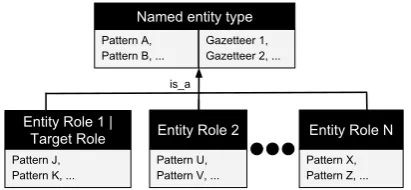
Figure 2: Role classification model representation
of hints that allows to identify an entity by its type or its role; patterns can be lexical, syntactic and
layout-based. B) Anentity typeis defined as the
classification group of an entity and it composed by sets patterns and gazetteers. C) Anentity role is defined as a subtype of a named entity type that is characterized by a set of patterns in a specific corpus and describes an entity by its act or
mean-ing in a given context. D) A role classification
modeldescribes the hierarchy of the different roles for a named entity type in a corpus; the role clas-sification model is composed of a named entity type, one role defined as the target role and a set of zero or more non-target roles. The different roles are disjoint between them and inherit patterns and gazetteers from the entity type.
Figure 2 shows a representation of the role clas-sification model. Once a role clasclas-sification model is defined, the proposed NER algorithm uses it to identify named entities with a specific role. 4.1 Creation of the role classification model The method to create a role classification model is composed of the following six tasks that are per-formed over a gold standard corpus:
1- Extraction of annotated entities. The first task is to collect all the annotated entities of one named entity type in the gold standard corpus.
2- Pattern detection of the annotated entities. The collected annotated entities are studied to de-tect lexical patterns (character combinations or af-fixes) that could represent the named entity type. Since lexical patterns do not represent role infor-mation, they are attached to the named entity type. Then, the context of the annotated entities is stud-ied to find syntactic patterns (word combinations) and layout patterns (the format in which the in-formation is presented); both types of patterns can represent the named entity type or the target role. Lexical and syntactical patterns are used to iden-tify new possible entities in documents; however,
layout patterns are meant to attach roles or named entity types to entities previously identified.
Figure 1 shows an example in which the an-notated entities are diseases inside a continuous black box. A lexical pattern is represented by the prefix “hiper_” that is commonly used in disease names. Also, a syntactic pattern represented by
the word combinationreacciones adversas pueden
ser:(the adverse reactions could be:). This syntac-tic pattern is reflecting the target role of the gold standard corpus (adverse reactions) and all the en-tities under the scope of the pattern (until the full stop) have the target role. Finally, a layout pattern is also represented in the example. All the entities in the table that are not headers in bold are also diseases with the target role (adverse reactions).
3- Identification of gazetteers for the named entity type. Gazetteers are a common NER re-source and there are many of them available for the most common named entity types. This task aims to identify gazetteers aligned with the annotated named entities to support the model on the identi-fication of named entities with the same type.
4- Discovery of entities with different role. Using the selected gazetteers and the patterns identified in the previous tasks, a review of the cor-pus is made to detect named entities of the same type that have not been reflected in the gold stan-dard corpus. Figure 1 shows three disease named entities inside a segmented black box that are not reflected in the gold standard corpus.
5- Pattern detection of the entities with dif-ferent role. This task aims to detect syntactic and layout patterns of the entities that are not re-flected in the gold standard corpus studying their context. These identified patterns represent other roles present in the corpus. The most common role interpretation is the complementary of the target role (¬Target role). However, it is possible to de-fine and classify different roles studying the gold standard corpus.
Figure 1 shows two examples with a syntactic pattern and a layout pattern. The first one is
rep-resented with the word combinationpacientes con
(patients with) that is reflecting diseases with the role for which the drug is prescribed. The second one is represented by rows in the table that are in bold font that is reflecting the classification role of the mentioned diseases.
model based on the named entity type. The named entity type is represented in the model as the upper class and it is composed by the set of patterns dis-covered in task 2 and the gazetteers identified in task 3; the patterns associated to the named entity type lack of role information. Then, the different roles are specified. First, the target role is repre-sented by the set of patterns associated to the role discovered in task 2. Second, the rest of the roles are specified by the sets of patterns discovered in task 5. Finally, the role classification model of the named entity type could be represented as in Fig-ure 2.
4.2 Role-based NER algorithm
The NER model executes the proposed Algorithm 1 for each role classification model to identify named entities with the target role, along with its span text and position.
The input of the algorithm is the document to be processed, the role classification model and whether a closed world assumption holds. The output is the set of identified named entities. In the algorithm, two sets of entities are defined: the set of entities without role (entities) and the set of entities with the target role (targetEntities). The algorithm is divided into five main steps. The first one (lines 5 to 11) is oriented to identify named entities by using the gazetteers of the named en-tity type. The second one (lines 13 to 16) uses the patterns of the entity type to identify named en-tities. Patterns are detected with the function de-tectPattern. These two tasks store their results in theentitiesset. The next task (lines 17 to 19) ex-ecutes the patterns of the target role and stores the results in thetargetEntitiesset. Then, the patterns of the non-target roles of the model are executed to identify and delete entities of the two sets (lines 20 to 27). Finally, if the NER model is oriented to a close world assumption (lines 28 to 32), the results are composed only by the entities of the targetEn-titiesset. In other case, the results are the union between theentitiesset andtargetEntitiesset.
5 Method Implementation
As mentioned in section 3, two projects in collab-oration with the AEMPS have implemented the proposed NER model for specific roles. Both projects were oriented to the exploitation of dif-ferent sections of the SPCs. The first aimed at automatically identifying therapeutic indications
Algorithm 1Role-based NER algorithm
Input: Document d, RoleClassificationModel
rcm, boolean cwa
Output: : Set of entities in document d
1: target= rcm.TargetRole
2: type= rcm.EntityType
3: entities← { } 4: targetEntities← { } 5: for all gaz∈Gazetteersdo
6: for all entry∈gazdo
7: if (termMatches(entry,d)) then
8: add(entities,entry)
9: end if
10: end for
11: end for
12: aux← { }
13: for all p∈type.Patternsdo
14: add(aux, detectPattern(p,d))
15: end for
16: entities←entities∪aux 17: for all p∈target.Patternsdo
18: add(targetEntities, detectPattern(p,d))
19: end for
20: for all role∈rcm.NonTargetRolesdo
21: aux← { }
22: for all p∈role.Patternsdo
23: add(aux, detectPattern(p,d))
24: end for
25: entities←entities - aux
26: targetEntities←targetEntities - aux
27: end for
28: if (cwa) then
29: returntargetEntities
30: else
31: returnentities∪targetEntities 32: end if
in the section with the same name. The second aimed at improving pharmacological surveillance processes through the identification of adverse re-actions in the section with the same name.
have been created with the two different sections. In both projects, 80 SPCs of each gold stan-dard corpus had been used to train their respective model and 40 to test them. The SPCs were se-lected randomly once for the two use cases. As the named entity type in both use cases is ‘dis-ease’, the proposed gazetteers for task 3 of the role classification model method were extracted from the Spanish version of the medical dictionary
MedDRA (Brown et al., 1999) and from the
Dic-cionario de siglas médicas(Yetano Laguna, J., Al-berola Cuñat, 2003).
5.1 Therapeutic indication section use case The first use case aimed at automatically identify-ing those diseases that have the therapeutic indi-cation role. The gold standard corpus used in this project was created from the therapeutic indication sections of 80 annotated SPCs.
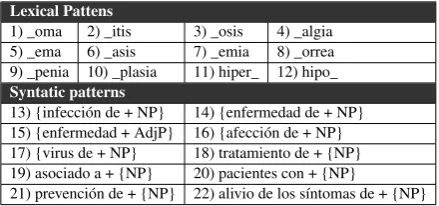
The first two tasks of the method are to extract the annotated entities in the gold standard corpus and to identify patterns. Table 1 shows the pat-terns discovered through these tasks, which were reviewed by experts from the agency. Lexical pat-terns are represented by affixes in nouns that are commonly used in medicine like “_itis” (e.g., si-nusitis). Lexical patterns are used to identify nom-inal phrases (NP) as a disease in which the noun contains at least one of the affixes. The nomi-nal phrases include the adjectival phrases (AdjP) that are joined to the noun. The identified pat-terns had to be classified into patpat-terns that belong to the named entity type and those that belong to the target role therapeutic indication. Lexical pat-terns are attached directly to the named entity type due to the lack of role information. Similarly, syn-tactic patterns 13 to 17 are language structures that represent only a disease. Syntactic patterns 18 to 22 represent the common structure to present ther-apeutic indications in SPCs, describing the target role of the entities.
This use case involved the identification of the named entity type disease, so the gazetteers
pro-posed in the third task are MedDRA and
Dic-cionario de siglas médicas. The next task involves the identification of disease entities that are not re-flected in the gold standard by using the gazetteers and the patterns identified in the previous task. The context of the discovered entities was then studied to discover patterns of entities with dif-ferent role. Table 2 shows the patterns
identi-Lexical Pattens
1) _oma 2) _itis 3) _osis 4) _algia
5) _ema 6) _asis 7) _emia 8) _orrea
9) _penia 10) _plasia 11) hiper_ 12) hipo_
Syntatic patterns
13) {infección de + NP} 14) {enfermedad de + NP} 15) {enfermedad + AdjP} 16) {afección de + NP} 17) {virus de + NP} 18) tratamiento de + {NP} 19) asociado a + {NP} 20) pacientes con + {NP}
21) prevención de + {NP} 22) alivio de los síntomas de + {NP}
Table 1: Patterns identified from the annotated en-tities in the therapeutic indication use case
Syntatic patterns
23) sin + {NP} 24) que se hayan excluido + {NP}
25) excluyendo + {NP} 26) que no tiene + {NP} 27) siempre que no exista + {NP} 28) pero no + {NP} 29) no protege + {NP} 30) no se recomienda + {NP} 31) no debe ser utilizado + {NP} 32) no debe utilizarse + {NP} 33) no se ha demostrado/
documentado/ estudiado + {NP} 34) no se han realizadoestudios + {NP}
Table 2: Patterns identified for entities with other role in the therapeutic indication use case
fied in the task. Experts from the AEMPS deter-mined that patterns 23 to 27 attach the role “med-ical record” of the patient, while patterns 28 to 33 represent the role “contraindication”, i.e., diseases for which the use of the drug is not recommended. Finally, the role classification model was cre-ated representing the named entity type as the parent class with its patterns and gazetteers and the different discovered roles and their patterns as children classes.
5.2 Adverse reaction use case
The second use case aimed at identifying adverse reactions. As in the first project, the target enti-ties for the NER model are diseases, but their role is “adverse reaction”. The gold standard corpus used for this project was created from the adverse reaction section of the 80 annotated SPCs.
The first two tasks of the method are to extract the annotated entities and to identify patterns; ta-ble 3 shows the patterns identified for the entities. Lexical patterns are the same as presented in Table 1 (1 to 12). Also, other syntactic patterns were re-peated (13 to 17). The new syntactic patterns (35 to 38) are diseases that are represented by fluc-tuation disorders of biological substances of the organism. The syntactic patterns in Table 3 are presented in sets having the same meaning with different words. For example, pattern 35 repre-sents decrease of biological substances and there
dismin-Lexical Pattens Patterns 1-12 Syntatic patterns
Patterns 13- 17 35) { ( disminución | pérdida |reducción | descenso) de + NP} 36) { (prolongación | incremento |
elevación | aumento) de + NP} 37) { (alteración | anormalidad |cambios | descompensación) de + NP} 38) { empeoramiento de + NP}
Layout Patterns
39) Entities inside tag <table> 40) Entities inside tag <p> belowheaders in tags <b>, <i> or <u>
Table 3: Patterns identified from the annotated en-tities in the adverse reaction use case
ución (decrease), reducción (reduction), pérdida
(loss) anddescenso(decline). None of these
pat-terns contains information about the role. How-ever, it has been observed that most of the adverse reactions presented in SPCs are represented in ta-bles, indicating the affection classification type and their frequency. At the same time, docu-ments that do not contain tables, also use the af-fection classification type as headers to enounce adverse reactions. Both layout patterns had been used to identify entities with the adverse reaction role. Pattern 39 associates entities that are inside the HTML table tag as an entity and pattern 40 identifies entities that are in the text under a header and associates them to the adverse reaction role.
As in the other use case, the next step was to identify other entities with the NE type disease that had not been reflected in the gold standard us-ing the gazetteers and the identified patterns. The syntactic patterns found for these entities are pre-sented in Table 4. In specific cases SPCs repeat the diseases with the “therapeutic indication” role (18, 21, 46-48). Other roles that have appeared are “medical interaction”, “non adverse reaction” and “classification headers”. “Medical interac-tion” (41-42) represents diseases that only appear in a specific case or diseases that could produce more adverse reactions. The “non adverse reac-tion” (43-45) role represents diseases that have not been discovered as adverse reactions during the drug clinical research. The last role is “classifi-cation headers” (49), general diseases that classify and enounce the adverse reactions. Finally, it was possible to represent the role classification model.
6 Evaluation
The model evaluation has been performed by mea-suring the results obtained over the 40 test docu-ments of the gold standard corpus. Each use case
Syntatic patterns
Patterns 18-21 41) potenciado por + {NP} 42) con el fin de evitar + {NP} 43) no se asocia + {NP} 44) no se observó + {NP} 45) sin indicios de + {NP} 46) en ensayos clínicos de + {NP} 47) en estudios clínicos de + {NP} 48) administración en combinación en + {NP}
Layout Patterns
49) Entities in tags <b>, <i> or <u>
Table 4: Patterns identified for entities with other role in the adverse reaction use case
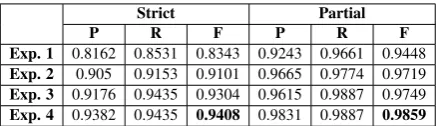
has been evaluated separately with their own role classification model. The evaluation consisted of four experiments related with the main steps in which the role-based NER algorithm is divided. The first experiment only takes the results ob-tained by gazetteers. The second one adds the re-sults obtained by the patterns of the named entity type disease. The third one uses the target role patterns to add or associate entities to the target role. Finally, the fourth one uses the patterns of the other roles to discard entities that are not asso-ciated to the target role. Both use cases work un-der the open world assumption; i.e., entities with no role are considered to be part of the target role. The evaluation metrics used are precision (P), recall (R) and F-measure (F). The evaluation mea-sures the detected entities under two matching cri-teria as proposed in other biomedical evaluations (Tsai et al., 2006). Normally, NER systems use the strict or exact matching criteria; the entity de-tected by the system and the entity annotated in the gold standard corpus must have the same span text and named entity type. However, the anno-tated entities of the provided gold standard corpus have problems in the consensus between annota-tors, i.e., the same entity with the same span text is annotated with different length (different offset in one side). Normally, the difference between an-notations are adjectives that experts have taken or not into account in the annotation process, such as adjectives that describe a particular case of the pa-tient’s disease (e.g.,recurrente(recurrent)) and ad-jectives that describes the intensity or degree (e.g., grave (severe)). Thus, the partial criteria allows that one of the span texts offsets can be different.
Strict Partial
P R F P R F
Exp. 1 0.8162 0.8531 0.8343 0.9243 0.9661 0.9448
Exp. 2 0.905 0.9153 0.9101 0.9665 0.9774 0.9719
Exp. 3 0.9176 0.9435 0.9304 0.9615 0.9887 0.9749
Exp. 4 0.9382 0.9435 0.9408 0.9831 0.9887 0.9859
Table 5: Therapeutic indication evaluation
the gazetteers. Experiment 3 shows how the pat-terns of the target role increase the recall. How-ever, precision decreases because these syntactic patterns are overlapped with patterns with other role patterns. For example, sometimes pattern 18 tratamiento de(treatment of) overlaps with pattern 31no debe ser utilizado(must not be used) in the sentenceno debe ser utilizado para el tratamiento de la rinitis(must not be used in the treatment of the rhinitis). Experiment 4 demonstrates that ap-plying the patterns of other roles to discard enti-ties increases the final precision, with a minimal decrease in the recall.
The evaluation of the adverse reaction use case is presented in Table 6. Experiment 1 shows again that gazetteers cover most of the entities. The main problem that gazetteers have in this domain is the representation of disorders; MedDRA represents disorders with adjectives (e.g.,glucosa aumentada (increased glucose)) and SPCs represent them in a
nominal form (e.g.,aumento de glucosa(increase
of glucose)). This problem is solved in experi-ment 2 by using syntactic patterns that represent the nominal form of the disorders. Patterns of the named entity type increase recall significantly in the partial matching criteria. The results in the ex-act matching criteria reflect how the gold standard corpus is highly affected by the annotation prob-lems. Experiment 3 shows no modification over the results. Layout patterns are associating dis-covered entities (in tables or under headers) to the target role and not discovering new ones. In spite of not improving the results, associating entities to the target role is critical if the experiment is not un-der the open world assumption. Experiment 4 fi-nally shows that patterns from other roles are used to discard entities and the precision on the overall result increases.
7 Conclusions and Future Work
The evaluations of both use cases show how a NER model oriented by roles increases the pre-cision of the obtained results in those natural lan-guage documents in which only some of the
enti-Strict Partial
P R F P R F
Exp. 1 0.8901 0.809 0.8476 0.9502 0.8636 0.9049
Exp. 2 0.8598 0.8274 0.8433 0.9429 0.9074 0.9248
Exp. 3 0.8598 0.8274 0.8433 0.9429 0.9074 0.9248
Exp. 4 0.872 0.8256 0.8482 0.9557 0.9048 0.9296
Table 6: Adverse reaction evaluation
ties are required. Roles and their patterns allow to represent a classification model of the entities in a corpus and the NER algorithm uses the role clas-sification model to identify named entities with a specific role. The proposed method to create a role classification model requires a gold standard cor-pus in which only the required entities are anno-tated, saving time in the annotation process.
Normally, the proposed role classification model could be represented with a target role and all the other roles joined as the complementary role (¬Target role). However, these two specific use cases have also demonstrated that to precisely classify and define roles benefits the overall work because different sections have repeated roles and patterns. Thus, it is possible to create a complete role classification model for all the roles that could be reused and extended in different use cases for homogeneous domain-specific documents.
The main disadvantage of the method is that it requires very time-consuming tasks involving do-main experts. Although the method is proposed for real use cases in which it is better to annotate only the required entities instead of annotating and classifying all of them, the patterns and the role that they represent have been discovered manually. This method performs the first approach to intro-duce entities roles inside the NER task in natural language documents in which the detection of spe-cific entities according to a role is required.
As mentioned above, one of the most time-consuming tasks was the pattern detection. One of the first future lines of work regarding the proposed method is to explore automatic pat-tern detection using algorithms based on distribu-tional semantics such as Latent Semantic Analysis (Konkol et al., 2015).
Acknowledgments
References
R. Boyce, G. Gardner, and Henk H. 2012. Us-ing natural language processUs-ing to identify pharma-cokinetic drug-drug interactions described in drug package inserts. Proceedings of the 2012 Work-shop on Biomedical Natural Language Processing, (BioNLP).
E. G. Brown, L. Wood, and S. Wood. 1999. The Medi-cal Dictionary for Regulatory Activities (MedDRA). D. Campos, S. Matos, and J. L. Oliveira. 2012. Biomedical named entity recognition: a survey of machine-learning tools. InTheory and Applications for Advanced Text Mining. InTech.
L. Ferro, L. Gerber, I. Mani, B. Sundheim, and G. Wil-son. 2005. TIDES 2005 Standard for the Annota-tion of Temporal Expressions.
R. Grishman and B. Sundheim. 1996. Message Un-derstanding Conference-6: A Brief History. Pro-ceedings of the 16th conference on Computational linguistics, 1.
L. Hunter and K. B. Cohen. 2006. Biomedical lan-guage processing: What’s beyond PubMed? J. D. Kim, T. Ohta, Y. Tateisi, and J. Tsujii. 2003.
GE-NIA corpus - A semantically annotated corpus for bio-textmining. InBioinformatics, volume 19.
J. Kim, T. Ohta, Y. Tsuruoka, Y. Tateisi, and N. Col-lier. 2004. Introduction to the Bio-entity Recog-nition Task at JNLPBA. Proceedings of the Inter-national Joint Workshop on Natural Language Pro-cessing in Biomedicine and Its Applications.
M. Konkol, T. Brychcín, and M. Konopík. 2015. La-tent semantics in named entity recognition. Expert Systems with Applications, 42(7).
S. M. Meystre, G. K. Savova, K. C. Kipper-Schuler, and J. F. Hurdle. 2008. Extracting information from textual documents in the electronic health record: a review of recent research. IMIA Yearbook of Medi-cal Informatics, 2008(1).
Isabel Moreno, Ester Boldrini, Paloma Moreda, and M Teresa Romá-Ferri. 2017. Drugsemantics: a corpus for named entity recognition in spanish summaries of product characteristics. Journal of Biomedical Informatics.
D. Nadeau and S. Sekine. 2007. A survey of named entity recognition and classification. Linguisticae Investigationes, 30(30).
S. Patwardhan and E. Riloff. 2007. Effective Informa-tion ExtracInforma-tion with Semantic Affinity Patterns and Relevant Regions. Proceedings of the 2007 Joint Conference on Empirical Methods in Natural guage Processing and Computational Natural Lan-guage Learning, 7(June).
T. C. Rindflesch, L. Tanabe, J. N. Weinstein, and L. Hunter. 2000. EDGAR: extraction of drugs, genes and relations from the biomedical literature.
Pacific Symposium on Biocomputing. Pacific Sympo-sium on Biocomputing.
R. C. Schank and R. P. Abelson. 1975. Scripts, Plans, and Knowledge. Proceedings of the 4th Interna-tional Joint Conference on Artificial Intelligence. S. Sekine, K. Sudo, and C. Nobata. 2002.
Ex-tended named entity hierarchy. In Third Interna-tional Conference on Language Resources and Eval-uation (LREC 2002).
B. Settles. 2004. Biomedical Named Entity Recog-nition Using Conditional Random Fields and Rich Feature Sets.
F. Steimann. 2000. On the representation of roles in object-oriented and conceptual modelling. Data and Knowledge Engineering, 35(1).
R. T. Tsai, S. Wu, .i Chou, Y. Lin, D. He, J. Hsiang, T. Sung, and W. Hsu. 2006. Various criteria in the evaluation of biomedical named entity recognition.
BMC bioinformatics, 7(1).
V. Yetano Laguna, J., Alberola Cuñat. 2003. Dic-cionario de siglas médicas. Ministerio de sanidad y consumo.