Kitten: a tool for normalizing HTML and extracting its textual content
Mathieu-Henri Falco, V´eronique Moriceau, Anne Vilnat
LIMSI-CNRS University Paris-Sud 91403 Orsay, France [email protected]
Abstract
The web is composed of a gigantic amount of documents that can be very useful for information extraction systems. Most of them are written in HTML and have to be rendered by an HTML engine in order to display the data they contain on a screen. HTML files thus mix both informational and rendering content. Our goal is to design a tool for informational content extraction. A linear extraction with only a basic filtering of rendering content would not be enough as objects such as lists and tables are linearly coded but need to be read in a non-linear way to be well interpreted. Besides these HTML pages are often incorrectly coded from an HTML point of view and use a segmentation of blocks based on blank space that cannot be transposed in a text file without confusing syntactic parsers. For this purpose, we propose theKittentool that first normalizes HTML files into unicode XHTML files, then extracts the informational content into a text file with a special processing for sentences, lists and tables.
Keywords:HTML, content extraction, question-answering
1.
Introduction
The motivation for coding the Kitten tool came during the question-answering system evaluation as part of the QUAERO program as it showed that the data extracted from web pages were confusing the systems based on lin-guistic features (language model or dependancy grammar notably) (Quintard et al., 2010). The QUAERO corpus is composed of 2 million HTML files (for French and for English) and only a subset is used for the evaluation cam-paigns: 499,736 files for French and 498,678 for English; from now these subsets will be referred to asthe QUAERO corpus. Participants were using textual files that had been linearly extracted without any kind of filtering or linguistic processing (Figure 1). It was inadequate mainly because HTML files contain visual blank spaces for segmenting blocks of text where systems expects punctuation marks.
Figure 1: Example of a linear extraction.
A correct extraction must focus on extracting textual con-tent with respect to the limitations of a text file that is read from left to right, line by line and where sentences are de-limited by punctuation marks; otherwise texts from differ-ent blocks would be merged. The Lynx software allows
the dump of an HTML file faithfully to its rendering aspect (Figure 2) but a very difficult segmentational processing has to be done for syntactic parsers to work on correctly delim-itated sentences.
Figure 2: HTML file dumped with Lynx.
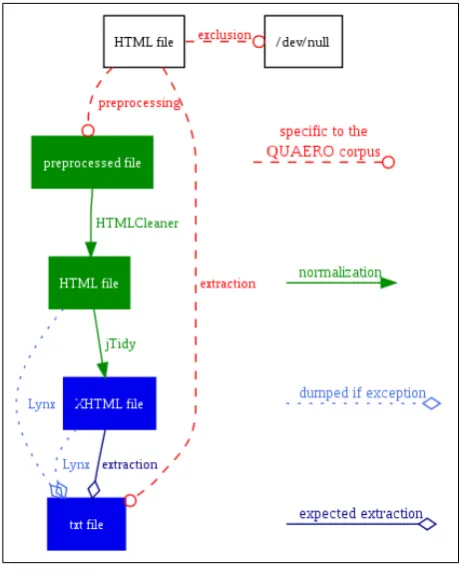
In this article, we present the Kitten(Kitten Is a Textual Treatment for Extraction and Normalization) tool that al-lows normalization of an HTML file and the extraction of its content into a basic text file. It focuses notably on tables and lists as they need particular attention for their extrac-tion: a simple extraction would not be enough to obtain exploitable textual data for information extraction. Kitten is composed of two main steps (Figure 3): after a compu-tational treatment aiming at normalizing the HTML code by combining existing tools (HTMLCleaner1, jTidy2 and jChardet3), a linguistic processing takes place for extraction
1
http://htmlcleaner.sourceforge.net/
2
http://jtidy.sourceforge.net/
of the informational content into a basic text file. Produc-ing a file at each step makes the use of these existProduc-ing tools easier. We were not aiming at a spam detector, a removal of boilerplate text (Kohlsch¨utter et al., 2010) or a web page cleaner (Baroni et al., 2008). Our first objective of nor-malization is very close to the work of Beautifulsoup4 but the use of BeautifulSoup on the Quaero corpus showed too many losses of files at the time we tested it (19.11% were not completed with the 3.1.0.1 version in January 2010; no file was lost with the more recent version 3.2.0 of Novem-ber 2010 but Kitten was already developped at that time).
We wanted to normalize the way an HTML file was coded to correctly extract its informational content (including for the moment SPAM and boiler plate content) and finally adapt it to a text file with sentence boundaries so that syn-tactic parsers can correctly process it.
Kitten processed both the English and French corpus: we provide here figures for the French one. The examples are written in English: some come from the English corpus and those from the French one have been translated.
Section 2 will present the HTML normalization processing and section 3 will focus on the statistical and linguistic pro-cessing during the extraction of informational content. Sec-tion 4 will present the evaluaSec-tion of a quesSec-tion-answering system on the QUAERO corpus preprocessed by Kitten, thus giving an indirect evaluation of Kitten.
Figure 3: Kitten architecture.
4http://www.crummy.com/software/
BeautifulSoup
2.
From crawled HTML to normalized
XHTML
The main goal of the computational processing is to obtain a normalized and UTF-8 encoded XHTML source code. This normalized file must then be XHTML compliant ac-cording to the W3 consortium and thus have a valid tree structure for allowing HTML parsing.
2.1. Specific preprocessing
The Kitten architecture (Figure 3) shows three steps: a file exclusion, a direct extraction and a preprocessing. The file exclusion rejects sitemap files as they only contain urls, are very time-consuming and seem to be relevant more for a document classification task (Qi and Davison, 2009) than for a question-answering system. The direct extraction han-dles already converted binary files (swf, doc, rtf): after hav-ing crawled the QUAERO corpus, Exalead5 converted the binary files into XML files using four tags (header, doc-ument,textfield,page); these XML files are thus ready to be extracted and do not need to be preprocessed. Almost all files of the QUAERO corpus are preprocessed (99,50%) while only 0,003% sitemap files are excluded and 0.5% XML files directly extracted.
2.2. Fixing HTML errors
HTMLCleaner and jTidy share a lot of common options for fixing HTML errors but we proceeded to several exper-iments that showed it was better to use them sequentially. HTMLCleaner aims notably at:
• replacing the'entity by its character’(simple quote): its use is valid in XML and XHTML but not in HTML,
• regarding the content of the tags <script> and <style> as plain text. It escapes entity like “<” in javascript code that could be confused with an open-ing tag,
• replacing special HTML entities (i.e. ô, &per-mil;) with unicode characters they represent (ˆo,h),
jTidy also aims notably at:
• fixing incorrect tag sequence: for example,<b> <i> </b> </i>becomes<b> <i> </i> </b>,
• closing unclosed tags,
• setting the indentation length within the source file to zero (as it would otherwise insert new carriage-returns inside textual content that will cut sentences).
2.3. Normalizing the files
By fixing incorrectly ordered or non-closed tags, jTidy also allows the normalization of HTML files into XHTML. We use jChardet6 to detect the most likely encoding of the HTML file allowing thus jTidy to produce an XHTML file encoded in UTF-8.
5http://www.exalead.com/search/: one of the QUAERO par-ticipant
6
Both HTMLCleaner and jTidy work on transformation of entities in order to return an unicode file. Non-ascii char-acters can be encoded on the web in three different ways: for example, thenumeric entityæ, thecharacter en-tityæ and thespecial characteræ represent the same character. As we want to use only numeric entities after jTidy, a final conversion has to be done for the range of nu-meric entities from € to Ÿ as they are invalid in XHTML.
It was impossible to produce a normalized XHTML file for 5 files. In this situation, a textual dump of these files has been produced with the Lynx browser.
3.
From normalized XHTML to exploitable
text
The main goal during the extraction of textual content is to produce a text file that can be read directly by syntactic parsers. By doing so, we had to find a way to transform content using layout (once rendered by an HTML browser) such as tables, lists and blocks of textual content. The ex-amples cited in this section come from needs of Question-Answering applications but all of these features can be set before launching Kitten.
3.1. HTML tables
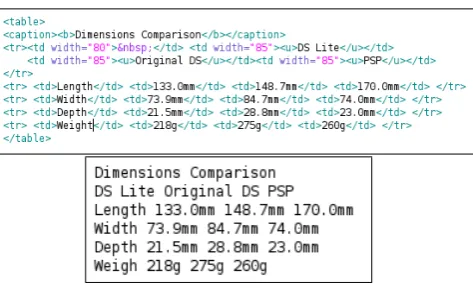
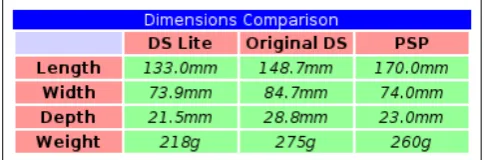
A table often contains precious informational content and a linear extraction would be particulary inadequate as it is coded linearly in an HTML file, i.e from left to right and row by row (Figure 4) but has to be read by linking seman-tically a data cell content with its header cell.
Figure 4: A data leaf-table: source code and once rendered.
3.1.1. Detecting data tables from layout tables
Kitten targets only leaf-tables: a leaf-table is a table tag not containing itself a table tag. Websites can use recur-sively the table tag to display information on a page with a depth of 10 nested tables so we decided to focus only on leaf-tables (the non-leaf-table are linearly extracted for the moment). A leaf-table can be a data table or a table used for layout (Figure 5). As this information is not explicitly coded, we use a classifier: a decision tree was built using the machine learning sofware collection WEKA (Hall et al., 2009) based on the features used by (Wang and Hu, 2002) and some others that we added :
Figure 5: Layout table.
• rate of empty cases for a line and a row,
• has a<form>tag,
• has a<caption>tag,
• number of<th>tags,
• is a leaf of an embedded table.
An annotated corpus composed of 2,850 layout and 638 data leaf-tables is used for the learning phase:
• 549 layout and 281 data leaf-tables come from 118 files of the corpus annotated by (Wang and Hu, 2002) (we kept only one webpage by website). Their an-notated corpus is available7 and is composed of web documents from 2001: we integrated it to reinforce the robustness of our detection,
• 2,301 layout and 357 data leaf-tables come from 294 files of the QUAERO corpus that we annotated,
• finally we randomly chose among the Wang and QUAERO corpus 614 layout leaf-tables to build the model.
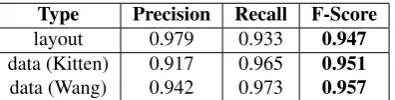
Type Precision Recall F-Score
layout 0.979 0.933 0.947
data (Kitten) 0.917 0.965 0.951 data (Wang) 0.942 0.973 0.957
Table 1: Categorization of 614 layout and 614 data leaf-tables.
The first pass with 10 cross-validations on the annotated corpus showed encouraging results (table 1).
3.1.2. Categorizing the cells of data tables
For all the data leaf-tables identified, a second decision tree was built in order to classify each cell among six categories (table 2):
• dataandheaderare explicit and obligatory,
• neutralis an empty cell for rendering purposes (not for missing data),
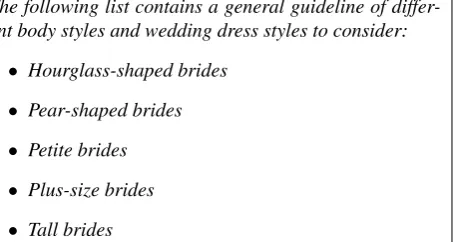
regard-The following list contains a general guideline of differ-ent body styles and wedding dress styles to consider:
• Hourglass-shaped brides
• Pear-shaped brides
• Petite brides
• Plus-size brides
• Tall brides
Figure 7: Example of a list where a linear extraction would move away the item from the introductory clause.
• if the median length of (non-empty) item is lower than 60 characters, the list is flatten to a unique sentence; if an allowed punctuation mark (full stop, question mark, exclamation mark, semi-colon, comma) does not end an item, a comma is added,
• if the median length is greater than 60 characters, we consider that each item should be a sentence so we add a full stop at the end ot the item (when a final punctua-tion mark is missing) or replace any non-ending punc-tuation mark by a full stop (except brackets and dash).
For example, the list on Figure 3.2.3. is flattened into the following sentence, improving the probability to answer a question about the terminology of wedding dress style :The following list contains a general guideline of different body styles and wedding dress styles to consider: Hourglass-shaped brides, Pear-Hourglass-shaped brides, Petite brides, Plus-size brides, Tall brides.
Figure 8: Example of syntactically related items.
Additionally to list flattening, introductory clauses can be repeated with each item (each pair forming a unique sentence) when a trigger word is ending the introductory clause. This happens when a syntactic dependancy links each beginning of the item to the end of the introductory clause. If this clause is not repeated, parsers can be con-fused as the sentence would not be syntactically correct. The trigger words are thus composed of prepositions (in, to, ...), auxiliary verbs (may,can, ...) and the adverb not. For example, the list in Figure 8 would be extracted into the following sentences :
Before selecting a college, parents need to determine how much funding can be available from conventional
sources such as savings, income from the family budget, trusts, and part-time jobs, if more money is needed. Before selecting a college, parents need to explore the availability of scholarships, low-interest student and parent loans, second mortgages, and conventional loans. Before selecting a college, parents need to examine their own life insurance policies and retirement programs to ensure that college funds will be available in the event of their death.
This type of repetition can be a problem as it reduces the number of items following the introductory clause to one: if the introductory clause specifies the number of expected items, the question-answering system should be able to dig around a sentence composed of the merged pair (introduc-tory +item) in order to gather all the mentionned items. For example, this would be the case if the introductory clause of Figure 8 was : There arethreeimportant crite-ria to check out before selecting a college, parents need to:.
3.3. Segmentation
The basic unit of syntactic parsers is the sentence delimited by punctuation marks. Without them, giant segments of text would be considered as a unique sentence. On the contrary, separated segments of the same sentence written on two consecutive lines would be considered as two sentences. To optimize the syntactic parsing of textual extracted data, we added a full period when missing: for example between a title and a paragraph or between two paragraphs.
We also need to join two parts of a sentence cut with the <br>tag for rendering result as showned in Figure 9. In a case of a linear extraction, each<br>tag would trans-form the current line (from the source code) into a unique sentence: the linear extraction would then produce six sen-tences whereas there are only three.
Figure 9: Example of cut clauses due to incorrect use of the <br>tag (source code above, linear extraction below).
Figure 10: Example of the <acronym>tag that displays informational contentNew South Waleson mouseover near NSW.
Arnaud Grappy, Brigitte Grau, Mathieu-Henri Falco, Anne-Laure Ligozat, Isabelle Robba, and Anne Vilnat. 2011. Selecting answers to questions from web documents by a robust validation process. InIEEE/WIC/ACM Interna-tional Conference on Web Intelligence.
Mark Hall, Eibe Frank, Geoffrey Holmes, Bernhard Pfahringer, Peter Reutemann, and Ian H. Witten. 2009. The weka data mining software: An update;. In SIGKDD Explorations, volume Volume 11, Issue 1. C. Kohlsch¨utter, P. Fankhauser, and W. Nejdl. 2010.
Boil-erplate detection using shallow text features. In Proceed-ings of the third ACM international conference on Web search and data mining, pages 441–450. ACM.
V´eronique Moriceau and Xavier Tannier. 2010. FIDJI: Us-ing Syntax for ValidatUs-ing Answers in Multiple Docu-ments. Information Retrieval, Special Issue on Focused Information Retrieval, (10791).
X. Qi and B. D. Davison. 2009. Web page classification: Features and algorithms. In ACM Computing Surveys, 41(2), February.
L. Quintard, O. Galibert, G. Adda, B. Grau, D. Lau-rent, V. Moriceau, S. Rosset, X. Tannier, and A. Vilnat. 2010. Question answering on web data: the qa evalu-ation in quæro. InProceedings of the Seventh confer-ence on International Language Resources and Evalua-tion (LREC’10), Valletta, Malta.
Keishi Tajima and Kaori Ohnishi. 2008. Browsing large html tables on small screens. InUIST, pages 259–268. Y. Wang and J. Hu. 2002. A machine learning based