A multi-view hyperlexicon resource for speech and language system
development
Dafydd Gibbon, Thorsten Trippel
Fakult¨at f¨ur Linguistik und Literaturwissenschaft Universit¨at Bielefeld
Postfach 100 131, D–33501 Bielefeld, Germany
fgibbon, [email protected]
Abstract
New generations of integrated multimodal speech and language systems with dictation, readback or talking face facilities require multiple sources of lexical information for development and evaluation. Recent developments in hyperlexicon development offer new perspectives for the development of such resources which are at the same time practically useful, computationally feasible, and theoretically well– founded. We describe the specification, three–level lexical document design principles, and implementation of a MARTIF document structure and several presentation structures for a terminological lexicon, including both on demand access and full hypertext lexicon compilation. The underlying resource is a relational lexical database with SQL querying and access via a CGI internet interface. This resource is mapped on to the hypergraph structure which defines the macrostructure of the hyperlexicon.
1.
Overview
New generations of integrated multimodal speech and language systems with dictation, readback or talking face facilities require multiple sources of lexical information for development and evaluation. Recent developments in hy-perlexicon development offer new perspectives for the de-velopment of such resources which are at the same time practically useful, computationally feasible, and theoreti-cally well founded. We describe an interactive hyperlexi-con for on demand parametrised lexical access and full hy-pertext lexicon compilation with multiple views of lexical resources. The underlying resource is a relational lexical database with SQL querying and access via a CGI internet interface. This resource is mapped on to the hypergraph structure which defines the macrostructure of the hyperlex-icon. Fuller discussion of lexical and terminological re-sources for spoken language systems can be found in (Gib-bon et al., 1997a) and (Gib(Gib-bon et al., 1999 forthcoming).
2.
Specification
In development environments for the new generation of multimodal systems there is a growing need for process-ing many simultaneous and heterogeneous sources of lex-ical knowledge representing acoustic and visual signal in-formation, references to marked up corpora, and symbolic information at many levels of linguistic representation. Ad-vanced techniques for processing data with multiple tiers of annotation, often in high-level markup languages such as XML, are currently under development at a number of centres.
Here we address the complementary problem of user access to complex information of this kind, and develop a hyperlexicon interface for such resources as a first step to-wards creating a standardisable lexicographic resource. We contend that the notion of a document is too complex to be dealt with using purely application oriented decisions, and consequently we base our approach on a theoretical defini-tion of documents as complex signs, using the term ‘sign’
in the same sense in which it is used for smaller linguistic units such as word and sentence in current linguistic theory. Advances in computational techniques have led to a rap-prochement between lexicon theory in computational lin-guistics and large–scale corpus–based computational lexi-cography, minimising possible theory–application conflicts in the present case. In the present approach, a complete
document representation contains
1. a text syntax or document structure DS, specifying (a) the category or context of occurrence of the document and (b) the parts (immediate constituents or daughters) of a document;
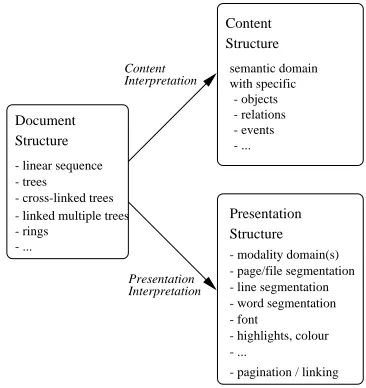
2. a text interpretation or interpretation structure IS, specifying on semiotic grounds an interpretation of DS in terms of a Content Structure CS and a Presentation Structure PS (analogous to the semantic and phonetic interpretation pair of mainstream linguistic theories).
These distinctions are not made simply on theoretical grounds, however, but in order to provide a specification for practical lexicographic implementation. In the case of a lexicon,
1. DS specifies the structure of a lexical database, e.g. re-lational, object–oriented, SGML/XML, or as a lexical knowledge base in DATR or another LKRL (lexicon knowledge representation language), its context (e.g. in relation to a corpus, a grammar, other lexica), its parts, and their contexts.
2. IS specifies
(a) CS in terms of category definitions for the fields of the lexicon (e.g. ‘types of lexical informa-tion’),
(b) PS in terms of a superimposed set of relations over document constituents defining ‘surface re-alisations’ as
on-in contrast to the simpler ‘logical structure / presentation’ approach of many current textbooks; (c) applied to lexica, it specifies the meta–semiotic structure of a lexical document as a complex sign which in turn describes object–semiotic signs, i.e. the lexical entries.
4.
Specifying
DS,
PSand
PIfor a
hyperlexicon
HyperlexiconPS. A hyperlexicon is a lexicon with
hy-pertextualPS, in general based on the ‘latent hypertext’ structure formalised inDS. We take a set–theoretic view of the structure of hypertexts such as hyperlexica and other hy-perdocuments, and define hypertexts as relations between text constituents, where the relations represent hyperlinks. We depart from conventional wisdom in regarding conven-tional linear textual structure simply as a special case of hypertextual structure, and a simple document as the ele-mentary hypertext.
We note thatPI is determined by procedural consider-ations of lexical lookup, and in addition to the traditional onomasiological–semasiological distinction we also distin-guish between two main procedural notions:
1. generator hypertext, i.e. the complete structure de-signed by the author or constructed by software, 2. receiver hypertext, i.e. the structure actually navigated
and retrieved by the reader (or perhaps a hypertext spi-der agent), possibly fragmentary in relation to the gen-erated hypertext, and with different relations over the parts.
The specification of receiver PI may well be pretty nearly identical for differentPS — after all, a dictionary user may simply look up an entry, find a synonym, look up the synonym and check out its definition. This path is not too different in paper or electronic books, though the details ofPSmay be different.
In principle, the relations which may be specified ad hoc for receiverPI will be arbitrary members of the powerset of the Cartesian productEE, where E is the set of linked documents inPS. The members are completely arbitrary, because in principle a user may make arbitrary on the fly jumps. However, more straightforward cases can be taken as the norm, in which receiver PI is simply a subset of generatorPI. We therefore concentrate on generatorPI.
The traditional onomasiological and semasiological cri-teria for organising lexica are procedural: an onomasio-logical lexicon favours concept–based lookup in search of appropriate forms, while a semasiological lexicon favours form–based lookup in search of definitions. The typical se-masiological lexicon has a top node, the lexicon, second level nodes for lexical entries, and leaf nodes represent-ing types of lexical information; some lexica have lemma– sublemma structures, thus involving an additional level in the tree structure. However, the tree structure does not cap-ture a fundamental feacap-ture of semasological lexica, since each pre–leaf node has, in general, the same number of leaves, in the same order, and information types; this sug-gests a tabular structure as being more suitable, though a user may not actually find this a convenient format. An
onomasiological lexicon, often a thesaurus or synonym lex-icon, is more naturally represented as a tree structure; this is a presentation structure which would in theory be suited to conventional termbanks, though these are in practice pre-sented as onomasiologically oriented structures.
Tree–structured and tabularDS. The Document
Struc-ture of a lexical document could be organised on the proce-durally biassed lines; however, we propose adhering to as strictly declarative aDSas possible, with procedural crite-ria being used to define differentPS. But a declarativeDS is not simple. We propose a multi–levelDS:
1. An underlyingn–place relationL, wherenis the num-ber of types of lexical information (the intensional
coverage), and eachn–tuple represents a lexical en-try. A tabular or matrix structure of this kind does not on its own yield natural representations of multiple mappings between types of lexical information how-ever (the injective onomasiological mapping of poly-semy or homonymy etc., including homophony, ho-mography, or the injective semasiological relations of synonymy). In a tabular representation, such relations have to be spelled out, leading to a massive inflation of table structure.
2. A set of more complex relations superimposed on the elements of the relationL, which can be represented graphically as a tree (e.g. for the hyperonym–hyponym relation), a ring (e.g. for partial synonyms), a fully connected graph (e.g. for co–hyponyms, antonyms), a linear graph (e.g. for predicate–argument type rela-tions).
The basic matrix concept DS is supplemented in current theoretically well–founded lexica by generalisa-tion (type or default inheritance) hierarchies coupled with attribute–value structures, which permit underspecified (‘sparse’) representations of lexical entry vectors, and re-duction of overly inflated tabular structures to more inter-esting and tractable tree structures. We do not discuss these methods here, however.
Traditional problems with the matrix representation structure are (cf. also (Gibbon et al., 1997a), Chapter 6, and (Gibbon et al., 1999 forthcoming), Chapter 4):
1. polysemy, i.e. closely related meanings associated with one lexical form (does each meaning require a separate entry?);
2. homonymy (homophony, homography), i.e. the more straightforward case in which one lexical form has completely disparate meanings, with variants of mul-tiple spellings for one pronunciation or mulmul-tiple pro-nunciations for one spelling;
3. (partial) synonymy, i.e. a lexical form shares at least one meaning with another (the extreme case being ab-breviations and their full forms).
systematically as a tractable PS, with the maximal table preserved by associating the rows or records with explicit superimposed relations or ‘rules’. The rules are then avail-able as hyperlinks between relevant types of lexical infor-mation, e.g. ‘pointing’ to synonyms, alternative spellings. More abstractly: the ‘rules’ are available as specifications of a type or default hierarchy over attribute–value structures in a higly–structured and theoretically motivated lexicon.
In summary: the basic, procedurally neutral lexico-graphic DS is tabular with well–defined superimposed tree structures representing paradigmatic similarity rela-tions within the lexicon. It is this concept ofDSfor a flex-ible hyperlexicon which we suggest as a suitable design. In a sense, this is no surprise, because numerous lexical databases adhere to this structure.
5.
Implementation of the
DSgraph
The standard text resource annotation languages SGML (Standard Generalised Markup Language) (ISO 8879:1986, 1986) and its derivative XML (eXtensible Markup Lan-guage) are not entirely adequate for lexicon markup as they are primarily tree–based, and therefore not immedi-ately suited to formulating relation tables or non–tree graph structures in the most expressive manner. They are ade-quate for many purposes, however, as tree structures are very common at all levels of lexicon representation. In particular they can easily be construed as typed attribute– value languages, and therefore isomorphic mappings can conveniently be constructed between SGML/XML markup and the conventional attribute formalisms of current lin-guistic theory. Practical advantages of SGML/XML are their standardised status, which promotes reusabillity of re-sources, and the availability of Document Type Definitions and tools such as parsers and structure editors. This tech-nique was adopted for mapping the the EAGLES-Termbank (EAGLET, 1997-99) database relation to additional tree structures, as described above, using the MARTIF DTD (ISO 12200, 1998) with the lexical categories described in (Gibbon et al., 1997b) based on (ISO 12620, 1998). The EAGLES Termbank covers the domain of terminology for spoken language and multimodal systems.This procedure is illustrated here with the lexicographic term abstract lemma.
Encoding the database relation table. The basic lexical
information type vector is encoded with the attributetype
of the element<termNote type=...>Different terms are included in the lexicon relation, representing different types of lexical information. A subject field, which permits a hierarchical domain classification, is defined:
<descripGrp>
<descrip type="subjectField"> Spoken Language Technology: lexicon </descrip>
</descripGrp>
Unconventionally for terminological lexica, which are in theory concept–based, detailed word form information is included (the pronunciation is given in standard SAMPA notation):
<ntig lang=en> <termGrp>
<term id="abstractlemma"> abstract lemma
</term>
<termNote type="termType"> international scientific term </termNote>
<termNote type="partOfSpeech"> [N: [AJ: abstract][N: lemma]] </termNote>
<termNote type="PLU"> [plural: abstract lemmata] </termNote>
<termNote type="PRON"> /’\{bstr\{kt ’lem@/ </termNote>
</termGrp>
Encoding superimposed tree relations. The database
relation is fully specified, with disjunction–free fields. In order to define relations between entries (records), addi-tional relations are superimposed. First, for each term an identifier id is defined to enable linking from other lexcial entries to this term. Relations with elements of a set of re-lated terms such as lemma and lexical lemma are included, defined as links to these other terms:
<ref type="relatedTerm" target="lemma"> lemma
</ref>
<ref type="relatedTerm" target="lexicallemma"> lexical lemma
</ref>
Both the definition and the concordance–like reference are also included; however, the reference itself is given in another place of the document with all other references and it is refered to by a link again:
<descripGrp>
<descrip type="definition">
An abstract lemma is an access key which may have any convenient unique name or number (or indeed be labelled by the spelling of the canonical inflected form); all properties have equal status, so that the abstract lemma is neutral with respect to different types of lexical access, through spelling, pronunciation, semantics, etc.
</descrip>
<ref type="sourceIdentifier" target="Gibbonetal1997"> p. 200
</ref>
</descripGrp>
<date type="modification">3.3.99</date> <ptr type="originator" target="MS"> <adminGrp>
<admin type="responsibility"> EAGLES 1999
</admin> </adminGrp>
In this notation, theDS can be checked by a conven-tional SGML/XML parser for consistency.
6.
Implementation of
PSgraphs
- linked multiple trees - rings
- ...
- linear sequence - trees - cross-linked trees
Presentation
- modality domain(s) - page/file segmentation - line segmentation - word segmentation - font
- highlights, colour - ...
- pagination / linking (e.g. MARTIF)
Document Structure
Interpretation Presentation
database
book
web
CD-ROM
Structures
versions multiple
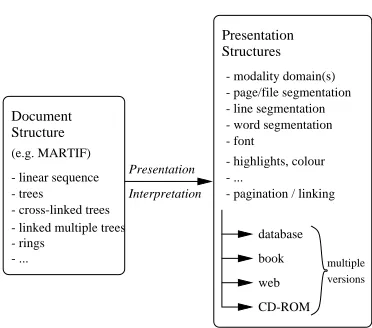
Figure 2: Multiple Presentation Structures.
The original relational database structure, with the ad-ditional relations described above, and the SGML/XML format can be seen as equivalent alternative DS repre-sentations. The different database indexings and views, with different user interfaces, provided by an appropriate database management system are entirely analogous to the
PS structures already discussed. From both the database relations and the SGML/XMLDSrepresentation it is rela-tively straightforward to derive database views, print media formats, as well as hypermedia formats.
Figure 5: HyperlexiconPSprototype.
The current relational databaseDS has the following properties (the DBMS is mSQL):
DS: a matrix with efficient internal representation, and exported for interchange purposes in ASCII CSV
Figure 6: Web database interfacePS.
(character separated value) format with further field coding where necessary. Acoustic visual signal infor-mation as well as concordance references to source text corpora are stored as local or network resource names (filenames, URLs).
User and lexicographer PS interfaces: JavaScript driven HTML forms.
Relational DB query PS output: filing card style browser appearance.
Compiled and on-the-fly hyperlexicon PS out-put: hyperlinked pages representing unifications of information-type-specific tree structures, with reen-trancy for shared subtrees, yielding a hypergraph structure.
The current implementation of the hyperlexicon con-structor uses UNIX scripting, and is in the process of being ported for use with servers in different operating system en-vironments.
DSdatabase structure (extract)
ORT: accuracy KEY: accuracy PRO: /’{kjUr@si/ POS: [N: accuracy] INF: [plural: none]
DOM: Spoken Language Technology: speaker recognition SUP: performance measure
SUB: recognition accuracy SYN: precision
ANT: recall; error rate
DEF: A measure of the performance of a system such as an automatic speech recognition (ASR) system, defined as (N - S - D - I)/N, where N: number of basic units(usually words) in a test, S: number of substitution errors, D: number of deletion errors, I: number of insertion errors.
DAT: 25.11.98, 20.1.99, 16.2.99, 23.2.99 AUT: ms, ms, ms, IMO
Figure 3: DatabaseDSformat.
Figure 4: Book lexiconPS.
this into several practical hypergraph (hyperlexicon) PS macrostructures. In this way, fast, reliable and consistent maintenance of a lexical resource for a range of different user types can be maintained. The present approach dif-fers from recent commercial ‘hypertextualisation’ systems in being based on a consistent, formally expressed linguis-tic model for textual signs.
The termbank currently has an extensional coverage (record count) of about 1300 terms, and an intensional cov-erage (field count) of 20, yielding 26k information items (cells). It is planned to re–implement the PS conversion with DSSSL or XSL in order to achieve maximal reusabil-ity in the future; cf. also (Witt et al., 2000).
8.
References
EAGLET, 1997-99. Eagles-termbase (eaglet). URL coral.lili.uni-bielefeld.de/EAGLES/. Termbank for Spoken Language Systems defined in: LE EAGLES Phase II project (LE3-4244 10484/0) for the European Commission.
Gibbon, Dafydd, Silke K¨olsch, Inge Mertins, Michaela Schulte, and Thorsten Trippel, 1999. Terminology prin-ciples and support for spoken language system develop-ment. In Proceedings of EUROSPEECH ’99. Budapest: EUROSPEECH.
Gibbon, Dafydd, Inge Mertins, and Roger Moore (eds.), 1999 forthcoming. Handbook of Audiovisual,
Multi-modal and Spoken Dialogue Systems Resources and Terminology for Development and Product Evaluation.
Dordrecht: Kluwer.
Gibbon, Dafydd, Inge Mertins, and Roger Moore (eds.), 2000, forthcoming. Handbook of Audiovisual,
Multi-modal and Spoken Dialogue Systems Resources and Ter-minology for Development and Product Evaluation.
Do-ordrecht, New York: Kluwer. Final Report of LE EA-GLES Phase II project (LE3-4244 10484/0) for the Eu-ropean Commission.
Gibbon, Dafydd, Roger Moore, and Richard Winski (eds.), 1997a. Handbook of Standards and Resources for
Spo-ken Language Systems. Berlin: Mouton de Gruyter.
Gibbon, Dafydd, Holger Nord, and Thorsten Trippel, 1997b. Eaglet: Eagles termbank for spoken language systems. DRAFT EAGLES Interim Deliverable, Univer-sity of Bielefeld.
ISO 12200, 1998. Computer applications in
terminol-ogy – Machine-readable terminolterminol-ogy interchange for-mat (MARTIF) –Negociated interchange ISO/DIS 12200.
International Organization for Standardization (ISO), Gen´eva.
ISO 12620, 1998. Computer applications in terminology –
Data categories ISO/DIS 12620. International
Organiza-tion for StandardizaOrganiza-tion (ISO), Gen´eva.
ISO 8879:1986, 1986. Information processing – Text and
office systems – Standard Generalized Markup Language (SGML). International Organization for Standardization
(ISO), Gen´eve.