A Corpus for Evaluating Semantic Multilingual Web Retrieval Systems:
The Sense Folder Corpus
Ernesto William De Luca
Technical University of Berlin - DAI-Labor Sekr. TEL 14 Ernst-Reuter-Platz 7, 10587 Berlin, Germany
Phone: +49 30 314 74074 Fax: +49 30 314 74003 [email protected]
Abstract
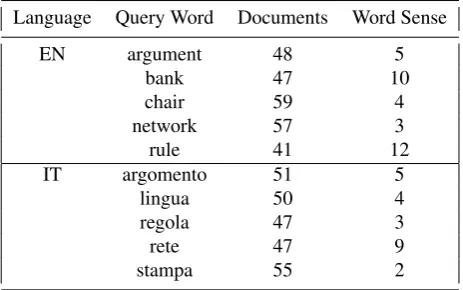
In this paper, we present the multilingualSense Folder Corpus. After the analysis of different corpora, we describe the requirements that have to be satisfied for evaluating semantic multilingual retrieval approaches. Justified by the unfulfilled requirements explained, we start creating a small bilingual hand-tagged corpus of 502 documents retrieved from Web searches. The documents contained in this collection have been created using Google queries. A single ambiguous word has been searched and related documents (approx. the first 60 documents for every keyword) have been retrieved. The document collection has been extended at the query word level, using single ambiguous words for English (argument, bank, chair, network and rule) and for Italian (argomento, lingua, regola, rete and stampa). The search and annotation process has been done both in a monolingual way for the English and the Italian language. 252 English and 250 Italian documents have been retrieved from Google and saved in their original rank. The performance of semantic multilingual retrieval systems has been evaluated using such a corpus with three baselines (“Random”, “First Sense” and “Most Frequent Sense”) that are formally presented and discussed. The fine-grained evaluation of the Sense Folder approach is discussed in details.
1.
Introduction
Many collections are already available in order to measure the effectiveness of information retrieval systems. Exam-ples are given by theReutersCorpus (RCV1), containing a large collection of high-quality news stories (Rose et al., 2002), or the Reuters-21578 and Reuters-22173 data be-ing the most widely used test collection for text categoriza-tion. Another collection is the Text REtrieval Conference
(TREC) data collection, having the purpose to support in-formation retrieval research by providing an infrastructure for large-scale evaluation of text retrieval methodologies. In this paper we first analyze different corpora including Senseval, Semcor, TREC data set and IR-Semcor and de-scribe the requirements and limits of available corpora for evaluating semantic multilingual retrieval approaches.
2.
Corpora Analysis
Before analyzing different kind of corpora used for Word Sense Disambiguation (WSD) or Information Retrieval (IR), some requirements should be discussed because of their importance for evaluating semantic multilingual re-trieval approaches, in order to choose an appropriate cor-pus. In the following we summarize the requirements that have to be satisfied:
• several languagesshould be included to evaluate the multilingual property of our approach. Parallel Cor-pora could be helpful.
• one dominant Domain annotation (Gliozzo and Strap-parava, 2009)describing the semantic domain of the document is required. A semantic domain is important in order to recognize the topic of a document.
• one sense per Document annotation describing the meaning of a given word sense of the document
(Yarowsky, 1993). The annotation has to be document- and not only word-oriented. A corpus with annotation on the document level implicity supports the “one sense per document” assumption (Gale et al., 1992), where a given word in a document is supposed to have one prevalent meaning. we thus prefer such corpora.
• Wordnet SynSet annotation containing the SynsetID of a given word sense of the document. In order to use our approach based on lexical resources (at the moment on WordNet), the documents contained in a given corpus had to be annotated with WordNet SynSets. Thus, every document had to be at least an-notated with one SynSet.
2.1. Word Sense Disambiguation Corpora
Senseval and Semcor are corpora that have been used for WSD evaluation and for learning classifiers (Strapparava et al., 2004). These two data sets are annotated at the sentence level with WordNet SynSets. But unfortunately, the word frequency of a term in a sentence is too low for having sta-tistical significance. While Senseval is available for differ-ent languages, Semcor (Miller et al., 1993) covers only the English language. In order to see if this kind of data could be adapted for the evaluation purpose, we used these data, as an experimental setting for network induction (De Luca and R¨ugheimer, 2007). These data had to be pre-processed in order to extract the most relevant attributes. Different information could have been taken into account.
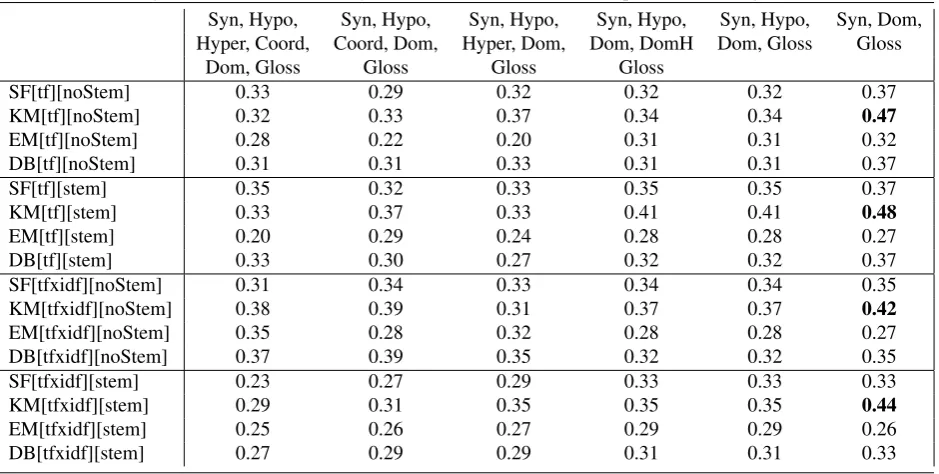
Table 3: Fine-grained (Overall) Accuracy Evaluation Results of different parameter settings with baselines.
Syn, Hypo, Syn, Hypo, Syn, Hypo, Syn, Hypo, Syn, Hypo, Syn, Dom, Hyper, Coord, Coord, Dom, Hyper, Dom, Dom, DomH Dom, Gloss Gloss
Dom, Gloss Gloss Gloss Gloss
SF[tf][noStem] 0.33 0.29 0.32 0.32 0.32 0.37
KM[tf][noStem] 0.32 0.33 0.37 0.34 0.34 0.47
EM[tf][noStem] 0.28 0.22 0.20 0.31 0.31 0.32
DB[tf][noStem] 0.31 0.31 0.33 0.31 0.31 0.37
SF[tf][stem] 0.35 0.32 0.33 0.35 0.35 0.37
KM[tf][stem] 0.33 0.37 0.33 0.41 0.41 0.48
EM[tf][stem] 0.20 0.29 0.24 0.28 0.28 0.27
DB[tf][stem] 0.33 0.30 0.27 0.32 0.32 0.37
SF[tfxidf][noStem] 0.31 0.34 0.33 0.34 0.34 0.35
KM[tfxidf][noStem] 0.38 0.39 0.31 0.37 0.37 0.42
EM[tfxidf][noStem] 0.35 0.28 0.32 0.28 0.28 0.27
DB[tfxidf][noStem] 0.37 0.39 0.35 0.32 0.32 0.35
SF[tfxidf][stem] 0.23 0.27 0.29 0.33 0.33 0.33
KM[tfxidf][stem] 0.29 0.31 0.35 0.35 0.35 0.44
EM[tfxidf][stem] 0.25 0.26 0.27 0.29 0.29 0.26
DB[tfxidf][stem] 0.27 0.29 0.29 0.31 0.31 0.33
When the automatic classification is compared within the baselines presented in Section 4., we can see that all combi-nations outperform all “Random” (0.16) and “First Sense” (0.18) baselines. Last, we can notice that the use of selected linguistic relations combined with clustering methods en-hances the classification performance. Best results have been achieved combining synonyms, semantic domains and glosses (Syn, Dom, Gloss) with the k-Means clustering algorithm (KM). This combination outperformed also the “Most Frequent Sense” baseline (0.35).
The evaluation based on the Sense Folder Corpus can also be done for every single query word in a coarse-grained setting, depending on the purpose of the systems to be eval-uated (De Luca, 2008).
6.
Conclusions
In this paper, we presented the Sense Folder Corpus. This is at the moment bilingual corpus that is being extended with other languages and will be made available for evaluating semantic multilingual retrieval systems. The classification accuracy performance of every semantic multilingual sys-tem can be compared within three baselines (“Random”, “First Sense” and “Most Frequent Sense”) in a fine- and coarse-grained setting, as well as within the Sense Folder approches presented in (De Luca and N¨urnberger, 2006b; De Luca, 2008).
7.
References
Luisa Bentivogli, Emanuele Pianta, and Marcello Ranieri. 2005. MultiSemCor: an English Italian aligned corpus with a shared inventory of senses. InProceedings of the Meaning Workshop 2005, Trento, Italy.
Ernesto William De Luca and Andreas N¨urnberger. 2006a. Rebuilding Lexical Resources for Information Retrieval using Sense Folder Detection and Merging Methods. In
Proceedings of the 5th International Conference on
Lan-guage Resources and Evaluation (LREC 2006), Genova, Italy.
Ernesto William De Luca and Andreas N¨urnberger. 2006b. Using Clustering Methods to Improve Ontology-Based Query Term Disambiguation. International Journal of Intelligent Systems, 21:693–709.
Ernesto William De Luca and Frank R¨ugheimer. 2007. Discovering Linguistic Dependencies with Graphi-cal Models. In LWA 2007 Workshop Proceedings, pages 119–125, Germany, September. Martin-Luther-University Halle-Wittenberg.
Ernesto William De Luca. 2008. Semantic Support in Mul-tilingual Text Retrieval. Shaker Verlag, Aachen, Ger-many.
Jerome H. Friedman and Jacqueline J. Meulman. 2004. Clustering objects on subsets of attributes (with discus-sion).Journal Of The Royal Statistical Society Series B, 66(4):815–849.
William A. Gale, Kenneth W. Church, and David Yarowsky. 1992. One sense per discourse. In Proceed-ings of the 4th DARPA Speech and Natrual Language Workshop, pages 233–237.
Alfio Massimiliano Gliozzo and Carlo Strapparava. 2009. Semantic Domains in Computational Linguistics. Springer, Berlin.
Julio Gonzalo, Anselmo Pe˜nas, and Felisa Verdejo. 1999. Lexical ambiguity and information retrieval revisited. In
Proceedings of the joint SIGDAT Conference on Empir-ical Methods in Natural Language Processing and Very Large Corpora (EMNLP/VLC-99), Maryland.
J. B. Macqueen. 1967. Some methods of classification and analysis of multivariate observations. InProceedings of the Fifth Berkeley Symposium on Mathematical Statistics and Probability, pages 281–297.
Christopher D. Manning and Hinrich Sch¨utze. 1999.
MIT Press, Boston, USA.
D. McCarthy, R. Koeling, J. Weeds, and J. Carroll. 2004. Finding predominant word senses in untagged text. In
42nd Annual Meeting of the Association for Computa-tional Linguistics, Barcelona, Spain.
George Miller, Claudia Leacock, Randee Tengi, and Ross Bunker. 1993. A semantic concordance. InProceedings of DARPA Speech and Natural Language Workshop. Kamal Nigam, Andrew McCallum, Sebastian Thrun, and
Tom Mitchell. 2000. Text classification from labeled and unlabeled documents using em. Machine Learning, 39(2/3):103–134.
Lawrence Page, Sergey Brin, Rajeev Motwani, and Terry Winograd. 1999. The pagerank citation ranking: Bring-ing order to the web. Technical report, Stanford InfoLab. Emanuele Pianta, Luisa Bentivogli, and Christian Girardi. 2002. Multiwordnet: developing an aligned multilingual database. InFirst International Conference on Global WordNet, Mysore, India.
T.G. Rose, M. Stevenson, and M. Whitehead. 2002. The reuters corpus volume 1 - from yesterday’s news to to-morrow’s language resources. In Proceedings of the Third International Conference on Language Resources and Evaluation, Las Palmas de Gran Canaria.
Mark Sanderson. 2000. Retrieving with good sense. Infor-mation Retrieval, 2(1):49–69.
Carlo Strapparava, Alfio Gliozzo, and Claudio Giuliano. 2004. Pattern Abstraction and Term Similarity for Word Sense Disambiguation:IRST at Senseval-3. In Proceed-ings of SENSEVAL-3: Third International Workshop on the Evaluation of Systems for the Semantic Analysis of Text, Barcelona, Spain.
E. Voorhees. 1994. Query expansion using lexical-semantic relations. In Proceedings of the 17th Annual International ACM SIGIR Conference on Research and Development in Information Retrieval, pages 61–69. David Yarowsky. 1993. One sense per collocation. In