Review on Flicker Mitigation of Variable
Speed Wind Turbine
Komal D. Thakur1, Prof. C. M. Bobade2
PG Student, Department of Electrical Engineering, G.H.R.C.E.M, Amravati, India1
Assistant Professor & Head, Department of Electrical Engineering, G.H.R.C.E.M, Amravati, India 2
ABSTRACT:In the huge connected grid various types of renewable resources are added to extract more power. But due to this addition more number of problems occurs into the grid connection. The problems are voltage fluctuation and harmonic distortion. The very most important renewable source is wind generation system. The grid connected wind turbine produces power fluctuations which may produce flicker. Due to this connection it affects power quality. This paper presents various methodologies which minimized flicker which are produced due to variable speed of wind turbine. This paper overviews the methods which can investigate the flicker emission and mitigation issues.
KEYWORDS: Wind turbine; flicker; doubly fed induction generator (DFIG) ; individual pitch control (IPC) ; power quality (PQ) ; fluctuation ; energy storage system (ESS) ; fatigue, aerodynamic, structures & turbulence (FAST).
I.INTRODUCTION
During last few decades, due to increase in power demand, there is need of penetration of various types of renewable sources into the grid system. One of the most important renewable source is wind generating system. But due to penetration of wind turbine into the grid affects the electric grid power supply quality. There are various types of power quality problems such as voltage sags, voltage swell, fluctuation, harmonics etc. One of the power quality problems which occur due to wind turbine is power fluctuation. This fluctuation occurs due to continuous variation in wind speed, wind shear and tower shadow effects. Due to the increase awareness of power quality particularly in highly sensitive industry like continuous process industry, complex machine part producing industry and security related industry where standardization and evaluation of performance is an important aspect [2]. Before discussing the various methods which are used to mitigate fluctuations in power supply for wind turbine, it is important to understand the various power quality issues.
Here some Power Quality issues are discussed below;
A] Voltage Fluctuation on grid
Fig. 1: Voltage Fluctuation
B] Switching operation of wind turbine on the grid
Switching operations of wind turbine generating system can cause voltage fluctuations and thus voltage sag, voltage swell that may cause significant voltage variation.
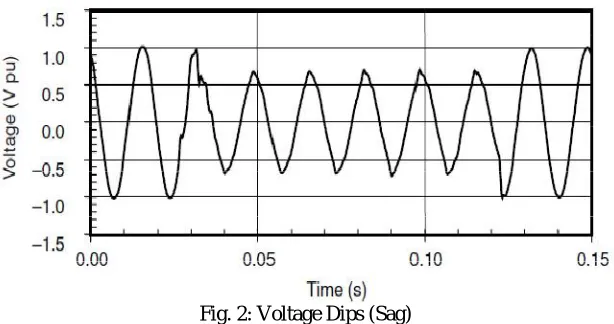
C] Voltage dips on the grid (voltage sag)
Voltage dip (voltage sag) is defined as a reduction in voltage for a short interval of time. The duration of a voltage sag is less than 1 minute but more than 8 milliseconds. The magnitude of the reduction is in between 10% and 90% of the normal root mean square (RMS) voltage at 50 or 60 Hz.
Fig. 2: Voltage Dips (Sag)
D] Harmonics
Harmonics are integral multiples of the fundamental frequency of the sine wave. They add to the fundamental 50 Hz waveform and distort it.
fluctuations caused by wind speed variation, wind shear, tower shadow, yaw errors, etc., lead to the voltage fluctuations in the network, which may produce flicker [1]. Apart from the wind power source conditions, the power system characteristics also have impact on flicker emission of grid-connected wind turbines, such as short-circuit capacity and grid impedance angle.
II. METHODOLOGY
1. Individual Pitch Control Method
An IPC scheme is proposed for flicker mitigation of grid-connected wind turbines. In this scheme, the oscillations are mitigated by adjusting the pitch angle according to the generator active power feedback & azimuth angle of wind turbine in such a way that the voltage fluctuations are smoothed from leading to flicker mitigation. The causes of flicker emission on load are also investigated. For simulating three-bladed wind turbines FAST code is used [1].
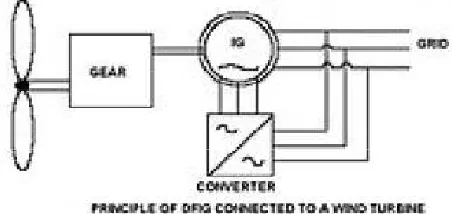
Fig. 3: Overall scheme of the DFIG-based wind turbine system
The overall scheme of a DFIG-based wind turbine system is shown in Fig. 3, which consists of a wind turbine, gearbox, DFIG, a back-to-back converter which is composed of a rotor side converter (RSC) and GSC, and a dc-link capacitor as energy storage placed between the two converters. In this methodology, FAST is used to simulate the mechanical parts of wind turbine and the drive train. The pitch and converter controllers, DFIG, and power system are modelled by Simulink blocks. The figure shows schematic representation of block diagram of grid connected wind turbine with a doubly fed induction generator. The wind turbine considered here applies a doubly fed induction generator, using a back-to-back PWM voltage source converter in the rotor circuit. Variable speed operation of the wind turbine can be realized by appropriate adjustment of the rotor speed and pitch angle. A complete wind turbine model includes the wind speed model, the aerodynamic model of the wind turbine, the mechanical model of the transmission system and models of the electrical components, namely the induction generator, PWM voltage source converters, transformer, and the control and supervisory system. Fig. 3 illustrates the main components of a grid connected wind turbine [4].
The above figure shows schematic representation of principle of DFIG connected to a wind turbine. The DFIG operate at unity power factor which requires higher flux in the air gap of machine than the wound rotor induction machine. The wound rotor machine can’t design to doubly fed operation because it saturate heavily if doubly fed operation is attempted. Thus special design is necessary. A multistep slip ring is used to transfer power to rotor winding set & it also controls the winding. It requires maintenance, cost & efficiency. The principle of DFIG is that rotor windings are connected to grid through slip ring and voltage source converter which controls both rotor & grid current. Converter controls the rotor current and adjusts the active and reactive power from the stator independently of generators turning speed [4].
2. Wind Energy Conversion System
The wind power conversion system is shown in Fig.5.The building blocks for this includes the wind turbine, converter inverter system and grid having non-linear load. The study of steady state and dynamic performance is carried out by modelling these components in MATLAB / SIMULINK with appropriate control scheme.
Fig. 5: System with nonlinear load (Thyristor Controlled D.C. Drive)
The starting end voltage source converter is always operated in hysteresis current control mode. The reference signals are derived from phase voltage. The scheme is used to match the supply currents in its magnitude, waveform and phase with three phase reference signals. When this is achieved, the supply current will be sinusoidal, with control over its magnitude & phase, irrespective of harmonics and unbalance of load demand. It maintains unity power factor at supply side with active & reactive power support at wind turbine side. In the proposed controller, the active power of the load in the steady state should be supplied from the source only and therefore the inverter will only provide the necessary reactive power. Among the various current control techniques, the hysteresis current control is the simplest and most commonly used method. The hysteresis control scheme provides excellent dynamic performance and inherent peak current limiting capability. The main drawback of hysteresis control schemes is variable switching frequency. The proposed scheme with its controller action is simulated in MATLAB / SIMULINK. The basic scheme involves the variable active and reactive load at PCC [3].
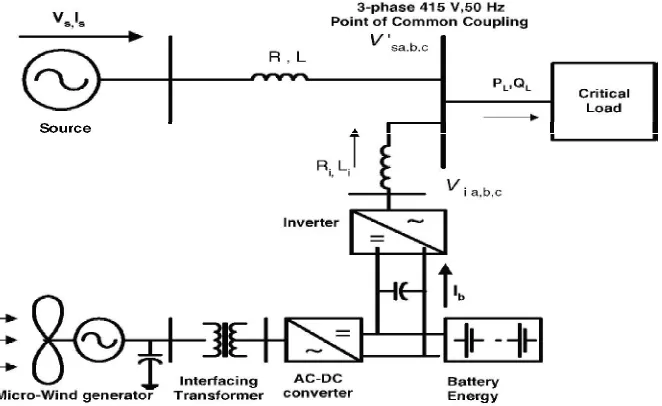
3. Wind Energy System With Battery Energy Storage
operate under stand alone system if grid fails like an uninterruptable power system. The system is simulated in MATLAB/SIMULINK and results are presented [5].
Fig. 6: Scheme of micro-wind generator with battery storage for critical load application.
The proposed control system with battery storage has the following objectives: 1) Unity power factor and power quality at the point of common coupling bus. 2) Real and reactive power support from wind generator and batteries to the load; 3) Stand-alone operation in case of grid failure [5].
4. Energy Storage System
Due to penetration of wind power (WP) in the distribution network the power quality (PQ) of grid network disturbs. More specifically, the major issues of networks are PQ which experiences disturbance due to fluctuating nature of generated active power in the wind power (WP). The installation of ESS is best remedy over these fluctuating PQ problems. The proposed scheme is used to offset the flicker production in WP system. The system is used to smooth the WP fluctuations that are faster than the response time of long term battery unit [6].
III. CONCLUSION
In this paper, different methodologies are reviewed using from past years for flicker mitigation of wind generating system. Also various flicker mitigation technologies have been studied and discussed. Basically the method is selected as per its efficiency and reliability. All the methodologies are varies with its cost, complexity and performance. It has determined that IPC scheme is best choice among all the methods due to its capacity which leads to flicker emission prominently in both high and low wind speeds during continuous operation. It is concluded that although the thyristor controlled scheme is more mature than others. But it is important to consider not only performance but also reliability.
REFERENCES
[1] Yunqian Zhang, Weihao Hu and Ming Cheng, “Flicker Mitigation by Individual Pitch Control of Variable Speed Wind Turbines With DFIG,” IEEE Trans. Energy Convers, vol. 29, no. 1, Mar.2014.
[2] Sharad W. Mohod & Dr. Mohan V. Aware, “Power Quality Issues & It’s Mitigation Technique in Wind Energy Generation,” in Proc. IEEE ICQPH, Sep.–Oct. 2008, pp. 1–6.
[3] S.W.Mohod & M. V. Aware, “ Grid Power Quality with Variable Speed Wind Energy Conversion,”proceeding of IEEE Int. Conf on.,Power Electronic Drives and Energy System (PEDES) Delhi, 5A- 21,Dec.2006
[4] T .Sun, Z. Chen, and F. Blaabjerg, “Flicker study on variable speed wind turbines with doubly fed induction generators,” IEEE Trans. Energy Convers., vol. 20, no. 4, pp. 896–905, Dec. 2005.
[5] S.W. Mohod & Dr. M.V. Aware, “Micro Wind Power Generator with Battery Energy Storage for Critical Load,” IEEE System Journal, vol. 6, no. 1, Mar.2012.
[6] Dr. Samalla Krishna & Ms. Katkuri Laxmi Chaitanya, “Flicker mitigation and Voltage Quality Improvement in WP using IPC and ESS,”IJR Journal, vol. 2, Issue 08, August 2015.
[7] T. Sun, “Power Quality of grid-connected wind turbines with DFIG and their interaction with the grid,” Ph.D. dissertation, Aalborg Univ ,Aalborg, Denmark, 2004.
[8] A Larsson, “Flicker emission of wind turbines during continuous operation,” IEEE Trans. Energy Convers , vol. 17, no. 1, pp. 114–118, Mar. 2002.
[9] T. Sun, Z. Chen, and F. Blaabjerg, “Flicker study on variable speed wind turbines with doubly fed induction generators,” IEEE Trans. Energy Convers., vol. 20, no. 4, pp. 896–905, Dec. 2005.
[10] K. Yun-Seong and W. Dong-Jun, “Mitigation of the flicker level of a DFIG using power factor angle control,” IEEE Trans. Power Del., vol. 24, no. 4, pp. 2457–2458, Oct. 2009.