ABSTRACT
MORRISON, PATRICK JAMES. A Security Practices Evaluation Framework. (Under the direction of Laurie Williams.)
Motivation. Security breaches, and the software vulnerabilities that enable them, have
in-creasingly become headline news. Avoiding or resolving vulnerabilities during software
devel-opment has become a consideration for many organizations that build and ship software.
Research Problem. Many software development security practices have been recommended.
However, empirical evidence on the application and results of the practices is limited. The
goal of this research is to support researcher and practitioner adoption of security practices
by developing a model for how security practice adherence affects security outcomes and a
framework for the collection of software development context factors, practice adherence, and
security outcomes.
Approach. To support the collection of empirical evidence for the effects of security practice
use in software development, we propose a model, the Security Outcomes Theoretical Model
(SOTM), for how security practice adherence affects security outcomes, supported by a
mea-surement framework, the Security Practices Evaluation Framework (SP-EF). SOTM is a set of
constructs and relationships that embody a theory of how security practices affect security
out-comes. SP-EF is a measurement framework that includes repeatable instructions for identifying
the use of these practices, recording the context of the team using the practices, and measuring
the security outcomes for the software.
Results. We conducted a literature review to identify software development security context
factors, security practices, and outcome measures. We identified a set of security practices,
practice adherence metrics, outcome measures, and context factors, and assembled them as
a measurement framework, EF. We conducted a case study in which we collected all
SP-EF data from an industrial software development project. We found agreement between the
researcher and team views of security practice use on the project, and evaluated the effectiveness
specified in SP-EF by one or more survey participants. We conducted a survey of open source
development projects to assess the use of the SP-EF security practices and the degree to which
our adherence measures correlate with security practice use. We found empirical support for
the use of the SP-EF security practices. We found that Training has a positive, statistically
significant correlation with Usage, suggesting that investment in training supports practice
usage. Finally, we assessed whether the theorized relationships in SOTM hold in observational
data by combining SP-EF measurements available in published datasets. Our data suggest
that assessing the state of software security requires accounting for both software development
context factors and the software usage context factors.
Contributions. Our contributions include:
• The Security Outcomes Theoretical Model, a proposed model of the constructs affecting software development security outcomes;
• SP-EF, a proposed set of measures for assessing security in the software development process including instructions for data collection, and
© Copyright 2017 by Patrick James Morrison
A Security Practices Evaluation Framework
by
Patrick James Morrison
A dissertation submitted to the Graduate Faculty of North Carolina State University
in partial fulfillment of the requirements for the Degree of
Doctor of Philosophy
Computer Science
Raleigh, North Carolina
2017
APPROVED BY:
Chris Parnin Emerson Murphy-Hill
Johnathan Stallings Laurie Williams
DEDICATION
BIOGRAPHY
Patrick Morrison was born in Avon Park, Fl. He graduated from Flagler Palm Coast High School, where he was part of the National Honor Society and the Chess Club. He graduated
from the University of Florida with a Bachelor of Science in Computer Science in 1986. He spent time in a sequence of development jobs for large corporations, and large and small consulting
firms, leading to teaching a class in web development at Florida Atlantic University. One thing
lead to another, and he earned a Master of Science in Computer Science from Florida Atlantic University in 2007. One more thing led to another, and he returned to school full-time to pursue
a Doctorate in Philosophy at North Carolina State University. Currently, Patrick is working at
ACKNOWLEDGEMENTS
I am grateful to my advisor, Laurie Williams, for the time and effort she took in introducing me to software engineering research, for all of the patience, encouragement, funding, and feedback
that came with the introduction, and for the vision and willingness behind it all. Thank you to my committee members, Emerson Murphy-Hill, Chris Parnin, and Jonathan Stallings, for all
of the time spent, and all of the advice and support you’ve so generously given.
I am greatly indebted to the members of Laurie’s research group: Andrew Austin, John Slankas, Pat Francis, Eric Helms, JeeHyun Hwang, Da Young Lee, Jason King, Andy Meneely,
Rahul Pandita, Akond Rahman, Maria Riaz, Yonghee Shin, Ben Smith, Will Snipes, Chris
Theisen, Akond Rahman, and Sarah Elder. From critiquing my work helpfully, to various project collaborations, to sharing the woes and joys of life inside and outside research, I am grateful.
Many of my new skills are your old skills, and I trust that our new friendships will become old
friendships over time. Much the same can be said for the many brilliant, creative, and dedicated denizens of the software engineering labs in rooms 3228 and 3231, e.g. Aaron Massey, Brittany
Johnson, Adam Marrs (honorary denizen), Jim Witschey, Titus Barik, Kevin Lubick, Michael
Winters, Justin Smith, and more.
I am grateful to teachers, mentors, and friends who have inspired, encouraged, taught,
admonished, and inspired me. Whether through a kind word, a new perspective, or an old
reminder, your influence on me is invaluable and cherished. The list can only be partial, but it includes Mrs. Chase, James Daly, Henly Wolin, Sylvia Brady, Ron Conkling, Charles Pike,
Kevin Desruisseau, Bruce Edwards, Patrick Forney, Phil Spadaro, Morgan Baker, Eduardo
Fernandez, Michael Van Hilst, Shihong Huang, Maria Petrie, Jerry Weinberg, Linda Rising, Rob DeLine, Brendan Murphy, Kim Herzig, Eric Franklin, Russell Teague, and Andy Rindos.
I am grateful to so many in the Triangle Church of Christ who have shared their lives and
hearts with us, around dinner tables, prayer circles, service activities, and worship services. I’m especially grateful for those who have watched over Daniel when Karen or I had to be elsewhere:
Kris Bailey, Dorothy, Ana, and Andrew Felsher, the Hoegemeyer clan, Joy Morris, Casey Kuan, Alec and Kaley Nunez, Cari Overturf, the Teague clan. I am grateful to Cub Scout Pack 222 for
taking Daniel and I in, and adding camping, woodworking, Pinewood Derby racing, and dozens
of other cool things to Daniel’s childhood. We are grateful to the staffs of Wiley Elementary School and the Alexander Family YMCA for taking Daniel into their hearts as well as their
classrooms.
I am grateful to the engineers behind my Pomodoro kitchen timer, Ikea lamp, Acura Legend, Apple Macbook, the R Project, and the ’Hadleyverse’ for making things that helped with
for the differences your contributions make for me and for so many others. I am grateful for a
thousand and one conversations supported by coffee at CupAJoe, beer at Mitch’s, and meals at Noodles and Company. I am grateful for Chet Atkins, Johann Sebastian Bach, David Byrne,
Guy Clark, Ry Cooder, Miles Davis, Brian Eno, Ella Fitzgerald, David Gilmour, Andy Getch,
Nanci Griffith, Mark Knopfler, Bob Marley, Joe Pass, John Prine, Paul Roub, John Santa, Ronnie Van Zant, Paul Westerberg, Doc Watson, Dar Williams, Stevie Wonder, and all the
other singers, songwriters, and musicians who kept me company over long stretches of writing
and contemplation.
The family I came from supplied me with abundant love, creativity, and vision in the form
of Leo and Liilia Morrison, Michael, Kathleen, and James, and Karl and Leida Talts.
The family I helped create sustains me in so many ways. Daniel brings great joy into our lives, and Karen brings joy as well as just about everything else. I’m pretty sure I wouldn’t
even be able to type these lines if not for a thousand things she’s done to keep things running
while I type.
Most of all, I am grateful to be able to pursue the Author of all things, and to know that
He wants to know me as well.
This work has been supported, in part, by an IBM PhD Fellowship, and by the USA National Security Agency (NSA) Science of Security Lablet at NCSU. Any opinions expressed in this
report are those of the author(s) and do not necessarily reflect the views of IBM or the NSA. We are grateful to the survey participants for their time, effort, and contributions.
Think - IBM
Think and Do - NCSU Esse quam videri - North Carolina
TABLE OF CONTENTS
LIST OF TABLES . . . xi
LIST OF FIGURES . . . xii
Chapter 1 Introduction . . . 1
1.1 Solution Methodology . . . 3
1.1.1 Security Outcomes Theoretical Model . . . 3
1.1.2 The Security Practices Evaluation Framework . . . 4
1.2 Thesis statement . . . 4
1.3 Research Questions and Associated Studies . . . 4
1.4 Contributions . . . 5
Chapter 2 Background and Related Work . . . 7
2.1 Definitions . . . 7
2.2 Measurement Frameworks . . . 8
2.3 Structural Equation Modeling . . . 9
2.4 Software Development Security Metrics . . . 12
2.5 Software Development Security Practices . . . 13
2.5.1 The Building Security In Maturity Model . . . 13
2.5.2 The Microsoft Security Development Lifecycle . . . 14
2.5.3 SAFECode . . . 14
2.5.4 OWASP CLASP . . . 14
2.5.5 Other Security Practice Lists and Surveys . . . 15
2.6 Technology Adoption . . . 16
2.7 Practice Adherence . . . 17
Chapter 3 Security Metrics and Practices Mapping Study . . . 18
3.1 Introduction . . . 18
3.1.1 Security Metrics Systematic Literature Review . . . 18
3.1.2 Security Practices Review . . . 19
3.2 Methodology . . . 20
3.2.1 Search Strategy . . . 20
3.3 Results . . . 26
3.3.1 RQ1.1: What software lifecycle security metrics have been proposed in the literature? . . . 26
3.3.2 RQ1.2: What are the people, artifacts, and process elements being mea-sured by software lifecycle security metrics? . . . 38
3.3.3 RQ1.3: What validation approaches are used for software lifecycle security metrics? . . . 39
3.3.4 RQ1.4 During what phases of the software development lifecycle are soft-ware lifecycle security metrics measured? . . . 39
3.4 Discussion . . . 41
3.4.2 What To Measure? . . . 44
3.4.3 Fundamental Security Questions, revisited . . . 44
3.5 Limitations . . . 46
3.6 Contributions of the Systematic Mapping Study . . . 47
3.7 RQ1.5: What software development security practices are used by software de-velopment teams? . . . 47
3.7.1 Methodology . . . 48
3.7.2 Practice classification results . . . 49
3.7.3 Discussion . . . 51
3.7.4 Limitations . . . 51
Chapter 4 A Security Practices Evaluation Framework . . . 53
4.1 Introduction . . . 53
4.2 Context Factors . . . 55
4.3 Practice Adherence . . . 55
4.3.1 Outcome Measures . . . 56
4.4 The Security Outcomes Theoretical Model (SOTM) . . . 56
4.4.1 Structural Model Constructs . . . 57
4.4.2 Structural Model Relationships . . . 58
4.4.3 Measurement Model: Metrics, Variables, and Relationships . . . 61
4.5 Contribution . . . 63
Chapter 5 Measuring Security Practice Use in Software Development . . . 64
5.1 Methodology . . . 65
5.2 Industrial Case Study Results . . . 65
5.2.1 RQ2.1: Can the complete set of SP-EF measurements be collected for a software development project? . . . 66
5.3 Discussion . . . 73
5.4 Lessons Learned . . . 74
5.5 Limitations . . . 75
5.6 Contributions of the Measurement Case Study . . . 75
Chapter 6 Surveying Security Practice Use in Software Development. . . 77
6.1 Introduction . . . 77
6.2 Methodology . . . 78
6.2.1 Study Methodology . . . 78
6.2.2 RQ2.2: What software development security practices are used by soft-ware development teams? . . . 78
6.2.3 RQ2.3: Does security practice adherence, as measured by Ease of use, Effectiveness, and Training, correlate with software development security practice use? . . . 79
6.3 Results . . . 80
6.3.1 Practice classification results . . . 80
6.3.2 Survey Subjects and Responses . . . 80
6.4 Discussion . . . 85
6.5 Limitations . . . 88
6.6 Contributions of the Survey Study . . . 88
Chapter 7 Quantifying Security Context Factors in Software Development . . 90
7.1 Expressing SOTM as a SEM Model . . . 91
7.2 Case Study Methodology . . . 93
7.2.1 Step 1: Select case study subject . . . 93
7.2.2 Step 2: Link data source variables to the model constructs . . . 93
7.2.3 Step 3: Evaluate collected data for fit problems . . . 94
7.2.4 Step 4: Estimate SEM model . . . 94
7.2.5 Step 5: Test model fit . . . 95
7.2.6 Step 6: Perform Re-specification, if necessary . . . 95
7.2.7 Step 7: Report Results . . . 96
7.3 Case Study . . . 97
7.3.1 Data selection . . . 98
7.3.2 Data collection . . . 99
7.3.3 Estimation . . . 99
7.3.4 Model Fit . . . 100
7.3.5 Re-specification . . . 101
7.3.6 Reporting Results . . . 102
7.3.7 Discussion . . . 104
7.4 Limitations . . . 106
7.5 Contributions of the Quantification Study . . . 107
Chapter 8 Case Studies using SP-EF . . . .109
8.1 Methodology . . . 109
8.1.1 Subject selection . . . 110
8.1.2 Data Collection . . . 110
8.1.3 Research question analysis . . . 111
8.2 Bitcoin Case Study . . . 112
8.2.1 Data Collection . . . 112
8.2.2 Results . . . 113
8.3 IBM wasCloud Case Study . . . 116
8.4 phpMyAdmin Case Study . . . 119
8.4.1 Data Collection . . . 119
8.4.2 Results . . . 120
8.5 OpenSSL Case Study . . . 123
8.5.1 Data Collection . . . 126
8.5.2 Results . . . 126
8.6 Research Question Answers . . . 129
8.6.1 RQ2.1: Can the complete set of SP-EF measurements be collected for a software development project? . . . 129
8.7 Discussion . . . 134
8.8 Limitations . . . 135
8.9 Conclusion . . . 135
Chapter 9 Conclusion . . . .136
9.1 Contributions . . . 137
9.2 Future Work . . . 138
BIBLIOGRAPHY . . . .138
APPENDICES . . . .147
Appendix A Selected Papers . . . 148
Appendix B Survey Questionnaire . . . 153
Appendix C SP-EF Guidebook . . . 155
C.1 SP-EF Measurement Guidebook . . . 155
C.1.1 Abstract . . . 155
C.2 Introduction . . . 156
C.2.1 Domain . . . 157
C.2.2 Context Factors . . . 158
C.2.3 Language . . . 158
C.2.4 Confidentiality, Integrity, and Availability Requirements . . . 158
C.2.5 Methodology . . . 159
C.2.6 Source Code Availability . . . 159
C.2.7 Team Size . . . 160
C.2.8 Team Location . . . 161
C.2.9 Operating System . . . 161
C.2.10 Product Age . . . 162
C.2.11 Number of Identities . . . 162
C.2.12 Number of Machines . . . 163
C.2.13 Source Lines of Code (SLOC) . . . 163
C.2.14 Churn . . . 164
C.2.15 Perform Security Training . . . 166
C.2.16 Description . . . 166
C.2.17 Apply Data Classification Scheme . . . 166
C.2.18 Apply Security Requirements . . . 167
C.2.19 Apply Threat Modeling . . . 168
C.2.20 Document Technical Stack . . . 169
C.2.21 Apply Secure Coding Standards . . . 170
C.2.22 Apply Security Tooling . . . 171
C.2.23 Perform Security Review . . . 172
C.2.24 Perform Security Testing . . . 173
C.2.25 Description . . . 174
C.2.26 Links . . . 174
C.2.27 Publish Operations Guide . . . 174
C.2.29 Track Vulnerabilities . . . 176
C.2.30 Improve Development Process . . . 177
C.2.31 Subjective Practice Adherence Measurement . . . 178
C.2.32 Objective Practice Adherence Measurement . . . 179
C.2.33 Per Vulnerability Attributes . . . 180
C.2.34 Pre-Release Defects . . . 180
C.2.35 Post-Release Defects . . . 181
C.2.36 Vulnerability Density . . . 181
C.2.37 Pre-Release Vulnerabilities . . . 182
C.2.38 Post-Release Vulnerabilities . . . 182
C.2.39 Vulnerability Removal Effectiveness . . . 183
LIST OF TABLES
Table 2.1 SEM Notation, adapted from Hildreth [27] . . . 10
Table 3.1 Research Question Keywords . . . 21
Table 3.2 Keyword Synonyms . . . 21
Table 3.3 Search Results . . . 24
Table 3.4 Security Metric Categories and Subcategories . . . 27
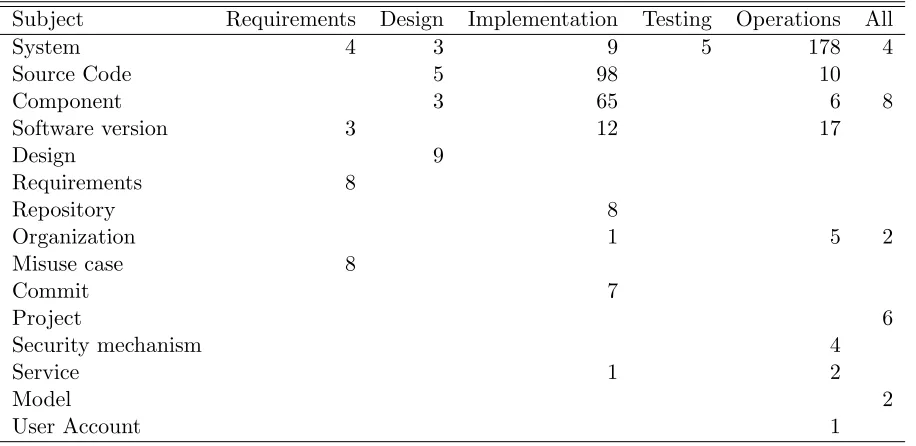
Table 3.5 Metric Ids by Phase and Subject . . . 38
Table 3.6 Studies by Evaluation Technique . . . 39
Table 3.7 Studies by Lifecycle Phase . . . 40
Table 3.8 Lifecycle Phase by Metric Category . . . 41
Table 3.9 Metrics referenced in two or more papers and evaluated in an industrial context . . . 45
Table 3.10 Security Practices By Source . . . 50
Table 3.11 SP-EF Security Practice Descriptions . . . 52
Table 4.1 Model Context Factors, Measures, and Hypotheses . . . 62
Table 5.1 Practice Adherence Comparison Table . . . 68
Table 6.1 Survey Invitations and Responses, by Project . . . 81
Table 6.2 Practice Adherence Metrics Usage . . . 87
Table 7.1 SOTM Lavaan Syntax . . . 92
Table 7.2 Combined Demographics for 697 Projects . . . 100
Table 7.3 Global Fit Measures and Results . . . 101
Table 7.4 OpenHub-NVD Respecified Model Results . . . 102
Table 7.5 OpenHub-NVD Respecified Model Residuals . . . 104
Table 8.1 Bitcoin Manual Review Evidence . . . 114
Table 8.2 phpMyAdmin Manual Review Evidence . . . 121
Table 8.3 SP-EF Model Context Factors, Measures, and Case Study Results . . . 125
Table 8.4 OpenSSL Manual Review Evidence . . . 127
Table A.1 Selected Papers . . . 149
Table A.2 Selected Papers . . . 150
Table A.3 Selected Papers . . . 151
LIST OF FIGURES
Figure 4.1 Structural Model Overview . . . 60
Figure 4.2 Graphical display of lavaan syntax for DevelopmentRisk =∼ Theorized measurement variables from Table 4.1 . . . 61
Figure 5.1 Context Factors . . . 67
Figure 5.2 Survey Results . . . 72
Figure 6.1 Security Practice Adherence Measurement Model . . . 80
Figure 6.2 Security Practices Usage Frequency . . . 82
Figure 7.1 Respecified OpenHub-NVD Combined Model . . . 103
Figure 8.1 Bitcoin Metrics 2010-2016 . . . 117
Figure 8.2 wasCloud Metrics 20103-2015 . . . 118
Figure 8.3 phpMyAdmin Metrics 2001-2014 . . . 124
Figure 8.4 OpenSSL Metrics 2013-2016 . . . 130
Chapter 1
Introduction
Vulnerabilities introduced during software development are one of the causes of security breaches
in software systems. For example, In February 2017, security researchers discovered a
program-ming bug in a HTML parser at Cloudflare1. The parser was sending decrypted encryption keys and passwords along with ordinary web requests, resulting in unencrypted sensitive data being
cached across the Internet. While the programming bug, now known as ‘Cloudbleed’2, was on a single line of code, the bug had widespread effects because of the code’s context, running on many servers and sending sensitive results to many clients. The example of Cloudbleed suggests
that software development teams must consider the software’s environment and data as well as
the technical characteristics of their software when evaluating their software’s security.
The IEEE defines security [31] as ’all aspects related to defining, achieving, and
main-taining confidentiality, integrity, availability, non-repudiation, accountability, authenticity, and
reliability of a system.’ Multiple software technical and process characteristics contribute to the potential for software vulnerabilities. For example, code size [1], code churn [86, 57], and
language [78] have been correlated with vulnerabilities. Similarly, multiple software usage
char-acteristics, for example, access to sensitive data 3, management of financial information [26], and the presence of a piece of software on large numbers of machines 4 have been correlated with vulnerabilities. Two pieces of software may have similar technical characteristics (e.g. same
language, same size) but different security outcomes as a consequence of the uses to which the
1
https://blog.cloudflare.com/incident-report-on-memory-leak-caused-by-cloudflare-parser-bug/
2https://blog.cloudflare.com/quantifying-the-impact-of-cloudbleed 3http://heartbleed.com/
software is put. For example, between a game level editor and a database system of similar source code size, the database system managing credit card data may be more prone to
at-tack and to have more publicly reported vulnerabilities5, than the game level editor managing custom game levels.
As evidenced by Cloudbleed, vulnerabilities due to even small mistakes during software
development can have significant consequences. As one approach to reducing or eliminating
vulnerabilities, software development teams are recognizing the need to ‘build security in’ [52] during the development process. Large companies have developed sophisticated approaches to
applying security practices in software development. Example lists include the Building Security
in Maturity Model [52] (BSIMM), the Microsoft Security Development Lifecycle [29] (SDL), the Software Assurance Forum for Excellence in Code [89] (SAFECode), and the Open Web
Application Security Project (OWASP) Software Security Assurance Process [49] (SSAP). The
BSIMM is a survey and inventory of security practices identified in large organizations. The authors of the BSIMM suggest that by clearly noting objectives and by tracking practices with
metrics tailored to your own situation, you can use the BSIMM as a measurement tool. However, determining the objectives, tracking the practices, determining which metrics to collect, and
organizing and analyzing the resulting data goes beyond the scope of the BSIMM. Indeed,
the BSIMM explicitly avoids recommending practices and recommends organizations develop their own initiatives for selecting and evaluating practices. Further, practices and initiatives
appropriate for a large, widely used product may be overly complicated or expensive for a
small team. Many software projects, including key infrastructure like OpenSSL and NTP6, are developed by small teams with limited resources.
An organization’s, team’s, or individual developer’s ability to measure is the first step in
balancing the trade off between the costs in time, effort, and complexity of applying security practices and the achievement of an appropriate level of security in delivered software. In a
sur-vey of the literature [93], Verendel concluded that the foremost reason for the unknown validity
of software security measurement is the lack of repeated large-sample empirical validation of the specific quantitative methods. Measurement frameworks [36, 98] offer a means for
catego-rizing empirical studies and organizing them into a body of knowledge, supporting repeated
large-sample empirical validation. Developing a framework for measuring the use and effect of security practices, applying and promoting it across projects, and supporting the collection and
5Following Krsul [40] and Ozment [73], we define a vulnerability as an instance of a mistake
in the specification, development, or configuration of software such that its execution can violate the explicit or implicit security policy.
6
analysis of the results are all necessary components of meeting Verendels concern.
Whether at the team, organization, or industry level, a body of knowledge on the effects of
security practice use in software development would support practitioners and researchers in
project planning, security assurance, and process improvement. For example, one question in software development security practice selection is which practices should be adopted to help
the team achieve its security goals. Team selection of security practices would be strengthened
by empirical evidence for the effectiveness of applying security practices. A second question is whether the practices selected are worth the investment given the project goals. A team
building a single-user application that does not store sensitive data may require relatively little
in the way of security practices and security effort. A team building a system that manages high-value data may require a comprehensive set of security practices and high levels of security
practice effort. Systematically determining where a software development project lies on this
continuum of security need versus the assurance afforded by applying security practices requires a scheme for measuring how environmental characteristics, system characteristics and security
practice use affect security need and protection. Answers for these questions based on empirical evidence would benefit software development teams. The goal of this research is to support
researcher and practitioner adoption of security practices through the development of a model
for how security practice adherence affects security outcomes and a framework for the collection of software development context factors, practice adherence, and security outcomes.
1.1
Solution Methodology
To support software development teams in assessing security practice effectiveness in the context of software development project, in this research a model for how security practice use affects
security outcomes was developed, as well as a measurement framework for the collection of
empirical data on security practices and outcomes.
1.1.1 Security Outcomes Theoretical Model
To support detailed analysis for how security practices affect security outcomes, we represent
each element of the framework in a model of the software development lifecycle, enabling study of the relative importance of each security practice in software development, and measurement
of the validity and reliability of the framework.
hypoth-esize that the four constructs are related as follows:
• H1 Software usage factors are associated with negative Security Outcomes
• H2Software development context factors are associated with negative Security Outcomes
• H3Practice Adherence is associated with Software development context factors
1.1.2 The Security Practices Evaluation Framework
We propose the Security Practices Evaluation Framework (SP-EF), a measurement framework to enable empirical data collection for security practice use and outcomes in software
devel-opment. SP-EF contains three categories of data elements: context factors, practice adherence metrics, and outcome measures. Context factors are a set of attributes and values that are
used to provide a basis of comparison between projects measured using SP-EF. The practice
adherence metrics are a set of attributes and values that are used to describe security practices in use on a project, and the degree to which each practice is adhered to by the project team.
Outcome measures are a set of attributes and values that are used to describe the
security-related outcomes of the project. We define data elements of SP-EF and provide guidance on how to collect the data elements in the form of an online guidebook [63]. The framework is
described in Section 4 and published online [63]. To support SP-EF use, we have built reusable
data collection infrastructure in the form of the guidebook, a survey questionnaire, and mining infrastructure. The SP-EF data is linked to the SOTM to support analysis of the effects of
context factors and practice adherence on security outcomes.
1.2
Thesis statement
My thesis is as follows: Measuring the effect of security practice adherence on software
secu-rity outcomes requires accounting for software development context factors and software usage context factors.
1.3
Research Questions and Associated Studies
To address our research goal, we address the thesis through posing three research questions:
• RQ2 Can the measurements affecting software development security outcomes be mea-sured on software development projects? (Chapter 5, Chapter 6, Chapter 8)
• RQ3 How do context factors and security practice adherence affect software development security outcomes? (Chapter 7, Chapter 8)
To investigate these research questions, we conducted five studies:
1. Security Metrics Mapping Study [65] (RQ1): We conducted a systematic mapping study
of software development security metrics. For each metric, we identify the subject being
measured, how the metric has been validated, and how the metric is used. We categorized the metrics, and give examples of metrics for each category. We conducted a literature
review of security practice lists, extracting 16 software development security practices.
We applied the results of the mapping study and practices review, to build the SP-EF framework and SOTM, which are presented in Chapter 4.
2. Case Study [66] (RQ2): We conducted a case study of security practice use in a typical
software development project at IBM. We collected SP-EF measurements from three
perspectives: qualitative researcher observations, a survey of the team members, and text mining of the team’s development history.
3. Survey [67] (RQ2): We surveyed 11 security-focused open source projects to collect SP-EF
security practice adherence data and analyzed the practice adherence metrics.
4. Model Evaluation (RQ3): We evaluate the SOTM and our hypotheses quantitatively,
applying Structural Equation Modeling (SEM) to 697 projects reported on in two public datasets, OpenHub, and the National Vulnerability Database (NVD).
5. SP-EF Longitudinal Case Studies (RQ2, RQ3): We apply SP-EF to software development project history from Bitcoin, IBM wasCloud, phpMyAdmin, and OpenSSL to observe
practice adoption and outcome measures over time.
1.4
Contributions
This dissertation makes the following contributions:
• SP-EF, a proposed set of measures for assessing security in the software development process, and
Chapter 2
Background and Related Work
To provide grounding for the topic of security metrics in software development, our mapping
study, and our classification scheme, this section presents a glossary of metric-related terms,
and literature on software metrics generally, and specifically on software security metrics.
2.1
Definitions
Attribute: a property associated with a set of real or abstract things that is some characteristic
of interest. [31]
Attack: An intentional act by which an entity attempts to evade security services and violate
the security policy of a system; A method or technique used in an assault [87].
Fault: an incorrect step, process, or data definition in a computer program. [31]
Indicator: Any observable characteristic that correlates with a desired security property
[81].
Measure: A way to ascertain or appraise value by comparing it to a norm; To apply a
metric [32].
Measurement: The process by which numbers or symbols are assigned to attributes of sub-jects in the real world in such a way as to describe them according to clearly defined rules [20].
Metric: A quantitative measure of the degree to which a system, component, or process
possesses a given attribute; the defined measurement method and the measurement scale [31].
Risk: The combination of the probability of an event and its consequence 1.
Security metric: A metric which measures a security property [81].
1ISO/IEC 16086 (IEEE Std 16085-2006) - Systems and Software Engineering - Life Cycle
Security property: A property related to security concerns, for example confidentiality, in-tegrity, availability, authentication, authorization, non-repudiation [52].
Software security: We adopt McGraw’s notion of “engineering software so that it continues
to function correctly under malicious attack” [52]. For our notion of malicious attack, we also reference the IEEE definition of software security: ”Protection of information and data so that
unauthorized persons or systems cannot read or modify them and authorized persons or systems
are not denied access to them.” 10
Vulnerability: A fault or weakness in a system’s design, implementation, or operation and
management that could be exploited to violate the system’s security policy [87].
2.2
Measurement Frameworks
Measurement frameworks offer a foundation for aggregating study results by standardizing
the collection of empirical evidence, enabling comparison of results across projects. Previous researchers [36, 98] have suggested four reasons for measurement frameworks:
• To allow researchers to provide a context within which specific questions can be investi-gated;
• To help researchers understand and resolve contradictory results observed in empirical studies;
• To provide researchers a standard framework to assist in data collection and reporting of empirical studies in such a manner that they can be classified, understood, and replicated and to help industrial adoption of research results;
• To provide researchers a framework for categorizing empirical studies into a body of knowledge.
Williams et al. [98] defined a measurement framework for evaluating the use of Extreme
Pro-gramming (XP). The Extreme ProPro-gramming Evaluation Framework (XP-EF) contains context factors to capture internal project-related variables; adherence metrics to capture XP practice
use; and outcome measures to capture external project results (e.g. quality). Modeled after
XP-EF, we have developed SP-XP-EF, a measurement framework for software development security practice use. We defined a similarly structured set of measures for recording context factors,
practice adherence metrics, and outcome measures, related to the use of security practices in
and Morrison et al. [65] produced a systematic mapping study on security metrics. We chose the context factors and outcome measures aligned with the findings of these studies.
The Common Vulnerability Scoring System [54] (CVSS) is a framework for communicating
the characteristics of vulnerabilities in information technology (IT). Our focus is on the software development process and product rather than the individual vulnerability, however we adopt the
Confidentiality Requirement, Integrity Requirement, and Availability Requirement elements of
CVSS as context factors.
2.3
Structural Equation Modeling
Structural Equation Modeling (SEM) is a family of statistical techniques for testing theories by specifying models that represent relationships among theoretical constructs, as measured
by appropriate observed variables [37] 2. While most traditional statistical methods empha-size the modeling of individual observations, SEM emphaempha-sizes the covariances of the observed variables [27]. In SEM, a model is posited that specifies the relationships among variables,
resulting in systems of equations where the relationships between all variables are linear (or
transformably linear). Hildreth [27], gives a clear presentation of the linear algebra involved in specifying and solving SEM models. In the equations shown in Table 2.1, the relationships
between latent variables internal (endogenous, η) and external (exogenous, ξ) to the model are represented by matrices of the endogenous (β) and exogenous (Γ) structural parameters containing the coefficients for the expected (modeled) relationships. Based on these equations,
the population covariance matrix of the observed variables can be represented as a function of
the model parameters. The population covariance matrix is derived from datasets representing a sample drawn from the population, and estimation algorithms are applied to the model and
dataset to solve for the model parameter estimates.
We rely, in particular, on two features of SEM to support our investigation: the distinction between observed variables and latent variables, and the distinction between structural and
measurement models.
Not every quantity we wish to measure can be measured directly. For example, in psycho-logical studies of ‘general intelligence’, g, researchers examine correlations between multiple
observed test scores and the notion, or ‘construct’ of general intelligence. Latent variables are a tool for analyzing combinations of observed variables that correspond to hypothetical
constructs, which are presumed to reflect a continuum that is not directly observable [37].
2Suhr provides a concise online tutorial: http://www.lexjansen.com/wuss/2006/
Table 2.1SEM Notation, adapted from Hildreth [27]
Structural Model Equation
η=βη+ Γξ+ζ
Assumptions E(η) = 0
E(ξ) = 0
E(ζ) = 0
E(ξζ0) = 0 (I−β) is nonsingular
Symbol Dimension Definition
Variables
η m∗1 endogenous latent variables
ξ n∗1 exogenous latent variables
ζ m∗1 latent errors in equations
Coefficients
β m∗m coefficient matrix for endogenous latent variables
Γ m∗n coefficient matrix for exogenous latent variables
φ n∗n covariance matrix ofξ
Researchers commonly investigate the effects of unobservables like intelligence by statistically relating covariation between observed variables to latent variables [9]. We adopt latent variables
as a suitable tool for relating observed data to the constructs we study, for example Usage Risk.
The distinction between structural and measurement models parallels the distinction be-tween latent variables and observed variables. Structural models are representations of the
latent variables and the relationships between them. Measurement models are representations
of observed variables and the relationships between them. A measurement model may be linked to a structural model to indicate relationships between observed and latent variables. Repeated
studies with a single structural-measurement model combination contribute evidence for
ac-cepting or rejecting the combined models. A single structural model may be associated, serially, with a variety of measurement models, reflecting a variety of approaches to measuring a
the-oretical construct. Observations of similar trends using different data sets and measurement
approaches lends strength to the underlying theory [7, 101].
A number of software packages, including sem3, MPlus4, and lavaan [80] (LAtent VAriable ANalysis), provide tools for specifying and estimating SEM models. SEM studies are organized around six steps (which may be iterated over, as called for by the needs of the study):
• Model specification Express the hypothesized relationships between observed variables and latent variables, typically in the form of a graphical model. Each edge in the graph
represents a parameter to be estimated, indicating the strength of the relationship between
the nodes connected by the edge.
• Identification Check the specified model against statistical theory for whether all of the models parameters can be estimated given the model’s structure. Identification is
analo-gous to checking whether a set of equations is solvable given their structure and the data
at hand. If the original model cannot be identified, it must be revised in light of both statistical theory and the theory the researcher is expressing in the model.
• Data selection Choose data for each of the models observed variables. Kline [37] states that SEM is a large-sample technique, reporting median sample size in the literature of
200 cases, starting with a minimum of 10 observations per parameter to be estimated. Factors that drive the need for a large sample include the size and complexity of the
model to be estimated, non-normally distributed data, categorical data, and imprecisely
measured data.
• Data collection Obtain data from the study’s sources, and, if necessary, clean and trans-form the data.
• EstimationCheck the observed data and the model for fit. If appropriate fit is achieved, the parameter estimates can be interpreted for implications of the theorized relationships and
the observed data. If appropriate fit is not achieved, the list of model changes developed during specification should be considered in re-specifying the model.
• Reporting results Report the model, parameter estimates, fit measures, and any changes made for re-specification.
Capra et al. [12] applied SEM to examine the relationship between design quality,
develop-ment effort and governance in open source projects. Wallace and Sheetz [95] applied SEM to
study development team adoption of software metrics. Gopal et al. [25] applied SEM to study how institutional factors affected metrics program adoption.
2.4
Software Development Security Metrics
We require a set of metrics to support measurement of security practice adherence,
security-related context factors and security outcomes. Software engineering authors have used multiple
definitions for the words “metric” and “measure”. For the purposes of this dissertation, we are liberal in the definitions we accept from the literature. A good metric should be
conceptu-ally specific, quantitatively measurable, practicconceptu-ally attainable, consistently measured without
subjective criteria, and time-dependent [76]. However, even when metrics appear to be useful, difficulties arise attempting to validate metrics and determine their overall usefulness and
prac-ticality [83]. In addition, metrics, including security metrics, are not valuable if the results of
applying them cannot be understood effectively [71].
What is a security metric? Jansen [32] quotes and discusses three variant definitions from
the literature, highlighting a diversity of usage and a reliance on human judgment rather than
more repeatable measures. For our purposes, we define a security metric to be a metric whose attribute is a measure of a security property, or some indication of a violation of a security
property. We limit our focus to the artifacts of software development; software, the source code
from which software is produced, and the related test suites, documentation, and other artifacts used and created during the software development process.
the engineering of secure software, seeking measurements of the process, tools, people, and the software produced. Rudolph and Schwarz [81] surveyed scholarly articles on “security
indicators”, where an indicator is defined as “an observable characteristic that correlates with
a desired security property.” In addition to what Rudolph and Schwarz studied, we seek to characterize the subjects being measured. Meneely, Smith, and Williams [58] review metric
validation, and suggest a scheme for choosing validation criteria. We only consider validation
in terms of the high-level approach chosen by the researchers, e.g., whether the metric(s) were evaluated through user study, theoretical analysis, or researcher opinion.
Savola’s [82] security metrics taxonomy, characterizes security metric properties and
appli-cations. At a high level, Savola provides three categories of metrics:
• Organizational metrics describe attributes of organizational programs and processes.
• Technical metrics describe software artifacts, e.g., requirements, specifications, designs, code.
• Operational metrics describe running systems and their environments.
To establish a set of set of security metrics possessing the properties described above and
suitable for SP-EF, we condict a mapping study, described in Section 3.
2.5
Software Development Security Practices
We draw our base of software development security practices from the BSIMM, SDL, OWASP,
and SSAP listed in the introduction. We identified these sources by searching for ’software development security practices’ at IEEE Xplore 5, and identifying lists of security practices
for software development that have been applied in industrial software development settings.
While other lists of software development security practices exist, particularly those defined by government standards bodies, each of these four sources has been derived from the experiences
of software development teams, and so each of the practices identified have an existing empirical
basis. We now present each source in more detail.
2.5.1 The Building Security In Maturity Model
The BSIMM [51] is a survey of software security initiatives. BSIMM’s goal is to allow comparison
within and between organizations, and over time, along the security practice dimensions
identi-fied in the BSIMM. BSIMM organizes the software security development life cycle (SSDL) into
four categories; Governance, Intelligence, SSDL Touchpoints, and Deployment. BSIMM defines 112 activities (practices in our terminology) in which the participating organizations engage.
BSIMM does not specify criteria for how to select or when to apply the security practices.
2.5.2 The Microsoft Security Development Lifecycle
Bill Gates’ Trustworthy Computing Memo of 2002 6 spurred investment within Microsoft in security training, tools, and process, eventually described as the Security Development
Life-cycle (SDL). The goal of the SDL is to minimize security-related vulnerabilities in design, code, and documentation and to detect and eliminate vulnerabilities as early as possible in
the development lifecycle. Howard and Lipner [28] presented an overview of the SDL, and a
detailed description of the SDL is available online 7. Microsoft has also developed a “Simpli-fied Implementation of the SDL” (SISDL) document 8 illustrating the SDL’s core concepts
and required security activities. In the SDL and SISDL, the development lifecycle is defined to
have five phases: Training/Policy/Organizational Capabilities, Requirements and Design, Im-plementation, Verification, and Release and Response. The SDL defines “Security Advisor” and
“Team Champion” roles in addition to the standard Microsoft roles of developers, testers, and
managers.
2.5.3 SAFECode
The SAFECode initiative Fundamental Practices for Secure Software Development [89]
(SAFE-Code) lists “foundational” secure development practices that have been reported as being effec-tive in improving software security in real-world implementations by members of the SAFECode
initiative. SAFECode identifies two roles: Developers and Testers. SAFECode lists 17 security
practices that should be applied during three phases of software development: Design, Program-ming, and Testing. For each practice, SAFECode includes a section on verification listing tools
and techniques for verifying that the practice has been correctly applied.
2.5.4 OWASP CLASP
The Open Web Application Security Project (OWASP) Software Security Assurance Process (Comprehensive, Lightweight Application Security Process) CLASP 9 is a prescriptive set of
6http://news.microsoft.com/2012/01/11/memo-from-bill-gates/ 7http://www.microsoft.com/en-us/download/details.aspx?id=29884 8https://www.microsoft.com/en-us/download/details.aspx?id=12379 9
software development security process recommendations. CLASP lists 24 activities (practices) to be applied across six phases; Policy, Specification, Analysis and Design, Implementation,
Test and Operation, and Maintenance.
2.5.5 Other Security Practice Lists and Surveys
McGraw [52] defined a set of seven Touchpoints for addressing security concerns during the software development process: Code Review, Architectural Risk Analysis, Penetration Testing,
Risk-Based Security Testing, Abuse Cases, Security Requirements, Security Operations, and External Analysis.
De Win et al. [100] compared CLASP, the SDL, and McGraw’s Touchpoints frameworks
for software development security practices and evaluated the framework strengths and weak-nesses during Requirements and Design phases on a case study. They concluded that the SDL’s
strength was in architectural threat analysis, Touchpoints’ strength was analysis-level risk
mod-eling, and CLASP’s strength was in architectural design. We examine the frameworks to identify and measure common practices across the full life cycle, to augment the identified practices with
measures of their usage, and to empirically validate our measurements with software
develop-ment teams.
Epstein [18] conducted interviews in software development organizations to identify
soft-ware development security “best practices”, finding that larger organizations tended to apply
more security practices than smaller organizations, and that nearly every organization inter-viewed practiced penetration testing and developer training in security. Epstein [18] focused on
interviewing commercial producers of “shrink-wrapped” software, while we develop a survey for
both commercial and open source projects.
Baca and Carlsson [6] interviewed developers in a commercial organization about integrating
SDL, McGraw Touchpoints, and Common Criteria practices into an agile development process.
They found that the developers believed the three security practice frameworks were too ex-pensive or of not enough value to implement. At the level of individual practices, they believed
that developing Security Requirements and Abuse Cases could be applicable to their process,
but that Static Analysis did not produce enough value for the effort required to identify false positives. We build a survey of practice adherence rather than an interview protocol.
Futcher and von Solms [22] reviewed software development security practice recommen-dations from standards bodies, producing a summarized list of recommenrecommen-dations. In terms of
software process management, they identified the need to incorporate security during each phase
security training. In terms of software process elements, they identified security requirements, threat modeling, coding standards, code reviews, and security testing tools. They perform no
empirical evaluation on the recommendations. We identified a superset of their practices in our
study, and develop a survey to capture team data on practice adherence.
Oyetoyan [72] surveyed security practice use in agile teams, asking five questions about a
list of practices identified by Ayalew et al. [5] and collected data from two industrial projects.
They found that developer skill correlated with practice application, that some practices were infrequently used, and that developers sought further training in security practices. We survey
software development teams in general, rather than only agile teams, extract a set of security
practices from literature review, and augment the practices with adherence metrics.
Wheeler10developed a checklist of recommended security practices for open source projects through literature review, measuring adherence by number of items checked off for each project.
The criteria are embedded in an application,“BadgeApp”, to award open source projects for compliance with the listed practices. We surveyed BadgeApp developers as a check on our
practice list.
2.6
Technology Adoption
Researchers have developed models for how technology users choose new technologies, referred
to as “technology adoption” models. Davis [16] developed and validated scales for perceived usefulness and perceived ease of use, finding correlation for both variables with user behavior.
Davis defined perceived usefulness as “the degree to which a person believes that using a
particular system would enhance his or her job performance”, and perceived ease of use as “the degree to which a person believes that using a particular system would be free from effort”.
Davis’ [15] Technology Acceptance Model (TAM) posits perceived usefulness and perceived
ease of use as constructs central to a user’s intention to use a given technology, and TAM has been applied and reviewed extensively, see Legris [44] and Venkatesh [92] for examples.
Venkatesh [92] examined TAM and seven related models and extensions to TAM, and proposed
the Unified Theory of Acceptance and Use of Technology (UTAUT) model. UTAUT retains the TAM constructs, while adding Social Influence and Facilitating Conditions as primary
constructs driving user intention to use a given technology. Our security practice adherence measures reflect the TAM and UTAUT line of work.
10https://github.com/linuxfoundation/cii-best-practices-badge/blob/master/
2.7
Practice Adherence
Different projects are unlikely to use the same set of security practices, or to use a given
security practice in exactly the same way. Adherence metrics are a means of characterizing the degree to which a practice is used on a project. Williams et al. [97] proposed a set of
objective and subjective adherence metrics for assessing the degree to which a team held to
Extreme Programming (XP) practices. XP-EF’s objective metrics are based on counts of new and changed classes and test cases, and on frequencies of planning, test runs, inspections, and
pair programming. XP-EF’s subjective metrics are based on survey responses to the Shodan
Adherence survey [39], which contains multiple-choice questions on the degree of individual use for each of the XP practices. Layman [43, 42] reports on two case studies of XP-EF application.
We emulate the organization and intent of the XP-EF adherence metrics, while adapting the content to focus on security practice adherence rather than XP, and adapting the metrics to
support data collection for technology acceptance theory.
Wood et al. [102] studied XP adherence and its relationship to teamwork in 40
stu-dent/professional XP teams, using an adapted version of the Shodan survey, finding
corre-lation between XP adherence dimensions and team performance. However, adherence to the
Foundations practices (automated unit tests, customer acceptance tests, test-first design, pair programming, and refactoring.) was negatively correlated with performance in some situations,
suggesting that practices have costs as well as benefits. Wood’s constructs and results inform
Chapter 3
Security Metrics and Practices
Mapping Study
3.1
Introduction
In this chapter1we review software development security metrics and security practices to form a basis for answering ‘RQ1 What measurements (context factors, security practices, adherence
measures, and outcome measures) affect software development security outcomes?’.
We conducted separate reviews of software development security metrics and security prac-tices, as described below.
3.1.1 Security Metrics Systematic Literature Review
Providing useful metrics for the security of a software system is a difficult undertaking because: 1) we lack effective models and measurements of software risk; 2) security must be considered
from the earliest stages of software development; 3) the people building and using the software
must be considered in estimation of security risk and assurance [21]. Many elements of the software development life cycle contribute to software security. Pfleeger and Cunningham [75]
consider dimensions ranging from the specification of systems to protocol verification to the
psychology of software designers, users and attackers. The range of dimensions suggests that a wide range of metrics is needed to properly represent security for assessment and prediction.
As a means of identifying the security properties measured, we conducted a systematic
mapping study of the metrics that have been applied to measuring the security in the software
development life cycle. According to Budgen [10], systematic mapping studies are “intended to ‘map out’ the research that has been undertaken rather than to answer a detailed research
question.” We include metrics measuring the software, and the artifacts, processes and people
involved in the software development life cycle, as well as metrics measuring aspects of security (e.g. measures of Confidentiality) or its absence (e.g. counts of vulnerabilities). We term these
metrics ‘software development security metrics’.
To assess software development security metrics and their evaluation and use, we subdivide RQ1 into the following research questions to map out the state of the field:
RQ1.1: What software life cycle security metrics have been proposed in the literature?
RQ1.2: What are the people, artifacts, and process elements being measured by software life cycle security metrics?
RQ1.3: What validation approaches are used for software life cycle security metrics?
RQ1.4: During what phases of the software development life cycle are software life cycle security metrics measured?
Our initial search yielded a set of 4,818 papers. We narrowed the set to 71 papers that
propose, evaluate and/or report on 324 security metrics for the software life cycle.
3.1.2 Security Practices Review
In addition to the security metrics mapping study, we reviewed four lists of software development
security practices, in Section 2.5, to assess their commonalities and differences. We formulated a research question to this end:
• RQ1.5What software development security practices are used by software development teams?
Our contributions include:
• A systematic map of the metrics used to evaluate the security properties of software and its development and use.
• An online catalog of software development security metrics.
• A list of software development security practices.
The remainder of this chapter is organized as follows: Section 3.2 describes the methodology we followed in executing the mapping study. Section 3.3 provides our summarization of the
data collected. Section 3.4 presents our discussion of the results, and Section 3.5 reports on
Limitations. Section 3.6 concludes the security metrics mapping study. Section 3.7.1 presents our review of the BSIMM, SDL, SAFECode, and OWASP security practice recommendation
lists.
3.2
Methodology
We subdivide how we approach the mapping study into four components: our search strategy
for identifying papers, our selection criteria for including papers, our classification scheme for collecting data on each metric, and our procedure for extracting metric information from each
paper.
3.2.1 Search Strategy
In this section, we describe the process used to conduct our systematic mapping study.
3.2.1.1 Databases
We based our selection of online databases on the most common databases used in Software
Engineering Systematic Literature Reviews (SLRs), and in Systematic Mapping Studies (SMSs),
and on sources used in previous software security metric literature reviews [81], [71]. The data sources in this study include online databases, conference proceedings, and academic journals.
The list is as follows: ACM Digital Library, IEEE Xplore, and Elsevier.
3.2.1.2 Search Terms and Strategy
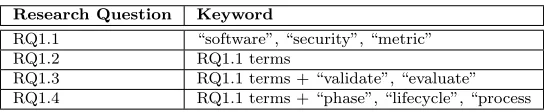
We developed a list of search terms with which to evaluate titles, shown in Table 3.1. For each term associated with a research question, we identified synonyms in the titles and abstracts
of previous surveys [81], [93] of security metrics. The synonyms are shown in Table 3.2. Two
researchers developed terms and synonyms independently, and then combined lists, retaining terms and synonyms agreed on as most relevant.
After searching using various combinations of the proposed keywords and evaluating their
performance using the set of papers in our Quasi-Gold-Standard (QGS, Section 3.2.1.5), we selected our basic search phrase: Our base search phrase is:
Table 3.1Research Question Keywords
Research Question Keyword
RQ1.1 “software”, “security”, “metric” RQ1.2 RQ1.1 terms
RQ1.3 RQ1.1 terms + “validate”, “evaluate” RQ1.4 RQ1.1 terms + “phase”, “lifecycle”, “process
Table 3.2Keyword Synonyms
Keyword Synonym(s) software “application” security “vulnerability”
metric “measurement ”, “measure ”, “indicator ”, “attribute ”, “property ”
validate “validation ”, “evaluate ”, “evaluating ”, “evaluation ”, “quantify ”, “quantifying ”, “quantification ”, “quantified ”, “quantitative ”, “assess ”, “assessment ”, “measure ”, “measurement ”, “appraisal ”, “analyze ”, “measuring ”, “analysis ”, “assurance ”, “scoring ”
AND (security OR vulnerability OR assurance)
AND (metric OR indicator OR quant*)
We created database search phrases using the base search phrase and syntax appropriate to
each database and collected papers based on those search phrases.
3.2.1.3 Search Process Evaluation
We followed Zhang [104] in evaluating the quality of our search results. An ideal search process
would return all relevant papers (sensitivity = 1.00), and only relevant papers (precision = 1.0).
Such a set of papers would be a “gold standard.” In practice, we do not know the set of relevant papers in advance, so we must estimate, using what Zhang terms a “quasi-gold standard” (QGS)
which is a set of relevant papers in the literature, chosen prior to the search process. The QGS
is used as a measure of how well each search string locates relevant papers. Zhang [104] defines sensitivity as the ratio of the number of retrieved papers to the total number of relevant studies.
Quasi-sensitivity (QS) is the number of papers returned by a search to the number of returned
papers that are present in the QGS. QS estimates how well the search string locates relevant papers within the searched corpus. By measuring the performance of the search in returning
members of the QGS from a given search engine, compared with the number of QGS papers in
0.8.
3.2.1.4 Selection Criteria
We developed a list of criteria to assess whether the papers found during the search process
met our objectives.
1. Inclusion Criteria:
• Related to measuring software security in software development artifacts and the software development process.
• Measurements and/or metrics are main subject
• Refereed publication
• Published since 2000
2. Exclusion Criteria
• Sources measuring security in non-software systems
• Sources related to identity, anonymity, privacy
• Sources related to forgery and/or biometrics
• Sources related to network security
• Sources related to encryption
• Sources limited to database security
• Books, dissertations
3. Study Quality Assessment: We developed a Quality Assessment Checklist for whether to include each paper, as follows:
• Is a primary or secondary goal of the paper to describe, define, or evaluate a metric or measurement of software security?
• Does the paper align with our inclusion criteria?
• Is the paper peer-reviewed?
4. Scoring: We also established a scoring procedure for resolving differences between raters
when disagreement was found.
• Complete agreement
(a) Yes from both raters: paper is selected
(b) No from both raters: paper is rejected
• Partial agreement combinations between 0 and 2. Raters discuss, find agreement, or agree to disagree.
(a) Agreement processed according to the rules for complete agreement.
In the case of unresolved disagreement, papers are selected for evaluation in the subsequent
step in the protocol.
3.2.1.5 Search Results
The second author and I identified a set of 39 software development security metrics papers, developed by reviewing the papers collected in the previous security metrics literature reviews
[81], [93]. Each author read the titles and abstracts of the collected papers independently,
applied the study quality assessment criteria, and made a list of candidates. The authors then discussed each list, applying the following selection procedure:
1. If both authors agreed the paper described a software development security metric, it was included in the final QGS list.
2. If both authors agreed the paper did not describe a software development security metric,
it was excluded from the final QGS list.
3. Disagreement was discussed. If agreement could be reached, the appropriate action listed
above was taken. If agreement could not be reached, the paper was included in the final list.
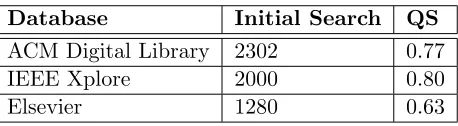
After our process, the QGS consisted of 17 papers. The results of each database search were
compared with the QGS set of papers. The quasi-sensitivity for each database search is reported
in Table 3.3.
We conducted three passes over the collected papers, applying the Study Quality Checklist
and scoring procedure to each paper’s title, abstract, and a 10-minute ‘quick read’ of each paper.
After reviewing the titles and coming to agreement, the raters (first two authors) identified 4815 papers to continue investigating. After reviewing the abstracts, the raters identified 107 papers
to continue investigating. After giving each paper a ’quick read’ and coming to agreement, the
Table 3.3Search Results
Database Initial Search QS
ACM Digital Library 2302 0.77
IEEE Xplore 2000 0.80
Elsevier 1280 0.63
the 71 papers, P1-P71. We use these codes throughout the remainder of the paper to refer to individual papers. See Table A.4 for the reference codes and bibliographic references of the
included papers.
3.2.1.6 Metric Classification Scheme
To support answering our research questions, we developed a set of data elements to be collected for each metric.
We begin with the IEEE definition of metric, “A quantitative measure of the degree to which a system, component, or process possesses a givenattribute; the defined measurement
method and the measurement scale” [31], defining the following data elements to describe each metric:
• Metric name: the “given name” of the metric defined or used in the paper. (RQ1.1)
• Measure: A description of how the value of the metric is determined, in terms of the metric’s Method and Scale (RQ1.2, RQ1.3).
– Method: Classification of how the metric value is measured, where “Quantitative” indicates objective, systematic, empirical measurements and “Qualitative” indicates
subjective measurements based upon observation (RQ1.3).
– Scale: denotes type of measurement scale (e.g., Nominal, Ordinal, Interval, Ratio), or specific instance of measurement scale (e.g., Count, Probability, Duration, Rate,
Currency, Percentage) (RQ1.2).
• Subject Type: Classification of whether the metric measures a ‘System’, ‘Component’, or ‘Process’ (RQ1.2). Target: class of subject measured by the metric (R&S).
– Process: Refers to security-related elements of a process, e.g., a development process, or a maintenance process.
– Resources: Refers to security-related attributes of resources used by a product or process.
• Subject: Description of the entity, ‘an object or event in the real world’ (Fenton [20]), being measured. Extracted from papers, or synthesized and named based on assessment of
extractors. For example, ‘Source Code’, ‘Component’, and ‘Vulnerability’. The complete
list is provided in Results, Section 3.3.2. (RQ1, RQ2)
• Attribute: Description of ‘a feature or property’ (Fenton [20]) of the subject being mea-sured. Extracted from papers, or synthesized and named based on assessment of
extrac-tors. For example, ‘Lines of Code’ or ‘Classified’ (RQ1.2).
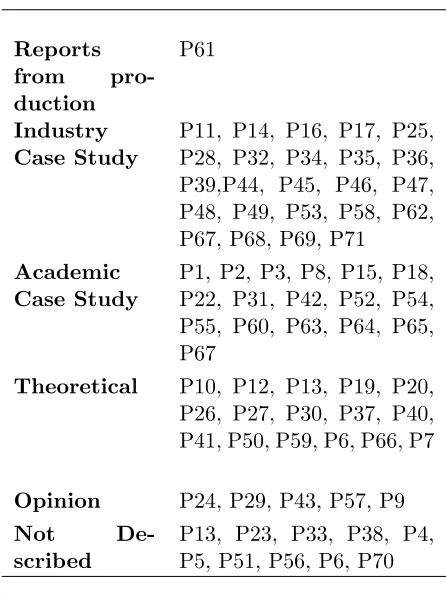
• Validation Approach: To characterize how metrics are validated, we record how the metrics are evaluated by the researchers in the paper. Values: Opinion, Theoretical, Academic user
study, Industry user study, Reports from production (RQ1.3).
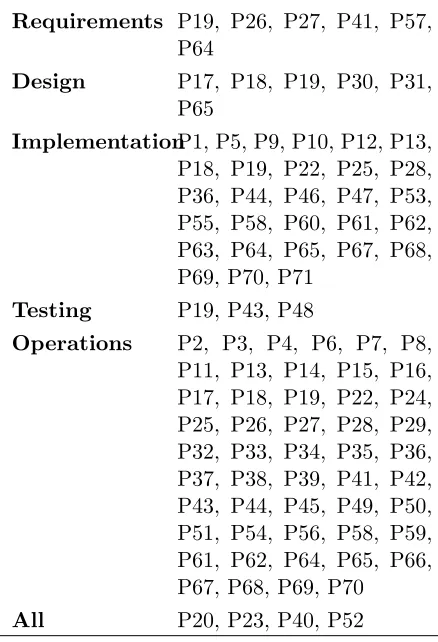
• Phase: We record the phase in the software development lifecycle with which the metric is associated: Requirements, Design, Implementation, Testing, Operations (RQ1.4).
For demographic purposes, we assigned unique paper and metric numbers to identify each
metric and its usage across papers. For audit purposes, we tracked the name of the extractor and auditor for each row, as well as the extraction and audit dates.
3.2.1.7 Data Extraction
The metric extractor (first or second author) reads a paper, identifies each metric defined or
used in the paper, and collects the data for each element in the metric classification scheme. The first author applied the extraction procedure described in the classification guide to every
paper in the final set of 71 papers, with spot checks by the second and third authors.
3.2.1.8 Metric Categorization
To discover relationships between similar metrics with varying names in different papers, we applied card sorting [30] to categorize the metrics. Card sorting is a technique for identifying
commonalities between collections of data items by using multiple raters to compare and group
each metric and its definition, and place it in a proposed category and subcategory. When a metric did not fit into existing categories, we created a category or subcategory. Over the course
of categorizing the metrics, we moved metrics between categories, and merged or removed
categories to capture our shared understanding of the metric definitions. After we assigned metric to a category, we took another pass, reviewed each metric and category definition and
revised our choices.
3.3
Results
In this section, we present our results in the form of summaries of the data extracted from the
selected papers. Based on the data extraction procedure, we tabulated the metrics, subjects, scales, evaluation means, and uses. The tabulated data provides an overview of ‘evidence
clus-ters’ and ‘evidence deserts’ for software security in the software development lifecycle. The full
data set is available online 2.
3.3.1 RQ1.1: What software lifecycle security metrics have been proposed in the literature?
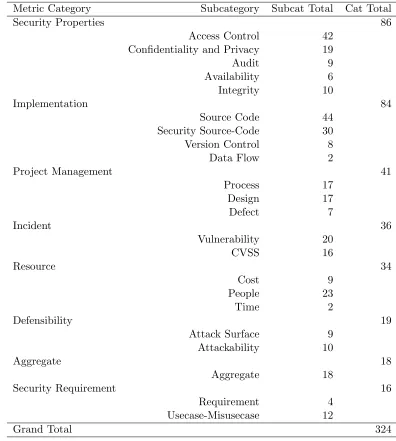
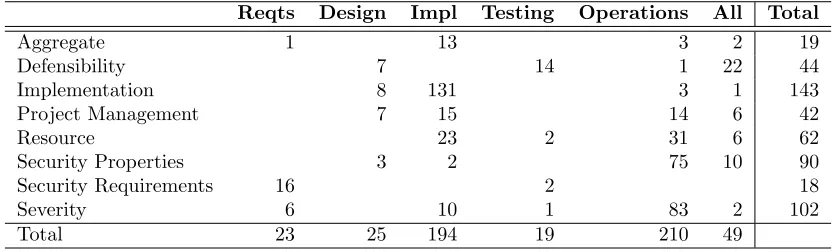
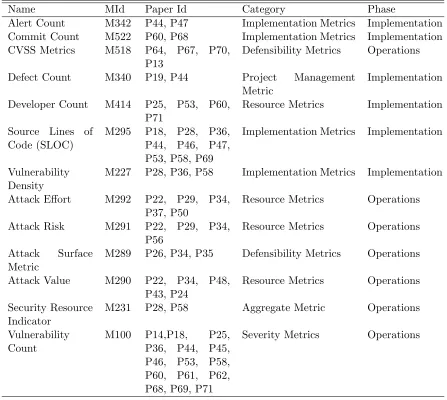
In total, we identified 324 unique metrics in the 71 selected papers. The list of metrics is available online3. We present each metric category and subcategory we identified (as described in Section 3.2.1.8), ordered by the number of metrics in each category/subcategory. We do
not present each metric, but we give representative examples of metrics from each category. Table 3.4 contains our final list of eight categories with associated subcategories, with metric
counts for each category and subcategory.
![Table 2.1 SEM Notation, adapted from Hildreth [27]](https://thumb-us.123doks.com/thumbv2/123dok_us/1190373.1149490/25.612.137.496.262.541/table-sem-notation-adapted-from-hildreth.webp)