Identifying FrameNet Frames for Verbs from a Real-Text Corpus
Matthew HONNIBAL and Tobias HAWKER
Language Technology Research Group School of Information Technologies
Madsen Building (F09) University of Sydney NSW 2006, Australia {mhonn,toby}@it.usyd.edu.au
Abstract
Previous systems that automatically tag text with FrameNet labels have been trained from the FrameNet example data, as there is no FrameNet annotated corpus. The FrameNet data is systemat-ically biased by the criteria for the examples’ se-lection, as annotators attempt to select simple sen-tences that include the target word.
Instead of using the FrameNet examples, we train a maximum entropy model classifier to identify verb frames on text from the Penn Treebank. We use ex-amples of verbs with only one entry in FrameNet as training data, and evaluate the system on human annotated text from the Wall Street Journal. We ac-curately identify the frame used by 76% of finite verbs.
We also investigate how well the system performs on verbs it has not encountered before. This task examines the feasibility of using the system to auto-matically extend the coverage of FrameNet by clas-sifying verbs with no FrameNet entries. The classi-fier accurately assigns a frame to 55% of instances of verbs it has not been trained on.
1 Introduction
FrameNet (Ruppenhofer et al., 2005) is a lexical se-mantic database that categorises words into frames, and gives extensive examples of their use. A frame records the semantic type of a predicate and the se-mantic roles of its arguments. Usually, the predicate will be a verb, and its roles will be realised by con-stituents of its clause.
Recently, Senseval-3 (Litowski, 2004) used FrameNet as the basis of a semantic role labelling shared task. Participants were asked to replicate the role labelling of frame elements in the FrameNet example data given the frame. However, a system which is trained and evaluated on the FrameNet ex-amples may not perform comparably on other text. FrameNet examples are selected by the annotators to illustrate the semantic and syntactic combinatory possibilities of each word, with minimal confusion
from irrelevant performance variables and com-plicated syntactic constructions. They are there-fore a systematically skewed sample, with much of the complexity of natural text under-represented or missing entirely.
The problem is that there is currently no FrameNet annotated corpus — only four manually annotated Wall Street Journal texts, recently re-leased on the FrameNet website. There is, how-ever, still a way to train a system for a subset of the FrameNet annotation task on real text without one. Frame selection is often unambiguous given a particular verb: currently, 73% of verbs entered in FrameNet are associated with only one frame. These verbs head 40% of the finite clauses in the Penn Treebank (Marcus et al., 1993).
The verb senses associated with a particu-lar FrameNet frame share simiparticu-lar semantics and argument structures. For instance, the Activ-ity finishframe includes the unambiguous verbs
fin-ish and complete, and the ambiguous verb conclude,
which is also associated with theComing to believe frame.
Clearly, these two types of conclude are different word senses, and the Activity finish sense should be closer to the other Activity finish verbs than the Coming to believe sense in a sense taxonomy like WordNet (Fellbaum, 1998). The two frames also have different argument structures: the Activ-ity finishverbs are all transitive, and would usually require a conscious agent and an event noun object. TheComing to believeframe verbs, such as
ascer-tain and deduce, expect a sentiential complement
instead of a noun phrase object. Such patterns can be learnt even if the learner has access to examples using only a few verbs of each frame.
well the classifier can deal with unknown words. FrameNet’s lexical coverage is currently quite low, so a system which can accurately assign frames to currently unclassified words could be used to auto-matically extend FrameNet’s vocabulary.
2 Labelling FrameNet predicates
FrameNet is a lexical semantic database that records the semantic type of a predicate and the seman-tic roles of its arguments, as well as how they are realised syntactically. The predicates are usually verbs, but can also be nouns, adjectives, adverbs or prepositions. The database is organised into frames, which group predicates that share similar semantics and argument structures.
Full FrameNet annotation involves labelling each predicate with a frame, and then allocating role la-bels to the constituents that realise its frame ele-ments. Verb frame elements are usually realised by direct arguments of the predicate, such as its subject and object.
The seminal work on automatic FrameNet an-notation, Gildea and Jurafsky (2002), and the Senseval-3 task (Litowski, 2004) after it, both con-centrate on labelling frame elements given a frame label. This semantic role labelling task is a sequence tagging problem, a little like chunk tagging, in terms of its sequantiality and boundary detection.
We are not aware of any other attempts to identify frame labels, rather than frame elements. This prob-lem is rather different, as there will be exactly one label per frame. We therefore assign labels to each clause independently, based on the semantics of the verb and the semantics of its syntactic arguments. Section 5 discusses how we capture this informa-tion in our features.
3 FrameNet and WordNet
The current problem with using FrameNet as the ba-sis of a semantic parser is its coverage. The latest release of FrameNet, 1.2, has approximately 6,765 lexical entries, covering only 64% of tokens (and 26% of token types) in the Penn Treebank. An-other potential issue is that annotation is proceed-ing frame by frame, rather than word by word. This means that there is no guarantee that existing lexi-cal entries are complete. For instance, the verb
oc-cur belongs only to the Eventframe; its cognition
sense, as in ‘the idea never occurred to me’, is un-documented.
Both of the problems noted above could be cor-rected — or at least, alleviated — by mapping FrameNet entries to WordNet senses. WordNet (Fellbaum, 1998) is a lexical database that focuses
on semantic relations between synonym sets, such as hyponymy and meronymy, and exhaustively cat-aloguing all senses of its entries. Unlike FrameNet, it does not include much detail on argument struc-ture or type. The two resources are therefore com-plementary.
Shi and Mihalcea (2005) argue that mapping the lexical entries in FrameNet to WordNet senses via VerbNet (Kipper et al., 2000) is a promising approach to connecting these complementary re-sources. They map the 2,393 verb intersection of these three resources, and additionally map another 839 verbs by generalising with WordNet synonymy and hyponymy. This is a relatively small subset of the 11,488 verbs entered in WordNet, and only in-creases the size of FrameNet a little.
However, the mapping does reduce frame ambi-guity a little in WordNet sense disambiguated text — of which there is a reasonably sized corpus. We find that using the mapping Shi and Mihalcea pub-lish allows us to increase the diversity of verbs in our training data, which consists of examples of un-ambiguous verbs, thereby increasing performance.
4 Training Data
We use examples of a limited set of verbs — the unambiguous ones — to represent each frame. This allows us to train the system without annotated data. This approximation rests on several assumptions, none of which are quite correct. We take a few sim-ple steps to alleviate the problems they introduce.
First, we assume that the similarities between the verbs in each frame are strong enough that an ex-ample of one verb is a reasonable surrogate for an example of a different verb. In the best case sce-nario, the two verb senses will have identical se-mantic and syntactic profiles: those senses will be interchangeable in all contexts, but one verb will be polysemous, and the other monosemous.
Second, we assume that using only the unam-biguous instances will not radically change the dis-tribution of the classes in the training data. In the worst case scenario, some frames will have no monosemous verbs from which to learn, so some of the classes will be missing entirely in the train-ing data. The distribution may also be skewed when a frame has a particularly common unam-biguous verb, over-representing it significantly. For instance, the verb be is associated with only one frame,Performers and roles. The problem is exac-erbated by the fact that polysemy is correlated with the frequency of the word, so most other frequent verbs will be ambiguous.
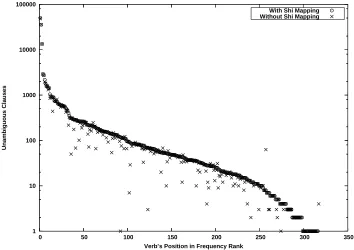
1 10 100 1000 10000 100000
0 50 100 150 200 250 300 350
Unambiguous Clauses
Verb’s Position in Frequency Rank
[image:3.612.145.499.50.300.2]With Shi Mapping Without Shi Mapping
Figure 1: Training data available with and without Shi & Mihalcea’s mapping
WordNet, it has thirteen senses. We assume that the lexical entries in FrameNet are complete; that when a verb has only one frame associated with it, there is only one frame it can use. In reality, FrameNet is a work in progress, and it is proceeding frame-by-frame, rather than word-by-word. The annotators add a frame, populate it with some lexemes, find examples for them, and describe its semantics and relations to other frames. They do not ensure that a given word is associated with every frame it can use.
Of the three assumptions, this last is the most troubling — as it makes it difficult to know what the answer is, not just how it can be predicted. We alle-viate the other two problems with two measures that are both designed to increase the variety of verbs we can train from.
First, we use the FrameNet-WordNet mapping re-leased by Shi and Mihalcea (2005) and use the Sem-Cor corpus (Miller et al., 1993), which is a Word-Net sense disambiguated portion of the Brown cor-pus (Francis, 1964) as part of our training data. So our training data includes the WordNet sense of the verb, and Shi and Mihalcea’s map translates that into a single frame label. We can then use instances of that verb as training data, where before it may have been ambiguous. Figure 1 shows how many clauses in the Penn Treebank are available for train-ing for each class with and without Shi and Mihal-cea’s mapping.
The second way we try to correct for the
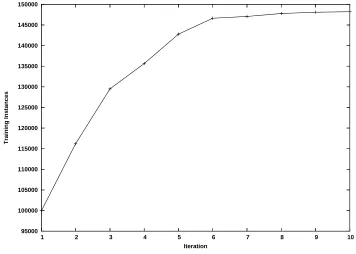
under-representation of classes in the training data is to use an iterative bootstrapping system. We first train a classifier on the unambiguous instances, and then use it to predict a class for those whose frame we are unsure of. When the predicted class is within the possibilities listed in FrameNet (if there are any), and the confidence of the prediction is above a threshold C, we add the instance to the training data for the next iteration. Figure 2 shows how many instances are drawn into the training data at each it-eration when C is set to 0.4. Clearly, the number levels off, so we limit it to six iterations.
5 Feature extraction and selection
A frame is defined by the semantic type of its predicate and the semantic roles of its arguments. FrameNet does not allow contextual elements to re-alise semantic roles. Instead, semantic roles must be realised by a syntactically local constituent, or be considered missing (“null instantiation”).
95000 100000 105000 110000 115000 120000 125000 130000 135000 140000 145000 150000
1 2 3 4 5 6 7 8 9 10
Training Instances
[image:4.612.126.482.50.304.2]Iteration
Figure 2: Training instances available per iteration (bootstrapping process)
of wine’. This type of construction is difficult to
re-liably distinguish from uses of ‘of ’ like ‘a glass of
the finest crystal’, so we simply accept the
imprecis-sion. We do, however, consider the head of prepo-sitional phrases to be the head of their component noun phrase, instead of the preposition. We attempt to model the semantics of the following clause con-stituents:
• Main verb
• Logical subject
• Logical object
• Indirect object
• Prepositional phrases
• Adverbial phrases
We represent the semantics of a word using its WordNet synset and hypernyms. The feature space consists of a list of WordNet synsets, whose value is initially the probability that a given constituent’s head is either a member or hyponym of that synset.
Probabilities allow us to use non-word sense dis-ambiguated data, by distributing the probability (or in Bayesian terms, belief) mass amongst the possi-ble senses of the word. It would be possipossi-ble to use a sophisticated word sense disambiguation system to arrive at these belief scores, but we use a naive method which simply weights the distribution by
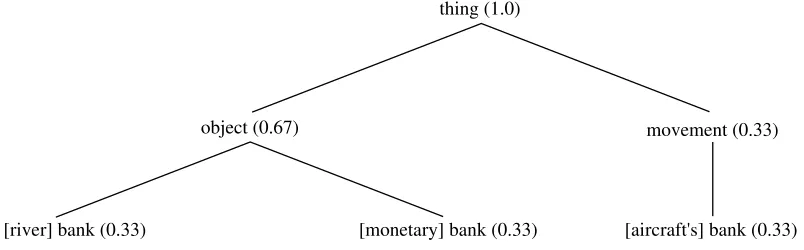
the senses’ frequency ranks, such that the most fre-quent sense has twice the belief strength of the least frequent sense. Hypernym belief scores are the sum of the belief scores of its hyponymys, as shown in figure 3. So even if a word is sense-ambiguous, it can have an unambiguous synset amongst its hyper-nyms, if its senses have one in common. The classi-fier will therefore favour features corresponding to more general synsets, because they will usually oc-cur more frequently and have higher belief scores.
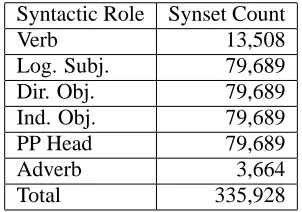
Each constituent type listed above controls its own section of the feature space, as shown in table 1. There are 152,059 unique synsets in WordNet, but 335,928 possible features in our feature space. This is because the same noun synset might be four distinct features, depending on whether it occurs in the logical subject, logical object, indirect object or a prepositional phrase. This replication preserves the distinction between the different grammatical functions, so that a clause with an animate subject and an inanimate object is represented differently from a clause with an inanimate subject and an an-imate patient. Compare ‘he considered his options’ with ‘the current swept him away’.
con-Syntactic Role Synset Count
Verb 13,508
Log. Subj. 79,689 Dir. Obj. 79,689 Ind. Obj. 79,689 PP Head 79,689
Adverb 3,664
[image:5.612.126.277.46.152.2]Total 335,928
Table 1: Potential Feature Space Size
sider proper nouns, as distinguished by their Tree-bank part of speech, to be polysemous: it is not im-mediately obvious whether they stand for a person, organisation, country, etc. We therefore supply a small group of general synsets (“person”, “organi-sation”, “place”) to represent them.
We reduce the size and complexity of our feature space by discretising each feature into a boolean value, and selecting features with the top N infor-mation gain. The maximum entropy implementa-tion we are using, Zhang Le’s Maxent Toolkit (Le, 2005), does allow real valued features, but they are nevertheless unideal with our data. Real valued fea-tures with non-uniform distributions may interfere with the parameter estimation algorithm, so we dis-cretise them into boolean features at the threshold which maximises their information gain. We then use the information gain scores to rank the features and select the N best, thereby reducing the feature space.
6 Evaluating on unseen verbs
We paid particular attention to how the system would perform on verbs it had not been trained with, to explore how well it can deal with unknown words. Paying individual attention to unknown words is a familiar strategy in tagging problems, but to our knowledge has not been applied to FrameNet labelling tasks.
There are two reasons why unknown words are even more important for a FrameNet tagger than, for example, a part-of-speech tagger. First, the vo-cabulary of FrameNet is quite small, so a tagger running on natural text will encounter plenty of them. In the Penn Treebank (Marcus et al., 1993), only 64% of tokens and 26% of token types have an entry in FrameNet. Second, assigning labels to previously unclassified words could be used to ex-tend FrameNet’s vocabulary semi-automatically, by manually correcting the tagger’s suggestions.
To evaluate performance on unknown verbs, we set aside instances of 25% of the verbs in the train-ing set. This is a tough evaluation measure. First,
Unseen verbs WSJ Data SemCor Shi 47% 62%
PTB Shi 55% 76%
SemCor no Shi 44% 52% PTB no Shi 48% 67%
Baseline 27% 40%
Table 2: Results
we already struggle to represent each frame ade-quately, as section 4 discusses. This problem is ex-acerbated by holding out a set of the verbs, since the test set may contain a disproportionate amount of the verbs associated with a particular frame, leav-ing few or no instances of that frame in the trainleav-ing data. Stratifying the held out set so that it contains roughly 25% of the instances, 25% of the verbs, and maintains a similar distribution of frames to the training data has proven difficult.
To alleviate the problem, we allow the early iter-ations of the classifier access to the test data, only removing it for the final classifier. This means that the final classifier has not had access to the test data, but the system has the opportunity to draw in exam-ples similar to it from the unclassified data during the bootstrapping process.
For instance, if all of the unambiguous examples of thePerformers and rolesframe use the verb be, and be is a test data verb, the training data will contain no examples from that class, and conse-quently get every example of be wrong. So we at first allow the system to train on examples of be, so that it can classify ambiguous examples of
Perform-ers and roles, such as instances of the verb play. Fi-nally, instances of be are removed before the final it-eration, so that the final classifier has some instances ofPerformers and roles, from verbs like play, but has not been trained on instances of be. The classi-fiers for the earlier iterations just need to be as accu-rate as possible. We do not need to evaluate them, so we can provide them the test data to build a better model. However, we do need to evaluate the final classifier, so we cannot train it with the test data.
7 Results
[image:5.612.342.547.48.137.2]Figure 3: Belief propagation to hypernyms
The “Unseen verbs” task is the classification of in-stances of verbs the classifier has not been trained with, as discussed in section 6 above. Assigning the most common frame to all examples gives an accu-racy of 27%, which we use as the baseline in table 2.
As discussed in section 4, using the WordNet mapping improves the balance of the training data by making more verbs available for training, so it is not surprising that there is such a clear improvement in performance.
The other obvious result is that performance is better when the classifier is trained on the whole Penn Treebank, instead of simply the SemCor sub-set. This indicates that on these tasks, it is worth having more data even at the cost of more ambigu-ous feature values. The disparity between the two datasets is much greater on the Wall Street Journal test data than on the classification of unseen verbs. We believe this is because the Penn Treebank train-ing data includes the rest of the Wall Street Journal text, while our SemCor data is limited to the inter-section of the SemCor text and the parsed Brown section from the Penn Treebank. This intersection is 31,456 clauses, and contains no newswire text. The Penn Treebank does not include skeletal parses of the newswire sections of the Brown corpus be-cause the Wall Street Journal data amply represents that genre.
The performance on unseen verbs is relatively poor, but nevertheless encouraging. Even noisy pre-diction on this task may reduce the time required for manual extension of FrameNet’s vocabulary. This is especially true if only verbs classified with espe-cially high confidence are considered as candidates for addition.
The main result we report is the 76% accuracy identifying verb frames in real text. While there are no directly comparable results reported in the litera-ture, this result considerably outperforms the trivial
method of simply assigning frames to verbs when they are unambiguous, which gives 40% accuracy. We use this figure as the baseline for comparison.
8 Related Work
This research falls under the broad umbrella of lex-ical semantics acquisition, such as the work of Pan-tel and Ravichandran (2004) or Fouvry (2003). The most pertinent research of this type to our system comes from the SALSA project(Erk et al., 2003), which is creating a German frame lexicon and an-notated corpus. In particular, Erk (2005) uses com-plement and adjunct heads (in addition to bigram and trigrams) as features in a naive Bayes classi-fier to assign frame labels to verbs. She reports a result of 74% on this task for the SALSA lexi-con. Because the classification scheme — and in-deed, its language — is different from ours, this re-sult is not directly comparable with our own; how-ever, Erk does compare baseline scores for both the SALSA projecttask and the equivalent FrameNet task, finding that the SALSA task’s baseline is con-siderably lower: assigning each verb its most fre-quent frame yields 93% accuracy for the labelling task on the FrameNet example corpus, and only 69% on the SALSA corpus. This reflects the fact that the SALSA lexicon is more polysemous than the current release of FrameNet: 4.12 for SALSA, 2.27 for FrameNet. This baseline would be quite meaningless for our task, as we are testing on unam-biguous verbs — so our baseline according to Erk’s method would be 100%.
9 Conclusion
We have reported two results on a novel kind of task: the assignment of frame labels to text which was not manually selected for FrameNet annotation. Despite the lack of obvious training data, our system achieves 76% accuracy, 55% when the verb is new.
and Mihalcea (2005): a comprehensive mapping be-tween WordNet and FrameNet is both possible and desirable. A comprehensive mapping will imme-diately make available a corpus of frame labelled material, in the form of the SemCor corpus. This text will also be annotated with syntactic bracketing and WordNet senses. A useful task for future work is to investigate how the results from our classifier might be used to produce such a mapping semi-automatically. High confidence misclassifications may also be able to reveal situations where a word is missing from one or more frames.
For now, we demonstrate that the FrameNet clas-sification scheme is at least robust enough to per-form on data that was not used to design it.
10 Acknowledgements
We would like to thank Zhang Le for making the Maximum Entropy toolkit publicly available. Our thanks also go to Shi and Mihalcea for releasing the list of mappings their system produces between WordNet and FrameNet. Finally we would like to thank Jon Patrick and James Curran from the Uni-versity of Sydney for their invaluable insights.
References
K. Erk. 2005. Frame assignment as word sense dis-ambiguation. In Proceedings of IWCS.
K. Erk, A. Kowalski, S. Pad´o, and M. Pinkal. 2003. Towards a resource for lexical semantics: A large german corpus with extensive semantic annota-tion. In Proceedings of ACL-03.
Christiane Fellbaum, editor. 1998. Wordnet: An Electronic Lexical Database. MIT Press.
Frederik Fouvry. 2003. Lexicon acquisition with a large-coverage unification-based grammar. In
Proceedings of the 10th Conference of the EACL (EACL 2003).
W. Francis. 1964. A standard sample of present-day english for use with digital computers. Report to the U.S Office of Education on Cooperative Research Project No. E–007. Brown University, Providence.
Daniel Gildea and Daniel Jurafsky. 2002. Auto-matic labeling of semantic roles. Computational
Linguistics, 28(3):245–288.
Karin Kipper, Hoa Trang Dang, and Martha Palmer. 2000. Class-based construction of a verb lexi-con. In Proceedings of the Seventh National
Con-ference on Artificial Intelligence (AAAI-2000).
Austin, Texas.
Zhang Le. 2005. Maximum entropy modeling toolkit for python and c++. http://homepages.inf.ed.ac.uk/s0450736/
maxent toolkit.html.
Kenneth C. Litowski. 2004. Senseval-3 task: Auto-matic labeling of semantic roles. In
SENSEVAL-3: Third International Workshop on the Evalua-tion of Systems for the Semantic Analysis of Text,
pages 9–12.
Mitchell P. Marcus, Beatrice Santorini, and Mary Ann Marcinkiewicz. 1993. Building a large annotated corpus of english: The penn treebank.
Computational Linguistics, 19(2):313–330.
G. A. Miller, C. Leacock, T. Randee, and R. Bunker. 1993. A semantic concordance. In Proceedings
of the 3 DARPA Workshop on Human Language Technology, pages 303–308.
Patrick Pantel and Deepak Ravichandran. 2004. Au-tomatically labeling semantic classes. In
Pro-ceedings of HLT/NAACL-04, pages 321–328.
Josef Ruppenhofer, Michael Ellsworth, Miriam R. L. Petruck, and Christopher R. Johnson. 2005.
FrameNet: Theory and Practice. Online,
avail-able at http://framenet.icsi.berkeley.edu.