Scholarship at UWindsor
Scholarship at UWindsor
Electronic Theses and Dissertations Theses, Dissertations, and Major Papers
2012
Regression Function Characterization of Synchronous Machine
Regression Function Characterization of Synchronous Machine
Magnetization and Its Impact on Machine Stability Analysis
Magnetization and Its Impact on Machine Stability Analysis
Saeedeh Hamidifar University of Windsor
Follow this and additional works at: https://scholar.uwindsor.ca/etd
Recommended Citation Recommended Citation
Hamidifar, Saeedeh, "Regression Function Characterization of Synchronous Machine Magnetization and Its Impact on Machine Stability Analysis" (2012). Electronic Theses and Dissertations. 431.
https://scholar.uwindsor.ca/etd/431
Regression Function Characterization of Synchronous Machine
Magnetization and Its Impact on Machine Stability Analysis
by
Saeedeh Hamidifar
A Dissertation
Submitted to the Faculty of Graduate Studies through the Department of Electrical and Computer Engineering
in Partial Fulfillment of the Requirements for the Degree of Doctor of Philosophy at the
University of Windsor
Windsor, Ontario, Canada
©2012 Saeedeh Hamidifar
All Rights Reserved. No part of this document may be reproduced, stored or otherwise
retained in a retrieval system or transmitted in any form, on any medium by any means
Regression Function Characterization of Synchronous Machine Magnetization and Its Impact on Machine Stability Analysis
by
Saeedeh Hamidifar
APPROVED BY:
______________________________________________ Tomy Sebastian, External Examiner
Nexteer Automotive
______________________________________________ Arunita Jaekel
Department of Computer Science, University of Windsor
______________________________________________ Jonathan Wu
Department of Electrical and Computer Engineering, University of Windsor
______________________________________________ Govinda Raju
Department of Electrical and Computer Engineering, University of Windsor
______________________________________________ Narayan C. Kar
Department of Electrical and Computer Engineering, University of Windsor
______________________________________________ Chair of Defense
Declaration of Previous Publication
This thesis includes four original papers that have been previously published/
submit-ted for publication in peer reviewed journals/conferences, as follows:
Thesis
Chapter Publication Title Publication Type Publication Status
Chapters 3,6 and its impact on synchronous machine transient stability A novel approach to saturation characteristics modeling
analysis Transaction Published Chapter 3 A trigonometric technique for characterizing magnetic saturation in electrical machines Conference Published
Chapter 4 A novel method to represent the saturation characteristics of PMSM using Levenberg-Marquardt algorithm Conference Published
Chapters 4,5 multifunctional characterization of saturation using A state space synchronous machine model with
levenberg-marquardt optimization algorithm Transaction
Submitted/Under Revision
I certify that I have obtained a written permission from the copyright owner(s) to
in-clude the above published materials in my thesis and have inin-cluded copies of such
copy-right clearances to my appendix. I certify that the above materials describe work
com-pleted during my registration as graduate student at the University of Windsor. I declare
nor violate any proprietary rights and that any ideas, techniques, quotations, or any other
material from the work of other people included in my thesis, published or otherwise, are
fully acknowledged in accordance with the standard referencing practices. Furthermore,
to the extent that I have included copyrighted material that surpasses the bounds of fair
dealing within the meaning of the Canada Copyright Act, I certify that I have obtained a
Abstract
Magnetization in the ferromagnetic core significantly affects the performance of
elec-trical machines. In the performance analysis of elecelec-trical machines, an accurate
represen-tation of the magnetization characteristics in the machine model is important. As a part of
this research work, two new mathematical models are proposed to represent the
magneti-zation characteristics of electrical machines based on the measured magnetimagneti-zation
charac-teristics data points. These models can be applied to various kinds and sizes of electrical
machines. The calculated results demonstrate the effectiveness of the proposed models.
The comparison analyses on the proposed models and three different existing models
which have been used in the literature by the researchers validate the fact that these
mod-els can be used as proper alternative for the other modmod-els.
Inasmuch as the omission of magnetization in the machine model has a negative
im-pact on the analysis results, integrating the proposed magnetization models into the
syn-chronous machine mode, can better describe the machine behavior. To aim this goal, as a
and steady state synchronous machine models. The trigonometric model developed in this
work, has been applied to a conventional synchronous machine model and extensive
sta-bility performance analysis has been carried out. This further reveals the usefulness of the
proposed trigonometric magnetization model and the importance of the inclusion of
mag-netization in stability analysis. The other magmag-netization model developed in this research
is incorporated into a state space synchronous machine model that is used in steady state
With Love and Gratitude
gÉ `ç _ÉäxÄç `Éà{xÜ tÇw Ytà{xÜ
For Blessing Every Moment of My Life with Their Unconditional Support and Love
and
Acknowledgements
I would like to express my sincere gratitude to my supervisor, Dr. Narayan Kar; For
his invaluable support, inspiring guidance, and encouragements throughout the course of
this thesis work. I would like to thank him for believing in me and my work and giving
me the opportunity to work as a member of his research team.
I would like to express my gratitude to my committee members, Dr. Arunita Jaekel,
Dr. Govinda Raju, Dr. Jonathan Wu, and Dr. Tomy Sebastian from Nexteer Automotive
for reviewing my thesis and their constructive comments and valuable suggestions to
im-prove this work.
I would also like to thank Ms. Andria Ballo, the Graduate Secretary of Electrical and
Computer Engineering Department at the University of Windsor, for her smiles and love;
and for making my life very easy with her supports during the busiest time of my life.
I am thankful to all my friends and colleagues in the Centre for Hybrid Automotive
Research & Green Energy (CHARGE) for their encouragements and supports. Working
in their friendly company was a wonderful experience.
Deep from my heart, I am grateful to my mother, my father, and my siblings for their
Table of Contents
Declaration of Previous Publication iv
Abstract vvi
Dedication viii
Acknowledgements ixx
List of Tables xiv
List of Figures xvi
Nomenclatures xx
1. Introduction 1
1.1. Research Background ... 1
1.1.1. Magnetization Modeling ... 1
1.1.2. Synchronous Machine Modeling ... 6
1.2. Thesis Objectives ... 7
2. Literature Review on the Steady-State and Transient Analysis of Synchronous Machines 9
2.1. Dynamic Synchronous Machine Model ... 9
2.1.1. Stator and Rotor Mathematical Modeling ... 12
2.1.2. Park’s Transformation Model ... 16
2.1.3. Rotor Reference Frame Equations ... 17
2.1.4. Power and Torque Equations: ... 19
2.1.5. Per-unit Calculations ... 19
2.1.6. The Synchronous Machine d- and q-axis Equivalent Circuits ... 20
2.2. The State Space Synchronous Machine Model ... 22
2.3. Fault Analysis ... 24
2.3.1. Classification of Short-circuit Faults ... 24
2.3.2. Effects of Short-circuit Faults on Power System Equipment ... 25
2.4. Transient Stability Analysis ... 26
2.5. The Previous Models Used to Represent Magnetization ... 30
2.5.1. Polynomial Regression Algorithm ... 30
2.5.2. Rational Regression Algorithm ... 33
2.5.3. DFT Regression Algorithm ... 36
2.6. Conclusion ... 40
3. Representation of Magnetization Phenomenon in Electrical Machines Using Regression Trigonometric Algorithm 41
3.1. Trigonometric Regression Algorithm ... 42
3.1.1. Amplitude Calculation ... 43
3.1.2. Frequency Calculation ... 47
3.2. Numerical Analysis Employing the DFT and Trigonometric Algorithms in the Cases of Synchronous and Doubly-fed Induction Machines ... 52
3.2.1. Measured and Calculated Main and Leakage Flux Magnetization Characteristics of the DFIG ... 53
3.2.2. Calculated d- and q-axis Magnetization Characteristics of the Nanticoke and Lambton Synchronous Machines ... 57
3.3. Chi-Square Tests to Measure the Accuracy of the Proposed Magnetization Model ... 61
4. Multifunctional Characterization of Magnetization Phenomenon Using Levenberg-Marquardt
Optimization Algorithm 64
4.1. Levenberg-Marquardt Algorithm ... 66
4.2. Numerical Investigations and Comparison ... 75
4.2.1. Magnetization Representation of the Synchronous Machine Using the LM Method ... 75
4.2.2. Modeling Magnetization of the Permanent Magnet Synchronous Machine Using the LM Method ... 77
4.2.3. Comparison Study on the Different Magnetization Models ... 84
4.3. Conclusion ... 85
5. A State Space Synchronous Machine Model Using LM Magnetizing Model 86
5.1. State Space Synchronous Machine Model ... 87
5.1.1. Linearization of Magnetization Model ... 87
5.1.2. Linearization of Synchronous Generator Model ... 89
5.2. Numerical Stability Studies on the Saturated and the Unsaturated Synchronous Machine Models ... 93
5.2.1. Synchronous Machine Stability Monitoring by Varying Active and Reactive Power ... 96
5.2.2. Synchronous Machine Stability Monitoring Considering the Machine Parameter Sensitivity ... 98
5.2.3. Frequency Analysis on the Synchronous Machine ... 99
5.3. Conclusion ... 103
6. Synchronous Machine Transient Performance Analysis under Momentary Interruption Considering Trigonometric Magnetization Model 104
6.1. Synchronous Machine Transient Performance Under Momentary Interruption ... 105
6.2. Synchronous Generator Performance Analysis Employing the Proposed Magnetization Model ... 107
6.2.1. Dynamic Performance Analysis of the Saturated Synchronous Generator Considering and Ignoring AVR ... 107
6.2.2. Parameter Sensitivity Analysis Employing the Synchronous Generator Models ... 115
Models ... 124
6.3. Conclusion ... 127
7. Conclusions and Future Work 128
7.1. Conclusions ... 128
7.2. Suggestions for Future Work ... 129
References 131
Appendix A. Electrical Machines Ratings and Specifications 139
A.1. Nanticoke Synchronous Generator ... 139
A.2. Lambton Synchronous Generator ... 140
A.3. Doubly Fed Induction Generator ... 141
A.4. Permanent Synchronous Machine ... 141
Appendix B. IEEE Permission Grant on Reusing the Published Papers 142
Vita Auctoris 146
List of Tables
Table 2.1. Base Quantities Used in the Per-unit System ... 20
Table 2.2. Stator Per-unit Equations ... 20
Table 2.3. Rotor Per-unit Equations ... 21
Table 3.1. Frequencies and Amplitudes of the Calculated Magnetization Characteristics for the Machines under the Investigations ... 60
Table 3.2. Comparison of Chi-Square Error Test for Different Trigonometric Orders and Their
Corresponding DFT Orders for the Machines Used in the Investigations. ... 62
Table 4.1. Ten Sample Magnetization Characteristics Functions and Their Corresponding Coefficients Generatedby the Proposed Method for the Lambton Synchronous Machine ... 79
Table 4.2. Chi-Square Test Results for Different Magnetization Representation Models of the Lambton Synchronous Generator ... 80
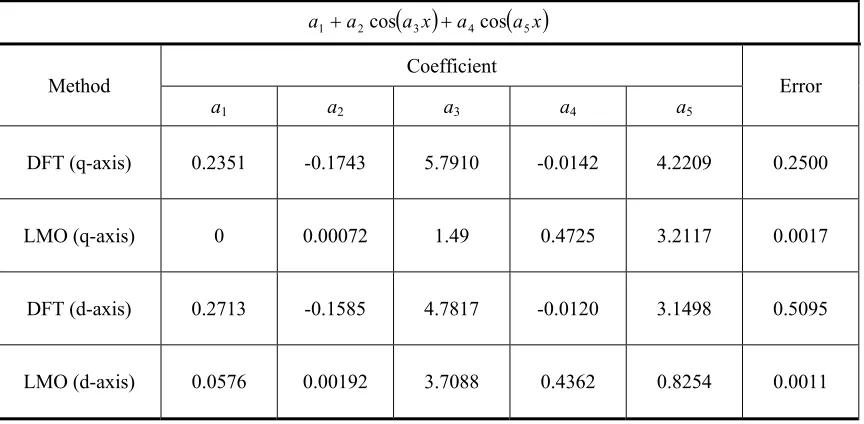
Table 4.3. Coefficients and the Corresponding Errors Calculated for the PMSM Magnetization
Characteristics Using the DFT and LM Optimization Algorithms ... 82
Table 4.5. Comparison Study on the Magnetization Models Introduced in this Dissertation ... 83
Table 6.1. The First Peak-To-Peak Values of Torque, Load Angle, and Phase Current Calculated by Employing AVR for Model 3. ... 113
Table 6.2. Critical Clearing Time for Different Magnetization Models With and Without AVR. ... 115
Table 6.3. Load Angle and Air-gap Torque Sensitivities with Respect to the Variation in the Machine Parameters. ... 118
Table A.1. The Nanticoke Synchronous Machine Ratings ... 139
Table A.2. The Lambton Synchronous Machine Ratings ... 140
Table A.3. The Lambton Synchronous Machine Parameters ... 140
Table A.4. The DFIG Ratings ... 141
List of Figures
Fig. 1.1. Typical magnetization characteristics of electrical machines. ... 2
Fig. 2.1. Cross-section view of a two-pole, salient-pole synchronous machine ... 10
Fig. 2.2. Circuit diagram for the rotor and stator of a 2×2 synchronous generator model. ... 11
Fig. 2.3. 22 Synchronous generator model. ... 21
Fig. 2.4. Transient stability concept in power systems. ... 29
Fig. 2.5. A set of flux linkage data points and their corresponding magnetizing currents represented by different degrees of polynomials. ... 30
Fig. 2.6. Mirrored magnetization characteristics calculated by the DFT method. ... 37
Fig. 2.7. Approximated integral calculation in the DFT method ... 37
Fig. 3.2. The doubly-fed induction generator (DFIG) under the investigations. ... 54
Fig. 3.3. Calculated and measured main flux magnetization characteristics of the DFIG for three orders of trigonometric series and for DFT curve fitting method of order 10. ... 56
Fig. 3.4. Calculated and measured rotor leakage flux magnetization characteristics of the DFIG for three orders of trigonometric series and for DFT curve fitting method of order 10. ... 56
Fig. 3.5. Calculated and measured stator leakage flux magnetization characteristics of the DFIG for three orders of trigonometric series and for DFT curve fitting method of order 10. ... 57
Fig. 3.6. d- and q-axis magnetization characteristics of the Nanticocke synchronous machine presented by the proposed model for two orders of trigonometric series and the 4th order of DFT model. ... 59
Fig. 3.7. d- and q-axis magnetization characteristics of the Lambton synchronous machine presented by the proposed model for two orders of trigonometric series and the 4th order of DFT model. ... 59
Fig. 4.1. Different configurations to represent magnetization characteristics of a typical electrical
machine. ... 65
Fig. 4.2. Flowchart of the LM optimization algorithm. ... 74
Fig. 4.3. The LM and trigonometric representation of measured data points of the magnetization
characteristics of the Lambton generator. ... 78
Fig. 4.4. The LM and DFT representation of measured data points of the magnetization characteristics of the Lambton generator. ... 78
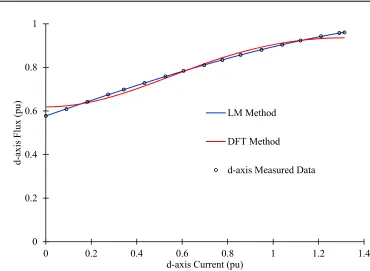
Fig. 4.5. Calculated d- axis magnetization characteristics of the laboratory PMSM employing the LM model and the DFT curve fitting method. ... 81
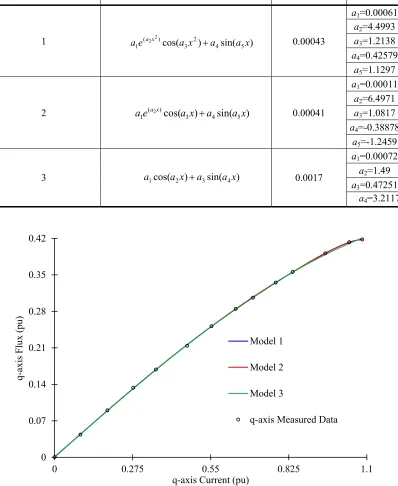
Fig. 4.7. Calculated q-axis magnetization characteristics of the laboratory PMSM employing the LM model
for different functions listed in Table 4.4. ... 83
Fig. 5.1. The dominant eigenvalues for the three magnetization models of the synchronous generator. ... 97
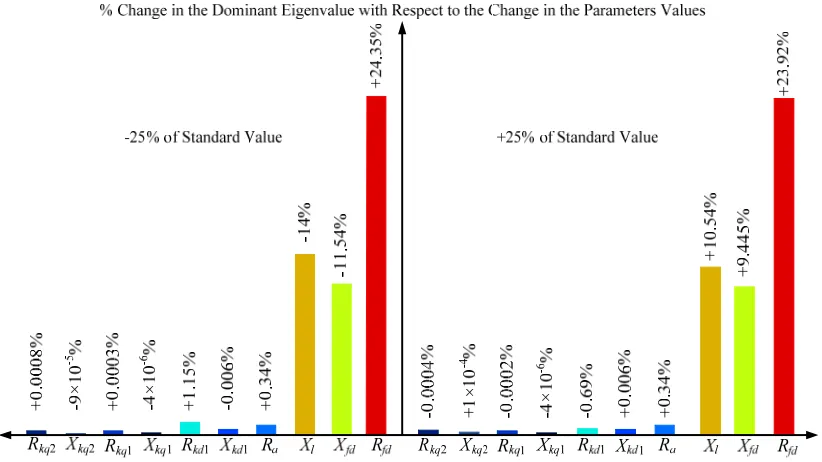
Fig. 5.2. The dominant eigenvalue sensitivity as a function of the variation of the machine parameters calculated by machine model 3. ... 98
Fig. 5.3. The Bode diagram of the speed of the Lambton synchronous machine calculated using magnetization Model 3. ... 100
Fig. 5.4. The Zero-Pole diagram of the speed of the Lambton synchronous machine calculated using magnetization Model 3. ... 100
Fig. 5.5. Frequency response of the synchronous machine speed with respect to the reactive power variations for active power Po=0.9 pu. ... 102
Fig. 6.1. Proposed voltage profile due to a momentary interruption at the machine terminals. ... 107
Fig. 6.2. Air-gap torque calculated by the three synchronous machine models. ... 108
Fig. 6.3. Load angle calculated by the three synchronous machine models. ... 108
Fig 6.4. Load angle response for marginally stable and unstable cases calculated for the three models using proposed trigonometric and DFT method. ... 109
Fig. 6.5. AVR block diagram. ... 110
Fig. 6.6. Machine rotor speed calculated by the three models. ... 111
Fig. 6.7. Synchronous machine air-gap torque calculated by the three models. ... 111
Fig. 6.9. The synchronous machine phase currents calculated using Model 3. ... 113
Fig. 6.10. Load angle response for marginally stable and unstable cases calculated by the three models. . 114
Fig. 6.11. Peak air-gap torque as a function of fault duration calculated by using Model 3. ... 115
Fig. 6.12. Peak-to-peak load angle sensitivity as functions of different synchronous machine parameters calculated using Model 3. ... 117
Fig. 6.13. Peak-to-peak air-gap torque sensitivity as functions of different synchronous machine parameters calculated using Model 3. ... 117
Fig. 6.14. Harmonic spectrum for the air-gap torque oscillations of the synchronous machine for fault duration of three and half cycles. ... 121
Fig. 6.15. Calculated air-gap torque harmonic spectrum of the synchronous machine by Model 3 for fault duration of four cycles. ... 122
Fig. 6.16. Harmonic spectrum for phase ‘a’ current of the synchronous machine for fault duration of three and half cycles. ... 123
Nomenclatures
laa, lbb, lcc, : Self-inductance of stator windings
lab, lbc, lca, : Mutual-inductance between stator windings
lafd, lakd, lakq, : Mutual-inductance between stator and rotor windings
Lffd, lkkd, lkkq, : Self-inductance of rotor windings
Ψ : Flux linkage
Im : Magnetizing current
bj, αj, βj : DFT and trigonometric series amplitudes
j,i : DFT and trigonometric series frequencies
k, k’, : DFT and trigonometric orders
aj : LM function coefficients
: Error criterion
2 : Chi-square error 2 : Variance
λ : Damping factor in LM algorithm
Vt : Steady state terminal voltage
ed, eq : d- and q-axis components of the stator voltage
Xmd, Xmq, : d- and q-axis magnetizing reactances
: Saturation coefficient matrix
Ψd, Ψq : d- and q-axis components of the flux linkage
Ψfd,Ψkd,Ψkq : Field and d- and q-axis damper winding flux linkages
Ifd, Ikd, Ikq : Field and d- and q-axis damper winding currents
Rfd, Rkd,Rkq : Field and d- and q-axis damper winding resistances
Xfd, Xkd,Xkq : Field and d- and q-axis damper winding reactances
Ra : Stator resistance
Xl : Stator leakage reactance
B, r : Rated and rotor speeds in electrical radian/second
: Load angle
KD : Damping torque coefficient
H : Inertia constant
Tm : Mechanical torque input
e,L : Air-gap and load torques
H : Inertia constant
efd : Field voltage referred to the stator
Vt0,Vt1 : Voltage during and after the fault
p-p : Peak-to-peak load angle
p-p : Peak-to-peak air-gap torque
S : Sensitivity with respect to
N : The number of samples
T : Sampling intervals
W : Window function in STFT
Pm :Mechanical input power
Chapter 1
Introduction
1.1.
Research Background
1.1.1.
Magnetization Modeling
Analysis of the non-linear saturation properties of ferromagnetic materials in
electri-cal machines necessitates mathematielectri-cal representation of the flux linkage-current
rela-tionship [1]- [5]. Various mathematical models have been presented by many researchers
that describe the flux linkage and current relationship in electrical machines. The
inclu-sion of magnetization in the electrical machine analysis is important since it affects the
magnetic flux in the direct and quadrature axes. The leakage flux paths are also
Flux Linkage (pu)
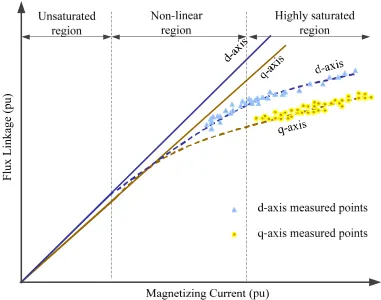
Fig. 1.1. Typical magnetization characteristics of electrical machines.
machines, it is necessary to use a precise and accurate mathematical representation of the
magnetizing saturation. The magnetic flux in the direct and quadrature axes of
synchro-nous machines is influenced by magnetization phenomenon. Thus, it will be useful to
have a synchronous machine model integrated with an accurate magnetization model in
algebraic configuration that makes it valuable in understanding the system behavior [6]-
[24]. Typical magnetization characteristics of an electrical machine is presented in Fig.
1.1. At low magnetizing current values, the flux linkage is proportionately related to the
current, the flux linkage in the machine reaches its maximum level, which is known as
the highly saturated region. The transition between unsaturated and highly saturated
re-gions takes place in the non-linear region. As illustrated in Fig. 1.1, the flux linkage is not
proportionally related to the magnetizing current in this region [5].
The magnetization model in an electrical machine is a mathematical realization of the
machine magnetization behavior. However, in most of the applications, there is a
collec-tion of experimentally obtained magnetizacollec-tion data points. This informacollec-tion, without
some knowledge of how the current and flux linkage are related, is not useful. Therefore,
employing an algorithm which can create a functional relationship and produce
meaning-ful information will be usemeaning-ful in machine modeling. The various techniques used are
in-tended to address inclusion of magnetization phenomenon into the electrical machine
model [6]- [24].
Researchers have employed numerous methods to incorporate the magnetization
phenomenon into the machine model. A transient saturated model for squirrel cage
induc-tion machines is proposed in [9] based on an assumpinduc-tion that the air-gap flux saturainduc-tion
harmonics are produced by the fundamental component of the air-gap flux. In this model,
the magnetization is included directly by using the fundamental and third harmonic
fac-tors. This model can explicitly be used for induction machines. One particular method
employs variable effective air-gap length [10] to represent magnetization in the machine
model. As a very popular method, the magnetization is expressed by regression of the
square criterion in [11, 12]. Although this model is very easy to implement, the level of
accuracy is affected by the order of the polynomial. Moreover this method is not
ade-quately accurate when the number of data points is small. To acquire a more accurate
curve in the case of a greater number of data points, a higher degree of the polynomial is
required that results in a more complicated model. On the other hand, increasing the
de-gree of the polynomial will not result in a more accurate regression function and also for
some degrees it might even produce oscillation in the resultant curve. The study
present-ed in [13], [14] includes a set of experimentally measurpresent-ed magnetization characteristics
data points interpolated into rational-fraction functions. This approach to represent
mag-netization is accurate which gives it merit to be considered as a good regression method.
In contrast with the polynomial method, the rational-fraction method generates smoother
and less oscillatory functions. Although the rational method is known as a non-linear
in-terpolation method, it can model a high number of observed magnetization data points
with low degree in both the numerator and denominator. Therefore, in comparison with
the polynomial functions, this method has fewer coefficients. Nevertheless, the main
drawback is that the small number of data points results in some errors in the
magnetiza-tion representamagnetiza-tion.
In [15], a mathematical relationship between magnetism and current is established
using a semi-empirical method. This method can be used for any type of electrical
ma-chine. Nevertheless, since both excessive high and low values of the flux linkage are
characteris-tic was modeled for induction machines based on the magnetizing current space vector
and generalized flux space vector. A classic hyperbolic function is used in [17] to
inter-polate the -I characteristics of a ferromagnetic core. Although this method can be used
for all kinds of electrical machines, the regression accuracy is not high. Authors in [18],
[19] suggest the magnetic saturation characteristics be divided into three parts in which
the unsaturated and highly saturated regions are expressed as linear functions, while the
saturated part is approximated by an arctangent function. In [5] the same methodology is
employed in spite of the fact that the saturated region is modeled by a hyperbolic
func-tion. Another method proposed by researchers is to express the magnetic flux linkage as a
function of the excitation ampere-turns to represent saturation in the machine model.
However, investigators in these papers made assumptions that may result in substantial
inaccuracies in the determination of the machine performance. Moreover, it is not clear
whether these magnetization models can be applied to all types of electrical machines
[20]. In [21]- [23], the sinusoidal series for modeling data points is presented. In these
papers, the discrete Fourier transform (DFT) approach is used to represent the B-H curve
in transformers based on a discrete set of data points. In the developed model in [24], two
additional sine and cosine terms at half the fundamental frequency are incorporated into
the conventional DFT model to interpolate the data samples to a sinusoidal function.
Alt-hough these models can be used as a general expression of magnetization in any type of
electrical machine, the accuracy of the model is highly affected by the number of the
By far, the most frequently used methods of regression employed by researchers to
represent magnetization in electrical machine models are polynomial, rational-fraction
and DFT. In the next chapter, the algorithms used to develop the aforementioned methods
are explained in detail. In the subsequent chapters, these models are re-developed and
used to validate the models proposed in this research. It will be shown that these
pro-posed models can be considered as valid alternatives for the existing models to represent
magnetization in electrical machines.
1.1.2.
Synchronous Machine Modeling
In performance analysis of electrical machines, it is essential to have a closed-form
mathematical expression that provides a precise description of the system. For a complex
system such as an electrical machine with significant non-linear magnetization properties
of ferromagnetic materials, flux linkage-current relationship must be considered in the
analyses to have more precise and realistic results. Therefore, development of a robust
model based on the available data for magnetization means to increase the accuracy and
reliability of the model [25]. In [18], a synchronous machine model with n number of d-
axis damper circuits and m number of q- axis damper circuits is developed with the
pro-posed magnetization model. In [26], magnetization and hysteresis models are
incorpo-rated into a state space synchronous machine model. A very detailed synchronous
ma-chine model is developed in [27] based on the operating point magnetization specification
As a part of this research work, based on the proposed magnetization models two
synchronous machine models are developed to be used in steady state and transient
per-formance analysis of synchronous machines.
1.2.
Thesis Objectives
The work presented in this thesis conforms to the following objectives:
1. New methods to represent all regions of magnetization characteristics in
syn-chronous machines are developed. These models are capable for application
to all kinds of electrical machines such as synchronous, permanent magnet
synchronous and induction machines. The accuracy of these models is
evalu-ated to ensure the level of reliability.
2. Since having a comprehensive machine model is very crucial to simulating
and analyzing the machine behavior, this research is also focused on
develop-ing transient and steady state synchronous machine models incorporated with
the magnetization models to make the machine model more realistic and
ac-curate. Synchronous machine performance is investigated by conducting
1.3.
Thesis Organization
This thesis consists of six chapters and two appendices
Chapter 2 provides detailed information about the synchronous machine mathemati-cal modeling as well as synchronous machine transient stability performance analysis
theory. Moreover, in this chapter, three models to represent magnetization in electrical
machines that have been used in the literature are introduced and explained in detail.
These models are redeveloped in this research and the results of magnetization
character-istics calculated by these models have been compared with those of the proposed models.
Chapters 3 and 4 present two new magnetization models using trigonometric and Levenberg-Marquardt algorithms, respectively. These chapters consist of the algorithm
development and numerical analyses to validate the accuracy and reliability of the
pro-posed models.
Chapter 5 consists of a comprehensive steady state synchronous machine model in-cluding the magnetization model proposed in Chapter 3.
Chapter 6 studies the magnetization effect on transient performance analysis of syn-chronous machines. The magnetization model developed in chapter 3 is used as the
mag-netization model in the investigations.
Chapter 7 includes the conclusion of this thesis and provides recommendations for future work.
Chapter 2
Literature Review on the Steady-State and
Transient Analysis of Synchronous
Machines
In this chapter synchronous machine modeling and transient stability analysis are
presented. Additionally, three regression methods used to represent magnetization in
electric machines in the literature are explained in detail.
2.1.
Dynamic Synchronous Machine Model
The objective of this section is to introduce the detailed synchronous generator model
which has been used in this research work. In this model for simplicity purposes, it is
as-sumed that magnetization and hysteresis effects are negligible. A cross-section view of a
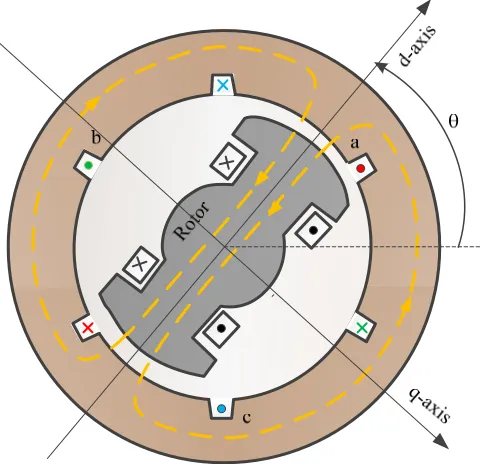
Fig. 2.1. Cross-section view of a two-pole, salient pole synchronous machine
of synchronous machine in this research work is illustrated in Fig. 2.1. As shown in this
diagram, a three phase synchronous machine model consists of three phase stator
wind-ings symmetrically distributed around the air-gap.
The rotor field in synchronous machines is produced by applying a DC current to the
rotor field windings. This results in a sinusoidal distribution of flux in the air-gap of the
synchronous machine. If the rotor is rotated by a prime mover such as a DC motor, a
ro-tating field is produced in the air-gap which is also known as the excitation field. The
in-duced voltages in the armature windings have the same magnitudes but they are 120
elec-trical degrees apart.
To obtain the synchronous generator mathematical model, the rotor reference frame
respect to the orthogonal axes. By definition, the direct axis is centered magnetically in
the center of the north pole and the quadrature axis lags it by 90 degrees.
The synchronous machine model order is defined by the total number of rotor
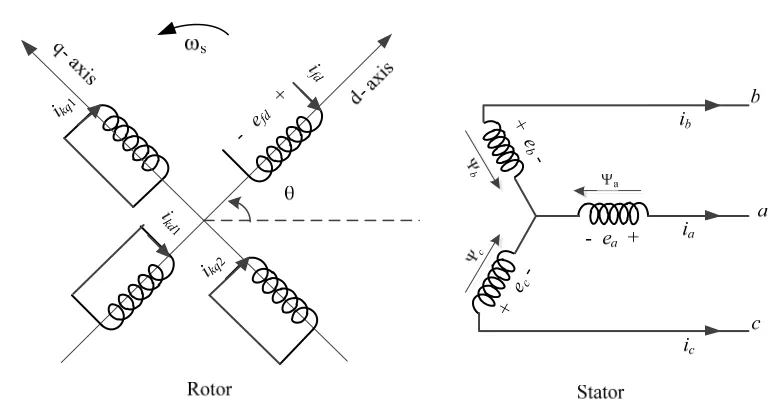
wind-ings on its two orthogonal axes. Fig. 2.2 shows the stator and rotor circuits of a 2×2
syn-chronous machine model used in this research. As shown in this figure, a 2×2
synchro-nous machine model consists of one damper circuit and the field winding along the direct
axis, and two damper circuits along the quadrature axis. Field and damper windings are
also placed along the rotor. As illustrated in this figure, the damper circuits can be
mod-eled by short-circuited windings along the direct and quadrature axes. The angle is the
rotor position with respect to the stator.
To have a steady torque, the rotating fields of the stator and rotor must have equal
speed which is called synchronous speed. This speed for a p-pole machine is calculated
as
c
b
+
eb
-+ e c
-fd
fd
kq1
kd1
kq2
p p f n s s
120 60 (2.1)
where f is the frequency in Hz, s=2f is the angular frequency in rad/s, and ns is the
synchronous speed in rpm.
2.1.1.
Stator and Rotor Mathematical Modeling
Assuming that the stator windings are distributed sinusoidally, the mmf wave of each
phase is sinusoidal with 120 electrical degrees apart in space with respect to each
adja-cent phase. Therefore, we have
3 2 cos 3 2 cos cos c c b b a a ki mmf ki mmf ki mmf (2.2)
in which is the angle along the periphery of the stator and the center of phase a. The
phase current can be defined by
The total amount of mmf is calculated by
t
kI mmf mmf
mmf
mmftotal a b c 3 mcoss (2.4)
Therefore, the total mmf is a sinusoidal waveform. (2.4) indicates that mmf in
synchro-nous machines rotates at the constant angular velocity of s. Therefore, for a balanced
operating condition in synchronous machine, stator field and rotor must rotate at the same
speed.
Considering Fig. 2.2, the voltage equations for the three phases can be written as
. c a c c b a b b a a a a i R dt d e i R dt d e i R dt d e (2.5)
The flux linkages in the three phases are expressed by
. 2 1 1 2 1 1 2 1 1 2 1 1 kq kq kd fd c b a ckq ckq ckd cfd cc bc ac bkq bkq bkd bfd bc bb ab akq akq akd afd ac ab aa c b a i i i i i i i l l l l l l l l l l l l l l l l l l l l l (2.6)
. 0 0 0 2 2 2 1 1 1 1 1 1 kq kq kq kq kq kq kd kd kd fd fd fd fd i R dt d i R dt d i R dt d i R dt d e (2.7)
Since the rotor has a cylindrical structure, the self-inductance of the rotor circuits as
well as their mutual inductances does not depend on the rotor position . Only the mutual
inductances between the rotor and the stator are affected by the rotor position. Therefore,
we have, . 0 0 0 0 0 0 0 0 2 1 1 2 1 2 2 2 2 2 1 1 1 1 1 1 1 1 1 1 1 2 1 1 kq kq fkd fd c b a kq kq kq ckq bkq akq kq kq kq ckq bkq akq kd fdkd ckd bkd akd fdkd fd cfd bfd afd kq kq kd fd i i i i i i i l l l l l l l l l l l l l l l l l l l l (2.8)
The stator mutual and self-inductances in (2.8) can be defined by (2.9) and (2.10),
. 3 2 2 cos 3 2 2 cos 2 cos 2 0 2 0 2 0 aa aa aa aa aa aa L L l L L l L L l cc bb aa (2.9) and
3 2 cos 2 cos 3 2 cos 2 0 2 0 2 0 ab ab ab ab ab ab L L l l L L l l L L l l ac ca cb bc ba ab (2.10) where . 4 2 2 2 0 2 2 2 2 0 q d a abl ab ab q d a q d a al P P N L L L P P N L P P N L L aa aa (2.11)Pd and Pq are the permeance coefficients of the d- and q-axis, respectively and Na is the
that are not crossing the air-gap. Similarly, the stator-rotor mutual inductances can be
de-fined by (2.12):
. sin sin cos cos 2 1 1 2 1 1 akq akq akd afd L l L l L l L l akq akq akd afd (2.12)
Equation (2.8) completely describes the mathematical equation of a synchronous
ma-chine. However, it contains the stator currents and the d- and q-axes currents which result
in a very complex calculation.
2.1.2.
Park’s Transformation Model
One of the most widely used methods to convert the stator quantity values such as
voltage, current, or flux into their corresponding rotor quantity values is Park’s
transfor-mation [28], This transfortransfor-mation can be defined by the following matrix equation
in which can be replaced by voltage, current, or flux. It should be noted that under the
balanced condition we have
0
a b c (2.14)
Therefore, 0=0. The inverse transformation can be defined as:
0 1 3 2 sin 3 2 cos 1 3 2 sin 3 2 cos 1 sin cos q d c b a (2.15)
2.1.3.
Rotor Reference Frame Equations
Using the transformation equation in (2.13) to convert the flux linkages and currents
in (2.6) and (2.8), one can obtain
0 2 1 1 0 2 1 1
0 0 0 0 0 0 0
0 0 0 0 0 0 0 0 i i i i i i i L L L L L L L kq kq q kd fd d akq akq q akd afd d q d (2.16)
0 0 2 0 0 2 0 0 2 2 3 2 3
0 aa ab
aa ab aa aa ab aa L L L L L L L L L L L q d (2.17) and . 2 3 0 0 0 2 3 0 0 0 0 0 0 2 3 0 0 0 2 3 2 1 1 2 2 1 2 2 1 1 1 1 1 1 1 2 1 1 kq kq q kd fd d kq kq kq akq kq kq kq akq kd fd kd akd fd kd fd afd kq kq kd fd i i i i i i L L L L L L L L L L L L (2.18)
Therefore, stator voltage equations in (2.5) can be converted to d-q components as
fol-lows [1] 0 0 0 R i
where r is the angular velocity of the rotor. For the steady state operating situation we have rad/s 377 60 2 Hz 60
@f r s (2.20)
2.1.4.
Power and Torque Equations:
The three-phase output power can be calculated in the rotor reference frame as
. 2 3 q q d do e i e i
P (2.21)
Substituting the voltage component from (2.19) in (2.21), (2.22) can be written as
2
.2 2 3 loss resistance armature 2 0 2 2 power gap -air energy magnetic armature in change of rate 0 0
q r d q q d d q a
q d d
o i i i i i R
dt d i dt d i dt d i P (2.22)
Consequently, the air-gap torque can be expressed by
. 2 3 power gap -air mech d q q d mech re i i
T
(2.23)
2.1.5.
Per-unit Calculations
In lights of the fact that using per-unit system results in simplified computational
analyses, all the performance analyses are conducted in per-unit system in this research.
. value Base
value Actual unit value
Per (2.24)
In this work, the machine ratings are chosen as the base quantities in the per unit
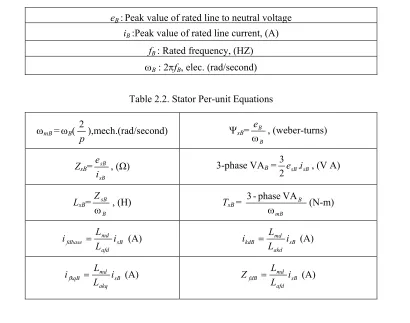
cal-culations. Tables 2.1- 2.3 summarize the per-unit equations used in this research. It
should be noted that hereafter all the quantities used in this thesis are in per unit unless
the unit is specified.
2.1.6.
The Synchronous Machine d- and q-axis Equivalent Circuits
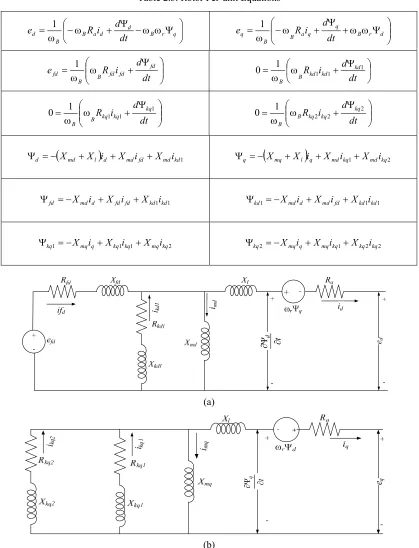
Based on the equations developed in the previous section, Figs. 2.3-a and -b provide
the synchronous machine direct and quadrature axes equivalent circuits, respectively.
Table 2.1. Base Quantities Used in the Per-unit System
eB: Peak value of rated line to neutral voltage
iB:Peak value of rated line current, (A)
fB: Rated frequency, (HZ)
B : 2fB, elec. (rad/second)
Table 2.2. Stator Per-unit Equations
mB= B(
p
2
),mech.(rad/second) sB=
B B e
, (weber-turns)
ZsB=
sB sB i e
, (Ω) 3-phase VAB =2esB.isB
3
, (V A)
LsB=
B sB Z
, (H) TsB= mB B
VA phase -3
(N-m)
(A)
sB afd md fdbase i
L L
i sB (A)
akd md
kdB i
L L i
(A)
sB akq md
fkqB i
L L
i sB (A)
afd md
fdB i
L L
Table 2.3. Rotor Per-unit Equations
d B r q
d a B B d dt d i R
e 1
q B r d
q a B B q dt d i R e 1 dt d i R e fd fd fd B B fd 1 dt d i R kd kd kd B B 1 1 1 1 0 dt d i R kq kq kq B B 1 1 1 1 0 dt d i R kq kq kq B B 2 2 2 1 0
md l
d md fd md kd1d X X i X i X i
q
XmqXl
iqXmdikq1Xmdikq21 1kd kd fd fd d md
fd X i X i X i
kd1 Xmdid XmdifdXkd1ikd1
2 1
1
1 mqq kq kq mqkq kq X i X i X i
kq2 Xmqiq Xmqikq1Xkq2ikq2
t d (a) t q (b)
2.2.
The State Space Synchronous Machine Model
In this section, a comprehensive saturated model for synchronous machines is
pre-sented. To describe the dynamic behavior of synchronous machines in time domain, the
analysis of this section employs the state space modeling concept. Therefore, based on
the dynamic equations of synchronous machines and their particular state variables, the
state space model can be utilized to determine the future state of the machine provided
that the present state and the excitation signals are known [29]. Firstly, consider a general
non-linear system with multiple states and inputs as
x x xn u u um
f
x 1, 2,... , 1, 2..., (2.25)
where xi is the ith vector of the state variables, uj is the jth system driving variable, and f is
a set of non-linear functions. Suppose the equilibrium points of x0i and u0j are defined
such that f(x01, …, x0n, …, u01, …, u0m)=0. If xiand uj are considered to be a perturbed
state of the above system, (28) can be written as
m m m
n n n
u u u u
u u u u u
x x x x
x x x x x
~ ~
~
~ ~
~
0 2
02 2 1 01 1
0 2
02 2 1 01 1
. (2.26)
Note that at the equilibrium points, the function f is zero. The linearization of the system
about the equilibrium point can be obtained using Taylor series expansion and by
,... , ,...,
~ ~. 1 ` 1 ` 1 1 0 0 0 0 i n i u ux x i in i
u ux x i m n u u f x x f u u x x f x i i i i i i i i
(2.27)
Therefore, for small perturbation of a non-linear system around the equilibrium point the
linear state space model of the system can be written
U D X C Y U B X A X (2.28)
in which A,B, C, and D are called the system, input, output, and feed-forward coefficient matrices, respectively. Considering X0 as the initial condition of the system, applying the Laplace transformation to the state space equations in (2.28), we have
s 0
s
s.sX X AX BU (2.29)
Therefore,
sIA
X s X0 BU
s. (2.30)It yields,
s sI A
1X0
sI A
1BU
s.X (2.31)
It can be proven that
sIA
1L
eAt . (2.32)
t t
t
d e
e
t t
t t-t-t
U D X C Y
U B X
X A A
0 0
0
(2.33)
2.3.
Fault Analysis
In a power system, an abrupt disturbance that causes a deviation from normal
opera-tion condiopera-tions of the power equipment is generally called a fault. Based on the nature of
the fault, they are classified into two groups. The first type of failures is short-circuiting
faults. They may occur as a result of an insulation default in the apparatus due to
degra-dation of electrical components over time or as a consequence of a sudden overvoltage
situation. The other type of faults is categorized under open circuit faults as a result of an
interruption in current flow [30].
In case of short-circuit fault occurrence in the transmission system, the fault must be
cleared in the least amount of time possible to prevent the system from losing the
syn-chronism and becoming unstable [31]. Therefore, part of this research is focused on
per-formance analysis of a synchronous generator when it is subjected to a short-circuit
inter-ruption.
2.3.1.
Classification of Short-circuit Faults
Weather conditions are one of the common factors causing short-circuit faults in
equipment are some of the weather-related conditions that can cause a short-circuit
fail-ure.
Equipment failure due to aging, degradation, or poor installation of the machines,
ca-bles, transformers, etc. can be another cause of short-circuit failure. Short-circuit faults
can also happen as a result of human error. For instance, this fault may happen during the
re-energizing process of the system to be in service after maintenance due to some
inad-vertent mistakes[30], [31].
2.3.2.
Effects of Short-circuit Faults on Power System Equipment
The short-circuit effects on the power system equipment can be classified as either
electrical or mechanical effects. Depending on duration of the short-circuit fault, the
cur-rent passing through the conductors of the power system equipment may cause some
thermal effects such as heating dissipations. On the other hand, electromagnetic forces
and mechanical stresses caused by short-circuit interruption are considered to be
mechan-ical effects. Mechanmechan-ical effects of short-circuit failures may result in serious problems.
Therefore, it is essential that the transformers windings are designed to tolerate
electro-magnetic forces. Also, if the cores in a three-phase unarmored cable are not bounded
properly, the electromagnetic force due to the short-circuit fault, can cause the cores to
2.4.
Transient Stability Analysis
In the previous section, short-circuit faults as a common source of failures in power
systems was presented. In this section, transient stability analysis is briefly introduced.
More information for further reading is available in [1], [29].
By definition, transient stability is the ability of a system to sustain synchronism after
it is subjected to sever transient disturbances. Through a part of this research, the
magnet-ization effect on the synchronous generator transient stability in the case of a short-circuit
fault is investigated.
It should be noted that after the fault occurs, the circuit breakers at both ends of the
faulted circuit will be activated to isolate the circuit and clear the fault. The fault clearing
time depends on the speed of time at which the circuit breakers can perform.
Firstly, let us consider fault location F1 to be at the high voltage transmission (HT)
bus as indicated in Fig. 2.4-a. For simplicity it is assumed that the stator and transformer
resistors are small and can be neglected. Therefore, in this situation, no active power is
transmitted to the infinite bus during the fault and the short-circuit current flows through
the pure reactance.
If the fault occurs at location F2 as shown in Fig. 2.4-b, some active power will be
transmitted to the infinite bus during the fault. Figs 2.4-d and 2.4-e demonstrate the active
power P graph with respect to the load angle for stable and unstable situations,
Suppose that the system is subjected to the fault at t=t0 and the fault is cleared at t=t1.
First, let us examine the stable situation shown in Fig. 2.4-d. As can be seen in this figure,
before the fault the system operates at the pre-fault state of operation. At t=t0, one of the
circuits is subjected to the fault. Therefore, the operating point suddenly drops from point
a to b. As a result of inertia, load angle cannot suddenly change. Since Pe<Pm, the rotor
starts accelerating until point c, at which the fault is cleared by activation of the circuit
breakers and isolating the faulted circuit from the network. Therefore, the operating point
abruptly changes to point d. At this time, since Pm<Pe, the rotor starts decelerating.
How-ever, the load angle continues increasing because during the fault the rotor speed is
in-creased to more than synchronous speed (0, 0). Therefore, the load angle increases until
the kinetic energy gained by the machine during the acceleration (area A1) is expended.
When the operating point reaches to d (t=t2)at which we have A1=A2 the rotor speed is the
synchronous speed and load angle is maximum. Since Pm<Pe remains true the rotor speed
and the load angle decrease. If there is no source of damping in the network, the
operat-ing point oscillates between points e and d.
With the longer fault duration illustrated in Fig. 2.4-e, the area A1 representing to the
energy gained during the fault is greater than area A2. Therefore, after the fault is cleared
at point e, the kinetic energy is not completely expended in the system. As a result, the
speed and the load angle both increase. The speed never reaches the synchronous speed,
Based on the above discussion, one can conclude that the transient stability in
syn-chronous generators in short-circuit interruptions is affected by the following factors:
- Load of the generator
- Location of the fault
- Fault clearing time
- Post-fault transmission circuit resistance
- Generator reactance: The greater this reactance is, the greater the peak power; this
results in having less initial load angle.
- Generator inertia: For the generators with greater amount of inertia, the kinetic
energy gained during the fault is smaller
(a)
G
F2
HT EB
F2
E
EB
(b) (c)
(d) (e)
2.5.
The Previous Models Used to Represent
Magneti-zation
In this section, three methods to represent magnetization in electrical machines used
by the researchers are explained. These models are developed in this research work to be
used in comparison investigations to validate the proposed models.
2.5.1.
Polynomial Regression Algorithm
Polynomial regression is one of the most commonly used methods in representation
of magnetization characteristics in electrical machines. Fig. 2.5 illustrates a representation
Im c0c1Im
3
3 2 2 1
0 m m m
m c cI cI cI
I
n
m n m m
m c cI cI cI
I
2
2 1 0
1,Im1 ,2,Im2 ,,n,Imn
2
2 1
0 m m
m c cI cI
I
Fl
ux lin
kage
(pu)
Magnetizing current (A)
of a set of flux linkage data points and their corresponding magnetizing currents by
dif-ferent degrees of polynomials. In general, n number of data points can be interpolated by
a set of polynomials from a straight line (k=2) to a polynomial of degree k=n-1.
Suppose that for the available set of magnetization data points the function is
ex-pressed in the form of a polynomial of degree k as
0 1 2 2 0 .
k 1 i
i m i k
m k m
m
m c c I c I c I c c I
I (2.34)
To assure that the curve is the best-fit curve of the data points, the least square method is
employed. In this technique, the error function is defined as sum of the squared
devia-tions from the data points.
.1
2
n
j mj j
I (2.35)
Substituting the calculated flux linkage from (2.34), (2.36) can be written as
.
1
2 0
n
j j
k 1 i
i mj iI
c
c (2.36)
According to the least square error method [32], [33], the regression algorithm will be
successful if the error is minimized by
. 0
2 1 0
k
c c
c
c (2.37)
. 0 2 0 2 0 2 0 2 1 0 2 1 0 2 1 0 1 1 0 0 k m n j j k 1 i i mj i k m n j j k 1 i i mj i m n j j k 1 i i mj i n j j k 1 i i mj i I I c c c I I c c c I I c c c I c c c (2.38) Consequently,
. 1 1 1 2 2 1 1 1 1 0 1 1 2 2 1 4 2 1 3 1 1 2 0 1 1 1 1 3 2 1 2 1 1 0 1 1 1 2 2 1 1 0 n j n j k m j k k m k n j k m n j k m n j k m n j nj j m k m k n j m n j m n j m n j n
j j m k m k n j m n j m n j m n j n j j k m k n j m n j m I I c I c I c I c I I c I c I c I c I I c I c I c I c I c I c I c nc (2.39)