Implementation of Confidentiality and
Security for M-Health App, Using Bio-Matrix
Authentication
S. D. Zambad 1,V. S. Gulhane2, L . K .Gautam3
M. E Student, Department of Information Technology, Sipna COET, Amravati, India1 Head of Department, Department of Information Technology, Sipna COET, Amravati, India 2
Assistant Professor, Department of Information Technology, Sipna COET, Amravati, India 3
ABSTRACT: Today Mobile wellbeing (m-Health) applications have turned out to be exceptionally prevalent in the previous few of years because of enhancements in equipment, broadcast communications, programming ("applications"), and moderateness of device and information transmission arranges. m-health applications can now utilize a few sensors to survey an individual's health status and help with health related basic leadership. we give an outline of the principle sorts of security and privacy dangers, and in addition imperatives confronted by unique finger impression bio-matrix verification that work on m-Health devices. In this paper we detail the security and protection design and usage of the Health portable electronic health observing and information accumulation framework. Healthcare comprises of a body sensor organize installed in attire that imparts remotely to the wearer's cell phone. The cell phone is utilized to oversee, store and move the information secure. The patient controls who may get to his information. Just crisis doctors close-by the patient may get to indispensable information without the patient's individual assent. We depict the remarkable security and protection elements of our design which may likewise be utilized to enhance other monitoring arrangements.
KEYWORDS: m-Health, security, privacy, Apps, IOT, Biometrics Authentication
I. INTRODUCTION
Nowadays, mobile health (m-Health) innovation can be characterized as the integration of mobile processing, medical sensors, and compact gadgets to guarantee social insurance [16]. The Global Observatory for e-Health characterized m-Health as medicinal and general mobile health practice upheld by cell phones, for example, cell phones, quiet checking gadgets, individual computerized partners (PDAs), and different remote gadgets." [12]. m-Health innovation is promising in both created and creating nations.
utilize cell phones for patient records and additionally quiet analytic process. The utilization of cell phone inside the human services space is called m-healthcare. A m-medicinal services application can be utilized by patients and in addition by doctors.
The range of medicinal services is included with treatment of patient touchy information. Security and protection of these information is vital. While doing on the web exchange of these secret information over people in general system, it can be seen and additionally adjusted by the attacker’s. It can be likewise gotten to by unauthorized people who can break protection of the patient's information. Patient's private information can be seen by outsider from the gadget if the handheld is lost.
The fundamental objective of this paper is to build up a m-medicinal services application that will give secure, trustful and solid correspondence for various groups in social insurance territory. We have wanted to build up an application that will give interface to both doctors and patients. It will be an application that will be secure from the three essential sorts of dangers. As we have talked about over, the three sorts of real dangers are
(1) Threats that attack during system correspondence, (2) Unauthorized access to information and
(3) Third people access to the gadget storage information, if the gadget is lost or utilizing some noxious programming. presently, Internet of Things (IOT) has ended up being a champion among the most extreme correspondence norms of the 21th century. In the IOT condition, all articles in our step by step life end up being a bit of the web as a result of their correspondence and handling capacities (checking little scale controllers, handsets for tunnel ital correspondence). IOT widens the possibility of the Internet and makes it more unavoidable. IOT grants predictable co-operations among different sorts of contraptions, for instance, remedial sensor, checking cameras, home mechanical assemblies so on. Thus of that reason IOT has ended up being more gainful in a couple zones, for instance, human administrations system. In social protection structure, IOT incorporates various sorts of trashy sensors (wearable, installed, and condition) that engage developed people to acknowledge display day therapeutic restorative administrations benefits wherever, at whatever time. What's more, it in like manner essentially improves developed social orders individual fulfillment. The body sensor orchestrate (BSN) development is a champion among the most essential progressions used as a piece of IOT-based present day therapeutic administrations framework. It is basically a social event of low-power and lightweight remote sensor centers that are used to screen the human body works and incorporating environment [7].
In this paper, we describe the novel plan of a security design for Healthcare. The Healthcare venture is a joint research venture of a few research gatherings of RWTH Aachen University in light of a sensor arrange installed in dress [9]. The sensor arrange gathers indispensable parameters and discusses remotely with the wearer's cell phone. The cell phone is utilized to oversee, store and move the information secure. Information might be transferred to different gatherings, for example, medicinal specialists, crisis mind administrations and private gatherings trusted by the wearer himself, e.g. his family. The patient controls who may get to his information. Just crisis doctors adjacent the patient may get to key information without the patient's individual assent. The framework is intended to support computerized crisis calls when fundamental parameters coordinate predefined designs. The framework is not gone for making a foundation among medical specialists or medical coverage organizations.
II.RELATED WORK
A Security and Privacy Challenges
Faudree and Ford (Faudree and Ford 2013) declared the utilization mHealth applications among human services suppliers and purchasers may bring critical issues, for example, security and protection challenges. On the off chance that social insurance suppliers can't give sufficient protections to patient security, the outcomes can be critical. As confirmation of the security and protection challenges, the creators detailed that a little review discovered 93% of clinicians utilize cell phones to get to EMR however just 38% take after a formal portable protection strategy.
Information security and protection are significant attentiveness toward individual wellbeing records as per Kharrazi, Chisholm, VanNasdale and Thompson (Kharrazi et al. 2012). The absence of institutionalization and security issues required with m-Health applications are an enormous boundary to their across the board utilize. Specifically, the creators concentrated on the confinement of data security on a cell phone. Buyers may lose their gadgets or may not utilize any security verification to ensure the information. It is in this manner the buyer's duty to secure their own data with gadget passwords and application passwords to ensure their private data in the applications. The creators likewise underlined that to lessen the security dangers of m-Health applications, an exhaustive check process is required by the application stores that could identify evil projects.
B. Security and Protection of m-health Application.
Kane (Group 2013) expressed that some m-Health applications include a web empowered cell phone associating remotely to compact or installed sensors that track or measure a patient's well being condition or a customer's exercises. The following of the patient's well being maybe happens progressively, with or without the patient's association or endorsement at every moment. The creator concentrated on the information accumulated by m-Health applications that get to the patient and are all the while imparted to others. The information assembled by such m-Health applications not just convey point by point data about a man's well being, additionally about their propensities, area and developments, which conceivably puts the individual's delicate data at hazard if such data is uncovered.
McCarthy (McCarthy 2013) highlighted a noteworthy worry in connection to shopper information, which is by and large ineffectively secured in m-Health applications. She detailed that in an investigation of 43 well being and wellness applications, just 74% of the free applications and 60% of the paid applications had a protection strategy, accessible either in the application or on the engineer's site. Be that as it may, just 25% of the free applications and 48% of the paid applications educated buyers about the security arrangement. Moreover, none of the free applications and just a couple of the paid applications encoded the information that customers went into the applications. Encryption is the change of information into a frame that can't be effectively comprehended by unapproved individuals. Along these lines m-Health applications that don't scramble shoppers' data can represent a risk to information protection.
Nasiri [3](HealthCareBusinessTech 2014) likewise revealed information security chances in m-Health applications. He discovered numerous customers utilize m-Health applications to cooperate with their social insurance suppliers, and in addition track and oversee side effects and other data. Nasiri found the data purchasers imparted to others may convey security dangers. He announced that analysts did an overview of 20 of the 23 most prevalent free m-Health applications and found that half send information to outsider publicists and 39% send information to unidentified gatherings with no information encryption. He expressed that paid applications are more secure contrasted with free m-Health applications to a specific degree. Many free m-Health applications for cell phones send information, associate with outsider destinations, utilize decoded associations, take into consideration information gathering by outsiders and store information remotely.
C.Smart home control by utilizing minimal effort ESP8266 and android plan
The standard explanation behind this wander is to develop an "Android based insightful home system with control through WIFI advancement". Here we are using an ESP8266 controller and WIFI. Microcontroller is interfaced to the WIFI at whatever indicate the customer needs control the stack which suggests machines in the home like fans, lights et cetera he principal inspiration driving this wander is to make "Android based smart home system with control through WIFI Technology", here we are using an ESP8266 controller and WIFI module which is related with Android PDA and the microcontroller is interfaced to the WIFI at whatever indicate the customer needs control the store which infers devices in the home like fans, lights et cetera. which are also connected with the controller then the customer will sent a request to WIFI module from wireless through WIFI correspondence at whatever point gets the particular charge at controller side by methods for WIFI module which doled out for the microcontroller it may do some action described in controller with programming written in side of the controller , whatever the summon sent by the customer will get the WIFI module and these requests to the controller to switch on/off conditions of the lights or fans. Moreover, another key component of this wander is recognition of fire and Gas in our home if any of them recognized at home sends message to proprietor of the house through GSM module, here we are controlled window hangings passages in like manner through WIFI correspondence.
III. SYSTEMARCHITECTURE
This extensive variety of possibilities outcomes has stimulated worries about the methods used to secure cell phones and m Health applications. he advanced mobile phone application showcase lies outside government control. The nature of actualized safety efforts varies broadly. A few suggestions are benefit capable for m Health application engineers, and mobile device management (MDM) arrangements can help clinical ventures secure advanced mobile phones and tablets. There is additionally a promising proposition to build up a "construction law" for security basic restorative framework Current advanced mobile phone application structures likewise raise protection concerns. Specifically, the Android stage, which makes up 80 percent of the advanced mobile phone OS advertise, has a level of openness that backings solid development additionally puts clients at danger of protection infringement.
This system consist of modules: ESP8255 microcontroller, Fingerprint module, Sensors, Smartphone device and doctor’s admin module and consider android side and website side process as following figure:
Fig1: system architecture diagram
A) ANDROID SIDE PROCESS
parameters of patient as show fig.4 in this way data and user register send server and stored into database for authentication and after send to website in fig 1.
B) WEBSITE SIDE PROCESS
In website side process, user fill normal detail of hospital registration as username, password and all details of hospital which is use as signup process. the request send to admin login and admin approves the request. If login page use to mail id and password then open the login page. The website side is doctor side portal and doctor monitoring the patient details. The doctor send the prescriptions to patient. In fig shows the patient data send to web server and store database and after go to android application. session end user logout and return into login page as show in fig6. For remember we give short notify for a second display on user screen then server verify authorized user or not as show in fig.5. If selected finger id is correct then user login into Android app and logout timer start after
The following figure shows the data flow diagram of two factor Android side and website side process
The flow diagram of android process is start, if first time start then fill the user registration form or if not first time start then user login form. The login form is start so first scan the fingerprint. If the user is valid then finger is generated and submit user id to server. After server check finger is valid or not. If finger is valid then login process is start and finger exists. The same process apply after fill the registration form and finger id submit to database and store the new user to database. If android app is start but user not use m-health app then 3 minutes duration login app is automatically stop and again restart the process. This process shown in fig2.
The flow diagram of website process is start, if start fist time then signup process start and fill the hospital registration form. And submit all data with doctors to admin. If admin receives the request then login successful and hospital registered completely. After start login form and take the id and password of hospital. So the page is open and this page is store the detail of registered patient. The doctor check the patient parameters and send prescription to patient and data send server to android app. This is the all website process is shown in fig3.
Fig2. Flow diagram of android process Fig3. Flow diagram of website process
IV. IMPLEMENTETION AND RESULT ANALYSIS .
Although the m-health application was implemented on an Android system it can be applied to a wide range of authentication scenarios. For instance user signup and login in Windows 8, email accounts login on web browser, and application login/ unlock on Android OS. It can also be applied to any client device such as personal computers, laptops, tablets, mobile phones, or bank ATM due to the fact that the method of authentication is simple and secure the entire authentication process can be completed by only touching or clicking on the screen. In our implementation, we assumed that users download an application from Google Play and register an account for later login to use the service. Since Android is an open source operating system based on Linux kernel and is widely used in mobile devices such as tablet PCs and smart phones, we implemented a m-health application on Android and carried out user experiments to evaluate it confidentiality and usability. In this section we will describe our implementation and the user study experimental design, environment, participants and procedures.
A) Implementation
The m-health prototype is built with Android SDK 2.2.3 since it was the mainstream version of the distribution in 2012. After connecting to the Internet, users can signup an account, log in a few times in practice mode, and then log in for the experiment with a client’s device in the client side of our prototype, we used XML to build the user interface and used JAVA and Android API to implement functions, including username checking, pass-images listing, image is in grid, pass-squares selection, login indicator delivery, and the horizontal and vertical bars circulation. In the server side of our implementation, we used JAVA web server and MySQL to store and fetch registered accounts to/from the database to handle the password verification. Although in our proposed system we mentioned that users can import the m-health app. the m-health app is secure. They user can use the fingerprint authentication. So user can scan the finger in login page using bio-matrix authentication and finger id is go to server. the server check user is valid or not. If user is valid then server go to next level. The main page open in m-health application. After a user sense the pulse rate and temperature parameters by using sensors. After a 10 seconds pulse rate and temperature readings send server todatabase table and after go to doctor’s website. This is shown in fig 4.
Fig. 4 a )Generate the finger id. b)Scan log in finger authentication c) Open main page of m-health app
In this fig. the first user scan the finger by using bio-matrix authentication .If the finger is match and user is valid then user goes to next step. So the user can open the mobile app and sense the health parameters. Then display the readings of pulse rate and temperature is mobile phone in and after send server through registered doctor’s website in fig.5.The doctors check the patient readings and send the prescriptions to patient android phone. In our implementation, to provide more security and privacy we used factor authentication that is android application
Fig.5 Display parameters reading in mobile app
C. Graphical analysis
In our implementation, we used three diagram of graphical analysis and execution time is common parameter. First is the server response time analysis. The three parameters execution of time, second is no. of users and time duration. The no. of users sense the health parameters. In analysis, we show how much seconds the no. of users health parameters like pulse rate and temperature readings go to web server. And both parameters have same time. The more users uses a sensors and check the health parameters. In graphical analysis, following figure displays which shows no. of users and shows the execution time in seconds. The graph shown in fig 6.
Fig 6. Server response time analysis
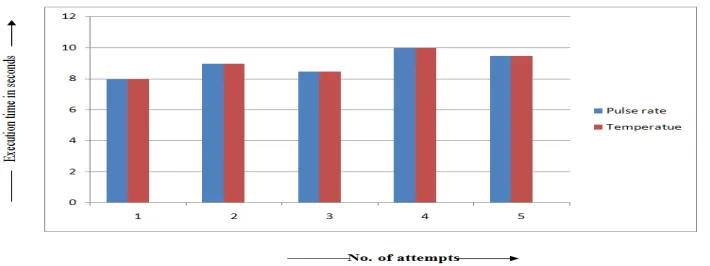
The second graph is sensors execution time graph. The two parameters are no. of attempts And execution time in seconds. We show the how much time in seconds to measure sensors readings in one attempt. The pulse rate calculate more time as well as temperature. In graphical analysis, the following figure displays X-axis which shows the no. of attempts and Y-axis shows the time execution in seconds. The graph shows in fig 7
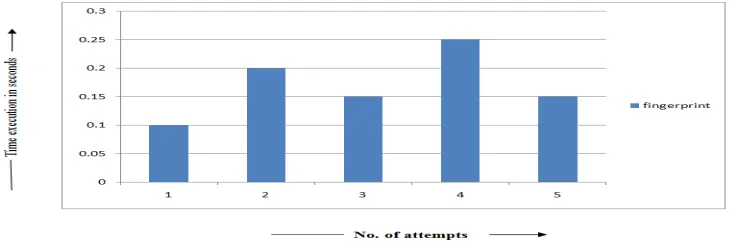
The third graph is fingerprint execution time. The two parameters are no. of attempts And execution time in seconds. We show the how much time in seconds to scan the finger in one attempt. The finger scanning time is always change. In graphical analysis, the following figure displays X-axis which shows the no. of attempts and Y-axis shows the time execution in seconds. The graph shows in fig 8.
Fig 8.Fingerprint execution time analysis
V. CONCLUSION
This relative analysis of m-Health applications that not all m-Health applications accessible in the application stores are free of privacy and security issues. As future work, it is critical to dissect the security instruments and encryption techniques for the applications. The review tries to plan purchasers, human services individual and application engineers to take alert when receiving and creating m-Health applications by giving them information about application issues and additionally advantages and hazard connected with m-Health applications in healthcare
VI. ACKNOWLEDGMENT
This result paper work is finished effectively simply because support from every single one including educators, companions. Extraordinarily, I am extremely appreciative to the individuals who give me direction and make this work done
REFERENCES
[1] K. Knorr and D. Aspinall, “Security Testing for Android mHealth Apps,” in Proc. of the IEEE Int’l Conference on Software Testing, Verification and Validation Workshops (ICSTW), Graz, Austria, 1-8, 2015.
[2] HealthCareBusinessTech. 2014. "Mobile Health Apps Create Privacy Risk, Study Says." Retrieved 18 - March - 2014, from http://www.healthcarebusinesstech.com/mobile-health-apps-privacy/
[3] Cisco mConcierge, “BYOD Insights: A Cisco Partner Network Study,” March 2013.
[4] Schulke, D.F. 2013. "The Regulatory Arms Race: Mobile-Health Applications and Agency Posturing," Boston University Law Review (93:5). [5]McCarthy, M. 2013. "Experts Warn on Data Security in Health and Fitness Apps." p. 1.
[6]Faudree, B., and Ford, M. 2013. "Security and Privacy in Mobile Health," CIO Journal).
[7]Kharrazi, H., Chisholm, R., VanNasdale, D., and Thompson, B. 2012. "Mobile Personal Health Records: An Evaluation of Features and Functionality," Int.l Journal of Medical Informatics (81:9), 9//, pp. 579-593.
[8] M. Ahmed and M. Ahamad, “Protecting Health Information on Mobile Devices," in Proc. of the second ACM Conference on Data and Application Security and Privacy, 229-240, February 2012.
[9] D. Luxton, R. Kayl, and M. Mishkind, “mHealth Data Security: The Need for HIPAA-Compliant Standardization.
[10] Boulos, M.N., Wheeler, S., Tavares, C., and Jones, R., "How Smartphone Are Changing the Face of Mobile and Participatory Healthcare: An Overview, with Example from Ecalyx", Biomedical engineering online, 10(1), pp.
[11] D. He et al., ―Security Concerns in Android m-Health Apps,‖ Proc. AMIA Ann. Symp. (AMIA 14), pp. 645–654
[12] WHO. mhealth: new horizons for health through mobile technologies: second global survey on ehealth. Technical report, The World Health Organization (WHO), 2011.
[14]Patricia Mechael, Hima Batavia, Nadi Kaonga, Sarah Searle, Ada Kwan, Adina Goldberger, Lin Fu, and James Ossman. Barriers and gaps affecting mHealth in low and middle income countries: A policy white paper. Technical report, Center for Global Health and Economic Development Earth Institute, Columbia University, 2010.
[15] Prabhjot Singh and Sarah Sullivan. One million community healthworkers: technical task force report. Technical report, Earth Institute at Columbia University, 2011.
BIOGRAPHY
S. D. Zambad received Bachelor of Engineering degree in Information Technology in the year 2015 and pursuing Master of Engineering degree in Information Technology from Sipna College of Engineering and Technology, Amravati.
V. S. Gulhane received his Master of Engineering degree in Comp. Science & Engineering, Ph.D. He is currently working as Professor and head in IT Department at Sipna College of Engineering and Technology, Amravati