ABSTRACT
BARTON, RYAN RICHARD. Depolymerization of Lignin in an Aqueous Environment via Zeolite Supported Nickel Catalysis. (Under the direction of Dr. Steven Peretti, Dr. Sunkyu Park, and Dr. Richard Venditti).
Lignin is an underutilized byproduct of various biomass industries. Lignin has the
potential to be a valuable product due to the presence of various phenolic subunits. The goal
of this project is to demonstrate that lignin can be depolymerized into high value aromatics
via a Ni/HZSM-5 catalyst; using a low temperature (250 ºC) aqueous environment. To
achieve this, first the Ni/HZSM-5 was developed; second, the catalyst was evaluated against
model compounds in various solvents; and third, the catalyst was applied to lignin
feedstocks. During the development process, first the HZSM-5 solid acid support was
evaluated in water at 250 °C using 2-phenoxy-1-phenylethanol (PPE), which is a lignin
model compound with a β-O-4 linkage. HZSM-5 showed activity for C-O cleavage at this
reaction condition, converting 96% of PPE with 68% selectivity to phenol and
phenylacetaldehyde.
The catalyst development dealt with Ni/HZSM-5 catalyst synthesized via
deposition-precipitation (DP). The effects of synthesis parameters; including nickel loading, DP time
(synthesis contact time), and calcination temperature, on catalyst properties were observed.
N2 and CO2 adsorption techniques were used to look at textual properties and confirmed the
existence of lamellar species generated from DP. X-ray diffraction (XRD) confirmed that
nickel metal was present on the support after reduction and passivation of the catalyst.
Temperature programmed reduction (TPR) showed that all the catalyst preparations were
to determine approximate particle size and dispersion of nickel metal. Of all the
preparations, the 15 wt% Ni/HZSM-5 catalyst with long DP time (16 h) and low calcination
temperature (400 °C), exhibited the most favorable particle size (~5 nm) and dispersion
(7%).
To evaluate these catalysts, a high throughput reaction system involving
hydrodeoxygenation (HDO) of guaiacol in dodecane was used. All Ni/HZSM-5 catalysts
were capable of guaiacol HDO into cyclohexane at 250 °C. The role of the HZSM-5 acid
sites was confirmed by comparison with Ni/SiO2 (inert support) which exhibited incomplete
deoxygenation of guaiacol due to the inability to perform the cyclohexanol dehydration step.
The most favorable catalyst, Ni(15)/HZSM-5 DP16_Cal400, performed the guaiacol
conversion and HDO activity with the highest intrinsic rates; 7.6 and 1.6 molecules of
guaiacol·Ni site-1·s-1, respectively. Guaiacol HDO reactions in dodecane exhibited undesired saturation of aromatics. This saturation was attributed to the use of the organic solvent,
instead of an aqueous environment.
This was confirmed with PPE model compound reactions using Ni(15)/HZSM-5
DP16_Cal400 catalyst at 250 °C in NaOH solution and water. Water was the desired solvent
while NaOH solution was used for its ability to solubilize lignin. Ni/HZSM-5 in NaOH
solution was active, but did not yield favorable products from PPE. For PPE reactions in
water, Ni/HZSM-5 exhibited the most favorable products after 30 min; ethylbenzene and
phenol (~35 and 23% of initial carbon, respectively).
The last step involved reactions applying the developed Ni/HZSM-5 to two types of
The Ni/HZSM-5 reaction against acetosolv lignin in NaOH exhibited poor monomer yields
(3-6 wt% yield of aromatics). The Ni/HZSM-5 reaction in water against the soluble lignin,
exhibited the highest yield of aromatics after 6 h (~24 wt% of the starting oligomer material).
This yield is comparable to work with similar catalysts used against lignin in organic
solvents; however, the extent of aromatic monomer yield from lignin in a water solvent
© Copyright 2016 Ryan Richard Barton
Depolymerization of Lignin in an Aqueous Environment via Zeolite Supported Nickel Catalysis
by
Ryan Richard Barton
A dissertation submitted to the Graduate Faculty of North Carolina State University
in partial fulfillment of the requirements for the degree of
Doctor of Philosophy
Chemical Engineering and Forest Biomaterials
Raleigh, North Carolina
2016
APPROVED BY:
_______________________________ _______________________________
Dr. Steven W. Peretti Dr. Sunkyu Park
Committee Co-Chair Committee Co-Chair
DEDICATION
I dedicate this work to my parents, Richard and Karen Barton, who have shown me
love and support, and instilled in me a strong work ethic; all of which has helped me reach
BIOGRAPHY
Ryan Richard Barton was born July 19, 1989 in Buffalo, New York and grew up in
the town of Amherst. While growing up, he enjoyed playing baseball, tennis, and volleyball.
Ryan also picked up an appreciation for music in the form of playing the bassoon. During
his K-12 education, he realized his interest in math and science; specifically in chemistry and
physics. After graduating high school as the valedictorian of his class, his core interests and
desire for challenging work led to his decision to pursue a B.S. degree in Chemical and
Biological Engineering at the University at Buffalo.
At the University at Buffalo, Ryan spent four years learning chemical engineering,
and playing club tennis with the UB Aces. During these years he became involved with
AIChE; participating on the ChemE Car team and serving as chapter president. In addition to
his studies, Ryan wanted to obtain some hands-on experience in the lab. He took on research
under the direction of Professor Carl Lund and graduate student Sushil Patel. Ryan’s first
research experience was in the area of biomass conversion, specifically, acid catalyzed
hydrolysis of sugars into levulinic acid, where he performed a kinetic study on the reaction
temperature, as well as characterized the humic byproduct from this reaction.
Upon graduating from UB summa cum laude in spring 2011, Ryan was in need of a
new challenge. Based on this need and his positive experience conducting research at UB, he
decided to pursue a career in graduate school at the Chemical and Biomolecular Engineering
department at NC State starting in summer 2011. At the beginning of 2012 Ryan started his
graduate research at NC State under the advisement of Drs. Steven Peretti, Sunkyu Park, and
ACKNOWLEDGMENTS
I would like to thank my many advisors for their support of me and my work. Steven
Peretti has provided me with much guidance and feedback, as well as provided me with
many opportunities to travel and experience the world, including travel all over the United
States (including Hawaii) to present my work, along with travel abroad to Chile for research
collaborations. Sunkyu Park and Richard Venditti provided me with the opportunities to
expand my knowledge base and allowed me to branch out of chemical engineering into the
field of forest biomaterials allowing me to obtain a PhD. co-major, and for such a unique
opportunity I am thankful. Henry Lamb provided me with the opportunity to use his lab and
equipment as well as impart useful knowledge regarding heterogeneous catalysis for which I
am thankful. I would also like to thank my advisors during my stay in Chile, including
Néstor Escalona, Marion Carrier, Cristina Segura, and Alex Berg for providing me with the
resources, guidance, and opportunity to perform my research in their labs, as well as allowing
me to explore the beautiful scenery and interesting culture that Chile has to offer.
This thesis work was supported by Basal PFB-27, PMI InEs UCO-1302 of the
Chilean Ministry of Education, and the National Institute of Food and Agriculture, U.S.
Department of Agriculture (Agreement No. 2010-38420-21828I). I want thank these funding
sources for allowing my research to be possible; here domestically and abroad.
I also would like to thank Barbara White from Forest Biomaterials for being able to
answer all my questions and provide support regarding lab instrumentation and safety. I also
graduate school related questions and making sure I stayed on track for the duration of my
PhD career.
There are also many students (former and current), post-docs, and instrument
operators involved with these labs and my work that I would like to thank for their help.
Joseph Eby and Kerri Cushing helped me get situated in the Peretti Lab. Dhana Savithri
helped me get started with my synthesis work in the Flex Lab. Pat Fahey allowed me to use
his GCxGC-MS and pyroprobe to conduct early preliminary experiments that helped guide
the direction of my research work. Simon Thompson provided me with useful tips for
catalyst synthesis and characterization, and introduced me to the Lamb Lab. Lu Liu helped
me get situated with the Park Lab and trained me on instrumentation in the Forest
Biomaterials department. BB (Ching-Chung Chang), Yang Liu, and Chuck Mooney from
AIF have provided me with their experience in XRD, TEM, and SEM, respectively. These
operators aided me in my research.
I would like to thank the students from the Universidad de Concepción who helped
me get situated in the lab. Specifically, I would like to thank Natalia Martinez, Katherine
Leiva, and Camila Rivera for their help in the lab, but also for getting me acquainted with the
Chilean culture, especially when my Spanish speaking was not very strong. I would also like
to thank Cristian Fuentes for getting me situated in Chile and offering help and suggestions
for how to enjoy my six months in Chile.
I would like to thank all my friends and colleagues in the CBE department for being
like one big family. Graduate school would have been a lot different, and probably not as
providing me with the chance to play great volleyball and make all kinds of connections
within the volleyball community in Raleigh. I would like to thank my roommates from the
very beginning, Marty Dufficy and Matt Melillo, and pseudo-roommate Cody Addington for
being great friends, partaking in many fun adventures and shenanigans, and supporting me
throughout these last five years.
Finally, I would like acknowledge my friends and family back home in Amherst,
New York. I would like to thank my friends back home for keeping in touch and continuing
to make great memories with me whenever I visit. I would like to thank my brother Matt for
keeping in touch and always offering interesting and sometimes questionable movie
suggestions. Last but not least, I want to thank my parents for always being there for me, and
TABLE OF CONTENTS
LIST OF TABLES ... xi
LIST OF FIGURES ... xiii
CHAPTER 1 Introduction and Background ... 1
1.1. Introduction ... 2
1.2. Background Information... 6
1.2.1. Structure of Lignin ... 6
1.2.2. Linkage Composition in Biomass ... 9
1.2.3. Extraction of Lignin... 11
1.2.4. Depolymerization of Lignin ... 18
1.2.5. Properties of HZSM-5 ... 22
1.2.6. Acid Catalysis ... 25
1.2.7. Preparation and Modification of HZSM-5 ... 28
1.2.8. Hydrogenation Metal Catalysts ... 31
1.2.9. Ni/HZSM-5 Preparation ... 36
1.3. References ... 45
CHAPTER 2 Lignin Depolymerization and C-O Linkage Cleavage via HZSM-5 ... 50
2.1. Introduction ... 51
2.2. Materials ... 54
2.3. Experimental Methods ... 55
2.3.1. Synthesis of PPE ... 55
2.3.2. Catalyst Characterization ... 57
2.3.2.1. Adsorption and Desorption Isotherms ... 57
2.3.2.2. Inductively Coupled Plasma-Optical Emission Spectrometer (ICP-OES) .... 57
2.3.3. PPE and Lignin Reactions ... 58
2.3.4. Product Analysis ... 58
2.4. Results and Discussion ... 60
2.4.1. PPE Reactions ... 60
2.5. Conclusions ... 71
2.6. References ... 73
CHAPTER 3 Ni/HZSM-5 Catalyst Preparation by Deposition-Precipitation: Effect of Nickel Loading and Preparation Conditions on Catalyst Properties ... 75
3.1. Introduction ... 76
3.2. Materials ... 79
3.3. Experimental Methods ... 79
3.3.1. Synthesis and Activation of Catalyst ... 79
3.3.2. Catalyst Characterization ... 82
3.3.2.1. Adsorption and Desorption Isotherms ... 82
3.3.2.2. Inductively Coupled Plasma-Optical Emission Spectrometer (ICP-OES) .... 82
3.3.2.3. Temperature Programmed Reduction (TPR) ... 83
3.3.2.4. X-ray Diffraction (XRD) ... 83
3.3.2.5. Transmission Electron Microscopy (TEM) ... 84
3.3.2.6. H2-Chemisorption ... 84
3.3.2.7. Potentiometric Titration... 85
3.3.2.8. X-ray Photoelectron Spectroscopy (XPS) ... 85
3.4. Results and Discussion ... 86
3.4.1. Catalyst with Varying Nickel Loading ... 86
3.4.1.1. Textural Properties ... 86
3.4.1.2. Active Site Properties ... 93
3.4.1.3. Optimal Nickel Loading ... 108
3.4.2. Catalysts with Varying Preparation Conditions ... 109
3.4.2.1. Textural Properties ... 109
3.4.2.2. Active Site Properties ... 118
3.4.2.3. Optimal Ni/HZSM-5 Preparation Conditions ... 131
3.5. Conclusions ... 132
3.6. References ... 135
4.1. Introduction ... 138
4.2. Materials ... 141
4.3. Experimental Methods ... 141
4.3.1. Synthesis and Activation of Catalyst ... 141
4.3.2. Catalyst Characterization ... 144
4.3.2.1. Adsorption and Desorption Isotherms ... 144
4.3.2.2. Inductively Coupled Plasma-Optical Emission Spectrometer (ICP-OES) .. 144
4.3.2.3. Temperature Programmed Reduction (TPR) ... 145
4.3.2.4. X-ray Diffraction (XRD) ... 145
4.3.2.5. Transmission Electron Microscopy (TEM) ... 146
4.3.2.6. H2-Chemisorption... 146
4.3.2.7. X-ray Photoelectron Spectroscopy (XPS) ... 147
4.3.2.8. Guaiacol HDO Reaction ... 147
4.3.2.9. Product Analysis ... 148
4.3.2.10. Specific and Intrinsic Rates ... 148
4.4. Results and Discussion ... 151
4.4.1. Guaiacol HDO Reactions Using Catalysts with Varying Nickel Loading ... 151
4.4.2. Guaiacol HDO Reactions Using Catalysts with Varying Preparation Conditions ... 163
4.4.3. Guaiacol HDO Reactions Using Active HZSM-5 versus Inert SiO2 as a Support ... 169
4.5. Conclusions ... 172
4.6. References ... 175
CHAPTER 5 Catalytic Depolymerization of Lignin over Ni/HZSM-5 prepared by Deposition-Precipitation ... 177
5.1. Introduction ... 178
5.2. Materials ... 181
5.3. Experimental Methods ... 182
5.3.1. Synthesis of PPE ... 182
5.3.2. Synthesis and Activation of Catalyst ... 182
5.3.3. Catalyst Characterization ... 185
5.3.3.2. Temperature Programmed Reduction (TPR) ... 186
5.3.3.3. X-ray Diffraction (XRD) ... 186
5.3.3.4. Transmission Electron Microscopy (TEM) ... 186
5.3.3.5. Scanning Electron Microscopy (SEM)... 187
5.3.3.6. H2-Chemisorption ... 187
5.3.4. β-O-4 Model Compound Experiments ... 188
5.3.4.1. PPE Cleavage Reactions ... 188
5.3.4.2. PPE Reaction Product Analysis... 188
5.3.5. Lignin Reaction Experiments ... 189
5.3.5.1. Acetosolv Lignin Reactions ... 190
5.3.5.2. Acetosolv Reaction Product Analysis ... 190
5.3.5.3. Miscanthus Soluble Lignin Preparation ... 192
5.3.5.4. Soluble Lignin Reactions ... 193
5.3.5.5. Soluble Lignin Reaction Product Analysis ... 193
5.4. Results and Discussion ... 194
5.4.1. PPE Cleavage Reactions in NaOH Solution ... 194
5.4.2. Acetosolv Lignin (ASL) Reactions in NaOH Solution ... 198
5.4.3. PPE Cleavage Reactions in Water ... 204
5.4.4. Miscanthus Soluble Lignin Reactions in Water ... 208
5.5. Conclusions ... 213
5.6. References ... 215
Chapter 6 Conclusion and Future Work ... 217
6.1. Conclusion ... 218
6.2. Future Work ... 222
6.3. References ... 227
APPENDICES ... 229
Appendix A ... 230
Appendix B ... 231
Appendix C ... 232
Appendix D ... 233
LIST OF TABLES
Table 1.1: Long-term conversion technologies required for aromatics market. ... 3
Table 1.2: Typical linkage compositions for softwood and hardwood. ... 10
Table 1.3: Literature summary of lignin depolymerization and conversion to monomer products catalyzed by nickel metal. ... 20
Table 1.4: Catalyst characterization techniques. ... 42
Table 2.1: Properties of the HZSM-5 catalyst. ... 53
Table 2.2: Mass balance for PPE reaction at 250 °C and 5 MPa H2, in water with HZSM-5.
... 61
Table 2.3: GPC results for Kraft lignin and lignin reactions (UV channel 280 nm). ... 68
Table 3.1: Nickel loading and textural properties of the catalysts which were calcined at 600 °C and nickel catalysts were reduced at 460 °C. ... 86
Table 3.2: Average particle size from TEM and H2-Chemisorption, and nickel dispersions
obtained from H2-chemisorption. Catalysts were calcined, reduced, and passivated for the
TEM. ... 98
Table 3.3: Acid strength and density obtained from potentiometric titration method. ... 104
Table 3.4: XPS binding energies (eV) and surface atomic ratios for reduced Ni(x)/HZSM-5 catalysts. ... 106
Table 3.5: Nickel loading and textural properties of the catalysts. ... 110
Table 3.6: Average particle size from TEM and H2-chemisorption, and nickel dispersions
obtained from H2-chemisorption. Catalysts were calcined, reduced, and passivated for the
TEM. ... 123
Table 3.7: Acid strength and density obtained from potentiometric titration method. ... 129
Table 3.8: XPS binding energies (eV) and surface atomic ratios for reduced Ni(15)/HZSM-5 catalysts. ... 131
Table 4.2: Summary of catalyst properties for varying preparation conditions, where supported nickel catalysts (15 wt%) were reduced at 460 °C. ... 149
Table 4.3: XPS binding energies (eV) and surface atomic ratios for reduced Ni(x)/HZSM-5 catalysts. ... 149
Table 4.4: XPS binding energies (eV) and surface atomic ratios for reduced Ni(15)/HZSM-5 catalysts. ... 150
Table 5.1: Properties of the Ni(15)/HZSM-5 catalysts, calcined at 400 °C, reduced at 460 °C. ... 185
Table 5.2: Carbon balance for PPE reaction at 250 °C and 5 MPa H2, in 0.1 M NaOH with
and without Ni/HZSM-5. ... 196
Table 5.3: GC results for ASL reactions in water and 0.1 M NaOH for 1 h. ... 199
Table 5.4: GPC results for ASL and ASL reactions in water (UV channel 280 nm). ... 200
Table 5.5: GPC results for ASL and ASL reactions in 0.1 M NaOH (UV channel 280 nm). ... 201
Table 5.6: Carbon balance for PPE reaction at 250 °C and 5 MPa H2, in water with and
without Ni/HZSM-5. ... 207
Table 5.7: GPC results for soluble lignin material (UV channel 280 nm)... 209
Table 5.8: Average masses for several preparations of the initial soluble lignin extract (based on GC results). ... 209
Table 5.9: GC results for soluble lignin reaction at 250 °C and 5 MPa H2, in water with and
LIST OF FIGURES
Figure 1.1: Two potential pathways for lignin degradation... 5
Figure 1.2: Proposed lignin structure example. ... 7
Figure 1.3: Monolignols and their corresponding aromatic residues. ... 8
Figure 1.4: Common lignin linkages. ... 9
Figure 1.5: Example degradation reactions in the Kraft process: a) alkaline cleavage of α-aryl ether bonds, b) alkaline cleavage of β-α-aryl ether bonds, c) sulfidolytic cleavage of β-α-aryl ether bonds. ... 12
Figure 1.6: Example condensation reactions in the Kraft process: a) competing reactions involving quinone methide intermediates, b) alkali-promoted condensation reaction. ... 13
Figure 1.7: Model structure of Kraft lignin from pine. ... 14
Figure 1.8: Example sulfite pulping reaction... 15
Figure 1.9: Model structure of lignosulfonate. ... 15
Figure 1.10: Examples of hydrogenolysis and hydrodeoxygenation reactions. ... 19
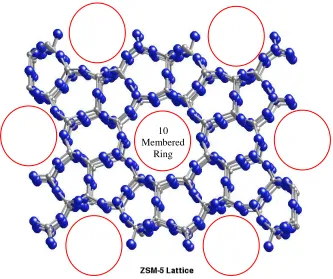
Figure 1.11: ZSM-5 structure; red circles indicate pores. ... 23
Figure 1.12: Active sites found in ZSM-5. ... 24
Figure 1.13: Protonated acid sites in HZSM-5. ... 24
Figure 1.14: Formation of a Lewis acid site in a zeolite by steam conditioning. ... 27
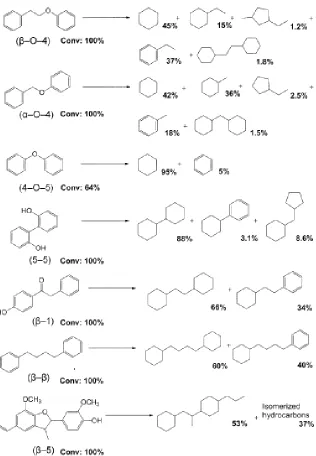
Figure 1.15: Ni/HZSM-5 catalysis applied to various lignin model compounds. ... 30
Figure 1.16: Nickel catalyzed C-O cleavage: a) from Kelly31, b) from He27. ... 34
Figure 1.17: Maia et al. mechanism for nickel and ZSM-5activity for C-C cleavage. ... 35
Figure 1.18: Nickel supported on HZSM-5: a) SEM image, b) TEM image. ... 36
Figure 2.1: Product selectivity using various zeolites. ... 52
Figure 2.2: GC-MS results and identification of synthesized PPE: a) chromatogram of synthesized PPE, b) mass spectrum of synthesized PPE, c) mass spectrum library match for PPE. ... 56
Figure 2.3: GC-FID results and comparison of synthesized and purchased PPE a) purchased PPE standard, b) synthesized PPE. ... 56
Figure 2.4: Reaction progress for PPE reaction at 250 °C and 5 MPa H2, in water with
HZSM-5. ... 63
Figure 2.5: PPE β-O-4 cleavage reaction mechanisms a) desired product mechanisms, b) undesired product mechanisms. ... 65
Figure 2.6: Molecular distribution from GPC analysis for starting lignin (acetylated), a control reaction without catalyst, and a reaction with HZSM-5 catalyst. ... 68
Figure 2.7: GC-FID results for control and catalytic reactions at 250 °C and 5 MPa H2, in
water. ... 70
Figure 3.1: N2 adsorption-desorption isotherms with increasing Ni loading for a) calcined
Ni(x)/HZSM-5 catalysts and b) calcined, reduced, and passivated Ni(x)/HZSM-5 catalysts. 88
Figure 3.2: N2 BJH desorption mesopore size distribution for a) calcined Ni(x)/HZSM-5
catalysts and b) calcined, reduced, and passivated Ni(x)/HZSM-5 catalysts. ... 90
Figure 3.3: CO2 DFT micropore size distribution for a) calcined Ni(x)/HZSM-5 catalysts
and b) calcined, reduced, and passivated Ni(x)/HZSM-5 catalysts. ... 92
Figure 3.4: X-ray diffraction (XRD) for a) calcined Ni(x)/HZSM-5 catalysts and b) calcined, reduced, and passivated Ni(x)/HZSM-5 catalysts. ... 94
Figure 3.5: Temperature programmed reduction (TPR) for Ni(x)/HZSM-5 catalysts. ... 96
Figure 3.6: TEM images and particle size distributions for a) Ni(5)/HZSM-5, b) Ni(10)/HZSM-5, c) Ni(12.5)/HZSM-5, d) Ni(15)/HZSM-5, and e) Ni(20)/HZSM-5. All catalysts are calcined, reduced, and passivated. ... 99
Figure 3.8: Ni/Si ratio correlation to nickel loading. ... 107
Figure 3.9: N2 adsorption-desorption isotherms with increasing DP time and calcination
temperature for a) calcined Ni(15)/HZSM-5 catalysts and b) calcined, reduced, and passivated Ni(15)/HZSM-5 catalysts. ... 113
Figure 3.10: N2 BJH desorption mesopore size distribution for a) calcined Ni(15)/HZSM-5
catalysts and b) calcined, reduced, and passivated Ni(15)/HZSM-5 catalysts. ... 115
Figure 3.11: CO2 DFT micropore size distribution for a) calcined Ni(15)/HZSM-5 catalysts
and b) calcined, reduced, and passivated Ni(15)/HZSM-5 catalysts. ... 117
Figure 3.12: X-ray diffraction (XRD) for a) calcined Ni(15)/HZSM-5 catalysts and b) calcined, reduced, and passivated Ni(15)/HZSM-5 catalysts. ... 119
Figure 3.13: Temperature programmed reduction (TPR) for Ni(15)/HZSM-5 catalysts. ... 120
Figure 3.14: TEM images and particle size distributions for Ni(15)/HZSM-5 catalysts a) DP5_Cal400, b) DP5_Cal600, c) DP16_Cal400, and d) DP16_Cal600. All catalysts are calcined, reduced, and passivated. ... 124
Figure 3.15: XPS spectra for Ni(15)/HZSM-5 catalysts a) DP5_Cal400, b) DP16_Cal400, c) DP5_Cal600, and d) DP16_Cal600. All catalysts are calcined, reduced, passivated, and re-reduction at 460 °C for 1 h. ... 130
Figure 4.1: Conversion of guaiacol and yield of products as a function of reaction time for a) Ni(5)/HZSM-5, b) Ni(10)/HZSM-5, c) Ni(12.5)/HZSM-5, d) Ni(15)/HZSM-5, and e) Ni(20)/HZSM-5. ... 152
Figure 4.2: a) Specific conversion and HDO rates and b) intrinsic conversion and HDO rates for Ni(x)/HZSM-5 catalysts. ... 154
Figure 4.3: Plots of intrinsic rate against nickel loading; a) guaiacol conversion, b) HDO. 155
Figure 4.4: Reaction network for guaiacol conversion; a) main pathways, b) alternate pathways. ... 157
Figure 4.5: Main reaction pathway for guaiacol conversion. ... 158
Figure 4.6: Product distribution at 20% conversion of guaiacol for Ni(x)/HZSM-5 catalysts. ... 159
Figure 4.8: Alternate reaction pathway for guaiacol conversion. ... 161
Figure 4.9: Temperature programmed reduction (TPR) for Ni(x)/HZSM-5 catalysts. ... 162
Figure 4.10: Conversion of guaiacol and yield of products as a function of reaction time for Ni(15)/HZSM-5 catalysts a) DP5_Cal400, b) DP16_Cal400, c) DP5_Cal600, and d) DP16_Cal600. ... 164
Figure 4.11: Product distribution at 20% conversion of guaiacol for Ni(15)/HZSM-5 catalysts. ... 165
Figure 4.12: a) Specific conversion and HDO rates and b) intrinsic conversion reaction and HDO rates for Ni(15)/HZSM-5 catalysts. ... 167
Figure 4.13: Temperature programmed reduction (TPR) for Ni(15)/HZSM-5 catalysts. ... 169
Figure 4.14: Conversion of guaiacol and yield of products as a function of reaction time for a) Ni/HZSM-5 (15 wt%, DP16_Cal400) and b) Ni/SiO2 (7 wt%), DP16_Cal400). ... 170 Figure 5.1: Reaction progress for PPE reaction at 250 °C and 5 MPa H2, in 0.1 M NaOH: a)
with Ni/HZSM-5, b) without Ni/HZSM-5. ... 195
Figure 5.2: PPE in 0.1 M NaOH reaction mechanisms: a) reaction without Ni/HZSM-5, b) reaction with Ni/HZSM-5. ... 197
Figure 5.3: ASL reaction product collection/preparation diagrams: a) water reaction collection, b) 0.1 M NaOH reaction collection. ... 198
Figure 5.4: GC-FID results for ASL reactions at 250 °C and 5 MPa H2, in 0.1 M NaOH: a)
without Ni/HZSM-5, b) with Ni/HZSM-5. ... 202
Figure 5.5: Reaction progress for PPE reaction at 250 °C and 5 MPa H2, in water: a) with
Ni/HZSM-5, b) without HZSM-5. ... 205
Figure 5.6: PPE in water reaction mechanisms: a) reaction with Ni/HZSM-5, b) reaction with HZSM-5. ... 206
Figure 5.7: Product distribution for the soluble lignin reactions at 250 °C and 5 MPa H2, in
CHAPTER 1
1.1 Introduction
Currently, scientists are looking for a renewable resource that can be used to create
transportation fuels and industrial chemicals.1,2 The United States’ Departments of Agriculture and Energy want 20% of our transportation fuels and 25% of our chemical
commodities to come from biomass sources by the year 2030.2 As reported by the U.S. Department of Energy (DOE), the National Academy of Science (NAS) estimates that by the
year 2020 there will be about 548 million dry tons of cellulosic biomass produced sustainably
each year (not including energy crops such as corn used for ethanol and other biodiesel
crops). The billion ton study estimates a total of about 1.4 billion dry tons of renewable
biomass available, which includes energy crops, agricultural and forest resources, and waste
residues.3
Lignocellulosic biomass is comprised of cellulose, hemicellulose and lignin, and its
use would not directly compete with food production. Research has been directed toward
cellulose, since it typically makes up approximately 50% of the biomass, while hemicellulose
makes up about 20%, and lignin is between 15 and 30% of the biomass.2,4 Despite lignin having the smaller biomass percentage, it contains 40% of the energy stored within the
biomass, has a higher heating value, and contains the largest amount of aromatic structures
compared to cellulose and hemicellulose.5 These properties of lignin, especially its chemical composition, make it valuable for chemical production. Based on the billion ton study
estimate of 1.4 billion dry tons of biomass, there will be potentially between 210 and 420
Lignin is a byproduct in various industries, including paper and pulp plants and
biorefineries. Currently, lignin is not utilized to its full potential; instead it is burned as low
value fuel to power industrial processes.1,2,6,7 If processed correctly, it could be used for the production of aromatic compounds, platform chemicals, and other high value products that
are typically derived from petroleum. Producing aromatic products from lignin not only
makes converting cellulose into transportation fuel more economically feasible, it provides a
renewable resource for the production of important chemicals. As can be seen in Table 1.1, it is theoretically possible to fulfill the U.S. demand of aromatics (2007 report) using lignin
as a renewable feedstock, and still have a large excess of lignin for other products.8
Table 1.1: Long-term conversion technologies required for aromatics market.
Aromatic U.S. Demand (109 lb.)
Lignin required* -theoretical-
(109 lb.)
Lignin required* -Current
technology-(109 lb.)
Billion-Ton Study
(109 lb.)
BTX 45.3 93 930 -
Phenol 5.09 10 80 -
Terephthalic acid 11.1 13 130 -
Total 61.5 116 1,112 330-840
*Theoretical lignin required is based on simple calculation of the relative molecular weights of lignin (taken to be 188 for organosolv lignin) and the aromatic listed. Using current technology, the best that can be achieved today is approximately ten percent of theoretical.
Needed technologies: Catalysis – selective dehydroxylations and demethoxylations; dealkylations; hydrogenolysis. Application of catalytic reforming chemistry from petrochemical industry.
Currently, the state of lignin conversion technology is not efficient enough to produce the
required amount of aromatics (only 10% of theoretical yield); however, this leaves much
lignin required to fulfill demand will be within the range of available lignin (based on only
15-35% yield of aromatics from lignin). With yields above 35%, the required lignin would be
well below the lower limit of available lignin. Overall, even with a marginal improvement in
aromatic yield from lignin, the aromatics market could be satisfied by conversion of
renewable lignin feedstocks.
The main obstacle to direct lignin depolymerization into useful products is the
complex structure of lignin, which is not entirely known because it varies with biomass
species, and it varies from plant to plant based on growing conditions and the extraction
methods employed. Currently, catalytic depolymerization processes require multiple steps
and have high energy demands due to the high temperatures required for catalytic activity.
The goal of this study is to develop a catalyst system that operates at milder temperatures,
around 250 °C, instead of pyrolysis range temperatures (500 °C), and to selectively produce
aromatic products while minimizing the number of treatment steps required.
While there are multiple pathways for the processing of lignin, the two most
Figure 1.1: Two potential pathways for lignin degradation.
The pathway to the right is reductive, and results in simple aromatic compounds that serve as
platform chemicals for other chemical commodities and fuels. Such reduction catalysis
could be done with a heterogeneous catalyst that can operate at a wide range of conditions,
including conditions similar those at which the lignin byproduct streams are initially
produced. The other pathway directly produces valuable chemicals and fuels from lignin in a
single step through oxidation; however, such a conversion of lignin would require a highly
selective enzyme or catalyst. These are typically homogeneous/biomimetic catalysts, which
can be more expensive, are unstable in more extreme conditions, and can be difficult to
recover. For these reasons, the reductive pathway was the focus of this work.
Before the catalyst system is addressed, the nature of lignin’s structure and
complexity is discussed. The reason that lignin depolymerization has been a problem for so
long is the fact that the structure is highly variable, with branching and high molecular
point the main methods for attacking lignin involve severe reaction conditions, such as found
with high temperature pyrolysis. However, even these methods are unsuccessful due to the
high variability of bonds and structures found within lignin, which lead to a wide range of
chemistries, many of which lead to recondensation and recombination of the broken down
lignin structures. In order to design a catalyst that can effectively attack the lignin, an
understanding of lignin and its many forms is needed. Specifically, an understanding of the
different extraction methods and sources of lignin available, along with their corresponding
structures and characteristics is important.
1.2 Background Information
1.2.1 Structure of Lignin
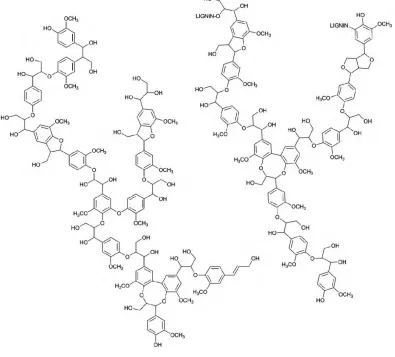
Lignin is a complex organic polymer typically composed of oxygenated
p-propylphenols (contains both hydroxy and methoxy groups), which are usually linked and
cross-linked by C-C bonds and C-O bonds.1,2,7 The composition of polymer units depends on many factors including biomass species, growth conditions, and extraction conditions. One
Figure 1.2: Proposed lignin structure example.
Lignin has been found to contain three dominant monomer structures called monolignols.
Figure 1.3: Monolignols and their corresponding aromatic residues.
Lignin from biomass can be categorized by the relative amount of the H, G, and S aromatic
residues it contains. The various groups are type-G, type-G-S, type-H-G-S, and type-H-G.
Type-G for example would be a lignin composed mainly of guaiacyl residues.1 The structural monolignol units are bound together by various types of linkages. The polymerization of
lignin starts with two of the monolignols forming radicals. The radicals form dimers, and the
radicals propagate further, leading to more coupling between monomers, dimers, and other
larger oligomers.7
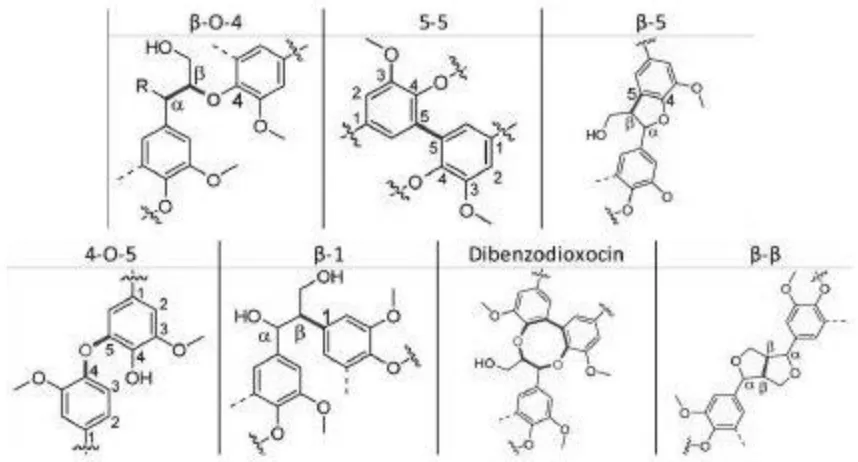
The linkages are typically either C-C bonds or C-O bonds. The C-C linkages are
usually more difficult to cleave than the C-O linkages. The most abundant linkage found in
mild treatment conditions. Other C-O linkages include 4-O-5 and α-O-4. The α-O-4 can
appear in both linear and cyclical forms such as in dibenzodioxocin. The typical C-C
linkages include 5-5, β-1, and β–β. The β-5 linkage is a combination of a C-C and a C-O
linkage. All the typical linkages are illustrated in Figure 1.4.2
Figure 1.4: Common lignin linkages.
1.2.2 Linkage Composition in Biomass
There are three main categories of biomass, including softwood, hardwood and
herbaceous biomass (grasses). Softwoods contain the largest amount of lignin at around
30% of the biomass, while hardwood contains the next highest percentage of lignin at about
approximately equal amounts of guaiacyl, and syringyl units (G and S). The approximate
linkage compositions for softwood and hardwood are listed in Table 1.2.2,7
Table 1.2: Typical linkage compositions for softwood and hardwood.
Linkage Softwood Hardwood
β-O-4 45-50% 60%
5-5 9-25% 0-9%
β -5 9-12% 3-10%
β -1 1-9% 1-7%
α-O-4 (dibenzodioxocin)
6-8% (5-7%)
6-8% (0-2%)
4-O-5 0-7% 0-9%
β - β 2-6% 3%
The major difference between the softwoods and the hardwoods is the amount of 5-5
linkages present. Hardwood has very few 5-5 linkages due to the presence of syringyl units,
which have two methoxy groups surrounding the 4 position on the aromatic ring. Guaiacyl
units only have one methoxy group, leaving the other position next to the 4 position open to
possible 5-5 linkages. As a result of the syringyl units, the hardwood lignin typically has a
more linear structure, while softwood is more branched. Overall, lignin in hardwood is less
abundant, but more easily degraded, while softwood has a higher composition of lignin, but it
1.2.3 Extraction of Lignin
The structure of the lignin is greatly affected by treatment conditions such as
temperature, pressure, solvent type, and pH range. Since the pulp and paper industry has
been focused solely on the quality of the cellulose extracted until recently, little attention was
paid to the effects of pretreatment and extraction methods on lignin quality. In order to
integrate lignin depolymerization into commercial pulp mills and biorefineries, the lignin
extraction methods must produce a lignin that has high purity and minimal condensation in a
reproducible manner.2 During extraction, linkages and methoxy groups can be cleaved, or condensation reactions can occur which lead to the creation of more C-C bonds.7 In general, it is easier to extract lignin when it is ground up in the form of milled wood lignin, typically
denoted as MWL.9 Common types of extracted lignin are Kraft lignin, lignosulfonates, and organosolv lignin.1,2,9,10
The Kraft process introduces the initial biomass to a mixture of sodium hydroxide
and sodium sulfide solutions, called white liquor, at a temperature ranging from 150-180 ºC
for approximately 2 h. During this process, the biomass is delignified and the lignin
undergoes both degradation reactions and condensation reactions. The degradation reactions
fragment the lignin into material that is soluble in alkaline solution. Some examples of
cleavage reactions are presented in Figure 1.5, including an alkaline α-aryl ether cleavage,
Figure 1.5: Example degradation reactions in the Kraft process: a) alkaline cleavage of α-aryl ether bonds, b) alkaline cleavage of β-aryl ether bonds, c) sulfidolytic cleavage of β-aryl ether bonds.
a)
b)
Condensation reactions, which are in competition with the degradation reactions,
repolymerize lignin fragments and create more stable lignin oligomers which are harder to
break down. Examples of condensation reactions are presented in Figure 1.6.11
Figure 1.6: Example condensation reactions in the Kraft process: a) competing reactions involving quinone methide intermediates, b) alkali-promoted condensation reaction.
The fragments formed are soluble in alkaline solution, and this alkaline solution containing
the soluble lignin fragments is called black liquor. To recover the Kraft lignin from the black
liquor, the lignin is precipitated out of solution through acidification. A model Kraft lignin
from pine is presented in Figure 1.7.8
Figure 1.7: Model structure of Kraft lignin from pine.
The sulfite pulping process which produces lignosulfonates is similar to the Kraft
process; minus the chemical recovery of the Kraft process. It also has the ability to use a
large range of pH (2-12) depending on the cation chosen for the pulping. For the more
common acidic sulfite pulping, calcium or magnesium sulfites (or bisulfite) are used, while
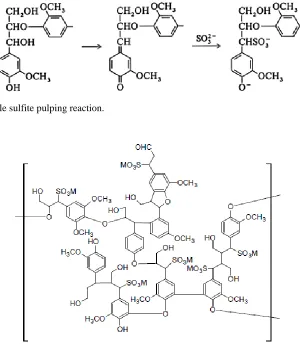
alkaline sulfite pulping is done with sodium and ammonium sulfites (or bisulfite). An
Figure 1.8: Example sulfite pulping reaction.
Figure 1.9: Model structure of lignosulfonate.
Sulfite pulping does not degrade the lignin as extensively as the Kraft process, so the lignin
has larger molecular weight. However, as a result of the sulfonating of lignin, the lignin
fragments become water soluble.
Organosolv lignin is obtained from various organic solvent extractions of biomass at
elevated temperatures. Typical solvents include 1,4-dioxane, ethanol or ethanol/water
Figure 1.2, retaining the β-O-4 linkages found in lignin.8 Organosolv processes are known for generating easy to separate streams of cellulose, hemicellulose, and lignin. An acetosolv
lignin is used in this work, and the process involves the use of 87 wt% at 185 ºC for 2 h.13 This lignin is not soluble in water at a pH 2-7, and requires an alkaline environment to be
solubilized.
Another pretreatment method for removing sugars from biomass is autohydrolysis,
which is becoming more common for biofuel applications, such as those using switchgrass to
produce bioethanol. Autohydrolysis pretreatment uses water (or dilute acid) at around
150-200 ºC to mildly break down the cellulose (insoluble solid) for subsequent enzymatic
hydrolysis. While the solid goes downstream for further degradation followed by
fermentation, the resulting liquor contains some hemicellulose (xylo-oligomers) and lignin,
which is soluble in the aqueous phase. This soluble lignin is a promising source of lignin,
since it has lower molecular weight and is soluble in the aqueous phase. The drawbacks of
this lignin are that it is very dilute (low yield of lignin), and it is mixed with the soluble
xylo-oligomers, and therefore needs to be purified prior to depolymerization.
An ideal lignin stream for this study is one that has a low molecular weight, no sulfur
content, and is soluble in water at neutral pH. Low molecular weight is important for
allowing the lignin to access the catalytic sites, since large, bulky lignin has much less
mobility. Similar to having low molecular weight, high solubility of the lignin in the reaction
solvent (the desired solvent being water solvent) facilitates better contact between the lignin
and the catalyst sites. The absence of sulfur is important for this work, since metal catalysts
organosolv lignin have lower molecular weights, while lignosulfonates have a relatively
higher molecular weight.8 Soluble lignin from autohydrolysis represents only a small fraction of the total lignin in the biomass, but the lignin present in the soluble form has low
molecular weight. With regards to sulfur content, organosolv lignin and the soluble lignin
from autohydrolysis have little to no sulfur content, Kraft lignin has a sulfur content around
1-2%, and lignosulfonates have a high sulfur content.8 Unlike Kraft and organosolv lignins, lignosulfonates are soluble in water for a wide range of pH, while Kraft lignin is only soluble
at alkali conditions (pH ≥ 9), and organosolv lignin is insoluble in water from a pH of 2 to 7.8
Overall, neither of the sources of lignin is ideal. Autohydrolysis soluble lignin and
lignosulfonates are both soluble in neutral water; however, they are not as commonly utilized
commercially as Kraft pulping. Another disadvantage of lignosulfonates is the unacceptable
amount of sulfur (catalyst poison) introduced into the lignin structure. Kraft lignin is
available in large amounts, and it is commercially available, especially from the pulping
industry. It might be an acceptable lignin source since it has a relatively low molecular
weight and low sulfur content. Unfortunately even the low sulfur content can severely
inhibit a nickel catalyst system. In addition, the Kraft process incorporates the lignin waste
stream into the process by burning it for energy to run the chemical recovery boilers needed
for the Kraft process. Since the need to fuel the process will take precedence over processing
the lignin for additional revenue, there would have to be large amounts of excess lignin
available from the process for it to be used. Therefore, organosolv and soluble lignin from
autohydrolysis are the best sources of lignin. Organosolv is desirable due to the lower
alkaline conditions than Kraft lignin. Soluble lignin from autohydrolysis is desirable due to
its even lower molecular weight and solubility in water. Both are also soluble in THF, which
is beneficial for GPC analysis since Kraft lignin requires acetylation to be soluble in THF.
While there are no significant commercial sources of organosolv lignin and soluble lignin
from autohydrolysis, as lignin conversion technologies are developed and improved, such an
extraction method may become dominant for biorefineries, which would depend on the
ability to utilize the lignin byproduct for economic viability. For this work, lignins in the
form of Kraft, organosolv (acetosolv), and soluble lignin from autohydrolysis pretreatment
were utilized.
1.2.4 Depolymerization of Lignin
When lignin is degraded, it forms a combination of alcohols, aldehydes, ethers, acids,
aromatics, and linear hydrocarbons. Selective cleavage is needed to produce the desired
aromatic products. Typically, lignin is degraded through thermal decomposition either in the
form of pyrolysis or hydrothermal oxidation in the presence of hydrogen peroxide.14,15 Pyrolysis, including catalytic pyrolysis, requires high temperatures (typically 500 °C and
higher) to degrade dry biomass or lignin. The disadvantages of such a method include high
energy costs and the production of char and coke, which deactivates cracking catalysts such
as zeolites and complicates downstream processing. In this study, a heterogeneous catalytic,
thermochemical process was used at lower reaction temperatures and in an aqueous
environment. The advantages of the aqueous environment include: removing the need for dry
(easy to recover solid catalyst from liquid and gaseous products), and easy product recovery
from the solvent, either by the liquid organic products phase separating from the aqueous
solvent or through extraction from the aqueous solvent using an organic solvent.
To effectively depolymerize lignin into monomeric aromatics, a wide range of
reactions needs to take place, including hydrogenolysis and hydrodeoxygenation (HDO).8 Examples of hydrogenolysis and HDO are presented in Figure 1.10.
Figure 1.10: Examples of hydrogenolysis and hydrodeoxygenation reactions.
The catalyst of interest, Ni/HZSM-5, is a multifunctional catalyst that employs catalytic
activity from the solid acid zeolite support and the nickel metal catalyst, and is capable of
catalyzing both of these critical reactions.
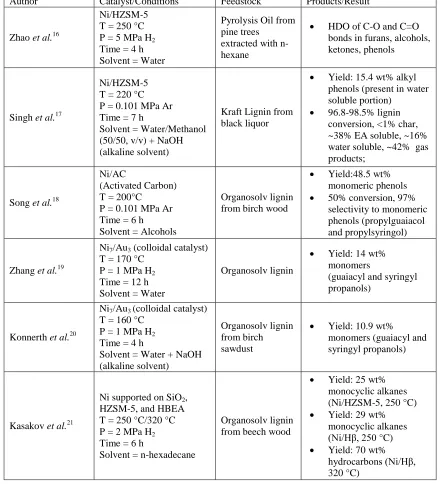
Many methods have been employed to depolymerize and valorize lignin, as detailed
bimetallic nickel systems for the production of aromatic monomers from lignin; a summary
of these recent studies is listed in Table 1.3.2,16-21
Table 1.3: Literature summary of lignin depolymerization and conversion to monomer products catalyzed by nickel metal.
Author Catalyst/Conditions Feedstock Products/Result
Zhao et al.16
Ni/HZSM-5 T = 250 °C P = 5 MPa H2
Time = 4 h Solvent = Water
Pyrolysis Oil from pine trees
extracted with n-hexane
HDO of C-O and C=O bonds in furans, alcohols, ketones, phenols
Singh et al.17
Ni/HZSM-5 T = 220 °C P = 0.101 MPa Ar Time = 7 h
Solvent = Water/Methanol (50/50, v/v) + NaOH (alkaline solvent)
Kraft Lignin from black liquor
Yield: 15.4 wt% alkyl phenols (present in water soluble portion)
96.8-98.5% lignin conversion, <1% char, ~38% EA soluble, ~16% water soluble, ~42% gas products;
Song et al.18
Ni/AC
(Activated Carbon) T = 200°C
P = 0.101 MPa Ar Time = 6 h Solvent = Alcohols
Organosolv lignin from birch wood
Yield:48.5 wt% monomeric phenols 50% conversion, 97%
selectivity to monomeric phenols (propylguaiacol and propylsyringol)
Zhang et al.19
Ni7/Au3 (colloidal catalyst)
T = 170 °C P = 1 MPa H2
Time = 12 h Solvent = Water
Organosolv lignin
Yield: 14 wt% monomers
(guaiacyl and syringyl propanols)
Konnerth et al.20
Ni7/Au3 (colloidal catalyst)
T = 160 °C P = 1 MPa H2
Time = 4 h
Solvent = Water + NaOH (alkaline solvent)
Organosolv lignin from birch sawdust
Yield: 10.9 wt% monomers (guaiacyl and syringyl propanols)
Kasakov et al.21
Ni supported on SiO2,
HZSM-5, and HBEA T = 250 °C/320 °C P = 2 MPa H2
Time = 6 h
Solvent = n-hexadecane
Organosolv lignin from beech wood
Yield: 25 wt% monocyclic alkanes (Ni/HZSM-5, 250 °C) Yield: 29 wt%
monocyclic alkanes (Ni/Hβ, 250 °C) Yield: 70 wt%
The study by Zhao et al. was not a lignin depolymerization, but a pyrolysis oil upgrading experiment using Ni/HZSM-5 in an aqueous environment, and it showed that Ni/HZSM-5 is
not only stable in the aqueous environment, but it was able to completely deoxygenate the
pyrolysis oil compounds. However, this particular catalyst preparation performed a large
extent of aromatic ring saturation.16 The remaining studies in Table 1.3 involved lignin, mainly organosolv lignin, except for one study with Kraft lignin.
The highest yield of monomeric phenols (propylguaiacol and propylsyringol)
involved the use of organic solvent instead of water; specifically, various alcohols including
methanol, ethanol, and ethylene glycol.18 Using organosolv lignin in an alcohol solvent at 200 °C, 50% lignin conversion was achieved, yielding 48.5 wt% monomeric phenols.18 Other researchers using organic solvent in the form of a mixture of water and methanol, only
achieved a yield of 15.4 wt% alkylphenols.17 For these two studies, alcohol served not only as a solvent, but as a source of hydrogen for the nickel catalysis.
Another example of excellent performance of nickel supported on zeolites was
reported by Kasakov et al. where 25-30 wt% yield of monocyclic alkanes was obtained from
organosolv hardwood lignin in n-hexadecane solvent at 250 ºC, and an even higher yield of
around 70 wt% hydrocarbons was obtained at 320 °C.21 These yields are very good, but all monomers were completely saturated hydrocarbons (instead of preserving the desired
aromaticity), and a non-polar organic solvent was used.
As mentioned previously, the goal of this thesis work is to utilize an aqueous solvent
for the depolymerization of lignin and production of monomers, due to the presence of
easy catalyst and product separation. Therefore, the reactions performed in aqueous
environment are of more interest; however as can be seen in Table 1.3, all the reactions in water solvent produced only about 10-15 wt% monomers (guaiacyl and syringyl propanols),
based on starting lignin mass, which is on the low end of the desired yield mentioned
previously.17,19,20
There was mild improvement in the rate of monomer production for the catalyst
system that utilized NaOH to make the reaction solution alkaline.20 The use of an alkaline, aqueous environment also showed improvements in the study by Singh et al., which observed little to no char production when an alkaline environment was used. The alkaline
aqueous environment ensures that the starting lignin is solubilized in the starting reaction
mixture. However, as mentioned before, only 15.4 wt% of alkyl phenols was obtained.17 As shown from the literature in Table 1.3, aromatic monomer production from lignin depolymerization has been relatively successful in non-aqueous solvents, but much work is
needed to improve the yield of aromatics from lignin depolymerization in an aqueous
environment.
1.2.5 Properties of HZSM-5
ZSM-5 is an aluminosilicate-based zeolite. It has a highly porous, 10 membered ring
pore structure, with a pore diameter between 5-6 Å, and a high surface area around 400 m2·g
-1
Figure 1.11: ZSM-5 structure; red circles indicate pores.
ZSM-5 is most commonly used as a cracking catalyst in the petroleum industry, or as a
molecular sieve for separation processes. The pore size of the ZSM-5 facilitates shape
selectivity, allowing only certain size particles in and out of the pore structure, and controls
the shape and size of the products made within the pore structure. The presence of aluminum
in the structure results in a net negative charge in the framework, which is balanced by a
cation, typically a metal ion (such as sodium), and is the potential active catalyst site. The
two types of actives sites that can be found in ZSM-5 are depicted in Figure 1.12; one being a strong acid site and the other being a weak acid site.25
10 Membered
Figure 1.12: Active sites found in ZSM-5.
HZSM-5 is a protonated form of ZSM-5 where hydrogen protons are bound to
oxygen-aluminum sites, as shown in Figure 1.13.24
HZSM-5 is a solid acid catalyst where the protonated oxygen-aluminum sites are the active
acid sites in the HZSM-5 structure, and therefore the acidity of the catalyst is related to the
SiO2/Al2O3 ratio, which can vary based on the synthesis method. Another feature of the
zeolite structure is that it is stable under high temperatures and can serve as a support for
other metal catalysts depending on the desired functionality.23 This ability to incorporate metal ions into the zeolite structure allows for multifunctional catalysts. Acidic zeolites have
been found to be favorable for supporting hydrogenation catalysts (Pt, Ni, etc.), since the
presence of the acidic support reduces sensitivity of the hydrogenation catalyst to trace
amounts of sulfur (which may be present in industrial lignin streams).25
1.2.6 Acid Catalysis
Acid catalysts are capable of many organic reactions, including dehydration,
hydrolysis, condensation, alkylation, acylation, and isomerization. Homogeneous acid
catalysts have a much higher concentration of acidic proton sites, but are hard to recover and
recycle, unlike heterogeneous catalysts.25 The pore structure of the solid acid catalyst allows for high selectivity towards specific products, but as a result, conversion can be limited by
diffusion of the reactant molecules into the pores. Among oxide supports, HZSM-5 and other
highly ordered zeolites, have a higher acid site concentration since the active acid sites are
located along the entire pore surface area.25 This allows HZSM-5 to be more active compared to other oxide supports (alumina). Another advantage of these heterogeneous catalyst sites is
functionalization of the framework. This allows the acidity to be tunable, and also allows for
a multifunctional catalyst system, as mentioned previously.
HZSM-5 (and other zeolites) can only have a limited number of acid sites. In the
aluminosilicate structure, the Al sites cannot be neighbors (Al-O-Al) because it is not a stable
structure, therefore only Si-O-Al can exist in the framework.22 For ZSM-5 type zeolites, the SiO2/Al2O3 ratio is typically 20 or greater. Furthermore, it has been found that acid sites are
stronger when they are isolated; meaning that the next nearest neighbors of the Al in the
Al-OH-Si structure (Brønsted acid site) are also not Al atoms.22,23 Therefore, there is an optimal acid site density. In addition, besides the strong Brønsted acid sites, there are Lewis acid
sites which are not directly attributed to the acid activity of the catalyst. Besides exchanging
a H+ proton with a metal cation as shown in Figure 1.12, a Lewis acid site can be formed when Al is only bonded to three oxygen atoms and the neighboring Si atom has a positive
charge.26 The Lewis acid site (loss of oxygen from AlO4- to AlO3) can be a result of
Figure 1.14: Formation of a Lewis acid site in a zeolite by steam conditioning.
The presence of Lewis acid sites has shown an indirect effect on the strength of the Brønsted
acid site. For example, after mild steaming, the HZSM-5 showed increased catalytic activity.
This has been attributed to the creation of electron withdrawing centers (hydrolyzed Al site)
around the Brønsted acid site.26
The role of the active acid sites in HZSM-5 for the reaction system at the focus of this
study is the dehydration and hydrolysis of the reactant molecules.16 Specifically, the acid proton of the Brønsted site protonates the oxygen atoms leading to the creation of
carbocations and cleavage, or deoxygenation due to dehydration. Typically, n-alkane
cracking or m-xylene isomerization are used to characterize the performance of HZSM-5
catalyst. These reactions operate at temperatures around 500 °C, which is more typical for
pyrolysis reactions. The reactions for this project are being performed in a Parr reactor at
reactions; therefore another simplified experiment was used to evaluate the performance of
HZSM-5. Instead, a lignin model compound dimer, 2-phenoxy-1-phenylethanol, was used
which contains a β-O-4 linkage, as well as a hydroxyl group. In this model reaction, the
HZSM-5 can either perform linkage cleavage via hydrolysis or perform dehydration on the
hydroxyl group.
1.2.7 Preparation and Modification of HZSM-5
When ZSM-5 is synthesized, it typically comes in a Na-ZSM-5 form (or other cation
in the place of sodium, depending on the initial synthesis method). To convert the
Na-ZSM-5 into HZSM-Na-ZSM-5, the catalyst is first converted to the ammonium form, which is accomplished
through ion exchange with a solution such as NH4Cl, which replaces the sodium cations with
ammonium cations. The resulting NH4-ZSM-5 needs to be calcined, which will thermally
degrade the ammonium and expel ammonium gas from the catalyst, leaving the hydrogen
cation on the aluminosilicate structure. The resulting catalyst solid is HZSM-5, which was
the starting catalyst for this study.
After the HZSM-5 is tested in the reaction system and characterized (selectivity,
conversion, surface area, pore volume, etc.) the catalyst is modified with a nickel metal
catalyst. Nickel metal is typically incorporated into the zeolite structure through an incipient
wetness impregnation method. The nickel metal is a hydrogenation catalyst which is capable
of performing hydrogenolysis, (breaking of bonds in the presence of hydrogen (in this
system, hydrogen is in the form of H2 gas)). The provided hydrogen is able to cleave the
products through HDO, which is desired.16,27 However, an undesired reaction that can also occur with the nickel catalyst is aromatic ring saturation; therefore, the use of mild conditions
(low temperature, low H2 gas pressure, short reaction times, and low Ni wt.% in the catalyst)
may be needed to prevent the undesired oversaturation of the aromatic ring. Demonstrated
by the experimental results illustrated in Figure 1.15, the Ni/HZSM-5 catalyst is capable of complete deoxygenation and C-O cleavage reactions; however, the current catalyst and
reaction conditions perform an undesirable amount of aromatic ring saturation.16 This study will explore another nickel incorporation method called deposition-precipitation (DP), in an
1.2.8 Hydrogenation Metal Catalysts
Nickel metal catalyst is only one of many metal hydrogenation catalysts; these
include platinum, palladium, ruthenium, rhodium, osmium (all of which are expensive
precious metals), gallium, and copper. Catalysts such as palladium and platinum are active
hydrogenation catalysts and are commonly used for hydrogenolysis reactions; however they
tend to oversaturate the aromatics, and therefore lack selectivity toward the desired products.
Nickel metal is a common and inexpensive hydrogenation and hydrogenolysis catalyst, used
by the Lercher group, and in many other hydrogenolysis studies.16,27-34 Nickel metal is also been found to be more selective toward hydrogenolysis than palladium and platinum which,
as mentioned, tend to oversaturate the reactants.28 Copper was another candidate for its ability to perform hydrogenolysis. Unlike the other metal catalysts, it favors C-O
hydrogenolysis and is less active for C-C hydrogenolysis and aromatic hydrogenation.35 Gallium was another candidate because it is capable of hydrogenolysis as well as
decarbonylation without saturation of the hydrogenation of the aromatic ring; however, the
Ga/HZSM-5 reactions were performed at significantly higher temperatures, so it may not be
active at the lower temperature.36
An important issue to consider for selecting a metal catalyst is that the binding of
solvent (water) to the catalyst must be competitive with binding of hydrogen and the reactant
to the catalyst surface. If the solvent interaction is too strong, no reaction will occur on the
metal catalyst. For example, water, even at low temperatures, has been found to inhibit
inhibiting effect of the solvent. However, by having a solvent with slightly competitive
binding to the catalyst, the activity of a catalyst system can be increased, since the solvent
would be able to displace product species that bind strongly to the catalyst.29 Overall, solvent selection is important for the specific metal/support catalyst system.
Water is being used for the reaction system of interest because it is has been utilized
with HZSM-5 supported nickel systems in the literature, including by the Lercher group, who
have shown such a catalyst system is stable in an aqueous environment. 16,27,33,34 He et al. studied both Ni/HZSM-5 and Ni/SiO2 with water or undecane to evaluate solvent effects
(250 °C, 40 bar H2, 0-2 h reaction time).34 The study focused on α-O-4 cleavage of an
aromatic ether compound. Without catalyst, radical reactions (pyrolysis) were dominant in
the non-polar solvent, while hydrolysis reactions followed by alkylation reactions were
dominant in the aqueous environment. The hydrolysis pathway was found to be kinetically
faster than the pyrolysis pathway.
When nickel metal catalyst (Ni/SiO2 and Ni/HZSM-5) was added to either solvent,
hydrogenolysis served as the main pathway for C-O cleavage of the α-O-4 dimer compound.
For the Ni/SiO2 catalyst, the solvent had little influence, but the turnover frequency (TOF)
was slightly higher in undecane, which was attributed to weaker adsorption of the reactants
onto nickel in the presence of water. However, using Ni/HZSM-5, the TOF was much greater
in the aqueous environment compared to the non-polar solvent, and was greater compared to
the Ni/SiO2 in both solvent environments.
The greater performance of Ni/HZSM-5 in the aqueous environment was attributed to
regardless of the nickel support, and the protonation of the reactant by the aqueous
environment, which facilitated C-O cleavage as opposed to direct cleavage in the undecane
solvent. The hydrolysis contribution is minor compared to the hydrogenolysis contribution,
but the combination of the two pathways allows the Ni/HZSM-5 to perform the cleavage
reaction with a greater TOF.34
Not thoroughly discussed in the study was why the Ni/SiO2 apparently had weak
adsorption of reactants due to the presence of water, while the Ni/HZSM-5 did not exhibit
this weak adsorption and had a greater TOF. This may be explained by a recent study by
Song et al. (2015) which showed that having solid acid sites adjacent to nickel sites
facilitated adsorption and reaction of substituted aromatics.33 This may allow adsorption of the reactants to be more favorable even in the presence of water. The acidity of the HZSM-5
support, allowing additional reactant protonation and subsequent hydrolysis, may contribute
to the greater performance of the Ni/HZSM-5 over Ni/SiO2. With regards to the hydrolysis,
the study showed that the hydrolysis performed by the aqueous solvent was much faster than
the HZSM-5 hydrolysis alone due to the higher abundance of accessible acid sites in the
liquid solvent. Therefore, the presence of the aqueous environment was more important for
increasing TOF than the HZSM-5 support.
In addition to the positive effect of water on the reaction chemistry, the presence of
water in industrial lignin streams provides further motivation to use a system which can
perform in a water solvent. For this study, the selection of a metal catalyst that is compatible
with a water solvent is an important consideration. Supported nickel and gallium have both