
ISSN(Online): 2320-9801 ISSN (Print): 2320-9798
I
nternational
J
ournal of
I
nnovative
R
esearch in
C
omputer
and
C
ommunication
E
ngineering
(A High Impact Factor, Monthly, Peer Reviewed Journal) Website: www.ijircce.com
Vol. 7, Issue 8, August 2019
Blockchain Technologies for the Internet of
Everything: Research Concerns and
Problems
Shubham Kumar
Assistant Professor, Galgotias University, Greater Noida, U.P, India
ABSTRACT: This paper introduces an extensive review of the current blockchain conventions for the Internet of Things (IoT) systems. We start by portraying the blockchains and condensing the current studies that manage blockchain innovations. At that point, we give a diagram of the application areas of blockchain innovations in IoT, e.g, Internet of Vehicles, Internet of Energy, Internet of Cloud, Fog registering, and so on. Besides, we give a grouping of danger models, which are considered by blockchain conventions in IoT systems, into five principle classifications, to be specific, personality based assaults, control based assaults, cryptanalytic assaults, notoriety based assaults, and administration based assaults. What's more, we give a scientific categorization and a one next to the other correlation of the best in class techniques towards secure and protection saving blockchain advancements concerning the blockchain model, explicit security objectives, execution, restrictions, calculation multifaceted nature, and commu-nication overhead. In view of the ebb and flow overview, we feature open research difficulties and talk about conceivable future research bearings in the blockchain advances for IoT.
KEYWORDS: Blockchain, Consensus, Security, Threats, IoT
I. INTRODUCTION
ISSN(Online): 2320-9801 ISSN (Print): 2320-9798
I
nternational
J
ournal of
I
nnovative
R
esearch in
C
omputer
and
C
ommunication
E
ngineering
(A High Impact Factor, Monthly, Peer Reviewed Journal) Website: www.ijircce.com
Vol. 7, Issue 8, August 2019
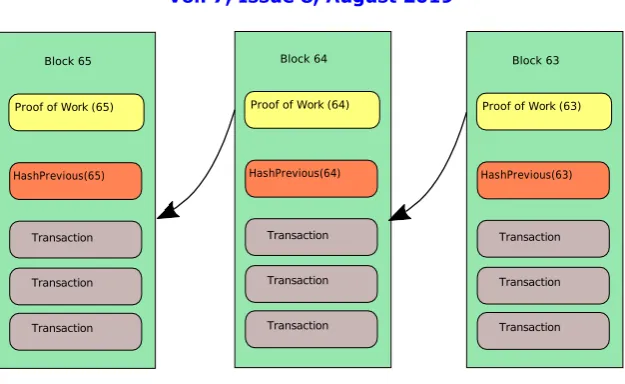
Fig. 1. Blockchain structure.
Blockchain, a circulated affix just open record tech-nology, was at first expected for the digital currencies, e.g., Bitcoin1. In 2008, Satoshi Nakamato [8] presented the con-cept of blockchain that has pulled in much consideration over the previous years as a rising shared (P2P) innovation for appropriated figuring and decentralized information sharing. Because of the selection of cryptography innovation and without a brought together control on-screen character or an incorporated information stockpiling, the blockchain can keep away from the assaults that need to assume responsibility for the framework. Afterward, in 2013, Ethereum, an exchange based state-machine, was displayed to program the blockchain tech-nologies. Curiously, because of its remarkable and appealing highlights, for example, value-based protection, security, the unchanging nature of information, auditability, trustworthiness, approval, framework straightforwardness, and adaptation to non-critical failure, blockchain is being connected in a few segments past the cryptographic forms of money. A portion of the territories are character the executives [9], insightful transportation [10], [11], [12], [13], [14], [15], production network the executives, portable group detecting [16], horticulture [17], Industry 4.0 [18], [19], Internet of Everything [20], [21], [18], [22], and security in mission basic frameworks [23].
Block 65 Block 64 Block 63 Proof of Work (65) Proof of Work (64) Proof of Work (63)
HashPrevious(65) HashPrevious(64) HashPrevious(63)
ISSN(Online): 2320-9801 ISSN (Print): 2320-9798
I
nternational
J
ournal of
I
nnovative
R
esearch in
C
omputer
and
C
ommunication
E
ngineering
(A High Impact Factor, Monthly, Peer Reviewed Journal) Website: www.ijircce.com
Vol. 7, Issue 8, August 2019
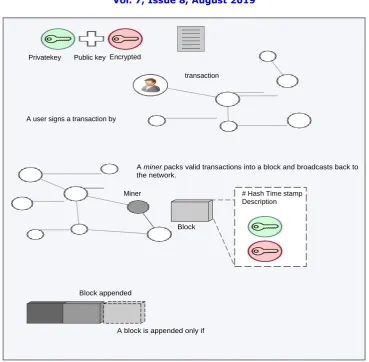
Fig. 2. An illustration of blockchain working methodology.
As appeared in Fig. 1, the blockchain structure is made out of a succession of squares, which are connected together by their hash esteems. In the blockchain arrange, an open record keeps up the carefully marked exchanges of the clients in a P2P organize. When all is said in done, a client has two keys: an open key for different clients for the encryption and a private key to peruse an encoded message, as appeared in Fig. 2. From the blockchain point of view, the private key is utilized for marking the blockchain exchange and the open key speaks to the remarkable location. Topsy-turvy cryptography is utilized to decode the message encoded by the comparing open key. At the underlying stage, a client signs an exchange utilizing its private key and communicates it to its friends. When the companions get the marked exchange, they approve the exchange and scatter it over the system. Every one of the gatherings who are engaged with the exchanges commonly approve the exchange to meet an accord understanding. When a dispersed agreement is come to, the uncommon hub, called as excavators, incorporates the legitimate exchange into a timestamped square. The square, which is incorporated by the excavator, is communicated again into the system. Subsequent to approving the communicate square, which contains the exchange, just as hash-coordinating it with the past square in the blockchain, the communicate square is affixed to the blockchain.
In view of the information the board and the kind of uses, blockchain can grouped either as private (authorization) or bar lic (permissionless). The two classes are decentralized and give a specific degree of insusceptibility against flawed or noxious clients for the record. The fundamental contrasts among private and open blockchains lie in the execution of
Block appended
A block is appended only if
a) the block is validatedafter Blockchain distributed strict cryptographicrules
b) hash matching withprevious block. Block
# Hash Time stamp Description Miner
A miner packs valid transactions into a block and broadcasts back to
the network. Privatekey Public key Encrypted
transaction
A user signs a transaction by
ISSN(Online): 2320-9801 ISSN (Print): 2320-9798
I
nternational
J
ournal of
I
nnovative
R
esearch in
C
omputer
and
C
ommunication
E
ngineering
(A High Impact Factor, Monthly, Peer Reviewed Journal) Website: www.ijircce.com
Vol. 7, Issue 8, August 2019
the accord convention, the support of the record, and the approval to join to the P2P organize. Nitty gritty instances of these classes are outlined in [24]. With regards to IoT, blockchains can be arranged dependent on approval and validation. As appeared in Fig. 3, in a private blockchain, the unified confided in power that deals with the confirmation and approval procedure chooses the diggers. Then again, in an open blockchain (by and large, permissionless), there is no intercession of any outsider for the excavator determination and joining for another client to the blockchain organize.
As of late, there is an enormous measure of speculation from the ventures [25], [26] just as a noteworthy enthusiasm from the scholarly community to illuminate real research difficulties in blockchain advances. For instance, the agreement conventions are the real building squares of the blockchain innovations, in this manner, the dangers focusing on the accord conventions become a huge research issue in the blockchain. Moreover, blockchain forks carry dangers to the blockchain agreement conventions. Additionally, it is seen that the helplessness is about 51% for another blockchain [27]. Simultaneously, support of a few blockchains requires a lot of intensity utilization [28].
II. RELATED SURVEYS AND OUR CONTRIBUTIONS
There are connected overview papers [7], [29], [30], [31], [24], [32]that secured various parts of the blockchain tech-nology. For instance, a short outline of blockchain for bitcoin was talked about in [29], [30]. Be that as it may, these overviews are restricted with respect to point by point dialog on research difficulties in blockchain. In addition, Sankar et al. [29] quickly exhibited the attainability of different agreement conventions in the blockchain. The point by point experiences of bitcon were exhibited in [7]. As of late, the reviews [24] exhibited the diagram of Blockchain-based IoT (BIoT) applications. The security and protection angles are exhibited in [32], [31] for bitcoin, one of the blockchain applications. Table I outlines the fundamental concentrations and significant commitments of the past com-prehensive reviews on blockchain advances. Despite the fact that the previously mentioned studies [7], [31], [24], [32] have established a strong framework for blockchain advances, our review contrasts in a few perspectives. The fundamental commitments of this paper are:
We give reviews of the distinctive application do-mains of blockchain advances in IoT, e.g, Internet of Vehicles, Internet of Energy, Internet of Cloud, Fog figuring, and so forth.
We order the risk models, which are considered by the blockchain conventions in IoT systems, into five fundamental classifications, in particular, personality based assaults, control based assaults, cryptanalytic assaults, notoriety based attacks, and administration based assaults.
ISSN(Online): 2320-9801 ISSN (Print): 2320-9798
I
nternational
J
ournal of
I
nnovative
R
esearch in
C
omputer
and
C
ommunication
E
ngineering
(A High Impact Factor, Monthly, Peer Reviewed Journal) Website: www.ijircce.com
Vol. 7, Issue 8, August 2019
We give a scientific categorization and a one next to the other correlation, in an unthinkable structure, of the cutting edge on the re-penny progressions towards secure and protection safeguarding blockchain advances as for blockchain model, explicit security objectives, execution and limita-tions, calculation unpredictability and correspondence over-head.
We feature the open research difficulties and talk about the conceivable future research bearings in the field of blockchain innovations for IoT.
The rest of this paper is composed as pursues. Area II shows the application areas of blockchain technolo-gies in IoT. In Section III, we present the grouping of danger models that are considered by the blockchain conventions in IoT systems. In Section IV, we present a next to each other correlation, in a forbidden structure, of the best in class on the ongoing headways towards secure and protection safeguarding blockchain advancements. At that point, we talk about open issues and suggestions for further look into in Section V. At last, we reach our determinations in Section VI.
III. BLOCKCHAIN APPLICATIONS FOR THEIOT
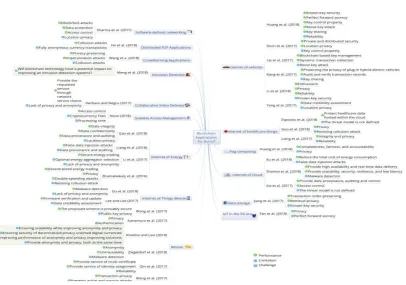
As presented in Fig. 4, the blockchain technology can be effectively applied in almost all domains of IoT.
Internet of healthcarethings
ISSN(Online): 2320-9801 ISSN (Print): 2320-9798
I
nternational
J
ournal of
I
nnovative
R
esearch in
C
omputer
and
C
ommunication
E
ngineering
(A High Impact Factor, Monthly, Peer Reviewed Journal) Website: www.ijircce.com
Vol. 7, Issue 8, August 2019
Internet of things in the 5Gera
In the IoT period, 5G will empower a completely portable and associated society for billions of associated objects [44]. To fathom the protection issues in the 5G heterogeneous correspondence envi-ronment, Fan et al. [45] proposed a blockchain-based security saving and information sharing plan. In light of adding squares to the blockchain, each new square is associated with the blockchain by its hash esteem. Note that the past hash worth can be known from the square header.
Internet of vehicles
The Internet of Vehicles (IoV) is a rising idea, which permits the combination of vehicles into the new period of the IoT so as to build up the keen correspondence be-tween vehicles and heterogeneous systems, for example, vehicle-to-vehicle, vehicle-to-street, vehicle-to-human, vehicle-to-sensor, and vehicle-to-everything. Notwithstanding, some ongoing works attempt to apply the blockchain innovation to IoV. In view of the decentralized security model, Huang et al. [10] proposed a blockchain environment model, named LNSC, for electric vehicle and charging heap the board. The LNSC model uses elliptic bend cryptography (ECC) to figure hash capacities electric vehicles and charging heaps. To maintain a strategic distance from the area following in the IoV, Dorri et al. [11] proposed a decentralized security safeguarding engineering, where overlay hubs deal with the blockchain. Likewise, the hash of the reinforcement stockpiling is put away in the blockchain.
ISSN(Online): 2320-9801 ISSN (Print): 2320-9798
I
nternational
J
ournal of
I
nnovative
R
esearch in
C
omputer
and
C
ommunication
E
ngineering
(A High Impact Factor, Monthly, Peer Reviewed Journal) Website: www.ijircce.com
Vol. 7, Issue 8, August 2019
Fig. 4. Blockchain applications for the IoT. Internet of Energy
ISSN(Online): 2320-9801 ISSN (Print): 2320-9798
I
nternational
J
ournal of
I
nnovative
R
esearch in
C
omputer
and
C
ommunication
E
ngineering
(A High Impact Factor, Monthly, Peer Reviewed Journal) Website: www.ijircce.com
Vol. 7, Issue 8, August 2019
Internet of Things devices
In the Internet of Things gadgets, aggressors try to exfiltrate the information of IoT gadgets by utilizing the pernicious codes in malware, particularly on the open source Android stage. By using measurable investigation technique, Gu et al. [46] introduction duced a malware recognition framework dependent on the consortium Blockchain, named CB-MDEE, which is made out of de-tecting consortium chain by test individuals and open chain by clients. The CB-MDEE framework embraces a fluffy correlation strategy and different checking capacities In request to lessen the false-positive rate and improve the discovery capacity of malware variations. To secure the installed gadgets in the IoT, Lee et al. [47] a firmware update plan dependent on the blockchain innovation, which the inserted gadgets have the two diverse activity cases, specifically, 1) reaction from a check hub to a solicitation hub, and 2) reaction from a reaction hub to a solicitation hub.
Access Management inIoT
ISSN(Online): 2320-9801 ISSN (Print): 2320-9798
I
nternational
J
ournal of
I
nnovative
R
esearch in
C
omputer
and
C
ommunication
E
ngineering
(A High Impact Factor, Monthly, Peer Reviewed Journal) Website: www.ijircce.com
Vol. 7, Issue 8, August 2019
4) lightweight, which implies that the IoT gadgets needn't bother with any change to embrace this framework; 5) versatility, as the IoT gadgets can be associated through various compelled systems; 6) straightforwardness, where the framework can safeguard the area security.
Collaborative video delivery
The dissemination of astounding substance in the IoT these days challenges for the web access suppliers. Be that as it may, Herbaut and Negru [49] proposed a decentralized handling instrument for shared blockchain-based video conveyance, which is depending on cutting edge system administrations chains. In particular, this administration instrument is made out of three blockchains, specifically, 1) the substance expediting blockchain, 2) the conveyance observing blockchain, and 3) the provisioning blockchain. What's more, this administration component is conveyed with the open source venture Hyperledger-Fabric 2 where the outcomes demonstrate that the quantity of hubs marginally expands the conver-gence time .
Internet of Cloud
In the Internet of Cloud (IoC), billions of IoT gadgets transfer their information to the cloud through the web association using virtualization innovation. Xu et al. [50] presented a savvy asset the executives for cloud datacenters dependent on the blockchain innovation, so as to spare and lessen the absolute expense of Everything utilization. In particular, the clients utilize their individual private keys to sign an exchange, while the neighboring clients check the communicate exchange. The square is disposed of when it doesn't pass check. In this way, Sharma et al. [51] proposed an appropriated cloud architec-ture that utilizations three developing advancements, to be specific, programming characterized organizing (SDN), mist figuring, and a blockchain strategy. The SDN controllers of the mist hub are utilized to give programming interfaces to arrange the board operation erators. The blockchain procedure is utilized to give versatile, dependable, and high-accessibility administrations. Likewise, Xia et al. [52] proposed a blockchain-based information sharing framework, named MeDShare, for cloud specialist co-ops. This framework utilizes four layers specifically, 1) User layer, 2) Data inquiry layer, 3) Data organizing and provenance layer, and 4) Existing database foundation layer.
Intrusion Detection
Numerous methods for executing interruption recognition sys-tems (IDSs) in the IoT condition have been proposed, which are situated in AI. To improve the collective interruption location frameworks (CIDSs), Alexopoulos et al. [53] presented using blockchain innovation so as to verify the trading of cautions between the collab-speaking hubs. Meng et al. [54] talked about the relevance of blockchain innovation in an interruption discovery frameworks. Present day interruption discovery frameworks must be founded on collabo-rative correspondence among conveyed IDSs [55], requesting broad information sharing among substances and trust calculation. So as to manage the security worries that are raised by the information trade and to stifle insider assaults, the blockchain innovation is connected. Along these lines, the utilization of confided in outsider, which is additionally a solitary purpose of disappointment, that is required in conventional community oriented IDSs can be maintained a strategic distance from.
Software-defined networking
ISSN(Online): 2320-9801 ISSN (Print): 2320-9798
I
nternational
J
ournal of
I
nnovative
R
esearch in
C
omputer
and
C
ommunication
E
ngineering
(A High Impact Factor, Monthly, Peer Reviewed Journal) Website: www.ijircce.com
Vol. 7, Issue 8, August 2019
Fog computing
Haze figuring, additionally called edge processing, is a profoundly virtualized stage that empowers registering and capacity be-tween end-clients and the server farm of the customary distributed computing [5]. Without the outsiders, Fog gadgets can com-municate with one another. Be that as it may, the blockchain strategy can be utilized to encourage interchanges between haze hubs and IoT gadgets. Huang et al. [57] proposed a reasonable installment conspire for re-appropriating calculations of Fog gadgets. In light of the bitcoin, this plan thinks about the accompanying security properties, specifically, fulfillment, decency, and responsibility
Distributed P2PApplications
In conveyed shared (P2P) applications for the IoT, the IoT gadgets self-sort out and participate for another type of utilizations, for example, community films, sending records, conveying messages, electronic trade, and transferring information utilizing sensor systems. To boost clients for collaboration, He et al. [42] proposed an honest motivator system dependent on the blockchain method for dynamic and conveyed P2P conditions. To avert narrow minded clients and guard against the agreement assaults, this plan proposed a valuing methodology, which enables moderate hubs to acquire rewards from blockchain exchanges because of their commitment to a triumph ful conveyance.
Crowdsensing Applications
The rising versatile crowdsensing worldview is a novel class of portable IoT applications (e.g., geological detecting applications). Wang et al. [16] is a fascinating motivating force mech-anism for protection safeguarding in crowdsensing applications dependent on the blockchain digital forms of money. In particular, this system can dispense with the security and protection issues utilizing the diggers' obvious information quality assessment to manage the pantomime assaults in the open and straightforward blockchain.
What's more, to accomplish k-namelessness security assurance, the instrument utilizes a hub collaboration technique for taking part clients.
Datastorage
The information stockpiling can manage heterogeneous information assets for IoT-based information stockpiling frameworks. The most effective method to share and secure these touchy information are the fundamental difficulties in IoT information stockpiling. In view of the blockchain innovation, Jiang et al. [58] proposed a private catchphrase search, named Searchain, for decentralized capacity. The Searchain design incorporates two segment, in particular, 1) exchange hubs in a shared structure and 2) a blockchain of all the arranged squares. Moreover, the Searchain design can give client protection, vagary, and responsibility.
Bitcoin
Propelled in 2009, Bitcoin is the distributed (P2P) pay-ment organize that needn't bother with any focal experts. In light of the center procedure of blockchain, Bitcoin clients don't utilize genuine names; rather, pen names utilized. Accordingly, Bitcoin depends on three fundamental specialized parts: exchanges, agreement Protocol, and correspondence arrange.
ISSN(Online): 2320-9801 ISSN (Print): 2320-9798
I
nternational
J
ournal of
I
nnovative
R
esearch in
C
omputer
and
C
ommunication
E
ngineering
(A High Impact Factor, Monthly, Peer Reviewed Journal) Website: www.ijircce.com
Vol. 7, Issue 8, August 2019
As examined by Wang et al. [71], Bitcoin works practically speaking, yet not in theory,and the principle issue is the way to ensure the potential purchasers' security in Bitcoin utilizing the open key infras-tructure. Wang et al. [71] examined the assigned verifier evidence of advantages for bitcoin trade utilizing elliptic bend cryptogra-phy. In particular, the creators proposed a protection safeguarding plan, named DV-PoA, which can fulfill unforgeability. Note that the DV-PoA plan utilizes elliptic bend discrete log-arithm issue, elliptic bend computational Diffie-Hellman issue, and impact obstruction of cryptographic hash func-tion. Also, to secure the protection of disentangled installment check (SPV) customers, Kanemura et al. [70] proposed a security protecting Bloom channel structure for a SPV customer dependent on γ Deniability.
By evacuating the confided in outsider, Qin et al. [73] proposed a distributively blockchain-based PKI for Bitcoin framework, named Cecoin. To guarantee the consistency, Cecoin utilizes a motivating force component and an appropriated accord convention. To give multi-declaration administrations and personality task, Cecoin changes over a triple (address, area, cert) to a tuple (key, address, cert), and key speaks to way of cert in the tree. Along these lines, to secure the exchange protection in Bitcoin, Wang et al. [41] proposed a structure by including the homomorphic Paillier encryption framework to cover the plaintext sums in exchanges. To take care of the trust issue in Bitcoin, Huang et al. [57]proposed a dedication based testing plan of ringer, which can be utilized for conventional calculations in the redistributing registering.
IV. THREAT MODELS FORBLOCKCHAIN
In this segment, we present and portray the danger models that are considered by the blockchain conventions in IoT net-works. A synopsis of 16 assaults are given in Table II, and are characterized into the accompanying five fundamental classes: personality based assaults, control based assaults, cryptanalytic at-tacks, notoriety based assaults, and administration based assaults, as introduced in Figure 5
Identity-based attacks
The assaults under this classification fashion personalities to masquer-ade as approved clients, so as to gain admittance to the framework and control it. We characterize four assaults, to be specific: Key assault, Replay assault, Impersonation assault, and Sybil assault.
Key attack:
This assault is characterized with regards to a framework consolidating electric vehicles and charging heaps, as pursues: "If the private key of an electric vehicle that has been utilized for long-term releases, the aggressor can imitate this electric vehicle to hoodwink others" [10]. To manage this assault, LNSC convention [10] gives a shared confirmation component between the electric vehicles and charging heaps. To this end, it utilizes the elliptic bend encryption to figure the hash capacities, and subsequently it guarantees flexibility against the key spillage assault.
Replay attack:
ISSN(Online): 2320-9801 ISSN (Print): 2320-9798
I
nternational
J
ournal of
I
nnovative
R
esearch in
C
omputer
and
C
ommunication
E
ngineering
(A High Impact Factor, Monthly, Peer Reviewed Journal) Website: www.ijircce.com
Vol. 7, Issue 8, August 2019
Impersonation attack:
A foe attempts to take on the appearance of an authentic client to perform unapproved tasks. As introduced in Table II, there are three techniques that are proposed to secure against this assault. The possibility of elliptic bend encryption to figure the hash capacities, is proposed by LNSC convention [10]. Wang et al. [16] propose a circulated impetus based collaboration mech-anism, which ensures the client's security just as an exchange check strategy for the hub participation. The system conceals the client's security data inside a gathering, and guarantees their insurance from the pantomime assault. BSeIn [39], then again, utilizes characteristic based marks, i.e., just real terminals can produce a substantial mark, and subsequently any pantomime endeavor will be identified when its relating verification activity falls flat.
ISSN(Online): 2320-9801 ISSN (Print): 2320-9798
I
nternational
J
ournal of
I
nnovative
R
esearch in
C
omputer
and
C
ommunication
E
ngineering
(A High Impact Factor, Monthly, Peer Reviewed Journal) Website: www.ijircce.com
Vol. 7, Issue 8, August 2019
Sybil attack:
Under this assault, a foe makes many phony characters. By performing numerous collaborations in the system, the foe can increase an enormous impact inside the network, i.e, expanding/diminishing the notoriety of certain specialists. TrustChain [40] addresses this issue by making an unchanging chain of transiently requested between activities for every specialist. It registers the reliability of specialists in an online network with Sybil-opposition by utilizing earlier exchanges as info. It guarantees that operators who use assets from the network likewise contribute back.
Manipulation-basedattacks:
False data injection attack:The point of this assault is to bargain the information trustworthiness of the control framework to settle on it take wrong control choices. Liang et al. [21] considers the meter hub as a private blockchain organize.
Tampering attack: The foe may alter the bitcoin exchanges of the bitcoin addresses, sums and other data in the wake of marking. To avert this assault, Wang et al. [41] utilize an open key cryptosystem that is good with the current Bitcoin framework. They propose including the homomorphic Paillier encryption framework to cover the plaintext sums in exchanges, and the scrambled sums will be checked by the Commitment Proof.
Overlay attack: It implies that the assailant adds a fabrication scrambled add up to the first encoded sum under the beneficiary's open key. In [41], this assault is distinguished as each exchange is inserted with a timestamp to check its uniqueness. Various contributions under a similar dealer can be recognized and connected to the various exchanges, and subsequently opposition against the overlay assault is guaranteed
Modification attack:It comprises in changing the communicate exchange or the reaction message. To manage this at-tack, LNSC [10] utilizes the possibility of elliptic bend encryption to figure the hash capacities. BSeIN [39], then again, utilizes the quality mark and the MAC.
Man-in-the-middle attack: An assailant by ridiculing the characters of two gatherings can furtively transfer and even adjust the correspondence between these gatherings, which accept they are conveying legitimately, yet in truth the entire discussion is under the influence of the aggressor. To oppose against this assault, BSeIn [39] gives secure shared validation. In [10], LNSC gives shared au-thentication by utilizing elliptic bend encryption to compute the hash capacities.
Cryptanalytic attacks:
They intend to break the cryptographic calculation and ex-represent its keys. In [43] the quantum assault is examined in blockchain. This assault is intended to settle the elliptic bend computerized logarithm, i.e., get the private key from the elliptic bend open key. Along these lines, an enemy can sign unapproved exchanges and produce the legitimate mark of clients. To manage this issue, Yin et al. [43] utilizes the possibility of grid based mark conspire., which permits inferring many sub-private keys from the seed in the deterministic wallet of blockchain.
Reputation-based attacks
ISSN(Online): 2320-9801 ISSN (Print): 2320-9798
I
nternational
J
ournal of
I
nnovative
R
esearch in
C
omputer
and
C
ommunication
E
ngineering
(A High Impact Factor, Monthly, Peer Reviewed Journal) Website: www.ijircce.com
Vol. 7, Issue 8, August 2019
Hiding Blocks attack:
Under this assault, an operator just uncovered exchanges that positively affect his notoriety and conceals the ones with negative notoriety. In [40], an unchanging chain of transiently requested interac-tions for every operator. Since each record has an arrangement number, any operator in the system can demand explicit records of others. The mentioned operators can't decline to give their records. Something else, different operators will quit interfacing with them.
Whitewashing:
At the point when an operator has negative notoriety, it can dispose of its character and make another one. There is no real way to avoid this conduct. Nonetheless, it is proposed in [40] to give lower needs to the specialists of new characters when applying the assignment approach.
Service-basedattacks:
They point either to make the administration inaccessible or cause it to carry on uniquely in contrast to its determinations. Under this classification, we can locate the accompanying assaults:
DDoS/DoS attack:
It includes sending a lot of solicitations to cause the disappointment of the blockchain framework. As appeared in Table II, there are four techniques that are proposed to manage this assault. Distributed SDN engineering is proposed by DistBlockNet convention in [36]. CoinParty [37] proposes decentralized blending administration. Liu et al. [38] utilize a ring-based mark with Elliptic Curve Digital Signature Algorithm (ECDSA). The versatility against DOS in BSeIn [39] is accomplished by constraining the square size, checking the maxi-mum number of quality marks for the exchange info, and utilizing multi-recipients encryption to give secrecy to approved members.
Refusal to Sign attack:
It includes sending a lot of solicitations to cause the disappointment of the blockchain framework. As appeared in Table II, there are four strategies that are proposed to manage this assault. Distributed SDN engineering is proposed by DistBlockNet convention in [36]. CoinParty [37] proposes decentralized blending administration. Liu et al. [38] utilize a ring-based mark with Elliptic Curve Digital Signature Algorithm (ECDSA). The strength against DOS in BSeIn [39] is accomplished by restricting the square size, checking the maxi-mum number of characteristic marks for the exchange info, and utilizing multi-recipients encryption to give classification to approved members.
Double-spending attack:
It implies that the aggressors spend the equivalent bitcoin twice to secure additional sums. In [41], the Time-Stamp and the Proof-of-Work system is utilized. In [22], a multi-signature exchange is utilized, where a base number of keys must sign an exchange before spending tokens.
Collusion Attack:
ISSN(Online): 2320-9801 ISSN (Print): 2320-9798
I
nternational
J
ournal of
I
nnovative
R
esearch in
C
omputer
and
C
ommunication
E
ngineering
(A High Impact Factor, Monthly, Peer Reviewed Journal) Website: www.ijircce.com
Vol. 7, Issue 8, August 2019
IV. EXISTING RESEARCH ON SECURITY AND PRIVACY IN BLOCKCHAIN-BASEDIOT
Table IV condenses examine for blockchain-based IoT security and protection.
Authentication
In [78], Lin et al. proposed a novel transitively shut undirected diagram verification plot that can bolster blockchain-based character the executives frameworks. In compar-ison to other contending validation plots, their professional posal gives an extra capacity of progressively including or erasing hubs and edges. Additionally, this novel plan that was based on Ethereum comprehends the confirmation prob-lem of non-existent edges, which is a realized test in transitive mark plans. Lin et al.in [39] proposed a novel blockchain-based structure that can guarantee a safe remote client confirmation. The proposed system joins characteristic based marks, multi-recipients encryption and Mes-sage Authentication Code. In [14], Li et al. proposed a novel protection saving Blockchain-based declaration arrange for Vanets that depends on a limit verification convention called Echo-Announcement.
ISSN(Online): 2320-9801 ISSN (Print): 2320-9798
I
nternational
J
ournal of
I
nnovative
R
esearch in
C
omputer
and
C
ommunication
E
ngineering
(A High Impact Factor, Monthly, Peer Reviewed Journal) Website: www.ijircce.com
Vol. 7, Issue 8, August 2019
Notations :
ISSN(Online): 2320-9801 ISSN (Print): 2320-9798
I
nternational
J
ournal of
I
nnovative
R
esearch in
C
omputer
and
C
ommunication
E
ngineering
(A High Impact Factor, Monthly, Peer Reviewed Journal) Website: www.ijircce.com
Vol. 7, Issue 8, August 2019
Tm:The unit of modular multiplication time; TE:The unit of modular exponentiation time
Privacy-preserving
In the center of blockchain theory lies the private key that can open the cryptographic assurance of the computerized resources. The private key turns into the most noteworthy helplessness of a blockchain framework whether it is put away on a bit of paper, screen, circle, in nearby memory or in the cloud. Clients will in general utilize advanced wallets that can be either programming or equipment, for example Trezor or Keepkey, which are defenseless against different assaults like shortcoming infusions [79].
Another arrangement that is making strides these days is the utilization of equipment security modules (HSMs), a crypto-processor that safely produces, ensures and stores keys. The whole cryptographic key lifecycle occurs inside the HSM. A HSM can be an independent gadget that works disconnected or can be installed in a server, can be solidified against altering or harm, and is generally situated in a physically secure territory to counteract unapproved get to. At last another age of ultra-secure PCs that have implanted a HSM and requires two-factor validation is as of late presented. This PC can be ensured against physical assaults with a sealed packaging and components like programmed erasion of the private key if there should be an occurrence of any rupture of the inserted physical or legitimate security controls [80]. Utilizing confided in PCs both as secure advanced wallets and blockchain hubs. Security affirmation of clients and associations need so as to believe this new innovation can be given sooner rather than later.
To accomplish k-obscurity security insurance, Wang et al. [16] utilize a hub collaboration confirmation approach, in which each gathering contains K hubs to meet the goal of K-namelessness assurance. Aitzhan et al. [22] proposed a thought that secures parties from inactive listening in by covering up non-content information. For upgrading the exchange protection in Bitcoin, Wang et al. [41]achieve exchange by utilizing cryptographic techniques, i.e., utilizes the open key framework. Through the standard ring mark and ECDSA unforgeability, Liu et al. [38] proposed a thought that can accomplish the obscurity.
One other part of protection in blockchain frameworks is about obscurity. In spite of the fact that it is conceivable to plan a nearly im-changeable, alter safe exchange, this exchange can be seen all through the majority of the hubs on the blockchain organize. One promising examination on supporting private exchanges inside a blockchain is zk-STARKs, which joins zCash and Ethereum. The mix of the two innovations makes it conceivable to keep secrecy when directing installments, dazzle barters, and notwithstanding casting a ballot [73].
Trust
A blockchain-based installment conspire that is stet up in a remote locale setting was presented in [77]. The proposed plan is expected to have a discontinuous network to a bank's focal framework. Conveyed trust is practiced with the utilization of a two-layer design, where the bank approves a lot of chosen townspeople to go about as excavators who on their turn approve exchanges among residents with tokens and the bank. In [40] creators present an instrument where each member develops and keeps up his own chain of exchanges. The proposed methodology gives conveyed trust, without the need of any guard, while being vigorous against Sybil assaults.
V. OPEN QUESTIONS AND RESEARCHCHALLENGES
ISSN(Online): 2320-9801 ISSN (Print): 2320-9798
I
nternational
J
ournal of
I
nnovative
R
esearch in
C
omputer
and
C
ommunication
E
ngineering
(A High Impact Factor, Monthly, Peer Reviewed Journal) Website: www.ijircce.com
Vol. 7, Issue 8, August 2019
Resiliency against CombinedAttacks
As introduced in this review, numerous security answers for bloackchain-based IoT have been proposed in the writing, every one of which is intended to handle distinctive security issues and risk models. The fundamental inquiry that may emerge is the manner by which to structure a security arrangement that can be flexible against com-bined assaults while considering the execution attainability of the arrangement, particularly if there should arise an occurrence of low asset compelled IoT gadgets.
Dynamic and Adaptable Security Framework
Heterogeneous gadgets are sent in the IoT arrange, running from low-control gadgets to top of the line servers. Henceforth, a solitary security arrangement can't be conveyed for all the blockchain-based IoT structures because of the diverse measure of assets that are given. Consequently, the security arrangement ought to at first adjust to the current assets, and choose which security administrations to offer, to meet the base security necessities of the end-clients. In this manner, one of the difficulties that ought to get more consideration later on is the means by which to structure such a dynamic and versatile security system for blockchain-based IoT designs.
Compliance with GDPR
The new guideline that produced results from the 25th of May of 2018 awards end-clients new controls over close to home information, and places new commitments upon information controllers. In an absolutely decentralized blockchain framework there are no responsible information processors making the execution of GDPR troublesome. Additionally then again, the privilege to be overlooked that is one of the primary rules of GDPR is deeply opposing thought behind blockchain innovation. On open blockchains, all information is repeated and shared over all machines in the system and just the blend with believed equipment arrangements can understand this issue. Some underlying endeavors are as of now embraced [81], [82] however this is a promising zone of research for the not so distant future.
Energy-efficient Mining
Mining incorporates the execution of the blockchain con-sensus calculations, for example, Proof-of-Work (PoW). Furthermore, the blockchain develops as the clients store their exchanges. Along these lines, all the more dominant excavators are required to deal with the accord conventions in the blockchain. A few Everything productive agreement calculations, for example, Proof-of-Space [83], Deligated Proof-of-Space [84] and Proof-of-Stake [85] and small scale blockchain [86], [87] to store just late blockchain exchanges are proposed. Nonetheless, asset and power-obliged IoT gadgets are not constantly fit for gathering the considerable computational and control utilization in the master cessing of blockchain agreement and putting away of blockchains. Along these lines, the structure of Everything effective accord conventions is one of the noteworthy research difficulties in the blockchain innovations for IoT.
Social Networks and Trust Management
When we talk about security we need to take at the top of the priority list that phony news can be a piece of a digital assault. Huge scale gossip spreading could present serious social and financial harms to an association or a country [88] particularly with the utilization of online informal organizations. Blockchains could be a methods for constraining gossip spreading as exhibited in [89] where a blockchain-empowered informal community is displayed.
Blockchain-specific Infrastructure
ISSN(Online): 2320-9801 ISSN (Print): 2320-9798
I
nternational
J
ournal of
I
nnovative
R
esearch in
C
omputer
and
C
ommunication
E
ngineering
(A High Impact Factor, Monthly, Peer Reviewed Journal) Website: www.ijircce.com
Vol. 7, Issue 8, August 2019
the executives and hidden correspondence conventions assume noteworthy jobs in blockchain foundation. Additionally, dependability among the computational asset improved gadgets must be built up in the blockchain framework. Plus, the Application Programming Interface (APIs) ought to be easy to use however much as could reasonably be expected.
Vehicular Cloud Advertisement Dissemination
As displayed in this review, in light of a decentralized blockchain structure, different obscurity plans are proposed to shroud the genuine personalities in IoV. In this way, since the ve-hicle's genuine character, vehicle's genuine area, and exchange could be revealed in vehicular cloud notice spread [90], basic security issues emerge as pursues:
• How to structure a solitary quality access control convention dependent on blockchain innovation for safeguarding transac-tion security in vehicular cloud promotion dissemina-tion?
• How to devise a protection safeguarding mystery sharing plan dependent on blockchain innovation to recognize partici-pation of chose vehicles in exchanges? e.g., by utilizing the homomorphic Paillier encryption framework.
• How to plan a low intricacy based validation utilizing the blockchain innovation among RSUs and standard ticipating vehicles during the commercial dispersal process?
Skyline Query Processing
Horizon question has turned into a significant issue in database investigate, e.g., concentrated database, dispersed database, and comparability search. The reviewed plans have not yet considered the plausibility of utilizing the horizon inquiry with blockchain. As of late, Hua et al. [91] proposed a security saving on-line restorative essential analysis system, named CINEMA, which uses the horizon question. In particular, CINEMA outline work can secure clients' medicinal information protection and guarantee the privacy of analysis model dependent on a horizon conclusion model. In this way, how to deal with the security and protection issues when a horizon determination model is built by a great deal of blockchains? Henceforth, the protection safeguarding plans dependent on the blockchain with horizon question are significant difficulties and ought to be examined later on.
VI. CONCLUSION
In this paper, we overviewed the best in class of existing blockchain conventions intended for Internet of Things (IoT) systems. We gave an outline of the application spaces of blockchain advances in IoT, e.g., Internet of Vehicles, Internet of Energy, Internet of Cloud, and Fog registering. Through broad research and investigation that was directed, we had the option to group the danger models that are considered by the blockchain conventions in IoT systems, into five fundamental classes, in particular, character based assaults, control based assaults, cryptanalytic assaults, notoriety based assaults, and administration based assaults. There still exist a few testing research zones, for example, versatility against joined assaults, dynamic and versatile security system, consistence with GDPR, Everything productive mining, interpersonal organizations and trust man-agement, blockchain-explicit foundation, vehicular cloud commercial dispersal, and Skyline question handling, which ought to be additionally examined sooner rather than later.
REFERENCES
[1]“IDC, Worldwide Internet of Things Forecast, 2015–2020,” IDC #256397. [2]“IDC, Worldwide Internet of Things Forecast Update 2015–2019,” Feb. 2016, Doc #US40983216.
[3]D. Miorandi, S. Sicari, F. De Pellegrini, and I. Chlamtac, “Internet of things: Vision, applications and research challenges,” Ad Hoc Netw.,
vol.10,no.7,pp.1497–1516,Sept.2012.
[4]D. Puthal, N. Malik, S. P. Mohanty, E. Kougianos, and G. Das, “Everything you wanted to know about the blockchain: Its promise, components,
processes, and problems,” IEEE Consumer Electronics Mag., vol. 7, no. 4, pp. 6–14, July 2018.
[5]M. Mukherjee, R. Matam, L. Shu, L. Maglaras, M. A. Ferrag, N. Choud- hury, and V. Kumar, “Security and privacy in fog computing: Chal-
ISSN(Online): 2320-9801 ISSN (Print): 2320-9798
I
nternational
J
ournal of
I
nnovative
R
esearch in
C
omputer
and
C
ommunication
E
ngineering
(A High Impact Factor, Monthly, Peer Reviewed Journal) Website: www.ijircce.com
Vol. 7, Issue 8, August 2019
[6]M. Swan, Blockchain: blueprint for a new economy, 1st ed. ÓReilly Media, Jan. 2015.
[7]F. Tschorsch and B. Scheuermann, “Bitcoin and beyond: A technical survey on decentralized digital currencies,” IEEE Commun. Surveys & Tut.,
vol. 18, no. 3, pp. 2084–2123, Mar. 2016.
[8]S. Nakamoto, “Bitcoin: A peer-to-peer electronic cash system,” 2008. [9]D. Wilson and G. Ateniese, “From pretty good to great: Enhancing
PGP using bitcoin and the blockchain,” in Network and System Security. Springer International Publishing, 2015, pp. 368–375.
[10]X. Huang, C. Xu, P. Wang, and H. Liu, “LNSC: A security model for electric vehicle and charging pile management based on blockchain
ecosystem,” IEEE Access, vol. 6, pp. 13 565–13 574,2018.
[11]A. Dorri, M. Steger, S. S. Kanhere, and R. Jurdak, “BlockChain: A Distributed Solution to Automotive Security and Privacy,” IEEE
Commun.Mag.,vol.55,no.12,pp.119–125,dec2017.
[12]A. Lei, H. Cruickshank, Y. Cao, P. Asuquo, C. P. A. Ogah, and Z. Sun, “Blockchain-Based Dynamic Key Management for Heterogeneous Intel-
ligent Transportation Systems,” IEEE Internet Things J., vol. 4, no. 6, pp. 1832–1843, dec 2017.
[13]J. Kang, R. Yu, X. Huang, S. Maharjan, Y. Zhang, and E. Hossain, “Enabling Localized Peer-to-Peer Electricity Trading Among Plug-in Hybrid
Electric Vehicles Using Consortium Blockchains,” IEEE Trans. Ind. Informatics, vol. 13, no. 6, pp. 3154–3164, dec 2017.
[14]L. Li, J. Liu, L. Cheng, S. Qiu, W. Wang, X. Zhang, and Z. Zhang, “CreditCoin: A Privacy-Preserving Blockchain-Based Incentive An-
nouncement Network for Communications of Smart Vehicles,” IEEE Trans. Intell. Transp. Syst., pp. 1–17, 2018.
[15]Z. Yang, K. Zheng, K. Yang, and V. C. M. Leung, “A blockchain-based reputation system for data credibility assessment in vehicular networks,”
in 2017 IEEE 28th Annu. Int. Symp. Pers. Indoor, Mob. Radio Commun. IEEE, oct 2017, pp. 1–5.
[16]J. Wang, M. Li, Y. He, H. Li, K. Xiao, and C. Wang, “A Blockchain Based Privacy-Preserving Incentive Mechanism in Crowdsensing Appli-
cations,”IEEEAccess,vol.6,pp.17545–17556,2018.
[17]F. Tian, “An agri-food supply chain traceability system for China based on RFID & blockchain technology,” in Proc. IEEE 13th Int. Conf. on
ServiceSystemsandServiceManagement(ICSSSM),June2016.
[18]Z. Li, J. Kang, R. Yu, D. Ye, Q. Deng, and Y. Zhang, “Consortium Blockchain for Secure Energy Trading in Industrial Internet of Things,” IEEE
Trans. Ind. Informatics, pp. 1–1, 2017.
[19]T. Ahram, A. Sargolzaei, S. Sargolzaei, J. Daniels, and B. Amaba, “Blockchain technology innovations,” in Proc. IEEE Technology &
Engineering Management Conference (TEMSCON), June 2017.
[20]J. Gao, K. O. Asamoah, E. B. Sifah, A. Smahi, Q. Xia, H. Xia, X. Zhang, and G. Dong, “GridMonitoring: Secured sovereign blockchain based
monitoring on smart grid,” IEEE Access, vol. 6, pp. 9917–9925, 2018.
[21]G. Liang, S. R. Weller, F. Luo, J. Zhao, and Z. Y. Dong, “Distributed Blockchain-Based Data Protection Framework for Modern Power Sys-
tems against Cyber Attacks,” IEEE Trans. Smart Grid, pp. 1–1, 2018.
[22]N. Zhumabekuly Aitzhan and D. Svetinovic, “Security and Privacy in Decentralized Energy Trading through Multi-signatures, Blockchain
and Anonymous Messaging Streams,” IEEE Trans. Dependable Secur. Comput., pp. 1–1,2016.
[23]N. Kshetri, “Blockchain’s roles in strengthening cybersecurity and protecting privacy,” Telecommunications Policy, vol. 41, no. 10, pp. 1027–
1038, Nov. 2017.
[24]T. M. Fernández-Caramés and P. Fraga-Lamas, “A review on the use of blockchain for the internet of things,” IEEE Access, pp. 1–23, May
2018.
[25]“Crypto-currency market capitalizations,” accessed on 15 June, 2018. [Online]. Available: https://coinmarketcap.comhttps://coinmarketcap. com
[26]“Blockchain technology report to the US federal advisory committee on insurance,” accessed on 15
June, 2018.[Online]. Available:https://www.treasury.gov/initiatives/fio/Documents/McKinsey_FACI_Blockchain_in_Insurance.pdf
[27]L. Bahack, “Theoretical Bitcoin attacks with less than half of the computational power,” Dec. 2013, arXiv:1312.7013v1.[Online]. Available: https://arxiv.org/pdf/1312.7013.pdf
[28]M. Ali, J. Nelson, R. Shea, and M. J. Freedman, “Blockstack: A global naming and storage system secured by blockchains,” in Proc. Annual
Technical Conference (USENIX ATC), June 2016, pp. 181–194.
[29]L. S. Sankar, M. Sindhu, and M. Sethumadhavan, “Survey of consensus protocols on blockchain applications,” in Proc. IEEE 4th Int. Conf. on
Advanced Comput. and Commun. Syst. (ICACCS), Jan. 2017.
[30]A. Kaushik, A. Choudhary, C. Ektare, D. Thomas, and S. Akram, “Blockchain-literature survey,” in Proc. IEEE 2nd Int. Conf. Recent Trends in
Electronics, Information & Communication Technology (RTE- ICT), May 2017.
[31]M. C. K. Khalilov and A. Levi, “A survey on anonymity and privacy in Bitcoin-like digital cash systems,” IEEE Commun. Surveys & Tut., pp. 1–
1, Mar. 2018.
[32]M. Conti, S. K. E, C. Lal, and S. Ruj, “A survey on security and privacy issues of Bitcoin,” IEEE Commun. Surveys & Tut., pp. 1–39, May 2018.
[33]C. Esposito, A. De Santis, G. Tortora, H. Chang, and K.-K. R. Choo, “Blockchain: A Panacea for Healthcare Cloud-Based Data Security and
Privacy?” IEEE Cloud Comput., vol. 5, no. 1, pp. 31–37, Jan. 2018.
[34]R. Guo, H. Shi, Q. Zhao, and D. Zheng, “Secure Attribute-Based Sig- nature Scheme With Multiple Authorities for Blockchain in Electronic
Health Records Systems,” IEEE Access, vol. 6, pp. 11 676–11 686, 2018.
[35]X. Liang, J. Zhao, S. Shetty, J. Liu, and D. Li, “Integrating blockchain for data sharing and collaboration in mobile healthcare applications,” in
2017 IEEE 28th Annu. Int. Symp. Pers. Indoor, Mob. Radio Commun.IEEE, oct 2017, pp.1–5.
[36]P. K. Sharma, S. Singh, Y.-S. Jeong, and J. H. Park, “DistBlockNet: A Distributed Blockchains-Based Secure SDN Architecture for IoT
Networks,”IEEECommun.Mag.,vol.55,no.9,pp.78–85,2017.
[37]J. H. Ziegeldorf, R. Matzutt, M. Henze, F. Grossmann, and K. Wehrle, “Secure and anonymous decentralized Bitcoin mixing,” Futur. Gener.
Comput. Syst., vol. 80, pp. 448–466, mar 2018.
[38]Y. Liu, X. Liu, C. Tang, J. Wang, and L. Zhang, “Unlinkable Coin Mixing Scheme for Transaction Privacy Enhancement of Bitcoin,”IEEE
ISSN(Online): 2320-9801 ISSN (Print): 2320-9798
I
nternational
J
ournal of
I
nnovative
R
esearch in
C
omputer
and
C
ommunication
E
ngineering
(A High Impact Factor, Monthly, Peer Reviewed Journal) Website: www.ijircce.com
Vol. 7, Issue 8, August 2019
[39]C. Lin, D. He, X. Huang, K.-K. R. Choo, and A. V. Vasilakos, “Bsein: A blockchain-based secure mutual authentication with fine-grained access
control system for industry 4.0,” J. Netw. Comput. Appl., vol. 116, pp. 42–52, 2018.
[40]P. Otte, M. de Vos, and J. Pouwelse, “TrustChain: A Sybil-resistant scalable blockchain,” Futur. Gener. Comput. Syst., sep 2017.
[41]Q. Wang, B. Qin, J. Hu, and F. Xiao, “Preserving transaction privacy in bitcoin,” Futur. Gener. Comput. Syst., sep 2017.
[42]Y. He, H. Li, X. Cheng, Y. Liu, C. Yang, and L. Sun, “A Blockchain based Truthful Incentive Mechanism for Distributed P2P
Applications,”IEEE Access, pp. 1–1,2018.
[43]W. Yin, Q. Wen, W. Li, H. Zhang, and Z. Jin, “An Anti-Quantum Transaction Authentication Approach in Blockchain,” IEEE Access, vol. 6, pp.
5393–5401,2018.
[44]M. A. Ferrag, L. Maglaras, A. Argyriou, D. Kosmanos, and H. Janicke, “Security for 4G and 5G cellular networks: A survey of existing
authentication and privacy-preserving schemes,” J. Netw. Comput. Appl., vol. 101, pp. 55–82, jan 2018.
[45]K. Fan, Y. Ren, Y. Wang, H. Li, and Y. Yang, “Blockchain-based efficient privacy preserving and data sharing scheme of content-centric network
in 5G,” IET Commun., vol. 12, no. 5, pp. 527–532, Mar. 2018.
[46]J. Gu, B. Sun, X. Du, J. Wang, Y. Zhuang, and Z. Wang, “Consortium Blockchain-Based Malware Detection in Mobile Devices,” IEEE Access,
vol. 6, pp. 12 118–12 128, 2018.
[47]B. Lee and J.-H. Lee, “Blockchain-based secure firmware update for em- bedded devices in an Internet of Things environment,” J. Supercomput.,
vol. 73, no. 3, pp. 1152–1167, mar 2017.
[48]O. Novo, “Blockchain Meets IoT: An Architecture for Scalable Access Management in IoT,” IEEE Internet Things J., vol. 5, no. 2, pp. 1184–
1195, Apr. 2018.
[49]N. Herbaut and N. Negru, “A Model for Collaborative Blockchain-Based Video Delivery Relying on Advanced Network Services Chains,” IEEE
Commun. Mag., vol. 55, no. 9, pp. 70–76, 2017.
[50]C. Xu, K. Wang, and M. Guo, “Intelligent Resource Management in Blockchain-Based Cloud Datacenters,” IEEE Cloud Comput., vol. 4,
no.6,pp.50–59,nov2017.
[51]P. K. Sharma, M.-Y. Chen, and J. H. Park, “A Software Defined Fog Node Based Distributed Blockchain Cloud Architecture for IoT,” IEEE
Access,vol.6,pp.115–124,2018.
[52]Q. Xia, E. B. Sifah, K. O. Asamoah, J. Gao, X. Du, and M. Guizani, “MeDShare: Trust-Less Medical Data Sharing Among Cloud Service
Providers via Blockchain,” IEEE Access, vol. 5, pp. 14 757–14 767,
2017.
[53]N. Alexopoulos, E. Vasilomanolakis, N. R. Ivanko, and M. Muhlhauser, “Towards blockchain-based collaborative intrusion detection systems,”
inProc.Int.Conf.CriticalInf.Infrastruct.Secur,2017,pp.1–12.
[54]W. Meng, E. W. Tischhauser, Q. Wang, Y. Wang, and J. Han, “When Intrusion Detection Meets Blockchain Technology: A Review,” IEEE
Access, vol. 6, pp. 10 179–10 188, 2018.
[55]T. Cruz, L. Rosa, J. Proença, L. Maglaras, M. Aubigny, L. Lev, J. Jiang, and P. Simões, “A cybersecurity detection framework for supervisory
control and data acquisition systems,” IEEE Transactions on Industrial Informatics, vol. 12, no. 6, pp. 2236–2246, 2016.
[56]K. Kalkan and S. Zeadally, “Securing internet of things (iot) with software defined networking (sdn),” IEEE Commun. Mag., 2017.
[57]H. Huang, X. Chen, Q. Wu, X. Huang, and J. Shen, “Bitcoin-based fair payments for outsourcing computations of fog devices,” Futur. Gener.
Comput. Syst., vol. 78, pp. 850–858, jan 2018.
[58]P. Jiang, F. Guo, K. Liang, J. Lai, and Q. Wen, “Searchain: Blockchain- based private keyword search in decentralized storage,” Futur. Gener.
Comput. Syst., sep 2017.
[59]G. Maxwll, “Coinswap,” 2013. [Online]. Available: https://bitcointalk.org/index.php?topic=321228
[60]G. Maxwell, “Coinjoin: Bitcoin privacy for the real world,” in Post on Bitcoin forum, 2013.
[61]I. Miers, C. Garman, M. Green, and A. D. Rubin, “Zerocoin: Anonymous Distributed E-Cash from Bitcoin,” in 2013 IEEE Symp. Secur. Priv.
IEEE, may 2013, pp. 397–411.
[62]J. Bonneau, A. Narayanan, A. Miller, J. Clark, J. A. Kroll, and E. W. Felten, “Mixcoin: Anonymity for Bitcoin with Accountable Mixes,” in Int.
Conf. Financ. Cryptogr. Data Secur. Springer Berlin Heidelberg, 2014, pp. 486–504.
[63]G. Bissias, A. P. Ozisik, B. N. Levine, and M. Liberatore, “Sybil- Resistant Mixing for Bitcoin,” in Proc. 13th Work. Priv. Electron. Soc.
-WPES’14. New York, New York, USA: ACM Press, 2014, pp. 149–158.
[64]T. Ruffing, P. Moreno-Sanchez, and A. Kate, “CoinShuffle: Practical Decentralized Coin Mixing for Bitcoin,” in Eur. Symp. Res. Comput. Secur.
Springer, 2014, pp. 345–364.
[65]E. B. Sasson, A. Chiesa, C. Garman, M. Green, I. Miers, E. Tromer, and M. Virza, “Zerocash: Decentralized Anonymous Payments from
Bitcoin,” in 2014 IEEE Symp. Secur. Priv. IEEE, may 2014, pp. 459– 474.
[66]L. Valenta and B. Rowan, “Blindcoin: Blinded, Accountable Mixes for Bitcoin,” in Int. Conf. Financ. Cryptogr. Data Secur. Springer Berlin
Heidelberg, 2015, pp. 112–126.
[67]J. H. Ziegeldorf, F. Grossmann, M. Henze, N. Inden, and K. Wehrle, “Coinparty: Secure multi-party mixing of bitcoins,” in Proc. 5th ACM Conf.
Data Appl. Secur. Priv. - CODASPY ’15. New York, New York, USA: ACM Press, 2015, pp. 75–86.
[68]E. Heilman, F. Baldimtsi, and S. Goldberg, “Blindly Signed Contracts: Anonymous On-Blockchain and Off-Blockchain Bitcoin Transactions,” in
Int. Conf. Financ. Cryptogr. Data Secur. Springer Berlin Heidelberg, 2016, pp. 43–60.
[69]E. Heilman, L. AlShenibr, F. Baldimtsi, A. Scafuro, and S. Goldberg, “TumbleBit: An Untrusted Bitcoin-Compatible Anonymous Payment
Hub,”inProc.2017Netw.Distrib.Syst.Secur.Symp. Reston, VA: Internet Society,2017.
[70]K. Kanemura, K. Toyoda, and T. Ohtsuki, “Design of privacy-preserving mobile Bitcoin client based on γ-deniability enabled bloom filter,” in
2017 IEEE 28th Annu. Int. Symp. Pers. Indoor, Mob. Radio Commun. IEEE, oct 2017, pp. 1–6.
[71]H. Wang, D. He, and Y. Ji, “Designated-verifier proof of assets for bit- coin exchange using elliptic curve cryptography,” Futur. Gener.Comput.
ISSN(Online): 2320-9801 ISSN (Print): 2320-9798
I
nternational
J
ournal of
I
nnovative
R
esearch in
C
omputer
and
C
ommunication
E
ngineering
(A High Impact Factor, Monthly, Peer Reviewed Journal) Website: www.ijircce.com
Vol. 7, Issue 8, August 2019
[72]M. C. K. Khalilov and A. Levi, “A Survey on Anonymity and Privacy in Bitcoin-like Digital Cash Systems,” IEEE Commun. Surv. Tutorials,
pp. 1–1,2018.
[73]B. Qin, J. Huang, Q. Wang, X. Luo, B. Liang, and W. Shi, “Cecoin: A decentralized PKI mitigating MitM attacks,” Futur. Gener. Comput.
Syst., oct2017.
[74]J.-H. Lee, “BIDaaS: Blockchain Based ID As a Service,” IEEE Access, vol. 6, pp. 2274–2278, 2018.
[75]Q. Lin, H. Yan, Z. Huang, W. Chen, J. Shen, and Y. Tang, “An ID- based linearly homomorphic signature scheme and its applicationin
blockchain,”IEEEAccess,pp.1–1,2018.
[76]C. Yang, X. Chen, and Y. Xiang, “Blockchain-based publicly verifiable data deletion scheme for cloud storage,” J. Netw. Comput. Appl., vol.
103, pp. 185–193, feb 2018.
[77]Y. Hu, A. Manzoor, P. Ekparinya, M. Liyanage, K. Thilakarathna,
G. Jourjon, A. Seneviratne, and M. E. Ylianttila, “A Delay-Tolerant Payment Scheme Based on the Ethereum Blockchain,” jan 2018. [Online]. Available: http://arxiv.org/abs/1801.10295
[78]C. Lin, D. He, X. Huang, M. K. Khan, and K.-K. R. Choo, “A New Transitively Closed Undirected Graph Authentication Scheme for
Blockchain-based Identity Management Systems,” IEEE Access, pp. 1– 1,2018.
[79]O. Boireau, “Securing the blockchain against hackers,” Network Secu- rity, vol. 2018, no. 1, pp. 8–11, 2018.
[80]“This ultra-secure pc self destructs if someone messes with it,” https://www.wired.com/2017/06/orwl-secure-desktop-computer/, ac- cessed:2018-06-01.
[81]J. Lind, I. Eyal, F. Kelbert, O. Naor, P. Pietzuch, and E. G. Sirer, “Teechain: Scalable blockchain payments using trusted execution en-
vironments,” arXiv preprint arXiv:1707.05454, 2017.
[82]I. Bentov, Y. Ji, F. Zhang, Y. Li, X. Zhao, L. Breidenbach, P. Daian, and
A. Juels, “Tesseract: Real-time cryptocurrency exchange using trusted hardware,” 2017.
[83]S. Dziembowski, S. Faust, V. Kolmogorov, and K. Pietrzak, “Proofs of space,” in Proc. 35th Annual Cryptology Conference on Advances in
Cryptology, Aug. 2015, pp. 585–605.
[84]“DPOSdescriptiononbitshares,”accessedon15June,2018.[Online].
Available: http://docs.bitshares.org/bitshares/dpos.html [85]“Telehash,” accessed on 15 June, 2018. [Online]. Available: http: //telehash.org
[86]B. F.França, “Homomorphic mini-blockchain scheme,” pp. 1–17, Apr. 2015, accessed on 15 June, 2018. [Online]. Available:http://cryptonite.info/files/HMBC.pdf
[87]J. D. Bruce, “The mini-blockchain scheme,” 2014, accessed on
15 June, 2018. [Online]. Available: http://www.cryptonite.info/files/ mbc-scheme-rev2.pdf
[88]N. Ayres and L. A. Maglaras, “Cyberterrorism targeting the general public through social media,” Security and Communication Networks,
vol.9,no.15,pp.2864–2875,2016.
[89]Y. Chen, Q. Li, and H. Wang, “Towards trusted social networks with blockchain technology,” arXiv preprint arXiv:1801.02796, 2018.
[90]Q. Kong, R. Lu, H. Zhu, and M. Ma, “Achieving secure and privacy- preserving incentive in vehicular cloud advertisement dissemination,”IEEE
Access, vol. 6, pp. 25 040–25 050, 2018.
[91]J. Hua, H. Zhu, F. Wang, X. Liu, R. Lu, H. Li, and Y. Zhang, “Cinema: Efficient and privacy-preserving online medical primary diagnosis with

![figure the hash capacities, is proposed by LNSC convention [10]. Wang et al. [16] propose a circulated impetus based collaboration mech-anism, which ensures the client's security just as an exchange check strategy for the hub participation](https://thumb-us.123doks.com/thumbv2/123dok_us/1371955.1169924/12.595.132.469.344.755/capacities-proposed-convention-circulated-collaboration-exchange-strategy-participation.webp)
