ISSN(Online): 2320-9801 ISSN (Print) : 2320-9798
I
nternational
J
ournal of
I
nnovative
R
esearch in
C
omputer
and
C
ommunication
E
ngineering
(A High Impact Factor, Monthly, Peer Reviewed Journal)
Website: www.ijircce.com
Vol. 5, Issue 12, December 2017
Multimedia Data Mining-A Survey
Prachi Kohade, Dr. K. S. Thakare
M. E Student, Department of Information Technology, SCOE, Vadgaon, Pune, India
Professor, Department of Information Technology, SCOE, Vadgaon, Pune, India
ABSTRACT: Now a day large amounts of Multimedia data is present on the Internet or web and is one of best domain for research. Multimedia mining is a form of data mining,which refers to the analysis of large amounts of multimedia information in order to find patterns or statistical relationships. Rapid changes in information technology have drastically changed the functions and activities of multimedia.Multimedia Data Mining draw out the data from multimedia files like audio, video and still images to perform similarity searches, identify associations. This paper specifies the basic concepts of multimedia mining and its important characteristics. The architectures for structured and unstructured data, data mining models and applications arealso discussed and explained. Various types of techniques are used to segment the data, to identify patterns and to make its predictions.
KEYWORDS: Data Mining, Multimedia Data Mining, Data Warehouse, Data Mining Process.
I. INTRODUCTION
With the recent progress in electronic imaging, video devices, storage, networking and computer power, the amount of multimedia has grown outrageously, and data mining has become a popular way of discovering new knowledge from such a large data sets. The goal of Multimedia Data Mining is to explore useful information from large disordered data and to obtain knowledge from the information [1]. Extracting the required information from the multimedia database is not a simple thing. The solution is to develop mining tools to operate on multimedia directly.
1.1 Multimedia Data Mining:
Multimedia mining is a subfield of data mining which is used to find interesting information of implicit knowledge from multimedia databases. Mining of multimedia data requires two or more data types such as text and video or text video and audio [3]. Mining in multimedia is referred to automatic annotation or annotation mining.
Multimedia data mining is used for extracting interesting information from multimedia data sets, such as audio, video, images, graphics, speech, text and combination of several types of data set which are all converted from different formats into digital media [3]. Multimedia data are classified into five types; they are: text data, Image data, audio data,video data and electronic and digital ink. Text data can be used in web browsers, messages like MMS and SMS. Image data can be used in art work and pictures with text still images taken by a digital camera. Audio data contains sound, MP3 songs, speech and music. Video data include time aligned sequence of frames, MPEG videos from desktops, cell phones, video cameras. Electronic and digital ink its sequence of time aligned 2D or 3D coordinates of stylus, a light pen, data glove sensors, graphical, similar devices are stored in a multimedia database and use to develop a multimedia system.
Multimedia data mining refers to the mining of Multimedia content.In other words, it is study of large amounts of multimedia information in order to find patterns or statistical relationships. Once data is collected, computer programs are used to analyze it and look for meaningful connections. This information can be used in marketing, to discover consumer habits. But it is mainly used by governments to improve socialsystems.Multimedia data mining tends to discover patterns, extractrules and refers to knowledge acquisition from multimedia database mining, in particular, various aspects.
ISSN(Online): 2320-9801 ISSN (Print) : 2320-9798
I
nternational
J
ournal of
I
nnovative
R
esearch in
C
omputer
and
C
ommunication
E
ngineering
(A High Impact Factor, Monthly, Peer Reviewed Journal)
Website: www.ijircce.com
Vol. 5, Issue 12, December 2017
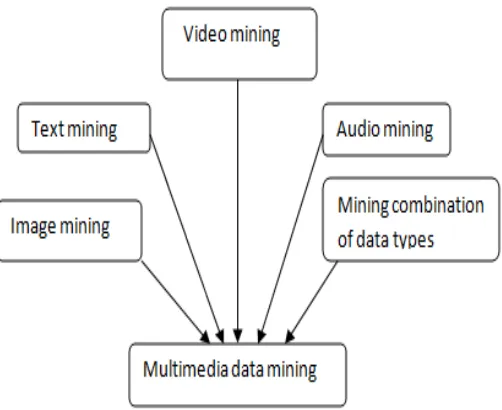
1.2 Categories of Multimedia Data Mining:
Multimedia data are classified into four types; they are:
(i) Text data: Text Mining also referred as text data mining and it is used to find meaningful information from
the unstructured texts that are from various sources and to evaluate huge amount of usual language text, it detects exact patterns to find useful information.
(ii) Image data: Image mining systems can discover meaningful information or image patterns from a huge
collection of images [2]. Image mining determines how low level pixel representation consists of a raw image or image sequence and can be handled to recognize high-level spatial objects and relationship. It includes digital image processing, image understanding, database, AI and so on.
(iii) Audio data: Audio mining plays an important role in multimedia applications, is a technique by which the
content of an audio signal can be automatically searched, analyzed and rotten with wavelet transformation.It is generally used in the field of automatic speech recognition, where the analysis efforts to find any speech within the audio.
(iv) Video data: Video mining is unsubstantiated to find the interesting patterns from large amount of video data;
multimedia data is video data such as text, image, and metadata, visual and audio. The processing are indexing, automatic segmentation, content-based retrieval, classification and detecting triggers. It is commonly used in various applications like security and surveillance, entertainment, medicine, sports and education programs
Fig 1: Categories of Multimedia data mining
II. LITERATURE SURVEY
Multimedia mining is a form of data mining, which refers to the analysis of large amounts of multimedia information in order to find patterns or statistical relationships. Multimedia Data Mining draw out the data from multimedia files like audio, video and still images to perform similarity searches, identify associations. This sectionspecifiesresearch papers on multimedia mining.
ISSN(Online): 2320-9801 ISSN (Print) : 2320-9798
I
nternational
J
ournal of
I
nnovative
R
esearch in
C
omputer
and
C
ommunication
E
ngineering
(A High Impact Factor, Monthly, Peer Reviewed Journal)
Website: www.ijircce.com
Vol. 5, Issue 12, December 2017
applications on heterogeneous systems. With the aid of the compiler and the utility library provided by CHCF, users are able to develop multimedia mining applications rapidly and efficiently.
The proposed framework employs a number of techniques, including adaptive data partitioning, knowledge-based hierarchical scheduling and performance estimation, to achieve high computing performance. The experimental
results demonstrate that CHCF can achieve good scalability and significant computing performance improvements for
image retrieval.
Manjunath Ret al. [5] proposed a paper on Review and Analysis of Multimedia Data Mining Tasks and Models. This paper presents a review and analysis on the state of the art in the field of multimedia data mining, advanced technologies and other mining approaches that are useful for decision making applications.
Smitha .T et al. [11] proposed a system on Comparative study of data mining algorithms for high dimensional data analysis. This paper explains one of the important mining model i.e. Statistical mining model which are used to regulate the statistical validity of test parameters and have been used to test hypothesis, undertake correlation studies and transform and make data for further analysis. Author explains algorithms and they are decision tree, k-means algorithm,and association rules. Each algorithm was studied with the help of high dimensional data set with UCI repository and advantages and disadvantages were given, of each comparative result.
Chih-Ming Chen et al. [12] proposed a system on using emotion recognition technology to assess the effects of
different multimedia materials on learning emotion and performance. This study employed thesystem known asem
Wave, a stress detector for emotional states that was developed by the Institute of Heart Math for measuring changes in
learner emotional states when presented with different multimedia materials with the same learning content. By analyzing the collected emotional data and assessment of learning performance, this study explores how different multimedia learning materials affect learning emotions, and ultimately, learning performance. Preliminary results show that the video-based multimedia material generates the best learning performance and most positive emotion among three types of multimedia materials assessed in the study.
Enireddy et al. [9] presents paper on a data mining approach for compressed medical image retrieval.In this paper content based image retrieval (CBIR) method was used to retrieve diagnostic cases similar to the query medical image. Haar wavelet was used for image compression without losses. Edge and texture features were extracted from the compressed medical images using Sobel edge detector and Gabor transforms, respectively.
The classification accuracy of retrieval was evaluated using Naïve Bayes and Support Vector Machine. The digital medical images are stored in large databases for easy accessibility and CBIR method is used to retrieve diagnostic cases similar to the query medical image. CBIR uses algorithms to extract relevant features from the image, on presenting a query image. CBIR retrieves images from the database based on the features such as color, texture, edge and shape in the images which are automatically extracted by CBIR systems.
V. Vijayakumar et al. [10] presents a paper on a study on video data mining. This paper describes the important part of the multimedia data mining i.e. video data mining; it contains several kinds of data such as text, image, visual, audio and meta-data. It is widely used in many major potential applications like security and surveillance, entertainment, medicine, education programs and sports. The objective of video data mining is to discover and describe interesting patterns from the huge amount of video data as it is one of the core problem areas of the data-mining research community.Compared to the mining of other types of data, video data mining is still in its infancy.
Brandyn White et al. [15] proposed a system on Web-Scale Computer Vision using Map Reduce for Multimedia Data Mining. This paper explores computer vision applications of the MapReduce framework that are relevant to the data mining community. An overview of MapReduce and common design patterns were provided for those with limited Map Reduce background. Both the high level theory and the low level implementation were discussed for several
computer vision algorithms: classifier training, sliding windows, clustering, bag-of-features, background subtraction,
and image registration.
ISSN(Online): 2320-9801 ISSN (Print) : 2320-9798
I
nternational
J
ournal of
I
nnovative
R
esearch in
C
omputer
and
C
ommunication
E
ngineering
(A High Impact Factor, Monthly, Peer Reviewed Journal)
Website: www.ijircce.com
Vol. 5, Issue 12, December 2017
III. DATA MINING VERSUS MULTIMEDIA DATA MINING
Currently structured data is used to operate data mining, the kind of data that resides in large relational databases whereas data in the multimedia databases are semistructured or unstructured [6]. If compared multimedia mining reaches much higher complexity than data mining resulting from: a) The huge volume of data, b) the variability and heterogeneity of the multimedia data (e.g. diversity of sensors, time or conditions of acquisition etc) and c) the multimedia content’s meaning is subjective.
Unstructured data is simply a bit stream. Examples include pixel level representation for images, video, and audio, and character level representation for text. To extract semantics from unstructured data, substantial processing and interpretation are required. This kind of data is not broken down into smaller logical structures and is not typically interpreted by the database.
IV. ARCHITECTURES FOR MULTIMEDIA DATA MINING
Various architectures are tested to design and develop a multimedia data mining system. The first architecture of multimedia data mining[4] is shown in fig. 2.a. In which data or meta-data is extracted from unstructured database. These extracted data is stored in structure database and finally data mining tools are used to extract the meaningful data or meta-data.
Figure: 2.a. General architecture of Multimedia data mining.
ISSN(Online): 2320-9801 ISSN (Print) : 2320-9798
I
nternational
J
ournal of
I
nnovative
R
esearch in
C
omputer
and
C
ommunication
E
ngineering
(A High Impact Factor, Monthly, Peer Reviewed Journal)
Website: www.ijircce.com
Vol. 5, Issue 12, December 2017
Figure 2.b.shows application of data mining in which data mining tools are used. Data collection is the starting point of a learning system. The overall achievable performance depends upon the quality of raw data.Discovering the important features from raw data is the goal of data pre-processing. Data pre-processing includes data cleaning, normalization, transformation, feature selection, etc. If the informative features can be identified at pre-processing stage the Learning can be straightforward.Nature of raw data and problem’s domain determines the detailed procedure.
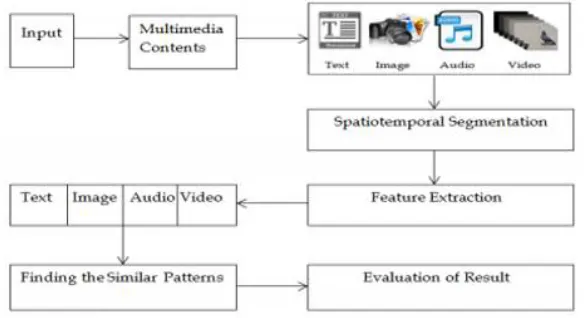
Fig 3: Multimedia data mining architecture
Input stage comprises of multimedia database which is used for finding the patterns and to perform data mining
process.
Data selection stage is the Multimedia Content which requires the user to select the databases, subset of fields or
data to be used for data mining.
The moving object in image sequence in the video which is useful for object segmentation is called
Spatio-temporal segmentation.
Feature extraction is the part of pre-processing step, that involves integrating data from various sources and
making choices regarding characterizing or coding certain data fields to serve when inputs to the pattern finding stage. Such representation of choices is required because certain fields could include data at various levels and not considered for finding the similar pattern stage. In Multimedia Data mining the pre processing stage is significant because of the unstructured nature of multimedia records.
Finding the Similar pattern stage is the heart of the whole data mining process. The hidden patterns and trends in
the data are basically uncovered in this stage. Some approaches of finding similar pattern stage contain association, classification, clustering, regression, time-series analysis and visualization.
Evaluation of Results is a data mining process used to evaluate the results and this is important to determine
whether prior stage must be revisited or not. This stage consists of reporting and makes use of the extracted knowledge to produce new actions or products and services or marketing strategies.
V. MODELS FOR MULTIMEDIA MINING
The models which are used to perform multimedia data miningare very important. There are four types of commonly used multimedia mining models. Those are classification, association rule, clustering and statistical modelling.
5.1. Classification:
ISSN(Online): 2320-9801 ISSN (Print) : 2320-9798
I
nternational
J
ournal of
I
nnovative
R
esearch in
C
omputer
and
C
ommunication
E
ngineering
(A High Impact Factor, Monthly, Peer Reviewed Journal)
Website: www.ijircce.com
Vol. 5, Issue 12, December 2017
5.2. Association Rule:
Association Rule is one of the most important data mining technique which helps to find relations between data items in huge databases. There are two different types of associations in multimedia mining: association between image content and non-image content features. Mining the frequently occurring patterns between different images becomes mining the repeated patterns in a set of transactions. Multi-relational association rule mining is used to display the multiple reports for the same image. In image classification also multiple level association rule techniques are used.
5.3. Clustering:
Cluster analysis divides the data objects into multiple groups or clusters. Cluster analysis combines all objects based on their groups. Clustering algorithms can be divided into several methods they are hierarchical methods, density based methods, grid-based methods, and model based methods, k-means algorithm and graph based model [2]. In multimedia mining, clustering technique can be applied to group similar images, objects, sounds, videos and texts.
5.4. Statistical Modelling:
Statistical mining models are used to regulate the statistical validity of test parameters and have been used to test hypothesis, undertake correlation studies and transform and make data for further analysis.
VI. APPLICATIONS OF MULTIMEDIA DATA MINING
There are various applications of MULTIMEDIA DATAMINING some of which are as follows:
In Digital Libraries: The retrieval collection storage and preservation of digital data should be performed in the
digital library. To fulfil this purpose, there is a need to convert different formats of information such as text, images, video, audio, etc. While conversion of the multimedia files into the libraries data mining techniques are popular.
For Traffic Video Sequences:To discover important but previously unknown knowledge the analysis and mining
of traffic video sequences such as vehicle identification, traffic flow, queue temporal relations of the vehicle at intersection, provides an economic approach for daily traffic monitoring operations.
For Automated event analysis of suspicious movements:Surveillance system to monitormovements of
employees, visitors and machines are used in many government organizations, multinationals companies, shopping malls, banks.
In medical analysis: Application of Data Mining techniques for Medical Image Classification is used.
Media Production and broadcasting: Proliferation of radio stations and TV channels makes broadcasting
companies to search for more efficient approaches for creating programs and monitoring their content.
Customer Insight: It includes collecting and summarizing information about customer‘s opinions, products or
services, customers complains, customer‘s preferences, and the level of customer‘s satisfaction of products or services.
Surveillance: Surveillance consists of collecting, analyzing, and summarizing audio, video, or audiovisual
information about a particular area, such as battlefields, forests, agricultural areas, highways, parking lots, buildings, workshops, malls, retail stores, offices, homes, etc. Which is associated with intelligence, security, and law enforcement and the major uses of this technology are military, police, and private companies that provide security services.
There are several goals of surveillance data mining: 1. Objector event detection/recognition
2. Summarization 3. Monitoring
Intelligent Content Service: The Intelligent Content Service (ICS) is a semantically smart content-centric set of
ISSN(Online): 2320-9801 ISSN (Print) : 2320-9798
I
nternational
J
ournal of
I
nnovative
R
esearch in
C
omputer
and
C
ommunication
E
ngineering
(A High Impact Factor, Monthly, Peer Reviewed Journal)
Website: www.ijircce.com
Vol. 5, Issue 12, December 2017
Knowledge Management: Many companies consider their archives of documents as a valuable asset. They spend a
lot of money to maintain and provide access to their archives to employees. Besides text documents, these archives can contain drawings of designs, photos and other images,audio and video recording of meetings and multimedia data for training.
VII. CONCLUSION
Multimedia mining is one of the important and challenging research domains in the field of computer science. The key idea is to provide review of multimedia data mining, which is an active and growing area of research. This paper discussed the multimedia mining basic concepts, essential characteristics, architectures, models and applications. Many of the recent MDM applications are focused on traffic monitoring and video surveillance, possibly due to increased attention to homeland security. It is an active and growing area of research.
REFERENCES
1. MylavarapuKalyan Ram, Dr.M.VenkateswaraRao,ChallapalliSujana,“An Overview on Multimedia Data Mining and Its Relevance Today” International Journal of Computer Science Trends and Technology (IJCST) – Volume 5 Issue 3, May – Jun 2017.
2. Hanli Wang, Bo Xiao, Lei Wang, Fengkuangtian Zhu, Yu-Gang Jiang, and Jun Wu, “CHCF: A Cloud-based Heterogeneous Computing Framework for Large-Scale Image Retrieval” IEEE Transactions on Circuits and Systems for Video Technology, 2015.
3. Vaibhavi S. Shukla, Jay Vala, “A Survey on Image Mining, its Techniques and Application” International Journal of Computer Applications (0975 – 8887) Volume 133 – No.9, January 2016.
4. Dr.S.Vijayarani and Ms.A.Sakila, “Multimedia Mining Research – An Overview” International Journal of Computer Graphics & Animation (IJCGA) Vol.5, No.1, January 2015.
5. AnuraagVikram Kate, Nikilav P V, Giriesh S, HariPrasath R,”Multimedia Data Mining- A Survey” International Journal Of Engineering And Computer Science ISSN:2319-7242 Volume 3 Issue 12 December 2014, Page No. 9610-9619.
6. Manjunath R, S. Balaji, “Review and Analysis of Multimedia Data Mining Tasks and Models” International Journal of Innovative Research in Computer and Communication EngineeringVol.2, Special Issue 2, May 2014.
7. Xindong Wu, Xingquan Zhu, Gong-Qing Wu, Wei Ding, ”Data Mining with Big data” IEEE Transactions On Knowledge and Data Engineering,Vol.26, Issue 1,June 2013.
8. Divya TL, Vijayalakshmi M.N, “Implementation of data mining techniques for Temperature Extraction for forest fire occurrence with Image Analysis” IJIRCCE,2013.
9. VamsidharEnireddy, Kiran Kumar Reddi ,”A Data Mining Approach for Compressed Medical Image Retrieval “, International Journal of Computer Applications (0975 – 887) Volume 52– No.5, August 2012
10. Sarla More, Durgesh Kumar Mishra, “Multimedia Data Mining: A Survey” Pratibha: International Journal of science, spirituality, business and technology (ijssbt), vol. 1, no.1, march 2012 issn (print) 2277— 7261.
11. V. Vijayakumar, R. Nedunchezhian “A study on video data mining”, International Journal of Multimedia Information Retrieval, October 2012, Volume 1, Issue 3, pp 153-172, Publisher Springer-Verlag.
12. Smitha .T, V. Sundaram, “Comparative Study Of Data Mining Algorithms For high Dimensional Data Analysis”, International Journal of Advances in Engineering & Technology, Vol. 4, Issue 2, pp. Sept 2012.
13. Chih-Ming Chen and Hui-Ping Wang, "Using Emotion Recognition Technology to Assess the Effects of Different Multimedia materials on Learning Emotion and Performance", Information Science Research, Vol. 33, No. 44, pp. 244 –255, 2011.
14. Manjunath T.N, Ravindra S Hegadi, Ravikumar GK, “A Survey on Multimedia Data Mining and Its Relevance Today” IJCSNS International Journal of Computer Science and Network Security, VOL.10 No.11, November 2010.
15. B. White, T. Yeh, J. Lin, and L. Davis, “Web-Scale Computer Vision using MapReduce for Multimedia Data Mining,” in Proc. MDMKDD’10, Jul. 2010, Article No.9
16. Valery A. Petrushin and Latifur Khan, “Multimedia Data Mining and Knowledge Discovery”, Springer, 2007 pp. 3- 17.